

IEC TR 60146-1-2:2019
(Main)Semiconductor converters - General requirements and line commutated converters - Part 1-2: Application guidelines
General Information
- Abstract
IEC TR 60146-1-2:2019 gives guidance on variations to the specifications given in IEC 60146-1-1:2009 to enable the specification to be extended in a controlled form for special cases. Background information is also given on technical points, which facilitates the use of IEC 60146-1-1:2009. This technical report primarily covers line commutated converters and is not in itself a specification, except as regards certain auxiliary components, in so far as existing standards may not provide the necessary data. This fifth edition includes the following significant technical changes with respect to the previous edition:
a) addition of annexes concerning the applications of converter transformers and of fuses for overcurrent protection;
b) changes of calculation methods related the inductive voltage regulation and changes of description on transformer losses to be consistent with the latest transformer standards;
c) addition and updates of references based on the latest information.
- Status
- Published
- Publication Date
- 21-Oct-2019
- Technical Committee
- TC 22 - Power electronic systems and equipment
- Drafting Committee
- MT 3 - TC 22/MT 3
- Current Stage
- PPUB - Publication issued
- Start Date
- 22-Oct-2019
- Completion Date
- 05-Nov-2019
Buy Documents
IEC TR 60146-1-2:2019 - Semiconductor converters - General requirements and line commutated converters - Part 1-2: Application guidelines Released:10/22/2019
IEC TR 60146-1-2:2019 RLV - Semiconductor converters - General requirements and line commutated converters - Part 1-2: Application guidelines Released:10/22/2019
Overview
IEC TR 60146-1-2:2019 - "Semiconductor converters – General requirements and line commutated converters – Part 1-2: Application guidelines" - is a technical report that provides application guidance and background information to support the specifications in IEC 60146-1-1:2009. It is primarily focused on line‑commutated converters and is intended to help suppliers, purchasers and designers extend the main specification in a controlled way for special cases. This fifth edition adds annexes on converter transformers and fuses for overcurrent protection, refines calculation methods for inductive voltage regulation and aligns transformer loss descriptions with the latest transformer standards.
Key Topics and Technical Coverage
The report covers practical and calculation-oriented topics that affect converter selection, design and system integration:
- Application guidance for semiconductor converters, including equipment specification data and terminal marking requirements.
- Converter transformers and reactors: selection, rating, magnetic circuit and guaranteed load/short‑circuit losses (annex material added).
- Calculation factors: voltage ratios, transformer current factors, inductive direct voltage regulation and magnetic circuit considerations.
- Power factor and reactive power: displacement factor, reactive power consumption and compensation needs.
- Direct voltage regulation and the impact of AC system impedance, with guidance on information exchange between supplier and purchaser.
- Harmonics and waveform distortion: commutation notches, harmonic current estimation, transformer phase shifts and operation of multiple converters on the same supply.
- Power loss evaluation and test methods: short‑circuit testing procedures and multiple test method options for loss estimation.
- Performance requirements: peak load current presentation, virtual junction temperature calculations and methods for continuous and cyclic loads.
- Converter operation and faults: stabilization, dynamic control properties, double‑converter operation, transition currents and fault protection guidance.
- Immunity class selection, DC short‑circuit current calculation and harmonic filter considerations.
Practical Applications
IEC TR 60146-1-2 is used when integrating or specifying line‑commutated semiconductor converters in power systems and industrial drives. Typical practical uses include:
- Preparing technical specifications and tender documents for converters and converter transformers.
- Sizing and selecting transformer ratings, fuses and protective devices for converter installations.
- Calculating voltage regulation, reactive power compensation and harmonic impacts on the supply system.
- Defining test procedures for power loss verification and checking peak load capability of semiconductor devices.
- Evaluating converter operation modes, protection strategies and fault management.
Who Should Use This Standard
- Power electronics designers and manufacturers (converters, rectifiers, inverters)
- Transformer designers and suppliers for converter applications
- Utility engineers and system integrators assessing grid interaction and reactive power needs
- Test engineers, procurement specialists and standards writers specifying converter equipment
Related Standards
- IEC 60146-1-1:2009 (primary specification this TR supports)
- Relevant IEC transformer and power quality standards (referenced in the TR for loss and impedance consistency)
This report is informative (not a normative specification except for certain auxiliary components) and is essential for engineers seeking robust, standards‑based guidance for integrating line‑commutated semiconductor converters into electrical systems.
Relations
- Effective Date
- 05-Sep-2023
Buy Documents
IEC TR 60146-1-2:2019 - Semiconductor converters - General requirements and line commutated converters - Part 1-2: Application guidelines Released:10/22/2019
IEC TR 60146-1-2:2019 RLV - Semiconductor converters - General requirements and line commutated converters - Part 1-2: Application guidelines Released:10/22/2019
Get Certified
Connect with accredited certification bodies for this standard

IMQ S.p.A. (Certification)
Italian electrical product certification.

SLG Prüf- und Zertifizierungs GmbH
German testing and certification body.

UL Solutions
Global safety science company with testing, inspection and certification.
Sponsored listings
Frequently Asked Questions
IEC TR 60146-1-2:2019 is a technical report published by the International Electrotechnical Commission (IEC). Its full title is "Semiconductor converters - General requirements and line commutated converters - Part 1-2: Application guidelines". This standard covers: IEC TR 60146-1-2:2019 gives guidance on variations to the specifications given in IEC 60146-1-1:2009 to enable the specification to be extended in a controlled form for special cases. Background information is also given on technical points, which facilitates the use of IEC 60146-1-1:2009. This technical report primarily covers line commutated converters and is not in itself a specification, except as regards certain auxiliary components, in so far as existing standards may not provide the necessary data. This fifth edition includes the following significant technical changes with respect to the previous edition: a) addition of annexes concerning the applications of converter transformers and of fuses for overcurrent protection; b) changes of calculation methods related the inductive voltage regulation and changes of description on transformer losses to be consistent with the latest transformer standards; c) addition and updates of references based on the latest information.
IEC TR 60146-1-2:2019 gives guidance on variations to the specifications given in IEC 60146-1-1:2009 to enable the specification to be extended in a controlled form for special cases. Background information is also given on technical points, which facilitates the use of IEC 60146-1-1:2009. This technical report primarily covers line commutated converters and is not in itself a specification, except as regards certain auxiliary components, in so far as existing standards may not provide the necessary data. This fifth edition includes the following significant technical changes with respect to the previous edition: a) addition of annexes concerning the applications of converter transformers and of fuses for overcurrent protection; b) changes of calculation methods related the inductive voltage regulation and changes of description on transformer losses to be consistent with the latest transformer standards; c) addition and updates of references based on the latest information.
IEC TR 60146-1-2:2019 is classified under the following ICS (International Classification for Standards) categories: 29.045 - Semiconducting materials; 29.200 - Rectifiers. Convertors. Stabilized power supply. The ICS classification helps identify the subject area and facilitates finding related standards.
IEC TR 60146-1-2:2019 has the following relationships with other standards: It is inter standard links to IEC TR 60146-1-2:2011. Understanding these relationships helps ensure you are using the most current and applicable version of the standard.
IEC TR 60146-1-2:2019 is available in PDF format for immediate download after purchase. The document can be added to your cart and obtained through the secure checkout process. Digital delivery ensures instant access to the complete standard document.
Standards Content (Sample)
IEC TR 60146-1-2 ®
Edition 5.0 2019-10
TECHNICAL
REPORT
Semiconductor converters – General requirements and line commutated
converters –
Part 1-2: Application guide
All rights reserved. Unless otherwise specified, no part of this publication may be reproduced or utilized in any form
or by any means, electronic or mechanical, including photocopying and microfilm, without permission in writing from
either IEC or IEC's member National Committee in the country of the requester. If you have any questions about IEC
copyright or have an enquiry about obtaining additional rights to this publication, please contact the address below or
your local IEC member National Committee for further information.
IEC Central Office Tel.: +41 22 919 02 11
3, rue de Varembé info@iec.ch
CH-1211 Geneva 20 www.iec.ch
Switzerland
About the IEC
The International Electrotechnical Commission (IEC) is the leading global organization that prepares and publishes
International Standards for all electrical, electronic and related technologies.
About IEC publications
The technical content of IEC publications is kept under constant review by the IEC. Please make sure that you have the
latest edition, a corrigendum or an amendment might have been published.
IEC publications search - webstore.iec.ch/advsearchform Electropedia - www.electropedia.org
The advanced search enables to find IEC publications by a The world's leading online dictionary on electrotechnology,
variety of criteria (reference number, text, technical containing more than 22 000 terminological entries in English
committee,…). It also gives information on projects, replaced and French, with equivalent terms in 16 additional languages.
and withdrawn publications. Also known as the International Electrotechnical Vocabulary
(IEV) online.
IEC Just Published - webstore.iec.ch/justpublished
Stay up to date on all new IEC publications. Just Published IEC Glossary - std.iec.ch/glossary
details all new publications released. Available online and 67 000 electrotechnical terminology entries in English and
once a month by email. French extracted from the Terms and Definitions clause of
IEC publications issued since 2002. Some entries have been
IEC Customer Service Centre - webstore.iec.ch/csc collected from earlier publications of IEC TC 37, 77, 86 and
If you wish to give us your feedback on this publication or CISPR.
need further assistance, please contact the Customer Service
Centre: sales@iec.ch.
IEC TR 60146-1-2 ®
Edition 5.0 2019-10
TECHNICAL
REPORT
Semiconductor converters – General requirements and line commutated
converters –
Part 1-2: Application guide
INTERNATIONAL
ELECTROTECHNICAL
COMMISSION
ICS 29.045; 29.200 ISBN 978-2-8322-7525-2
– 2 – IEC TR 60146-1-2:2019 © IEC 2019
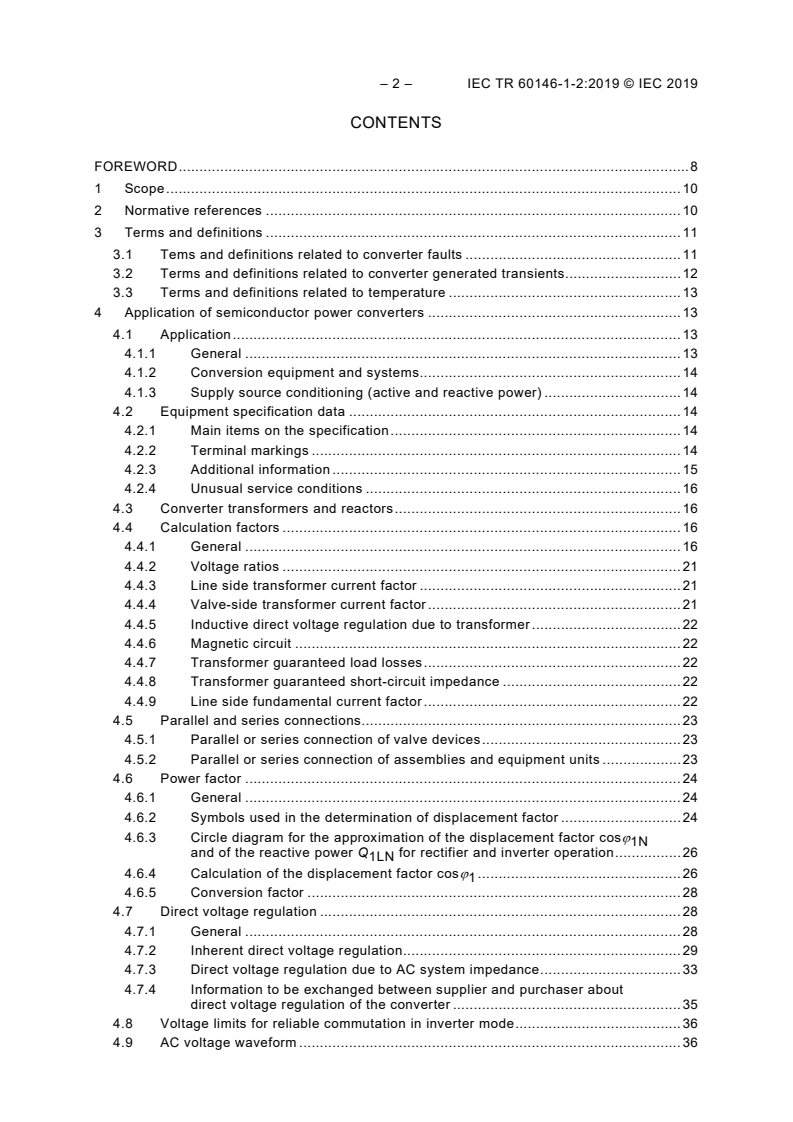
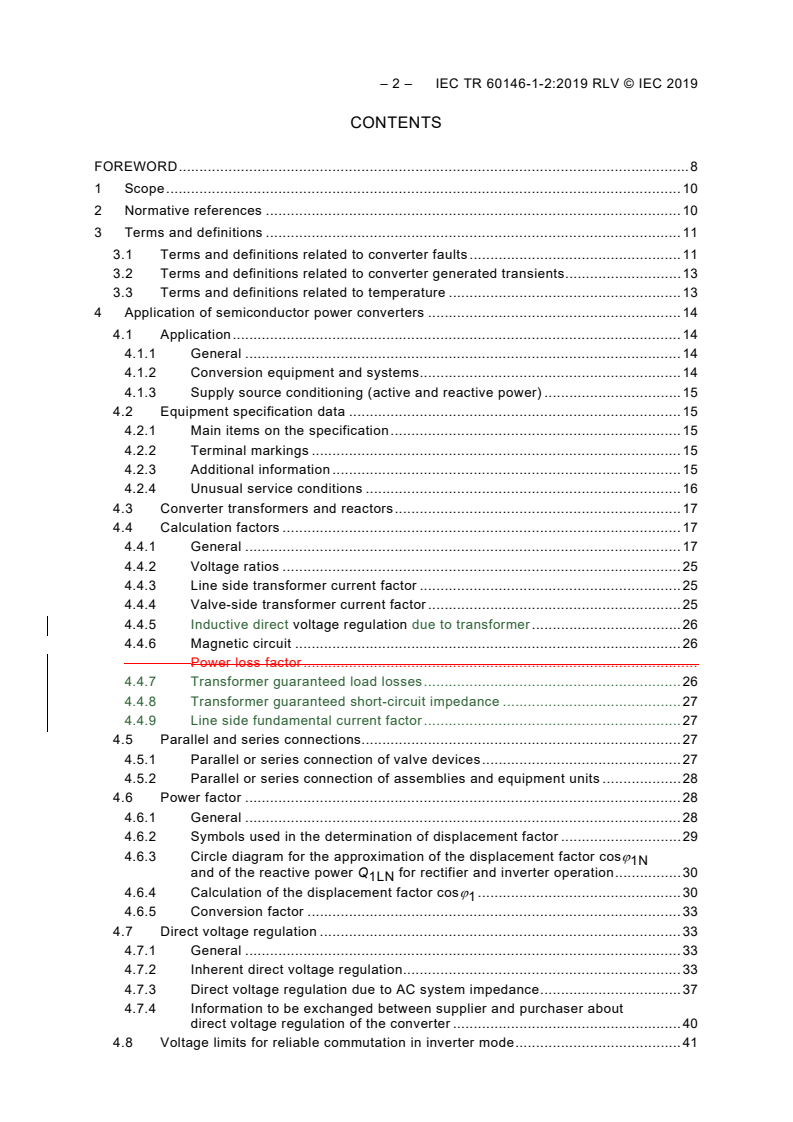
CONTENTS
FOREWORD . 8
1 Scope . 10
2 Normative references . 10
3 Terms and definitions . 11
3.1 Tems and definitions related to converter faults . 11
3.2 Terms and definitions related to converter generated transients. 12
3.3 Terms and definitions related to temperature . 13
4 Application of semiconductor power converters . 13
4.1 Application . 13
4.1.1 General . 13
4.1.2 Conversion equipment and systems. 14
4.1.3 Supply source conditioning (active and reactive power) . 14
4.2 Equipment specification data . 14
4.2.1 Main items on the specification . 14
4.2.2 Terminal markings . 14
4.2.3 Additional information . 15
4.2.4 Unusual service conditions . 16
4.3 Converter transformers and reactors . 16
4.4 Calculation factors . 16
4.4.1 General . 16
4.4.2 Voltage ratios . 21
4.4.3 Line side transformer current factor . 21
4.4.4 Valve-side transformer current factor . 21
4.4.5 Inductive direct voltage regulation due to transformer . 22
4.4.6 Magnetic circuit . 22
4.4.7 Transformer guaranteed load losses . 22
4.4.8 Transformer guaranteed short-circuit impedance . 22
4.4.9 Line side fundamental current factor . 22
4.5 Parallel and series connections. 23
4.5.1 Parallel or series connection of valve devices . 23
4.5.2 Parallel or series connection of assemblies and equipment units . 23
4.6 Power factor . 24
4.6.1 General . 24
4.6.2 Symbols used in the determination of displacement factor . 24
4.6.3 Circle diagram for the approximation of the displacement factor cosϕ
1N
and of the reactive power Q for rectifier and inverter operation . 26
1LN
4.6.4 Calculation of the displacement factor cosϕ . 26
4.6.5 Conversion factor . 28
4.7 Direct voltage regulation . 28
4.7.1 General . 28
4.7.2 Inherent direct voltage regulation. 29
4.7.3 Direct voltage regulation due to AC system impedance . 33
4.7.4 Information to be exchanged between supplier and purchaser about
direct voltage regulation of the converter . 35
4.8 Voltage limits for reliable commutation in inverter mode . 36
4.9 AC voltage waveform . 36
5 Application information . 37
5.1 Practical calculation of the operating parameters . 37
5.1.1 General . 37
5.1.2 Assumptions . 38
5.1.3 Preliminary calculations . 38
5.1.4 Calculation of the operating conditions . 39
5.2 Supply system voltage change due to converter loads . 41
5.2.1 Fundamental voltage change . 41
5.2.2 Minimum R requirements for voltage change . 41
1SC
5.2.3 Converter transformer ratio . 41
5.2.4 Transformer rating . 42
5.3 Compensation of converter reactive power consumption . 43
5.3.1 Average reactive power consumption. 43
5.3.2 Required compensation of the average reactive power . 43
5.3.3 Voltage fluctuations with fixed reactive power compensation . 44
5.4 Supply voltage distortion . 45
5.4.1 Commutation notches . 45
5.4.2 Operation of several converters on the same supply line . 47
5.5 Quantities on the line side. 48
5.5.1 RMS value of the line current . 48
5.5.2 Harmonics on the line side, approximate method for 6-pulse converters . 48
5.5.3 Minimum R requirements for harmonic distortion . 51
1SC
5.5.4 Estimated phase shift of the harmonic currents . 52
5.5.5 Addition of harmonic currents . 52
5.5.6 Peak and average harmonic spectrum . 52
5.5.7 Transformer phase shift . 53
5.5.8 Sequential gating, two 6-pulse converters. 53
5.6 Power factor compensation and harmonic distortion. 54
5.6.1 General . 54
5.6.2 Resonant frequency . 54
5.6.3 Directly connected capacitor bank . 54
5.6.4 Estimation of the resonant frequency . 54
5.6.5 Detuning reactor . 56
5.6.6 Ripple control frequencies (carrier frequencies) . 57
5.7 Direct voltage harmonic content . 57
5.8 Other considerations . 58
5.8.1 Random control angle . 58
5.8.2 Sub-harmonic instability . 58
5.8.3 Harmonic filters . 59
5.8.4 Approximate capacitance of cables . 59
5.9 Calculation of DC short-circuit current of converters . 59
5.10 Guidelines for the selection of the immunity class . 59
5.10.1 General . 59
5.10.2 Converter Immunity class . 60
5.10.3 Selection of the immunity class . 60
6 Test requirements. 63
6.1 Guidance on power loss evaluation by short-circuit test . 63
6.1.1 Single-phase connections . 63
6.1.2 Polyphase double-way connections . 64
– 4 – IEC TR 60146-1-2:2019 © IEC 2019
6.1.3 Polyphase single-way connections . 64
6.2 Procedure for evaluation of power losses by short-circuit method . 64
6.3 Test methods . 65
6.3.1 Method A1 . 65
6.3.2 Method B . 66
6.3.3 Method C . 66
6.3.4 Method D . 66
6.3.5 Method E . 69
6.3.6 Method A2 . 69
7 Performance requirements . 69
7.1 Presentation of rated peak load current values . 69
7.2 Letter symbols related to virtual junction temperature . 70
7.3 Determination of peak load capability through calculation of the virtual
junction temperature . 71
7.3.1 General . 71
7.3.2 Approximation of the shape of power pulses applied to the
semiconductor devices . 72
7.3.3 The superposition method for calculation of temperature . 73
7.3.4 Calculation of the virtual junction temperature for continuous load . 74
7.3.5 Calculation of the virtual junction temperature for cyclic loads . 75
7.3.6 Calculation of the virtual junction temperature for a few typical
applications . 76
7.4 Circuit operating conditions affecting the voltage applied across converter
valve devices . 76
8 Converter operation . 77
8.1 Stabilization . 77
8.2 Static properties. 77
8.3 Dynamic properties of the control system . 78
8.4 Mode of operation of single and double converters . 78
8.4.1 Single converter connection . 78
8.4.2 Double converter connections and limits for rectifier and inverter
operation . 80
8.5 Transition current . 81
8.6 Suppression of direct current circulation in double converter connections . 82
8.6.1 General . 82
8.6.2 Limitation of delay angles . 82
8.6.3 Controlled circulating current . 82
8.6.4 Blocking of trigger pulses . 82
8.7 Principle of operation for reversible converters for control of DC motors . 83
8.7.1 General . 83
8.7.2 Motor field reversal . 83
8.7.3 Motor armature reversal by reversing switch . 83
8.7.4 Double converter connection to motor armature . 83
9 Converter faults . 84
9.1 General . 84
9.2 Fault finding . 85
9.3 Protection from fault currents . 85
Annex A (informative) Information on converter transformer standards . 86
A.1 Background . 86
A.1.1 General . 86
A.1.2 Structure of IEC 61378 (all parts) . 86
A.2 Important difference between IEC 61378 (all parts) and IEC 60146 (all parts) . 86
A.3 Coordination between transformer and power converter . 87
Annex B (informative) Application guide for the protection of semiconductor converters
against overcurrent by fuses . 88
B.1 Object . 88
B.2 Fuse connections in converter . 88
B.2.1 General . 88
B.2.2 Double way connection . 88
B.2.3 Single-way connection (B), regenerative or non-regenerative load . 90
B.3 Main parameters to be considered for fuse selection . 90
B.4 Applied voltage in service . 91
B.5 Discrimination for fuses in parallel connection . 91
B.5.1 Discrimination between paralleled fuses and circuit breaker . 91
B.5.2 Discrimination among paralleled fuses . 92
B.5.3 Protection of semiconductor against overcurrent. 93
B.6 General considerations . 93
Annex C (informative) Inductive voltage regulation due to converter transformer . 94
C.1 General . 94
C.2 Recommendation for calculating inductive voltage regulation due to
converter transformer. 94
C.3 Inductive voltage regulation . 94
C.3.1 DC output voltage during commutation . 94
C.3.2 DC voltage regulation . 95
C.3.3 Formula of inductive voltage regulation due to converter transformer. 96
C.4 Analysis of ratio (d /e ) . 96
xtN xN
C.4.1 General . 96
C.4.2 Base impedance of converter transformer . 97
C.4.3 Relationship between transformer reactance X and parameter e . 97
t xN
C.4.4 Derivation of ratio (d /e ) . 98
xtN xN
C.5 Implicit assumptions implemented in ratio (d /e ) . 98
xtN xN
C.6 Old calculation factors for information . 99
C.7 Inductive voltage regulation including the system reactances . 100
Bibliography . 104
Figure 1 – Voltages at converter faults . 11
Figure 2 – Circle diagram for approximation of the displacement factor . 26
Figure 3 – Displacement factor as a function of d for p = 6 . 27
xN
Figure 4 – Displacement factor as a function of d for p = 12 . 28
xN
Figure 5 – d as a function of d for p = 6 and p = 12 . 34
LN xN
Figure 6 – AC voltage waveform . 37
Figure 7 – Harmonic current spectrum on the AC side for p = 6 . 50
Figure 8 – Influence of capacitor rating and AC motor loads on the resonant frequency
and amplification factor . 55
Figure 9 – Direct voltage harmonic content for p = 6 . 58
Figure 10 – Example of power distribution . 61
Figure 11 – Test method A1 . 65
– 6 – IEC TR 60146-1-2:2019 © IEC 2019
Figure 12 – Test method D . 67
Figure 13 – Single peak load . 70
Figure 14 – Repetitive peak loads . 70
Figure 15 – Approximation of the shape of power pulses . 73
Figure 16 – Calculation of the virtual junction temperature for continuous load . 74
Figure 17 – Calculation of the virtual junction temperature for cyclic loads . 75
Figure 18 – Circuit operating conditions affecting the voltage applied across converter
valve devices . 77
Figure 19 – Direct voltage waveform for various delay angles . 79
Figure 20 – Direct voltage for various loads and delay angles . 80
Figure 21 – Direct voltage limits in inverter operation . 81
Figure 22 – Direct voltage at values below the transition current . 82
Figure 23 – Operating sequences of converters serving a reversible DC motor . 84
Figure B.1 – Three-phase double-way connection with diodes or thyristors with AC side
fuses F for non-regenerative load . 89
v
Figure B.2 – Three phase double-way connection with AC side fuses F and DC side
v
fuse F for regenerative load . 89
d
Figure B.3 – Three-phase double-way connection with arm fuses F for regenerative or
a
non-regenerative load . 90
Figure B.4 – Double three-phase single-way connection with interphase transformer,
with arm fuses F for regenerative or non-regenerative load . 90
a
Figure B.5 – Arc voltage . 91
Figure C.1 – Three-phase bridge converter . 95
Figure C.2 – Voltage regulation . 96
Table 1 – Connections and calculation factors (1 of 4) . 17
Table 2 – List of symbols used in the determination of displacement factor . 25
Table 3 – List of symbols used in the calculation formulae . 32
Table 4 – Example of operating conditions . 40
Table 5 – Example of operating points . 40
Table 6 – Example of operating conditions . 42
Table 7 – Result of the iteration . 42
Table 8 – Example of calculation results of active and reactive power consumption . 43
Table 9 – Example of notch depth . 46
Table 10 – Example of notch depth by one converter with a common transformer . 47
Table 11 – Example of notch depth by ten converters operating at the same time . 47
∗
Table 12 – Values of ( ) . 48
I α,µ I
L L
Table 13 – Minimum R requirement for low voltage systems. 52
1SC
Table 14 – Transformer phase shift and harmonic orders . 53
Table 15 – Approximate kvar/km of cables . 59
Table 16 – Short-circuit values of converter currents . 59
Table 17 – Calculated values for the example in Figure 10 . 63
Table 18 – Letter symbols related to virtual junction temperature . 71
Table 19 – Virtual junction temperature . 76
Table C.1 – Columns from 12 to 15 and 17 in Table 1 of IEC 60146-1-2:2011 or older
editions (1 of 2). 99
– 8 – IEC TR 60146-1-2:2019 © IEC 2019
INTERNATIONAL ELECTROTECHNICAL COMMISSION
____________
SEMICONDUCTOR CONVERTERS –
GENERAL REQUIREMENTS AND LINE COMMUTATED CONVERTERS –
Part 1-2: Application guidelines
FOREWORD
1) The International Electrotechnical Commission (IEC) is a worldwide organization for standardization comprising
all national electrotechnical committees (IEC National Committees). The object of IEC is to promote
international co-operation on all questions concerning standardization in the electrical and electronic fields. To
this end and in addition to other activities, IEC publishes International Standards, Technical Specifications,
Technical Reports, Publicly Available Specifications (PAS) and Guides (hereafter referred to as “IEC
Publication(s)”). Their preparation is entrusted to technical committees; any IEC National Committee interested
in the subject dealt with may participate in this preparatory work. International, governmental and non-
governmental organizations liaising with the IEC also participate in this preparation. IEC collaborates closely
with the International Organization for Standardization (ISO) in accordance with conditions determined by
agreement between the two organizations.
2) The formal decisions or agreements of IEC on technical matters express, as nearly as possible, an international
consensus of opinion on the relevant subjects since each technical committee has representation from all
interested IEC National Committees.
3) IEC Publications have the form of recommendations for international use and are accepted by IEC National
Committees in that sense. While all reasonable efforts are made to ensure that the technical content of IEC
Publications is accurate, IEC cannot be held responsible for the way in which they are used or for any
misinterpretation by any end user.
4) In order to promote international uniformity, IEC National Committees undertake to apply IEC Publications
transparently to the maximum extent possible in their national and regional publications. Any divergence
between any IEC Publication and the corresponding national or regional publication shall be clearly indicated in
the latter.
5) IEC itself does not provide any attestation of conformity. Independent certification bodies provide conformity
assessment services and, in some areas, access to IEC marks of conformity. IEC is not responsible for any
services carried out by independent certification bodies.
6) All users should ensure that they have the latest edition of this publication.
7) No liability shall attach to IEC or its directors, employees, servants or agents including individual experts and
members of its technical committees and IEC National Committees for any personal injury, property damage or
other damage of any nature whatsoever, whether direct or indirect, or for costs (including legal fees) and
expenses arising out of the publication, use of, or reliance upon, this IEC Publication or any other IEC
Publications.
8) Attention is drawn to the Normative references cited in this publication. Use of the referenced publications is
indispensable for the correct application of this publication.
9) Attention is drawn to the possibility that some of the elements of this IEC Publication may be the subject of
patent rights. IEC shall not be held responsible for identifying any or all such patent rights.
The main task of IEC technical committees is to prepare International Standards. However, a
technical committee may propose the publication of a Technical Report when it has collected
data of a different kind from that which is normally published as an International Standard, for
example "state of the art".
IEC TR 60146-1-2, which is a Technical Report, has been prepared by IEC technical
committee 22: Power electronic systems and equipment.
This fifth edition cancels and replaces the fourth edition published in 2011. This edition
constitutes a technical revision.
This edition includes the following significant technical changes with respect to the previous
edition:
a) addition of annexes concerning the applications of converter transformers and of fuses for
overcurrent protection;
b) changes of calculation methods related the inductive voltage regulation and changes of
description on transformer losses to be consistent with the latest transformer standards;
c) addition and updates of references based on the latest information.
The text of this Technical Report is based on the following documents:
Draft T Report on voting
22/306/DTR 22/310/RVDTR
Full information on the voting for the approval of this technical report can be found in the
report on voting indicated in the above table.
This document has been drafted in accordance with the ISO/IEC Directives, Part 2.
A list of all parts of the IEC 60146 series, under the general title Semiconductor converters –
General requirements and line commutated converters, can be found on the IEC website.
The committee has decided that the contents of this document will remain unchanged until the
stability date indicated on the IEC website under "http://webstore.iec.ch" in the data related to
the specific document. At this date, the document will be
• reconfirmed,
• withdrawn,
• replaced by a revised edition, or
• amended.
A bilingual version of this standard may be issued at a later date.
– 10 – IEC TR 60146-1-2:2019 © IEC 2019
SEMICONDUCTOR CONVERTERS –
GENERAL REQUIREMENTS AND LINE COMMUTATED CONVERTERS –
Part 1-2: Application guidelines
1 Scope
This part of IEC 60146, which is a Technical Report, gives guidance on variations to the
specifications given in IEC 60146-1-1:2009 to enable the specification to be extended in a
controlled form for special cases. Background information is also given on technical points,
which facilitates the use of IEC 60146-1-1:2009.
This document primarily covers line commutated converters and is not in itself a specification,
except as regards certain auxiliary components, in so far as existing standards may not
provide the necessary data.
This document will not take precedence on any product specific standard according to the
concept shown in IEC Guide 108. IEC Guide 108 provides the information on the relationship
between horizontal standards and product publications.
2 Normative references
The following documents are referred to in the text in such a way that some or all of their
content constitutes requirements of this document. For dated references, only the edition
cited applies. For undated references, the latest edition of the referenced document (including
any amendments) applies.
IEC 60050-551, International Electrotechnical Vocabulary – Part 551: Power electronics
(available at www.electropedia.org)
IEC 60050-551-20, International Electrotechnical Vocabulary – Part 551-20: Power electronics
– Harmonic analysis (available at www.electropedia.org)
IEC 60146-1-1:2009, Semiconductor converters – General requirements and line commutated
converters – Part 1-1: Specification of basic requirements
IEC 60269-1:2006, Low-voltage fuses – Part 1: General requirements
IEC 60269-4:2009, Low-voltage fuses – Part 4: Supplementary requirements for fuse-links for
the protection of semiconductor devices
IEC 60529, Degrees of protection provided by enclosures (IP Code)
IEC 60664-1, Insulation coordination for equipment within low-voltage systems – Part 1:
Principles, requirements and tests
IEC 61148, Terminal markings for valve device stacks and assemblies and for power
conversion equipment
IEC 61378-1:2011, Convertor transformers – Part 1: Transformers for industrial applications
IEC/IEEE 60076-57-129, Power transformers – Part 57-129: Transformers for HVDC
applications
3 Terms and definitions
For the purposes of this document, the terms and definitions given in IEC 60146-1-1:2009,
IEC 60050-551, IEC 60050-551-20 and the following apply.
ISO and IEC maintain terminological databases for use in standardization at the following
addresses:
• IEC Electropedia: available at http://www.electropedia.org/
• ISO Online browsing platform: available at http://www.iso.org/obp
NOTE Several terms from IEC 60146-1-1:2009, IEC 60050-551, IEC 60050-551-20 are repeated here for
convenience.
3.1 Terms and definitions related to converter faults
3.1.1
breakthrough
failure by which a controllable valve device or an arm consisting of such devices loses its
ability to block voltage during the forward blocking interval
Note 1 to entry: See Figure 1a). Breakthrough can occur in rectifier operation as well as inverter operation and for
various reasons, for example excessive junction temperature, voltage surges in excess of rated peak off-state
voltage, excessive rate of rise of off-state voltage or spurious gate current.
Figure 1a) Breakthrough in arm 2
Figure 1b) Firing failure in arm 2
Figure 1c) Conduction through related to arm 3
Figure 1 – Voltages at converter faults
– 12 – IEC TR 60146-1-2:2019 © IEC 2019
[SOURCE: IEC 60050-551:1998, 551-16-60, modified – Note 1 to entry has been added.]
3.1.2
false firing
firing of a latching valve device or an arm consisting of such devices at an incorrect instant
[SOURCE: IEC 60050-551:1998, 551-16-63]
3.1.3
breakdown
failure that permanently deprives an
electronic valve device or a valve arm of its property to block voltage
[SOURCE: IEC 60050-551:1998, 551-16-66]
3.1.4
firing failure
failure to achieve conduction in a latching valve device or an arm consisting of such devices
during the conduction interval
Note 1 to entry: See Figure 1b).
[SOURCE: IEC 60050-551:1998, 551-16-65, modified – Note 1 to entry has been added.]
3.1.5
conduction through
situation where, in inverter operation, a valve arm continues conduction at the end of the
normal conduction interval or at the end of the hold-off interval
Note 1 to entry: See Figure 1c).
[SOURCE: IEC 60050-551:1998, 551-16-64, modified – The definition has been rephrased,
and Note 1 to entry has been added.]
3.1.6
commutation failure
failure to commutate the current from a conducting arm to the succeeding arm
[SOURCE: IEC 60050-551:1998, 551-16-59]
3.2 Terms and definitions related to converter generated transients
3.2.1
DC side transients
voltage transients produced by rapid changes of the DC voltage applied to the inductance and
capacitance of the DC circuit
Note 1 to entry: See 7.4.
3.2.2
commutation transients on the line
voltage transients produced on the AC line after commutation
Note 1 to entry: See 7.4.
Note 2 to entry: The commutation transients are repetitive.
3.3 Terms and definitions related to temperature
3.3.1
thermal resistance
R
th
quotient of the difference between the virtual junction temperature and the temperature of a
specified external reference point, by the steady-state power dissipation in the device under
conditions of thermal equilibrium
Note 1 to entry: For most cases, the power dissipation can be assumed to be equal to the heat flow.
3.3.2
transient thermal impedance
Z
th
quotient of
a) variation of the temperature difference, reached at the end of a time interval between the
virtual junction temperature and the temperature of a specified external reference point,
and
b) step function change of power dissipation at the beginning of the same time interval
causing the change of temperature
Note 1 to entry: Immediately before the beginning of this time interval, the distribution of temperature should have
been constant with time.
Note 2 to entry: Transient thermal impedance is given as a function of the time interval.
3.3.3
virtual equivalent junction temperature
virtual junction temperature
T
j
virtual temperature of the junction of a semiconductor device
Note 1 to entry: The virtual junction temperature is not necessarily the highest temperature in the semiconductor
device.
Note 2 to entry: Based on the power dissipation and the thermal resistance or transient thermal impedance that
corresponds to the mode of operation, the virtual junction temperature can be calculated using a specified
relationship.
[SOURCE: IEC 60050-521:2002, 521-05-15, modified – The symbol T has been added, as
j
well as the notes to entry.]
3.3.4
virtual temperature
internal equivalent temperature
theoretical temperature which is based on a simplified
representation of the thermal and electrical behaviour of the semiconductor device
[SOURCE: IEC 60050-521:2002, 521-05-14, modified – The notes to entry have been deleted.]
4 Application of semiconductor power converters
4.1 Application
4.1.1 General
Semiconductor power converters are used in most industries for the conversion of electrical
power and also to facilitate the conversion of mechanical, chemical or other energy into
electrical power and vice versa.
They also used in electrical power utilities for the supply source conditioning.
– 14 – IEC TR 60146-1-2:2019 © IEC 2019
4.1.2 Conversion equipment and systems
Examples of applications of conversion equipment and systems are as follows, and not limited
in these applications:
a) DC load, stabilized/adjustable voltage/current control;
b) AC power controllers (AC or DC output);
c) AC variable frequency:
– line-commutated converters;
– slip energy recovery;
– machine-commutated converters;
– self-commutated converters:
• voltage stiff (voltage source);
• current stiff (current source);
d) adjustable speed drives (covered by specific IEC standards, e.g. IEC 61800-1);
e) uninterruptible power systems (UPS, covered by specific IEC standards, e.g.
IEC 62040-3);
f) chemical processes (electrolysis, electroplating, electrophoresis);
g) computer power supplies;
h) traction s
...
IEC TR 60146-1-2 ®
Edition 5.0 2019-10
REDLINE VERSION
TECHNICAL
REPORT
colour
inside
Semiconductor converters – General requirements and line commutated
converters –
Part 1-2: Application guide
All rights reserved. Unless otherwise specified, no part of this publication may be reproduced or utilized in any form
or by any means, electronic or mechanical, including photocopying and microfilm, without permission in writing from
either IEC or IEC's member National Committee in the country of the requester. If you have any questions about IEC
copyright or have an enquiry about obtaining additional rights to this publication, please contact the address below or
your local IEC member National Committee for further information.
IEC Central Office Tel.: +41 22 919 02 11
3, rue de Varembé info@iec.ch
CH-1211 Geneva 20 www.iec.ch
Switzerland
About the IEC
The International Electrotechnical Commission (IEC) is the leading global organization that prepares and publishes
International Standards for all electrical, electronic and related technologies.
About IEC publications
The technical content of IEC publications is kept under constant review by the IEC. Please make sure that you have the
latest edition, a corrigendum or an amendment might have been published.
IEC publications search - webstore.iec.ch/advsearchform Electropedia - www.electropedia.org
The advanced search enables to find IEC publications by a The world's leading online dictionary on electrotechnology,
variety of criteria (reference number, text, technical containing more than 22 000 terminological entries in English
committee,…). It also gives information on projects, replaced and French, with equivalent terms in 16 additional languages.
and withdrawn publications. Also known as the International Electrotechnical Vocabulary
(IEV) online.
IEC Just Published - webstore.iec.ch/justpublished
Stay up to date on all new IEC publications. Just Published IEC Glossary - std.iec.ch/glossary
details all new publications released. Available online and 67 000 electrotechnical terminology entries in English and
once a month by email. French extracted from the Terms and Definitions clause of
IEC publications issued since 2002. Some entries have been
IEC Customer Service Centre - webstore.iec.ch/csc collected from earlier publications of IEC TC 37, 77, 86 and
If you wish to give us your feedback on this publication or CISPR.
need further assistance, please contact the Customer Service
Centre: sales@iec.ch.
IEC TR 60146-1-2 ®
Edition 5.0 2019-10
REDLINE VERSION
TECHNICAL
REPORT
colour
inside
Semiconductor converters – General requirements and line commutated
converters –
Part 1-2: Application guide
INTERNATIONAL
ELECTROTECHNICAL
COMMISSION
ICS 29.045; 29.200 ISBN 978-2-8322-7560-3
– 2 – IEC TR 60146-1-2:2019 RLV © IEC 2019
CONTENTS
FOREWORD . 8
1 Scope . 10
2 Normative references . 10
3 Terms and definitions . 11
3.1 Terms and definitions related to converter faults . 11
3.2 Terms and definitions related to converter generated transients. 13
3.3 Terms and definitions related to temperature . 13
4 Application of semiconductor power converters . 14
4.1 Application . 14
4.1.1 General . 14
4.1.2 Conversion equipment and systems. 14
4.1.3 Supply source conditioning (active and reactive power) . 15
4.2 Equipment specification data . 15
4.2.1 Main items on the specification . 15
4.2.2 Terminal markings . 15
4.2.3 Additional information . 15
4.2.4 Unusual service conditions . 16
4.3 Converter transformers and reactors . 17
4.4 Calculation factors . 17
4.4.1 General . 17
4.4.2 Voltage ratios . 25
4.4.3 Line side transformer current factor . 25
4.4.4 Valve-side transformer current factor . 25
4.4.5 Inductive direct voltage regulation due to transformer . 26
4.4.6 Magnetic circuit . 26
Power loss factor .
4.4.7 Transformer guaranteed load losses . 26
4.4.8 Transformer guaranteed short-circuit impedance . 27
4.4.9 Line side fundamental current factor . 27
4.5 Parallel and series connections. 27
4.5.1 Parallel or series connection of valve devices . 27
4.5.2 Parallel or series connection of assemblies and equipment units . 28
4.6 Power factor . 28
4.6.1 General . 28
4.6.2 Symbols used in the determination of displacement factor . 29
4.6.3 Circle diagram for the approximation of the displacement factor cosϕ
1N
and of the reactive power Q for rectifier and inverter operation . 30
1LN
4.6.4 Calculation of the displacement factor cosϕ . 30
4.6.5 Conversion factor . 33
4.7 Direct voltage regulation . 33
4.7.1 General . 33
4.7.2 Inherent direct voltage regulation. 33
4.7.3 Direct voltage regulation due to AC system impedance . 37
4.7.4 Information to be exchanged between supplier and purchaser about
direct voltage regulation of the converter . 40
4.8 Voltage limits for reliable commutation in inverter mode . 41
4.9 AC voltage waveform . 41
5 Application information . 42
5.1 Practical calculation of the operating parameters . 42
5.1.1 General . 42
5.1.2 Assumptions . 43
5.1.3 Preliminary calculations . 43
5.1.4 Calculation of the operating conditions . 45
5.2 Supply system voltage change due to converter loads . 47
5.2.1 Fundamental voltage change . 47
5.2.2 Minimum R requirements for voltage change . 47
1SC
5.2.3 Converter transformer ratio . 48
5.2.4 Transformer rating . 49
5.3 Compensation of converter reactive power consumption . 49
5.3.1 Average reactive power consumption. 49
5.3.2 Required compensation of the average reactive power . 50
5.3.3 Voltage fluctuations with fixed reactive power compensation . 50
5.4 Supply voltage distortion . 51
5.4.1 Commutation notches . 51
5.4.2 Operation of several converters on the same supply line . 53
5.5 Quantities on the line side. 54
5.5.1 RMS value of the line current . 54
5.5.2 Harmonics on the line side, approximate method for 6-pulse converters . 55
5.5.3 Minimum R requirements for harmonic distortion . 58
1SC
5.5.4 Estimated phase shift of the harmonic currents . 59
5.5.5 Addition of harmonic currents . 59
5.5.6 Peak and average harmonic spectrum . 59
5.5.7 Transformer phase shift . 60
5.5.8 Sequential gating, two 6-pulse converters. 60
5.6 Power factor compensation and harmonic distortion. 61
5.6.1 General . 61
5.6.2 Resonant frequency . 61
5.6.3 Directly connected capacitor bank . 61
5.6.4 Estimation of the resonant frequency . 61
5.6.5 Detuning reactor . 63
5.6.6 Ripple control frequencies (carrier frequencies) . 64
5.7 Direct voltage harmonic content . 64
5.8 Other considerations . 65
5.8.1 Random control angle . 65
5.8.2 Sub-harmonic instability . 65
5.8.3 Harmonic filters . 66
5.8.4 Approximate capacitance of cables . 66
5.9 Calculation of DC short-circuit current of converters . 66
5.10 Guidelines for the selection of the immunity class . 66
5.10.1 General . 66
5.10.2 Converter Immunity class . 67
5.10.3 Selection of the immunity class . 67
6 Test requirements. 70
6.1 Guidance on power loss evaluation by short-circuit test . 70
6.1.1 Single-phase connections . 70
– 4 – IEC TR 60146-1-2:2019 RLV © IEC 2019
6.1.2 Polyphase double-way connections . 71
6.1.3 Polyphase single-way connections . 71
6.2 Procedure for evaluation of power losses by short-circuit method . 71
6.3 Test methods . 72
6.3.1 Method A1 . 72
6.3.2 Method B . 73
6.3.3 Method C . 73
6.3.4 Method D . 73
6.3.5 Method E . 76
6.3.6 Method A2 . 76
7 Performance requirements . 76
7.1 Presentation of rated peak load current values . 76
7.2 Letter symbols related to virtual junction temperature . 77
7.3 Determination of peak load capability through calculation of the virtual
junction temperature . 78
7.3.1 General . 78
7.3.2 Approximation of the shape of power pulses applied to the
semiconductor devices . 79
7.3.3 The superposition method for calculation of temperature . 80
7.3.4 Calculation of the virtual junction temperature for continuous load . 81
7.3.5 Calculation of the virtual junction temperature for cyclic loads . 82
7.3.6 Calculation of the virtual junction temperature for a few typical
applications . 83
7.4 Circuit operating conditions affecting the voltage applied across converter
valve devices . 83
8 Converter operation . 84
8.1 Stabilization . 84
8.2 Static properties. 84
8.3 Dynamic properties of the control system . 85
8.4 Mode of operation of single and double converters . 85
8.4.1 Single converter connection . 85
8.4.2 Double converter connections and limits for rectifier and inverter
operation . 87
8.5 Transition current . 88
8.6 Suppression of direct current circulation in double converter connections . 89
8.6.1 General . 89
8.6.2 Limitation of delay angles . 89
8.6.3 Controlled circulating current . 89
8.6.4 Blocking of trigger pulses . 90
8.7 Principle of operation for reversible converters for control of DC motors . 90
8.7.1 General . 90
8.7.2 Motor field reversal . 90
8.7.3 Motor armature reversal by reversing switch . 90
8.7.4 Double converter connection to motor armature . 90
9 Converter faults . 91
9.1 General . 91
9.2 Fault finding . 92
9.3 Protection from fault currents . 92
Annex A (informative) Information on converter transformer standards . 93
A.1 Background . 93
A.1.1 General . 93
A.1.2 Structure of IEC 61378 (all parts) . 93
A.2 Important difference between IEC 61378 (all parts) and IEC 60146 (all parts) . 93
A.3 Coordination between transformer and power converter . 94
Annex B (informative) Application guide for the protection of semiconductor converters
against overcurrent by fuses . 95
B.1 Object . 95
B.2 Fuse connections in converter . 95
B.2.1 General . 95
B.2.2 Double way connection . 95
B.2.3 Single-way connection (B), regenerative or non-regenerative load . 97
B.3 Main parameters to be considered for fuse selection . 97
B.4 Applied voltage in service . 98
B.5 Discrimination for fuses in parallel connection . 98
B.5.1 Discrimination between paralleled fuses and circuit breaker . 98
B.5.2 Discrimination among paralleled fuses . 99
B.5.3 Protection of semiconductor against overcurrent. 100
B.6 General considerations . 100
Annex C (informative) Inductive voltage regulation due to converter transformer . 101
C.1 General . 101
C.2 Recommendation for calculating inductive voltage regulation due to
converter transformer. 101
C.3 Inductive voltage regulation . 102
C.3.1 DC output voltage during commutation . 102
C.3.2 DC voltage regulation . 102
C.3.3 Formula of inductive voltage regulation due to converter transformer. 103
C.4 Analysis of ratio (d /e ) . 103
xtN xN
C.4.1 General . 103
C.4.2 Base impedance of converter transformer . 104
C.4.3 Relationship between transformer reactance X and parameter e . 104
t xN
C.4.4 Derivation of ratio (d /e ) . 105
xtN xN
C.5 Implicit assumptions implemented in ratio (d /e ) . 105
xtN xN
C.6 Old calculation factors for information . 106
C.7 Inductive voltage regulation including the system reactances . 107
Bibliography . 111
Figure 1 – Voltages at converter faults . 12
Figure 2 – Circle diagram for approximation of the displacement factor . 30
Figure 3 – Displacement factor as a function of d for p = 6 . 32
xN
Figure 4 – Displacement factor as a function of d for p = 12 . 32
xN
Figure 5 – d as a function of d for p = 6 and p = 12 . 39
LN xN
Figure 6 – AC voltage waveform . 42
Figure 7 – Harmonic current spectrum on the AC side for p = 6 . 57
Figure 8 – Influence of capacitor rating and AC motor loads on the resonant frequency
and amplification factor . 62
Figure 9 – Direct voltage harmonic content for p = 6 . 65
Figure 10 – Example of power distribution . 68
– 6 – IEC TR 60146-1-2:2019 RLV © IEC 2019
Figure 11 – Test method A1 . 72
Figure 12 – Test method D . 74
Figure 13 – Single peak load . 77
Figure 14 – Repetitive peak loads . 77
Figure 15 – Approximation of the shape of power pulses . 80
Figure 16 – Calculation of the virtual junction temperature for continuous load . 81
Figure 17 – Calculation of the virtual junction temperature for cyclic loads . 82
Figure 18 – Circuit operating conditions affecting the voltage applied across converter
valve devices . 84
Figure 19 – Direct voltage waveform for various delay angles . 86
Figure 20 – Direct voltage for various loads and delay angles . 87
Figure 21 – Direct voltage limits in inverter operation . 88
Figure 22 – Direct voltage at values below the transition current . 89
Figure 23 – Operating sequences of converters serving a reversible DC motor . 91
Figure B.1 – Three-phase double-way connection with diodes or thyristors with AC side
fuses F for non-regenerative load . 96
v
Figure B.2 – Three phase double-way connection with AC side fuses F and DC side
v
fuse F for regenerative load . 96
d
Figure B.3 – Three-phase double-way connection with arm fuses F for regenerative or
a
non-regenerative load . 97
Figure B.4 – Double three-phase single-way connection with interphase transformer,
with arm fuses F for regenerative or non-regenerative load . 97
a
Figure B.5 – Arc voltage . 98
Figure C.1 – Three-phase bridge converter . 102
Figure C.2 – Voltage regulation . 103
Table 1 – Connections and calculation factors (1 of 4) . 18
Table 2 – List of symbols used in the determination of displacement factor . 29
Table 3 – List of symbols used in the calculation formulae . 36
Table 4 – Example of operating conditions . 46
Table 5 – Example of operating points . 47
Table 6 – Example of operating conditions . 48
Table 7 – Result of the iteration . 49
Table 8 – Example of calculation results of active and reactive power consumption . 50
Table 9 – Example of notch depth . 52
Table 10 – Example of notch depth by one converter with a common transformer . 53
Table 11 – Example of notch depth by ten converters operating at the same time . 53
∗
( )
Table 12 – Values of I α,µ I . 55
L L
Table 13 – Minimum R requirement for low voltage systems. 59
1SC
Table 14 – Transformer phase shift and harmonic orders . 60
Table 15 – Approximate kvar/km of cables . 66
Table 16 – Short-circuit values of converter currents . 66
Table 17 – Calculated values for the example in Figure 10 . 70
Table 18 – Letter symbols related to virtual junction temperature . 78
Table 19 – Virtual junction temperature . 83
Table C.1 – Columns from 12 to 15 and 17 in Table 1 of IEC 60146-1-2:2011 or older
editions (1 of 2). 106
– 8 – IEC TR 60146-1-2:2019 RLV © IEC 2019
INTERNATIONAL ELECTROTECHNICAL COMMISSION
____________
SEMICONDUCTOR CONVERTERS –
GENERAL REQUIREMENTS AND LINE COMMUTATED CONVERTERS –
Part 1-2: Application guidelines
FOREWORD
1) The International Electrotechnical Commission (IEC) is a worldwide organization for standardization comprising
all national electrotechnical committees (IEC National Committees). The object of IEC is to promote
international co-operation on all questions concerning standardization in the electrical and electronic fields. To
this end and in addition to other activities, IEC publishes International Standards, Technical Specifications,
Technical Reports, Publicly Available Specifications (PAS) and Guides (hereafter referred to as “IEC
Publication(s)”). Their preparation is entrusted to technical committees; any IEC National Committee interested
in the subject dealt with may participate in this preparatory work. International, governmental and non-
governmental organizations liaising with the IEC also participate in this preparation. IEC collaborates closely
with the International Organization for Standardization (ISO) in accordance with conditions determined by
agreement between the two organizations.
2) The formal decisions or agreements of IEC on technical matters express, as nearly as possible, an international
consensus of opinion on the relevant subjects since each technical committee has representation from all
interested IEC National Committees.
3) IEC Publications have the form of recommendations for international use and are accepted by IEC National
Committees in that sense. While all reasonable efforts are made to ensure that the technical content of IEC
Publications is accurate, IEC cannot be held responsible for the way in which they are used or for any
misinterpretation by any end user.
4) In order to promote international uniformity, IEC National Committees undertake to apply IEC Publications
transparently to the maximum extent possible in their national and regional publications. Any divergence
between any IEC Publication and the corresponding national or regional publication shall be clearly indicated in
the latter.
5) IEC itself does not provide any attestation of conformity. Independent certification bodies provide conformity
assessment services and, in some areas, access to IEC marks of conformity. IEC is not responsible for any
services carried out by independent certification bodies.
6) All users should ensure that they have the latest edition of this publication.
7) No liability shall attach to IEC or its directors, employees, servants or agents including individual experts and
members of its technical committees and IEC National Committees for any personal injury, property damage or
other damage of any nature whatsoever, whether direct or indirect, or for costs (including legal fees) and
expenses arising out of the publication, use of, or reliance upon, this IEC Publication or any other IEC
Publications.
8) Attention is drawn to the Normative references cited in this publication. Use of the referenced publications is
indispensable for the correct application of this publication.
9) Attention is drawn to the possibility that some of the elements of this IEC Publication may be the subject of
patent rights. IEC shall not be held responsible for identifying any or all such patent rights.
This redline version of the official IEC Standard allows the user to identify the changes
made to the previous edition. A vertical bar appears in the margin wherever a change
has been made. Additions are in green text, deletions are in strikethrough red text.
The main task of IEC technical committees is to prepare International Standards. However, a
technical committee may propose the publication of a Technical Report when it has collected
data of a different kind from that which is normally published as an International Standard, for
example "state of the art".
IEC TR 60146-1-2, which is a Technical Report, has been prepared by IEC technical
committee 22: Power electronic systems and equipment.
This fifth edition cancels and replaces the fourth edition published in 2011. This edition
constitutes a technical revision.
This edition includes the following significant technical changes with respect to the previous
edition:
a) addition of annexes concerning the applications of converter transformers and of fuses for
overcurrent protection;
b) changes of calculation methods related the inductive voltage regulation and changes of
description on transformer losses to be consistent with the latest transformer standards;
c) addition and updates of references based on the latest information.
The text of this Technical Report is based on the following documents:
Draft T Report on voting
22/306/DTR 22/310/RVDTR
Full information on the voting for the approval of this technical report can be found in the
report on voting indicated in the above table.
This document has been drafted in accordance with the ISO/IEC Directives, Part 2.
A list of all parts of the IEC 60146 series, under the general title Semiconductor converters –
General requirements and line commutated converters, can be found on the IEC website.
The committee has decided that the contents of this document will remain unchanged until the
stability date indicated on the IEC website under "http://webstore.iec.ch" in the data related to
the specific document. At this date, the document will be
• reconfirmed,
• withdrawn,
• replaced by a revised edition, or
• amended.
IMPORTANT – The 'colour inside' logo on the cover page of this publication indicates
that it contains colours which are considered to be useful for the correct
understanding of its contents. Users should therefore print this document using a
colour printer.
– 10 – IEC TR 60146-1-2:2019 RLV © IEC 2019
SEMICONDUCTOR CONVERTERS –
GENERAL REQUIREMENTS AND LINE COMMUTATED CONVERTERS –
Part 1-2: Application guidelines
1 Scope
This part of IEC 60146, which is a Technical Report, gives guidance on variations to the
specifications given in IEC 60146-1-1:2009 to enable the specification to be extended in a
controlled form for special cases. Background information is also given on technical points,
which should facilitate facilitates the use of IEC 60146-1-1:2009.
This document primarily covers line commutated converters and is not in itself a specification,
except as regards certain auxiliary components, in so far as existing standards may not
provide the necessary data.
This document will not take precedence on any product specific standard according to the
concept shown in IEC Guide 108. IEC Guide 108 provides the information on the relationship
between horizontal standards and product publications.
2 Normative references
The following documents are referred to in the text in such a way that some or all of their
content constitutes requirements of this document. For dated references, only the edition
cited applies. For undated references, the latest edition of the referenced document (including
any amendments) applies.
IEC 60050-521:2002, International Electrotechnical Vocabulary – Part 521: Semiconductor
devices and integrated circuits
IEC 60050-551:1998, International Electrotechnical Vocabulary – Part 551: Power electronics
(available at www.electropedia.org)
IEC 60050-551-20:2001, International Electrotechnical Vocabulary – Part 551-20: Power
electronics – Harmonic analysis (available at www.electropedia.org)
IEC 60146-1-1:2009, Semiconductor converters – General requirements and line commutated
converters – Part 1-1: Specification of basic requirements
IEC 60146-1-3:1991, Semiconductor converters – General requirements and line commutated
converters Part 1-3: Transformers and reactors
IEC 60269-1:2006, Low-voltage fuses – Part 1: General requirements
IEC 60269-4:2009, Low-voltage fuses – Part 4: Supplementary requirements for fuse-links for
the protection of semiconductor devices
IEC 60529, Degrees of protection provided by enclosures (IP Code)
IEC 60664-1, Insulation coordination for equipment within low-voltage systems – Part 1:
Principles, requirements and tests
IEC 61378-1, Convertor transformers – Part 1: Transformers for industrial applications
IEC 61148, Terminal markings for valve device stacks and assemblies and for power
converter conversion equipment
IEC 61378-1:2011, Convertor transformers – Part 1: Transformers for industrial applications
IEC/IEEE 60076-57-129, Power transformers – Part 57-129: Transformers for HVDC
applications
3 Terms and definitions
For the purposes of this document, the terms and definitions given in IEC 60146-1-1:2009,
IEC 60050-551, IEC 60050-551-20, several of which are repeated here for convenience, and
the following apply.
ISO and IEC maintain terminological databases for use in standardization at the following
addresses:
• IEC Electropedia: available at http://www.electropedia.org/
• ISO Online browsing platform: available at http://www.iso.org/obp
NOTE Several terms from IEC 60146-1-1:2009, IEC 60050-551, IEC 60050-551-20 are repeated here for
convenience.
3.1 Terms and definitions related to converter faults
3.1.1
breakthrough
failure by which a controllable valve device or an arm consisting of such devices loses its
ability to block voltage during the forward blocking interval
[IEC 60050-551:1998, 551-16-60]
Note 1 to entry: See Figure 1a). Breakthrough can occur in rectifier operation as well as inverter operation and for
various reasons, for example excessive junction temperature, voltage surges in excess of rated peak off-state
voltage, excessive rate of rise of off-state voltage or spurious gate current.
– 12 – IEC TR 60146-1-2:2019 RLV © IEC 2019
Figure 1a) Breakthrough in arm 2
Figure 1b) Firing failure in arm 2
Figure 1c) Conduction through related to arm 3
Figure 1 – Voltages at converter faults
[SOURCE: IEC 60050-551:1998, 551-16-60, modified – Note 1 to entry has been added.]
3.1.2
false firing
firing of a latching valve device or an arm consisting of such devices at an incorrect instant
[SOURCE: IEC 60050-551:1998, 551-16-63]
3.1.3
breakdown
failure that permanently deprives an
electronic valve device or a valve arm of its property to block voltage
[SOURCE: IEC 60050-551:1998, 551-16-66]
3.1.4
firing failure
failure to achieve conduction in a latching valve device or an arm consisting of such devices
during the conduction interval
Note 1 to entry: See Figure 1b).
[SOURCE: IEC 60050-551:1998, 551-16-65, modified – Note 1 to entry has been added.]
3.1.5
conduction through
situation where, in inverter operation, a valve arm continues conduction at the end of the
normal conduction interval or at the end of the hold-off interval
Note 1 to entry: See Figure 1c).
[SOURCE: IEC 60050-551:1998, 551-16-64, modified – The definition has been rephrased,
and Note 1 to entry has been added.]
3.1.6
commutation failure
failure to commutate the current from a conducting arm to the succeeding arm
[SOURCE: IEC 60050-551:1998, 551-16-59]
3.2 Terms and definitions related to converter generated transients
3.2.1
DC side transients
voltage transients produced by rapid changes of the DC voltage applied to the inductance and
capacitance of the DC circuit
Note 1 to entry: See 7.4.
3.2.2
commutation transients on the line (repetitive transient)
voltage transients produced on the AC line after commutation
Note 1 to entry: See 7.4.
Note 2 to entry: The commutation transients are repetitive.
3.3 Terms and definitions related to temperature
3.3.1
thermal resistance
R
th
quotient of the difference between the virtual junction temperature and the temperature of a
specified external reference point, by the steady-state power dissipation in the device under
conditions of thermal equilibrium
[IEC 60050-521:2002, 521-05-13, modified]
Note 1 to entry: For most cases, the power dissipation can be assumed to be equal to the heat flow.
3.3.2
transient thermal impedance
Z
th
quotient of
a) variation of the temperature difference, reached at the end of a time interval between the
virtual junction temperature and the temperature of a specified external reference point,
and
b) step function change of power dissipation at the beginning of the same time interval
causing the change of temperature
Note 1 to entry: Immediately before the beginning of this time interval, the distribution of temperature should have
been constant with time.
Note 2 to entry: Transient thermal impedance is given as a function of the time interval.
– 14 – IEC TR 60146-1-2:2019 RLV © IEC 2019
3.3.3
virtual equivalent junction temperature
virtual junction temperature
T
j
virtual temperature of the junction of a semiconductor device
Note 1 to entry: The virtual junction temperature is not necessarily the highest temperature in the semiconductor
device.
Note 2 to entry: Based on the power dissipation and the thermal resistance or transient thermal impedance that
corresponds to the mode of operation, the virtual junction temperature can be calculated using a specified
relationship.
[SOURCE: IEC 60050-521:2002, 521-05-15, modified – The symbol T has been added, as
j
well as the notes to entry.]
3.3.4
virtual temperature
internal equivalent temperature
theoretical temperature which is based on a simplified
representation of the thermal and electrical behaviour of the semiconductor device
[SOURCE: IEC 60050-5
...