

IEC TR 62541-1:2016
(Main)OPC unified architecture - Part 1: Overview and concepts
General Information
- Abstract
IEC TR 62541-1:2016(E) is a Technical Report and presents the concepts and overview of the OPC Unified Architecture (OPC UA). Reading this document is helpful to understand the remaining parts of this multi-part document set. Each of the other parts is briefly explained along with a suggested reading order. This second edition cancels and replaces the first edition of IEC TR 62541-1, published in 2010. This edition includes no technical changes with respect to the previous edition but includes updates to reflect changes or additions in normative parts of IEC 62541.
- Status
- Published
- Publication Date
- 04-Oct-2016
- Technical Committee
- SC 65E - Devices and integration in enterprise systems
- Drafting Committee
- WG 8 - TC 65/SC 65E/WG 8
- Current Stage
- DELPUB - Deleted Publication
- Start Date
- 18-Nov-2020
- Completion Date
- 28-Aug-2026
Buy Documents
IEC TR 62541-1:2016 - OPC unified architecture - Part 1: Overview and concepts


IEC TR 62541-1:2016 - OPC unified architecture - Part 1: Overview and concepts Released:10/5/2016
Overview
IEC TR 62541-1:2016 - "OPC unified architecture – Part 1: Overview and concepts" is a Technical Report from the IEC that presents the high-level concepts and structure of the OPC Unified Architecture (OPC UA). This second edition replaces the 2010 edition and updates references to reflect changes in the normative parts of the IEC 62541 series while introducing no technical changes. The report is intended as an introductory guide to the multi-part OPC UA specification and helps readers understand the scope, organization, and recommended reading order for the remaining parts.
Key topics and technical scope
IEC TR 62541-1:2016 summarizes the essential building blocks of OPC UA without prescribing implementation details. Key topics covered include:
- OPC UA architecture and design goals - portability, interoperability, scalability and security for industrial automation and enterprise integration.
- Security Model - high-level overview of secure communication, certificates and SecureChannels (see IEC TR 62541-2 for details).
- AddressSpace and Information Model - the AddressSpace concept, Nodes and Attributes that a Server exposes (see IEC 62541-3 and IEC 62541-5).
- Service-oriented model - explanation of service sets (Discovery, SecureChannel, Session, NodeManagement, Attribute, Method, MonitoredItem, Subscription, etc.) and how Clients and Servers interact (see IEC 62541-4).
- Access types and mappings - conceptual description of data access methods and protocol mappings (see IEC 62541-6, -8).
- Utility topics - Profiles, Historical Access, Alarms and Conditions, Programs and Aggregates overview (see IEC 62541-7, -9, -10, -11, -13).
- System concepts - Client/Server roles, Publisher/Subscriber entities, server-to-server interactions, sessions and redundancy concepts.
Practical applications and users
IEC TR 62541-1 is useful for anyone planning, designing or implementing OPC UA-based systems. Typical users include:
- System architects and automation engineers evaluating OPC UA for SCADA, PLC, DCS and IIoT integration.
- Software developers and integrators building OPC UA Clients, Servers, and communication stacks.
- Product managers and vendors defining interoperability and compliance with OPC UA profiles.
- Consultants and project managers assessing fit-for-purpose use of OPC UA in industrial projects.
- Certification bodies and technical evaluators needing a conceptual overview of the standard series.
Practical applications include secure machine-to-enterprise data exchange, standardized telemetry for historians, alarm/condition handling, historical access and unified information modeling across heterogeneous industrial systems.
Related standards
IEC TR 62541-1 references and positions the following key parts of the OPC UA series:
- IEC TR 62541-2 (Security Model)
- IEC 62541-3 (Address Space Model)
- IEC 62541-4 (Services)
- IEC 62541-5 (Information Model)
- IEC 62541-6 (Mappings)
- IEC 62541-7 (Profiles)
- IEC 62541-8 (Data Access)
- IEC 62541-9 (Alarms and Conditions)
- IEC 62541-10 (Programs)
- IEC 62541-11 (Historical Access)
- IEC 62541-13 (Aggregates)
For a guided approach, read IEC TR 62541-1 first to understand the series, then follow the suggested reading order tailored to your implementation needs.
Relations
- Effective Date
- 05-Sep-2023
- Effective Date
- 05-Sep-2023
Buy Documents
IEC TR 62541-1:2016 - OPC unified architecture - Part 1: Overview and concepts
IEC TR 62541-1:2016 - OPC unified architecture - Part 1: Overview and concepts Released:10/5/2016
Get Certified
Connect with accredited certification bodies for this standard

BSI Group
BSI (British Standards Institution) is the business standards company that helps organizations make excellence a habit.

DVS-ZERT GmbH
German welding certification society.
CARES (UK Certification Authority for Reinforcing Steels)
UK certification for reinforcing steels and construction.
Sponsored listings
Frequently Asked Questions
IEC TR 62541-1:2016 is a technical report published by the International Electrotechnical Commission (IEC). Its full title is "OPC unified architecture - Part 1: Overview and concepts". This standard covers: IEC TR 62541-1:2016(E) is a Technical Report and presents the concepts and overview of the OPC Unified Architecture (OPC UA). Reading this document is helpful to understand the remaining parts of this multi-part document set. Each of the other parts is briefly explained along with a suggested reading order. This second edition cancels and replaces the first edition of IEC TR 62541-1, published in 2010. This edition includes no technical changes with respect to the previous edition but includes updates to reflect changes or additions in normative parts of IEC 62541.
IEC TR 62541-1:2016(E) is a Technical Report and presents the concepts and overview of the OPC Unified Architecture (OPC UA). Reading this document is helpful to understand the remaining parts of this multi-part document set. Each of the other parts is briefly explained along with a suggested reading order. This second edition cancels and replaces the first edition of IEC TR 62541-1, published in 2010. This edition includes no technical changes with respect to the previous edition but includes updates to reflect changes or additions in normative parts of IEC 62541.
IEC TR 62541-1:2016 is classified under the following ICS (International Classification for Standards) categories: 25.040.40 - Industrial process measurement and control; 35.100.01 - Open systems interconnection in general. The ICS classification helps identify the subject area and facilitates finding related standards.
IEC TR 62541-1:2016 has the following relationships with other standards: It is inter standard links to IEC TR 62541-1:2020, IEC TR 62541-1:2010. Understanding these relationships helps ensure you are using the most current and applicable version of the standard.
IEC TR 62541-1:2016 is available in PDF format for immediate download after purchase. The document can be added to your cart and obtained through the secure checkout process. Digital delivery ensures instant access to the complete standard document.
Standards Content (Sample)
IEC TR 62541-1 ®
Edition 2.0 2016-10
TECHNICAL
REPORT
colour
inside
OPC unified architecture –
Part 1: Overview and concepts
All rights reserved. Unless otherwise specified, no part of this publication may be reproduced or utilized in any form
or by any means, electronic or mechanical, including photocopying and microfilm, without permission in writing from
either IEC or IEC's member National Committee in the country of the requester. If you have any questions about IEC
copyright or have an enquiry about obtaining additional rights to this publication, please contact the address below or
your local IEC member National Committee for further information.
IEC Central Office Tel.: +41 22 919 02 11
3, rue de Varembé Fax: +41 22 919 03 00
CH-1211 Geneva 20 info@iec.ch
Switzerland www.iec.ch
About the IEC
The International Electrotechnical Commission (IEC) is the leading global organization that prepares and publishes
International Standards for all electrical, electronic and related technologies.
About IEC publications
The technical content of IEC publications is kept under constant review by the IEC. Please make sure that you have the
latest edition, a corrigenda or an amendment might have been published.
IEC Catalogue - webstore.iec.ch/catalogue Electropedia - www.electropedia.org
The stand-alone application for consulting the entire The world's leading online dictionary of electronic and
bibliographical information on IEC International Standards, electrical terms containing 20 000 terms and definitions in
Technical Specifications, Technical Reports and other English and French, with equivalent terms in 15 additional
documents. Available for PC, Mac OS, Android Tablets and languages. Also known as the International Electrotechnical
iPad. Vocabulary (IEV) online.
IEC publications search - www.iec.ch/searchpub IEC Glossary - std.iec.ch/glossary
The advanced search enables to find IEC publications by a 65 000 electrotechnical terminology entries in English and
variety of criteria (reference number, text, technical French extracted from the Terms and Definitions clause of
committee,…). It also gives information on projects, replaced IEC publications issued since 2002. Some entries have been
and withdrawn publications. collected from earlier publications of IEC TC 37, 77, 86 and
CISPR.
IEC Just Published - webstore.iec.ch/justpublished
Stay up to date on all new IEC publications. Just Published IEC Customer Service Centre - webstore.iec.ch/csc
details all new publications released. Available online and If you wish to give us your feedback on this publication or
also once a month by email. need further assistance, please contact the Customer Service
Centre: csc@iec.ch.
IEC TR 62541-1 ®
Edition 2.0 2016-10
TECHNICAL
REPORT
colour
inside
OPC unified architecture –
Part 1: Overview and concepts
INTERNATIONAL
ELECTROTECHNICAL
COMMISSION
ICS 25.040.40; 35.100.01 ISBN 978-2-8322-3640-6
– 2 – IEC TR 62541-1:2016 © IEC 2016
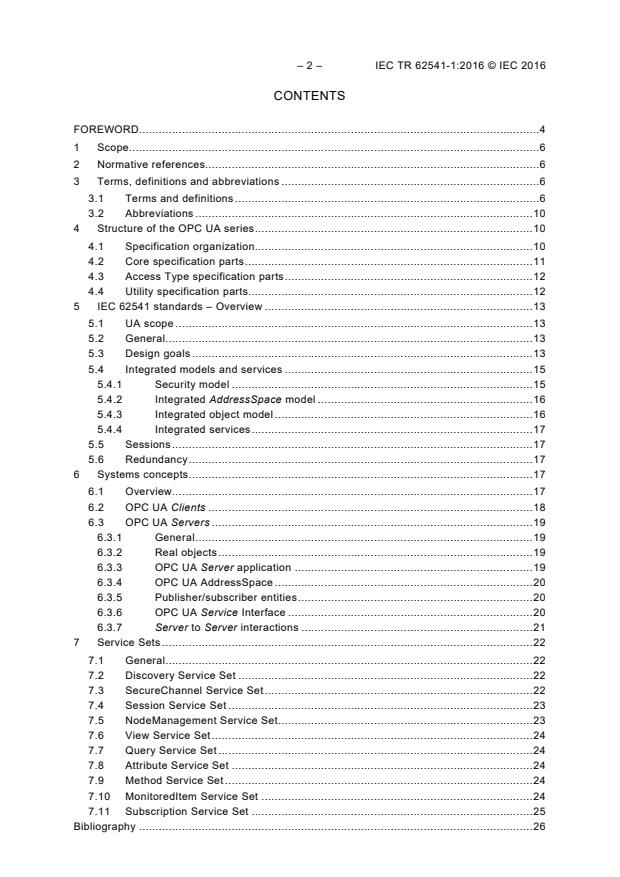
CONTENTS
FOREWORD . 4
1 Scope . 6
2 Normative references. 6
3 Terms, definitions and abbreviations . 6
3.1 Terms and definitions . 6
3.2 Abbreviations . 10
4 Structure of the OPC UA series . 10
4.1 Specification organization. 10
4.2 Core specification parts . 11
4.3 Access Type specification parts . 12
4.4 Utility specification parts. 12
5 IEC 62541 standards – Overview . 13
5.1 UA scope . 13
5.2 General . 13
5.3 Design goals . 13
5.4 Integrated models and services . 15
5.4.1 Security model . 15
5.4.2 Integrated AddressSpace model . 16
5.4.3 Integrated object model . 16
5.4.4 Integrated services . 17
5.5 Sessions . 17
5.6 Redundancy . 17
6 Systems concepts . 17
6.1 Overview. 17
6.2 OPC UA Clients . 18
6.3 OPC UA Servers . 19
6.3.1 General . 19
6.3.2 Real objects . 19
6.3.3 OPC UA Server application . 19
6.3.4 OPC UA AddressSpace . 20
6.3.5 Publisher/subscriber entities . 20
6.3.6 OPC UA Service Interface . 20
6.3.7 Server to Server interactions . 21
7 Service Sets . 22
7.1 General . 22
7.2 Discovery Service Set . 22
7.3 SecureChannel Service Set . 22
7.4 Session Service Set . 23
7.5 NodeManagement Service Set . 23
7.6 View Service Set . 24
7.7 Query Service Set . 24
7.8 Attribute Service Set . 24
7.9 Method Service Set . 24
7.10 MonitoredItem Service Set . 24
7.11 Subscription Service Set . 25
Bibliography . 26
Figure 1 – OPC UA Specification organization . 11
Figure 2 – OPC UA Target applications . 14
Figure 3 – OPC UA System architecture . 18
Figure 4 – OPC UA Client architecture . 18
Figure 5 – OPC UA Server architecture . 19
Figure 6 – Peer-to-peer interactions between Servers . 21
Figure 7 – Chained Server example . 22
Figure 8 – SecureChannel and Session Services . 23
– 4 – IEC TR 62541-1:2016 © IEC 2016
INTERNATIONAL ELECTROTECHNICAL COMMISSION
____________
OPC UNIFIED ARCHITECTURE –
Part 1: Overview and concepts
FOREWORD
1) The International Electrotechnical Commission (IEC) is a worldwide organization for standardization comprising
all national electrotechnical committees (IEC National Committees). The object of IEC is to promote
international co-operation on all questions concerning standardization in the electrical and electronic fields. To
this end and in addition to other activities, IEC publishes International Standards, Technical Specifications,
Technical Reports, Publicly Available Specifications (PAS) and Guides (hereafter referred to as “IEC
Publication(s)”). Their preparation is entrusted to technical committees; any IEC National Committee interested
in the subject dealt with may participate in this preparatory work. International, governmental and non-
governmental organizations liaising with the IEC also participate in this preparation. IEC collaborates closely
with the International Organization for Standardization (ISO) in accordance with conditions determined by
agreement between the two organizations.
2) The formal decisions or agreements of IEC on technical matters express, as nearly as possible, an international
consensus of opinion on the relevant subjects since each technical committee has representation from all
interested IEC National Committees.
3) IEC Publications have the form of recommendations for international use and are accepted by IEC National
Committees in that sense. While all reasonable efforts are made to ensure that the technical content of IEC
Publications is accurate, IEC cannot be held responsible for the way in which they are used or for any
misinterpretation by any end user.
4) In order to promote international uniformity, IEC National Committees undertake to apply IEC Publications
transparently to the maximum extent possible in their national and regional publications. Any divergence
between any IEC Publication and the corresponding national or regional publication shall be clearly indicated in
the latter.
5) IEC itself does not provide any attestation of conformity. Independent certification bodies provide conformity
assessment services and, in some areas, access to IEC marks of conformity. IEC is not responsible for any
services carried out by independent certification bodies.
6) All users should ensure that they have the latest edition of this publication.
7) No liability shall attach to IEC or its directors, employees, servants or agents including individual experts and
members of its technical committees and IEC National Committees for any personal injury, property damage or
other damage of any nature whatsoever, whether direct or indirect, or for costs (including legal fees) and
expenses arising out of the publication, use of, or reliance upon, this IEC Publication or any other IEC
Publications.
8) Attention is drawn to the Normative references cited in this publication. Use of the referenced publications is
indispensable for the correct application of this publication.
9) Attention is drawn to the possibility that some of the elements of this IEC Publication may be the subject of
patent rights. IEC shall not be held responsible for identifying any or all such patent rights.
The main task of IEC technical committees is to prepare International Standards. However, a
technical committee may propose the publication of a technical report when it has collected
data of a different kind from that which is normally published as an International Standard, for
example "state of the art".
IEC TR 62541-1, which is a technical report, has been prepared by subcommittee 65E:
Devices and integration in enterprise systems, of IEC technical committee 65: Industrial-
process measurement, control and automation.
The text of this technical report is based on the following documents:
Enquiry draft Report on voting
65E/414/DTR 65E/463/RVC
Full information on the voting for the approval of this technical report can be found in the
report on voting indicated in the above table.
This second edition cancels and replaces the first edition of IEC TR 62541-1, published in
2010.
This edition includes no technical changes with respect to the previous edition but includes
updates to reflect changes or additions in normative parts of IEC 62541.
This publication has been drafted in accordance with the ISO/IEC Directives, Part 2.
Throughout this document and the referenced other parts of the series, certain document
conventions are used:
– Italics are used to denote a defined term or definition that appears in the “Terms and
definition” clause in one of the parts of the series.
– Italics are also used to denote the name of a service input or output parameter or the
name of a structure or element of a structure that are usually defined in tables.
– The italicized terms and names are also often written in camel-case (the practice of writing
compound words or phrases in which the elements are joined without spaces, with each
element's initial letter capitalized within the compound). For example the defined term is
AddressSpace instead of Address Space. This makes it easier to understand that there is
a single definition for AddressSpace, not separate definitions for Address and Space.
A list of all parts of the IEC 62541 series, published under the general title OPC Unified
Architecture, can be found on the IEC website.
The committee has decided that the contents of this publication will remain unchanged until
the stability date indicated on the IEC website under "http://webstore.iec.ch" in the data
related to the specific publication. At this date, the publication will be
• reconfirmed,
• withdrawn,
• replaced by a revised edition, or
• amended.
A bilingual version of this publication may be issued at a later date.
IMPORTANT – The 'colour inside' logo on the cover page of this publication indicates
that it contains colours which are considered to be useful for the correct
understanding of its contents. Users should therefore print this document using a
colour printer.
– 6 – IEC TR 62541-1:2016 © IEC 2016
OPC UNIFIED ARCHITECTURE –
Part 1: Overview and concepts
1 Scope
This part of IEC 62541, which is a Technical Report, presents the concepts and overview of
the OPC Unified Architecture (OPC UA). Reading this document is helpful to understand the
remaining parts of this multi-part document set. Each of the other parts is briefly explained
along with a suggested reading order.
2 Normative references
The following documents, in whole or in part, are normatively referenced in this document and
are indispensable for its application. For dated references, only the edition cited applies. For
undated references, the latest edition of the referenced document (including any
amendments) applies.
IEC TR 62541-2, OPC Unified Architecture – Part 2: Security Model
IEC 62541-3, OPC unified architecture – Part 3: Address Space Model
IEC 62541-4, OPC Unified Architecture – Part 4: Services
IEC 62541-5, OPC Unified Architecture – Part 5: Information Model
IEC 62541-6, OPC unified architecture – Part 6: Mappings
IEC 62541-7, OPC unified architecture – Part 7: Profiles
IEC 62541-8, OPC Unified Architecture – Part 8: Data Access
IEC 62541-9, OPC Unified Architecture – Part 9: Alarms and Conditions
IEC 62541-10, OPC Unified Architecture – Part 10: Programs
IEC 62541-11, OPC Unified Architecture – Part 11: Historical Access
IEC 62541-13, OPC Unified Architecture – Part 13: Aggregates
3 Terms, definitions and abbreviations
3.1 Terms and definitions
For the purposes of this document, the following terms and definitions apply.
3.1.1
AddressSpace
collection of information that an OPC UA Server makes visible to its Clients
Note 1 to entry: See IEC 62541-3 for a description of the contents and structure of the Server AddressSpace.
3.1.2
Aggregate
a function that calculates derived values from Raw data
Note 1 to entry: Raw data may be from a historian or buffered real time data. Common Aggregates include
averages over a given time range, minimum over a time range and maximum over a time range.
3.1.3
Alarm
type of Event associated with a state condition that typically requires acknowledgement
Note 1 to entry: See IEC 62541-9 for a description of Alarms.
3.1.4
Attribute
primitive characteristic of a Node
Note 1 to entry: All Attributes are defined by OPC UA, and may not be defined by Clients or Servers. Attributes
are the only elements in the AddressSpace permitted to have data values.
3.1.5
Certificate
digitally signed data structure that describes capabilities of a Client or Server
3.1.6
Client
software application that sends Messages to OPC UA Servers conforming to the Services
specified in the IEC 62541 series of standards
3.1.7
Condition
generic term that is an extension to an Event
Note 1 to entry: A Condition represents the conditions of a system or one of its components and always exists in
some state.
3.1.8
Communication Stack
layered set of software modules between the application and the hardware that provides
various functions to encode, encrypt and format a Message for sending, and to decode,
decrypt and unpack a Message that was received
3.1.9
Complex Data
data that is composed of elements of more than one primitive data type, such as a structure
3.1.10
Discovery
process by which OPC UA Client obtains information about OPC UA Servers, including
endpoint and security information
3.1.11
Event
generic term used to describe an occurrence of some significance within a system or system
component
3.1.12
EventNotifier
special Attribute of a Node that signifies that a Client may subscribe to that particular Node to
receive Notifications of Event occurrences
– 8 – IEC TR 62541-1:2016 © IEC 2016
3.1.13
Information Model
organizational framework that defines, characterizes and relates information resources of a
given system or set of systems
Note 1 to entry: The core address space model supports the representation of Information Models in the
AddressSpace. See IEC 62541-5 for a description of the base OPC UA Information Model.
3.1.14
Message
data unit conveyed between Client and Server that represents a specific Service request or
response
3.1.15
Method
callable software function that is a component of an Object
3.1.16
MonitoredItem
Client-defined entity in the Server used to monitor Attributes or EventNotifiers for new values
or Event occurrences and that generates Notifications for them
3.1.17
Node
fundamental component of an AddressSpace
3.1.18
NodeClass
class of a Node in an AddressSpace
Note 1 to entry: NodeClasses define the metadata for the components of the OPC UA Object Model. They also
define constructs, such as Views, that are used to organize the AddressSpace.
3.1.19
Notification
generic term for data that announces the detection of an Event or of a changed Attribute value
Note 1 to entry: Notifications are sent in NotificationMessages.
3.1.20
NotificationMessage
Message published from a Subscription that contains one or more Notifications
3.1.21
Object
Node that represents a physical or abstract element of a system
Note 1 to entry: Objects are modelled using the OPC UA Object Model. Systems, subsystems and devices are
examples of Objects. An Object may be defined as an instance of an ObjectType.
3.1.22
Object Instance
synonym for Object
Note 1 to entry: Not all Objects are defined by ObjectTypes.
3.1.23
ObjectType
Node that represents the type definition for an Object
3.1.24
Profile
specific set of capabilities to which a Server may claim conformance
Note 1 to entry: Each Server may claim conformance to more than one Profile.
Note 2 to entry: The set of capabilities are defined in IEC 62541-7.
3.1.25
Program
executable Object that, when invoked, immediately returns a response to indicate that
execution has started, and then returns intermediate and final results through Subscriptions
identified by the Client during invocation
3.1.26
Reference
explicit relationship (a named pointer) from one Node to another
Note 1 to entry: The Node that contains the Reference is the source Node, and the referenced Node is the target
Node. All References are defined by ReferenceTypes.
3.1.27
ReferenceType
Node that represents the type definition of a Reference
Note 1 to entry: The ReferenceType specifies the semantics of a Reference. The name of a ReferenceType
identifies how source Nodes are related to target Nodes and generally reflects an operation between the two, such
as “A Contains B”.
3.1.28
RootNode
beginning or top Node of a hierarchy
Note 1 to entry: The RootNode of the OPC UA AddressSpace is defined in IEC 62541-5.
3.1.29
Server
software application that implements and exposes the Services specified in the IEC 62541
series of standards
3.1.30
Service
Client-callable operation in an OPC UA Server
Note 1 to entry: Services are defined in IEC 62541-4. A Service is similar to a method call in a programming
language or an operation in a Web services WSDL contract.
3.1.31
Service Set
group of related Services
3.1.32
Session
logical long-running connection between a Client and a Server
Note 1 to entry: A Session maintains state information between Service calls from the Client to the Server.
3.1.33
Subscription
Client-defined endpoint in the Server, used to return Notifications to the Client
– 10 – IEC TR 62541-1:2016 © IEC 2016
Note 1 to entry: ”Subscription” is a generic term that describes a set of Nodes selected by the Client (1) that the
Server periodically monitors for the existence of some condition, and (2) for which the Server sends Notifications to
the Client when the condition is detected.
3.1.34
Variable
Node that contains a value
3.1.35
View
specific subset of the AddressSpace that is of interest to the Client
3.2 Abbreviations
A&E Alarms and Events
API Application Programming Interface
COM Component Object Model
DA Data Access
DCS Distributed Control System
DX Data Exchange
HDA Historical Data Access
HMI Human-Machine Interface
LDAP Lightweight Directory Access Protocol
MES Manufacturing Execution System
OPC OPC Foundation (a non-profit industry association)
formerly an acronym for “OLE for Process Control”. No longer used anymore
PLC Programmable Logic Controller
SCADA Supervisory Control And Data Acquisition
SOAP Simple Object Access Protocol
UA Unified Architecture
UDDI Universal Description, Discovery and Integration
UML Unified Modelling Language
WSDL Web Services Definition Language
XML Extensible Mark-up Language
4 Structure of the OPC UA series
4.1 Specification organization
OPC UA is organized as a multi-part specification, as illustrated in Figure 1.
OPC UA Multi-Part Specification
Core Specification Parts Access Type Specification Parts
Part 1 – Overview and Concept Part 8 – Data Access
Part 2 – Security Model Part 9 – Alarms and Conditions
Part 3 – Address Space Model Part 10 – Programs
Part 4 – Service Part 11 – Historical Access
Part 5 – Information Model
Utility Specification Parts
Part 6 – Service Mappings
Part 12 – Discovery
Part 7 – Profiles
Part 13 – Aggregates
IEC
Figure 1 – OPC UA Specification organization
IEC 62541-1 to IEC 62541-7 specify the core capabilities of OPC UA. These core capabilities
define the structure of the OPC AddressSpace and the Services that operate on it.
IEC 62541-8 to IEC 62541-11 apply these core capabilities to specific types of access
previously addressed by separate OPC COM specifications, such as Data Access (DA),
Alarms and Events (A&E) and Historical Data Access (HDA). IEC 62541-12 describes
Discovery mechanisms for OPC UA and IEC 62541-13 describes ways of aggregating data.
Readers are encouraged to read IEC 62541-1 to IEC 62541-5 of the core specifications
before reading IEC 62541-6 to IEC 62541-13. Some parts can be skipped depending on the
needs of the reader. For example, a reader interested in Data Access should read
IEC 62541-1 to IEC 62541-5 and then IEC 62541-8. References in IEC 62541-8 may direct
the reader to other parts of this specification.
4.2 Core specification parts
IEC 62541-1 – Overview and concepts
Part 1 (this part) presents the concepts and overview of OPC UA.
IEC 62541-2 – Security Model
IEC 62541-2 describes the model for securing interactions between OPC UA Clients and OPC
UA Servers.
IEC 62541-3 – Address Space Model
IEC 62541-3 describes the contents and structure of the Server’s AddressSpace.
– 12 – IEC TR 62541-1:2016 © IEC 2016
IEC 62541-4 – Services
IEC 62541-4 specifies the Services provided by OPC UA Servers.
IEC 62541-5 – Information Model
IEC 62541-5 specifies the types and their relationships defined for OPC UA Servers.
IEC 62541-6 – Mappings
IEC 62541-6 specifies the mappings to transport protocols and data encodings supported by
OPC UA.
IEC 62541-7 – Profiles
IEC 62541-7 specifies the Profiles that are available for OPC Clients and Servers. These
Profiles provide groups of Services or functionality that can be used for conformance level
certification. Servers and Clients will be tested against the Profiles.
4.3 Access Type specification parts
IEC 62541-8 – Data Access
IEC 62541-8 specifies the use of OPC UA for data access.
IEC 62541-9 – Alarms and Conditions
IEC 62541-9 specifies use of OPC UA support for access to Alarms and Conditions. The base
system includes support for simple Events; this specification extends that support to include
support for Alarms and Conditions.
IEC 62541-10 – Programs
IEC 62541-10 specifies OPC UA support for access to Programs.
IEC 62541-11 – Historical Access
IEC 62541-11 specifies use of OPC UA for historical access. This access includes both
historical data and historical Events.
4.4 Utility specification parts
IEC 62541-12 – Discovery
IEC 62541-12 specifies how Discovery Servers operate in different scenarios and describes
how UA Clients and Servers should interact with them. It also defines how UA related
information should be accessed using common directory service protocols such as UDDI and
LDAP.
IEC 62541-13 – Aggregates
IEC 62541-13 specifies how to compute and return aggregates like minimum, maximum,
average etc. Aggregates can be used with current and historical data.
5 IEC 62541 standards – Overview
5.1 UA scope
OPC UA is applicable to manufacturing software in application areas such as Field Devices,
Control Systems, Manufacturing Execution Systems and Enterprise Resource Planning
Systems. These systems are intended to exchange information and to use command and
control for industrial processes. OPC UA defines a common infrastructure model to facilitate
this information exchange. OPC UA specifies the following:
• the information model to represent structure, behaviour and semantics;
• the message model to interact between applications;
• the communication model to transfer the data between end-points;
• the conformance model to guarantee interoperability between systems.
5.2 General
OPC UA is a platform-independent standard through which various kinds of systems and
devices can communicate by sending Messages between Clients and Servers over various
types of networks. It supports robust, secure communication that assures the identity of
Clients and Servers and resists attacks. OPC UA defines sets of Services that Servers may
provide, and individual Servers specify to Clients what Service sets they support. Information
is conveyed using OPC UA-defined and vendor-defined data types, and Servers define object
models that Clients can dynamically discover. Servers can provide access to both current and
historical data, as well as Alarms and Events to notify Clients of important changes. OPC UA
can be mapped onto a variety of communication protocols and data can be encoded in various
ways to trade off portability and efficiency.
5.3 Design goals
OPC UA provides a consistent, integrated AddressSpace and service model. This allows a
single OPC UA Server to integrate data, Alarms and Events, and history into its
AddressSpace, and to provide access to them using an integrated set of Services. These
Services also include an integrated security model.
OPC UA also allows Servers to provide Clients with type definitions for the Objects accessed
from the AddressSpace. This allows information models to be used to describe the contents of
the AddressSpace. OPC UA allows data to be exposed in many different formats, including
binary structures and XML documents. The format of the data may be defined by OPC, other
standard organizations or vendors. Through the AddressSpace, Clients can query the Server
for the meta
...
IEC TR 62541-1 ®
Edition 2.0 2016-10
TECHNICAL
REPORT
colour
inside
OPC unified architecture –
Part 1: Overview and concepts
All rights reserved. Unless otherwise specified, no part of this publication may be reproduced or utilized in any form
or by any means, electronic or mechanical, including photocopying and microfilm, without permission in writing from
either IEC or IEC's member National Committee in the country of the requester. If you have any questions about IEC
copyright or have an enquiry about obtaining additional rights to this publication, please contact the address below or
your local IEC member National Committee for further information.
IEC Central Office Tel.: +41 22 919 02 11
3, rue de Varembé Fax: +41 22 919 03 00
CH-1211 Geneva 20 info@iec.ch
Switzerland www.iec.ch
About the IEC
The International Electrotechnical Commission (IEC) is the leading global organization that prepares and publishes
International Standards for all electrical, electronic and related technologies.
About IEC publications
The technical content of IEC publications is kept under constant review by the IEC. Please make sure that you have the
latest edition, a corrigenda or an amendment might have been published.
IEC Catalogue - webstore.iec.ch/catalogue Electropedia - www.electropedia.org
The stand-alone application for consulting the entire The world's leading online dictionary of electronic and
bibliographical information on IEC International Standards, electrical terms containing 20 000 terms and definitions in
Technical Specifications, Technical Reports and other English and French, with equivalent terms in 15 additional
documents. Available for PC, Mac OS, Android Tablets and languages. Also known as the International Electrotechnical
iPad. Vocabulary (IEV) online.
IEC publications search - www.iec.ch/searchpub IEC Glossary - std.iec.ch/glossary
The advanced search enables to find IEC publications by a 65 000 electrotechnical terminology entries in English and
variety of criteria (reference number, text, technical French extracted from the Terms and Definitions clause of
committee,…). It also gives information on projects, replaced IEC publications issued since 2002. Some entries have been
and withdrawn publications. collected from earlier publications of IEC TC 37, 77, 86 and
CISPR.
IEC Just Published - webstore.iec.ch/justpublished
Stay up to date on all new IEC publications. Just Published IEC Customer Service Centre - webstore.iec.ch/csc
details all new publications released. Available online and If you wish to give us your feedback on this publication or
also once a month by email. need further assistance, please contact the Customer Service
Centre: csc@iec.ch.
IEC TR 62541-1 ®
Edition 2.0 2016-10
TECHNICAL
REPORT
colour
inside
OPC unified architecture –
Part 1: Overview and concepts
INTERNATIONAL
ELECTROTECHNICAL
COMMISSION
ICS 25.040.40; 35.100.01 ISBN 978-2-8322-3640-6
– 2 – IEC TR 62541-1:2016 © IEC 2016
CONTENTS
FOREWORD . 4
1 Scope . 6
2 Normative references. 6
3 Terms, definitions and abbreviations . 6
3.1 Terms and definitions . 6
3.2 Abbreviations . 10
4 Structure of the OPC UA series . 10
4.1 Specification organization. 10
4.2 Core specification parts . 11
4.3 Access Type specification parts . 12
4.4 Utility specification parts. 12
5 IEC 62541 standards – Overview . 13
5.1 UA scope . 13
5.2 General . 13
5.3 Design goals . 13
5.4 Integrated models and services . 15
5.4.1 Security model . 15
5.4.2 Integrated AddressSpace model . 16
5.4.3 Integrated object model . 16
5.4.4 Integrated services . 17
5.5 Sessions . 17
5.6 Redundancy . 17
6 Systems concepts . 17
6.1 Overview. 17
6.2 OPC UA Clients . 18
6.3 OPC UA Servers . 19
6.3.1 General . 19
6.3.2 Real objects . 19
6.3.3 OPC UA Server application . 19
6.3.4 OPC UA AddressSpace . 20
6.3.5 Publisher/subscriber entities . 20
6.3.6 OPC UA Service Interface . 20
6.3.7 Server to Server interactions . 21
7 Service Sets . 22
7.1 General . 22
7.2 Discovery Service Set . 22
7.3 SecureChannel Service Set . 22
7.4 Session Service Set . 23
7.5 NodeManagement Service Set . 23
7.6 View Service Set . 24
7.7 Query Service Set . 24
7.8 Attribute Service Set . 24
7.9 Method Service Set . 24
7.10 MonitoredItem Service Set . 24
7.11 Subscription Service Set . 25
Bibliography . 26
Figure 1 – OPC UA Specification organization . 11
Figure 2 – OPC UA Target applications . 14
Figure 3 – OPC UA System architecture . 18
Figure 4 – OPC UA Client architecture . 18
Figure 5 – OPC UA Server architecture . 19
Figure 6 – Peer-to-peer interactions between Servers . 21
Figure 7 – Chained Server example . 22
Figure 8 – SecureChannel and Session Services . 23
– 4 – IEC TR 62541-1:2016 © IEC 2016
INTERNATIONAL ELECTROTECHNICAL COMMISSION
____________
OPC UNIFIED ARCHITECTURE –
Part 1: Overview and concepts
FOREWORD
1) The International Electrotechnical Commission (IEC) is a worldwide organization for standardization comprising
all national electrotechnical committees (IEC National Committees). The object of IEC is to promote
international co-operation on all questions concerning standardization in the electrical and electronic fields. To
this end and in addition to other activities, IEC publishes International Standards, Technical Specifications,
Technical Reports, Publicly Available Specifications (PAS) and Guides (hereafter referred to as “IEC
Publication(s)”). Their preparation is entrusted to technical committees; any IEC National Committee interested
in the subject dealt with may participate in this preparatory work. International, governmental and non-
governmental organizations liaising with the IEC also participate in this preparation. IEC collaborates closely
with the International Organization for Standardization (ISO) in accordance with conditions determined by
agreement between the two organizations.
2) The formal decisions or agreements of IEC on technical matters express, as nearly as possible, an international
consensus of opinion on the relevant subjects since each technical committee has representation from all
interested IEC National Committees.
3) IEC Publications have the form of recommendations for international use and are accepted by IEC National
Committees in that sense. While all reasonable efforts are made to ensure that the technical content of IEC
Publications is accurate, IEC cannot be held responsible for the way in which they are used or for any
misinterpretation by any end user.
4) In order to promote international uniformity, IEC National Committees undertake to apply IEC Publications
transparently to the maximum extent possible in their national and regional publications. Any divergence
between any IEC Publication and the corresponding national or regional publication shall be clearly indicated in
the latter.
5) IEC itself does not provide any attestation of conformity. Independent certification bodies provide conformity
assessment services and, in some areas, access to IEC marks of conformity. IEC is not responsible for any
services carried out by independent certification bodies.
6) All users should ensure that they have the latest edition of this publication.
7) No liability shall attach to IEC or its directors, employees, servants or agents including individual experts and
members of its technical committees and IEC National Committees for any personal injury, property damage or
other damage of any nature whatsoever, whether direct or indirect, or for costs (including legal fees) and
expenses arising out of the publication, use of, or reliance upon, this IEC Publication or any other IEC
Publications.
8) Attention is drawn to the Normative references cited in this publication. Use of the referenced publications is
indispensable for the correct application of this publication.
9) Attention is drawn to the possibility that some of the elements of this IEC Publication may be the subject of
patent rights. IEC shall not be held responsible for identifying any or all such patent rights.
The main task of IEC technical committees is to prepare International Standards. However, a
technical committee may propose the publication of a technical report when it has collected
data of a different kind from that which is normally published as an International Standard, for
example "state of the art".
IEC TR 62541-1, which is a technical report, has been prepared by subcommittee 65E:
Devices and integration in enterprise systems, of IEC technical committee 65: Industrial-
process measurement, control and automation.
The text of this technical report is based on the following documents:
Enquiry draft Report on voting
65E/414/DTR 65E/463/RVC
Full information on the voting for the approval of this technical report can be found in the
report on voting indicated in the above table.
This second edition cancels and replaces the first edition of IEC TR 62541-1, published in
2010.
This edition includes no technical changes with respect to the previous edition but includes
updates to reflect changes or additions in normative parts of IEC 62541.
This publication has been drafted in accordance with the ISO/IEC Directives, Part 2.
Throughout this document and the referenced other parts of the series, certain document
conventions are used:
– Italics are used to denote a defined term or definition that appears in the “Terms and
definition” clause in one of the parts of the series.
– Italics are also used to denote the name of a service input or output parameter or the
name of a structure or element of a structure that are usually defined in tables.
– The italicized terms and names are also often written in camel-case (the practice of writing
compound words or phrases in which the elements are joined without spaces, with each
element's initial letter capitalized within the compound). For example the defined term is
AddressSpace instead of Address Space. This makes it easier to understand that there is
a single definition for AddressSpace, not separate definitions for Address and Space.
A list of all parts of the IEC 62541 series, published under the general title OPC Unified
Architecture, can be found on the IEC website.
The committee has decided that the contents of this publication will remain unchanged until
the stability date indicated on the IEC website under "http://webstore.iec.ch" in the data
related to the specific publication. At this date, the publication will be
• reconfirmed,
• withdrawn,
• replaced by a revised edition, or
• amended.
A bilingual version of this publication may be issued at a later date.
IMPORTANT – The 'colour inside' logo on the cover page of this publication indicates
that it contains colours which are considered to be useful for the correct
understanding of its contents. Users should therefore print this document using a
colour printer.
– 6 – IEC TR 62541-1:2016 © IEC 2016
OPC UNIFIED ARCHITECTURE –
Part 1: Overview and concepts
1 Scope
This part of IEC 62541, which is a Technical Report, presents the concepts and overview of
the OPC Unified Architecture (OPC UA). Reading this document is helpful to understand the
remaining parts of this multi-part document set. Each of the other parts is briefly explained
along with a suggested reading order.
2 Normative references
The following documents, in whole or in part, are normatively referenced in this document and
are indispensable for its application. For dated references, only the edition cited applies. For
undated references, the latest edition of the referenced document (including any
amendments) applies.
IEC TR 62541-2, OPC Unified Architecture – Part 2: Security Model
IEC 62541-3, OPC unified architecture – Part 3: Address Space Model
IEC 62541-4, OPC Unified Architecture – Part 4: Services
IEC 62541-5, OPC Unified Architecture – Part 5: Information Model
IEC 62541-6, OPC unified architecture – Part 6: Mappings
IEC 62541-7, OPC unified architecture – Part 7: Profiles
IEC 62541-8, OPC Unified Architecture – Part 8: Data Access
IEC 62541-9, OPC Unified Architecture – Part 9: Alarms and Conditions
IEC 62541-10, OPC Unified Architecture – Part 10: Programs
IEC 62541-11, OPC Unified Architecture – Part 11: Historical Access
IEC 62541-13, OPC Unified Architecture – Part 13: Aggregates
3 Terms, definitions and abbreviations
3.1 Terms and definitions
For the purposes of this document, the following terms and definitions apply.
3.1.1
AddressSpace
collection of information that an OPC UA Server makes visible to its Clients
Note 1 to entry: See IEC 62541-3 for a description of the contents and structure of the Server AddressSpace.
3.1.2
Aggregate
a function that calculates derived values from Raw data
Note 1 to entry: Raw data may be from a historian or buffered real time data. Common Aggregates include
averages over a given time range, minimum over a time range and maximum over a time range.
3.1.3
Alarm
type of Event associated with a state condition that typically requires acknowledgement
Note 1 to entry: See IEC 62541-9 for a description of Alarms.
3.1.4
Attribute
primitive characteristic of a Node
Note 1 to entry: All Attributes are defined by OPC UA, and may not be defined by Clients or Servers. Attributes
are the only elements in the AddressSpace permitted to have data values.
3.1.5
Certificate
digitally signed data structure that describes capabilities of a Client or Server
3.1.6
Client
software application that sends Messages to OPC UA Servers conforming to the Services
specified in the IEC 62541 series of standards
3.1.7
Condition
generic term that is an extension to an Event
Note 1 to entry: A Condition represents the conditions of a system or one of its components and always exists in
some state.
3.1.8
Communication Stack
layered set of software modules between the application and the hardware that provides
various functions to encode, encrypt and format a Message for sending, and to decode,
decrypt and unpack a Message that was received
3.1.9
Complex Data
data that is composed of elements of more than one primitive data type, such as a structure
3.1.10
Discovery
process by which OPC UA Client obtains information about OPC UA Servers, including
endpoint and security information
3.1.11
Event
generic term used to describe an occurrence of some significance within a system or system
component
3.1.12
EventNotifier
special Attribute of a Node that signifies that a Client may subscribe to that particular Node to
receive Notifications of Event occurrences
– 8 – IEC TR 62541-1:2016 © IEC 2016
3.1.13
Information Model
organizational framework that defines, characterizes and relates information resources of a
given system or set of systems
Note 1 to entry: The core address space model supports the representation of Information Models in the
AddressSpace. See IEC 62541-5 for a description of the base OPC UA Information Model.
3.1.14
Message
data unit conveyed between Client and Server that represents a specific Service request or
response
3.1.15
Method
callable software function that is a component of an Object
3.1.16
MonitoredItem
Client-defined entity in the Server used to monitor Attributes or EventNotifiers for new values
or Event occurrences and that generates Notifications for them
3.1.17
Node
fundamental component of an AddressSpace
3.1.18
NodeClass
class of a Node in an AddressSpace
Note 1 to entry: NodeClasses define the metadata for the components of the OPC UA Object Model. They also
define constructs, such as Views, that are used to organize the AddressSpace.
3.1.19
Notification
generic term for data that announces the detection of an Event or of a changed Attribute value
Note 1 to entry: Notifications are sent in NotificationMessages.
3.1.20
NotificationMessage
Message published from a Subscription that contains one or more Notifications
3.1.21
Object
Node that represents a physical or abstract element of a system
Note 1 to entry: Objects are modelled using the OPC UA Object Model. Systems, subsystems and devices are
examples of Objects. An Object may be defined as an instance of an ObjectType.
3.1.22
Object Instance
synonym for Object
Note 1 to entry: Not all Objects are defined by ObjectTypes.
3.1.23
ObjectType
Node that represents the type definition for an Object
3.1.24
Profile
specific set of capabilities to which a Server may claim conformance
Note 1 to entry: Each Server may claim conformance to more than one Profile.
Note 2 to entry: The set of capabilities are defined in IEC 62541-7.
3.1.25
Program
executable Object that, when invoked, immediately returns a response to indicate that
execution has started, and then returns intermediate and final results through Subscriptions
identified by the Client during invocation
3.1.26
Reference
explicit relationship (a named pointer) from one Node to another
Note 1 to entry: The Node that contains the Reference is the source Node, and the referenced Node is the target
Node. All References are defined by ReferenceTypes.
3.1.27
ReferenceType
Node that represents the type definition of a Reference
Note 1 to entry: The ReferenceType specifies the semantics of a Reference. The name of a ReferenceType
identifies how source Nodes are related to target Nodes and generally reflects an operation between the two, such
as “A Contains B”.
3.1.28
RootNode
beginning or top Node of a hierarchy
Note 1 to entry: The RootNode of the OPC UA AddressSpace is defined in IEC 62541-5.
3.1.29
Server
software application that implements and exposes the Services specified in the IEC 62541
series of standards
3.1.30
Service
Client-callable operation in an OPC UA Server
Note 1 to entry: Services are defined in IEC 62541-4. A Service is similar to a method call in a programming
language or an operation in a Web services WSDL contract.
3.1.31
Service Set
group of related Services
3.1.32
Session
logical long-running connection between a Client and a Server
Note 1 to entry: A Session maintains state information between Service calls from the Client to the Server.
3.1.33
Subscription
Client-defined endpoint in the Server, used to return Notifications to the Client
– 10 – IEC TR 62541-1:2016 © IEC 2016
Note 1 to entry: ”Subscription” is a generic term that describes a set of Nodes selected by the Client (1) that the
Server periodically monitors for the existence of some condition, and (2) for which the Server sends Notifications to
the Client when the condition is detected.
3.1.34
Variable
Node that contains a value
3.1.35
View
specific subset of the AddressSpace that is of interest to the Client
3.2 Abbreviations
A&E Alarms and Events
API Application Programming Interface
COM Component Object Model
DA Data Access
DCS Distributed Control System
DX Data Exchange
HDA Historical Data Access
HMI Human-Machine Interface
LDAP Lightweight Directory Access Protocol
MES Manufacturing Execution System
OPC OPC Foundation (a non-profit industry association)
formerly an acronym for “OLE for Process Control”. No longer used anymore
PLC Programmable Logic Controller
SCADA Supervisory Control And Data Acquisition
SOAP Simple Object Access Protocol
UA Unified Architecture
UDDI Universal Description, Discovery and Integration
UML Unified Modelling Language
WSDL Web Services Definition Language
XML Extensible Mark-up Language
4 Structure of the OPC UA series
4.1 Specification organization
OPC UA is organized as a multi-part specification, as illustrated in Figure 1.
OPC UA Multi-Part Specification
Core Specification Parts Access Type Specification Parts
Part 1 – Overview and Concept Part 8 – Data Access
Part 2 – Security Model Part 9 – Alarms and Conditions
Part 3 – Address Space Model Part 10 – Programs
Part 4 – Service Part 11 – Historical Access
Part 5 – Information Model
Utility Specification Parts
Part 6 – Service Mappings
Part 12 – Discovery
Part 7 – Profiles
Part 13 – Aggregates
IEC
Figure 1 – OPC UA Specification organization
IEC 62541-1 to IEC 62541-7 specify the core capabilities of OPC UA. These core capabilities
define the structure of the OPC AddressSpace and the Services that operate on it.
IEC 62541-8 to IEC 62541-11 apply these core capabilities to specific types of access
previously addressed by separate OPC COM specifications, such as Data Access (DA),
Alarms and Events (A&E) and Historical Data Access (HDA). IEC 62541-12 describes
Discovery mechanisms for OPC UA and IEC 62541-13 describes ways of aggregating data.
Readers are encouraged to read IEC 62541-1 to IEC 62541-5 of the core specifications
before reading IEC 62541-6 to IEC 62541-13. Some parts can be skipped depending on the
needs of the reader. For example, a reader interested in Data Access should read
IEC 62541-1 to IEC 62541-5 and then IEC 62541-8. References in IEC 62541-8 may direct
the reader to other parts of this specification.
4.2 Core specification parts
IEC 62541-1 – Overview and concepts
Part 1 (this part) presents the concepts and overview of OPC UA.
IEC 62541-2 – Security Model
IEC 62541-2 describes the model for securing interactions between OPC UA Clients and OPC
UA Servers.
IEC 62541-3 – Address Space Model
IEC 62541-3 describes the contents and structure of the Server’s AddressSpace.
– 12 – IEC TR 62541-1:2016 © IEC 2016
IEC 62541-4 – Services
IEC 62541-4 specifies the Services provided by OPC UA Servers.
IEC 62541-5 – Information Model
IEC 62541-5 specifies the types and their relationships defined for OPC UA Servers.
IEC 62541-6 – Mappings
IEC 62541-6 specifies the mappings to transport protocols and data encodings supported by
OPC UA.
IEC 62541-7 – Profiles
IEC 62541-7 specifies the Profiles that are available for OPC Clients and Servers. These
Profiles provide groups of Services or functionality that can be used for conformance level
certification. Servers and Clients will be tested against the Profiles.
4.3 Access Type specification parts
IEC 62541-8 – Data Access
IEC 62541-8 specifies the use of OPC UA for data access.
IEC 62541-9 – Alarms and Conditions
IEC 62541-9 specifies use of OPC UA support for access to Alarms and Conditions. The base
system includes support for simple Events; this specification extends that support to include
support for Alarms and Conditions.
IEC 62541-10 – Programs
IEC 62541-10 specifies OPC UA support for access to Programs.
IEC 62541-11 – Historical Access
IEC 62541-11 specifies use of OPC UA for historical access. This access includes both
historical data and historical Events.
4.4 Utility specification parts
IEC 62541-12 – Discovery
IEC 62541-12 specifies how Discovery Servers operate in different scenarios and describes
how UA Clients and Servers should interact with them. It also defines how UA related
information should be accessed using common directory service protocols such as UDDI and
LDAP.
IEC 62541-13 – Aggregates
IEC 62541-13 specifies how to compute and return aggregates like minimum, maximum,
average etc. Aggregates can be used with current and historical data.
5 IEC 62541 standards – Overview
5.1 UA scope
OPC UA is applicable to manufacturing software in application areas such as Field Devices,
Control Systems, Manufacturing Execution Systems and Enterprise Resource Planning
Systems. These systems are intended to exchange information and to use command and
control for industrial processes. OPC UA defines a common infrastructure model to facilitate
this information exchange. OPC UA specifies the following:
• the information model to represent structure, behaviour and semantics;
• the message model to interact between applications;
• the communication model to transfer the data between end-points;
• the conformance model to guarantee interoperability between systems.
5.2 General
OPC UA is a platform-independent standard through which various kinds of systems and
devices can communicate by sending Messages between Clients and Servers over various
types of networks. It supports robust, secure communication that assures the identity of
Clients and Servers and resists attacks. OPC UA defines sets of Services that Servers may
provide, and individual Servers specify to Clients what Service sets they support. Information
is conveyed using OPC UA-defined and vendor-defined data types, and Servers define object
models that Clients can dynamically discover. Servers can provide access to both current and
historical data, as well as Alarms and Events to notify Clients of important changes. OPC UA
can be mapped onto a variety of communication protocols and data can be encoded in various
ways to trade off portability and efficiency.
5.3 Design goals
OPC UA provides a consistent, integrated AddressSpace and service model. This allows a
single OPC UA Server to integrate data, Alarms and Events, and history into its
AddressSpace, and to provide access to them using an integrated set of Services. These
Services also include an integrated security model.
OPC UA also allows Servers to provide Clients with type definitions for the Objects accessed
from the AddressSpace. This allows information models to be used to describe the contents of
the AddressSpace. OPC UA allows data to be exposed in many different formats, including
binary structures and XML documents. The format of the data may be defined by OPC, other
standard organizations or vendors. Through the AddressSpace, Clients can query the Se
...