

IEC 62496-3:2011
(Main)Optical circuit boards - Part 3: Performance standards - General and guidance
General Information
- Abstract
IEC 62496-3:2011 covers general information on optical circuit board performance standards. It defines those tests and severities which form the performance categories or general operating service environments and identifies those tests which are considered to be product-specific.
- Status
- Published
- Publication Date
- 11-Jan-2011
- Technical Committee
- TC 86 - Fibre optics
- Drafting Committee
- JWG 9 - TC 86/JWG 9
- Current Stage
- PPUB - Publication issued
- Start Date
- 12-Jan-2011
- Completion Date
- 31-Jan-2011
Overview
IEC 62496-3:2011, titled Optical circuit boards - Part 3: Performance standards - General and guidance, is an international standard developed by the International Electrotechnical Commission (IEC). This standard provides comprehensive guidance on defining performance standards for optical circuit boards, including the tests, severities, and criteria necessary to categorize products according to operating service environments. It serves as a foundational document for the preparation of performance standards applicable to different types of optical circuit boards, whether rigid, flexible, or waveguide types.
This standard plays a crucial role in the design verification of optical circuit boards, ensuring consistent performance in specific application environments without guaranteeing lifetime reliability or product life span. It aligns closely with other IEC standards to foster international uniformity in the testing and quality assurance of fiber optic components.
Key Topics
1. Scope and Definitions
- Performance standard: A set of defined tests and measurements that verify a product’s ability to meet specified service environment requirements.
- Performance category: Groups of tests and severities simulating typical operating or service conditions for optical circuit boards.
- Product-specific tests: Tests tailored for particular product types such as flexible or rigid optical circuit boards, or those using optical waveguides.
2. Tests and Severities
- Test methods are generally derived from the IEC 61300 series on fiber optic interconnecting devices.
- Tests include environmental simulations like dry heat, damp heat, and temperature changes.
- Each test defines severity levels and durations intended to replicate real-world operating conditions.
- Test grouping and sequencing are structured to rigorously evaluate optical circuit board performance.
3. Test Requirements and Reporting
- Tests have explicit pass/fail criteria with no ambiguity or optional approaches.
- The performance standard dictates sample sizes and defines required performance metrics.
- A standardized test report documents the results of performance standard testing.
- The standard ensures product compliance when all criteria are met under specified tests.
4. Preparation of Performance Standards
- Instructions for drafting performance standards include steps such as defining the product, selecting appropriate tests, determining test details (severities, durations), and specifying pass/fail criteria.
- The goal is to align tests with expected operating environments for accurate product evaluation.
Applications
IEC 62496-3:2011 is essential for manufacturers, testers, and designers involved with optical circuit boards, particularly in sectors relying on fiber optic technology such as telecommunications, data communications, and optoelectronics. The standard helps:
- Design verification: Validates that optical circuit boards meet environmental and operational requirements before market release.
- Quality assurance: Provides structured protocols for consistent testing and evaluation to maintain manufacturing quality.
- Interoperability: Supports compatibility within product lines by standardizing performance benchmarks for optical circuit boards.
- Industry compliance: Ensures adherence to internationally recognized testing and performance criteria, facilitating global trade and acceptance.
By following IEC 62496-3, companies can confidently certify their optical circuit boards for specific applications and environments, reducing risks associated with performance failures and incompatibilities.
Related Standards
- IEC 61300 series: Provides fundamental test and measurement procedures for fiber optic components, including environmental and mechanical testing relevant to optical circuit boards.
- IEC 61753-1: Defines general guidance for fiber optic interconnecting device performance standards, complementing the optical circuit board standards.
- IEC 62005 series: Addresses reliability evaluation procedures for fiber optic components to supplement performance standards with lifetime considerations.
- IEC 60529: International Protection (IP) codes, which may apply to product-specific environmental protection testing in conjunction with optical circuit board standards.
By adhering to IEC 62496-3:2011, stakeholders in fiber optic technology can ensure that optical circuit boards perform reliably within their intended environments, helping to advance the development and deployment of robust optical communication systems worldwide. This standard forms a critical part of the comprehensive framework for evaluating and standardizing the performance of optical circuit board products.
Get Certified
Connect with accredited certification bodies for this standard

ANCE
Mexican certification and testing association.

Intertek Slovenia
Intertek testing, inspection, and certification services in Slovenia.

LNE (Laboratoire National de Métrologie et d'Essais)
French national laboratory for metrology and testing.
Sponsored listings
Frequently Asked Questions
IEC 62496-3:2011 is a standard published by the International Electrotechnical Commission (IEC). Its full title is "Optical circuit boards - Part 3: Performance standards - General and guidance". This standard covers: IEC 62496-3:2011 covers general information on optical circuit board performance standards. It defines those tests and severities which form the performance categories or general operating service environments and identifies those tests which are considered to be product-specific.
IEC 62496-3:2011 covers general information on optical circuit board performance standards. It defines those tests and severities which form the performance categories or general operating service environments and identifies those tests which are considered to be product-specific.
IEC 62496-3:2011 is classified under the following ICS (International Classification for Standards) categories: 33.180.01 - Fibre optic systems in general. The ICS classification helps identify the subject area and facilitates finding related standards.
IEC 62496-3:2011 is available in PDF format for immediate download after purchase. The document can be added to your cart and obtained through the secure checkout process. Digital delivery ensures instant access to the complete standard document.
Standards Content (Sample)
IEC 62496-3 ®
Edition 1.0 2011-01
INTERNATIONAL
STANDARD
NORME
INTERNATIONALE
Optical circuit boards –
Part 3: Performance standards – General and guidance
Cartes à circuits optiques –
Partie 3: Normes de performance – Généralités et guide
All rights reserved. Unless otherwise specified, no part of this publication may be reproduced or utilized in any form or by
any means, electronic or mechanical, including photocopying and microfilm, without permission in writing from either IEC or
IEC's member National Committee in the country of the requester.
If you have any questions about IEC copyright or have an enquiry about obtaining additional rights to this publication,
please contact the address below or your local IEC member National Committee for further information.
Droits de reproduction réservés. Sauf indication contraire, aucune partie de cette publication ne peut être reproduite
ni utilisée sous quelque forme que ce soit et par aucun procédé, électronique ou mécanique, y compris la photocopie
et les microfilms, sans l'accord écrit de la CEI ou du Comité national de la CEI du pays du demandeur.
Si vous avez des questions sur le copyright de la CEI ou si vous désirez obtenir des droits supplémentaires sur cette
publication, utilisez les coordonnées ci-après ou contactez le Comité national de la CEI de votre pays de résidence.
IEC Central Office
3, rue de Varembé
CH-1211 Geneva 20
Switzerland
Email: inmail@iec.ch
Web: www.iec.ch
About the IEC
The International Electrotechnical Commission (IEC) is the leading global organization that prepares and publishes
International Standards for all electrical, electronic and related technologies.
About IEC publications
The technical content of IEC publications is kept under constant review by the IEC. Please make sure that you have the
latest edition, a corrigenda or an amendment might have been published.
§ Catalogue of IEC publications: www.iec.ch/searchpub
The IEC on-line Catalogue enables you to search by a variety of criteria (reference number, text, technical committee,…).
It also gives information on projects, withdrawn and replaced publications.
§ IEC Just Published: www.iec.ch/online_news/justpub
Stay up to date on all new IEC publications. Just Published details twice a month all new publications released. Available
on-line and also by email.
§ Electropedia: www.electropedia.org
The world's leading online dictionary of electronic and electrical terms containing more than 20 000 terms and definitions
in English and French, with equivalent terms in additional languages. Also known as the International Electrotechnical
Vocabulary online.
§ Customer Service Centre: www.iec.ch/webstore/custserv
If you wish to give us your feedback on this publication or need further assistance, please visit the Customer Service
Centre FAQ or contact us:
Email: csc@iec.ch
Tel.: +41 22 919 02 11
Fax: +41 22 919 03 00
A propos de la CEI
La Commission Electrotechnique Internationale (CEI) est la première organisation mondiale qui élabore et publie des
normes internationales pour tout ce qui a trait à l'électricité, à l'électronique et aux technologies apparentées.
A propos des publications CEI
Le contenu technique des publications de la CEI est constamment revu. Veuillez vous assurer que vous possédez
l’édition la plus récente, un corrigendum ou amendement peut avoir été publié.
§ Catalogue des publications de la CEI: www.iec.ch/searchpub/cur_fut-f.htm
Le Catalogue en-ligne de la CEI vous permet d’effectuer des recherches en utilisant différents critères (numéro de référence,
texte, comité d’études,…). Il donne aussi des informations sur les projets et les publications retirées ou remplacées.
§ Just Published CEI: www.iec.ch/online_news/justpub
Restez informé sur les nouvelles publications de la CEI. Just Published détaille deux fois par mois les nouvelles
publications parues. Disponible en-ligne et aussi par email.
§ Electropedia: www.electropedia.org
Le premier dictionnaire en ligne au monde de termes électroniques et électriques. Il contient plus de 20 000 termes et
définitions en anglais et en français, ainsi que les termes équivalents dans les langues additionnelles. Egalement appelé
Vocabulaire Electrotechnique International en ligne.
§ Service Clients: www.iec.ch/webstore/custserv/custserv_entry-f.htm
Si vous désirez nous donner des commentaires sur cette publication ou si vous avez des questions, visitez le FAQ du
Service clients ou contactez-nous:
Email: csc@iec.ch
Tél.: +41 22 919 02 11
Fax: +41 22 919 03 00
IEC 62496-3 ®
Edition 1.0 2011-01
INTERNATIONAL
STANDARD
NORME
INTERNATIONALE
Optical circuit boards –
Part 3: Performance standards – General and guidance
Cartes à circuits optiques –
Partie 3: Normes de performance – Généralités et guide
INTERNATIONAL
ELECTROTECHNICAL
COMMISSION
COMMISSION
ELECTROTECHNIQUE
PRICE CODE
INTERNATIONALE
L
CODE PRIX
ICS 33.180.01 ISBN 978-2-88912-315-5
– 2 – 62496-3 Ó IEC:2011
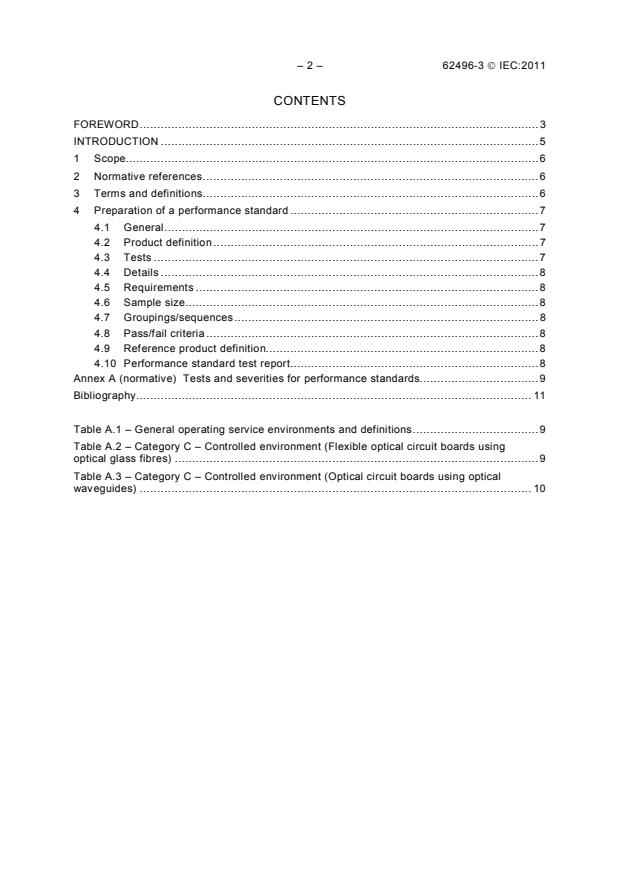
CONTENTS
FOREW ORD . 3
INTRODUCTION . 5
1 Sc o pe . 6
2 Normative references . 6
3 Terms and definitions . 6
4 Preparation of a performance standard . 7
4.1 Ge n eral . 7
4.2 Product definition . 7
4.3 Tests . 7
4.4 Details . 8
4.5 Requirements . 8
4.6 Sample size . 8
4.7 Groupings/sequences . 8
4.8 Pass/fail criteria . 8
4.9 Reference product definition. 8
4.10 Performance standard test report . 8
Annex A (normative) Tests and severities for performance standards. 9
Bibliography . 11
Table A.1 – General operating service environments and definitions . 9
Table A.2 – Category C – Controlled environment (Flexible optical circuit boards using
optical glass fibres) . 9
Table A.3 – Category C – Controlled environment (Optical circuit boards using optical
waveguides) . 10
62496-3 Ó IEC:2011 – 3 –
INTERNATIONAL ELECTROTECHNICAL COMMISSION
____________
OPTICAL CIRCUIT BOARDS –
Part 3: Performance standards –
General and guidance
FOREWORD
1) The International Electrotechnical Commission (IEC) is a worldwide organization for standardization comprising
all national electrotechnical committees (IEC National Committees). The object of IEC is to promote
international co-operation on all questions concerning standardization in the electrical and electronic fields. To
this end and in addition to other activities, IEC publishes International Standards, Technical Specifications,
Technical Reports, Publicly Available Specifications (PAS) and Guides (hereafter referred to as “IEC
Publication(s)”). Their preparation is entrusted to technical committees; any IEC National Committee interested
in the subject dealt with may participate in this preparatory work. International, governmental and non-
governmental organizations liaising with the IEC also participate in this preparation. IEC collaborates closely
with the International Organization for Standardization (ISO) in accordance with conditions determined by
agreement between the two organizations.
2) The formal decisions or agreements of IEC on technical matters express, as nearly as possible, an international
consensus of opinion on the relevant subjects since each technical committee has representation from all
interested IEC National Committees.
3) IEC Publications have the form of recommendations for international use and are accepted by IEC National
Committees in that sense. While all reasonable efforts are made to ensure that the technical content of IEC
Publications is accurate, IEC cannot be held responsible for the way in which they are used or for any
misinterpretation by any end user.
4) In order to promote international uniformity, IEC National Committees undertake to apply IEC Publications
transparently to the maximum extent possible in their national and regional publications. Any divergence
between any IEC Publication and the corresponding national or regional publication shall be clearly indicated in
the latter.
5) IEC itself does not provide any attestation of conformity. Independent certification bodies provide conformity
assessment services and, in some areas, access to IEC marks of conformity. IEC is not responsible for any
services carried out by independent certification bodies.
6) All users should ensure that they have the latest edition of this publication.
7) No liability shall attach to IEC or its directors, employees, servants or agents including individual experts and
members of its technical committees and IEC National Committees for any personal injury, property damage or
other damage of any nature whatsoever, whether direct or indirect, or for costs (including legal fees) and
expenses arising out of the publication, use of, or reliance upon, this IEC Publication or any other IEC
Publications.
8) Attention is drawn to the Normative references cited in this publication. Use of the referenced publications is
indispensable for the correct application of this publication.
9) Attention is drawn to the possibility that some of the elements of this IEC Publication may be the subject of
patent rights. IEC shall not be held responsible for identifying any or all such patent rights.
International Standard IEC 62496-3 has been prepared by IEC technical committee 86: Fibre
optics.
The text of this standard is based on the following documents:
FDIS Report on voting
86/380/FDIS 86/387/RVD
Full information on the voting for the approval of this standard can be found in the report on
voting indicated in the above table.
This publication has been drafted in accordance with the ISO/IEC Directives, Part 2.
– 4 – 62496-3 Ó IEC:2011
A list of all the parts in the IEC 62496 series, under the general title Optical circuit boards,
can be found on the IEC website.
The committee has decided that the contents of this publication will remain unchanged until
the stability date indicated on the IEC web site under "http://webstore.iec.ch" in the data
related to the specific publication. At this date, the publication will be
• reconfirmed,
• withdrawn,
• replaced by a revised edition, or
• amended.
62496-3 Ó IEC:2011 – 5 –
INTRODUCTION
Performance standards define standard electro-optical performance under a set of prescribed
conditions and contain a series or a set of tests and measurements (which may or may not be
grouped into a specific schedule) with clearly defined conditions, severities and pass/fail
criteria. The tests are intended to be run as an initial design verification to prove the product’s
ability to satisfy the requirements of a specific application, market sector or user group.
The following clauses in this part of IEC 62496 contain those sets of performance criteria that
have been standardized for international use. A product that has been shown to meet all the
requirements of a performance standard may be declared as complying with that performance
standard.
Products from one manufacturer that are tested to a performance standard will operate
together within the bounds of the criteria set by the performance standard. There is however
no guarantee that products from different suppliers having the same standard interface, which
have been independently tested to a performance standard, will meet the same levels of
optical performance when mated together as those supplied by one manufacturer.
Compliance with a performance standard demonstrates that a product has passed a design
verification test; it is not a guarantee of lifetime assured performance or reliability. Both
service life tests and reliability testing must be the subject of a separate test schedule where
the tests and severities selected are such that they are truly representative of the
requirements of these test programmes. Consistency of manufacture should be maintained
using a recognized quality assurance programme, while the reliability of the product should be
evaluated using the procedures recommended in IEC 62005 series and IEC 61751.
When possible, tests and measurements should be selected from the IEC 61300 series.
Where this is not possible, the required test method should be attached as an annex to the
performance standard.
– 6 – 62496-3 Ó IEC:2011
OPTICAL CIRCUIT BOARDS –
Part 3: Performance standards –
General and guidance
1 Scope
This part of IEC 62496 covers general information on optical circuit board performance
standards. It defines those tests and severities which form the performance categories or
general operating service environments and identifies those tests which are considered to be
product-specific. Test and severity details are given in Annex A. IEC 62496-3 provides
references, definitions and rules for creating optical circuit board performance standards, as
well as related information pertinent to the subject.
Subsequent parts of the IEC 62496-3 series are sequentially numbered and contain
performance criteria for specific applications. Each part will be added as the performance
criteria become standardized for international use.
2 Normative references
The following referenced documents are indispensable for the application of this document.
For dated references, only the edition cited applies. For undated references, the latest edition
of the referenced document (including any amendments) applies.
IEC 61300-2-18, Fibre optic interconnecting devices and passive components – Basic test
and measurement procedures – Part 2-18: Tests – Dry heat – High temperature endurance
IEC 61300-2-19, Fibre optic interconnecting devices and passive components – Basic test
and measurement procedures – Part 2-19: Tests – Damp heat (steady state)
IEC 61300-2-22, Fibre optic interconnecting devices and passive components – Basic test
and measurement procedures – Part 2-22: Tests – Change of temperature
IEC 61753-1, Fibre optic interconnecting devices and passive components performance
standard – Part 1: General and guidance for performance standards
3 Terms and definitions
For the purposes of this document, the following terms and definitions apply.
3.1
operating/service environment
typical service environment or operating location simulated by a performance category
3.2
performance category
series of tests and measurements (which may or may not be grouped into a specific
sequence) with clearly stated conditions and severities, which are chosen to simulate a
particular operating service environment
62496-3 Ó IEC:2011 – 7 –
3.3
performance standard
standard designed to verify a product which is capable of meeting the requirements of a
particular service environment
NOTE It contains a combination of those tests, together with their severities and pass-fail criteria, which shall be
applied to all optical circuit boards for a particular performance category, together with those which are considered
specific to that particular product in that environment.
3.4
product specific tests
those tests which are considered to be specific to a particular product type, e.g. flexible
optical circuit boards, rigid optical circuit board, optical fibre circuit boards, or waveguide
circuit boards
NOTE Where there is a specific IP (International Protection, IEC 60529) for a product, this shall be the subject of
a separate test and shall be included in the relevant product performance standard.
3.5
performance standard test report
report to be produced on completion of testing to a performance standard
4 Preparation of a performance standard
4.1 General
In the preparation of a performance standard, the following items shall be considered and
instructions pertaining to them included:
· product definition,
· tests,
· details,
· requirements,
· sample size,
· groupings/sequences,
· pass/fail criteria,
· reference product definition.
4.2 Product definition
The product to which the performance standard relates shall be clearly defined.
4.3 Tests
The tests to be carried out on the product in order for it to meet the performance standard
shall be clearly defined. No ambiguity or options shall be allowed.
The tests selected, combined with the severities/durations, groupings/sequencing, method
used and pass/fail criteria, should be indicative of a defined product location within a service
environment.
The test method to be used shall be clearly defined for each test. Wherever possible the test
method shall be selected from IEC referenced tests; where this is not possible other test
methods may be defined. If a previously undefined test method is used, the test method and
details to be specified shall be included in an annex of the performance standard.
– 8 – 62496-3 Ó IEC:2011
4.4 Details
Severities, durations and the details to be considered shall be given for all tests and
measurements presented in a performance standard. These shall be directly related to the
requirements specified for a product location within a service environment to which the
performance standard is intended to correspond. No ambiguity or options shall be allowed.
4.5 Requirements
The performance requirements that shall be satisfied in order for the product to comply with
the standard shall be specified for each test and/or measurement. No ambiguities shall be
allowed.
4.6 Sample size
The sample size for each test shall be defined in an annex of the performance standard. No
deviations shall be allowed.
4.7 Groupings/sequences
Test groups and test sequences shall be defined in an annex as required by the user, user
group or manufacturer. The number of samples for each test group shall also be defined in
the annex. Where prohibitive cost is associated with the active devices, numbers of samples
may be reduced.
4.8 Pass/fail criteria
The pass/fail criteria shall be unambiguously stated for each test within the performance
standard. No deviation or exceptions shall be allowed.
4.9 Reference product definition
Where a reference product is called for in any of the test and measurement methods used
within a performance standard, the reference product shall be clearly defined in an annex of
the performance standard.
4.10 Performance standard test report
Conformance with a performance standard shall be supported by a test report. The test report
may be prepared by an independent test laboratory. The test report shall clearly demonstrate
that the tests were carried out as per the requirements of the performance standard and
provide full details of the tests, together with a pass/fail declaration.
Any product failing a particular test or sequence of tests shall be reported in the performance
standard test report. The cause of the failure shall be given and any corrective action taken
shall be described.
If no design changes are made to the product, the test or test sequence where the failure
occurred shall be rerun with the results of both the tests reported.
Any design changes shall be identified in the performance standard test report. The full set of
performance tests must be rerun and the results reported in this case.
62496-3 Ó IEC:2011 – 9 –
Annex A
(normative)
Tests and severities for performance standards
This annex contains the preferred tests and recommended severities associated with these
tests for typical system locations in which optical circuit boards may be installed (see Tables
A.2 to A.3).
Where tests have been grouped it is intended that the tests be run as a group, in the order
indicated, to simulate a particular aspect of the conditions to which the product may be
submitted.
The general system location for which performance standard schedules are provided is given
in Table A.1.
Table A.1 – General operating service environments and definitions
Category
Temperature range Typical
Environment Water/Humidity
°C location
(IEC 61753-1)
C Controlled -10 to +60 85 % maximum RH In a building
U Uncontrolled -25 to +70 Uncontrolled RH Temperate outdoors
Uncontrolled RH
O Outside plant -40 to +75 Sheltered outdoors
May be liable to
E Extreme -40 to +85 Unsheltered outdoors
water immersion
Table A.1 indicates the ambient temperature ranges for optical network equipment under
various environmental categories described in IEC 61753-1 and does not indicate the
operating temperature ranges for optical circuit boards. The operating temperature range for
each optical circuit board shall be specified by its case temperature, unless otherwise stated,
and defined in each performance standard document in order that the optical circuit board
operates under the specific environmental category described in Table A.1. The system
designer should design the heat flow of the equipment to maintain the case temperature of
the installed optical circuit boards within their specifications. The performance tests for each
optical circuit board should be carried out within the specified case temperature range.
Table A.2 – Category C – Controlled environment
(Flexible optical circuit boards using optical glass fibres)
Test Severity
Bending radius of OCB body: 30mm
Bending endurance of OCB body
Number of cycles
...