

IEC 60216-5:2022
(Main)Electrical insulating materials - Thermal endurance properties - Part 5: Determination of relative temperature index (RTI) of an insulating material
General Information
- Abstract
IEC 60216-5:2022 specifies the experimental and calculation procedures to be used for deriving the relative temperature index of a material from experimental data obtained in accordance with the instructions of IEC 60216-1 and IEC 60216-2. The calculation procedures are supplementary to those of IEC 60216-3. Guidance is also given for assessment of thermal ageing after a single fixed time and temperature, without extrapolation. This edition includes the following significant technical changes with respect to the previous edition:
Annex C “Computer program” has been completely reworked;
in 3.1, the terms “ATE” and “RTE” were replaced by “ATI” and “RTI” to emphasize their reference to an electrical insulating material (EIM).
This standard is to be read in conjunction with IEC 60216-1:2013, IEC 60216-2:2005 and IEC 60216-3:2021.
- Status
- Published
- Publication Date
- 17-Nov-2022
- Technical Committee
- TC 112 - Evaluation and qualification of electrical insulating materials and systems
- Drafting Committee
- WG 1 - TC 112/WG 1
- Current Stage
- PPUB - Publication issued
- Start Date
- 18-Nov-2022
- Completion Date
- 02-Dec-2022
Buy Documents
REDLINE IEC 60216-5:2022 CMV - Electrical insulating materials - Thermal endurance properties - Part 5: Determination of relative temperature index (RTI) of an insulating material Released:11/18/2022
IEC 60216-5:2022 - Electrical insulating materials - Thermal endurance properties - Part 5: Determination of relative temperature index (RTI) of an insulating material Released:11/18/2022
Overview
IEC 60216-5:2022 - "Electrical insulating materials - Thermal endurance properties - Part 5: Determination of relative temperature index (RTI) of an insulating material" specifies the experimental and calculation procedures for deriving the Relative Temperature Index (RTI) of electrical insulating materials. It is part of the IEC 60216 series and is intended to be read together with IEC 60216‑1, IEC 60216‑2 and IEC 60216‑3. This edition updates Annex C (computer program) and clarifies terminology (ATE/RTE → ATI/RTI).
Key topics and technical requirements
- Purpose: Defines how to calculate the RTI from thermal‑ageing experimental data obtained under the protocols of IEC 60216‑1 and IEC 60216‑2.
- Experimental procedures:
- Selection of a reference electrical insulating material (EIM).
- Selection of appropriate diagnostic tests to assess extent of ageing (destructive, non‑destructive or proof tests).
- Ageing procedures including guidance for short‑term thermal ageing.
- Calculation procedures:
- Calculation of intermediate thermal endurance parameters and derivation of RTI values.
- Statistical and numerical tests (precision of correlation time, lower confidence interval of RTI, and extrapolation checks).
- Guidance for assessment after a single fixed time and temperature without extrapolation.
- Results and reporting:
- Required results, statistical tests, and recommended report contents for reproducible RTI reporting.
- Annexes:
- Informative material on repeatability, thermal class assignment, selection of reference EIM and a reworked Annex C providing a computer program framework for the RTI calculations.
Practical applications and who uses it
IEC 60216‑5:2022 is used by professionals who need to evaluate or document the thermal endurance of insulating materials and assign thermal classes:
- Material manufacturers - to characterize and compare thermal endurance and declare RTI for product datasheets.
- Testing laboratories and QA teams - to perform standardized ageing tests, compute RTI, run statistical checks and issue compliant test reports.
- Design and R&D engineers - to select insulation materials and estimate thermal performance and longevity under elevated temperatures.
- Certification bodies and standards engineers - to verify compliance, support insulation classification and integrate RTI data into system-level thermal class assessments.
Related standards
- IEC 60216‑1:2013 - Ageing procedures and evaluation of test results
- IEC 60216‑2:2005 - Choice of test criteria
- IEC 60216‑3:2021 - Instructions for calculating thermal endurance characteristics
Keywords: IEC 60216-5:2022, RTI, relative temperature index, electrical insulating materials, thermal endurance properties, thermal class, ageing procedures, insulation testing.
Relations
- Effective Date
- 05-Sep-2023
Buy Documents
REDLINE IEC 60216-5:2022 CMV - Electrical insulating materials - Thermal endurance properties - Part 5: Determination of relative temperature index (RTI) of an insulating material Released:11/18/2022
IEC 60216-5:2022 - Electrical insulating materials - Thermal endurance properties - Part 5: Determination of relative temperature index (RTI) of an insulating material Released:11/18/2022
Get Certified
Connect with accredited certification bodies for this standard

IMQ S.p.A. (Certification)
Italian electrical product certification.

SLG Prüf- und Zertifizierungs GmbH
German testing and certification body.

UL Solutions
Global safety science company with testing, inspection and certification.
Sponsored listings
Frequently Asked Questions
IEC 60216-5:2022 is a standard published by the International Electrotechnical Commission (IEC). Its full title is "Electrical insulating materials - Thermal endurance properties - Part 5: Determination of relative temperature index (RTI) of an insulating material". This standard covers: IEC 60216-5:2022 specifies the experimental and calculation procedures to be used for deriving the relative temperature index of a material from experimental data obtained in accordance with the instructions of IEC 60216-1 and IEC 60216-2. The calculation procedures are supplementary to those of IEC 60216-3. Guidance is also given for assessment of thermal ageing after a single fixed time and temperature, without extrapolation. This edition includes the following significant technical changes with respect to the previous edition: Annex C “Computer program” has been completely reworked; in 3.1, the terms “ATE” and “RTE” were replaced by “ATI” and “RTI” to emphasize their reference to an electrical insulating material (EIM). This standard is to be read in conjunction with IEC 60216-1:2013, IEC 60216-2:2005 and IEC 60216-3:2021.
IEC 60216-5:2022 specifies the experimental and calculation procedures to be used for deriving the relative temperature index of a material from experimental data obtained in accordance with the instructions of IEC 60216-1 and IEC 60216-2. The calculation procedures are supplementary to those of IEC 60216-3. Guidance is also given for assessment of thermal ageing after a single fixed time and temperature, without extrapolation. This edition includes the following significant technical changes with respect to the previous edition: Annex C “Computer program” has been completely reworked; in 3.1, the terms “ATE” and “RTE” were replaced by “ATI” and “RTI” to emphasize their reference to an electrical insulating material (EIM). This standard is to be read in conjunction with IEC 60216-1:2013, IEC 60216-2:2005 and IEC 60216-3:2021.
IEC 60216-5:2022 is classified under the following ICS (International Classification for Standards) categories: 19.020 - Test conditions and procedures in general; 29.020 - Electrical engineering in general; 29.035.01 - Insulating materials in general. The ICS classification helps identify the subject area and facilitates finding related standards.
IEC 60216-5:2022 has the following relationships with other standards: It is inter standard links to IEC 60216-5:2008/COR1:2009. Understanding these relationships helps ensure you are using the most current and applicable version of the standard.
IEC 60216-5:2022 is available in PDF format for immediate download after purchase. The document can be added to your cart and obtained through the secure checkout process. Digital delivery ensures instant access to the complete standard document.
Standards Content (Sample)
IEC 60216-5 ®
Edition 4.0 2022-11
COMMENTED VERSION
INTERNATIONAL
STANDARD
colour
inside
Electrical insulating materials – Thermal endurance properties –
Part 5: Determination of relative temperature index (RTI) of an insulating material
All rights reserved. Unless otherwise specified, no part of this publication may be reproduced or utilized in any form
or by any means, electronic or mechanical, including photocopying and microfilm, without permission in writing from
either IEC or IEC's member National Committee in the country of the requester. If you have any questions about IEC
copyright or have an enquiry about obtaining additional rights to this publication, please contact the address below or
your local IEC member National Committee for further information.
IEC Secretariat Tel.: +41 22 919 02 11
3, rue de Varembé info@iec.ch
CH-1211 Geneva 20 www.iec.ch
Switzerland
About the IEC
The International Electrotechnical Commission (IEC) is the leading global organization that prepares and publishes
International Standards for all electrical, electronic and related technologies.
About IEC publications
The technical content of IEC publications is kept under constant review by the IEC. Please make sure that you have the
latest edition, a corrigendum or an amendment might have been published.
IEC publications search - webstore.iec.ch/advsearchform IEC Products & Services Portal - products.iec.ch
The advanced search enables to find IEC publications by a
Discover our powerful search engine and read freely all the
variety of criteria (reference number, text, technical publications previews. With a subscription you will always
committee, …). It also gives information on projects, replaced have access to up to date content tailored to your needs.
and withdrawn publications.
Electropedia - www.electropedia.org
IEC Just Published - webstore.iec.ch/justpublished
The world's leading online dictionary on electrotechnology,
Stay up to date on all new IEC publications. Just Published
containing more than 22 300 terminological entries in English
details all new publications released. Available online and
and French, with equivalent terms in 19 additional languages.
once a month by email.
Also known as the International Electrotechnical Vocabulary
(IEV) online.
IEC Customer Service Centre - webstore.iec.ch/csc
If you wish to give us your feedback on this publication or
need further assistance, please contact the Customer Service
Centre: sales@iec.ch.
IEC 60216-5 ®
Edition 4.0 2022-11
COMMENTED VERSION
INTERNATIONAL
STANDARD
colour
inside
Electrical insulating materials – Thermal endurance properties –
Part 5: Determination of relative temperature index (RTI) of an insulating material
INTERNATIONAL
ELECTROTECHNICAL
COMMISSION
ICS 19.020; 29.020; 29.035.01 ISBN 978-2-8322-6112-5
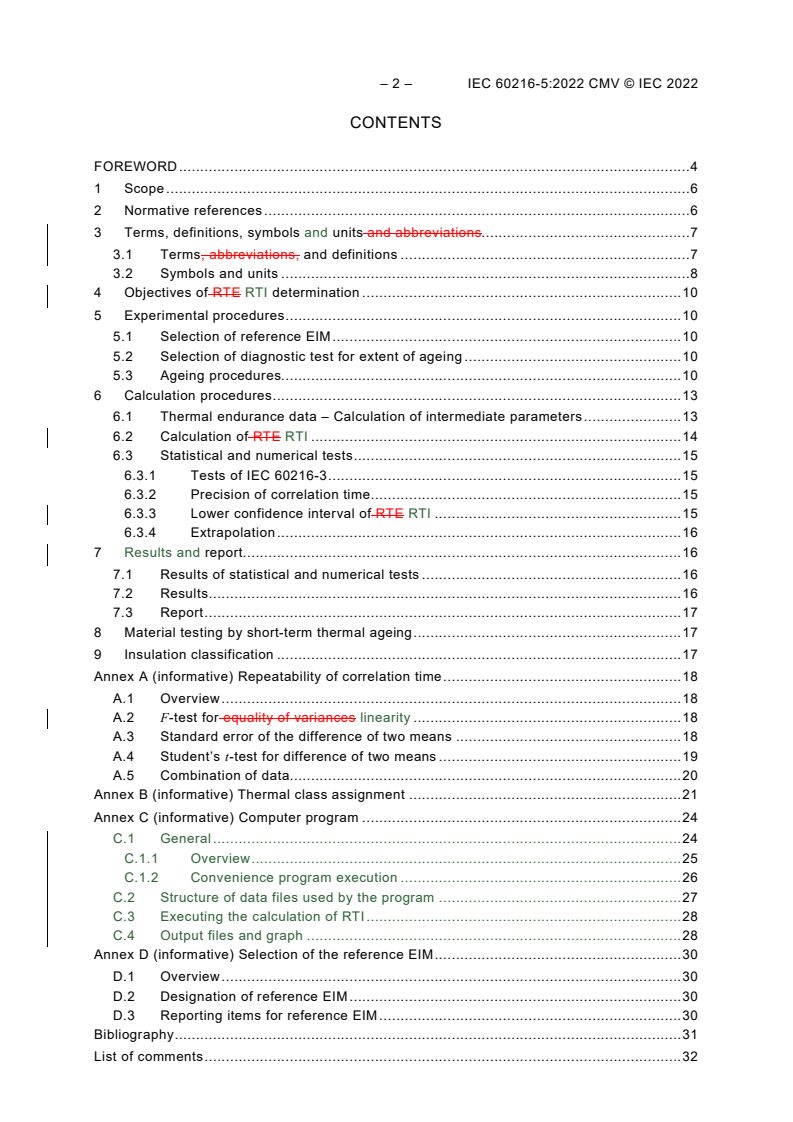
– 2 – IEC 60216-5:2022 CMV © IEC 2022
CONTENTS
FOREWORD .4
1 Scope .6
2 Normative references .6
3 Terms, definitions, symbols and units and abbreviations.7
3.1 Terms, abbreviations, and definitions .7
3.2 Symbols and units .8
4 Objectives of RTE RTI determination . 10
5 Experimental procedures . 10
5.1 Selection of reference EIM . 10
5.2 Selection of diagnostic test for extent of ageing . 10
5.3 Ageing procedures. 10
6 Calculation procedures . 13
6.1 Thermal endurance data – Calculation of intermediate parameters . 13
6.2 Calculation of RTE RTI . 14
6.3 Statistical and numerical tests . 15
6.3.1 Tests of IEC 60216-3 . 15
6.3.2 Precision of correlation time . 15
6.3.3 Lower confidence interval of RTE RTI . 15
6.3.4 Extrapolation . 16
7 Results and report. 16
7.1 Results of statistical and numerical tests . 16
7.2 Results . 16
7.3 Report . 17
8 Material testing by short-term thermal ageing . 17
9 Insulation classification . 17
Annex A (informative) Repeatability of correlation time . 18
A.1 Overview . 18
A.2 F-test for equality of variances linearity . 18
A.3 Standard error of the difference of two means . 18
A.4 Student’s t-test for difference of two means . 19
A.5 Combination of data. 20
Annex B (informative) Thermal class assignment . 21
Annex C (informative) Computer program . 24
C.1 General . 24
C.1.1 Overview . 25
C.1.2 Convenience program execution . 26
C.2 Structure of data files used by the program . 27
C.3 Executing the calculation of RTI . 28
C.4 Output files and graph . 28
Annex D (informative) Selection of the reference EIM . 30
D.1 Overview . 30
D.2 Designation of reference EIM . 30
D.3 Reporting items for reference EIM . 30
Bibliography . 31
List of comments . 32
Figure 1 – Thermal endurance graphs . 12
Figure 2 – Unacceptable thermal endurance graphs . 13
Figure C.1 – Shortcut property dialog for program launch . 27
Figure C.2 – Thermal endurance graphs . 28
Figure C.3 – Example thermal endurance graphs . 29
Table 1 – Input parameters for the calculations concerning RTE RTI . 14
Table B.1 – Thermal class equivalents for insulating material . 21
Table B.2 – F– function; p = 0,05 . 22
Table B.3 – t–function . 23
– 4 – IEC 60216-5:2022 CMV © IEC 2022
INTERNATIONAL ELECTROTECHNICAL COMMISSION
____________
ELECTRICAL INSULATING MATERIALS –
THERMAL ENDURANCE PROPERTIES –
Part 5: Determination of relative thermal endurance
index (RTE) relative temperature index (RTI) 1 of an insulating material
FOREWORD
1) The International Electrotechnical Commission (IEC) is a worldwide organization for standardization comprising
all national electrotechnical committees (IEC National Committees). The object of IEC is to promote international
co-operation on all questions concerning standardization in the electrical and electronic fields. To this end and
in addition to other activities, IEC publishes International Standards, Technical Specifications, Technical Reports,
Publicly Available Specifications (PAS) and Guides (hereafter referred to as “IEC Publication(s)”). Their
preparation is entrusted to technical committees; any IEC National Committee interested in the subject dealt with
may participate in this preparatory work. International, governmental and non-governmental organizations liaising
with the IEC also participate in this preparation. IEC collaborates closely with the International Organization for
Standardization (ISO) in accordance with conditions determined by agreement between the two organizations.
2) The formal decisions or agreements of IEC on technical matters express, as nearly as possible, an international
consensus of opinion on the relevant subjects since each technical committee has representation from all
interested IEC National Committees.
3) IEC Publications have the form of recommendations for international use and are accepted by IEC National
Committees in that sense. While all reasonable efforts are made to ensure that the technical content of IEC
Publications is accurate, IEC cannot be held responsible for the way in which they are used or for any
misinterpretation by any end user.
4) In order to promote international uniformity, IEC National Committees undertake to apply IEC Publications
transparently to the maximum extent possible in their national and regional publications. Any divergence between
any IEC Publication and the corresponding national or regional publication shall be clearly indicated in the latter.
5) IEC itself does not provide any attestation of conformity. Independent certification bodies provide conformity
assessment services and, in some areas, access to IEC marks of conformity. IEC is not responsible for any
services carried out by independent certification bodies.
6) All users should ensure that they have the latest edition of this publication.
7) No liability shall attach to IEC or its directors, employees, servants or agents including individual experts and
members of its technical committees and IEC National Committees for any personal injury, property damage or
other damage of any nature whatsoever, whether direct or indirect, or for costs (including legal fees) and
expenses arising out of the publication, use of, or reliance upon, this IEC Publication or any other IEC
Publications.
8) Attention is drawn to the Normative references cited in this publication. Use of the referenced publications is
indispensable for the correct application of this publication.
9) Attention is drawn to the possibility that some of the elements of this IEC Publication may be the subject of patent
rights. IEC shall not be held responsible for identifying any or all such patent rights.
This commented version (CMV) of the official standard IEC 60216-5:2022 edition 4.0
allows the user to identify the changes made to the previous IEC 60216-5:2008
edition 3.0. Furthermore, comments from IEC TC 112 experts are provided to explain the
reasons of the most relevant changes, or to clarify any part of the content.
A vertical bar appears in the margin wherever a change has been made. Additions are in
green text, deletions are in strikethrough red text. Experts' comments are identified by a
blue-background number. Mouse over a number to display a pop-up note with the
comment.
This publication contains the CMV and the official standard. The full list of comments is
available at the end of the CMV.
IEC 60216-5 has been prepared by IEC technical committee 112: Evaluation and qualification
of electrical insulating materials and systems. It is an International Standard.
This fourth edition cancels and replaces the third edition published in 2008. This edition
constitutes a technical revision.
This edition includes the following significant technical changes with respect to the previous
edition:
a) Annex C “Computer program” has been completely reworked;
b) in 3.1, the terms “ATE” and “RTE” were replaced by “ATI” and “RTI” to emphasize their
reference to an electrical insulating material (EIM).
This standard is to be read in conjunction with IEC 60216-1:2013, IEC 60216-2:2005 and
IEC 60216-3:2021.
The text of this International Standard is based on the following documents:
Draft Report on voting
112/582/FDIS 112/588/RVD
Full information on the voting for its approval can be found in the report on voting indicated in
the above table.
The language used for the development of this International Standard is English.
This document was drafted in accordance with ISO/IEC Directives, Part 2, and developed in
accordance with ISO/IEC Directives, Part 1 and ISO/IEC Directives, IEC Supplement, available
at www.iec.ch/members_experts/refdocs. The main document types developed by IEC are
described in greater detail at www.iec.ch/standardsdev/publications.
A list of all parts in the IEC 60216 series, published under the general title Electrical insulating
materials – Thermal endurance properties, can be found on the IEC website.
The committee has decided that the contents of this document will remain unchanged until the
stability date indicated on the IEC website under webstore.iec.ch in the data related to the
specific document. At this date, the document will be
• reconfirmed,
• withdrawn,
• replaced by a revised edition, or
• amended.
IMPORTANT – The "colour inside" logo on the cover page of this document indicates
that it contains colours which are considered to be useful for the correct understanding
of its contents. Users should therefore print this document using a colour printer.
– 6 – IEC 60216-5:2022 CMV © IEC 2022
ELECTRICAL INSULATING MATERIALS –
THERMAL ENDURANCE PROPERTIES –
Part 5: Determination of relative thermal endurance
index (RTE) relative temperature index (RTI) of an insulating material
1 Scope
This part of IEC 60216 specifies the experimental and calculation procedures to be used for
deriving the relative thermal endurance temperature index of a material from experimental data
obtained in accordance with the instructions of IEC 60216-1 and IEC 60216-2. The calculation
procedures are supplementary to those of IEC 60216-3.
Guidance is also given for assessment of thermal ageing after a single fixed time and
temperature, without extrapolation.
The experimental data may can 2 in principle be obtained using destructive, non-destructive
or proof tests, although destructive tests have been much more extensively employed. Data
obtained from non-destructive or proof tests may can 3 be “censored”, in that measurement of
times taken to reach the endpoint may 4 have been terminated at some point after the median
time but before all specimens have reached end-point (see IEC 60216-1).
Guidance is given for preliminary assignment of a thermal class for an electrical insulating
material (EIM) 5, based upon the thermal ageing performance.
While the thermal classification of an EIM is not directly related to the thermal classification of
an electrical insulation system (EIS), the thermal classification of an EIS follows the same
concepts as presented in this part of the 60216 series. 6 The calculation procedures of this
standard apply to the determination of the thermal class of an EIS when the thermal stress is
the prevailing ageing factor.
2 Normative references
The following documents are referred to in the text in such a way that some or all of their content
constitutes requirements of this document. For dated references, only the edition cited applies.
For undated references, the latest edition of the referenced document (including any
amendments) applies.
IEC 60216-1:20012013 7, Electrical insulating materials – Thermal endurance properties –
Part 1: Ageing procedures and evaluation of test results
IEC 60216-2:2005 8, Electrical insulating materials – Thermal endurance properties – Part 2:
Determination of thermal endurance properties of electrical insulating materials – Choice of test
criteria
IEC 60216-3:20062021 9, Electrical insulating materials – Thermal endurance properties –
Part 3: Instructions for calculating thermal endurance characteristics
3 Terms, definitions, symbols and units and abbreviations 10
3.1 Terms, abbreviations, and definitions
For the purposes of this document, the following terms and definitions, symbols, units and
abbreviated terms apply.
ISO and IEC maintain terminological databases for use in standardization at the following
addresses:
• IEC Electropedia: available at https://www.electropedia.org/
• ISO Online browsing platform: available at https://www.iso.org/obp 11
3.1.1
electrical insulating material
EIM
solid or fluid with negligibly low electric conductivity, or a simple combination of such materials,
used to separate conducting parts at different electrical potential in electrotechnical devices
material of low electric conductivity, used to separate conducting parts at different electric
potentials or to isolate such parts from the surroundings 12
3.1.2
assessed thermal endurance index
ATE
numerical value of the temperature in degrees Celsius, up to which the reference EIM
possesses known, satisfactory service performance in the specified application
NOTE 1 The value of the ATE may vary between applications for the same material.
NOTE 2 Sometimes referred to as “absolute” thermal endurance index.
3.1.2
assessed temperature index
ATI
numerical value of the temperature index in degrees Celsius of the reference EIM
Note 1 to entry: The value of the ATI can vary between applications for the same material. 13
3.1.3
candidate EIM
material for which an estimate of the thermal endurance is required to be determined
Note 1 to entry: The determination is made by simultaneous thermal ageing of the material and a reference EIM.
3.1.4
reference EIM
material with known thermal endurance, preferably (derived from service experience or previous
RTI or TI evaluation) 14, used as a reference for comparative tests with the candidate EIM
3.1.5
central second moment of a data group
sum of the squares of the differences between the data values and the value of the group mean
divided by the number of data in the group
3.1.6
correlation time for RTI 15
estimated time to endpoint of the reference EIM at a temperature equal to its assessed thermal
endurance (ATE) ATI in degrees Celsius
– 8 – IEC 60216-5:2022 CMV © IEC 2022
3.1.7
degrees of freedom
number of data values minus the number of parameter values
3.1.8
standard error
standard error of an estimate of the true value of a data group property is the value of the
standard deviation of the hypothetical sampling population of which the group property may can 16
be considered to be a member
Note 1 to entry: For the group mean it is equal to the group standard deviation divided by the square root of the
number of data in the group, and indicates the uncertainty in the true value of the mean.
Note 2 to entry: This standard is concerned only with means and the difference between two means (see
Clause A.3).
3.1.9
standard deviation
square root of the variance of a data group or sub-group
3.1.10
relative thermal endurance index
RTE
numerical value of the temperature in degrees Celsius at which the estimated time to endpoint
of the candidate EIM is the same as the estimated time to endpoint of the reference EIM at a
temperature equal to its assessed thermal endurance (ATE)
3.1.10
relative temperature index
RTI
determined by test in relation to the thermal performance of a known reference EIM 17
3.1.11
variance of a data group
sum of the squares of the deviations of the data from a reference level defined by one or more
parameters, divided by the number of degrees of freedom
Note 1 to entry: The reference level may can 18, for example, be a mean value (1 parameter) or a line (2
parameters, in this document, the slope and the intercept with the y axis).
3.2 Symbols and units
Regression coefficient (y-intercept) of thermal endurance equation for reference
a
A
EIM
Regression coefficient (y-intercept) of thermal endurance equation for candidate
a
B
EIM
Regression coefficient (slope) of thermal endurance equation for reference EIM
b
A
Regression coefficient (slope) of thermal endurance equation for candidate EIM
b
B
X
1/(ϑ +Θ )
Variable for statistical analysis equal to
Y
(τ )
Variable for statistical analysis equal to ln
Ageing temperature in determination of RTE RTI
ϑ
Temperature on Kelvin scale equal to 0 °C
Θ
Time to endpoint
τ
Estimated time to endpoint of reference EIM at a temperature equal to ATE ATI
τ
c
(“correlation time”)
Central second moment of x values for reference EIM
µ
2(A)
Central second moment of x values for candidate EIM
µ
2(B)
Number of y values for reference EIM data
n
A
Number of y values for candidate EIM data
n
B
T Student’s t distributed stochastic variable
S Standard error of the difference of two means
2 Variance of y values for reference EIM data
s
A
2 Variance of y values for candidate EIM data
s
B
General mean of x-values for reference EIM data
x
A
General mean of x-values for candidate EIM data
x
B
General mean of y-values for reference EIM data
y
A
General mean of y-values for candidate EIM data
y
B
Temperature in degrees Celsius equal to ATE ATI
θ
A
Temperature in degrees Celsius equal to RTE RTI
θ
B
ˆ
X
B
θ
x value corresponding to
B
ˆ
X
A
θ
x value corresponding to
A
θ
θ
c(B)
Lower confidence limit of
B
θ
θ
c(A) Lower confidence limit of
A
X
L(B)
θ
x value corresponding to lower confidence limit of
B
X
L(A)
θ
x value corresponding to lower confidence limit of
A
∆
B
θ
Lower confidence interval of
B
∆
A
θ
Lower confidence interval of
A
HIC
B(c)
τ
Halving interval of candidate EIM at a time equal to
c
2 Variance associated with the difference between the mean y-values for the two
s
D
materials
– 10 – IEC 60216-5:2022 CMV © IEC 2022
n s
Degrees of freedom of
D
D
Logarithms of the longest mean times to endpoint for materials A and B
υ , υ
A B
Intermediate variable: adjusted value of b for calculation of temperature confidence
b
r
interval
s Intermediate variable: adjusted value of s for calculation of temperature confidence
r
interval
4 Objectives of RTE RTI determination
The objectives of the determination are as follows.
a) To exploit an assumed relationship between thermal endurance (with an appropriate test
criterion for ageing) and service performance, and to use this to predict a value for a
preliminary assessment of service temperature of a material for which there is relatively little
service experience (by comparison with a known reference EIM, see Clauses 5 and 6).
NOTE 19 In the majority of cases, this will involve extrapolation to a longer time and/or lower
temperature than in the experimental data. This extrapolation should be kept to a minimum
by appropriate choice of ageing temperatures and times since the uncertainty in the result
increases rapidly as the extrapolation is increased. However, even when there is no
extrapolation, the uncertainty is still finite, on account of the variances of the experimental
data and experimental errors.
b) To improve the precision of a thermal endurance determination by reduction of systematic
errors in the ageing process. If, after ageing, the results for the reference EIM are found to
be significantly different from earlier experience, this may indicate changes in material or
equipment. This may be investigated and possibly corrected. In any case, the simultaneous
ageing of reference and candidate will at least partially compensate for the systematic
changes. Statistical procedures for use in assessing the significance of changes are given
in Annex A.
c) To provide instructions for assigning a thermal class to an EIM.
5 Experimental procedures
5.1 Selection of reference EIM
The primary requirement for the reference EIM is that it has a known thermal endurance index
(ATE) temperature index (ATI) for the application under consideration. The thermal endurance
temperature index, if determined by an RTE RTI procedure, is preferably supported by actual
service experience (see Annex D).
The expected ageing mechanisms and rates of both materials shall be similar, and relevant to
the application.
5.2 Selection of diagnostic test for extent of ageing
The diagnostic test shall be one considered relevant to the application for which the RTE RTI
is required. The same test shall be applied to both reference and candidate EIM.
5.3 Ageing procedures
The number and type of test specimens of each material and the ageing temperatures and times
shall be in accordance with the requirements of IEC 60216-1:2013, 5.3.2, 5.4 and the first
paragraph of 5.5. At each common 20 ageing temperature, the oven load shall comprise
appropriate numbers of test specimens of both materials in the same oven. The specimens shall
be evenly distributed in the oven so that there is likely to be no systematic difference between
the ageing conditions applied to the specimens of the two materials. It is important that test
specimens of both materials are aged simultaneously at a minimum of three temperatures to be
included in the calculations.
NOTE As an example, while the data represented in Figure 1 would be acceptable for analysis of the data
represented by Figure 2, the lowest temperature group of the candidate EIM and the highest temperature group of
the reference cannot be included, since in each case, the specimen group is made up of only one material or one of
the two materials did not reach the chosen end point within the test time.
– 12 – IEC 60216-5:2022 CMV © IEC 2022
If, when ageing at the selected temperatures is completed, the results from either material do
not meet the requirements of criteria b) in 7.1 of this document, a further specimen group shall
be aged, within the same oven, at an appropriate temperature. This group shall again be
composed of the required number and type of specimens of each material.
θ θ
B A
τ
C
B
A
RTE ATE
Temperature
IEC 353/08
Key
A = reference EIM
B = candidate EIM
Figure 1 – Thermal endurance graphs 21
Log time
θ
B θ
A
τ
C
B
A
RTE ATE
Temperature
IEC 354/08
Key
A = reference EIM
B = candidate EIM
NOTE The test specimens of both materials are not aged simultaneously at a minimum of three temperatures.
Figure 2 – Unacceptable thermal endurance graphs 22
6 Calculation procedures
6.1 Thermal endurance data – Calculation of intermediate parameters
Calculation of the thermal endurance equations shall be made in accordance with the
instructions of IEC 60216-3.
The following input parameters as set out in Table 1 are needed for the calculations relevant to
RTE RTI and should be recorded (each of the symbols may have either subscript A for reference
EIM or B for candidate EIM).
Log time
– 14 – IEC 60216-5:2022 CMV © IEC 2022
Table 1 – Input parameters for the calculations concerning RTE RTI
Symbol in Equation in Symbol in
Parameter
IEC 60216-3 IEC 60216-3 IEC 60216-5
b b
Slope of regression line b (33)
A B
a a
a
Intercept of regression line (34)
A B
Weighted mean of x values (26)
x x x
A B
nd
μ μ
Central 2 moment of x values (31)
μx()
2(A) 2(B)
y
Weighted mean of y values (27)
y y
A B
2 2
Variance of y values (41)
s s
s
A B
n n
Number of y values N (25)
A B
HIC
Halving interval HIC (53) --
B(c)
y υ υ
Largest mean log time to endpoint --
k A B
ˆ
θ θ
(50)
Lower confidence limit of θ ϑ
c(A) c(B)
c
NOTE If the calculations of IEC 60216-3 are performed by the recommended computer programme of Annex C 23,
subroutines should be included to record the parameters in a data file which can be recalled for the purposes of
the present calculations. Alternatively, the values of and may be calculated directly in that program.
θ θ
c(A) c(B)
The result of the linearity test (IEC 60216-3:2021, 6.3.2) is also needed necessary 24.
6.2 Calculation of RTE RTI
Calculation of the coefficients of the thermal endurance equations shall be made for both
reference and candidate EIMs in accordance with the instructions of 6.1 and 6.2 of
τ
IEC 60216-3:2021 (see 6.1 of this document). From these coefficients, the values of and
c
θ shall be calculated as below (see also Figure 1).
B
τ
a) From the regression coefficients of the reference EIM, calculate the time c corresponding
to its ATE ATI:
b
A
lnτa+
cA (1)
θΘ+
( )
A 0
b) From the regression coefficients of the candidate EIM, calculate the temperature
τ
corresponding to the time :
c
b
B
θ = −Θ
(2)
B 0
[ln (τ )− a ]
c B
θ
The required RTE RTI is equal to the value of in degrees Celsius.
B
=
6.3 Statistical and numerical tests
6.3.1 Tests of IEC 60216-3
The statistical and numerical tests of IEC 60216-3 shall be carried out before the calculations
of this standard, and their results employed in compiling the report of 7.3.
6.3.2 Precision of correlation time
Where a reference EIM has been tested on a previous occasion, with the same diagnostic test
τ
should be compared using the Student’s t-test for the difference
and ATE ATI, the values of
c
of two means. A significant difference may imply a change in the reference EIM itself, a change
in the oven equipment or a change in the test apparatus. The cause should be investigated and
reported.
Statistical procedures for assessing the significance of differences between values are given in
Annex A.
6.3.3 Lower confidence interval of RTE RTI
The lower confidence limit of RTE RTI is calculated from the lower confidence limits of
temperature estimates equal to θ and θ (IEC 60216-3:2021, 6.3.3 b), Equations (46) to
A B
(50)).
θ
The lower confidence limit of , , is calculated as in IEC 60216-3:2021, 6.3.3 b) for a time
θ c(B)
B
τ
equal to and subtracted from θ to give the confidence interval ∆ .
B
c B
(Y − y ) t s
B r
X = x + +
(3)
L(B) B
b b
r r
ˆ
Y ln ;τ X Ya− /b (4)
( )
c B B B
t s
B
bb−
(5)
where
r B
b μ
B2
(B)
ˆ
b (X − x )
2 2 r B
s = s +
(6)
r B
b µ
B 2
(B)
Where
t is the value of Student’s t for n degrees of freedom and a significance level of 0,05
B
(see Table B.3);
µ
is the central second moment of the x values:
2(B)
k
µ = n (x − x )
∑
i(B) i(B) (B) (7)
2(B)
n
i =1
B
(see IEC 60216-3:2021, 6.2.2 for details).
=
= =
– 16 – IEC 60216-5:2022 CMV © IEC 2022
θ τ
θ
The lower confidence limit of , is calculated as above for a time equal to and
A c(A) c
θ
subtracted from to give the confidence interval ∆ .
A
A
The lower confidence interval of RTE RTI, ∆ , is then equal to the “Pythagorean” (orthogonal)
R
vector sum of the above two intervals:
2 2
(8)
∆ = (∆ + ∆ )
R A B
6.3.4 Extrapolation
The extrapolation required to estimate the correlation time is calculated for both reference and
candidate EIMs as the difference between the logarithm of the correlation time and the greatest
value of the mean of the logarithms of the ageing times to endpoint (υ or υ ). The extrapolation
A B
required is the greater of these two values.
7 Results and report 25
7.1 Results of statistical and numerical tests
The following criteria apply:
a) linearity of thermal endurance relationships and confidence intervals of TI results of both
reference and candidate EIMs (see IEC 60216-3:2021, 6.3.2 and 6.3.3) which shall satisfy
the requirements of IEC 60216-3, 7.3.1 and 7.3.2;
b) extrapolation to the correlation time (see 6.3.4 above): the extrapolation, expressed as the
ratio of correlation time to greatest geometric mean ageing time shall be less than 4;
∆
c) lower confidence interval of RTE RTI (see 6.3.3 above): The value of shall be less than
R
the halving interval ( ) of the candidate EIM at a time equal to the correlation time (see
HIC
B(c)
IEC 60216-3:2021, 7.1).
HIC b − (9)
B
Bc( )
lnτa−
(lnτa/ 2) − ( )
( )
c B
cB
7.2 Results
The results shall be determined from the calculations of 6.2 and 6.3.3 as follows.
a) If all three test criteria (see 7.1) are met, the result shall be the value of RTE RTI. The result
shall be reported in the format: "RTE RTI according to IEC 60216-5 = xxx" rounded to one
full degree Celsius 26.
b) If one of the test criteria is not met, the result shall be the lower 95 % confidence limit of
RTE RTI. The result shall be reported in the format: "RTE RTI lower 95 % confidence limit
= xxx" rounded to one full degree Celsius 27.
c) If two or more of the criteria are not met, a result in accordance with the requirements of
IEC 60216-5 cannot be reported. The result may be reported in the format:
"RTE RTI = xxx. (Result not validated by the statistical analysis)".
=
7.3 Report
The report shall comprise the following:
a) the result;
b) the identification of the reference EIM and its ATE ATI (see Annex D);
c) the diagnostic test employed and the endpoint;
d) the thermal endurance reports according to IEC 60216-1 for the reference and candidate
EIMs;
e) the details of the failure of statistical validation for a result in category 7.2 c).
8 Material testing by short-term thermal ageing
There is often a need for short-term thermal ageing tests on materials, e.g. to compare thermal
performances of materials having slight chemical modifications with respect to a known
reference EIM, or in quality reference testing of insulation containing anti-oxidant constituents,
where ageing at the rated temperature of the material for a period of a few thousand hours
could be employed.
The interpretation of such tests can be quite difficult, particularly if the ageing is at a single
temperature, with property measurement after a single fixed time. The absence of testing for
compliance with a chemical kinetic model leads to a liability to systematic errors caused by
equipment or material changes.
It is recommended that in such cases, a reference EIM of similar type and rating as the test
material should be aged simultaneously and tested after the same time. A similar analysis to
that of Annex A can then be applied to the two sets of property values to establish whether
there are significant differences between
a) the candidate EIM and the reference EIM, or
b) the current test values of the reference EIM and the historical values obtained on the same
material.
2 2
s and s
In this analysis, are the variances of the groups of property values after ageing at the
1 2
test temperature; and are the means of these groups (see Equations (A.1) to (A.4)).
y y
1 2
Unless otherwise specified, the test for significant difference shall be made at a level of 0,05
(see Table B.1 Table B.2).
If significant differences are not found, it may can 28 be assumed that the thermal endurance
performances of the two materials being compared are the same. If significant differences are
found in case a) above, it is likely that the performance of the candidate EIM will not be the
same as that of the reference. If significant differences are found in case b) above, then it is
likely that the ageing conditions differ in some way from those originally employed: they should
be investigated, and the cause established.
9 Insulation classification
When required, the candidate EIM may be assigned to an insulation thermal class in accordance
with Annex B, Table B.1.
– 18 – IEC 60216-5:2022 CMV © IEC 2022
Annex A
(informative)
Repeatability of correlation time
A.1 Overview
Where a reference EIM has been tested on a previous occasion, the values of τ should be
c
compared. A significant difference may can 29 imply a change in the reference EIM itself, or
possibly a change in the oven equipment or a change in the test apparatus. The cause should
be investigated and reported.
The comparison is made using the Student's t-test for the difference of two means, by the
procedures below. The suffixes 1 and 2 refer to the two sets of data. In the equations, the
values y and y are the logarithms of the two values of correlation time.
1 2
A.2 F-test for equality of variances linearity 30
The variances of the y-values for the reference EIMs in the present and previous determinations
2 2
s and s
( ) shall be calculated in accordance with the instructions of IEC 60216-3:2021 [6.3.2,
1 2
Equation (41) or (42)]. Their ratio is then tested for linearity i.e. equality of the variances by the
F-test on a significance level of 0,05 with degrees of freedom n -2 and n -2 (see Table B.1
1 2
Table B.2).
2 2
NOTE The symbols and here refer to the estimates of variance for the material on occasions 1 and 2, and
s s
1 2
not to the within and between classes as given in IEC 60216-3:2021, Equations (41) and (42).
A.3 Standard error of the difference of two means
The values of variance are combined using Equations (A.1) and (A.2) if the values are not
significantly different:
2 2
s ( n − 1 ) + s ( n − 1 )
1 1
2 1 1 2 2
s = + (A.1)
D
( n + n − 2 ) n n
1 2 1 2
n = (n + n − 2)
(A.2)
D 1 2
If the values of variance are significantly different, then Equations (A.3) and (A.4) shall be used.
In this case the value n may not be an integer. The nearest integer (rounded up or down as
D
appropriate) shall then be employed in subsequent calculations.
2 2
s s
1 2
s = +
(A.3)
D
n n
1 2
(s )
D
n =
D
2 2
2 2
s s
1 2
(A.4)
n n
1 2
+
n −1 n −1
1 2
The square root of the value of is the standard error, s, of the difference of the general
s
D
means of the y-values.
NOTE When the values of n and n are equal, Equations (A.1) and (A.3) become identical.
1 2
A.4 Student’s t-test for difference of two means
When two estimates of a mean value (which in this case includes estimates by linear regression)
are obtained from separate sets of data and the true values are expected to be the same, their
equality may be tested by the Student’s t-test. The principle of this test is to calculate the ratio
of the difference of the mean estimates to the standard error of this difference. The variances
of the two data sets are combined in the same way as the variances in Clause A.3 and the
standard error calculated.
The value of t is the ratio of the difference of the means to the standard error:
(y − y )
1 2
t =
(A.5)
s
D
The associated number of degrees of freedom is or the nearest integer. If the value of t is
n
D
greater than the value for a significance level of 0,05 given in Table B.2 Table B.3, the difference
is considered to be significant and its cause should be investigated.
2 2
For the purposes of 6.3.2, in the calculations of Equations (A.1) to (A.5), the values of s and s
1 2
are obtained using Equation (45) of IEC 60216-3:2021, 6.3.3, which is:
s (X − x )
s = 1+
Y
N µ (x)
2 2 2 2
s = N s and s = N s
(A.6)
Y Y
1 2
1 2
The values of are the logarithms of the two values of .
y and y τ
1 2 c
– 20 – IEC 60216-5:2022 CMV © IEC 2022
A.5 Combination of data
If the two results for correlation time and the two values of variance are not significantly
different, a more precise estimate of the logarithm of correlation time may be obtained by
merging the two sets of data:
(n y + n y )
1 1 2 2
y =
(A.7)
(n + n )
1 2
2 2
( ) ( )
n − + n −
s 1 s 1
2 1 2
1 2
s =
(A.8)
( n + n − 2 )
1 2
Annex B
(informative)
Thermal class assignment
Table B.1 relates the thermal class assignment, when required, to the value of ATE/RTE
ATI/RTI, in accordance with IEC 60085.
Table B.1 – Thermal class equivalents for insulating material
ATE/RTE ATI/RTI Thermal class Letter designation
°C °C
≥90 <105 90 Y
≥105 <120 105 A
≥120 <130 120 E
≥130 <155 130 B
≥155 <180 155 F
≥180 <200 180 H
≥200 <220 200 N
≥220 <250 220 R
≥250 <275 250
a
If desired, the letter designation may be added in parentheses, e.g. Class 180
(H). Where space is a factor, such as on a nameplate, the product TC may elect
to use only the letter designation.
b
Designations of thermal classes over 250 shall increase by increments of 25 and
be designated accordingly.
Table B.2 and Table B.3 give the values of F and of Student’s t for significance levels of 0,05
and 0,005.
NOTE 1 The significance, p, is equal to 1-P, where P is the probability of the stochastic variable (F or t) being less
than the tabulated value.
The columns of the F table (Table B.2) represent the number of degrees of freedom of the
numerator and the rows the number of degrees of freedom of the denominator.
The columns of the t table (Table B.3) represent the number of degrees of freedom and the
rows the significance level (p).
NOTE 2 The tables in
...
IEC 60216-5 ®
Edition 4.0 2022-11
INTERNATIONAL
STANDARD
NORME
INTERNATIONALE
colour
inside
Electrical insulating materials – Thermal endurance properties –
Part 5: Determination of relative temperature index (RTI) of an insulating material
Matériaux isolants électriques – Propriétés d'endurance thermique –
Partie 5: Détermination de l’indice de température relatif (ITR) d’un matériau
isolant
All rights reserved. Unless otherwise specified, no part of this publication may be reproduced or utilized in any form
or by any means, electronic or mechanical, including photocopying and microfilm, without permission in writing from
either IEC or IEC's member National Committee in the country of the requester. If you have any questions about IEC
copyright or have an enquiry about obtaining additional rights to this publication, please contact the address below or
your local IEC member National Committee for further information.
Droits de reproduction réservés. Sauf indication contraire, aucune partie de cette publication ne peut être reproduite ni
utilisée sous quelque forme que ce soit et par aucun procédé, électronique ou mécanique, y compris la photocopie et
les microfilms, sans l'accord écrit de l'IEC ou du Comité national de l'IEC du pays du demandeur. Si vous avez des
questions sur le copyright de l'IEC ou si vous désirez obtenir des droits supplémentaires sur cette publication, utilisez
les coordonnées ci-après ou contactez le Comité national de l'IEC de votre pays de résidence.
IEC Secretariat Tel.: +41 22 919 02 11
3, rue de Varembé info@iec.ch
CH-1211 Geneva 20 www.iec.ch
Switzerland
About the IEC
The International Electrotechnical Commission (IEC) is the leading global organization that prepares and publishes
International Standards for all electrical, electronic and related technologies.
About IEC publications
The technical content of IEC publications is kept under constant review by the IEC. Please make sure that you have the
latest edition, a corrigendum or an amendment might have been published.
IEC publications search - webstore.iec.ch/advsearchform IEC Products & Services Portal - products.iec.ch
The advanced search enables to find IEC publications by a Discover our powerful search engine and read freely all the
variety of criteria (reference number, text, technical publications previews. With a subscription you will always have
committee, …). It also gives information on projects, replaced access to up to date content tailored to your needs.
and withdrawn publications.
Electropedia - www.electropedia.org
IEC Just Published - webstore.iec.ch/justpublished
The world's leading online dictionary on electrotechnology,
Stay up to date on all new IEC publications. Just Published
containing more than 22 300 terminological entries in English
details all new publications released. Available online and once
and French, with equivalent terms in 19 additional languages.
a month by email.
Also known as the International Electrotechnical Vocabulary
(IEV) online.
IEC Customer Service Centre - webstore.iec.ch/csc
If you wish to give us your feedback on this publication or need
further assistance, please contact the Customer Service
Centre: sales@iec.ch.
A propos de l'IEC
La Commission Electrotechnique Internationale (IEC) est la première organisation mondiale qui élabore et publie des
Normes internationales pour tout ce qui a trait à l'électricité, à l'électronique et aux technologies apparentées.
A propos des publications IEC
Le contenu technique des publications IEC est constamment revu. Veuillez vous assurer que vous possédez l’édition la
plus récente, un corrigendum ou amendement peut avoir été publié.
Recherche de publications IEC - Découvrez notre puissant moteur de recherche et consultez
webstore.iec.ch/advsearchform gratuitement tous les aperçus des publications. Avec un
La recherche avancée permet de trouver des publications IEC abonnement, vous aurez toujours accès à un contenu à jour
en utilisant différents critères (numéro de référence, texte, adapté à vos besoins.
comité d’études, …). Elle donne aussi des informations sur les
projets et les publications remplacées ou retirées. Electropedia - www.electropedia.org
Le premier dictionnaire d'électrotechnologie en ligne au monde,
IEC Just Published - webstore.iec.ch/justpublished
avec plus de 22 300 articles terminologiques en anglais et en
Restez informé sur les nouvelles publications IEC. Just
français, ainsi que les termes équivalents dans 19 langues
Published détaille les nouvelles publications parues.
additionnelles. Egalement appelé Vocabulaire
Disponible en ligne et une fois par mois par email.
Electrotechnique International (IEV) en ligne.
Service Clients - webstore.iec.ch/csc
Si vous désirez nous donner des commentaires sur cette
publication ou si vous avez des questions contactez-nous:
sales@iec.ch.
IEC Products & Services Portal - products.iec.ch
IEC 60216-5 ®
Edition 4.0 2022-11
INTERNATIONAL
STANDARD
NORME
INTERNATIONALE
colour
inside
Electrical insulating materials – Thermal endurance properties –
Part 5: Determination of relative temperature index (RTI) of an insulating material
Matériaux isolants électriques – Propriétés d'endurance thermique –
Partie 5: Détermination de l’indice de température relatif (ITR) d’un matériau
isolant
INTERNATIONAL
ELECTROTECHNICAL
COMMISSION
COMMISSION
ELECTROTECHNIQUE
INTERNATIONALE
ICS 19.020; 29.020; 29.035.01 ISBN 978-2-8322-6014-2
– 2 – IEC 60216-5:2022 © IEC 2022
CONTENTS
FOREWORD . 4
1 Scope . 6
2 Normative references . 6
3 Terms, definitions, symbols and units . 7
3.1 Terms and definitions. 7
3.2 Symbols and units . 8
4 Objectives of RTI determination . 10
5 Experimental procedures . 10
5.1 Selection of reference EIM . 10
5.2 Selection of diagnostic test for extent of ageing . 10
5.3 Ageing procedures . 10
6 Calculation procedures . 11
6.1 Thermal endurance data – Calculation of intermediate parameters . 11
6.2 Calculation of RTI . 12
6.3 Statistical and numerical tests . 13
6.3.1 Tests of IEC 60216-3 . 13
6.3.2 Precision of correlation time . 13
6.3.3 Lower confidence interval of RTI. 13
6.3.4 Extrapolation . 14
7 Results and report . 14
7.1 Results of statistical and numerical tests . 14
7.2 Results . 14
7.3 Report . 15
8 Material testing by short-term thermal ageing . 15
9 Insulation classification. 16
Annex A (informative) Repeatability of correlation time . 17
A.1 Overview . 17
A.2 F-test for linearity . 17
A.3 Standard error of the difference of two means . 17
A.4 Student’s t-test for difference of two means . 18
A.5 Combination of data . 19
Annex B (informative) Thermal class assignment . 20
Annex C (informative) Computer program . 23
C.1 General . 23
C.1.1 Overview . 23
C.1.2 Convenience program execution . 24
C.2 Structure of data files used by the program . 25
C.3 Executing the calculation of RTI . 26
C.4 Output files and graph. 26
Annex D (informative) Selection of the reference EIM . 28
D.1 Overview . 28
D.2 Designation of reference EIM . 28
D.3 Reporting items for reference EIM. 28
Bibliography . 29
Figure 1 – Thermal endurance graphs. 11
Figure 2 – Unacceptable thermal endurance graphs . 11
Figure C.1 – Shortcut property dialog for program launch . 25
Figure C.2 – Thermal endurance graphs . 26
Figure C.3 – Example thermal endurance graphs . 27
Table 1 – Input parameters for the calculations concerning RTI . 12
Table B.1 – Thermal class equivalents for insulating material . 20
Table B.2 – F– function; p = 0,05 . 21
Table B.3 – t–function . 22
– 4 – IEC 60216-5:2022 © IEC 2022
INTERNATIONAL ELECTROTECHNICAL COMMISSION
____________
ELECTRICAL INSULATING MATERIALS –
THERMAL ENDURANCE PROPERTIES –
Part 5: Determination of relative
temperature index (RTI) of an insulating material
FOREWORD
1) The International Electrotechnical Commission (IEC) is a worldwide organization for standardization comprising
all national electrotechnical committees (IEC National Committees). The object of IEC is to promote international
co-operation on all questions concerning standardization in the electrical and electronic fields. To this end and
in addition to other activities, IEC publishes International Standards, Technical Specifications, Technical Reports,
Publicly Available Specifications (PAS) and Guides (hereafter referred to as “IEC Publication(s)”). Their
preparation is entrusted to technical committees; any IEC National Committee interested in the subject dealt with
may participate in this preparatory work. International, governmental and non-governmental organizations liaising
with the IEC also participate in this preparation. IEC collaborates closely with the International Organization for
Standardization (ISO) in accordance with conditions determined by agreement between the two organizations.
2) The formal decisions or agreements of IEC on technical matters express, as nearly as possible, an international
consensus of opinion on the relevant subjects since each technical committee has representation from all
interested IEC National Committees.
3) IEC Publications have the form of recommendations for international use and are accepted by IEC National
Committees in that sense. While all reasonable efforts are made to ensure that the technical content of IEC
Publications is accurate, IEC cannot be held responsible for the way in which they are used or for any
misinterpretation by any end user.
4) In order to promote international uniformity, IEC National Committees undertake to apply IEC Publications
transparently to the maximum extent possible in their national and regional publications. Any divergence between
any IEC Publication and the corresponding national or regional publication shall be clearly indicated in the latter.
5) IEC itself does not provide any attestation of conformity. Independent certification bodies provide conformity
assessment services and, in some areas, access to IEC marks of conformity. IEC is not responsible for any
services carried out by independent certification bodies.
6) All users should ensure that they have the latest edition of this publication.
7) No liability shall attach to IEC or its directors, employees, servants or agents including individual experts and
members of its technical committees and IEC National Committees for any personal injury, property damage or
other damage of any nature whatsoever, whether direct or indirect, or for costs (including legal fees) and
expenses arising out of the publication, use of, or reliance upon, this IEC Publication or any other IEC
Publications.
8) Attention is drawn to the Normative references cited in this publication. Use of the referenced publications is
indispensable for the correct application of this publication.
9) Attention is drawn to the possibility that some of the elements of this IEC Publication may be the subject of patent
rights. IEC shall not be held responsible for identifying any or all such patent rights.
IEC 60216-5 has been prepared by IEC technical committee 112: Evaluation and qualification
of electrical insulating materials and systems. It is an International Standard.
This fourth edition cancels and replaces the third edition published in 2008. This edition
constitutes a technical revision.
This edition includes the following significant technical changes with respect to the previous
edition:
a) Annex C “Computer program” has been completely reworked;
b) in 3.1, the terms “ATE” and “RTE” were replaced by “ATI” and “RTI” to emphasize their
reference to an electrical insulating material (EIM).
This standard is to be read in conjunction with IEC 60216-1:2013, IEC 60216-2:2005 and
IEC 60216-3:2021.
The text of this International Standard is based on the following documents:
Draft Report on voting
112/582/FDIS 112/588/RVD
Full information on the voting for its approval can be found in the report on voting indicated in
the above table.
The language used for the development of this International Standard is English.
This document was drafted in accordance with ISO/IEC Directives, Part 2, and developed in
accordance with ISO/IEC Directives, Part 1 and ISO/IEC Directives, IEC Supplement, available
at www.iec.ch/members_experts/refdocs. The main document types developed by IEC are
described in greater detail at www.iec.ch/standardsdev/publications.
A list of all parts in the IEC 60216 series, published under the general title Electrical insulating
materials – Thermal endurance properties, can be found on the IEC website.
The committee has decided that the contents of this document will remain unchanged until the
stability date indicated on the IEC website under webstore.iec.ch in the data related to the
specific document. At this date, the document will be
• reconfirmed,
• withdrawn,
• replaced by a revised edition, or
• amended.
IMPORTANT – The "colour inside" logo on the cover page of this document indicates
that it contains colours which are considered to be useful for the correct understanding
of its contents. Users should therefore print this document using a colour printer.
– 6 – IEC 60216-5:2022 © IEC 2022
ELECTRICAL INSULATING MATERIALS –
THERMAL ENDURANCE PROPERTIES –
Part 5: Determination of relative
temperature index (RTI) of an insulating material
1 Scope
This part of IEC 60216 specifies the experimental and calculation procedures to be used for
deriving the relative temperature index of a material from experimental data obtained in
accordance with the instructions of IEC 60216-1 and IEC 60216-2. The calculation procedures
are supplementary to those of IEC 60216-3.
Guidance is also given for assessment of thermal ageing after a single fixed time and
temperature, without extrapolation.
The experimental data can in principle be obtained using destructive, non-destructive or proof
tests, although destructive tests have been much more extensively employed. Data obtained
from non-destructive or proof tests can be “censored”, in that measurement of times taken to
reach the endpoint have been terminated at some point after the median time but before all
specimens have reached end-point (see IEC 60216-1).
Guidance is given for preliminary assignment of a thermal class for an electrical insulating
material (EIM), based upon the thermal ageing performance.
While the thermal classification of an EIM is not directly related to the thermal classification of
an electrical insulation system (EIS), the thermal classification of an EIS follows the same
concepts as presented in this part of the 60216 series. The calculation procedures of this
standard apply to the determination of the thermal class of an EIS when the thermal stress is
the prevailing ageing factor.
2 Normative references
The following documents are referred to in the text in such a way that some or all of their content
constitutes requirements of this document. For dated references, only the edition cited applies.
For undated references, the latest edition of the referenced document (including any
amendments) applies.
IEC 60216-1:2013, Electrical insulating materials – Thermal endurance properties – Part 1:
Ageing procedures and evaluation of test results
IEC 60216-2:2005, Electrical insulating materials – Thermal endurance properties – Part 2:
Determination of thermal endurance properties of electrical insulating materials – Choice of test
criteria
IEC 60216-3:2021, Electrical insulating materials – Thermal endurance properties – Part 3:
Instructions for calculating thermal endurance characteristics
3 Terms, definitions, symbols and units
3.1 Terms and definitions
For the purposes of this document, the following terms and definitions apply.
ISO and IEC maintain terminological databases for use in standardization at the following
addresses:
• IEC Electropedia: available at https://www.electropedia.org/
• ISO Online browsing platform: available at https://www.iso.org/obp
3.1.1
electrical insulating material
EIM
material of low electric conductivity, used to separate conducting parts at different electric
potentials or to isolate such parts from the surroundings
3.1.2
assessed temperature index
ATI
numerical value of the temperature index in degrees Celsius of the reference EIM
Note 1 to entry: The value of the ATI can vary between applications for the same material.
3.1.3
candidate EIM
material for which an estimate of the thermal endurance is required to be determined
Note 1 to entry: The determination is made by simultaneous thermal ageing of the material and a reference EIM.
3.1.4
reference EIM
material with known thermal endurance (derived from service experience or previous RTI or TI
evaluation), used as a reference for comparative tests with the candidate EIM
3.1.5
central second moment of a data group
sum of the squares of the differences between the data values and the value of the group mean
divided by the number of data in the group
3.1.6
correlation time for RTI
estimated time to endpoint of the reference EIM at a temperature equal to its ATI in degrees
Celsius
3.1.7
degrees of freedom
number of data values minus the number of parameter values
– 8 – IEC 60216-5:2022 © IEC 2022
3.1.8
standard error
standard error of an estimate of the true value of a data group property is the value of the
standard deviation of the hypothetical sampling population of which the group property can be
considered to be a member
Note 1 to entry: For the group mean it is equal to the group standard deviation divided by the square root of the
number of data in the group, and indicates the uncertainty in the true value of the mean.
Note 2 to entry: This standard is concerned only with means and the difference between two means (see
Clause A.3).
3.1.9
standard deviation
square root of the variance of a data group or sub-group
3.1.10
relative temperature index
RTI
determined by test in relation to the thermal performance of a known reference EIM
3.1.11
variance of a data group
sum of the squares of the deviations of the data from a reference level defined by one or more
parameters, divided by the number of degrees of freedom
Note 1 to entry: The reference level can, for example, be a mean value (1 parameter) or a line (2 parameters, in
this document, the slope and the intercept with the y axis).
3.2 Symbols and units
Regression coefficient (y-intercept) of thermal endurance equation for reference
a
A
EIM
Regression coefficient (y-intercept) of thermal endurance equation for candidate
a
B
EIM
Regression coefficient (slope) of thermal endurance equation for reference EIM
b
A
Regression coefficient (slope) of thermal endurance equation for candidate EIM
b
B
X
1/(ϑ+Θ )
Variable for statistical analysis equal to
Y
Variable for statistical analysis equal to ln (τ )
ϑ
Ageing temperature in determination of RTI
Temperature on Kelvin scale equal to 0 °C
Θ
Time to endpoint
τ
Estimated time to endpoint of reference EIM at a temperature equal to ATI
τ
c
(“correlation time”)
Central second moment of x values for reference EIM
µ
2(A)
Central second moment of x values for candidate EIM
µ
2(B)
Number of y values for reference EIM data
n
A
Number of y values for candidate EIM data
n
B
T Student’s t distributed stochastic variable
S Standard error of the difference of two means
Variance of y values for reference EIM data
s
A
Variance of y values for candidate EIM data
s
B
General mean of x-values for reference EIM data
x
A
General mean of x-values for candidate EIM data
x
B
General mean of y-values for reference EIM data
y
A
General mean of y-values for candidate EIM data
y
B
Temperature in degrees Celsius equal to ATI
θ
A
Temperature in degrees Celsius equal to RTI
θ
B
ˆ
θ
x value corresponding to
X
B
B
ˆ
θ
x value corresponding to
X
A
A
θ
θ
c(B) Lower confidence limit of
B
θ
θ
c(A) Lower confidence limit of
A
X θ
x value corresponding to lower confidence limit of
L(B)
B
X θ
x value corresponding to lower confidence limit of
L(A)
A
∆
B Lower confidence interval of θ
B
∆
A Lower confidence interval of θ
A
HIC
B(c) τ
Halving interval of candidate EIM at a time equal to
c
Variance associated with the difference between the mean y-values for the two
s
D
materials
n Degrees of freedom of s
D D
υ , υ Logarithms of the longest mean times to endpoint for materials A and B
A B
b Intermediate variable: adjusted value of b for calculation of temperature confidence
r
interval
s Intermediate variable: adjusted value of s for calculation of temperature confidence
r
interval
– 10 – IEC 60216-5:2022 © IEC 2022
4 Objectives of RTI determination
The objectives of the determination are as follows.
a) To exploit an assumed relationship between thermal endurance (with an appropriate test
criterion for ageing) and service performance, and to use this to predict a value for a
preliminary assessment of service temperature of a material for which there is relatively little
service experience (by comparison with a known reference EIM, see Clauses 5 and 6).
In the majority of cases, this will involve extrapolation to a longer time and/or lower
temperature than in the experimental data. This extrapolation should be kept to a minimum
by appropriate choice of ageing temperatures and times since the uncertainty in the result
increases rapidly as the extrapolation is increased. However, even when there is no
extrapolation, the uncertainty is still finite, on account of the variances of the experimental
data and experimental errors.
b) To improve the precision of a thermal endurance determination by reduction of systematic
errors in the ageing process. If, after ageing, the results for the reference EIM are found to
be significantly different from earlier experience, this may indicate changes in material or
equipment. This may be investigated and possibly corrected. In any case, the simultaneous
ageing of reference and candidate will at least partially compensate for the systematic
changes. Statistical procedures for use in assessing the significance of changes are given
in Annex A.
c) To provide instructions for assigning a thermal class to an EIM.
5 Experimental procedures
5.1 Selection of reference EIM
The primary requirement for the reference EIM is that it has a known temperature index (ATI)
for the application under consideration. The temperature index, if determined by an RTI
procedure, is preferably supported by actual service experience (see Annex D).
The expected ageing mechanisms and rates of both materials shall be similar, and relevant to
the application.
5.2 Selection of diagnostic test for extent of ageing
The diagnostic test shall be one considered relevant to the application for which the RTI is
required. The same test shall be applied to both reference and candidate EIM.
5.3 Ageing procedures
The number and type of test specimens of each material and the ageing temperatures and times
shall be in accordance with the requirements of IEC 60216-1:2013, 5.3.2, 5.4 and the first
paragraph of 5.5. At each common ageing temperature, the oven load shall comprise
appropriate numbers of test specimens of both materials in the same oven. The specimens shall
be evenly distributed in the oven so that there is likely to be no systematic difference between
the ageing conditions applied to the specimens of the two materials. It is important that test
specimens of both materials are aged simultaneously at a minimum of three temperatures to be
included in the calculations.
NOTE As an example, while the data represented in Figure 1 would be acceptable for analysis of the data
represented by Figure 2, the lowest temperature group of the candidate EIM and the highest temperature group of
the reference cannot be included, since in each case, the specimen group is made up of only one material or one of
the two materials did not reach the chosen end point within the test time.
If, when ageing at the selected temperatures is completed, the results from either material do
not meet the requirements of criteria b) in 7.1 of this document, a further specimen group shall
be aged, within the same oven, at an appropriate temperature. This group shall again be
composed of the required number and type of specimens of each material.
Key
A = reference EIM
B = candidate EIM
Figure 1 – Thermal endurance graphs
Key
A = reference EIM
B = candidate EIM
NOTE The test specimens of both materials are not aged simultaneously at a minimum of three temperatures.
Figure 2 – Unacceptable thermal endurance graphs
6 Calculation procedures
6.1 Thermal endurance data – Calculation of intermediate parameters
Calculation of the thermal endurance equations shall be made in accordance with the
instructions of IEC 60216-3.
– 12 – IEC 60216-5:2022 © IEC 2022
The following input parameters as set out in Table 1 are needed for the calculations relevant to
RTI and should be recorded (each of the symbols may have either subscript A for reference
EIM or B for candidate EIM).
Table 1 – Input parameters for the calculations concerning RTI
Symbol in Equation in Symbol in
Parameter
IEC 60216-3 IEC 60216-3 IEC 60216-5
b b
Slope of regression line b (33)
A B
a a
Intercept of regression line a (34)
A B
Weighted mean of x values
x (26) x x
A B
nd
μ μ
Central 2 moment of x values μx() (31)
2(A) 2(B)
y
Weighted mean of y values (27)
y y
A B
2 2
Variance of y values (41)
s s
s
A B
n n
Number of y values N (25)
A B
HIC
Halving interval HIC (53) --
B(c)
Largest mean log time to endpoint y -- υ υ
A B
k
ˆ
Lower confidence limit of (50) θ θ
θ
ϑ
c(A) c(B)
c
NOTE If the calculations of IEC 60216-3 are performed by the recommended computer programme of Annex C,
the values of θ and θ may be calculated directly in that program.
c(A) c(B)
The result of the linearity test (IEC 60216-3:2021, 6.3.2) is also necessary.
6.2 Calculation of RTI
Calculation of the coefficients of the thermal endurance equations shall be made for both
reference and candidate EIMs in accordance with the instructions of 6.1 and 6.2 of
τ
IEC 60216-3:2021 (see 6.1 of this document). From these coefficients, the values of and θ
c
B
shall be calculated as below (see also Figure 1).
a) From the regression coefficients of the reference EIM, calculate the time τ corresponding
c
to its ATI:
b
A
lnτa+
(1)
cA
θΘ+
( )
A 0
b) From the regression coefficients of the candidate EIM, calculate the temperature
τ
corresponding to the time :
c
b
B
θ = −Θ
(2)
B 0
[ln(τ )− a ]
c B
θ
The required RTI is equal to the value of in degrees Celsius.
B
=
6.3 Statistical and numerical tests
6.3.1 Tests of IEC 60216-3
The statistical and numerical tests of IEC 60216-3 shall be carried out before the calculations
of this standard, and their results employed in compiling the report of 7.3.
6.3.2 Precision of correlation time
Where a reference EIM has been tested on a previous occasion, with the same diagnostic test
τ
and ATI, the values of should be compared using the Student’s t-test for the difference of
c
two means. A significant difference may imply a change in the reference EIM itself, a change
in the oven equipment or a change in the test apparatus. The cause should be investigated and
reported.
Statistical procedures for assessing the significance of differences between values are given in
Annex A.
6.3.3 Lower confidence interval of RTI
The lower confidence limit of RTI is calculated from the lower confidence limits of temperature
estimates equal to θ and θ (IEC 60216-3:2021, 6.3.3 b), Equations (46) to (50)).
A B
The lower confidence limit of , θ , is calculated as in IEC 60216-3:2021, 6.3.3 b) for a time
θ
c(B)
B
equal to and subtracted from to give the confidence interval ∆ .
τ θ
B B
c
(Y− y ) t s
B r
X = x + +
(3)
L(B) B
b b
r r
ˆ
Y ln ;τ X Ya− /b
( ) (4)
c B B B
t s
B
where bb−
(5)
r B
b μ
B2 B
( )
ˆ
b (X− x )
2 2 r B
s = s +
(6)
r B
b µ
B 2
(B)
Where
t is the value of Student’s t for n degrees of freedom and a significance level of 0,05
B
(see Table B.3);
µ is the central second moment of the x values:
( )
2 B
=
= =
– 14 – IEC 60216-5:2022 © IEC 2022
k
µ = n (x − x )
∑
i(B) i(B) (B) (7)
2(B)
n
i=1
B
(see IEC 60216-3:2021, 6.2.2 for details).
θ τ
The lower confidence limit of , θ is calculated as above for a time equal to and
A c
c(A)
θ
subtracted from to give the confidence interval ∆ .
A
A
The lower confidence interval of RTI, ∆ , is then equal to the “Pythagorean” (orthogonal) vector
R
sum of the above two intervals:
2 2
(8)
∆ = (∆ +∆ )
R A B
6.3.4 Extrapolation
The extrapolation required to estimate the correlation time is calculated for both reference and
candidate EIMs as the difference between the logarithm of the correlation time and the greatest
value of the mean of the logarithms of the ageing times to endpoint (υ or υ ). The extrapolation
A B
required is the greater of these two values.
7 Results and report
7.1 Results of statistical and numerical tests
The following criteria apply:
a) linearity of thermal endurance relationships and confidence intervals of TI results of both
reference and candidate EIMs (see IEC 60216-3:2021, 6.3.2 and 6.3.3) which shall satisfy
the requirements of IEC 60216-3, 7.3.1 and 7.3.2;
b) extrapolation to the correlation time (see 6.3.4 above): the extrapolation, expressed as the
ratio of correlation time to greatest geometric mean ageing time shall be less than 4;
∆
c) lower confidence interval of RTI (see 6.3.3 above): The value of shall be less than the
R
halving interval ( ) of the candidate EIM at a time equal to the correlation time (see
HIC
B(c)
IEC 60216-3:2021, 7.1).
HIC b −
(9)
B
Bc
( )
lnτa/ 2 − lnτa−
( ) ( )
( )
cB c B
7.2 Results
The results shall be determined from the calculations of 6.2 and 6.3.3 as follows.
a) If all three test criteria (see 7.1) are met, the result shall be the value of RTI. The result shall
be reported in the format: "RTI according to IEC 60216-5 = xxx" rounded to one full degree
Celsius.
=
b) If one of the test criteria is not met, the result shall be the lower 95 % confidence limit of
RTI. The result shall be reported in the format: "RTI lower 95 % confidence limit = xxx"
rounded to one full degree Celsius.
c) If two or more of the criteria are not met, a result in accordance with the requirements of
IEC 60216-5 cannot be reported. The result may be reported in the format:
"RTI = xxx. (Result not validated by the statistical analysis)".
7.3 Report
The report shall comprise the following:
a) the result;
b) the identification of the reference EIM and its ATI (see Annex D);
c) the diagnostic test employed and the endpoint;
d) the thermal endurance reports according to IEC 60216-1 for the reference and candidate
EIMs;
e) the details of the failure of statistical validation for a result in category 7.2 c).
8 Material testing by short-term thermal ageing
There is often a need for short-term thermal ageing tests on materials, e.g. to compare thermal
performances of materials having slight chemical modifications with respect to a known
reference EIM, or in quality reference testing of insulation containing anti-oxidant constituents,
where ageing at the rated temperature of the material for a period of a few thousand hours
could be employed.
The interpretation of such tests can be quite difficult, particularly if the ageing is at a single
temperature, with property measurement after a single fixed time. The absence of testing for
compliance with a chemical kinetic model leads to a liability to systematic errors caused by
equipment or material changes.
It is recommended that in such cases, a reference EIM of similar type and rating as the test
material should be aged simultaneously and tested after the same time. A similar analysis to
that of Annex A can then be applied to the two sets of property values to establish whether
there are significant differences between
a) the candidate EIM and the reference EIM, or
b) the current test values of the reference EIM and the historical values obtained on the same
material.
2 2
In this analysis, s and s are the variances of the groups of property values after ageing at the
1 2
test temperature; and are the means of these groups (see Equations (A.1) to (A.4)).
y y
1 2
Unless otherwise specified, the test for significant difference shall be made at a level of 0,05
(see Table B.2).
If significant differences are not found, it can be assumed that the thermal endurance
performances of the two materials being compared are the same. If significant differences are
found in case a) above, it is likely that the performance of the candidate EIM will not be the
same as that of the reference. If significant differences are found in case b) above, then it is
likely that the ageing conditions differ in some way from those originally employed: they should
be investigated, and the cause established.
– 16 – IEC 60216-5:2022 © IEC 2022
9 Insulation classification
When required, the candidate EIM may be assigned to an insulation thermal class in accordance
with Annex B, Table B.1.
Annex A
(informative)
Repeatability of correlation time
A.1 Overview
Where a reference EIM has been tested on a previous occasion, the values of τ should be
c
compared. A significant difference can imply a change in the reference EIM itself, or possibly a
change in the oven equipment or a change in the test apparatus. The cause should be
investigated and reported.
The comparison is made using the Student's t-test for the difference of two means, by the
procedures below. The suffixes 1 and 2 refer to the two sets of data. In the equations, the
values y and y are the logarithms of the two values of correlation time.
1 2
A.2 F-test for linearity
The variances of the y-values for the reference EIMs in the present and previous determinations
2 2
( s and s ) shall be calculated in accordance with the instructions of IEC 60216-3:2021 [6.3.2,
1 2
Equation (41) or (42)]. Their ratio is then tested for linearity i.e. equality of the variances by the
F-test on a significance level of 0,05 with degrees of freedom n -2 and n -2 (see Table B.2).
1 2
2 2
NOTE The symbols s and s here refer to the estimates of variance for the material on occasions 1 and 2, and
1 2
not to the within and between classes as given in IEC 60216-3:2021, Equations (41) and (42).
A.3 Standard error of the difference of two means
The values of variance are combined using Equations (A.1) and (A.2) if the values are not
significantly different:
2 2
s ( n − 1)+ s ( n − 1) 1 1
2 1 1 2 2
s = + (A.1)
D
( + − )
n n 2 n n
1 2 1 2
n =(n + n − 2)
(A.2)
D 1 2
If the values of variance are significantly different, then Equations (A.3) and (A.4) shall be used.
In this case the value n may not be an integer. The nearest integer (rounded up or down as
D
appropriate) shall then be employed in subsequent calculations.
2 2
s s
1 2
s = +
(A.3)
D
n n
1 2
– 18 – IEC 60216-5:2022 © IEC 2022
(s )
D
n =
D
2 2
2 2
s s
1 2
(A.4)
n n
1 2
+
n −1 n −1
1 2
The square root of the value of s is the standard error, s, of the difference of the general
D
means of the y-values.
NOTE When the values of n and n are equal, Equations (A.1) and (A.3) become identical.
1 2
A.4 Student’s t-test for difference of two means
When two estimates of a mean value (which in this case includes estimates by linear regression)
are obtained from separate sets of data and the true values are expected to be the same, their
equality may be tested by the Student’s t-test. The principle of this test is to calculate the ratio
of the difference of the mean estimates to the standard error of this difference. The variances
of the two data sets are combined in the same way as the variances in Clause A.3 and the
standard error calculated.
The value of t is the ratio of the difference of the means to the standard error:
(y − y )
1 2
t=
(A.5)
s
D
The associated number of degrees of freedom is n or the nearest integer. If the value of t is
D
greater than the value for a significance level of 0,05 given in Table B.3, the difference is
considered to be significant and its cause should be investigated.
2 2
For the purposes of 6.3.2, in the calculations of Equations (A.1) to (A.5), the values of s and s
1 2
are obtained using Equation (45) of IEC 60216-3:2021, 6.3.3, which is:
s (X− x)
s = 1+
Y
N µ (x)
2 2 2 2
s = N s and s = N s
(A.6)
Y Y
1 2
1 2
The values of are the logarithms of the two values of .
y and y τ
1 2 c
A.5 Combination of data
If the two results for correlation time and the two values of variance are not significantly
different, a more precise estimate of the logarithm of correlation time may be obtained by
merging the two sets of data:
(n y + n y )
1 1 2 2
y=
(A.7)
(n + n )
1 2
2 2
( n − )+ ( n − )
s s
1 1
2 1 2
1 2
s =
(A.8)
( n + n − 2)
1 2
– 20 – IEC 60216-5:2022 © IEC 2022
Annex B
(informative)
Thermal class assignment
Table B.1 relates the thermal class assignment, when required, to the value of ATI/RTI, in
accordance with IEC 60085.
Table B.1 – Thermal class equivalents for insulating material
ATI/RTI Thermal class Letter designation
°C °C
≥90 <105 90 Y
≥105 <120 105 A
≥120 <130 120 E
≥130 <155 130 B
≥155 <180 155 F
≥180 <200 180 H
≥200 <220 200 N
≥220 <250 220 R
≥250 <275 250
a
If desired, the letter designation may be added in parentheses, e.g. Class 180
(H). Where space is a factor, such as on a nameplate, the product TC may elect
to use only the letter designation.
b
Designations of thermal classes over 250 shall increase by increments of 25 and
be designated accordingly.
Table B.2 and Table B.3 give the values of F and of Student’s t for significance levels of 0,05
and 0,005.
NOTE 1 The significance, p, is equal to 1-P, where P is the probability of the stochastic variable (F
...