

IEC 63132-2:2020
(Main)Guidance for installation procedures and tolerances of hydroelectric machines - Part 2: Vertical generators
General Information
- Abstract
The purpose of IEC 63132-2:2020 is to establish, in a general way, suitable procedures and tolerances for installation of generator. This document presents a typical assembly. There are many possible ways to assemble a unit. The size of the machines, design of the machines, layout of the powerhouse or delivery schedule of the components are some of the elements that could result in additional steps, the elimination of some steps and/or assembly sequences. It is understood that a publication of this type will be binding only if, and to the extent that, both contracting parties have agreed upon it. This document excludes matters of purely commercial interest, except those inextricably bound up with the conduct of installation. This document applies to vertical generators according to IEC 60034-7. The tolerances in this document have been established upon best practices and experience, although it is recognized that other standards specify different tolerances. Brushless excitation system is not included in this document. Wherever this document specifies that documents, drawings or information is supplied by a manufacturer (or by manufacturers), each individual manufacturer will furnish the appropriate information for their own supply only.
- Status
- Published
- Publication Date
- 19-Apr-2020
- Technical Committee
- TC 4 - Hydraulic turbines
- Drafting Committee
- WG 30 - TC 4/WG 30
- Current Stage
- PPUB - Publication issued
- Start Date
- 20-Apr-2020
- Completion Date
- 01-May-2020
Overview
IEC 63132-2:2020 is an international standard developed by the International Electrotechnical Commission (IEC) that provides comprehensive guidance on installation procedures and tolerances for hydroelectric vertical generators. As part 2 of the IEC 63132 series, this document focuses specifically on vertical generators in hydroelectric power plants, applying to machines built according to IEC 60034-7. The standard outlines typical assembly processes, emphasizing best practices and experienced-based tolerances while acknowledging variations due to machine size, design, powerhouse layout, and component delivery schedules.
This standard aims to support manufacturers, installers, and project engineers by defining suitable procedures for installing vertical generators to ensure optimal performance and reliability. It excludes commercial considerations except where inherently linked to installation and does not cover brushless excitation systems.
Key Topics
Installation Procedures
IEC 63132-2 defines a step-by-step installation flowchart addressing core assembly tasks such as foundation checks, bracket installation, stator and rotor assembly, bearing setup, alignment, and commissioning. These procedures ensure proper mechanical integration and alignment of vertical hydroelectric generators.Installation Tolerances
The standard sets guidelines on acceptable mechanical tolerances during installation, including shaft runout, verticality, circularity, concentricity, and air gap measurements. These tolerances help maintain generator efficiency and reduce operational wear.Typical Assembly Steps Covered
- Turbine shaft clearance verification
- Generator foundation and embedded part inspection
- Lower and upper bracket assembly and installation
- Stator and rotor mounting
- Thrust and guide bearing assembly and adjustment
- Brakes and jacks installation
- Shaft coupling and precise alignment between turbine and generator shafts
- Installation of slip rings, brushes, and other auxiliary components
- Final cleaning, painting, and pre-commissioning checks
Adaptable Procedures
The document recognizes that installation sequences may vary depending on machine design or project conditions. It provides a general installation framework that can be tailored as needed.Normative Reference
IEC 60034-7 is referenced for definitions and classifications related to vertical generators.
Applications
IEC 63132-2:2020 is specifically designed for hydroelectric vertical generators used in powerhouses and related facilities. Typical users and applications include:
Hydroelectric Power Plant Engineers
For planning and supervising the installation of vertical generators, ensuring compliance with international best practices and standards.Generator Manufacturers
To provide installation guidelines and technical information customized to their products.Contractors and Installation Teams
To execute assembly and alignment procedures with tolerances that guarantee operational reliability and longevity.Quality Assurance Professionals
For auditing installation works and confirming adherence to the established mechanical tolerances and procedures.
This standard is essential in enabling smooth installation workflows, reducing installation-related risks, and optimizing generator performance through accurate alignment and assembly.
Related Standards
IEC 60034-7 – Rotating electrical machines – Part 7
Classification of types of construction, mounting arrangements, and terminal box positions; essential for understanding vertical generator configurations.Other Parts of IEC 63132 Series
These cover installation procedures and tolerances for other hydroelectric machine types beyond vertical generators.ISO and IEC Terminology Databases
Resources such as the IEC Electropedia provide standard electrotechnical definitions to complement understanding when applying IEC 63132-2.
Practical Value
By following IEC 63132-2:2020, stakeholders benefit from:
- Streamlined and safe installation processes customized for vertical hydroelectric generators.
- Defined mechanical tolerances that reduce misalignment risks, thus preventing premature wear and failure.
- Enhanced coordination between turbine and generator installation steps, improving overall plant efficiency.
- Assurance of international best practices for quality and uniformity in hydroelectric generator installation.
Adoption of this standard supports sustainable and reliable hydroelectric power generation through robust installation practices aligned with global industry consensus.
Get Certified
Connect with accredited certification bodies for this standard

DNV
DNV is an independent assurance and risk management provider.

Lloyd's Register
Lloyd's Register is a global professional services organisation specialising in engineering and technology.
DNV Energy Systems
Energy and renewable energy certification.
Sponsored listings
Frequently Asked Questions
IEC 63132-2:2020 is a standard published by the International Electrotechnical Commission (IEC). Its full title is "Guidance for installation procedures and tolerances of hydroelectric machines - Part 2: Vertical generators". This standard covers: The purpose of IEC 63132-2:2020 is to establish, in a general way, suitable procedures and tolerances for installation of generator. This document presents a typical assembly. There are many possible ways to assemble a unit. The size of the machines, design of the machines, layout of the powerhouse or delivery schedule of the components are some of the elements that could result in additional steps, the elimination of some steps and/or assembly sequences. It is understood that a publication of this type will be binding only if, and to the extent that, both contracting parties have agreed upon it. This document excludes matters of purely commercial interest, except those inextricably bound up with the conduct of installation. This document applies to vertical generators according to IEC 60034-7. The tolerances in this document have been established upon best practices and experience, although it is recognized that other standards specify different tolerances. Brushless excitation system is not included in this document. Wherever this document specifies that documents, drawings or information is supplied by a manufacturer (or by manufacturers), each individual manufacturer will furnish the appropriate information for their own supply only.
The purpose of IEC 63132-2:2020 is to establish, in a general way, suitable procedures and tolerances for installation of generator. This document presents a typical assembly. There are many possible ways to assemble a unit. The size of the machines, design of the machines, layout of the powerhouse or delivery schedule of the components are some of the elements that could result in additional steps, the elimination of some steps and/or assembly sequences. It is understood that a publication of this type will be binding only if, and to the extent that, both contracting parties have agreed upon it. This document excludes matters of purely commercial interest, except those inextricably bound up with the conduct of installation. This document applies to vertical generators according to IEC 60034-7. The tolerances in this document have been established upon best practices and experience, although it is recognized that other standards specify different tolerances. Brushless excitation system is not included in this document. Wherever this document specifies that documents, drawings or information is supplied by a manufacturer (or by manufacturers), each individual manufacturer will furnish the appropriate information for their own supply only.
IEC 63132-2:2020 is classified under the following ICS (International Classification for Standards) categories: 27.140 - Hydraulic energy engineering. The ICS classification helps identify the subject area and facilitates finding related standards.
IEC 63132-2:2020 is available in PDF format for immediate download after purchase. The document can be added to your cart and obtained through the secure checkout process. Digital delivery ensures instant access to the complete standard document.
Standards Content (Sample)
IEC 63132-2 ®
Edition 1.0 2020-04
INTERNATIONAL
STANDARD
NORME
INTERNATIONALE
colour
inside
Guidance for installation procedures and tolerances of hydroelectric machines –
Part 2: Vertical generators
Lignes directrices des procédures et tolérances d’installation des machines
hydroélectriques –
Partie 2: Alternateurs verticaux
All rights reserved. Unless otherwise specified, no part of this publication may be reproduced or utilized in any form
or by any means, electronic or mechanical, including photocopying and microfilm, without permission in writing from
either IEC or IEC's member National Committee in the country of the requester. If you have any questions about IEC
copyright or have an enquiry about obtaining additional rights to this publication, please contact the address below or
your local IEC member National Committee for further information.
Droits de reproduction réservés. Sauf indication contraire, aucune partie de cette publication ne peut être reproduite
ni utilisée sous quelque forme que ce soit et par aucun procédé, électronique ou mécanique, y compris la photocopie
et les microfilms, sans l'accord écrit de l'IEC ou du Comité national de l'IEC du pays du demandeur. Si vous avez des
questions sur le copyright de l'IEC ou si vous désirez obtenir des droits supplémentaires sur cette publication, utilisez
les coordonnées ci-après ou contactez le Comité national de l'IEC de votre pays de résidence.
IEC Central Office Tel.: +41 22 919 02 11
3, rue de Varembé info@iec.ch
CH-1211 Geneva 20 www.iec.ch
Switzerland
About the IEC
The International Electrotechnical Commission (IEC) is the leading global organization that prepares and publishes
International Standards for all electrical, electronic and related technologies.
About IEC publications
The technical content of IEC publications is kept under constant review by the IEC. Please make sure that you have the
latest edition, a corrigendum or an amendment might have been published.
IEC publications search - webstore.iec.ch/advsearchform Electropedia - www.electropedia.org
The advanced search enables to find IEC publications by a The world's leading online dictionary on electrotechnology,
variety of criteria (reference number, text, technical containing more than 22 000 terminological entries in English
committee,…). It also gives information on projects, replaced and French, with equivalent terms in 16 additional languages.
and withdrawn publications. Also known as the International Electrotechnical Vocabulary
(IEV) online.
IEC Just Published - webstore.iec.ch/justpublished
Stay up to date on all new IEC publications. Just Published IEC Glossary - std.iec.ch/glossary
details all new publications released. Available online and 67 000 electrotechnical terminology entries in English and
once a month by email. French extracted from the Terms and Definitions clause of
IEC publications issued since 2002. Some entries have been
IEC Customer Service Centre - webstore.iec.ch/csc collected from earlier publications of IEC TC 37, 77, 86 and
If you wish to give us your feedback on this publication or CISPR.
need further assistance, please contact the Customer Service
Centre: sales@iec.ch.
A propos de l'IEC
La Commission Electrotechnique Internationale (IEC) est la première organisation mondiale qui élabore et publie des
Normes internationales pour tout ce qui a trait à l'électricité, à l'électronique et aux technologies apparentées.
A propos des publications IEC
Le contenu technique des publications IEC est constamment revu. Veuillez vous assurer que vous possédez l’édition la
plus récente, un corrigendum ou amendement peut avoir été publié.
Recherche de publications IEC - Electropedia - www.electropedia.org
webstore.iec.ch/advsearchform Le premier dictionnaire d'électrotechnologie en ligne au
La recherche avancée permet de trouver des publications IEC monde, avec plus de 22 000 articles terminologiques en
en utilisant différents critères (numéro de référence, texte, anglais et en français, ainsi que les termes équivalents dans
comité d’études,…). Elle donne aussi des informations sur les 16 langues additionnelles. Egalement appelé Vocabulaire
projets et les publications remplacées ou retirées. Electrotechnique International (IEV) en ligne.
IEC Just Published - webstore.iec.ch/justpublished Glossaire IEC - std.iec.ch/glossary
Restez informé sur les nouvelles publications IEC. Just 67 000 entrées terminologiques électrotechniques, en anglais
Published détaille les nouvelles publications parues. et en français, extraites des articles Termes et Définitions des
Disponible en ligne et une fois par mois par email. publications IEC parues depuis 2002. Plus certaines entrées
antérieures extraites des publications des CE 37, 77, 86 et
Service Clients - webstore.iec.ch/csc CISPR de l'IEC.
Si vous désirez nous donner des commentaires sur cette
publication ou si vous avez des questions contactez-nous:
sales@iec.ch.
IEC 63132-2 ®
Edition 1.0 2020-04
INTERNATIONAL
STANDARD
NORME
INTERNATIONALE
colour
inside
Guidance for installation procedures and tolerances of hydroelectric machines –
Part 2: Vertical generators
Lignes directrices des procédures et tolérances d’installation des machines
hydroélectriques –
Partie 2: Alternateurs verticaux
INTERNATIONAL
ELECTROTECHNICAL
COMMISSION
COMMISSION
ELECTROTECHNIQUE
INTERNATIONALE
ICS 27.140 ISBN 978-2-8322-8102-4
– 2 – IEC 63132-2:2020 IEC 2020
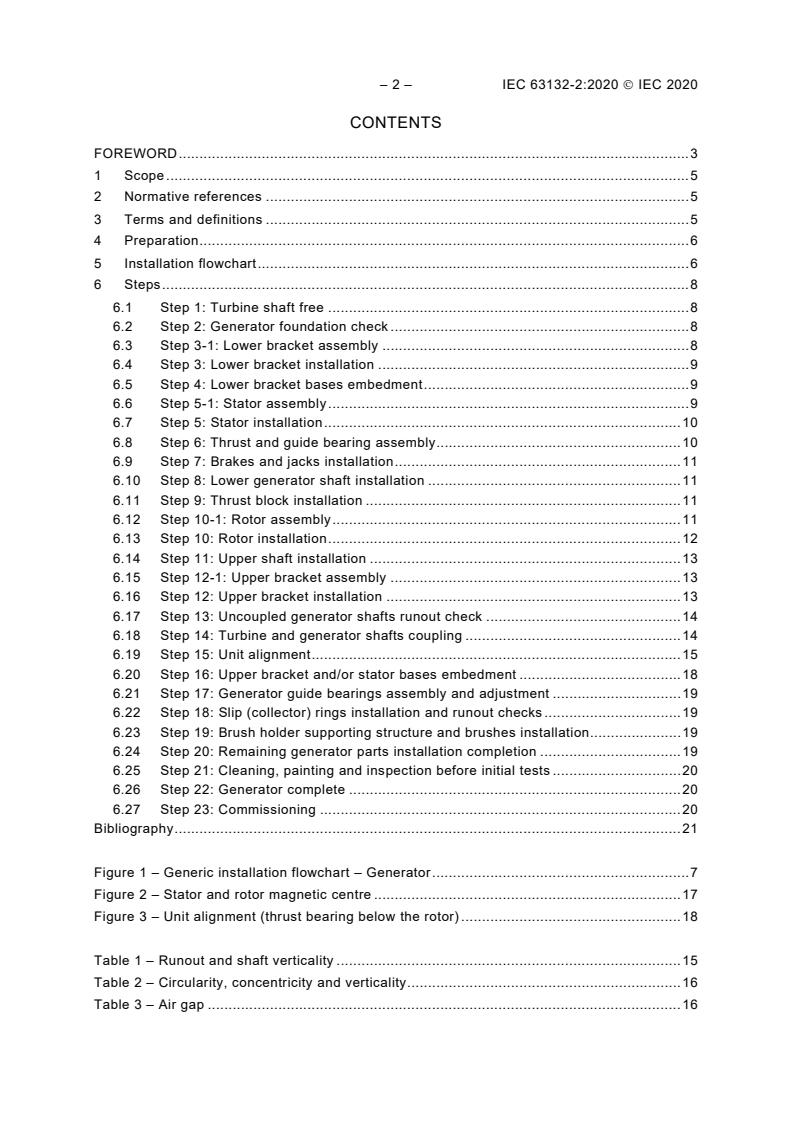
CONTENTS
FOREWORD . 3
1 Scope . 5
2 Normative references . 5
3 Terms and definitions . 5
4 Preparation . 6
5 Installation flowchart . 6
6 Steps . 8
6.1 Step 1: Turbine shaft free . 8
6.2 Step 2: Generator foundation check . 8
6.3 Step 3-1: Lower bracket assembly . 8
6.4 Step 3: Lower bracket installation . 9
6.5 Step 4: Lower bracket bases embedment . 9
6.6 Step 5-1: Stator assembly . 9
6.7 Step 5: Stator installation . 10
6.8 Step 6: Thrust and guide bearing assembly . 10
6.9 Step 7: Brakes and jacks installation . 11
6.10 Step 8: Lower generator shaft installation . 11
6.11 Step 9: Thrust block installation . 11
6.12 Step 10-1: Rotor assembly . 11
6.13 Step 10: Rotor installation . 12
6.14 Step 11: Upper shaft installation . 13
6.15 Step 12-1: Upper bracket assembly . 13
6.16 Step 12: Upper bracket installation . 13
6.17 Step 13: Uncoupled generator shafts runout check . 14
6.18 Step 14: Turbine and generator shafts coupling . 14
6.19 Step 15: Unit alignment . 15
6.20 Step 16: Upper bracket and/or stator bases embedment . 18
6.21 Step 17: Generator guide bearings assembly and adjustment . 19
6.22 Step 18: Slip (collector) rings installation and runout checks . 19
6.23 Step 19: Brush holder supporting structure and brushes installation . 19
6.24 Step 20: Remaining generator parts installation completion . 19
6.25 Step 21: Cleaning, painting and inspection before initial tests . 20
6.26 Step 22: Generator complete . 20
6.27 Step 23: Commissioning . 20
Bibliography . 21
Figure 1 – Generic installation flowchart – Generator . 7
Figure 2 – Stator and rotor magnetic centre . 17
Figure 3 – Unit alignment (thrust bearing below the rotor) . 18
Table 1 – Runout and shaft verticality . 15
Table 2 – Circularity, concentricity and verticality . 16
Table 3 – Air gap . 16
INTERNATIONAL ELECTROTECHNICAL COMMISSION
____________
GUIDANCE FOR INSTALLATION PROCEDURES
AND TOLERANCES OF HYDROELECTRIC MACHINES –
Part 2: Vertical generators
FOREWORD
1) The International Electrotechnical Commission (IEC) is a worldwide organization for standardization comprising
all national electrotechnical committees (IEC National Committees). The object of IEC is to promote international
co-operation on all questions concerning standardization in the electrical and electronic fields. To this end and
in addition to other activities, IEC publishes International Standards, Technical Specifications, Technical Reports,
Publicly Available Specifications (PAS) and Guides (hereafter referred to as “IEC Publication(s)”). Their
preparation is entrusted to technical committees; any IEC National Committee interested in the subject dealt with
may participate in this preparatory work. International, governmental and non-governmental organizations liaising
with the IEC also participate in this preparation. IEC collaborates closely with the International Organization for
Standardization (ISO) in accordance with conditions determined by agreement between the two organizations.
2) The formal decisions or agreements of IEC on technical matters express, as nearly as possible, an international
consensus of opinion on the relevant subjects since each technical committee has representation from all
interested IEC National Committees.
3) IEC Publications have the form of recommendations for international use and are accepted by IEC National
Committees in that sense. While all reasonable efforts are made to ensure that the technical content of IEC
Publications is accurate, IEC cannot be held responsible for the way in which they are used or for any
misinterpretation by any end user.
4) In order to promote international uniformity, IEC National Committees undertake to apply IEC Publications
transparently to the maximum extent possible in their national and regional publications. Any divergence between
any IEC Publication and the corresponding national or regional publication shall be clearly indicated in the latter.
5) IEC itself does not provide any attestation of conformity. Independent certification bodies provide conformity
assessment services and, in some areas, access to IEC marks of conformity. IEC is not responsible for any
services carried out by independent certification bodies.
6) All users should ensure that they have the latest edition of this publication.
7) No liability shall attach to IEC or its directors, employees, servants or agents including individual experts and
members of its technical committees and IEC National Committees for any personal injury, property damage or
other damage of any nature whatsoever, whether direct or indirect, or for costs (including legal fees) and
expenses arising out of the publication, use of, or reliance upon, this IEC Publication or any other IEC Publications.
8) Attention is drawn to the Normative references cited in this publication. Use of the referenced publications is
indispensable for the correct application of this publication.
9) Attention is drawn to the possibility that some of the elements of this IEC Publication may be the subject of patent
rights. IEC shall not be held responsible for identifying any or all such patent rights.
International Standard IEC 63132-2 has been prepared by IEC technical committee 4: Hydraulic
turbines.
The text of this International Standard is based on the following documents:
FDIS Report on voting
4/381/FDIS 4/391/RVD
Full information on the voting for the approval of this International Standard can be found in the
report on voting indicated in the above table.
This document has been drafted in accordance with the ISO/IEC Directives, Part 2.
A list of all parts in the IEC 63132 series, published under the general title Guidance for
installation procedures and tolerances of hydroelectric machines, can be found on the IEC
website
– 4 – IEC 63132-2:2020 IEC 2020
The committee has decided that the contents of this document will remain unchanged until the
stability date indicated on the IEC website under "http://webstore.iec.ch" in the data related to
the specific document. At this date, the document will be
• reconfirmed,
• withdrawn,
• replaced by a revised edition, or
• amended.
IMPORTANT – The 'colour inside' logo on the cover page of this publication indicates
that it contains colours which are considered to be useful for the correct understanding
of its contents. Users should therefore print this document using a colour printer.
GUIDANCE FOR INSTALLATION PROCEDURES
AND TOLERANCES OF HYDROELECTRIC MACHINES –
Part 2: Vertical generators
1 Scope
The purpose of this part of IEC 63132 is to establish, in a general way, suitable procedures and
tolerances for installation of generator. This document presents a typical assembly. There are
many possible ways to assemble a unit. The size of the machines, design of the machines,
layout of the powerhouse or delivery schedule of the components are some of the elements that
could result in additional steps, the elimination of some steps and/or assembly sequences.
It is understood that a publication of this type will be binding only if, and to the extent that, both
contracting parties have agreed upon it.
This document excludes matters of purely commercial interest, except those inextricably bound
up with the conduct of installation.
This document applies to vertical generators according to IEC 60034-7 .
The tolerances in this document have been established upon best practices and experience,
although it is recognized that other standards specify different tolerances.
Brushless excitation system is not included in this document.
Wherever this document specifies that documents, drawings or information is supplied by a
manufacturer (or by manufacturers), each individual manufacturer will furnish the appropriate
information for their own supply only.
2 Normative references
The following documents are referred to in the text in such a way that some or all of their content
constitutes requirements of this document. For dated references, only the edition cited applies.
For undated references, the latest edition of the referenced document (including any
amendments) applies.
IEC 60034-7:-, Rotating electrical machines - Part 7: Classification of types of constructions,
mounting arrangements and terminal box position (IM Code)
3 Terms and definitions
No terms and definitions are listed in this document.
ISO and IEC maintain terminological databases for use in standardization at the following
addresses:
____________
Third edition under preparation. Stage at the time of publication: IEC/ACDV 60034-7:2019.
Third edition under preparation. Stage at the time of publication: IEC/ACDV 60034-7:2019.
– 6 – IEC 63132-2:2020 IEC 2020
• IEC Electropedia: available at http://www.electropedia.org/
• ISO Online browsing platform: available at http://www.iso.org/obp
4 Preparation
Embedded parts such as piping and foundation plates are covered in the turbine embedded
parts.
5 Installation flowchart
The installation flowchart of this document showed in Figure 1 is mainly based on a vertical
generator having its thrust bearing under the rotor. If the generator has the thrust bearing above
the rotor or supported by the head cover, some corrections to the flowchart will be necessary.
NOTE 1 This flowchart represents a generator with thrust bearing below the rotor. For generators with thrust bearing
above the rotors, the steps with an asterisk would be totally or partially done between steps 11 and 12 in the flowchart.
NOTE 2 The generator installation is linked to the turbine installation.
Figure 1 – Generic installation flowchart – Generator
– 8 – IEC 63132-2:2020 IEC 2020
6 Steps
6.1 Step 1: Turbine shaft free
See the relevant turbine part of this document.
6.2 Step 2: Generator foundation check
a) Objective of work in the step
– Check the foundations for the upper and/or lower brackets (if applicable) and the stator.
– Check the openings for cables/bars for phase terminals and neutral point.
– Check the embedded water and oil piping.
b) Explanation of work
– Check the foundations for the lower bracket, upper bracket and the stator.
– Check the dimension of the openings.
– Check the position of piping (if secondary stage concreting is used, also check).
– Install the foundation bolts.
– Install the sole plates.
c) Recommendations
The tolerances should be provided by the generator supplier.
– If a one-stage concreting method is used
The location in plan, elevation and/or locations of the foundation plates should be
checked.
– If a two-stage concreting method is used
The location in plan, elevation and/or locations of the foundation bolts, embedded parts
and block-outs should be checked.
d) Additional information
There are two different methods for embedding the sole plates; one-stage concreting or two-
stage concreting method.
Care shall be taken when placing concrete to avoid moving the generator foundations.
If the two-stage concreting method is used, the entire surface of the block-out for the lower
bracket and stator bases should be prepared to ensure proper bonding between secondary
and primary concrete.
There are many different generator configurations. See IEC 60034-7 for a description of the
possibilities. The various configurations may or may not have a lower or an upper bracket.
6.3 Step 3-1: Lower bracket assembly
a) Objective of work in the step
– Assemble the lower bracket.
b) Explanation of work
– Attach the arms to the hub, as per the design (i.e. welding, bolting).
– This task is generally carried out outside of the pit.
c) Recommendations
The tolerances should be provided by the generator supplier, if required.
If the lower bracket is assembled by welding, non-destructive tests (NDT) according to the
inspection and test plan (ITP) may be required.
d) Additional information
The generator supplier should take precautions to limit the distortion by welding in order to
be able to connect to the embedded parts.
The lower bracket, upper bracket, rotor and stator assemblies are typically the largest
components in a unit and take considerable time (days to months) to assemble. Their
assembly works are often carried out in parallel and can greatly affect the assembly space
requirements and availability. This step is presented to ensure the reader is aware that there
are often challenges to find space and have all parties work effectively together on this issue.
6.4 Step 3: Lower bracket installation
a) Objective of work in the step
– Install the lower bracket in the correct position.
b) Explanation of work
– Place the lower bracket on the sole plates.
– Control the concentricity, elevation and level of the lower bracket.
c) Recommendations
Concentricity, elevation and level should be checked. The tolerances should be provided by
the generator supplier. When determining the correct elevation, the lower bracket deflection
due to the total weight of the rotating parts and the hydraulic thrust acting on the runner
when the unit is at the desired operating condition should be considered.
d) Additional information
Different designs require different tolerances; therefore, it is recommended that the
generator supplier provides the tolerances.
The lower bracket is aligned to the centre of bottom ring. The turbine shaft is typically to be
a relative reference. Other methods that employ benchmarks could also be used to align the
lower bracket.
In some cases, the brakes and jacks are installed in this step instead of Step 7: Brakes and
jacks installation.
6.5 Step 4: Lower bracket bases embedment
a) Objective of work in the step
– Embed the lower bracket bases.
b) Explanation of work
– Grout the through-bolts or the foundation bolts and sole plates.
c) Recommendations
Before embedment, check that any reinforcement will not interfere with the sole plates and
foundation bolts.
d) Additional information
Ensure that the air can escape upwards during grouting. Some designs do not require
second stage concrete.
Depending on the design, it may be possible to embed the lower bracket foundation plates
before installation of the lower bracket.
Care shall be taken when placing concrete to avoid moving the lower bracket bases.
6.6 Step 5-1: Stator assembly
a) Objective of work in the step
– Assemble the stator.
b) Explanation of work
– Assemble the stator frame by bolting or welding.
– Stack the core.
– Install the winding.
– Execute the electrical tests and mechanical measurements.
– 10 – IEC 63132-2:2020 IEC 2020
c) Recommendations
Please see Step 15: Unit alignment. The tolerances depend on the design.
d) Additional information
The stator can be assembled in the shop, in the pit or beside the pit. The stator can be
assembled from a number of pre-assembled blocks comprising cores, windings and frame,
or the frame is assembled first at the site and then the core is stacked in one complete ring.
Protect all winding parts especially during drilling and welding work occurring nearby.
See the additional information in Step 3-1: Lower bracket assembly.
6.7 Step 5: Stator installation
a) Objective of work in the step
– Install the stator in the pit.
b) Explanation of work
– Install the stator at the proper level, elevation and position.
c) Recommendations
Please see Step 15: Unit alignment. The tolerances depend on the design.
The stator magnetic centre elevation and stator core verticality should be checked. The
tolerances should be provided by the generator supplier.
d) Additional information
The stator is aligned to the centre of the bottom ring using a relative reference. The turbine
shaft flange is typically the relative reference. Other methods that employ benchmarks could
also be used to align the stator.
The alignment of the stator will be checked during the unit alignment (see Step 15: Unit
alignment). In some cases, the stator position may require adjustment.
6.8 Step 6: Thrust and guide bearing assembly
a) Objective of work in the step
– Assemble the combined thrust and guide bearing.
b) Explanation of work
– The thrust and guide bearing components and accessories are installed in the oil
reservoir located on the thrust bearing bracket.
– Check and eliminate any oil leakage from the oil reservoir.
c) Recommendations
The thrust bearing and bracket assembly is located concentric, at the proper elevation and
level. The tolerances should be provided by the generator supplier.
d) Additional information
The thrust bearing is aligned to the centre of the thrust bearing bracket. This may be
required for the bearing to function properly.
The alignment of the thrust bearing, the thrust bearing bracket and the rotating components
will be checked in Step 15: Unit alignment. In some cases, the position of these components
may require adjustment.
In order to install the rotor, a minimum of four guide bearing segments, spaced 90° apart,
shall be installed.
In some designs, the thrust bearing may be supported on the top of the head cover. In this
case, the thrust bearing housing is aligned to the centre of the head cover. The thrust
bearing is aligned to the centre of the thrust bearing housing.
In some designs, the generator guide bearing(s) may not be combined with the thrust
bearing. Other designs may also have a smaller diameter on the generator guide bearing
preventing the installation of the thrust block.
The electrical insulation of the bearing system should be checked.
NOTE The term "thrust bearing bracket" means either the lower or the upper bracket on which the thrust bearing is
located. In the case of a thrust bearing located below the rotor, the thrust bearing bracket is the lower bracket.
6.9 Step 7: Brakes and jacks installation
a) Objective of work in the step
– Install the brakes and lifting jacks.
b) Explanation of work
– Assemble the jacks, as per the design (i.e. on the lower bracket arms or on support
pedestals on the concrete).
– Assemble the pipes.
– Install the accessories (compressor, control panel, air tank, oil reservoir, etc.).
c) Recommendations
The level and height tolerances for the brake shoes should be provided by the generator
supplier.
d) Additional information
N/A
6.10 Step 8: Lower generator shaft installation
a) Objective of work in the step
– Install the lower generator shaft (if applicable) for coupling with the turbine shaft.
b) Explanation of work
– Install the lower shaft in the pit.
c) Recommendations
The level, elevation, concentricity and inclination should be checked. The tolerances should
be provided by the generator supplier.
d) Additional Information
N/A
6.11 Step 9: Thrust block installation
a) Objective of work in the step
– Place the thrust block on the thrust bearing and assemble to the shaft.
b) Explanation of work
– Connect the thrust runner to the thrust block.
– Connect the thrust block to the lower shaft (when the thrust bearing is below the rotor).
– Connect the thrust block to the upper shaft (when the thrust bearing is above the rotor).
c) Recommendations
Level, elevation, concentricity and inclination should be checked. The tolerances should be
provided by the generator supplier.
d) Additional information
It is assumed that the thrust runner is connected to the thrust block.
There are different designs which require different checks during installation of the shaft
and thrust block. In some designs, the thrust block may be integral to the shaft; in other
designs, the thrust block may attach to the rotor. There are also designs where the thrust
block is located on the turbine shaft, in which case the sequence of steps shall be revised.
In case of the thrust bearing being above the rotor, this step will follow Step 12: Upper
bracket installation.
6.12 Step 10-1: Rotor assembly
a) Objective of work in the step
– 12 – IEC 63132-2:2020 IEC 2020
– Assemble the generator rotor in the erection area.
b) Explanation of work
– Assemble the rotor spider, as per the design (i.e. welding, bolting).
– Stack the rotor rim and clamping in stages according to drawings and instructions.
– Adjust, if necessary, and tighten/shrink the rim to the hub/spider.
– Mount the poles on the rotor rim.
– Make the pole-to-pole connections and damper winding connections (if exist).
– Assemble the rotor brake ring.
– Assemble the ventilator ring, and the fan blades or rotating air guide, according to the
design.
– Dry (if necessary) and cleaning or painting according to the design.
– Execute the electrical tests and mechanical measurements.
c) Requirements and recommendations
Please see Step 15: Unit alignment. The tolerances depend on the design.
d) Additional information
If the rotor hub is assembled by welding, NDT according to the ITP is required.
It is a best practice to check the circularity, diameter and stacking height of the rotor rim.
It is a best practice to check the magnetic centre elevation at this step.
It is a best practice to verify the tightening and locking of all bolts and connections of rotating
parts.
In some designs, shims are provided between the poles and the rim to adjust the rotor
circularity, concentricity, and average diameter. In this case, it is a best practice to check
the stator inner diameter to determine the required shimming adjustment.
Protect the rotor especially during drilling and welding work occurring nearby.
The tolerances of the rim stacking height and magnetic centre elevation should be provided
by the generator supplier.
See the additional information in Step 3-1: Lower bracket assembly.
6.13 Step 10: Rotor installation
a) Objective of work in the step
– Move the rotor into the unit's pit.
b) Explanation of work
– Couple the rotor and the lower shaft.
– Couple the rotor with the thrust block, according to the design.
c) Recommendations
N/A
d) Additional information
There are many possible coupling systems, such as:
– friction coupling;
– fitted bolts;
– fitted sleeves;
– keys or dowels.
Depending on the design, machining of the bores and/or bolts may be required.
The tightening procedure should be provided by the generator supplier.
In the case of the thrust bearing being above the rotor, the rotor will be temporality placed
on the jacks until the upper shaft and the thrust block are installed.
6.14 Step 11: Upper shaft installation
a) Objective of work in the step
– Install the upper shaft on the rotor.
b) Explanation of work
– Install the upper shaft with respect to the centre of the rotor.
c) Recommendations
N/A
d) Additional information
There are many possible coupling systems, such as:
– friction coupling;
– fitted bolts;
– fitted sleeves;
– keys or dowels.
Depending on the design, machining of the bores and/or bolts may be required.
The tightening procedure should be provided by the generator supplier.
6.15 Step 12-1: Upper bracket assembly
a) Objective of work in the step
– Assemble the upper bracket.
b) Explanation of the work
– Attach the arms to the hub, as per the design (i.e. welding, bolting).
– This task generally happens outside of the pit.
c) Recommendations
The tolerances should be provided by the generator supplier, if required.
If the upper bracket is assembled by welding, NDT according to the ITP may be required.
d) Additional information
See the additional information in Step 3-1: Lower bracket assembly.
6.16 Step 12: Upper bracket installation
a) Objective of work in the step
– Place the upper bracket in the pit.
b) Explanation of work
– Place the upper bracket on the stator or other support.
– Install the upper guide bearing housing (if applicable).
c) Recommendations
The concentricity, elevation and level should be checked.
The tolerances should be provided by the generator supplier.
If the thrust bearing is above the rotor, refer to recommendations regarding the thrust
bearing elevation setting in Step 3: Lower bracket installation.
d) Additional information
The upper bracket is installed with respect to the centre of the upper shaft or the rotor
depending on design.
– 14 – IEC 63132-2:2020 IEC 2020
The alignment of the upper bracket will be checked in Step 15: Unit alignment. In some
cases, its position may require adjustment.
6.17 Step 13: Uncoupled generator shafts runout check
a) Objective of work in the step
– Check that the runout of the generator components is within the tolerance.
b) Explanation of work
– Rotate the generator and measure the runout of the generator shaft system.
c) Recommendations
The runout tolerance given in Step 15: Unit alignment should be used.
d) Additional information
It is a good practice to check the height differences between the theoretical elevation and
the actual bottom surface elevation of the coupling flange.
It is a good practice to check the relationship between the generator lower shaft and the
turbine shaft at this step. The concentricity of the two shafts and the verticality of the
generator lower shaft can be checked and adjusted if necessary.
In order to perform the runout check and unit alignment, a minimum of four guide bearing
segments (at the guide bearing closest to the thrust bearing), spaced 90° apart, shall be
installed and have their clearance set at a small value to limit the lateral movement while
still allowing the unit to rotate freely. In the case where the generator guide bearing is a
sleeve or split sleeve style bearing, temporary adjustable guides may need to be installed
to limit the lateral movement. All other interference (bearing, sealing, bearing covers, etc.)
should be removed.
It could also be helpful to have a preliminary assembly of the high pressure oil injection
system, if present, to facilitate the rotations.
6.18 Step 14: Turbine and generator shafts coupling
a) Objective of work in the step
– Couple the turbine and generator shafts.
b) Explanation of work
– Fit of the coupling flanges.
– Couple of the shafts.
– Tighten of the coupling bolts.
c) Recommendations
In many cases, the shafts coupling holes will be marked with numbers. In this case, these
holes will determine the angular positioning. When numbers are not marked, it is a good
practice to match the high point on generator shaft flange to the low point on the turbine
shaft flange.
It is a good practice to check the lower bracket deflection at this step when the turbine shaft
with the runner is coupled to the lower shaft, and all rotating weight is now supported by the
thrust bearing. If necessary, the lower bracket elevation may need adjustment to
compensate for the deflection due to the weight of the runner and turbine shaft.
d) Additional information
There are many possible coupling systems, such as:
– friction coupling;
– fitted bolts;
– fitted sleeves;
– keys or dowels.
Depending on the design, machining of the bore and/or bolts may be required
The tightening procedure should be provided by the supplier who supplied the fasteners.
This step can be used to calibrate the lower bracket. At this time, it is known how much the
lower bracket will deflect with a known weight (the rotating components). The elevation of
the lower bracket can be adjusted so that the rotating parts will be at the correct elevation
when the hydraulic thrust is applied.
6.19 Step 15: Unit alignment
a) Objective of work in the step
– Align and set the elevation of the rotating components within the stationary components.
b) Explanation of work
– In order to perform the unit alignment, a minimum of four guide bearing segments (at the
guide bearing closest to the thrust bearing), spaced 90°apart, need to be installed and
have their clearance set at a small value to limit the lateral movement while still allowing
the unit to rotate freely. All other interferences (bearings, seals, bearing covers, etc.)
should be removed.
– Rotate the unit and perform all measurements and adjustment to achieve required
tolerances.
– Secure the shaft system to allow the bearing, shaft sealing and cover installation and
adjustment.
c) Recommendations
The items listed in Table 1 should be checked.
Table 1 – Runout and shaft verticality
Item Tolerance Minimum No. of Measurement location
measurements
Shaft run-out 0,05 × L/D mm (peak to 4 readings for each dial At each bearing
peak) indicator at each
a
Minimum: half of the
bearing
design radial clearance of
the bearing.
Maximum: 1,5 times the
design radial clearance of
the bearing.
b
Shaft verticality 0,06 mm/m Shaft
4 readings
a
Readings at the guide bearing closest to the thrust bearing shall be used to compensate the translation
movement within this bearing to determine the pure rotation movement at the measured guide bearing journals.
b
There are many methods in measuring shaft verticality; however, they all require rotations. One common
method is to mount a level on the shaft body and record the level at every 90° positions. The verticality of the
shaft is obtained by calculating the best centre of the 4 readings. The verticality is corrected by re-aligning the
thrust bearing horizontal plane.
Refer to the unit alignment step in the appropriate turbine flowchart to determine the
applicable turbine tolerances that should be applied during the unit alignment.
Straightness verification may be useful to determine the cause of the run-out problem.
There are two methods presented for checking rotor and stator circularity, concentricity and
verticality.
• Method 1: This method is generally applied when the degree of confidence in the rotor
circularity, concentricity and vertically is low. For example, when the rotor spider shall
be welded at the site, or in case of a refurbishment project, this method will be applied.
If the stator and rotor verticalities are verified in previous steps, it is not necessary to
repeat in this step. See Table 2.
– 16 – IEC 63132-2:2020 IEC 2020
Table 2 – Circularity, concentricity and verticality
Item Tolerance Minimum no. of Measurement location
measurements
Stator circularity 8 % of the design air gap 8 when D < 5 m Top and bottom of core
SC
max. 1,5 mm
12 when 5 m ≤ D < 7,5 m
SC
16 when 7,5 m ≤
D < 10 m
SC
24 when D ≥ 10 m
SC
Stator concentricity 5 % of the design air gap 8 when D < 5m Top and bottom of core
SC
max. 1 mm
12 when 5 m ≤ D < 7,5 m
SC
16 when 7,5m ≤ D < 10 m
SC
24 when D ≥ 10 m
SC
a
8 when D < 5m
6 % of the design air gap Top and bottom of core
Stator core verticality
SC
12 when 5m ≤ D < 7,5 m
SC
16 when 7,5m ≤ D < 10 m
SC
24 when D ≥ 10 m
SC
Rotor circularity 6 % (average top and Number of rotor spider Top and bottom of poles
bottom air gap reading) arms
Rotor concentricity 1,2 % (average top and Number of rotor spider Top and bottom of poles
bottom air gap reading) arms
a
6 % of the design air gap Number of rotor spider Top and bottom of poles
Rotor pole verticality
arms
Key
D : diameter of the stator core
SC
a
This tolerance is applied at each measurement location.
• Method 2: This method is generally used when the level of confidence in the rotor
circularity, concentricity and verticality is high. See Table 3.
Examples of where this method could be used:
– the rotor spider is final machined at the shop;
– no structural site welding is necessary;
– no adjustment between the rim and spider is required.
Table 3 – Air gap
Item Tolerance Minimum no. of Measurement location
measurements
Air gap average with ±5% of the design air gap Number of poles Top and bottom of poles
respect to design air gap
Air gap min./max. values ±5% of the average air Number of poles Top and bottom of poles
gap
The rotor magnetic centre elevation and runner elevation should be checked and
compared to the stator magnetic centre elevation. The tolerances for the difference in
magnetic centre elevations should be provided by the generator supplier and the
tolerance on runner elevation should be provided by the turbine supplier. See Figure 2.
For the applicable Kaplan or propeller turbine tolerances that should be applied during
unit alignment, refer to mechanical parts step 17: Unit alignment of IEC 63132-4.
For the applicable Francis turbine tolerances that should be applied during unit
alignment, refer to mechanical parts step 18: Unit alignment of IEC 63132-3.
d) Additional information
Unit alignment is a combined effort by both the turbine and generator suppliers. Adjustments
on the turbine will affect generator results and vice-versa. Therefore, a good cooperation
and coordination are required between the turbine and generator supplier. See Figure 3.
In the case where the generator guide bearing is a sleeve or split sleeve style bearing,
temporary adjustable guides may need to be installed to limit the lateral movement.
In the case of water lubricated bearing with rubber layer pads, the minimum and maximum
criteria for the shaft runout tolerance do not apply.
Uneven heating sources (lights, heaters, etc.) and air movement should be minimized. Care
shall be taken to ensure reading repeatability. Measurement convention and timing shall be
coordinated.
For thrust bearings which are rigidly supported, the axis of rotation passes through the
centre of the guide bearing closest to the thrust bearing and is perpendicular to the plane
of the thrust bearing pads (sliding surface). For thrust bearings which are hydraulically self-
levelling, two guide bearings shall be installed (4 segments with small clearance) to define
the axis of rotation. The axis of rotation is the axis passing through the centre of the two
guide bearings. Therefore, in the case of units equipped with non-rigidly supported thrust
bearings, the method to verify verticality and runout is different.
Figure 2 – Stator and rotor magnetic centre
– 18 – IEC 63132-2:2020 IEC 2020
Figure 3 – Unit alignment (thrust bearing below the rotor)
6.20 Step 16: Upper bracket and/or stator bases embedment
a) Objective of work in the step
– Grout the upper bracket and/or the stator sole plates.
b) Explanation of work
– Grout the through-bolts or the founda
...