

IEC 60263:2020
(Main)Scales and sizes for plotting frequency characteristics and polar diagrams
General Information
- Abstract
IEC 60263:2020 specifies standard aspect ratios for logarithmic or level characteristics expressed in decibels versus a logarithmic frequency axis and ranges for the radius of polar diagrams of level. Applications include hard copy printouts, electronic files (e.g., PDF files), scientific publications, screen displays in computer programs and apps, as well as graphs in standards.
Informative examples of graphs that conform to the requirements in this document are found in Annex A.
Although outside the scope of this document, graphs with a linear y-axis versus logarithmic frequency (e.g., phase, group delay, etc.) often accompany the standard aspect ratio graphs of level described in the normative part of this document. These are described in informative Annex B.
IEC 60263:2020 cancels and replaces the third edition published in 1982. This edition constitutes a technical revision.
This edition includes the following significant technical changes with respect to the previous edition:
a) the scope is expanded to include electronic files (e.g., PDF), scientific publications, graphs in other standards, and screen displays in programs and apps;
b) a Terms and Definitions clause has been added;
c) aspect ratios of 20 dB/decade, and 0,5, 1, 1,25, and 2,5 decades/decade have been added;
d) ranges of 60 dB or 30 dB are specified for polar plots of absolute level; a 30 dB range is specified for polar plots of relative level;
e) as most graphs are now computer generated, tolerances and sizes have been removed;
f) all informative figures have been updated with contemporary examples;
g) an informative annex with information about linear y-axis vs. logarithmic frequency has been added.
- Status
- Published
- Publication Date
- 25-Jun-2020
- Technical Committee
- TC 29 - Electroacoustics
- Drafting Committee
- MT 25 - TC 29/MT 25
- Current Stage
- PPUB - Publication issued
- Start Date
- 26-Jun-2020
- Completion Date
- 10-Jul-2020

Overview
IEC 60263:2020 is the international standard that defines scales and sizes for plotting frequency characteristics and polar diagrams with an emphasis on standardizing graphical representations in electroacoustics and related fields. It specifies standard aspect ratios for frequency response plots, particularly logarithmic frequency versus level (in decibels), and standard ranges for the radii in polar level diagrams. This fourth edition updates and supersedes the 1982 version, reflecting advancements in graphic display technologies such as computer-generated plots, electronic documents (PDFs), screen displays, and scientific publications.
The purpose of IEC 60263:2020 is to ensure clarity, consistency, and comparability of graphical data presentations for frequency response and polar plots across different media and devices. By standardizing these visual formats, users including engineers, researchers, and product developers can accurately interpret and compare frequency-related measurements without distortion due to scale manipulation.
Key Topics
Standard Aspect Ratios for Frequency Plots: Defines official ratios for plotting levels in dB versus logarithmic frequency. This minimizes distortion in visual representation and prevents misleading impressions of flatness or steepness in spectral data.
Range Specifications for Polar Diagrams: Specifies radii ranges for polar plots including 60 dB and 30 dB for absolute level plots and 30 dB for relative level plots, enhancing standardization in directional response representations of audio devices.
Expanded Applications: The 2020 edition broadens scope from traditional printed graphs to include electronic files (e.g., PDF), scientific papers, computer program displays, and mobile apps.
Informative Annexes:
- Annex A: Provides current, practical examples of compliant frequency response plots and polar diagrams to guide proper implementation.
- Annex B: Discusses the complementary use of linear y-axis versus logarithmic frequency plots (e.g., for phase and group delay), a common accompaniment to the decibel-scale graphs.
Elimination of Tolerances: Recognizing the dominance of digital graph generation, this edition removes previously defined size tolerances, allowing flexibility in display size without compromising readability or standardization principles.
New Aspect Ratios Added: Includes aspect ratios such as 20 dB/decade, and frequency ratios like 0.5, 1, 1.25, and 2.5 decades per decade, offering better accommodation of diverse measurement data.
Applications
IEC 60263:2020 plays a vital role in ensuring accurate and consistent visualization of frequency-related data in:
Scientific Research: Standardized graphs allow researchers to publish clear and comparable frequency response data in journals and conferences.
Product Development: Manufacturers of microphones, loudspeakers, hearing aids, and audio amplifiers use standardized plotting to characterize device performance and disseminate results in datasheets, user manuals, and technical reports.
Software and Apps: Audio analysis programs and mobile applications use the standard’s aspect ratios and polar plot ranges to present frequency characteristics intuitively and reliably.
Technical Standards and Documentation: Ensures uniformity of graphical data in international and national standards, supporting harmonization across industries.
Educational Materials: Facilitates teaching and understanding of frequency behavior in acoustics and electronics with universally recognized graph formats.
Related Standards
While IEC 60263:2020 specifically addresses frequency response and polar plotting scales, it complements other IEC and ISO standards in electroacoustics and signal measurement, including but not limited to:
- IEC 61672 - Electroacoustics - Sound level meters (for instrument measurements relevant to frequency plotting)
- IEC 60268 series - Sound system equipment (for standardized audio equipment performance characterization)
- ISO/IEC Directives, Part 2 (governing the development of International Standards)
For terminology, the standard references the International Electrotechnical Vocabulary (IEV), maintained jointly by ISO and IEC, ensuring consistent definitions across technical documents.
By adhering to IEC 60263:2020, professionals working with frequency characteristics and polar diagrams can achieve visual clarity, comparability, and international consistency in their graphical presentations, supporting precision and transparency in communication of electroacoustic data.
Get Certified
Connect with accredited certification bodies for this standard

BSMI (Bureau of Standards, Metrology and Inspection)
Taiwan's standards and inspection authority.
Sponsored listings
Frequently Asked Questions
IEC 60263:2020 is a standard published by the International Electrotechnical Commission (IEC). Its full title is "Scales and sizes for plotting frequency characteristics and polar diagrams". This standard covers: IEC 60263:2020 specifies standard aspect ratios for logarithmic or level characteristics expressed in decibels versus a logarithmic frequency axis and ranges for the radius of polar diagrams of level. Applications include hard copy printouts, electronic files (e.g., PDF files), scientific publications, screen displays in computer programs and apps, as well as graphs in standards. Informative examples of graphs that conform to the requirements in this document are found in Annex A. Although outside the scope of this document, graphs with a linear y-axis versus logarithmic frequency (e.g., phase, group delay, etc.) often accompany the standard aspect ratio graphs of level described in the normative part of this document. These are described in informative Annex B. IEC 60263:2020 cancels and replaces the third edition published in 1982. This edition constitutes a technical revision. This edition includes the following significant technical changes with respect to the previous edition: a) the scope is expanded to include electronic files (e.g., PDF), scientific publications, graphs in other standards, and screen displays in programs and apps; b) a Terms and Definitions clause has been added; c) aspect ratios of 20 dB/decade, and 0,5, 1, 1,25, and 2,5 decades/decade have been added; d) ranges of 60 dB or 30 dB are specified for polar plots of absolute level; a 30 dB range is specified for polar plots of relative level; e) as most graphs are now computer generated, tolerances and sizes have been removed; f) all informative figures have been updated with contemporary examples; g) an informative annex with information about linear y-axis vs. logarithmic frequency has been added.
IEC 60263:2020 specifies standard aspect ratios for logarithmic or level characteristics expressed in decibels versus a logarithmic frequency axis and ranges for the radius of polar diagrams of level. Applications include hard copy printouts, electronic files (e.g., PDF files), scientific publications, screen displays in computer programs and apps, as well as graphs in standards. Informative examples of graphs that conform to the requirements in this document are found in Annex A. Although outside the scope of this document, graphs with a linear y-axis versus logarithmic frequency (e.g., phase, group delay, etc.) often accompany the standard aspect ratio graphs of level described in the normative part of this document. These are described in informative Annex B. IEC 60263:2020 cancels and replaces the third edition published in 1982. This edition constitutes a technical revision. This edition includes the following significant technical changes with respect to the previous edition: a) the scope is expanded to include electronic files (e.g., PDF), scientific publications, graphs in other standards, and screen displays in programs and apps; b) a Terms and Definitions clause has been added; c) aspect ratios of 20 dB/decade, and 0,5, 1, 1,25, and 2,5 decades/decade have been added; d) ranges of 60 dB or 30 dB are specified for polar plots of absolute level; a 30 dB range is specified for polar plots of relative level; e) as most graphs are now computer generated, tolerances and sizes have been removed; f) all informative figures have been updated with contemporary examples; g) an informative annex with information about linear y-axis vs. logarithmic frequency has been added.
IEC 60263:2020 is classified under the following ICS (International Classification for Standards) categories: 17.140.50 - Electroacoustics. The ICS classification helps identify the subject area and facilitates finding related standards.
IEC 60263:2020 is available in PDF format for immediate download after purchase. The document can be added to your cart and obtained through the secure checkout process. Digital delivery ensures instant access to the complete standard document.
Standards Content (Sample)
IEC 60263 ®
Edition 4.0 2020-06
INTERNATIONAL
STANDARD
NORME
INTERNATIONALE
colour
inside
Scales and sizes for plotting frequency characteristics and polar diagrams
Échelles et dimensions des graphiques pour le tracé des courbes de réponse
en fréquence et des diagrammes polaires
All rights reserved. Unless otherwise specified, no part of this publication may be reproduced or utilized in any form
or by any means, electronic or mechanical, including photocopying and microfilm, without permission in writing from
either IEC or IEC's member National Committee in the country of the requester. If you have any questions about IEC
copyright or have an enquiry about obtaining additional rights to this publication, please contact the address below or
your local IEC member National Committee for further information.
Droits de reproduction réservés. Sauf indication contraire, aucune partie de cette publication ne peut être reproduite
ni utilisée sous quelque forme que ce soit et par aucun procédé, électronique ou mécanique, y compris la photocopie
et les microfilms, sans l'accord écrit de l'IEC ou du Comité national de l'IEC du pays du demandeur. Si vous avez des
questions sur le copyright de l'IEC ou si vous désirez obtenir des droits supplémentaires sur cette publication, utilisez
les coordonnées ci-après ou contactez le Comité national de l'IEC de votre pays de résidence.
IEC Central Office Tel.: +41 22 919 02 11
3, rue de Varembé info@iec.ch
CH-1211 Geneva 20 www.iec.ch
Switzerland
About the IEC
The International Electrotechnical Commission (IEC) is the leading global organization that prepares and publishes
International Standards for all electrical, electronic and related technologies.
About IEC publications
The technical content of IEC publications is kept under constant review by the IEC. Please make sure that you have the
latest edition, a corrigendum or an amendment might have been published.
IEC publications search - webstore.iec.ch/advsearchform Electropedia - www.electropedia.org
The advanced search enables to find IEC publications by a The world's leading online dictionary on electrotechnology,
variety of criteria (reference number, text, technical containing more than 22 000 terminological entries in English
committee,…). It also gives information on projects, replaced and French, with equivalent terms in 16 additional languages.
and withdrawn publications. Also known as the International Electrotechnical Vocabulary
(IEV) online.
IEC Just Published - webstore.iec.ch/justpublished
Stay up to date on all new IEC publications. Just Published IEC Glossary - std.iec.ch/glossary
details all new publications released. Available online and 67 000 electrotechnical terminology entries in English and
once a month by email. French extracted from the Terms and Definitions clause of
IEC publications issued since 2002. Some entries have been
IEC Customer Service Centre - webstore.iec.ch/csc collected from earlier publications of IEC TC 37, 77, 86 and
If you wish to give us your feedback on this publication or CISPR.
need further assistance, please contact the Customer Service
Centre: sales@iec.ch.
A propos de l'IEC
La Commission Electrotechnique Internationale (IEC) est la première organisation mondiale qui élabore et publie des
Normes internationales pour tout ce qui a trait à l'électricité, à l'électronique et aux technologies apparentées.
A propos des publications IEC
Le contenu technique des publications IEC est constamment revu. Veuillez vous assurer que vous possédez l’édition la
plus récente, un corrigendum ou amendement peut avoir été publié.
Recherche de publications IEC - Electropedia - www.electropedia.org
webstore.iec.ch/advsearchform Le premier dictionnaire d'électrotechnologie en ligne au
La recherche avancée permet de trouver des publications IEC monde, avec plus de 22 000 articles terminologiques en
en utilisant différents critères (numéro de référence, texte, anglais et en français, ainsi que les termes équivalents dans
comité d’études,…). Elle donne aussi des informations sur les 16 langues additionnelles. Egalement appelé Vocabulaire
projets et les publications remplacées ou retirées. Electrotechnique International (IEV) en ligne.
IEC Just Published - webstore.iec.ch/justpublished Glossaire IEC - std.iec.ch/glossary
Restez informé sur les nouvelles publications IEC. Just 67 000 entrées terminologiques électrotechniques, en anglais
Published détaille les nouvelles publications parues. et en français, extraites des articles Termes et Définitions des
Disponible en ligne et une fois par mois par email. publications IEC parues depuis 2002. Plus certaines entrées
antérieures extraites des publications des CE 37, 77, 86 et
Service Clients - webstore.iec.ch/csc CISPR de l'IEC.
Si vous désirez nous donner des commentaires sur cette
publication ou si vous avez des questions contactez-nous:
sales@iec.ch.
IEC 60263 ®
Edition 4.0 2020-06
INTERNATIONAL
STANDARD
NORME
INTERNATIONALE
colour
inside
Scales and sizes for plotting frequency characteristics and polar diagrams
Échelles et dimensions des graphiques pour le tracé des courbes de réponse
en fréquence et des diagrammes polaires
INTERNATIONAL
ELECTROTECHNICAL
COMMISSION
COMMISSION
ELECTROTECHNIQUE
INTERNATIONALE
ICS 17.140.50 ISBN 978-2-8322-8497-1
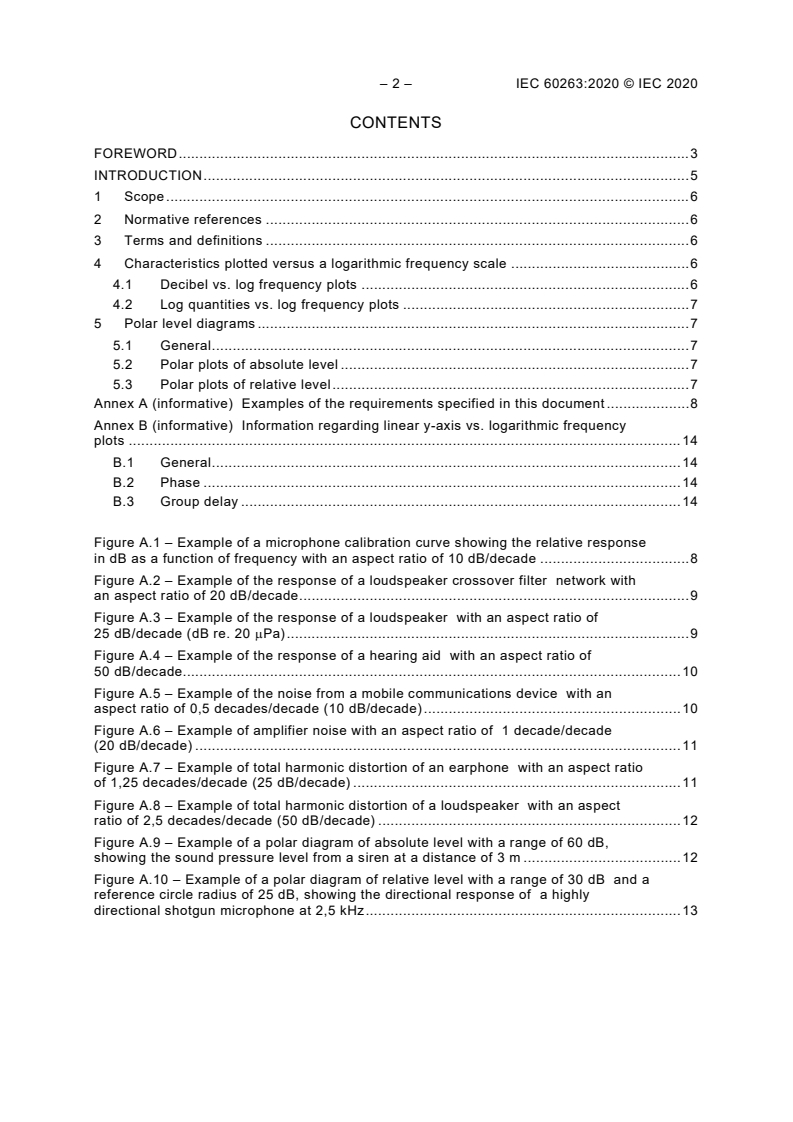
– 2 – IEC 60263:2020 © IEC 2020
CONTENTS
FOREWORD . 3
INTRODUCTION . 5
1 Scope . 6
2 Normative references . 6
3 Terms and definitions . 6
4 Characteristics plotted versus a logarithmic frequency scale . 6
4.1 Decibel vs. log frequency plots . 6
4.2 Log quantities vs. log frequency plots . 7
5 Polar level diagrams . 7
5.1 General . 7
5.2 Polar plots of absolute level . 7
5.3 Polar plots of relative level . 7
Annex A (informative) Examples of the requirements specified in this document . 8
Annex B (informative) Information regarding linear y-axis vs. logarithmic frequency
plots . 14
B.1 General . 14
B.2 Phase . 14
B.3 Group delay . 14
Figure A.1 – Example of a microphone calibration curve showing the relative response
in dB as a function of frequency with an aspect ratio of 10 dB/decade . 8
Figure A.2 – Example of the response of a loudspeaker crossover filter network with
an aspect ratio of 20 dB/decade . 9
Figure A.3 – Example of the response of a loudspeaker with an aspect ratio of
25 dB/decade (dB re. 20 µPa) . 9
Figure A.4 – Example of the response of a hearing aid with an aspect ratio of
50 dB/decade. 10
Figure A.5 – Example of the noise from a mobile communications device with an
aspect ratio of 0,5 decades/decade (10 dB/decade) . 10
Figure A.6 – Example of amplifier noise with an aspect ratio of 1 decade/decade
(20 dB/decade) . 11
Figure A.7 – Example of total harmonic distortion of an earphone with an aspect ratio
of 1,25 decades/decade (25 dB/decade) . 11
Figure A.8 – Example of total harmonic distortion of a loudspeaker with an aspect
ratio of 2,5 decades/decade (50 dB/decade) . 12
Figure A.9 – Example of a polar diagram of absolute level with a range of 60 dB,
showing the sound pressure level from a siren at a distance of 3 m . 12
Figure A.10 – Example of a polar diagram of relative level with a range of 30 dB and a
reference circle radius of 25 dB, showing the directional response of a highly
directional shotgun microphone at 2,5 kHz . 13
INTERNATIONAL ELECTROTECHNICAL COMMISSION
____________
SCALES AND SIZES FOR PLOTTING FREQUENCY
CHARACTERISTICS AND POLAR DIAGRAMS
FOREWORD
1) The International Electrotechnical Commission (IEC) is a worldwide organization for standardization comprising
all national electrotechnical committees (IEC National Committees). The object of IEC is to promote international
co-operation on all questions concerning standardization in the electrical and electronic fields. To this end and
in addition to other activities, IEC publishes International Standards, Technical Specifications, Technical Reports,
Publicly Available Specifications (PAS) and Guides (hereafter referred to as “IEC Publication(s)”). Their
preparation is entrusted to technical committees; any IEC National Committee interested in the subject dealt with
may participate in this preparatory work. International, governmental and non-governmental organizations liaising
with the IEC also participate in this preparation. IEC collaborates closely with the International Organization for
Standardization (ISO) in accordance with conditions determined by agreement between the two organizations.
2) The formal decisions or agreements of IEC on technical matters express, as nearly as possible, an international
consensus of opinion on the relevant subjects since each technical committee has representation from all
interested IEC National Committees.
3) IEC Publications have the form of recommendations for international use and are accepted by IEC National
Committees in that sense. While all reasonable efforts are made to ensure that the technical content of IEC
Publications is accurate, IEC cannot be held responsible for the way in which they are used or for any
misinterpretation by any end user.
4) In order to promote international uniformity, IEC National Committees undertake to apply IEC Publications
transparently to the maximum extent possible in their national and regional publications. Any divergence between
any IEC Publication and the corresponding national or regional publication shall be clearly indicated in the latter.
5) IEC itself does not provide any attestation of conformity. Independent certification bodies provide conformity
assessment services and, in some areas, access to IEC marks of conformity. IEC is not responsible for any
services carried out by independent certification bodies.
6) All users should ensure that they have the latest edition of this publication.
7) No liability shall attach to IEC or its directors, employees, servants or agents including individual experts and
members of its technical committees and IEC National Committees for any personal injury, property damage or
other damage of any nature whatsoever, whether direct or indirect, or for costs (including legal fees) and
expenses arising out of the publication, use of, or reliance upon, this IEC Publication or any other IEC
Publications.
8) Attention is drawn to the Normative references cited in this publication. Use of the referenced publications is
indispensable for the correct application of this publication.
9) Attention is drawn to the possibility that some of the elements of this IEC Publication may be the subject of patent
rights. IEC shall not be held responsible for identifying any or all such patent rights.
International Standard IEC 60263 has been prepared by IEC technical committee TC 29:
Electroacoustics.
This fourth edition cancels and replaces the third edition published in 1982. This edition
constitutes a technical revision.
This edition includes the following significant technical changes with respect to the previous
edition:
a) the scope is expanded to include electronic files (e.g., PDF), scientific publications, graphs
in other standards, and screen displays in programs and apps;
b) a Terms and Definitions clause has been added;
c) aspect ratios of 20 dB/decade, and 0,5, 1, 1,25, and 2,5 decades/decade have been added;
d) ranges of 60 dB or 30 dB are specified for polar plots of absolute level; a 30 dB range is
specified for polar plots of relative level;
e) as most graphs are now computer generated, tolerances and sizes have been removed;
f) all informative figures have been updated with contemporary examples;
– 4 – IEC 60263:2020 © IEC 2020
g) an informative annex with information about linear y-axis vs. logarithmic frequency has been
added.
The text of this International Standard is based on the following documents:
CDV Report on voting
29/1038/CDV 29/1060/RVC
Full information on the voting for the approval of this International Standard can be found in the
report on voting indicated in the above table.
This document has been drafted in accordance with the ISO/IEC Directives, Part 2.
The committee has decided that the contents of this document will remain unchanged until the
stability date indicated on the IEC website under "http://webstore.iec.ch" in the data related to
the specific document. At this date, the document will be
• reconfirmed,
• withdrawn,
• replaced by a revised edition, or
• amended.
IMPORTANT – The 'colour inside' logo on the cover page of this publication indicates
that it contains colours which are considered to be useful for the correct understanding
of its contents. Users should therefore print this document using a colour printer.
INTRODUCTION
Historically, on analogue level recorders, 1 dB was represented by 1 mm, 2 mm or 5 mm,
corresponding to level ranges of 50 dB, 25 dB and 10 dB, respectively. One of these three level
ranges was equal in length to 1 decade on the logarithmic frequency scale of the paper used
for the plot, limiting the available aspect ratios. With the advent of computer-generated
graphics, plots can now be of any size that is legible or enlarged on a display as necessary.
A plot of the data may only represent a graphical summary that is convenient for communicating
via a report or other publication where one does not wish to list out the entire data set. This
further emphasizes the importance of the visual representation.
Therefore, in order to gain an accurate impression from a graph in which a response is plotted
as level (in decibels) or as an amplitude or percentage on a logarithmic y-axis versus frequency
on a logarithmic scale, it remains important that the aspect ratio be standardized. Otherwise, a
spectrum or response curve can be made to appear unduly flat or unduly steep by compression
or expansion of one of the axes.
The subject of interest is usually a frequency response or output spectrum that results from the
application of an input spectrum to a device such as a microphone, amplifier, hearing aid,
headphone, or loudspeaker, or alternatively, level differences for the response of these devices
compared to a reference response. Analogous characteristics may be measured and plotted for
the mechanical vibration of structures. Similarly, an insertion gain or transmission loss may be
plotted. For cascaded systems, the contribution of each sub-system to the overall result is more
readily understood if each characteristic is plotted to a standard aspect ratio.
For displaying frequency spectra and response characteristics, different ranges are often
needed. A range of 10 dB may suffice for the response of a standard measurement microphone,
but a range of more than 60 dB may be required for a filter or loudspeaker. Although these
requirements illustrate the need for different aspect ratios, the number of standard aspect ratios
should be kept to a minimum to facilitate comparisons.
Graphs for publication may be reduced or enlarged to fit the printed page. Likewise, graphs
may appear on the display of a computer screen or mobile app. Therefore, the use of a standard
aspect ratio makes it feasible to compare graphs from different sources or to view the same
data displayed on different sized displays.
– 6 – IEC 60263:2020 © IEC 2020
SCALES AND SIZES FOR PLOTTING FREQUENCY
CHARACTERISTICS AND POLAR DIAGRAMS
1 Scope
This document specifies standard aspect ratios for logarithmic or level characteristics
expressed in decibels versus a logarithmic frequency axis and ranges for the radius of polar
diagrams of level. Applications include hard copy printouts, electronic files (e.g., PDF files),
scientific publications, screen displays in computer programs and apps, as well as graphs in
standards.
Informative examples of graphs that conform to the requirements in this document are found in
Annex A.
Although outside the scope of this document, graphs with a linear y-axis versus logarithmic
frequency (e.g., phase, group delay, etc.) often accompany the standard aspect ratio graphs of
level described in the normative part of this document. These are described in informative
Annex B.
2 Normative references
There are no normative references in this document.
3 Terms and definitions
For the purposes of this document, the following terms and definitions apply.
ISO and IEC maintain terminological databases for use in standardization at the following
addresses:
• ISO Online browsing platform: available at https://www.iso.org/obp
• IEC Electropedia: available at http://www.electropedia.org/
3.1
aspect ratio
scale proportion between the y-axis and x-axis of a graph
Note 1 to entry: For graphs with a logarithmic frequency x-axis, the aspect ratio is expressed as the y-axis factor
per decade (in frequency), for example 25 dB/decade, or 1,25 decades/decade.
3.2
decade
factor of 10 on a logarithmic scale
Note 1 to entry: For example, 500 Hz is 1 decade above 50 Hz; 0,01 % is 3 decades below 10 %.
4 Characteristics plotted versus a logarithmic frequency scale
4.1 Decibel vs. log frequency plots
For graphs in which the y-axis depicts a level (in decibels) plotted versus logarithmic frequency
on the x-axis, the aspect ratio shall be 10 dB/decade, 20 dB/decade, 25 dB/decade or
50 dB/decade.
NOTE Direct comparison of hardcopy printouts to older analogue plots is facilitated by ensuring that 1 dB is equal
to 1 mm, 2 mm, or 5 mm, as required.
4.2 Log quantities vs. log frequency plots
For graphs in which the y-axis depicts an absolute quantity or a percentage on a logarithmic
amplitude scale plotted versus logarithmic frequency on the x-axis, the aspect ratio shall be
0,5 decades/decade, 1 decade/decade, 1,25 decades/decade or 2,5 decades/decade.
NOTE These aspect ratios correspond exactly to the level equivalents of 10 dB/decade, 20 dB/decade,
25 dB/decade and 50 dB/decade in 4.1, respectively.
5 Polar level diagrams
5.1 General
Polar level diagrams shall depict level as increasing outward versus radius. The angle of
incidence shall be depicted as increasing moving counterclockwise relative to the reference
direction. The angle assigned to the reference direction shall be 0°. Major angular divisions
shall be plotted as radii at a minimum of 30° intervals and shall be labelled.
5.2 Polar plots of absolute level
For a polar plot of absolute level referred to a reference quantity (e.g. dB re. 20µPa), the level
range of the graph shall be 60 dB or 30 dB to the origin.
For polar plots of absolute level with a range of 60 dB to the origin, the maximum level shall be
plotted less than 10 dB below the circle of maximum radius. Major level divisions shall be plotted
as concentric circles with radii in multiples of 10 dB. Major divisions shall be labelled. Optional
minor divisions are plotted as circles in 2 dB intervals without labels.
For polar plots of absolute level with a range of 30 dB to the origin, the maximum level shall be
plotted less than 5 dB below the circle of maximum radius. Major level divisions shall be plotted
as circles with radii in multiples of 5 dB. Major divisions shall be labelled. Optional minor
divisions are plotted as circles in 1 dB intervals without labels.
5.3 Polar plots of relative level
For a polar plot of relative level, such as the difference between the absolute level from a
transducer and the absolute level in a reference direction, the level range of the graph shall be
30 dB to the origin. The reference circle shall represent a relative level of 0 dB. The reference
circle radius shall be 10 dB, 15 dB, or 20 dB or 25 dB. The maximum level shall be plotted less
than or equal to 5 dB below the circle of maximum radius. Major level divisions shall be plotted
as circles with radii in multiples of 5 dB. Major divisions shall be labelled. Optional minor
divisions are plotted as circles in 1 dB intervals without labels.
NOTE The level in the reference direction is 0 dB.
– 8 – IEC 60263:2020 © IEC 2020
Annex A
(informative)
Examples of the requirements specified in this document
Examples of plots with the eight aspect ratios specified in this document are shown in
Figure A.1 through Figure A.8, respectively. The examples are plotted with typical data but are
not intended to restrict the plotting of data to any one of the aspect ratios or ranges illustrated.
Figure A.8 also shows the equivalence of level difference in decibels and percentage on a
logarithmic amplitude scale with a secondary y-axis scale in decibels on the right-hand side.
NOTE Minor gridlines following a base-10 pattern are preferred.
Figure A.9 is an example of a polar diagram according to this document with a 60 dB range,
showing the sound pressure level emitted by a siren at a distance of 3 m.
Figure A.10 is an example of a polar diagram showing the directional response of a shotgun
highly directional microphone at 2,5 kHz, relative to its on-axis response. The range of the plot
is 30 dB and the reference circle radius is a level difference of 25 dB.
Figure A.1 – Example of a microphone calibration curve showing the relative response
in dB as a function of frequency with an aspect ratio of 10 dB/decade
Figure A.2 – Example of the response of a loudspeaker crossover filter
network with an aspect ratio of 20 dB/decade
Figure A.3 – Example of the response of a loudspeaker
with an aspect ratio of 25 dB/decade (dB re. 20 µPa)
– 10 – IEC 60263:2020 © IEC 2020
Figure A.4 – Example of the response of a hearing aid
with an aspect ratio of 50 dB/decade
Figure A.5 – Example of the noise from a mobile communications device
with an aspect ratio of 0,5 decades/decade (10 dB/decade)
Figure A.6 – Example of amplifier noise with an aspect ratio of
1 decade/decade (20 dB/decade)
Figure A.7 – Example of total harmonic distortion of an earphone
with an aspect ratio of 1,25 decades/decade (25 dB/decade)
– 12 – IEC 60263:2020 © IEC 2020
Figure A.8 – Example of total harmonic distortion of a loudspeaker
with an aspect ratio of 2,5 decades/decade (50 dB/decade)
Figure A.9 – Example of a polar diagram of absolute level with a range of 60 dB,
showing the sound pressure level from a siren at a distance of 3 m
Figure A.10 – Example of a polar diagram of relative level with a range of 30 dB
and a reference circle radius of 25 dB, showing the directional response of
a highly directional shotgun microphone at 2,5 kHz
– 14 – IEC 60263:2020 © IEC 2020
Annex B
(informative)
Information regarding linear y-axis vs. logarithmic frequency plots
B.1 General
Graphs with a linear y-axis versus logarithmic frequency, such as phase, group delay, etc.,
often accompany the standard aspect ratio graphs of level described in the normative part of
this document. These graphs are, in general, subject to many of the same issues with respect
to comparison. Therefore, some guidelines are given to facilit
...