IEC 60749-22:2002/COR1:2003
(Corrigendum)Corrigendum 1 - Semiconductor devices - Mechanical and climatic test methods - Part 22: Bond strength
Corrigendum 1 - Semiconductor devices - Mechanical and climatic test methods - Part 22: Bond strength
Corrigendum 1 - Dispositifs à semiconducteurs - Méthodes d'essais mécaniques et climatiques - Partie 22: Robustesse des contacts soudés
General Information
Relations
Standards Content (Sample)
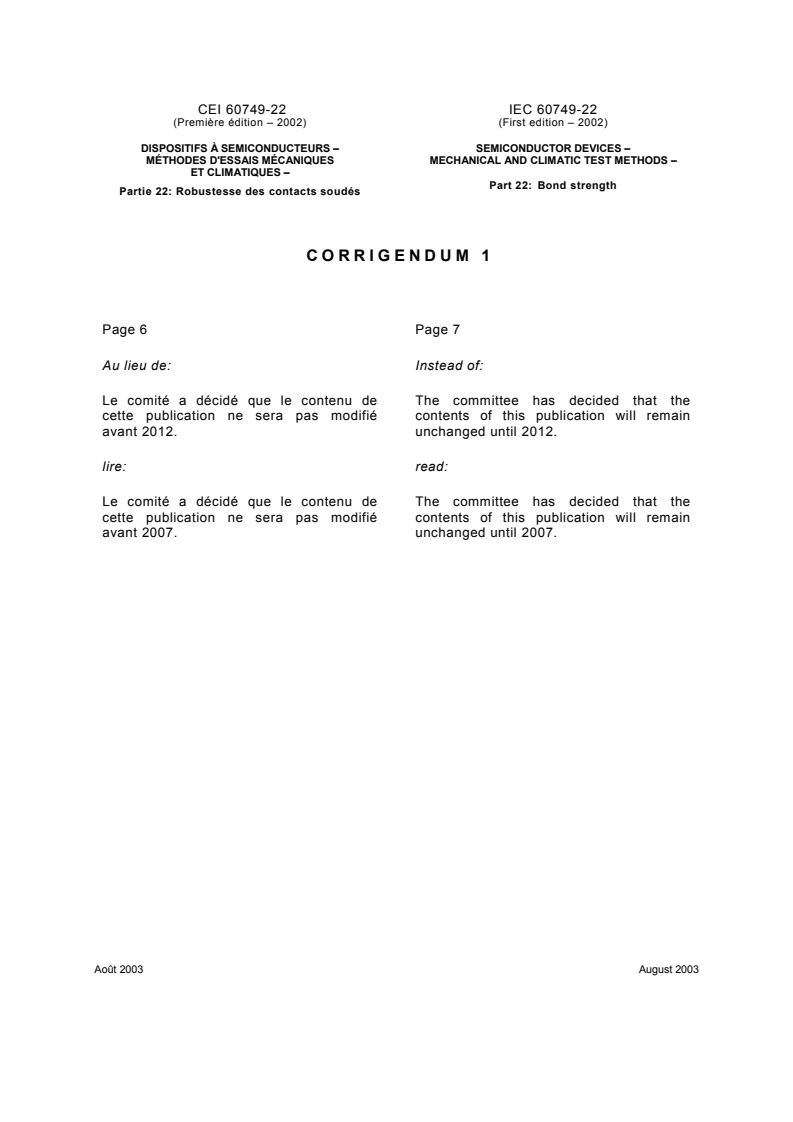
CEI 60749-22 IEC 60749-22
(Première édition – 2002) (First edition – 2002)
DISPOSITIFS À SEMICONDUCTEURS – SEMICONDUCTOR DEVICES –
MÉTHODES D'ESSAIS MÉCANIQUES MECHANICAL AND CLIMATIC TEST METHODS –
ET CLIMATIQUES –
Part 22: Bond strength
Partie 22: Robustesse des contacts soudés
CORRIGENDUM 1
Page 6 Page 7
Au lieu de: Instead of:
Le comité a décidé que le contenu de The committee has decided
...
This May Also Interest You
IEC 60749-21:2025 establishes a standard procedure for determining the solderability of device package terminations that are intended to be joined to another surface using tin-lead (SnPb) or lead-free (Pb-free) solder for the attachment. This test method provides a procedure for “dip and look” solderability testing of through hole, axial and surface mount devices (SMDs) as well as an optional procedure for a board mounting solderability test for SMDs for the purpose of allowing simulation of the soldering process to be used in the device application. The test method also provides optional conditions for ageing. This test is considered destructive unless otherwise detailed in the relevant specification.
NOTE 1 This test method does not assess the effect of thermal stresses which can occur during the soldering process. More details can be found in IEC 60749‑15 or IEC 60749‑20.
NOTE 2 If a qualitative test method is preferred, the Wetting balance test method can be found in IEC 60068-2-69.
This edition includes the following significant technical changes with respect to the previous edition:
- revision to certain operating conditions in line with current working practices.
- Standard61 pagesEnglish languagesale 15% off
IEC 60749-23:2025 specifies the test used to determine the effects of bias conditions and temperature on solid state devices over time. It simulates the device operating condition in an accelerated way and is primarily for device qualification and reliability monitoring. A form of high temperature bias life using a short duration, popularly known as "burn-in", can be used to screen for infant-mortality related failures. The detailed use and application of burn-in is outside the scope of this document.
This edition includes the following significant technical changes with respect to the previous edition:
a) absolute stress test definitions and resultant test durations have been updated.
- Standard29 pagesEnglish languagesale 15% off
IEC 60749-7:2025 specifies the testing and measurement of water vapour and other gas content of the atmosphere inside a metal or ceramic hermetically sealed device. The test is used as a measure of the quality of the sealing process and to provide information about the long-term chemical stability of the atmosphere inside the package. It is applicable to semiconductor devices sealed in such a manner but generally only used for high reliability applications such as military or aerospace.
Of particular interest is the measurement of the primary sealing gases (or lack thereof), the moisture content, the presence of bombing gases that are indicative of non-hermeticity (e.g. helium), oxygen to argon ratio indicative of room air ~ 20 to 1 (± 10 %), dissimilar concentration of internally sealed gases (e.g. nitrogen, helium) than originally sealed in the device package, the presence of leak test fluid (i.e. fluorocarbon, helium, air), and all other gases to determine if the device meets the specified moisture, hermeticity and other criteria. Also of interest is the measurement of all the other gases since they reflect upon the quality of the sealing process and provide information about the long-term chemical stability of the atmosphere inside the device. The presence of leak test fluorocarbon vapour in the internal gas analysis (IGA) is an indication of failure to meet leak test requirements of IEC 60749‑8.
This test is destructive.
This edition includes the following significant technical changes with respect to the previous edition:
a) This document has been re-written and rearranged to align with the text of MIL-STD-883, Method 1018.10.
b) Additional detail has been provided in the calibration requirements.
- Standard12 pagesEnglish languagesale 15% off
- Standard12 pagesFrench languagesale 15% off
- Standard24 pagesEnglish and French languagesale 15% off
IEC 60749-24:2025 specifies unbiased highly accelerated stress testing (HAST). HAST is performed for the purpose of evaluating the reliability of non-hermetically packaged solid-state devices in humid environments. It is a highly accelerated test which employs temperature and humidity under non-condensing conditions to accelerate the penetration of moisture through the external protective material (encapsulant or seal) or along the interface between the external protective material and the metallic conductors which pass through it. Bias is not applied in this test to ensure that the failure mechanisms potentially overshadowed by bias can be uncovered (e.g. galvanic corrosion).
This test is used to identify failure mechanisms internal to the package and is destructive.
This edition includes the following significant technical changes with respect to the previous edition:
a) rearrangement of clauses to reposition requirements;
b) addition of two notes to the post-test electrical procedures.
- Standard27 pagesEnglish languagesale 15% off
IEC 60749-22-2:2025 establishes a means for determining the strength of a ball bond to a die or package bonding surface and can be performed on pre-encapsulation or post-encapsulation devices. This measure of bond strength is extremely important in determining two features:
a) the integrity of the metallurgical bond which has been formed, and
b) the quality of ball bonds to die or package bonding surfaces.
This test method covers thermosonic (ball) bonds made with small diameter wire from 15 µm to 76 µm (0,000 6" to 0,003").
This test method can only be used when the bonds are large enough to allow for proper contact with the shear test chisel and when there are no adjacent interfering structures that would hinder the movement of the chisel. For consistent shear results the ball height will be at least 4,0 µm (0,000 6 ") for ball bonds, which is the current state of the art for bond shear test equipment at the time of this revision.
This test method can also be used on ball bonds that have had their wire removed and on to which a second bond wire (typically a stitch bond) is placed. This is known as "stitch on ball" and "reverse bonding". See Annex A for additional information.
The wire bond shear test is destructive. It is appropriate for use in process development, process control, or quality assurance, or both.
This test method can be used on ultrasonic (wedge) bonds, however its use has not been shown to be a consistent indicator of bond integrity. See Annex B for information on performing shear testing on wedge bonds.
This test method does not include bond strength testing using wire bond pull testing. Wire bond pull testing is described in IEC 60749-22-1.
This first edition, together with the first edition of IEC 60749-22-1, cancels and replaces the first edition IEC 60749-22 published in 2002. This International Standard is to be used in conjunction with IEC 60749-22-1:2025.
This edition includes the following significant technical changes with respect to the previous edition:
a) Major update, including new techniques and use of new materials (e.g. copper wire) involving a complete rewrite as two separate subparts (this document and IEC 60749‑22‑1).
- Standard34 pagesEnglish languagesale 15% off
- Standard38 pagesFrench languagesale 15% off
- Standard72 pagesEnglish and French languagesale 15% off
IEC 60749-22-1:2025 provides a means for determining the strength and failure mode of a wire bonded to, and the corresponding interconnects on, a die or package bonding surface and can be performed on unencapsulated or decapsulated devices. This test method can be performed on gold alloy, copper alloy, and silver alloy thermosonic (ball and stitch) bonds made of wire ranging in diameter from 15 µm to 76 µm (0,000 6" to 0,003"); and on gold alloy, copper alloy, and aluminium alloy ultrasonic (wedge) bonds made of wire ranging in diameter from 18 µm to 600 µm (0,000 7" to 0,024").
This wire bond pull test method is destructive. It is appropriate for use in process development, process control, or quality assurance.
This test method allows for two distinct methods of pulling wires:
a) One method incorporates the use of a hook that is placed under the wire and is then pulled.
b) One method requires that after the wire be cut, a clamp is placed on the wire connected to the bond to be tested, and this clamp is used to pull the wire.
This test method does not include bond strength testing using wire bond shear testing. Wire bond shear testing is described in IEC 60749-22-2.
This first edition, together with the first edition of IEC 60749-22-2:2025, cancels and replaces the first edition of IEC 60749-22 published in 2002.
This edition includes the following significant technical changes with respect to the previous edition:
a) Major update, including new techniques and use of new materials (e.g. copper wire) involving a complete rewrite as two separate subparts (this document and IEC 60749-22-2).
This International Standard is to be used in conjunction with IEC 60749-22-2:2025.
- Standard61 pagesEnglish languagesale 15% off
- Standard67 pagesFrench languagesale 15% off
- Standard128 pagesEnglish and French languagesale 15% off
IEC 60749-34-1:2025 describes a test method that is used to determine the capability of power semiconductor modules to withstand thermal and mechanical stress resulting from cycling the power dissipation of the internal semiconductors and the internal connectors. It is based on IEC 60749-34, but is developed specifically for power semiconductor module products, including insulated-gate bipolar transistor (IGBT), metal-oxide-semiconductor field-effect transistor (MOSFET), diode and thyristor.
If there is a customer request for an individual use or an application specific guideline (for example ECPE Guideline AQG 324), details of the test method can be based on these requirements if they deviate from the content of this document.
This test caused wear-out and is considered destructive.
- Standard56 pagesEnglish and French languagesale 15% off
IEC 60749-5:2023 provides a steady-state temperature and humidity bias life test to evaluate the reliability of non-hermetic packaged semiconductor devices in humid environments. This test method is considered destructive. This edition includes the following significant technical changes with respect to the previous edition:
a) The specification of the test equipment is changed to require the need to minimize relative humidity gradients and maximize air flow between semiconductor devices under test;
b) The specification of the test equipment fixtures is changed to require the avoidance of condensation on devices under test and on electrical fixtures connecting the devices to the test equipment;
c) replacement of references to “virtual junction” with “die”.
- Standard26 pagesEnglish languagesale 15% off
- Standard17 pagesEnglish and French languagesale 15% off
IEC 63287-2:2023 gives guidelines for the development of reliability qualification plans using the concept of mission profile, based on the environmental conditioning and proposed usage of the product. This document is not intended for military- and space-related applications.
- Standard30 pagesEnglish and French languagesale 15% off
IEC 60749-37:2022 provides a test method that is intended to evaluate and compare drop performance of surface mount electronic components for handheld electronic product applications in an accelerated test environment, where excessive flexure of a circuit board causes product failure. The purpose is to standardize the test board and test methodology to provide a reproducible assessment of the drop test performance of surface-mounted components while producing the same failure modes normally observed during product level test. This edition includes the following significant technical changes with respect to the previous edition:
- correction of a previous technical error concerning test conditions;
- updates to reflect improvements in technology.
- Standard67 pagesEnglish languagesale 15% off
- Standard43 pagesEnglish and French languagesale 15% off


Questions, Comments and Discussion
Ask us and Technical Secretary will try to provide an answer. You can facilitate discussion about the standard in here.
Loading comments...