

IEC 61970-600-1:2021
(Main)Energy management system application program interface (EMS-API) - Part 600-1: Common Grid Model Exchange Standard (CGMES) - Structure and rules
General Information
- Abstract
IEC 61970-600-1:2021 covers the definition of Common Grid Model Exchange Standard (CGMES), defines the main rules and application’s requirements to meet business requirements for assembled and merged model to fit relevant business services. This document does not define the business requirements, business processes nor how applications are implemented. This document defines how relevant Common Information Model (CIM) standards work together so that specific business requirements can be resolved.
It also includes extensions to the Common Information Model (CIM). The current extensions are defined in IEC 61970-301:2020 and will be covered in its future Amendment 1, but additional extensions can be defined in other standards in the IEC 61970-600-series. The extensions can be used to define additional profiles or to expand IEC 61970-450-series or IEC 61968-13 profiles. However, primary CGMES includes additional constraints on existing profiles and validation of assembled and merged models that is based on existing profiles. This can be done by making optional attributes and associations mandatory (required).
In addition, this document includes the specification of the serialisation that must be supported by referring to an existing standard defined in IEC 61970-550-series, e.g. IEC 61970-552, and making relevant constraints related to it.
The goal is to achieve interoperability between applications using CGMES in a high-performance environment with combined minimum effort so that relevant business processes are satisfied.
This first edition cancels and replaces IEC TS 61970-600-1 published in 2017. This edition constitutes a technical revision.
- Status
- Published
- Publication Date
- 03-Jun-2021
- Technical Committee
- TC 57 - Power systems management and associated information exchange
- Drafting Committee
- WG 13 - TC 57/WG 13
- Current Stage
- PPUB - Publication issued
- Start Date
- 04-Jun-2021
- Completion Date
- 11-Jun-2021
Buy Documents
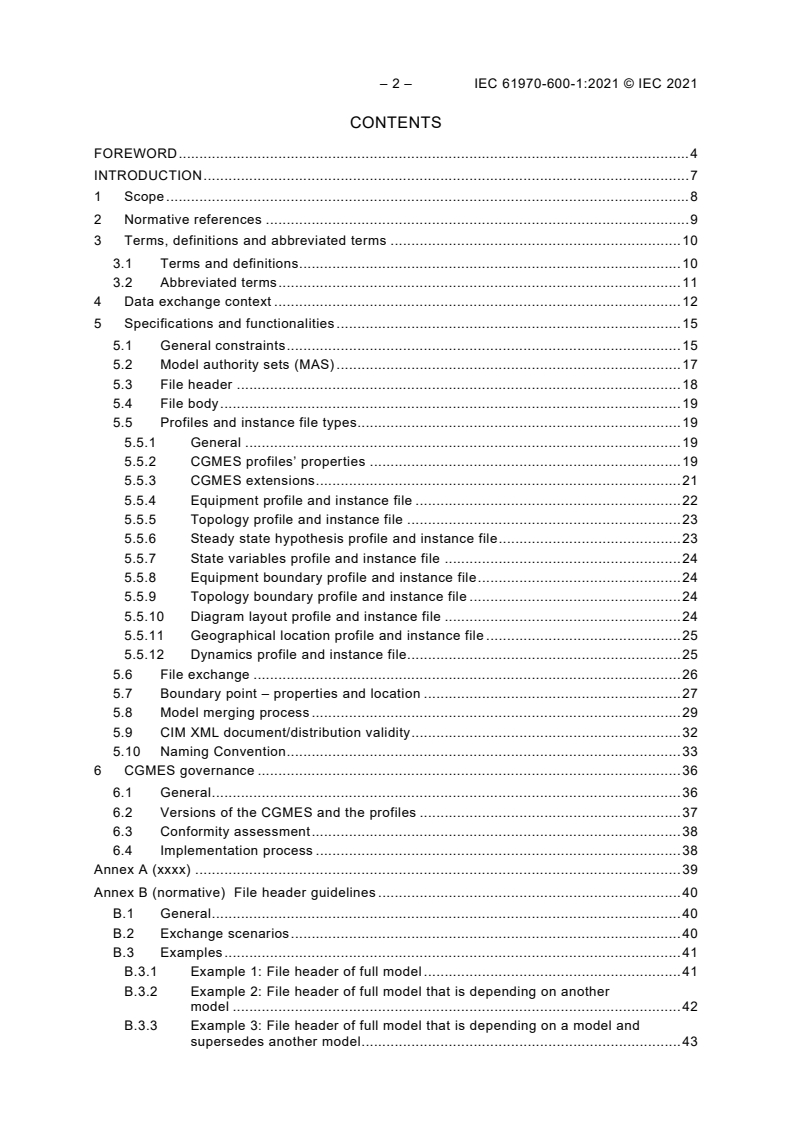
IEC 61970-600-1:2021 - Energy management system application program interface (EMS-API) - Part 600-1: Common Grid Model Exchange Standard (CGMES) - Structure and rules Released:6/4/2021
IEC 61970-600-1:2021 - Energy management system application program interface (EMS-API) - Part 600-1: Common Grid Model Exchange Standard (CGMES) - Structure and rules Released:6/4/2021
Overview
IEC 61970-600-1:2021 defines the Common Grid Model Exchange Standard (CGMES) structure and rules as part of the Energy Management System Application Program Interface (EMS‑API) family. The standard specifies how Common Information Model (CIM) standards work together to enable interoperable exchange, validation and merging of power system models. It focuses on format, constraints, profiles, serialization and governance for exchanging assembled and merged grid models - but does not prescribe business processes or application implementation details.
Key topics and technical requirements
- CGMES structure and profiles: Defines a set of CGMES profiles (equipment, topology, steady‑state hypothesis, state variables, diagram/layout, geographical location, dynamics, etc.) and rules for profile contents and relationships.
- Model Authority Sets (MAS): Rules for identifying model ownership, dependencies and authoritative data sources used when assembling and merging multi‑source grid models.
- File header & body rules: Requirements for file headers, metadata and instance file organization to support dependable model exchange and traceability.
- Serialization: Specifies required serialization formats by referencing IEC 61970‑550‑series standards (for example IEC 61970‑552) and applies constraints to serialized CIM XML.
- Validation and merging: Defines validation rules and the model merging process to create consistent assembled/merged models suitable for operational services.
- Profile constraints and extensions: Adds constraints (including making some optional CIM attributes mandatory) and supports CIM extensions defined in IEC 61970‑301:2020 (and future amendments) or other IEC 61970‑600 series documents.
- Governance and conformity: Versioning, conformity assessment guidance and implementation governance to ensure interoperability in high‑performance environments.
Applications and users
IEC 61970‑600‑1 (CGMES) is intended for:
- Transmission System Operators (TSOs), Distribution System Operators (DSOs) and Regional Coordination Centres (RCCs)
- EMS/SCADA, planning and market systems vendors and integrators
- Tooling for power flow, contingency analysis, short‑circuit studies, capacity calculation, dynamic security assessment and market transparency
- System engineers responsible for model management, exchange workflows, model merging and interoperability testing
By enforcing consistent profiles, serialization and validation, CGMES reduces integration effort and improves data quality across multi‑vendor and cross‑organizational exchanges.
Related standards
- IEC 61970 series (CIM for EMS‑API)
- IEC 61970‑301:2020 (CIM extensions) and its future amendments
- IEC 61970‑550 series (CIM XML serialization, e.g. IEC 61970‑552)
- IEC 61968‑13 and IEC 62325 series (related CIM profiles and market data exchange)
Keywords: IEC 61970‑600‑1, CGMES, Common Grid Model Exchange Standard, CIM, EMS‑API, power system model exchange, model merging, model authority set, serialization, interoperability.
Relations
- Effective Date
- 05-Sep-2023
Buy Documents
IEC 61970-600-1:2021 - Energy management system application program interface (EMS-API) - Part 600-1: Common Grid Model Exchange Standard (CGMES) - Structure and rules Released:6/4/2021
IEC 61970-600-1:2021 - Energy management system application program interface (EMS-API) - Part 600-1: Common Grid Model Exchange Standard (CGMES) - Structure and rules Released:6/4/2021
Get Certified
Connect with accredited certification bodies for this standard

ANCE
Mexican certification and testing association.

Intertek Slovenia
Intertek testing, inspection, and certification services in Slovenia.

LNE (Laboratoire National de Métrologie et d'Essais)
French national laboratory for metrology and testing.
Sponsored listings
Frequently Asked Questions
IEC 61970-600-1:2021 is a standard published by the International Electrotechnical Commission (IEC). Its full title is "Energy management system application program interface (EMS-API) - Part 600-1: Common Grid Model Exchange Standard (CGMES) - Structure and rules". This standard covers: IEC 61970-600-1:2021 covers the definition of Common Grid Model Exchange Standard (CGMES), defines the main rules and application’s requirements to meet business requirements for assembled and merged model to fit relevant business services. This document does not define the business requirements, business processes nor how applications are implemented. This document defines how relevant Common Information Model (CIM) standards work together so that specific business requirements can be resolved. It also includes extensions to the Common Information Model (CIM). The current extensions are defined in IEC 61970-301:2020 and will be covered in its future Amendment 1, but additional extensions can be defined in other standards in the IEC 61970-600-series. The extensions can be used to define additional profiles or to expand IEC 61970-450-series or IEC 61968-13 profiles. However, primary CGMES includes additional constraints on existing profiles and validation of assembled and merged models that is based on existing profiles. This can be done by making optional attributes and associations mandatory (required). In addition, this document includes the specification of the serialisation that must be supported by referring to an existing standard defined in IEC 61970-550-series, e.g. IEC 61970-552, and making relevant constraints related to it. The goal is to achieve interoperability between applications using CGMES in a high-performance environment with combined minimum effort so that relevant business processes are satisfied. This first edition cancels and replaces IEC TS 61970-600-1 published in 2017. This edition constitutes a technical revision.
IEC 61970-600-1:2021 covers the definition of Common Grid Model Exchange Standard (CGMES), defines the main rules and application’s requirements to meet business requirements for assembled and merged model to fit relevant business services. This document does not define the business requirements, business processes nor how applications are implemented. This document defines how relevant Common Information Model (CIM) standards work together so that specific business requirements can be resolved. It also includes extensions to the Common Information Model (CIM). The current extensions are defined in IEC 61970-301:2020 and will be covered in its future Amendment 1, but additional extensions can be defined in other standards in the IEC 61970-600-series. The extensions can be used to define additional profiles or to expand IEC 61970-450-series or IEC 61968-13 profiles. However, primary CGMES includes additional constraints on existing profiles and validation of assembled and merged models that is based on existing profiles. This can be done by making optional attributes and associations mandatory (required). In addition, this document includes the specification of the serialisation that must be supported by referring to an existing standard defined in IEC 61970-550-series, e.g. IEC 61970-552, and making relevant constraints related to it. The goal is to achieve interoperability between applications using CGMES in a high-performance environment with combined minimum effort so that relevant business processes are satisfied. This first edition cancels and replaces IEC TS 61970-600-1 published in 2017. This edition constitutes a technical revision.
IEC 61970-600-1:2021 is classified under the following ICS (International Classification for Standards) categories: 33.200 - Telecontrol. Telemetering. The ICS classification helps identify the subject area and facilitates finding related standards.
IEC 61970-600-1:2021 has the following relationships with other standards: It is inter standard links to IEC TS 61970-600-1:2017. Understanding these relationships helps ensure you are using the most current and applicable version of the standard.
IEC 61970-600-1:2021 is available in PDF format for immediate download after purchase. The document can be added to your cart and obtained through the secure checkout process. Digital delivery ensures instant access to the complete standard document.
Standards Content (Sample)
IEC 61970-600-1 ®
Edition 1.0 2021-06
INTERNATIONAL
STANDARD
colour
inside
Energy management system application program interface (EMS-API) –
Part 600-1: Common Grid Model Exchange Standard (CGMES) – Structure and
rules
All rights reserved. Unless otherwise specified, no part of this publication may be reproduced or utilized in any form
or by any means, electronic or mechanical, including photocopying and microfilm, without permission in writing from
either IEC or IEC's member National Committee in the country of the requester. If you have any questions about IEC
copyright or have an enquiry about obtaining additional rights to this publication, please contact the address below or
your local IEC member National Committee for further information.
IEC Central Office Tel.: +41 22 919 02 11
3, rue de Varembé info@iec.ch
CH-1211 Geneva 20 www.iec.ch
Switzerland
About the IEC
The International Electrotechnical Commission (IEC) is the leading global organization that prepares and publishes
International Standards for all electrical, electronic and related technologies.
About IEC publications
The technical content of IEC publications is kept under constant review by the IEC. Please make sure that you have the
latest edition, a corrigendum or an amendment might have been published.
IEC publications search - webstore.iec.ch/advsearchform IEC online collection - oc.iec.ch
The advanced search enables to find IEC publications by a Discover our powerful search engine and read freely all the
variety of criteria (reference number, text, technical publications previews. With a subscription you will always
committee, …). It also gives information on projects, replaced have access to up to date content tailored to your needs.
and withdrawn publications.
Electropedia - www.electropedia.org
IEC Just Published - webstore.iec.ch/justpublished
The world's leading online dictionary on electrotechnology,
Stay up to date on all new IEC publications. Just Published
containing more than 22 000 terminological entries in English
details all new publications released. Available online and
and French, with equivalent terms in 18 additional languages.
once a month by email.
Also known as the International Electrotechnical Vocabulary
(IEV) online.
IEC Customer Service Centre - webstore.iec.ch/csc
If you wish to give us your feedback on this publication or
need further assistance, please contact the Customer Service
Centre: sales@iec.ch.
IEC 61970-600-1 ®
Edition 1.0 2021-06
INTERNATIONAL
STANDARD
colour
inside
Energy management system application program interface (EMS-API) –
Part 600-1: Common Grid Model Exchange Standard (CGMES) – Structure and
rules
INTERNATIONAL
ELECTROTECHNICAL
COMMISSION
ICS 33.200 ISBN 978-2-8322-9814-5
– 2 – IEC 61970-600-1:2021 © IEC 2021
CONTENTS
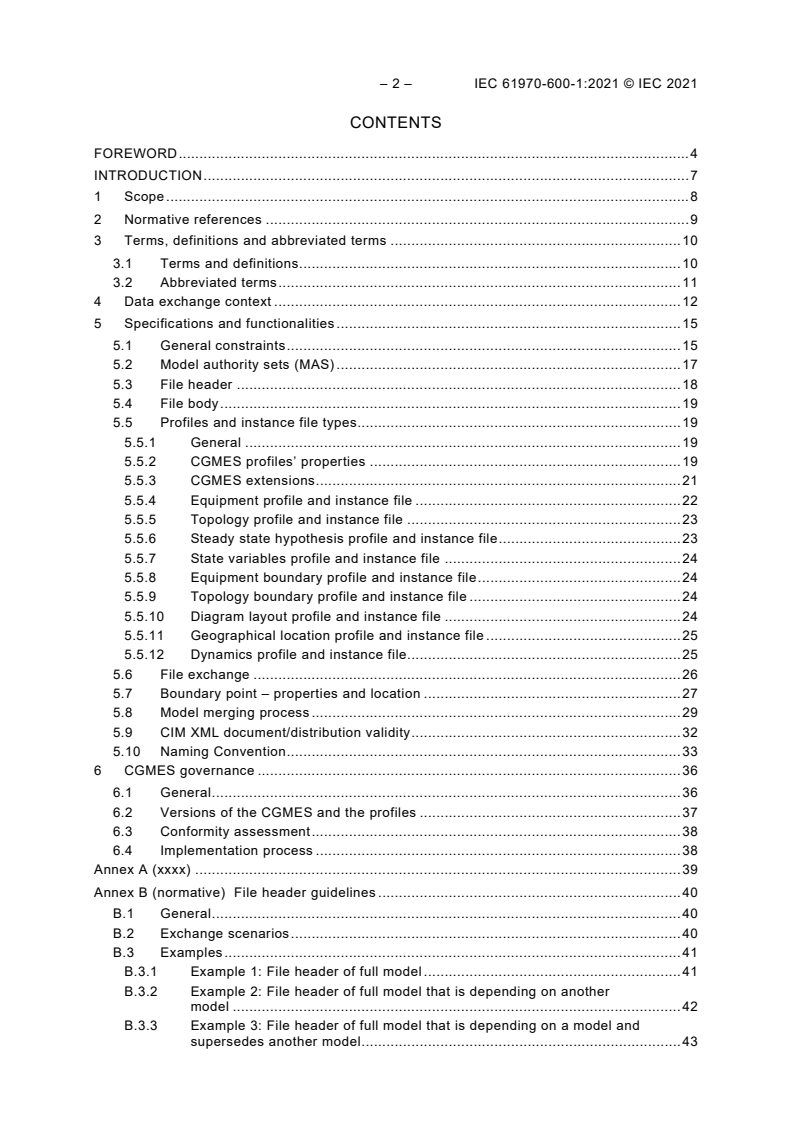
FOREWORD . 4
INTRODUCTION . 7
1 Scope . 8
2 Normative references . 9
3 Terms, definitions and abbreviated terms . 10
3.1 Terms and definitions . 10
3.2 Abbreviated terms . 11
4 Data exchange context . 12
5 Specifications and functionalities . 15
5.1 General constraints . 15
5.2 Model authority sets (MAS) . 17
5.3 File header . 18
5.4 File body . 19
5.5 Profiles and instance file types. 19
5.5.1 General . 19
5.5.2 CGMES profiles’ properties . 19
5.5.3 CGMES extensions . 21
5.5.4 Equipment profile and instance file . 22
5.5.5 Topology profile and instance file . 23
5.5.6 Steady state hypothesis profile and instance file . 23
5.5.7 State variables profile and instance file . 24
5.5.8 Equipment boundary profile and instance file . 24
5.5.9 Topology boundary profile and instance file . 24
5.5.10 Diagram layout profile and instance file . 24
5.5.11 Geographical location profile and instance file . 25
5.5.12 Dynamics profile and instance file . 25
5.6 File exchange . 26
5.7 Boundary point – properties and location . 27
5.8 Model merging process . 29
5.9 CIM XML document/distribution validity . 32
5.10 Naming Convention . 33
6 CGMES governance . 36
6.1 General . 36
6.2 Versions of the CGMES and the profiles . 37
6.3 Conformity assessment . 38
6.4 Implementation process . 38
Annex A (xxxx) . 39
Annex B (normative) File header guidelines . 40
B.1 General . 40
B.2 Exchange scenarios . 40
B.3 Examples . 41
B.3.1 Example 1: File header of full model . 41
B.3.2 Example 2: File header of full model that is depending on another
model . 42
B.3.3 Example 3: File header of full model that is depending on a model and
supersedes another model . 43
B.3.4 Example 4: File header of difference model that is depending on a full
model and supersedes another full model . 44
B.3.5 Example 5: File header of difference model that is depending on a
difference model and supersedes another difference model . 45
Bibliography . 47
Figure 1 – CGMES instance file dependency . 20
Figure 2 – Boundary point placed on a tie-line . 27
Figure 3 – Boundary point placed in a substation . 27
Figure 4 – HVDC as interconnection or internal line . 28
Figure 5 – HVDC grid . 28
Figure 6 – Merge process . 31
Figure B.1 – Example workflow events . 40
Table 1 – IdentifiedObject attributes . 36
Table 2 – IdentifiedObject attributes in EQBD profile . 36
– 4 – IEC 61970-600-1:2021 © IEC 2021
INTERNATIONAL ELECTROTECHNICAL COMMISSION
____________
ENERGY MANAGEMENT SYSTEM APPLICATION
PROGRAM INTERFACE (EMS-API) –
Part 600-1: Common Grid Model Exchange Standard (CGMES) –
Structure and rules
FOREWORD
1) The International Electrotechnical Commission (IEC) is a worldwide organization for standardization comprising
all national electrotechnical committees (IEC National Committees). The object of IEC is to promote international
co-operation on all questions concerning standardization in the electrical and electronic fields. To this end and
in addition to other activities, IEC publishes International Standards, Technical Specifications, Technical Reports,
Publicly Available Specifications (PAS) and Guides (hereafter referred to as “IEC Publication(s)”). Their
preparation is entrusted to technical committees; any IEC National Committee interested in the subject dealt with
may participate in this preparatory work. International, governmental and non-governmental organizations liaising
with the IEC also participate in this preparation. IEC collaborates closely with the International Organization for
Standardization (ISO) in accordance with conditions determined by agreement between the two organizations.
2) The formal decisions or agreements of IEC on technical matters express, as nearly as possible, an international
consensus of opinion on the relevant subjects since each technical committee has representation from all
interested IEC National Committees.
3) IEC Publications have the form of recommendations for international use and are accepted by IEC National
Committees in that sense. While all reasonable efforts are made to ensure that the technical content of IEC
Publications is accurate, IEC cannot be held responsible for the way in which they are used or for any
misinterpretation by any end user.
4) In order to promote international uniformity, IEC National Committees undertake to apply IEC Publications
transparently to the maximum extent possible in their national and regional publications. Any divergence between
any IEC Publication and the corresponding national or regional publication shall be clearly indicated in the latter.
5) IEC itself does not provide any attestation of conformity. Independent certification bodies provide conformity
assessment services and, in some areas, access to IEC marks of conformity. IEC is not responsible for any
services carried out by independent certification bodies.
6) All users should ensure that they have the latest edition of this publication.
7) No liability shall attach to IEC or its directors, employees, servants or agents including individual experts and
members of its technical committees and IEC National Committees for any personal injury, property damage or
other damage of any nature whatsoever, whether direct or indirect, or for costs (including legal fees) and
expenses arising out of the publication, use of, or reliance upon, this IEC Publication or any other IEC
Publications.
8) Attention is drawn to the Normative references cited in this publication. Use of the referenced publications is
indispensable for the correct application of this publication.
9) Attention is drawn to the possibility that some of the elements of this IEC Publication may be the subject of patent
rights. IEC shall not be held responsible for identifying any or all such patent rights.
International Standard IEC 61970-600-1 has been prepared by IEC technical committee 57:
Power systems management and associated information exchange.
This first edition cancels and replaces IEC TS 61970-600-1 published in 2017. This edition
constitutes a technical revision.
This edition includes the following significant technical changes with respect to
IEC TS 61970-600-1:2017:
• Terms and definitions were updated.
• The “Type” column in all tables was deleted to increase readability of the document as all
the rules are considered required, hence categorisation is not necessary.
• Requirement HGEN4 was added to define additional rules to the file header compared to
IEC 61970-552:2016.
• Annex B on “Summary of specific rules for naming conventions” is deleted as the information
was either integrated in the UML or considered outdated.
• Annex D referring to the PST modelling is deleted as it will be fully integrated in
IEC 61970-301:2020+AMD1 .
• Annex E “Implementation guide” is deleted as all rules and implementation guidance is or
will be integrated in either Clause 5 of this document or IEC 61970-301:2020 (and its future
Amendment 1) or IEC 61970-452 or IEC 61970-456 as referenced by this document. Note
that former Subclause E.11.2 on ConformLoadGroup and NonConformLoadGroup was
implemented differently due to another issue, please refer to IEC 61970-600-2:2020.
• Rules GENC17, GENC18, GENC19, EQ__4, EQ__5, SV__4, BPPL12, BPPL13, MVAL5,
EXCH9, TP__4 and MARP12 were added.
• Rules GENC3, GENC6, PROF2, PROF4, PROF5, PROF8, PROF9, EXCH5, EXCH6,
EXCH7, MAS_4, MAS_6, MAS_9, MAS_10, MAS_11, MAS_13, EQ__1, HREF2, HREF3,
HREF5, MVAL3, TPBD1, TPBD2, BPPL10, NAMC12 and NAMC13 are deleted as they are
considered not relevant due to other changes.
• The following rules were modified: GENC1, GENC2, GENC4, GENC5, GENC7, GENC8,
GENC9, GENC10, GENC16, EQBD2, BPPL11, EXCH2, EXCH3, EXCH8, FBOD3, FBOD5,
PROF10, PROF11, MAS_1, MAS_8, HGEN3, HREF1,EEXT1, EQ__2, TP__1, TP__2,
TP__3, MARP10, MARP11, NAMC1, NAMC4, NAMC11, NAMC14, BPPL1, BPPL2 and
BPPL3.
• Explicit equipment boundary profile definition (EQBD) has been deprecated (refer to
Subclause 4.6.5 of IEC 61970-301:2020 and future Amendment 1 for details on
deprecations) in this edition in favour of using its full profile counterpart (EQ) for exchange
of boundary datasets. The topology boundary profile (TPBD) is not included in the CGMES
as TP is considered output and therefore it is no need to exchange Topology information
part of the boundary model authority set.
• Annex F has been deleted.
The text of this International Standard is based on the following documents:
FDIS Report on voting
57/2366/FDIS 57/2382/RVD
Full information on the voting for its approval can be found in the report on voting indicated in
the above table.
The language used for the development of this International Standard is English.
This document was drafted in accordance with ISO/IEC Directives, Part 2, and developed in
accordance with ISO/IEC Directives, Part 1 and ISO/IEC Directives, IEC Supplement, available
at www.iec.ch/members_experts/refdocs. The main document types developed by IEC are
described in greater detail at www.iec.ch/standardsdev/publications.
A list of all parts in the IEC 61970 series, published under the general title Energy management
system application program interface (EMS-API), can be found on the IEC website.
___________
An amendment to IEC 61970-301:2020 is currently under consideration.
– 6 – IEC 61970-600-1:2021 © IEC 2021
The committee has decided that the contents of this document will remain unchanged until the
stability date indicated on the IEC website under "http://webstore.iec.ch" in the data related to
the specific document. At this date, the document will be
• reconfirmed,
• withdrawn,
• replaced by a revised edition, or
• amended.
IMPORTANT – The 'colour inside' logo on the cover page of this publication indicates
that it contains colours which are considered to be useful for the correct understanding
of its contents. Users should therefore print this document using a colour printer.
INTRODUCTION
The purpose of this document is to define the Common Grid Model Exchange Standard
(CGMES) based on Common Information Model (CIM) standards defined in IEC 61970-series,
IEC 61968-series and IEC 62325-series and to address requirements defined by the European
legislation. However, the document is not limited to the European legislation requirements and
business processes, it is created to support data exchange between applications that support
power system model management and analysis. The data exchange can be between internal
applications or between applications at System Operators (SO) and Reginal Coordination
Centre (RCC). This covers DSO-DSO, DSO-TSO, TSO-TSO, TSO-RCC/ISO/RTO and RCC-
RCC interfaces, but not limited to these.
The CGMES is created to address the information exchange requirements provided in Common
Grid Model methodologies (CGMm) in accordance with the legal requirements stated in various
European network codes guidelines. The CGMES applies to applications dealing with power
system data management, as well as applications supporting the following analyses:
• power flow and contingency analyses,
• short circuit calculations,
• market information and transparency,
• capacity calculation for capacity allocation and congestion management, and
• dynamic security assessment.
The conformity of applications used for system operation and system development data
exchanges with the CGMES is crucial for the needed interoperability of these applications. This
document provides the grouping of all principle requirements for the CGMES Conformity
Assessment Framework and the guiding principles for assessing applications’ CGMES
conformity. The description of the CGMES Conformity Assessment Process is currently not part
of the IEC 61970-600-series, but it is planned to be included as an international standard in
order to validate that the CGMES is correctly implemented by suppliers of the applications used
by system operators (ISO/TSO/DSO etc) and for Regional Coordination Centres (RCCs).
– 8 – IEC 61970-600-1:2021 © IEC 2021
ENERGY MANAGEMENT SYSTEM APPLICATION
PROGRAM INTERFACE (EMS-API) –
Part 600-1: Common Grid Model Exchange Standard (CGMES) –
Structure and rules
1 Scope
This part of IEC 61970, which covers the definition of Common Grid Model Exchange Standard
(CGMES), defines the main rules and application’s requirements to meet business requirements
for assembled and merged model to fit relevant business services. This document does not
define the business requirements, business processes nor how applications are implemented.
This document defines how relevant Common Information Model (CIM) standards work together
so that specific business requirements can be resolved.
It also includes extensions to the Common Information Model (CIM). The current extensions are
defined in IEC 61970-301:2020 and will be covered in its future Amendment 1, but additional
extensions can be defined in other standards in the IEC 61970-600-series. The extensions can
be used to define additional profiles or to expand IEC 61970-450-series or IEC 61968-13
profiles. However, primary CGMES includes additional constraints on existing profiles and
validation of assembled and merged models that is based on existing profiles. This can be done
by making optional attributes and associations mandatory (required).
In addition, this document includes the specification of the serialisation that must be supported
by referring to an existing standard defined in IEC 61970-550-series, e.g., IEC 61970-552, and
making relevant constraints related to it.
The goal is to achieve interoperability between applications using CGMES in a high-
performance environment with combined minimum effort so that relevant business processes
are satisfied.
An overview of IEC 61970-600 series is provided in the following table, which also presents
identified needs that are not yet addressed.
Part Description Scope
61970-600-1 Structure and rules. In the scope
This part defines the structure of the series of standard
and the rules that needs to be applied on the assembled
and merged models that are defined by the different profile
standards.
61970-600-2 Exchange profiles specification. In the scope
This part defines the IEC 61970-450-series and
IEC 61968-13 related profiles that are included in CGMES.
It includes the references to published standards and
additional constraints defined to the relevant standard. If
the relevant edition of a standard is not published, it also
includes the profile definition and the standard’s
constraints.
to be defined (TBD) Information extension. Identified as a
need and not yet
This part defines additional information model that is not
addressed neither
included in the relevant edition of IEC 61970-301,
in this document
IEC 61970-302 or IEC 61968-11 that is needed to meet
nor in IEC 61970-
business requirement.
600 series
to be defined (TBD) Extended exchange profiles specification.
This part defines additional profiles that is not included in
IEC 61970-450-series and IEC 61968-13 that is needed to
meet business requirement.
to be defined (TBD) Conformity Assessment Scheme (CAS).
This part defines the Conformity Assessment Scheme
(CAS) including test use cases and references to test
configurations to evaluate if an application tool conforms
to the CGMES.
Clause 4, Data exchange context, describes the context the CGMES is developed to support.
Clause 5, Specifications and functionalities, defines the rules that shall be applied for validating
a model part, an assembled and a merged model. When the rule is defined in the relevant profile
it will include a refence to the rule.
Clause 6, CGMES governance, defines the governance of CGMES and the version strategy.
Annex A is left blank.
Annex B (normative), File header guidelines, explains the usage of the file header that is
defined in IEC 61970-552.
2 Normative references
The following documents are referred to in the text in such a way that some or all of their content
constitutes requirements of this document. For dated references, only the edition cited applies.
For undated references, the latest edition of the referenced document (including any
amendments) applies.
IEC 61970-552:2016, Energy management system application program interface (EMS-API) –
Part 552: CIMXML Model exchange format
IEC 61970-301:2020, Energy management system application program interface (EMS-API) –
Part 301: Common information model (CIM) base
IEC 61970-302:2018, Energy management system application program interface (EMS-API) –
Part 302: Common information model (CIM) dynamics
– 10 – IEC 61970-600-1:2021 © IEC 2021
3 Terms, definitions and abbreviated terms
For the purposes of this document, the following terms, definitions and abbreviated terms apply.
ISO and IEC maintain terminological databases for use in standardization at the following
addresses:
• IEC Electropedia: available at http://www.electropedia.org/
• ISO Online browsing platform: available at http://www.iso.org/obp
NOTE For definitions which are not specified in the CGMES the definitions in the IEC 61970 standard series shall
be applied.
3.1 Terms and definitions
3.1.1
assembled model
model of a Model Authority Set with internal references resolved
3.1.2
boundary point
BP
connection point between two Model Authority Sets, that has been agreed on by both relevant
Model Authority
3.1.3
boundary set
set containing all boundary points necessary for a merge model
3.1.4
CIM XML document/distribution
instance file which is serialised according to IEC 61970-552
3.1.5
distribution
specific representation of a dataset. A dataset might be available in multiple serializations that
may differ in various ways, including natural language, media-type or format, schematic
organization, temporal and spatial resolution. The level of detail in the distribution is defined by
one or more profiles that the dataset conforms to
3.1.6
Common Grid Model Exchange Standard
CGMES
collection of standards defined in IEC 61970-600 series that support the exchange of power
system models (e.g. individual grid model or common grid model) between model authorities
(TSOs, DSOs, etc.) for the purpose of coordinated set of services to be performed on the same
model according to legislation or general data exchanges in the frame of system operation,
system development or utilities’ projects
3.1.7
European extensions
collection of classes, attributes and associations, which either extend or are defined in the
standard IEC CIM model (IEC 61970-300 series, IEC 91968-11 and IEC 62325-300 series). The
European extensions aim at satisfying requirements by the European legislation hence not
necessarily applicable to other continents. The worldwide adoption of these extensions may not
be exactly the same as the defined extension
3.1.8
external references resolved
no dangling references are present across the models of Model Authority Sets
3.1.9
header references resolved
references defined in model header are resolved
3.1.10
internal references resolved
no dangling references are present within the model of a Model Authority Set
3.1.11
merged model
model that is a union of different assembled models with external and header references
resolved
3.1.12
profile
data model to describe instance file for exchange of CIM data. A profile is a subset of classes,
associations and attributes needed to accomplish a specific type of interface and based upon
a CIM data model. Profiles may impose stricter rules on original classes and associations. A
profile is usually converted to schema (XSD, RDF, OWL, etc.) that can be used to create, read
and validate instance files for data exchange
Note 1 to entry: This term may be used to define either the semantic model for an instance data payload or the
syntactic schema for an instance data payload. A profile may be expressed in XSD, RDF, and/or OWL files. An
instance data conforming to a profile can be tested in exchanges between applications. A profile is necessary in
order to “use” the canonical model.
3.1.13
solved model
model containing instance of State Variables (SV)
3.2 Abbreviated terms
BP Boundary point
CIM Common Information Model (electricity)
CGMES Common Grid Model Exchange Standard
DL Diagram Layout profile
DSO Distribution System Operator
DY Dynamics profile
ENTSO-E European Network of Transmission System Operators for Electricity
EQ Core Equipment profile
EQBD Equipment Boundary profile
GL Geographical Location profile
HVDC High Voltage Direct Current
IEC The International Electrotechnical Commission, headquartered in Geneva
IOP Interoperability Test
ISO Independent System Operator
MAS Model Authority Set
mRID CIM Master Resource Identifier
OCL Object Constraint Language
– 12 – IEC 61970-600-1:2021 © IEC 2021
OP Operation profile
OWL Web Ontology Language
RCC Regional Coordination Centres
RDF Resource Description Framework
RDFS RDF Schema
SC Short-Circuit profile
SHACL Shapes Constraint Language
SSH Steady State Hypothesis profile
SV State Variables profile
TP Topology profile
TSO Transmission System Operator
URI Uniform Resource Identifier
UUID Universally Unique Identifier
XML Extensible Markup Language
XSD XML Schema Definition
4 Data exchange context
There are various levels at which an exchange of power system data/models is necessary. A
pan-European model exchange level covers the territory of all system operators (TSOs and
DSOs). Regional model exchanges can be realised between different TSOs in one or more
synchronous areas. A model exchange on the national level includes interfaces between TSOs
(in case there are multiple TSOs on a national level) as well as between different DSOs.
The purpose of model exchanges is not only to exchange the data from one authority to another
but also to satisfy the ultimate goal, namely, to perform common studies using shared data. All
parties involved in the process should be able to perform the same types of studies and share
project tasks between different parties which are using different power system analysis
applications. Indeed, the interoperability between different applications used in the exchange
process is therefore crucial in both reaching seamless data exchange and obtaining comparable
study results when using this data.
The CGMES covers these European and system operators (TSOs and DSOs) business
processes by defining the following main types of exchanges valid for a particular study or
process:
• Exchange of boundary set: An exchange of a boundary Set is necessary to prepare an
exchange of an internal system operator model and to merge a common grid model. E.g.
the ENTSO-E Network Modelling Database (NMD) is used to maintain the Boundary Set
covering the pan-European area where all TSOs negotiate and agree on the boundary
information.
• Exchange of an internal TSO model, i.e. individual grid model (IGM ): A number of business
processes require each TSO to provide models of its internal territory. To describe its
internal territory in a single stand-alone exchange, a TSO is treated as a single model
authority set and shall be able to exchange datasets complying with profiles defined in the
CGMES. The TSO prepares its internal model in such a way that it is easily and
unambiguously combined with other TSO internal models to make up complete models for
analytical purposes. This type of exchange can also be applied for the interface between a
TSO and a DSO, where models covering transmission or distribution parts of the power
system can be exchanged based on a mutual agreement between the TSOs and the DSOs.
In this case, and if a TSO requests a DSO model, the DSO would provide its model in
accordance with CGMES definitions.
• Exchange of a common grid model: A common grid model refers to the concept of having
one model which can be used for multiple purposes. The specification describes what is
needed to create a merge model of multiple TSOs' Individual Grid Models (IGM) of their
responsible territory into a regional or pan-European model. Various business processes
will require specific implementation of the profiles part of the CGMES and the exchange of
respective instance files to meet interoperability inside the business process. The Common
Grid Model meta-model description will ensure interoperability across the business process.
Business processes (e.g. system development planning, protection planning, operational
planning, operation, fault study/simulation, market operation, etc.) are, of course, more complex
than these operations, but what is important to note is that all processes are supported using
only these basic kinds of interoperation. In addition, business processes shall define or precise,
where necessary, the content of the data exchange within the scope of the defined profiles. For
instance, OperationalLimitSet can be used to constraint any conducting equipment. It is up to
the business process to define if any equipment is mandatory to have operational limits.
Note that each power system model normally consists of multiple datasets (distribution) as
defined in CIM standards and further specified by CGMES.
The CGMES supports node-breaker (NB) and bus-branch (BB) model exchanges.
NOTE 1 A network model representation including the connectivity details of all the switching equipment and bays
in substations and other equipment containers. Switching equipment is normally not retained, except for those
carrying power flow that needs to be monitored, e.g. coupler bays. In order to be used in steady-state analysis
calculations, this model representation usually requires topology processing, to produce a BB representation.
NOTE 2 A network model using a simplified representation of a network, typically resulting from topology processing
(where the detailed switching equipment and bays get reduced to typically single bus per voltage level in a
substation). The only switching equipment used shall be flagged as retained. This model representation is ultimately
used in steady-state analysis calculations.
Moving forward the procedures of the model exchanges using the CGMES, it is expected that
equipment and steady state hypothesis data (EQ and SSH distribution) will be the input source
data for all processes. This type of model should be the fully detailed model with all
disconnectors/breakers, etc. Any configuration changes will be made by changing switch
statuses.
___________
IGM: EU Regulation 2015/1222 Article 2
https://eur-lex.europa.eu/legal-content/EN/TXT/?uri=CELEX%3A32015R1222.
– 14 – IEC 61970-600-1:2021 © IEC 2021
ID Specification
EXCH1. The CGMES defines equipment and steady state hypothesis profiles as an input to power flow,
meaning that all results, whether topology or state variables profiles distribution, shall refer to the
equipment and steady state hypothesis objects. Therefore, in the case that both equipment and
steady state hypothesis instance files are available for a node-breaker model representation,
there is no need to exchange topology or state variables instance files in order to obtain a power
flow solution.
EXCH2. For node-breaker model exchanges the TopologicalNode-s represent the output from a topology
processing on the detailed input source operational data. These may be optionally exchanged to
be used by tools which have an interest in the computed buses.
EXCH3. For node-breaker model exchanges mRID (rdf:ID in serialisation, see GENC1) of the
TopologicalNode-s are not required to be persistent.
EXCH4. For CGMES exchanges a Topology profile distribution is not exchanged using a difference file. In
CGMES Topology profile distribution is only exchanged as full model.
EXCH5. Left blank intentionally.
EXCH6. Left blank intentionally.
EXCH7. Left blank intentionally.
EXCH8. An application supporting CGMES shall meet the following requirements and constraints:
– Model exchange containing node-breaker, bus-branch and hybrid (mixed bus-branch and
node-breaker) model representations;
– One model authority set containing modelling parts representing different granularity, i.e.
different subsets of the model can be modelled in detail as a node-breaker model while
other subsets can be with bus-branch level of detail;
– ConnectivityNode object instances shall be included in Core Equipment profile instance;
– TopologicalNode object instances are representing a given result of a topology processing
(EXCH1, EXCH2) or a designed topology;
– The association end Terminal.ConnectivityNode is optional in the Core Equipment profile
instance. However, a model including topology requires Terminals to have an association
to either ConnectivityNode, TopologyNode or both;
– The association end ConnectivityNode.TopologicalNode is required in the Topology profile
distribution;
– The association end Terminal.TopologicalNode is optional, while at least one instance of
TopologicalNode.Terminal is required;
– The association end Terminal.TopologicalNode is required in cases where a
RegulatingControl is associated with a Terminal;
Justification and consequence:
– ConnectivityNode is a required class in Core Equipment instance data. Therefore, all
model representations are built with ConnectivityNode-s; Historically there is assumption
that ConnectivityNode-s are for node-breaker style modelling only (whereas
TopologicalNode-s are for bus-branch modelling, typically resulting from topology
processing on node-breaker models, with buses used to construct the admittance matrix
for power flow). ConnectivityNode-s can actually be used for both modelling styles, which
is the prescribed way of describing electrical connectivity of ConductingEquipment. For
pure bus-branch models, this will mean one additional object (ConnectivityNode) per
existing TopologicalNode.
– The header information provided in the attribute Model.profile does not give any
information about the model authority set model representation (bus-branch, node-breaker
or hybrid).
ID Specification
EXCH9. CGMES recognises the following main cases of model exchange and model part assembly that
application shall support:
– Case 1: Exchange of node-breaker, bus-branch or hybrid models without topology
processing result (so, inherently without power flow solution);
– Case 2: Exchange of node-breaker, bus-branch or hybrid models with topology processing
result, but without power flow solution;
– Case 3: Exchange of node-breaker, bus-branch or hybrid models with topology processing
result and with power flow solution;
– Case 4: Merge of models containing same or different model representation with an
execution of a topology processing;
– Case 5: Merge of models containing same or different model representation without an
execution of a topology processing;
Cases 1, 2 and 3 are related to how the data is exchanged while cases 4 and 5 are related to
how the models are merged. To provide consistency in the model parts it is recommends that
within an exchange, if all models are exchanged according to:
– Case 1, the merge process Case 4 is applied;
– Case 2 or 3, the merge process Case 5 is applied.
In general, within an exchange process where the deliverable is a merged model, the topology
and state variables information can be used to ensure possibility of pre-merge validation of
different model parts for conformity with exchange standard or procedures.
5 Specifications and functionalities
5.1 General constraints
The following rules are general in nature or involve multiple classes. Additional rules are defined
in the notes to the individual classes in the profiles part of the CGMES.
– 16 – IEC 61970-600-1:2021 © IEC 2021
ID Specification
GENC1. All IdentifiedObject-s shall have a persistent and globally unique identifier (Master
Resource Identifier – mRID).
GENC2. Name related attributes (name, shortName, description, etc. inherited by many classes
from the abstract class IdentifiedObject) shall never be used as persistent identifiers for
referencing purpose, but contain human readable text without additional embedded
information that would need to be parsed. This implies that names can be changed without
impacting the consistency of the dataset. (R:452:ALL:IdentifiedObject.name:rule)
GENC3. Left blank intentionally.
IEC 61970-301 strongly recommends to use UUID, as specified in RFC 4122, for the
GENC4.
.
.mRID. CGMES requires the usage of UUID
(deprecated) A requirement to ensure transition until all systems and entities fully comply
GENC5.
with GENC4. The CGMES defines the identifier as a non-case sensitive string which
conforms to W3C (ISO 8859-1:1998, Information technology — 8-bit single-byte coded
graphic character sets — Part 1: Latin alphabet No. 1,
http://www.w3.org/MarkUp/html3/specialchars.html). A prefix may be added, if necessary,
to ensure global uniqueness. The rdf:ID is the mRID plus an underscore “_” added in the
beginning of the string. The maximum character limit of the string is 60 characters
(including an underscore and a prefix, if any).
GENC6. Left blank intentionally.
GENC7. Each model authority is responsible for ensuring that the mRID is globally unique. The role
of entities such as regional authorities is limited to coordination and harmonisation of the
approaches used in different data exchanges and which shall conform to GENC4 and
GENC5.
GENC8. mRIDs shall be kept persistent between series of exchanges for all objects in all profiles
with the following exceptions:
– objects created in the Topology profile dataset when it represents the result of
topological processing as part of a node-breaker model.
– objects created in the State Variable profile dataset that are dependent Topology profile
created object, e.g. SvPowerFlow, SvVoltage, etc.
– objects created in the Diagram Layout profile dataset, e.g. DiagramObjectPoint and
DiagramObject (in some cases, see DL__1).
GENC9. Some objects in profiles define additional attributes to objects defined in other profiles,
e.g. SSH extends objects defined in EQ profile. In profile definition these classes are
tagged with “Description” stereotype. The objects of these classes shall be serialised using
rdf:about with the additional attributes. Related requirements are MVAL4 and MVAL5.
GENC10. Instance files shall be encoded according to UTF-8. UTF-16 is currently not supported.
GENC11. Instance data (distribution) to be exchanged shall make use of the most detailed class
possible within a profile, i.e. using sub-typed classes rather than general classes e.g.
NuclearGeneratingUnit instead of GeneratingUnit. MAS_7 describe an exception.
GENC12. Optional and required attributes and associations must be imported and exported if they
are in the distribution prior to import. (R:452:ALL:NA:exchange)
GENC13. If an optional attribute does not exist in the imported file, it does not have to be exported in
case exactly the same data set is exported, i.e. the tool is not obliged to automatically
provide this attribute. If the export is resulting from an action by the user performed after
the import, e.g. data processing or model update the export can contain optional attributes.
(R:452:ALL:NA:exchange1)
GENC14. In most of the profiles the selection of optional and required attributes is made so as to
ensure a minimum set of required attributes without which t
...
IEC 61970-600-1 ®
Edition 1.0 2021-06
INTERNATIONAL
STANDARD
NORME
INTERNATIONALE
colour
inside
Energy management system application program interface (EMS-API) –
Part 600-1: Common Grid Model Exchange Standard (CGMES) – Structure and
rules
Interface de programmation d'application pour système de gestion d'énergie
(EMS-API) –
Partie 600-1: Norme pour l'échange de modèle de réseau commun (CGMES) –
Structure et règles
All rights reserved. Unless otherwise specified, no part of this publication may be reproduced or utilized in any form
or by any means, electronic or mechanical, including photocopying and microfilm, without permission in writing from
either IEC or IEC's member National Committee in the country of the requester. If you have any questions about IEC
copyright or have an enquiry about obtaining additional rights to this publication, please contact the address below or
your local IEC member National Committee for further information.
Droits de reproduction réservés. Sauf indication contraire, aucune partie de cette publication ne peut être reproduite ni
utilisée sous quelque forme que ce soit et par aucun procédé, électronique ou mécanique, y compris la photocopie et
les microfilms, sans l'accord écrit de l'IEC ou du Comité national de l'IEC du pays du demandeur. Si vous avez des
questions sur le copyright de l'IEC ou si vous désirez obtenir des droits supplémentaires sur cette publication, utilisez
les coordonnées ci-après ou contactez le Comité national de l'IEC de votre pays de résidence.
IEC Secretariat Tel.: +41 22 919 02 11
3, rue de Varembé info@iec.ch
CH-1211 Geneva 20 www.iec.ch
Switzerland
About the IEC
The International Electrotechnical Commission (IEC) is the leading global organization that prepares and publishes
International Standards for all electrical, electronic and related technologies.
About IEC publications
The technical content of IEC publications is kept under constant review by the IEC. Please make sure that you have the
latest edition, a corrigendum or an amendment might have been published.
IEC publications search - webstore.iec.ch/advsearchform IEC Products & Services Portal - products.iec.ch
The advanced search enables to find IEC publications by a Discover our powerful search engine and read freely all the
variety of criteria (reference number, text, technical publications previews. With a subscription you will always have
committee, …). It also gives information on projects, replaced access to up to date content tailored to your needs.
and withdrawn publications.
Electropedia - www.electropedia.org
IEC Just Published - webstore.iec.ch/justpublished
The world's leading online dictionary on electrotechnology,
Stay up to date on all new IEC publications. Just Published
containing more than 22 300 terminological entries in English
details all new publications released. Available online and once
and French, with equivalent terms in 19 additional languages.
a month by email.
Also known as the International Electrotechnical Vocabulary
(IEV) online.
IEC Customer Service Centre - webstore.iec.ch/csc
If you wish to give us your feedback on this publication or need
further assistance, please contact the Customer Service
Centre: sales@iec.ch.
A propos de l'IEC
La Commission Electrotechnique Internationale (IEC) est la première organisation mondiale qui élabore et publie des
Normes internationales pour tout ce qui a trait à l'électricité, à l'électronique et aux technologies apparentées.
A propos des publications IEC
Le contenu technique des publications IEC est constamment revu. Veuillez vous assurer que vous possédez l’édition la
plus récente, un corrigendum ou amendement peut avoir été publié.
Recherche de publications IEC - Découvrez notre puissant moteur de recherche et consultez
webstore.iec.ch/advsearchform gratuitement tous les aperçus des publications. Avec un
La recherche avancée permet de trouver des publications IEC abonnement, vous aurez toujours accès à un contenu à jour
en utilisant différents critères (numéro de référence, texte, adapté à vos besoins.
comité d’études, …). Elle donne aussi des informations sur les
projets et les publications remplacées ou retirées. Electropedia - www.electropedia.org
Le premier dictionnaire d'électrotechnologie en ligne au monde,
IEC Just Published - webstore.iec.ch/justpublished
avec plus de 22 300 articles terminologiques en anglais et en
Restez informé sur les nouvelles publications IEC. Just
français, ainsi que les termes équivalents dans 19 langues
Published détaille les nouvelles publications parues.
additionnelles. Egalement appelé Vocabulaire
Disponible en ligne et une fois par mois par email.
Electrotechnique International (IEV) en ligne.
Service Clients - webstore.iec.ch/csc
Si vous désirez nous donner des commentaires sur cette
publication ou si vous avez des questions contactez-nous:
sales@iec.ch.
IEC Products & Services Portal - products.iec.ch
IEC 61970-600-1 ®
Edition 1.0 2021-06
INTERNATIONAL
STANDARD
NORME
INTERNATIONALE
colour
inside
Energy management system application program interface (EMS-API) –
Part 600-1: Common Grid Model Exchange Standard (CGMES) – Structure and
rules
Interface de programmation d'application pour système de gestion d'énergie
(EMS-API) –
Partie 600-1: Norme pour l'échange de modèle de réseau commun (CGMES) –
Structure et règles
INTERNATIONAL
ELECTROTECHNICAL
COMMISSION
COMMISSION
ELECTROTECHNIQUE
INTERNATIONALE
ICS 33.200 ISBN 978-2-8322-1074-7
– 2 – IEC 61970-600-1:2021 © IEC 2021
CONTENTS
FOREWORD . 4
INTRODUCTION . 7
1 Scope . 8
2 Normative references . 9
3 Terms, definitions and abbreviated terms . 10
3.1 Terms and definitions . 10
3.2 Abbreviated terms . 11
4 Data exchange context . 12
5 Specifications and functionalities . 15
5.1 General constraints . 15
5.2 Model authority sets (MAS) . 17
5.3 File header . 18
5.4 File body . 19
5.5 Profiles and instance file types. 19
5.5.1 General . 19
5.5.2 CGMES profiles’ properties . 19
5.5.3 CGMES extensions . 21
5.5.4 Equipment profile and instance file . 22
5.5.5 Topology profile and instance file . 23
5.5.6 Steady state hypothesis profile and instance file . 23
5.5.7 State variables profile and instance file . 24
5.5.8 Equipment boundary profile and instance file . 24
5.5.9 Topology boundary profile and instance file . 24
5.5.10 Diagram layout profile and instance file . 24
5.5.11 Geographical location profile and instance file . 25
5.5.12 Dynamics profile and instance file . 25
5.6 File exchange . 26
5.7 Boundary point – properties and location . 27
5.8 Model merging process . 29
5.9 CIM XML document/distribution validity . 32
5.10 Naming Convention . 33
6 CGMES governance . 36
6.1 General . 36
6.2 Versions of the CGMES and the profiles . 37
6.3 Conformity assessment . 38
6.4 Implementation process . 38
Annex A (xxxx) . 39
Annex B (normative) File header guidelines . 40
B.1 General . 40
B.2 Exchange scenarios . 40
B.3 Examples . 41
B.3.1 Example 1: File header of full model . 41
B.3.2 Example 2: File header of full model that is depending on another
model . 42
B.3.3 Example 3: File header of full model that is depending on a model and
supersedes another model . 43
B.3.4 Example 4: File header of difference model that is depending on a full
model and supersedes another full model . 44
B.3.5 Example 5: File header of difference model that is depending on a
difference model and supersedes another difference model . 45
Bibliography . 47
Figure 1 – CGMES instance file dependency . 20
Figure 2 – Boundary point placed on a tie-line . 27
Figure 3 – Boundary point placed in a substation . 27
Figure 4 – HVDC as interconnection or internal line . 28
Figure 5 – HVDC grid . 28
Figure 6 – Merge process . 31
Figure B.1 – Example workflow events . 40
Table 1 – IdentifiedObject attributes . 36
Table 2 – IdentifiedObject attributes in EQBD profile . 36
– 4 – IEC 61970-600-1:2021 © IEC 2021
INTERNATIONAL ELECTROTECHNICAL COMMISSION
____________
ENERGY MANAGEMENT SYSTEM APPLICATION
PROGRAM INTERFACE (EMS-API) –
Part 600-1: Common Grid Model Exchange Standard (CGMES) –
Structure and rules
FOREWORD
1) The International Electrotechnical Commission (IEC) is a worldwide organization for standardization comprising
all national electrotechnical committees (IEC National Committees). The object of IEC is to promote international
co-operation on all questions concerning standardization in the electrical and electronic fields. To this end and
in addition to other activities, IEC publishes International Standards, Technical Specifications, Technical Reports,
Publicly Available Specifications (PAS) and Guides (hereafter referred to as “IEC Publication(s)”). Their
preparation is entrusted to technical committees; any IEC National Committee interested in the subject dealt with
may participate in this preparatory work. International, governmental and non-governmental organizations liaising
with the IEC also participate in this preparation. IEC collaborates closely with the International Organization for
Standardization (ISO) in accordance with conditions determined by agreement between the two organizations.
2) The formal decisions or agreements of IEC on technical matters express, as nearly as possible, an international
consensus of opinion on the relevant subjects since each technical committee has representation from all
interested IEC National Committees.
3) IEC Publications have the form of recommendations for international use and are accepted by IEC National
Committees in that sense. While all reasonable efforts are made to ensure that the technical content of IEC
Publications is accurate, IEC cannot be held responsible for the way in which they are used or for any
misinterpretation by any end user.
4) In order to promote international uniformity, IEC National Committees undertake to apply IEC Publications
transparently to the maximum extent possible in their national and regional publications. Any divergence between
any IEC Publication and the corresponding national or regional publication shall be clearly indicated in the latter.
5) IEC itself does not provide any attestation of conformity. Independent certification bodies provide conformity
assessment services and, in some areas, access to IEC marks of conformity. IEC is not responsible for any
services carried out by independent certification bodies.
6) All users should ensure that they have the latest edition of this publication.
7) No liability shall attach to IEC or its directors, employees, servants or agents including individual experts and
members of its technical committees and IEC National Committees for any personal injury, property damage or
other damage of any nature whatsoever, whether direct or indirect, or for costs (including legal fees) and
expenses arising out of the publication, use of, or reliance upon, this IEC Publication or any other IEC
Publications.
8) Attention is drawn to the Normative references cited in this publication. Use of the referenced publications is
indispensable for the correct application of this publication.
9) Attention is drawn to the possibility that some of the elements of this IEC Publication may be the subject of patent
rights. IEC shall not be held responsible for identifying any or all such patent rights.
International Standard IEC 61970-600-1 has been prepared by IEC technical committee 57:
Power systems management and associated information exchange.
This first edition cancels and replaces IEC TS 61970-600-1 published in 2017. This edition
constitutes a technical revision.
This edition includes the following significant technical changes with respect to
IEC TS 61970-600-1:2017:
• Terms and definitions were updated.
• The “Type” column in all tables was deleted to increase readability of the document as all
the rules are considered required, hence categorisation is not necessary.
• Requirement HGEN4 was added to define additional rules to the file header compared to
IEC 61970-552:2016.
• Annex B on “Summary of specific rules for naming conventions” is deleted as the information
was either integrated in the UML or considered outdated.
• Annex D referring to the PST modelling is deleted as it will be fully integrated in
IEC 61970-301:2020+AMD1 .
• Annex E “Implementation guide” is deleted as all rules and implementation guidance is or
will be integrated in either Clause 5 of this document or IEC 61970-301:2020 (and its future
Amendment 1) or IEC 61970-452 or IEC 61970-456 as referenced by this document. Note
that former Subclause E.11.2 on ConformLoadGroup and NonConformLoadGroup was
implemented differently due to another issue, please refer to IEC 61970-600-2:2020.
• Rules GENC17, GENC18, GENC19, EQ__4, EQ__5, SV__4, BPPL12, BPPL13, MVAL5,
EXCH9, TP__4 and MARP12 were added.
• Rules GENC3, GENC6, PROF2, PROF4, PROF5, PROF8, PROF9, EXCH5, EXCH6,
EXCH7, MAS_4, MAS_6, MAS_9, MAS_10, MAS_11, MAS_13, EQ__1, HREF2, HREF3,
HREF5, MVAL3, TPBD1, TPBD2, BPPL10, NAMC12 and NAMC13 are deleted as they are
considered not relevant due to other changes.
• The following rules were modified: GENC1, GENC2, GENC4, GENC5, GENC7, GENC8,
GENC9, GENC10, GENC16, EQBD2, BPPL11, EXCH2, EXCH3, EXCH8, FBOD3, FBOD5,
PROF10, PROF11, MAS_1, MAS_8, HGEN3, HREF1,EEXT1, EQ__2, TP__1, TP__2,
TP__3, MARP10, MARP11, NAMC1, NAMC4, NAMC11, NAMC14, BPPL1, BPPL2 and
BPPL3.
• Explicit equipment boundary profile definition (EQBD) has been deprecated (refer to
Subclause 4.6.5 of IEC 61970-301:2020 and future Amendment 1 for details on
deprecations) in this edition in favour of using its full profile counterpart (EQ) for exchange
of boundary datasets. The topology boundary profile (TPBD) is not included in the CGMES
as TP is considered output and therefore it is no need to exchange Topology information
part of the boundary model authority set.
• Annex F has been deleted.
The text of this International Standard is based on the following documents:
FDIS Report on voting
57/2366/FDIS 57/2382/RVD
Full information on the voting for its approval can be found in the report on voting indicated in
the above table.
The language used for the development of this International Standard is English.
This document was drafted in accordance with ISO/IEC Directives, Part 2, and developed in
accordance with ISO/IEC Directives, Part 1 and ISO/IEC Directives, IEC Supplement, available
at www.iec.ch/members_experts/refdocs. The main document types developed by IEC are
described in greater detail at www.iec.ch/standardsdev/publications.
A list of all parts in the IEC 61970 series, published under the general title Energy management
system application program interface (EMS-API), can be found on the IEC website.
___________
An amendment to IEC 61970-301:2020 is currently under consideration.
– 6 – IEC 61970-600-1:2021 © IEC 2021
The committee has decided that the contents of this document will remain unchanged until the
stability date indicated on the IEC website under "http://webstore.iec.ch" in the data related to
the specific document. At this date, the document will be
• reconfirmed,
• withdrawn,
• replaced by a revised edition, or
• amended.
IMPORTANT – The 'colour inside' logo on the cover page of this publication indicates
that it contains colours which are considered to be useful for the correct understanding
of its contents. Users should therefore print this document using a colour printer.
INTRODUCTION
The purpose of this document is to define the Common Grid Model Exchange Standard
(CGMES) based on Common Information Model (CIM) standards defined in IEC 61970-series,
IEC 61968-series and IEC 62325-series and to address requirements defined by the European
legislation. However, the document is not limited to the European legislation requirements and
business processes, it is created to support data exchange between applications that support
power system model management and analysis. The data exchange can be between internal
applications or between applications at System Operators (SO) and Reginal Coordination
Centre (RCC). This covers DSO-DSO, DSO-TSO, TSO-TSO, TSO-RCC/ISO/RTO and RCC-
RCC interfaces, but not limited to these.
The CGMES is created to address the information exchange requirements provided in Common
Grid Model methodologies (CGMm) in accordance with the legal requirements stated in various
European network codes guidelines. The CGMES applies to applications dealing with power
system data management, as well as applications supporting the following analyses:
• power flow and contingency analyses,
• short circuit calculations,
• market information and transparency,
• capacity calculation for capacity allocation and congestion management, and
• dynamic security assessment.
The conformity of applications used for system operation and system development data
exchanges with the CGMES is crucial for the needed interoperability of these applications. This
document provides the grouping of all principle requirements for the CGMES Conformity
Assessment Framework and the guiding principles for assessing applications’ CGMES
conformity. The description of the CGMES Conformity Assessment Process is currently not part
of the IEC 61970-600-series, but it is planned to be included as an international standard in
order to validate that the CGMES is correctly implemented by suppliers of the applications used
by system operators (ISO/TSO/DSO etc) and for Regional Coordination Centres (RCCs).
– 8 – IEC 61970-600-1:2021 © IEC 2021
ENERGY MANAGEMENT SYSTEM APPLICATION
PROGRAM INTERFACE (EMS-API) –
Part 600-1: Common Grid Model Exchange Standard (CGMES) –
Structure and rules
1 Scope
This part of IEC 61970, which covers the definition of Common Grid Model Exchange Standard
(CGMES), defines the main rules and application’s requirements to meet business requirements
for assembled and merged model to fit relevant business services. This document does not
define the business requirements, business processes nor how applications are implemented.
This document defines how relevant Common Information Model (CIM) standards work together
so that specific business requirements can be resolved.
It also includes extensions to the Common Information Model (CIM). The current extensions are
defined in IEC 61970-301:2020 and will be covered in its future Amendment 1, but additional
extensions can be defined in other standards in the IEC 61970-600-series. The extensions can
be used to define additional profiles or to expand IEC 61970-450-series or IEC 61968-13
profiles. However, primary CGMES includes additional constraints on existing profiles and
validation of assembled and merged models that is based on existing profiles. This can be done
by making optional attributes and associations mandatory (required).
In addition, this document includes the specification of the serialisation that must be supported
by referring to an existing standard defined in IEC 61970-550-series, e.g., IEC 61970-552, and
making relevant constraints related to it.
The goal is to achieve interoperability between applications using CGMES in a high-
performance environment with combined minimum effort so that relevant business processes
are satisfied.
An overview of IEC 61970-600 series is provided in the following table, which also presents
identified needs that are not yet addressed.
Part Description Scope
61970-600-1 Structure and rules. In the scope
This part defines the structure of the series of standard
and the rules that needs to be applied on the assembled
and merged models that are defined by the different profile
standards.
61970-600-2 Exchange profiles specification. In the scope
This part defines the IEC 61970-450-series and
IEC 61968-13 related profiles that are included in CGMES.
It includes the references to published standards and
additional constraints defined to the relevant standard. If
the relevant edition of a standard is not published, it also
includes the profile definition and the standard’s
constraints.
to be defined (TBD) Information extension. Identified as a
need and not yet
This part defines additional information model that is not
addressed neither
included in the relevant edition of IEC 61970-301,
in this document
IEC 61970-302 or IEC 61968-11 that is needed to meet
nor in IEC 61970-
business requirement.
600 series
to be defined (TBD) Extended exchange profiles specification.
This part defines additional profiles that is not included in
IEC 61970-450-series and IEC 61968-13 that is needed to
meet business requirement.
to be defined (TBD) Conformity Assessment Scheme (CAS).
This part defines the Conformity Assessment Scheme
(CAS) including test use cases and references to test
configurations to evaluate if an application tool conforms
to the CGMES.
Clause 4, Data exchange context, describes the context the CGMES is developed to support.
Clause 5, Specifications and functionalities, defines the rules that shall be applied for validating
a model part, an assembled and a merged model. When the rule is defined in the relevant profile
it will include a refence to the rule.
Clause 6, CGMES governance, defines the governance of CGMES and the version strategy.
Annex A is left blank.
Annex B (normative), File header guidelines, explains the usage of the file header that is
defined in IEC 61970-552.
2 Normative references
The following documents are referred to in the text in such a way that some or all of their content
constitutes requirements of this document. For dated references, only the edition cited applies.
For undated references, the latest edition of the referenced document (including any
amendments) applies.
IEC 61970-552:2016, Energy management system application program interface (EMS-API) –
Part 552: CIMXML Model exchange format
IEC 61970-301:2020, Energy management system application program interface (EMS-API) –
Part 301: Common information model (CIM) base
IEC 61970-302:2018, Energy management system application program interface (EMS-API) –
Part 302: Common information model (CIM) dynamics
– 10 – IEC 61970-600-1:2021 © IEC 2021
3 Terms, definitions and abbreviated terms
For the purposes of this document, the following terms, definitions and abbreviated terms apply.
ISO and IEC maintain terminological databases for use in standardization at the following
addresses:
• IEC Electropedia: available at http://www.electropedia.org/
• ISO Online browsing platform: available at http://www.iso.org/obp
NOTE For definitions which are not specified in the CGMES the definitions in the IEC 61970 standard series shall
be applied.
3.1 Terms and definitions
3.1.1
assembled model
model of a Model Authority Set with internal references resolved
3.1.2
boundary point
BP
connection point between two Model Authority Sets, that has been agreed on by both relevant
Model Authority
3.1.3
boundary set
set containing all boundary points necessary for a merge model
3.1.4
CIM XML document/distribution
instance file which is serialised according to IEC 61970-552
3.1.5
distribution
specific representation of a dataset. A dataset might be available in multiple serializations that
may differ in various ways, including natural language, media-type or format, schematic
organization, temporal and spatial resolution. The level of detail in the distribution is defined by
one or more profiles that the dataset conforms to
3.1.6
Common Grid Model Exchange Standard
CGMES
collection of standards defined in IEC 61970-600 series that support the exchange of power
system models (e.g. individual grid model or common grid model) between model authorities
(TSOs, DSOs, etc.) for the purpose of coordinated set of services to be performed on the same
model according to legislation or general data exchanges in the frame of system operation,
system development or utilities’ projects
3.1.7
European extensions
collection of classes, attributes and associations, which either extend or are defined in the
standard IEC CIM model (IEC 61970-300 series, IEC 91968-11 and IEC 62325-300 series). The
European extensions aim at satisfying requirements by the European legislation hence not
necessarily applicable to other continents. The worldwide adoption of these extensions may not
be exactly the same as the defined extension
3.1.8
external references resolved
no dangling references are present across the models of Model Authority Sets
3.1.9
header references resolved
references defined in model header are resolved
3.1.10
internal references resolved
no dangling references are present within the model of a Model Authority Set
3.1.11
merged model
model that is a union of different assembled models with external and header references
resolved
3.1.12
profile
data model to describe instance file for exchange of CIM data. A profile is a subset of classes,
associations and attributes needed to accomplish a specific type of interface and based upon
a CIM data model. Profiles may impose stricter rules on original classes and associations. A
profile is usually converted to schema (XSD, RDF, OWL, etc.) that can be used to create, read
and validate instance files for data exchange
Note 1 to entry: This term may be used to define either the semantic model for an instance data payload or the
syntactic schema for an instance data payload. A profile may be expressed in XSD, RDF, and/or OWL files. An
instance data conforming to a profile can be tested in exchanges between applications. A profile is necessary in
order to “use” the canonical model.
3.1.13
solved model
model containing instance of State Variables (SV)
3.2 Abbreviated terms
BP Boundary point
CIM Common Information Model (electricity)
CGMES Common Grid Model Exchange Standard
DL Diagram Layout profile
DSO Distribution System Operator
DY Dynamics profile
ENTSO-E European Network of Transmission System Operators for Electricity
EQ Core Equipment profile
EQBD Equipment Boundary profile
GL Geographical Location profile
HVDC High Voltage Direct Current
IEC The International Electrotechnical Commission, headquartered in Geneva
IOP Interoperability Test
ISO Independent System Operator
MAS Model Authority Set
mRID CIM Master Resource Identifier
OCL Object Constraint Language
– 12 – IEC 61970-600-1:2021 © IEC 2021
OP Operation profile
OWL Web Ontology Language
RCC Regional Coordination Centres
RDF Resource Description Framework
RDFS RDF Schema
SC Short-Circuit profile
SHACL Shapes Constraint Language
SSH Steady State Hypothesis profile
SV State Variables profile
TP Topology profile
TSO Transmission System Operator
URI Uniform Resource Identifier
UUID Universally Unique Identifier
XML Extensible Markup Language
XSD XML Schema Definition
4 Data exchange context
There are various levels at which an exchange of power system data/models is necessary. A
pan-European model exchange level covers the territory of all system operators (TSOs and
DSOs). Regional model exchanges can be realised between different TSOs in one or more
synchronous areas. A model exchange on the national level includes interfaces between TSOs
(in case there are multiple TSOs on a national level) as well as between different DSOs.
The purpose of model exchanges is not only to exchange the data from one authority to another
but also to satisfy the ultimate goal, namely, to perform common studies using shared data. All
parties involved in the process should be able to perform the same types of studies and share
project tasks between different parties which are using different power system analysis
applications. Indeed, the interoperability between different applications used in the exchange
process is therefore crucial in both reaching seamless data exchange and obtaining comparable
study results when using this data.
The CGMES covers these European and system operators (TSOs and DSOs) business
processes by defining the following main types of exchanges valid for a particular study or
process:
• Exchange of boundary set: An exchange of a boundary Set is necessary to prepare an
exchange of an internal system operator model and to merge a common grid model. E.g.
the ENTSO-E Network Modelling Database (NMD) is used to maintain the Boundary Set
covering the pan-European area where all TSOs negotiate and agree on the boundary
information.
• Exchange of an internal TSO model, i.e. individual grid model (IGM ): A number of business
processes require each TSO to provide models of its internal territory. To describe its
internal territory in a single stand-alone exchange, a TSO is treated as a single model
authority set and shall be able to exchange datasets complying with profiles defined in the
CGMES. The TSO prepares its internal model in such a way that it is easily and
unambiguously combined with other TSO internal models to make up complete models for
analytical purposes. This type of exchange can also be applied for the interface between a
TSO and a DSO, where models covering transmission or distribution parts of the power
system can be exchanged based on a mutual agreement between the TSOs and the DSOs.
In this case, and if a TSO requests a DSO model, the DSO would provide its model in
accordance with CGMES definitions.
• Exchange of a common grid model: A common grid model refers to the concept of having
one model which can be used for multiple purposes. The specification describes what is
needed to create a merge model of multiple TSOs' Individual Grid Models (IGM) of their
responsible territory into a regional or pan-European model. Various business processes
will require specific implementation of the profiles part of the CGMES and the exchange of
respective instance files to meet interoperability inside the business process. The Common
Grid Model meta-model description will ensure interoperability across the business process.
Business processes (e.g. system development planning, protection planning, operational
planning, operation, fault study/simulation, market operation, etc.) are, of course, more complex
than these operations, but what is important to note is that all processes are supported using
only these basic kinds of interoperation. In addition, business processes shall define or precise,
where necessary, the content of the data exchange within the scope of the defined profiles. For
instance, OperationalLimitSet can be used to constraint any conducting equipment. It is up to
the business process to define if any equipment is mandatory to have operational limits.
Note that each power system model normally consists of multiple datasets (distribution) as
defined in CIM standards and further specified by CGMES.
The CGMES supports node-breaker (NB) and bus-branch (BB) model exchanges.
NOTE 1 A network model representation including the connectivity details of all the switching equipment and bays
in substations and other equipment containers. Switching equipment is normally not retained, except for those
carrying power flow that needs to be monitored, e.g. coupler bays. In order to be used in steady-state analysis
calculations, this model representation usually requires topology processing, to produce a BB representation.
NOTE 2 A network model using a simplified representation of a network, typically resulting from topology processing
(where the detailed switching equipment and bays get reduced to typically single bus per voltage level in a
substation). The only switching equipment used shall be flagged as retained. This model representation is ultimately
used in steady-state analysis calculations.
Moving forward the procedures of the model exchanges using the CGMES, it is expected that
equipment and steady state hypothesis data (EQ and SSH distribution) will be the input source
data for all processes. This type of model should be the fully detailed model with all
disconnectors/breakers, etc. Any configuration changes will be made by changing switch
statuses.
___________
IGM: EU Regulation 2015/1222 Article 2
https://eur-lex.europa.eu/legal-content/EN/TXT/?uri=CELEX%3A32015R1222.
– 14 – IEC 61970-600-1:2021 © IEC 2021
ID Specification
EXCH1. The CGMES defines equipment and steady state hypothesis profiles as an input to power flow,
meaning that all results, whether topology or state variables profiles distribution, shall refer to the
equipment and steady state hypothesis objects. Therefore, in the case that both equipment and
steady state hypothesis instance files are available for a node-breaker model representation,
there is no need to exchange topology or state variables instance files in order to obtain a power
flow solution.
EXCH2. For node-breaker model exchanges the TopologicalNode-s represent the output from a topology
processing on the detailed input source operational data. These may be optionally exchanged to
be used by tools which have an interest in the computed buses.
EXCH3. For node-breaker model exchanges mRID (rdf:ID in serialisation, see GENC1) of the
TopologicalNode-s are not required to be persistent.
EXCH4. For CGMES exchanges a Topology profile distribution is not exchanged using a difference file. In
CGMES Topology profile distribution is only exchanged as full model.
EXCH5. Left blank intentionally.
EXCH6. Left blank intentionally.
EXCH7. Left blank intentionally.
EXCH8. An application supporting CGMES shall meet the following requirements and constraints:
– Model exchange containing node-breaker, bus-branch and hybrid (mixed bus-branch and
node-breaker) model representations;
– One model authority set containing modelling parts representing different granularity, i.e.
different subsets of the model can be modelled in detail as a node-breaker model while
other subsets can be with bus-branch level of detail;
– ConnectivityNode object instances shall be included in Core Equipment profile instance;
– TopologicalNode object instances are representing a given result of a topology processing
(EXCH1, EXCH2) or a designed topology;
– The association end Terminal.ConnectivityNode is optional in the Core Equipment profile
instance. However, a model including topology requires Terminals to have an association
to either ConnectivityNode, TopologyNode or both;
– The association end ConnectivityNode.TopologicalNode is required in the Topology profile
distribution;
– The association end Terminal.TopologicalNode is optional, while at least one instance of
TopologicalNode.Terminal is required;
– The association end Terminal.TopologicalNode is required in cases where a
RegulatingControl is associated with a Terminal;
Justification and consequence:
– ConnectivityNode is a required class in Core Equipment instance data. Therefore, all
model representations are built with ConnectivityNode-s; Historically there is assumption
that ConnectivityNode-s are for node-breaker style modelling only (whereas
TopologicalNode-s are for bus-branch modelling, typically resulting from topology
processing on node-breaker models, with buses used to construct the admittance matrix
for power flow). ConnectivityNode-s can actually be used for both modelling styles, which
is the prescribed way of describing electrical connectivity of ConductingEquipment. For
pure bus-branch models, this will mean one additional object (ConnectivityNode) per
existing TopologicalNode.
– The header information provided in the attribute Model.profile does not give any
information about the model authority set model representation (bus-branch, node-breaker
or hybrid).
ID Specification
EXCH9. CGMES recognises the following main cases of model exchange and model part assembly that
application shall support:
– Case 1: Exchange of node-breaker, bus-branch or hybrid models without topology
processing result (so, inherently without power flow solution);
– Case 2: Exchange of node-breaker, bus-branch or hybrid models with topology processing
result, but without power flow solution;
– Case 3: Exchange of node-breaker, bus-branch or hybrid models with topology processing
result and with power flow solution;
– Case 4: Merge of models containing same or different model representation with an
execution of a topology processing;
– Case 5: Merge of models containing same or different model representation without an
execution of a topology processing;
Cases 1, 2 and 3 are related to how the data is exchanged while cases 4 and 5 are related to
how the models are merged. To provide consistency in the model parts it is recommends that
within an exchange, if all models are exchanged according to:
– Case 1, the merge process Case 4 is applied;
– Case 2 or 3, the merge process Case 5 is applied.
In general, within an exchange process where the deliverable is a merged model, the topology
and state variables information can be used to ensure possibility of pre-merge validation of
different model parts for conformity with exchange standard or procedures.
5 Specifications and functionalities
5.1 General constraints
The following rules are general in nature or involve multiple classes. Additional rules are defined
in the notes to the individual classes in the profiles part of the CGMES.
– 16 – IEC 61970-600-1:2021 © IEC 2021
ID Specification
GENC1. All IdentifiedObject-s shall have a persistent and globally unique identifier (Master
Resource Identifier – mRID).
GENC2. Name related attributes (name, shortName, description, etc. inherited by many classes
from the abstract class IdentifiedObject) shall never be used as persistent identifiers for
referencing purpose, but contain human readable text without additional embedded
information that would need to be parsed. This implies that names can be changed without
impacting the consistency of the dataset. (R:452:ALL:IdentifiedObject.name:rule)
GENC3. Left blank intentionally.
IEC 61970-301 strongly recommends to use UUID, as specified in RFC 4122, for the
GENC4.
.
.mRID. CGMES requires the usage of UUID
(deprecated) A requirement t
...