

IEC 61400-27-2:2020
(Main)Wind energy generation systems - Part 27-2: Electrical simulation models - Model validation
General Information
- Abstract
IEC 61400-27-2:2020 specifies procedures for validation of electrical simulation models for wind turbines and wind power plants, intended to be used in power system and grid stability analyses. The validation procedures are based on the tests specified in IEC 61400-21 (all parts). The validation procedures are applicable to the generic models specified in
IEC 61400-27-1 and to other fundamental frequency wind power plant models and wind turbine models.
The validation procedures for wind turbine models focus on fault ride through capability and control performance. The fault ride through capability includes response to balanced and unbalanced voltage dips as well as voltage swells. The control performance includes active power control, frequency control, synthetic inertia control and reactive power control. The validation procedures for wind turbine models refer to the tests specified in IEC 61400-21-1. The validation procedures for wind turbine models refer to the wind turbine terminals.
- Status
- Published
- Publication Date
- 13-Jul-2020
- Technical Committee
- TC 88 - Wind energy generation systems
- Drafting Committee
- WG 27 - TC 88/WG 27
- Current Stage
- PPUB - Publication issued
- Start Date
- 14-Jul-2020
- Completion Date
- 17-Jul-2020
Buy Documents

IEC 61400-27-2:2020 - Wind energy generation systems - Part 27-2: Electrical simulation models - Model validation Released:7/14/2020


IEC 61400-27-2:2020 - Wind energy generation systems - Part 27-2: Electrical simulation models - Model validation Released:7/14/2020
Overview
IEC 61400-27-2:2020 - "Wind energy generation systems - Part 27-2: Electrical simulation models - Model validation" defines procedures to validate electrical simulation models for wind turbines and wind power plants used in power system and grid stability analyses. The validation approach is based on the tests in IEC 61400-21 and applies to the generic models in IEC 61400-27-1 as well as other fundamental‑frequency turbine and plant models.
Key technical topics and requirements
- Scope of validation
- Model validation is targeted at model behavior at the wind turbine terminals and for wind power plants in system studies.
- Procedures apply to both generic and vendor-specific fundamental‑frequency models.
- Fault Ride Through (FRT) capability
- Validation covers response to balanced and unbalanced voltage dips and voltage swells.
- Uses defined FRT windows and error statistics to compare measured and simulated responses.
- Control performance
- Active power control, frequency control, synthetic inertia (inertia emulation) and reactive power control are explicitly addressed.
- Validation tests reference the test procedures described in IEC 61400-21 (all parts).
- Methodologies and signal processing
- Time‑series processing, windows error statistics, step response characteristics and settling time evaluation are part of the workflow.
- Two validation approaches: play‑back (recorded test signals) and full‑system simulations.
- Documentation and uncertainty
- Annexes provide templates for validation results, required simulation/model setup information, reference grid for model‑to‑model validation, and treatment of measurement and simulation uncertainties.
- Interoperability
- Informative guidance on a generic software interface for using models across different simulation environments.
Practical applications and intended users
IEC 61400-27-2 is used to ensure that wind turbine and wind power plant electrical models reliably reproduce real device behavior for system studies. Typical users include:
- Wind turbine OEMs and model developers validating control and protection models
- TSO/DSO engineers and grid planners performing stability, FRT and grid‑integration studies
- Consulting engineers conducting model acceptance and compliance checks
- Research labs and universities developing validated models and tools
- Software vendors implementing interoperable model interfaces for power system simulators
Practical uses include model acceptance for interconnection studies, grid‑code compliance assessment, power system dynamic stability analysis, and vendor model verification before deployment in system studies.
Related standards (concise)
- IEC 61400-21 - turbine tests used as the basis for validation procedures
- IEC 61400-27-1 - generic electrical model definitions (applicability target)
For authoritative requirements and templates, obtain the full IEC 61400-27-2:2020 document from IEC or your national standards body.
Buy Documents
IEC 61400-27-2:2020 - Wind energy generation systems - Part 27-2: Electrical simulation models - Model validation Released:7/14/2020
IEC 61400-27-2:2020 - Wind energy generation systems - Part 27-2: Electrical simulation models - Model validation Released:7/14/2020
Get Certified
Connect with accredited certification bodies for this standard

DNV
DNV is an independent assurance and risk management provider.

Lloyd's Register
Lloyd's Register is a global professional services organisation specialising in engineering and technology.
DNV Energy Systems
Energy and renewable energy certification.
Sponsored listings
Frequently Asked Questions
IEC 61400-27-2:2020 is a standard published by the International Electrotechnical Commission (IEC). Its full title is "Wind energy generation systems - Part 27-2: Electrical simulation models - Model validation". This standard covers: IEC 61400-27-2:2020 specifies procedures for validation of electrical simulation models for wind turbines and wind power plants, intended to be used in power system and grid stability analyses. The validation procedures are based on the tests specified in IEC 61400-21 (all parts). The validation procedures are applicable to the generic models specified in IEC 61400-27-1 and to other fundamental frequency wind power plant models and wind turbine models. The validation procedures for wind turbine models focus on fault ride through capability and control performance. The fault ride through capability includes response to balanced and unbalanced voltage dips as well as voltage swells. The control performance includes active power control, frequency control, synthetic inertia control and reactive power control. The validation procedures for wind turbine models refer to the tests specified in IEC 61400-21-1. The validation procedures for wind turbine models refer to the wind turbine terminals.
IEC 61400-27-2:2020 specifies procedures for validation of electrical simulation models for wind turbines and wind power plants, intended to be used in power system and grid stability analyses. The validation procedures are based on the tests specified in IEC 61400-21 (all parts). The validation procedures are applicable to the generic models specified in IEC 61400-27-1 and to other fundamental frequency wind power plant models and wind turbine models. The validation procedures for wind turbine models focus on fault ride through capability and control performance. The fault ride through capability includes response to balanced and unbalanced voltage dips as well as voltage swells. The control performance includes active power control, frequency control, synthetic inertia control and reactive power control. The validation procedures for wind turbine models refer to the tests specified in IEC 61400-21-1. The validation procedures for wind turbine models refer to the wind turbine terminals.
IEC 61400-27-2:2020 is classified under the following ICS (International Classification for Standards) categories: 27.180 - Wind turbine energy systems. The ICS classification helps identify the subject area and facilitates finding related standards.
IEC 61400-27-2:2020 is available in PDF format for immediate download after purchase. The document can be added to your cart and obtained through the secure checkout process. Digital delivery ensures instant access to the complete standard document.
Standards Content (Sample)
IEC 61400-27-2 ®
Edition 1.0 2020-07
INTERNATIONAL
STANDARD
colour
inside
Wind energy generation systems –
Part 27-2: Electrical simulation models – Model validation
All rights reserved. Unless otherwise specified, no part of this publication may be reproduced or utilized in any form
or by any means, electronic or mechanical, including photocopying and microfilm, without permission in writing from
either IEC or IEC's member National Committee in the country of the requester. If you have any questions about IEC
copyright or have an enquiry about obtaining additional rights to this publication, please contact the address below or
your local IEC member National Committee for further information.
IEC Central Office Tel.: +41 22 919 02 11
3, rue de Varembé info@iec.ch
CH-1211 Geneva 20 www.iec.ch
Switzerland
About the IEC
The International Electrotechnical Commission (IEC) is the leading global organization that prepares and publishes
International Standards for all electrical, electronic and related technologies.
About IEC publications
The technical content of IEC publications is kept under constant review by the IEC. Please make sure that you have the
latest edition, a corrigendum or an amendment might have been published.
IEC publications search - webstore.iec.ch/advsearchform Electropedia - www.electropedia.org
The advanced search enables to find IEC publications by a The world's leading online dictionary on electrotechnology,
variety of criteria (reference number, text, technical containing more than 22 000 terminological entries in English
committee,…). It also gives information on projects, replaced and French, with equivalent terms in 16 additional languages.
and withdrawn publications. Also known as the International Electrotechnical Vocabulary
(IEV) online.
IEC Just Published - webstore.iec.ch/justpublished
Stay up to date on all new IEC publications. Just Published IEC Glossary - std.iec.ch/glossary
details all new publications released. Available online and 67 000 electrotechnical terminology entries in English and
once a month by email. French extracted from the Terms and Definitions clause of
IEC publications issued since 2002. Some entries have been
IEC Customer Service Centre - webstore.iec.ch/csc collected from earlier publications of IEC TC 37, 77, 86 and
If you wish to give us your feedback on this publication or CISPR.
need further assistance, please contact the Customer Service
Centre: sales@iec.ch.
IEC 61400-27-2 ®
Edition 1.0 2020-07
INTERNATIONAL
STANDARD
colour
inside
Wind energy generation systems –
Part 27-2: Electrical simulation models – Model validation
INTERNATIONAL
ELECTROTECHNICAL
COMMISSION
ICS 27.180 ISBN 978-2-8322-8506-0
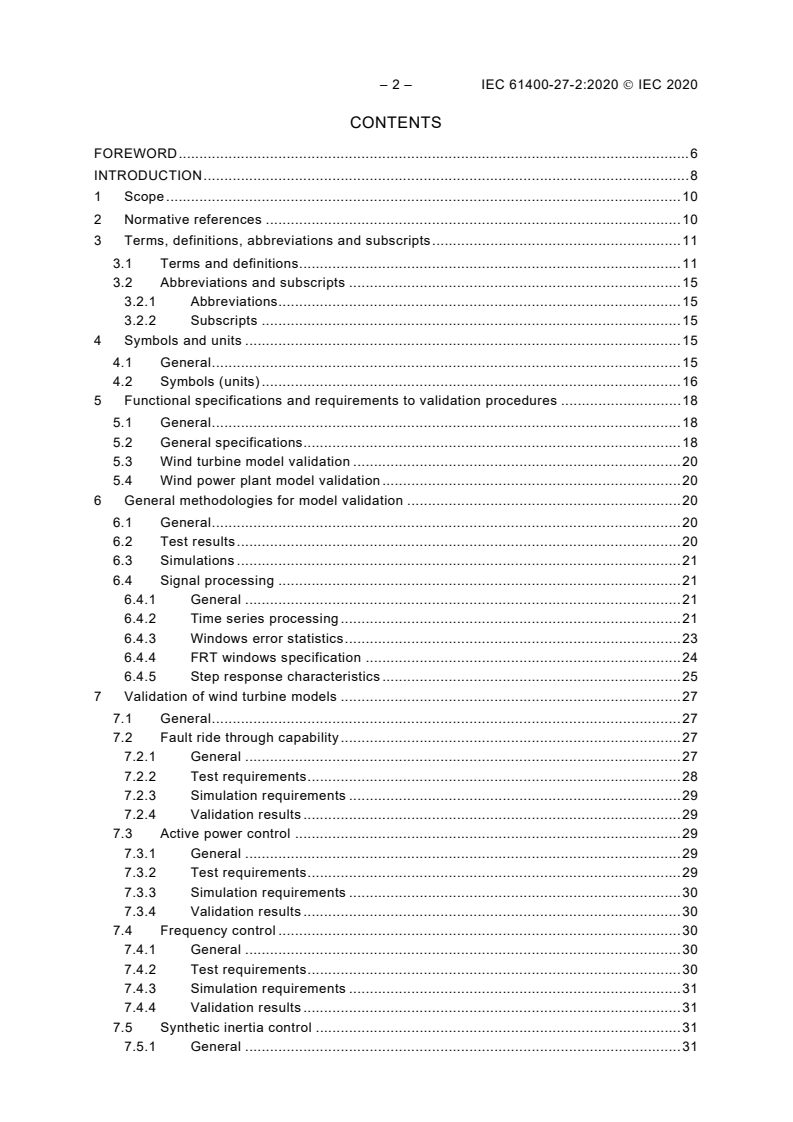
– 2 – IEC 61400-27-2:2020 IEC 2020
CONTENTS
FOREWORD . 6
INTRODUCTION . 8
1 Scope . 10
2 Normative references . 10
3 Terms, definitions, abbreviations and subscripts . 11
3.1 Terms and definitions . 11
3.2 Abbreviations and subscripts . 15
3.2.1 Abbreviations . 15
3.2.2 Subscripts . 15
4 Symbols and units . 15
4.1 General . 15
4.2 Symbols (units) . 16
5 Functional specifications and requirements to validation procedures . 18
5.1 General . 18
5.2 General specifications . 18
5.3 Wind turbine model validation . 20
5.4 Wind power plant model validation . 20
6 General methodologies for model validation . 20
6.1 General . 20
6.2 Test results . 20
6.3 Simulations . 21
6.4 Signal processing . 21
6.4.1 General . 21
6.4.2 Time series processing . 21
6.4.3 Windows error statistics . 23
6.4.4 FRT windows specification . 24
6.4.5 Step response characteristics . 25
7 Validation of wind turbine models . 27
7.1 General . 27
7.2 Fault ride through capability . 27
7.2.1 General . 27
7.2.2 Test requirements . 28
7.2.3 Simulation requirements . 29
7.2.4 Validation results . 29
7.3 Active power control . 29
7.3.1 General . 29
7.3.2 Test requirements . 29
7.3.3 Simulation requirements . 30
7.3.4 Validation results . 30
7.4 Frequency control . 30
7.4.1 General . 30
7.4.2 Test requirements . 30
7.4.3 Simulation requirements . 31
7.4.4 Validation results . 31
7.5 Synthetic inertia control . 31
7.5.1 General . 31
7.5.2 Test requirements . 31
7.5.3 Simulation requirements . 32
7.5.4 Validation results . 32
7.6 Reactive power reference control . 32
7.6.1 General . 32
7.6.2 Test requirements . 32
7.6.3 Simulation requirements . 33
7.6.4 Validation results . 33
7.7 Reactive power – voltage reference control . 33
7.7.1 General . 33
7.7.2 Test requirements . 33
7.7.3 Simulation requirements . 33
7.7.4 Validation results . 34
7.8 Grid protection . 34
7.8.1 General . 34
7.8.2 Test requirements . 34
7.8.3 Simulation requirements . 34
7.8.4 Validation results . 35
8 Validation of wind power plant models . 35
8.1 General . 35
8.2 Active power control . 35
8.2.1 General . 35
8.2.2 Test requirements . 36
8.2.3 Simulation requirements . 36
8.2.4 Validation results . 36
8.3 Reactive power reference control . 36
8.3.1 General . 36
8.3.2 Test requirements . 37
8.3.3 Simulation requirements . 37
8.3.4 Validation results . 37
8.4 Reactive power – voltage reference control . 37
8.4.1 General . 37
8.4.2 Test requirements . 38
8.4.3 Simulation requirements . 38
8.4.4 Validation results . 38
Annex A (informative) Validation documentation for wind turbine model . 39
A.1 General . 39
A.2 Simulation model and validation setup information . 39
A.3 Template for validation results . 39
A.3.1 General . 39
A.3.2 Fault ride through capability . 40
A.3.3 Active power control . 42
A.3.4 Frequency control . 42
A.3.5 Synthetic inertia control . 43
A.3.6 Reactive power reference control . 43
A.3.7 Reactive power – voltage reference control . 44
A.3.8 Grid protection . 45
Annex B (informative) Validation documentation for wind power plant model. 46
B.1 General . 46
– 4 – IEC 61400-27-2:2020 IEC 2020
B.2 Simulation model and validation setup information . 46
B.3 Template for validation results . 46
B.3.1 General . 46
B.3.2 Active power control . 47
B.3.3 Reactive power reference control . 47
B.3.4 Reactive power – voltage reference control . 48
Annex C (informative) Reference grid for model-to-model validation . 49
Annex D (informative) Model validation uncertainty . 50
D.1 General . 50
D.2 Simulation uncertainties . 50
D.3 Measurement uncertainties . 50
D.4 Impact of model validation uncertainties . 51
nd
Annex E (normative) Digital 2 order critically damped low pass filter . 52
Annex F (informative) Additional performance based model validation methodology for
active power recovery in voltage dips. 53
F.1 General . 53
F.2 Active power recovery criterion . 53
F.3 Active power oscillation criterion . 53
Annex G (informative) Generic software interface for use of models in different
software environments . 55
G.1 Description of the approach . 55
G.2 Description of the software interface . 56
G.2.1 Description of data structures . 56
G.2.2 Functions for communication through the ESE-interface . 58
G.2.3 Inputs, outputs, parameters . 59
Bibliography . 60
Figure 1 – Classification of power system stability according to IEEE/CIGRE Joint Task
Force on Stability Terms and Definitions [1] . 8
Figure 2 – Signal processing structure with play-back simulation approach applied . 22
Figure 3 – Signal processing structure with full-system simulation approach applied . 22
Figure 4 – Voltage dip windows [12] . 24
Figure 5 – Step response characteristics . 26
Figure 6 – Measured and simulated settling time with inexpedient choice of tolerance
band . 27
Figure A.1 – Time series of measured and simulated positive sequence voltage . 40
Figure A.2 – Time series of measured and simulated positive sequence active current . 40
Figure A.3 – Time series of measured and simulated positive sequence reactive
current . 40
Figure A.4 – Time series of calculated absolute error of positive sequence active and
reactive current . 40
Figure A.5 – Time series of measured and simulated negative sequence voltage . 41
Figure A.6 – Time series of measured and simulated negative sequence active current . 41
Figure A.7 – Time series of measured and simulated negative sequence reactive
current . 41
Figure A.8 – Time series of calculated absolute error of negative sequence active and
reactive current . 41
Figure A.9 – Time series of active power reference, available active power, measured
active power and simulated active power . 42
Figure A.10 – Time series of frequency reference value and measured input to WT
controller . 43
Figure A.11 – Time series of available active power, measured active power and
simulated active power . 43
Figure A.12 – Time series of frequency reference value and measured input to WT
controller . 43
Figure A.13 – Time series of available active power, measured active power and
simulated active power . 43
Figure A.14 – Time series of reactive power reference, measured reactive power and
simulated reactive power . 44
Figure A.15 – Time series of measured active power and simulated active power . 44
Figure A.16 – Time series of measured and simulated reactive power . 44
Figure B.1 – Time series of active power reference, available active power, measured
active power and simulated active power . 47
Figure B.2 – Time series of reactive power reference, measured reactive power and
simulated reactive power . 47
Figure B.3 – Time series of measured active power and simulated active power . 47
Figure B.4 – Time series of measured and simulated reactive power . 48
Figure C.1 – Layout of reference grid . 49
Figure F.1 – Voltage dip active power performance validation parameters . 54
Figure G.1 – Sequence of simulation on use of ESE-interface . 59
Table 1 – Windows applied for error calculations . 25
Table A.1 – Required information about simulation model and validation setup . 39
Table A.2 – Additional information required if full-system method is applied . 39
Table A.3 – Positive sequence validation summary for each voltage dip and voltage
swell validation case . 41
Table A.4 – Negative sequence validation summary for each voltage dip and voltage
swell validation case . 42
Table A.5 – Validation summary for active power control . 42
Table A.6 – Validation summary for reactive power control . 44
Table A.7 – Validation summary for grid protection . 45
Table B.1 – Required information about simulation model and validation setup . 46
Table B.2 – Additional information required if full-system method is applied . 46
Table B.3 – Validation summary for active power control . 47
Table B.4 – Validation summary for reactive power control . 47
Table C.1 – Line data for the WECC test system in per-unit . 49
Table C.2 – Transformer data for the WECC test system . 49
– 6 – IEC 61400-27-2:2020 IEC 2020
INTERNATIONAL ELECTROTECHNICAL COMMISSION
_____________
WIND ENERGY GENERATION SYSTEMS –
Part 27-2: Electrical simulation models –
Model validation
FOREWORD
1) The International Electrotechnical Commission (IEC) is a worldwide organization for standardization comprising
all national electrotechnical committees (IEC National Committees). The object of IEC is to promote
international co-operation on all questions concerning standardization in the electrical and electronic fields. To
this end and in addition to other activities, IEC publishes International Standards, Technical Specifications,
Technical Reports, Publicly Available Specifications (PAS) and Guides (hereafter referred to as “IEC
Publication(s)”). Their preparation is entrusted to technical committees; any IEC National Committee interested
in the subject dealt with may participate in this preparatory work. International, governmental and non-
governmental organizations liaising with the IEC also participate in this preparation. IEC collaborates closely
with the International Organization for Standardization (ISO) in accordance with conditions determined by
agreement between the two organizations.
2) The formal decisions or agreements of IEC on technical matters express, as nearly as possible, an international
consensus of opinion on the relevant subjects since each technical committee has representation from all
interested IEC National Committees.
3) IEC Publications have the form of recommendations for international use and are accepted by IEC National
Committees in that sense. While all reasonable efforts are made to ensure that the technical content of IEC
Publications is accurate, IEC cannot be held responsible for the way in which they are used or for any
misinterpretation by any end user.
4) In order to promote international uniformity, IEC National Committees undertake to apply IEC Publications
transparently to the maximum extent possible in their national and regional publications. Any divergence
between any IEC Publication and the corresponding national or regional publication shall be clearly indicated in
the latter.
5) IEC itself does not provide any attestation of conformity. Independent certification bodies provide conformity
assessment services and, in some areas, access to IEC marks of conformity. IEC is not responsible for any
services carried out by independent certification bodies.
6) All users shall ensure that they have the latest edition of this publication.
7) No liability shall attach to IEC or its directors, employees, servants or agents including individual experts and
members of its technical committees and IEC National Committees for any personal injury, property damage or
other damage of any nature whatsoever, whether direct or indirect, or for costs (including legal fees) and
expenses arising out of the publication, use of, or reliance upon, this IEC Publication or any other IEC
Publications.
8) Attention is drawn to the Normative references cited in this publication. Use of the referenced publications is
indispensable for the correct application of this publication.
9) Attention is drawn to the possibility that some of the elements of this IEC Publication may be the subject of
patent rights. IEC shall not be held responsible for identifying any or all such patent rights.
International Standard IEC 61400-27-2 has been prepared by IEC technical committee 88:
Wind energy generation systems.
The text of this International Standard is based on the following documents:
FDIS Report on voting
88/763/FDIS 88/772/RVD
Full information on the voting for the approval of this International Standard can be found in
the report on voting indicated in the above table.
This publication has been drafted in accordance with the ISO/IEC Directives, Part 2.
A list of all parts in the IEC 61400, published under the general title Wind energy generation
systems, can be found on the IEC website.
Future standards in this series will carry the new general title as cited above. Titles of existing
standards in this series will be updated at the time of the next edition.
The committee has decided that the contents of this publication will remain unchanged until
the stability date indicated on the IEC web site under "http://webstore.iec.ch" in the data
related to the specific publication. At this date, the publication will be
• reconfirmed,
• withdrawn,
• replaced by a revised edition, or
• amended.
IMPORTANT – The 'colour inside' logo on the cover page of this publication indicates
that it contains colours which are considered to be useful for the correct
understanding of its contents. Users should therefore print this document using a
colour printer.
– 8 – IEC 61400-27-2:2020 IEC 2020
INTRODUCTION
IEC 61400-27-2 specifies model validation procedures for electrical simulation models of wind
turbines and wind power plants.
The increasing penetration of wind energy in power systems implies that Transmission
System Operators (TSOs) and Distribution System Operators (DSOs) need to use dynamic
models of wind power generation for power system stability studies.
The purpose of this International Standard is to specify validation procedures for dynamic
models, which can be applied in power system stability studies. The IEEE/CIGRE Joint Task
Force on Stability Terms and Definitions [1] has classified power system stability in
categories according to Figure 1.
Figure 1 – Classification of power system stability according to IEEE/CIGRE
Joint Task Force on Stability Terms and Definitions [1]
Referring to these categories, the models to be validated have been developed to represent
wind power generation in studies of large-disturbance short term stability phenomena, i.e.
short term voltage stability, short term frequency stability and short term transient stability
studies referring to the definitions of IEEE/CIGRE Joint Task Force on Stability Terms and
Definitions in Figure 1. Thus, the models are applicable for dynamic simulations of power
system events such as short-circuits (low voltage ride through), loss of generation or loads,
and system separation of one synchronous area into more synchronous areas.
The validation procedure specified in this document assesses the accuracy of the
fundamental frequency response of wind power plant models and wind turbine models. This
includes validation of the generic positive sequence models specified in IEC 61400-27-1 and
validation of positive sequence as well as negative sequence response of more detailed
models developed by the wind turbine manufacturers.
___________
Figures in square brackets refer to the Bibliography.
The validation procedure has the following limitations:
– The validation procedure does not specify any requirements to model accuracy. It only
2 3
specifies measures to quantify the accuracy of the model , .
– The validation procedure does not specify test and measurement procedures, as it is
intended to be based on tests specified in IEC 61400-21-1 and IEC 61400-21-2 .
– The validation procedure is not intended to justify compliance to any grid code
requirement, power quality requirements or national legislation.
– The validation procedure does not include validation of steady state capabilities e.g. of
reactive power, but focuses on validation of the dynamic performance of the models.
– The validation procedure does not cover long term stability analysis.
– The validation procedure does not cover sub-synchronous interaction phenomena.
– The validation procedure does not cover investigation of the fluctuations originating from
wind speed variability in time and space.
– The validation procedure does not cover phenomena such as harmonics, flicker or any
other EMC emissions included in the IEC 61000 series.
– The validation procedure does not cover eigenvalue calculations for small signal stability
analysis.
– This validation procedure does not address the specifics of short-circuit calculations.
– The validation procedure is limited by the functional specifications in Clause 5.
The following stakeholders are potential users of the validation procedures specified in this
document:
– TSOs and DSOs need procedures to validate the accuracy of the models which they use
in power system stability studies;
– wind plant owners are typically responsible to provide validation of their wind power plant
models to TSO and/or DSO prior to plant commissioning;
– wind turbine manufacturers will typically provide validation of the wind turbine models to
the owner.
– developers of modern software for power system simulation tools may use the standard to
implement validation procedures as part of the software library;
– certification bodies in case of independent model validation;
– education and research communities, who can also benefit from standard model validation
procedures.
___________
Specification of requirements to model accuracy is the responsibility of TSOs e.g. in grid codes. The scope of
IEC 61400-27-2 is to provide a standard for how to measure accuracy and this way remove indefiniteness.
Clause 7 specifies a large number of measures for model accuracy. The importance of the individual measure
depends on the type of grid and type of stability study. Annex D describes limits to the possible accuracy of the
models.
Under consideration.
– 10 – IEC 61400-27-2:2020 IEC 2020
WIND ENERGY GENERATION SYSTEMS –
Part 27-2: Electrical simulation models –
Model validation
1 Scope
This part of IEC 61400 specifies procedures for validation of electrical simulation models for
wind turbines and wind power plants, intended to be used in power system and grid stability
analyses. The validation procedures are based on the tests specified in IEC 61400-21 (all
parts). The validation procedures are applicable to the generic models specified in
IEC 61400-27-1 and to other fundamental frequency wind power plant models and wind
turbine models.
The validation procedures for wind turbine models focus on fault ride through capability and
control performance. The fault ride through capability includes response to balanced and
unbalanced voltage dips as well as voltage swells. The control performance includes active
power control, frequency control, synthetic inertia control and reactive power control. The
validation procedures for wind turbine models refer to the tests specified in IEC 61400-21-1.
The validation procedures for wind turbine models refer to the wind turbine terminals.
The validation procedures for wind power plant models is not specified in detail because
IEC 61400-21-2 which has the scope to specify tests of wind power plants is at an early
stage. The validation procedures for wind power plant models refer to the point of connection
of the wind power plant.
The validation procedures specified in IEC 61400-27-2 are based on comparisons between
measurements and simulations, but they are independent of the choice of software simulation
tool.
2 Normative references
The following documents are referred to in the text in such a way that some or all of their
content constitutes requirements of this document. For dated references, only the edition
cited applies. For undated references, the latest edition of the referenced document (including
any amendments) applies.
IEC 60050-415:1999, International Electrotechnical Vocabulary (IEV) – Part 415: Wind turbine
generator systems (available at www.electropedia.org)
IEC 61400-21-1:2019, Wind energy generation systems – Part 21-1: Measurement and
assessment of electrical characteristics – Wind turbines
IEC 61400-27-1, Wind energy generation systems – Part 27-1: Electrical simulation models –
Generic models
3 Terms, definitions, abbreviations and subscripts
3.1 Terms and definitions
For the purposes of this document, the terms and definitions given in IEC 60050-415 and the
following apply.
ISO and IEC maintain terminological databases for use in standardization at the following
addresses:
• IEC Electropedia: available at http://www.electropedia.org/
• ISO Online browsing platform: available at http://www.iso.org/obp
3.1.1
application range
specification of the boundaries for the situations where the electrical simulation model is
applicable
3.1.2
available active power
predicted optimal active power of wind turbine or wind power plant, either based on power
curves and measured wind speeds or as an output from wind turbine controller or wind power
plant controller, where more parameters are taken into the calculation
3.1.3
base unit
unit of parameter values, which is the per-unit base value if the parameter is given in per-unit
or the physical unit if the value is given in a physical unit
3.1.4
generic model
model that can be adapted to simulate different wind turbines or wind power plants by
changing the model parameters
3.1.5
integration time step
simulation time interval between two consecutive numerical solutions of the model's
differential equations
3.1.6
negative (sequence) component (of a three-phase system)
one of the three symmetrical sequence components which exists only in an unsymmetrical
three-phase system of sinusoidal quantities and which is defined by the following complex
mathematical expression:
X= X++a X aX
( )
2 L1 L2 L3
where a is the 120 degree operator, and X , X and X are the complex expressions of the
L1 L2 L3
phase quantities concerned, and where X denotes the system current or voltage phasors
[SOURCE: IEC 60050-448:1995, 448-11-28]
3.1.7
nominal active power
nominal value of active power, which is stated by the manufacturer and is used as a per-unit
base for all powers (active, reactive, apparent)
– 12 – IEC 61400-27-2:2020 IEC 2020
[SOURCE: IEC 61400-21-1:2019, 3.15, modified – Removed “wind turbine” from definition]
3.1.8
nominal voltage
nominal value of line-to-line voltage, which is stated by the manufacturer and is used as a per-
unit base
3.1.9
overshoot
difference between the maximum value of the response and the steady-state final value
Note 1 to entry: Overshoot is defined by the response to a step change of a controller reference variable, see
Figure 5.
[SOURCE: IEC 61400-21-1:2019, 3.47, modified – The note to entry has been changed]
3.1.10
phasor
complex RMS value
representation of a sinusoidal integral quantity by a complex quantity whose argument is
equal to the initial phase and whose modulus is equal to the RMS value
A
Note 1 to entry: For a quantity at() Acosωϑt+ the phasor is AA= exp jϑ where A= is the RMS value
( ) ( )
0 0
and ϑ is the initial phase. A phasor can also be represented graphically.
Note 2 to entry: Electric current phasor I and voltage phasor U are often used.
Note 3 to entry: The similar representation with the modulus equal to the amplitude is sometimes also called
"phasor".
[SOURCE: IEC 60050-103:2017 103-07-14]
3.1.11
point of connection
reference point on the electric power system where the user’s electrical facility is connected
[SOURCE: IEC 60050-617:2009, 617-04-01]
3.1.12
positive (sequence) component (of a three-phase system)
one of the three symmetrical sequence components which exists in symmetrical and
unsymmetrical three-phase system of sinusoidal quantities and which is defined by the
following complex mathematical expression:
X X++aX a X
( )
1 L1 L2 L3
where a is the 120 degree operator, and X , X and X are the complex expressions of the
L1 L2 L3
phase quantities concerned, and where X denotes the system current or voltage phasors
[SOURCE: IEC 60050-448:1995, 448-11-27]
3.1.13
power system stability
capability of a power system to regain a steady state, characterized by the synchronous
operation of the generators after a disturbance due, for example, to variation of power or
impedance
=
=
Note 1 to entry: IEEE/CIGRE Joint Task Force on Stability Terms and Definitions: Power system stability is the
ability of an electric power system, for a given initial operating condition, to regain a state of operating equilibrium
after being subjected to a physical disturbance, with most system variables bounded so that practically the entire
system remains intact.
[SOURCE: IEC 60050-603:1986, 603-03-01, modified – addition of Note 1 to entry]
3.1.14
quasi steady state of a system
short-term steady state, for instance during a voltage dip or voltage swell which is long
enough to include a period where the system state variables can be considered sensibly
constant
3.1.15
reaction time
elapsed time from test command issued until the change in amplitude reaches 10 % of the
measured output variable of the step height
Note 1 to entry: Reaction time is defined by the response to a step change of a controller reference variable, see
Figure 5.
[SOURCE: IEC 61400-21-1:2019, 3.48, modified – The note to entry has been changed]
3.1.16
reference variable
input variable to a comparing element in a controlling system, which sets the desired value of
the controlled variable and is deducted from the command variable
[SOURCE: IEC 60050-351:2013, 351-48-02, modified – The note to entry and the figure have
been deleted]
3.1.17
response time
elapsed time from the start of a step change or start of event until the observed value first
time enters the predefined tolerance band of the target value
Note 1 to entry: Response time is defined by the response to a step change of a controller reference variable, see
Figure 5.
[SOURCE: IEC 61400-21-1:2019,3.44, modified – The note to entry has been changed]
3.1.18
rise time
time from when the observed value reaches 10 % of the step change until the observed value
reaches 90 % of the step change
Note 1 to entry: Rise time is defined by the response to a step change of a controller reference variable, see
Figure 5.
[SOURCE: IEC 61400-21-1:2019, 3.46, modified – The note to entry has been changed]
3.1.19
settling time
elapsed time from the start of a step change event until the observed value continuously stays
within the predefined tolerance band of the target value
Note 1 to entry: Settling time is defined by the response to a step change of a controller reference variable, see
Figure 5.
[SOURCE: IEC 61400-21-1:2019, 3.45, modified – The note to entry has been changed]
– 14 – IEC 61400-27-2:2020 IEC 2020
3.1.20
short-circuit power
the product of the current in the short circuit at a point of a system and a conventional
voltage, generally the operating voltage
Note 1 to entry: Transient and subtransient currents are not considered.
[SOURCE: IEC 60050-601:1985, 601-01-14, modified – The note 1 to entry has been added]
3.1.21
system state variables
variable quantities associated with the electrical state of a system
Examples: Voltages, currents, powers, electric charges, magnetic fluxes.
[SOURCE: IEC 60050-603:1986, 603-02-02]
3.1.22
target value
final value of the reference variable after a step change.
Note 1 to entry: Reaction time is illustrated in Figure 5.
3.1.23
Thevenin equivalent
equivalent representation of a circuit by a Thevenin voltage in series with a Thevenin
impedance
3.1.24
transient time period
time periods with measured electromagnetic transients which are not included in fundamental
frequency models
3.1.25
voltage dip
limited duration non-periodic sudden decrease of the power supply network’s voltage
magnitude and associated change o
...
IEC 61400-27-2 ®
Edition 1.0 2020-07
INTERNATIONAL
STANDARD
NORME
INTERNATIONALE
colour
inside
Wind energy generation systems –
Part 27-2: Electrical simulation models – Model validation
Systèmes de génération d’énergie éolienne –
Partie 27-2: Modèles de simulation électrique – Validation des modèles
All rights reserved. Unless otherwise specified, no part of this publication may be reproduced or utilized in any form
or by any means, electronic or mechanical, including photocopying and microfilm, without permission in writing from
either IEC or IEC's member National Committee in the country of the requester. If you have any questions about IEC
copyright or have an enquiry about obtaining additional rights to this publication, please contact the address below or
your local IEC member National Committee for further information.
Droits de reproduction réservés. Sauf indication contraire, aucune partie de cette publication ne peut être reproduite
ni utilisée sous quelque forme que ce soit et par aucun procédé, électronique ou mécanique, y compris la photocopie
et les microfilms, sans l'accord écrit de l'IEC ou du Comité national de l'IEC du pays du demandeur. Si vous avez des
questions sur le copyright de l'IEC ou si vous désirez obtenir des droits supplémentaires sur cette publication, utilisez
les coordonnées ci-après ou contactez le Comité national de l'IEC de votre pays de résidence.
IEC Central Office Tel.: +41 22 919 02 11
3, rue de Varembé info@iec.ch
CH-1211 Geneva 20 www.iec.ch
Switzerland
About the IEC
The International Electrotechnical Commission (IEC) is the leading global organization that prepares and publishes
International Standards for all electrical, electronic and related technologies.
About IEC publications
The technical content of IEC publications is kept under constant review by the IEC. Please make sure that you have the
latest edition, a corrigendum or an amendment might have been published.
IEC publications search - webstore.iec.ch/advsearchform IEC online collection - oc.iec.ch
The advanced search enables to find IEC publications by a Discover our powerful search engine and read freely all the
variety of criteria (reference number, text, technical publications previews. With a subscription you will always
committee, …). It also gives information on projects, replaced have access to up to date content tailored to your needs.
and withdrawn publications.
Electropedia - www.electropedia.org
IEC Just Published - webstore.iec.ch/justpublished
The world's leading online dictionary on electrotechnology,
Stay up to date on all new IEC publications. Just Published
containing more than 22 000 terminological entries in English
details all new publications released. Available online and
and French, with equivalent terms in 18 additional languages.
once a month by email.
Also known as the International Electrotechnical Vocabulary
(IEV) online.
IEC Customer Service Centre - webstore.iec.ch/csc
If you wish to give us your feedback on this publication or
need further assistance, please contact the Customer Service
Centre: sales@iec.ch.
A propos de l'IEC
La Commission Electrotechnique Internationale (IEC) est la première organisation mondiale qui élabore et publie des
Normes internationales pour tout ce qui a trait à l'électricité, à l'électronique et aux technologies apparentées.
A propos des publications IEC
Le contenu technique des publications IEC est constamment revu. Veuillez vous assurer que vous possédez l’édition la
plus récente, un corrigendum ou amendement peut avoir été publié.
Recherche de publications IEC - IEC online collection - oc.iec.ch
webstore.iec.ch/advsearchform Découvrez notre puissant moteur de recherche et consultez
La recherche avancée permet de trouver des publications IEC gratuitement tous les aperçus des publications. Avec un
en utilisant différents critères (numéro de référence, texte, abonnement, vous aurez toujours accès à un contenu à jour
comité d’études, …). Elle donne aussi des informations sur adapté à vos besoins.
les projets et les publications remplacées ou retirées.
Electropedia - www.electropedia.org
IEC Just Published - webstore.iec.ch/justpublished
Le premier dictionnaire d'électrotechnologie en ligne au
Restez informé sur les nouvelles publications IEC. Just
monde, avec plus de 22 000 articles terminologiques en
Published détaille les nouvelles publications parues.
anglais et en français, ainsi que les termes équivalents dans
Disponible en ligne et une fois par mois par email.
16 langues additionnelles. Egalement appelé Vocabulaire
Electrotechnique International (IEV) en ligne.
Service Clients - webstore.iec.ch/csc
Si vous désirez nous donner des commentaires sur cette
publication ou si vous avez des questions contactez-nous:
sales@iec.ch.
IEC 61400-27-2 ®
Edition 1.0 2020-07
INTERNATIONAL
STANDARD
NORME
INTERNATIONALE
colour
inside
Wind energy generation systems –
Part 27-2: Electrical simulation models – Model validation
Systèmes de génération d’énergie éolienne –
Partie 27-2: Modèles de simulation électrique – Validation des modèles
INTERNATIONAL
ELECTROTECHNICAL
COMMISSION
COMMISSION
ELECTROTECHNIQUE
INTERNATIONALE
ICS 27.180 ISBN 978-2-8322-1008-7
– 2 – IEC 61400-27-2:2020 IEC 2020
CONTENTS
FOREWORD . 6
INTRODUCTION . 8
1 Scope . 10
2 Normative references . 10
3 Terms, definitions, abbreviations and subscripts . 11
3.1 Terms and definitions . 11
3.2 Abbreviations and subscripts . 15
3.2.1 Abbreviations . 15
3.2.2 Subscripts . 15
4 Symbols and units . 15
4.1 General . 15
4.2 Symbols (units) . 16
5 Functional specifications and requirements to validation procedures . 18
5.1 General . 18
5.2 General specifications . 18
5.3 Wind turbine model validation . 20
5.4 Wind power plant model validation . 20
6 General methodologies for model validation . 20
6.1 General . 20
6.2 Test results . 20
6.3 Simulations . 21
6.4 Signal processing . 21
6.4.1 General . 21
6.4.2 Time series processing . 21
6.4.3 Windows error statistics . 23
6.4.4 FRT windows specification . 24
6.4.5 Step response characteristics . 25
7 Validation of wind turbine models . 27
7.1 General . 27
7.2 Fault ride through capability . 27
7.2.1 General . 27
7.2.2 Test requirements . 28
7.2.3 Simulation requirements . 29
7.2.4 Validation results . 29
7.3 Active power control . 29
7.3.1 General . 29
7.3.2 Test requirements . 29
7.3.3 Simulation requirements . 30
7.3.4 Validation results . 30
7.4 Frequency control . 30
7.4.1 General . 30
7.4.2 Test requirements . 30
7.4.3 Simulation requirements . 31
7.4.4 Validation results . 31
7.5 Synthetic inertia control . 31
7.5.1 General . 31
7.5.2 Test requirements . 31
7.5.3 Simulation requirements . 32
7.5.4 Validation results . 32
7.6 Reactive power reference control . 32
7.6.1 General . 32
7.6.2 Test requirements . 32
7.6.3 Simulation requirements . 33
7.6.4 Validation results . 33
7.7 Reactive power – voltage reference control . 33
7.7.1 General . 33
7.7.2 Test requirements . 33
7.7.3 Simulation requirements . 33
7.7.4 Validation results . 34
7.8 Grid protection . 34
7.8.1 General . 34
7.8.2 Test requirements . 34
7.8.3 Simulation requirements . 34
7.8.4 Validation results . 35
8 Validation of wind power plant models . 35
8.1 General . 35
8.2 Active power control . 35
8.2.1 General . 35
8.2.2 Test requirements . 36
8.2.3 Simulation requirements . 36
8.2.4 Validation results . 36
8.3 Reactive power reference control . 36
8.3.1 General . 36
8.3.2 Test requirements . 37
8.3.3 Simulation requirements . 37
8.3.4 Validation results . 37
8.4 Reactive power – voltage reference control . 37
8.4.1 General . 37
8.4.2 Test requirements . 38
8.4.3 Simulation requirements . 38
8.4.4 Validation results . 38
Annex A (informative) Validation documentation for wind turbine model . 39
A.1 General . 39
A.2 Simulation model and validation setup information . 39
A.3 Template for validation results . 39
A.3.1 General . 39
A.3.2 Fault ride through capability . 40
A.3.3 Active power control . 42
A.3.4 Frequency control . 42
A.3.5 Synthetic inertia control . 43
A.3.6 Reactive power reference control . 43
A.3.7 Reactive power – voltage reference control . 44
A.3.8 Grid protection . 45
Annex B (informative) Validation documentation for wind power plant model. 46
B.1 General . 46
– 4 – IEC 61400-27-2:2020 IEC 2020
B.2 Simulation model and validation setup information . 46
B.3 Template for validation results . 46
B.3.1 General . 46
B.3.2 Active power control . 47
B.3.3 Reactive power reference control . 47
B.3.4 Reactive power – voltage reference control . 48
Annex C (informative) Reference grid for model-to-model validation . 49
Annex D (informative) Model validation uncertainty . 50
D.1 General . 50
D.2 Simulation uncertainties . 50
D.3 Measurement uncertainties . 50
D.4 Impact of model validation uncertainties . 51
nd
Annex E (normative) Digital 2 order critically damped low pass filter . 52
Annex F (informative) Additional performance based model validation methodology for
active power recovery in voltage dips. 53
F.1 General . 53
F.2 Active power recovery criterion . 53
F.3 Active power oscillation criterion . 53
Annex G (informative) Generic software interface for use of models in different
software environments . 55
G.1 Description of the approach . 55
G.2 Description of the software interface . 56
G.2.1 Description of data structures . 56
G.2.2 Functions for communication through the ESE-interface . 58
G.2.3 Inputs, outputs, parameters . 59
Bibliography . 60
Figure 1 – Classification of power system stability according to IEEE/CIGRE Joint Task
Force on Stability Terms and Definitions [1] . 8
Figure 2 – Signal processing structure with play-back simulation approach applied . 22
Figure 3 – Signal processing structure with full-system simulation approach applied . 22
Figure 4 – Voltage dip windows [12] . 24
Figure 5 – Step response characteristics . 26
Figure 6 – Measured and simulated settling time with inexpedient choice of tolerance
band . 27
Figure A.1 – Time series of measured and simulated positive sequence voltage . 40
Figure A.2 – Time series of measured and simulated positive sequence active current . 40
Figure A.3 – Time series of measured and simulated positive sequence reactive
current . 40
Figure A.4 – Time series of calculated absolute error of positive sequence active and
reactive current . 40
Figure A.5 – Time series of measured and simulated negative sequence voltage . 41
Figure A.6 – Time series of measured and simulated negative sequence active current . 41
Figure A.7 – Time series of measured and simulated negative sequence reactive
current . 41
Figure A.8 – Time series of calculated absolute error of negative sequence active and
reactive current . 41
Figure A.9 – Time series of active power reference, available active power, measured
active power and simulated active power . 42
Figure A.10 – Time series of frequency reference value and measured input to WT
controller . 43
Figure A.11 – Time series of available active power, measured active power and
simulated active power . 43
Figure A.12 – Time series of frequency reference value and measured input to WT
controller . 43
Figure A.13 – Time series of available active power, measured active power and
simulated active power . 43
Figure A.14 – Time series of reactive power reference, measured reactive power and
simulated reactive power . 44
Figure A.15 – Time series of measured active power and simulated active power . 44
Figure A.16 – Time series of measured and simulated reactive power . 44
Figure B.1 – Time series of active power reference, available active power, measured
active power and simulated active power . 47
Figure B.2 – Time series of reactive power reference, measured reactive power and
simulated reactive power . 47
Figure B.3 – Time series of measured active power and simulated active power . 47
Figure B.4 – Time series of measured and simulated reactive power . 48
Figure C.1 – Layout of reference grid . 49
Figure F.1 – Voltage dip active power performance validation parameters . 54
Figure G.1 – Sequence of simulation on use of ESE-interface . 59
Table 1 – Windows applied for error calculations . 25
Table A.1 – Required information about simulation model and validation setup . 39
Table A.2 – Additional information required if full-system method is applied . 39
Table A.3 – Positive sequence validation summary for each voltage dip and voltage
swell validation case . 41
Table A.4 – Negative sequence validation summary for each voltage dip and voltage
swell validation case . 42
Table A.5 – Validation summary for active power control . 42
Table A.6 – Validation summary for reactive power control . 44
Table A.7 – Validation summary for grid protection . 45
Table B.1 – Required information about simulation model and validation setup . 46
Table B.2 – Additional information required if full-system method is applied . 46
Table B.3 – Validation summary for active power control . 47
Table B.4 – Validation summary for reactive power control . 47
Table C.1 – Line data for the WECC test system in per-unit . 49
Table C.2 – Transformer data for the WECC test system . 49
– 6 – IEC 61400-27-2:2020 IEC 2020
INTERNATIONAL ELECTROTECHNICAL COMMISSION
_____________
WIND ENERGY GENERATION SYSTEMS –
Part 27-2: Electrical simulation models –
Model validation
FOREWORD
1) The International Electrotechnical Commission (IEC) is a worldwide organization for standardization comprising
all national electrotechnical committees (IEC National Committees). The object of IEC is to promote
international co-operation on all questions concerning standardization in the electrical and electronic fields. To
this end and in addition to other activities, IEC publishes International Standards, Technical Specifications,
Technical Reports, Publicly Available Specifications (PAS) and Guides (hereafter referred to as “IEC
Publication(s)”). Their preparation is entrusted to technical committees; any IEC National Committee interested
in the subject dealt with may participate in this preparatory work. International, governmental and non-
governmental organizations liaising with the IEC also participate in this preparation. IEC collaborates closely
with the International Organization for Standardization (ISO) in accordance with conditions determined by
agreement between the two organizations.
2) The formal decisions or agreements of IEC on technical matters express, as nearly as possible, an international
consensus of opinion on the relevant subjects since each technical committee has representation from all
interested IEC National Committees.
3) IEC Publications have the form of recommendations for international use and are accepted by IEC National
Committees in that sense. While all reasonable efforts are made to ensure that the technical content of IEC
Publications is accurate, IEC cannot be held responsible for the way in which they are used or for any
misinterpretation by any end user.
4) In order to promote international uniformity, IEC National Committees undertake to apply IEC Publications
transparently to the maximum extent possible in their national and regional publications. Any divergence
between any IEC Publication and the corresponding national or regional publication shall be clearly indicated in
the latter.
5) IEC itself does not provide any attestation of conformity. Independent certification bodies provide conformity
assessment services and, in some areas, access to IEC marks of conformity. IEC is not responsible for any
services carried out by independent certification bodies.
6) All users shall ensure that they have the latest edition of this publication.
7) No liability shall attach to IEC or its directors, employees, servants or agents including individual experts and
members of its technical committees and IEC National Committees for any personal injury, property damage or
other damage of any nature whatsoever, whether direct or indirect, or for costs (including legal fees) and
expenses arising out of the publication, use of, or reliance upon, this IEC Publication or any other IEC
Publications.
8) Attention is drawn to the Normative references cited in this publication. Use of the referenced publications is
indispensable for the correct application of this publication.
9) Attention is drawn to the possibility that some of the elements of this IEC Publication may be the subject of
patent rights. IEC shall not be held responsible for identifying any or all such patent rights.
International Standard IEC 61400-27-2 has been prepared by IEC technical committee 88:
Wind energy generation systems.
The text of this International Standard is based on the following documents:
FDIS Report on voting
88/763/FDIS 88/772/RVD
Full information on the voting for the approval of this International Standard can be found in
the report on voting indicated in the above table.
This publication has been drafted in accordance with the ISO/IEC Directives, Part 2.
A list of all parts in the IEC 61400, published under the general title Wind energy generation
systems, can be found on the IEC website.
Future standards in this series will carry the new general title as cited above. Titles of existing
standards in this series will be updated at the time of the next edition.
The committee has decided that the contents of this publication will remain unchanged until
the stability date indicated on the IEC web site under "http://webstore.iec.ch" in the data
related to the specific publication. At this date, the publication will be
• reconfirmed,
• withdrawn,
• replaced by a revised edition, or
• amended.
IMPORTANT – The 'colour inside' logo on the cover page of this publication indicates
that it contains colours which are considered to be useful for the correct
understanding of its contents. Users should therefore print this document using a
colour printer.
– 8 – IEC 61400-27-2:2020 IEC 2020
INTRODUCTION
IEC 61400-27-2 specifies model validation procedures for electrical simulation models of wind
turbines and wind power plants.
The increasing penetration of wind energy in power systems implies that Transmission
System Operators (TSOs) and Distribution System Operators (DSOs) need to use dynamic
models of wind power generation for power system stability studies.
The purpose of this International Standard is to specify validation procedures for dynamic
models, which can be applied in power system stability studies. The IEEE/CIGRE Joint Task
Force on Stability Terms and Definitions [1] has classified power system stability in
categories according to Figure 1.
Figure 1 – Classification of power system stability according to IEEE/CIGRE
Joint Task Force on Stability Terms and Definitions [1]
Referring to these categories, the models to be validated have been developed to represent
wind power generation in studies of large-disturbance short term stability phenomena, i.e.
short term voltage stability, short term frequency stability and short term transient stability
studies referring to the definitions of IEEE/CIGRE Joint Task Force on Stability Terms and
Definitions in Figure 1. Thus, the models are applicable for dynamic simulations of power
system events such as short-circuits (low voltage ride through), loss of generation or loads,
and system separation of one synchronous area into more synchronous areas.
The validation procedure specified in this document assesses the accuracy of the
fundamental frequency response of wind power plant models and wind turbine models. This
includes validation of the generic positive sequence models specified in IEC 61400-27-1 and
validation of positive sequence as well as negative sequence response of more detailed
models developed by the wind turbine manufacturers.
___________
Figures in square brackets refer to the Bibliography.
The validation procedure has the following limitations:
– The validation procedure does not specify any requirements to model accuracy. It only
2 3
specifies measures to quantify the accuracy of the model , .
– The validation procedure does not specify test and measurement procedures, as it is
intended to be based on tests specified in IEC 61400-21-1 and IEC 61400-21-2 .
– The validation procedure is not intended to justify compliance to any grid code
requirement, power quality requirements or national legislation.
– The validation procedure does not include validation of steady state capabilities e.g. of
reactive power, but focuses on validation of the dynamic performance of the models.
– The validation procedure does not cover long term stability analysis.
– The validation procedure does not cover sub-synchronous interaction phenomena.
– The validation procedure does not cover investigation of the fluctuations originating from
wind speed variability in time and space.
– The validation procedure does not cover phenomena such as harmonics, flicker or any
other EMC emissions included in the IEC 61000 series.
– The validation procedure does not cover eigenvalue calculations for small signal stability
analysis.
– This validation procedure does not address the specifics of short-circuit calculations.
– The validation procedure is limited by the functional specifications in Clause 5.
The following stakeholders are potential users of the validation procedures specified in this
document:
– TSOs and DSOs need procedures to validate the accuracy of the models which they use
in power system stability studies;
– wind plant owners are typically responsible to provide validation of their wind power plant
models to TSO and/or DSO prior to plant commissioning;
– wind turbine manufacturers will typically provide validation of the wind turbine models to
the owner.
– developers of modern software for power system simulation tools may use the standard to
implement validation procedures as part of the software library;
– certification bodies in case of independent model validation;
– education and research communities, who can also benefit from standard model validation
procedures.
___________
Specification of requirements to model accuracy is the responsibility of TSOs e.g. in grid codes. The scope of
IEC 61400-27-2 is to provide a standard for how to measure accuracy and this way remove indefiniteness.
Clause 7 specifies a large number of measures for model accuracy. The importance of the individual measure
depends on the type of grid and type of stability study. Annex D describes limits to the possible accuracy of the
models.
Under consideration.
– 10 – IEC 61400-27-2:2020 IEC 2020
WIND ENERGY GENERATION SYSTEMS –
Part 27-2: Electrical simulation models –
Model validation
1 Scope
This part of IEC 61400 specifies procedures for validation of electrical simulation models for
wind turbines and wind power plants, intended to be used in power system and grid stability
analyses. The validation procedures are based on the tests specified in IEC 61400-21 (all
parts). The validation procedures are applicable to the generic models specified in
IEC 61400-27-1 and to other fundamental frequency wind power plant models and wind
turbine models.
The validation procedures for wind turbine models focus on fault ride through capability and
control performance. The fault ride through capability includes response to balanced and
unbalanced voltage dips as well as voltage swells. The control performance includes active
power control, frequency control, synthetic inertia control and reactive power control. The
validation procedures for wind turbine models refer to the tests specified in IEC 61400-21-1.
The validation procedures for wind turbine models refer to the wind turbine terminals.
The validation procedures for wind power plant models is not specified in detail because
IEC 61400-21-2 which has the scope to specify tests of wind power plants is at an early
stage. The validation procedures for wind power plant models refer to the point of connection
of the wind power plant.
The validation procedures specified in IEC 61400-27-2 are based on comparisons between
measurements and simulations, but they are independent of the choice of software simulation
tool.
2 Normative references
The following documents are referred to in the text in such a way that some or all of their
content constitutes requirements of this document. For dated references, only the edition
cited applies. For undated references, the latest edition of the referenced document (including
any amendments) applies.
IEC 60050-415:1999, International Electrotechnical Vocabulary (IEV) – Part 415: Wind turbine
generator systems (available at www.electropedia.org)
IEC 61400-21-1:2019, Wind energy generation systems – Part 21-1: Measurement and
assessment of electrical characteristics – Wind turbines
IEC 61400-27-1, Wind energy generation systems – Part 27-1: Electrical simulation models –
Generic models
3 Terms, definitions, abbreviations and subscripts
3.1 Terms and definitions
For the purposes of this document, the terms and definitions given in IEC 60050-415 and the
following apply.
ISO and IEC maintain terminological databases for use in standardization at the following
addresses:
• IEC Electropedia: available at http://www.electropedia.org/
• ISO Online browsing platform: available at http://www.iso.org/obp
3.1.1
application range
specification of the boundaries for the situations where the electrical simulation model is
applicable
3.1.2
available active power
predicted optimal active power of wind turbine or wind power plant, either based on power
curves and measured wind speeds or as an output from wind turbine controller or wind power
plant controller, where more parameters are taken into the calculation
3.1.3
base unit
unit of parameter values, which is the per-unit base value if the parameter is given in per-unit
or the physical unit if the value is given in a physical unit
3.1.4
generic model
model that can be adapted to simulate different wind turbines or wind power plants by
changing the model parameters
3.1.5
integration time step
simulation time interval between two consecutive numerical solutions of the model's
differential equations
3.1.6
negative (sequence) component (of a three-phase system)
one of the three symmetrical sequence components which exists only in an unsymmetrical
three-phase system of sinusoidal quantities and which is defined by the following complex
mathematical expression:
X= X++a X aX
( )
2 L1 L2 L3
where a is the 120 degree operator, and X , X and X are the complex expressions of the
L1 L2 L3
phase quantities concerned, and where X denotes the system current or voltage phasors
[SOURCE: IEC 60050-448:1995, 448-11-28]
3.1.7
nominal active power
nominal value of active power, which is stated by the manufacturer and is used as a per-unit
base for all powers (active, reactive, apparent)
– 12 – IEC 61400-27-2:2020 IEC 2020
[SOURCE: IEC 61400-21-1:2019, 3.15, modified – Removed “wind turbine” from definition]
3.1.8
nominal voltage
nominal value of line-to-line voltage, which is stated by the manufacturer and is used as a per-
unit base
3.1.9
overshoot
difference between the maximum value of the response and the steady-state final value
Note 1 to entry: Overshoot is defined by the response to a step change of a controller reference variable, see
Figure 5.
[SOURCE: IEC 61400-21-1:2019, 3.47, modified – The note to entry has been changed]
3.1.10
phasor
complex RMS value
representation of a sinusoidal integral quantity by a complex quantity whose argument is
equal to the initial phase and whose modulus is equal to the RMS value
A
Note 1 to entry: For a quantity at() Acosωϑt+ the phasor is AA= exp jϑ where A= is the RMS value
( ) ( )
0 0
and ϑ is the initial phase. A phasor can also be represented graphically.
Note 2 to entry: Electric current phasor I and voltage phasor U are often used.
Note 3 to entry: The similar representation with the modulus equal to the amplitude is sometimes also called
"phasor".
[SOURCE: IEC 60050-103:2017 103-07-14]
3.1.11
point of connection
reference point on the electric power system where the user’s electrical facility is connected
[SOURCE: IEC 60050-617:2009, 617-04-01]
3.1.12
positive (sequence) component (of a three-phase system)
one of the three symmetrical sequence components which exists in symmetrical and
unsymmetrical three-phase system of sinusoidal quantities and which is defined by the
following complex mathematical expression:
X X++aX a X
( )
1 L1 L2 L3
where a is the 120 degree operator, and X , X and X are the complex expressions of the
L1 L2 L3
phase quantities concerned, and where X denotes the system current or voltage phasors
[SOURCE: IEC 60050-448:1995, 448-11-27]
3.1.13
power system stability
capability of a power system to regain a steady state, characterized by the synchronous
operation of the generators after a disturbance due, for example, to variation of power or
impedance
=
=
Note 1 to entry: IEEE/CIGRE Joint Task Force on Stability Terms and Definitions: Power system stability is the
ability of an electric power system, for a given initial operating condition, to regain a state of operating equilibrium
after being subjected to a physical disturbance, with most system variables bounded so that practically the entire
system remains intact.
[SOURCE: IEC 60050-603:1986, 603-03-01, modified – addition of Note 1 to entry]
3.1.14
quasi steady state of a system
short-term steady state, for instance during a voltage dip or voltage swell which is long
enough to include a period where the system state variables can be considered sensibly
constant
3.1.15
reaction time
elapsed time from test command issued until the change in amplitude reaches 10 % of the
measured output variable of the step height
Note 1 to entry: Reaction time is defined by the response to a step change of a controller reference variable, see
Figure 5.
[
...