


IEC 61784-2:2010
(Main)Industrial communication networks - Profiles - Part 2: Additional fieldbus profiles for real-time networks based on ISO/IEC 8802-3
General Information
- Abstract
IEC 61784-2:2010 specifies performance indicators supporting classification schemes for Real-Time Ethernet (RTE) requirements; profiles and related network components based on ISO/IEC 8802-3, IEC 61158 series, and IEC 61784-1; RTE solutions that are able to run in parallel with ISO/IEC 8802-3-based applications. These communication profiles are called Real-Time Ethernet communication profiles. This second edition cancels and replaces the first edition published in 2007 and constitutes a technical revision. The main changes with respect to the previous edition are:
- update of the dated references to the IEC 61158 series, to IEC 61784-1, to the IEC 61784-3 series, to the IEC 61784-5 series and to IEC 61918 throughout the document;
- update of selection tables for CPF 2, CPF 3, CPF 11 and CPF 14;
- addition of a new profile CP 11/2 in 12.3;
- addition of a new profile CP 14/3 in subclause 15.5;
- addition of a new Communication Profile Family - CPF 17;
- new subclause 3.3.12 (CPF 17 symbols);
- new Clause 18 for CPF 17 with one profile;
- addition of a new Communication Profile Family - CPF 18;
- new subclause 3.3.13 (CPF 18 symbols);
- new Clause 19 for CPF 18 with one profile;
- specification changes for CPF3;
- update of the requirements for all conformance classes;
- added precise timing requirements for IP;
- updated timing requirements for IO devices;
- added precise timing requirements for PTCP;
- increasing the amount of synchronized devices in line;
- integrating the fast startup as additional feature.
This bilingual version published in 2011-12, corresponds to the English version published in 2010-07.
- Status
- Published
- Publication Date
- 21-Jul-2010
- Technical Committee
- SC 65C - Industrial networks
- Drafting Committee
- WG 9 - TC 65/SC 65C/WG 9
- Current Stage
- DELPUB - Deleted Publication
- Start Date
- 17-Jul-2014
- Completion Date
- 28-Aug-2026
Buy Documents

IEC 61784-2:2010 - Industrial communication networks - Profiles - Part 2: Additional fieldbus profiles for real-time networks based on ISO/IEC 8802-3 Released:7/22/2010



IEC 61784-2:2010 - Industrial communication networks - Profiles - Part 2: Additional fieldbus profiles for real-time networks based on ISO/IEC 8802-3 Released:7/22/2010
Overview
IEC 61784-2:2010 - part of the IEC 61784 series - defines Real‑Time Ethernet (RTE) communication profiles and performance indicators for industrial networks based on ISO/IEC 8802-3 (Ethernet). This second edition updates profile selection tables, adds new Communication Profile Families (CPF 17 and CPF 18) and new profiles (e.g., CP 11/2, CP 14/3), tightens conformance-class requirements, and introduces more precise timing requirements (including IP and PTCP). The standard helps ensure deterministic, interoperable fieldbus behaviour when RTE solutions run in parallel with standard Ethernet applications.
Key topics and technical requirements
- RTE performance indicators: delivery time, number of RTE end‑stations, network topology, switch count, throughput, non‑RTE bandwidth share, time‑synchronization accuracy, redundancy recovery time.
- Conformance classes and tests: methodology, test conditions, procedures and reporting to verify profile compliance and deterministic behaviour.
- Communication Profile Families (CPFs): mapping of multiple fieldbus families to Ethernet (examples include CPF 2 CIP, CPF 3 PROFIBUS/PROFINET, CPF 4 P‑NET, CPF 6 INTERBUS, CPF 10 Vnet/IP, CPF 11 TCnet, CPF 12 EtherCAT, CPF 13 Ethernet Powerlink, and the newly added CPF 17 and CPF 18).
- Layer mappings: physical, data‑link and application layer specifications for each profile; symbol sets and records for CPFs.
- Timing and synchronization: updated and precise timing requirements for IP, IO devices and PTCP; support for increased numbers of synchronized devices and an integrated fast‑startup feature.
- Parallel operation: requirements and profiles for RTE solutions operating alongside ISO/IEC 8802‑3 Ethernet applications.
Practical applications and who uses this standard
IEC 61784-2 is intended for:
- Industrial automation engineers designing deterministic Ethernet networks.
- Device and component manufacturers implementing RTE communication stacks and switches.
- System integrators selecting appropriate CPFs and conformance classes to meet application latency and synchronization needs.
- Test laboratories performing conformance and interoperability testing against IEC profiles.
- Procurement and project managers specifying communication profiles and performance indicators in automation contracts.
Typical use cases: motion control systems, distributed IO, safety and synchronization‑sensitive applications, and mixed networks where RTE and standard Ethernet coexist.
Related standards
- ISO/IEC 8802-3 (Ethernet)
- IEC 61158 series (fieldbus protocols)
- IEC 61784-1 (communication profiles - overview)
- IEC 61784-3, IEC 61784-5 (related profile parts)
- IEC 61918 (timing/synchronization related references)
IEC 61784-2:2010 is essential for anyone implementing or validating Real‑Time Ethernet, ensuring predictable performance, interoperability and standardized conformance across modern industrial networks.
Relations
- Effective Date
- 05-Sep-2023
- Effective Date
- 05-Sep-2023
- Effective Date
- 05-Sep-2023
Buy Documents
IEC 61784-2:2010 - Industrial communication networks - Profiles - Part 2: Additional fieldbus profiles for real-time networks based on ISO/IEC 8802-3 Released:7/22/2010
IEC 61784-2:2010 - Industrial communication networks - Profiles - Part 2: Additional fieldbus profiles for real-time networks based on ISO/IEC 8802-3 Released:7/22/2010
Get Certified
Connect with accredited certification bodies for this standard

BSI Group
BSI (British Standards Institution) is the business standards company that helps organizations make excellence a habit.

NYCE
Mexican standards and certification body.
Sponsored listings
Frequently Asked Questions
IEC 61784-2:2010 is a standard published by the International Electrotechnical Commission (IEC). Its full title is "Industrial communication networks - Profiles - Part 2: Additional fieldbus profiles for real-time networks based on ISO/IEC 8802-3". This standard covers: IEC 61784-2:2010 specifies performance indicators supporting classification schemes for Real-Time Ethernet (RTE) requirements; profiles and related network components based on ISO/IEC 8802-3, IEC 61158 series, and IEC 61784-1; RTE solutions that are able to run in parallel with ISO/IEC 8802-3-based applications. These communication profiles are called Real-Time Ethernet communication profiles. This second edition cancels and replaces the first edition published in 2007 and constitutes a technical revision. The main changes with respect to the previous edition are: - update of the dated references to the IEC 61158 series, to IEC 61784-1, to the IEC 61784-3 series, to the IEC 61784-5 series and to IEC 61918 throughout the document; - update of selection tables for CPF 2, CPF 3, CPF 11 and CPF 14; - addition of a new profile CP 11/2 in 12.3; - addition of a new profile CP 14/3 in subclause 15.5; - addition of a new Communication Profile Family - CPF 17; - new subclause 3.3.12 (CPF 17 symbols); - new Clause 18 for CPF 17 with one profile; - addition of a new Communication Profile Family - CPF 18; - new subclause 3.3.13 (CPF 18 symbols); - new Clause 19 for CPF 18 with one profile; - specification changes for CPF3; - update of the requirements for all conformance classes; - added precise timing requirements for IP; - updated timing requirements for IO devices; - added precise timing requirements for PTCP; - increasing the amount of synchronized devices in line; - integrating the fast startup as additional feature. This bilingual version published in 2011-12, corresponds to the English version published in 2010-07.
IEC 61784-2:2010 specifies performance indicators supporting classification schemes for Real-Time Ethernet (RTE) requirements; profiles and related network components based on ISO/IEC 8802-3, IEC 61158 series, and IEC 61784-1; RTE solutions that are able to run in parallel with ISO/IEC 8802-3-based applications. These communication profiles are called Real-Time Ethernet communication profiles. This second edition cancels and replaces the first edition published in 2007 and constitutes a technical revision. The main changes with respect to the previous edition are: - update of the dated references to the IEC 61158 series, to IEC 61784-1, to the IEC 61784-3 series, to the IEC 61784-5 series and to IEC 61918 throughout the document; - update of selection tables for CPF 2, CPF 3, CPF 11 and CPF 14; - addition of a new profile CP 11/2 in 12.3; - addition of a new profile CP 14/3 in subclause 15.5; - addition of a new Communication Profile Family - CPF 17; - new subclause 3.3.12 (CPF 17 symbols); - new Clause 18 for CPF 17 with one profile; - addition of a new Communication Profile Family - CPF 18; - new subclause 3.3.13 (CPF 18 symbols); - new Clause 19 for CPF 18 with one profile; - specification changes for CPF3; - update of the requirements for all conformance classes; - added precise timing requirements for IP; - updated timing requirements for IO devices; - added precise timing requirements for PTCP; - increasing the amount of synchronized devices in line; - integrating the fast startup as additional feature. This bilingual version published in 2011-12, corresponds to the English version published in 2010-07.
IEC 61784-2:2010 is classified under the following ICS (International Classification for Standards) categories: 35.100.20 - Data link layer; 35.240.50 - IT applications in industry. The ICS classification helps identify the subject area and facilitates finding related standards.
IEC 61784-2:2010 has the following relationships with other standards: It is inter standard links to IEC PAS 62633:2009, IEC 61784-2:2014, IEC 61784-2:2007. Understanding these relationships helps ensure you are using the most current and applicable version of the standard.
IEC 61784-2:2010 is available in PDF format for immediate download after purchase. The document can be added to your cart and obtained through the secure checkout process. Digital delivery ensures instant access to the complete standard document.
Standards Content (Sample)
IEC 61784-2 ®
Edition 2.0 2010-07
INTERNATIONAL
STANDARD
colour
inside
Industrial communication networks – Profiles –
Part 2: Additional fieldbus profiles for real-time networks based
on ISO/IEC 8802-3
All rights reserved. Unless otherwise specified, no part of this publication may be reproduced or utilized in any form
or by any means, electronic or mechanical, including photocopying and microfilm, without permission in writing from
either IEC or IEC's member National Committee in the country of the requester.
If you have any questions about IEC copyright or have an enquiry about obtaining additional rights to this publication,
please contact the address below or your local IEC member National Committee for further information.
IEC Central Office
3, rue de Varembé
CH-1211 Geneva 20
Switzerland
Email: inmail@iec.ch
Web: www.iec.ch
About the IEC
The International Electrotechnical Commission (IEC) is the leading global organization that prepares and publishes
International Standards for all electrical, electronic and related technologies.
About IEC publications
The technical content of IEC publications is kept under constant review by the IEC. Please make sure that you have the
latest edition, a corrigenda or an amendment might have been published.
ƒ Catalogue of IEC publications: www.iec.ch/searchpub
The IEC on-line Catalogue enables you to search by a variety of criteria (reference number, text, technical committee,…).
It also gives information on projects, withdrawn and replaced publications.
ƒ IEC Just Published: www.iec.ch/online_news/justpub
Stay up to date on all new IEC publications. Just Published details twice a month all new publications released. Available
on-line and also by email.
ƒ Electropedia: www.electropedia.org
The world's leading online dictionary of electronic and electrical terms containing more than 20 000 terms and definitions
in English and French, with equivalent terms in additional languages. Also known as the International Electrotechnical
Vocabulary online.
ƒ Customer Service Centre: www.iec.ch/webstore/custserv
If you wish to give us your feedback on this publication or need further assistance, please visit the Customer Service
Centre FAQ or contact us:
Email: csc@iec.ch
Tel.: +41 22 919 02 11
Fax: +41 22 919 03 00
IEC 61784-2 ®
Edition 2.0 2010-07
INTERNATIONAL
STANDARD
colour
inside
Industrial communication networks – Profiles –
Part 2: Additional fieldbus profiles for real-time networks based
on ISO/IEC 8802-3
INTERNATIONAL
ELECTROTECHNICAL
COMMISSION
PRICE CODE
XH
ICS 35.100.20, 35.240.50 ISBN 978-2-88912-053-6
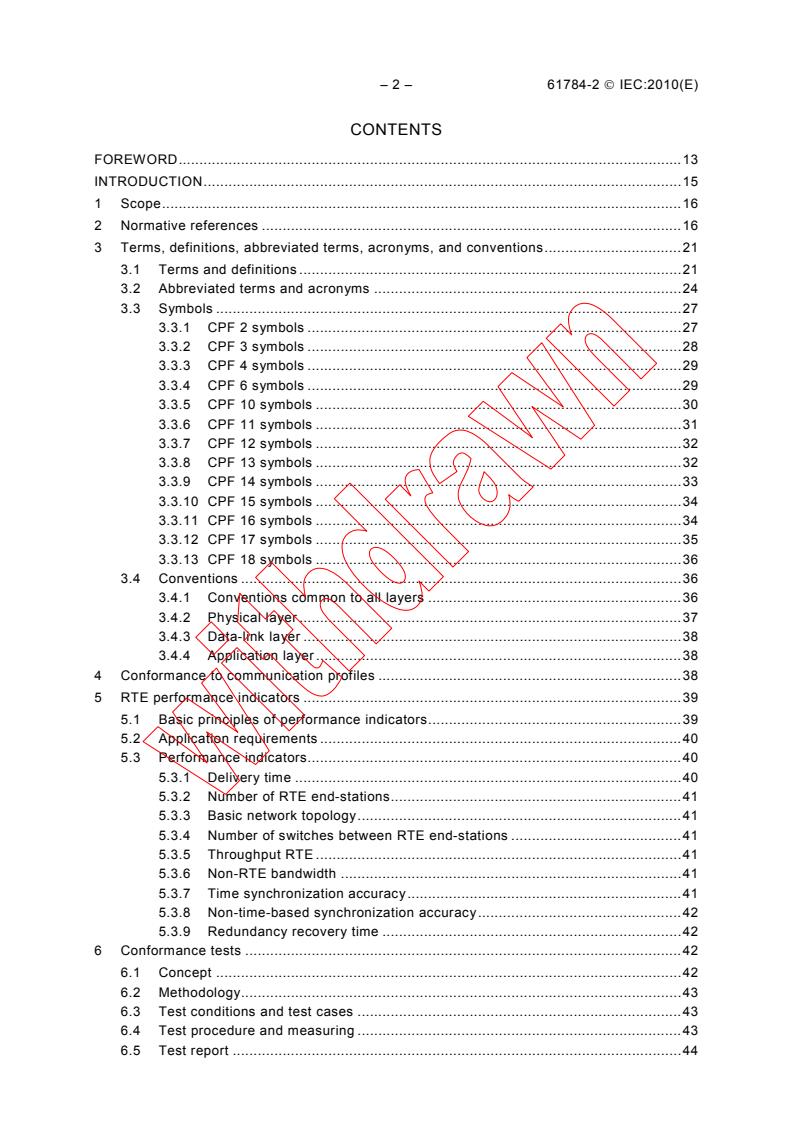
– 2 – 61784-2 © IEC:2010(E)
CONTENTS
FOREWORD.13
INTRODUCTION.15
1 Scope.16
2 Normative references .16
3 Terms, definitions, abbreviated terms, acronyms, and conventions.21
3.1 Terms and definitions .21
3.2 Abbreviated terms and acronyms .24
3.3 Symbols .27
3.3.1 CPF 2 symbols .27
3.3.2 CPF 3 symbols .28
3.3.3 CPF 4 symbols .29
3.3.4 CPF 6 symbols .29
3.3.5 CPF 10 symbols .30
3.3.6 CPF 11 symbols .31
3.3.7 CPF 12 symbols .32
3.3.8 CPF 13 symbols .32
3.3.9 CPF 14 symbols .33
3.3.10 CPF 15 symbols .34
3.3.11 CPF 16 symbols .34
3.3.12 CPF 17 symbols .35
3.3.13 CPF 18 symbols .36
3.4 Conventions .36
3.4.1 Conventions common to all layers .36
3.4.2 Physical layer .37
3.4.3 Data-link layer .38
3.4.4 Application layer.38
4 Conformance to communication profiles .38
5 RTE performance indicators .39
5.1 Basic principles of performance indicators.39
5.2 Application requirements .40
5.3 Performance indicators.40
5.3.1 Delivery time .40
5.3.2 Number of RTE end-stations.41
5.3.3 Basic network topology.41
5.3.4 Number of switches between RTE end-stations .41
5.3.5 Throughput RTE .41
5.3.6 Non-RTE bandwidth .41
5.3.7 Time synchronization accuracy.41
5.3.8 Non-time-based synchronization accuracy.42
5.3.9 Redundancy recovery time .42
6 Conformance tests .42
6.1 Concept .42
6.2 Methodology.43
6.3 Test conditions and test cases .43
6.4 Test procedure and measuring .43
6.5 Test report .44
61784-2 © IEC:2010(E) – 3 –
7 Communication Profile Family 2 (CIP™) - RTE communication profiles .44
7.1 General overview .44
7.2 Profile 2/2 .45
7.2.1 Physical layer .45
7.2.2 Data-link layer .45
7.2.3 Application layer.45
7.2.4 Performance indicator selection.45
7.3 Profile 2/2.1.49
7.3.1 Physical layer .49
7.3.2 Data-link layer .49
7.3.3 Application layer.50
7.3.4 Performance indicator selection.52
8 Communication Profile Family 3 (PROFIBUS & PROFINET) – RTE communication
profiles .54
8.1 General overview .54
8.1.1 CPF 3 overview .54
8.1.2 Administrative numbers .54
8.1.3 Node Classes .54
8.1.4 Application classes.57
8.1.5 Communication classes .57
8.1.6 Redundancy classes.58
8.1.7 Media classes.58
8.1.8 Records.59
8.1.9 Communication feature list .64
8.1.10 Conformance class behaviors.65
8.2 Profile 3/4 .68
8.2.1 Physical layer .68
8.2.2 Data-link layer .68
8.2.3 Application layer.69
8.2.4 Performance indicator selection.74
8.3 Profile 3/5 .81
8.3.1 Physical layer .81
8.3.2 Data-link layer .81
8.3.3 Application layer.82
8.3.4 Performance indicator selection.87
8.4 Profile 3/6 .88
8.4.1 Physical layer .88
8.4.2 Data-link layer .88
8.4.3 Application layer.89
8.4.4 Performance indicator selection.93
9 Communication Profile Family 4 (P-NET) - RTE communication profiles .95
9.1 General overview .95
9.2 Profile 4/3, P-NET on IP .96
9.2.1 Physical layer .96
9.2.2 Data-link layer .96
9.2.3 Application layer.97
9.2.4 Performance indicator selection.98
10 Communication Profile Family 6 (INTERBUS®) - RTE communication profiles. 101
10.1 General overview .101
– 4 – 61784-2 © IEC:2010(E)
10.2 Profile 6/4 .103
10.2.1 Mapping .103
10.2.2 Type 10 service and protocol selection . 104
10.2.3 Type 8 service and protocol selection. 104
10.2.4 Performance indicator selection.104
10.3 Profile 6/5 .105
10.3.1 Mapping .105
10.3.2 Type 10 service and protocol selection . 106
10.3.3 Type 8 service and protocol selection. 106
10.3.4 Performance indicator selection.106
10.4 Profile 6/6 .107
10.4.1 Mapping .107
10.4.2 Type 10 service and protocol selection . 107
10.4.3 Type 8 service and protocol selection. 107
10.4.4 Performance indicator selection.107
11 Communication Profile Family 10 (Vnet/IP) - RTE communication profiles . 108
11.1 General overview .108
11.2 Profile 10/1.109
11.2.1 Physical layer .109
11.2.2 Data link layer .109
11.2.3 Application layer.111
11.2.4 Performance indicator selection.112
12 Communication Profile Family 11 (TCnet) - RTE communication profiles . 117
12.1 General overview .117
12.2 Profile 11/1.118
12.2.1 Physical layer .118
12.2.2 Data-link layer .118
12.2.3 Application layer.120
12.2.4 Performance indicator selection.121
12.3 Profile 11/2.126
12.3.1 Physical layer .126
12.3.2 Data-link layer .126
12.3.3 Application layer.128
12.3.4 Performance indicator selection.128
13 Communication Profile Family 12 (EtherCAT) - RTE communication profiles . 134
13.1 General overview .134
13.2 Profile CP 12/1.134
13.2.1 Physical layer .134
13.2.2 Data-link layer .135
13.2.3 Application layer.138
13.2.4 Performance indicator selection.139
13.3 Profile CP 12/2.142
13.3.1 Physical layer .142
13.3.2 Data-link layer .142
13.3.3 Application layer.145
13.3.4 Performance indicator selection.147
14 Communication Profile Family 13 (ETHERNET Powerlink) - RTE communication
profiles .149
14.1 General overview .149
61784-2 © IEC:2010(E) – 5 –
14.2 Profile 13/1.149
14.2.1 Physical layer .149
14.2.2 Data-link layer .150
14.2.3 Application layer.150
14.2.4 Performance indicator selection.150
15 Communication Profile Family 14 (EPA)- RTE communication profiles. 155
15.1 General overview .155
15.2 CPF 14 (EPA) communication concept .156
15.2.1 General .156
15.2.2 Network Topology.156
15.2.3 EPA devices .157
15.3 Profile 14/1.158
15.3.1 Physical layer .158
15.3.2 Data-link layer .158
15.3.3 Network Layer .158
15.3.4 Transport Layer .158
15.3.5 Application layer.158
15.3.6 Performance indicator selection.159
15.4 Profile 14/2.163
15.4.1 Physical layer .163
15.4.2 Data-link layer .163
15.4.3 Network Layer .163
15.4.4 Transport Layer .163
15.4.5 Application layer.164
15.4.6 Performance indicator selection.164
15.5 Profile 14/3.167
15.5.1 Physical layer .167
15.5.2 Data-link layer .167
15.5.3 Network Layer .168
15.5.4 Transport Layer .168
15.5.5 Application layer.168
15.5.6 Performance indicator selection.169
16 Communication Profile Family 15 (MODBUS-RTPS)- RTE communication profiles . 174
16.1 General overview .174
16.2 Profile 15/1.174
16.2.1 Physical layer .174
16.2.2 Data-link layer .174
16.2.3 Application layer.174
16.2.4 Performance indicator selection.175
16.3 Profile 15/2.179
16.3.1 Physical layer .179
16.3.2 Data-link layer .179
16.3.3 Application layer.179
16.3.4 Performance indicator selection.180
17 Communication Profile Family 16 (SERCOS)- RTE communication profiles . 184
17.1 General overview .184
17.2 Profile 16/3 (SERCOS III).185
17.2.1 Physical layer .185
17.2.2 Data-link layer .185
– 6 – 61784-2 © IEC:2010(E)
17.2.3 Application layer.185
17.2.4 Performance indicator selection.186
18 Communication Profile Family 17(RAPIEnet) - RTE communication profiles . 192
18.1 General overview .192
18.2 Profile 17/1.193
18.2.1 Physical layer .193
18.2.2 Datalink layer .193
18.2.3 Application layer.193
18.2.4 Performance indicator selection.194
19 Communication Profile Family 18 (SafetyNET p) – RTE communication profiles . 198
19.1 General overview .198
19.2 Profile 18/1.199
19.2.1 Physical layer .199
19.2.2 Data link layer .199
19.2.3 Application layer.202
19.2.4 Performance indicator selection.203
19.3 Profile 18/2.205
19.3.1 Physical layer .205
19.3.2 Data link layer .205
19.3.3 Application layer.208
19.3.4 Performance indicator selection.209
Annex A (informative) Performance Indicator calculation . 212
A.1 CPF 2 (CIP) - Performance indicator calculation. 212
A.1.1 Profile 2/2 EtherNet/IP .212
A.1.2 Profile 2/2.1 EtherNet/IP with Time Synchronization . 213
A.2 CPF 3 - Performance indicator calculation.214
A.2.1 Application Scenario.214
A.2.2 Structural examples used for calculation .214
A.2.3 Principles used for calculation .220
A.3 CPF 4/3 P-NET on IP - Performance indicator calculation.223
A.3.1 Application scenario .223
A.3.2 Delivery time calculation.223
A.3.3 Non-RTE throughput calculation.224
A.3.4 Non time-base synchronization accuracy.226
A.3.5 RTE throughput calculation .226
A.3.6 CPF 4/3, Derivation of delivery time formula.227
A.3.7 CPF 4/3, Ethernet characteristics .229
Bibliography.230
Figure 1 – Example of graphical representation of consistent indicators.40
Figure 2 – Conformance test overview .42
Figure 3 – Example of network topology using CP 3/4, CP 3/5, and CP 3/6 components.68
Figure 4 – Example of network topology with wireless segment .71
Figure 5 – Calculation basis for delivery time and throughput RTE.77
Figure 6 – Linking-device communication profiles RTE-network context. 102
Figure 7 – Linking-device mapping principle .103
Figure 8 – Data Mapping.103
61784-2 © IEC:2010(E) – 7 –
Figure 9 – Throughput RTE and non-RTE bandwidth .124
Figure 10 – CP 11/2: Throughput RTE and non-RTE bandwidth.131
Figure 11 – EPA system network topology example .157
Figure A.1 – CP 3/4: Example of line structure.214
Figure A.2 – CP 3/4: Example of ring structure .214
Figure A.3 – CP 3/4: Example of a wireless segment .215
Figure A.4 – CP 3/4: Example of an integrated wireless client.215
Figure A.5 – CP 3/5: Example of line structure.216
Figure A.6 – CP 3/5: Example of ring structure .216
Figure A.7 – CP 3/6: Example of line structure.217
Figure A.8 – CP 3/6: Example of ring structure .218
Figure A.9 – CP 3/6: Example of tree structure .219
Figure A.10 — CP 3/6: Example of comb structure .220
Figure A.11 – Definition of bridge delay .221
Figure A.12 – Example of a switch structure .222
Figure A.13 – Application configuration.223
Figure A.14 – Non-RTE throughput calculation .225
Figure A.15 – Non time-base synchronization accuracy . 226
Table 1 – Layout of profile (sub)clause selection tables .36
Table 2 – Contents of (sub)clause selection tables .36
Table 3 – Layout of service selection tables.37
Table 4 – Contents of service selection tables .37
Table 5 – Layout of parameter selection tables .37
Table 6 – Contents of parameter selection tables .37
Table 7 – Layout of class attribute selection tables .38
Table 8 – Contents of class attribute selection tables.38
Table 9 – Basic network topology types .41
Table 10 – CP 2/2: performance indicator overview .45
Table 11 – CP 2/2: Performance indicator dependency matrix .46
Table 12 – CP 2/2: consistent set of performance indicators for factory automation .49
Table 13 – CP 2/2.1: DLL protocol selection .49
Table 14 – CP 2/2.1: DLL protocol selection of management objects .50
Table 15 – CP 2/2.1: AL service selection.50
Table 16 – CP 2/2.1: AL protocol selection .51
Table 17 – CP 2/2.1: performance indicator overview .52
Table 18 – CP 2/2.1: performance indicator dependency matrix.53
Table 19 – CP 2/2.1: Consistent set of performance indicators for motion control .53
Table 20 – Administrative numbers assignment .54
Table 21 – IP layer parameters for IO controller.55
Table 22 – IP layer parameters for IO device .55
Table 23 – Timeout values for name resolution .56
Table 24 – Reaction time for an IO device .56
– 8 – 61784-2 © IEC:2010(E)
Table 25 – Timeout values for PTCP.57
Table 26 – Maximum time values for PTCP.57
Table 27 – Communication classes applicable in conformance classes.58
Table 28 – Redundancy class applicable in conformance classes .58
Table 29 – Index (user specific) .59
Table 30 – Index (subslot specific).59
Table 31 – Index (slot specific) .61
Table 32 – Index (AR specific) .62
Table 33 – Index (API specific) .63
Table 34 – Index (device specific).64
Table 35 – Communication feature list .64
Table 36 – Conformance class behaviors.65
Table 37 – Conformance class behaviors for network components.67
Table 38 – CP 3/4: AL service selection for an IO device .69
Table 39 – CP 3/4: AL protocol selection for an IO device and Network component .72
Table 40 – CP 3/4: AL protocol selection for an IO controller .73
Table 41 – CP 3/4, CP 3/5 and CP 3/6: performance indicator overview .75
Table 42 – CP 3/4, CP 3/5 and CP 3/6: performance indicator dependency matrix.75
Table 43 – Manager parameters .78
Table 44 – Client parameters .79
Table 45 – CP 3/4: Consistent set of PI for MinDeviceInterval = 128 ms .80
Table 46 – CP 3/4: Assumed values for consistent set of PI calculation .81
Table 47 – CP 3/5: AL service selection for an IO device .82
Table 48 – CP 3/5: AL protocol selection for an IO device and Network component .84
Table 49 – CP 3/5: AL protocol selection for an IO controller .85
Table 50 – CP 3/5: Consistent set of PI for MinDeviceInterval = 128 ms .87
Table 51 – CP 3/5: Assumed values for consistent set of PI calculation .88
Table 52 – CP 3/6: AL service selection for an IO device .89
Table 53 – Buffering capacity.90
Table 54 – CP 3/6: AL protocol selection for an IO device and network component.91
Table 55 – CP 3/6: AL protocol selection for an IO controller .92
Table 56 – CP 3/6: Consistent set of PI for MinDeviceInterval=1ms with 64 end-
stations.94
Table 57 – CP 3/6: Assumed values for consistent set of PI calculation .95
Table 58 – CP 4/3: DLL service selection.96
Table 59 – CP 4/3: DLL protocol selection .97
Table 60 – CP 4/3: AL service selection.97
Table 61 – CP 4/3: AL protocol selection .97
Table 62 – CP 4/3: Performance indicator overview .98
Table 63 – CP 4/3: Performance indicator dependency matrix .98
Table 64 – CP 4/3: Consistent set of performance indicators . 101
Table 65 – Parameters for calculation of consistent set of performance indicators . 101
Table 66 – CPF 6: device CP identifier assignment. 102
61784-2 © IEC:2010(E) – 9 –
Table 67 – Linking-device Type 10 network performance indicator overview . 105
Table 68 – OSI layers and CPF 10 layers .108
Table 69 – Overview of CPF 10 profile.109
Table 70 – CP 10/1: DLL service selection.110
Table 71 – CP 10/1: DLL protocol selection .110
Table 72 – Transport Layer Parameter selection.111
Table 73 – CP 10/1: AL service selection.112
Table 74 – CP 10/1: AL protocol selection .112
Table 75 – CP 10/1: Performance indicator overview .112
Table 76 – CP 10/1: Performance indicator dependency matrix. 113
Table 77 – CP 10/1: Consistent set of performance indicators for the communication
between two end-stations belonging to the same domain.116
Table 78 – CP 10/1: Consistent set of performance indicators for the communication
between two end-stations belonging to different domains.116
Table 79 – CP 10/1: Consistent set of performance indicators for the communication
between two end-stations belonging to the same domain with one lost flame.117
Table 80 – CP 10/1: Consistent set of performance indicators for the communication
between two end-stations belonging to different domains with one lost flame.117
Table 81 – CPF 11: Overview of profile sets .118
Table 82 – CP 11/1: DLL service selection.118
Table 83 – CP 11/1: DLL protocol selection .119
Table 84 – CP 11/1: DLL protocol selection of Clause 5.119
Table 85 – CP 11/1: DLL protocol selection of Clause 6.120
Table 86 – CP 11/1: AL service selection.121
Table 87 – CP 11/1: AL protocol selection .121
Table 88 – CP 11/1: Performance indicator overview .121
Table 89 – CP 11/1: Performance indicator dependency matrix. 122
Table 90 – CP 11/1: TCC data service selection .122
Table 91 – CP 11/1: Consistent set of PIs preferential for RTE communications . 126
Table 92 – CP 11/1: Consistent set of PIs both for RTE and non-RTE communications.126
Table 93 – CP 11/2: DLL protocol selection .127
Table 94 – CP 11/2: DLL protocol selection of Clause 5.127
Table 95 – CP 11/2: DLL protocol selection of Clause 6.128
Table 96 – CP 11/2: Performance indicator overview .129
Table 97 – CP 11/2: Performance indicator dependency matrix. 129
Table 98 – CP 11/2: TCC data service selection .130
Table 99 – CP 11/2: Consiste
...
IEC 61784-2 ®
Edition 2.0 2010-07
INTERNATIONAL
STANDARD
NORME
INTERNATIONALE
colour
inside
Industrial communication networks – Profiles –
Part 2: Additional fieldbus profiles for real-time networks based on
ISO/IEC 8802-3
Réseaux de communication industriels – Profils –
Partie 2: Profils de bus de terrain supplémentaires pour les réseaux en temps
réel basés sur l’ISO/CEI 8802-3
All rights reserved. Unless otherwise specified, no part of this publication may be reproduced or utilized in any form or by
any means, electronic or mechanical, including photocopying and microfilm, without permission in writing from either IEC or
IEC's member National Committee in the country of the requester.
If you have any questions about IEC copyright or have an enquiry about obtaining additional rights to this publication,
please contact the address below or your local IEC member National Committee for further information.
Droits de reproduction réservés. Sauf indication contraire, aucune partie de cette publication ne peut être reproduite
ni utilisée sous quelque forme que ce soit et par aucun procédé, électronique ou mécanique, y compris la photocopie
et les microfilms, sans l'accord écrit de la CEI ou du Comité national de la CEI du pays du demandeur.
Si vous avez des questions sur le copyright de la CEI ou si vous désirez obtenir des droits supplémentaires sur cette
publication, utilisez les coordonnées ci-après ou contactez le Comité national de la CEI de votre pays de résidence.
IEC Central Office
3, rue de Varembé
CH-1211 Geneva 20
Switzerland
Email: inmail@iec.ch
Web: www.iec.ch
About the IEC
The International Electrotechnical Commission (IEC) is the leading global organization that prepares and publishes
International Standards for all electrical, electronic and related technologies.
About IEC publications
The technical content of IEC publications is kept under constant review by the IEC. Please make sure that you have the
latest edition, a corrigenda or an amendment might have been published.
Catalogue of IEC publications: www.iec.ch/searchpub
The IEC on-line Catalogue enables you to search by a variety of criteria (reference number, text, technical committee,…).
It also gives information on projects, withdrawn and replaced publications.
IEC Just Published: www.iec.ch/online_news/justpub
Stay up to date on all new IEC publications. Just Published details twice a month all new publications released. Available
on-line and also by email.
Electropedia: www.electropedia.org
The world's leading online dictionary of electronic and electrical terms containing more than 20 000 terms and definitions
in English and French, with equivalent terms in additional languages. Also known as the International Electrotechnical
Vocabulary online.
Customer Service Centre: www.iec.ch/webstore/custserv
If you wish to give us your feedback on this publication or need further assistance, please visit the Customer Service
Centre FAQ or contact us:
Email: csc@iec.ch
Tel.: +41 22 919 02 11
Fax: +41 22 919 03 00
A propos de la CEI
La Commission Electrotechnique Internationale (CEI) est la première organisation mondiale qui élabore et publie des
normes internationales pour tout ce qui a trait à l'électricité, à l'électronique et aux technologies apparentées.
A propos des publications CEI
Le contenu technique des publications de la CEI est constamment revu. Veuillez vous assurer que vous possédez
l’édition la plus récente, un corrigendum ou amendement peut avoir été publié.
Catalogue des publications de la CEI: www.iec.ch/searchpub/cur_fut-f.htm
Le Catalogue en-ligne de la CEI vous permet d’effectuer des recherches en utilisant différents critères (numéro de référence,
texte, comité d’études,…). Il donne aussi des informations sur les projets et les publications retirées ou remplacées.
Just Published CEI: www.iec.ch/online_news/justpub
Restez informé sur les nouvelles publications de la CEI. Just Published détaille deux fois par mois les nouvelles
publications parues. Disponible en-ligne et aussi par email.
Electropedia: www.electropedia.org
Le premier dictionnaire en ligne au monde de termes électroniques et électriques. Il contient plus de 20 000 termes et
définitions en anglais et en français, ainsi que les termes équivalents dans les langues additionnelles. Egalement appelé
Vocabulaire Electrotechnique International en ligne.
Service Clients: www.iec.ch/webstore/custserv/custserv_entry-f.htm
Si vous désirez nous donner des commentaires sur cette publication ou si vous avez des questions, visitez le FAQ du
Service clients ou contactez-nous:
Email: csc@iec.ch
Tél.: +41 22 919 02 11
Fax: +41 22 919 03 00
IEC 61784-2 ®
Edition 2.0 2010-07
INTERNATIONAL
STANDARD
NORME
INTERNATIONALE
colour
inside
Industrial communication networks – Profiles –
Part 2: Additional fieldbus profiles for real-time networks based on
ISO/IEC 8802-3
Réseaux de communication industriels – Profils –
Partie 2: Profils de bus de terrain supplémentaires pour les réseaux en temps
réel basés sur l’ISO/CEI 8802-3
INTERNATIONAL
ELECTROTECHNICAL
COMMISSION
COMMISSION
ELECTROTECHNIQUE
PRICE CODE
INTERNATIONALE
XH
CODE PRIX
ICS 35.100.20; 35.240.50 ISBN 978-2-88912-808-2
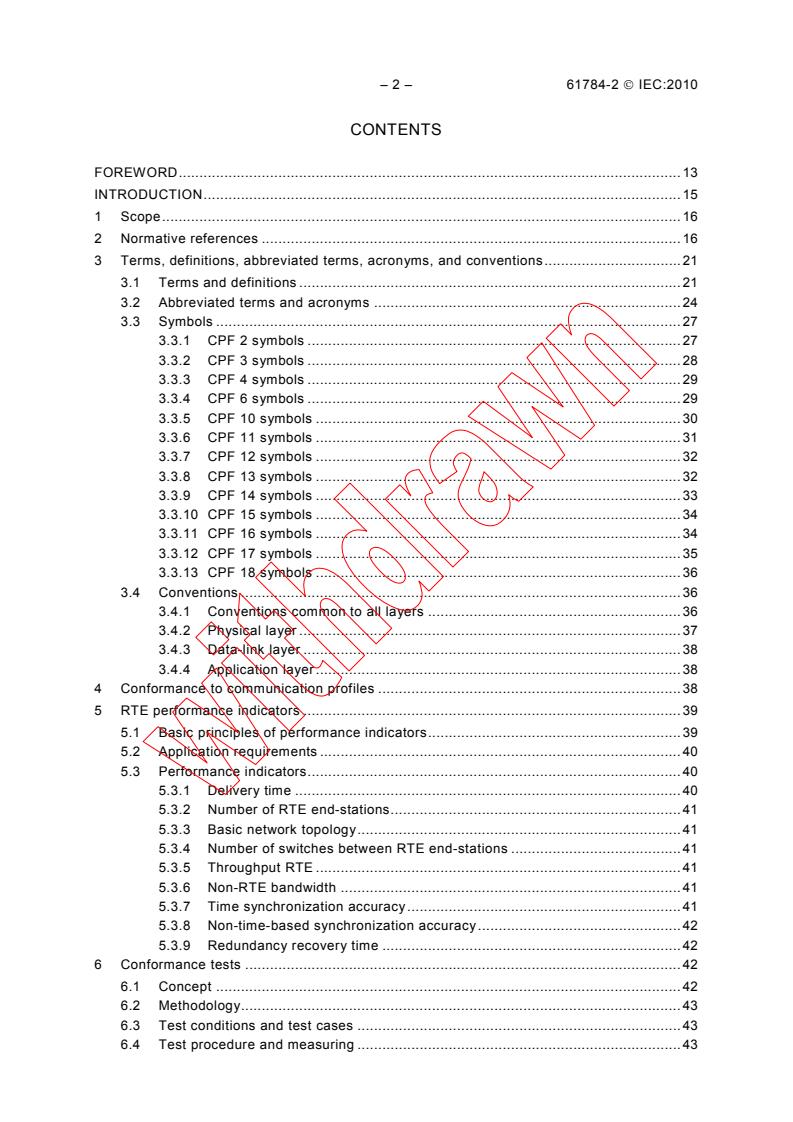
– 2 – 61784-2 IEC:2010
CONTENTS
FOREWORD . 13
INTRODUCTION . 15
1 Scope . 16
2 Normative references . 16
3 Terms, definitions, abbreviated terms, acronyms, and conventions . 21
3.1 Terms and definitions . 21
3.2 Abbreviated terms and acronyms . 24
3.3 Symbols . 27
3.3.1 CPF 2 symbols . 27
3.3.2 CPF 3 symbols . 28
3.3.3 CPF 4 symbols . 29
3.3.4 CPF 6 symbols . 29
3.3.5 CPF 10 symbols . 30
3.3.6 CPF 11 symbols . 31
3.3.7 CPF 12 symbols . 32
3.3.8 CPF 13 symbols . 32
3.3.9 CPF 14 symbols . 33
3.3.10 CPF 15 symbols . 34
3.3.11 CPF 16 symbols . 34
3.3.12 CPF 17 symbols . 35
3.3.13 CPF 18 symbols . 36
3.4 Conventions . 36
3.4.1 Conventions common to all layers . 36
3.4.2 Physical layer . 37
3.4.3 Data-link layer . 38
3.4.4 Application layer . 38
4 Conformance to communication profiles . 38
5 RTE performance indicators . 39
5.1 Basic principles of performance indicators . 39
5.2 Application requirements . 40
5.3 Performance indicators . 40
5.3.1 Delivery time . 40
5.3.2 Number of RTE end-stations . 41
5.3.3 Basic network topology . 41
5.3.4 Number of switches between RTE end-stations . 41
5.3.5 Throughput RTE . 41
5.3.6 Non-RTE bandwidth . 41
5.3.7 Time synchronization accuracy . 41
5.3.8 Non-time-based synchronization accuracy . 42
5.3.9 Redundancy recovery time . 42
6 Conformance tests . 42
6.1 Concept . 42
6.2 Methodology . 43
6.3 Test conditions and test cases . 43
6.4 Test procedure and measuring . 43
61784-2 IEC:2010 – 3 –
6.5 Test report . 44
7 Communication Profile Family 2 (CIP™) - RTE communication profiles . 44
7.1 General overview . 44
7.2 Profile 2/2 . 45
7.2.1 Physical layer . 45
7.2.2 Data-link layer . 45
7.2.3 Application layer . 45
7.2.4 Performance indicator selection . 45
7.3 Profile 2/2.1 . 49
7.3.1 Physical layer . 49
7.3.2 Data-link layer . 49
7.3.3 Application layer . 50
7.3.4 Performance indicator selection . 52
8 Communication Profile Family 3 (PROFIBUS & PROFINET) – RTE communication
profiles . 54
8.1 General overview . 54
8.1.1 CPF 3 overview . 54
8.1.2 Administrative numbers . 54
8.1.3 Node Classes . 54
8.1.4 Application classes . 57
8.1.5 Communication classes . 57
8.1.6 Redundancy classes . 58
8.1.7 Media classes . 58
8.1.8 Records . 59
8.1.9 Communication feature list . 64
8.1.10 Conformance class behaviors . 65
8.2 Profile 3/4 . 68
8.2.1 Physical layer . 68
8.2.2 Data-link layer . 68
8.2.3 Application layer . 69
8.2.4 Performance indicator selection . 74
8.3 Profile 3/5 . 81
8.3.1 Physical layer . 81
8.3.2 Data-link layer . 81
8.3.3 Application layer . 82
8.3.4 Performance indicator selection . 87
8.4 Profile 3/6 . 88
8.4.1 Physical layer . 88
8.4.2 Data-link layer . 88
8.4.3 Application layer . 89
8.4.4 Performance indicator selection . 93
9 Communication Profile Family 4 (P-NET) - RTE communication profiles . 95
9.1 General overview . 95
9.2 Profile 4/3, P-NET on IP . 96
9.2.1 Physical layer . 96
9.2.2 Data-link layer . 96
9.2.3 Application layer . 97
9.2.4 Performance indicator selection . 98
10 Communication Profile Family 6 (INTERBUS®) - RTE communication profiles . 101
– 4 – 61784-2 IEC:2010
10.1 General overview . 101
10.2 Profile 6/4 . 103
10.2.1 Mapping . 103
10.2.2 Type 10 service and protocol selection . 104
10.2.3 Type 8 service and protocol selection . 104
10.2.4 Performance indicator selection . 104
10.3 Profile 6/5 . 105
10.3.1 Mapping . 105
10.3.2 Type 10 service and protocol selection . 106
10.3.3 Type 8 service and protocol selection . 106
10.3.4 Performance indicator selection . 106
10.4 Profile 6/6 . 107
10.4.1 Mapping . 107
10.4.2 Type 10 service and protocol selection . 107
10.4.3 Type 8 service and protocol selection . 107
10.4.4 Performance indicator selection . 107
11 Communication Profile Family 10 (Vnet/IP) - RTE communication profiles . 108
11.1 General overview . 108
11.2 Profile 10/1 . 109
11.2.1 Physical layer . 109
11.2.2 Data link layer . 109
11.2.3 Application layer . 111
11.2.4 Performance indicator selection . 112
12 Communication Profile Family 11 (TCnet) - RTE communication profiles . 117
12.1 General overview . 117
12.2 Profile 11/1 . 118
12.2.1 Physical layer . 118
12.2.2 Data-link layer . 118
12.2.3 Application layer . 120
12.2.4 Performance indicator selection . 121
12.3 Profile 11/2 . 126
12.3.1 Physical layer . 126
12.3.2 Data-link layer . 126
12.3.3 Application layer . 128
12.3.4 Performance indicator selection . 128
13 Communication Profile Family 12 (EtherCAT) - RTE communication profiles . 134
13.1 General overview . 134
13.2 Profile CP 12/1 . 134
13.2.1 Physical layer . 134
13.2.2 Data-link layer . 135
13.2.3 Application layer . 138
13.2.4 Performance indicator selection . 139
13.3 Profile CP 12/2 . 142
13.3.1 Physical layer . 142
13.3.2 Data-link layer . 142
13.3.3 Application layer . 145
13.3.4 Performance indicator selection . 147
14 Communication Profile Family 13 (ETHERNET Powerlink) - RTE communication
profiles . 149
61784-2 IEC:2010 – 5 –
14.1 General overview . 149
14.2 Profile 13/1 . 149
14.2.1 Physical layer . 149
14.2.2 Data-link layer . 150
14.2.3 Application layer . 150
14.2.4 Performance indicator selection . 150
15 Communication Profile Family 14 (EPA)- RTE communication profiles . 155
15.1 General overview . 155
15.2 CPF 14 (EPA) communication concept . 155
15.2.1 General . 155
15.2.2 Network Topology . 156
15.2.3 EPA devices . 157
15.3 Profile 14/1 . 157
15.3.1 Physical layer . 157
15.3.2 Data-link layer . 157
15.3.3 Network Layer . 158
15.3.4 Transport Layer . 158
15.3.5 Application layer . 158
15.3.6 Performance indicator selection . 159
15.4 Profile 14/2 . 162
15.4.1 Physical layer . 162
15.4.2 Data-link layer . 162
15.4.3 Network Layer . 163
15.4.4 Transport Layer . 163
15.4.5 Application layer . 163
15.4.6 Performance indicator selection . 164
15.5 Profile 14/3 . 167
15.5.1 Physical layer . 167
15.5.2 Data-link layer . 167
15.5.3 Network Layer . 168
15.5.4 Transport Layer . 168
15.5.5 Application layer . 168
15.5.6 Performance indicator selection . 169
16 Communication Profile Family 15 (MODBUS-RTPS)- RTE communication profiles . 174
16.1 General overview . 174
16.2 Profile 15/1 . 174
16.2.1 Physical layer . 174
16.2.2 Data-link layer . 174
16.2.3 Application layer . 174
16.2.4 Performance indicator selection . 175
16.3 Profile 15/2 . 179
16.3.1 Physical layer . 179
16.3.2 Data-link layer . 179
16.3.3 Application layer . 179
16.3.4 Performance indicator selection . 180
17 Communication Profile Family 16 (SERCOS)- RTE communication profiles . 184
17.1 General overview . 184
17.2 Profile 16/3 (SERCOS III) . 185
17.2.1 Physical layer . 185
– 6 – 61784-2 IEC:2010
17.2.2 Data-link layer . 185
17.2.3 Application layer . 185
17.2.4 Performance indicator selection . 186
18 Communication Profile Family 17(RAPIEnet) - RTE communication profiles . 192
18.1 General overview . 192
18.2 Profile 17/1 . 193
18.2.1 Physical layer . 193
18.2.2 Datalink layer . 193
18.2.3 Application layer . 193
18.2.4 Performance indicator selection . 194
19 Communication Profile Family 18 (SafetyNET p) – RTE communication profiles . 198
19.1 General overview . 198
19.2 Profile 18/1 . 199
19.2.1 Physical layer . 199
19.2.2 Data link layer . 199
19.2.3 Application layer . 202
19.2.4 Performance indicator selection . 203
19.3 Profile 18/2 . 205
19.3.1 Physical layer . 205
19.3.2 Data link layer . 205
19.3.3 Application layer . 208
19.3.4 Performance indicator selection . 209
Annex A (informative) Performance Indicator calculation . 212
A.1 CPF 2 (CIP) - Performance indicator calculation . 212
A.1.1 Profile 2/2 EtherNet/IP . 212
A.1.2 Profile 2/2.1 EtherNet/IP with Time Synchronization . 213
A.2 CPF 3 - Performance indicator calculation . 214
A.2.1 Application Scenario . 214
A.2.2 Structural examples used for calculation . 214
A.2.3 Principles used for calculation . 220
A.3 CPF 4/3 P-NET on IP - Performance indicator calculation. 223
A.3.1 Application scenario . 223
A.3.2 Delivery time calculation . 223
A.3.3 Non-RTE throughput calculation . 224
A.3.4 Non time-base synchronization accuracy . 226
A.3.5 RTE throughput calculation . 226
A.3.6 CPF 4/3, Derivation of delivery time formula . 227
A.3.7 CPF 4/3, Ethernet characteristics . 229
Bibliography . 230
Figure 1 – Example of graphical representation of consistent indicators. 40
Figure 2 – Conformance test overview . 42
Figure 3 – Example of network topology using CP 3/4, CP 3/5, and CP 3/6 components . 68
Figure 4 – Example of network topology with wireless segment . 71
Figure 5 – Calculation basis for delivery time and throughput RTE . 77
Figure 6 – Linking-device communication profiles RTE-network context . 102
Figure 7 – Linking-device mapping principle . 103
61784-2 IEC:2010 – 7 –
Figure 8 – Data Mapping . 103
Figure 9 – Throughput RTE and non-RTE bandwidth . 124
Figure 10 – CP 11/2: Throughput RTE and non-RTE bandwidth . 131
Figure 11 – EPA system network topology example . 156
Figure A.1 – CP 3/4: Example of line structure . 214
Figure A.2 – CP 3/4: Example of ring structure . 214
Figure A.3 – CP 3/4: Example of a wireless segment . 215
Figure A.4 – CP 3/4: Example of an integrated wireless client . 215
Figure A.5 – CP 3/5: Example of line structure . 216
Figure A.6 – CP 3/5: Example of ring structure . 216
Figure A.7 – CP 3/6: Example of line structure . 217
Figure A.8 – CP 3/6: Example of ring structure . 218
Figure A.9 – CP 3/6: Example of tree structure . 219
Figure A.10 – CP 3/6: Example of comb structure . 220
Figure A.11 – Definition of bridge delay . 221
Figure A.12 – Example of a switch structure . 222
Figure A.13 – Application configuration . 223
Figure A.14 – Non-RTE throughput calculation . 225
Figure A.15 – Non time-base synchronization accuracy . 226
Table 1 – Layout of profile (sub)clause selection tables . 36
Table 2 – Contents of (sub)clause selection tables . 36
Table 3 – Layout of service selection tables . 37
Table 4 – Contents of service selection tables . 37
Table 5 – Layout of parameter selection tables . 37
Table 6 – Contents of parameter selection tables . 37
Table 7 – Layout of class attribute selection tables . 38
Table 8 – Contents of class attribute selection tables . 38
Table 9 – Basic network topology types . 41
Table 10 – CP 2/2: performance indicator overview . 45
Table 11 – CP 2/2: Performance indicator dependency matrix . 46
Table 12 – CP 2/2: consistent set of performance indicators for factory automation . 49
Table 13 – CP 2/2.1: DLL protocol selection . 49
Table 14 – CP 2/2.1: DLL protocol selection of management objects . 50
Table 15 – CP 2/2.1: AL service selection . 50
Table 16 – CP 2/2.1: AL protocol selection . 51
Table 17 – CP 2/2.1: performance indicator overview . 52
Table 18 – CP 2/2.1: performance indicator dependency matrix . 53
Table 19 – CP 2/2.1: Consistent set of performance indicators for motion control . 53
Table 20 – Administrative numbers assignment . 54
Table 21 – IP layer parameters for IO controller . 55
Table 22 – IP layer parameters for IO device . 55
Table 23 – Timeout values for name resolution . 56
– 8 – 61784-2 IEC:2010
Table 24 – Reaction time for an IO device . 56
Table 25 – Timeout values for PTCP . 57
Table 26 – Maximum time values for PTCP . 57
Table 27 – Communication classes applicable in conformance classes . 58
Table 28 – Redundancy class applicable in conformance classes . 58
Table 29 – Index (user specific) . 59
Table 30 – Index (subslot specific) . 59
Table 31 – Index (slot specific) . 61
Table 32 – Index (AR specific) . 62
Table 33 – Index (API specific) . 63
Table 34 – Index (device specific) . 64
Table 35 – Communication feature list . 64
Table 36 – Conformance class behaviors . 65
Table 37 – Conformance class behaviors for network components . 67
Table 38 – CP 3/4: AL service selection for an IO device . 69
Table 39 – CP 3/4: AL protocol selection for an IO device and Network component . 72
Table 40 – CP 3/4: AL protocol selection for an IO controller . 73
Table 41 – CP 3/4, CP 3/5 and CP 3/6: performance indicator overview . 75
Table 42 – CP 3/4, CP 3/5 and CP 3/6: performance indicator dependency matrix . 75
Table 43 – Manager parameters . 78
Table 44 – Client parameters . 79
Table 45 – CP 3/4: Consistent set of PI for MinDeviceInterval = 128 ms . 80
Table 46 – CP 3/4: Assumed values for consistent set of PI calculation . 81
Table 47 – CP 3/5: AL service selection for an IO device . 82
Table 48 – CP 3/5: AL protocol selection for an IO device and Network component . 84
Table 49 – CP 3/5: AL protocol selection for an IO controller . 85
Table 50 – CP 3/5: Consistent set of PI for MinDeviceInterval = 128 ms . 87
Table 51 – CP 3/5: Assumed values for consistent set of PI calculation . 88
Table 52 – CP 3/6: AL service selection for an IO device . 89
Table 53 – Buffering capacity . 90
Table 54 – CP 3/6: AL protocol selection for an IO device and network component . 91
Table 55 – CP 3/6: AL protocol selection for an IO controller . 92
Table 56 – CP 3/6: Consistent set of PI for MinDeviceInterval=1ms with 64 end-
stations . 94
Table 57 – CP 3/6: Assumed values for consistent set of PI calculation . 95
Table 58 – CP 4/3: DLL service selection . 96
Table 59 – CP 4/3: DLL protocol selection . 97
Table 60 – CP 4/3: AL service selection . 97
Table 61 – CP 4/3: AL protocol selection . 97
Table 62 – CP 4/3: Performance indicator overview . 98
Table 63 – CP 4/3: Performance indicator dependency matrix . 98
Table 64 – CP 4/3: Consistent set of performance indicators . 101
Table 65 – Parameters for calculation of consistent set of performance indicators . 101
61784-2 IEC:2010 – 9 –
Table 66 – CPF 6: device CP identifier assignment . 102
Table 67 – Linking-device Type 10 network performance indicator overview . 105
Table 68 – OSI layers and CPF 10 layers . 108
Table 69 – Overview of CPF 10 profile . 109
Table 70 – CP 10/1: DLL service selection . 110
Table 71 – CP 10/1: DLL protocol selection . 110
Table 72 – Transport Layer Parameter selection . 111
Table 73 – CP 10/1: AL service selection . 112
Table 74 – CP 10/1: AL proto
...