

IEC TS 61850-80-4:2016
(Main)Communication networks and systems for power utility automation - Part 80-4: Translation from the COSEM object model (IEC 62056) to the IEC 61850 data model
General Information
- Abstract
IEC TS 61850-80-4:2016(E) defines the one-to-one relationship of IEC 62056 OBIS codes to IEC 61850 Logical Nodes. The purpose is to increase the availability of revenue meter information to other applications defined within the IEC 61850 framework. This increased visibility will contribute to information available for smart grid applications.
- Status
- Published
- Publication Date
- 15-Mar-2016
- Technical Committee
- TC 57 - Power systems management and associated information exchange
- Drafting Committee
- WG 10 - TC 57/WG 10
- Current Stage
- PPUB - Publication issued
- Start Date
- 16-Mar-2016
- Completion Date
- 30-Jun-2016
Buy Documents
IEC TS 61850-80-4:2016 - Communication networks and systems for power utility automation - Part 80-4: Translation from the COSEM object model (IEC 62056) to the IEC 61850 data model Released:3/16/2016
Overview
IEC TS 61850-80-4:2016 specifies a standardized translation between the COSEM object model (IEC 62056, including OBIS codes) and the IEC 61850 data model. This Technical Specification defines a one-to-one mapping of IEC 62056 OBIS identifiers to IEC 61850 Logical Nodes to make revenue meter information more visible and usable inside IEC 61850 power utility automation environments. The aim is to enhance meter data availability for substation automation and smart grid applications, and to simplify protocol-converter design, testing and end-user configuration.
Key topics and technical requirements
- One-to-one mapping of IEC 62056 (COSEM/OBIS) data objects to IEC 61850 Logical Nodes to ensure unambiguous translation.
- Data modelling hierarchy: comparison and alignment of COSEM object model and IEC 61850 hierarchical naming and data structures.
- Translation principles: general rules for mapping objects, attributes and methods from COSEM to compatible IEC 61850 elements.
- Data type mapping: guidance on mapping IEC 61850 DataTypeTemplates to IEC 62056 common data types (ensuring semantic and type compatibility).
- Translation tables: structured mapping tables (including Metering and Measurement logical node classes such as MMTR, MMTN, MMXU, MMXN) that specify how common metering registers and measurement objects are represented in IEC 61850.
- Scope limitation: focuses on use cases requiring revenue meter data exchange in HV/MV and MV/LV substations; other applications outside referenced standards are out of scope.
- Normative references: relies on IEC 61850 parts (7‑2, 7‑3, 7‑4) and IEC 62056 parts (6‑1, 6‑2) for precise definitions and interfaces.
Applications and who should use it
This specification is practical for:
- Electric utilities and grid operators seeking to integrate revenue-grade meter data into IEC 61850-based automation, SCADA and smart grid systems.
- Meter manufacturers implementing COSEM/DLMS (IEC 62056) and offering native or gateway support for IEC 61850.
- System integrators and vendors of protocol converters/gateways who need standardized mappings for reliable data translation and test-case development.
- Test laboratories and quality assurance teams developing interoperability test suites for meter-to-substation communications.
- Software developers building applications that consume meter data in IEC 61850 formats for analytics, billing verification or distribution automation.
Practical benefits include improved interoperability, reduced configuration errors, clearer test cases for protocol converters, and increased availability of meter-derived information for smart grid use cases.
Related standards
- IEC 61850 series (communication networks and systems for power utility automation) - notably IEC 61850-7-2, IEC 61850-7-3, IEC 61850-7-4
- IEC 62056 series (DLMS/COSEM) - notably IEC 62056-6-1 (OBIS) and IEC 62056-6-2 (COSEM interface classes)
Keywords: IEC TS 61850-80-4, IEC 62056, COSEM, OBIS, IEC 61850, Logical Nodes, revenue meter, smart grid, protocol converter, metering data mapping.
Buy Documents
IEC TS 61850-80-4:2016 - Communication networks and systems for power utility automation - Part 80-4: Translation from the COSEM object model (IEC 62056) to the IEC 61850 data model Released:3/16/2016
Get Certified
Connect with accredited certification bodies for this standard

ANCE
Mexican certification and testing association.

Intertek Slovenia
Intertek testing, inspection, and certification services in Slovenia.

LNE (Laboratoire National de Métrologie et d'Essais)
French national laboratory for metrology and testing.
Sponsored listings
Frequently Asked Questions
IEC TS 61850-80-4:2016 is a technical specification published by the International Electrotechnical Commission (IEC). Its full title is "Communication networks and systems for power utility automation - Part 80-4: Translation from the COSEM object model (IEC 62056) to the IEC 61850 data model". This standard covers: IEC TS 61850-80-4:2016(E) defines the one-to-one relationship of IEC 62056 OBIS codes to IEC 61850 Logical Nodes. The purpose is to increase the availability of revenue meter information to other applications defined within the IEC 61850 framework. This increased visibility will contribute to information available for smart grid applications.
IEC TS 61850-80-4:2016(E) defines the one-to-one relationship of IEC 62056 OBIS codes to IEC 61850 Logical Nodes. The purpose is to increase the availability of revenue meter information to other applications defined within the IEC 61850 framework. This increased visibility will contribute to information available for smart grid applications.
IEC TS 61850-80-4:2016 is classified under the following ICS (International Classification for Standards) categories: 33.200 - Telecontrol. Telemetering. The ICS classification helps identify the subject area and facilitates finding related standards.
IEC TS 61850-80-4:2016 is available in PDF format for immediate download after purchase. The document can be added to your cart and obtained through the secure checkout process. Digital delivery ensures instant access to the complete standard document.
Standards Content (Sample)
IEC TS 61850-80-4 ®
Edition 1.0 2016-03
TECHNICAL
SPECIFICATION
colour
inside
Communication networks and systems for power utility automation –
Part 80-4: Translation from the COSEM object model (IEC 62056) to the
IEC 61850 data model
All rights reserved. Unless otherwise specified, no part of this publication may be reproduced or utilized in any form
or by any means, electronic or mechanical, including photocopying and microfilm, without permission in writing from
either IEC or IEC's member National Committee in the country of the requester. If you have any questions about IEC
copyright or have an enquiry about obtaining additional rights to this publication, please contact the address below or
your local IEC member National Committee for further information.
IEC Central Office Tel.: +41 22 919 02 11
3, rue de Varembé Fax: +41 22 919 03 00
CH-1211 Geneva 20 info@iec.ch
Switzerland www.iec.ch
About the IEC
The International Electrotechnical Commission (IEC) is the leading global organization that prepares and publishes
International Standards for all electrical, electronic and related technologies.
About IEC publications
The technical content of IEC publications is kept under constant review by the IEC. Please make sure that you have the
latest edition, a corrigenda or an amendment might have been published.
IEC Catalogue - webstore.iec.ch/catalogue Electropedia - www.electropedia.org
The stand-alone application for consulting the entire The world's leading online dictionary of electronic and
bibliographical information on IEC International Standards, electrical terms containing 20 000 terms and definitions in
Technical Specifications, Technical Reports and other English and French, with equivalent terms in 15 additional
documents. Available for PC, Mac OS, Android Tablets and languages. Also known as the International Electrotechnical
iPad. Vocabulary (IEV) online.
IEC publications search - www.iec.ch/searchpub IEC Glossary - std.iec.ch/glossary
The advanced search enables to find IEC publications by a 65 000 electrotechnical terminology entries in English and
variety of criteria (reference number, text, technical French extracted from the Terms and Definitions clause of
committee,…). It also gives information on projects, replaced IEC publications issued since 2002. Some entries have been
and withdrawn publications. collected from earlier publications of IEC TC 37, 77, 86 and
CISPR.
IEC Just Published - webstore.iec.ch/justpublished
Stay up to date on all new IEC publications. Just Published IEC Customer Service Centre - webstore.iec.ch/csc
details all new publications released. Available online and If you wish to give us your feedback on this publication or
also once a month by email. need further assistance, please contact the Customer Service
Centre: csc@iec.ch.
IEC TS 61850-80-4 ®
Edition 1.0 2016-03
TECHNICAL
SPECIFICATION
colour
inside
Communication networks and systems for power utility automation –
Part 80-4: Translation from the COSEM object model (IEC 62056) to the
IEC 61850 data model
INTERNATIONAL
ELECTROTECHNICAL
COMMISSION
ICS 33.200 ISBN 978-2-8322-3222-4
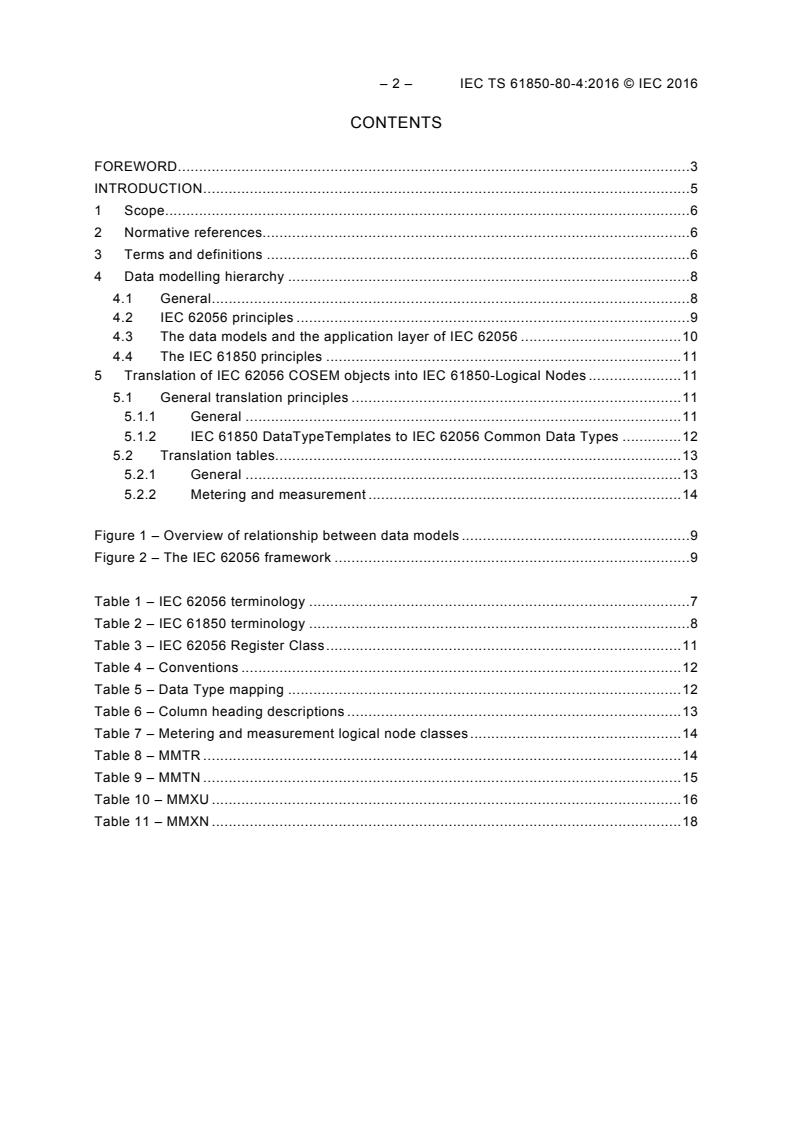
– 2 – IEC TS 61850-80-4:2016 © IEC 2016
CONTENTS
FOREWORD . 3
INTRODUCTION . 5
1 Scope . 6
2 Normative references. 6
3 Terms and definitions . 6
4 Data modelling hierarchy . 8
4.1 General . 8
4.2 IEC 62056 principles . 9
4.3 The data models and the application layer of IEC 62056 . 10
4.4 The IEC 61850 principles . 11
5 Translation of IEC 62056 COSEM objects into IEC 61850-Logical Nodes . 11
5.1 General translation principles . 11
5.1.1 General . 11
5.1.2 IEC 61850 DataTypeTemplates to IEC 62056 Common Data Types . 12
5.2 Translation tables . 13
5.2.1 General . 13
5.2.2 Metering and measurement . 14
Figure 1 – Overview of relationship between data models . 9
Figure 2 – The IEC 62056 framework . 9
Table 1 – IEC 62056 terminology . 7
Table 2 – IEC 61850 terminology . 8
Table 3 – IEC 62056 Register Class . 11
Table 4 – Conventions . 12
Table 5 – Data Type mapping . 12
Table 6 – Column heading descriptions . 13
Table 7 – Metering and measurement logical node classes . 14
Table 8 – MMTR . 14
Table 9 – MMTN . 15
Table 10 – MMXU . 16
Table 11 – MMXN . 18
INTERNATIONAL ELECTROTECHNICAL COMMISSION
____________
COMMUNICATION NETWORKS AND SYSTEMS
FOR POWER UTILITY AUTOMATION –
Part 80-4: Translation from the COSEM object model
(IEC 62056) to the IEC 61850 data model
FOREWORD
1) The International Electrotechnical Commission (IEC) is a worldwide organization for standardization comprising
all national electrotechnical committees (IEC National Committees). The object of IEC is to promote
international co-operation on all questions concerning standardization in the electrical and electronic fields. To
this end and in addition to other activities, IEC publishes International Standards, Technical Specifications,
Technical Reports, Publicly Available Specifications (PAS) and Guides (hereafter referred to as “IEC
Publication(s)”). Their preparation is entrusted to technical committees; any IEC National Committee interested
in the subject dealt with may participate in this preparatory work. International, governmental and non-
governmental organizations liaising with the IEC also participate in this preparation. IEC collaborates closely
with the International Organization for Standardization (ISO) in accordance with conditions determined by
agreement between the two organizations.
2) The formal decisions or agreements of IEC on technical matters express, as nearly as possible, an international
consensus of opinion on the relevant subjects since each technical committee has representation from all
interested IEC National Committees.
3) IEC Publications have the form of recommendations for international use and are accepted by IEC National
Committees in that sense. While all reasonable efforts are made to ensure that the technical content of IEC
Publications is accurate, IEC cannot be held responsible for the way in which they are used or for any
misinterpretation by any end user.
4) In order to promote international uniformity, IEC National Committees undertake to apply IEC Publications
transparently to the maximum extent possible in their national and regional publications. Any divergence
between any IEC Publication and the corresponding national or regional publication shall be clearly indicated in
the latter.
5) IEC itself does not provide any attestation of conformity. Independent certification bodies provide conformity
assessment services and, in some areas, access to IEC marks of conformity. IEC is not responsible for any
services carried out by independent certification bodies.
6) All users should ensure that they have the latest edition of this publication.
7) No liability shall attach to IEC or its directors, employees, servants or agents including individual experts and
members of its technical committees and IEC National Committees for any personal injury, property damage or
other damage of any nature whatsoever, whether direct or indirect, or for costs (including legal fees) and
expenses arising out of the publication, use of, or reliance upon, this IEC Publication or any other IEC
Publications.
8) Attention is drawn to the Normative references cited in this publication. Use of the referenced publications is
indispensable for the correct application of this publication.
9) Attention is drawn to the possibility that some of the elements of this IEC Publication may be the subject of
patent rights. IEC shall not be held responsible for identifying any or all such patent rights.
The main task of IEC technical committees is to prepare International Standards. In
exceptional circumstances, a technical committee may propose the publication of a technical
specification when
• the required support cannot be obtained for the publication of an International Standard,
despite repeated efforts, or
• the subject is still under technical development or where, for any other reason, there is the
future but no immediate possibility of an agreement on an International Standard.
Technical specifications are subject to review within three years of publication to decide
whether they can be transformed into International Standards.
IEC TS 61850-80-4, which is a technical specification, has been prepared by IEC technical
committee 57: Power systems management and associated information exchange.
– 4 – IEC TS 61850-80-4:2016 © IEC 2016
The text of this technical specification is based on the following documents:
Enquiry draft Report on voting
57/1602/DTS 57/1659/RVC
Full information on the voting for the approval of this technical specification can be found in
the report on voting indicated in the above table.
This publication has been drafted in accordance with the ISO/IEC Directives, Part 2.
The content of this part of IEC 61850 is based on existing or emerging standards and
applications.
A list of all parts of the IEC 61850 series, published under the general title Communication
networks and systems for power utility automation, can be found on the IEC website.
The committee has decided that the contents of this publication will remain unchanged until
the stability date indicated on the IEC website under "http://webstore.iec.ch" in the data
related to the specific publication. At this date, the publication will be
• transformed into an International standard,
• reconfirmed,
• withdrawn,
• replaced by a revised edition, or
• amended.
A bilingual version of this publication may be issued at a later date.
IMPORTANT – The 'colour inside' logo on the cover page of this publication indicates
that it contains colours which are considered to be useful for the correct
understanding of its contents. Users should therefore print this document using a
colour printer.
INTRODUCTION
IEC 61850 defines communication networks and systems for power utility automation, and
more specifically the communication architecture for subsystems such as substation
automation systems, feeder automation systems and SCADA for distributed energy resources.
In essence, IEC 61850 is a description of the communication architecture for the overall
power system management when the combined total of the above mentioned subsystems are
considered.
The devices in the electricity grid are becoming more intelligent with an increasing number of
elements and increasing complexity of data to be processed in a distributed environment.
Introduction of comprehensive data models simplifies the handling and management of the
data drastically since the models can be re-used once standardized. By defining a number of
standardized hierarchical names, it can drastically reduce errors in the field. The names in the
standard can be directly used for the configuration of devices and the communication between
devices.
This part of IEC 61850, which is a technical specification, defines the one-to-one relationship
of IEC 62056 OBIS codes to IEC 61850 Logical Nodes. The purpose is to increase the
availability of revenue meter information to other applications defined within the IEC 61850
framework. This increased visibility will contribute to information available for smart grid
applications.
The other benefit of defining these relationships is in regards to the design of protocol
converters. With a clear specification, test cases can be developed as well as end user
understanding of the quantities is unambiguous. Finally, end user configuration is simplified
by limiting the options for translation.
– 6 – IEC TS 61850-80-4:2016 © IEC 2016
COMMUNICATION NETWORKS AND SYSTEMS
FOR POWER UTILITY AUTOMATION –
Part 80-4: Translation from the COSEM object model
(IEC 62056) to the IEC 61850 data model
1 Scope
Included within the IEC 61850 power utility automation architecture are its concepts, data
models, communication protocols and the mapping data exchanges on the substation
network. This extends beyond just IEDs to other IEC 61850 enabled devices like meters,
system applications and remote access gateways.
This part of IEC 61850, which is a technical specification, considers the requirements of
power utility automation applications; i.e. the scope is limited by the use cases relevant for
meter data exchange in HV/MV substations and MV/LV substations. Only use cases that
require the data exchange involving a revenue meter are considered. Applications not
covered by the existing standards listed in Clause 2 are out of scope.
2 Normative references
The following documents, in whole or in part, are normatively referenced in this document and
are indispensable for its application. For dated references, only the edition cited applies. For
undated references, the latest edition of the referenced document (including any
amendments) applies.
IEC TS 61850-2, Communication networks and systems in substations – Part 2: Glossary
IEC 61850-7-2, Communication networks and systems for power utility automation – Part 7-2:
Basic information and communication structure – Abstract communication service interface
(ACSI)
IEC 61850-7-3:2010, Communication networks and systems for power utility automation –
Part 7-3: Basic communication structure – Common data classes
IEC 61850-7-4:2010, Communication networks and systems for power utility automation –
Part 7-4: Basic communication structure – Compatible logical node classes and data object
classes
IEC 62056-6-1:2015, Electricity metering data exchange – The DLMS/COSEM suite –
Part 6-1: Object Identification System (OBIS)
IEC 62056-6-2:2016, Electricity metering data exchange – The DLMS/COSEM suite –
Part 6-2: COSEM interface classes
3 Terms and definitions
For the purposes of this document, the terms and definitions given in IEC TS 61850-2 and
IEC 61850-7-2 apply. In addition, the terms and definitions given in IEC 62056-6-1 and
IEC 62056-6-2 apply.
Due to the fact that the same or similar terminology exist from the two standards areas and
may have different meanings, the terminology to be used in this document is explicitly defined
in Table 1 and Table 2. In addition, in some cases, the terms are elaborated to provide more
insight on the application for users who are not experts in the standards area.
Table 1 – IEC 62056 terminology
Term Description
COSEM Companion Specification for Energy Metering according to IEC 62056-6-2.
OBIS Code Object Identification System according to IEC 62056-6-1, uniquely identifying data objects
within COSEM compliant metering equipment.
COSEM Interface The Interface Class (IC) defines the common characteristics (by means of attributes and
Class (IC) methods) of a set data objects. The interface class specifies the characteristics of the objects
encountered at the interface through which a system interacts with the objects.
Implementation issues are not considered.
An IC consists of several attributes and methods. The first attribute is always the “logical
name”.
The set of standardised Interface Classes are defined in IEC 62056-6-2.
COSEM object An Interface class is instantiated by assigning a specific OBIS code to the logical name of the
IC. The result of the instantiation of an IC is a specific data object. The instantiation of an
Interface Class may be part of the meter configuration or part of the production process. A
meter operating in the field contains a set of objects. Data is exchanged by accessing these
objects.
Example: the IC “Register” defines the generic data structure for any metering register
containing 3 attributes (logical name, measured value and the unit).
By assigning the logical name “total electrical energy A+” to the IC “Register” we have formed
a specific data object providing information on the totally energy consumption.
The set of standardised OBIS codes are defined in IEC 62056-6-1.
Class ID(CID) The Class ID identifies a specific class of the set of standardised Interface Classes. For
example, Class_ID of 3 identifies the class type “Register”.
Physical Device A physical device is a subsystem which has a physical connection to a communication
medium and which can be addressed by a physical address. The behaviour of the physical
device is modelled with a set of logical devices.
A physical device must contain a “management logical device”.
Logical Device A logical device is an abstract entity within a physical device. A logical device is addressed
via its Service Access Point (SAP) provided by the communication layer below the application
layer. The behaviour of the logical device is modelled with a set of COSEM objects.
Logical Name The logical name contains an OBIS identifier; it is the first attribute of any object.
By assigning a specific OBIS code to the logical name the IC is instantiated. The OBIS code,
the Class ID and the version of the Interface Class uniquely identifies a data object.
COSEM Attribute A numbered set of attributes form (together with the methods) an interface class.
The first attribute is always the logical name. The nature of the value is described by the logic
name using OBIS identification system. For example, a register may contain the
instantaneous voltage on phase 1. This would correspond to a specific OBIS code stored in
the logical name attribute. The second attribute is a value with a choice of representation
among which is integer and floating point representation. The third attribute is the scaler and
unit. The first method of class register is a method to reset the register.
Common Data Common Data Types are made of simple and complex data types used to describe the
Types attributes of the IC. The typical simple data types include integer and floating point numbers.
Complex data types include array and structures. CHOICE is a data type that allows one of
many representations for an attribute. (see IEC 62056-6-2). The data types are described in
ASN1.
Metering A physical device which may contain multiple logical devices to measure energy usage of
Equipment different media. Equivalent to a Physical Meter.
Common abbreviation for Active Energy import and Active Energy export respectively.
+A and –A
Common abbreviation for Reactive Energy import and Reactive Energy export respectively.
+R and –R
– 8 – IEC TS 61850-80-4:2016 © IEC 2016
Table 2 – IEC 61850 terminology
Term Description
Logical Node The group defines Logical Nodes Classes with similar functions. For example, Group M
Group contains classes related to Metering and Measurement. (See IEC 61850-7-4).
Logical Node Aggregation of data, data sets, report controls, logs, log controls, etc. They represent typical
Class functions of a substation system. For example, Metering for commercial purposes of a 3
phase system (MMTR) is one Logical Node Class. An instance of a Logical Node Class is a
Logical Node and the smallest part of a function that exchanges data. (See IEC 61850-5).
Data Object This is a meaning and representation that is part of a Logical Node Class. For example, “Net
Name reactive energy” is one of many instances of the BCR Common Data Class of the MMTR
Logical Node. (see IEC 61850-7-4).
Common Data This class (See IEC 61850-7-3) is composed of Constructed Attribute Classes, other common
Class (CDC) data classes or types defined in IEC 61850-7-2 (Basic Data Types and Common ACSI
Types).
Constructed These classes are defined in IEC 61850-7-3:2010, Clause 6.
Attribute Class
(CAC)
DataAttribute This class (see IEC 61850-7-3) is composed of relatively simply data structures that are
Type commonly used. Examples include analog value
...