

IEC 61223-3-8:2024
(Main)Evaluation and routine testing in medical imaging departments - Part 3-8: Acceptance and constancy tests - Imaging performance of X-ray equipment for radiography and radioscopy
General Information
- Abstract
IEC 61223-3-8:2024 applies to evaluation of the imaging performance and related quality control parameters of X‑ray equipment for radiography and radioscopy that conform to IEC 60601-2-54:2022 or IEC 60601-2-43:2022.
This document applies to the evaluation of the imaging performance of the entire imaging chain from image acquisition, image processing and image display.
This document applies to acceptance tests and constancy tests, which are part of the quality assurance program in medical imaging departments and are intended to be performed by or under the responsibility of the responsible organization. A detailed discussion of the position of these tests within the medical radiological equipment lifecycle is provided in Clause A.2. The methods included rely mainly on non-invasive measurements that use appropriate test equipment and are performed after the installation is completed in accordance with the manufacturer’s installation instructions.
IEC 60601-2-54:2022 and IEC 60601-2-43:2022 require information to be provided to the responsible organization with respect to quality control. This document provides guidance to manufacturers regarding the acceptance and constancy tests for the X‑ray equipment in a manufacturer supplied quality control manual. Annex G provides guidance for such a manual.
- Status
- Published
- Publication Date
- 25-Mar-2024
- Technical Committee
- SC 62B - Medical imaging equipment, software, and systems
- Drafting Committee
- WG 37 - TC 62/SC 62B/WG 37
- Current Stage
- PPUB - Publication issued
- Start Date
- 26-Mar-2024
- Completion Date
- 12-Apr-2024
Buy Documents
IEC 61223-3-8:2024 - Evaluation and routine testing in medical imaging departments - Part 3-8: Acceptance and constancy tests - Imaging performance of X-ray equipment for radiography and radioscopy Released:3/26/2024
Overview
IEC 61223-3-8:2024 is an international standard published by the International Electrotechnical Commission (IEC) that addresses the evaluation and routine testing of imaging performance in X-ray equipment used for radiography and radioscopy. This standard is part 3-8 of the broader IEC 61223 series, focusing specifically on acceptance and constancy tests.
It applies to X-ray systems that comply with IEC 60601-2-54:2022 or IEC 60601-2-43:2022, covering the entire imaging chain including image acquisition, processing, and display. The document provides guidance for quality control practices in medical imaging departments to ensure the consistent performance of X-ray diagnostic equipment and compliance with safety and performance requirements.
This standard promotes non-invasive test methods conducted after installation, using dedicated test equipment and phantoms, with procedures designed for responsible organizations within healthcare institutions. It also offers manufacturers recommendations for quality control manuals accompanying supplied equipment.
Keywords: IEC 61223-3-8, X-ray equipment testing, radiography, radioscopy, acceptance testing, constancy tests, medical imaging quality control, IEC standards
Key Topics
Acceptance Testing
These are initial tests performed post-installation to confirm X-ray equipment meets manufacturer specifications, regulatory requirements, and contractual obligations. Acceptance tests verify the readiness and compliance of the entire imaging system before clinical use.Constancy Testing
Routine performance checks carried out periodically during equipment operation ensure that imaging quality and system function remain stable over time. These tests help detect deviations typically caused by equipment wear or environmental factors.Quality Control Parameters
The standard defines key parameters such as X-ray tube voltage, current, focal spot size, half-value layer, air kerma rates, and geometric accuracy. It specifies measurement methods and acceptable tolerance levels to maintain diagnostic image quality and patient safety.Test Equipment and Phantoms
Utilization of dedicated test devices including dosimeters, high-voltage meters, and image quality phantoms is outlined. These tools support quantitative assessment of system characteristics with software analysis and standardized viewing conditions.Imaging Chain Evaluation
IEC 61223-3-8 emphasizes evaluation spanning image acquisition hardware, processing algorithms, and display monitors, ensuring comprehensive performance verification.Manufacturer Guidance
Annex G provides manufacturers with instructions for preparing quality control manuals which must accompany X-ray equipment to facilitate routine acceptance and constancy tests.
Applications
Medical Imaging Departments
Hospitals and outpatient imaging centers benefit by applying IEC 61223-3-8 to maintain the reliability of their radiography and radioscopy devices, complying with local regulations and international standards.Equipment Installation and Commissioning
Installation engineers and medical physicists conduct acceptance tests aligned with this standard to verify that new or upgraded X-ray systems are fit for clinical use.Routine Quality Assurance Programs
Radiology technologists and medical physicists execute constancy tests regularly to monitor equipment stability and image performance, minimizing risks of diagnostic errors or unsafe radiation exposure.Manufacturer Quality Documentation
Equipment manufacturers utilize the guidance to prepare comprehensive quality control manuals to assist end-users in conducting standardized acceptance and ongoing performance testing.Regulatory Compliance
Compliance with IEC 61223-3-8 supports adherence to legal and certification requirements for medical radiological equipment safety and performance, aiding hospital accreditation and safety audits.
Related Standards
IEC 60601-2-54:2022 – Medical electrical equipment – Part 2-54: Particular requirements for the basic safety and essential performance of X-ray equipment for radiography and radioscopy.
IEC 60601-2-43:2022 – Medical electrical equipment – Part 2-43: Particular requirements for the basic safety and essential performance of X-ray equipment for interventional procedures.
IEC 61223 Series – Evaluation and routine testing in medical imaging departments covering other imaging modalities and testing aspects.
ISO 16371-1 – Medical imaging – Acceptance testing and quality control of X-ray equipment.
By implementing IEC 61223-3-8:2024, healthcare providers and manufacturers ensure optimal performance and safety of radiographic and radioscopic X-ray equipment, enhancing diagnostic accuracy and patient protection through rigorous quality control practices.
Buy Documents
IEC 61223-3-8:2024 - Evaluation and routine testing in medical imaging departments - Part 3-8: Acceptance and constancy tests - Imaging performance of X-ray equipment for radiography and radioscopy Released:3/26/2024
Get Certified
Connect with accredited certification bodies for this standard

BSI Group
BSI (British Standards Institution) is the business standards company that helps organizations make excellence a habit.

TÜV Rheinland
TÜV Rheinland is a leading international provider of technical services.

TÜV SÜD
TÜV SÜD is a trusted partner of choice for safety, security and sustainability solutions.
Sponsored listings
Frequently Asked Questions
IEC 61223-3-8:2024 is a standard published by the International Electrotechnical Commission (IEC). Its full title is "Evaluation and routine testing in medical imaging departments - Part 3-8: Acceptance and constancy tests - Imaging performance of X-ray equipment for radiography and radioscopy". This standard covers: IEC 61223-3-8:2024 applies to evaluation of the imaging performance and related quality control parameters of X‑ray equipment for radiography and radioscopy that conform to IEC 60601-2-54:2022 or IEC 60601-2-43:2022. This document applies to the evaluation of the imaging performance of the entire imaging chain from image acquisition, image processing and image display. This document applies to acceptance tests and constancy tests, which are part of the quality assurance program in medical imaging departments and are intended to be performed by or under the responsibility of the responsible organization. A detailed discussion of the position of these tests within the medical radiological equipment lifecycle is provided in Clause A.2. The methods included rely mainly on non-invasive measurements that use appropriate test equipment and are performed after the installation is completed in accordance with the manufacturer’s installation instructions. IEC 60601-2-54:2022 and IEC 60601-2-43:2022 require information to be provided to the responsible organization with respect to quality control. This document provides guidance to manufacturers regarding the acceptance and constancy tests for the X‑ray equipment in a manufacturer supplied quality control manual. Annex G provides guidance for such a manual.
IEC 61223-3-8:2024 applies to evaluation of the imaging performance and related quality control parameters of X‑ray equipment for radiography and radioscopy that conform to IEC 60601-2-54:2022 or IEC 60601-2-43:2022. This document applies to the evaluation of the imaging performance of the entire imaging chain from image acquisition, image processing and image display. This document applies to acceptance tests and constancy tests, which are part of the quality assurance program in medical imaging departments and are intended to be performed by or under the responsibility of the responsible organization. A detailed discussion of the position of these tests within the medical radiological equipment lifecycle is provided in Clause A.2. The methods included rely mainly on non-invasive measurements that use appropriate test equipment and are performed after the installation is completed in accordance with the manufacturer’s installation instructions. IEC 60601-2-54:2022 and IEC 60601-2-43:2022 require information to be provided to the responsible organization with respect to quality control. This document provides guidance to manufacturers regarding the acceptance and constancy tests for the X‑ray equipment in a manufacturer supplied quality control manual. Annex G provides guidance for such a manual.
IEC 61223-3-8:2024 is classified under the following ICS (International Classification for Standards) categories: 11.040.50 - Radiographic equipment. The ICS classification helps identify the subject area and facilitates finding related standards.
IEC 61223-3-8:2024 is available in PDF format for immediate download after purchase. The document can be added to your cart and obtained through the secure checkout process. Digital delivery ensures instant access to the complete standard document.
Standards Content (Sample)
IEC 61223-3-8 ®
Edition 1.0 2024-03
INTERNATIONAL
STANDARD
NORME
INTERNATIONALE
Evaluation and routine testing in medical imaging departments –
Part 3-8: Acceptance and constancy tests – Imaging performance of X-ray
equipment for radiography and radioscopy
Essais d'évaluation et de routine dans les services d'imagerie médicale –
Partie 3-8: Essais d'acceptation et de constance – Performance d'imagerie des
appareils à rayonnement X pour la radiographie et la radioscopie
All rights reserved. Unless otherwise specified, no part of this publication may be reproduced or utilized in any form
or by any means, electronic or mechanical, including photocopying and microfilm, without permission in writing from
either IEC or IEC's member National Committee in the country of the requester. If you have any questions about IEC
copyright or have an enquiry about obtaining additional rights to this publication, please contact the address below or
your local IEC member National Committee for further information.
Droits de reproduction réservés. Sauf indication contraire, aucune partie de cette publication ne peut être reproduite ni
utilisée sous quelque forme que ce soit et par aucun procédé, électronique ou mécanique, y compris la photocopie et
les microfilms, sans l'accord écrit de l'IEC ou du Comité national de l'IEC du pays du demandeur. Si vous avez des
questions sur le copyright de l'IEC ou si vous désirez obtenir des droits supplémentaires sur cette publication, utilisez
les coordonnées ci-après ou contactez le Comité national de l'IEC de votre pays de résidence.
IEC Secretariat Tel.: +41 22 919 02 11
3, rue de Varembé info@iec.ch
CH-1211 Geneva 20 www.iec.ch
Switzerland
About the IEC
The International Electrotechnical Commission (IEC) is the leading global organization that prepares and publishes
International Standards for all electrical, electronic and related technologies.
About IEC publications
The technical content of IEC publications is kept under constant review by the IEC. Please make sure that you have the
latest edition, a corrigendum or an amendment might have been published.
IEC publications search - webstore.iec.ch/advsearchform IEC Products & Services Portal - products.iec.ch
The advanced search enables to find IEC publications by a Discover our powerful search engine and read freely all the
variety of criteria (reference number, text, technical publications previews, graphical symbols and the glossary.
committee, …). It also gives information on projects, replaced With a subscription you will always have access to up to date
and withdrawn publications. content tailored to your needs.
IEC Just Published - webstore.iec.ch/justpublished
Electropedia - www.electropedia.org
Stay up to date on all new IEC publications. Just Published
The world's leading online dictionary on electrotechnology,
details all new publications released. Available online and once
containing more than 22 500 terminological entries in English
a month by email.
and French, with equivalent terms in 25 additional languages.
Also known as the International Electrotechnical Vocabulary
IEC Customer Service Centre - webstore.iec.ch/csc
(IEV) online.
If you wish to give us your feedback on this publication or need
further assistance, please contact the Customer Service
Centre: sales@iec.ch.
A propos de l'IEC
La Commission Electrotechnique Internationale (IEC) est la première organisation mondiale qui élabore et publie des
Normes internationales pour tout ce qui a trait à l'électricité, à l'électronique et aux technologies apparentées.
A propos des publications IEC
Le contenu technique des publications IEC est constamment revu. Veuillez vous assurer que vous possédez l’édition la
plus récente, un corrigendum ou amendement peut avoir été publié.
Recherche de publications IEC - IEC Products & Services Portal - products.iec.ch
webstore.iec.ch/advsearchform Découvrez notre puissant moteur de recherche et consultez
La recherche avancée permet de trouver des publications IEC gratuitement tous les aperçus des publications, symboles
en utilisant différents critères (numéro de référence, texte, graphiques et le glossaire. Avec un abonnement, vous aurez
comité d’études, …). Elle donne aussi des informations sur les toujours accès à un contenu à jour adapté à vos besoins.
projets et les publications remplacées ou retirées.
Electropedia - www.electropedia.org
IEC Just Published - webstore.iec.ch/justpublished
Le premier dictionnaire d'électrotechnologie en ligne au monde,
Restez informé sur les nouvelles publications IEC. Just
avec plus de 22 500 articles terminologiques en anglais et en
Published détaille les nouvelles publications parues.
français, ainsi que les termes équivalents dans 25 langues
Disponible en ligne et une fois par mois par email.
additionnelles. Egalement appelé Vocabulaire
Electrotechnique International (IEV) en ligne.
Service Clients - webstore.iec.ch/csc
Si vous désirez nous donner des commentaires sur cette
publication ou si vous avez des questions contactez-nous:
sales@iec.ch.
IEC 61223-3-8 ®
Edition 1.0 2024-03
INTERNATIONAL
STANDARD
NORME
INTERNATIONALE
Evaluation and routine testing in medical imaging departments –
Part 3-8: Acceptance and constancy tests – Imaging performance of X-ray
equipment for radiography and radioscopy
Essais d'évaluation et de routine dans les services d'imagerie médicale –
Partie 3-8: Essais d'acceptation et de constance – Performance d'imagerie des
appareils à rayonnement X pour la radiographie et la radioscopie
INTERNATIONAL
ELECTROTECHNICAL
COMMISSION
COMMISSION
ELECTROTECHNIQUE
INTERNATIONALE
ICS 11.040.50 ISBN 978-2-8322-8565-7
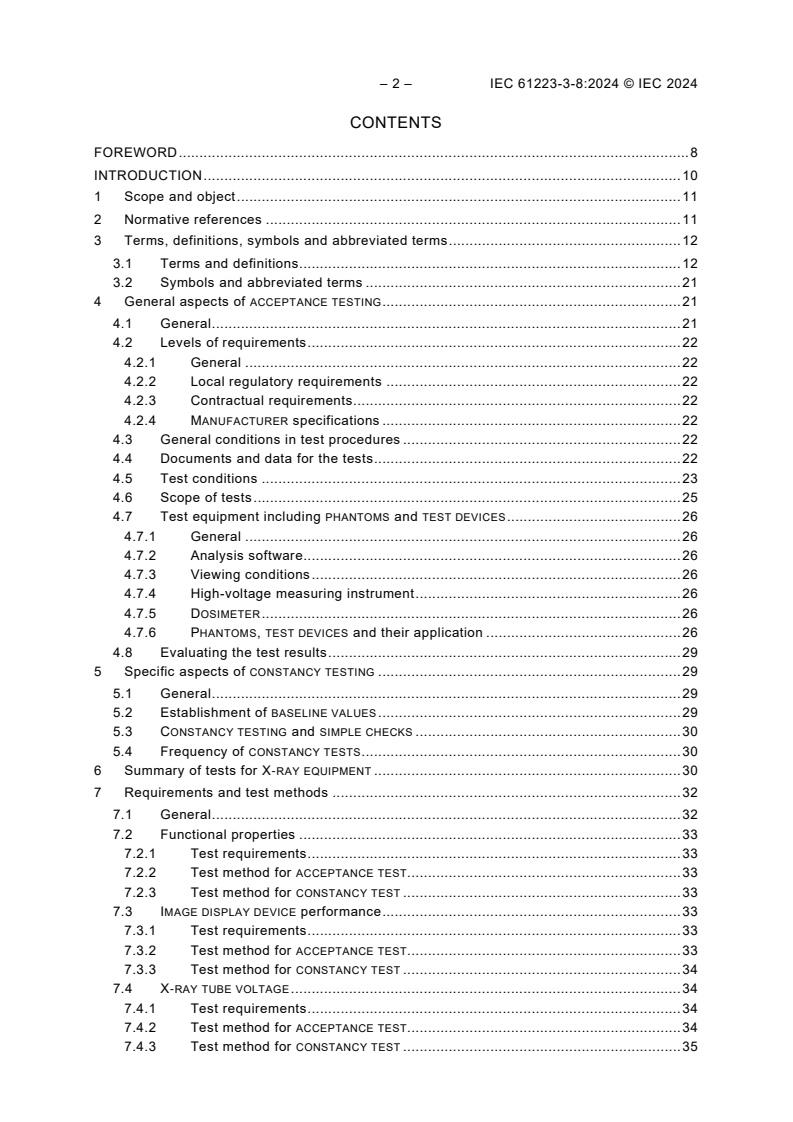
– 2 – IEC 61223-3-8:2024 © IEC 2024
CONTENTS
FOREWORD . 8
INTRODUCTION . 10
1 Scope and object . 11
2 Normative references . 11
3 Terms, definitions, symbols and abbreviated terms . 12
3.1 Terms and definitions . 12
3.2 Symbols and abbreviated terms . 21
4 General aspects of ACCEPTANCE TESTING . 21
4.1 General . 21
4.2 Levels of requirements . 22
4.2.1 General . 22
4.2.2 Local regulatory requirements . 22
4.2.3 Contractual requirements . 22
4.2.4 MANUFACTURER specifications . 22
4.3 General conditions in test procedures . 22
4.4 Documents and data for the tests . 22
4.5 Test conditions . 23
4.6 Scope of tests . 25
4.7 Test equipment including PHANTOMS and TEST DEVICES . 26
4.7.1 General . 26
4.7.2 Analysis software. 26
4.7.3 Viewing conditions . 26
4.7.4 High-voltage measuring instrument . 26
4.7.5 DOSIMETER . 26
4.7.6 PHANTOMS, TEST DEVICES and their application . 26
4.8 Evaluating the test results . 29
5 Specific aspects of CONSTANCY TESTING . 29
5.1 General . 29
5.2 Establishment of BASELINE VALUES . 29
5.3 CONSTANCY TESTING and SIMPLE CHECKS . 30
5.4 Frequency of CONSTANCY TESTS . 30
6 Summary of tests for X‑RAY EQUIPMENT . 30
7 Requirements and test methods . 32
7.1 General . 32
7.2 Functional properties . 33
7.2.1 Test requirements . 33
7.2.2 Test method for ACCEPTANCE TEST . 33
7.2.3 Test method for CONSTANCY TEST . 33
7.3 IMAGE DISPLAY DEVICE performance . 33
7.3.1 Test requirements . 33
7.3.2 Test method for ACCEPTANCE TEST . 33
7.3.3 Test method for CONSTANCY TEST . 34
7.4 X‑RAY TUBE VOLTAGE . 34
7.4.1 Test requirements . 34
7.4.2 Test method for ACCEPTANCE TEST . 34
7.4.3 Test method for CONSTANCY TEST . 35
7.5 X‑RAY TUBE CURRENT or CURRENT TIME PRODUCT . 35
7.5.1 Test requirements . 35
7.5.2 Test method for ACCEPTANCE TEST . 35
7.5.3 Test method for CONSTANCY TEST . 35
7.6 HALF-VALUE LAYER of the X‑RAY SOURCE ASSEMBLY . 35
7.6.1 Test requirements . 35
7.6.2 Test method for ACCEPTANCE TEST . 36
7.6.3 Test method for CONSTANCY TEST . 36
7.7 * QUALITY EQUIVALENT FILTRATION of ADDED FILTERS . 36
7.7.1 Test requirements . 36
7.7.2 * Test method for ACCEPTANCE TEST . 36
7.7.3 Test method for CONSTANCY TEST . 36
7.8 * ATTENUATION EQUIVALENT of materials between the PATIENT and the X‑RAY
IMAGE RECEPTOR . 36
7.8.1 Test requirements . 36
7.8.2 * Test method for ACCEPTANCE TEST . 37
7.8.3 Test method for CONSTANCY TEST . 37
7.9 FOCAL SPOT of the X‑RAY TUBE . 37
7.9.1 Test requirements . 37
7.9.2 Test method for ACCEPTANCE TEST . 37
7.9.3 Test method for CONSTANCY TEST . 37
7.10 Assessing geometrical properties of the X-RAY EQUIPMENT . 37
7.10.1 Test requirements . 37
7.10.2 Test method for ACCEPTANCE TEST . 37
7.10.3 Test method for CONSTANCY TEST . 37
7.11 AUTOMATIC CONTROL SYSTEM ─ Performance . 38
7.11.1 Test requirements . 38
7.11.2 * Test method for ACCEPTANCE TEST . 38
7.11.3 * Test method for CONSTANCY TEST . 38
7.12 AUTOMATIC CONTROL SYSTEM ─ Reproducibility . 38
7.12.1 Test requirements . 38
7.12.2 Test method for ACCEPTANCE TEST . 38
7.12.3 Test method for CONSTANCY TEST . 38
7.13 * AUTOMATIC CONTROL SYSTEM – NOMINAL SHORTEST IRRADIATION TIME . 38
7.13.1 Test requirements . 38
7.13.2 * Test method for ACCEPTANCE TEST . 38
7.13.3 Test method for CONSTANCY TEST . 39
7.14 Correspondence between the X‑RAY FIELD and EFFECTIVE IMAGE RECEPTION
AREA . 39
7.14.1 Test requirements . 39
7.14.2 Test method for ACCEPTANCE TEST . 40
7.14.3 Test method for CONSTANCY TEST . 41
7.15 Accuracy of indication of the LIGHT FIELD-INDICATOR . 41
7.15.1 Test requirements . 41
7.15.2 Test method for ACCEPTANCE TEST . 42
7.15.3 Test method for CONSTANCY TEST . 42
7.16 Accuracy of marked and written indications of the X‑RAY FIELD size . 43
7.16.1 Test requirements . 43
7.16.2 Test method for ACCEPTANCE TEST . 43
– 4 – IEC 61223-3-8:2024 © IEC 2024
7.16.3 Test method for CONSTANCY TEST . 43
7.17 AIR KERMA RATE at the ENTRANCE PLANE of the X‑RAY IMAGE RECEPTOR for
RADIOSCOPY. 43
7.17.1 Test requirements . 43
7.17.2 Test method for ACCEPTANCE TEST . 44
7.17.3 Test method for CONSTANCY TEST . 44
7.18 REFERENCE AIR KERMA RATE for RADIOSCOPY . 44
7.18.1 Test requirements . 44
7.18.2 Test method for ACCEPTANCE TEST . 44
7.18.3 Test method for CONSTANCY TEST . 45
7.19 AIR KERMA at the ENTRANCE PLANE of the X‑RAY IMAGE RECEPTOR for
RADIOGRAPHY . 46
7.19.1 Test requirements . 46
7.19.2 Test method for ACCEPTANCE TEST . 46
7.19.3 Test method for CONSTANCY TEST . 46
7.20 REFERENCE AIR KERMA for SERIAL RADIOGRAPHY . 46
7.20.1 Test requirements . 46
7.20.2 Test method for ACCEPTANCE TEST . 46
7.20.3 Test method for CONSTANCY TEST . 46
7.21 Limitation of the REFERENCE AIR KERMA RATE in RADIOSCOPY . 46
7.21.1 Test requirements . 46
7.21.2 Test method for ACCEPTANCE TEST . 46
7.21.3 Test method for CONSTANCY TEST . 47
7.22 SPATIAL RESOLUTION for RADIOSCOPY and RADIOGRAPHY . 47
7.22.1 Test requirements . 47
7.22.2 Test method for ACCEPTANCE TEST . 47
7.22.3 Test method for CONSTANCY TEST . 49
7.23 LOW CONTRAST RESOLUTION for RADIOSCOPY and RADIOGRAPHY . 49
7.23.1 Test requirements . 49
7.23.2 Test method for ACCEPTANCE TEST . 50
7.23.3 Test method for CONSTANCY TEST . 50
7.24 DYNAMIC RANGE for RADIOSCOPY and RADIOGRAPHY . 50
7.24.1 Test requirements . 50
7.24.2 Test method for ACCEPTANCE TEST . 51
7.24.3 Test method for CONSTANCY TEST . 51
7.25 DOSE AREA PRODUCT and REFERENCE AIR KERMA (RATE) indicator . 51
7.25.1 Test requirements . 51
7.25.2 Test method for ACCEPTANCE TEST . 51
7.25.3 Test method for CONSTANCY TEST . 51
7.26 Back-up timer and safety measures . 51
7.26.1 Test requirements . 51
7.26.2 Test method for ACCEPTANCE TEST . 51
7.26.3 Test method for CONSTANCY TEST . 52
7.27 ARTEFACTS . 52
7.27.1 Test requirements . 52
7.27.2 Test method for ACCEPTANCE TEST . 52
7.27.3 Test method for CONSTANCY TEST . 53
7.28 Accuracy of image measuring functions . 53
7.28.1 Test requirements . 53
7.28.2 Test method for ACCEPTANCE TEST . 53
7.28.3 Test method for CONSTANCY TEST . 53
7.29 DYNAMIC RANGE for SUBTRACTION IMAGING . 53
7.29.1 Test requirements . 53
7.29.2 Conditions for testing the SUBTRACTION IMAGING mode . 53
7.29.3 Test method for ACCEPTANCE TEST . 53
7.29.4 Test method for CONSTANCY TEST . 54
7.30 Contrast sensitivity for SUBTRACTION IMAGING . 54
7.30.1 Test requirements . 54
7.30.2 Test method for ACCEPTANCE TEST . 54
7.30.3 Test method for CONSTANCY TEST . 54
7.31 SPATIAL RESOLUTION for SUBTRACTION IMAGING . 54
7.31.1 Test requirements . 54
7.31.2 Test method for ACCEPTANCE TEST . 55
7.31.3 Test method for CONSTANCY TEST . 55
7.32 ARTEFACTS in SUBTRACTION IMAGING . 55
7.32.1 Test requirements . 55
7.32.2 Test method for ACCEPTANCE TEST . 55
7.32.3 Test method for CONSTANCY TEST . 55
7.33 X‑RAY IMAGE RECEPTOR EXPOSURE INDEX . 55
7.33.1 Test requirements . 55
7.33.2 Test method for ACCEPTANCE TEST . 56
7.33.3 Test method for CONSTANCY TEST . 56
7.34 LEAKAGE RADIATION in the LOADING STATE . 57
7.34.1 Test requirements . 57
7.34.2 Test method for ACCEPTANCE TEST . 57
7.34.3 Test method for CONSTANCY TEST . 57
Annex A (informative) General guidance and rationale . 58
A.1 Aim and background information . 58
A.2 Medical radiological equipment lifecycle testing . 58
A.2.1 General . 58
A.2.2 The "lifecycle" . 58
A.3 Rationale for particular clauses and subclauses . 61
Annex B (informative) Use of REFERENCE AIR KERMA and AIR KERMA at the ENTRANCE
PLANE of the X‑RAY IMAGE RECEPTOR . 64
B.1 General . 64
B.2 Issues with AIR KERMA at the ENTRANCE PLANE of the X‑RAY IMAGE RECEPTOR
as a measure of performance . 64
B.3 AIR KERMA at the ENTRANCE PLANE of the X‑RAY IMAGE RECEPTOR as an
ACCEPTANCE TEST or CONSTANCY TEST . 64
B.4 REFERENCE AIR KERMA as a measure of performance . 65
B.5 REFERENCE AIR KERMA as an ACCEPTANCE TEST . 65
Annex C (informative) Assessing clinical protocol performance . 66
C.1 General . 66
C.2 Discussion . 66
Annex D (informative) Examples of TEST DEVICES for image quality evaluation . 67
D.1 General . 67
D.2 TEST DEVICE according to DIN 6868-150 . 67
D.3 Leeds X‑ray test objects for RADIOGRAPHY/RADIOSCOPY systems . 67
– 6 – IEC 61223-3-8:2024 © IEC 2024
D.4 LOW CONTRAST RESOLUTION TEST DEVICE of the University of Alabama at
Birmingham, USA. 67
Annex E (informative) Examples of DSA PHANTOMS . 69
E.1 General . 69
E.2 Generic DSA PHANTOM . 69
E.3 DSA PHANTOM with test step for compensation . 71
Annex F (informative) QUALITY CONTROL in cone beam computed tomography (CBCT) . 73
F.1 General . 73
F.2 Image quality parameters . 73
F.2.1 Summary of tests for CBCT . 73
F.2.2 Uniformity . 73
F.2.3 Geometrical precision . 74
F.2.4 Voxel density values . 75
F.2.5 Noise . 75
F.2.6 LOW CONTRAST RESOLUTION . 75
F.2.7 SPATIAL RESOLUTION . 76
F.3 Tests of RADIATION output . 76
F.3.1 General . 76
F.3.2 Cumulative DOSE AREA PRODUCT . 77
F.3.3 AIR KERMA at the ENTRANCE PLANE of the X‑RAY IMAGE RECEPTOR . 78
F.3.4 In-phantom dosimetry indexes – CTDI metrics . 78
F.3.5 Cumulative AIR KERMA . 79
F.4 Image quality PHANTOMS . 79
Annex G (informative) Guidance for MANUFACTURER supplied QUALITY CONTROL manual. 80
G.1 General . 80
G.2 Generic considerations for a QUALITY CONTROL manual . 80
G.3 Prerequisites for guidance for MANUFACTURER supplied QUALITY CONTROL
manual . 80
G.3.1 General . 80
G.3.2 General aspects . 81
G.3.3 Objective of test . 81
G.3.4 Test methods, test equipment and test objects . 81
G.3.5 Frequency of test . 81
G.3.6 Acceptance and constancy criteria . 81
G.4 Example of a QUALITY CONTROL manual for a DOSE AREA PRODUCT verification . 82
Annex H (informative) Uncertainty aspects of testing on X‑RAY EQUIPMENT for
RADIOGRAPHY and RADIOSCOPY . 84
H.1 General . 84
H.2 Measurements performed in a clinical facility . 85
H.3 Measurements made by placing a probe in the X‑RAY BEAM . 85
H.3.1 General . 85
H.3.2 Direct setting of the X‑ray equipment . 86
H.3.3 Indirect setting of the X‑ray equipment . 86
Annex I (informative) Examples of SIMPLE CHECKS . 87
I.1 General . 87
I.2 Examples of visual inspection . 87
I.3 Examples of indicated values of parameters . 87
Annex J (informative) Examples of system changes and relevant ACCEPTANCE TESTS . 89
Bibliography . 90
Index of defined terms . 93
Figure 1 – Indicative measuring arrangement for RADIOGRAPHY and RADIOSCOPY
equipment for AIR KERMA measurements. 24
Figure 2 – Indicative measuring arrangement for RADIOGRAPHY and RADIOSCOPY
equipment to test geometry and resolutions . 25
Figure 3 – Example of a LINE PAIR RESOLUTION TEST DEVICE . 28
Figure 4 – MODULATION TRANSFER FUNCTION TEST DEVICE . 28
Figure 5 – Discrepancies in covering the IMAGE RECEPTION AREA . 41
Figure 6 – Discrepancies in visual indication of the X‑RAY FIELD . 42
Figure A.1 – Lifecycle of X‑ray imaging equipment . 59
Figure E.1 – Generic DSA PHANTOM . 70
Figure E.2 – DSA PHANTOM with test step for compensation . 72
Figure F.1 – Position of the ROIs for the calculation of the uniformity . 74
Figure F.2 – CTDI PHANTOM with the positions of the DOSIMETER . 78
Figure G.1 – Measurement set-up for DAP measurement . 82
Figure H.1 – Decision points with respect to MEASUREMENT UNCERTAINTY. 85
Table 1 – QUALITY CONTROL tests and recommended frequencies . 31
Table E.1 – Summary of properties of the generic DSA PHANTOM. . 69
Table E.2 – Summary of properties of the DSA PHANTOM with test step for compensation. 71
Table F.1 – Summary of image quality tests for CBCT including suggested frequencies . 73
Table F.2 – Summary of RADIATION output tests for CBCT including suggested
frequency. . 77
Table J.1 – Overview of relevant ACCEPTANCE TESTS related to system changes . 89
– 8 – IEC 61223-3-8:2024 © IEC 2024
INTERNATIONAL ELECTROTECHNICAL COMMISSION
____________
EVALUATION AND ROUTINE TESTING
IN MEDICAL IMAGING DEPARTMENTS –
Part 3-8: Acceptance and constancy tests –
Imaging performance of X‑ray equipment for radiography and radioscopy
FOREWORD
1) The International Electrotechnical Commission (IEC) is a worldwide organization for standardization comprising
all national electrotechnical committees (IEC National Committees). The object of IEC is to promote international
co-operation on all questions concerning standardization in the electrical and electronic fields. To this end and
in addition to other activities, IEC publishes International Standards, Technical Specifications, Technical Reports,
Publicly Available Specifications (PAS) and Guides (hereafter referred to as “IEC Publication(s)”). Their
preparation is entrusted to technical committees; any IEC National Committee interested in the subject dealt with
may participate in this preparatory work. International, governmental and non-governmental organizations liaising
with the IEC also participate in this preparation. IEC collaborates closely with the International Organization for
Standardization (ISO) in accordance with conditions determined by agreement between the two organizations.
2) The formal decisions or agreements of IEC on technical matters express, as nearly as possible, an international
consensus of opinion on the relevant subjects since each technical committee has representation from all
interested IEC National Committees.
3) IEC Publications have the form of recommendations for international use and are accepted by IEC National
Committees in that sense. While all reasonable efforts are made to ensure that the technical content of IEC
Publications is accurate, IEC cannot be held responsible for the way in which they are used or for any
misinterpretation by any end user.
4) In order to promote international uniformity, IEC National Committees undertake to apply IEC Publications
transparently to the maximum extent possible in their national and regional publications. Any divergence between
any IEC Publication and the corresponding national or regional publication shall be clearly indicated in the latter.
5) IEC itself does not provide any attestation of conformity. Independent certification bodies provide conformity
assessment services and, in some areas, access to IEC marks of conformity. IEC is not responsible for any
services carried out by independent certification bodies.
6) All users should ensure that they have the latest edition of this publication.
7) No liability shall attach to IEC or its directors, employees, servants or agents including individual experts and
members of its technical committees and IEC National Committees for any personal injury, property damage or
other damage of any nature whatsoever, whether direct or indirect, or for costs (including legal fees) and
expenses arising out of the publication, use of, or reliance upon, this IEC Publication or any other IEC
Publications.
8) Attention is drawn to the Normative references cited in this publication. Use of the referenced publications is
indispensable for the correct application of this publication.
9) IEC draws attention to the possibility that the implementation of this document may involve the use of (a)
patent(s). IEC takes no position concerning the evidence, validity or applicability of any claimed patent rights in
respect thereof. As of the date of publication of this document, IEC had not received notice of (a) patent(s), which
may be required to implement this document. However, implementers are cautioned that this may not represent
the latest information, which may be obtained from the patent database available at https://patents.iec.ch. IEC
shall not be held responsible for identifying any or all such patent rights.
IEC 61223-3-8 has been prepared by subcommittee 62B: Medical imaging equipment, software,
and systems, of IEC technical committee 62: Medical equipment, software, and systems. It is
an International Standard.
The text of this document is based on the following documents:
Draft Report on voting
62B/1347/FDIS 62B/1351/RVD
Full information on the voting for its approval can be found in the report on voting indicated in
the above table.
The language used for the development of this International Standard is English.
This document was drafted in accordance with ISO/IEC Directives, Part 2, and developed in
accordance with ISO/IEC Directives, Part 1 and ISO/IEC Directives, IEC Supplement, available
at www.iec.ch/members_experts/refdocs. The main document types developed by IEC are
described in greater detail at www.iec.ch/publications.
In this document, the following print types are used:
– requirements, compliance with which can be tested, and definitions: in roman type.
– explanations, advice, notes, general statements, exceptions and references: in smaller type.
– test specifications: in italic type.
– TERMS USED THROUGHOUT THIS DOCUMENT THAT HAVE BEEN LISTED IN THE INDEX OF DEFINED
TERMS AND DEFINED IN CLAUSE 3, OR IN OTHER STANDARDS: IN SMALL CAPITALS.
References to clauses within this document are preceded by the term "Clause" followed by the
clause number. References to subclauses within this document are by number only.
In this document, the conjunctive "or" is used as an "inclusive or" so a statement is true if any
combination of the conditions is true.
The verbal forms used in this document conform to usage described in Clause 7 of the ISO/IEC
Directives, Part 2. For the purposes of this document, the auxiliary verb:
– "shall" means that compliance with a requirement or a test is mandatory for compliance with
this document;
– "should" means that compliance with a requirement or a test is recommended but is not
mandatory for compliance with this document;
– "may" is used to describe a permissible way to achieve compliance with a requirement or
test.
An asterisk (*) as the first character of a title or at the beginning of a paragraph or table title
indicates that there is guidance or rationale related to that item in Annex A.
A list of all parts of the IEC 61223 series, published under the general title Evaluation and
routine testing in medical imaging departments, can be found on the IEC website.
The committee has decided that the contents of this document will remain unchanged until the
stability date indicated on the IEC website under webstore.iec.ch in the data related to the
specific document. At this date, the document will be
• reconfirmed,
• withdrawn, or
• revised.
NOTE The attention of the users of this document is drawn to the fact that equipment MANUFACTURERS and testing
organizations might need a transitional period following publication of a new, amended or revised IEC publication in
order to develop contractual specifications in accordance with the new test procedures and to equip themselves for
conducting new or revised tests. It is the recommendation of the committee that the content of this publication be
adopted for implementation nationally not earlier than 3 years from the date of publication.
IMPORTANT – The "colour inside" logo on the cover page of this document indicates
that it contains colours which are considered to be useful for the correct understanding
of its contents. Users should therefore print this document using a colour printer.
– 10 – IEC 61223-3-8:2024 © IEC 2024
INTRODUCTION
The IEC 61223 series gives methods for ACCEPTANCE TESTS and CONSTANCY TESTS for diagnostic
X‑RAY EQUIPMENT.
IEC 60601-2-54:2022 and IEC 60601-2-43:2022 state that the MANUFACTURER provides
ACCOMPANYING DOCUMENTS with instructions for MANUFACTURER-recommended QUALITY CONTROL
PROCEDURES and tests to be performed on the X‑RAY EQUIPMENT by the RESPONSIBLE
ORGANIZATION. In this document, these instructi
...