

IEC 60092-352:2025
(Main)Electrical installations in ships - Part 352: Selection, installation, and operating conditions of cables
General Information
- Abstract
IEC 60092-352:2025 provides the basic requirements for the selection, installation and operating conditions of electrical cables intended for fixed electrical systems on board ships at voltages (U) up to and including Um 18/30 (36) kV, symmetrical category cables and fibre optic cables.
The reference to fixed systems includes those that are subjected to vibration (due to the movement of the ship) or movement (due to motion of the ship) and not to those that are intended for frequent flexing.
Cables subject to frequent or continual flexing use, which can withstand the mechanical stress and the environment they are exposed to, are detailed in other IEC specifications such as IEC 60227 and IEC 60245. Flexible cables are frequently used for retractable thrusters, elevators, moving decks, cranes, shore connections and other moving applications on board ships.
This fourth edition cancels and replaces the third edition published in 2005. This edition constitutes a technical revision.
This edition includes the following significant technical changes with respect to the previous edition:
a) modification of the part title;
b) complete review of the document and establishment of the match with all other standards from the group IEC 60092-350 to IEC 60092-379;
c) addition of terms and definitions;
d) addition of technical requirements for the installation of symmetrical category cables with transmission characteristics up to 1 000 MHz;
e) addition of the technical requirements for the installation of fibre optic cables;
f) addition of technical requirements for the installation of cables for installation between areas with and without explosive atmospheres
- Status
- Published
- Publication Date
- 22-Oct-2025
- Technical Committee
- SC 18A - Electric cables for ships and mobile and fixed offshore units
- Drafting Committee
- MT 2 - TC 18/SC 18A/MT 2
- Current Stage
- PPUB - Publication issued
- Start Date
- 23-Oct-2025
- Completion Date
- 07-Nov-2025
Buy Documents
IEC 60092-352:2025 - Electrical installations in ships - Part 352: Selection, installation, and operating conditions of cables/23/2025
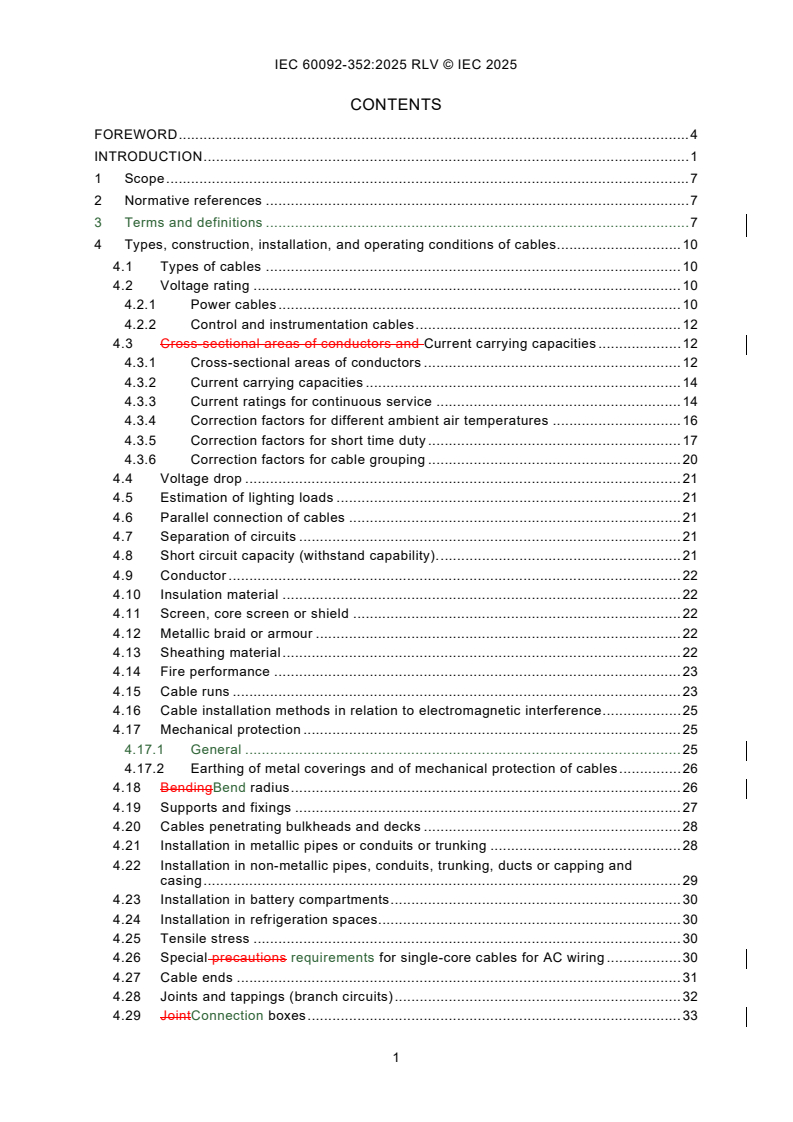
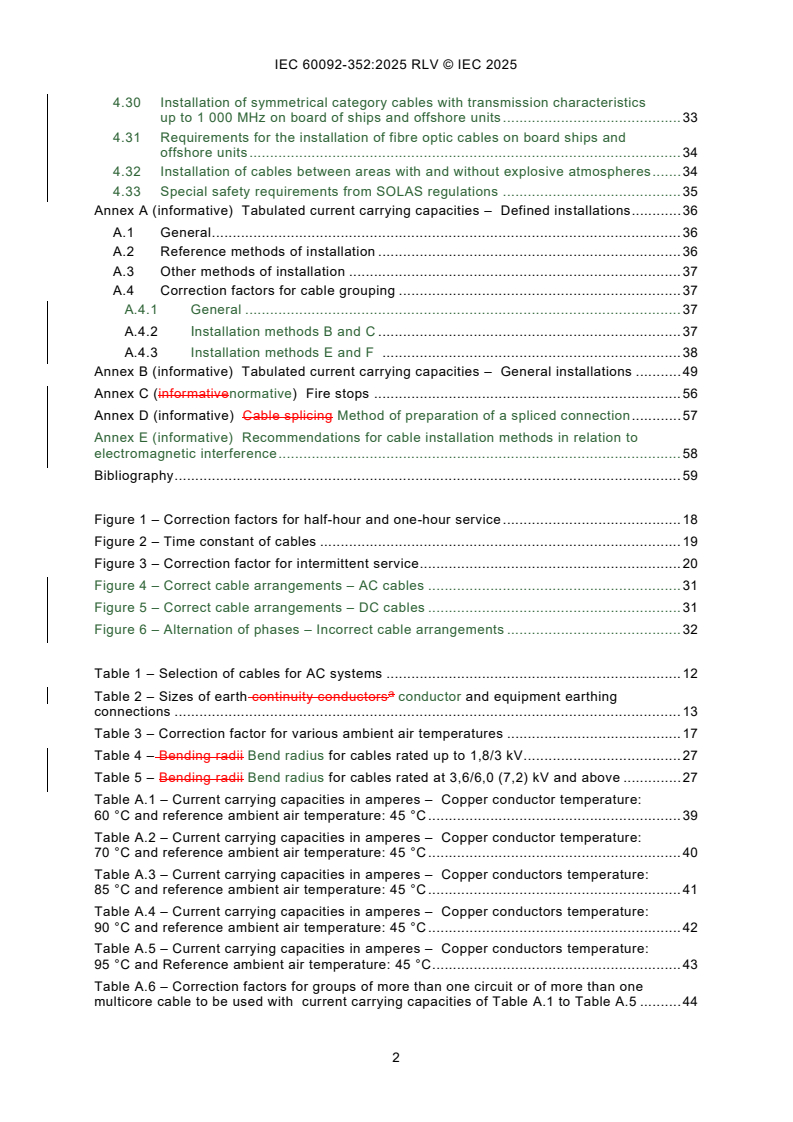
IEC 60092-352:2025 RLV - Electrical installations in ships - Part 352: Selection, installation, and operating conditions of cables Released:10/23/2025
Overview
IEC 60092-352:2025 - Electrical installations in ships: Selection, installation and operating conditions of cables provides updated, consolidated guidance for selecting and installing electrical and fibre optic cables for fixed shipboard electrical systems at voltages up to and including Um 18/30 (36) kV. This fourth edition (2025) replaces the 2005 edition and adds requirements for symmetrical category cables (transmission characteristics up to 1 000 MHz) and fibre optic cables, plus provisions for installations between areas with and without explosive atmospheres. The standard applies to fixed cable runs subject to ship movement and vibration - not to cables designed for frequent flexing (see IEC 60227 / IEC 60245).
Key Topics
- Scope and definitions: Updated terms and alignment with the IEC 60092 series (350–379).
- Types and voltage ratings: Power, control, instrumentation and symmetrical category cables; fibre optic cable inclusion.
- Conductor sizing & current carrying capacity: Guidance and tabulated ratings (multiple conductor temperature classes) with correction factors for ambient temperature, short‑time duty, and cable grouping.
- Installation requirements: Routing, supports, bending radii, mechanical protection, armour and earthing of metal coverings, and penetration of bulkheads/decks.
- Electrical performance: Voltage drop, short‑circuit withstand capability and parallel cable use.
- Fire performance & safety: Cable fire behavior, relevant SOLAS considerations, and informative annex on fire stops.
- EMI and screening: Installation practices for electromagnetic interference mitigation and requirements for screened/shielded cables.
- Fibre optic & high‑frequency cables: Technical requirements for installation and transmission‑grade cable handling up to 1 000 MHz.
- Hazardous areas: Special provisions for cables installed between explosive and non‑explosive zones.
- Annexes & tables: Detailed current‑carrying tables, bending radii, correction factors, splicing guidance and more.
Applications
IEC 60092-352 is essential for:
- Marine electrical engineers & ship designers specifying cable types, sizing and routing for newbuilds and refits.
- Shipbuilders & installation contractors executing compliant cable runs, penetrations and terminations.
- Classification societies & surveyors assessing conformity with international shipboard electrical safety and SOLAS requirements.
- Cable manufacturers & suppliers developing marine-grade power, control, symmetrical category and fibre optic cables.
- Offshore unit operators requiring robust cable installation practices for fixed systems.
Practical uses include cable selection for power/control circuits, determining grouping and derating factors, specifying fire‑safe installations, and designing fibre optic and high‑frequency data pathways on vessels and offshore units.
Related Standards
- IEC 60092 series (other parts covering systems and components)
- IEC 60227, IEC 60245 (flexible cables for frequent flexing)
- SOLAS regulations (safety of life at sea)
Relations
- Effective Date
- 05-Sep-2023
Buy Documents
IEC 60092-352:2025 - Electrical installations in ships - Part 352: Selection, installation, and operating conditions of cables/23/2025
IEC 60092-352:2025 RLV - Electrical installations in ships - Part 352: Selection, installation, and operating conditions of cables Released:10/23/2025
Get Certified
Connect with accredited certification bodies for this standard

DNV
DNV is an independent assurance and risk management provider.

Lloyd's Register
Lloyd's Register is a global professional services organisation specialising in engineering and technology.

FSC International
Forest Stewardship Council certification.
Sponsored listings
Frequently Asked Questions
IEC 60092-352:2025 is a standard published by the International Electrotechnical Commission (IEC). Its full title is "Electrical installations in ships - Part 352: Selection, installation, and operating conditions of cables". This standard covers: IEC 60092-352:2025 provides the basic requirements for the selection, installation and operating conditions of electrical cables intended for fixed electrical systems on board ships at voltages (U) up to and including Um 18/30 (36) kV, symmetrical category cables and fibre optic cables. The reference to fixed systems includes those that are subjected to vibration (due to the movement of the ship) or movement (due to motion of the ship) and not to those that are intended for frequent flexing. Cables subject to frequent or continual flexing use, which can withstand the mechanical stress and the environment they are exposed to, are detailed in other IEC specifications such as IEC 60227 and IEC 60245. Flexible cables are frequently used for retractable thrusters, elevators, moving decks, cranes, shore connections and other moving applications on board ships. This fourth edition cancels and replaces the third edition published in 2005. This edition constitutes a technical revision. This edition includes the following significant technical changes with respect to the previous edition: a) modification of the part title; b) complete review of the document and establishment of the match with all other standards from the group IEC 60092-350 to IEC 60092-379; c) addition of terms and definitions; d) addition of technical requirements for the installation of symmetrical category cables with transmission characteristics up to 1 000 MHz; e) addition of the technical requirements for the installation of fibre optic cables; f) addition of technical requirements for the installation of cables for installation between areas with and without explosive atmospheres
IEC 60092-352:2025 provides the basic requirements for the selection, installation and operating conditions of electrical cables intended for fixed electrical systems on board ships at voltages (U) up to and including Um 18/30 (36) kV, symmetrical category cables and fibre optic cables. The reference to fixed systems includes those that are subjected to vibration (due to the movement of the ship) or movement (due to motion of the ship) and not to those that are intended for frequent flexing. Cables subject to frequent or continual flexing use, which can withstand the mechanical stress and the environment they are exposed to, are detailed in other IEC specifications such as IEC 60227 and IEC 60245. Flexible cables are frequently used for retractable thrusters, elevators, moving decks, cranes, shore connections and other moving applications on board ships. This fourth edition cancels and replaces the third edition published in 2005. This edition constitutes a technical revision. This edition includes the following significant technical changes with respect to the previous edition: a) modification of the part title; b) complete review of the document and establishment of the match with all other standards from the group IEC 60092-350 to IEC 60092-379; c) addition of terms and definitions; d) addition of technical requirements for the installation of symmetrical category cables with transmission characteristics up to 1 000 MHz; e) addition of the technical requirements for the installation of fibre optic cables; f) addition of technical requirements for the installation of cables for installation between areas with and without explosive atmospheres
IEC 60092-352:2025 is classified under the following ICS (International Classification for Standards) categories: 29.060.20 - Cables; 47.020.60 - Electrical equipment of ships and of marine structures. The ICS classification helps identify the subject area and facilitates finding related standards.
IEC 60092-352:2025 has the following relationships with other standards: It is inter standard links to IEC 60092-352:2005. Understanding these relationships helps ensure you are using the most current and applicable version of the standard.
IEC 60092-352:2025 is available in PDF format for immediate download after purchase. The document can be added to your cart and obtained through the secure checkout process. Digital delivery ensures instant access to the complete standard document.
Standards Content (Sample)
IEC 60092-352 ®
Edition 4.0 2025-10
INTERNATIONAL
STANDARD
Electrical installations in ships -
Part 352: Selection, installation, and operating conditions of cables
ICS 47.020.60; 29.060.20 ISBN 978-2-8327-0769-2
All rights reserved. Unless otherwise specified, no part of this publication may be reproduced or utilized in any form or
by any means, electronic or mechanical, including photocopying and microfilm, without permission in writing from either
IEC or IEC's member National Committee in the country of the requester. If you have any questions about IEC copyright
or have an enquiry about obtaining additional rights to this publication, please contact the address below or your local
IEC member National Committee for further information.
IEC Secretariat Tel.: +41 22 919 02 11
3, rue de Varembé info@iec.ch
CH-1211 Geneva 20 www.iec.ch
Switzerland
About the IEC
The International Electrotechnical Commission (IEC) is the leading global organization that prepares and publishes
International Standards for all electrical, electronic and related technologies.
About IEC publications
The technical content of IEC publications is kept under constant review by the IEC. Please make sure that you have the
latest edition, a corrigendum or an amendment might have been published.
IEC publications search - IEC Products & Services Portal - products.iec.ch
webstore.iec.ch/advsearchform Discover our powerful search engine and read freely all the
The advanced search enables to find IEC publications by a publications previews, graphical symbols and the glossary.
variety of criteria (reference number, text, technical With a subscription you will always have access to up to date
committee, …). It also gives information on projects, content tailored to your needs.
replaced and withdrawn publications.
Electropedia - www.electropedia.org
The world's leading online dictionary on electrotechnology,
IEC Just Published - webstore.iec.ch/justpublished
Stay up to date on all new IEC publications. Just Published containing more than 22 500 terminological entries in English
details all new publications released. Available online and and French, with equivalent terms in 25 additional languages.
once a month by email. Also known as the International Electrotechnical Vocabulary
(IEV) online.
IEC Customer Service Centre - webstore.iec.ch/csc
If you wish to give us your feedback on this publication or
need further assistance, please contact the Customer
Service Centre: sales@iec.ch.
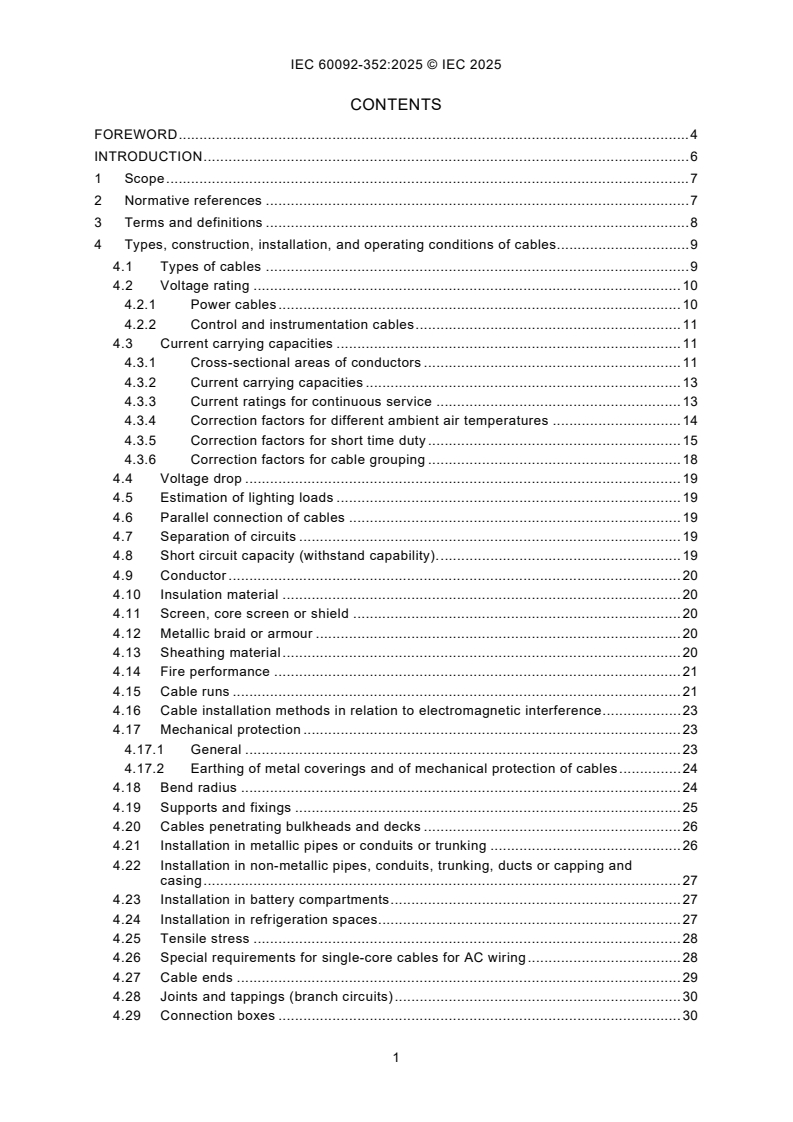
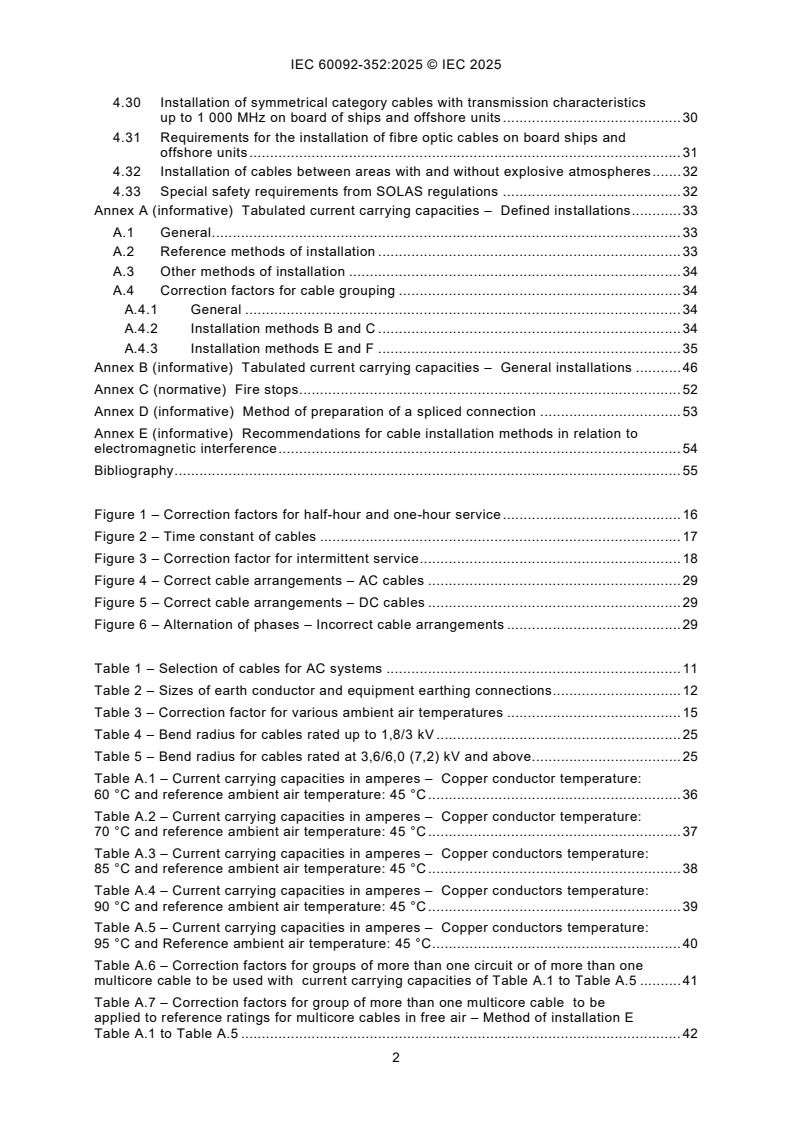
CONTENTS
FOREWORD . 4
INTRODUCTION . 6
1 Scope . 7
2 Normative references . 7
3 Terms and definitions . 8
4 Types, construction, installation, and operating conditions of cables. 9
4.1 Types of cables . 9
4.2 Voltage rating . 10
4.2.1 Power cables . 10
4.2.2 Control and instrumentation cables . 11
4.3 Current carrying capacities . 11
4.3.1 Cross-sectional areas of conductors . 11
4.3.2 Current carrying capacities . 13
4.3.3 Current ratings for continuous service . 13
4.3.4 Correction factors for different ambient air temperatures . 14
4.3.5 Correction factors for short time duty . 15
4.3.6 Correction factors for cable grouping . 18
4.4 Voltage drop . 19
4.5 Estimation of lighting loads . 19
4.6 Parallel connection of cables . 19
4.7 Separation of circuits . 19
4.8 Short circuit capacity (withstand capability). . 19
4.9 Conductor . 20
4.10 Insulation material . 20
4.11 Screen, core screen or shield . 20
4.12 Metallic braid or armour . 20
4.13 Sheathing material . 20
4.14 Fire performance . 21
4.15 Cable runs . 21
4.16 Cable installation methods in relation to electromagnetic interference . 23
4.17 Mechanical protection . 23
4.17.1 General . 23
4.17.2 Earthing of metal coverings and of mechanical protection of cables . 24
4.18 Bend radius . 24
4.19 Supports and fixings . 25
4.20 Cables penetrating bulkheads and decks . 26
4.21 Installation in metallic pipes or conduits or trunking . 26
4.22 Installation in non-metallic pipes, conduits, trunking, ducts or capping and
casing . 27
4.23 Installation in battery compartments . 27
4.24 Installation in refrigeration spaces. 27
4.25 Tensile stress . 28
4.26 Special requirements for single-core cables for AC wiring . 28
4.27 Cable ends . 29
4.28 Joints and tappings (branch circuits) . 30
4.29 Connection boxes . 30
4.30 Installation of symmetrical category cables with transmission characteristics
up to 1 000 MHz on board of ships and offshore units . 30
4.31 Requirements for the installation of fibre optic cables on board ships and
offshore units . 31
4.32 Installation of cables between areas with and without explosive atmospheres . 32
4.33 Special safety requirements from SOLAS regulations . 32
Annex A (informative) Tabulated current carrying capacities – Defined installations . 33
A.1 General . 33
A.2 Reference methods of installation . 33
A.3 Other methods of installation . 34
A.4 Correction factors for cable grouping . 34
A.4.1 General . 34
A.4.2 Installation methods B and C . 34
A.4.3 Installation methods E and F . 35
Annex B (informative) Tabulated current carrying capacities – General installations . 46
Annex C (normative) Fire stops . 52
Annex D (informative) Method of preparation of a spliced connection . 53
Annex E (informative) Recommendations for cable installation methods in relation to
electromagnetic interference . 54
Bibliography . 55
Figure 1 – Correction factors for half-hour and one-hour service . 16
Figure 2 – Time constant of cables . 17
Figure 3 – Correction factor for intermittent service . 18
Figure 4 – Correct cable arrangements – AC cables . 29
Figure 5 – Correct cable arrangements – DC cables . 29
Figure 6 – Alternation of phases – Incorrect cable arrangements . 29
Table 1 – Selection of cables for AC systems . 11
Table 2 – Sizes of earth conductor and equipment earthing connections . 12
Table 3 – Correction factor for various ambient air temperatures . 15
Table 4 – Bend radius for cables rated up to 1,8/3 kV . 25
Table 5 – Bend radius for cables rated at 3,6/6,0 (7,2) kV and above. 25
Table A.1 – Current carrying capacities in amperes – Copper conductor temperature:
60 °C and reference ambient air temperature: 45 °C . 36
Table A.2 – Current carrying capacities in amperes – Copper conductor temperature:
70 °C and reference ambient air temperature: 45 °C . 37
Table A.3 – Current carrying capacities in amperes – Copper conductors temperature:
85 °C and reference ambient air temperature: 45 °C . 38
Table A.4 – Current carrying capacities in amperes – Copper conductors temperature:
90 °C and reference ambient air temperature: 45 °C . 39
Table A.5 – Current carrying capacities in amperes – Copper conductors temperature:
95 °C and Reference ambient air temperature: 45 °C . 40
Table A.6 – Correction factors for groups of more than one circuit or of more than one
multicore cable to be used with current carrying capacities of Table A.1 to Table A.5 . 41
Table A.7 – Correction factors for group of more than one multicore cable to be
applied to reference ratings for multicore cables in free air – Method of installation E
Table A.1 to Table A.5 . 42
Table A.8 – Correction factors for groups of more than one circuit of single-core cables
to be applied to reference rating for one circuit of single-core cables in free air –
Method of installation F in Table A.1 to Table A.5 . 44
Table B.1 – Maximum permissible service temperature of a conductor . 46
Table B.2 – Current carrying capacities in continuous service at maximum rated
conductor temperature of 60 °C . 47
Table B.3 – Current carrying capacities in continuous service at maximum rated
conductor temperature of 70 °C . 48
Table B.4 – Current carrying capacities in continuous service at maximum rated
conductor temperature of 85 °C . 49
Table B.5 – Current carrying capacities in continuous service at maximum rated
conductor temperature of 90 °C . 50
Table B.6 – Current carrying capacities in continuous service at maximum rated
conductor temperature of 95 °C . 51
INTERNATIONAL ELECTROTECHNICAL COMMISSION
____________
Electrical installations in ships -
Part 352: Selection, installation, and operating conditions of cables
FOREWORD
1) The International Electrotechnical Commission (IEC) is a worldwide organization for standardization comprising
all national electrotechnical committees (IEC National Committees). The object of IEC is to promote international
co-operation on all questions concerning standardization in the electrical and electronic fields. To this end and
in addition to other activities, IEC publishes International Standards, Technical Specifications, Technical Reports,
Publicly Available Specifications (PAS) and Guides (hereafter referred to as "IEC Publication(s)"). Their
preparation is entrusted to technical committees; any IEC National Committee interested in the subject dealt with
may participate in this preparatory work. International, governmental and non-governmental organizations liaising
with the IEC also participate in this preparation. IEC collaborates closely with the International Organization for
Standardization (ISO) in accordance with conditions determined by agreement between the two organizations.
2) The formal decisions or agreements of IEC on technical matters express, as nearly as possible, an international
consensus of opinion on the relevant subjects since each technical committee has representation from all
interested IEC National Committees.
3) IEC Publications have the form of recommendations for international use and are accepted by IEC National
Committees in that sense. While all reasonable efforts are made to ensure that the technical content of IEC
Publications is accurate, IEC cannot be held responsible for the way in which they are used or for any
misinterpretation by any end user.
4) In order to promote international uniformity, IEC National Committees undertake to apply IEC Publications
transparently to the maximum extent possible in their national and regional publications. Any divergence between
any IEC Publication and the corresponding national or regional publication shall be clearly indicated in the latter.
5) IEC itself does not provide any attestation of conformity. Independent certification bodies provide conformity
assessment services and, in some areas, access to IEC marks of conformity. IEC is not responsible for any
services carried out by independent certification bodies.
6) All users should ensure that they have the latest edition of this publication.
7) No liability shall attach to IEC or its directors, employees, servants or agents including individual experts and
members of its technical committees and IEC National Committees for any personal injury, property damage or
other damage of any nature whatsoever, whether direct or indirect, or for costs (including legal fees) and
expenses arising out of the publication, use of, or reliance upon, this IEC Publication or any other IEC
Publications.
8) Attention is drawn to the Normative references cited in this publication. Use of the referenced publications is
indispensable for the correct application of this publication.
9) IEC draws attention to the possibility that the implementation of this document may involve the use of (a)
patent(s). IEC takes no position concerning the evidence, validity or applicability of any claimed patent rights in
respect thereof. As of the date of publication of this document, IEC had not received notice of (a) patent(s), which
may be required to implement this document. However, implementers are cautioned that this may not represent
the latest information, which may be obtained from the patent database available at https://patents.iec.ch. IEC
shall not be held responsible for identifying any or all such patent rights.
IEC 60092-352 has been prepared by IEC subcommittee 18A: Cables and cable installations,
of IEC technical committee TC 18: Electrical installations of ships and of mobile and fixed
offshore units. It is an International Standard.
This fourth edition cancels and replaces the third edition published in 2005. This edition
constitutes a technical revision.
This edition includes the following significant technical changes with respect to the previous
edition:
a) modification of the part title;
b) complete review of the document and establishment of the match with all other standards
from the group IEC 60092-350 to IEC 60092-379;
c) addition of terms and definitions;
d) addition of technical requirements for the installation of symmetrical category cables with
transmission characteristics up to 1 000 MHz;
e) addition of the technical requirements for the installation of fibre optic cables;
f) addition of technical requirements for the installation of cables for installation between areas
with and without explosive atmospheres;
g) addition of technical requirements for Special safety requirements from SOLAS regulations.
The text of this International Standard is based on the following documents:
Draft Report on voting
18A/505/FDIS 18A/508/RVD
Full information on the voting for its approval can be found in the report on voting indicated in
the above table.
The language used for the development of this International Standard is English.
This document was drafted in accordance with ISO/IEC Directives, Part 2, and developed in
accordance with ISO/IEC Directives, Part 1 and ISO/IEC Directives, IEC Supplement, available
at www.iec.ch/members_experts/refdocs. The main document types developed by IEC are
described in greater detail at www.iec.ch/publications.
A list of all parts in the IEC 60095, published under the general title Electrical installations in
ships, can be found on the IEC website.
The committee has decided that the contents of this document will remain unchanged until the
stability date indicated on the IEC website under webstore.iec.ch in the data related to the
specific document. At this date, the document will be
– reconfirmed,
– withdrawn, or
– revised.
INTRODUCTION
IEC 60092 forms a series of International Standards concerning electrical installations in sea-
going ships and fixed or mobile offshore units, incorporating good practice and co-ordinating
as far as possible existing rules.
These standards form:
– a code of practical interpretation and amplification of the requirements of the International
Convention on Safety of Life at Sea;
– a guide for future regulations which can be prepared;
– a statement of practice for use by owners and builders of ships and fixed or mobile and
offshore units and other appropriate organisations.
This revision of IEC 60092-352 has been prepared by Maintenance Team 2 of IEC SC 18A, to
update and include developments identified in other parts of the 60092 series of standards
applicable to cables for installations in ships.
NOTE Guidance for the use and installation of cables for offshore applications is being prepared jointly by SC18A,
MT 2 and TC 18, MT 18, and will be issued by TC 18, MT 18.
1 Scope
This part of IEC 60092 provides the basic requirements for the selection, installation and
operating conditions of electrical cables intended for fixed electrical systems on board ships at
18/30 (36) kV, symmetrical category cables and fibre optic
voltages (U) up to and including U
m
cables.
The reference to fixed systems includes those that are subjected to vibration (due to the
movement of the ship) or movement (due to motion of the ship) and not to those that are
intended for frequent flexing.
Cables subject to frequent or continual flexing use, which can withstand the mechanical stress
and the environment they are exposed to, are detailed in other IEC specifications such as
IEC 60227 and IEC 60245. Flexible cables are frequently used for retractable thrusters,
elevators, moving decks, cranes, shore connections and other moving applications on board
ships.
The following cable types and applications are not included:
– sub-sea and umbilical cables;
– telecommunication and radio frequency cables;
– selection and installation of cables for use on offshore platforms.
2 Normative references
The following documents are referred to in the text in such a way that some or all of their content
constitutes requirements of this document. For dated references, only the edition cited applies.
For undated references, the latest edition of the referenced document (including any
amendments) applies.
IEC 60079 series, Explosive atmospheres
IEC 60092-101, Electrical installations in ships - Part 101: Definitions and general requirements
IEC 60092-201, Electrical installations in ships - Part 201: System design - General
IEC 60092-302-2, Electrical installations in ships - Part 302-2: Low voltage switchgear and
controlgear assemblies - Marine power
IEC 60092-350:2020, Electrical installations in ships - Part 350: General construction and test
methods of power, control and instrumentation cables for shipboard and offshore applications
IEC 60092-353:2024, Electrical installations in ships - Part 353: Power cables for rated voltages
1 kV and 3 kV
IEC 60092-354, Electrical installations in ships - Part 354: Single and three-core power cables
with extruded solid insulation for rated voltages 6 kV (U = 7,2 kV); up to 30 kV (U = 36 kV)
m m
IEC 60092-360, Electrical installations in ships - Part 360: Insulating and sheathing materials
for shipboard and offshore units, power, control, instrumentation and telecommunication cables
IEC 60092-376, Electrical installations in ships - Part 376: Cables for control and
instrumentation circuits 150/250 V (300 V)
IEC 60092-378, Electrical installations in ships - Part 378: Optical fiber cables
IEC 60092-379:2024, Electrical installations in ships - Part 379: Symmetrical category cables
with transmission characteristics up to 1 000 MHz
IEC 60092-401, Electrical installations in ships - Part 401: Installation and test of completed
installation
IEC 60228, Conductors of insulated cables
IEC 60287 (all parts), Electric cables - Calculation of the current rating
IEC 60331-1:2018, Tests for electric cables under fire conditions - Circuit integrity - Part 1: Test
method for fire with shock at a temperature of at least 830 °C for cables of rated voltage up to
and including 0,6/1,0 kV and with an overall diameter exceeding 20 mm
IEC 60331-2:2018, Tests for electric cables under fire conditions - Circuit integrity - Part 2: Test
method for fire with shock at a temperature of at least 830 °C for cables of rated voltage up to
and including 0,6/1,0 kV and with an overall diameter not exceeding 20 mm
IEC 60332-1-2:2025, Tests on electric and optical fibre cables under fire conditions - Part 1-2:
Test for vertical flame propagation for a single insulated wire or cable - Procedure for 1 kW pre-
mixed flame
IEC 60332-3-22, Tests on electric and optical fibre cables under fire conditions - Part 3-22: Test
for vertical flame spread of vertically-mounted bunched wires or cables - Category A
IEC 60332-3-24, Tests on electric and optical fibre cables under fire conditions - Part 3-24: Test
for vertical flame spread of vertically-mounted bunched wires or cables - Category C
IEC 60332-3-25, Tests on electric and optical fibre cables under fire conditions - Part 3-25: Test
for vertical flame spread of vertically-mounted bunched wires or cables - Category D
IEC 60533, Electrical and electronic installations in ships - Electromagnetic compatibility (EMC)
IEC 60684-2, Flexible insulating sleeving - Part 2: Methods of test
IEC 60754-1, Test on gases evolved during combustion of materials from cables -
Part 1: Determination of the halogen acid gas content
IEC 60754-2, Test on gases evolved during combustion of materials from cables -
Part 2: Determination of acidity (by pH measurement) and conductivity
IEC 61034-2:2005+AMD1:2013+AMD2:2019, Measurement of smoke density of cables burning
under defined conditions - Part 2: Test procedure and requirements
3 Terms and definitions
For the purposes of this document, the terms and definitions given in IEC 60092-101 and the
following apply.
ISO and IEC maintain terminology databases for use in standardization at the following
addresses:
• IEC Electropedia: available at https://www.electropedia.org/
• ISO Online browsing platform: available at https://www.iso.org/obp
3.1
braid
covering formed from braided metallic or non-metallic material
[SOURCE: IEC 60092-350:2020, 3.2]
3.2
braid armour
covering formed from braided metal wires used to protect a cable from external mechanical
effects
[SOURCE: IEC 60092-350:2020, 3.3, modified – The notes to entry have been deleted]
3.3
armour
covering consisting of a metal tape(s) or wires, generally used to protect the cable from external
mechanical effects
[SOURCE: IEC 60050-461:2008, 461-05-06]
3.4
screen
conducting layer or assembly of conducting layers having the function either of control of the
electric field within the insulation or to reduce the coupling of an electric, magnetic or
electromagnetic field with the internal wires and to conduct common mode currents
Note 1 to entry: It may also provide smooth surfaces at the boundaries of the insulation and assist in the elimination
of spaces at these boundaries
[SOURCE: IEV 461-03-01, modified – " either of control of the electric field within the insulation
or to reduce the coupling of an electric, magnetic or electromagnetic field with the internal wires
and to conduct common mode currents" has been added.]
3.5
earthing conductor
grounding conductor, US
conductor forming a conductive path between a conductive part and an earth electrode
EXAMPLE conductor connected between a main earthing terminal or busbar and an earth electrode.
[SOURCE: IEV 195-02-03]
3.6
extra low voltage
ELV
voltage not exceeding the maximum value of the prospective touch voltage that is acceptable
to be maintained indefinitely under specified conditions of external influences
[SOURCE: 60050-461:2021, 195-05-24]
4 Types, construction, installation, and operating conditions of cables
4.1 Types of cables
Cables constructed in accordance with IEC 60092-350, IEC 60092-353, IEC 60092-354,
IEC 60092-376, IEC 60092-378 and IEC 60092-379 shall be used on board ships.
NOTE The use of other types of cables can be agreed.
4.2 Voltage rating
4.2.1 Power cables
In the voltage designation of cables U /U/(U ):
0 m
U is the rated voltage between conductor and earth or metallic screen for which the cable
is designed;
U is the rated voltage between conductors for which the cable is designed;
U is the maximum value of the highest system voltage which can be sustained under normal
m
operating conditions at any time and at any point in the system. It excludes transient
voltage conditions and rapid disconnection of loads.
U is chosen to be equal to or greater than the highest voltage of the three-phase system.
m
Where cables are permitted for use on circuits where the nominal system voltage exceeds the
rated voltage of the cables, the nominal system voltage shall not exceed the maximum system
voltage (U ) of the cable.
m
Cables subjected to voltage surges associated with highly inductive circuits shall be checked
to ensure that they are of a suitable voltage rating.
The choice of standard cables of appropriate voltage designations for particular systems
depends upon the system voltage and the system earthing arrangements.
The rated voltage of any cable shall not be lower than the nominal voltage of the circuit for
which it is used. To facilitate the choice of the cable, the values of U recommended for cables
to be used in three-phase systems are listed in Table 1, in which systems are divided into the
following three categories:
– Category A
This category comprises those systems in which any phase conductor that comes in contact
with earth or an earth conductor is automatically disconnected from the system.
– Category B
This category comprises those systems that under fault conditions are operated for a short
time, not exceeding 8 h on any single occasion, with one phase earthed. For example, for a
13,8 kV system of Category A or Category B, the cable should have a rated voltage not less
than 8,7/15 kV.
In a system where an earth fault is not automatically and promptly eliminated, the increased
stresses on the insulation of cables during the earth fault are likely to affect the life of the cables
to a certain degree. If the system is expected to be operated fairly often with a sustained earth
fault, cables suitable for Category C should be used. In any case, for Category B, the expected
total duration of earth faults shall not exceed 125 h.
– Category C
This category comprises all systems that do not fall into category A and category B.
The nominal system voltages from 1,8/3 kV to 12/20 kV given in Table 1 are generally in
accordance with Series I specified in IEC 60038. For nominal system voltages intermediate
between these standard voltages and between 0,6/1 kV and 1,8/3 kV, the cables should be
selected with a rated voltage not less than the next higher standard value.
For example: a first earth fault with one phase earthed causes a √3 higher voltage between the
phases and earth during the fault. If the duration of this earth fault exceeds the times given for
category B, then according to Table 1, for a 6 kV system, the cable shall have a rated voltage
not less than 6/10 kV.
A DC voltage to earth of up to a maximum of 1,5 times the AC U RMS voltage can be used.
However, consideration should be given to the peak value when determining the voltage of DC
systems derived from rectifiers, bearing in mind that smoothing does not modify the peak value
when the semiconductors are operating on an open circuit.
Table 1 – Selection of cables for AC systems
System voltage System category Minimum rated voltage of cable
U /U
Nominal voltage Maximum Unscreened Single-core or
sustained screened
voltage
U U
m
kV kV kV kV
up to 0,25 0,30 A, B or C 0,15/0,25 −
1 1,2 A, B or C 0,6/1,0 0,6/1,0
3 3,6 A or B 1,8/3,0 1,8/3,0
3 3,6 C 3,6/6,0
6 7,2 A or B 3,6/6,0
6 7,2 C 6,0/10
10 12 A or B 6,0/10
10 12 C 8,7/15
15 17,5 A or B 8,7/15
15 17,5 C 12/20
20 24 A or B 12/20
20 24 C 18/30
30 36 A or B 18/30
4.2.2 Control and instrumentation cables
The maximum rated voltage (U) for control and instrumentation cables considered in this
document is 250 V.
In some instances, for conductor sizes of 1,0 mm and larger, or when circuits must be supplied
from a low impedance source, 0,6/1 kV rated cables are specified for use as control or
instrumentation cables.
4.3 Current carrying capacities
4.3.1 Cross-sectional areas of conductors
The cross-sectional area of each conductor shall be selected to be large enough to comply with
the following conditions.
– The highest load to be carried by the cable shall be calculated from the load demands and
diversity factors.
– The "corrected current rating" calculated by applying the appropriate correction factors to
the "current rating for continuous services" shall not be lower than the highest current likely
to be carried by the cable. The applicable correction factors are given in 4.3.4, 4.3.5 and
4.3.6.
– The voltage drop in the circuit shall not exceed the limits for the circuits concerned – further
guidance is given in 4.4.
– The cross-sectional area of the conductor shall be able to accommodate the mechanical
and thermal effects of a short circuit current (see 4.8) and the effects upon voltage drop of
motor starting currents (see NOTE 3 of 4.4).
– Class 5 conductors, where used, shall be subject to special consideration in respect of
maximum current-carrying capacity. Class 5 conductors have, in most cases, a lower
conductivity than the equivalent Class 2 conductors of the same nominal cross-section.
– The nominal cross-sectional areas of the earth conductor shall comply with Table 2. One of
the alternative methods of determining the cross-sectional area of each earthing conductor
is that based upon the rating of the fuse or circuit protection device installed to protect the
circuit. If this method is used, the nominal cross-sectional area finally selected shall be the
higher of any cross-sectional areas determined by each of the methods.
Table 2 – Sizes of earth conductor and equipment earthing connections
Arrangement of earth conductor Cross-sectional Minimum cross-sectional
area Q of area of earth conductor
associated
current carrying
conductor (One
phase or pole)
mm
1. a) Insulated earth conductor in cable for fixed Q ≤ 16 Q
installation.
b) Copper braid of cable for fixed installation
according to IEC 60092-350.
c) Separate, insulated earth conductor for fixed
installation in pipes in dry accommodation 50 % of the current-carrying
spaces, when carried in the same pipe as the Q > 16 conductor, but not less than
supply cable.
16 mm
d) Separate, insulated earth conductor when
installed inside enclosures or behind covers or
panels, including earth conductor for hinged
doors as specified in IEC 60092-302-2.
2. a) Uninsulated earth conductor in cable for fixed Q ≤ 2,5
1 mm
installation.
2,5 < Q ≤ 6
1,5 mm
b) Armour or copper braid and in metal-to-metal
contact with the uninsulated earth conductor. Q > 6 Not permitted
3. Separately installed earth conductor for fixed Q < 2,5 Same as current-carrying
installation other than specified in 1 c) and 1 d). conductor subject to min.
1,5 mm for stranded earthing
connection or 2,5 mm for
unstranded earthing
connection
2,5 < Q ≤ 120 50 % of current-carrying
conductor, but not less than
4 mm
Q > 120
70 mm
4. Insulated earth conductor in flexible cable. Q ≤ 16 Same as current-carrying
conductor
Q > 16 50 % of current-carrying
conductor, but minimum
16 mm
NOTE See 4.3.1 for a method based on the rating of fuses.
4.3.2 Current carrying capacities
The procedure for cable selection employs rating factors to adjust the current carrying
capacities for different ambient temperatures, for the mutual heating effects of grouping with
other cables, methods of installation and short time duty. Guidance on the use of these factors
is given below.
4.3.3 Current ratings for continuous service
4.3.3.1 General
Continuous service for a cable shall be considered as a current-carrying service with constant
load and having a duration longer than three times the thermal time constant of the cable, i.e.
longer than the critical duration (see Figure 2).
The current to be carried by any conductor for sustained periods during normal operation shall
be such that the appropriate conductor temperature limit is not exceeded.
The selection of the method applicable to any particular installation can be subject to approval
by the relevant authority or can be subject to governing regulations.
The current carrying capacity shall be calculated according to Annex A, Method B or alternative
methods as described in 4.3.3.2, 4.3.3.3 and 4.3.3.4 respectively.
Annex A is more accurate than Annex B and should be used when there is an enhanced risk of
overheating. For example, when bunched cables are used simultaneously under full continuous
load.
Annex B is the easiest method to use but is also less accurate than Method A.
If distances between cable bunches are less than one cable outer diameter (OD), those bunches
shall be considered as a single bunch.
4.3.3.2 Method A
A method for determination of current carrying capacities based upon those that have been
accepted and established in other applications of cable use. This method has been derived
from a technical basis established from experimental data on a number of cables and
installation information. It allows for greater choice of use in different installation configurations.
For further reference see IEC 60364-5-52.
The current carrying capacity is determined by the Formula (1):
mn
(1)
I= AS× −×B S
where
I is the current carrying capacity (A);
S is the nominal cross-sectional area of conductor (mm );
A and B are coefficients;
m and n are exponents according to cable type and method of installation.
Values calculated using Formula (1) for various installations are given in Annex A together with
guidance on selection.
or;
4.3.3.3 Method B
A simplified method for the determination of current carrying capacities.
The current carrying capacity is determined by Formula (2):
0,625
(2)
I = aA
where
I is the current carrying capacity expressed in amperes (A);
A is the nominal cross-sectional area of conductor expressed in square millimetres (mm );
α is a coefficient related to the maximum permissible service temperature of the conductor.
Values calculated using Method B are only applicable if Method A is not applicable.
or;
4.3.3.4 Alternative methods
The carrying capacity can also be calculated
– according to the IEC 60287 series, or
– using a recognised method, which is documented, and which shall consider the load
characteristics where appropriate.
4.3.4 Correction factors for different ambient air temperatures
The current-carrying capacity in Annex A and Method B assumes a reference ambient air
temperature of 45 °C. This temperature is generally applicable to insulated conductors and
cables in any kind of ship and for navigation in any climate, irrespective of the method of
installation.
Where the ambient temperature in the intended location of the insulated conductors or cables
differs from the reference ambient temperature, the appropriate correction factor given in
Table 3 shall be applied to the values of current-carrying capacity in Method A and Method B.
NOTE The air temperature around the cables can be higher than 45 °C when, for instance, a cable is wholly or
partly installed in spaces or compartments where heat is produced or due to heat transfer.
The correction factors in Table 3 do not take account of the increase in temperature, if any, due
to solar or other infrared radiation. Where the cables or insulated conductors are subject to
such radiation, the current-carrying capacity shall be derived by the methods specified in the
IEC 60287 series.
Table 3 – Correction factor for various ambient air temperatures
Maximum Correction factors for ambient air temperature of
rated
conductor
temperature
°C 35 °C 40 °C 45 °C 50 °C 55 °C 60 °C 65 °C 70 °C 75 °C 80 °C 85 °C
60 1,29 1,15 1,00 0,82 - - - - - - -
65 1,22 1,12 1,00 0,87 0,71 - - - - - -
70 1,18 1,10 1,00 0,89 0,77 0,63 - - - - -
75 1,15 1,08 1,00 0,91 0,82 0,71 0,58 - - - -
80 1,13 1,07 1,00 0,93 0,85 0,76 0,65 0,53 - - -
85 1,12 1,06 1,00 0,94 0,87 0,79 0,71 0,61 0,50 - -
90 1,10 1,05 1,00 0,94 0,88 0,82 0,74 0,67 0,58 0,47 -
95 1,10 1,05 1,00 0,95 0,89 0,84 0,77 0,71 0,63 0,55 0,45
4.3.5 Correction factors for short time duty
If a cable is intended to supply a single motor or equipment operating for periods of 30 minutes
or 60 minutes, its current rating, as given in the relevant table (see Annex A and Annex B), may
be increased using the relevant correction factors obtained from Figure 1. These correction
factors are only applicable if the intermediate periods of rests are longer than the critical
duration (which is equal to three times the time constant of the cable), obtained from Figure 2,
as a function of the cable diameter.
NOTE 1 The correction factors given in Figure 1 are approximate and depend mainly upon the diameter of the
cable. In general, the 30 min service is applicable to mooring winches, windlasses, heavy cargo winches and bow
thrusters. It is possible that the 30-min service rating is not appropriate for automatic tensioning mooring winches
and bow thrusters of specialised vessels.
NOTE 2 For cables supplying a single motor or other equipment intended to operate in an intermittent service,
which is usually the case for cargo winches (except heavy cargo winches), engine room cranes and similar devices,
the current ratings as given in Annex A and Annex B can be increased by applying the correction factor obtained
from Figure 3.
NOTE 3 The correction factor given in Figure 3 has been calculated for periods of 10 min, of which 4 min are with
a constant load and 6 min without load.
Figure 1 – Correction factors for half-hour and one-hour service
Figure 2 – Time constant of cables
Figur
...
IEC 60092-352 ®
Edition 4.0 2025-10
INTERNATIONAL
STANDARD
REDLINE VERSION
Electrical installations in ships -
Part 352: Selection, installation, and operating conditions of cables
ICS 47.020.60; 29.060.20 ISBN 978-2-8327-0812-5
All rights reserved. Unless otherwise specified, no part of this publication may be reproduced or utilized in any form or
by any means, electronic or mechanical, including photocopying and microfilm, without permission in writing from either
IEC or IEC's member National Committee in the country of the requester. If you have any questions about IEC copyright
or have an enquiry about obtaining additional rights to this publication, please contact the address below or your local
IEC member National Committee for further information.
IEC Secretariat Tel.: +41 22 919 02 11
3, rue de Varembé info@iec.ch
CH-1211 Geneva 20 www.iec.ch
Switzerland
About the IEC
The International Electrotechnical Commission (IEC) is the leading global organization that prepares and publishes
International Standards for all electrical, electronic and related technologies.
About IEC publications
The technical content of IEC publications is kept under constant review by the IEC. Please make sure that you have the
latest edition, a corrigendum or an amendment might have been published.
IEC publications search - IEC Products & Services Portal - products.iec.ch
webstore.iec.ch/advsearchform Discover our powerful search engine and read freely all the
The advanced search enables to find IEC publications by a publications previews, graphical symbols and the glossary.
variety of criteria (reference number, text, technical With a subscription you will always have access to up to date
committee, …). It also gives information on projects, content tailored to your needs.
replaced and withdrawn publications.
Electropedia - www.electropedia.org
The world's leading online dictionary on electrotechnology,
IEC Just Published - webstore.iec.ch/justpublished
Stay up to date on all new IEC publications. Just Published containing more than 22 500 terminological entries in English
details all new publications released. Available online and and French, with equivalent terms in 25 additional languages.
once a month by email. Also known as the International Electrotechnical Vocabulary
(IEV) online.
IEC Customer Service Centre - webstore.iec.ch/csc
If you wish to give us your feedback on this publication or
need further assistance, please contact the Customer
Service Centre: sales@iec.ch.
CONTENTS
FOREWORD . 4
INTRODUCTION . 1
1 Scope . 7
2 Normative references . 7
3 Terms and definitions . 7
4 Types, construction, installation, and operating conditions of cables. 10
4.1 Types of cables . 10
4.2 Voltage rating . 10
4.2.1 Power cables . 10
4.2.2 Control and instrumentation cables . 12
4.3 Cross-sectional areas of conductors and Current carrying capacities . 12
4.3.1 Cross-sectional areas of conductors . 12
4.3.2 Current carrying capacities . 14
4.3.3 Current ratings for continuous service . 14
4.3.4 Correction factors for different ambient air temperatures . 16
4.3.5 Correction factors for short time duty . 17
4.3.6 Correction factors for cable grouping . 20
4.4 Voltage drop . 21
4.5 Estimation of lighting loads . 21
4.6 Parallel connection of cables . 21
4.7 Separation of circuits . 21
4.8 Short circuit capacity (withstand capability). . 21
4.9 Conductor . 22
4.10 Insulation material . 22
4.11 Screen, core screen or shield . 22
4.12 Metallic braid or armour . 22
4.13 Sheathing material . 22
4.14 Fire performance . 23
4.15 Cable runs . 23
4.16 Cable installation methods in relation to electromagnetic interference . 25
4.17 Mechanical protection . 25
4.17.1 General . 25
4.17.2 Earthing of metal coverings and of mechanical protection of cables . 26
4.18 BendingBend radius . 26
4.19 Supports and fixings . 27
4.20 Cables penetrating bulkheads and decks . 28
4.21 Installation in metallic pipes or conduits or trunking . 28
4.22 Installation in non-metallic pipes, conduits, trunking, ducts or capping and
casing . 29
4.23 Installation in battery compartments . 30
4.24 Installation in refrigeration spaces. 30
4.25 Tensile stress . 30
4.26 Special precautions requirements for single-core cables for AC wiring . 30
4.27 Cable ends . 31
4.28 Joints and tappings (branch circuits) . 32
4.29 JointConnection boxes . 33
4.30 Installation of symmetrical category cables with transmission characteristics
up to 1 000 MHz on board of ships and offshore units . 33
4.31 Requirements for the installation of fibre optic cables on board ships and
offshore units . 34
4.32 Installation of cables between areas with and without explosive atmospheres . 34
4.33 Special safety requirements from SOLAS regulations . 35
Annex A (informative) Tabulated current carrying capacities – Defined installations . 36
A.1 General . 36
A.2 Reference methods of installation . 36
A.3 Other methods of installation . 37
A.4 Correction factors for cable grouping . 37
A.4.1 General . 37
A.4.2 Installation methods B and C . 37
A.4.3 Installation methods E and F . 38
Annex B (informative) Tabulated current carrying capacities – General installations . 49
Annex C (informativenormative) Fire stops . 56
Annex D (informative) Cable splicing Method of preparation of a spliced connection . 57
Annex E (informative) Recommendations for cable installation methods in relation to
electromagnetic interference . 58
Bibliography . 59
Figure 1 – Correction factors for half-hour and one-hour service . 18
Figure 2 – Time constant of cables . 19
Figure 3 – Correction factor for intermittent service . 20
Figure 4 – Correct cable arrangements – AC cables . 31
Figure 5 – Correct cable arrangements – DC cables . 31
Figure 6 – Alternation of phases – Incorrect cable arrangements . 32
Table 1 – Selection of cables for AC systems . 12
a
Table 2 – Sizes of earth continuity conductors conductor and equipment earthing
connections . 13
Table 3 – Correction factor for various ambient air temperatures . 17
Table 4 – Bending radii Bend radius for cables rated up to 1,8/3 kV . 27
Table 5 – Bending radii Bend radius for cables rated at 3,6/6,0 (7,2) kV and above . 27
Table A.1 – Current carrying capacities in amperes – Copper conductor temperature:
60 °C and reference ambient air temperature: 45 °C . 39
Table A.2 – Current carrying capacities in amperes – Copper conductor temperature:
70 °C and reference ambient air temperature: 45 °C . 40
Table A.3 – Current carrying capacities in amperes – Copper conductors temperature:
85 °C and reference ambient air temperature: 45 °C . 41
Table A.4 – Current carrying capacities in amperes – Copper conductors temperature:
90 °C and reference ambient air temperature: 45 °C . 42
Table A.5 – Current carrying capacities in amperes – Copper conductors temperature:
95 °C and Reference ambient air temperature: 45 °C . 43
Table A.6 – Correction factors for groups of more than one circuit or of more than one
multicore cable to be used with current carrying capacities of Table A.1 to Table A.5 . 44
Table A.7 – Correction factors for group of more than one multicore cable to be
applied to reference ratings for multicore cables in free air – Method of installation E
Table A.1 to Table A.5 . 45
Table A.8 – Correction factors for groups of more than one circuit of single-core cables
to be applied to reference rating for one circuit of single-core cables in free air –
Method of installation F in Table A.1 to Table A.5 . 47
Table B.1 – Maximum permissible service temperature of a conductor . 50
Table B.2 – Current carrying capacities in continuous service at maximum rated
conductor temperature of 60 °C . 51
Table B.3 – Current carrying capacities in continuous service at maximum rated
conductor temperature of 70 °C . 52
Table B.4 – Current carrying capacities in continuous service at maximum rated
conductor temperature of 85 °C . 53
Table B.5 – Current carrying capacities in continuous service at maximum rated
conductor temperature of 90 °C . 54
Table B.6 – Current carrying capacities in continuous service at maximum rated
conductor temperature of 95 °C . 55
INTERNATIONAL ELECTROTECHNICAL COMMISSION
____________
Electrical installations in ships -
Part 352: Selection, installation, and operating conditions of cables
FOREWORD
1) The International Electrotechnical Commission (IEC) is a worldwide organization for standardization comprising
all national electrotechnical committees (IEC National Committees). The object of IEC is to promote international
co-operation on all questions concerning standardization in the electrical and electronic fields. To this end and
in addition to other activities, IEC publishes International Standards, Technical Specifications, Technical Reports,
Publicly Available Specifications (PAS) and Guides (hereafter referred to as "IEC Publication(s)"). Their
preparation is entrusted to technical committees; any IEC National Committee interested in the subject dealt with
may participate in this preparatory work. International, governmental and non-governmental organizations liaising
with the IEC also participate in this preparation. IEC collaborates closely with the International Organization for
Standardization (ISO) in accordance with conditions determined by agreement between the two organizations.
2) The formal decisions or agreements of IEC on technical matters express, as nearly as possible, an international
consensus of opinion on the relevant subjects since each technical committee has representation from all
interested IEC National Committees.
3) IEC Publications have the form of recommendations for international use and are accepted by IEC National
Committees in that sense. While all reasonable efforts are made to ensure that the technical content of IEC
Publications is accurate, IEC cannot be held responsible for the way in which they are used or for any
misinterpretation by any end user.
4) In order to promote international uniformity, IEC National Committees undertake to apply IEC Publications
transparently to the maximum extent possible in their national and regional publications. Any divergence between
any IEC Publication and the corresponding national or regional publication shall be clearly indicated in the latter.
5) IEC itself does not provide any attestation of conformity. Independent certification bodies provide conformity
assessment services and, in some areas, access to IEC marks of conformity. IEC is not responsible for any
services carried out by independent certification bodies.
6) All users should ensure that they have the latest edition of this publication.
7) No liability shall attach to IEC or its directors, employees, servants or agents including individual experts and
members of its technical committees and IEC National Committees for any personal injury, property damage or
other damage of any nature whatsoever, whether direct or indirect, or for costs (including legal fees) and
expenses arising out of the publication, use of, or reliance upon, this IEC Publication or any other IEC
Publications.
8) Attention is drawn to the Normative references cited in this publication. Use of the referenced publications is
indispensable for the correct application of this publication.
9) IEC draws attention to the possibility that the implementation of this document may involve the use of (a)
patent(s). IEC takes no position concerning the evidence, validity or applicability of any claimed patent rights in
respect thereof. As of the date of publication of this document, IEC had not received notice of (a) patent(s), which
may be required to implement this document. However, implementers are cautioned that this may not represent
the latest information, which may be obtained from the patent database available at https://patents.iec.ch. IEC
shall not be held responsible for identifying any or all such patent rights.
This redline version of the official IEC Standard allows the user to identify the changes made
to the previous edition IEC 60092-352:2005. A vertical bar appears in the margin wherever a
change has been made. Additions are in green text, deletions are in strikethrough red text.
IEC 60092-352 has been prepared by IEC subcommittee 18A: Cables and cable installations,
of IEC technical committee TC 18: Electrical installations of ships and of mobile and fixed
offshore units. It is an International Standard.
This fourth edition cancels and replaces the third edition published in 2005. This edition
constitutes a technical revision.
This edition includes the following significant technical changes with respect to the previous
edition:
a) modification of the part title;
b) complete review of the document and establishment of the match with all other standards
from the group IEC 60092-350 to IEC 60092-379;
c) addition of terms and definitions;
d) addition of technical requirements for the installation of symmetrical category cables with
transmission characteristics up to 1 000 MHz;
e) addition of the technical requirements for the installation of fibre optic cables;
f) addition of technical requirements for the installation of cables for installation between areas
with and without explosive atmospheres;
g) addition of technical requirements for Special safety requirements from SOLAS regulations.
The text of this International Standard is based on the following documents:
Draft Report on voting
18A/505/FDIS 18A/508/RVD
Full information on the voting for its approval can be found in the report on voting indicated in
the above table.
The language used for the development of this International Standard is English.
This document was drafted in accordance with ISO/IEC Directives, Part 2, and developed in
accordance with ISO/IEC Directives, Part 1 and ISO/IEC Directives, IEC Supplement, available
at www.iec.ch/members_experts/refdocs. The main document types developed by IEC are
described in greater detail at www.iec.ch/publications.
A list of all parts in the IEC 60095, published under the general title Electrical installations in
ships, can be found on the IEC website.
The committee has decided that the contents of this document will remain unchanged until the
stability date indicated on the IEC website under webstore.iec.ch in the data related to the
specific document. At this date, the document will be
– reconfirmed,
– withdrawn, or
– revised.
INTRODUCTION
IEC 60092 forms a series of International Standards concerning electrical installations in sea-
going ships and fixed or mobile offshore units, incorporating good practice and co-ordinating
as far as possible existing rules.
These standards form:
– a code of practical interpretation and amplification of the requirements of the International
Convention on Safety of Life at Sea;
– a guide for future regulations which may can be prepared;
– a statement of practice for use by owners and builders of ships and fixed or mobile and
offshore units and other appropriate organisations.
This revision of IEC 60092-352 has been prepared by Maintenance Team 1 2 of IEC SC 18A,
to update and include developments identified in other parts of the 60092 series of standards
applicable to electric cables for electrical installations in ships, viz:.
− the increase in maximum rated conductor temperature during normal operation for EPR,
XLPE type insulations – see IEC 60092-351 – and the effect on current carrying capacities;
− the publication of IEC 60092-376 covering cables for control and instrumentation
150/250V(300V);
− changes in test methods to demonstrate the capability of cables to continue to operate in
fire conditions and to limit the spread of flame;
− the inclusion of a method for the determination of current carrying capacities based upon
those that have been accepted and established in other applications of cable use. This
method has been derived from a technical basis and allows a greater choice of use in
different installation methods as opposed to that currently specified, which was established
from experimental data on a limited number of cables and installation information. The
existing ratings are included as informative annexes A and B, and their use is valid under
certain conditions, e.g. refurbishment of ships;
− the inclusion of a method for the determination of the cross-sectional areas of earthing
conductors based on the current carrying capacities of the fuse or circuit protection device
installed to protect the circuit.
NOTE Guidance for the use and installation of cables for offshore applications is being prepared jointly by SC18A,
MT 2 and TC 18, MT 18, and will be issued by TC 18, MT 18.
1 Scope
This standard provides the basic requirements for the choice and installation of cables intended
for fixed electrical systems on board ships at voltages (U) up to and including 15 kV.
This part of IEC 60092 provides the basic requirements for the selection, installation and
operating conditions of electrical cables intended for fixed electrical systems on board ships at
voltages (U) up to and including U 18/30 (36) kV, symmetrical category cables and fibre optic
m
cables.
The reference to fixed systems includes those that are subjected to vibration (due to the
movement of the ship) or movement (due to motion of the ship) and not to those that are
intended for frequent flexing. Cables suitable for frequent or continual flexing use are detailed
in other IEC specifications e.g. IEC 60227 and IEC 60245, and their uses on board ship is
restricted to those situations which do not directly involve exposure to a marine environment
e.g. portable tools or domestic appliances.
Cables subject to frequent or continual flexing use, which can withstand the mechanical stress
and the environment they are exposed to, are detailed in other IEC specifications such as
IEC 60227 and IEC 60245. Flexible cables are frequently used for retractable thrusters,
elevators, moving decks, cranes, shore connections and other moving applications on board
ships.
The following cable types and applications are not included:
– optical fibre cables;
– sub-sea and umbilical cables;
– data, telecommunication and radio frequency cables;
– selection and installation of cables for use on offshore units platforms.
2 Normative references
The following documents are referred to in the text in such a way that some or all of their content
constitutes requirements of this document. For dated references, only the edition cited applies.
For undated references, the latest edition of the referenced document (including any
amendments) applies.
IEC 60079 series, Explosive atmospheres
IEC 60092-101, Electrical installations in ships - Part 101: Definitions and general requirements
IEC 60092-201:1994, Electrical installations in ships - Part 201: System design - General
IEC 60092-203, Electrical installations in ships – Part 203: System design – Acoustic and
optical signals
IEC 60092-302-2, Electrical installations in ships - Part 302-2: Low voltage switchgear and
controlgear assemblies - Marine power
IEC 60092-350:20012020, Electrical installations in ships - Part 350: Shipboard power cables
– General construction and test requirements General construction and test methods of power,
control and instrumentation cables for shipboard and offshore applications
IEC 60092-351, Electrical installations in ships – Part 351: Insulating materials for shipboard
and offshore units, power, control, instrumentation, telecommunication and data cables
IEC 60092-353:19952024, Electrical installations in ships - Part 353: Single and multicore non-
radial field power cables with extruded solid insulation Power cables for rated voltages 1 kV
and 3 kV
Amendment 1 (2001)
IEC 60092-354, Electrical installations in ships - Part 354: Single and three-core power cables
with extruded solid insulation for rated voltages 6 kV (U = 7,2 kV); up to 30 kV (U = 36 kV)
m m
IEC 60092-359, Electrical installations in ships – Part 359: Sheathing materials for shipboard
power and telecommunication cables
IEC 60092-360, Electrical installations in ships - Part 360: Insulating and sheathing materials
for shipboard and offshore units, power, control, instrumentation and telecommunication cables
IEC 60092-376, Electrical installations in ships - Part 376: Cables for control and
instrumentation circuits 150/250 V (300 V)
IEC 60092-378, Electrical installations in ships - Part 378: Optical fiber cables
IEC 60092-379:2024, Electrical installations in ships - Part 379: Symmetrical category cables
with transmission characteristics up to 1 000 MHz
IEC 60092-401, Electrical installations in ships - Part 401: Installation and test of completed
installation
IEC 60228:2004, Conductors of insulated cables
IEC 60287 (all parts), Electric cables - Calculation of the current rating
IEC 60331-1:2018, Tests for electric cables under fire conditions - Circuit integrity - Part 1: Test
method for fire with shock at a temperature of at least 830 °C for cables of rated voltage up to
and including 0,6/1,0 kV and with an overall diameter exceeding 20 mm
IEC 60331-2:2018, Tests for electric cables under fire conditions - Circuit integrity - Part 2: Test
method for fire with shock at a temperature of at least 830 °C for cables of rated voltage up to
and including 0,6/1,0 kV and with an overall diameter not exceeding 20 mm
IEC 60331-21:1999, Tests for electric cables under fire conditions – Circuit integrity – Part 21:
Procedures and requirements – Cables of rated voltage up to and including 0,6/1,0 kV
IEC 60331-31:2002, Tests for electric cables under fire conditions – Circuit integrity – Part 31:
Procedures and requirements for fire with shock – Cables of rated voltage up to and including
0,6/1,0 kV
IEC 60332-1-2:20042025, Tests on electric and optical fibre cables under fire conditions - Part
1-2: Test for vertical flame propagation for a single insulated wire or cable - Procedure for 1 kW
pre-mixed flame
IEC 60332-3-22:2000, Tests on electric and optical fibre cables under fire conditions - Part 3-
22: Test for vertical flame spread of vertically-mounted bunched wires or cables - Category A
IEC 60332-3-24, Tests on electric and optical fibre cables under fire conditions - Part 3-24: Test
for vertical flame spread of vertically-mounted bunched wires or cables - Category C
IEC 60332-3-25, Tests on electric and optical fibre cables under fire conditions - Part 3-25: Test
for vertical flame spread of vertically-mounted bunched wires or cables - Category D
IEC 60533:1999, Electrical and electronic installations in ships - Electromagnetic compatibility
(EMC)
IEC 60684-2:2003, Flexible insulating sleeving - Part 2: Methods of test
Amendment 1 (2003)
IEC 60702-1:2002, Mineral insulated cables and their terminations with a rated voltage not
exceeding 750V
IEC 60702-2:2002, Mineral insulated cables and their terminations with a rated voltage not
exceeding 750 V – Terminations
IEC 60754-1:1994, Test on gases evolved during combustion of materials from cables - Part 1:
Determination of the amount of halogen acid gas content
IEC 60754-2:1991, Test on gases evolved during combustion of electric materials from cables
- Part 2: Determination of degree of acidity of gases evolved during the combustion of materials
taken from electric cables by measuring (by pH measurement) and conductivity
Amendment 1 (1997)
IEC 61034-2:2005+AMD1:2013+AMD2:2019, Measurement of smoke density of cables burning
under defined conditions - Part 2: Test procedure and requirements
3 Terms and definitions
For the purposes of this document, the terms and definitions given in IEC 60092-101 and the
following apply.
ISO and IEC maintain terminology databases for use in standardization at the following
addresses:
• IEC Electropedia: available at https://www.electropedia.org/
• ISO Online browsing platform: available at https://www.iso.org/obp
3.1
braid
covering formed from braided metallic or non-metallic material
[SOURCE: IEC 60092-350:2020, 3.2]
3.2
braid armour
covering formed from braided metal wires used to protect a cable from external mechanical
effects
[SOURCE: IEC 60092-350:2020, 3.3, modified – The notes to entry have been deleted]
3.3
armour
covering consisting of a metal tape(s) or wires, generally used to protect the cable from external
mechanical effects
[SOURCE: IEC 60050-461:2008, 461-05-06]
3.4
screen
conducting layer or assembly of conducting layers having the function either of control of the
electric field within the insulation or to reduce the coupling of an electric, magnetic or
electromagnetic field with the internal wires and to conduct common mode currents
Note 1 to entry: It may also provide smooth surfaces at the boundaries of the insulation and assist in the elimination
of spaces at these boundaries
[SOURCE: IEV 461-03-01, modified – " either of control of the electric field within the insulation
or to reduce the coupling of an electric, magnetic or electromagnetic field with the internal wires
and to conduct common mode currents" has been added.]
3.5
earthing conductor
grounding conductor, US
conductor forming a conductive path between a conductive part and an earth electrode
EXAMPLE conductor connected between a main earthing terminal or busbar and an earth electrode.
[SOURCE: IEV 195-02-03]
3.6
extra low voltage
ELV
voltage not exceeding the maximum value of the prospective touch voltage that is acceptable
to be maintained indefinitely under specified conditions of external influences
[SOURCE: 60050-461:2021, 195-05-24]
4 Types, construction, installation, and operating conditions of cables
4.1 Types of cables
Cables constructed in accordance with IEC 60092-350, IEC 60092-353, IEC 60092-354,
IEC 60092-376 are recommended for use, IEC 60092-378 and IEC 60092-379 shall be used on
board ships. Cables (and their terminations) for use in special applications which are
constructed in accordance with IEC 60702-1 and IEC 60702-2 are also acceptable provided
that due consideration has been given to their intended application and use in a marine
environment.
NOTE The use of other types of cables can be agreed.
4.2 Voltage rating
4.2.1 Power cables
The maximum rated voltage (U) considered in this standard for power cables is 15 kV.
In the voltage designation of cables U /U/(U ):
0 m
U is the rated power voltage between conductor and earth or metallic screen for which the
cable is designed;
U is the rated power frequency voltage between conductors for which the cable is designed;
U is the maximum value of the highest system voltage which may can be sustained under
m
normal operating conditions at any time and at any point in the system. It excludes
transient voltage conditions and rapid disconnection of loads.
U is chosen to be equal to or greater than the highest voltage of the three-phase system.
m
Where cables are permitted for use on circuits where the nominal system voltage exceeds the
rated voltage of the cables, the nominal system voltage shall not exceed the maximum system
voltage (U ) of the cable.
m
Careful consideration shall be given to Cables subjected to voltage surges associated with
highly inductive circuits shall be checked to ensure that they are of a suitable voltage rating.
The choice of standard cables of appropriate voltage designations for particular systems
depends upon the system voltage and the system earthing arrangements.
The rated voltage of any cable shall not be lower than the nominal voltage of the circuit for
which it is used. To facilitate the choice of the cable, the values of U recommended for cables
to be used in three-phase systems are listed in Table 1, in which systems are divided into the
following three categories:
– Category A
This category comprises those systems in which any phase conductor that comes in contact
with earth or an earth conductor is automatically disconnected from the system.
– Category B
This category comprises those systems that under fault conditions are operated for a short
time, not exceeding 8 h on any single occasion, with one phase earthed. For example, for a
13,8 kV system of Category A or Category B, the cable should have a rated voltage not less
than 8,7/15 kV.
NOTE In a system where an earth fault is not automatically and promptly eliminated, the
increased stresses on the insulation of cables during the earth fault are likely to affect the life
of the cables to a certain degree. If the system is expected to be operated fairly often with a
sustained earth fault, it may be preferable to use cables suitable for Category C should be used.
In any case, for classification as Category B, the expected total duration of earth faults in any
year is shall not permitted to exceed 125 h.
– Category C
This category comprises all systems that do not fall into category A and category B.
The nominal system voltages from 1,8/3 kV to 8,7/15 12/20 kV given in Table 1 are generally
in accordance with Series I specified in IEC 60038. For nominal system voltages intermediate
between these standard voltages and between 0,6/1 kV and 1,8/3 kV, the cables should be
selected with a rated voltage not less than the next higher standard value.
For example: a first earth fault with one phase earthed causes a √3 higher voltage between the
phases and earth during the fault. If the duration of this earth fault exceeds the times given for
category B, then according to Table 1, for a 6 kV system, the cable is to shall have a rated
voltage not less than 6/10 kV.
A DC voltage to earth of up to a maximum of 1,5 times the AC U RMS voltage may can be
used. However, consideration should be given to the peak value when determining the voltage
of DC systems derived from rectifiers, bearing in mind that smoothing does not modify the peak
value when the semiconductors are operating on an open circuit.
Table 1 – Selection of cables for AC systems
System voltage System category Minimum rated voltage of cable
U /U
Nominal voltage Maximum Unscreened Single-core or
sustained screened
voltage
U U
m
kV kV kV kV
up to 0,25 0,30 A, B or C 0,15/0,25 −
1 1,2 A, B or C 0,6/1,0 0,6/1,0
3 3,6 A or B 1,8/3,0 1,8/3,0
3 3,6 C 3,6/6,0
6 7,2 A or B 3,6/6,0
6 7,2 C 6,0/10
10 12 A or B 6,0/10
10 12 C 8,7/15
15 17,5 A or B 8,7/15
15 17,5 C 12/20
20 24 A or B 12/20
20 24 C 18/30
30 36 A or B 18/30
4.2.2 Control and instrumentation cables
The maximum rated voltage (U) for control and instrumentation cables considered in this
document is 250 V.
In some instances, for conductor sizes 1,5 of 1,0 mm and larger, or when circuits are to must
be supplied from a low impedance source, 0,6/1 kV rated cables are specified for use as control
or instrumentation cables.
NOTE The use of 1,0 mm is under consideration for 0,6/1 kV applications.
4.3 Cross-sectional areas of conductors and Current carrying capacities
4.3.1 Cross-sectional areas of conductors
The cross-sectional area of each conductor shall be selected to be large enough to comply with
the following conditions.
– The highest load to be carried by the cable shall be calculated from the load demands and
diversity factors.
– The "corrected current rating" calculated by applying the appropriate correction factors to
the "current rating for continuous services" shall not be lower than the highest current likely
to be carried by the cable. The applicable correction factors are given in 4.3.4, 4.3.5 and
4.3.6.
– The voltage drop in the circuit shall not exceed the limits specified by the regulatory body
for the circuits concerned – further guidance is given in 4.4.
– The cross-sectional area of the conductor shall be able to accommodate the mechanical
and thermal effects of a short circuit current (see 4.8) and the effects upon voltage drop of
motor starting currents (see NOTE 3 of 4.4).
– Class 5 conductors, where used, shall be subject to special consideration in respect of
maximum current-carrying capacity. Class 5 conductors have, in most cases, a lower
conductivity than the equivalent Class 2 conductors of the same nominal cross-section.
– The nominal cross-sectionssectional areas of the earth conductor shall comply with Table 2.
One of the alternative methods of determining the cross-sectional area of each earthing
conductor is that based upon the rating of the fuse or circuit protection device installed to
protect the circuit. If this method is used, the nominal cross-sectional area finally selected
shall be the higher of any cross-sectional areas determined by each of the methods.
a
Table 2 – Sizes of earth continuity conductors conductor and equipment earthing
connections
Arrangement of earth conductor Cross- Minimum cross-
sectionsectional sectionsectional area of
area Q of earth conductor
associated
current carrying
conductor (One
phase or pole)
mm
1. a) Insulated earth conductor in cable for fixed Q ≤ 16 Q
installation.
b) Copper braid of cable for fixed installation
according to IEC 60092-350.
c) Separate, insulated earth conductor for fixed
installation in pipes in dry accommodation
50 % of the current-carrying
spaces, when carried in the same pipe as the
Q > 16 conductor, but not less than
supply cable.
16 mm
d) Separate, insulated earth conductor when
installed inside enclosures or behind covers or
panels, including earth conductor for hinged
doors as specified in IEC 60092-203
IEC 60092-302-2.
2. a) Uninsulated earth conductor in cable for fixed
Q ≤ 2,5
1 mm
installation.
2,5 < Q ≤ 6
1,5 mm
b) Armour or copper braid and in metal-to-metal
contact with this the uninsulated earth
Q > 6 Not permitted
conductor.
3. Separately installed earth conductor for fixed Q < 2,5 Same as current-carrying
installation other than specified in 1 c) and 1 d). conductor subject to min.
1,5 mm for stranded earthing
connection or 2,5 mm for
unstranded earthing
connection
2,5 < Q ≤ 120 50 % of current-carrying
conductor, but not less than
4 mm
Q > 120
70 mm
4. Insulated earth conductor in flexible cable. Q ≤ 16 Same as current-carrying
conductor
Q > 16 50 % of current-carrying
conductor, but minimum
16 mm
NOTE See 4.3.1 for a method based on the rating of fuses.
a
The term protective conductor is accepted as an alternative term for the earth continuity conductor.
4.3.2 Current carrying capacities
The procedure for cable selection employs rating factors to adjust the current carrying
capacities for different ambient temperatures, for the mutual heating effects of grouping with
other cables, methods of installation and short time duty. Guidance on the use of these factors
is given below.
4.3.3 Current ratings for continuous service
Continuous service for a cable is to be considered, for the purpose of this standard, as a current-
carrying service with constant load and having a duration longer than three times the thermal
time constant of the cable, i.e., longer than the critical duration (see Figure 2).
The current to be carried by any conductor for sustained periods during normal operation shall
be such that the appropriate conductor temperature limit is not exceeded.
The value shall either be:
– selected from one of the following annexes in accordance with the appropriate installation
method:
Annex A: a method for determination of current carrying capacities based upon those that
have been accepted and established in other applications of cable use. This method has
been derived from a technical basis established from experimental data on a number of
cables and installation information. It allows for greater choice of use in different installation
configurations. For further reference see IEC 60364-5-52.
The basis of the determination is on the following formula:
m n
I = A × S – B × S
where
I is the current carrying capacity (A);
S is the nominal cross-sectional area of conductor (mm );
A and B are coefficients, m and n are exponents according to cable type and method of
installation.
Values calculated using the above for various installations are given in Annex A together
with guidance on selection.
Annex B: a method for the determination of current carrying capacities as given in the
second edition (1997) of IEC 60092-352. The values were initially established in 1958 based
on limited experimental data and have been both amended and their range extended in
attempts to reflect the changes in construction of cables and their maximum conductor
operating temperatures which have taken place. They are only valid for a limited number of
installations under certain conditions. It is recommended that they are only used for
refurbishment of ships or in
...