


IEC 62888-4:2018
(Main)Railway applications - Energy measurement on board trains - Part 4: Communication
General Information
- Abstract
IEC 62888-4:2018 applies to the on board and on board to ground communication services, i.e. it covers the data communication using digital interfaces:
a) between functions implemented within the EMS;
b) between EMS function and other on board subsystems;
c) between EMS and ground communication services.
- Status
- Published
- Publication Date
- 24-Jan-2018
- Technical Committee
- TC 9 - Electrical equipment and systems for railways
- Drafting Committee
- MT 62888 - TC 9/MT 62888
- Current Stage
- PPUB - Publication issued
- Start Date
- 25-Jan-2018
- Completion Date
- 29-Dec-2017
Overview
IEC 62888-4:2018 is an International Electrotechnical Commission (IEC) standard dedicated to railway applications, specifically focusing on energy measurement on board trains with an emphasis on communication. This fourth part of the IEC 62888 series addresses the digital data communication methodologies vital for Energy Management Systems (EMS) in rail vehicles. It defines communication protocols and interfaces for seamless data exchange:
- Within the EMS functions onboard
- Between EMS and other on-board subsystems
- Between EMS and ground-based communication services
By standardizing communication pathways and security measures, IEC 62888-4 helps ensure efficient, reliable, and secure energy measurement operations critical to modern rail transport systems.
Key Topics
Onboard Communication Subsystem
- Protocol Stack Architecture: Detailed specification of communication protocol layers to support EMS internal data transmission, ensuring interoperability among functions.
- Interfaces: Defined interfaces such as VMF/CMF to ECF (VEI), EMF to DHS (EMDI), and maintenance/testing interfaces (DSI and ESI) provide structured data flow within the train’s EMS environment.
- Security: Security measures to safeguard data integrity and prevent unauthorized access during onboard communications.
Onboard-to-Ground Communication Subsystem
- Data Transfer: Standardized methods for transmitting EMS data from trains to ground systems, including file structures and XML schema for consistent encoding.
- Communication Architecture: Recommended communication service models supporting reliable and secure data exchange between moving trains and stationary control centers.
- Access Security: Protocols for secure authentication and authorization to protect sensitive energy data from cyber threats.
Conformance and Testing
- Testing methodologies outlined include design review, type test procedures, and communication tests to ensure compliance with the standard’s requirements.
- Use of Protocol Implementation Conformance Statements (PICS) and Protocol Implementation Extra Information for Testing (PIXIT) to verify communication interoperability and performance.
Applications
IEC 62888-4:2018 applies broadly within the rail industry, offering tangible benefits including:
- Energy Management Optimization: Facilitates accurate and timely measurement of energy consumption on board trains, supporting energy efficiency initiatives.
- System Integration: Ensures compatibility and communication consistency among EMS functions and with external subsystems.
- Real-time Monitoring and Control: Enables ground control centers to receive up-to-date energy data, enhancing decision-making for railway operations.
- Security Enhancement: Implements robust cybersecurity standards vital for protecting critical rail infrastructure communications.
- Maintenance Support: Provides standardized interfaces for system diagnostics and testing, thereby improving maintenance processes and reducing downtime.
Rail operators, system integrators, EMS developers, and communication technology providers benefit from applying IEC 62888-4 to ensure standardized, secure, and efficient communication mechanisms in railway energy measurement systems.
Related Standards
- IEC 62888 Series: Parts 1 to 3 specify energy measurement parameters, data models, and system architecture for onboard energy management.
- IEC 61375: Covers communication networks for train control and management systems, complementing onboard communication frameworks.
- ISO/IEC 27000 Series: Provides guidelines for security management, relevant to communication security in the rail environment.
- EN 50155: Specifies electronic equipment standards for railway applications, including environmental and communication aspects.
- ETSI EN 302 931: Standard for secure communication in railway systems, pertinent to onboard and ground communication security.
Summary
IEC 62888-4:2018 is a critical standard for the digital communication protocols used in modern railway energy measurement systems. It ensures effective data exchange within trains and between trains and ground stations, emphasizing interoperability, security, and reliability. Implementation of this standard enables railway operators and manufacturers to enhance energy monitoring accuracy, operational efficiency, and cybersecurity, driving forward sustainable and intelligent rail transport solutions.
Get Certified
Connect with accredited certification bodies for this standard

IRIS Certification (UNIFE)
International Railway Industry Standard certification.

TÜV SÜD Rail GmbH
TÜV SÜD railway certification services.

ANCE
Mexican certification and testing association.
Sponsored listings
Frequently Asked Questions
IEC 62888-4:2018 is a standard published by the International Electrotechnical Commission (IEC). Its full title is "Railway applications - Energy measurement on board trains - Part 4: Communication". This standard covers: IEC 62888-4:2018 applies to the on board and on board to ground communication services, i.e. it covers the data communication using digital interfaces: a) between functions implemented within the EMS; b) between EMS function and other on board subsystems; c) between EMS and ground communication services.
IEC 62888-4:2018 applies to the on board and on board to ground communication services, i.e. it covers the data communication using digital interfaces: a) between functions implemented within the EMS; b) between EMS function and other on board subsystems; c) between EMS and ground communication services.
IEC 62888-4:2018 is classified under the following ICS (International Classification for Standards) categories: 33.180.20 - Fibre optic interconnecting devices; 45.060.01 - Railway rolling stock in general. The ICS classification helps identify the subject area and facilitates finding related standards.
IEC 62888-4:2018 is available in PDF format for immediate download after purchase. The document can be added to your cart and obtained through the secure checkout process. Digital delivery ensures instant access to the complete standard document.
Standards Content (Sample)
IEC 62888-4 ®
Edition 1.0 2018-01
INTERNATIONAL
STANDARD
NORME
INTERNATIONALE
colour
inside
Railway applications – Energy measurement on board trains –
Part 4: Communication
Applications ferroviaires – Mesure d'énergie à bord des trains –
Partie 4: Communications
All rights reserved. Unless otherwise specified, no part of this publication may be reproduced or utilized in any form
or by any means, electronic or mechanical, including photocopying and microfilm, without permission in writing from
either IEC or IEC's member National Committee in the country of the requester. If you have any questions about IEC
copyright or have an enquiry about obtaining additional rights to this publication, please contact the address below or
your local IEC member National Committee for further information.
Droits de reproduction réservés. Sauf indication contraire, aucune partie de cette publication ne peut être reproduite
ni utilisée sous quelque forme que ce soit et par aucun procédé, électronique ou mécanique, y compris la photocopie
et les microfilms, sans l'accord écrit de l'IEC ou du Comité national de l'IEC du pays du demandeur. Si vous avez des
questions sur le copyright de l'IEC ou si vous désirez obtenir des droits supplémentaires sur cette publication, utilisez
les coordonnées ci-après ou contactez le Comité national de l'IEC de votre pays de résidence.
IEC Central Office Tel.: +41 22 919 02 11
3, rue de Varembé info@iec.ch
CH-1211 Geneva 20 www.iec.ch
Switzerland
About the IEC
The International Electrotechnical Commission (IEC) is the leading global organization that prepares and publishes
International Standards for all electrical, electronic and related technologies.
About IEC publications
The technical content of IEC publications is kept under constant review by the IEC. Please make sure that you have the
latest edition, a corrigenda or an amendment might have been published.
IEC Catalogue - webstore.iec.ch/catalogue Electropedia - www.electropedia.org
The stand-alone application for consulting the entire The world's leading online dictionary of electronic and
bibliographical information on IEC International Standards, electrical terms containing 21 000 terms and definitions in
Technical Specifications, Technical Reports and other English and French, with equivalent terms in 16 additional
documents. Available for PC, Mac OS, Android Tablets and languages. Also known as the International Electrotechnical
iPad. Vocabulary (IEV) online.
IEC publications search - webstore.iec.ch/advsearchform IEC Glossary - std.iec.ch/glossary
The advanced search enables to find IEC publications by a 67 000 electrotechnical terminology entries in English and
variety of criteria (reference number, text, technical French extracted from the Terms and Definitions clause of
committee,…). It also gives information on projects, replaced IEC publications issued since 2002. Some entries have been
and withdrawn publications. collected from earlier publications of IEC TC 37, 77, 86 and
CISPR.
IEC Just Published - webstore.iec.ch/justpublished
Stay up to date on all new IEC publications. Just Published IEC Customer Service Centre - webstore.iec.ch/csc
details all new publications released. Available online and If you wish to give us your feedback on this publication or
also once a month by email. need further assistance, please contact the Customer Service
Centre: sales@iec.ch.
A propos de l'IEC
La Commission Electrotechnique Internationale (IEC) est la première organisation mondiale qui élabore et publie des
Normes internationales pour tout ce qui a trait à l'électricité, à l'électronique et aux technologies apparentées.
A propos des publications IEC
Le contenu technique des publications IEC est constamment revu. Veuillez vous assurer que vous possédez l’édition la
plus récente, un corrigendum ou amendement peut avoir été publié.
Catalogue IEC - webstore.iec.ch/catalogue Electropedia - www.electropedia.org
Application autonome pour consulter tous les renseignements
Le premier dictionnaire en ligne de termes électroniques et
bibliographiques sur les Normes internationales,
électriques. Il contient 21 000 termes et définitions en anglais
Spécifications techniques, Rapports techniques et autres
et en français, ainsi que les termes équivalents dans 16
documents de l'IEC. Disponible pour PC, Mac OS, tablettes
langues additionnelles. Egalement appelé Vocabulaire
Android et iPad.
Electrotechnique International (IEV) en ligne.
Recherche de publications IEC -
Glossaire IEC - std.iec.ch/glossary
webstore.iec.ch/advsearchform
67 000 entrées terminologiques électrotechniques, en anglais
La recherche avancée permet de trouver des publications IEC et en français, extraites des articles Termes et Définitions des
en utilisant différents critères (numéro de référence, texte, publications IEC parues depuis 2002. Plus certaines entrées
comité d’études,…). Elle donne aussi des informations sur les antérieures extraites des publications des CE 37, 77, 86 et
projets et les publications remplacées ou retirées. CISPR de l'IEC.
IEC Just Published - webstore.iec.ch/justpublished Service Clients - webstore.iec.ch/csc
Restez informé sur les nouvelles publications IEC. Just Si vous désirez nous donner des commentaires sur cette
Published détaille les nouvelles publications parues. publication ou si vous avez des questions contactez-nous:
Disponible en ligne et aussi une fois par mois par email. sales@iec.ch.
IEC 62888-4 ®
Edition 1.0 2018-01
INTERNATIONAL
STANDARD
NORME
INTERNATIONALE
colour
inside
Railway applications – Energy measurement on board trains –
Part 4: Communication
Applications ferroviaires – Mesure d'énergie à bord des trains –
Partie 4: Communications
INTERNATIONAL
ELECTROTECHNICAL
COMMISSION
COMMISSION
ELECTROTECHNIQUE
INTERNATIONALE
ICS 45.060.01 ISBN 978-2-8322-5097-6
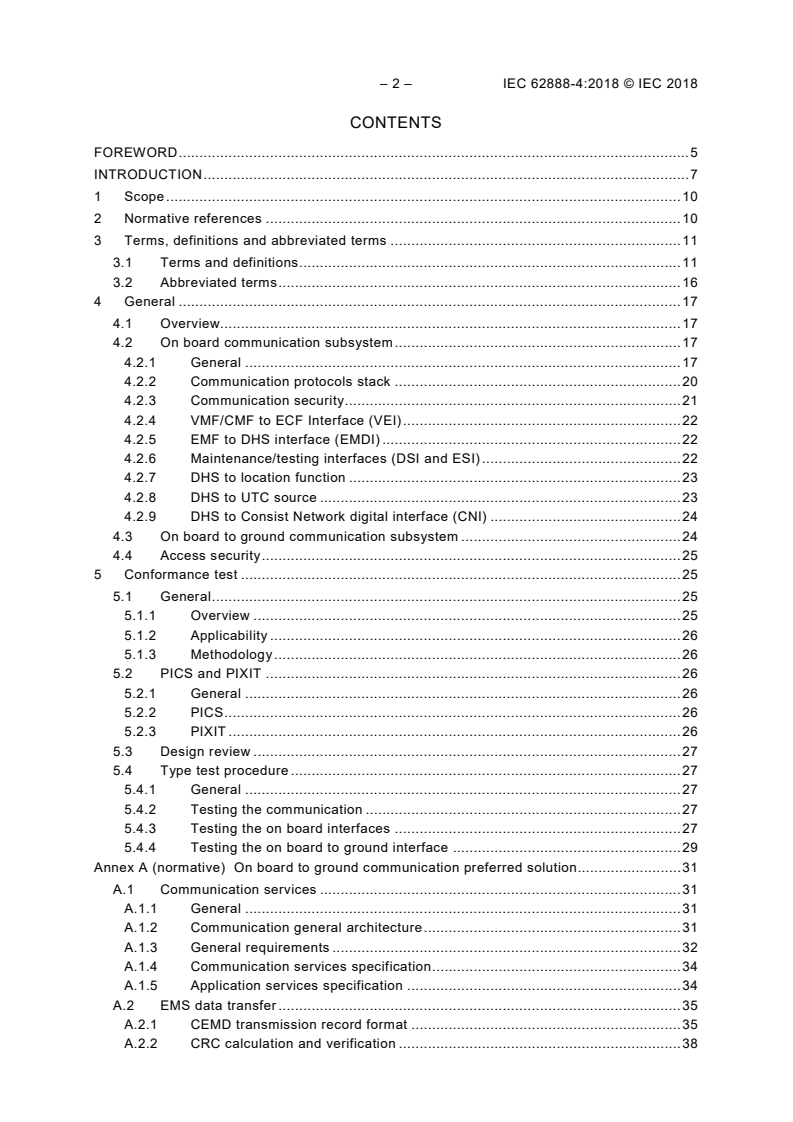
– 2 – IEC 62888-4:2018 © IEC 2018
CONTENTS
FOREWORD . 5
INTRODUCTION . 7
1 Scope . 10
2 Normative references . 10
3 Terms, definitions and abbreviated terms . 11
3.1 Terms and definitions . 11
3.2 Abbreviated terms . 16
4 General . 17
4.1 Overview. 17
4.2 On board communication subsystem . 17
4.2.1 General . 17
4.2.2 Communication protocols stack . 20
4.2.3 Communication security . 21
4.2.4 VMF/CMF to ECF Interface (VEI) . 22
4.2.5 EMF to DHS interface (EMDI) . 22
4.2.6 Maintenance/testing interfaces (DSI and ESI) . 22
4.2.7 DHS to location function . 23
4.2.8 DHS to UTC source . 23
4.2.9 DHS to Consist Network digital interface (CNI) . 24
4.3 On board to ground communication subsystem . 24
4.4 Access security . 25
5 Conformance test . 25
5.1 General . 25
5.1.1 Overview . 25
5.1.2 Applicability . 26
5.1.3 Methodology . 26
5.2 PICS and PIXIT . 26
5.2.1 General . 26
5.2.2 PICS . 26
5.2.3 PIXIT . 26
5.3 Design review . 27
5.4 Type test procedure . 27
5.4.1 General . 27
5.4.2 Testing the communication . 27
5.4.3 Testing the on board interfaces . 27
5.4.4 Testing the on board to ground interface . 29
Annex A (normative) On board to ground communication preferred solution. 31
A.1 Communication services . 31
A.1.1 General . 31
A.1.2 Communication general architecture . 31
A.1.3 General requirements . 32
A.1.4 Communication services specification . 34
A.1.5 Application services specification . 34
A.2 EMS data transfer . 35
A.2.1 CEMD transmission record format . 35
A.2.2 CRC calculation and verification . 38
A.2.3 CEMD file structure . 39
A.2.4 Transferred data file XML schema . 40
A.3 Access security . 40
Annex B (informative) VEI–VMF/CMF to ECF interface implementation example. 41
B.1 General . 41
B.2 Payload format . 41
B.3 Encryption . 42
Annex C (informative) PICS structure and instruction . 43
C.1 Structure . 43
C.2 Instructions for completing the PICS pro-forma . 43
C.2.1 PICS table structure . 43
C.2.2 Abbreviations used in PICS . 43
C.2.3 Ref. column . 44
C.2.4 Subclause column . 44
C.2.5 Capability column . 44
C.2.6 Requirement column . 44
C.2.7 Implementation column . 44
C.2.8 Parameter values column . 45
C.3 PICS pro-forma examples . 45
C.3.1 Identification of PICS . 45
C.3.2 Identification of the implementation under assessment . 45
C.3.3 Identification of the IUA supplier . 46
C.3.4 Identification of the standards . 46
C.3.5 Global statement of conformity . 47
C.3.6 Level of conformity . 47
Annex D (informative) Access security . 48
Bibliography . 49
Figure 1 – EMS functional structure and dataflow diagram . 9
Figure 2 – Example of energy index value . 13
Figure 3 – Communication interface between function/sub-function . 18
Figure 4 – EMS block diagram and interfaces . 19
Figure 5 – Preferred solution stack for on board to ground communication stack . 25
Figure 6 – Test bench for on board interface . 28
Figure 7 – On board to ground test bench 1 . 29
Figure 8 – On board to ground test bench 2 . 29
Figure A.1 – Communication components . 31
Figure B.1 – Payload format . 41
Table 1 – Example list of protocol stacks . 20
Table A.1 – Preferred solution communication services . 34
Table A.2 – Preferred solution application services . 35
Table A.3 – Record format . 37
Table C.1 – PICS table format . 43
Table C.2 – PICS identification table . 45
Table C.3 – IUA identification table . 46
– 4 – IEC 62888-4:2018 © IEC 2018
Table C.4 – IUA supplier identification table . 46
Table C.5 – Applicable standards identification table . 47
Table C.6 – Global statement table . 47
Table C.7 – Level of conformity . 47
INTERNATIONAL ELECTROTECHNICAL COMMISSION
____________
RAILWAY APPLICATIONS –
ENERGY MEASUREMENT ON BOARD TRAINS –
Part 4: Communication
FOREWORD
1) The International Electrotechnical Commission (IEC) is a worldwide organization for standardization comprising
all national electrotechnical committees (IEC National Committees). The object of IEC is to promote
international co-operation on all questions concerning standardization in the electrical and electronic fields. To
this end and in addition to other activities, IEC publishes International Standards, Technical Specifications,
Technical Reports, Publicly Available Specifications (PAS) and Guides (hereafter referred to as “IEC
Publication(s)”). Their preparation is entrusted to technical committees; any IEC National Committee interested
in the subject dealt with may participate in this preparatory work. International, governmental and non-
governmental organizations liaising with the IEC also participate in this preparation. IEC collaborates closely
with the International Organization for Standardization (ISO) in accordance with conditions determined by
agreement between the two organizations.
2) The formal decisions or agreements of IEC on technical matters express, as nearly as possible, an international
consensus of opinion on the relevant subjects since each technical committee has representation from all
interested IEC National Committees.
3) IEC Publications have the form of recommendations for international use and are accepted by IEC National
Committees in that sense. While all reasonable efforts are made to ensure that the technical content of IEC
Publications is accurate, IEC cannot be held responsible for the way in which they are used or for any
misinterpretation by any end user.
4) In order to promote international uniformity, IEC National Committees undertake to apply IEC Publications
transparently to the maximum extent possible in their national and regional publications. Any divergence
between any IEC Publication and the corresponding national or regional publication shall be clearly indicated in
the latter.
5) IEC itself does not provide any attestation of conformity. Independent certification bodies provide conformity
assessment services and, in some areas, access to IEC marks of conformity. IEC is not responsible for any
services carried out by independent certification bodies.
6) All users should ensure that they have the latest edition of this publication.
7) No liability shall attach to IEC or its directors, employees, servants or agents including individual experts and
members of its technical committees and IEC National Committees for any personal injury, property damage or
other damage of any nature whatsoever, whether direct or indirect, or for costs (including legal fees) and
expenses arising out of the publication, use of, or reliance upon, this IEC Publication or any other IEC
Publications.
8) Attention is drawn to the Normative references cited in this publication. Use of the referenced publications is
indispensable for the correct application of this publication.
9) Attention is drawn to the possibility that some of the elements of this IEC Publication may be the subject of
patent rights. IEC shall not be held responsible for identifying any or all such patent rights.
International Standard IEC 62888-4 has been prepared by technical committee 9: Electrical
equipment and systems for railways.
This standard is based on EN 50463.
The text of this International Standard is based on the following documents:
FDIS Report on voting
9/2323/FDIS 9/2334/RVD
Full information on the voting for the approval of this International Standard can be found in
the report on voting indicated in the above table.
This document has been drafted in accordance with the ISO/IEC Directives, Part 2.
– 6 – IEC 62888-4:2018 © IEC 2018
A list of all parts in the IEC 62888 series, published under the general title Railway
applications – Energy measurement on board trains, can be found on the IEC website.
The committee has decided that the contents of this document will remain unchanged until the
stability date indicated on the IEC website under "http://webstore.iec.ch" in the data related to
the specific document. At this date, the document will be
• reconfirmed,
• withdrawn,
• replaced by a revised edition, or
• amended.
IMPORTANT – The 'colour inside' logo on the cover page of this publication indicates
that it contains colours which are considered to be useful for the correct
understanding of its contents. Users should therefore print this document using a
colour printer.
INTRODUCTION
Three levels are introduced for categorizing EMS as described in this document in 4.1.
This part is Part 4 of the IEC 62888 series, which consists of the following parts, under the
general title Railway applications – Energy measurement on board trains:
Part 1: General
Part 2: Energy measurement
Part 3: Data handling
Part 4: Communication
Part 5: Conformance test
Part 6: Requirements for purposes other than billing
This series of International Standards follows the functional guidelines description in Annex A,
“Principles of conformity assessment”, of ISO/IEC 17000:2004 tailored to the Energy
Measurement System (EMS).
The Energy Measurement System (EMS) provides measurement and data suitable for
applications such as energy management, energy saving, billing and others.
This series of International Standards uses the functional approach to describe the EMS.
These functions are implemented in one or more physical devices. The user of this series of
standards is free to choose the physical implementation arrangements.
Structure and main contents of the IEC 62888 series
This series of International Standards is divided into six parts. The titles and brief descriptions
of each part are given below:
IEC 62888-1 – General
The scope of IEC 62888-1 is the Energy Measurement System (EMS).
IEC 62888-1 provides system level requirements for the complete EMS and common
requirements for all devices implementing one or more functions of the EMS.
IEC 62888-2 – Energy measurement
The scope of IEC 62888-2 is the Energy Measurement Function (EMF).
The EMF provides measurement of the consumed and regenerated active energy of a traction
unit. If the traction unit is designed for use on AC traction supply systems, the EMF also
provides measurement of reactive energy. The EMF provides the measured quantities via an
interface to the Data Handling System.
The EMF consists of the three functions: Voltage Measurement Function, Current
Measurement Function and Energy Calculation Function. For each of these functions,
accuracy classes are specified and associated reference conditions are defined. This part
also defines all specific requirements for all functions of the EMF.
The Voltage Measurement Function measures the voltage of the contact line (CL) system and
the Current Measurement Function measures the current taken from and returned to the CL
system. These functions provide signal inputs to the Energy Calculation Function.
– 8 – IEC 62888-4:2018 © IEC 2018
The Energy Calculation Function inputs the signals from the Current and Voltage
Measurement Functions and calculates a set of values representing the consumed and
regenerated energies. These values are transferred to the Data Handling System and are
used in the creation of Compiled Energy Measured Data.
All relevant metrological aspects are covered in this part of IEC 62888.
IEC 62888-2 also defines the conformance test of the EMF.
IEC 62888-3 – Data handling
The scope of IEC 62888-3 is the Data Handling System (DHS).
The on board DHS receives, produces and stores data, ready for transmission to any
authorised receiver of data on board or on ground. The main goal of the DHS is to produce
Compiled Energy Measured Data and transfer it to an on-ground Data Collection Service
(DCS). The DHS can support other functionality on board or on-ground with data, as long as
this does not conflict with the main goal.
IEC 62888-3 also defines the conformance test of the DHS.
IEC 62888-4 – Communication
The scope of IEC 62888-4 is the communication services.
This part of IEC 62888 gives requirements and guidance regarding the data communication
between the functions implemented within EMS as well as between such functions and other
on board units where data are exchanged using a communications protocol stack over a
dedicated physical interface or a shared network.
It includes the on board to ground communication service and covers the requirements
necessary to support data transfer between DHS and DCS.
IEC 62888-4 also defines the conformance test of the communications services.
IEC 62888-5 – Conformance test
The scope of IEC 62888-5 is the conformance test procedures for the EMS.
IEC 62888-5 also covers re-verification procedures and conformance test in the event of the
replacement of a device of the EMS.
IEC 62888-6 – Requirements for purposes other than billing
The scope of IEC 62888-6 is to specify the requirements for EMS to be used for
benchmarking, daily energy consumption monitoring, technical research and development.
This part provides the requirements for monitoring consumed energy on-board in daily
services in an easy way and the measured data are applicable for general purposes in
industry such as energy management, energy saving, etc. However, this part is not applicable
for billing purposes.
EMS functional structure and dataflow
Figure 1 illustrates the functional structure of the EMS, the main sub-functions and the
structure of the dataflow and is informative only. Only the main interfaces required by this
standard are displayed by arrows.
Since the communication function is distributed throughout the EMS, it has been omitted for
clarity. Not all interfaces are shown.
Time Reference Other Systems
Settlement
System
Location Reference
Data Storage Function
Current Measurement Function
Voltage Measurement Function
Data compilation Function
Energy Calculation Function
Data
Collection
Energy Measurement Function
Data Handling System
Service
(EMF) (DHS)
(DCS)
IEC 62888-3 (Data Handling)
IEC 62888-2 (Energy Measuring)
Energy Measurement System (EMS)
Other
Systems
IEC 62888-1 (General), IEC 62888-4 (Communication), IEC 62888-5 (Conformity)
Assessment), IEC 62888-6 (Purposes other than billing)
On-board (Traction Unit)
On-ground
IEC
Figure 1 – EMS functional structure and dataflow diagram
– 10 – IEC 62888-4:2018 © IEC 2018
RAILWAY APPLICATIONS –
ENERGY MEASUREMENT ON BOARD TRAINS –
Part 4: Communication
1 Scope
This part of IEC 62888 applies to the on board and on board to ground communication
services, i.e. it covers the data communication using digital interfaces:
a) between functions implemented within the EMS;
b) between EMS function and other on board subsystems;
c) between EMS and ground communication services.
The on board data communication services of the EMS cover the data exchange between
functions of the EMS and the data exchange between EMS and other on board units, where
data is exchanged using a communications protocol stack over a dedicated physical interface
or a shared communication network.
The on board to ground communication services cover the wireless data communication
between the DHS and the on ground server. Furthermore, this document includes
conformance test requirements.
Specific requirements for EMS Level 2 and Level 3 are specified in IEC 62888-6.
2 Normative references
The following documents are referred to in the text in such a way that some or all of their
content constitutes requirements of this document. For dated references, only the edition
cited applies. For undated references, the latest edition of the referenced document (including
any amendments) applies.
IEC 60870-5 (all parts), Telecontrol equipment and systems – Part 5: Transmission protocols
IEC 61158-2, Industrial communication networks – Fieldbus specifications – Part 2: Physical
layer specification and service definition
IEC 61375 (all parts), Electronic railway equipment – Train communication network (TCN)
IEC 62888-1:2018, Railway applications – Energy measurement on board trains – Part 1:
General
IEC 62888-2:2018, Railway applications – Energy measurement on board trains – Part 2:
Energy measurement
IEC 62888-3:2018, Railway applications – Energy measurement on board trains – Part 3:
Data handling
IEC 62888-5:2018, Railway applications – Energy measurement on board trains – Part 5:
Conformance test
IEC 62888-6:2018, Railway applications – Energy measurement on board trains – Part 6:
Requirements for purposes other than billing
ISO/IEC 8482, Information technology – Telecommunications and information exchange
between systems – Twisted pair multipoint interconnections
ISO/IEC/IEEE 8802-3:2017, Information technology – Telecommunications and information
exchange between systems – Local and metropolitan area networks – Specific requirements –
Part 3: Standard for Ethernet
ISO/IEC 9646-1:1994, Information technology – Open Systems Interconnection –
Conformance testing methodology and framework – Part 1: General concepts
ISO 11898-1:2015, Road vehicles – Controller area network (CAN) – Part 1: Data link layer
and physical signalling
ISO 11898-2:2016, Road vehicles – Controller area network (CAN) – Part 2: High-speed
medium access unit
3 Terms, definitions and abbreviated terms
3.1 Terms and definitions
For the purposes of this document, the terms and definitions given in IEC 62888-1:2018 and
the following apply.
ISO and IEC maintain terminological databases for use in standardization at the following
addresses:
• IEC Electropedia: available at http://www.electropedia.org/
• ISO Online browsing platform: available at http://www.iso.org/obp
3.1.1
Board to Ground Interface
BGI
interface used for the communication between the train and the ground
3.1.2
consist
single vehicle or a group of vehicles which are not separated during normal operation
Note 1 to entry: A consist can contain no, one or several consist networks.
Note 2 to entry: A consist may contain one or more traction units.
[SOURCE: IEC 60050-811:2017, 811-37-20, modified: Note 2 to entry has been added]
3.1.3
consist network
CN
bus connecting equipment within a consist, e.g. the MVB, and which conforms or adapts to
the TCN real-time protocols
[SOURCE: IEC 60050-811:2017, 811-37-21]
– 12 – IEC 62888-4:2018 © IEC 2018
3.1.4
Consist Network Interface
CNI
interface to an on board consist network used by the EMS and by other on board devices
interfacing with the EMS
3.1.5
Coordinated Universal Time
UTC
time scale which forms the basis of a coordinated radio dissemination of standard frequencies
and time signals. It corresponds exactly in rate with international atomic time, but differs from
it by an integral number of seconds
Note 1 to entry: Coordinated universal time is established by the International Bureau of Weights and Measures
(BIPM) and the International Earth Rotation Services (IERS).
Note 2 to entry: The UTC scales are adjusted by the insertion or deletion of seconds, so called positive or
negative leap seconds, to ensure approximate agreement with UT1.
[SOURCE: IEC 60050-713:1998, 713-05-20]
3.1.6
DHS to Service Interface
DSI
interface between the DHS and a maintenance/administration tool
3.1.7
DHS to MCF Interface
DMI
interface between the DHS and the MCF; it may be dedicated or shared on CNI
3.1.8
EMF to DHS Interface
EMDI
interface between the EMF and the DHS
3.1.9
EMF to Service Interface
ESI
interface between the EMF and a maintenance/administration tool
3.1.10
energy delta value
energy consumed and/or regenerated during a time period
Note 1 to entry: See Figure 2 for example.
3.1.11
energy index value
total accumulated energy consumption and/or energy regeneration at the end of a time period
Note 1 to entry: See Figure 2 for example.
2350 2360 2372 2379 2393 2404
energy index value:
10 12 7 14 11
energy delta value:
Timeline:
10:40 10:45 10:50 10:55 11:00
10:35
IEC
Figure 2 – Example of energy index value
3.1.12
flag
code indicating information relevant to the functioning of the EMS
Note 1 to entry: Examples include data quality, operational status, etc.
3.1.13
Fully Qualified Domain Name
FQDN
domain name which specifies its exact location in the tree hierarchy of the Domain Name
System (DNS)
Note 1 to entry: It specifies all domain levels, starting from the host name up to the top-level domain.
3.1.14
Ground Station
GS
any station on ground which is able to communicate with the EMS
Note 1 to entry: A GS may host different services such as DCS or any EMS management service.
3.1.15
integrity
state in which information is complete and not altered
[SOURCE: IEC 60050-821:2017, 821-11-26]
3.1.16
Internet Engineering Task Force
IETF
organised activity of the Internet Society in charge of producing technical documents relevant
to the design, use and management of the Internet
3.1.17
Implementation Under Assessment
IUA
implementation of one or more protocols between user and provider being part of the EMS
that is submitted to the conformance test
Note 1 to entry: The protocols are specified in this part of IEC 62888.
3.1.18
location data
data describing the geographical position of the traction unit
– 14 – IEC 62888-4:2018 © IEC 2018
3.1.19
Location Function to DHS Interface
LFDI
interface linking the location function to the DHS
Note 1 to entry: The location function can be interfaced with the DHS via a CNI.
3.1.20
Mobile Communication Function
MCF
function performing the EMS to on ground communication
Note 1 to entry: It includes the sub-function(s) for the wireless link between the train and ground and the sub-
functions that execute the communication protocols up to the application interface.
3.1.21
Mobile Communication Gateway
MCG
device that implements the MCF
Note 1 to entry: It may be embedded into the DHS, shared on CNI or connected as a dedicated device by means
of the DMI.
3.1.22
non-voluntary change
accidental or unintentional change
Note 1 to entry: Accidental change is caused by unpredictable physical influences, and unintentional change is
the effect caused by user functions and residual defects of the software even though the best efforts in
development techniques have been applied.
3.1.23
Payload
part of the message containing the useful data produced by the source application and used
by the destination application
3.1.24
Protocol Analyser
PA
instrument which is used to record and analyse the frames produced by the IUA during the
protocol testing
3.1.25
Protocol Frame Generator
PFG
instrument which is used to inject the testing frames into the interface of the IUA
3.1.26
Protocol Implementation Conformity Statement
PICS
document containing the information of the claim of conformity of the IUA in respect of the
specification
3.1.27
protective interface
interface which permits intended data to be exchanged, and prevents unintended data being
exchanged
3.1.28
Protocol Implementation Extra Information for Testing
PIXIT
document used when testing the user defined aspects of the protocol for the IUA
3.1.29
sensor
device performing the VMF and/or CMF
Note 1 to entry: Sensor is used as a general term and encompasses a wide variety of technology / devices for
measurement purposes, e.g. inductive transformers, hall-effect devices, capacitive and resistive dividers, and
resistive shunts, etc.
Note 2 to entry: One sensor can perform multiple functions.
3.1.30
software
programs, procedures, rules, documentation and data of an information processing system
EXAMPLE Requirements and design specifications; source code listings, check lists and comments; “Help” text
and messages for display at the computer/human interface; instructions for installation and operation; and support
guides for hardware and software maintenance.
Note 1 to entry: Software is an intellectual creation that is independent of the medium upon which it is recorded.
Note 2 to entry: Software requires hardware devices to execute programs, and to store and transmit data.
Note 3 to entry: Types of software include firmware, system software, and application software.
[SOURCE: IEC 60050-192:2015, 192-01-07]
3.1.31
entity in charge of the test
organisation responsible for conformance testing
3.1.32
test bench
arrangement of test equipment for testing an IUA
Note 1 to entry: Test equipment may include oscilloscopes, signal generators and other instruments.
3.1.33
TGZ
file format and the name of a program used to handle such files
Note 1 to entry: The format was created in the early days of Unix and standardized by POSIX.1-1988 and later
POSIX.1-2001.
3.1.34
Time Reference Period
TRP
period of time for which CEMD is produced
3.1.35
Train Control and Monitoring System
TCMS
set of interrelated objects providing on board control and monitoring of the train
3.1.36
EPOCH time
EPOCH
st
number of seconds elapsed since midnight on the 1 of January 1970 according to the
Coordinated Universal Time (UTC)
– 16 – IEC 62888-4:2018 © IEC 2018
Note 1 to entry: EPOCH time is coded as a signed integer data type of 32 bits.
3.1.37
UTC source to DHS interface
TFDI
dedicated interface of the UTC Source to the DHS
Note 1 to entry: The UTC source can be interfaced with the DHS via a CNI.
3.1.38
verdict
statement of “pass”, “fail”, or “inconclusive”, as specified in an abstract test case, concerning
conformity of an IUA with respect to the test case when it is executed
3.1.39
VMF/CMF to ECF Interface
VEI
interface between a VMF/CMF and an ECF
Note 1 to entry: It may be a combined interface for VMF and CMF or two separated interfaces.
3.1.40
voluntary change
intentional change consisting in a modification of software elements and/or modification,
loading or swapping of the memory
3.2 Abbreviated terms
NOTE The definition of some of the abbreviations can be found in IEC 62888-1:2018, Clause 3.
ASN Abstract Syntax Notation
BGI Board to Ground Interface
CEMD Compiled Energy Measured Data
CMF Current Measurement Function
CNI Consist Network Interface
CPID Consumption Point Identification
CRC Cyclic Redundancy Check
DCS Data Collection System
DHS Data Handling System
DMI DHS interface to Mobile Communication Function
DSI Data Handling System to service interface
ECF Energy Calculation Function
EMDI EMF to DHS interface
EMF Energy Measurement Function
EMS Energy Measurement System
EPOCH UNIX Time
ESI Energy Measuring Function to service interface
VIN Vehicle Identification Number
FQDN Fully Qualified Domain Name
GS Ground Station
IETF Internet Engineering Task Force
IUA Implementation Under Assessment
LFDI Location Function to DHS interface
MCF Mobile Communication Function
MCG Mobile Communication Gateway
NMEA National Marine Electronics Association
PA Protocol Analyser
PFG Protocol Frame Generator
PICS Protocol Implementation Conformity Statement
PIXIT Protocol Implementation Extra Information for Testing
SNTP Simple Network Time Protocol
TCMS Train Control and Monitoring System
TFDI UTC Source to DHS interface
TRP Time Reference Period
UTC Coordinated Universal Time
VEI VMF/CMF to ECF interface
VMF Voltage Measurement Function
4 General
4.1 Overview
The requirements in IEC 62888-1:2018, Clause 4, apply to any device containing one or more
implementation of the communication services where applicable. IEC 62888-4 defines
additional requirements specific to the communication services.
4.2 On board communication subsystem
4.2.1 General
Figure 1 describes the functional structure of the communication between two functions
and/or sub-functions. Embedded communication is implemented using a virtual channel and
exposed communication is implemented using physical channel. Whether the communication
between functions/sub-functions is performed by a virtual or a physical link, is an
implementation choice.
– 18 – IEC 62888-4:2018 © IEC 2018
Function /
Function /
Embedded
Sub-function B
Sub-function A
communication
Behavioural
Behavioural
specification
interface
specification
To be implemented by a
virtual channel
Specified as the Syntax
and the semantics of the
exchanged data
Function/sub-
Function/sub-
function interface function interface
Exposed
communication
interface
Protocols stack
Protocols stack
To be implemented by
(security) Physical channel
(security)
Specified as protocols
to transfer the payload
IEC
Figure 3 – Communication interface between function/sub-function
The on board communication subsystem covers the specification of the communication
protocol stack, the communication security sub-function and the communication profile for
digital interfaces where it is implemented using an exposed communication interface over a
physical channel. Figure 3 illustrates some of the possible interfaces, noting that some of
them may be combined or may be alternative.
Data transfer using an embedded communication interface, implemented using a virtual
channel, is specified elsewhere in the relevant part of this series of standards.
Figure 4 shows the EMS functions which communicate through interfaces. The BGI interface
is specified in 4.3.
------------------
...