

IEC 60870-6-802:1997
(Main)Telecontrol equipment and systems - Part 6: Telecontrol protocols compatible with ISO standards and ITU-T recommendations - Section 802: TASE.2 Object models
General Information
- Abstract
Specifies a method of exchanging time-critical control centre data through wide- and local-area networks using a full ISO compliant protocol stack. Contains provisions for supporting both centralized and distributed architectures.
- Status
- Published
- Publication Date
- 08-Oct-1997
- Technical Committee
- TC 57 - Power systems management and associated information exchange
- Drafting Committee
- WG 7 - TC 57/WG 7
- Current Stage
- DELPUB - Deleted Publication
- Start Date
- 03-Apr-2002
- Completion Date
- 28-Aug-2026
Buy Documents
IEC 60870-6-802:1997 - Telecontrol equipment and systems - Part 6: Telecontrol protocols compatible with ISO standards and ITU-T recommendations - Section 802: TASE.2 Object models Released:10/9/1997
Overview
IEC 60870-6-802:1997 is an international standard published by the International Electrotechnical Commission (IEC) that specifies telecontrol equipment and systems protocols compatible with ISO standards and ITU-T recommendations. This particular section, Section 802: TASE.2 Object Models, defines a method for exchanging time-critical control center data over wide-area and local-area networks using a fully ISO-compliant protocol stack. The standard supports both centralized and distributed telecontrol architectures, enabling efficient, reliable communication in supervisory control and data acquisition (SCADA) systems.
The importance of IEC 60870-6-802 lies in its detailed object models that serve as the foundation for interoperable telecontrol protocols. This ensures seamless communication between control centers and field devices, improving operational effectiveness and reliability in electrical power systems and other critical infrastructure.
Key Topics
- TASE.2 Object Models: Defines hierarchical object models such as IndicationPoint, ControlPoint, Protection Equipment Event, TransferAccount, and DeviceOutage which represent different elements of telecontrol systems.
- SCADA Integration: Detailed models for supervisory control and data acquisition, including mechanisms to represent signals, commands, protection status, and event handling.
- Transfer Accounts: Object definitions for managing data transfer accounting, transmission segments, and profile values to ensure accurate and traceable data exchange.
- Power Plant Objects: Models covering availability reports, real-time status, forecast schedules, curves, and power system dynamics to support power generation management.
- Mapping to MMS Types: Specification of correspondence between object models and Manufacturing Message Specification (MMS) data types for standardized communication.
- Distributed Architectures: Provisions supporting both centralized and distributed telecontrol systems ensure flexibility and scalability in network design.
- Use of ISO and ITU-T Standards: Compliance with international OTC (open telecontrol) standards and recommendations guarantees global interoperability.
Applications
- Electrical Power Systems: Implementation in electrical substations and control centers for reliable telemetry, remote control, and data acquisition.
- Grid Management: Enhances situational awareness and decision-making in power grid operations with timely and accurate data exchange.
- Critical Infrastructure Monitoring: Suitable for managing infrastructure that requires real-time supervision, status updates, and command issuance.
- Energy Management Systems: Facilitate integration with energy resource planning, forecasting, and dynamic system analysis.
- Telecommunication Networks: Utilization in wide-area network (WAN) and local-area network (LAN) environments for secure and efficient remote management.
Related Standards
- IEC 60870-6: Broader series covering telecontrol protocols compatible with ISO and ITU-T.
- ISO 9506 (MMS): Manufacturing Message Specification standard upon which the IEC 60870-6-802 object models map for protocol communication.
- IEC 60050: International Electrotechnical Vocabulary providing terminology relevant to telecontrol and electrical systems.
- ITU-T Recommendations: Telecommunication standards used for aligning telecontrol protocols.
- IEC 60417 and IEC 60617: Standards defining graphical symbols and diagrams used in related telecontrol documentation.
Summary
IEC 60870-6-802:1997 establishes a comprehensive framework for telecontrol object models, enabling standardized, ISO-compliant data exchange for control systems in critical infrastructure. Its detailed modeling of supervisory control points, protection events, transfer accounts, and power plant data allows utilities and system integrators to implement interoperable and scalable SCADA applications. By adopting this standard, organizations ensure robust, real-time communication across telecontrol networks essential for modern energy management and infrastructure resilience.
Keywords: IEC 60870-6-802, TASE.2, telecontrol protocols, SCADA systems, ISO-compliant telecontrol, control center data exchange, transfer accounts, MMS data types, distributed telecontrol architecture, electrical power systems standard.
Relations
- Effective Date
- 05-Sep-2023
Buy Documents
IEC 60870-6-802:1997 - Telecontrol equipment and systems - Part 6: Telecontrol protocols compatible with ISO standards and ITU-T recommendations - Section 802: TASE.2 Object models Released:10/9/1997
Get Certified
Connect with accredited certification bodies for this standard

ANCE
Mexican certification and testing association.

Intertek Slovenia
Intertek testing, inspection, and certification services in Slovenia.

LNE (Laboratoire National de Métrologie et d'Essais)
French national laboratory for metrology and testing.
Sponsored listings
Frequently Asked Questions
IEC 60870-6-802:1997 is a standard published by the International Electrotechnical Commission (IEC). Its full title is "Telecontrol equipment and systems - Part 6: Telecontrol protocols compatible with ISO standards and ITU-T recommendations - Section 802: TASE.2 Object models". This standard covers: Specifies a method of exchanging time-critical control centre data through wide- and local-area networks using a full ISO compliant protocol stack. Contains provisions for supporting both centralized and distributed architectures.
Specifies a method of exchanging time-critical control centre data through wide- and local-area networks using a full ISO compliant protocol stack. Contains provisions for supporting both centralized and distributed architectures.
IEC 60870-6-802:1997 is classified under the following ICS (International Classification for Standards) categories: 33.200 - Telecontrol. Telemetering. The ICS classification helps identify the subject area and facilitates finding related standards.
IEC 60870-6-802:1997 has the following relationships with other standards: It is inter standard links to IEC 60870-6-802:2002. Understanding these relationships helps ensure you are using the most current and applicable version of the standard.
IEC 60870-6-802:1997 is available in PDF format for immediate download after purchase. The document can be added to your cart and obtained through the secure checkout process. Digital delivery ensures instant access to the complete standard document.
Standards Content (Sample)
NORME
CEI
INTERNATIONALE
IEC
60870-6-802
INTERNATIONAL
Première édition
STANDARD
First edition
1997-10
Matériels et systèmes de téléconduite –
Partie 6:
Protocoles de téléconduite compatibles
avec les normes ISO et les recommandations
de l’UIT-T –
Section 802: Modèles d’objets TASE.2
Telecontrol equipment and systems –
Part 6:
Telecontrol protocols compatible
with ISO standards and ITU-T recommendations –
Section 802: TASE.2 Object models
Numéro de référence
Reference number
CEI/IEC 60870-6-802:1997
Numéros des publications Numbering
Depuis le 1er janvier 1997, les publications de la CEI As from the 1st January 1997 all IEC publications are
sont numérotées à partir de 60000. issued with a designation in the 60000 series.
Publications consolidées Consolidated publications
Les versions consolidées de certaines publications de Consolidated versions of some IEC publications
la CEI incorporant les amendements sont disponibles. including amendments are available. For example,
Par exemple, les numéros d’édition 1.0, 1.1 et 1.2 edition numbers 1.0, 1.1 and 1.2 refer, respectively, to
indiquent respectivement la publication de base, la the base publication, the base publication
publication de base incorporant l’amendement 1, et la incorporating amendment 1 and the base publication
publication de base incorporant les amendements 1 incorporating amendments 1 and 2.
et 2.
Validité de la présente publication Validity of this publication
Le contenu technique des publications de la CEI est The technical content of IEC publications is kept under
constamment revu par la CEI afin qu'il reflète l'état constant review by the IEC, thus ensuring that the
actuel de la technique. content reflects current technology.
Des renseignements relatifs à la date de Information relating to the date of the reconfirmation of
reconfirmation de la publication sont disponibles dans the publication is available in the IEC catalogue.
le Catalogue de la CEI.
Les renseignements relatifs à ces révisions, à l'établis- Information on the revision work, the issue of revised
sement des éditions révisées et aux amendements editions and amendments may be obtained from
peuvent être obtenus auprès des Comités nationaux de IEC National Committees and from the following
la CEI et dans les documents ci-dessous: IEC sources:
• Bulletin de la CEI • IEC Bulletin
• Annuaire de la CEI • IEC Yearbook
Accès en ligne* On-line access*
• Catalogue des publications de la CEI • Catalogue of IEC publications
Publié annuellement et mis à jour régulièrement Published yearly with regular updates
(Accès en ligne)* (On-line access)*
Terminologie, symboles graphiques Terminology, graphical and letter
et littéraux symbols
En ce qui concerne la terminologie générale, le lecteur For general terminology, readers are referred to
se reportera à la CEI 60050: Vocabulaire Electro- IEC 60050: International Electrotechnical Vocabulary
technique International (VEI). (IEV).
Pour les symboles graphiques, les symboles littéraux For graphical symbols, and letter symbols and signs
et les signes d'usage général approuvés par la CEI, le approved by the IEC for general use, readers are
lecteur consultera la CEI 60027: Symboles littéraux à referred to publications IEC 60027: Letter symbols to
utiliser en électrotechnique, la CEI 60417: Symboles be used in electrical technology, IEC 60417: Graphical
symbols for use on equipment. Index, survey and
graphiques utilisables sur le matériel. Index, relevé et
compilation des feuilles individuelles, et la CEI 60617: compilation of the single sheets and IEC 60617:
Symboles graphiques pour schémas. Graphical symbols for diagrams.
Publications de la CEI établies par IEC publications prepared by the same
le même comité d'études technical committee
L'attention du lecteur est attirée sur les listes figurant The attention of readers is drawn to the end pages of
à la fin de cette publication, qui énumèrent les this publication which list the IEC publications issued
publications de la CEI préparées par le comité by the technical committee which has prepared the
d'études qui a établi la présente publication. present publication.
* Voir adresse «site web» sur la page de titre. * See web site address on title page.
NORME
CEI
INTERNATIONALE
IEC
60870-6-802
INTERNATIONAL
Première édition
STANDARD
First edition
1997-10
Matériels et systèmes de téléconduite –
Partie 6:
Protocoles de téléconduite compatibles
avec les normes ISO et les recommandations
de l’UIT-T –
Section 802: Modèles d’objets TASE.2
Telecontrol equipment and systems –
Part 6:
Telecontrol protocols compatible
with ISO standards and ITU-T recommendations –
Section 802: TASE.2 Object models
IEC 1997 Droits de reproduction réservés Copyright - all rights reserved
Aucune partie de cette publication ne peut être reproduite ni No part of this publication may be reproduced or utilized in
utilisée sous quelque forme que ce soit et par aucun any form or by any means, electronic or mechanical,
procédé, électronique ou mécanique, y compris la photo- including photocopying and microfilm, without permission in
copie et les microfilms, sans l'accord écrit de l'éditeur. writing from the publisher.
International Electrotechnical Commission 3, rue de Varembé Geneva, Switzerland
Telefax: +41 22 919 0300 e-mail: inmail@iec.ch IEC web site http: //www.iec.ch
CODE PRIX
Commission Electrotechnique Internationale
XB
PRICE CODE
International Electrotechnical Commission
Pour prix, voir catalogue en vigueur
For price, see current catalogue
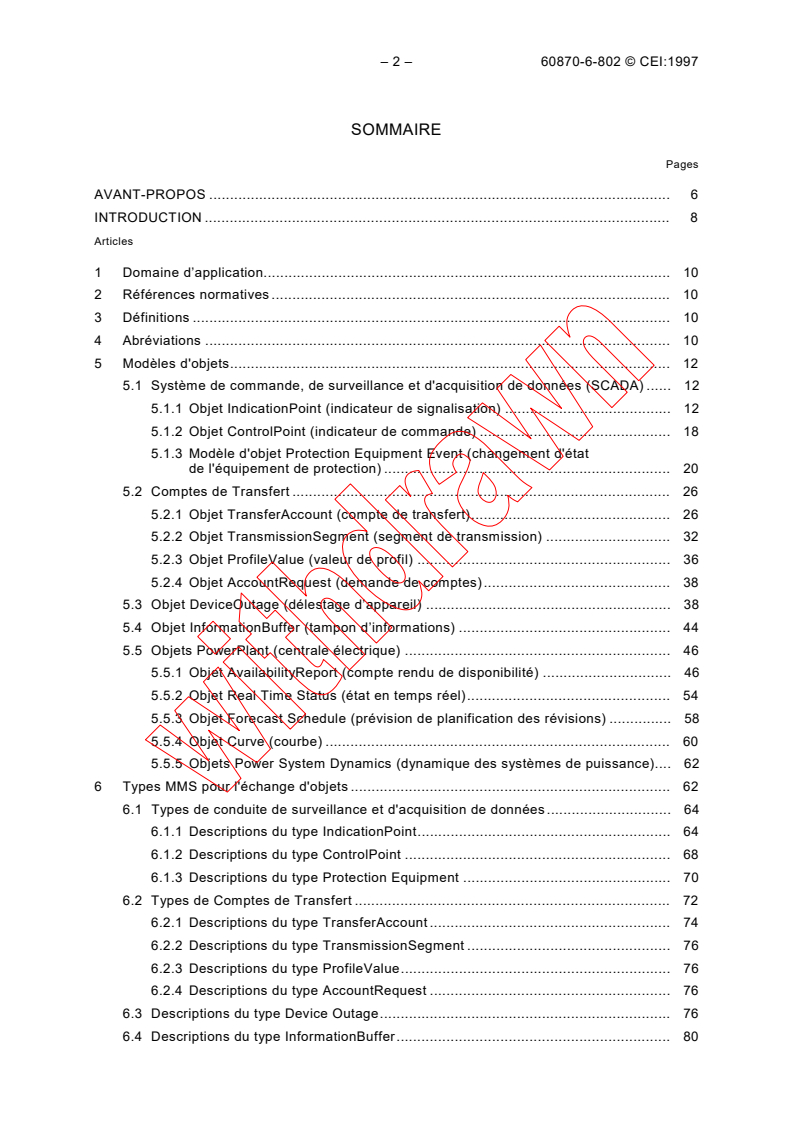
– 2 – 60870-6-802 © CEI:1997
SOMMAIRE
Pages
AVANT-PROPOS . 6
INTRODUCTION . 8
Articles
1 Domaine d’application. 10
2 Références normatives . 10
3 Définitions . 10
4 Abréviations . 10
5 Modèles d'objets. 12
5.1 Système de commande, de surveillance et d'acquisition de données (SCADA) . 12
5.1.1 Objet IndicationPoint (indicateur de signalisation) . 12
5.1.2 Objet ControlPoint (indicateur de commande) . 18
5.1.3 Modèle d'objet Protection Equipment Event (changement d'état
de l'équipement de protection) . 20
5.2 Comptes de Transfert . 26
5.2.1 Objet TransferAccount (compte de transfert). 26
5.2.2 Objet TransmissionSegment (segment de transmission) . 32
5.2.3 Objet ProfileValue (valeur de profil) . 36
5.2.4 Objet AccountRequest (demande de comptes). 38
5.3 Objet DeviceOutage (délestage d’appareil) . 38
5.4 Objet InformationBuffer (tampon d’informations) . 44
5.5 Objets PowerPlant (centrale électrique) . 46
5.5.1 Objet AvailabilityReport (compte rendu de disponibilité) . 46
5.5.2 Objet Real Time Status (état en temps réel). 54
5.5.3 Objet Forecast Schedule (prévision de planification des révisions) . 58
5.5.4 Objet Curve (courbe) . 60
5.5.5 Objets Power System Dynamics (dynamique des systèmes de puissance). 62
6 Types MMS pour l'échange d'objets . 62
6.1 Types de conduite de surveillance et d'acquisition de données . 64
6.1.1 Descriptions du type IndicationPoint. 64
6.1.2 Descriptions du type ControlPoint . 68
6.1.3 Descriptions du type Protection Equipment . 70
6.2 Types de Comptes de Transfert . 72
6.2.1 Descriptions du type TransferAccount . 74
6.2.2 Descriptions du type TransmissionSegment . 76
6.2.3 Descriptions du type ProfileValue. 76
6.2.4 Descriptions du type AccountRequest . 76
6.3 Descriptions du type Device Outage. 76
6.4 Descriptions du type InformationBuffer. 80
60870-6-802 © IEC:1997 – 3 –
CONTENTS
Page
FOREWORD . 7
INTRODUCTION . 9
Clause
1 Scope.11
2 Normative references . 11
3 Definitions . 11
4 Abbreviations. 11
5 Object models . 13
5.1 Supervisory Control and Data Acquisition. 13
5.1.1 IndicationPoint Object. 13
5.1.2 ControlPoint Object. 19
5.1.3 Protection Equipment Event Object Model. 21
5.2 Transfer Accounts . 27
5.2.1 TransferAccount Object . 27
5.2.2 TransmissionSegment Object . 33
5.2.3 ProfileValue Object. 37
5.2.4 AccountRequest Object . 39
5.3 Device Outage Object . 39
5.4 InformationBuffer Object . 45
5.5 Power Plant Objects . 47
5.5.1 Availability Report Object . 47
5.5.2 Real Time Status Object . 55
5.5.3 Forecast Schedule Object. 59
5.5.4 Curve Object . 61
5.5.5 Power System Dynamics Objects. 63
6 MMS types for object exchange . 63
6.1 Supervisory Control and Data Acquisition Types. 65
6.1.1 IndicationPoint Type Descriptions . 65
6.1.2 ControlPoint Type Descriptions . 69
6.1.3 Protection Equipment Type Descriptions . 71
6.2 Transfer Account Types . 73
6.2.1 TransferAccount Type Descriptions. 75
6.2.2 TransmissionSegment Type Descriptions. 77
6.2.3 ProfileValue Type Descriptions . 77
6.2.4 AccountRequest Type Descriptions. 77
6.3 Device Outage Type Descriptions . 77
6.4 InformationBuffer Type Descriptions . 81
– 4 – 60870-6-802 © CEI:1997
Articles Pages
6.5 Descriptions du type Power Plant . 80
6.5.1 Descriptions du type Availability Report. 82
6.5.2 Descriptions du type Real Time Status. 84
6.5.3 Descriptions du type Forecast. 84
6.5.4 Descriptions du type Curve . 84
6.6 Power System Dynamics (dynamique du système de puissance) . 86
6.7 Type de données Matrix. 86
7 Correspondance des modèles d'objets avec les types MMS . 88
7.1 Correspondance entre surveillance de conduite et données. 88
7.1.1 Correspondance avec l'objet Indication . 88
7.1.2 Correspondance avec l'objet ControlPoint . 90
7.1.3 Correspondance avec Protection Event. 92
7.2 Correspondance avec les comptes de transfert . 98
7.2.1 Correspondance avec TransferAccount. 98
7.2.2 Correspondance de TransmissionSegment (segment de transmission). 106
7.2.3 Correspondance de ProfileValue. 108
7.2.4 Correspondance de AccountRequest . 110
7.3 Correspondance de Device Outage. 110
7.4 Correspondance de Information Buffer. 114
7.5 Correspondance de Power Plant . 114
7.5.1 Disponibilité de Report Mapping. 114
7.5.2 Correspondance de Real Time Status . 120
7.5.3 Correspondance de Forecast . 126
7.5.4 Correspondance de Curve . 128
8 Utilisation des objets Supervisory Control (supervision). 130
8.1 Utilisation du modèle IndicationPoint. 130
8.2 Utilisation du modèle ControlPoint. 132
8.3 Utilisation de Device Outage . 132
8.4 Utilisation de Information Buffer . 132
8.5 Utilisation de Power Plant . 132
9 Conformité . 132
Annexe A – Exemples de comptes de transfert . 136
60870-6-802 © IEC:1997 – 5 –
Clause Page
6.5 Power Plant Type Descriptions. 81
6.5.1 Availability Report Type Descriptions . 83
6.5.2 Real Time Status Type Descriptions. 85
6.5.3 Forecast Type Descriptions. 85
6.5.4 Curve Type Descriptions. 85
6.6 Power System Dynamics. 87
6.7 Matrix Data Types. 87
7 Mapping of object models to MMS types . 89
7.1 Supervisory Control and Data Mapping. 89
7.1.1 Indication Object Mapping. 89
7.1.2 ControlPoint Object Mapping. 91
7.1.3 Protection Event Mapping . 93
7.2 Transfer Accounts Mapping . 99
7.2.1 TransferAccount Mapping . 99
7.2.2 TransmissionSegment Mapping . 107
7.2.3 ProfileValue Mapping. 109
7.2.4 AccountRequest Mapping . 111
7.3 Device Outage Mapping. 111
7.4 Information Buffer Mapping. 115
7.5 Power Plant Mapping . 115
7.5.1 Availability Report Mapping. 115
7.5.2 Real Time Status Mapping . 121
7.5.3 Forecast Mapping . 127
7.5.4 Curve Mapping . 129
8 Use of supervisory control objects . 131
8.1 Use of IndicationPoint Model. 131
8.2 Use of ControlPoint Model . 133
8.3 Device Outage Usage . 133
8.4 Information Buffer Usage . 133
8.5 Power Plant Usage . 133
9 Conformance. 133
Annex A – Transfer account examples. 137
– 6 – 60870-6-802 © CEI:1997
COMMISSION ÉLECTROTECHNIQUE INTERNATIONALE
__________
MATÉRIELS ET SYSTÈMES DE TÉLÉCONDUITE –
Partie 6: Protocoles de téléconduite compatibles avec
les normes ISO et les recommandations de l’UIT-T –
Section 802: Modèles d’objets TASE.2
AVANT-PROPOS
1) La CEI (Commission Electrotechnique Internationale) est une organisation mondiale de normalisation composée
de l'ensemble des comités électrotechniques nationaux (Comités nationaux de la CEI). La CEI a pour objet de
favoriser la coopération internationale pour toutes les questions de normalisation dans les domaines de
l'électricité et de l'électronique. A cet effet, la CEI, entre autres activités, publie des Normes Internationales.
Leur élaboration est confiée à des comités d'études, aux travaux desquels tout Comité national intéressé par le
sujet traité peut participer. Les organisations internationales, gouvernementales et non gouvernementales, en
liaison avec la CEI, participent également aux travaux. La CEI collabore étroitement avec l'Organisation
Internationale de Normalisation (ISO), selon des conditions fixées par accord entre les deux organisations.
2) Les décisions ou accords officiels de la CEI concernant les questions techniques, représentent, dans la mesure
du possible un accord international sur les sujets étudiés, étant donné que les Comités nationaux intéressés
sont représentés dans chaque comité d’études.
3) Les documents produits se présentent sous la forme de recommandations internationales. Ils sont publiés
comme normes, rapports techniques ou guides et agréés comme tels par les Comités nationaux.
4) Dans le but d'encourager l'unification internationale, les Comités nationaux de la CEI s'engagent à appliquer de
façon transparente, dans toute la mesure possible, les Normes internationales de la CEI dans leurs normes
nationales et régionales. Toute divergence entre la norme de la CEI et la norme nationale ou régionale
correspondante doit être indiquée en termes clairs dans cette dernière.
5) La CEI n’a fixé aucune procédure concernant le marquage comme indication d’approbation et sa responsabilité
n’est pas engagée quand un matériel est déclaré conforme à l’une de ses normes.
6) L’attention est attirée sur le fait que certains des éléments de la présente Norme internationale peuvent faire
l’objet de droits de propriété intellectuelle ou de droits analogues. La CEI ne saurait être tenue pour
responsable de ne pas avoir identifié de tels droits de propriété et de ne pas avoir signalé leur existence.
La Norme internationale CEI 60870-6-802 a été établie par le comité d’études 57 de la CEI:
Conduite des systèmes de puissance et communications associées.
Le texte de cette norme est issu des documents suivants:
FDIS Rapport de vote
57/314/FDIS 57/328/RVD
Le rapport de vote indiqué dans le tableau ci-dessus donne toute information sur le vote ayant
abouti à l'approbation de cette norme.
L’annexe A est donnée uniquement à titre d’information.
60870-6-802 © IEC:1997 – 7 –
INTERNATIONAL ELECTROTECHNICAL COMMISSION
__________
TELECONTROL EQUIPMENT AND SYSTEMS –
Part 6: Telecontrol protocols compatible with ISO standards
and ITU-T recommendations –
Section 802: TASE.2 Object models
FOREWORD
1) The IEC (International Electrotechnical Commission) is a worldwide organization for standardization comprising
all national electrotechnical committees (IEC National Committees). The object of the IEC is to promote
international co-operation on all questions concerning standardization in the electrical and electronic fields. To
this end and in addition to other activities, the IEC publishes International Standards. Their preparation is
entrusted to technical committees; any IEC National Committee interested in the subject dealt with may
participate in this preparatory work. International, governmental and non-governmental organizations liaising
with the IEC also participate in this preparation. The IEC collaborates closely with the International Organization
for Standardization (ISO) in accordance with conditions determined by agreement between the two
organizations.
2) The formal decisions or agreements of the IEC on technical matters express, as nearly as possible, an
international consensus of opinion on the relevant subjects since each technical committee has representation
from all interested National Committees.
3) The documents produced have the form of recommendations for international use and are published in the form
of standards, technical reports or guides and they are accepted by the National Committees in that sense.
4) In order to promote international unification, IEC National Committees undertake to apply IEC International
Standards transparently to the maximum extent possible in their national and regional standards. Any
divergence between the IEC Standard and the corresponding national or regional standard shall be clearly
indicated in the latter.
5) The IEC provides no marking procedure to indicate its approval and cannot be rendered responsible for any
equipment declared to be in conformity with one of its standards.
6) Attention is drawn to the possibility that some of the elements of this International Standard may be the subject
of patent rights. The IEC shall not be held responsible for identifying any or all such patent rights.
International Standard IEC 60870-6-802 has been prepared by IEC technical committee 57:
Power system control and associated communications.
The text of this standard is based on the following documents:
FDIS Report on voting
57/314/FDIS 57/328/RVD
Full information on the voting for the approval of this standard can be found in the report on
voting indicated in the above table.
Annex A is for information only.
– 8 – 60870-6-802 © CEI:1997
INTRODUCTION
L'objectif principal de TASE.2 (Telecontrol Application Service Element = Elément de Service
d'Application de Téléconduite) est de spécifier le transfert de données entre des systèmes de
conduite et de lancer les actions de conduite. Les données sont représentées par des
instances d'objets. La présente section de la CEI 60870-6 propose des modèles d'objets à
partir desquels on peut définir les instances d'objets. Les modèles d'objets représentent les
objets à transférer. Le système local peut ne pas conserver de copie à jour de chaque attribut
d'une instance d'objet.
Les modèles d'objets présentés ici sont spécifiques à l'exploitation ou aux applications
des «centres de conduite» ou des «compagnies de services publiques»; on trouvera les
objets nécessaires à la mise en oeuvre du protocole et des services TASE.2 dans la
CEI 60870-6-503. Etant donné que les besoins évoluent, les modèles d'objets présentés ici ne
fournissent qu'une base; des extensions ou des modèles supplémentaires peuvent être
nécessaires pour que deux systèmes puissent échanger des données non définies dans la
présente norme.
Par définition, les valeurs des attributs (c'est-à-dire les données) sont gérées par le
propriétaire (c'est-à-dire l'émetteur) d'une instance d'objet. La méthode d'acquisition des
valeurs dépend de la mise en oeuvre; la précision est donc traitée localement.
La notation utilisée pour définir le modèle des objets spécifiés à l'article 5 est définie dans la
future CEI 60870-6-503. A noter que la présente section de la CEI 60870-6 est fondée sur les
services et le protocole TASE.2. Afin de comprendre les procédures de création d'un modèle et
la sémantique définies dans la présente norme, il est conseillé de se familiariser avec
certaines notations de base de la CEI 60870-6-503.
L’article 5 décrit les modèles d'objets spécifiques au centre de conduite et à leur application.
Ils sont destinés à fournir des informations expliquant la fonction des données.
L’article 6 définit un ensemble de descriptions de types MMS à utiliser lors de l'échange des
valeurs des instances des modèles d'objets définis. Il est important de noter que tous les
attributs des modèles d'objets ne correspondent pas à des types. Certains attributs ne sont
décrits que pour définir le traitement demandé par le propriétaire des données et ne sont
jamais échangés entre des centres de conduite. D'autres attributs servent à déterminer les
types spécifiques des variables MMS utilisées pour la correspondance et n'apparaissent donc
pas eux-mêmes comme valeurs échangées. Un modèle d'objet unique peut aussi correspondre
à plusieurs variables MMS distinctes, selon le type d'accès et les services TASE.2 requis.
L’article 7 décrit la correspondance entre les instances des variables MMS de chaque type
d'objet et les listes de variables nommées pour la mise en oeuvre d'échanges.
L’article 8 décrit les codes et les sémantiques spécifiques aux dispositifs à employer pour les
objets généraux.
Une annexe informative a été ajoutée. Elle décrit des scénarios types de planification
d'échanges, ainsi que l'utilisation des objets TASE.2 pour mettre en oeuvre l'échange de
planification.
60870-6-802 © IEC:1997 – 9 –
INTRODUCTION
The primary purpose of Telecontrol Application Service Element (TASE.2) is to transfer data
between control systems and to initiate control actions. Data is represented by object
instances. This section of IEC 60870-6 proposes object models from which to define object
instances. The object models represent objects for transfer. The local system may not maintain
a copy of every attribute of an object instance.
The object models presented herein are specific to "control centre" or "utility" operations and
applications; objects required to implement the TASE.2 protocol and services are found in IEC
60870-6-503. Since needs will vary, the object models presented here provide only a base;
extensions or additional models may be necessary for two systems to exchange data not
defined within this standard.
It is by definition that the attribute values (i.e. data) are managed by the owner (i.e. source) of
an object instance. The method of acquiring the values are implementation dependent;
therefore accuracy is a local matter.
The notation of the object modelling used for the objects specified in clause 5 is defined in IEC
60870-6-503. It should be noted that this section of IEC 60870-6 is based on the TASE.2
services and protocol. To understand the modelling and semantics of this standard, some basic
knowledge of IEC 60870-6-503 is recommended.
Clause 5 describes the control centre-specific object models and their application. They are
intended to provide information to explain the function of the data.
Clause 6 defines a set of MMS type descriptions for use in exchanging the values of instances
of the defined object models. It is important to note that not all attributes of the object models
are mapped to types. Some attributes are described simply to define the processing required
by the owner of the data and are never exchanged between control centers. Other attributes
are used to determine the specific types of MMS variables used for the mapping, and therefore
do not appear as exchanged values themselves. A single object model may also be mapped
onto several distinct MMS variables, based on the type of access and the TASE.2 services
required.
Clause 7 describes the mapping of instances of each object type MMS variables and named
variable lists for implementing the exchange.
Clause 8 describes device-specific codes and semantics to be used with the general objects.
An informative annex is included which describes some typical interchange scheduling
scenarios, along with the use of TASE.2 objects to implement the schedule exchange.
– 10 – 60870-6-802 © CEI:1997
MATÉRIELS ET SYSTÈMES DE TÉLÉCONDUITE –
Partie 6: Protocoles de téléconduite compatibles avec
les normes ISO et les recommandations de l’UIT-T –
Section 802: Modèles d’objets TASE.2
1 Domaine d’application
La présente section de la CEI 60870-6 décrit une méthode d'échange de données «temps
critique» de centres de conduite, à travers des réseaux locaux ou à longues distances utilisant
une pile de protocoles entièrement conformes à l'ISO. Elle contient des dispositions permettant
de soutenir aussi bien une architecture distribuée qu'une architecture centralisée. La norme
traite d'échanges d'indications de données temps réel, d'exploitations de conduite, de données
par ordre chronologique, d'informations de planification et de comptabilité, de commande à
distance du programme et de notification de changement d'état.
2 Références normatives
Les documents normatifs suivants contiennent des dispositions qui, par suite de la référence
qui y est faite, constituent des dispositions valables pour la présente partie de la CEI 60870-6.
Au moment de sa publication, les éditions indiquées étaient en vigueur. Tout document
normatif est sujet à révision et les parties prenantes aux accords fondés sur la présente partie
de la CEI 60870-6 sont invitées à rechercher la possibilité d'appliquer les éditions les plus
récentes des documents normatifs indiqués ci-après. Les membres de la CEI et de l'ISO
possèdent le registre des Normes internationales en vigueur.
CEI 60870-5-101: 1995, Matériels et systèmes de téléconduite – Partie 5: Protocoles de
transmission – Section 101: Norme d’accompagnement pour tâches élémentaires de
téléconduite
CEI 60870-6-503: 1997, Matériels et systèmes de téléconduite – Partie 6: Protocoles
de téléconduite compatibles avec les normes ISO et les recommandations de l’UIT-T –
Section 503: Services et protocole TASE.2
ISO/CEI 9506-1: 1990, Systèmes d'automatisation industrielle – Spécification de messagerie
industrielle – Partie 1: Définition de service (publiée actuellement en anglais seulement)
ISO/CEI 9506-2: 1990, Systèmes d'automatisation industrielle – Spécification de messagerie
industrielle – Partie 2: Spécification de protocole (publiée actuellement en anglais seulement)
3 Définitions
Pour les besoins de la présente norme, les définitions des normes citées ci-dessus
*
s’appliquent .
4 Abréviations
Pour les besoins de la présente norme, les abréviations utilisées dans les normes citées ci-
dessus s’appliquent.
–––––––––––
*
Dans la suite du présent document, le mot «centre» utilisé seul (c’est-à-dire sans complément de nom) pourra
désigner un centre de conduite, un centre de production, une compagnie d’électricité de production, de
transport ou de distribution.
60870-6-802 © IEC:1997 – 11 –
TELECONTROL EQUIPMENT AND SYSTEMS –
Part 6: Telecontrol protocols compatible with ISO standards
and ITU-T recommendations –
Section 802: TASE.2 Object models
1 Scope
This section of IEC 60870-6 specifies a method of exchanging time-critical control centre data
through wide- and local-area networks using a full ISO compliant protocol stack. It contains
provisions for supporting both centralized and distributed architectures. The standard includes
the exchange of real-time data indications, control operations, time series data, scheduling and
accounting information, remote program control and event notification.
2 Normative references
The following normative documents contain provisions which, through reference in this text,
constitute provisions of this section of IEC 60870-6. At the time of publication, the editions
indicated were valid. All normative documents are subject to revision, and parties to
agreements based on this section of IEC 60870-6 are encouraged to investigate the possibility
of applying the most recent editions of the normative documents indicated below. Members of
IEC and ISO maintain registers of currently valid International Standards.
IEC 60870-5-101: 1995, Telecontrol equipment and systems – Part 5: Transmission protocols –
Section 101: Companion standard for basic telecontrol tasks
IEC 60870-6-503: 1997, Telecontrol equipment and systems – Part 6: Telecontrol protocols
compatible with ISO standards and ITU-T recommendations – Section 503: TASE.2 Services
and protocol
ISO/IEC 9506-1: 1990, Industrial automation systems – Manufacturing message specification –
Part 1: Service definition
ISO/IEC 9506-2: 1990, Industrial automation systems – Manufacturing message specification –
Part 2: Protocol specification
3 Definitions
For the purpose of this standard, the definitions in the above referenced standards apply.
4 Abbreviations
For the purpose of this standard, all the abbreviations defined in the above referenced
standards apply.
– 12 – 60870-6-802 © CEI:1997
5 Modèles d'objets
Dans un système, les modèles d'objets sont nécessaires à de nombreuses fonctions. Le
présent article définit les modèles d'objets abstraits à partir de leurs fonctionnalités. Les
modèles d'objets d’un domaine fonctionnel peuvent être utilisés dans un autre domaine
fonctionnel.
5.1 Système de commande, de surveillance et d'acquisition de données (SCADA)
Les modèles d'objets présentés dans cet article sont dérivés de la perspective historique des
systèmes SCADA (Supervisory Control and Data Acquisition = systèmes de commande de
surveillance et d'acquisition de données). Le texte ci-dessous présente le contexte dans lequel
sont définis les modèles d'objets.
Fondamentalement, les systèmes SCADA ont deux fonctions clés: la commande et la
signalisation. La fonction de commande est associée à l'émission de données tandis que la
fonction de signalisation est associée à la réception de données. Un concept plus récent qui
trouve son utilité est la fonction de commande et de signalisation, où les données peuvent être
aussi bien émises que reçues (fonction bidirectionnelle).
Les fonctions identifiées précédemment dans les systèmes SCADA correspondent à des
équipements de signalisation (indicateurs). L'attribut principal d'un indicateur est la valeur des
données. Les systèmes SCADA définissent trois types de données pour les indicateurs:
analogique, numérique et d’état.
L'association d'un ou de plusieurs indicateurs sert à représenter des dispositifs. Par exemple,
un dispositif de coupe-circuit peut être représenté par un indicateur de commande et un
indicateur de signalisation. L'indicateur de commande représente le nouvel état souhaité pour
le dispositif de coupe-circuit. L'indicateur de signalisation représente l'état actuel du dispositif
de coupe-circuit. Pour les échanges de données de SCADA à SCADA (par exemple de centre
de conduite à centre de conduite, de centre de conduite à SCADA maître, etc.), on associe
souvent des données supplémentaires aux données de l'indicateur. La qualité des données de
l'indicateur est souvent transmise afin de définir si les données sont valides. En outre, pour les
données pouvant être mises à jour à partir de sources de remplacement, la qualité identifie
souvent la source de remplacement. Une commande Select-Before-Operate (Sélectionner-
Avant-Exploitation) est associée aux Indicateurs de Commande pour empêcher
momentanément l'accès à partir de toutes les sources, sauf une. Il existe deux autres valeurs
de données informatives: l'horodateur et le changement de compteur de valeur. L'horodateur,
quand il existe, précise la date de dernière modification de la valeur d'une donnée. Le
changement de compteur de valeur, quand il existe, précise le nombre de modifications de la
valeur.
A partir du contexte présenté, on déduit que les principaux modèles d'objets nécessaires sont:
Indicateur de Signalisation et Indicateur de Commande. Les attributs Valeur de l'Indicateur,
Qualité, Sélectionner-Avant-Exploitation, Horodateur et Changement de Compteur de Valeur
sont nécessaires pour satisfaire les fonctionnalités demandées pour les échanges de données.
Les modèles Indicateur de Signalisation et Indicateur de Commande peuvent être combinés
logiquement en un seul modèle représentant un dispositif mettant en oeuvre une fonction de
commande et une indication d'état concernant le succès ou l'échec. Le modèle logique
combiné aura les mêmes attributs logiques et correspondra aux mêmes types MMS que les
modèles indépendants.
5.1.1 Objet IndicationPoint (indicateur de signalisation)
Un objet IndicationPoint représente un indicateur d'entrée réel.
60870-6-802 © IEC:1997 – 13 –
5 Object models
Object models are required for various functions within a system. This clause delineates
abstract object models based on functionality. Object models within one functional area may be
used in another functional area.
5.1 Supervisory Control and Data Acquisition
The object models in this clause are derived from the historical perspective of Supervisory
Control and Data Acquisition (SCADA) systems. The following text presents the context within
which the object models are defined.
Fundamental to SCADA systems are two key functions: control and indication. The control
function is associated with the output of data whereas the indication function is associated with
the input of data. A more recent concept that is finding usage is the control and indication
function where data output may also be input (i.e. bi-directional).
The previous identified functions within SCADA systems are mapped to point equipment
(point). The primary attribute of a point is the data value. SCADA systems define three types of
data for points: analog, digital and state.
The association of one or more points together is used to represent devices. For example, a
breaker device may be represented by a control point and an indication point. The control point
represents the new state that one desires for the breaker device. The indication point
represents the current state of the breaker device. For SCADA to SCADA data exchange (e.g.
control centre to control centre, control centre to SCADA master etc.), additional data is often
associated with point data. Quality of point data is often exchanged to defined whether the data
is valid or not. In addition, for data that may be updated from alternate sources, quality often
identifies the alternate source. Select-Before-Operate control is associated with Control Points
for momentary inhibiting access except from one source. Two other informative data values
are: time stamp and change of value counter. The time stamp, when available, details when a
data value last changed. The change of value counter, when available, details the number of
changes to the value.
From the context presented, the primary object models required are: Indication Point, and
Control Point. The attributes Point Value, Quality, Select-Before-Operate, Time Stamp, and
Change of Value Counter are required to meet the desired functionality for data exchange. The
Indication Point and Control Point models may be logically combined to a single model to
represent a device which implements a control function with a status indication as to its
success/failure. The combined logical model will result in the same logical attributes, and map
onto the same MMS types as the independent models.
5.1.1 Indi
...