

IEC 61968-8:2015
(Main)Application integration at electric utilities - System interfaces for distribution management - Part 8: Interfaces for customer operations
General Information
- Abstract
IEC 61968-8:2015 specifies the information content of a set of message types that can be used to support many of the business functions related to customer support. Typical uses of the message types include service request, customer agreement, and trouble management. The purpose is to define a standard for the integration of customer support (CS), which would include customer service, trouble management and point of sale related components integrated with other systems and business functions within the scope of IEC 61968. The scope of this standard is the exchange of information between a customer support system and other systems within the utility enterprise.
- Status
- Published
- Publication Date
- 26-May-2015
- Technical Committee
- TC 57 - Power systems management and associated information exchange
- Drafting Committee
- WG 14 - TC 57/WG 14
- Current Stage
- PPUB - Publication issued
- Start Date
- 27-May-2015
- Completion Date
- 31-May-2015
Buy Documents
IEC 61968-8:2015 - Application integration at electric utilities - System interfaces for distribution management - Part 8: Interfaces for customer operations Released:5/27/2015
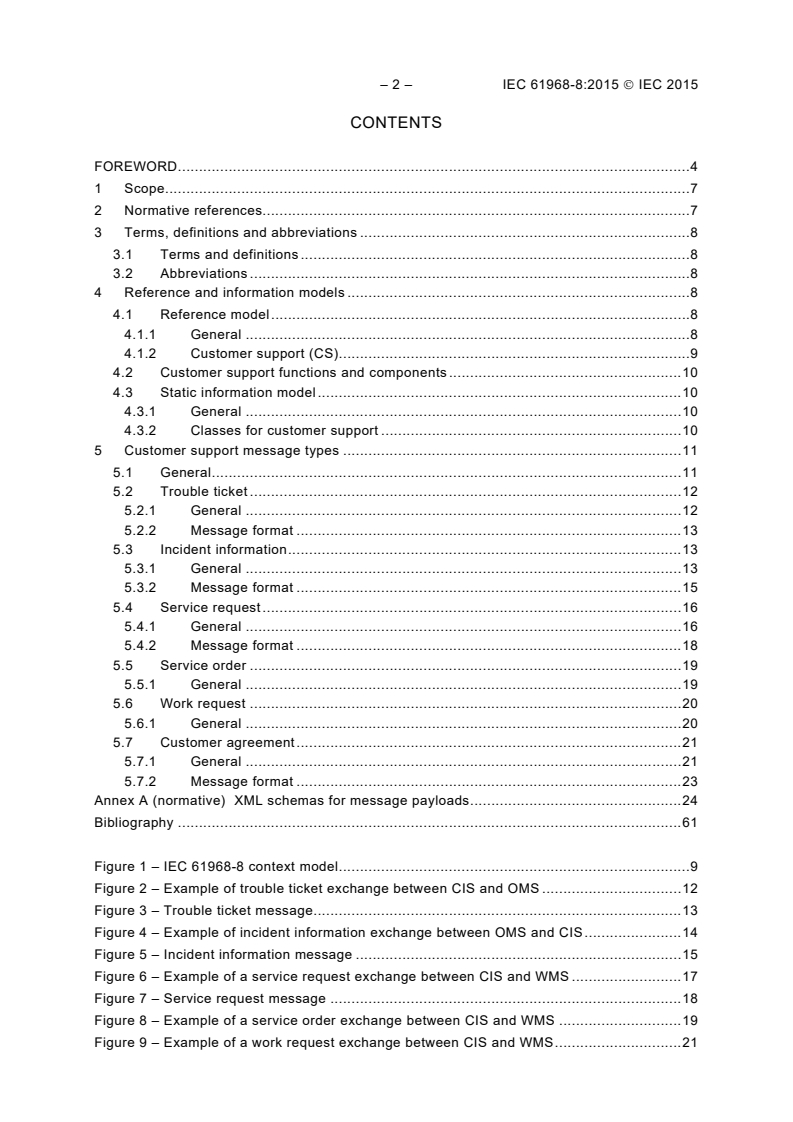
IEC 61968-8:2015 - Application integration at electric utilities - System interfaces for distribution management - Part 8: Interfaces for customer operations Released:5/27/2015
Overview
IEC 61968-8:2015 - part of the IEC 61968 series - defines standard system interfaces for customer operations in electric utility distribution management. It specifies the information content of a set of message types used to support customer support (CS) business functions such as service requests, customer agreements, and trouble management. The standard targets inter-application integration across the utility enterprise - enabling exchange of customer-related information between Customer Information Systems (CIS) and other systems (e.g., Outage Management Systems, Work Management Systems).
Key Topics
- Message types and payloads: Standardized message structures for trouble tickets, incident information, service requests, service orders, work requests and customer agreements.
- Information and reference models: A reference model and static information model that define classes and relationships used in customer operations messaging.
- XML schemas (XSD): Annex A provides sample XML schemas for message payloads to support implementation and message validation.
- Integration scope: Focus on exchange of information between a customer support system and other enterprise systems (loose coupling, heterogeneous environments).
- Use-case examples: Illustrative flows such as CIS ↔ OMS trouble ticket exchange and CIS ↔ WMS service order/work request exchanges.
- Normative structure: Includes terms/definitions, normative references and message format guidance for implementers.
Applications
IEC 61968-8 is practical for:
- Utilities seeking standard integration between Customer Service/CRM (CIS) and operational systems (Outage Management, Work Management).
- System integrators and software vendors building middleware, ESBs or message-based interfaces for distribution management.
- IT architects implementing inter-application messaging (near-real-time exchanges) across legacy and third‑party applications.
- Operational teams improving workflows for trouble management, service provisioning, point-of-sale interactions and customer agreements.
Benefits:
- Reduces custom interface development by providing standardized message semantics and XSD examples.
- Supports reliable exchange of customer-centric operational data for faster incident resolution, accurate service orders and consistent customer records.
Related Standards
- IEC 61968 series (Application integration at electric utilities - system interfaces for distribution management) - IEC 61968-8 complements other parts of the series.
- IEC 61968-1 (Interface Architecture and General Requirements) - provides the overall Interface Reference Model that IEC 61968-8 leverages.
Keywords: IEC 61968-8, application integration, customer support, distribution management, message types, service request, trouble management, customer agreement, CIS, OMS, XML schemas.
Buy Documents
IEC 61968-8:2015 - Application integration at electric utilities - System interfaces for distribution management - Part 8: Interfaces for customer operations Released:5/27/2015
IEC 61968-8:2015 - Application integration at electric utilities - System interfaces for distribution management - Part 8: Interfaces for customer operations Released:5/27/2015
Get Certified
Connect with accredited certification bodies for this standard

ANCE
Mexican certification and testing association.

Intertek Slovenia
Intertek testing, inspection, and certification services in Slovenia.

LNE (Laboratoire National de Métrologie et d'Essais)
French national laboratory for metrology and testing.
Sponsored listings
Frequently Asked Questions
IEC 61968-8:2015 is a standard published by the International Electrotechnical Commission (IEC). Its full title is "Application integration at electric utilities - System interfaces for distribution management - Part 8: Interfaces for customer operations". This standard covers: IEC 61968-8:2015 specifies the information content of a set of message types that can be used to support many of the business functions related to customer support. Typical uses of the message types include service request, customer agreement, and trouble management. The purpose is to define a standard for the integration of customer support (CS), which would include customer service, trouble management and point of sale related components integrated with other systems and business functions within the scope of IEC 61968. The scope of this standard is the exchange of information between a customer support system and other systems within the utility enterprise.
IEC 61968-8:2015 specifies the information content of a set of message types that can be used to support many of the business functions related to customer support. Typical uses of the message types include service request, customer agreement, and trouble management. The purpose is to define a standard for the integration of customer support (CS), which would include customer service, trouble management and point of sale related components integrated with other systems and business functions within the scope of IEC 61968. The scope of this standard is the exchange of information between a customer support system and other systems within the utility enterprise.
IEC 61968-8:2015 is classified under the following ICS (International Classification for Standards) categories: 31.140 - Piezoelectric devices; 33.200 - Telecontrol. Telemetering. The ICS classification helps identify the subject area and facilitates finding related standards.
IEC 61968-8:2015 is available in PDF format for immediate download after purchase. The document can be added to your cart and obtained through the secure checkout process. Digital delivery ensures instant access to the complete standard document.
Standards Content (Sample)
IEC 61968-8 ®
Edition 1.0 2015-05
INTERNATIONAL
STANDARD
colour
inside
Application integration at electric utilities – System interfaces for distribution
management –
Part 8: Interfaces for customer operations
All rights reserved. Unless otherwise specified, no part of this publication may be reproduced or utilized in any form
or by any means, electronic or mechanical, including photocopying and microfilm, without permission in writing from
either IEC or IEC's member National Committee in the country of the requester. If you have any questions about IEC
copyright or have an enquiry about obtaining additional rights to this publication, please contact the address below or
your local IEC member National Committee for further information.
IEC Central Office Tel.: +41 22 919 02 11
3, rue de Varembé Fax: +41 22 919 03 00
CH-1211 Geneva 20 info@iec.ch
Switzerland www.iec.ch
About the IEC
The International Electrotechnical Commission (IEC) is the leading global organization that prepares and publishes
International Standards for all electrical, electronic and related technologies.
About IEC publications
The technical content of IEC publications is kept under constant review by the IEC. Please make sure that you have the
latest edition, a corrigenda or an amendment might have been published.
IEC Catalogue - webstore.iec.ch/catalogue Electropedia - www.electropedia.org
The stand-alone application for consulting the entire The world's leading online dictionary of electronic and
bibliographical information on IEC International Standards, electrical terms containing more than 30 000 terms and
Technical Specifications, Technical Reports and other definitions in English and French, with equivalent terms in 15
documents. Available for PC, Mac OS, Android Tablets and additional languages. Also known as the International
iPad. Electrotechnical Vocabulary (IEV) online.
IEC publications search - www.iec.ch/searchpub IEC Glossary - std.iec.ch/glossary
The advanced search enables to find IEC publications by a More than 60 000 electrotechnical terminology entries in
variety of criteria (reference number, text, technical English and French extracted from the Terms and Definitions
committee,…). It also gives information on projects, replaced clause of IEC publications issued since 2002. Some entries
and withdrawn publications. have been collected from earlier publications of IEC TC 37,
77, 86 and CISPR.
IEC Just Published - webstore.iec.ch/justpublished
Stay up to date on all new IEC publications. Just Published IEC Customer Service Centre - webstore.iec.ch/csc
details all new publications released. Available online and If you wish to give us your feedback on this publication or
also once a month by email. need further assistance, please contact the Customer Service
Centre: csc@iec.ch.
IEC 61968-8 ®
Edition 1.0 2015-05
INTERNATIONAL
STANDARD
colour
inside
Application integration at electric utilities – System interfaces for distribution
management –
Part 8: Interfaces for customer operations
INTERNATIONAL
ELECTROTECHNICAL
COMMISSION
ICS 33.200 ISBN 978-2-8322-2678-0
– 2 – IEC 61968-8:2015 IEC 2015
CONTENTS
FOREWORD . 4
1 Scope . 7
2 Normative references . 7
3 Terms, definitions and abbreviations . 7
3.1 Terms and definitions . 7
3.2 Abbreviations . 8
4 Reference and information models . 8
4.1 Reference model . 8
4.1.1 General . 8
4.1.2 Customer support (CS) . 9
4.2 Customer support functions and components . 9
4.3 Static information model . 9
4.3.1 General . 9
4.3.2 Classes for customer support . 9
5 Customer support message types . 10
5.1 General . 10
5.2 Trouble ticket . 11
5.2.1 General . 11
5.2.2 Message format . 12
5.3 Incident information . 12
5.3.1 General . 12
5.3.2 Message format . 14
5.4 Service request . 15
5.4.1 General . 15
5.4.2 Message format . 16
5.5 Service order . 17
5.5.1 General . 17
5.6 Work request . 17
5.6.1 General . 17
5.7 Customer agreement . 18
5.7.1 General . 18
5.7.2 Message format . 20
Annex A (normative) XML schemas for message payloads . 21
Bibliography . 58
Figure 1 – IEC 61968-8 context model . 8
Figure 2 – Example of trouble ticket exchange between CIS and OMS . 11
Figure 3 – Trouble ticket message . 12
Figure 4 – Example of incident information exchange between OMS and CIS . 13
Figure 5 – Incident information message . 14
Figure 6 – Example of a service request exchange between CIS and WMS . 15
Figure 7 – Service request message . 16
Figure 8 – Example of a service order exchange between CIS and WMS . 17
Figure 9 – Example of a work request exchange between CIS and WMS . 18
Figure 10 – Example of a customer exchange between CIS and external or third party
systems . 19
Figure 11 – Customer agreement message . 20
Figure A.1 – Trouble ticket XSD . 24
Figure A.2 – Incident information XSD . 28
Figure A.3 – Customer agreement XSD . 35
Figure A.4 – Service request XSD . 57
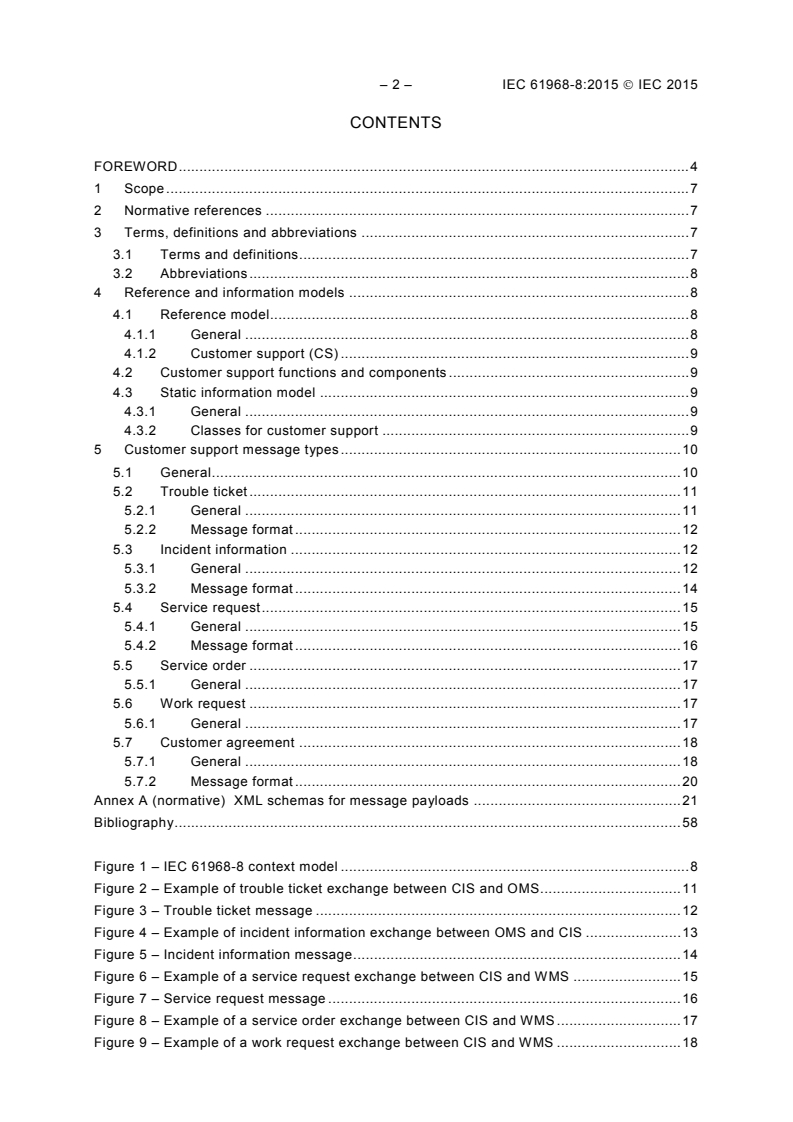
Table 1 – Document overview for IEC 61968-8 . 6
Table 2 – Business functions and abstract components . 9
Table 3 – Customer support classes . 10
– 4 – IEC 61968-8:2015 IEC 2015
INTERNATIONAL ELECTROTECHNICAL COMMISSION
___________
APPLICATION INTEGRATION AT ELECTRIC UTILITIES –
SYSTEM INTERFACES FOR DISTRIBUTION MANAGEMENT –
Part 8: Interfaces for customer operations
FOREWORD
1) The International Electrotechnical Commission (IEC) is a worldwide organization for standardization comprising
all national electrotechnical committees (IEC National Committees). The object of IEC is to promote
international co-operation on all questions concerning standardization in the electrical and electronic fields. To
this end and in addition to other activities, IEC publishes International Standards, Technical Specifications,
Technical Reports, Publicly Available Specifications (PAS) and Guides (hereafter referred to as “IEC
Publication(s)”). Their preparation is entrusted to technical committees; any IEC National Committee interested
in the subject dealt with may participate in this preparatory work. International, governmental and non-
governmental organizations liaising with the IEC also participate in this preparation. IEC collaborates closely
with the International Organization for Standardization (ISO) in accordance with conditions determined by
agreement between the two organizations.
2) The formal decisions or agreements of IEC on technical matters express, as nearly as possible, an international
consensus of opinion on the relevant subjects since each technical committee has representation from all
interested IEC National Committees.
3) IEC Publications have the form of recommendations for international use and are accepted by IEC National
Committees in that sense. While all reasonable efforts are made to ensure that the technical content of IEC
Publications is accurate, IEC cannot be held responsible for the way in which they are used or for any
misinterpretation by any end user.
4) In order to promote international uniformity, IEC National Committees undertake to apply IEC Publications
transparently to the maximum extent possible in their national and regional publications. Any divergence
between any IEC Publication and the corresponding national or regional publication shall be clearly indicated in
the latter.
5) IEC itself does not provide any attestation of conformity. Independent certification bodies provide conformity
assessment services and, in some areas, access to IEC marks of conformity. IEC is not responsible for any
services carried out by independent certification bodies.
6) All users should ensure that they have the latest edition of this publication.
7) No liability shall attach to IEC or its directors, employees, servants or agents including individual experts and
members of its technical committees and IEC National Committees for any personal injury, property damage or
other damage of any nature whatsoever, whether direct or indirect, or for costs (including legal fees) and
expenses arising out of the publication, use of, or reliance upon, this IEC Publication or any other IEC
Publications.
8) Attention is drawn to the Normative references cited in this publication. Use of the referenced publications is
indispensable for the correct application of this publication.
9) Attention is drawn to the possibility that some of the elements of this IEC Publication may be the subject of
patent rights. IEC shall not be held responsible for identifying any or all such patent rights.
International Standard IEC 61968-8 has been prepared by IEC technical committee 57: Power
systems management and associated information exchange.
The text of this standard is based on the following documents:
FDIS Report on voting
57/1548/FDIS 57/1573/RVD
Full information on the voting for the approval of this standard can be found in the report on
voting indicated in the above table.
This publication has been drafted in accordance with the ISO/IEC Directives, Part 2.
A list of all parts of the IEC 61968 series, under the general title: Application integration at
electric utilities – System interfaces for distribution management, can be found on the IEC
website.
The committee has decided that the contents of this publication will remain unchanged until
the stability date indicated on the IEC web site under "http://webstore.iec.ch" in the data
related to the specific publication. At this date, the publication will be
• reconfirmed,
• withdrawn,
• replaced by a revised edition, or
• amended.
A bilingual version of this publication may be issued at a later date.
IMPORTANT – The 'colour inside' logo on the cover page of this publication indicates
that it contains colours which are considered to be useful for the correct
understanding of its contents. Users should therefore print this document using a
colour printer.
– 6 – IEC 61968-8:2015 IEC 2015
INTRODUCTION
The purpose of this part of IEC 61968 is to define a standard for the integration of Customer
Support (CS), which would include Customer Service, Trouble Management and Point of Sale
related components integrated with other systems and business functions within the scope of
IEC 61968. The scope of this standard is the exchange of information between a customer
support system and other systems within the utility enterprise.
The IEC 61968 series of standards is intended to facilitate inter-application integration as
opposed to intra-application integration. Intra-application integration is aimed at programs in
the same application system, usually communicating with each other using middleware that is
embedded in their underlying runtime environment, and tends to be optimised for close, real-
time, synchronous connections and interactive request/reply or conversation communication
models. IEC 61968, by contrast, is intended to support the inter-application integration of a
utility enterprise that needs to connect disparate applications that are already built or new
(legacy or purchased applications), each supported by dissimilar runtime environments.
Therefore, these interface standards are relevant to loosely coupled applications with more
heterogeneity in languages, operating systems, protocols and management tools. This series
of standards is intended to support applications that need to exchange data every few
seconds, minutes, or hours rather than waiting for a nightly batch run. This series of
standards, which are intended to be implemented with middleware services that exchange
messages among applications, will complement, not replace utility data warehouses,
database gateways, and operational stores.
As used in IEC 61968, a Distribution Management System (DMS) consists of various
distributed application components for the utility to manage electrical distribution networks.
These capabilities include monitoring and control of equipment for power delivery,
management processes to ensure system reliability, voltage management, demand-side
management, outage management, work management, automated mapping and facilities
management. Standard interfaces are defined for each class of applications identified in the
Interface Reference Model (IRM), which is described in IEC 61968-1: Application integration
at electric utilities – System interfaces for distribution management – Interface Architecture
and General Requirements.
This part of IEC 61968 contains the clauses listed in Table 1.
Table 1 – Document overview for IEC 61968-8
Clause Title Purpose
1.
Scope The scope and purpose of the document are described.
2.
Normative references Documents that contain provisions which, through reference in
this text, constitute provisions of this international standard.
3.
Terms, definitions and
abbreviations
4.
Reference and information Description of general approach to customer support,
models reference model, interface reference model, customer support
functions and components, message type terms and static
information model.
5.
Customer support message Message types related to the exchange of information for
types documents related to customer services.
Annex A
Sample XML schemas for To provide XSD information for information use only.
message payloads
APPLICATION INTEGRATION AT ELECTRIC UTILITIES –
SYSTEM INTERFACES FOR DISTRIBUTION MANAGEMENT –
Part 8: Interfaces for customer operations
1 Scope
This part of IEC 61968 specifies the information content of a set of message types that can be
used to support many of the business functions related to customer support. Typical uses of
the message types include service request, customer agreement, and trouble management.
The purpose of this part of IEC 61968 is to define a standard for the integration of customer
support (CS), which would include customer service, trouble management and point of sale
related components integrated with other systems and business functions within the scope of
IEC 61968. The scope of this standard is the exchange of information between a customer
support system and other systems within the utility enterprise.
2 Normative references
The following documents, in whole or in part, are normatively referenced in this document and
are indispensable for its application. For dated references, only the edition cited applies. For
undated references, the latest edition of the referenced document (including any
amendments) applies.
IEC 60050, International Electrotechnical Vocabulary
IEC 61968-1, Application integration at electric utilities – System interfaces for distribution
management – Part 1: Interface architecture and general recommendations
IEC TS 61968-2, Application integration at electric utilities – System interfaces for distribution
management – Part 2: Glossary
IEC 61968-6, Application integration at electric utilities – System interfaces for distribution
management – Part 6: Interfaces for maintenance and construction
IEC 61968-11, Application integration at electric utilities – System interfaces for distribution
management – Part 11: Common information model (CIM) extensions for distribution
IEC 61968-100, Application integration at electric utilities – System interfaces for distribution
management – Part 100: Implementation profiles
IEC 61970-301, Energy management system application program interface (EMS-API) – Part
301: Common information model (CIM) base
3 Terms, definitions and abbreviations
3.1 Terms and definitions
For the purposes of this standard, the terms and definitions given in IEC 60050-300,
IEC 61968-2, IEC 62051 and IEC 62055-31 apply.
Where there is a difference between the definitions in this standard and those contained in
other referenced IEC standards, then those defined in IEC 61968-2 shall take precedence
over the others listed, and those defined in this document shall take precedence over those
defined in IEC 61968-2.
______________
To be published.
– 8 – IEC 61968-8:2015 IEC 2015
3.2 Abbreviations
CIM Common information model
CIS Customer information system
CRM Customer relationship management
CSR Customer service representative
ERT Estimated restoration time
IVR Interactive voice response
NO Network operations
OMS Outage management system
POS Point of sale
UML Unified modelling language
WM Work management
XSD XML schema definition
4 Reference and information models
4.1 Reference model
4.1.1 General
The diagram in Figure 1 serves as a reference model and provides examples of the logical
components and data flows related to the context of this part of IEC 61968.
Figure 1 describes the information flows between the components defined in this part of
IEC 61968 and the components in the reference model defined in IEC 61968-1.
61968 Parts 3-10
(10) External (6) Maintenance and (3) Trouble call
to DMS (EXT-ACT) construction (MC) management (NO)
(5) (3) (4) (2) (1)
(6)
Customer service Trouble call
(CSRV) management (TCM)
Part 8 Customer support (CS)
1. Trouble ticket
2. Incident information
3. Service order
4. Work request
5. Customer agreement
6. Service request
IEC
Figure 1 – IEC 61968-8 context model
4.1.2 Customer support (CS)
Typical tasks of customer support:
• Customer services may include, but are not limited to, customer enquiries, new service,
program enrollment and service or work request updates.
• Trouble call management may include, but are not limited to, trouble calls reported from
customers and non-customers, outage notifications and restoration updates.
4.2 Customer support functions and components
Table 2 shows these functions and typical abstract components that are expected to be
producers of information for these message types. Typical consumers of the information
include, but are not restricted to, the other components as listed in IEC 61968-1.
Table 2 – Business functions and abstract components
Service requests
Customer support (CS)
Construction billing inquiry
Billing inquiry
Work status
Self-service inquiry
Customer connection
Customer service (CSRV)
Turn on, turn off
Line losses
Service level agreements
Customer information analysis
Customer information management
Customer relationship management
Outage calls
Trouble call management (TCM)
Power quality
Planned outage notifications
Media communication
Performance indices
Restoration projection/confirmation
Outage history
Point of sale (POS)
4.3 Static information model
4.3.1 General
The information model relevant to customer support consists of classes that provide a
template for the attributes for each message.
The classes are defined in detail in IEC 61968-11, Application integration at electric utilities –
System interfaces for distribution management – Part 11: Common Information Model (CIM)
Extensions for Distribution or in IEC 61970-301, Energy management system application
program interfaces (EMS-API) – Part 301: Common information model (CIM) base.
4.3.2 Classes for customer support
Table 3 lists classes used within message types. Usually all the attributes of these classes
are contained within a message type. The descriptions provided describe usage within this
part.
Classes described as type "Customer" are defined in the 61968/customer package of the CIM.
– 10 – IEC 61968-8:2015 IEC 2015
Table 3 – Customer support classes
Class/Noun Package Description
Customer Customers Organisation receiving services from service supplier
CustomerAgreement Customers Agreement between the customer and the service supplier to pay
for service at a specific service location. It records certain billing
information about the type of service provided at the service
location and is used during charge creation to determine the type
of service
DemandResponseProgram Metering Demand response program
Incident Operations Description of a problem in the field that may be reported in a
trouble ticket or come from another source. It may have to do
with an outage
Location Common The place, scene, or point of something where someone or
something has been, is, and/or will be at a given moment in time.
It can be defined with one or more position points (coordinates)
in a given coordinate system
Outage Operations Document describing details of an active or planned outage in a
part of the electrical network.
A non-planned outage may be created upon:
– a breaker trip,
– a fault indicator status change,
– a meter event indicating customer outage,
– a reception of one or more customer trouble calls, or
– an operator command, reflecting information obtained from
the field crew.
Outage restoration may be performed using a switching plan
which complements the outage information with detailed
switching activities, including the relationship to the crew and
work.
A planned outage may be created upon:
– a request for service, maintenance or construction work in
the field, or
– an operator-defined outage for what-if/contingency network
analysis.
The associated outage plan defines operational restrictions and
atomic switch actions to define the changes that, after applied,
would result in a total or partial equipment outage as required for
network analysis.
ServiceCategory Customers Category of service provided to the customer
ServiceLocation Customers A real estate location, commonly referred to as premise
TroubleTicket Customers A document that provides details about trouble in the power
network
Work Work Document used to request, initiate, track and record work
NOTE The class definitions provided here are for convenience purposes only. The normative definitions are
provided by IEC 61968-11, which describes the distribution extensions to the IEC CIM standard.
5 Customer support message types
5.1 General
The purpose of this section is to describe the message types related to IEC 61968-8. It is
important to note that some of these message types may also be used by other parts of
IEC 61968. The general approach to the realization of message structures and XML schemas
for IEC 61968 messages is described in IEC 61968-1 and IEC 61968-100.
It is also important to note that the use cases and sequence diagrams provided in this
standard are informative in nature, and are intended to provide examples of usage for the
normative messages definitions. There is no intent by this standard to standardize specific
business processes.
5.2 Trouble ticket
5.2.1 General
Many electric utilities depend on the calls from the customers to begin the process to identify
the location of the faulted section of the electric distribution circuit. The trouble ticket is the
communication mechanism between the utility and the customer that is used to initiate an
analysis to determine where best to deploy field personnel for service restoration. The trouble
ticket is typically created based on direct conversation with the customer. The trouble ticket is
also created based on customer report via an automated call taking system and on an outage
report from an AMI meter. The trouble ticket contains the information of a customer call.
Once created, the trouble ticket may be sent to the OMS for further processing.
Figure 2 provides a sequence diagram showing the use case for communication between the
CIS and OMS using the trouble ticket message. Figure 3 presents an XSD diagram showing
the contents of the trouble ticket message.
sd Trouble ticket
CS-TCM NO-FLT
(CIS) (OMS)
Call taker obtains all the relevent
information from the customer and enters
the data into the call tracking application
Created (trouble ticket)
Obtain connectivity topology
and determine potential
scope of trouble
opt
Changed (trouble ticket)
IEC
Figure 2 – Example of trouble ticket exchange between CIS and OMS
– 12 – IEC 61968-8:2015 IEC 2015
5.2.2 Message format
IEC
Figure 3 – Trouble ticket message
5.3 Incident information
5.3.1 General
When there is an outage and it is a confirmed outage, utilities typically can provide an
estimated restoration time (ERT) depending on where the event is within the outage
management processes. A request is made to outage management for a status update on a
particular trouble ticket assigned to an outage incident, or to determine if an incident already
exists before creating a trouble ticket (See Figure 4 showing the use case for this message
exchange).
When making a trouble call, some callers request for a call back at a certain point in the
restoration phase; e.g. at the time of arrival of the crew or when the supply is restored. This
message needs to be created when the call back is due and lists the customers requiring call
back. While the incident information message is generated by the Outage Management
System (OMS), it is included in this document to complete the interaction between the CIS
and the OMS and will be removed from this standard when the message is included in the
IEC 61968-3. Figure 5 details the contents of the incident information message and includes
the required elements of the CIS as well as the OMS.
sd Incident information
NO-FLT CS-CSRV
(OMS)
Changed (incident information)
Update associated
trouble ticket
IEC
Figure 4 – Example of incident information exchange between OMS and CIS
– 14 – IEC 61968-8:2015 IEC 2015
5.3.2 Message format
IEC
Figure 5 – Incident information message
5.4 Service request
5.4.1 General
Customers initiate service requests as their main point of contact with the utility. Service
requests by a customer may include but are not limited to:
• Request to turn an existing service on or off (move in/move out, seasonal, etc.)
• Request a new service (electrification of a garage, new house, etc.)
• Request investigation into power quality or other concern about an existing service
(not a trouble or outage call)
• Enroll or de-enroll in a customer program (demand response, etc.)
• Account issues (billing inquiries, high bill complaints, etc.)
Service requests may be initiated:
• In person at a utility office with a customer service representative (CSR)
• Over the internet to CIS or CRM systems
• Through an automated IVR system
• Over the telephone with a CSR
Once a service request is received, the CIS sends it to the WMS for further processing
(see Figure 6).
Service requests may:
• Be manually handled by a customer service representative
• Cause a service order to be created and assigned to a field service technician/crew
• Cause a work request to be created in work management, which in turn may generate
a work order or some other action
Service requests are typically handled by a manual process, but increasingly require an
electronic representation between front end systems such as IVR and CRM, which send a
service request message (see Figure 7 for message contents) to the customer information
system.
sd Service order
Customer MC-SCHD
support
Customer or person creates
a service request
Created (service request)
IEC
Figure 6 – Example of a service request exchange between CIS and WMS
– 16 – IEC 61968-8:2015 IEC 2015
5.4.2 Message format
IEC
Figure 7 – Service request message
5.5 Service order
5.5.1 General
A service order is an IEC 61968-6 message and is created when customer service needs to
have some work done at a customer premise. The service order is created as one possible
response to a service request.
The service order contains the information for a field service technician or crew to perform the
work required by the customer such as:
• Service connection / disconnection
• Power quality / high bill investigation
• Meter service, such as meter replacement
Figure 8 shows the work flow between CIS and WMS when a service order message is
exchanged.
Service orders by definition define work to be performed on an existing service and therefore
typically include account and existing premise information. If a new service is required, a
maintenance or construction order is required instead. The final task of a maintenance order
for installing a new service is usually a meter set. This job is often performed by field service
crews or technicians, so that meter set may occur as a service order, or as part of the
maintenance order depending on the utility.
sd Service order
CS-TCM MC-SCHD
(CIS) (WMS)
Someone creates
a service request
Created (service request)
Processing
Created (service order)
IEC
Figure 8 – Example of a service order exchange between CIS and WMS
The service order message is defined fully in IEC 61968-6.
5.6 Work request
5.6.1 General
A work request is an IEC 61968-6 message and informs work management that some work
may be required on company assets. While there are numerous work management-initiated
use cases for creating a work request, such as inspections and maintenance, this subclause
describes work requests that are created by the customer support organization.
– 18 – IEC 61968-8:2015 IEC 2015
The work request is the main point of contact between the customer service organization and
the engineering or maintenance organization. Figure 9 shows the work request message
exchange between the CIS and WMS.
Typical reasons for customer service to create a work request include:
• A new customer wishes a new service to be created, such when a new house is built
• An existing customer wishes to extend their service, such as adding power to
previously unpowered garage
• An existing customer wishes to modify their service, such as upgrading from 100 A to
200 A service.
Engineering may create a maintenance order or construction order in the work management
system to track the estimation, design, planning and eventually construction crew tasks to be
performed in the field. Other utilities only create the maintenance or construction order when
there is actual work to be done in the field.
Other processes that may cause the creation of maintenance or construction order include
contribution in aid of construction or other evaluation.
Customers may end up declining to have the work done upon receipt of the estimate, and for
many utilities that would mean that a maintenance or construction order never gets created in
response to the work request.
The work request contains as much information as is needed for the eventual creation of a
construction or maintenance order.
sd Work request
Customer MC-SCHD
support
Customer or person creates
a work request
Created (work request)
IEC
Figure 9 – Example of a work request exchange between CIS and WMS
The work request message is defined in IEC 61968-6 as well as the maintenance order and
construction order messages.
5.7 Customer agreement
5.7.1 General
The customer service agreement documents the terms and conditions between the utility and
the Customer for the provision of electricity. Not all utilities require a customer service
agreement; however, utilities will assign the rate appropriate for the requested customer
connection.
The customer agreement configuration message has been included in IEC 61968-9 because
this Part 8 had not been published and the Automated Metering systems needed this
message defined to fully define the exchanges with other back office systems. The
GetCustomerAgreements is also contained in IEC 61968-9 and will remain there until the next
release of this IS when it will be moved to IEC 61968-8. The CustomerAgreementConfig
nd
message that is currently contained in the 2 edition of IEC 61968-9 will be removed in the
next edition and will remain a part of IEC 61968-8.
Figure 10 provides a sequence diagram showing the use case for communication between the
CIS and external or third party systems using the customer agreement message. Figure 11
presents an XSD diagram showing the contents of the customer agreement configuration
message.
sd Customer agreement
EXT-SAL Customer
support
Created (customer agreement)
IEC
Figure 10 – Example of a customer exchange between CIS
and external or third party systems
– 20 – IEC 61968-8:2015 IEC 2015
5.7.2 Message format
IEC
Figure 11 – Customer agreement message
Annex A
(normative)
XML schemas for message payloads
The purpose of this annex is to provide examples of XML schemas (see Figure A.1,
Figure A.2, Figure A.3 and Figure A.4) for message payloads to augment the descriptions
provided earlier in this document. These XML Schemas were defined using profile definitions
within CIMTool. These schemas may be extended as needed for specific implementation
needs.
xmlns:sawsdl="http://www.w3.org/ns/sawsdl" xmlns="http://langdale.com.au/2005/Message#"
xmlns:m="http://iec.ch/TC57/2014/TroubleTickets/1#" targetNamespace="http://iec.ch/TC57/2014/TroubleTickets/1#"
elementFormDefault="qualified" attributeFormDefault="unqualified">
maxOccurs="unbounded"/>
Organisation receiving services from service supplier.
sawsdl:modelReference="http://iec.ch/TC57/CIM-generic#IdentifiedObject.mRID">
Master resource identifier issued by a model authority.
The mRID must semantically be a UUID as specified in RFC 4122. The mRID is globally unique.
For CIMXML data files in RDF syntax, the mRID is
mapped to rdf:ID or rdf:about attributes that identify CIM object elements.
Conditions for notifying the customer about the changes in the status of their
service (e.g., outage restore, estimated restoration time, tariff or service level change, etc.)
sawsdl:modelReference="http://iec.ch/TC57/CIM-generic#CustomerNotification.contactType">
Type of contact (e.g., phone, email,
etc.).
sawsdl:modelReference="http://iec.ch/TC57/CIM-generic#CustomerNotification.contactValue">
Value of contact type (e.g., phone number, email
address, etc.).
sawsdl:modelReference="http://iec.ch/TC57/CIM-generic#CustomerNotification.earliestDateTimeToCall">
Earliest date time to call the
customer.
– 22 – IEC 61968-8:2015 IEC 2015
sawsdl:modelReference="http://iec.ch/TC57/CIM-generic#CustomerNotification.latestDateTimeToCall">
Latest date time to call the
customer.
sawsdl:modelReference="http://iec.ch/TC57/CIM-generic#CustomerNotification.trigger">
Trigger for this notification.
Description of a problem in the field that may be reported in a trouble ticket or
come from another source. It may have to do with an outage.
sawsdl:modelReference="http://iec.ch/TC57/CIM-generic#IdentifiedObject.mRID">
Master resource identifier issued by a model authority.
The mRID must semantically be a UUID as specified in RFC 4122. The mRID is globally unique.
For CIMXML data files in RDF syntax, the mRID is
mapped to rdf:ID or rdf:about attributes that identify CIM object elements.
sawsdl:modelReference="http://iec.ch/TC57/CIM-generic#IdentifiedObject.description">
The description is a free human readable text describing
or naming the object. It may be non unique and may not correlate to a naming hierarchy.
sawsdl:modelReference="http://iec.ch/TC57/CIM-generic#IdentifiedObject.name">
The name is any free human readable and possibly non
unique text naming the object.
Hazardous situation associated with an incident. Examples are l
...
IEC 61968-8 ®
Edition 1.0 2015-05
INTERNATIONAL
STANDARD
NORME
INTERNATIONALE
colour
inside
Application integration at electric utilities – System interfaces for distribution
management –
Part 8: Interfaces for customer operations
Intégration d'applications pour les services électriques – Interfaces système
pour la gestion de distribution –
Partie 8: Interfaces pour l'assistance à la clientèle
All rights reserved. Unless otherwise specified, no part of this publication may be reproduced or utilized in any form
or by any means, electronic or mechanical, including photocopying and microfilm, without permission in writing from
either IEC or IEC's member National Committee in the country of the requester. If you have any questions about IEC
copyright or have an enquiry about obtaining additional rights to this publication, please contact the address below or
your local IEC member National Committee for further information.
Droits de reproduction réservés. Sauf indication contraire, aucune partie de cette publication ne peut être reproduite
ni utilisée sous quelque forme que ce soit et par aucun procédé, électronique ou mécanique, y compris la photocopie
et les microfilms, sans l'accord écrit de l'IEC ou du Comité national de l'IEC du pays du demandeur. Si vous avez des
questions sur le copyright de l'IEC ou si vous désirez obtenir des droits supplémentaires sur cette publication, utilisez
les coordonnées ci-après ou contactez le Comité national de l'IEC de votre pays de résidence.
IEC Central Office Tel.: +41 22 919 02 11
3, rue de Varembé Fax: +41 22 919 03 00
CH-1211 Geneva 20 info@iec.ch
Switzerland www.iec.ch
About the IEC
The International Electrotechnical Commission (IEC) is the leading global organization that prepares and publishes
International Standards for all electrical, electronic and related technologies.
About IEC publications
The technical content of IEC publications is kept under constant review by the IEC. Please make sure that you have the
latest edition, a corrigenda or an amendment might have been published.
IEC Catalogue - webstore.iec.ch/catalogue Electropedia - www.electropedia.org
The stand-alone application for consulting the entire The world's leading online dictionary of electronic and
bibliographical information on IEC International Standards, electrical terms containing 20 000 terms and definitions in
Technical Specifications, Technical Reports and other English and French, with equivalent terms in 15 additional
documents. Available for PC, Mac OS, Android Tablets and languages. Also known as the International Electrotechnical
iPad. Vocabulary (IEV) online.
IEC publications search - www.iec.ch/searchpub IEC Glossary - std.iec.ch/glossary
The advanced search enables to find IEC publications by a 65 000 electrotechnical terminology entries in English and
variety of criteria (reference number, text, technical French extracted from the Terms and Definitions clause of
committee,…). It also gives information on projects, replaced IEC publications issued since 2002. Some entries have been
and withdrawn publications. collected from earlier publications of IEC TC 37, 77, 86 and
CISPR.
IEC Just Published - webstore.iec.ch/justpublished
Stay up to date on all new IEC publications. Just Published IEC Customer Service Centre - webstore.iec.ch/csc
details all new publications released. Available online and If you wish to give us your feedback on this publication or
also once a month by email. need further assistance, please contact the Customer Service
Centre: csc@iec.ch.
A propos de l'IEC
La Commission Electrotechnique Internationale (IEC) est la première organisation mondiale qui élabore et publie des
Normes internationales pour tout ce qui a trait à l'électricité, à l'électronique et aux technologies apparentées.
A propos des publications IEC
Le contenu technique des publications IEC est constamment revu. Veuillez vous assurer que vous possédez l’édition la
plus récente, un corrigendum ou amendement peut avoir été publié.
Catalogue IEC - webstore.iec.ch/catalogue Electropedia - www.electropedia.org
Application autonome pour consulter tous les renseignements
Le premier dictionnaire en ligne de termes électroniques et
bibliographiques sur les Normes internationales,
électriques. Il contient 20 000 termes et définitions en anglais
Spécifications techniques, Rapports techniques et autres
et en français, ainsi que les termes équivalents dans 15
documents de l'IEC. Disponible pour PC, Mac OS, tablettes
langues additionnelles. Egalement appelé Vocabulaire
Android et iPad.
Electrotechnique International (IEV) en ligne.
Recherche de publications IEC - www.iec.ch/searchpub
Glossaire IEC - std.iec.ch/glossary
La recherche avancée permet de trouver des publications IEC 65 000 entrées terminologiques électrotechniques, en anglais
en utilisant différents critères (numéro de référence, texte, et en français, extraites des articles Termes et Définitions des
comité d’études,…). Elle donne aussi des informations sur les publications IEC parues depuis 2002. Plus certaines entrées
projets et les publications remplacées ou retirées. antérieures extraites des publications des CE 37, 77, 86 et
CISPR de l'IEC.
IEC Just Published - webstore.iec.ch/justpublished
Service Clients - webstore.iec.ch/csc
Restez informé sur les nouvelles publications IEC. Just
Published détaille les nouvelles publications parues. Si vous désirez nous donner des commentaires sur cette
Disponible en ligne et aussi une fois par mois par email. publication ou si vous avez des questions contactez-nous:
csc@iec.ch.
IEC 61968-8 ®
Edition 1.0 2015-05
INTERNATIONAL
STANDARD
NORME
INTERNATIONALE
colour
inside
Application integration at electric utilities – System interfaces for distribution
management –
Part 8: Interfaces for customer operations
Intégration d'applications pour les services électriques – Interfaces système
pour la gestion de distribution –
Partie 8: Interfaces pour l'assistance à la clientèle
INTERNATIONAL
ELECTROTECHNICAL
COMMISSION
COMMISSION
ELECTROTECHNIQUE
INTERNATIONALE
ICS 33.200 ISBN 978-2-8322-3258-3
– 2 – IEC 61968-8:2015 IEC 2015
CONTENTS
FOREWORD . 4
1 Scope . 7
2 Normative references. 7
3 Terms, definitions and abbreviations . 8
3.1 Terms and definitions . 8
3.2 Abbreviations . 8
4 Reference and information models . 8
4.1 Reference model . 8
4.1.1 General . 8
4.1.2 Customer support (CS) . 9
4.2 Customer support functions and components . 10
4.3 Static information model . 10
4.3.1 General . 10
4.3.2 Classes for customer support . 10
5 Customer support message types . 11
5.1 General . 11
5.2 Trouble ticket . 12
5.2.1 General . 12
5.2.2 Message format . 13
5.3 Incident information . 13
5.3.1 General . 13
5.3.2 Message format . 15
5.4 Service request . 16
5.4.1 General . 16
5.4.2 Message format . 18
5.5 Service order . 19
5.5.1 General . 19
5.6 Work request . 20
5.6.1 General . 20
5.7 Customer agreement . 21
5.7.1 General . 21
5.7.2 Message format . 23
Annex A (normative) XML schemas for message payloads . 24
Bibliography . 61
Figure 1 – IEC 61968-8 context model . 9
Figure 2 – Example of trouble ticket exchange between CIS and OMS . 12
Figure 3 – Trouble ticket message . 13
Figure 4 – Example of incident information exchange between OMS and CIS . 14
Figure 5 – Incident information message . 15
Figure 6 – Example of a service request exchange between CIS and WMS . 17
Figure 7 – Service request message . 18
Figure 8 – Example of a service order exchange between CIS and WMS . 19
Figure 9 – Example of a work request exchange between CIS and WMS . 21
Figure 10 – Example of a customer exchange between CIS and external or third party
systems . 22
Figure 11 – Customer agreement message. 23
Figure A.1 – Trouble ticket XSD . 27
Figure A.2 – Incident information XSD . 31
Figure A.3 – Customer agreement XSD . 38
Figure A.4 – Service request XSD . 60
Table 1 – Document overview for IEC 61968-8 . 6
Table 2 – Business functions and abstract components . 10
Table 3 – Customer support classes . 11
– 4 – IEC 61968-8:2015 IEC 2015
INTERNATIONAL ELECTROTECHNICAL COMMISSION
___________
APPLICATION INTEGRATION AT ELECTRIC UTILITIES –
SYSTEM INTERFACES FOR DISTRIBUTION MANAGEMENT –
Part 8: Interfaces for customer operations
FOREWORD
1) The International Electrotechnical Commission (IEC) is a worldwide organization for standardization comprising
all national electrotechnical committees (IEC National Committees). The object of IEC is to promote
international co-operation on all questions concerning standardization in the electrical and electronic fields. To
this end and in addition to other activities, IEC publishes International Standards, Technical Specifications,
Technical Reports, Publicly Available Specifications (PAS) and Guides (hereafter referred to as “IEC
Publication(s)”). Their preparation is entrusted to technical committees; any IEC National Committee interested
in the subject dealt with may participate in this preparatory work. International, governmental and non-
governmental organizations liaising with the IEC also participate in this preparation. IEC collaborates closely
with the International Organization for Standardization (ISO) in accordance with conditions determined by
agreement between the two organizations.
2) The formal decisions or agreements of IEC on technical matters express, as nearly as possible, an international
consensus of opinion on the relevant subjects since each technical committee has representation from all
interested IEC National Committees.
3) IEC Publications have the form of recommendations for international use and are accepted by IEC National
Committees in that sense. While all reasonable efforts are made to ensure that the technical content of IEC
Publications is accurate, IEC cannot be held responsible for the way in which they are used or for any
misinterpretation by any end user.
4) In order to promote international uniformity, IEC National Committees undertake to apply IEC Publications
transparently to the maximum extent possible in their national and regional publications. Any divergence
between any IEC Publication and the corresponding national or regional publication shall be clearly indicated in
the latter.
5) IEC itself does not provide any attestation of conformity. Independent certification bodies provide conformity
assessment services and, in some areas, access to IEC marks of conformity. IEC is not responsible for any
services carried out by independent certification bodies.
6) All users should ensure that they have the latest edition of this publication.
7) No liability shall attach to IEC or its directors, employees, servants or agents including individual experts and
members of its technical committees and IEC National Committees for any personal injury, property damage or
other damage of any nature whatsoever, whether direct or indirect, or for costs (including legal fees) and
expenses arising out of the publication, use of, or reliance upon, this IEC Publication or any other IEC
Publications.
8) Attention is drawn to the Normative references cited in this publication. Use of the referenced publications is
indispensable for the correct application of this publication.
9) Attention is drawn to the possibility that some of the elements of this IEC Publication may be the subject of
patent rights. IEC shall not be held responsible for identifying any or all such patent rights.
International Standard IEC 61968-8 has been prepared by IEC technical committee 57: Power
systems management and associated information exchange.
This bilingual version (2016-08) corresponds to the monolingual English version, published in
2015-05.
The text of this standard is based on the following documents:
FDIS Report on voting
57/1548/FDIS 57/1573/RVD
Full information on the voting for the approval of this standard can be found in the report on
voting indicated in the above table.
The French version of this standard has not been voted upon.
This publication has been drafted in accordance with the ISO/IEC Directives, Part 2.
A list of all parts of the IEC 61968 series, under the general title: Application integration at
electric utilities – System interfaces for distribution management, can be found on the IEC
website.
The committee has decided that the contents of this publication will remain unchanged until
the stability date indicated on the IEC web site under "http://webstore.iec.ch" in the data
related to the specific publication. At this date, the publication will be
• reconfirmed,
• withdrawn,
• replaced by a revised edition, or
• amended.
IMPORTANT – The 'colour inside' logo on the cover page of this publication indicates
that it contains colours which are considered to be useful for the correct
understanding of its contents. Users should therefore print this document using a
colour printer.
– 6 – IEC 61968-8:2015 IEC 2015
INTRODUCTION
The purpose of this part of IEC 61968 is to define a standard for the integration of Customer
Support (CS), which would include Customer Service, Trouble Management and Point of Sale
related components integrated with other systems and business functions within the scope of
IEC 61968. The scope of this standard is the exchange of information between a customer
support system and other systems within the utility enterprise.
The IEC 61968 series of standards is intended to facilitate inter-application integration as
opposed to intra-application integration. Intra-application integration is aimed at programs in
the same application system, usually communicating with each other using middleware that is
embedded in their underlying runtime environment, and tends to be optimised for close, real-
time, synchronous connections and interactive request/reply or conversation communication
models. IEC 61968, by contrast, is intended to support the inter-application integration of a
utility enterprise that needs to connect disparate applications that are already built or new
(legacy or purchased applications), each supported by dissimilar runtime environments.
Therefore, these interface standards are relevant to loosely coupled applications with more
heterogeneity in languages, operating systems, protocols and management tools. This series
of standards is intended to support applications that need to exchange data every few
seconds, minutes, or hours rather than waiting for a nightly batch run. This series of
standards, which are intended to be implemented with middleware services that exchange
messages among applications, will complement, not replace utility data warehouses,
database gateways, and operational stores.
As used in IEC 61968, a Distribution Management System (DMS) consists of various
distributed application components for the utility to manage electrical distribution networks.
These capabilities include monitoring and control of equipment for power delivery,
management processes to ensure system reliability, voltage management, demand-side
management, outage management, work management, automated mapping and facilities
management. Standard interfaces are defined for each class of applications identified in the
Interface Reference Model (IRM), which is described in IEC 61968-1: Application integration
at electric utilities – System interfaces for distribution management – Interface Architecture
and General Requirements.
This part of IEC 61968 contains the clauses listed in Table 1.
Table 1 – Document overview for IEC 61968-8
Clause Title Purpose
1.
Scope The scope and purpose of the document are described.
2.
Normative references Documents that contain provisions which, through reference in
this text, constitute provisions of this international standard.
3.
Terms, definitions and
abbreviations
4.
Reference and information Description of general approach to customer support,
models reference model, interface reference model, customer support
functions and components, message type terms and static
information model.
5.
Customer support message Message types related to the exchange of information for
types documents related to customer services.
Annex A
Sample XML schemas for To provide XSD information for information use only.
message payloads
APPLICATION INTEGRATION AT ELECTRIC UTILITIES –
SYSTEM INTERFACES FOR DISTRIBUTION MANAGEMENT –
Part 8: Interfaces for customer operations
1 Scope
This part of IEC 61968 specifies the information content of a set of message types that can be
used to support many of the business functions related to customer support. Typical uses of
the message types include service request, customer agreement, and trouble management.
The purpose of this part of IEC 61968 is to define a standard for the integration of customer
support (CS), which would include customer service, trouble management and point of sale
related components integrated with other systems and business functions within the scope of
IEC 61968. The scope of this standard is the exchange of information between a customer
support system and other systems within the utility enterprise.
2 Normative references
The following documents, in whole or in part, are normatively referenced in this document and
are indispensable for its application. For dated references, only the edition cited applies. For
undated references, the latest edition of the referenced document (including any
amendments) applies.
IEC 60050, International Electrotechnical Vocabulary
IEC 61968-1, Application integration at electric utilities – System interfaces for distribution
management – Part 1: Interface architecture and general recommendations
IEC TS 61968-2, Application integration at electric utilities – System interfaces for distribution
management – Part 2: Glossary
IEC 61968-6, Application integration at electric utilities – System interfaces for distribution
management – Part 6: Interfaces for maintenance and construction
IEC 61968-11, Application integration at electric utilities – System interfaces for distribution
management – Part 11: Common information model (CIM) extensions for distribution
IEC 61968-100, Application integration at electric utilities – System interfaces for distribution
management – Part 100: Implementation profiles
IEC 61970-301, Energy management system application program interface (EMS-API) – Part
301: Common information model (CIM) base
______________
To be published.
– 8 – IEC 61968-8:2015 IEC 2015
3 Terms, definitions and abbreviations
3.1 Terms and definitions
For the purposes of this standard, the terms and definitions given in IEC 60050-300,
IEC 61968-2, IEC 62051 and IEC 62055-31 apply.
Where there is a difference between the definitions in this standard and those contained in
other referenced IEC standards, then those defined in IEC 61968-2 shall take precedence
over the others listed, and those defined in this document shall take precedence over those
defined in IEC 61968-2.
3.2 Abbreviations
CIM Common information model
CIS Customer information system
CRM Customer relationship management
CSR Customer service representative
ERT Estimated restoration time
IVR Interactive voice response
NO Network operations
OMS Outage management system
POS Point of sale
UML Unified modelling language
WM Work management
XSD XML schema definition
4 Reference and information models
4.1 Reference model
4.1.1 General
The diagram in Figure 1 serves as a reference model and provides examples of the logical
components and data flows related to the context of this part of IEC 61968.
Figure 1 describes the information flows between the components defined in this part of
IEC 61968 and the components in the reference model defined in IEC 61968-1.
61968 Parts 3-10
(10) External (6) Maintenance and (3) Trouble call
to DMS (EXT-ACT) construction (MC) management (NO)
(5) (3) (4) (2) (1)
(6)
Customer service Trouble call
(CSRV) management (TCM)
Part 8 Customer support (CS)
1. Trouble ticket
2. Incident information
3. Service order
4. Work request
5. Customer agreement
6. Service request
IEC
Figure 1 – IEC 61968-8 context model
4.1.2 Customer support (CS)
Typical tasks of customer support:
• Customer services may include, but are not limited to, customer enquiries, new service,
program enrollment and service or work request updates.
• Trouble call management may include, but are not limited to, trouble calls reported from
customers and non-customers, outage notifications and restoration updates.
– 10 – IEC 61968-8:2015 IEC 2015
4.2 Customer support functions and components
Table 2 shows these functions and typical abstract components that are expected to be
producers of information for these message types. Typical consumers of the information
include, but are not restricted to, the other components as listed in IEC 61968-1.
Table 2 – Business functions and abstract components
Customer support (CS) Service requests
Construction billing inquiry
Billing inquiry
Work status
Self-service inquiry
Customer connection
Customer service (CSRV)
Turn on, turn off
Line losses
Service level agreements
Customer information analysis
Customer information management
Customer relationship management
Trouble call management (TCM)
Outage calls
Power quality
Planned outage notifications
Media communication
Performance indices
Restoration projection/confirmation
Outage history
Point of sale (POS)
4.3 Static information model
4.3.1 General
The information model relevant to customer support consists of classes that provide a
template for the attributes for each message.
The classes are defined in detail in IEC 61968-11, Application integration at electric utilities –
System interfaces for distribution management – Part 11: Common Information Model (CIM)
Extensions for Distribution or in IEC 61970-301, Energy management system application
program interfaces (EMS-API) – Part 301: Common information model (CIM) base.
4.3.2 Classes for customer support
Table 3 lists classes used within message types. Usually all the attributes of these classes
are contained within a message type. The descriptions provided describe usage within this
part.
Classes described as type "Customer" are defined in the 61968/customer package of the CIM.
Table 3 – Customer support classes
Class/Noun Package Description
Customer Customers Organisation receiving services from service supplier
CustomerAgreement Customers Agreement between the customer and the service supplier to pay
for service at a specific service location. It records certain billing
information about the type of service provided at the service
location and is used during charge creation to determine the type
of service
DemandResponseProgram Metering Demand response program
Incident Operations Description of a problem in the field that may be reported in a
trouble ticket or come from another source. It may have to do
with an outage
Location Common The place, scene, or point of something where someone or
something has been, is, and/or will be at a given moment in time.
It can be defined with one or more position points (coordinates)
in a given coordinate system
Outage Operations Document describing details of an active or planned outage in a
part of the electrical network.
A non-planned outage may be created upon:
– a breaker trip,
– a fault indicator status change,
– a meter event indicating customer outage,
– a reception of one or more customer trouble calls, or
– an operator command, reflecting information obtained from
the field crew.
Outage restoration may be performed using a switching plan
which complements the outage information with detailed
switching activities, including the relationship to the crew and
work.
A planned outage may be created upon:
– a request for service, maintenance or construction work in
the field, or
– an operator-defined outage for what-if/contingency network
analysis.
The associated outage plan defines operational restrictions and
atomic switch actions to define the changes that, after applied,
would result in a total or partial equipment outage as required for
network analysis.
ServiceCategory Customers Category of service provided to the customer
ServiceLocation Customers A real estate location, commonly referred to as premise
TroubleTicket Customers A document that provides details about trouble in the power
network
Work Work Document used to request, initiate, track and record work
NOTE The class definitions provided here are for convenience purposes only. The normative definitions are
provided by IEC 61968-11, which describes the distribution extensions to the IEC CIM standard.
5 Customer support message types
5.1 General
The purpose of this section is to describe the message types related to IEC 61968-8. It is
important to note that some of these message types may also be used by other parts of
IEC 61968. The general approach to the realization of message structures and XML schemas
for IEC 61968 messages is described in IEC 61968-1 and IEC 61968-100.
– 12 – IEC 61968-8:2015 IEC 2015
It is also important to note that the use cases and sequence diagrams provided in this
standard are informative in nature, and are intended to provide examples of usage for the
normative messages definitions. There is no intent by this standard to standardize specific
business processes.
5.2 Trouble ticket
5.2.1 General
Many electric utilities depend on the calls from the customers to begin the process to identify
the location of the faulted section of the electric distribution circuit. The trouble ticket is the
communication mechanism between the utility and the customer that is used to initiate an
analysis to determine where best to deploy field personnel for service restoration. The trouble
ticket is typically created based on direct conversation with the customer. The trouble ticket is
also created based on customer report via an automated call taking system and on an outage
report from an AMI meter. The trouble ticket contains the information of a customer call.
Once created, the trouble ticket may be sent to the OMS for further processing.
Figure 2 provides a sequence diagram showing the use case for communication between the
CIS and OMS using the trouble ticket message. Figure 3 presents an XSD diagram showing
the contents of the trouble ticket message.
sd Trouble ticket
CS-TCM NO-FLT
(CIS) (OMS)
Call taker obtains all the relevent
information from the customer and enters
the data into the call tracking application
Created (trouble ticket)
Obtain connectivity topology
and determine potential
scope of trouble
opt
Changed (trouble ticket)
IEC
Figure 2 – Example of trouble ticket exchange between CIS and OMS
5.2.2 Message format
IEC
Figure 3 – Trouble ticket message
5.3 Incident information
5.3.1 General
When there is an outage and it is a confirmed outage, utilities typically can provide an
estimated restoration time (ERT) depending on where the event is within the outage
management processes. A request is made to outage management for a status update on a
particular trouble ticket assigned to an outage incident, or to determine if an incident already
– 14 – IEC 61968-8:2015 IEC 2015
exists before creating a trouble ticket (See Figure 4 showing the use case for this message
exchange).
When making a trouble call, some callers request for a call back at a certain point in the
restoration phase; e.g. at the time of arrival of the crew or when the supply is restored. This
message needs to be created when the call back is due and lists the customers requiring call
back. While the incident information message is generated by the Outage Management
System (OMS), it is included in this document to complete the interaction between the CIS
and the OMS and will be removed from this standard when the message is included in the
IEC 61968-3. Figure 5 details the contents of the incident information message and includes
the required elements of the CIS as well as the OMS.
sd Incident information
NO-FLT CS-CSRV
(OMS)
Changed (incident information)
Update associated
trouble ticket
IEC
Figure 4 – Example of incident information exchange between OMS and CIS
5.3.2 Message format
IEC
Figure 5 – Incident information message
– 16 – IEC 61968-8:2015 IEC 2015
5.4 Service request
5.4.1 General
Customers initiate service requests as their main point of contact with the utility. Service
requests by a customer may include but are not limited to:
• Request to turn an existing service on or off (move in/move out, seasonal, etc.)
• Request a new service (electrification of a garage, new house, etc.)
• Request investigation into power quality or other concern about an existing service
(not a trouble or outage call)
• Enroll or de-enroll in a customer program (demand response, etc.)
• Account issues (billing inquiries, high bill complaints, etc.)
Service requests may be initiated:
• In person at a utility office with a customer service representative (CSR)
• Over the internet to CIS or CRM systems
• Through an automated IVR system
• Over the telephone with a CSR
Once a service request is received, the CIS sends it to the WMS for further processing
(see Figure 6).
Service requests may:
• Be manually handled by a customer service representative
• Cause a service order to be created and assigned to a field service technician/crew
• Cause a work request to be created in work management, which in turn may generate
a work order or some other action
Service requests are typically handled by a manual process, but increasingly require an
electronic representation between front end systems such as IVR and CRM, which send a
service request message (see Figure 7 for message contents) to the customer information
system.
sd Service order
Customer MC-SCHD
support
Customer or person creates
a service request
Created (service request)
IEC
Figure 6 – Example of a service request exchange between CIS and WMS
– 18 – IEC 61968-8:2015 IEC 2015
5.4.2 Message format
IEC
Figure 7 – Service request message
5.5 Service order
5.5.1 General
A service order is an IEC 61968-6 message and is created when customer service needs to
have some work done at a customer premise. The service order is created as one possible
response to a service request.
The service order contains the information for a field service technician or crew to perform the
work required by the customer such as:
• Service connection / disconnection
• Power quality / high bill investigation
• Meter service, such as meter replacement
Figure 8 shows the work flow between CIS and WMS when a service order message is
exchanged.
Service orders by definition define work to be performed on an existing service and therefore
typically include account and existing premise information. If a new service is required, a
maintenance or construction order is required instead. The final task of a maintenance order
for installing a new service is usually a meter set. This job is often performed by field service
crews or technicians, so that meter set may occur as a service order, or as part of the
maintenance order depending on the utility.
sd Service order
CS-TCM MC-SCHD
(CIS) (WMS)
Someone creates
a service request
Created (service request)
Processing
Created (service order)
IEC
Figure 8 – Example of a service order exchange between CIS and WMS
The service order message is defined fully in IEC 61968-6.
– 20 – IEC 61968-8:2015 IEC 2015
5.6 Work request
5.6.1 General
A work request is an IEC 61968-6 message and informs work management that some work
may be required on company assets. While there are numerous work management-initiated
use cases for creating a work request, such as inspections and maintenance, this subclause
describes work requests that are created by the customer support organization.
The work request is the main point of contact between the customer service organization and
the engineering or maintenance organization. Figure 9 shows the work request message
exchange between the CIS and WMS.
Typical reasons for customer service to create a work request include:
• A new customer wishes a new service to be created, such when a new house is built
• An existing customer wishes to extend their service, such as adding power to
previously unpowered garage
• An existing customer wishes to modify their service, such as upgrading from 100 A to
200 A service.
Engineering may create a maintenance order or construction order in the work management
system to track the estimation, design, planning and eventually construction crew tasks to be
performed in the field. Other utilities only create the maintenance or construction order when
there is actual work to be done in the field.
Other processes that may cause the creation of maintenance or construction order include
contribution in aid of construction or other evaluation.
Customers may end up declining to have the work done upon receipt of the estimate, and for
many utilities that would mean that a maintenance or construction order never gets created in
response to the work request.
The work request contains as much information as is needed for the eventual creation of a
construction or maintenance order.
sd Work request
Customer MC-SCHD
support
Customer or person creates
a work request
Created (work request)
IEC
Figure 9 – Example of a work request exchange between CIS and WMS
The work request message is defined in IEC 61968-6 as well as the maintenance order and
construction order messages.
5.7 Customer agreement
5.7.1 General
The customer service agreement documents the terms and conditions between the utility and
the Customer for the provision of electricity. Not all utilities require a customer service
agreement; however, utilities will assign the rate appropriate for the requested customer
connection.
The customer agreement configuration message has been included in IEC 61968-9 because
this Part 8 had not been published and the Automated Metering systems needed this
message defined to fully define the exchanges with other back office systems. The
GetCustomerAgreements is also contained in IEC 61968-9 and will remain there until the next
release of this IS when it will be moved to IEC 61968-8. The CustomerAgreementConfig
nd
message that is currently contained in the 2 edition of IEC 61968-9 will be removed in the
next edition and will remain a part of IEC 61968-8.
Figure 10 provides a sequence diagram showing the use case for communication between the
CIS and external or third party systems using the customer agreement message. Figure 11
presents an XSD diagram showing the contents of the customer agreement configuration
message.
– 22 – IEC 61968-8:2015 IEC 2015
sd Customer agreement
EXT-SAL Customer
support
Created (customer agreement)
IEC
Figure 10 – Example of a customer exchange between CIS
and external or third party systems
5.7.2 Message format
IEC
Figure 11 – Customer agreement message
– 24 – IEC 61968-8:2015 IEC 2015
Annex A
(normative)
XML schemas for message payloads
The purpose of this annex is to provide examples of XML schemas (see Figure A.1,
Figure A.2, Figure A.3 and Figure A.4) for message payloads to augment the descriptions
provided earlier in this document. These XML Schemas were defined using profile definitions
within CIMTool. These schemas may be extended as needed for specific implementation
needs.
xmlns:sawsdl="http://www.w3.org/ns/sawsdl" xmlns="http://langdale.com.au/2005/Message#"
xmlns:m="http://iec.ch/TC57/2014/TroubleTickets/1#" targetNamespace="http://iec.ch/TC57/2014/TroubleTickets/1#"
elementFormDefault="qualified" attributeFormDefault="unqualified">
maxOccurs="unbounded"/>
Organisation receiving services from service supplier.
sawsdl:modelReference="http://iec.ch/TC57/CIM-generic#IdentifiedObject.mRID">
Master resource identifier issued by a model authority.
The mRID must semantically be a UUID as specified in RFC 4122. The mRID is globally unique.
For CIMXML data files in RDF syntax, the mRID is
mapped to rdf:ID or rdf:about attributes that identify CIM object elements.
Conditions for notifying the customer about the changes in the status of their
service (e.g., outage restore, estimated restoration time, tariff or service level change, etc.)
sawsdl:modelReference="http://iec.ch/TC57/CIM-generic#CustomerNotification.contactType">
...