

IEC 63177:2024
(Main)Test methods for compatibility of construction materials with electrical insulating liquids
General Information
- Abstract
IEC 63177:2024 specifies the test method for the compatibility of construction materials with electrical insulating liquids for use in electrical equipment, such as liquid-immersed transformers and tap-changers, liquid-impregnated capacitors, and liquid-cooled rotating machines used in electrical vehicles and oil pumps. This document is applicable to mineral insulating liquids, natural esters, silicone insulating liquids, synthetic organic esters, modified esters, capacitor fluids based on synthetic aromatic hydrocarbons and e-transmission fluids used in electrical vehicles and oil pumps. The compatibility tests are not sufficient for a full qualification of construction materials for a given application without additional tests requested by the appropriate IEC Technical Committee or equipment manufacturers.
- Status
- Published
- Publication Date
- 28-May-2024
- Technical Committee
- TC 112 - Evaluation and qualification of electrical insulating materials and systems
- Drafting Committee
- WG 6 - TC 112/WG 6
- Current Stage
- PPUB - Publication issued
- Start Date
- 29-May-2024
- Completion Date
- 03-May-2024
Overview
IEC 63177:2024 – Test Methods for Compatibility of Construction Materials with Electrical Insulating Liquids establishes internationally recognized procedures for evaluating how construction materials interact with various electrical insulating liquids. This standard is vital for manufacturers and users of electrical equipment such as liquid-immersed transformers, tap-changers, liquid-impregnated capacitors, and liquid-cooled rotating machines, especially those used in electrical vehicles and oil pumps.
The document provides clear recommendations and methodologies to assess the chemical compatibility of solid construction materials (e.g., gaskets, resins, adhesives, enamels) with a range of insulating liquids, including mineral oils, natural esters, silicone and synthetic organic esters, modified esters, capacitor fluids based on synthetic aromatic hydrocarbons, and e-transmission fluids used in electric vehicles.
Key Topics
- Compatibility Testing: IEC 63177:2024 outlines test methods to determine if construction materials and insulating liquids can be used together without adverse reactions or changes in material properties.
- Comprehensive Material Coverage: The standard applies to varied construction materials, encompassing solid polymers, resins, adhesives, gaskets, enamels, varnishes, and other components commonly found in electrical apparatus.
- Wide Range of Insulating Liquids: It addresses compatibility with mineral insulating oil, natural and synthetic esters, silicone, modified and blended esters, and specialized capacitor and e-transmission fluids.
- Test Preparation: Guidance is given for sample size, material conditioning, and the necessary cleanliness and handling procedures to avoid contamination that could affect results.
- Test Procedures: Recommendations cover test conditions such as temperature, sample ratios to liquid, test duration, and evaluation intervals. The standard emphasizes simulation of real operational conditions in electrical equipment.
- Benchmarking and Reporting: Pre-test and post-test measurements of physical and chemical properties serve as benchmarks for evaluating compatibility, with detailed reporting requirements to ensure transparency and repeatability.
Applications
IEC 63177:2024 supports quality, safety, and performance in the design and operation of electrical equipment relying on liquid insulation systems. Key application areas include:
- Liquid-Immersed Transformers and Tap-Changers: Verifying that materials in contact with transformer oils or ester fluids remain stable and retain essential properties.
- Liquid-Impregnated Capacitors: Ensuring long-term reliability of capacitor components exposed to specialized insulating fluids.
- Liquid-Cooled Rotating Machines and E-Vehicles: Essential for evaluating compatibility in innovative electric vehicle propulsion systems, where chemical and mechanical resistance to advanced e-transmission fluids is crucial.
- Oil Pumps and Electrical Apparatus: Used to ensure that seals, gaskets, and structural components perform reliably in the presence of modern insulating liquids.
- Materials Development and Supplier Qualification: Facilitates supplier and end-user alignment on acceptance criteria, testing intervals, and reporting, supporting optimized material selection and improved product lifecycle.
Related Standards
IEC 63177 references and aligns with several other key international standards, including:
- IEC 60156: Insulating liquids – Determination of breakdown voltage
- IEC 60247: Measurement of permittivity, dissipation factor, and resistivity
- IEC 60296: Fluids for electrotechnical applications – Mineral insulating oils
- IEC 60422: Maintenance of mineral insulating oils in electrical equipment
- IEC 60814: Determination of water by Karl Fischer titration
- IEC 60836: Specifications for silicone insulating liquids
- IEC 61099: Specifications for synthetic organic esters
- IEC 62770: Unused natural esters for transformers
These standards support a comprehensive approach to testing and evaluating electrical insulating liquids and their interactions with construction materials, underpinning equipment reliability and safety in critical energy infrastructure.
Keywords: IEC 63177, insulating liquids compatibility, transformer oil test methods, electrical insulation materials, e-vehicle rotating machines, mineral and ester insulating fluids, material qualification for electrical equipment.
Get Certified
Connect with accredited certification bodies for this standard

IMQ S.p.A. (Certification)
Italian electrical product certification.

SLG Prüf- und Zertifizierungs GmbH
German testing and certification body.

UL Solutions
Global safety science company with testing, inspection and certification.
Sponsored listings
Frequently Asked Questions
IEC 63177:2024 is a standard published by the International Electrotechnical Commission (IEC). Its full title is "Test methods for compatibility of construction materials with electrical insulating liquids". This standard covers: IEC 63177:2024 specifies the test method for the compatibility of construction materials with electrical insulating liquids for use in electrical equipment, such as liquid-immersed transformers and tap-changers, liquid-impregnated capacitors, and liquid-cooled rotating machines used in electrical vehicles and oil pumps. This document is applicable to mineral insulating liquids, natural esters, silicone insulating liquids, synthetic organic esters, modified esters, capacitor fluids based on synthetic aromatic hydrocarbons and e-transmission fluids used in electrical vehicles and oil pumps. The compatibility tests are not sufficient for a full qualification of construction materials for a given application without additional tests requested by the appropriate IEC Technical Committee or equipment manufacturers.
IEC 63177:2024 specifies the test method for the compatibility of construction materials with electrical insulating liquids for use in electrical equipment, such as liquid-immersed transformers and tap-changers, liquid-impregnated capacitors, and liquid-cooled rotating machines used in electrical vehicles and oil pumps. This document is applicable to mineral insulating liquids, natural esters, silicone insulating liquids, synthetic organic esters, modified esters, capacitor fluids based on synthetic aromatic hydrocarbons and e-transmission fluids used in electrical vehicles and oil pumps. The compatibility tests are not sufficient for a full qualification of construction materials for a given application without additional tests requested by the appropriate IEC Technical Committee or equipment manufacturers.
IEC 63177:2024 is classified under the following ICS (International Classification for Standards) categories: 29.040.01 - Insulating fluids in general; 29.080.99 - Other standards related to insulation. The ICS classification helps identify the subject area and facilitates finding related standards.
IEC 63177:2024 is available in PDF format for immediate download after purchase. The document can be added to your cart and obtained through the secure checkout process. Digital delivery ensures instant access to the complete standard document.
Standards Content (Sample)
IEC 63177 ®
Edition 1.0 2024-05
INTERNATIONAL
STANDARD
NORME
INTERNATIONALE
Test methods for compatibility of construction materials with electrical
insulating liquids
Méthodes d'essai pour évaluer la compatibilité des matériaux de construction
avec les isolants électriques liquides
All rights reserved. Unless otherwise specified, no part of this publication may be reproduced or utilized in any form
or by any means, electronic or mechanical, including photocopying and microfilm, without permission in writing from
either IEC or IEC's member National Committee in the country of the requester. If you have any questions about IEC
copyright or have an enquiry about obtaining additional rights to this publication, please contact the address below or
your local IEC member National Committee for further information.
Droits de reproduction réservés. Sauf indication contraire, aucune partie de cette publication ne peut être reproduite ni
utilisée sous quelque forme que ce soit et par aucun procédé, électronique ou mécanique, y compris la photocopie et
les microfilms, sans l'accord écrit de l'IEC ou du Comité national de l'IEC du pays du demandeur. Si vous avez des
questions sur le copyright de l'IEC ou si vous désirez obtenir des droits supplémentaires sur cette publication, utilisez
les coordonnées ci-après ou contactez le Comité national de l'IEC de votre pays de résidence.
IEC Secretariat Tel.: +41 22 919 02 11
3, rue de Varembé info@iec.ch
CH-1211 Geneva 20 www.iec.ch
Switzerland
About the IEC
The International Electrotechnical Commission (IEC) is the leading global organization that prepares and publishes
International Standards for all electrical, electronic and related technologies.
About IEC publications
The technical content of IEC publications is kept under constant review by the IEC. Please make sure that you have the
latest edition, a corrigendum or an amendment might have been published.
IEC publications search - webstore.iec.ch/advsearchform IEC Products & Services Portal - products.iec.ch
The advanced search enables to find IEC publications by a Discover our powerful search engine and read freely all the
variety of criteria (reference number, text, technical publications previews, graphical symbols and the glossary.
committee, …). It also gives information on projects, replaced With a subscription you will always have access to up to date
and withdrawn publications. content tailored to your needs.
IEC Just Published - webstore.iec.ch/justpublished
Electropedia - www.electropedia.org
Stay up to date on all new IEC publications. Just Published
The world's leading online dictionary on electrotechnology,
details all new publications released. Available online and once
containing more than 22 500 terminological entries in English
a month by email.
and French, with equivalent terms in 25 additional languages.
Also known as the International Electrotechnical Vocabulary
IEC Customer Service Centre - webstore.iec.ch/csc
(IEV) online.
If you wish to give us your feedback on this publication or need
further assistance, please contact the Customer Service
Centre: sales@iec.ch.
A propos de l'IEC
La Commission Electrotechnique Internationale (IEC) est la première organisation mondiale qui élabore et publie des
Normes internationales pour tout ce qui a trait à l'électricité, à l'électronique et aux technologies apparentées.
A propos des publications IEC
Le contenu technique des publications IEC est constamment revu. Veuillez vous assurer que vous possédez l’édition la
plus récente, un corrigendum ou amendement peut avoir été publié.
Recherche de publications IEC - IEC Products & Services Portal - products.iec.ch
webstore.iec.ch/advsearchform Découvrez notre puissant moteur de recherche et consultez
La recherche avancée permet de trouver des publications IEC gratuitement tous les aperçus des publications, symboles
en utilisant différents critères (numéro de référence, texte, graphiques et le glossaire. Avec un abonnement, vous aurez
comité d’études, …). Elle donne aussi des informations sur les toujours accès à un contenu à jour adapté à vos besoins.
projets et les publications remplacées ou retirées.
Electropedia - www.electropedia.org
IEC Just Published - webstore.iec.ch/justpublished
Le premier dictionnaire d'électrotechnologie en ligne au monde,
Restez informé sur les nouvelles publications IEC. Just
avec plus de 22 500 articles terminologiques en anglais et en
Published détaille les nouvelles publications parues.
français, ainsi que les termes équivalents dans 25 langues
Disponible en ligne et une fois par mois par email.
additionnelles. Egalement appelé Vocabulaire
Electrotechnique International (IEV) en ligne.
Service Clients - webstore.iec.ch/csc
Si vous désirez nous donner des commentaires sur cette
publication ou si vous avez des questions contactez-nous:
sales@iec.ch.
IEC 63177 ®
Edition 1.0 2024-05
INTERNATIONAL
STANDARD
NORME
INTERNATIONALE
Test methods for compatibility of construction materials with electrical
insulating liquids
Méthodes d'essai pour évaluer la compatibilité des matériaux de construction
avec les isolants électriques liquides
INTERNATIONAL
ELECTROTECHNICAL
COMMISSION
COMMISSION
ELECTROTECHNIQUE
INTERNATIONALE
ICS 29.040.01, 29.080.99 ISBN 978-2-8322-8719-4
– 2 – IEC 63177:2024 © IEC 2024
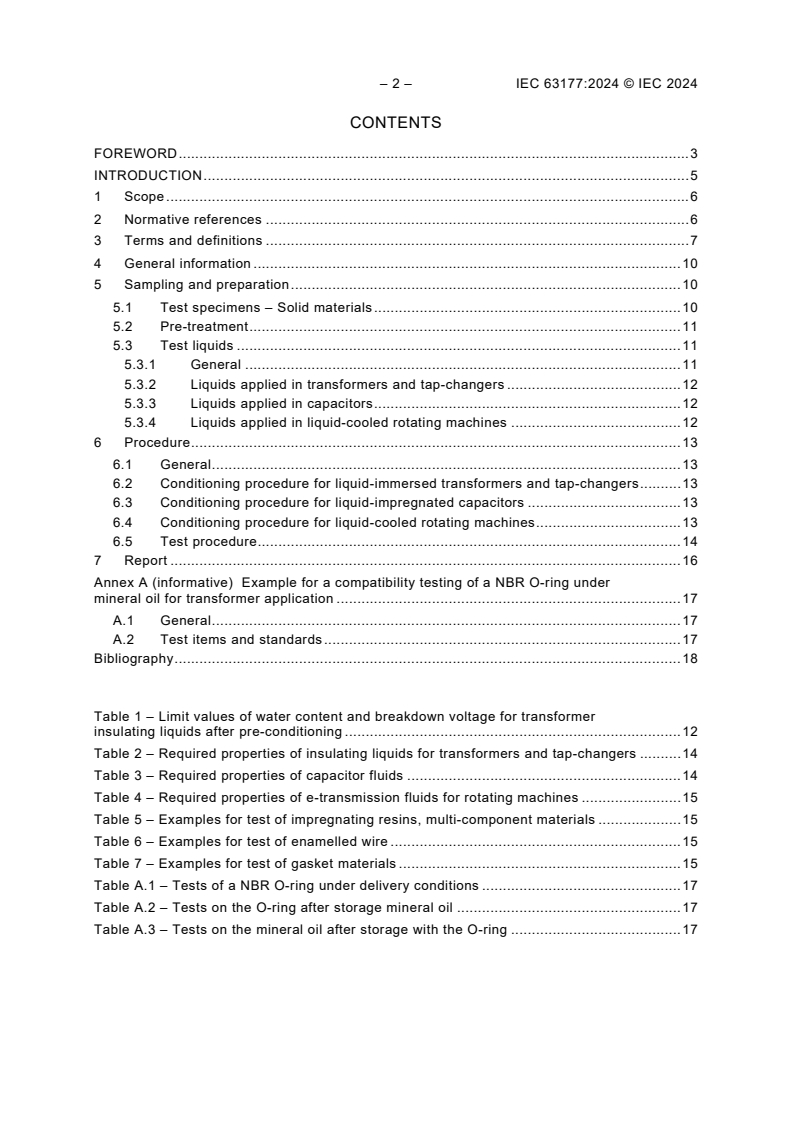
CONTENTS
FOREWORD . 3
INTRODUCTION . 5
1 Scope . 6
2 Normative references . 6
3 Terms and definitions . 7
4 General information . 10
5 Sampling and preparation . 10
5.1 Test specimens – Solid materials . 10
5.2 Pre-treatment . 11
5.3 Test liquids . 11
5.3.1 General . 11
5.3.2 Liquids applied in transformers and tap-changers . 12
5.3.3 Liquids applied in capacitors . 12
5.3.4 Liquids applied in liquid-cooled rotating machines . 12
6 Procedure . 13
6.1 General . 13
6.2 Conditioning procedure for liquid-immersed transformers and tap-changers . 13
6.3 Conditioning procedure for liquid-impregnated capacitors . 13
6.4 Conditioning procedure for liquid-cooled rotating machines . 13
6.5 Test procedure . 14
7 Report . 16
Annex A (informative) Example for a compatibility testing of a NBR O-ring under
mineral oil for transformer application . 17
A.1 General . 17
A.2 Test items and standards . 17
Bibliography . 18
Table 1 – Limit values of water content and breakdown voltage for transformer
insulating liquids after pre-conditioning . 12
Table 2 – Required properties of insulating liquids for transformers and tap-changers . 14
Table 3 – Required properties of capacitor fluids . 14
Table 4 – Required properties of e-transmission fluids for rotating machines . 15
Table 5 – Examples for test of impregnating resins, multi-component materials . 15
Table 6 – Examples for test of enamelled wire . 15
Table 7 – Examples for test of gasket materials . 15
Table A.1 – Tests of a NBR O-ring under delivery conditions . 17
Table A.2 – Tests on the O-ring after storage mineral oil . 17
Table A.3 – Tests on the mineral oil after storage with the O-ring . 17
INTERNATIONAL ELECTROTECHNICAL COMMISSION
____________
TEST METHODS FOR COMPATIBILITY OF CONSTRUCTION
MATERIALS WITH ELECTRICAL INSULATING LIQUIDS
FOREWORD
1) The International Electrotechnical Commission (IEC) is a worldwide organization for standardization comprising
all national electrotechnical committees (IEC National Committees). The object of IEC is to promote international
co-operation on all questions concerning standardization in the electrical and electronic fields. To this end and
in addition to other activities, IEC publishes International Standards, Technical Specifications, Technical Reports,
Publicly Available Specifications (PAS) and Guides (hereafter referred to as “IEC Publication(s)”). Their
preparation is entrusted to technical committees; any IEC National Committee interested in the subject dealt with
may participate in this preparatory work. International, governmental and non-governmental organizations liaising
with the IEC also participate in this preparation. IEC collaborates closely with the International Organization for
Standardization (ISO) in accordance with conditions determined by agreement between the two organizations.
2) The formal decisions or agreements of IEC on technical matters express, as nearly as possible, an international
consensus of opinion on the relevant subjects since each technical committee has representation from all
interested IEC National Committees.
3) IEC Publications have the form of recommendations for international use and are accepted by IEC National
Committees in that sense. While all reasonable efforts are made to ensure that the technical content of IEC
Publications is accurate, IEC cannot be held responsible for the way in which they are used or for any
misinterpretation by any end user.
4) In order to promote international uniformity, IEC National Committees undertake to apply IEC Publications
transparently to the maximum extent possible in their national and regional publications. Any divergence between
any IEC Publication and the corresponding national or regional publication shall be clearly indicated in the latter.
5) IEC itself does not provide any attestation of conformity. Independent certification bodies provide conformity
assessment services and, in some areas, access to IEC marks of conformity. IEC is not responsible for any
services carried out by independent certification bodies.
6) All users should ensure that they have the latest edition of this publication.
7) No liability shall attach to IEC or its directors, employees, servants or agents including individual experts and
members of its technical committees and IEC National Committees for any personal injury, property damage or
other damage of any nature whatsoever, whether direct or indirect, or for costs (including legal fees) and
expenses arising out of the publication, use of, or reliance upon, this IEC Publication or any other IEC
Publications.
8) Attention is drawn to the Normative references cited in this publication. Use of the referenced publications is
indispensable for the correct application of this publication.
9) IEC draws attention to the possibility that the implementation of this document may involve the use of (a)
patent(s). IEC takes no position concerning the evidence, validity or applicability of any claimed patent rights in
respect thereof. As of the date of publication of this document, IEC had not received notice of (a) patent(s), which
may be required to implement this document. However, implementers are cautioned that this may not represent
the latest information, which may be obtained from the patent database available at https://patents.iec.ch. IEC
shall not be held responsible for identifying any or all such patent rights.
IEC 63177 has been prepared by IEC technical committee 112: Evaluation and qualification of
electrical insulating materials and systems. It is an International Standard.
The text of this International Standard is based on the following documents:
Draft Report on voting
112/630/FDIS 112/640/RVD
Full information on the voting for its approval can be found in the report on voting indicated in
the above table.
The language used for the development of this International Standard is English.
– 4 – IEC 63177:2024 © IEC 2024
This document was drafted in accordance with ISO/IEC Directives, Part 2, and developed in
accordance with ISO/IEC Directives, Part 1 and ISO/IEC Directives, IEC Supplement, available
at www.iec.ch/members_experts/refdocs. The main document types developed by IEC are
described in greater detail at www.iec.ch/publications.
The committee has decided that the contents of this document will remain unchanged until the
stability date indicated on the IEC website under webstore.iec.ch in the data related to the
specific document. At this date, the document will be
• reconfirmed,
• withdrawn, or
• revised.
INTRODUCTION
The objective of the document is to clarify the evaluation methodology for the compatibility
between construction materials and electrical insulating liquids. It provides recommendations
for manufacturers of liquid-immersed transformers and tap-changers, liquid-impregnated
capacitors, and liquid-cooled rotating machines used in electrical vehicles and oil pumps. The
recommendations focus on screening appropriate construction materials ensuring compatibility
between solid and liquid materials for use with different liquids under varying operating
conditions. Additionally, the document contains tests that should be carried out on liquids and
construction materials. These tests occur after a conditioning procedure at the desired
temperature and for reference samples.
In the past, limited construction materials and liquids based on mineral oil served the industry
needs. Since the industry needs have been advanced with new applications and driven by
higher flash points and improved reliability of performance for liquid-filled electrical equipment,
it is necessary to be able to evaluate high temperature electrical insulation systems, using
silicone oils, synthetic esters, natural esters, and other potential suitable insulating liquids.
At the same time, liquid-cooled rotating machines used in electrical vehicles and oil pumps also
increase the possibility for construction materials to be exposed to different liquids, driven by
better thermal conductive performance. To avoid mechanical, electrical, and sealing failure for
construction materials, such as gasket materials, impregnating resins, prefabricates, etc., the
test methods described in this document can be applied for different liquid-immersed electrical
equipment, including liquid-immersed transformers and tap-changers, liquid-impregnated
capacitors and liquid-cooled rotating machines used in electrical vehicles and oil pumps.
The evaluation process specified in this document focuses on the chemical compatibility
between construction materials and liquids, but does not provide a long-term thermal or aging
evaluation. In addition, threshold values for functional parameters of each material are not
specified, as they depend on the requirements of the specific application.
Clause 1 to Clause 5 contain definitions and describe the preparation of suitable solid and liquid
test samples.
Clause 6 describes the test procedure (e.g. temperatures, test duration and cycles) and lists
the characteristic parameters to be evaluated. This allows an estimate of the basic compatibility
of typical construction materials with insulating liquids.
An application example is given in Annex A.
– 6 – IEC 63177:2024 © IEC 2024
TEST METHODS FOR COMPATIBILITY OF CONSTRUCTION
MATERIALS WITH ELECTRICAL INSULATING LIQUIDS
1 Scope
This document specifies the test method for the compatibility of construction materials with
electrical insulating liquids for use in electrical equipment, such as liquid-immersed
transformers and tap-changers, liquid-impregnated capacitors, and liquid-cooled rotating
machines used in electrical vehicles and oil pumps. This document is applicable to mineral
insulating liquids, natural esters, silicone insulating liquids, synthetic organic esters, modified
esters, capacitor fluids based on synthetic aromatic hydrocarbons and e-transmission fluids
used in electrical vehicles and oil pumps. The compatibility tests are not sufficient for a full
qualification of construction materials for a given application without additional tests requested
by the appropriate IEC Technical Committee or equipment manufacturers.
2 Normative references
The following documents are referred to in the text in such a way that some or all of their content
constitutes requirements of this document. For dated references, only the edition cited applies.
For undated references, the latest edition of the referenced document (including any
amendments) applies.
IEC 60156, Insulating liquids – Determination of the breakdown voltage at power frequency –
Test method
IEC 60247, Insulating liquids – Measurement of relative permittivity, dielectric dissipation factor
(tan δ) and d.c. resistivity
IEC 60296:2020, Fluids for electrotechnical applications – Mineral insulating oils for electrical
equipment
IEC 60422, Mineral insulating oils in electrical equipment – Supervision and maintenance
guidance
IEC 60814, Insulating liquids – Oil-impregnated paper and pressboard – Determination of water
by automatic coulometric Karl Fischer titration
IEC 60836:2015, Specifications for unused silicone insulating liquids for electrotechnical
purposes
IEC 60851-4:2016, Winding wires – Test methods – Part 4: Chemical properties
IEC 60867, Insulating liquids – Specifications for unused liquids based on synthetic aromatic
hydrocarbons
IEC 61099, Insulating liquids – Specifications for unused synthetic organic esters for electrical
purposes
IEC 62021-3:2014, Insulating liquids – Determination of acidity – Part 3: Test methods for non-
mineral insulating oils
IEC 62770:2013, Fluids for electrotechnical applications – Unused natural esters for
transformers and similar electrical equipment
IEC 62961, Insulating liquids – Test methods for the determination of interfacial tension of
insulating liquids – Determination with the ring method
IEC 63012:2019, Insulating liquids – Unused modified or blended esters for electrotechnical
applications
ISO 2049, Petroleum products – Determination of colour (ASTM scale)
ASTM D1524, Standard Test Method for Visual Examination of Used Electrical Insulating
Liquids in the Field
3 Terms and definitions
For the purposes of this document, the following terms and definitions apply.
ISO and IEC maintain terminology databases for use in standardization at the following
addresses:
• IEC Electropedia: available at https://www.electropedia.org/
• ISO Online browsing platform: available at https://www.iso.org/obp
3.1
insulating liquid
insulating material consisting entirely of a liquid
[SOURCE: IEC 60050-212:2010, 212-11-04]
3.2
mineral insulating oil
insulating liquid for transformers and similar electrical equipment (e.g. switchgear,
tapchangers), derived from petroleum products and/or other hydrocarbons
[SOURCE: IEC 60296:2020, 3.1]
3.3
natural esters
vegetable oils obtained from seeds and oils obtained from other suitable biological materials
and comprised of triglycerides
[SOURCE: IEC 62770:2013, 3.3]
3.4
silicone insulating liquids
liquid organopolysiloxanes whose molecular structure consists mainly of linear chains of
alternating silicon and oxygen atoms, with hydrocarbon groups attached to the silicon atoms
[SOURCE: IEC 60836:2015, 3.1]
3.5
synthetic organic ester
insulating liquid produced from acids and alcohols by chemical reaction
[SOURCE: IEC 60050-212:2010, 212-17-08, modified – The Note to entry has been omitted.]
– 8 – IEC 63177:2024 © IEC 2024
3.6
modified ester insulating liquid
ester insulating liquid which has been made/synthesized or altered by chemical reaction
[SOURCE: IEC 63012:2019, 3.3, modified – The Notes to entry have been omitted.]
3.7
blended ester insulating liquid
homogeneous combination of unused natural, synthetic and/or modified esters that are miscible
[SOURCE: IEC 63012:2019, 3.4, modified – The note to entry has been omitted.]
3.8
compatibility (of materials)
ability of materials to be used together without deleterious changes in any of the materials
[SOURCE: IEC 60050-212:2010, 212-14-19]
3.9
breakdown voltage
voltage at which electric breakdown occurs under prescribed test conditions, or in use
[SOURCE: IEC 60050-212:2010, 212-11-34]
3.10
dielectric dissipation factor
absolute value of the ratio of the imaginary to the real part of the complex relative permittivity
Note 1 to entry: The dielectric dissipation factor is equal to the tangent of the dielectric loss angle.
Note 2 to entry: In English the abbreviation DDF is sometimes used to characterize the dielectric loss in insulating
materials.
[SOURCE: IEC 60050-212:2010, 212-11-29, modified – The admitted terms have been deleted
′′ ′
and, in the definition, has been deleted.]
tanδ=ε /ε
rr
3.11
acidity
quantity of base, expressed in milligrams of potassium hydroxide per gram of sample, required
to titrate potentiometrically or colourimetrically a test portion in a specified solvent to the end
point
[SOURCE: IEC 62021-3:2014, 3.1]
3.12
thermal class
designation that is equal to the numerical value of the recommended maximum continuous use
temperature in degrees Celsius
Note 1 to entry: EIS subjected to operating temperatures exceeding its assigned thermal class can result in shorter
expected life.
Note 2 to entry: Electrical insulation materials with different thermal endurance indices (ATE/RTE according to
IEC 60216-5) may be combined to form an EIS which has a thermal class that may be higher or lower than the
recommended maximum continuous use temperature of any of the individual components according to IEC 60505.
[SOURCE: IEC 60085:2007, 3.11]
3.13
electric insulation system
EIS
insulating structure containing one or more electrical insulating material together with
associated conducting parts employed in an electrotechnical device
[SOURCE: IEC 60085:2007, 3.2]
3.14
transformer
electric energy converter without moving parts that changes voltages and currents associated
with electric energy without change of frequency
[SOURCE: IEC 60050-151:2001, 151-13-42]
3.15
capacitor
two-terminal device characterized essentially by its capacitance
Note 1 to entry: The term "capacitor" is used when it is not necessary to specify whether a capacitor unit or capacitor
bank is meant.
[SOURCE: IEC 60050-151:2001, 151-13-28, modified – Note 1 to entry has been added.]
3.16
e-transmission fluid
fluid which is used in transmission with integrated e-motor design and plays dual roles of cooling
e-motor and lubricating transmissions
3.17
liquid-cooled rotating machine
type of rotating machine whose cooling system relies on fluids instead of air or water
Note 1 to entry: During operation period, heat exchange happens between fluids and rotating machine.
3.18
impregnating resin
solventless compound of low viscosity which is applied by casting or dipping techniques, and
which solidifies after application
Note 1 to entry: The resin normally has a viscosity low enough to permit complete penetration into fine windings,
etc.
Note 2 to entry: See also 212-15-36, varnish.
[SOURCE: IEC 60050-212:2010, 212-15-31]
3.19
coating
insulating material such as varnish or dry film laid on the surface of the assembly
Note 1 to entry: The coating and base material of a printed board form an insulating system that may have properties
similar to solid insulation.
[SOURCE: IEC 60664-2-1:2011]
– 10 – IEC 63177:2024 © IEC 2024
4 General information
It is possible that individual tests will not be sufficient for the full evaluation of the construction
material compatibility. Other detection methods such as dissolved gas analysis (DGA) can be
informative to detect compatibility problems at the beginning stage if additional requirements
are agreed upon between supplier and user.
NOTE 1 Based on the test experiences, sampling directly after opening the test vessel is the common practice and
there is negligible effect on the determination of the compatibility.
Selection of the tests depends on the stress of application and shall be agreed between the
involved parties.
Some equipment manufacturers have their own testing protocols for construction material,
which are adapted to their design, and shall be aligned between supplier and user.
Beyond construction materials discussed in 5.1, other remaining construction materials shall be
tested according to each specific application request.
NOTE 2 The requirements for the oven can be referred to the series standards of IEC 60216-4.
5 Sampling and preparation
5.1 Test specimens – Solid materials
Test specimen size shall be such that the ratio of surface area to electrical insulating liquid
volume is balanced between 100 % to 400 % of normal use in electrical equipment and the test
sample specified in 6.5.
Some suggested ratios and preparations are as follows:
If the surface area of test specimen can be measured, surface areas no less than 52 cm shall
be used with each 800 ml of liquid. If the surface area of the specimen is less than 50 cm , the
amount of insulating liquid shall be reduced accordingly.
If the surface area of test specimen cannot be measured, the test specimen shall be used in
the amount of 1 % by the weight of the liquid.
Multi-component materials (e.g. unsaturated polyester resin, epoxy resin, vinyl ester resin or
phenolic resin in combination with cellulose, glass fibres or polyester fabrics and fillers) shall
be cured or treated in compliance with the different requirements of each application known to
be compatible with the insulating liquid.
Solid polymer-based materials such as those made of polyamides, polypthalamides,
polytetrafluoroethylene (PTFE) or other high-performance materials shall be tested on suitable
sample parts (or sections thereof) as used in the real application. If tensile strength of multi-
component materials and solid materials shall be determined, standardized tensile specimen
(tensile rods) shall be prepared and immersed in 800 ml of liquid.
Adhesives can be tested by creating bonded joint samples, using the same materials and
combinations as in the industrial application. For thread lock materials, threaded connection
samples shall be created, which are fastened with a defined torque, as in the industrial
application.
Gasket materials shall be tested not less than 65 cm surface area per 800 ml of liquid. Samples
as used in the application (or sections thereof) can be used.
For liquid filled transformers and similar equipment, tap-changers, varnishes or material used
as dip coatings shall be cured on aluminium foil, steel plate or other known materials to be
compatible with insulating liquids. They shall be tested at a ratio of not less than 500 cm of
surface area per 800 ml of liquid.
Enamelled wire shall be tested at a ratio as one of below:
• Specified in IEC 60851-4:2016, Table 2.
• Aligned between supplier and user.
When the proportions used for the evaluation are in accordance with the values in ASTM D3455,
ASTM D3455 shall be recorded in the report.
Core steel and core-steel coatings shall be tested on specimens at a ratio of no less than
500 cm of surface area per 800 ml of liquid.
For liquid-cooled rotating machines, impregnating resins, such as epoxy resin and unsaturated
polyester resin, shall be cured or treated in compliance with the corresponding applications and
shall be tested at a ratio of no less than 500 cm of surface area per 800 ml of liquid. Enamelled
wire, such as polyamides, polypthalamides, polyester and polyamide-imide coated wire shall
be tested at a ratio of 300 cm of surface area per 800 ml of liquid.
There are certain materials in electrical apparatus where the suggested ratios of material to
liquid are impractical. When this condition exists, the actual ratio should be reported.
Ratio of other materials which are not specified should be balanced between normal
consumption in electrical equipment and test sample requests.
In the compatibility test, the sample size can be reduced as necessary, but the sample used for
testing should be fully exposed to the insulating liquid.
5.2 Pre-treatment
Solid materials shall be carefully cleaned and pre-dried in an oven at (105 ± 5) °C for at least
16 h, or by the agreement between supplier and user. Cellulose insulation or other porous
materials shall be carefully treated to mitigate the damage from drying in an air circulating oven.
It is recommended that such materials be adequately dried and impregnated in a vacuum oven
to reduce the effects of oxygen on these materials. Additional pre-conditioning solid materials
should be prepared as reference samples (refer to Clause 6). Vessels, tongs, and any other
tools shall be carefully cleaned and pre-dried in an oven at (105 ± 5) °C for at least 16 h. Any
additional handling, transportation of solid materials or test apparatus should be done with clean
and dry tools, since contaminated or improperly handled liquids and test specimens, and
improperly cleaned vessels, handling devices and tools can obscure the results.
Vessels made of stainless steel or glass are recommended as these do not have any impact on
the accuracy of the compatibility test results.
5.3 Test liquids
5.3.1 General
In accordance with established industry test standards for liquids, different liquids for different
applications can have different pre-conditioning requirements. Some test standards require
additional procedures to degas, to reduce moisture content, or to remove possible contaminants.
For the sample of all liquids to be evaluated, an additional liquid sample of designed volume
shall be included for the exposure to the same test conditions without any material being
immersed, which is referred to as a reference sample.
– 12 – IEC 63177:2024 © IEC 2024
NOTE In some industry test standards this reference is known as blank sample.
5.3.2 Liquids applied in transformers and tap-changers
The insulating liquid used in the compatibility test shall be filtered, degassed and dried, the
water content and breakdown voltage of the insulating liquid shall meet the limits requirement
given in Table 1. The tested parameters like dissipation factor, acidity and interfacial tension
deviated from the values required in the standards for unused liquids (IEC 60296 for mineral
oils, IEC 61099 for synthetic esters, IEC 62770 for natural esters, IEC 63012 for blended esters,
IEC 60836 for silicone liquids) shall be critically evaluated for applicability before use.
Unless recommended, these conditions shall be the default conditions. Other values for any
properties shall be agreed, followed and reported accordingly.
Table 1 – Limit values of water content and breakdown voltage
for transformer insulating liquids after pre-conditioning
Insulating liquid Max. water content Min. breakdown voltage
(mg/kg) (kV/2,5 mm)
Mineral insulating oil 20 50
Natural ester 100 50
Silicone insulating liquid 50 50
Synthetic organic ester 200 50
Modified ester insulating liquid or blended ester
200 50
insulating liquid
5.3.3 Liquids applied in capacitors
An approved capacitor fluid based on synthetic aromatic hydrocarbons shall not exceed the
water content limitation required in IEC 60867.
Other parameters such as dielectric dissipation factor, breakdown voltage, etc. shall also be
taken into consideration.
5.3.4 Liquids applied in liquid-cooled rotating machines
For an approved e-transmission fluid, select one from below:
• 0,2 % per volume deionized water, represents a typical maximum empirical limit of water
content of in-service liquids for liquid-cooled rotating machines,
• 0,5 % per volume deionized water, act as an accelerating condition for the compatibility
evaluation,
which should be added to simulate operation conditions of liquid-cooled rotating machine in
vehicles.
NOTE 1 Different water content can be aligned and selected by supplier and user, depending on different maximum
empirical limit of in-service liquids for liquid-cooled rotating machines.
NOTE 2 There can be a difference in deterioration result from 0,2 % condition to 0,5 % condition.
6 Procedure
6.1 General
Vessels, gasket and other testing containers shall be selected to avoid any detrimental impact
on the test results.
To evaluate changes of the liquid and solid materials, it is necessary to have all properties
included in the conditioning process tested prior to any exposure to any other solid or liquid
materials. These measured values are the benchmark values, referred to in 6.5.
Sets of test specimens are to be placed in separate vessels. One set for each test interval. The
number of test sets is determined by the number of test intervals. Test conditions should follow
6.2, 6.3 or 6.4, according to different applications. At the completion of each test interval, one
set should be removed from conditioning and evaluated according to 6.5.
Recommended interval duration is from 48 h to 168 h and recommended number of test
intervals is 4, which can be accumulated to 672 h.
NOTE 1 For some applications, the numbers and the length of the ageing cycle interval can be increased or
decreased by the agreement between the involved parties.
NOTE 2 Long time interval is special testing for the purpose to evaluate solid materials.
6.2 Conditioning procedure for liquid-immersed transformers and tap-changers
The qualified sample taken from the liquid treatment system shall be transferred directly into
the test vessels.
Put the test specimens into the vessels and keep them completely immersed in the liquid.
Bubble dry nitrogen in the liquid for approximately 10 min. Close and seal the test vessels.
Place the sealed test vessels with the specimens in an oven at the temperature that meets the
thermal class of the electrical insulation system (such as (105 ± 2) °C, (120 ± 2) °C,
(130 ± 2) °C and (155 ± 2) °C, etc.) or applicable temperature. Together place a similar vessel
filled with an equivalent volume of the same liquid as reference sample.
NOTE The selection of the ageing temperature is based on the temperature of the EIS is expected to be the
maximum temperature. Using the EIS temperature rating is expected to be the most severe thermal condition.
6.3 Conditioning procedure for liquid-impregnated capacitors
The qualified sample taken from the liquid treatment system shall be transferred directly into
the test vessels.
Put the test specimens into the vessels and keep them completely immersed in the liquid. Close
and seal the test vessels or cover the vessels with aluminium foil, to ensure the liquid is
protected from any contaminations.
Place the test vessels with specimens in an oven at (105 ± 2) °C. Together place a similar
vessel filled with an equivalent volume of the same liquid as reference sample.
6.4 Conditioning procedure for liquid-cooled rotating machines
The qualified sample taken from the liquid treatment system shall be transferred directly into
the test vessels.
Add the test specimens into the vessels and keep them completely immersed in the liquid. Close
and seal the test vessels with pressure relief valve, which shall be able to withstand saturated
vapor pressure of water under specific test temperature.
– 14 – IEC 63177:2024 © IEC 2024
When agreed by supplier and user, a waterproof breathable valve is accepted as a replacement
for a pressure relief valve for sealing the test vessels, but regular water supplementation is
necessary for the purpose of simulating the operation conditions of a liquid-cooled rotating
machine in vehicles.
Place the test vessels with specimens in an oven at the temperature that meets the thermal
class of the insulating system using the tested insulating liquids (such as (155 ± 2) °C and
(180 ± 2) °C, etc.). Place with it a similar vessel filled with an equivalent volume of the same
liquid as a reference sample.
6.5 Test procedure
After the conditioning, remove the vessels from the oven and cool down to room temperature.
Remove the test specimens from the liquid and conduct any desired tests on the materials. The
properties of both insulating liquids and construction materials are tested. The test results shall
be compared with those of benchmark specimens to determine any differences. Caution shall
be taken to avoid contaminating the sample during operation.
The required measurable properties of the liquid are specified in Table 2, Table 3 and Table 4,
and the ageing behaviour of liquid shall be considered if a high number of intervals is applied
(refer to 6.1).
The properties for the reference sample shall also be determined to allow a calculation of
possible changes, caused by the immersion of solid material in the liquid. Further properties
can be tested if required based on the real application case.
Table 2 – Required properties of insulating liquids for transformers and tap-changers
Properties Standard
Interfacial tension IEC 62961
Acidity IEC 62021
Breakdown voltage IEC 60156
Dielectric dissipation factor IEC 60247
Colour ISO 2049
Appearance and turbidity IEC 60422, ASTM D1524
Water content IEC 60814
NOTE 1 Water content can be useful but optional.
NOTE 2 Suggested breakdown voltage gap distance: 2,5 mm.
NOTE 3 Suggested to run dielectric dissipation factor at temperature: 90 ºC.
Table 3 – Required properties of capacitor fluids
Properties Standard
Breakdown voltage IEC 60156
Dielectric dissipation factor IEC 60247
Water content IEC 60814
NOTE 1 Water content can be useful but optional.
NOTE 2 Suggested breakdown voltage gap distance: 2,5 mm.
NOTE 3 Suggested to run dielectric dissipation factor at temperature: 90 ºC.
Table 4 – Required properties of e-transmission fluids for rotating machines
Properties Standard
Acidity IEC 62021
Resistivity IEC 60247
Water content IEC 60814
NOTE Water content can be useful but optional.
Suggested properties of solid materials are shown in Table 5, Table 6 and Table 7.
An example for a compatibility testing of a NBR O-ring with mineral oil is presented in Annex A.
Table 5 – Examples for test of impregnating resins, multi-component materials
Properties Standard
Breakdown voltage (if material is under dielectric stress) IEC 60455-2 (resins) or IEC 60243-1 (multi-
component materials)
Mass change ISO 1817
Volume change ISO 1817
Tensile strength (if applicable) ISO 527-4
NOTE Some additional indicators are the appearance of the surface and discoloration: by comparison with an
untested reference sample, changes are easily detected (e.g. from glossy to matte, from smooth to rough, from
solid to crumbly, from light to dark). Another indicator is the tactile sensation (e.g. hard, weak or soft, brittle).
Table 6 – Examples for test of enamelled wire
Properties Standard
Breakdown voltage (enamelled wire) IEC 60851-5, IEC 60851-4
Bonding strength (impregnating resins to an enamelled IEC 61033
wire substrate, if applicable)
Table 7 – Examples for test of gasket materials
Properties Standard
Mass change ISO 1817
Volume change ISO 1817
Hardness ISO 868
Tensile strength ISO 37
Elongation at break ISO 37
Compression set ISO 815-1
NOTE Tested specimens of adhesives or thread locks are evaluated according to their required function.
Reduction of adhesive force and loosening torque meet the functional requirements.
– 16 – IEC 63177:2024 © IEC 2024
7 Report
The report shall include all the following:
a) Reference to this IEC test standard.
b) Any modifications or adjustments to the procedure used which is not defined in this
document.
c) The description of the material tested, including the size or dimensions or shape of the
material.
d) The description of the insulating liquid and the quantity used in the test.
e) Pre-testing conditioning and the ratio of tested material to insulating liquid.
f) Test conditions: duration of the exposure, test temperature.
g) Test results of all measured properties of the tested liquid and tested solid material shall be
recorded, as well as the measured properties of the reference liquid and solid material
sample. Deviations between tested and reference sample shall be calculated and reported.
Annex A
(informative)
Example for a compatibility testing of a NBR O-ring
under mineral oil for transformer application
A.1 General
The following tests listed in Table A.1, Table A.2 and Table A.3 are conducted for the
compatibility evaluation of NBR O-ring with mineral oil for transformer application.
A.2 Test items and standards
Table A.1 – Tests of a NBR O-ring under delivery conditions
Properties Standard
A-ha
...