

IEC 62490-1:2010
(Main)ESL measuring method - Part 1: Capacitors with lead terminal for use in electronic equipment
General Information
- Abstract
IEC 62490-1:2010 provides the equivalent series inductance L (ESL) measuring method for capacitors with lead terminal type for use in electronic equipment. The inductance values of capacitors provided for this document are within the range of 1 nH to 10 nH.
- Status
- Published
- Publication Date
- 27-Jul-2010
- Technical Committee
- TC 40 - Capacitors and resistors for electronic equipment
- Current Stage
- PPUB - Publication issued
- Start Date
- 28-Jul-2010
- Completion Date
- 31-Aug-2010
Overview
IEC 62490-1:2010 is an international standard established by the International Electrotechnical Commission (IEC) that specifies the measurement method for Equivalent Series Inductance (ESL) in capacitors with lead terminals intended for use in electronic equipment. The standard specifically addresses ESL values within the range of 1 nH to 10 nH, an essential parameter impacting capacitor performance at high frequencies.
This standard defines a precise and repeatable method for measuring the ESL using a designated test fixture (measurement jig), short compensation jig, and spacers to simulate real-use conditions accurately. The ESL measurement plays a critical role in optimizing electronic components for signal integrity, noise reduction, and overall equipment reliability.
Key Topics
- Scope: IEC 62490-1 covers capacitors with lead terminals used in electronic equipment, focusing on ESL measurement methods with inductance values between 1 nH and 10 nH.
- Measurement Equipments:
- Measurement Jig (Test Fixture): Designed with screw-fixation electrodes to hold capacitor lead terminals securely.
- Short Compensation Jig: Made from materials identical to capacitor leads, with specified dimensions and lead spacing for accurate compensation.
- Spacer: Nonmagnetic material fixed firmly on the measurement jig to maintain consistent measurements at defined points.
- Measurement Methodology:
- The use of an impedance analyzer capable of measuring inductance at frequencies of 40 MHz or higher.
- Application of open compensation and short compensation techniques to zero out measurement errors caused by the test fixture and wiring.
- Standardized preparation of capacitor samples, including precise lead terminal cutting (5 to 10 mm) to ensure stable and reproducible contact.
- Measurement Conditions: Standard atmospheric conditions as per IEC 60384-1:2008 and adherence to defined frequency (40 MHz) and signal levels (0.5 to 1.0 V rms) for accurate ESL measurement.
- Measurement Points: ESL is measured at the seating plane or flange of the capacitor on the printed circuit board, ensuring the results reflect practical circuit conditions.
Applications
- High-Frequency Electronic Equipment Design: Accurate ESL measurement facilitates the design of capacitors that perform reliably in circuits operating at RF and microwave frequencies, improving signal integrity and reducing electromagnetic interference (EMI).
- Component Specification and Quality Control: Manufacturers use this standard to ensure capacitors meet stringent inductance characteristics, which is critical for customers requiring precise component performance.
- Circuit Modeling and Simulation: ESL data obtained by this standard supports accurate electrical modeling of components in simulation software, leading to better predicted circuit behavior.
- Testing and Certification: Ensures consistency in testing processes for capacitors with lead terminals, aiding conformity assessments and supporting international market acceptance.
Related Standards
- IEC 60384-1:2008 – Fixed Capacitors for Use in Electronic Equipment – Part 1: Generic Specification: This standard provides general specifications for fixed capacitors and is referenced within IEC 62490-1 to establish testing conditions and terminology.
- IEC 62490 Series: Covers other parts of the ESL measuring method targeting different capacitor types or configurations.
- International Electrotechnical Vocabulary (IEV): Accessed via Electropedia, provides standard definitions for technical terms used in IEC 62490-1 and related standards.
Keywords: IEC 62490-1, ESL measuring method, Equivalent Series Inductance, capacitors with lead terminals, electronic equipment, capacitor testing, impedance analyzer, high-frequency capacitors, electronic component standards, IEC standards, electronic measurement techniques, capacitor quality control.
Frequently Asked Questions
IEC 62490-1:2010 is a standard published by the International Electrotechnical Commission (IEC). Its full title is "ESL measuring method - Part 1: Capacitors with lead terminal for use in electronic equipment". This standard covers: IEC 62490-1:2010 provides the equivalent series inductance L (ESL) measuring method for capacitors with lead terminal type for use in electronic equipment. The inductance values of capacitors provided for this document are within the range of 1 nH to 10 nH.
IEC 62490-1:2010 provides the equivalent series inductance L (ESL) measuring method for capacitors with lead terminal type for use in electronic equipment. The inductance values of capacitors provided for this document are within the range of 1 nH to 10 nH.
IEC 62490-1:2010 is classified under the following ICS (International Classification for Standards) categories: 31.060.01 - Capacitors in general. The ICS classification helps identify the subject area and facilitates finding related standards.
IEC 62490-1:2010 is available in PDF format for immediate download after purchase. The document can be added to your cart and obtained through the secure checkout process. Digital delivery ensures instant access to the complete standard document.
Standards Content (Sample)
IEC 62490-1 ®
Edition 1.0 2010-07
INTERNATIONAL
STANDARD
NORME
INTERNATIONALE
ESL measuring method –
Part 1: Capacitors with lead terminal for use in electronic equipment
Méthode de mesure de l’ESL –
Partie 1: Condensateurs à bornes de sortie utilisés dans les équipements
électroniques
All rights reserved. Unless otherwise specified, no part of this publication may be reproduced or utilized in any form or by
any means, electronic or mechanical, including photocopying and microfilm, without permission in writing from either IEC or
IEC's member National Committee in the country of the requester.
If you have any questions about IEC copyright or have an enquiry about obtaining additional rights to this publication,
please contact the address below or your local IEC member National Committee for further information.
Droits de reproduction réservés. Sauf indication contraire, aucune partie de cette publication ne peut être reproduite
ni utilisée sous quelque forme que ce soit et par aucun procédé, électronique ou mécanique, y compris la photocopie
et les microfilms, sans l'accord écrit de la CEI ou du Comité national de la CEI du pays du demandeur.
Si vous avez des questions sur le copyright de la CEI ou si vous désirez obtenir des droits supplémentaires sur cette
publication, utilisez les coordonnées ci-après ou contactez le Comité national de la CEI de votre pays de résidence.
IEC Central Office
3, rue de Varembé
CH-1211 Geneva 20
Switzerland
Email: inmail@iec.ch
Web: www.iec.ch
About the IEC
The International Electrotechnical Commission (IEC) is the leading global organization that prepares and publishes
International Standards for all electrical, electronic and related technologies.
About IEC publications
The technical content of IEC publications is kept under constant review by the IEC. Please make sure that you have the
latest edition, a corrigenda or an amendment might have been published.
ƒ Catalogue of IEC publications: www.iec.ch/searchpub
The IEC on-line Catalogue enables you to search by a variety of criteria (reference number, text, technical committee,…).
It also gives information on projects, withdrawn and replaced publications.
ƒ IEC Just Published: www.iec.ch/online_news/justpub
Stay up to date on all new IEC publications. Just Published details twice a month all new publications released. Available
on-line and also by email.
ƒ Electropedia: www.electropedia.org
The world's leading online dictionary of electronic and electrical terms containing more than 20 000 terms and definitions
in English and French, with equivalent terms in additional languages. Also known as the International Electrotechnical
Vocabulary online.
ƒ Customer Service Centre: www.iec.ch/webstore/custserv
If you wish to give us your feedback on this publication or need further assistance, please visit the Customer Service
Centre FAQ or contact us:
Email: csc@iec.ch
Tel.: +41 22 919 02 11
Fax: +41 22 919 03 00
A propos de la CEI
La Commission Electrotechnique Internationale (CEI) est la première organisation mondiale qui élabore et publie des
normes internationales pour tout ce qui a trait à l'électricité, à l'électronique et aux technologies apparentées.
A propos des publications CEI
Le contenu technique des publications de la CEI est constamment revu. Veuillez vous assurer que vous possédez
l’édition la plus récente, un corrigendum ou amendement peut avoir été publié.
ƒ Catalogue des publications de la CEI: www.iec.ch/searchpub/cur_fut-f.htm
Le Catalogue en-ligne de la CEI vous permet d’effectuer des recherches en utilisant différents critères (numéro de référence,
texte, comité d’études,…). Il donne aussi des informations sur les projets et les publications retirées ou remplacées.
ƒ Just Published CEI: www.iec.ch/online_news/justpub
Restez informé sur les nouvelles publications de la CEI. Just Published détaille deux fois par mois les nouvelles
publications parues. Disponible en-ligne et aussi par email.
ƒ Electropedia: www.electropedia.org
Le premier dictionnaire en ligne au monde de termes électroniques et électriques. Il contient plus de 20 000 termes et
définitions en anglais et en français, ainsi que les termes équivalents dans les langues additionnelles. Egalement appelé
Vocabulaire Electrotechnique International en ligne.
ƒ Service Clients: www.iec.ch/webstore/custserv/custserv_entry-f.htm
Si vous désirez nous donner des commentaires sur cette publication ou si vous avez des questions, visitez le FAQ du
Service clients ou contactez-nous:
Email: csc@iec.ch
Tél.: +41 22 919 02 11
Fax: +41 22 919 03 00
IEC 62490-1 ®
Edition 1.0 2010-07
INTERNATIONAL
STANDARD
NORME
INTERNATIONALE
ESL measuring method –
Part 1: Capacitors with lead terminal for use in electronic equipment
Méthode de mesure de l’ESL –
Partie 1: Condensateurs à bornes de sortie utilisés dans les équipements
électroniques
INTERNATIONAL
ELECTROTECHNICAL
COMMISSION
COMMISSION
ELECTROTECHNIQUE
PRICE CODE
INTERNATIONALE
L
CODE PRIX
ICS 31.060.01 ISBN 978-2-88912-068-0
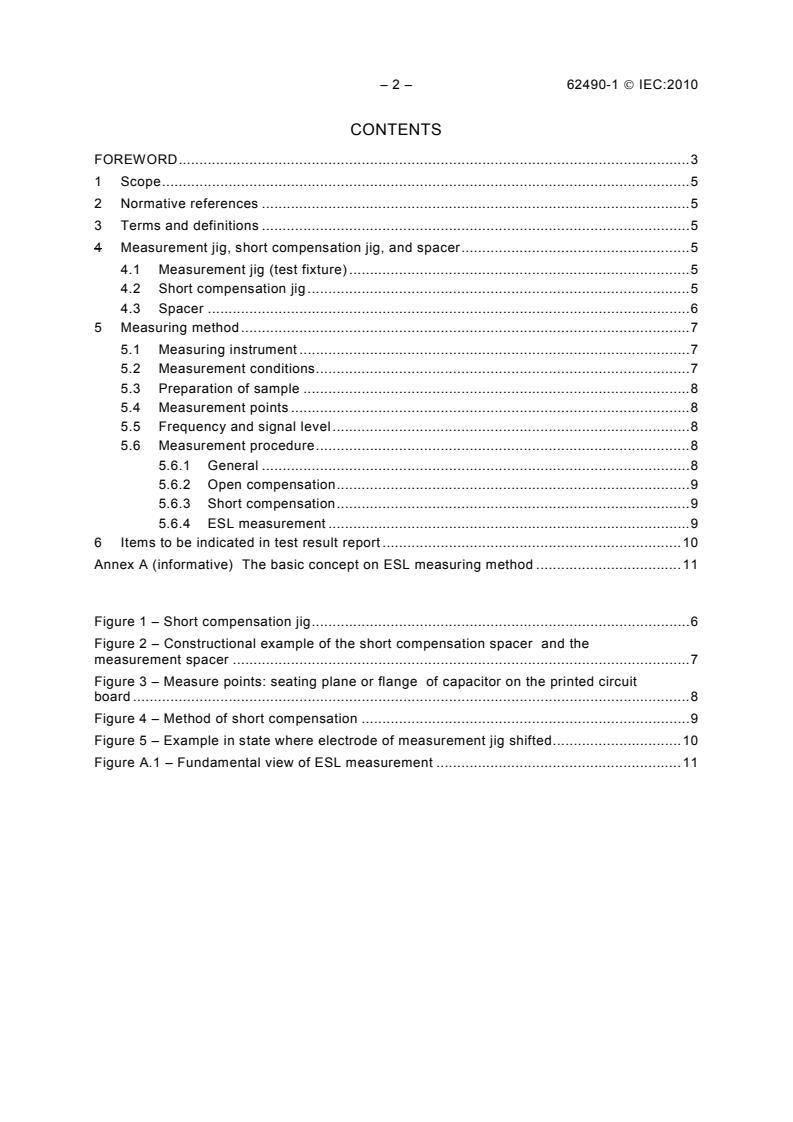
– 2 – 62490-1 © IEC:2010
CONTENTS
FOREWORD.3
1 Scope.5
2 Normative references .5
3 Terms and definitions .5
4 Measurement jig, short compensation jig, and spacer.5
4.1 Measurement jig (test fixture) .5
4.2 Short compensation jig .5
4.3 Spacer .6
5 Measuring method.7
5.1 Measuring instrument .7
5.2 Measurement conditions.7
5.3 Preparation of sample .8
5.4 Measurement points .8
5.5 Frequency and signal level.8
5.6 Measurement procedure.8
5.6.1 General .8
5.6.2 Open compensation.9
5.6.3 Short compensation.9
5.6.4 ESL measurement .9
6 Items to be indicated in test result report .10
Annex A (informative) The basic concept on ESL measuring method .11
Figure 1 – Short compensation jig.6
Figure 2 – Constructional example of the short compensation spacer and the
measurement spacer .7
Figure 3 – Measure points: seating plane or flange of capacitor on the printed circuit
board .8
Figure 4 – Method of short compensation .9
Figure 5 – Example in state where electrode of measurement jig shifted.10
Figure A.1 – Fundamental view of ESL measurement .11
62490-1 © IEC:2010 – 3 –
INTERNATIONAL ELECTROTECHNICAL COMMISSION
____________
ESL MEASURING METHOD –
Part 1: Capacitors with lead terminal
for use in electronic equipment
FOREWORD
1) The International Electrotechnical Commission (IEC) is a worldwide organization for standardization comprising
all national electrotechnical committees (IEC National Committees). The object of IEC is to promote
international co-operation on all questions concerning standardization in the electrical and electronic fields. To
this end and in addition to other activities, IEC publishes International Standards, Technical Specifications,
Technical Reports, Publicly Available Specifications (PAS) and Guides (hereafter referred to as “IEC
Publication(s)”). Their preparation is entrusted to technical committees; any IEC National Committee interested
in the subject dealt with may participate in this preparatory work. International, governmental and non-
governmental organizations liaising with the IEC also participate in this preparation. IEC collaborates closely
with the International Organization for Standardization (ISO) in accordance with conditions determined by
agreement between the two organizations.
2) The formal decisions or agreements of IEC on technical matters express, as nearly as possible, an international
consensus of opinion on the relevant subjects since each technical committee has representation from all
interested IEC National Committees.
3) IEC Publications have the form of recommendations for international use and are accepted by IEC National
Committees in that sense. While all reasonable efforts are made to ensure that the technical content of IEC
Publications is accurate, IEC cannot be held responsible for the way in which they are used or for any
misinterpretation by any end user.
4) In order to promote international uniformity, IEC National Committees undertake to apply IEC Publications
transparently to the maximum extent possible in their national and regional publications. Any divergence
between any IEC Publication and the corresponding national or regional publication shall be clearly indicated in
the latter.
5) IEC itself does not provide any attestation of conformity. Independent certification bodies provide conformity
assessment services and, in some areas, access to IEC marks of conformity. IEC is not responsible for any
services carried out by independent certification bodies.
6) All users should ensure that they have the latest edition of this publication.
7) No liability shall attach to IEC or its directors, employees, servants or agents including individual experts and
members of its technical committees and IEC National Committees for any personal injury, property damage or
other damage of any nature whatsoever, whether direct or indirect, or for costs (including legal fees) and
expenses arising out of the publication, use of, or reliance upon, this IEC Publication or any other IEC
Publications.
8) Attention is drawn to the Normative references cited in this publication. Use of the referenced publications is
indispensable for the correct application of this publication.
9) Attention is drawn to the possibility that some of the elements of this IEC Publication may be the subject of
patent rights. IEC shall not be held responsible for identifying any or all such patent rights.
International Standard IEC 62490-1 has been prepared by IEC technical committee 40:
Capacitors and resistors for electronic equipment.
The text of this standard is based on the following documents:
FDIS Report on voting
40/2044/FDIS 40/2056/RVD
Full information on the voting for the approval of this standard can be found in the report on
voting indicated in the above table.
This publication has been drafted in accordance with the ISO/IEC Directives, Part 2.
A list of all the parts in the IEC 62490 series, under the general title ESL measuring method,
can be found on the IEC website.
– 4 – 62490-1 © IEC:2010
The committee has decided that the contents of this publication will remain unchanged until
the stability date indicated on the IEC web site under "http://webstore.iec.ch" in the data
related to the specific publication. At this date, the publication will be
• reconfirmed,
• withdrawn,
• replaced by a revised edition, or
• amended.
62490-1 © IEC:2010 – 5 –
ESL MEASURING METHOD –
Part 1: Cap with lead terminal
for use in electronic equipment
1 Scope
This part of IEC 62490 provides the equivalent series inductance L (ESL) measuring method
for capacitors with lead terminal type for use in electronic equipment.
The inductance values of capacitors provided for this document are within the range of 1 nH
to 10 nH.
2 Normative references
The following referenced documents are indispensable for the application of this document.
For dated references, only the edition cited applies. For undated references, the latest edition
of the referenced document (including any amendments) applies.
IEC 60384-1:2008, Fixed capacitors for use in electronic equipment – Part 1: Generic
specification
3 Terms and definitions
For the purpose of this document, the terms and definitions given in IEC 60384-1 and the
following apply.
3.1
equivalent series inductance L
ESL
inductive part of the impedance of capacitors
NOTE 1 The unit of ESL is Henry (H).
4 Measurement jig, short compensation jig, and spacer
4.1 Measurement jig (test fixture)
The measurement jig shall have the following features:
a) the lead terminal holding method shall be screw up;
b) the measurement jig has two pairs of screw-fixation electrodes for fixing the lead terminals
of the capacitor to be measured. In pairs, one of the electrodes is fixed to the
measurement jig and the other is adjustable for fixing the lead wire. The adjustable
electrode shall move only in a direction to hold the lead terminal and shall not rotate
around the electrode fixing screw.
4.2 Short compensation jig
The short compensation jig shall be the lead wire rod which has the following features of the
materials and dimensions, which includes the diameter or the cross-section area:
a) materials shall be the same materials as the lead wire of the capacitor to be measured;
b) shape shall be as shown in Figure 1;
– 6 – 62490-1 © IEC:2010
c) spacing section (pitch) shall be the same lead spacing as the capacitor to be measured.
The tolerance on the lead spacing of a short compensation jig shall be ±0,25 mm;
d) the straight section (shank) of the jig length shall be 5 mm to 10 mm, depending on what
the measurement jig is able to hold. The straight section of the jig shall be kept from
bending.
l
P
IEC 1725/10
Key
P spacing section (pitch) (shaded section)
l straight section (shank)
Figure 1 – Short compensation jig
4.3 Spacer
These spacers shall be firmly fixed onto the measurement jig. The spacer material shall be
nonmagnetic. An example is shown in Figure 2.
62490-1 © IEC:2010 – 7 –
0,5
t
0,5
∅1,2
*
P /2
*
P /2
IEC 1726/10
Dimensions in millimetres
Key for Figure 2a Key for Figure 2b
P lead spacing
t thickness of the spacer
*
Lead spacing shall be the same as the capacitor
to be measured.
Figure 2a – Front view of the spacer
Figure 2b – Side view of the spacer
Remarks
P t
Short compensation spacer
1,5 ± 0,1
3,5 ± 0,3
3,25 ± 0,1 Measurement spacer
1,5 ± 0,1 Short compensation spacer
5,0 ± 0,3
Measurement spacer
4,0 ± 0,1
NOTE The basic method for measuring ESL when using these types of spacer is shown in Annex A.
Figure 2 – Constructional example of the short compensation spacer
and the measurement spacer
5 Measuring method
5.1 Measuring instrument
The impedance analyser (balance bridge method) with the following specification or
equivalent shall be used:
a) inductance value (ESL) can be measured at a frequency of 40 MHz or higher;
b) basic impedance accuracy shall be ±0,08 % or better;
c) impedance value of 3 mΩ or less can be measured.
5.2 Measurement conditions
The measurements shall be made under the standard atmospheric conditions for testing, as
specified in IEC 60384-1:2008, 4.2.1. In addition, if there is any doubt as to the validity of
measurement, the recovery conditions, as specified in IEC 60384-1:2008, 4.2.2, shall be
implemented.
5,5
+0,1
17 –0,1
– 8 – 62490-1 © IEC:2010
5.3 Preparation of sample
The lead terminals of a capacitor to be measured shall be cut at a length of 5 mm to 10 mm.
When cutting the lead terminals, the lead terminal shall be kept from bending.
NOTE By cutting the leads shorter, they make stable contact with the measurement electrodes and provide highly
repeatability and reproducibility.
5.4 Measurement points
The measurement points of ESL shall be the places of the seating plane or flange of the
capacitor to be measured. An example is shown in Figure 3.
NOTE Although during measurement the spacer is used, the measured value is equivalent to the value that would
be measured at the seating plane of the lead terminals of capacitors as shown in Annex A.
IEC 1727/10
Key
1 flange
2 seating plane
Figure 3 – Measure points: seating plane or flange
of capacitor on the printed circuit board
5.5 Frequency and signal level
Unless otherwise specified in the product specification, the frequency and signal shall be as
follows;
a) the measurement frequency shall be 40 MHz;
b) the signal level of an oscillation of a measuring instrument shall be 0,5 V to 1,0 V in r.m.s.
5.6 Measurement procedure
5.6.1 General
The measurement shall be performed in the order of open compensation, short compensation,
and ESL measurement of the capacitor. Before beginning the procedure, the number of times
to average and integration time shall be set so that measurement accuracy in less than 2 %.
NOTE Increasing the number of times to average and integration time increases repeatability and reproducibility.
62490-1 © IEC:2010 – 9 –
5.6.2 Open compensation
Connect the measurement jig specified in 4.1 to the measuring instrument and tighten the
screw for adjustable electrode with nothing in between the electrodes. Perform open
compensation according to the instructions for the measuring instrument.
5.6.3 Short compensation
The test fixture specified in 4.1 shall be connected to the measuring instrument and the short
compensation jig specified in 4.2 with the short compensation spacer shall be fixed in
between the electrodes by tightening the screws. Then the short compensation shall be
performed according to the instruction of the measurement instrument. Example of short
compensation shall be as shown in Figure 4.
P*
IEC 1728/10
Key
1 short compensation jig (dashed lines)
2 electrode of measurement jig (solid lines)
3 short compensation spacer (shaded section)
P lead spacing
* lead spacing shall be the same as the capacitor to be measured.
Figure 4 – Method of short compensation
5.6.4 ESL measurement
After performing the compensation specified in 5.6.2 and 5.6.3, replace short compensation
spacer with the measurement spacer specified in 4.3 and tighten the screw for adjustable
electrode with the lead terminal of the capacitor to be measured which is prepared according
to 5.3 through the spacer in between the electrodes. Then measure the ESL of the capacitor.
Care shall be taken so that the electrode of the measurement jig does not rotate and prevent
shifting as shown in Figure 5, when insert lead terminal of the capacitor to be measured.
– 10 – 62490-1 © IEC:2010
Electrode fixing screw of a measurement jig
IEC 1729/10
Key
1 lead wire (shaded section)
2 fixation screw (shaded section)
3 adjustable electrode (dashed lines)
4 fixed electrode (solid lines)
5 shifting (measuring point deviation)
Figure 5 – Example in state where electrode of measurement jig shifted
6 Items to be indicated in test result report
The test report shall include at least the following information:
a) test date *;
b) test site (name and place) *;
c) detail description of capacitor under test *;
d) measuring instrument (manufacturer and type);
e) test fixture (manufacturer and type);
f) measurement frequency and a measurement signal level;
g) measurement point, if other than seating plane; and
h) measured ESL value.
* optional
62490-1 © IEC:2010 – 11 –
Annex A
(informative)
The basic concept on ESL measuring method
The basic concept on ESL measuring method is shown in Figure A.1. The measuring point by
this method shall be the place of the seating plane, as described in 5.4.
a) The inductance corresponding to the short compensation jig length of P is deducted at
short compensation. See Figure A.1a.
b) Use the short compensation spacer, and the measurement spacer as specified in 4.3.
c) Perform short compensation with the short compensation spacer as shown in Figure A.1a.
d) When ESL measurement of the capacitor, deducted ESL at short compensation shall be
added. For this purpose thickness of the measurement spacer shall be thicker than short
compensation spacer by P/2. The measured ESL in Figure A.1b is
...