

IEC 62610-4:2013
(Main)Mechanical structures for electronic equipment - Thermal management for cabinets in accordance with IEC 60297 and IEC 60917 series - Part 4: Cooling performance tests for water supplied heat exchangers in electronic cabinets
General Information
- Abstract
IEC 62610-4:2013 specifies the test setup and test parameters for water supplied heat exchangers within single electronic cabinet configurations. The tests are focused on cabinets for the installation of high power dissipation electronic equipment. The cabinets concerned are from the IEC 60297 (19 in) and IEC 60917 (25 mm) series. The purpose of this standard is to provide comparable data for the cooling performance of cabinets according to defined test setups and cooling parameters. Key words: Electronic cabinets, cooling, water supplied heat exchangers
- Status
- Published
- Publication Date
- 14-Aug-2013
- Technical Committee
- SC 48D - Mechanical structures for electrical and electronic equipment
- Drafting Committee
- WG 5 - TC 48/SC 48D/WG 5
- Current Stage
- PPUB - Publication issued
- Start Date
- 15-Aug-2013
- Completion Date
- 15-Sep-2013
Buy Documents
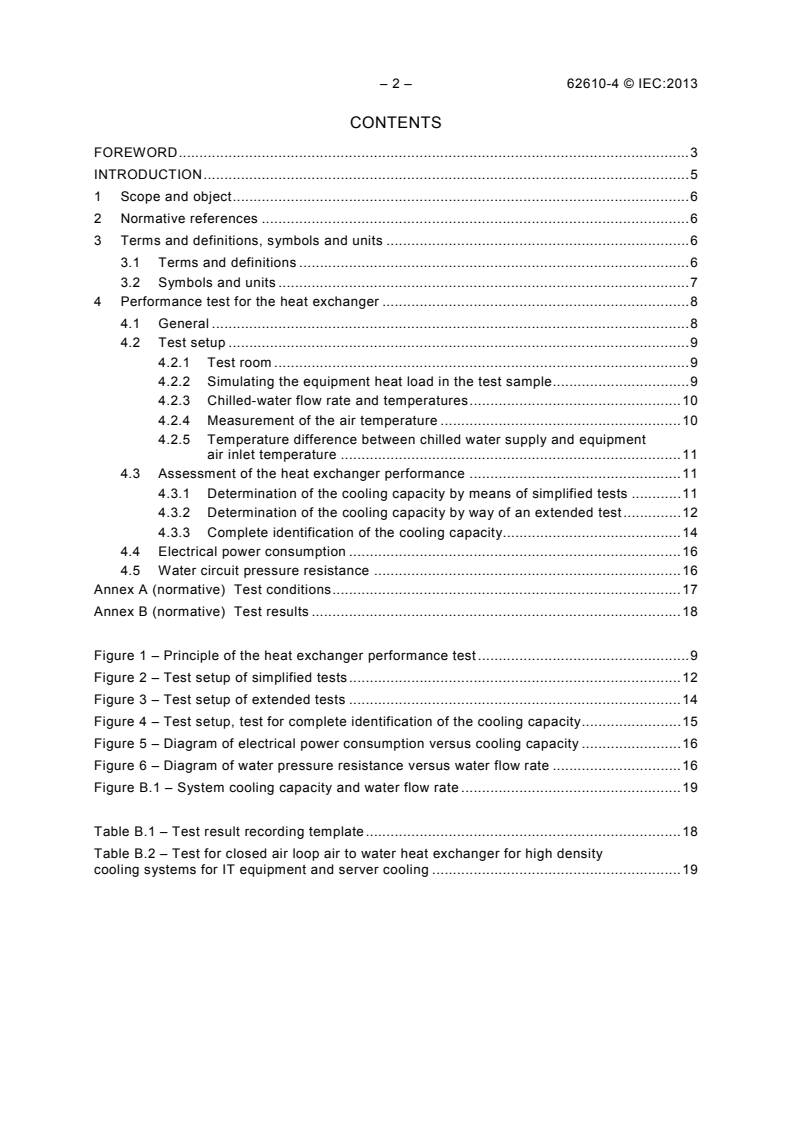
IEC 62610-4:2013 - Mechanical structures for electronic equipment - Thermal management for cabinets in accordance with IEC 60297 and IEC 60917 series - Part 4: Cooling performance tests for water supplied heat exchangers in electronic cabinets Released:8/15/2013
IEC 62610-4:2013 Overview
IEC 62610-4:2013 is an international standard published by the International Electrotechnical Commission (IEC) focused on the thermal management of electronic equipment cabinets. Specifically, it defines the test setup and parameters for evaluating the cooling performance of water supplied heat exchangers used in electronic cabinets compliant with the IEC 60297 and IEC 60917 series of mechanical structures. This standard is vital for ensuring reliable and efficient cooling, particularly for cabinets housing high power dissipation electronic devices such as servers and IT equipment.
Key objectives of IEC 62610-4:2013 include:
- Providing a unified methodology for testing water-air heat exchangers in single cabinet configurations.
- Ensuring comparability of cooling performance data through standardized test conditions.
- Supporting the efficient thermal management of electronic cabinets to extend equipment lifetime and reduce operational costs.
Key Topics
Scope and Application
- Applies to water supplied heat exchangers integrated within electronic cabinets.
- Covers cabinets of the IEC 60297 (19-inch) and IEC 60917 (25 mm) series.
- Focuses on cabinets designed for high heat load dissipation-typically over 12 kW cooling capacity.
- Test configurations simulate real operating conditions involving air and water temperatures, chilled-water flow rates, and heat loads.
Testing Methodology
- Defines test room conditions such as ambient temperature and airflow to replicate field usage.
- Details the simulation of equipment heat load for realistic performance evaluation.
- Specifies measurement techniques for air inlet/outlet temperatures and water temperature differentials.
- Includes methods for calculating cooling capacity using simplified, extended, or complete test approaches.
- Mandates recording of parameters like electrical power consumption of heat exchangers and water circuit pressure resistance.
- Features normative annexes providing standardized test conditions and data recording templates.
Thermal Management Benefits
- Enables precise control of cabinet internal temperatures through closed-loop air circulation with water cooling.
- Helps overcome environmental challenges in data centers, such as high-density heat output and energy efficiency concerns.
- Reduces reliance on room air conditioning by focusing on localized cooling solutions-leading to energy savings.
- Supports sustainable practices by minimizing CO2 emissions related to traditional cooling methods.
Practical Applications
IEC 62610-4:2013 is highly relevant for industries and sectors that deploy advanced electronic cabinets or racks with demanding thermal requirements:
- Data centers and IT infrastructure: Ensures reliable cooling of high-performance servers and storage systems.
- Telecommunication networks: Maintains stable environments for sensitive communication equipment.
- Industrial automation systems: Protects embedded electronics with consistent thermal management.
- High-density electronics installations: Optimizes cooling in compact and power-intensive cabinet configurations.
Implementing standardized cooling tests based on IEC 62610-4 enables manufacturers and facility operators to:
- Verify and compare the effectiveness of water supplied heat exchangers.
- Design cabinets to meet specified thermal performance benchmarks.
- Enhance system reliability and prolong hardware lifecycle by preventing overheating.
- Optimize energy consumption associated with cooling processes for cost-efficiency.
Related Standards
To fully leverage IEC 62610-4:2013, it is essential to consider its context within the broader framework of IEC standards:
- IEC 60297 series: Covers dimensions and mechanical structures for 19-inch electronic equipment cabinets and racks.
- IEC 60917 series: Defines modular mechanical structures with 25 mm unit intervals for electronic equipment.
- Additional parts of IEC 62610 series addressing other aspects of thermal management and mechanical structures for electronic equipment.
- Standards related to environmental testing and climate control in electronic enclosures that complement thermal management guidelines.
Summary
IEC 62610-4:2013 provides a critical foundation for the standardized testing and evaluation of water supplied heat exchangers in electronic cabinets, highlighting practical parameters and benchmark methods to assure consistent cooling performance. This standard supports improved energy efficiency, equipment reliability, and environment-friendly practices in high heat load electronic system deployments. Professionals designing, manufacturing, or managing electronic cabinets can utilize this standard to implement optimized cooling solutions aligned with international best practices.
Buy Documents
IEC 62610-4:2013 - Mechanical structures for electronic equipment - Thermal management for cabinets in accordance with IEC 60297 and IEC 60917 series - Part 4: Cooling performance tests for water supplied heat exchangers in electronic cabinets Released:8/15/2013
Frequently Asked Questions
IEC 62610-4:2013 is a standard published by the International Electrotechnical Commission (IEC). Its full title is "Mechanical structures for electronic equipment - Thermal management for cabinets in accordance with IEC 60297 and IEC 60917 series - Part 4: Cooling performance tests for water supplied heat exchangers in electronic cabinets". This standard covers: IEC 62610-4:2013 specifies the test setup and test parameters for water supplied heat exchangers within single electronic cabinet configurations. The tests are focused on cabinets for the installation of high power dissipation electronic equipment. The cabinets concerned are from the IEC 60297 (19 in) and IEC 60917 (25 mm) series. The purpose of this standard is to provide comparable data for the cooling performance of cabinets according to defined test setups and cooling parameters. Key words: Electronic cabinets, cooling, water supplied heat exchangers
IEC 62610-4:2013 specifies the test setup and test parameters for water supplied heat exchangers within single electronic cabinet configurations. The tests are focused on cabinets for the installation of high power dissipation electronic equipment. The cabinets concerned are from the IEC 60297 (19 in) and IEC 60917 (25 mm) series. The purpose of this standard is to provide comparable data for the cooling performance of cabinets according to defined test setups and cooling parameters. Key words: Electronic cabinets, cooling, water supplied heat exchangers
IEC 62610-4:2013 is classified under the following ICS (International Classification for Standards) categories: 31.240 - Mechanical structures for electronic equipment. The ICS classification helps identify the subject area and facilitates finding related standards.
IEC 62610-4:2013 is available in PDF format for immediate download after purchase. The document can be added to your cart and obtained through the secure checkout process. Digital delivery ensures instant access to the complete standard document.
Standards Content (Sample)
IEC 62610-4 ®
Edition 1.0 2013-08
INTERNATIONAL
STANDARD
NORME
INTERNATIONALE
Mechanical structures for electronic equipment – Thermal management for
cabinets in accordance with IEC 60297 and IEC 60917 series –
Part 4: Cooling performance tests for water supplied heat exchangers in
electronic cabinets
Structures mécaniques pour équipements électroniques – Gestion thermique
pour les armoires conformes aux séries CEI 60297 et CEI 60917 –
Partie 4: Essais de performances de refroidissement pour les échangeurs de
chaleur alimentés par de l'eau dans des baies électroniques
All rights reserved. Unless otherwise specified, no part of this publication may be reproduced or utilized in any form
or by any means, electronic or mechanical, including photocopying and microfilm, without permission in writing from
either IEC or IEC's member National Committee in the country of the requester.
If you have any questions about IEC copyright or have an enquiry about obtaining additional rights to this publication,
please contact the address below or your local IEC member National Committee for further information.
Droits de reproduction réservés. Sauf indication contraire, aucune partie de cette publication ne peut être reproduite ni
utilisée sous quelque forme que ce soit et par aucun procédé, électronique ou mécanique, y compris la photocopie et les
microfilms, sans l'accord écrit de la CEI ou du Comité national de la CEI du pays du demandeur.
Si vous avez des questions sur le copyright de la CEI ou si vous désirez obtenir des droits supplémentaires sur cette
publication, utilisez les coordonnées ci-après ou contactez le Comité national de la CEI de votre pays de résidence.
IEC Central Office Tel.: +41 22 919 02 11
3, rue de Varembé Fax: +41 22 919 03 00
CH-1211 Geneva 20 info@iec.ch
Switzerland www.iec.ch
About the IEC
The International Electrotechnical Commission (IEC) is the leading global organization that prepares and publishes
International Standards for all electrical, electronic and related technologies.
About IEC publications
The technical content of IEC publications is kept under constant review by the IEC. Please make sure that you have the
latest edition, a corrigenda or an amendment might have been published.
Useful links:
IEC publications search - www.iec.ch/searchpub Electropedia - www.electropedia.org
The advanced search enables you to find IEC publications The world's leading online dictionary of electronic and
by a variety of criteria (reference number, text, technical electrical terms containing more than 30 000 terms and
committee,…). definitions in English and French, with equivalent terms in
It also gives information on projects, replaced and additional languages. Also known as the International
withdrawn publications. Electrotechnical Vocabulary (IEV) on-line.
IEC Just Published - webstore.iec.ch/justpublished Customer Service Centre - webstore.iec.ch/csc
Stay up to date on all new IEC publications. Just Published If you wish to give us your feedback on this publication
details all new publications released. Available on-line and or need further assistance, please contact the
also once a month by email. Customer Service Centre: csc@iec.ch.
A propos de la CEI
La Commission Electrotechnique Internationale (CEI) est la première organisation mondiale qui élabore et publie des
Normes internationales pour tout ce qui a trait à l'électricité, à l'électronique et aux technologies apparentées.
A propos des publications CEI
Le contenu technique des publications de la CEI est constamment revu. Veuillez vous assurer que vous possédez
l’édition la plus récente, un corrigendum ou amendement peut avoir été publié.
Liens utiles:
Recherche de publications CEI - www.iec.ch/searchpub Electropedia - www.electropedia.org
La recherche avancée vous permet de trouver des Le premier dictionnaire en ligne au monde de termes
publications CEI en utilisant différents critères (numéro de électroniques et électriques. Il contient plus de 30 000
référence, texte, comité d’études,…). termes et définitions en anglais et en français, ainsi que
Elle donne aussi des informations sur les projets et les les termes équivalents dans les langues additionnelles.
publications remplacées ou retirées. Egalement appelé Vocabulaire Electrotechnique
International (VEI) en ligne.
Just Published CEI - webstore.iec.ch/justpublished
Service Clients - webstore.iec.ch/csc
Restez informé sur les nouvelles publications de la CEI.
Just Published détaille les nouvelles publications parues. Si vous désirez nous donner des commentaires sur
Disponible en ligne et aussi une fois par mois par email. cette publication ou si vous avez des questions
contactez-nous: csc@iec.ch.
IEC 62610-4 ®
Edition 1.0 2013-08
INTERNATIONAL
STANDARD
NORME
INTERNATIONALE
Mechanical structures for electronic equipment – Thermal management for
cabinets in accordance with IEC 60297 and IEC 60917 series –
Part 4: Cooling performance tests for water supplied heat exchangers in
electronic cabinets
Structures mécaniques pour équipements électroniques – Gestion thermique
pour les armoires conformes aux séries CEI 60297 et CEI 60917 –
Partie 4: Essais de performances de refroidissement pour les échangeurs de
chaleur alimentés par de l'eau dans des baies électroniques
INTERNATIONAL
ELECTROTECHNICAL
COMMISSION
COMMISSION
ELECTROTECHNIQUE
PRICE CODE
INTERNATIONALE
CODE PRIX R
ICS 31.240 ISBN 978-2-8322-1037-6
– 2 – 62610-4 © IEC:2013
CONTENTS
FOREWORD . 3
INTRODUCTION . 5
1 Scope and object . 6
2 Normative references . 6
3 Terms and definitions, symbols and units . 6
3.1 Terms and definitions . 6
3.2 Symbols and units . 7
4 Performance test for the heat exchanger . 8
4.1 General . 8
4.2 Test setup . 9
4.2.1 Test room . 9
4.2.2 Simulating the equipment heat load in the test sample. 9
4.2.3 Chilled-water flow rate and temperatures . 10
4.2.4 Measurement of the air temperature . 10
4.2.5 Temperature difference between chilled water supply and equipment
air inlet temperature . 11
4.3 Assessment of the heat exchanger performance . 11
4.3.1 Determination of the cooling capacity by means of simplified tests . 11
4.3.2 Determination of the cooling capacity by way of an extended test . 12
4.3.3 Complete identification of the cooling capacity. 14
4.4 Electrical power consumption . 16
4.5 Water circuit pressure resistance . 16
Annex A (normative) Test conditions . 17
Annex B (normative) Test results . 18
Figure 1 – Principle of the heat exchanger performance test . 9
Figure 2 – Test setup of simplified tests . 12
Figure 3 – Test setup of extended tests . 14
Figure 4 – Test setup, test for complete identification of the cooling capacity . 15
Figure 5 – Diagram of electrical power consumption versus cooling capacity . 16
Figure 6 – Diagram of water pressure resistance versus water flow rate . 16
Figure B.1 – System cooling capacity and water flow rate . 19
Table B.1 – Test result recording template . 18
Table B.2 – Test for closed air loop air to water heat exchanger for high density
cooling systems for IT equipment and server cooling . 19
62610-4 © IEC:2013 – 3 –
INTERNATIONAL ELECTROTECHNICAL COMMISSION
_____________
MECHANICAL STRUCTURES FOR ELECTRONIC EQUIPMENT –
THERMAL MANAGEMENT FOR CABINETS IN ACCORDANCE
WITH IEC 60297 AND IEC 60917 SERIES –
Part 4: Cooling performance tests for water supplied
heat exchangers in electronic cabinets
FOREWORD
1) The International Electrotechnical Commission (IEC) is a worldwide organization for standardization comprising
all national electrotechnical committees (IEC National Committees). The object of IEC is to promote
international co-operation on all questions concerning standardization in the electrical and electronic fields. To
this end and in addition to other activities, IEC publishes International Standards, Technical Specifications,
Technical Reports, Publicly Available Specifications (PAS) and Guides (hereafter referred to as “IEC
Publication(s)”). Their preparation is entrusted to technical committees; any IEC National Committee interested
in the subject dealt with may participate in this preparatory work. International, governmental and non-
governmental organizations liaising with the IEC also participate in this preparation. IEC collaborates closely
with the International Organization for Standardization (ISO) in accordance with conditions determined by
agreement between the two organizations.
2) The formal decisions or agreements of IEC on technical matters express, as nearly as possible, an international
consensus of opinion on the relevant subjects since each technical committee has representation from all
interested IEC National Committees.
3) IEC Publications have the form of recommendations for international use and are accepted by IEC National
Committees in that sense. While all reasonable efforts are made to ensure that the technical content of IEC
Publications is accurate, IEC cannot be held responsible for the way in which they are used or for any
misinterpretation by any end user.
4) In order to promote international uniformity, IEC National Committees undertake to apply IEC Publications
transparently to the maximum extent possible in their national and regional publications. Any divergence
between any IEC Publication and the corresponding national or regional publication shall be clearly indicated in
the latter.
5) IEC itself does not provide any attestation of conformity. Independent certification bodies provide conformity
assessment services and, in some areas, access to IEC marks of conformity. IEC is not responsible for any
services carried out by independent certification bodies.
6) All users should ensure that they have the latest edition of this publication.
7) No liability shall attach to IEC or its directors, employees, servants or agents including individual experts and
members of its technical committees and IEC National Committees for any personal injury, property damage or
other damage of any nature whatsoever, whether direct or indirect, or for costs (including legal fees) and
expenses arising out of the publication, use of, or reliance upon, this IEC Publication or any other IEC
Publications.
8) Attention is drawn to the Normative references cited in this publication. Use of the referenced publications is
indispensable for the correct application of this publication.
9) Attention is drawn to the possibility that some of the elements of this IEC Publication may be the subject of
patent rights. IEC shall not be held responsible for identifying any or all such patent rights.
International Standard IEC 62610-4 has been prepared by subcommittee 48D: Mechanical
structures for electronic equipment, of IEC technical committee 48: Electromechanical
components and mechanical structures for electronic equipment.
The text of this standard is based on the following documents:
FDIS Report on voting
48D/542/FDIS 48D/545/RVD
Full information on the voting for the approval of this standard can be found in the report on
voting indicated in the above table.
This publication has been drafted in accordance with the ISO/IEC Directives, Part 2.
– 4 – 62610-4 © IEC:2013
A list of all parts of IEC 62610 series, under the general title Mechanical structures for
electronic equipment – Thermal management for cabinets in accordance with IEC 60297 and
IEC 60917 series, can be found on the IEC website.
The committee has decided that the contents of this publication will remain unchanged until
the stability date indicated on the IEC web site under "http://webstore.iec.ch" in the data
related to the specific publication. At this date, the publication will be
• reconfirmed,
• withdrawn,
• replaced by a revised edition, or
• amended.
62610-4 © IEC:2013 – 5 –
INTRODUCTION
Electronic cabinets of the IEC 60297 and IEC 60917 series are used for the housing of
electronic devices in many different fields of application. A wide field of application is
represented by installations of communication networks with electronic devices in information
technology (IT) environments. The classic way is to install rows of cabinets into defined foot
print patterns and interconnect them via cables managed from overhead cable trays or raised
floor cable management. So far, cooling has been facilitated by equipping the entire IT room
with air conditioning in order to provide for air flow and air temperatures required for the safe
operation of the electronic devices. With the growing heat load in data centers, this form of
cooling has become more and more inefficient. Thermal problems with respect to high-
performance electronic devices have become more difficult to solve. The environmental
aspect is gaining crucial importance forcing us to cut down on wasting resources and to
reduce CO emissions.
Alternatives to the air conditioning of rooms need to be looked at more closely. Under the
aspect of increasing cooling efficiency, there are some major concepts, two cases serve as
examples here:
Case 1. The equipped group of cabinets, with dedicated temperature control.
This method is the cold aisles / hot aisles arrangement of a smaller number of cabinets,
typically four to twelve. Its advantage over the air conditioning of rooms is the smaller air
volume which allows a focused heat management with optimised dimensioning of power
consumption for the cooling devices and increased temperatures in the warm zones of the
room. In such cases, efficiency can be increased by adopting exhaust heat recovery for room
heating in cold periods. Due to the improved energy efficiency contained aisles are becoming
more and more popular.
Case 2. Single cabinets with water-air heat exchangers.
This method is used for cabinets accommodating high-performance/heat dissipating electronic
equipment, typically servers and mainframe computers. Its advantage over the room air
conditioning or cold aisles consists in the high degree of constant air inlet temperature for
sensitive electronic devices. Closed air circulation within a cabinet allows a very precise
temperature control. The power consumption aspect may be similar to that of the cold aisle,
but the temperature control aspect is more important and favourable to a longer life-cycle of
costly equipment.
This standard has been created for case 2: Cooling performance tests for water-supplied heat
exchangers in single electronic cabinet configurations. The parameters with reference to the
described test sample are shown in diagrams which may be useful to provide for a
standardized calculation method for specific cabinet dimensions and heat exchanger cooling
requirements. The typical required cooling capacity for such cabinets is normally higher than
12 kW. The described test methods of this standard address a cooling capacity of more than
12 kW. However, since IT equipment varies the heat load to a cabinet the test also considers
values below 12 kW for partial heat load.
– 6 – 62610-4 © IEC:2013
MECHANICAL STRUCTURES FOR ELECTRONIC EQUIPMENT –
THERMAL MANAGEMENT FOR CABINETS IN ACCORDANCE
WITH IEC 60297 AND IEC 60917 SERIES –
Part 4: Cooling performance tests for water supplied
heat exchangers in electronic cabinets
1 Scope and object
This part of IEC 62610 specifies the test setup and test parameters for water supplied heat
exchangers within single electronic cabinet configurations. The tests are focused on cabinets
for the installation of high power dissipation electronic equipment. The cabinets concerned
are from the IEC 60297 (19 in) and IEC 60917 (25 mm) series. The purpose of this standard
is to provide comparable data for the cooling performance of cabinets according to defined
test setups and cooling parameters.
2 Normative references
The following documents, in whole or in part, are normatively referenced in this document and
are indispensable for its application. For dated references, only the edition cited applies. For
undated references, the latest edition of the referenced document (including any
amendments) applies.
IEC 60297 (all parts), Dimensions of mechanical structures of the 482,6 mm (19 in) series
IEC 60917 (all parts), Modular order for the development of mechanical structures for
electronic equipment practices
3 Terms and definitions, symbols and units
3.1 Terms and definitions
For the purposes of this document, the following terms and definitions apply.
3.1.1
cooling capacity
Q
removed heat load given by the electronic equipment mounted inside the electronic cabinet
[kW]
3.1.2
absolute humidity
mass content of water (gram of water) per defined mass of dry air (kilogram of air) [g/kg] g of
water per kg dry air
3.1.3
dummy
device to generate heat load similar to most common electronic devices in information
technology: horizontal air flow with air intake at the front and air outlet at the rear side of the
equipment.
62610-4 © IEC:2013 – 7 –
Note 1 to entry: The air flow orientation is defined in IEC 60297 (19 in) and IEC 60917 (25 mm) standard series
cabinet design.
3.1.4
sensible cooling
cooling capacity to provide air temperature change only. The absolute humidity of air in
sensible cooling process is unchanged.
3.1.5
simplified test
this test method does not consider the influence of the heat transfer through the walls of the
electronic cabinet nor the heat transfer by leaking air in and out of the housing of the
electronic equipment
3.1.6
extended test
this test method does not consider the heat transfer by leaking air in and out of the housing of
the electronic equipment
3.2 Symbols and units
P electrical power consumption [kW]
el
T Temperature [°C]
Q heat flow of the cooling air [kW]
air
v air velocity (test result) [m/s]
air
A air cross-section [m ]
air
ρ air density (related to 101,325 kPa air pressure) [kg/m ]
air
c specific heat capacity of air [kJ/kgK]
p,air
δT temperature difference [K]
δT temperature difference of the chilled water between supply and return [K]
CW
δT temperature difference of the cooling air between equipment air inlet and air outlet
air
[K]
f
factor based on specific heat capacity of water [l/s, l/min, m /h]
Q heat flow in chilled water [kW]
CW
3
V chilled-water flow [l/s, l/min, m /h]
CW
Q
cooling capacity [kW]
Q
cooling capacity of the IT equipment [kW]
S
– 8 – 62610-4 © IEC:2013
4 Performance test for the heat exchanger
4.1 General
For testing the heat exchanger performance, the following parameters shall be applied:
The heat load of the dummy equipment shall be unchanged during the test. The heat
dissipation of the heat load dummies shall be measured during the test and be recorded in the
test report as the main result of the test according to Table B.1. The determination of the heat
dissipation of the heat load shall be measured in accordance to the electrical power
consumption.
During all measurements all control function and algorithm of the tested unit shall be disabled.
The air temperature in front of the electronic equipment (between its front panel and door)
shall be in the range defined in Annex A, with a max. tolerance of ± 1 K at the different
temperature sensors. The temperature difference between air inlet and air outlet of the
dummy heat loads shall be equal or less than the temperature difference defined in Annex A.
The measured temperature difference during the test shall be recorded in the test report. The
temperature difference of the air temperature in the test report shall be determined with an
accuracy of 0,2 K.
The maximum temperature difference between the chilled water supply temperature and air
inlet temperature of the equipment dummies shall be equal or less than the temperature
difference defined in Annex A. This temperature difference during the test shall be measured
as average after all temperatures are stabilized. The measured temperature difference as test
result shall be recorded as outlined in Table B.1. During the test the chilled water supply
temperature can fluctuate within the range of 1 K. The temperature difference of the air
temperature in the test report shall be determined with an accuracy of
0,1 K. The temperature difference of the water temperature in the test report shall be
recorded within an accuracy of 0,1 K. See Table B.1.
During the test the pressure resistance of the air water heat exchanger between chilled water
supply and chilled water return of the chilled water system shall not exceed the pressure
difference defined in Annex A. This pressure resistance shall include all hydraulic components
for the heat exchanger operation e.g. modulating valves, balancing valves, connectors. The
pressure difference and the relation to the chilled water flow rate shall be recorded in the
table and the chart in according Annex B.
The water temperature increase between heat exchanger in and out is a result of the test and
shall be recorded in the test report in the table according to Annex B. The chilled water flow
rate shall be recorded in the test report as a test result according to the table and chart in
Annex B. The flow rate shall be selected to a value such that the maximum pressure
difference according to Annex A is not exceeded. The flow rate shall be measured within a
tolerance of ± 2 %. The measured pressure difference shall be recorded in the test report
according to the table and chart in Annex B.
The air temperature of the test chamber shall be in the same range as the temperature inside
the cabinet, in front of the electronic equipment.
For the determination of the test changing humidity conditions of the test room are not
recognized. The cooling capacity is considered as 100 % sensible cooling. That means
according the test room conditions described in 4.2.1 and the chilled water feed temperature
tolerance of ± 1 K the chilled water feed temperature shall be higher than 12 °C. See
Figure 1.
62610-4 © IEC:2013 – 9 –
Chilled water return
temperature
Temperature
difference of
chilled water
Chilled
water
Cooling Supply air
Chilled water feed
capacity
to cool equipment
temperature
[kW]
temperature
Cooling
air
Temperature
difference of
cooling air
Air intake
temperature
IEC 2110/13
Figure 1 – Principle of the heat exchanger performance test
4.2 Test setup
4.2.1 Test room
The test sample (a closed cabinet for electronic equipment with a built-in air-water heat
exchanger) is installed in an environment of precisely defined temperature and humidity,
called a test room. This test room is expected to maintain the test conditions during testing
within the required test conditions.
• air temperature of the test room equal to air inlet temperature of the equipment dummy
[°C ± 2 K] see Annex A
• absolute humidity 8 g ± 0,5 g water per kg dry air (dew-point temperature 10,5 °C).
For the course of the test it is assumed that the absolute humidity inside the test room and
inside the sample will be balanced with each other.
The test is to be performed at the standard air pressure of 101,325 kPa. Should that prove
impossible, all airflows are to be recalculated in accordance with the air density altered in
dependence on air pressure. Critical for the test is the air-mass flow resulting at an air
pressure of 101,325 kPa. The enthalpy of the air needs to be calculated to the standard
atmospheric pressure conditions.
4.2.2 Simulating the equipment heat load in the test sample
The test sample (cabinet) is to be populated with simulated electronic equipment, such as a
server. The simulated electronic equipment is also referred to as “dummies”. The dummies
are installed to the mounting points as provided for by the cabinets according to IEC 60297
and IEC 60917. The air-intake is at the front panel of the dummy and exits at the rear of the
dummy. The dummies are designed in such a manner that a change in heat loss can be
measured. The mechanical design of the heat load shall avoid any outgoing heat radiation
(leaks).
The electrical power consumption by the dummies is to be recorded by measurement. The
electrical power consumption shall be recorded in the test report according the table in
– 10 – 62610-4 © IEC:2013
Annex B. It is assumed that the sample is charged by the entire electrical power in the form of
heat load.
The airflow generated by the dummies shall be adjustable. During the test, the airflow is to be
selected in such a way that the air pressure rise between the front and the rear of the
dummies is less than the limit defined at Annex A. The dummy installation shall provide
separation of the cold air zone and the warm air zone. The pressure difference between the
front and the rear of the heat exchanger shall be recorded in the test report according to the
table in Annex B.
4.2.3 Chilled-water flow rate and temperatures
During the test, the temperatures and the temperature difference between the chilled water
supply temperature and chilled water return of the system shall be measured within a
tolerance of 0,1 K.
The sample is to be supplied with water that is free from glycol and other chemical additives
which would affect the specific cooling capacity of the chilled water.
The temperature increase between chilled-water supply and chilled-water return and the
chilled water supply and return temperatures shall be recorded in the test report according the
table in Annex B. The chilled water supply temperature shall be in a temperature range as
defined in Annex A.
During the test the pressure resistance of the air water heat exchanger between chilled water
supply and chilled water return of the chilled water system shall not exceed the pressure
difference defined in Annex A. This pressure resistance shall include all hydraulic components
for the heat exchanger operation e.g. modulating valves, balancing valves, connectors.
The water temperature increase between heat exchanger inlet and outlet is a result of the test
and shall be recorded in the test report. The chilled water flow rate shall be recorded in the
test report as a test result. The flow rate shall be selected to a value such that the maximum
pressure difference according to Annex A is not exceeded. The pressure difference during the
test shall be recorded in the test report as a result of the test according to the table in
Annex B.
4.2.4 Measurement of the air temperature
The air temperature is to be measured at both the supply air inlet and exhaust air outlet of the
dummies and the heat exchanger. A sufficient number of sensors shall be positioned in order
to guarantee precision measurement. Initially, five air temperature sensors at the four
sections (see Figures 2, 3 and 4) shall be provided. The four sections are:
st
1 the area in front of the dummies simulating the heat load of the electronic equipment at
the air inlet side.
nd
2 the area at the air outlet side of the dummies.
rd
3 the area at the air inlet side of the heat exchanger
th
4 the area at the air outlet side of the heat exchanger
These sensors shall be positioned in the core volume flow.
Initially a minimum number of 5 temperature sensors it required. This number of sensors can
be reduced if the measuring precision continues to be sufficient. Should further sensors be
required for the purpose of precision, they are to be added to the test setup. For evaluating
the test, the mean value is to be generated from the measured temperatures. The variation of
the temperatures of each side of the dummy equipment shall be less than ± 1 K.
62610-4 © IEC:2013 – 11 –
The air temperature in front of the electronic equipment (between its front panel and door)
shall be within the range defined in Annex A. The temperature difference between air inlet and
air outlet of the dummy heat loads shall be equal or less than the temperature difference
defined in Annex A. The measured temperature difference during the test shall be recorded in
the test report. The temperature difference of the air temperature in the test report shall be
recorded with an accuracy of ± 0,2 K.
4.2.5 Temperature difference between chilled water supply and equipment air inlet
temperature
The cooling capacity of the dummy equipment shall be selected in such a way that the
temperature difference between chilled water supply and dummy equipment air inlet
temperature stays within a temperature range as defined in Annex A. The temperature
difference between chilled water supply and dummy equipment air inlet temperature during
the test shall be recorded in the test report according to the table in Annex B.
4.3 Assessment of the heat exchanger performance
4.3.1 Determination of the cooling capacity by means of simplified tests
A simplified test method for determining the cooling capacity of closed cabinets assembled
with electronic equipment to be cooled is based on the assumption that the cooling capacity of
the heat exchanger is larger than the heat absorption of the cabinet panels. The simplified
test method can be applied to cooling capacities of more than 12 kW. As a condition of the
test the heat absorption of the cabinet panels should be less than 600 W (<5 %). For all other
test conditions (in particular heat loads less than 12 kW) applicable tests are described in
4.2.2 and 4.2.3.
The cooling capacity of the heat exchanger is based on an electronic equipment air intake
temperature shown in Annex A, with ± 0,2 K as mean value. The useful cooling capacity can
now be measured via the heat load dummies.
Fans used in the sample cabinet under test shall run at normal rpm as indicated by the
manufacturer. Fan redundancy concepts shall not affect the test and are not covered by this
standard.
The test setup conditions as described in 4.2 shall be met.
P =Q
(1)
el
The fans in the sample shall be run at nominal speed. If the sample design provides for
redundancy for the fans, the fan speed is to be selected during the test in such a way that fan
redundancy is not impaired during the determination of the cooling capacity. For the purpose
of checking, the fan performance is to be compensated in accordance with redundancy and
can be switched off for another test. In doing so, the cooling capacity shall not be
compromised.
Furthermore, the test conditions as described in 4.2 shall be met.
Q cooling capacity [kW]
P electrical power consumption [kW]
el
– 12 – 62610-4 © IEC:2013
Test Room Conditions
Test Room Conditions
Air temperature test room = Air temperature test room =
Air inlet temperature equipment dummy [°C ± 2 °C] Air inlet temperature equipment dummy [°C ± 2 °C]
Absolute humidity 8 g ± 0,5 g/kg Absolute humidity 8 g ± 0,5 g/kg
Dew point temperature 10,5 °C ± 0,5 °C
Dew point temperature 10,5 °C ± 0,5 °C
Test setup
Test setup
Cabinet with bottom mount heat exchanger
Side view
Cabinet with side mount heat exchanger
Supply air Return air
Top view
to cool Equipment off
equipment equipment
dummy
Supply air Return air
P
el
to cool off
Electrical
equipment equipment
power
Equipment
consumption
dummy
Electrical
power
consumption
P
el
air-water
heat
exchanger
air-water
heat
exchanger
Fan
Chilled water return supply
Chilled water return supply
Temperature sensor
IEC 2111/13
Figure 2 – Test setup of simplified tests
4.3.2 Determination of the cooling capacity by way of an extended test
According to the extended test method, the heat flow which is discharged from the sample
with the help of chilled water is recorded. This allows the calculation of the difference between
the heat load applied and the heat flow released by cold water to yield the heat flow
discharged via the housing shell. This heat flow is usually caused by convection at the
covering parts of the sample cabinet. Furthermore, air leakage flows from the sample may
cause material-borne heat transfer. This test method allows test results below 12 kW as an
additional informative result.
According to the extended test method, the actual temperature increase of the chilled water
return of the test sample is recorded. Accordingly, the difference between the dissipated heat
absorbed by the chilled water system and the heat absorbed by the cabinet covers can be
calculated.
It is to be noted that unwanted air leakage of the cabinet may effect the calculation negatively.
To establish the temperature increase of the chilled water return it is necessary to measure
the chilled water flow rate. The chilled water flow rate shall be measured within ± 2 %. The
(heated) chilled water return shall be calculated as follows:
Q = P −Q
(2)
S el CW
62610-4 © IEC:2013 – 13 –
The determination of the heat flow which is discharged from the sample by way of chilled
water requires the measurement of the water flow. The water flow is to be measured at a
precision of ± 2 %. The heat flow to be determined is calculated as follows:
Q =V ∗ f ∗δT Q [kW]
at (3)
CW CW CW CW
Based on the given measurement unit of the flow rate the f factor implements the specific
heat capacity to formula 3 as follows.
l l
f = 4,19 at V determining the chilled water flow rate in
CW
s s
l l
= 0,070 at V determining the chilled water flow rate in
f
CW
min min
3 3
m m
= 1,16 at V determining the chilled water flow rate in
f
CW
h h
The test conditions as described in 4.1. and the method as described in 4.2.1. apply to
determining the cooling capacity.
The heat flow leaving the sample by way of chilled water applies to determining the cooling
capacity.
Q =Q
(4)
CW
– 14 – 62610-4 © IEC:2013
Test Room Conditions
Test Room Conditions
Air temperature test room =
Air temperature test room =
Air inlet temperature equipment dummy [°C ± 2 °C]
Air inlet temperature equipment dummy [°C ± 2 °C]
Absolute humidity 8 g ± 0,5 g/kg
Absolute humidity 8 g ± 0,5 g/kg
Dew point temperature 10,5 °C ± 0,5 °C
Dew point temperature 10,5 °C ± 0,5 °C
Test setup
Cabinet with bottom mount heat exchanger
Test setup
Side view
Supply air Return air
Equipment
Cabinet with side mount heat exchanger
to cool off
top view
dummy
equipment equipment
Electrical
Supply air Return air
P
power
to cool el off
consumption
equipment equipment
Equipment
dummy
Electrical
P
el power
consumption
air-water
heat
exchanger
air-water
heat
exchanger
V
V
Fan
Temperature sensor
V Flow meter
Chilled water return supply Chilled water return supply
IEC 2112/13
Figure 3 – Test setup of extended tests
4.3.3 Complete identification of the cooling capacity
In addition to the determination of the heat flow leaving the sample by means of cooling
water, the heat flow that is passed into the heat exchanger as well as the cooling air can be
determined. This heat flow should correspond with the heat flow that leaves the sample as
cooling capacity by way of chilled water.
A difference detected between the two air flows taken of the same sample may be caused by
air leakage. Should the difference between both heat flows be larger than 5 %, the sample
needs to be checked for its setup, particularly for its internal air leakage volume. The amount
of air leakage is to be reduced to be max. within 5 %.
The determination of the heat flow of the cooling air requires measuring the air flow at either
the air inlet into the heat exchanger or the air outlet from the heat exchanger. By means of
suitable measurement instruments, the air flow rate is measured at several measuring spots
in a defined flow cross-section, and its mean value is calculated. The measuring instrument
shall not affect the air flow in the sample. The result is the volume per time increment of
cooling air passing the heat exchanger. Since the measurement of the air flow rate is carried
out to measure the air velocity in a defined cross-section area formula 5 considers the flow
rate input as a factor of cross-section and air velocity. This test method allows test results
below 12 kW as an additional informative result.
62610-4 © IEC:2013 – 15 –
Q =v ∗A ∗ρ ∗c ∗δT
(5)
air air air air p,air air
Test Room Conditions
Test Room Conditions
Air temperature test room =
Air temperature test room =
Air inlet temperature equipment dummy [°C ± 2 °C]
Air inlet temperature equipment dummy [°C ± 2 °C]
Absolute humidity 8 g ± 0,5 g/kg
Absolute humidity 8 g ± 0,5 g/kg
Dew point temperature 10,5 °C ± 0,5 °C
Dew point temperature 10,5 °C ± 0,5 °C
Test setup
Cabinet with bottom mount heat exchanger
Test setup
Side view
Supply air Return air
Equipment
Cabinet with side mount heat exchanger
to cool off
dummy
top view
equipment equipment
Electrical
Supply air Return air
power
to cool P off
el
consumption
equipment equipment
Equipment
dummy
Electrical
power
P
el
consumption
air-water
heat
V
exchanger
air-water
heat
V
exchanger
V
V Fan
Temperature sensors
Flow/velocity meter
V
Chilled water return supply
Chilled water return supply
IEC 2113/13
Figure 4 – Test setup, test for complete identification of the cooling capacity
– 16 – 62610-4 © IEC:2013
4.4 Electrical power consumption
During the test of the cooling system the electrical power consumption shall be measured. As
a test result, a diagram of the electrical power consumption versus cooling capacity shall be
provided (see Figure 5).
Electrical power
consumption [W]
System cooling capacity [kW]
IEC 2114/13
Figure 5 – Diagram of electrical power consumption versus cooling capacity
4.5 Water circuit pressure resistance
The test shall provide a diagram of the pressure resistance in the chilled water circuit (see
Figure 6).
Pressure difference
chilled water circuit
[kPa]
Water flow rate [m³/h]
IEC 2115/13
Figure 6 – Diagram of water pressure resistance versus water flow rate
62610-4 © IEC:2013 – 17 –
Annex A
(normative)
Test conditions
A.1 Closed air loop air to water heat exchanger for high density cooling
systems for IT equipment and server cooling
Air intake temperature of the dummy equipment: 18 °C to 27 °C.
Temperature difference between air intake and air outlet of the equipment dummy: 20 K or
less.
Temperature difference between air intake temperature into the equipment and chilled water
supply temperature: 10 K or less.
Chilled water supply temperature shall stay between 12 °C and 25 °C.
During the test the pressure resistance of the air water heat exchanger between chilled water
supply and chilled water return of the chilled water system shall not exceed 100 kPa.
This pressure resistance shall include all hydraulic components for the heat exchanger
operation e.g. modulating valves, balancing valves, connectors.
The pressure difference between front sides and the rear side of the dummy equipment shall
between 0 Pa and 10 Pa ± 1 Pa.
A.2 Closed air loop cooling systems for industrial/telecom air to water heat
exchangers
Air intake temperature of the dummy equipment: 35 °C to 55 °C.
Temperature difference between air intake and air outlet of the dummy equipment: 25 K or
less.
Temperature difference between air intake temperature and chilled water supply temperature:
10 K or less.
Chilled water supply temperature shall stay between 12 °C and 25 °C.
During the test the pressure resistance of the air water heat exchanger between chilled water
supply and chilled water return of the chilled water system shall not exceed 300 kPa.
This pressure resistance shall include all hydraulic components for the heat exchanger
operation e.g. modulating valves, balancing valves, connectors.
The pressure difference between front sides and the rear side of the dummy equipment shall
between 0 Pa and 20 Pa ± 1 Pa.
– 18 – 62610-4 © IEC:2013
Annex B
(normative)
Test results
B.1 Test result recording template
Table B.1 – Test result recording template
Electrical power consumption of the equipment dummies: [kW]
Total electrical power consumption of the unit: [W]
Chilled water supply temperature: [°C]
Chilled water return temperature: [°C]
Temperature increase between chilled water supply and return [K]
m l l
Chilled water flow rate , or
h min s
Chilled water system pressure difference
[kPa]
Diagram see Figure 6
Air temperature at equipment dummy air inlet [°C]
Air temperature at equipment dummy air outlet [°C]
Temperature difference between air inlet an
...