

IEC TS 62600-103:2018
(Main)Marine energy - Wave, tidal and other water current converters - Part 103: Guidelines for the early stage development of wave energy converters - Best practices and recommended procedures for the testing of pre-prototype devices
General Information
- Abstract
IEC TS 62600-103:2018(E) is concerned with the sub-prototype scale development of wave energy converters. It includes the wave tank test programmes, where wave conditions are controlled so they can be scheduled, and the first large-scale sea trials, where sea states occur naturally and the programmes are adjusted and flexible to accommodate the conditions. This document describes the minimum test programmes that form the basis of a structured technology development schedule. For each testing campaign, the prerequisites, goals and minimum test plans are specified.
- Status
- Published
- Publication Date
- 18-Jul-2018
- Technical Committee
- TC 114 - Marine Energy Conversion Systems
- Drafting Committee
- PT 62600-103 - TC 114/PT 62600-103
- Current Stage
- DELPUB - Deleted Publication
- Start Date
- 03-Jul-2024
- Completion Date
- 30-Sep-2021
Buy Documents
IEC TS 62600-103:2018 - Marine energy - Wave, tidal and other water current converters - Part 103: Guidelines for the early stage development of wave energy converters - Best practices and recommended procedures for the testing of pre-prototype devices Released:7/19/2018
Overview
IEC TS 62600-103:2018 provides guidelines for the early-stage development and testing of wave energy converters (WECs) at sub‑prototype scale. The Technical Specification covers structured test programmes for controlled wave tank tests and the first large‑scale sea trials, defining the minimum test programmes, prerequisites, goals and test plans that form a staged technology development schedule for pre‑prototype devices.
Keywords: wave energy, wave energy converters, pre-prototype testing, wave tank testing, sea trials, early-stage development
Key topics and technical requirements
- Staged development approach: A three‑stage pathway (Stages 1–3) with defined stage gates and criteria to progress from lab models to sea trials.
- Test planning: Guidance on facility selection, design statements and minimum test plans tailored to each stage.
- Similitude and modelling: Requirements for geometric, structural and hydrodynamic similitude, and representation of the power conversion chain (PCC) during model tests.
- Testing environments: Distinguishes between controlled laboratory conditions (regular and irregular waves, long- and short-crested) and natural sea states for Stage 3 trials.
- Data acquisition and instrumentation: Best practices for signal conditioning, sampling, analogue‑to‑digital conversion, synchronization, calibration and instrument response functions.
- Performance measurement: Methods to present power performance, response amplitude operators (RAOs), scatter diagrams and other performance indicators in both regular and irregular waves.
- Kinematics, dynamics and survival testing: Procedures for operational and extreme event testing to assess motions, loads and survivability.
- Reporting, uncertainty and verification: Minimum reporting content, presentation formats and guidance on uncertainty analysis and third‑party review.
Annexes include example test plans, physical modelling guidance and uncertainty considerations to support reproducible test campaigns.
Applications and users
This TS is intended for:
- WEC designers and developers planning sub‑prototype validation and first sea trials.
- Wave tank and ocean testing facilities establishing agreed test programmes.
- Research institutions performing physical modelling and scale testing.
- Certification bodies and investors seeking standardized evidence of early‑stage performance and risk reduction.
- Project engineers developing test instrumentation, data acquisition and reporting templates.
Practical benefits include accelerated technology maturation, consistent test datasets, clearer go/no‑go stage gates, and improved comparability across devices.
Related standards
IEC TS 62600-103 is part of the broader IEC 62600 family addressing marine energy converters. Users should consult other IEC 62600 documents for device‑specific or system‑level requirements and certification pathways.
Relations
- Effective Date
- 05-Sep-2023
Buy Documents
IEC TS 62600-103:2018 - Marine energy - Wave, tidal and other water current converters - Part 103: Guidelines for the early stage development of wave energy converters - Best practices and recommended procedures for the testing of pre-prototype devices Released:7/19/2018
Get Certified
Connect with accredited certification bodies for this standard

DNV
DNV is an independent assurance and risk management provider.

Lloyd's Register
Lloyd's Register is a global professional services organisation specialising in engineering and technology.
DNV Energy Systems
Energy and renewable energy certification.
Sponsored listings
Frequently Asked Questions
IEC TS 62600-103:2018 is a technical specification published by the International Electrotechnical Commission (IEC). Its full title is "Marine energy - Wave, tidal and other water current converters - Part 103: Guidelines for the early stage development of wave energy converters - Best practices and recommended procedures for the testing of pre-prototype devices". This standard covers: IEC TS 62600-103:2018(E) is concerned with the sub-prototype scale development of wave energy converters. It includes the wave tank test programmes, where wave conditions are controlled so they can be scheduled, and the first large-scale sea trials, where sea states occur naturally and the programmes are adjusted and flexible to accommodate the conditions. This document describes the minimum test programmes that form the basis of a structured technology development schedule. For each testing campaign, the prerequisites, goals and minimum test plans are specified.
IEC TS 62600-103:2018(E) is concerned with the sub-prototype scale development of wave energy converters. It includes the wave tank test programmes, where wave conditions are controlled so they can be scheduled, and the first large-scale sea trials, where sea states occur naturally and the programmes are adjusted and flexible to accommodate the conditions. This document describes the minimum test programmes that form the basis of a structured technology development schedule. For each testing campaign, the prerequisites, goals and minimum test plans are specified.
IEC TS 62600-103:2018 is classified under the following ICS (International Classification for Standards) categories: 27.140 - Hydraulic energy engineering. The ICS classification helps identify the subject area and facilitates finding related standards.
IEC TS 62600-103:2018 has the following relationships with other standards: It is inter standard links to IEC TS 62600-103:2024. Understanding these relationships helps ensure you are using the most current and applicable version of the standard.
IEC TS 62600-103:2018 is available in PDF format for immediate download after purchase. The document can be added to your cart and obtained through the secure checkout process. Digital delivery ensures instant access to the complete standard document.
Standards Content (Sample)
IEC TS 62600-103 ®
Edition 1.0 2018-07
TECHNICAL
SPECIFICATION
colour
inside
Marine energy – Wave, tidal and other water current converters –
Part 103: Guidelines for the early stage development of wave energy converters –
Best practices and recommended procedures for the testing of pre-prototype
devices
All rights reserved. Unless otherwise specified, no part of this publication may be reproduced or utilized in any form
or by any means, electronic or mechanical, including photocopying and microfilm, without permission in writing from
either IEC or IEC's member National Committee in the country of the requester. If you have any questions about IEC
copyright or have an enquiry about obtaining additional rights to this publication, please contact the address below or
your local IEC member National Committee for further information.
IEC Central Office Tel.: +41 22 919 02 11
3, rue de Varembé info@iec.ch
CH-1211 Geneva 20 www.iec.ch
Switzerland
About the IEC
The International Electrotechnical Commission (IEC) is the leading global organization that prepares and publishes
International Standards for all electrical, electronic and related technologies.
About IEC publications
The technical content of IEC publications is kept under constant review by the IEC. Please make sure that you have the
latest edition, a corrigenda or an amendment might have been published.
IEC Catalogue - webstore.iec.ch/catalogue Electropedia - www.electropedia.org
The stand-alone application for consulting the entire The world's leading online dictionary of electronic and
bibliographical information on IEC International Standards, electrical terms containing 21 000 terms and definitions in
Technical Specifications, Technical Reports and other English and French, with equivalent terms in 16 additional
documents. Available for PC, Mac OS, Android Tablets and languages. Also known as the International Electrotechnical
iPad. Vocabulary (IEV) online.
IEC publications search - webstore.iec.ch/advsearchform IEC Glossary - std.iec.ch/glossary
The advanced search enables to find IEC publications by a 67 000 electrotechnical terminology entries in English and
variety of criteria (reference number, text, technical French extracted from the Terms and Definitions clause of
committee,…). It also gives information on projects, replaced IEC publications issued since 2002. Some entries have been
and withdrawn publications. collected from earlier publications of IEC TC 37, 77, 86 and
CISPR.
IEC Just Published - webstore.iec.ch/justpublished
Stay up to date on all new IEC publications. Just Published IEC Customer Service Centre - webstore.iec.ch/csc
details all new publications released. Available online and If you wish to give us your feedback on this publication or
also once a month by email. need further assistance, please contact the Customer Service
Centre: sales@iec.ch.
IEC TS 62600-103 ®
Edition 1.0 2018-07
TECHNICAL
SPECIFICATION
colour
inside
Marine energy – Wave, tidal and other water current converters –
Part 103: Guidelines for the early stage development of wave energy converters –
Best practices and recommended procedures for the testing of pre-prototype
devices
INTERNATIONAL
ELECTROTECHNICAL
COMMISSION
ICS 27.140 ISBN 978-2-8322-5831-6
– 2 – IEC TS 62600-103:2018 © IEC 2018
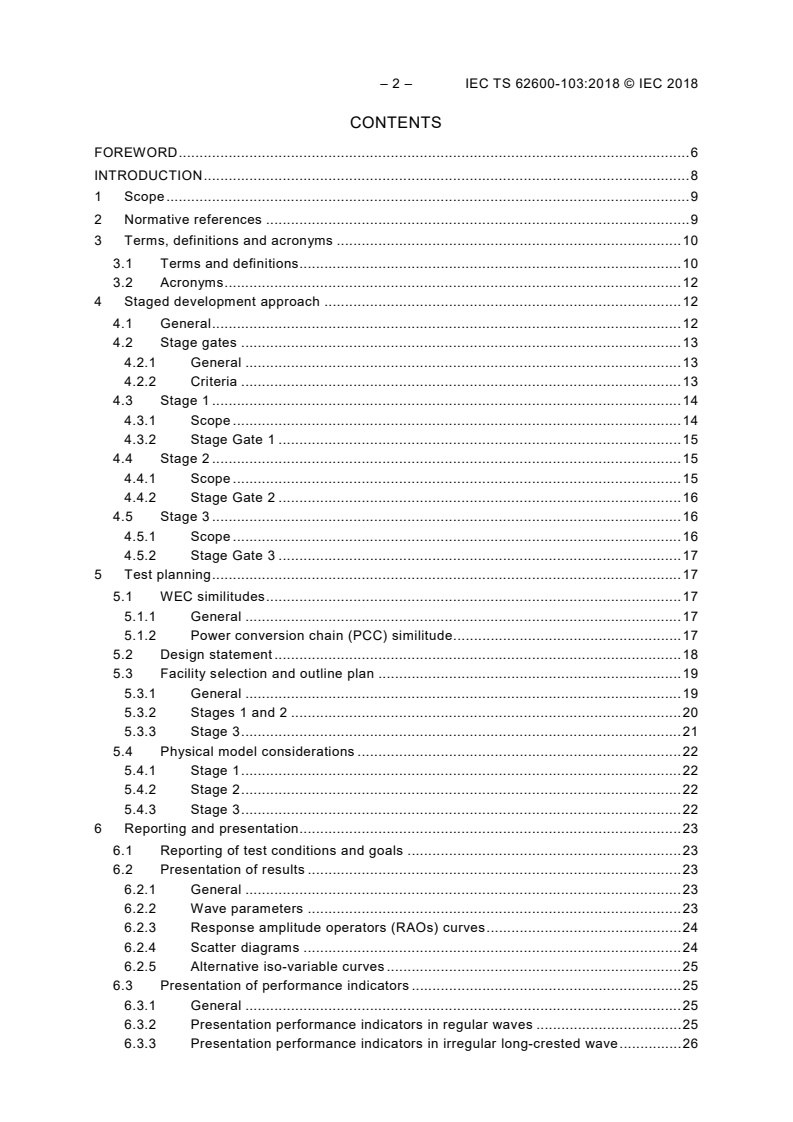
CONTENTS
FOREWORD . 6
INTRODUCTION . 8
1 Scope . 9
2 Normative references . 9
3 Terms, definitions and acronyms . 10
3.1 Terms and definitions . 10
3.2 Acronyms . 12
4 Staged development approach . 12
4.1 General . 12
4.2 Stage gates . 13
4.2.1 General . 13
4.2.2 Criteria . 13
4.3 Stage 1 . 14
4.3.1 Scope . 14
4.3.2 Stage Gate 1 . 15
4.4 Stage 2 . 15
4.4.1 Scope . 15
4.4.2 Stage Gate 2 . 16
4.5 Stage 3 . 16
4.5.1 Scope . 16
4.5.2 Stage Gate 3 . 17
5 Test planning . 17
5.1 WEC similitudes . 17
5.1.1 General . 17
5.1.2 Power conversion chain (PCC) similitude . 17
5.2 Design statement . 18
5.3 Facility selection and outline plan . 19
5.3.1 General . 19
5.3.2 Stages 1 and 2 . 20
5.3.3 Stage 3 . 21
5.4 Physical model considerations . 22
5.4.1 Stage 1 . 22
5.4.2 Stage 2 . 22
5.4.3 Stage 3 . 22
6 Reporting and presentation . 23
6.1 Reporting of test conditions and goals . 23
6.2 Presentation of results . 23
6.2.1 General . 23
6.2.2 Wave parameters . 23
6.2.3 Response amplitude operators (RAOs) curves . 24
6.2.4 Scatter diagrams . 24
6.2.5 Alternative iso-variable curves . 25
6.3 Presentation of performance indicators . 25
6.3.1 General . 25
6.3.2 Presentation performance indicators in regular waves . 25
6.3.3 Presentation performance indicators in irregular long-crested wave . 26
6.3.4 Presentation of performance indicators in irregular short-crested waves . 27
7 Testing environment characterisation . 27
7.1 General . 27
7.2 Wave tank characterisation (Stages 1 and 2) . 27
7.3 Trial site characterisation (Stage 3) . 29
7.4 Wave characterisation. 29
7.4.1 General . 29
7.4.2 Laboratory regular waves . 29
7.4.3 Laboratory irregular long-crested waves . 29
7.4.4 Laboratory irregular short-crested waves . 29
7.4.5 Sea trials . 29
8 Data acquisition . 30
8.1 Signal conditioning . 30
8.2 Sample rate . 31
8.3 Analogue to digital conversion and DAQ system . 31
8.4 Frequency response . 31
8.5 Data synchronisation . 31
8.6 Data recording . 32
8.7 Recording of supplementary test data . 32
8.8 Calibration factors . 32
8.9 Instrument response functions . 32
8.10 Health monitoring and verification of signals . 32
8.11 Special data acquisition requirements for Stage 3 sea trials . 33
9 Power performance . 33
9.1 Testing goals . 33
9.2 WEC and mooring similitude . 33
9.3 Power conversion chain similitude . 34
9.3.1 General . 34
9.3.2 Stage 1 . 35
9.3.3 Stage 2 . 35
9.3.4 Stage 3 . 35
9.4 Signal measurement . 36
9.5 Calibration and setup . 36
9.6 Wave parameters . 37
9.6.1 Stage 1 and 2 . 37
9.6.2 Stage 3 . 38
9.7 Performance indicators . 38
10 Kinematics and dynamics in operational environments . 38
10.1 Testing goals . 38
10.2 Testing similitude . 39
10.3 Signal measurement . 40
10.4 Calibration and setup . 42
10.5 Wave parameters . 43
10.5.1 Stages 1 and 2 . 43
10.5.2 Stage 3 . 44
10.6 Performance indicators . 44
11 Kinematics and dynamics in survival environments . 45
11.1 Testing goals . 45
– 4 – IEC TS 62600-103:2018 © IEC 2018
11.2 Testing similitude . 45
11.3 Signal measurements . 46
11.4 Calibration and setup . 46
11.5 Wave parameters . 47
11.5.1 Stage 1 . 47
11.5.2 Stage 2 . 47
11.5.3 Stage 3 . 48
11.6 Performance indicators . 48
Annex A (informative) Stage Gates . 50
A.1 Overview. 50
A.2 Design statements . 50
A.3 Stage Gate criteria . 50
A.4 Uncertainty factors . 51
A.5 Third party review . 52
Annex B (informative) Example test plan . 53
Annex C (informative) Physical modelling guidance . 54
C.1 Similitude . 54
C.1.1 General . 54
C.1.2 Geometric similitude . 54
C.1.3 Structural similitude . 54
C.1.4 Hydrodynamic similitude . 54
C.2 Model instrumentation and data acquisition . 56
C.2.1 General . 56
C.2.2 Water surface elevation . 56
C.2.3 PTO . 56
C.2.4 Device and mooring loads . 56
C.3 Recommendations on calibrations . 57
Annex D (informative) Uncertainty . 58
Bibliography . 60
Figure 1 – Staged development approach . 13
Table 1 – Presentation of performance indicators (regular waves) . 26
Table 2 – Presentation of performance indicators (irregular long-crested waves) . 26
Table 3 – Presentation of performance indicators (irregular short-crested waves) . 27
Table 4 – Environmental measurements . 28
Table 5 – Environmental performance indicators . 30
Table 6 – Power performance testing similitude . 34
Table 7 – Power conversion chain (PCC) representation . 34
Table 8 – Power performance signal measurements . 36
Table 9 – Power performance calibrations . 37
Table 10 – Power performance wave parameters . 37
Table 11 – Kinematics and dynamics similitude requirements (operational
environments) . 40
Table 12 – Kinematic signal measurements (operational environments) . 41
Table 13 – Dynamic signal measurements (operational environments) . 42
Table 14 – Calibration for kinematic and dynamic testing (operational environments) . 43
Table 15 – Wave parameters for kinematics and dynamics testing (operational
conditions) . 44
Table 16 – Kinematics and dynamics similitude requirements (survival environments) . 46
Table C.1 – Scale laws . 55
Table C.2 – Sensor calibrations . 57
Table D.1 – Scale example . 59
– 6 – IEC TS 62600-103:2018 © IEC 2018
INTERNATIONAL ELECTROTECHNICAL COMMISSION
____________
MARINE ENERGY – WAVE, TIDAL AND
OTHER WATER CURRENT CONVERTERS –
Part 103: Guidelines for the early stage development
of wave energy converters – Best practices and recommended
procedures for the testing of pre-prototype devices
FOREWORD
1) The International Electrotechnical Commission (IEC) is a worldwide organization for standardization comprising
all national electrotechnical committees (IEC National Committees). The object of IEC is to promote
international co-operation on all questions concerning standardization in the electrical and electronic fields. To
this end and in addition to other activities, IEC publishes International Standards, Technical Specifications,
Technical Reports, Publicly Available Specifications (PAS) and Guides (hereafter referred to as “IEC
Publication(s)”). Their preparation is entrusted to technical committees; any IEC National Committee interested
in the subject dealt with may participate in this preparatory work. International, governmental and non-
governmental organizations liaising with the IEC also participate in this preparation. IEC collaborates closely
with the International Organization for Standardization (ISO) in accordance with conditions determined by
agreement between the two organizations.
2) The formal decisions or agreements of IEC on technical matters express, as nearly as possible, an international
consensus of opinion on the relevant subjects since each technical committee has representation from all
interested IEC National Committees.
3) IEC Publications have the form of recommendations for international use and are accepted by IEC National
Committees in that sense. While all reasonable efforts are made to ensure that the technical content of IEC
Publications is accurate, IEC cannot be held responsible for the way in which they are used or for any
misinterpretation by any end user.
4) In order to promote international uniformity, IEC National Committees undertake to apply IEC Publications
transparently to the maximum extent possible in their national and regional publications. Any divergence
between any IEC Publication and the corresponding national or regional publication shall be clearly indicated in
the latter.
5) IEC itself does not provide any attestation of conformity. Independent certification bodies provide conformity
assessment services and, in some areas, access to IEC marks of conformity. IEC is not responsible for any
services carried out by independent certification bodies.
6) All users should ensure that they have the latest edition of this publication.
7) No liability shall attach to IEC or its directors, employees, servants or agents including individual experts and
members of its technical committees and IEC National Committees for any personal injury, property damage or
other damage of any nature whatsoever, whether direct or indirect, or for costs (including legal fees) and
expenses arising out of the publication, use of, or reliance upon, this IEC Publication or any other IEC
Publications.
8) Attention is drawn to the Normative references cited in this publication. Use of the referenced publications is
indispensable for the correct application of this publication.
9) Attention is drawn to the possibility that some of the elements of this IEC Publication may be the subject of
patent rights. IEC shall not be held responsible for identifying any or all such patent rights.
The main task of IEC technical committees is to prepare International Standards. In
exceptional circumstances, a technical committee may propose the publication of a technical
specification when
• the required support cannot be obtained for the publication of an International Standard,
despite repeated efforts, or
• the subject is still under technical development or where, for any other reason, there is the
future but no immediate possibility of an agreement on an International Standard.
Technical specifications are subject to review within three years of publication to decide
whether they can be transformed into International Standards.
IEC TS 62600-103, which is a technical specification, has been prepared by IEC technical
committee 114: Marine energy – Wave, tidal and other water current converters.
The text of this technical specification is based on the following documents:
Enquiry draft Report on voting
114/233/DTS 114/259A/RVDTS
Full information on the voting for the approval of this technical specification can be found in
the report on voting indicated in the above table.
This document has been drafted in accordance with the ISO/IEC Directives, Part 2.
A list of all parts in the IEC 62600 series, published under the general title Marine energy –
Wave, tidal and other water current converters, can be found on the IEC website.
The committee has decided that the contents of this document will remain unchanged until the
stability date indicated on the IEC website under "http://webstore.iec.ch" in the data related to
the specific document. At this date, the document will be
• reconfirmed,
• withdrawn,
• replaced by a revised edition, or
• amended.
A bilingual version of this publication may be issued at a later date.
IMPORTANT – The 'colour inside' logo on the cover page of this publication indicates
that it contains colours which are considered to be useful for the correct
understanding of its contents. Users should therefore print this document using a
colour printer.
– 8 – IEC TS 62600-103:2018 © IEC 2018
INTRODUCTION
Developing wave energy converters (WECs) will always be a demanding engineering process.
It is important, therefore, to follow a design path that will minimise the risks encountered
along a route of increasing technical complexity and fiscal commitment. This Technical
Specification (TS) presents a guide that addresses these issues, the approach being based
on a proven methodology adapted from other technology areas, especially NASA and similar
heavy maritime engineering industries.
The scope of the work is defined in Clause 1. Normative references and definitions of
important terms are introduced in Clauses 2 and 3 respectively. The core of the document
then follows a twin-track approach, relying on:
a) a structured or staged development approach outlined in Clause 4, and
b) a set of model specific and goal orientated Clauses 9 to 11 ensuring that targets are
clearly defined and attained with confidence. Testing specific requirements such as test
planning (Clause 5), reporting and presentation (Clause 6), characterisation of the
surrounding wave environment (Clause 7), and data acquisition (Clause 8) are also
included.
The structured development schedule makes use of the ability to accurately scale WECs such
that sub-prototype size physical models can be used to investigate the relevant device
parameters and design variables at an appropriate dimension and associated budget.
The parallel development of mathematical models describing a WEC’s behaviour and
performance is encouraged, but the procedure is not included in the document.
This document is quite exacting in terms of both the approach and requirements for the
development of WECs since it takes a professional approach to the process. Following these
guidelines will not guarantee success, but not following them will be a recipe for lost time and
opportunities.
MARINE ENERGY – WAVE, TIDAL AND
OTHER WATER CURRENT CONVERTERS –
Part 103: Guidelines for the early stage development
of wave energy converters – Best practices and recommended
procedures for the testing of pre-prototype devices
1 Scope
This part of IEC TS 62600 is concerned with the sub-prototype scale development of WECs. It
includes the wave tank test programmes, where wave conditions are controlled so they can be
scheduled, and the first large-scale sea trials, where sea states occur naturally and the
programmes are adjusted and flexible to accommodate the conditions. A full-scale prototype
test schedule is not covered in this document. Bench tests of PTO (power take-off) equipment
are also not covered in this document.
This document describes the minimum test programmes that form the basis of a structured
technology development schedule. For each testing campaign, the prerequisites, goals and
minimum test plans are specified. This document addresses:
• Planning an experimental programme, including a design statement, technical drawings,
facility selection, site data and other inputs as specified in Clause 5.
• Device characterisation, including the physical device model, PTO components and
mooring arrangements where appropriate.
• Environment characterisation, concerning either the tank testing facility or the sea
deployment site, depending on the stage of development.
• Specification of specific test goals, including power conversion performance, device
motions, device loads and device survival.
Guidance on the measurement sensors and data acquisition packages is included but not
dictated. Providing that the specified parameters and tolerances are adhered to, selection of
the components and instrumentation can be at the device developer’s discretion.
An important element of the test protocol is to define the limitations and accuracy of the raw
data and, more specifically, the results and conclusion drawn from the trials. A methodology
addressing these limitations is presented with each goal so the plan always produces
defendable results of defined uncertainty.
This document intends to serve a wide audience of wave energy stakeholders, including
device developers and their technical advisors; government agencies and funding councils;
test centres and certification bodies; private investors; and environmental regulators and
NGOs.
2 Normative references
The following documents are referred to in the text in such a way that some or all of their
content constitutes requirements of this document. For dated references, only the edition
cited applies. For undated references, the latest edition of the referenced document (including
any amendments) applies.
IEC TS 62600-1, Marine energy – Wave, tidal and other water current converters – Part 1:
Terminology
– 10 – IEC TS 62600-103:2018 © IEC 2018
IEC TS 62600-2, Marine energy – Wave, tidal and other water current converters – Part 2:
Design requirements for marine energy systems
IEC TS 62600-100, Marine energy – Wave, tidal and other water current converters –
Part 100: Electricity producing wave energy converters – Power performance assessment
IEC TS 62600-101, Marine energy – Wave, tidal and other water current converters –
Part 101: Wave energy resource assessment and characterization
3 Terms, definitions and acronyms
For the purposes of this document, the terms and definitions given in IEC TS 62600-1 and the
following apply.
ISO and IEC maintain terminological databases for use in standardization at the following
addresses:
• IEC Electropedia: available at http://www.electropedia.org/
• ISO Online browsing platform: available at http://www.iso.org/obp
3.1 Terms and definitions
3.1.1
cross-sectional load
compressive or tensile stress parallel to the stress plane and shear stress perpendicular to
the stress plane
3.1.2
dynamic
forces responsible for the object’s motion.
Note 1 to entry: Dynamic side of absorbed power: “Load measurement” (force, torque, pressure, etc.).
3.1.3
kinematic
motion of object, irrespective of how this motion was caused
Note 1 to entry: Kinematic side of absorbed power: “Velocity measurement” (velocity, angular velocity, flow, etc.).
Note 2 to entry: The terms “dynamic” and “kinematic” as defined above are used extensively throughout this
document. These terms are used to ensure that a range of WEC conversion concepts are covered. For example,
“dynamic” side of load measurement may refer to forces, torques or pressures, and as such provides a convenient
and concise means of relating to a range of technologies.
3.1.4
local load
highly localised impacts like green water, slam event or other impacts that could occur due to
motion limitations
3.1.5
regular wave
series of waves containing a single frequency component
3.1.6
operational sea state
wave conditions where the wave energy converter is in power production mode
3.1.7
irregular wave
wave composed of multiple frequency components
3.1.8
peak distribution
distribution of peak magnitude values
3.1.9
stage 1
small-scale testing in the laboratory
Note 1 to entry: Stage 1 is equivalent to technology readiness level 3.
3.1.10
stage 2
medium-scale testing in the laboratory
Note 1 to entry: Stage 2 is equivalent to technology readiness level 4.
3.1.11
stage 3
large-scale testing at sea
Note 1 to entry: Stage 3 is equivalent to technology readiness level 6.
3.1.12
stationary part of the time series (regular waves)
interval of the time series in which the wave amplitude and frequency result in repeatable
values with small standard deviations
3.1.13
stationary part of the time series (irregular waves)
interval of the time series used to analyse the spectral shape of the series
3.1.14
storm conditions
sea state with return period as defined in IEC TS 62600-2
3.1.15
wave train
laboratory generated series of similar period waves
3.1.16
long-crested waves
sea state with little or no directional spreading
3.1.17
short-crested waves
sea state where energy propagation is directionally spread
– 12 – IEC TS 62600-103:2018 © IEC 2018
3.2 Acronyms
CoG Centre of Gravity
DAQ Data Acquisition
DoF Degree of Freedom as defined in IEC TS 62600-1
PCC Power Conversion Chain. The power conversion chain is made up of a drivetrain, generator, storage,
and power electronics.
RAO Response Amplitude Operator
TRL Technology Readiness Level
ULS Ultimate Limit State in the context of structural engineering
4 Staged development approach
4.1 General
This clause introduces the staged development of the design for a WEC through physical
model testing. Each stage of development is motivated by risk reduction. The primary goals
for each stage address elements that shall be completed before proceeding through the
user’s pre-defined stage gate for that stage.
Scaled wave conditions produced in the wave tank should be representative of anticipated full
scale wave conditions at the expected deployment sites, including sea state spectral
characteristics.
Figure 1 shows an overview of the process from the early design concept to the deployment
of the first limited device number array. Each stage is based on a different physical scale
range carefully selected to achieve a set of specific design objectives prior to advancing the
device trials to the next stage. This clause outlines the scope and stage gates for Stages 1, 2
and 3, guiding the development process from Technology Readiness Level (TRL) 1 to 6
(Figure 1). Stages 4 and 5 (Figure 1) concern full scale (or near full scale) testing and are not
covered in this document.
This document does not dictate a scale for each of the Stages 1 to 3. The model testing scale
heavily depends on the type of WEC developed, the fidelity of the available instrumentation,
and to some extent on the availability of appropriate test facilities. The scales provided in
Figure 1 are included as indicators of previous WEC development efforts.
Every type of WEC will have slightly different requirements so a bespoke programme should
be drawn up around these basic testing requirements. The necessary and recommended
goals and experimental activities for Stages 1 to 3 are described in detail in Clauses 5 to 11.
Activities are to be defined in the context of good engineering practice, where factor of safety,
reliability or other design philosophy are followed.
Although the ordering of the test schedule is of paramount importance, it is equally essential
that a stage gate process is applied at the conclusion of each set of trials to evaluate if the
WEC has achieved the required experimental objectives before advancing forward. This due
diligence should be monitored against the design statement produced by the device developer
prior to each stage and the standards being established by the industry based on the other
WEC’s performances.
A set of Stage Gate criteria for the evaluation of the WEC behaviour and performance at the
conclusion of each testing period are defined. These shall be achieved before advancing to
the next stage. At this stage of the technology development, the criteria are defined as a
general framework and allow for a high degree of flexibility to suit the particular design
requirements.
At Stage 1, it should be anticipated that several iterations of a device will be required to
optimise the performance, reliability, safety and economics. More than one iteration may still
be required at Stage 2, and a single implementation should normally suffice at Stage 3.
Figure 1 – Staged development approach
4.2 Stage gates
4.2.1 General
At the conclusion of each stage of device model testing, an evaluation procedure should be
instigated to assess the overall performance of the design. The appraisal may include a
technical and economic review based on three elements of the proposed device design:
• Analysis of the results from the appropriate preceding test programme.
• A comparison with the related device design statement produced at the beginning of the
stage.
• An overall design review by a third party, independent, established engineering company.
NOTE See also Annex A for an informative description of the stage gate process.
4.2.2 Criteria
The review shall follow the same set of evaluation criteria at each Stage which are based on
the test goals specified for each Stage in Clauses 9, 10 and 11. As the test scale enlarges,
the complexity of the model and trials increase to produce more accurate results with less
uncertainty in the prototype extrapolation. The Stage Gate evaluation criteria reflect this
decreasing uncertainty.
The evaluation criteria shall include
• Energy absorption.
• Device seakeeping (motions).
– 14 – IEC TS 62600-103:2018 © IEC 2018
• Mooring loads.
• PTO loads.
• Ultimate Limit State (ULS) verification.
The minimum specification for each Stage Gate criteria that experimental testing can
contribute to are outlined in Clauses 9, 10 and 11 and summarised below.
NOTE Physical model testing is often run in conjunction with a mathematical model development, with model
validation criteria similar to the above.
4.3 Stage 1
4.3.1 Scope
Stage 1 is intended to demonstrate that the design has potential and may be realised or
transitioned up to TRL3. A key purpose of Stage 1 testing is to explore initial design choices.
NOTE 1 Stage 1 is often used to explore a number of device configurations without a detailed design for the full
scale prototype.
There are three facets to Stage 1 tests:
• Proof of concept: to verify that the device design concept operates under wave excitation
as predicted and described (under TRL1).
• Optimisation of design: to evolve the most favourable device configuration(s) in regular
and irregular waves.
• Device performance: to obtain a first indication of power performance in five sea states for
the optimised PTO setting of the device.
All three facets are required to provide input to Stage Gate 1.
For the proof of concept phase of Stage 1, the testing may rely on an idealised physical
model. This model can be restricted to a limited number of DoF if this can be justified.
The PTO can be represented by a simplified, but accurate, mechanism. The selected PTO
mechanism shall provide a damping that can be characterised across an appropriate range of
settings.
A generic station keeping system can be used if the mooring behaviour is not an integral part
of the device hydrodynamic motion and energy conversion scheme.
Established ocean spectra can be utilised at this stage to generate the irregular wave
excitation time histories, such as Bretschneider, JONSWAP or ITTC.
NOTE 2 At Stage 1, parts of the testing are commonly undertaken using non-natural distributions. This includes
white or pink spectra for system identification purposes.
NOTE 3 References [1],[2],[3] provide guidelines for generic test site data, which may assist with the Stage 1 sea
state selection.
The methodology of testing recommended here follows the best practice for Stage 1 testing
and builds upon the practices developed in [4] and [5]. The results of this stage are lessons
used to converge on a full-scale design and data to be validated in the next stage.
___________
Numbers in square brackets refer to the Bibliography.
4.3.2 Stage Gate 1
Energy absorption appraisal shall be based on:
• the set of power response transfer function (RAO, for similar wave heights);
• power capture prospects estimated on a minimum of five selected sea states.
Seakeeping appraisal shall be based on:
• the RAO for the dominant or relevant degrees of motion.
Mooring appraisal if implemented:
• the time series and associated analysis (e.g. RAOs) of the mooring line loads.
4.4 Stage 2
4.4.1 Scope
The purpose of Stage 2 testing is to fully evaluate the device design identified in Stage 1.
Stage 2 testing can be associated with a significant amount of design variables, particularly in
the PTO description, but shall be based on similar performance indicators as adopted during
Stage 1.
Stage 2 testing shall specifically address the following key objectives:
• stage 1 validation: To validate the technical conclusions drawn from the previous test
programme and to identify potential scaling issues between the two stages;
• mooring function check: to verify the proposed full-scale mooring and anchorage system
design and assess a realistic mooring response;
• device performance: to verify the energy conversion performance;
• device dynamics and kinematics;
• survivability check: introducing storm conditions to observe device response in survival
conditions, and to discover device-specific failure modes;
• use
...