

IEC 62430:2019
(Main)Environmentally conscious design (ECD) - Principles, requirements and guidance
General Information
- Abstract
IEC 62430:2019 describes principles, specifies requirements and provides guidance for organizations intending to integrate environmental aspects into the design and development in order to minimize the adverse environmental impacts of their products.
This document applies to processes on how ECD (environmentally conscious design) are integrated into the design and development. This document applies to any organization, regardless of its size, type or sector.
This document does not provide requirements for assessing the conformity of individual products.
IEC 62430:2019 cancels and replaces the first edition published in 2009. This edition constitutes a technical revision.
This edition includes the following significant technical changes with respect to the previous edition:
a) Scope is extended from electrotechnical product and systems to all products including services.
b) As a consequence of the scope expansion, non-electrotechnical products, services in particular, are taken into account to modify requirements.
c) Clause 6 is added as a guidance.
It has the status of a horizontal standard in accordance with IEC Guide 108 . One of the responsibilities of a technical committee is, wherever applicable, to make use of horizontal standards in the preparation of its publications. The contents of this horizontal standard will not apply unless specifically referred to or included in the relevant publications.
- Status
- Published
- Publication Date
- 21-Oct-2019
- Technical Committee
- TC 111 - Environmental standardization for electrical and electronic products and systems
- Drafting Committee
- JWG ECD - 62430 - TC 111/JWG ECD - 62430
- Current Stage
- PPUB - Publication issued
- Start Date
- 22-Oct-2019
- Completion Date
- 01-Nov-2019
Overview
IEC 62430:2019 is an international standard titled Environmentally Conscious Design (ECD) - Principles, Requirements and Guidance, published by the International Electrotechnical Commission (IEC). This standard provides a comprehensive framework for organizations aiming to incorporate environmental considerations into the design and development of products and services. It helps minimize adverse environmental impacts throughout a product’s life cycle.
The 2019 edition represents a significant technical revision, expanding the scope from exclusively electrotechnical products to all types of products, including services. It is applicable to any organization, regardless of size, sector, or type, and focuses on integrating environmentally conscious design principles into organizational processes rather than setting requirements for individual products.
Key Topics
Principles of Environmentally Conscious Design (ECD)
The standard emphasizes life cycle thinking and the integration of environmental considerations as a policy within organizations. ECD is positioned as a strategic approach to reduce environmental impacts linked to product design and development.Requirements for ECD Implementation
IEC 62430:2019 outlines essential requirements such as:- Integration of ECD into organizational management systems
- Scoping and defining the extent of ECD efforts
- Analyzing and addressing stakeholder environmental requirements
- Identification and evaluation of environmental aspects and impacts
- Incorporation of ECD throughout the design and development stages
- Conducting thorough reviews of ECD processes and designs
- Effective exchange of information among stakeholders
Guidance for Practical Application
The standard includes Clause 6, which provides detailed guidance to help organizations implement ECD effectively. This includes tips for management integration, stakeholder engagement, evaluation methods, and review procedures.Life Cycle Perspective
IEC 62430 advocates a holistic, life cycle approach covering all stages from raw material extraction, manufacturing, delivery, use, maintenance, and end-of-life treatment to final disposal. This approach ensures sustainable design decisions minimize environmental footprints at every phase.
Applications
IEC 62430:2019 is relevant for organizations in the following contexts:
Product Design and Development
Manufacturers and designers can embed environmental considerations early and throughout product lifecycle decisions, enhancing sustainability and compliance.Service Development
Extending beyond products, this standard supports environmentally conscious approaches to service design and delivery, responding to expanding sustainability demands.Corporate Environmental Management
By integrating ECD into corporate policies and management systems, organizations can align with global environmental goals and regulatory requirements.Supply Chain Collaboration
Facilitates information exchange and collaboration across value chains, enabling improved environmental performance upstream and downstream.Sustainability Reporting and Improvement
Supports organizations in systematically identifying environmental aspects, setting improvement targets, and documenting progress for stakeholders.
Related Standards
IEC 62430:2019 aligns closely with several other international standards and guidelines essential for environmental management and sustainable design:
ISO 14001 – Environmental Management Systems
Provides frameworks for organizations to manage environmental responsibilities holistically, complementing ECD integration.ISO 14006 – Environmental Management Systems - Guidelines for Ecodesign
Offers direct guidance on incorporating ecodesign principles into environmental management systems, enhancing the implementation of IEC 62430.ISO 14040 series – Life Cycle Assessment (LCA)
Methodologies to quantify environmental impacts across product life cycles, supporting ECD decision-making.IEC Guide 108 – Horizontal Standards
Defines the role of horizontal standards like IEC 62430, emphasizing their cross-sector application and relevance.
Keywords: Environmentally conscious design, ECD, sustainable product development, life cycle thinking, environmental impact reduction, IEC 62430, environmental management, eco-design, sustainable services, product lifecycle, environmental aspects, design review, environmental requirements, stakeholder engagement.
Relations
- Effective Date
- 05-Sep-2023
Get Certified
Connect with accredited certification bodies for this standard

BSI Group
BSI (British Standards Institution) is the business standards company that helps organizations make excellence a habit.

Bureau Veritas
Bureau Veritas is a world leader in laboratory testing, inspection and certification services.

DNV
DNV is an independent assurance and risk management provider.
Sponsored listings
Frequently Asked Questions
IEC 62430:2019 is a standard published by the International Electrotechnical Commission (IEC). Its full title is "Environmentally conscious design (ECD) - Principles, requirements and guidance". This standard covers: IEC 62430:2019 describes principles, specifies requirements and provides guidance for organizations intending to integrate environmental aspects into the design and development in order to minimize the adverse environmental impacts of their products. This document applies to processes on how ECD (environmentally conscious design) are integrated into the design and development. This document applies to any organization, regardless of its size, type or sector. This document does not provide requirements for assessing the conformity of individual products. IEC 62430:2019 cancels and replaces the first edition published in 2009. This edition constitutes a technical revision. This edition includes the following significant technical changes with respect to the previous edition: a) Scope is extended from electrotechnical product and systems to all products including services. b) As a consequence of the scope expansion, non-electrotechnical products, services in particular, are taken into account to modify requirements. c) Clause 6 is added as a guidance. It has the status of a horizontal standard in accordance with IEC Guide 108 . One of the responsibilities of a technical committee is, wherever applicable, to make use of horizontal standards in the preparation of its publications. The contents of this horizontal standard will not apply unless specifically referred to or included in the relevant publications.
IEC 62430:2019 describes principles, specifies requirements and provides guidance for organizations intending to integrate environmental aspects into the design and development in order to minimize the adverse environmental impacts of their products. This document applies to processes on how ECD (environmentally conscious design) are integrated into the design and development. This document applies to any organization, regardless of its size, type or sector. This document does not provide requirements for assessing the conformity of individual products. IEC 62430:2019 cancels and replaces the first edition published in 2009. This edition constitutes a technical revision. This edition includes the following significant technical changes with respect to the previous edition: a) Scope is extended from electrotechnical product and systems to all products including services. b) As a consequence of the scope expansion, non-electrotechnical products, services in particular, are taken into account to modify requirements. c) Clause 6 is added as a guidance. It has the status of a horizontal standard in accordance with IEC Guide 108 . One of the responsibilities of a technical committee is, wherever applicable, to make use of horizontal standards in the preparation of its publications. The contents of this horizontal standard will not apply unless specifically referred to or included in the relevant publications.
IEC 62430:2019 is classified under the following ICS (International Classification for Standards) categories: 13.020.01 - Environment and environmental protection in general. The ICS classification helps identify the subject area and facilitates finding related standards.
IEC 62430:2019 has the following relationships with other standards: It is inter standard links to IEC 62430:2009. Understanding these relationships helps ensure you are using the most current and applicable version of the standard.
IEC 62430:2019 is available in PDF format for immediate download after purchase. The document can be added to your cart and obtained through the secure checkout process. Digital delivery ensures instant access to the complete standard document.
Standards Content (Sample)
IEC 62430 ®
Edition 2.0 2019-10
INTERNATIONAL
STANDARD
NORME
INTERNATIONALE
HORIZONTAL STANDARD
NORME HORIZONTALE
Environmentally conscious design – Principles, requirements and guidance
Écoconception (ECD) – Principes, exigences et recommandations
All rights reserved. Unless otherwise specified, no part of this publication may be reproduced or utilized in any form
or by any means, electronic or mechanical, including photocopying and microfilm, without permission in writing from
either IEC or IEC's member National Committee in the country of the requester. If you have any questions about IEC
copyright or have an enquiry about obtaining additional rights to this publication, please contact the address below or
your local IEC member National Committee for further information.
Droits de reproduction réservés. Sauf indication contraire, aucune partie de cette publication ne peut être reproduite
ni utilisée sous quelque forme que ce soit et par aucun procédé, électronique ou mécanique, y compris la photocopie
et les microfilms, sans l'accord écrit de l'IEC ou du Comité national de l'IEC du pays du demandeur. Si vous avez des
questions sur le copyright de l'IEC ou si vous désirez obtenir des droits supplémentaires sur cette publication, utilisez
les coordonnées ci-après ou contactez le Comité national de l'IEC de votre pays de résidence.
IEC Central Office Tel.: +41 22 919 02 11
3, rue de Varembé info@iec.ch
CH-1211 Geneva 20 www.iec.ch
Switzerland
About the IEC
The International Electrotechnical Commission (IEC) is the leading global organization that prepares and publishes
International Standards for all electrical, electronic and related technologies.
About IEC publications
The technical content of IEC publications is kept under constant review by the IEC. Please make sure that you have the
latest edition, a corrigendum or an amendment might have been published.
IEC publications search - webstore.iec.ch/advsearchform Electropedia - www.electropedia.org
The advanced search enables to find IEC publications by a The world's leading online dictionary on electrotechnology,
variety of criteria (reference number, text, technical containing more than 22 000 terminological entries in English
committee,…). It also gives information on projects, replaced and French, with equivalent terms in 16 additional languages.
and withdrawn publications. Also known as the International Electrotechnical Vocabulary
(IEV) online.
IEC Just Published - webstore.iec.ch/justpublished
Stay up to date on all new IEC publications. Just Published IEC Glossary - std.iec.ch/glossary
details all new publications released. Available online and 67 000 electrotechnical terminology entries in English and
once a month by email. French extracted from the Terms and Definitions clause of
IEC publications issued since 2002. Some entries have been
IEC Customer Service Centre - webstore.iec.ch/csc collected from earlier publications of IEC TC 37, 77, 86 and
If you wish to give us your feedback on this publication or CISPR.
need further assistance, please contact the Customer Service
Centre: sales@iec.ch.
A propos de l'IEC
La Commission Electrotechnique Internationale (IEC) est la première organisation mondiale qui élabore et publie des
Normes internationales pour tout ce qui a trait à l'électricité, à l'électronique et aux technologies apparentées.
A propos des publications IEC
Le contenu technique des publications IEC est constamment revu. Veuillez vous assurer que vous possédez l’édition la
plus récente, un corrigendum ou amendement peut avoir été publié.
Recherche de publications IEC - Electropedia - www.electropedia.org
webstore.iec.ch/advsearchform Le premier dictionnaire d'électrotechnologie en ligne au
La recherche avancée permet de trouver des publications IEC monde, avec plus de 22 000 articles terminologiques en
en utilisant différents critères (numéro de référence, texte, anglais et en français, ainsi que les termes équivalents dans
comité d’études,…). Elle donne aussi des informations sur les 16 langues additionnelles. Egalement appelé Vocabulaire
projets et les publications remplacées ou retirées. Electrotechnique International (IEV) en ligne.
IEC Just Published - webstore.iec.ch/justpublished Glossaire IEC - std.iec.ch/glossary
Restez informé sur les nouvelles publications IEC. Just 67 000 entrées terminologiques électrotechniques, en anglais
Published détaille les nouvelles publications parues. et en français, extraites des articles Termes et Définitions des
Disponible en ligne et une fois par mois par email. publications IEC parues depuis 2002. Plus certaines entrées
antérieures extraites des publications des CE 37, 77, 86 et
Service Clients - webstore.iec.ch/csc CISPR de l'IEC.
Si vous désirez nous donner des commentaires sur cette
publication ou si vous avez des questions contactez-nous:
sales@iec.ch.
IEC 62430 ®
Edition 2.0 2019-10
INTERNATIONAL
STANDARD
NORME
INTERNATIONALE
HORIZONTAL STANDARD
NORME HORIZONTALE
Environmentally conscious design – Principles, requirements and guidance
Écoconception (ECD) – Principes, exigences et recommandations
INTERNATIONAL
ELECTROTECHNICAL
COMMISSION
COMMISSION
ELECTROTECHNIQUE
INTERNATIONALE
ICS 13.020.01 ISBN 978-2-8322-7456-9
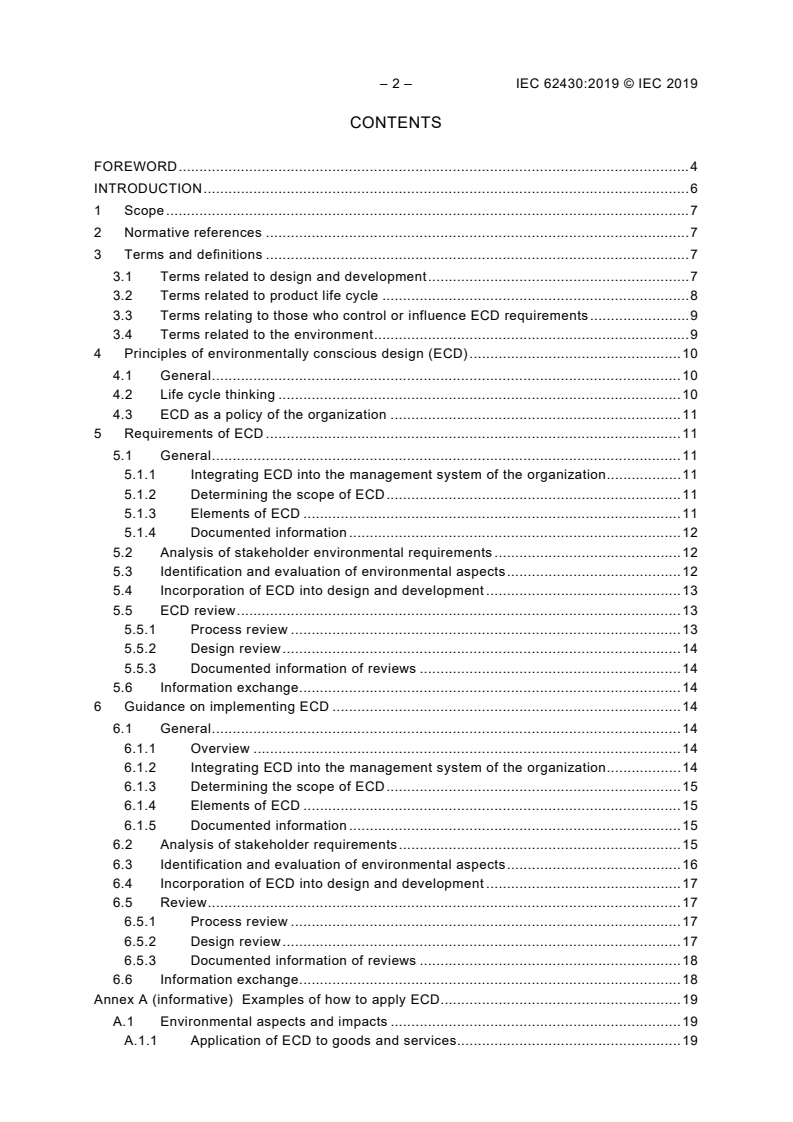
– 2 – IEC 62430:2019 © IEC 2019
CONTENTS
FOREWORD . 4
INTRODUCTION . 6
1 Scope . 7
2 Normative references . 7
3 Terms and definitions . 7
3.1 Terms related to design and development . 7
3.2 Terms related to product life cycle . 8
3.3 Terms relating to those who control or influence ECD requirements . 9
3.4 Terms related to the environment . 9
4 Principles of environmentally conscious design (ECD) . 10
4.1 General . 10
4.2 Life cycle thinking . 10
4.3 ECD as a policy of the organization . 11
5 Requirements of ECD . 11
5.1 General . 11
5.1.1 Integrating ECD into the management system of the organization . 11
5.1.2 Determining the scope of ECD . 11
5.1.3 Elements of ECD . 11
5.1.4 Documented information . 12
5.2 Analysis of stakeholder environmental requirements . 12
5.3 Identification and evaluation of environmental aspects . 12
5.4 Incorporation of ECD into design and development . 13
5.5 ECD review . 13
5.5.1 Process review . 13
5.5.2 Design review . 14
5.5.3 Documented information of reviews . 14
5.6 Information exchange. 14
6 Guidance on implementing ECD . 14
6.1 General . 14
6.1.1 Overview . 14
6.1.2 Integrating ECD into the management system of the organization . 14
6.1.3 Determining the scope of ECD . 15
6.1.4 Elements of ECD . 15
6.1.5 Documented information . 15
6.2 Analysis of stakeholder requirements . 15
6.3 Identification and evaluation of environmental aspects . 16
6.4 Incorporation of ECD into design and development . 17
6.5 Review . 17
6.5.1 Process review . 17
6.5.2 Design review . 17
6.5.3 Documented information of reviews . 18
6.6 Information exchange. 18
Annex A (informative) Examples of how to apply ECD. 19
A.1 Environmental aspects and impacts . 19
A.1.1 Application of ECD to goods and services. 19
A.1.2 Inputs and outputs . 20
A.1.3 Value proposition creation . 21
A.1.4 Design and development . 21
A.1.5 Manufacture of goods and preparation of enablers/capabilities to deliver
services . 21
A.1.6 Delivery/installation of goods and launch/delivery of services . 22
A.1.7 Use stage of goods and provisioning of services . 23
A.1.8 Maintenance, repair, upgrade, reuse and remanufacture . 23
A.1.9 End of life treatment and final disposal . 24
A.1.10 Environmental impacts. 24
A.2 Examples of ECD strategies . 24
A.3 Information exchange. 26
Annex B (informative) ECD methods and tools selection . 28
B.1 Overview. 28
B.2 Examples of methods and tools . 28
B.2.1 General . 28
B.2.2 ECD benchmarking . 28
B.2.3 ECD checklists and guidelines . 29
B.2.4 Environmental quality function deployment . 29
B.2.5 LCT based assessment . 29
B.2.6 Design and development methods and tools . 29
Bibliography . 30
Figure A.1 – Inputs and outputs and indicative examples of life cycle stages for goods
and services . 20
Figure A.2 – Conceptual diagram showing information exchange and collaboration
across the value chain . 27
Table A.1 – Examples of product-related environmental improvement strategies. 25
– 4 – IEC 62430:2019 © IEC 2019
INTERNATIONAL ELECTROTECHNICAL COMMISSION
____________
ENVIRONMENTALLY CONSCIOUS DESIGN –
PRINCIPLES, REQUIREMENTS AND GUIDANCE
FOREWORD
1) The International Electrotechnical Commission (IEC) is a worldwide organization for standardization comprising
all national electrotechnical committees (IEC National Committees). The object of IEC is to promote international
co-operation on all questions concerning standardization in the electrical and electronic fields. To this end and
in addition to other activities, IEC publishes International Standards, Technical Specifications, Technical Reports,
Publicly Available Specifications (PAS) and Guides (hereafter referred to as “IEC Publication(s)”). Their
preparation is entrusted to technical committees; any IEC National Committee interested in the subject dealt with
may participate in this preparatory work. International, governmental and non-governmental organizations liaising
with the IEC also participate in this preparation. IEC collaborates closely with the International Organization for
Standardization (ISO) in accordance with conditions determined by agreement between the two organizations.
2) The formal decisions or agreements of IEC on technical matters express, as nearly as possible, an international
consensus of opinion on the relevant subjects since each technical committee has representation from all
interested IEC National Committees.
3) IEC Publications have the form of recommendations for international use and are accepted by IEC National
Committees in that sense. While all reasonable efforts are made to ensure that the technical content of IEC
Publications is accurate, IEC cannot be held responsible for the way in which they are used or for any
misinterpretation by any end user.
4) In order to promote international uniformity, IEC National Committees undertake to apply IEC Publications
transparently to the maximum extent possible in their national and regional publications. Any divergence between
any IEC Publication and the corresponding national or regional publication shall be clearly indicated in the latter.
5) IEC itself does not provide any attestation of conformity. Independent certification bodies provide conformity
assessment services and, in some areas, access to IEC marks of conformity. IEC is not responsible for any
services carried out by independent certification bodies.
6) All users should ensure that they have the latest edition of this publication.
7) No liability shall attach to IEC or its directors, employees, servants or agents including individual experts and
members of its technical committees and IEC National Committees for any personal injury, property damage or
other damage of any nature whatsoever, whether direct or indirect, or for costs (including legal fees) and
expenses arising out of the publication, use of, or reliance upon, this IEC Publication or any other IEC Publications.
8) Attention is drawn to the Normative references cited in this publication. Use of the referenced publications is
indispensable for the correct application of this publication.
9) Attention is drawn to the possibility that some of the elements of this IEC Publication may be the subject of patent
rights. IEC shall not be held responsible for identifying any or all such patent rights.
International Standard IEC 62430 has been prepared by IEC Technical Committee 111:
Environmental standardization for electrical and electronic products and systems, and
ISO Technical Committee 207: Environmental management.
It is published as a double logo standard.
This second edition cancels and replaces the first edition published in 2009. This edition
constitutes a technical revision.
This edition includes the following significant technical changes with respect to the previous
edition:
Scope is extended from electrotechnical product and systems to all products including
services.
As a consequence of the scope expansion, non-electrotechnical products, services in
particular, are taken into account to modify requirements.
Clause 6 is added as a guidance.
The text of this International Standard is based on the following documents:
FDIS Report on voting
111/536/FDIS 111/553/RVD
Full information on the voting for the approval of this International Standard can be found in the
report on voting indicated in the above table.
This document has been drafted in accordance with the ISO/IEC Directives, Part 2.
It has the status of a horizontal standard in accordance with IEC Guide 108.
The committee has decided that the contents of this document will remain unchanged until the
stability date indicated on the IEC website under "http://webstore.iec.ch" in the data related to
the specific document. At this date, the document will be
• reconfirmed,
• withdrawn,
• replaced by a revised edition, or
• amended.
– 6 – IEC 62430:2019 © IEC 2019
INTRODUCTION
The main purpose of this document is to set requirements and give guidance on how an
organization can integrate environmentally conscious design (ECD) into their design and
development. It is not a product standard and so does not describe requirements that apply to
individual products, or a series of products.
This document uses the term ECD but other terminology used worldwide with the same meaning
includes ecodesign, design for environment (DFE), green design and environmentally
sustainable design.
This document covers physical goods, services, and a combination of the two, all of which are
referred to as ‘products’.
ECD is not a separate activity; it is rather an integral part of an organization’s existing design
and development. While this is not a management system standard, its requirements regarding
ECD can be incorporated into an organization’s existing management system, such as created
to support conformance with ISO 14001 and ISO 9001.
NOTE ISO 14001 links management of an organization's processes with environmental impacts, but it does not
specify requirements for the management processes associated with design and development. Therefore, this ECD
standard can be an addition for organizations which have ISO 14001 in place, as ISO 14001 does not specify how to
incorporate ECD into products. ISO 14006 provides guidance on how to incorporate ECD into an environmental
management system, however, it does not specify how to apply ECD.
Every product has environmental impacts, and these can occur during all stages of its life cycle.
These impacts can range from slight to significant; they may be short-term or long-term; and
they may occur at the local, national, regional or global level (or a combination thereof).
In order to minimize these impacts, it is essential to implement ECD within design and
development. ECD is a systematic approach to achieve reduction of these adverse impacts of
a product throughout its entire life cycle.
Multiple benefits can be achieved for the organization, its customers, and other stakeholders
by applying ECD, such as an overall environmental improvement, a cost reduction, and better
marketability.
This document is intended for those, directly and indirectly, involved in the implementation of
ECD into the design and development.
This document does not preclude sectors from generating their own ECD specific standards or
guidance. However, where such documents are produced, the authors are encouraged to use
this document as a reference to ensure consistency across areas of various products and supply
chains.
ENVIRONMENTALLY CONSCIOUS DESIGN –
PRINCIPLES, REQUIREMENTS AND GUIDANCE
1 Scope
This document describes principles, specifies requirements and provides guidance for
organizations intending to integrate environmental aspects into the design and development in
order to minimize the adverse environmental impacts of their products.
This document applies to processes on how ECD (environmentally conscious design) are
integrated into the design and development. This document applies to any organization,
regardless of its size, type or sector.
This document does not provide requirements for assessing the conformity of individual
products.
This horizontal standard is primarily intended for use by technical committees in the preparation
of standards in accordance with the principles laid down in IEC Guide 108.
One of the responsibilities of a technical committee is, wherever applicable, to make use of
horizontal standards in the preparation of its publications. The contents of this horizontal
standard will not apply unless specifically referred to or included in the relevant publications.
2 Normative references
There are no normative references in this document.
3 Terms and definitions
For the purposes of this document, the following terms and definitions apply.
ISO and IEC maintain terminological databases for use in standardization at the following
addresses:
• ISO Online browsing platform: available at http://www.iso.org/obp
• IEC Electropedia: available at http://www.electropedia.org/
3.1 Terms related to design and development
3.1.1
environmentally conscious design
ECD
systematic approach which considers environmental aspects in the design and development
with the aim to reduce adverse environmental impacts throughout the life cycle of a product
Note 1 to entry: Other terminology used worldwide with the same meaning includes ecodesign, design for
environment (DFE), green design and environmentally sustainable design.
Note 2 to entry: This note applies to the French language only.
3.1.2
product
any goods or service
– 8 – IEC 62430:2019 © IEC 2019
Note 1 to entry: This includes interconnected, interrelated goods or services.
[SOURCE: ISO 14050:2009, 6.2, modified – Note 1 and 2 deleted and new Note 1 added.]
3.1.3
product group
group of technologically or functionally similar products where the environmental aspects can
reasonably be expected to be similar
3.1.4
design and development
process that transforms requirements into a product
Note 1 to entry: Design and development usually follow a series of steps e.g. starting with an initial idea,
transforming the idea into a formal specification, through to the creation of a product, its possible redesign and
consideration of end of life.
Note 2 to entry: Design and development can include taking a product idea from planning to product provision and
review of the product. It can include considerations on business strategies, marketing, research methods and design
aspects that are used. It includes improvements or modifications of existing products.
3.1.5
process
set of interrelated or interacting activities which transforms inputs into outputs
[SOURCE: ISO 14001:2015, 3.3.5, modified – Note1 deleted.]
3.1.6
requirement
need or expectation that is stated, generally implied or obligatory
[SOURCE: ISO/IEC Directives, Part 1, Consolidated ISO Supplement, Annex L,
Appendix 2:2019, 3.3, modified – Notes have been deleted.]
3.2 Terms related to product life cycle
3.2.1
life cycle
consecutive and interlinked stages of a product
Note 1 to entry: Examples of interlinked stages for goods include value proposition creation, design and
development, manufacture of goods, delivery/installation of goods, use of goods, maintenance, repair, upgrade, re-
use, remanufacture, end of life treatment and final disposal.
Note 2 to entry: Examples of interlinked stages of service include value proposition creation, design and
development, preparation of enablers/capabilities to deliver the service, launch/delivery of the service, and service
provision.
Note 3 to entry: The term “entire life cycle” refers to all life cycle stages that a product goes through, e.g. from
raw material acquisition or generation from natural resources to the final disposal.
3.2.2
life cycle stage
life cycle phase
element of a life cycle
3.2.3
life cycle thinking
LCT
life cycle perspective
LCP
consideration of all relevant environmental aspects of a product during its entire life cycle
Note 1 to entry: LCT does not imply undertaking a life cycle assessment.
Note 2 to entry: This note applies to the French language only.
Note 3 to entry: This note applies to the French language only.
3.3 Terms relating to those who control or influence ECD requirements
3.3.1
organization
person or group of people who have their own functions with responsibilities, authorities and
relationships to achieve their objectives
[SOURCE: ISO/IEC Directives, Part 1, Consolidated ISO Supplement, Annex L,
Appendix 2:2019, 3.1, modified – “that has” replaced with “who have” and “its” replaced with
“their”.]
3.3.2
stakeholder
interested party
person or organization that can affect, be affected by, or perceive itself to be affected by a
decision or activity
[SOURCE: ISO/IEC Directives, Part 1, Consolidated ISO Supplement, Annex L,
Appendix 2:2019, 3.2]
3.3.3
value chain
entire sequence of activities or parties that create or receive value through the provision of a
product
[SOURCE: ISO 26000:2010, 2.25, modified – “that provide” replaced with “that create”, “in the
form of products or services” replaced with “through the provision of a product”, and notes
deleted.]
3.4 Terms related to the environment
3.4.1
environment
surroundings which a product can affect, by its existence, including air, water, land, natural
resources, flora, fauna, humans and their interrelations
Note 1 to entry: Surroundings can be described in terms of biodiversity, ecosystems, climate or other characteristics.
3.4.2
environmental aspect
element of an organization’s activities or products that interacts with, or can interact with, the
environment
Note 1 to entry: An environmental aspect can cause (an) environmental impact(s). A significant environmental
aspect is one that has or can have one or more significant environmental impact(s).
Note 2 to entry: Significant environmental aspects are determined by the organization applying one or more criteria.
Note 3 to entry: Activities of the organization are those related to design and development.
[SOURCE: ISO 14001: 2015, 3.2.2, modified – "or services" deleted and Note 3 added.]
3.4.3
environmental impact
change to the environment, whether adverse or beneficial, wholly or partially resulting from
environmental aspects
– 10 – IEC 62430:2019 © IEC 2019
[SOURCE: ISO 14001:2015, 3.2.4, modified – “an organization’s” deleted.]
3.4.4
environmental parameter
quantifiable attribute of an environmental aspect
EXAMPLE Environmental parameters include the type and quantity of materials used (weight, volume), power
consumption, emissions, rate of recyclability.
3.4.5
objective
result to be achieved
Note 1 to entry: An objective can be strategic, tactical, or operational.
Note 2 to entry: An objective can be expressed in other ways, e.g. as an intended outcome, a purpose, an
operational criterion, as an environmental objective, or by the use of other words with similar meaning (e.g. aim, goal,
or target).
[SOURCE: ISO/IEC Directives, Part 1, Consolidated ISO Supplement, Annex L,
Appendix 2:2019, 3.8, modified – Notes 2 and 4 deleted.]
3.4.6
environmental objective
objective set by the organization consistent with its environmental policy
[SOURCE: ISO 14001: 2015, 3.2.6.]
3.4.7
documented information
information required to be controlled and maintained by an organization and the medium on
which it is contained
Note 1 to entry: Documented information can be in any format and media, and from any source.
Note 2 to entry: Documented information can refer to:
• the management system, including related processes;
• information created in order for the organization to operate (documentation);
• evidence of results achieved (records).
[SOURCE: ISO/IEC Directives, Part 1, Consolidated ISO Supplement, Annex L,
Appendix 2:2019, 3.11]
4 Principles of environmentally conscious design (ECD)
4.1 General
The application of the following principles is fundamental to implement ECD:
• life cycle thinking;
• ECD as a policy of the organization.
4.2 Life cycle thinking
Life cycle thinking includes, but is not limited to, the following elements:
having an objective to reduce the overall adverse environmental impacts of the product
while still taking into account other aspects such as safety, quality;
identifying the significant environmental aspects of the product;
considering the trade-offs between different environmental aspects throughout all life cycle
stages;
EXAMPLE 1: The trade-off between energy and material use when replacing an old product with a new one.
considering the trade-offs of a specific environmental aspect between life cycle stages.
EXAMPLE 2: Consider an automobile; selecting lightweight materials (e.g. high-alloy steel or aluminum) could
require more energy to be expended in the manufacturing stage, but the trade-off would be lower fuel
consumption during the use stage (due to the lower mass).
NOTE When a product is part of a system, the environmental performance of that product, during one or more
life cycle stages, can be altered by other products in that system.
In order to include life cycle thinking within ECD, the above elements are considered as early
as possible in the design and development, since that is when the greatest opportunities exist
to make improvements to the product and to reduce any consequential adverse environmental
impact.
4.3 ECD as a policy of the organization
The objective of integrating ECD into the policy of an organization and its implementing strategy
is to ensure:
management understanding of and commitment to ECD;
early contribution and commitment of all relevant business functions to the environmental
objectives for the product throughout its entire life cycle.
5 Requirements of ECD
5.1 General
5.1.1 Integrating ECD into the management system of the organization
The organization shall establish, implement, and maintain ECD as an integral part of design
and development by integrating corresponding requirements into the related procedures and
instructions.
ECD shall be reflected in the policy and strategy of the organization.
If an organization has a management system which includes design and development, the ECD
shall be a part of that management system.
NOTE Management systems are described, for example, in ISO 9001 and ISO 14001. ISO 14006 provides
guidelines for incorporating ECD into a management system.
5.1.2 Determining the scope of ECD
The organization shall determine the scope of ECD for a particular product or product group.
This scope shall consider the relevant stakeholder requirements, and environmental aspects
relevant to the product (or product group, as applicable) and the environmental sphere of
influence of the organization.
NOTE 1 Depending on the nature of the organization’s product, the scope can include manufacturing,
remanufacturing, and service provision.
NOTE 2 The sphere of influence is the ability of an organization to affect other organizations through contractual,
economic or other relationships to affect the decisions, activities or requirements of these other organizations.
5.1.3 Elements of ECD
Elements of ECD incorporated into the design and development are:
– 12 – IEC 62430:2019 © IEC 2019
identification and analysis of relevant stakeholder requirements (see 5.2);
identification and evaluation of environmental aspects and corresponding impacts (see 5.3);
incorporation of ECD into design and development (see 5.4);
review and continual improvement (see 5.5);
information exchange (see 5.6).
NOTE The above items from a) to d) correspond to a PDCA (plan, do, check and act) cycle as follows:
• steps a) and b) correspond to Plan;
• step c) corresponds to Do;
• step d) corresponds to Check and Act.
5.1.4 Documented information
The scope determined in 5.1.2 shall be maintained as documented information and be available
to relevant stakeholders.
The results obtained from the elements listed in 5.1.3 shall be documented, including
subsequent conclusions and responsibilities assigned.
5.2 Analysis of stakeholder environmental requirements
The organization shall establish, implement, and maintain a process to identify the following
items regarding the product being designed and developed:
• the relevant stakeholders;
• the generic, sector specific, product group specific, and product specific environmental
requirements of the stakeholders.
NOTE 1 Generic requirements are those requirements that are applicable to any product, e.g. energy saving
requirements.
NOTE 2 Sector specific requirements are those requirements that are applicable to a specific sector, e.g.
automotive sectors.
NOTE 3 Product (group) specific requirements are those requirements that are applicable to a specific product
(group), e.g. vacuum cleaners.
In implementing the above, the organization shall ensure that:
requirements from relevant stakeholders are identified, for example, covering:
– the different life cycle stages where the requirements are applicable;
– environmental aspects of the product;
– the intended geographic market of the product;
– activities of the organization related to the design and development of the product.
current and emerging relevant stakeholder requirements are identified, reviewed and
updated as needed;
an analysis of the requirements in a) and b) is performed, to identify the affected potential
functions and life cycle stages of the product;
steps from a) to c) are periodically repeated to address new or changed requirements which
occur during design and development.
NOTE 4 It is for the organization to determine what life cycle stages are included.
5.3 Identification and evaluation of environmental aspects
The organization shall establish, implement and maintain a process to identify and evaluate
product-related environmental aspects. The process shall take into account environmental
impacts corresponding to those environmental aspects of the product throughout the life cycle,
and the scope of ECD determined in 5.1.2.
When assessing the environmental aspects of a product the steps below shall be followed:
identification of environmental aspects relevant to a product or product group;
evaluation of environmental impacts related to the identified environmental aspects;
determination of significant environmental aspects.
It is permitted to use qualitative or quantitative evaluation and prioritization of the environmental
aspects. Where feasible, the quantitative approach is encouraged.
5.4 Incorporation of ECD into design and development
The organization shall establish, implement and maintain a process to ensure that the following
tasks are carried out during design and development:
specify the functions to be provided by a product;
determine the relevant environmental parameters, taking into account legal and other
relevant stakeholder requirements, and significant environmental aspects;
determine improvement strategies for the environmental parameters;
set environmental objectives for the environmental parameters based on the improvement
strategies;
create a product specification addressing the environmental objectives;
create solutions to realize the specification while taking into account other design
considerations.
NOTE 1 ECD is a multi-disciplinary set of activities and functions involved in design and development within an
organization or value chain (e.g. design engineers, logistics, procurement, sales and suppliers).
The product solution resulting from design and development should achieve a balance between
the various environmental aspects including relevant stakeholder requirements (see 5.2) and
other requirements such as function, technical requirements, quality, performance, safety,
economic aspects, ethical and social value, and technical and business risks.
NOTE 2 Further guidance on and definition of ethical and social value is provided in ISO 26000.
When compliance with regulations (e.g. health and safety) is required, these shall be met while
considering the environmental objectives.
5.5 ECD review
5.5.1 Process review
The organization shall establish, implement and maintain a process to conduct reviews to
ensure that the resulting system implements the requirements of this document correctly and
fully.
Such reviews shall be conducted at planned intervals and additionally when necessary, to
ensure that ECD is implemented and maintained in a suitable and effective manner.
Each review shall include assessing opportunities for improving how ECD is implemented
resulting in a decision whether or not relevant policies and strategies of the organization need
to be updated.
– 14 – IEC 62430:2019 © IEC 2019
5.5.2 Design review
The organization shall establish, implement and maintain a process to review the ability to
further reduce significant environmental impacts of products.
These reviews shall be conducted at planned intervals or when necessary, to ensure that each
life cycle stage is considered, taking into account changes in both internal and external factors
(such as revised relevant stakeholder requirements).
Improvement actions shall be determined and implemented based on knowledge gained through
the review if:
• the environmental objectives have not been met; or
• the environmental objectives are no longer appropriate or valid.
5.5.3 Documented information of reviews
Documented information obtained from the reviews specified in 5.5.1 and 5.5.2, including the
assigned actions arising from the review, shall be created, retained and serve as a reference
for the future development of the product and continual improvement activities.
5.6 Information exchange
As part of the ECD, the organization shall exchange information with relevant stakeholders in
the value chain to achieve its environmental objective. If the information from the value chain
is not available the organization shall take other measures to obtain the required information.
The information to be exchanged in the value chain should facilitate the reduction of adverse
environmental impacts throughout the entire life cycle of the product.
6 Guidance on implementing ECD
6.1 General
6.1.1 Overview
Subclause 6.1 provides guidance on implementing 5.1. Annex A provides examples of how to
apply ECD. Annex B provides information on how to select methods and tools for ECD. This
document also applies to design and development in multiple organizations, and activities
occurring in different locations, providing one organization has overall responsibility for design
and development.
6.1.2 Integrating ECD into the management system of the organization
ECD should not be a separate activity, rather it should be an integral part of the design and
development within an organization. Hence, the organization’s policies and strategy determine
the framework and objectives of the ECD, including the resource allocation (e.g. financial and
human resources and time allocation for completing the tasks). The strategy also needs to cover
engagement with relevant internal and external stakeholders to improve the organization’s ECD.
As an example, an organization could establish policies or strategies to improve the
environmental performance of specific areas of its products. It could then have a mechanism to
determine if these policies or strategies have been met. It is for the organization to determine
the appropriate timescales, for example in short-term, medium-term and long-term action plans.
ISO 14006 provides guidance on how an organization can integrate ECD into their existing
management system.
Continual improvement refers to a recurring process to improve performance over time,
according to a plan set by the organization. Using the plan-do-check-act (PDCA) cycle can
facilitate continual improvement.
6.1.3 Determining the scope of ECD
The scope of ECD will usually have an impact on other parts of the value chain within an
organization. Moreover, choices and decisions made during the design and development will
modify the environmental impacts caused by a product throughout its life cycle.
The scope of ECD can vary depending on the organization, its relevant stakeholder
requirements and environmental sphere of influence.
The scope of ECD is set by the organization carrying out the design and development. It will be
dependent on the range of activities that the organization can influence through design and
development. Decisions made in the design and development influence activities such as choice
of raw materials, manufacturing methods, logistics, sale, use and maintenance arrangements
for the product, and end of life. Some of these influences could be internal to the organization
while others could be external to it.
Guidance concerning relevant stakeholder requirements are given in 6.2 and environmental
aspects relevant to a product are given in 6.3.
The sphere of influence is also determined on a case by case basis. The organization can have
influence over suppliers in the value chain. If this is the case, it can determine the scope of
ECD including those suppliers. If this is not the case, it could be feasible for an organization to
increase its influence over time as part of the
...