

IEC 60079-13:2017
(Main)Explosive atmospheres - Part 13: Equipment protection by pressurized room "p" and artificially ventilated room "v"
General Information
- Abstract
IEC 60079-13:2017 gives requirements for the design, construction, assessment, verification and marking of rooms used to protect internal equipment:
– located in a Zone 1 or Zone 2 or Zone 21 or Zone 22 explosive atmosphere without an internal source of gas/vapour release and protected by pressurization;
– located in a Zone 2 explosive atmosphere with or without an internal source of gas/vapour release and protected by artificial ventilation;
– located in a non-hazardous area, containing an internal source of gas/vapour release and protected by artificial ventilation;
– located in a Zone 1 or Zone 2 or Zone 21 or Zone 22 explosive atmosphere containing an internal source of gas/vapour release and protected by both pressurization and artificial ventilation.
The term "room" used in this document includes single rooms, multiple rooms, a complete building or a room contained within a building. A room is intended to facilitate the entry of personnel and includes inlet and outlet ducts. An acoustic hood and other like enclosures designed to permit the entry of personnel can be considered as a room.
This document also includes requirements related safety devices and controls necessary to ensure that artificial ventilation, purging and pressurization is established and maintained.
A room assembled or constructed on site, can be either on land or off-shore. The room is primarily intended for installation by an end-user but could be constructed and assessed at a manufacturer’s facility, where the final construction such as ducting can be completed on site.
This document does not specify the methods that may be required to ensure adequate air quality for personnel with regard to toxicity and temperature within the room. National or other regulations and requirements may exist to ensure the safety of personnel in this regard.
This second edition cancels and replaces the first edition published in 2010. This edition constitutes a technical revision.
This edition includes the following significant technical changes with respect to the previous edition:
a) modification of the title of this document to include artificially ventilated room "v" in addition to pressurized room "p";
b) addition of types of protection "pb", "pc", and "vc" and removal of types of protection "px", "py", "pz" and "pv";
c) definition of the differences between pressurization and artificial ventilation types of protection;
d) removal of protection of rooms with an inert gas or a flammable gas from the scope of this document;
e) addition of an informative annex to include examples of applications where types of protection pressurization or artificial ventilation or pressurization and artificial ventilation can be used and associated guidelines.
- Status
- Published
- Publication Date
- 21-May-2017
- Technical Committee
- SC 31J - Classification of hazardous areas and installation requirements
- Current Stage
- PPUB - Publication issued
- Start Date
- 22-May-2017
- Completion Date
- 02-Jun-2017
Buy Documents
IEC 60079-13:2017 - Explosive atmospheres - Part 13: Equipment protection by pressurized room "p" and artificially ventilated room "v" Released:5/22/2017
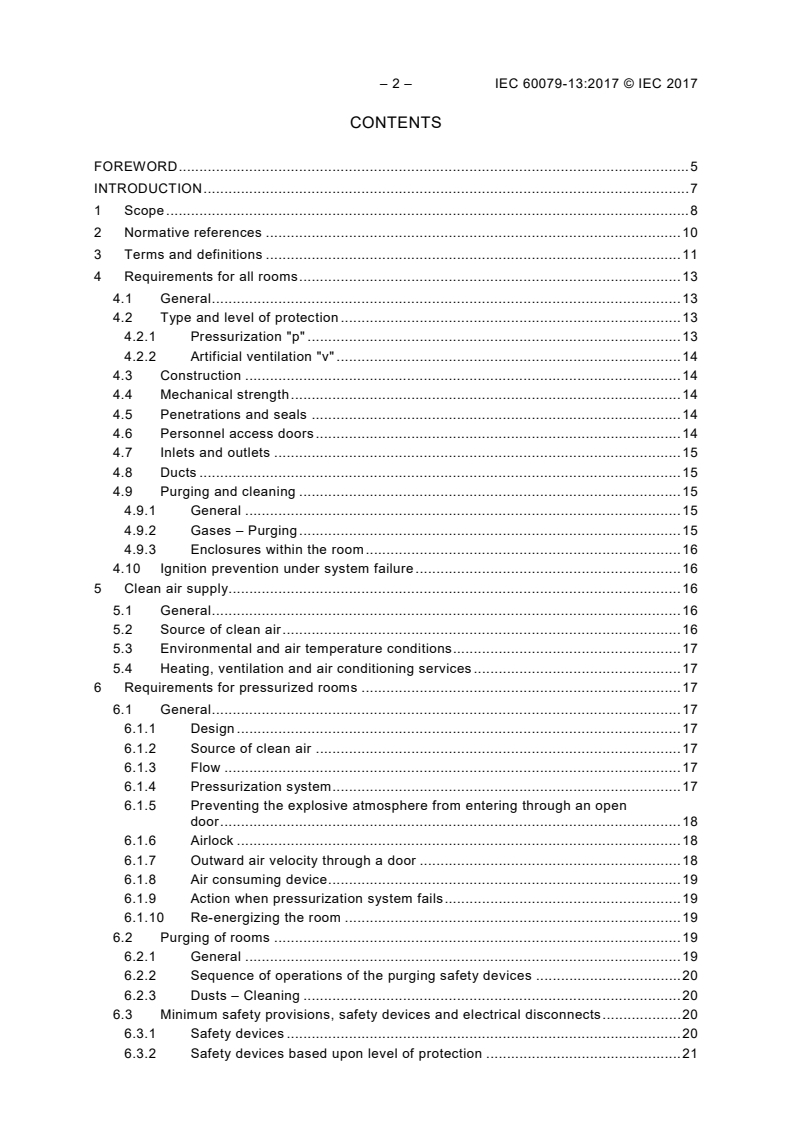
IEC 60079-13:2017 - Explosive atmospheres - Part 13: Equipment protection by pressurized room "p" and artificially ventilated room "v" Released:11/13/2018
Overview
IEC 60079-13:2017 - Explosive atmospheres - Part 13: Equipment protection by pressurized room "p" and artificially ventilated room "v" - gives requirements for the design, construction, assessment, verification and marking of rooms used to protect electrical and electronic equipment located in explosive atmospheres. The standard applies to single rooms, multi-room arrangements, whole buildings, acoustic hoods and similar enclosures that permit personnel entry and include inlet/outlet ducts. This is Edition 2.0 (2017) and represents a technical revision to the 2010 edition.
Key scope points:
- Protection of equipment inside rooms located in Zone 1/2 and Zone 21/22 explosive atmospheres using pressurization ("p"), artificial ventilation ("v"), or a combination of both.
- Rooms in non-hazardous areas that contain an internal source of gas/vapour release and are protected by artificial ventilation.
- Requirements for safety devices, control systems, purging, verification, marking and technical documentation.
Key topics and technical requirements
The standard addresses practical and technical elements necessary to achieve equipment protection in explosive atmospheres:
- Types of protection: Definitions and differences between pressurization ("p") and artificially ventilated ("v") rooms, and the introduced protection types such as pb, pc, vc.
- Design & construction: Room integrity, mechanical strength, penetrations, seals, personnel access doors, inlet/outlet ducts and HVAC considerations.
- Clean air supply: Sources of clean air, environmental conditions and integration with heating, ventilation and air conditioning systems.
- Pressurization-specific requirements: Pressurization systems, minimum pressure differentials, airlock arrangements, purging sequences, and actions on system failure.
- Artificial ventilation-specific requirements: Minimum flow rates, ventilation system design, safety actions for ventilation loss and purging procedures.
- Safety devices & controls: Gas detectors, safety interlocks, electrical disconnects, and verification of sequence of operations.
- Verification, testing & marking: Overpressure, purging, ventilation flow tests, confirmation of safety device ratings, marking and instruction documentation.
Practical applications and users
Who uses IEC 60079-13:
- Design and safety engineers specifying protective rooms for process plants, refineries, chemical and petrochemical facilities.
- Manufacturers and integrators of enclosures, acoustic hoods, packaged rooms, and modular onshore/offshore units.
- End‑users and facility operators implementing protected equipment rooms in Zones 1/2/21/22.
- Certification bodies, inspectors and maintenance teams responsible for verification, testing and periodic re‑assessment.
Typical applications:
- Enclosures for control and electrical equipment at gas turbine packages, pump skids, switchrooms, packaged plants and offshore modules where equipment must be isolated from surrounding explosive atmospheres.
Related standards
- IEC 60079 series (general explosive atmosphere standards) - consult IEC 60079-0 and other parts for complementary requirements, referenced normative documents and harmonized practices.
- National regulations on personnel air quality, toxicity and temperature may apply in addition to IEC 60079-13.
Relations
- Effective Date
- 25-Aug-2026
- Effective Date
- 25-Aug-2026
- Effective Date
- 25-Aug-2026
- Effective Date
- 11-Mar-2026
- Effective Date
- 10-Feb-2026
Buy Documents
IEC 60079-13:2017 - Explosive atmospheres - Part 13: Equipment protection by pressurized room "p" and artificially ventilated room "v" Released:5/22/2017
IEC 60079-13:2017 - Explosive atmospheres - Part 13: Equipment protection by pressurized room "p" and artificially ventilated room "v" Released:11/13/2018
Get Certified
Connect with accredited certification bodies for this standard

IMQ S.p.A. (Certification)
Italian electrical product certification.

SLG Prüf- und Zertifizierungs GmbH
German testing and certification body.

UL Solutions
Global safety science company with testing, inspection and certification.
Sponsored listings
Frequently Asked Questions
IEC 60079-13:2017 is a standard published by the International Electrotechnical Commission (IEC). Its full title is "Explosive atmospheres - Part 13: Equipment protection by pressurized room "p" and artificially ventilated room "v"". This standard covers: IEC 60079-13:2017 gives requirements for the design, construction, assessment, verification and marking of rooms used to protect internal equipment: – located in a Zone 1 or Zone 2 or Zone 21 or Zone 22 explosive atmosphere without an internal source of gas/vapour release and protected by pressurization; – located in a Zone 2 explosive atmosphere with or without an internal source of gas/vapour release and protected by artificial ventilation; – located in a non-hazardous area, containing an internal source of gas/vapour release and protected by artificial ventilation; – located in a Zone 1 or Zone 2 or Zone 21 or Zone 22 explosive atmosphere containing an internal source of gas/vapour release and protected by both pressurization and artificial ventilation. The term "room" used in this document includes single rooms, multiple rooms, a complete building or a room contained within a building. A room is intended to facilitate the entry of personnel and includes inlet and outlet ducts. An acoustic hood and other like enclosures designed to permit the entry of personnel can be considered as a room. This document also includes requirements related safety devices and controls necessary to ensure that artificial ventilation, purging and pressurization is established and maintained. A room assembled or constructed on site, can be either on land or off-shore. The room is primarily intended for installation by an end-user but could be constructed and assessed at a manufacturer’s facility, where the final construction such as ducting can be completed on site. This document does not specify the methods that may be required to ensure adequate air quality for personnel with regard to toxicity and temperature within the room. National or other regulations and requirements may exist to ensure the safety of personnel in this regard. This second edition cancels and replaces the first edition published in 2010. This edition constitutes a technical revision. This edition includes the following significant technical changes with respect to the previous edition: a) modification of the title of this document to include artificially ventilated room "v" in addition to pressurized room "p"; b) addition of types of protection "pb", "pc", and "vc" and removal of types of protection "px", "py", "pz" and "pv"; c) definition of the differences between pressurization and artificial ventilation types of protection; d) removal of protection of rooms with an inert gas or a flammable gas from the scope of this document; e) addition of an informative annex to include examples of applications where types of protection pressurization or artificial ventilation or pressurization and artificial ventilation can be used and associated guidelines.
IEC 60079-13:2017 gives requirements for the design, construction, assessment, verification and marking of rooms used to protect internal equipment: – located in a Zone 1 or Zone 2 or Zone 21 or Zone 22 explosive atmosphere without an internal source of gas/vapour release and protected by pressurization; – located in a Zone 2 explosive atmosphere with or without an internal source of gas/vapour release and protected by artificial ventilation; – located in a non-hazardous area, containing an internal source of gas/vapour release and protected by artificial ventilation; – located in a Zone 1 or Zone 2 or Zone 21 or Zone 22 explosive atmosphere containing an internal source of gas/vapour release and protected by both pressurization and artificial ventilation. The term "room" used in this document includes single rooms, multiple rooms, a complete building or a room contained within a building. A room is intended to facilitate the entry of personnel and includes inlet and outlet ducts. An acoustic hood and other like enclosures designed to permit the entry of personnel can be considered as a room. This document also includes requirements related safety devices and controls necessary to ensure that artificial ventilation, purging and pressurization is established and maintained. A room assembled or constructed on site, can be either on land or off-shore. The room is primarily intended for installation by an end-user but could be constructed and assessed at a manufacturer’s facility, where the final construction such as ducting can be completed on site. This document does not specify the methods that may be required to ensure adequate air quality for personnel with regard to toxicity and temperature within the room. National or other regulations and requirements may exist to ensure the safety of personnel in this regard. This second edition cancels and replaces the first edition published in 2010. This edition constitutes a technical revision. This edition includes the following significant technical changes with respect to the previous edition: a) modification of the title of this document to include artificially ventilated room "v" in addition to pressurized room "p"; b) addition of types of protection "pb", "pc", and "vc" and removal of types of protection "px", "py", "pz" and "pv"; c) definition of the differences between pressurization and artificial ventilation types of protection; d) removal of protection of rooms with an inert gas or a flammable gas from the scope of this document; e) addition of an informative annex to include examples of applications where types of protection pressurization or artificial ventilation or pressurization and artificial ventilation can be used and associated guidelines.
IEC 60079-13:2017 is classified under the following ICS (International Classification for Standards) categories: 29.260.20 - Electrical apparatus for explosive atmospheres. The ICS classification helps identify the subject area and facilitates finding related standards.
IEC 60079-13:2017 has the following relationships with other standards: It is inter standard links to EN ISO 12643-1:2023, EN ISO 21789:2022, EN ISO 20257-1:2020, EN ISO 15138:2018, EN 61800-2:2015. Understanding these relationships helps ensure you are using the most current and applicable version of the standard.
IEC 60079-13:2017 is available in PDF format for immediate download after purchase. The document can be added to your cart and obtained through the secure checkout process. Digital delivery ensures instant access to the complete standard document.
Standards Content (Sample)
IEC 60079-13 ®
Edition 2.0 2017-05
INTERNATIONAL
STANDARD
Explosive atmospheres –
Part 13: Equipment protection by pressurized room "p" and artificially ventilated
room "v"
All rights reserved. Unless otherwise specified, no part of this publication may be reproduced or utilized in any form
or by any means, electronic or mechanical, including photocopying and microfilm, without permission in writing from
either IEC or IEC's member National Committee in the country of the requester. If you have any questions about IEC
copyright or have an enquiry about obtaining additional rights to this publication, please contact the address below or
your local IEC member National Committee for further information.
IEC Central Office Tel.: +41 22 919 02 11
3, rue de Varembé Fax: +41 22 919 03 00
CH-1211 Geneva 20 info@iec.ch
Switzerland www.iec.ch
About the IEC
The International Electrotechnical Commission (IEC) is the leading global organization that prepares and publishes
International Standards for all electrical, electronic and related technologies.
About IEC publications
The technical content of IEC publications is kept under constant review by the IEC. Please make sure that you have the
latest edition, a corrigenda or an amendment might have been published.
IEC Catalogue - webstore.iec.ch/catalogue Electropedia - www.electropedia.org
The stand-alone application for consulting the entire The world's leading online dictionary of electronic and
bibliographical information on IEC International Standards, electrical terms containing 20 000 terms and definitions in
Technical Specifications, Technical Reports and other English and French, with equivalent terms in 16 additional
documents. Available for PC, Mac OS, Android Tablets and languages. Also known as the International Electrotechnical
iPad. Vocabulary (IEV) online.
IEC publications search - www.iec.ch/searchpub IEC Glossary - std.iec.ch/glossary
The advanced search enables to find IEC publications by a 65 000 electrotechnical terminology entries in English and
variety of criteria (reference number, text, technical French extracted from the Terms and Definitions clause of
committee,…). It also gives information on projects, replaced IEC publications issued since 2002. Some entries have been
and withdrawn publications. collected from earlier publications of IEC TC 37, 77, 86 and
CISPR.
IEC Just Published - webstore.iec.ch/justpublished
Stay up to date on all new IEC publications. Just Published IEC Customer Service Centre - webstore.iec.ch/csc
details all new publications released. Available online and If you wish to give us your feedback on this publication or
also once a month by email. need further assistance, please contact the Customer Service
Centre: csc@iec.ch.
IEC 60079-13 ®
Edition 2.0 2017-05
INTERNATIONAL
STANDARD
Explosive atmospheres –
Part 13: Equipment protection by pressurized room "p" and artificially ventilated
room "v"
INTERNATIONAL
ELECTROTECHNICAL
COMMISSION
ICS 29.260.20 ISBN 978-2-8322-4326-8
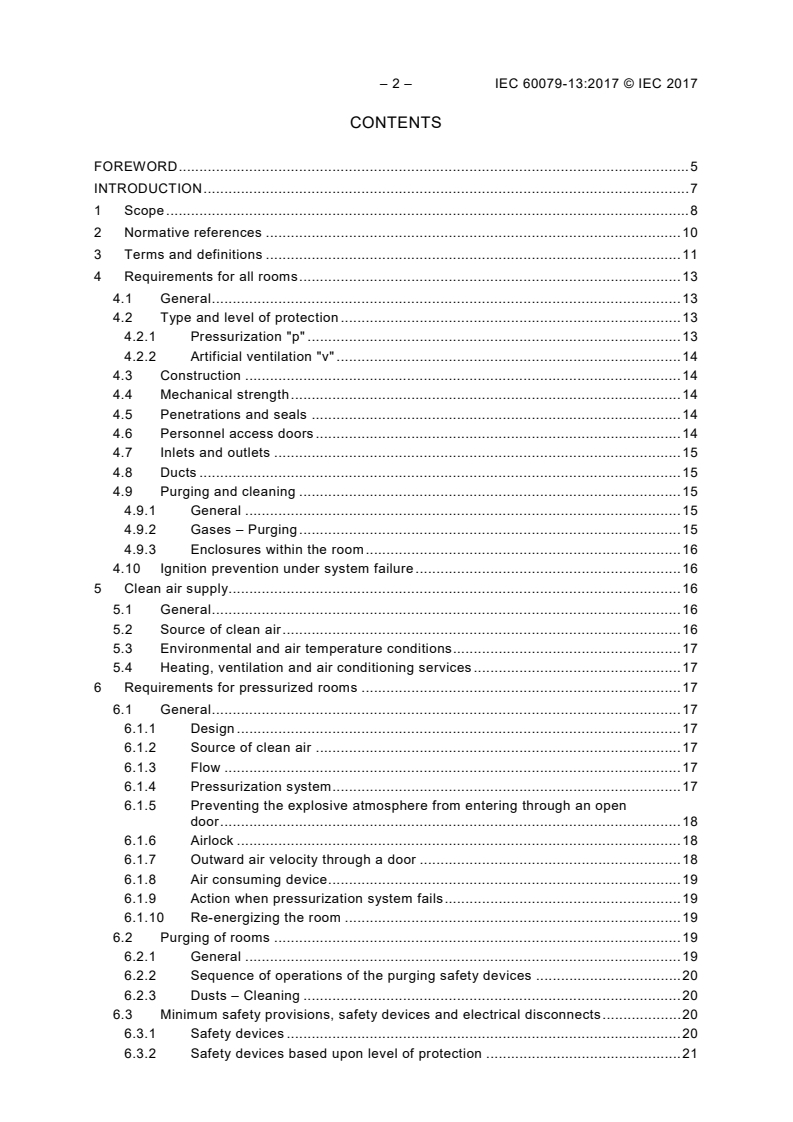
– 2 – IEC 60079-13:2017 © IEC 2017
CONTENTS
FOREWORD . 5
INTRODUCTION . 7
1 Scope . 8
2 Normative references . 10
3 Terms and definitions . 11
4 Requirements for all rooms . 13
4.1 General . 13
4.2 Type and level of protection . 13
4.2.1 Pressurization "p" . 13
4.2.2 Artificial ventilation "v" . 14
4.3 Construction . 14
4.4 Mechanical strength . 14
4.5 Penetrations and seals . 14
4.6 Personnel access doors . 14
4.7 Inlets and outlets . 15
4.8 Ducts . 15
4.9 Purging and cleaning . 15
4.9.1 General . 15
4.9.2 Gases – Purging . 15
4.9.3 Enclosures within the room . 16
4.10 Ignition prevention under system failure . 16
5 Clean air supply. 16
5.1 General . 16
5.2 Source of clean air . 16
5.3 Environmental and air temperature conditions . 17
5.4 Heating, ventilation and air conditioning services . 17
6 Requirements for pressurized rooms . 17
6.1 General . 17
6.1.1 Design . 17
6.1.2 Source of clean air . 17
6.1.3 Flow . 17
6.1.4 Pressurization system . 17
6.1.5 Preventing the explosive atmosphere from entering through an open
door . 18
6.1.6 Airlock . 18
6.1.7 Outward air velocity through a door . 18
6.1.8 Air consuming device . 19
6.1.9 Action when pressurization system fails . 19
6.1.10 Re-energizing the room . 19
6.2 Purging of rooms . 19
6.2.1 General . 19
6.2.2 Sequence of operations of the purging safety devices . 20
6.2.3 Dusts – Cleaning . 20
6.3 Minimum safety provisions, safety devices and electrical disconnects . 20
6.3.1 Safety devices . 20
6.3.2 Safety devices based upon level of protection . 21
6.3.3 Gas detectors . 21
6.4 Verification for pressurized rooms . 21
6.4.1 General . 21
6.4.2 Tests . 21
6.4.3 Overpressure test . 22
6.4.4 Purging test . 22
6.4.5 Minimum pressure differential test . 22
6.4.6 Confirmation of the ratings of the safety devices . 22
6.4.7 Verification of sequence of operation of the safety devices . 22
7 Requirements for artificially ventilated rooms . 22
7.1 General . 22
7.1.1 Design . 22
7.1.2 Source of clean air . 22
7.1.3 Minimum flow rate . 23
7.1.4 Ventilation system . 23
7.1.5 Air consuming device . 24
7.1.6 Safety actions when ventilation system fails . 24
7.1.7 Energizing the artificially ventilated area . 24
7.2 Purging of artificially ventilated rooms . 25
7.2.1 General . 25
7.2.2 Sequence of operations of the purging safety devices . 25
7.3 Minimum safety provisions, safety devices and electrical disconnects . 25
7.3.1 Safety devices . 25
7.3.2 Safety devices based upon equipment protection level . 25
7.3.3 Artificial ventilation protection . 26
7.3.4 Gas detectors . 26
7.4 Loss of artificial ventilation . 26
7.5 Verification for artificially ventilated rooms . 27
7.5.1 General . 27
7.5.2 Tests . 27
7.5.3 Purging test . 27
7.5.4 Minimum ventilation flow rate test . 27
7.5.5 Confirmation of the ratings of the safety devices . 27
7.5.6 Verification of sequence of operation of the safety devices . 27
7.5.7 Testing of ventilation system . 28
8 Marking . 28
8.1 General . 28
8.2 Marking of pressurized rooms . 28
8.3 Marking for artificially ventilated rooms . 29
9 Instructions . 30
9.1 General . 30
9.2 Technical documentation for pressurized rooms . 30
9.3 Technical documentation for artificially ventilated rooms . 30
9.4 Technical documentation for rooms protected by pressurization and artificial
ventilation combined . 31
9.5 Modifications. 31
Annex A (informative) Maintenance. 32
A.1 Periodic verification . 32
A.2 Modifications. 32
– 4 – IEC 60079-13:2017 © IEC 2017
Annex B (informative) Guidelines when pressurization or artificial ventilation is not
immediately restored. 33
Annex C (informative) Examples of applications and associated guidelines . 34
C.1 Examples of applications . 34
C.2 Guidelines for gas turbine enclosure/package . 34
Bibliography . 35
Table 1 – Exclusion of specific clauses or subclauses of IEC 60079-0 . 9
Table 2 – Safety devices for pressurized rooms . 21
Table 3 – Safety actions for artificial ventilation failure . 24
Table 4 – Required safety devices for artificial ventilation . 26
INTERNATIONAL ELECTROTECHNICAL COMMISSION
____________
EXPLOSIVE ATMOSPHERES –
Part 13: Equipment protection by pressurized
room "p" and artificially ventilated room "v"
FOREWORD
1) The International Electrotechnical Commission (IEC) is a worldwide organization for standardization comprising
all national electrotechnical committees (IEC National Committees). The object of IEC is to promote
international co-operation on all questions concerning standardization in the electrical and electronic fields. To
this end and in addition to other activities, IEC publishes International Standards, Technical Specifications,
Technical Reports, Publicly Available Specifications (PAS) and Guides (hereafter referred to as "IEC
Publication(s)"). Their preparation is entrusted to technical committees; any IEC National Committee interested
in the subject dealt with may participate in this preparatory work. International, governmental and non-
governmental organizations liaising with the IEC also participate in this preparation. IEC collaborates closely
with the International Organization for Standardization (ISO) in accordance with conditions determined by
agreement between the two organizations.
2) The formal decisions or agreements of IEC on technical matters express, as nearly as possible, an international
consensus of opinion on the relevant subjects since each technical committee has representation from all
interested IEC National Committees.
3) IEC Publications have the form of recommendations for international use and are accepted by IEC National
Committees in that sense. While all reasonable efforts are made to ensure that the technical content of IEC
Publications is accurate, IEC cannot be held responsible for the way in which they are used or for any
misinterpretation by any end user.
4) In order to promote international uniformity, IEC National Committees undertake to apply IEC Publications
transparently to the maximum extent possible in their national and regional publications. Any divergence
between any IEC Publication and the corresponding national or regional publication shall be clearly indicated in
the latter.
5) IEC itself does not provide any attestation of conformity. Independent certification bodies provide conformity
assessment services and, in some areas, access to IEC marks of conformity. IEC is not responsible for any
services carried out by independent certification bodies.
6) All users should ensure that they have the latest edition of this publication.
7) No liability shall attach to IEC or its directors, employees, servants or agents including individual experts and
members of its technical committees and IEC National Committees for any personal injury, property damage or
other damage of any nature whatsoever, whether direct or indirect, or for costs (including legal fees) and
expenses arising out of the publication, use of, or reliance upon, this IEC Publication or any other IEC
Publications.
8) Attention is drawn to the Normative references cited in this publication. Use of the referenced publications is
indispensable for the correct application of this publication.
9) Attention is drawn to the possibility that some of the elements of this IEC Publication may be the subject of
patent rights. IEC shall not be held responsible for identifying any or all such patent rights.
International Standard IEC 60079-13 has been prepared by IEC technical committee 31:
Equipment for explosive atmospheres
This second edition cancels and replaces the first edition published in 2010. This edition
constitutes a technical revision.
This edition includes the following significant technical changes with respect to the previous
edition:
a) modification of the title of this document to include artificially ventilated room "v" in
addition to pressurized room "p";
b) addition of types of protection "pb", "pc", and "vc" and removal of types of protection "px",
"py", "pz" and "pv";
c) definition of the differences between pressurization and artificial ventilation types of
protection;
– 6 – IEC 60079-13:2017 © IEC 2017
d) removal of protection of rooms with an inert gas or a flammable gas from the scope of this
document;
e) addition of an informative annex to include examples of applications where types of
protection pressurization or artificial ventilation or pressurization and artificial ventilation
can be used and associated guidelines.
The text of this document is based on the following documents:
FDIS Report on voting
31/1309/FDIS 31/1317/RVD
Full information on the voting for the approval of this document can be found in the report on
voting indicated in the above table.
This publication has been drafted in accordance with the ISO/IEC Directives, Part 2.
This document is to be used in conjunction with the principles of hazardous area classification
from IEC 60079-10-1 and artificial ventilation for the protection of analyser(s) houses from
IEC 60079-16.
A list of all parts in the IEC 60079 series, published under the general title Explosive
atmospheres, can be found on the IEC website.
The committee has decided that the contents of this publication will remain unchanged until
the stability date indicated on the IEC website under "http://webstore.iec.ch" in the data
related to the specific publication. At this date, the publication will be
• reconfirmed,
• withdrawn,
• replaced by a revised edition, or
• amended.
A bilingual version of this publication may be issued at a later date.
INTRODUCTION
This part of IEC 60079 gives requirements for the design, construction, assessment,
verification and marking of rooms used to protect internal equipment by pressurization or
artificial ventilation or both as applicable when located in an explosive gas atmosphere or
combustible dust atmosphere hazardous area with or without an internal source of a
flammable gas or vapour. It also includes a room located in a non-hazardous area that has an
internal source of release of a flammable gas or vapour.
This document deals with rooms that are partially constructed in a manufacturer’s facility and
intended to have the final installation completed on-site, as well as rooms that are constructed
completely on-site. Rooms partially constructed in a manufacturer’s facility may include third-
party verification. For rooms built on-site, this document can be used by plant operators as a
guide for assessment of those facilities.
This document represents a major technical revision of the requirements for equipment
protection by pressurized room "p" and artificially ventilated room "v" and should be
considered as introducing all new requirements.
– 8 – IEC 60079-13:2017 © IEC 2017
EXPLOSIVE ATMOSPHERES –
Part 13: Equipment protection by pressurized
room "p" and artificially ventilated room "v"
1 Scope
This part of IEC 60079 gives requirements for the design, construction, assessment,
verification and marking of rooms used to protect internal equipment:
– located in a Zone 1 or Zone 2 or Zone 21 or Zone 22 explosive atmosphere (an area
normally requiring an equipment protection level (EPL) Gb, Gc, Db or Dc) without an
internal source of gas/vapour release and protected by pressurization;
– located in a Zone 2 explosive atmosphere (an area normally requiring EPL Gc) with or
without an internal source of gas/vapour release and protected by artificial ventilation;
– located in a non-hazardous area, containing an internal source of gas/vapour release and
protected by artificial ventilation;
– located in a Zone 1 or Zone 2 or Zone 21 or Zone 22 explosive atmosphere (an area
normally requiring EPL Gb, Gc, Db or Dc), containing an internal source of gas/vapour
release and protected by both pressurization and artificial ventilation.
The term "room" used in this document includes single rooms, multiple rooms, a complete
building or a room contained within a building. A room is intended to facilitate the entry of
personnel and includes inlet and outlet ducts. An acoustic hood and other like enclosures
designed to permit the entry of personnel can be considered as a room.
This document also includes requirements related safety devices and controls necessary to
ensure that artificial ventilation, purging and pressurization is established and maintained.
A room assembled or constructed on site, can be either on land or off-shore. The room is
primarily intended for installation by an end-user but could be constructed and assessed at a
manufacturer’s facility, where the final construction such as ducting can be completed on site.
Rooms can be located in an explosive gas atmosphere requiring EPL Gb or Gc, or a
combustible dust atmosphere requiring EPL Db, or Dc.
This document does not specify the methods that may be required to ensure adequate air
quality for personnel with regard to toxicity and temperature within the room. National or other
regulations and requirements may exist to ensure the safety of personnel in this regard.
Protection of rooms by using an inert gas or a flammable gas is outside of the scope of this
document. It is recognized that such applications are special cases, which in part may be
addressed using the principles from IEC 60079-2, but in all probability will also be the subject
of additional, stringent engineering standards, procedures and practices. Pressurized
enclosures for equipment that are not intended to facilitate the entry of personnel are
addressed in IEC 60079-2, and are not in the scope of this document.
NOTE Maintenance recommendations are contained in Annex A until they can be included in IEC 60079-17.
This document supplements and modifies the general requirements of IEC 60079-0, except
exclusions as indicated in Table 1. Where a requirement of this document conflicts with a
requirement of IEC 60079-0, the requirement of this document takes precedence.
Table 1 – Exclusion of specific clauses or subclauses of IEC 60079-0
Clause of IEC 60079-0
IEC 60079-0
Ed. 6.0 Clause / subclause title
application to
(2011) (Normative)
IEC 60079-13
(Informative)
4 Equipment grouping Applies
4.1 Group I Excluded
4.2 Group II Applies
4.3 Group III Applies
4.4 Equipment for a particular explosive atmosphere Applies
5.1 Environmental influences Applies
5.1.1 Ambient temperature Applies
5.1.2 External source of heating or cooling Applies
5.2 Service temperature Applies
5.3.1 Determination of maximum surface temperature Applies
5.3.2.1 Group I electrical equipment Excluded
5.3.2.2 Group II electrical equipment Applies
5.3.2.3 Group III electrical equipment Applies
5.3.3 Small component temperature for Group I and Group II electrical equipment Excluded
6.1 General Applies
6.2 Mechanical strength Excluded
6.3 Opening times Excluded
6.4 Circulating currents Excluded
6.5 Gasket retention Excluded
6.6 Electromagnetic and ultrasonic radiating equipment Applies
7.1 General Excluded
7.2 Thermal endurance Excluded
7.3 Resistance to light Modified
7.4 Electrostatic charges on external non-metallic materials Excluded
7.5 Accessible metal parts Excluded
8 Metallic enclosures and metallic parts of enclosures Excluded
9 Fasteners Excluded
10 Interlocking devices Excluded
11 Bushings Excluded
12 Materials used for cementing Excluded
13 Ex components Excluded
14 Connection facilities and termination compartments Excluded
15 Connection facilities for earthing and bonding conductors Excluded
16 Entries into enclosures Excluded
17 Supplementary requirements for rotating electrical machines Excluded
18 Supplementary requirements for switchgear Excluded
19 Supplementary requirements for fuses Excluded
20 Supplementary requirements for plugs and sockets Excluded
21 Supplementary requirements for luminaires Excluded
22 Supplementary requirements for caplights and handlights Excluded
23 Equipment incorporating cells and batteries Excluded
24 Documentation Applies
25 Compliance of prototype or sample with documents Applies
26.1 General Applies
26.2 Test configuration Applies
26.3 Tests in explosive test mixtures Excluded
– 10 – IEC 60079-13:2017 © IEC 2017
Clause of IEC 60079-0
IEC 60079-0
Ed. 6.0 Clause / subclause title
application to
(2011) (Normative)
IEC 60079-13
(Informative)
26.4 Tests of enclosures Excluded
26.5 Thermal tests Excluded
26.6 Torque test for bushings Excluded
26.7 Non-metallic enclosures or non-metallic parts of enclosures Excluded
26.8 Thermal endurance to heat Excluded
26.9 Thermal endurance to cold Excluded
26.10 Resistance to light Applies
26.11 Resistance to chemical agents for Group I electrical equipment Excluded
26.12 Earth continuity Excluded
26.13 Surface resistance test of parts of enclosures of non-metallic materials Excluded
26.14 Measurement of capacitance Excluded
26.15 Verification of ratings of ventilating fans Excluded
26.16 Alternative qualification of elastomeric sealing O-rings Excluded
27 Routine tests Applies
28 Manufacturers responsibility Applies
29.1 Applicability Applies
29.2 Location Modified
29.3 General Modified
29.4 Ex marking for explosive gas atmospheres Modified
29.5 Ex marking for explosive dust atmospheres Applies
29.6 Combined types of protection Applies
29.7 Multiple types of protection Excluded
29.8 Ga using two independent Gb types of protection Excluded
29.9 Ex components Excluded
29.10 Small equipment and small Ex components Excluded
29.11 Extremely small equipment and extremely small Ex components Modified
29.12 Warning markings Applies
29.13 Alternate marking of equipment protection levels (EPLs) Excluded
29.14 Cells and batteries Applies
30 Instructions Modified
Annex A Supplementary requirements for Ex cable glands Excluded
Annex B Requirements for Ex components Excluded
Annex C Example of rig for resistance to impact test Excluded
Annex D Introduction to an alternative risk assessment method encompassing Applies
"equipment protection levels" for Ex equipment
Applies: this requirement of IEC 60079-0 is applied without change.
Excluded: this requirement of IEC 60079-0 does not apply.
Modified: this requirement of IEC 60079-0 is modified as detailed in this document.
NOTE The applicable requirements of IEC 60079-0 are identified by the clause title which is normative. This
table was written against the specific requirements of IEC 60079-0, Ed 6.0.
2 Normative references
The following documents are referred to in the text in such a way that some or all of their
content constitutes requirements of this document. For dated references, only the edition
cited applies. For undated references, the latest edition of the referenced document (including
any amendments) applies.
IEC 60050-426, International Electrotechnical Vocabulary – Part 426: Equipment for explosive
atmospheres
IEC 60079-0, Explosive atmospheres – Part 0: Equipment – General requirements
IEC 60079-10-1, Explosive atmospheres – Part 10-1: Classification of areas – Explosive gas
atmospheres
IEC 60079-29 (all parts), Explosive atmospheres – Gas detectors
3 Terms and definitions
For the purposes of this document, the terms and definitions given in IEC 60050-426,
IEC 60079-0 and the following apply.
ISO and IEC maintain terminological databases for use in standardization at the following
addresses:
• IEC Electropedia: available at http://www.electropedia.org/
• ISO Online browsing platform: available at http://www.iso.org/obp
NOTE Unless otherwise specified, the terms "voltage" and "current" mean the RMS values of an alternating,
direct or composite voltage or current.
3.1
airlock
means of egress, consisting of two interdependent doors designed to maintain the internal
pressure of the room in order to prevent or significantly reduce the entry of a surrounding
explosive atmosphere
3.2
alarm
piece of apparatus that generates a visual or audible signal that is intended to attract
attention
[SOURCE: IEC 60050-426:2008, 426-09-05]
3.3
clean air
air that is essentially free of combustible dust, and contains no more than trace amounts of
flammable vapour or gas
3.4
dilution
mixing of flammable vapour or gas with air which, over time, will reduce the flammable
concentration
Note 1 to entry: For safety reasons, dilution to a level lower than the lower explosive limit (LEL) can be required if
associated with the potential release there is an additional toxic or asphyxiant risk. Further guidance can be found
in IEC 61285.
[SOURCE: IEC 60079-10-1:2015, 3.5.2, modified – The note to entry has been added.]
– 12 – IEC 60079-13:2017 © IEC 2017
3.5
internal source of release
point or location indoors from which a gas, vapour, mist or liquid may be released into the
atmosphere such that an explosive gas atmosphere could be formed
3.6
limiting value
lowest concentration value of the lower flammable limit (LFL) of each component involved,
taking account of the most onerous conditions of concentration that may occur from every
internal source of release within the room
3.7
lower flammable limit
LFL
volume fraction of flammable gas or vapour in air below which an explosive gas atmosphere
will not form, expressed as a percentage
Note 1 to entry: Although the lower explosive limit (LEL) is often used in place of the lower flammable limit (LFL),
it should be recognized that the LFL is often slightly lower than the LEL.
Note 2 to entry: See IEC 60079-20-1.
[SOURCE: IEC 60079-2:2014, 3.24, modified – In the definition, the parentheses have been
moved to a second note to entry, and the existing note has been replaced by a new note.]
3.8
opening
inlet, outlet, door or non-airtight fixed panel
3.9
pressurization
technique of guarding against the ingress of the external atmosphere into a room by
maintaining clean air therein at a pressure above that of the external atmosphere
3.10
pressurization system
grouping of safety devices and other components used to pressurize and monitor or control a
pressurized room
3.11
restricted access door
door with controlled or limited use or alarmed when open
3.12
safety device
item used to implement or maintain the integrity of the type of protection
3.13
pressurized room
room volume protected by pressurization and of sufficient size to permit the entry of a person
who may occupy the room
3.14
artificially ventilated room
room volume protected by artificial ventilation and of sufficient size to permit the entry of a
person who may occupy the room
Note 1 to entry: The room volume can be an entire room (general) or part of a room (local ventilation).
3.15
purging
operation of passing a quantity of clean air through the room and ducts in a pressurized or
artificially ventilated room, so that the concentration of the explosive gas atmosphere is
brought to a safe level
3.16
room volume
volume of the empty room and including
any associated ducting without internal equipment
3.17
pressurization "pb"
pressurized room that provides an equipment protection level Gb or Db
3.18
pressurization "pc"
pressurized room that provides an equipment protection level Gc or Dc
3.19
artificial ventilation "vc"
artificial ventilation of a room with or without an internal source of release, such that the room
provides an equipment protection level Gc
3.20
artificial ventilation
technique of guarding against an explosive atmosphere by the use of mechanical means to
provide for the movement of air
3.21
ventilation system
complete installation required to produce artificial ventilation
4 Requirements for all rooms
4.1 General
Protection by pressurization and protection by artificial ventilation are separately described
but may be combined to protect against hazards where required. Where both techniques are
combined, then requirements for both shall apply. Unless otherwise identified in Clauses 6 or
7, the requirements in 4.2 to 4.10 apply to both protection techniques.
NOTE Annex C provides examples of applications and associated guidelines.
4.2 Type and level of protection
4.2.1 Pressurization "p"
Rooms with pressurization "p" and located in a hazardous area shall be one of the following:
a) Level of protection "pb" (EPL Gb or Db). The pressurized room maintains an internal
overpressure reducing the risk of ingress of an explosive atmosphere and is suitable for
use in an area requiring EPL Gb or Db, permitting unprotected equipment to be installed
within the pressurized room except for pressurization safety devices (see 6.3.1).
b) Level of protection "pc" (EPL Gc or Dc). The pressurized room maintains an internal
overpressure reducing the risk of the ingress of an explosive atmosphere and is suitable
for use in an area requiring EPL Gc or Dc, permitting unprotected equipment to be
installed within the pressurized room except for pressurization safety devices (see 6.3.1).
– 14 – IEC 60079-13:2017 © IEC 2017
4.2.2 Artificial ventilation "v"
The artificial ventilated room maintains artificial ventilation to dilute a release of flammable
substance to reduce a hazardous area inside such that the required EPL is reduced from
either Gb or Gc to non-hazardous or from Gb to Gc.
Rooms with artificial ventilation "v" and located in a hazardous area shall be:
• level of protection "vc" (EPL Gc). The ventilated room maintains artificial ventilation to
dilute a release of flammable substance to reduce a hazardous area such that unprotected
equipment can be installed within the artificially ventilated room, and is suitable for use in
an area requiring EPL Gc.
NOTE This permits equipment with a lower EPL to be installed within the artificially ventilated room except for
ventilation safety devices (see 7.3.1).
Rooms may be protected by either general or local artificial ventilation. General artificial
ventilation applies to an entire room or significant portion of a room and local artificial
ventilation applies to restricted regions, for example an extraction hood.
4.3 Construction
The protected room shall, at a minimum, be designed to allow pressurization or artificial
ventilation to be used in accordance with Clauses 6 or 7.
NOTE The room construction requirements could be affected by the location, occupancy requirements, and
functionality.
For pressurized rooms and rooms protected by artificial ventilation, provision shall be made to
ensure adequate purging of dead air spaces created within the room, for example by avoiding
suspended ceilings, trenches, or raised floors.
4.4 Mechanical strength
The room and any ducts and their connecting parts shall be designed to withstand the
maximum pressure of the pressurization or ventilation system. This shall be verified by the
design documentation or by the overpressure test of 6.4.2. National or regional building
requirements may also apply.
Test for mechanical strength need not be carried out on the completed room but may instead
be applied to all parts such as windows, gland plates, penetrations, doors, inlets or outlets of
the room which are not made of steel or concrete but which are integral to the type of
protection. In this case, the tests may be carried out on the parts themselves, appropriately
mounted for the test.
4.5 Penetrations and seals
The entry of cables, electrical conduits and other penetrations into the room shall be sealed
so that the necessary pressure differential or artificial ventilation integrity is maintained.
Measures shall be taken to minimize the exchange of atmosphere between the inside and the
outside of the room where this may lead to another hazard, for example displacement of
vapours via floor drainage facilities.
Barriers may need to be considered for certain room designs to minimize ingress or egress of
gases or vapours, for example this may include liquid seals such as s-bends in drain piping.
4.6 Personnel access doors
Where protection against ingress of a flammable atmosphere is required, doors for personnel
access shall be automatically self-closing, close fitting, and designed to close and latch
against the normal pressure differential. Restricted access doors are not required to be self-
closing.
NOTE Refer to IEC 60079-10-1 for additional guidance on doors.
4.7 Inlets and outlets
For pressurization and general artificial ventilation, the location of air inlets and outlets shall
be arranged to ensure even distribution of the clean air flow to minimize pockets where gases
or vapours could accumulate, taking into account the density of those gases and vapours.
Verification shall be according to 6.4.4 or 7.5.3.
Where it is not possible to avoid pockets where gases and vapours can accumulate,
alternative methods of detection and control shall be used.
4.8 Ducts
In order to minimize the entry of contaminated air in the duct or loss of system performance,
the fan suction and discharge ducts should be suitably designed to be free of leaks and
protected against foreseeable mechanical damage.
NOTE Ducts for the pressurization system or ventilation system can be subject to applicable national or regional
standards for building fire requirements.
4.9 Purging and cleaning
4.9.1 General
Purging of flammable gases or removal of combustible dusts from a pressurized room or an
artificially ventilated room is required at both the initial commissioning of the room and
following loss of pressurization or loss of flow, respectively.
Administrative procedures or other controls during loss of pressurization or artificial
ventilation may be deemed by the user sufficient to ensure a gas free atmosphere under some
conditions, for example during short time loss of pressurization or artificial ventilation and
when no other abnormal situations are present. However, the means for purging shall still be
provided.
4.9.2 Gases – Purging
4.9.2.1 General
Before energizing any electrical equipment which is not suitable for the EPL required in a
pressurized room or an artificially ventilated room, it is necessary to ensure the concentration
of flammable gas is not more than 25 % of the limiting value (see 3.6) by purging with clean
air.
Purging shall be verified by either:
a) flow measurement at the dedicated outlet to detect flow below the minimum purge rate
determined for the system;
b) detection of the room pressure above that determined for the pressure at the minimum
purge rate in conjunction with
– flow sensing at the dedicated outlet, or
– gas detectors, where there is not a dedicated outlet, or flow detection is not practicable
at the outlet, to confirm the purge has been effective and that the concentration of
flammable gas within the room is at or below 25 % of the limiting value. Gas detection
cannot be used as to reduce the initial purge requirement of 4.9.2.2 but may be used
to extend the purge time where appropriate.
– 16 – IEC 60079-13:2017 © IEC 2017
4.9.2.2 Purge volume and flow rate
The purge volume for pressurization and for general artificial ventilation shall be a minimum of
10 room volumes unless a reduced purge volume can be verified by 6.4.4 or 7.5.3 or
determined from other analysis.
The purging flow rate shall be a minimum of five air changes per hour.
4.9.3 Enclosures within the room
During purging of the room, any enclosure which exceeds 5 % of the total internal volume of
the room and that contains electrical equipment which is not suitable for the EPL required
shall be
a) vented to the exterior (if not an explosive atmosphere) or to
...
IEC 60079-13 ®
Edition 2.0 2017-05
INTERNATIONAL
STANDARD
NORME
INTERNATIONALE
Explosive atmospheres –
Part 13: Equipment protection by pressurized room "p" and artificially ventilated
room "v"
Atmosphères explosives –
Partie 13: Protection du matériel par salle à surpression interne «p» et salle à
ventilation artificielle «v»
All rights reserved. Unless otherwise specified, no part of this publication may be reproduced or utilized in any form
or by any means, electronic or mechanical, including photocopying and microfilm, without permission in writing from
either IEC or IEC's member National Committee in the country of the requester. If you have any questions about IEC
copyright or have an enquiry about obtaining additional rights to this publication, please contact the address below or
your local IEC member National Committee for further information.
Droits de reproduction réservés. Sauf indication contraire, aucune partie de cette publication ne peut être reproduite
ni utilisée sous quelque forme que ce soit et par aucun procédé, électronique ou mécanique, y compris la photocopie
et les microfilms, sans l'accord écrit de l'IEC ou du Comité national de l'IEC du pays du demandeur. Si vous avez des
questions sur le copyright de l'IEC ou si vous désirez obtenir des droits supplémentaires sur cette publication, utilisez
les coordonnées ci-après ou contactez le Comité national de l'IEC de votre pays de résidence.
IEC Central Office Tel.: +41 22 919 02 11
3, rue de Varembé info@iec.ch
CH-1211 Geneva 20 www.iec.ch
Switzerland
About the IEC
The International Electrotechnical Commission (IEC) is the leading global organization that prepares and publishes
International Standards for all electrical, electronic and related technologies.
About IEC publications
The technical content of IEC publications is kept under constant review by the IEC. Please make sure that you have the
latest edition, a corrigenda or an amendment might have been published.
IEC Catalogue - webstore.iec.ch/catalogue Electropedia - www.electropedia.org
The stand-alone application for consulting the entire The world's leading online dictionary of electronic and
bibliographical information on IEC International Standards, electrical terms containing 21 000 terms and definitions in
Technical Specifications, Technical Reports and other English and French, with equivalent terms in 16 additional
documents. Available for PC, Mac OS, Android Tablets and languages. Also known as the International Electrotechnical
iPad. Vocabulary (IEV) online.
IEC publications search - webstore.iec.ch/advsearchform IEC Glossary - std.iec.ch/glossary
The advanced search enables to find IEC publications by a 67 000 electrotechnical terminology entries in English and
variety of criteria (reference number, text, technical French extracted from the Terms and Definitions clause of
committee,…). It also gives information on projects, replaced IEC publications issued since 2002. Some entries have been
and withdrawn publications. collected from earlier publications of IEC TC 37, 77, 86 and
CISPR.
IEC Just Published - webstore.iec.ch/justpublished
Stay up to date on all new IEC publications. Just Published IEC Customer Service Centre - webstore.iec.ch/csc
details all new publications released. Available online and If you wish to give us your feedback on this publication or
also once a month by email. need further assistance, please contact the Customer Service
Centre: sales@iec.ch.
A propos de l'IEC
La Commission Electrotechnique Internationale (IEC) est la première organisation mondiale qui élabore et publie des
Normes internationales pour tout ce qui a trait à l'électricité, à l'électronique et aux technologies apparentées.
A propos des publications IEC
Le contenu technique des publications IEC est constamment revu. Veuillez vous assurer que vous possédez l’édition la
plus récente, un corrigendum ou amendement peut avoir été publié.
Catalogue IEC - webstore.iec.ch/catalogue Electropedia - www.electropedia.org
Application autonome pour consulter tous les renseignements
Le premier dictionnaire en ligne de termes électroniques et
bibliographiques sur les Normes internationales,
électriques. Il contient 21 000 termes et définitions en anglais
Spécifications techniques, Rapports techniques et autres
et en français, ainsi que les termes équivalents dans 16
documents de l'IEC. Disponible pour PC, Mac OS, tablettes
langues additionnelles. Egalement appelé Vocabulaire
Android et iPad.
Electrotechnique International (IEV) en ligne.
Recherche de publications IEC -
Glossaire IEC - std.iec.ch/glossary
webstore.iec.ch/advsearchform
67 000 entrées terminologiques électrotechniques, en anglais
La recherche avancée permet de trouver des publications IEC et en français, extraites des articles Termes et Définitions des
en utilisant différents critères (numéro de référence, texte, publications IEC parues depuis 2002. Plus certaines entrées
comité d’études,…). Elle donne aussi des informations sur les antérieures extraites des publications des CE 37, 77, 86 et
projets et les publications remplacées ou retirées. CISPR de l'IEC.
IEC Just Published - webstore.iec.ch/justpublished Service Clients - webstore.iec.ch/csc
Restez informé sur les nouvelles publications IEC. Just Si vous désirez nous donner des commentaires sur cette
Published détaille les nouvelles publications parues. publication ou si vous avez des questions contactez-nous:
Disponible en ligne et aussi une fois par mois par email. sales@iec.ch.
IEC 60079-13 ®
Edition 2.0 2017-05
INTERNATIONAL
STANDARD
NORME
INTERNATIONALE
Explosive atmospheres –
Part 13: Equipment protection by pressurized room "p" and artificially ventilated
room "v"
Atmosphères explosives –
Partie 13: Protection du matériel par salle à surpression interne «p» et salle à
ventilation artificielle «v»
INTERNATIONAL
ELECTROTECHNICAL
COMMISSION
COMMISSION
ELECTROTECHNIQUE
INTERNATIONALE
ICS 29.260.20 ISBN 978-2-8322-6204-7
– 2 – IEC 60079-13:2017 © IEC 2017
CONTENTS
FOREWORD . 5
INTRODUCTION . 7
1 Scope . 8
2 Normative references . 10
3 Terms and definitions . 11
4 Requirements for all rooms . 13
4.1 General . 13
4.2 Type and level of protection . 13
4.2.1 Pressurization "p" . 13
4.2.2 Artificial ventilation "v" . 14
4.3 Construction . 14
4.4 Mechanical strength . 14
4.5 Penetrations and seals . 14
4.6 Personnel access doors . 14
4.7 Inlets and outlets . 15
4.8 Ducts . 15
4.9 Purging and cleaning . 15
4.9.1 General . 15
4.9.2 Gases – Purging . 15
4.9.3 Enclosures within the room . 16
4.10 Ignition prevention under system failure . 16
5 Clean air supply. 16
5.1 General . 16
5.2 Source of clean air . 16
5.3 Environmental and air temperature conditions . 17
5.4 Heating, ventilation and air conditioning services . 17
6 Requirements for pressurized rooms . 17
6.1 General . 17
6.1.1 Design . 17
6.1.2 Source of clean air . 17
6.1.3 Flow . 17
6.1.4 Pressurization system . 17
6.1.5 Preventing the explosive atmosphere from entering through an open
door . 18
6.1.6 Airlock . 18
6.1.7 Outward air velocity through a door . 18
6.1.8 Air consuming device . 19
6.1.9 Action when pressurization system fails . 19
6.1.10 Re-energizing the room . 19
6.2 Purging of rooms . 19
6.2.1 General . 19
6.2.2 Sequence of operations of the purging safety devices . 20
6.2.3 Dusts – Cleaning . 20
6.3 Minimum safety provisions, safety devices and electrical disconnects . 20
6.3.1 Safety devices . 20
6.3.2 Safety devices based upon level of protection . 21
6.3.3 Gas detectors . 21
6.4 Verification for pressurized rooms . 21
6.4.1 General . 21
6.4.2 Tests . 21
6.4.3 Overpressure test . 22
6.4.4 Purging test . 22
6.4.5 Minimum pressure differential test . 22
6.4.6 Confirmation of the ratings of the safety devices . 22
6.4.7 Verification of sequence of operation of the safety devices . 22
7 Requirements for artificially ventilated rooms . 22
7.1 General . 22
7.1.1 Design . 22
7.1.2 Source of clean air . 22
7.1.3 Minimum flow rate . 23
7.1.4 Ventilation system . 23
7.1.5 Air consuming device . 24
7.1.6 Safety actions when ventilation system fails . 24
7.1.7 Energizing the artificially ventilated area . 24
7.2 Purging of artificially ventilated rooms . 25
7.2.1 General . 25
7.2.2 Sequence of operations of the purging safety devices . 25
7.3 Minimum safety provisions, safety devices and electrical disconnects . 25
7.3.1 Safety devices . 25
7.3.2 Safety devices based upon equipment protection level . 25
7.3.3 Artificial ventilation protection . 26
7.3.4 Gas detectors . 26
7.4 Loss of artificial ventilation . 26
7.5 Verification for artificially ventilated rooms . 27
7.5.1 General . 27
7.5.2 Tests . 27
7.5.3 Purging test . 27
7.5.4 Minimum ventilation flow rate test . 27
7.5.5 Confirmation of the ratings of the safety devices . 27
7.5.6 Verification of sequence of operation of the safety devices . 27
7.5.7 Testing of ventilation system . 28
8 Marking . 28
8.1 General . 28
8.2 Marking of pressurized rooms . 28
8.3 Marking for artificially ventilated rooms . 29
9 Instructions . 30
9.1 General . 30
9.2 Technical documentation for pressurized rooms . 30
9.3 Technical documentation for artificially ventilated rooms . 30
9.4 Technical documentation for rooms protected by pressurization and artificial
ventilation combined . 31
9.5 Modifications. 31
Annex A (informative) Maintenance. 32
A.1 Periodic verification . 32
A.2 Modifications. 32
– 4 – IEC 60079-13:2017 © IEC 2017
Annex B (informative) Guidelines when pressurization or artificial ventilation is not
immediately restored. 33
Annex C (informative) Examples of applications and associated guidelines . 34
C.1 Examples of applications . 34
C.2 Guidelines for gas turbine enclosure/package . 34
Bibliography . 35
Table 1 – Exclusion of specific clauses or subclauses of IEC 60079-0 . 9
Table 2 – Safety devices for pressurized rooms . 21
Table 3 – Safety actions for artificial ventilation failure . 24
Table 4 – Required safety devices for artificial ventilation . 26
INTERNATIONAL ELECTROTECHNICAL COMMISSION
____________
EXPLOSIVE ATMOSPHERES –
Part 13: Equipment protection by pressurized
room "p" and artificially ventilated room "v"
FOREWORD
1) The International Electrotechnical Commission (IEC) is a worldwide organization for standardization comprising
all national electrotechnical committees (IEC National Committees). The object of IEC is to promote
international co-operation on all questions concerning standardization in the electrical and electronic fields. To
this end and in addition to other activities, IEC publishes International Standards, Technical Specifications,
Technical Reports, Publicly Available Specifications (PAS) and Guides (hereafter referred to as "IEC
Publication(s)"). Their preparation is entrusted to technical committees; any IEC National Committee interested
in the subject dealt with may participate in this preparatory work. International, governmental and non-
governmental organizations liaising with the IEC also participate in this preparation. IEC collaborates closely
with the International Organization for Standardization (ISO) in accordance with conditions determined by
agreement between the two organizations.
2) The formal decisions or agreements of IEC on technical matters express, as nearly as possible, an international
consensus of opinion on the relevant subjects since each technical committee has representation from all
interested IEC National Committees.
3) IEC Publications have the form of recommendations for international use and are accepted by IEC National
Committees in that sense. While all reasonable efforts are made to ensure that the technical content of IEC
Publications is accurate, IEC cannot be held responsible for the way in which they are used or for any
misinterpretation by any end user.
4) In order to promote international uniformity, IEC National Committees undertake to apply IEC Publications
transparently to the maximum extent possible in their national and regional publications. Any divergence
between any IEC Publication and the corresponding national or regional publication shall be clearly indicated in
the latter.
5) IEC itself does not provide any attestation of conformity. Independent certification bodies provide conformity
assessment services and, in some areas, access to IEC marks of conformity. IEC is not responsible for any
services carried out by independent certification bodies.
6) All users should ensure that they have the latest edition of this publication.
7) No liability shall attach to IEC or its directors, employees, servants or agents including individual experts and
members of its technical committees and IEC National Committees for any personal injury, property damage or
other damage of any nature whatsoever, whether direct or indirect, or for costs (including legal fees) and
expenses arising out of the publication, use of, or reliance upon, this IEC Publication or any other IEC
Publications.
8) Attention is drawn to the Normative references cited in this publication. Use of the referenced publications is
indispensable for the correct application of this publication.
9) Attention is drawn to the possibility that some of the elements of this IEC Publication may be the subject of
patent rights. IEC shall not be held responsible for identifying any or all such patent rights.
International Standard IEC 60079-13 has been prepared by IEC technical committee 31:
Equipment for explosive atmospheres.
This bilingual edition (2018-11) corresponds to the monolingual English version, published in
2017-05.
This second edition cancels and replaces the first edition published in 2010. This edition
constitutes a technical revision.
This edition includes the following significant technical changes with respect to the previous
edition:
a) modification of the title of this document to include artificially ventilated room "v" in
addition to pressurized room "p";
b) addition of types of protection "pb", "pc", and "vc" and removal of types of protection "px",
"py", "pz" and "pv";
– 6 – IEC 60079-13:2017 © IEC 2017
c) definition of the differences between pressurization and artificial ventilation types of
protection;
d) removal of protection of rooms with an inert gas or a flammable gas from the scope of this
document;
e) addition of an informative annex to include examples of applications where types of
protection pressurization or artificial ventilation or pressurization and artificial ventilation
can be used and associated guidelines.
The text of this document is based on the following documents:
FDIS Report on voting
31/1309/FDIS 31/1317/RVD
Full information on the voting for the approval of this document can be found in the report on
voting indicated in the above table.
The French version of this standard has not been voted upon.
This publication has been drafted in accordance with the ISO/IEC Directives, Part 2.
This document is to be used in conjunction with the principles of hazardous area classification
from IEC 60079-10-1 and artificial ventilation for the protection of analyser(s) houses from
IEC 60079-16.
A list of all parts in the IEC 60079 series, published under the general title Explosive
atmospheres, can be found on the IEC website.
The committee has decided that the contents of this publication will remain unchanged until
the stability date indicated on the IEC website under "http://webstore.iec.ch" in the data
related to the specific publication. At this date, the publication will be
• reconfirmed,
• withdrawn,
• replaced by a revised edition, or
• amended.
INTRODUCTION
This part of IEC 60079 gives requirements for the design, construction, assessment,
verification and marking of rooms used to protect internal equipment by pressurization or
artificial ventilation or both as applicable when located in an explosive gas atmosphere or
combustible dust atmosphere hazardous area with or without an internal source of a
flammable gas or vapour. It also includes a room located in a non-hazardous area that has an
internal source of release of a flammable gas or vapour.
This document deals with rooms that are partially constructed in a manufacturer’s facility and
intended to have the final installation completed on-site, as well as rooms that are constructed
completely on-site. Rooms partially constructed in a manufacturer’s facility may include third-
party verification. For rooms built on-site, this document can be used by plant operators as a
guide for assessment of those facilities.
This document represents a major technical revision of the requirements for equipment
protection by pressurized room "p" and artificially ventilated room "v" and should be
considered as introducing all new requirements.
– 8 – IEC 60079-13:2017 © IEC 2017
EXPLOSIVE ATMOSPHERES –
Part 13: Equipment protection by pressurized
room "p" and artificially ventilated room "v"
1 Scope
This part of IEC 60079 gives requirements for the design, construction, assessment,
verification and marking of rooms used to protect internal equipment:
– located in a Zone 1 or Zone 2 or Zone 21 or Zone 22 explosive atmosphere (an area
normally requiring an equipment protection level (EPL) Gb, Gc, Db or Dc) without an
internal source of gas/vapour release and protected by pressurization;
– located in a Zone 2 explosive atmosphere (an area normally requiring EPL Gc) with or
without an internal source of gas/vapour release and protected by artificial ventilation;
– located in a non-hazardous area, containing an internal source of gas/vapour release and
protected by artificial ventilation;
– located in a Zone 1 or Zone 2 or Zone 21 or Zone 22 explosive atmosphere (an area
normally requiring EPL Gb, Gc, Db or Dc), containing an internal source of gas/vapour
release and protected by both pressurization and artificial ventilation.
The term "room" used in this document includes single rooms, multiple rooms, a complete
building or a room contained within a building. A room is intended to facilitate the entry of
personnel and includes inlet and outlet ducts. An acoustic hood and other like enclosures
designed to permit the entry of personnel can be considered as a room.
This document also includes requirements related safety devices and controls necessary to
ensure that artificial ventilation, purging and pressurization is established and maintained.
A room assembled or constructed on site, can be either on land or off-shore. The room is
primarily intended for installation by an end-user but could be constructed and assessed at a
manufacturer’s facility, where the final construction such as ducting can be completed on site.
Rooms can be located in an explosive gas atmosphere requiring EPL Gb or Gc, or a
combustible dust atmosphere requiring EPL Db, or Dc.
This document does not specify the methods that may be required to ensure adequate air
quality for personnel with regard to toxicity and temperature within the room. National or other
regulations and requirements may exist to ensure the safety of personnel in this regard.
Protection of rooms by using an inert gas or a flammable gas is outside of the scope of this
document. It is recognized that such applications are special cases, which in part may be
addressed using the principles from IEC 60079-2, but in all probability will also be the subject
of additional, stringent engineering standards, procedures and practices. Pressurized
enclosures for equipment that are not intended to facilitate the entry of personnel are
addressed in IEC 60079-2, and are not in the scope of this document.
NOTE Maintenance recommendations are contained in Annex A until they can be included in IEC 60079-17.
This document supplements and modifies the general requirements of IEC 60079-0, except
exclusions as indicated in Table 1. Where a requirement of this document conflicts with a
requirement of IEC 60079-0, the requirement of this document takes precedence.
Table 1 – Exclusion of specific clauses or subclauses of IEC 60079-0
Clause of IEC 60079-0
IEC 60079-0
Ed. 6.0 Clause / subclause title
application to
(2011)
(Normative)
IEC 60079-13
(Informative)
4 Equipment grouping Applies
4.1 Group I Excluded
4.2 Group II Applies
4.3 Group III Applies
4.4 Equipment for a particular explosive atmosphere Applies
5.1 Environmental influences Applies
5.1.1 Ambient temperature Applies
5.1.2 External source of heating or cooling Applies
5.2 Service temperature Applies
5.3.1 Determination of maximum surface temperature Applies
5.3.2.1 Group I electrical equipment Excluded
5.3.2.2 Group II electrical equipment Applies
5.3.2.3 Group III electrical equipment Applies
5.3.3 Small component temperature for Group I and Group II electrical equipment Excluded
6.1 General Applies
6.2 Mechanical strength Excluded
6.3 Opening times Excluded
6.4 Circulating currents Excluded
6.5 Gasket retention Excluded
6.6 Electromagnetic and ultrasonic radiating equipment Applies
7.1 General Excluded
7.2 Thermal endurance Excluded
7.3 Resistance to light Modified
7.4 Electrostatic charges on external non-metallic materials Excluded
7.5 Accessible metal parts Excluded
8 Metallic enclosures and metallic parts of enclosures Excluded
9 Fasteners Excluded
10 Interlocking devices Excluded
11 Bushings Excluded
12 Materials used for cementing Excluded
13 Ex components Excluded
14 Connection facilities and termination compartments Excluded
15 Connection facilities for earthing and bonding conductors Excluded
16 Entries into enclosures Excluded
17 Supplementary requirements for rotating electrical machines Excluded
18 Supplementary requirements for switchgear Excluded
19 Supplementary requirements for fuses Excluded
20 Supplementary requirements for plugs and sockets Excluded
21 Supplementary requirements for luminaires Excluded
22 Supplementary requirements for caplights and handlights Excluded
23 Equipment incorporating cells and batteries Excluded
24 Documentation Applies
25 Compliance of prototype or sample with documents Applies
26.1 General Applies
26.2 Test configuration Applies
26.3 Tests in explosive test mixtures Excluded
– 10 – IEC 60079-13:2017 © IEC 2017
Clause of IEC 60079-0
IEC 60079-0
Ed. 6.0 Clause / subclause title
application to
(2011) (Normative)
IEC 60079-13
(Informative)
26.4 Tests of enclosures Excluded
26.5 Thermal tests Excluded
26.6 Torque test for bushings Excluded
26.7 Non-metallic enclosures or non-metallic parts of enclosures Excluded
26.8 Thermal endurance to heat Excluded
26.9 Thermal endurance to cold Excluded
26.10 Resistance to light Applies
26.11 Resistance to chemical agents for Group I electrical equipment Excluded
26.12 Earth continuity Excluded
26.13 Surface resistance test of parts of enclosures of non-metallic materials Excluded
26.14 Measurement of capacitance Excluded
26.15 Verification of ratings of ventilating fans Excluded
26.16 Alternative qualification of elastomeric sealing O-rings Excluded
27 Routine tests Applies
28 Manufacturers responsibility Applies
29.1 Applicability Applies
29.2 Location Modified
29.3 General Modified
29.4 Ex marking for explosive gas atmospheres Modified
29.5 Ex marking for explosive dust atmospheres Applies
29.6 Combined types of protection Applies
29.7 Multiple types of protection Excluded
29.8 Ga using two independent Gb types of protection Excluded
29.9 Ex components Excluded
29.10 Small equipment and small Ex components Excluded
29.11 Extremely small equipment and extremely small Ex components Modified
29.12 Warning markings Applies
29.13 Alternate marking of equipment protection levels (EPLs) Excluded
29.14 Cells and batteries Applies
30 Instructions Modified
Annex A Supplementary requirements for Ex cable glands Excluded
Annex B Requirements for Ex components Excluded
Annex C Example of rig for resistance to impact test Excluded
Introduction to an alternative risk assessment method encompassing
Annex D Applies
"equipment protection levels" for Ex equipment
Applies: this requirement of IEC 60079-0 is applied without change.
Excluded: this requirement of IEC 60079-0 does not apply.
Modified: this requirement of IEC 60079-0 is modified as detailed in this document.
NOTE The applicable requirements of IEC 60079-0 are identified by the clause title which is normative. This
table was written against the specific requirements of IEC 60079-0, Ed 6.0.
2 Normative references
The following documents are referred to in the text in such a way that some or all of their
content constitutes requirements of this document. For dated references, only the edition
cited applies. For undated references, the latest edition of the referenced document (including
any amendments) applies.
IEC 60050-426, International Electrotechnical Vocabulary – Part 426: Equipment for explosive
atmospheres
IEC 60079-0, Explosive atmospheres – Part 0: Equipment – General requirements
IEC 60079-10-1, Explosive atmospheres – Part 10-1: Classification of areas – Explosive gas
atmospheres
IEC 60079-29 (all parts), Explosive atmospheres – Gas detectors
3 Terms and definitions
For the purposes of this document, the terms and definitions given in IEC 60050-426,
IEC 60079-0 and the following apply.
ISO and IEC maintain terminological databases for use in standardization at the following
addresses:
• IEC Electropedia: available at http://www.electropedia.org/
• ISO Online browsing platform: available at http://www.iso.org/obp
NOTE Unless otherwise specified, the terms "voltage" and "current" mean the RMS values of an alternating,
direct or composite voltage or current.
3.1
airlock
means of egress, consisting of two interdependent doors designed to maintain the internal
pressure of the room in order to prevent or significantly reduce the entry of a surrounding
explosive atmosphere
3.2
alarm
piece of apparatus that generates a visual or audible signal that is intended to attract
attention
[SOURCE: IEC 60050-426:2008, 426-09-05]
3.3
clean air
air that is essentially free of combustible dust, and contains no more than trace amounts of
flammable vapour or gas
3.4
dilution
mixing of flammable vapour or gas with air which, over time, will reduce the flammable
concentration
Note 1 to entry: For safety reasons, dilution to a level lower than the lower explosive limit (LEL) can be required if
associated with the potential release there is an additional toxic or asphyxiant risk. Further guidance can be found
in IEC 61285.
[SOURCE: IEC 60079-10-1:2015, 3.5.2, modified – The note to entry has been added.]
– 12 – IEC 60079-13:2017 © IEC 2017
3.5
internal source of release
point or location indoors from which a gas, vapour, mist or liquid may be released into the
atmosphere such that an explosive gas atmosphere could be formed
3.6
limiting value
lowest concentration value of the lower flammable limit (LFL) of each component involved,
taking account of the most onerous conditions of concentration that may occur from every
internal source of release within the room
3.7
lower flammable limit
LFL
volume fraction of flammable gas or vapour in air below which an explosive gas atmosphere
will not form, expressed as a percentage
Note 1 to entry: Although the lower explosive limit (LEL) is often used in place of the lower flammable limit (LFL),
it should be recognized that the LFL is often slightly lower than the LEL.
Note 2 to entry: See IEC 60079-20-1.
[SOURCE: IEC 60079-2:2014, 3.24, modified – In the definition, the parentheses have been
moved to a second note to entry, and the existing note has been replaced by a new note.]
3.8
opening
inlet, outlet, door or non-airtight fixed panel
3.9
pressurization
technique of guarding against the ingress of the external atmosphere into a room by
maintaining clean air therein at a pressure above that of the external atmosphere
3.10
pressurization system
grouping of safety devices and other components used to pressurize and monitor or control a
pressurized room
3.11
restricted access door
door with controlled or limited use or alarmed when open
3.12
safety device
item used to implement or maintain the integrity of the type of protection
3.13
pressurized room
room volume protected by pressurization and of sufficient size to permit the entry of a person
who may occupy the room
3.14
artificially ventilated room
room volume protected by artificial ventilation and of sufficient size to permit the entry of a
person who may occupy the room
Note 1 to entry: The room volume can be an entire room (general) or part of a room (local ventilation).
3.15
purging
operation of passing a quantity of clean air through the room and ducts in a pressurized or
artificially ventilated room, so that the concentration of the explosive gas atmosphere is
brought to a safe level
3.16
room volume
volume of the empty room and including
any associated ducting without internal equipment
3.17
pressurization "pb"
pressurized room that provides an equipment protection level Gb or Db
3.18
pressurization "pc"
pressurized room that provides an equipment protection level Gc or Dc
3.19
artificial ventilation "vc"
artificial ventilation of a room with or without an internal source of release, such that the room
provides an equipment protection level Gc
3.20
artificial ventilation
technique of guarding against an explosive atmosphere by the use of mechanical means to
provide for the movement of air
3.21
ventilation system
complete installation required to produce artificial ventilation
4 Requirements for all rooms
4.1 General
Protection by pressurization and protection by artificial ventilation are separately described
but may be combined to protect against hazards where required. Where both techniques are
combined, then requirements for both shall apply. Unless otherwise identified in Clauses 6 or
7, the requirements in 4.2 to 4.10 apply to both protection techniques.
NOTE Annex C provides examples of applications and associated guidelines.
4.2 Type and level of protection
4.2.1 Pressurization "p"
Rooms with pressurization "p" and located in a hazardous area shall be one of the following:
a) Level of protection "pb" (EPL Gb or Db). The pressurized room maintains an internal
overpressure reducing the risk of ingress of an explosive atmosphere and is suitable for
use in an area requiring EPL Gb or Db, permitting unprotected equipment to be installed
within the pressurized room except for pressurization safety devices (see 6.3.1).
b) Level of protection "pc" (EPL Gc or Dc). The pressurized room maintains an internal
overpressure reducing the risk of the ingress of an explosive atmosphere and is suitable
for use in an area requiring EPL Gc or Dc, permitting unprotected equipment to be
installed within the pressurized room except for pressurization safety devices (see 6.3.1).
– 14 – IEC 60079-13:2017 © IEC 2017
4.2.2 Artificial ventilation "v"
The artificial ventilated room maintains artificial ventilation to dilute a release of flammable
substance to reduce a hazardous area inside such that the required EPL is reduced from
either Gb or Gc to non-hazardous or from Gb to Gc.
Rooms with artificial ventilation "v" and located in a hazardous area shall be:
• level of protection "vc" (EPL Gc). The ventilated room maintains artificial ventilation to
dilute a release of flammable substance to reduce a hazardous area such that unprotected
equipment can be installed within the artificially ventilated room, and is suitable for use in
an area requiring EPL Gc.
NOTE This permits equipment with a lower EPL to be installed within the artificially ventilated room except for
ventilation safety devices (see 7.3.1).
Rooms may be protected by either general or local artificial ventilation. General artificial
ventilation applies to an entire room or significant portion of a room and local artificial
ventilation applies to restricted regions, for example an extraction hood.
4.3 Construction
The protected room shall, at a minimum, be designed to allow pressurization or artificial
ventilation to be used in accordance with Clauses 6 or 7.
NOTE The room construction requirements could be affected by the location, occupancy requirements, and
functionality.
For pressurized rooms and rooms protected by artificial ventilation, provision shall be made to
ensure adequate purging of dead air spaces created within the room, for example by avoiding
suspended ceilings, trenches, or raised floors.
4.4 Mechanical strength
The room and any ducts and their connecting parts shall be designed to withstand the
maximum pressure of the pressurization or ventilation system. This shall be verified by the
design documentation or by the overpressure test of 6.4.2. National or regional building
requirements may also apply.
Test for mechanical strength need not be carried out on the completed room but may instead
be applied to all parts such as windows, gland plates, penetrations, doors, inlets or outlets of
the room which are not made of steel or concrete but which are integral to the type of
protection. In this case, the tests may be carried out on the parts themselves, appropriately
mounted for the test.
4.5 Penetrations and seals
The entry of cables, electrical conduits and other penetrations into the room shall be sealed
so that the necessary pressure differential or artificial ventilation integrity is maintained.
Measures shall be taken to minimize the exchange of atmosphere between the inside and the
outside of the room where this may lead to another hazard, for example displacement of
vapours via floor drainage facilities.
Barriers may need to be considered for certain room designs to minimize ingress or egress of
gases or vapours, for example this may include liquid seals such as s-bends in drain piping.
4.6 Personnel access doors
Where protection against ingress of a flammable atmosphere is required, doors for personnel
access shall be automatically self-closing, close fitting, and designed to close and latch
against the normal pressure differential. Restricted access doors are not required to be self-
closing.
NOTE Refer to IEC 60079-10-1 for additional guidance on doors.
4.7 Inlets and outlets
For pressurization and general artificial
...