

IEC 61937-5:2006
(Main)Digital audio - Interface for non-linear PCM encoded audio bitstreams applying IEC 60958 - Part 5: Non-linear PCM bitstreams according to the DTS (Digital Theater Systems) format(s)
General Information
- Abstract
audio bitstreams encoded according to the Digital Theater Systems (DTS) format data-types I, II, III, and IV.
- Status
- Published
- Publication Date
- 23-Jan-2019
- Technical Committee
- TC 100 - Audio, video and multimedia systems and equipment
- Current Stage
- PPUB - Publication issued
- Start Date
- 26-Jan-2006
- Completion Date
- 28-Feb-2006
Buy Documents
IEC 61937-5:2006 - Digital audio - Interface for non-linear PCM encoded audio bitstreams applying IEC 60958 - Part 5: Non-linear PCM bitstreams according to the DTS (Digital Theater Systems) format(s) Released:1/26/2006

IEC 61937-5:2006+AMD1:2019 CSV - Digital audio - Interface for non-linear PCM encoded audio bitstreams applying IEC 60958 - Part 5: Non-linear PCM bitstreams according to the DTS (Digital Theater Systems) format(s) Released:1/24/2019
Overview
IEC 61937-5:2006 - "Digital audio - Interface for non-linear PCM encoded audio bitstreams applying IEC 60958 - Part 5" - defines how DTS (Digital Theater Systems) bitstreams are carried over IEC 60958 audio interfaces (e.g., S/PDIF, AES3). The standard covers DTS data‑types I, II, III and IV, specifying how frames are mapped into IEC 61937 data‑bursts, how burst‑info is encoded, and constraints needed for correct decoding and synchronization.
Key topics and technical requirements
- Scope and mapping: The coding of DTS bitstreams and data‑bursts follows IEC 61937‑1 and IEC 61937‑2 rules; IEC 61937‑5 adds DTS‑specific mappings.
- Burst‑info: A 16‑bit burst‑info field identifies the DTS data‑type and repetition period. Certain bits indicate the data‑type (I–IV) and for type IV the repetition period is dependent on bits 8–10.
- Data‑type identifiers: Examples in the standard: DTS type I uses data‑type value 0Bh; DTS type II uses 0Ch.
- Data‑burst format: Each data‑burst contains a burst preamble, burst payload and stuffing bits.
- DTS type I: payload contains one complete DTS frame representing 512 samples per encoded channel.
- DTS type II: payload contains one complete DTS frame representing 1 024 samples per channel.
- Pause data‑bursts: Recommended repetition period for pause data‑bursts is 3 IEC 60958 frames for all DTS types to fill stream gaps and maintain spacing.
- Reference points and timing: The standard specifies reference points (e.g., bit 0 of Pa) and repetition periods - critical for correct frame alignment and lip‑sync.
- Decoding latency: Shown per data‑type to allow transmitters to schedule bursts for picture/audio synchronization. Example: a DTS decoder latency example for type II is given as 768 PCM samples (≈16 ms at 48 kHz).
Applications and who uses it
- Consumer electronics manufacturers (Blu‑ray players, set‑top boxes, DVD players) to implement S/PDIF/AES3 output that carries DTS audio.
- AV receiver and decoder vendors to correctly detect and decode DTS bursts and handle latency/stream gaps.
- Firmware and hardware designers developing IEC 60958‑compliant transmitters and receivers for non‑linear PCM (compressed) audio.
- Test labs and interoperability engineers verifying compliance and stream timing (burst spacing, pause bursts, burst‑info correctness).
- Broadcasters and content distributors that need to transport DTS audio over digital audio interfaces while preserving synchronization.
Related standards
- IEC 61937‑1, IEC 61937‑2 (general mapping and burst‑info)
- IEC 60958‑1, ‑3, ‑4 (digital audio interface consumer/professional)
- Other IEC 61937 parts for AC‑3, MPEG, ATRAC, WMA professional
Keywords: IEC 61937-5, DTS bitstream, digital audio, IEC 60958, S/PDIF, AES3, burst-info, data-burst, non-linear PCM, audio latency.
Relations
- Effective Date
- 05-Sep-2023
- Effective Date
- 05-Sep-2023
Buy Documents
IEC 61937-5:2006 - Digital audio - Interface for non-linear PCM encoded audio bitstreams applying IEC 60958 - Part 5: Non-linear PCM bitstreams according to the DTS (Digital Theater Systems) format(s) Released:1/26/2006
IEC 61937-5:2006+AMD1:2019 CSV - Digital audio - Interface for non-linear PCM encoded audio bitstreams applying IEC 60958 - Part 5: Non-linear PCM bitstreams according to the DTS (Digital Theater Systems) format(s) Released:1/24/2019
Get Certified
Connect with accredited certification bodies for this standard

ANCE
Mexican certification and testing association.

Intertek Slovenia
Intertek testing, inspection, and certification services in Slovenia.

LNE (Laboratoire National de Métrologie et d'Essais)
French national laboratory for metrology and testing.
Sponsored listings
Frequently Asked Questions
IEC 61937-5:2006 is a standard published by the International Electrotechnical Commission (IEC). Its full title is "Digital audio - Interface for non-linear PCM encoded audio bitstreams applying IEC 60958 - Part 5: Non-linear PCM bitstreams according to the DTS (Digital Theater Systems) format(s)". This standard covers: audio bitstreams encoded according to the Digital Theater Systems (DTS) format data-types I, II, III, and IV.
audio bitstreams encoded according to the Digital Theater Systems (DTS) format data-types I, II, III, and IV.
IEC 61937-5:2006 is classified under the following ICS (International Classification for Standards) categories: 33.160.60 - Multimedia systems and teleconferencing equipment. The ICS classification helps identify the subject area and facilitates finding related standards.
IEC 61937-5:2006 has the following relationships with other standards: It is inter standard links to IEC 61937-5:2006/AMD1:2019, IEC 61937-5:2002. Understanding these relationships helps ensure you are using the most current and applicable version of the standard.
IEC 61937-5:2006 is available in PDF format for immediate download after purchase. The document can be added to your cart and obtained through the secure checkout process. Digital delivery ensures instant access to the complete standard document.
Standards Content (Sample)
INTERNATIONAL IEC
STANDARD 61937-5
Second edition
2006-01
Digital audio –
Interface for non-linear PCM encoded
audio bistreams applying IEC 60958 –
Part 5:
Non-linear PCM bitstreams according to
the DTS (Digital Theater Systems) format(s)
Reference number
Publication numbering
As from 1 January 1997 all IEC publications are issued with a designation in the
60000 series. For example, IEC 34-1 is now referred to as IEC 60034-1.
Consolidated editions
The IEC is now publishing consolidated versions of its publications. For example,
edition numbers 1.0, 1.1 and 1.2 refer, respectively, to the base publication, the
base publication incorporating amendment 1 and the base publication incorporating
amendments 1 and 2.
Further information on IEC publications
The technical content of IEC publications is kept under constant review by the IEC,
thus ensuring that the content reflects current technology. Information relating to
this publication, including its validity, is available in the IEC Catalogue of
publications (see below) in addition to new editions, amendments and corrigenda.
Information on the subjects under consideration and work in progress undertaken
by the technical committee which has prepared this publication, as well as the list
of publications issued, is also available from the following:
• IEC Web Site (www.iec.ch)
• Catalogue of IEC publications
The on-line catalogue on the IEC web site (www.iec.ch/searchpub) enables you to
search by a variety of criteria including text searches, technical committees
and date of publication. On-line information is also available on recently issued
publications, withdrawn and replaced publications, as well as corrigenda.
• IEC Just Published
This summary of recently issued publications (www.iec.ch/online_news/ justpub)
is also available by email. Please contact the Customer Service Centre (see
below) for further information.
• Customer Service Centre
If you have any questions regarding this publication or need further assistance,
please contact the Customer Service Centre:
Email: custserv@iec.ch
Tel: +41 22 919 02 11
Fax: +41 22 919 03 00
INTERNATIONAL IEC
STANDARD 61937-5
Second edition
2006-01
Digital audio –
Interface for non-linear PCM encoded
audio bistreams applying IEC 60958 –
Part 5:
Non-linear PCM bitstreams according to
the DTS (Digital Theater Systems) format(s)
IEC 2006 Copyright - all rights reserved
No part of this publication may be reproduced or utilized in any form or by any means, electronic or
mechanical, including photocopying and microfilm, without permission in writing from the publisher.
International Electrotechnical Commission, 3, rue de Varembé, PO Box 131, CH-1211 Geneva 20, Switzerland
Telephone: +41 22 919 02 11 Telefax: +41 22 919 03 00 E-mail: inmail@iec.ch Web: www.iec.ch
PRICE CODE
Commission Electrotechnique Internationale P
International Electrotechnical Commission
МеждународнаяЭлектротехническаяКомиссия
For price, see current catalogue
– 2 – 61937-5 IEC:2006(E)
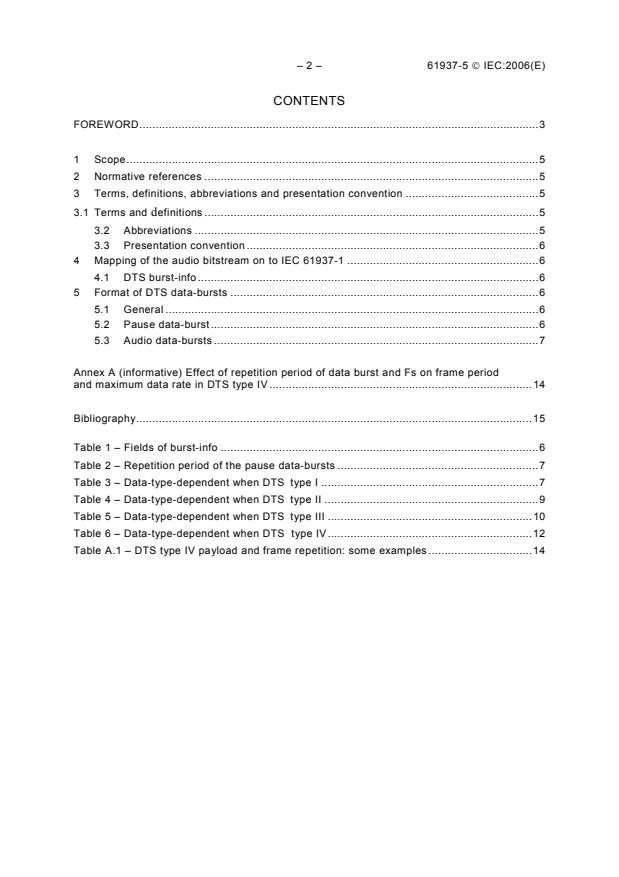
CONTENTS
FOREWORD.3
1 Scope.5
2 Normative references .5
3 Terms, definitions, abbreviations and presentation convention .5
3.1 Terms and definitions .5
3.2 Abbreviations .5
3.3 Presentation convention .6
4 Mapping of the audio bitstream on to IEC 61937-1 .6
4.1 DTS burst-info.6
5 Format of DTS data-bursts .6
5.1 General .6
5.2 Pause data-burst.6
5.3 Audio data-bursts .7
Annex A (informative) Effect of repetition period of data burst and Fs on frame period
and maximum data rate in DTS type IV .14
Bibliography.15
Table 1 – Fields of burst-info .6
Table 2 – Repetition period of the pause data-bursts .7
Table 3 – Data-type-dependent when DTS type I .7
Table 4 – Data-type-dependent when DTS type II .9
Table 5 – Data-type-dependent when DTS type III .10
Table 6 – Data-type-dependent when DTS type IV.12
Table A.1 – DTS type IV payload and frame repetition: some examples .14
61937-5 IEC:2006(E) – 3 –
INTERNATIONAL ELECTROTECHNICAL COMMISSION
____________
DIGITAL AUDIO –
INTERFACE FOR NON-LINEAR PCM ENCODED
AUDIO BITSTREAMS APPLYING IEC 60958 –
Part 5: Non-linear PCM bitstreams according to
the DTS (Digital Theater Systems) format(s)
FOREWORD
1) The International Electrotechnical Commission (IEC) is a worldwide organization for standardization comprising
all national electrotechnical committees (IEC National Committees). The object of IEC is to promote
international co-operation on all questions concerning standardization in the electrical and electronic fields. To
this end and in addition to other activities, IEC publishes International Standards, Technical Specifications,
Technical Reports, Publicly Available Specifications (PAS) and Guides (hereafter referred to as “IEC
Publication(s)”). Their preparation is entrusted to technical committees; any IEC National Committee interested
in the subject dealt with may participate in this preparatory work. International, governmental and non-
governmental organizations liaising with the IEC also participate in this preparation. IEC collaborates closely
with the International Organization for Standardization (ISO) in accordance with conditions determined by
agreement between the two organizations.
2) The formal decisions or agreements of IEC on technical matters express, as nearly as possible, an international
consensus of opinion on the relevant subjects since each technical committee has representation from all
interested IEC National Committees.
3) IEC Publications have the form of recommendations for international use and are accepted by IEC National
Committees in that sense. While all reasonable efforts are made to ensure that the technical content of IEC
Publications is accurate, IEC cannot be held responsible for the way in which they are used or for any
misinterpretation by any end user.
4) In order to promote international uniformity, IEC National Committees undertake to apply IEC Publications
transparently to the maximum extent possible in their national and regional publications. Any divergence
between any IEC Publication and the corresponding national or regional publication shall be clearly indicated in
the latter.
5) IEC provides no marking procedure to indicate its approval and cannot be rendered responsible for any
equipment declared to be in conformity with an IEC Publication.
6) All users should ensure that they have the latest edition of this publication.
7) No liability shall attach to IEC or its directors, employees, servants or agents including individual experts and
members of its technical committees and IEC National Committees for any personal injury, property damage or
other damage of any nature whatsoever, whether direct or indirect, or for costs (including legal fees) and
expenses arising out of the publication, use of, or reliance upon, this IEC Publication or any other IEC
Publications.
8) Attention is drawn to the Normative references cited in this publication. Use of the referenced publications is
indispensable for the correct application of this publication.
9) Attention is drawn to the possibility that some of the elements of this IEC Publication may be the subject of
patent rights. IEC shall not be held responsible for identifying any or all such patent rights.
International Standard IEC 61937-5 has been prepared by Technical Area 4: Digital system
interfaces and protocols, of IEC technical committee 100: Audio, video and multimedia
systems and equipment.
This second edition cancels and replaces the first edition published in 2002. This edition
constitutes a technical revision.
This edition includes the following significant technical changes with respect to the previous
edition.
a) References to the company name Digital Theater Systems have been changed to DTS
which is consistent with the official change of the company name.
– 4 – 61937-5 IEC:2006(E)
b) DTS type IV has been added to Table 1 and 5.3.4 describing type IV has been added.
c) Annex A, which provides examples of the use of the repetition period parameter
introduced in subclause 5.3.4, has been added.
The text of this standard is based on the following documents:
CDV Report on voting
100/974/CDV 100/1055/RVC
Full information on the voting for the approval of this standard can be found in the report on
voting indicated in the above table.
This publication has been drafted in accordance with the ISO/IEC Directives, Part 2.
IEC 61937 consists of the following parts, under the general title Digital audio – Interface for
non-linear PCM encoded audio bitstreams applying IEC 60958:
Part 1: General
Part 2: Burst-info
Part 3: Non-linear PCM bitstreams according to the AC-3 format
Part 4: Non-linear PCM bistreams according to the MPEG audio formats
Part 5: Non-linear PCM bitstreams according to the DTS (Digital Theater Systems) format(s)
Part 6: Non-linear PCM bitstreams according to the ATRAC, ATRAC2/3 and ATRAC-X
formats
Part 8: Non-linear PCM bitstreams according to the Windows Media Audio Professional
The committee has decided that the contents of this publication will remain unchanged until
the maintenance result date indicated on the IEC web site under "http://webstore.iec.ch" in
the data related to the specific publication. At this date, the publication will be
• reconfirmed,
• withdrawn,
• replaced by a revised edition, or
• amended.
A bilingual version of this publication may be issued at a later date.
—————————
To be published.
61937-5 IEC:2006(E) – 5 –
DIGITAL AUDIO –
INTERFACE FOR NON-LINEAR PCM ENCODED
AUDIO BITSTREAMS APPLYING IEC 60958 –
Part 5: Non-linear PCM bitstreams according to
the (Digital Theater Systems) DTS format(s)
1 Scope
This part of IEC 61937 describes audio bitstreams encoded according to the Digital Theater
Systems (DTS) format data-types I, II, III, and IV.
2 Normative references
The following referenced documents are indispensable for the application of this document.
For dated references, only the edition cited applies. For undated references, the latest edition
of the referenced document (including any amendments) applies.
IEC 60958-1, Digital audio interface – Part 1: General
IEC 60958-3, Digital audio interface – Part 3: Consumer applications
IEC 60958-4, Digital audio interface – Part 4: Professional applications
IEC 61937-1, Digital audio – Interface for non-linear PCM encoded audio bitstreams applying
IEC 60958 – Part 1: General
IEC 61937-2, Digital audio – Interface for non-linear PCM encoded audio bitstreams applying
IEC 60958 – Part 2: Burst Information
3 Terms, definitions, abbreviations and presentation convention
For the purposes of this document, the following terms, definitions, abbreviations and
presentation convention apply.
3.1 Definitions
3.1.1
latency
delay time of an external audio decoder to decode a DTS data-burst, defined as the sum of
two values of the receiving delay time and the decoding delay time
3.2 Abbreviations
IEC International Electrotechnical Commission
ISO/IEC MPEG The Moving Pictures Expert Group, a joint committee of ISO and IEC
– 6 – 61937-5 IEC:2006(E)
3.3 Presentation convention
F872h Value ‘F872’ in hexadecimal format
4 Mapping of the audio bitstream on to IEC 61937-1
The coding of the bitstream and data-burst is in accordance with IEC 61937-1 and 61937-2.
4.1 DTS burst-info
The 16-bit burst-info contains information about the data which will be found in the data-burst.
Table 1 – Fields of burst-info
Bits of Reference Repetition period of data-burst
Value Contents
Pc point R in IEC 60958 frames
0-4 Data-type
0-10 According to IEC 61937
11 DTS type I Bit 0 of Pa 512
12 DTS type II Bit 0 of Pa 1 024
13 DTS type III Bit 0 of Pa 2 048
14-16 According to IEC 61937
17 DTS type IV Dependent on bits 8-10
14-31 According to IEC 61937 Bit 0 of Pa
5, 6 Reserved
7 According to IEC 61937
Reserved for DTS types I, II and III
8-10
For the repetition period for DTS type
IV, see Table 6
11, 12 Reserved
13-15 According to IEC 61937
5 Format of DTS data-bursts
This clause specifies the audio data-bursts DTS type I, DTS type II, DTS type III and DTS
type IV. Specific properties such as reference points, repetition period, the method of filling
stream gaps, and decoding latency are specified for each data-type.
5.1 General
The decoding latency (or delay), indicated for the data-types, should be used by the
transmitter to schedule data-bursts as necessary to establish synchronization between picture
and decoded audio.
5.2 Pause data-burst
Pause data-burst for DTS type I, DTS type II, DTS type III and DTS type IV is given in
Table 2.
61937-5 IEC:2006(E) – 7 –
Table 2 – Repetition period of the pause data-bursts
Repetition period of pause data-burst
Data-t
...
IEC 61937-5 ®
Edition 2.1 2019-01
CONSOLIDATED VERSION
INTERNATIONAL
STANDARD
colour
inside
Digital audio – Interface for non-linear PCM encoded audio bitstreams applying
IEC 60958 –
Part 5: Non-linear PCM bitstreams according to the DTS (Digital Theater
Systems) format(s)
All rights reserved. Unless otherwise specified, no part of this publication may be reproduced or utilized in any form
or by any means, electronic or mechanical, including photocopying and microfilm, without permission in writing from
either IEC or IEC's member National Committee in the country of the requester. If you have any questions about IEC
copyright or have an enquiry about obtaining additional rights to this publication, please contact the address below or
your local IEC member National Committee for further information.
IEC Central Office Tel.: +41 22 919 02 11
3, rue de Varembé info@iec.ch
CH-1211 Geneva 20 www.iec.ch
Switzerland
About the IEC
The International Electrotechnical Commission (IEC) is the leading global organization that prepares and publishes
International Standards for all electrical, electronic and related technologies.
About IEC publications
The technical content of IEC publications is kept under constant review by the IEC. Please make sure that you have the
latest edition, a corrigendum or an amendment might have been published.
IEC publications search - webstore.iec.ch/advsearchform Electropedia - www.electropedia.org
The advanced search enables to find IEC publications by a The world's leading online dictionary on electrotechnology,
variety of criteria (reference number, text, technical containing more than 22 000 terminological entries in English
committee,…). It also gives information on projects, replaced and French, with equivalent terms in 16 additional languages.
and withdrawn publications. Also known as the International Electrotechnical Vocabulary
(IEV) online.
IEC Just Published - webstore.iec.ch/justpublished
Stay up to date on all new IEC publications. Just Published IEC Glossary - std.iec.ch/glossary
details all new publications released. Available online and 67 000 electrotechnical terminology entries in English and
once a month by email. French extracted from the Terms and Definitions clause of
IEC publications issued since 2002. Some entries have been
IEC Customer Service Centre - webstore.iec.ch/csc collected from earlier publications of IEC TC 37, 77, 86 and
If you wish to give us your feedback on this publication or CISPR.
need further assistance, please contact the Customer Service
Centre: sales@iec.ch.
IEC 61937-5 ®
Edition 2.1 2019-01
CONSOLIDATED VERSION
INTERNATIONAL
STANDARD
colour
inside
Digital audio – Interface for non-linear PCM encoded audio bitstreams applying
IEC 60958 –
Part 5: Non-linear PCM bitstreams according to the DTS (Digital Theater
Systems) format(s)
INTERNATIONAL
ELECTROTECHNICAL
COMMISSION
ICS 33.160.60 ISBN 978-2-8322-6483-6
IEC 61937-5 ®
Edition 2.1 2019-01
CONSOLIDATED VERSION
REDLINE VERSION
colour
inside
Digital audio – Interface for non-linear PCM encoded audio bitstreams applying
IEC 60958 –
Part 5: Non-linear PCM bitstreams according to the DTS (Digital Theater
Systems) format(s)
– 2 – IEC 61937-5:2006+AMD1:2019 CSV
IEC 2019
CONTENTS
1 Scope . 5
2 Normative references . 5
3 Terms, definitions, abbreviations and presentation convention . 5
3.1 Definitions . 5
3.2 Abbreviations . 5
3.3 Presentation convention . 6
4 Mapping of the audio bitstream on to IEC 61937-1 . 6
4.1 DTS burst-info . 6
5 Format of DTS data-bursts . 6
5.1 General . 6
5.2 Pause data-burst . 6
5.3 Audio data-bursts . 7
5.3.1 DTS type I . 7
5.3.2 DTS type II . 8
5.3.3 DTS type III . 9
5.3.4 DTS type IV . 11
5.3.5 DTS type IV profile definitions . 13
Annex A (informative) Effect of repetition period of data burst and Fs on frame period
and maximum data rate in DTS type IV . 17
Figure 1 – DTS type I data-burst . 7
Figure 2 – Latency of DTS type II decoding . 8
Figure 3 – DTS type II data-burst . 8
Figure 4 – Latency of DTS type II decoding . 9
Figure 5 – DTS type III data-burst . 10
Figure 6 – Latency of DTS type III decoding . 11
Figure 7 – DTS type IV single data-burst mode . 13
Figure 8 – Decoder latency of DTS type IV decoding single burst mode . 14
Figure 9 – DTS type IV multi-burst mode . 15
Figure 10 – Decoder latency for DTS type IV multi-burst mode . 16
Table 1 – Fields of burst-info . 6
Table 2 – Repetition period of the pause data-bursts . 7
Table 3 – Data-type-dependent when DTS type I . 7
Table 4 – Data-type-dependent when DTS type II . 9
Table 5 – Data-type-dependent when DTS type III . 10
Table 6 – Data-type-dependent when information for DTS type IV . 12
Table 7 – Bits of multi-burst control byte . 15
Table A.1 – DTS type IV payload and frame repetition: some examples . 17
IEC 2019
INTERNATIONAL ELECTROTECHNICAL COMMISSION
____________
DIGITAL AUDIO –
INTERFACE FOR NON-LINEAR PCM ENCODED
AUDIO BITSTREAMS APPLYING IEC 60958 –
Part 5: Non-linear PCM bitstreams according to
the DTS (Digital Theater Systems) format(s)
FOREWORD
1) The International Electrotechnical Commission (IEC) is a worldwide organization for standardization comprising
all national electrotechnical committees (IEC National Committees). The object of IEC is to promote
international co-operation on all questions concerning standardization in the electrical and electronic fields. To
this end and in addition to other activities, IEC publishes International Standards, Technical Specifications,
Technical Reports, Publicly Available Specifications (PAS) and Guides (hereafter referred to as “IEC
Publication(s)”). Their preparation is entrusted to technical committees; any IEC National Committee interested
in the subject dealt with may participate in this preparatory work. International, governmental and non-
governmental organizations liaising with the IEC also participate in this preparation. IEC collaborates closely
with the International Organization for Standardization (ISO) in accordance with conditions determined by
agreement between the two organizations.
2) The formal decisions or agreements of IEC on technical matters express, as nearly as possible, an international
consensus of opinion on the relevant subjects since each technical committee has representation from all
interested IEC National Committees.
3) IEC Publications have the form of recommendations for international use and are accepted by IEC National
Committees in that sense. While all reasonable efforts are made to ensure that the technical content of IEC
Publications is accurate, IEC cannot be held responsible for the way in which they are used or for any
misinterpretation by any end user.
4) In order to promote international uniformity, IEC National Committees undertake to apply IEC Publications
transparently to the maximum extent possible in their national and regional publications. Any divergence
between any IEC Publication and the corresponding national or regional publication shall be clearly indicated in
the latter.
5) IEC itself does not provide any attestation of conformity. Independent certification bodies provide conformity
assessment services and, in some areas, access to IEC marks of conformity. IEC is not responsible for any
services carried out by independent certification bodies.
6) All users should ensure that they have the latest edition of this publication.
7) No liability shall attach to IEC or its directors, employees, servants or agents including individual experts and
members of its technical committees and IEC National Committees for any personal injury, property damage or
other damage of any nature whatsoever, whether direct or indirect, or for costs (including legal fees) and
expenses arising out of the publication, use of, or reliance upon, this IEC Publication or any other IEC
Publications.
8) Attention is drawn to the Normative references cited in this publication. Use of the referenced publications is
indispensable for the correct application of this publication.
9) Attention is drawn to the possibility that some of the elements of this IEC Publication may be the subject of
patent rights. IEC shall not be held responsible for identifying any or all such patent rights.
This consolidated version of the official IEC Standard and its amendment has been
prepared for user convenience.
IEC 61937-5 edition 2.1 contains the second edition (2006-01) [documents 100/974/CDV
and 100/1055/RVC] and its amendment 1 (2019-01) [documents 100/3101/CDV and
100/3163/RVC].
In this Redline version, a vertical line in the margin shows where the technical content
is modified by amendment 1. Additions are in green text, deletions are in strikethrough
red text. A separate Final version with all changes accepted is available in this
publication.
– 4 – IEC 61937-5:2006+AMD1:2019 CSV
IEC 2019
International Standard IEC 61937-5 has been prepared by Technical Area 4: Digital system
interfaces and protocols, of IEC technical committee 100: Audio, video and multimedia
systems and equipment.
This second edition constitutes a technical revision.
This edition includes the following significant technical changes with respect to the previous
edition.
a) References to the company name Digital Theater Systems have been changed to DTS
which is consistent with the official change of the company name.
b) DTS type IV has been added to Table 1 and 5.3.4 describing type IV has been added.
c) Annex A, which provides examples of the use of the repetition period parameter
introduced in subclause 5.3.4, has been added.
This publication has been drafted in accordance with the ISO/IEC Directives, Part 2.
IEC 61937 consists of the following parts, under the general title Digital audio – Interface for
non-linear PCM encoded audio bitstreams applying IEC 60958:
Part 1: General
Part 2: Burst-info
Part 3: Non-linear PCM bitstreams according to the AC-3 format
Part 4: Non-linear PCM bistreams according to the MPEG audio formats
Part 5: Non-linear PCM bitstreams according to the DTS (Digital Theater Systems) format(s)
Part 6: Non-linear PCM bitstreams according to the ATRAC, ATRAC2/3 and ATRAC-X
formats
Part 8: Non-linear PCM bitstreams according to the Windows Media Audio Professional
The committee has decided that the contents of the base publication and its amendment will
remain unchanged until the stability date indicated on the IEC web site under
"http://webstore.iec.ch" in the data related to the specific publication. At this date, the
publication will be
• reconfirmed,
• withdrawn,
• replaced by a revised edition, or
• amended.
A bilingual version may be issued at a later date.
IMPORTANT – The 'colour inside' logo on the cover page of this publication indicates
that it contains colours which are considered to be useful for the correct
understanding of its contents. Users should therefore print this document using a
colour printer.
—————————
To be published.
IEC 2019
DIGITAL AUDIO –
INTERFACE FOR NON-LINEAR PCM ENCODED
AUDIO BITSTREAMS APPLYING IEC 60958 –
Part 5: Non-linear PCM bitstreams according to
the (Digital Theater Systems) DTS format(s)
1 Scope
This part of IEC 61937 describes audio bitstreams encoded according to the Digital Theater
Systems (DTS) format data-types I, II, III, and IV.
2 Normative references
The following referenced documents are indispensable for the application of this document.
For dated references, only the edition cited applies. For undated references, the latest edition
of the referenced document (including any amendments) applies.
IEC 60958-1, Digital audio interface – Part 1: General
IEC 60958-3, Digital audio interface – Part 3: Consumer applications
IEC 60958-4, Digital audio interface – Part 4: Professional applications
IEC 61937-1, Digital audio – Interface for non-linear PCM encoded audio bitstreams applying
IEC 60958 – Part 1: General
IEC 61937-2, Digital audio – Interface for non-linear PCM encoded audio bitstreams applying
IEC 60958 – Part 2: Burst Information
3 Terms, definitions, abbreviations and presentation convention
For the purposes of this document, the following terms, definitions, abbreviations and
presentation convention apply.
3.1 Definitions
3.1.1
latency
delay time of an external audio decoder to decode a DTS data-burst, defined as the sum of
two values of the receiving delay time and the decoding delay time
3.2 Abbreviations
IEC International Electrotechnical Commission
ISO/IEC MPEG The Moving Pictures Expert Group, a joint committee of ISO and IEC
– 6 – IEC 61937-5:2006+AMD1:2019 CSV
IEC 2019
3.3 Presentation convention
F872h Value ‘F872’ in hexadecimal format
4 Mapping of the audio bitstream on to IEC 61937-1
The coding of the bitstream and data-burst is in accordance with IEC 61937-1 and 61937-2.
4.1 DTS burst-info
The 16-bit burst-info contains information about the data which will be found in the data-burst.
Table 1 – Fields of burst-info
Bits of Reference Repetition period of data-burst
Value Contents
Pc point R in IEC 60958 frames
0 – 4 Data-type
0 – 10 According to IEC 61937
11 DTS type I bit 0 of Pa 512
12 DTS type II bit 0 of Pa 1 024
13 DTS type III bit 0 of Pa 2 048
14 – 16 According to IEC 61937
17 DTS type IV Dependent on bits 8 – 10
14 – 31 According to IEC 61937 bit 0 of Pa
5,6 Reserved
7 According to IEC 61937
Reserved for DTS Types I, II and III,
8 – 10
For the Repetition period for DTS
Type IV, see Table 6
11 – 12 0 – 3 Reserved Profile
13 – 15 According to IEC 61937
5 Format of DTS data-bursts
This clause specifies the audio data-bursts DTS type I, DTS type II, DTS type III and DTS
type IV. Specific properties such as reference points, repetition period, the method of filling
stream gaps, and decoding latency are specified for each data-type.
5.1 General
The decoding latency (or delay), indicated for the data-types, should be used by the
transmitter to schedule data-bursts as necessary to establish synchronization between picture
and decoded audio.
5.2 Pause data-burst
Pause data-burst for DTS type I, DTS type II, DTS type III and DTS type IV is given in
Table 2.
IEC 2019
Table 2 – Repetition period of the pause data-bursts
Repetition period of pause data-burst
Data-type of audio data-burst
Mandatory Recommended
DTS type I - 3 IEC 60958 frames
DTS type II - 3 IEC 60958 frames
DTS type III - 3 IEC 60958 frames
DTS type IV - 3 IEC 60958 frames
5.3 Audio data-bursts
5.3.1 DTS type I
The DTS bitstream consists of sequences of DTS frames. The data-type of a DTS data-burst
type I is 0Bh. The data-burst is headed with a burst-preamble, followed by the burst-payload,
and stuffed with stuffing bits. The burst-payload of each data-burst of DTS type I data shall
contain one complete DTS-frame and represents 512 samples for each encoded channel.
NOTE 1 The length of the DTS type I data-burst depends on the encoded bit rate (which determines the DTS-
frame length).
NOTE 2 The reference to the specification for the DTS bitstream, representing 512 samples of encoded audio per
frame, is given in the bibliography.
DTS type I DTS type I
Pa Pb Pc Pd Pa Pb Pc Pd
burst_payload burst_payload
Bit 0 of Pa Bit 0 of Pa
DTS frame Stuffing DTS frame
Regular rate of the DTS frames
Repetition period of the burst
IEC 2671/05
Figure 1 – DTS type I data-burst
The data-type-dependent information for DTS type I is given in Table 3.
Table 3 – Data-type-dependent when DTS type I
Bits of Pc
Value Contents
LSB.MSB
8-12 00h Reserved, shall be set to ‘0’
The reference point of a DTS type I data-burst is bit 0 of Pa and occurs exactly once every
512 sampling periods. The data-burst containing DTS type I frames occurs at a regular rate,
with the reference point of each DTS type I data-burst beginning 512 IEC 60958 frames after
the reference point of the preceding DTS type I data-burst (of the same bit-stream-number).
It is recommended that pause data-bursts be used to fill stream gaps in the DTS type I
bitstream, as described in IEC 61937, and that pause data-bursts be transmitted with a
repetition period of 3 IEC 60958 frames, except when other repetition periods are necessary
– 8 – IEC 61937-5:2006+AMD1:2019 CSV
IEC 2019
to fill the precise stream gap length (which may not be a multiple of 3 IEC 60958 frames), or
to meet the requirement on burst spacing (see IEC 61937).
When a stream gap in a DTS type I stream is filled by a sequence of pause data-bursts, the
Pa of the first pause data-burst shall be located 512 sampling periods following the Pa of the
previous DTS type I frame. It is recommended that the sequence(s) of pause data-bursts
which fill the stream gap should continue from this point up to (as close as possible
considering the 3 IEC 60958 frame length of the pause data-burst) the Pa of the first DTS
type I data-burst which follows the stream gap.
NOTE 3 The gap-length parameter contained in the pause data-burst is intended to be interpreted by the DTS
decoder as an indication of the number of decoded PCM samples which are missing (due to the resulting audio
gap).
DTS type I DTS type I
Pa Pb Pc Pd Pa Pb Pc Pd
burst_payload burst_payload
Bit 0 of Pa Bit 0 of Pa
DTS frame Stuffing DTS frame
Repetition period of the burst
Decoding delay
(256 samples)
Latency of DTS decoder
IEC 2672/05
Figure 2 – Latency of DTS type II decoding
NOTE 4 The latency of a DTS decoder is defined as a delay measured from the reference point and equal to one
frame (10,67 ms) plus 5,33 ms (equivalent to 256 samples). This is 768 PCM samples or 16 ms at 48 kHz sampling
frequency.
5.3.2 DTS type II
The DTS bitstream consists of sequences of DTS frames. The data-type of a DTS data-burst
type II is 0Ch. The data-burst is headed with a burst-preamble, followed by the burst-payload,
and stuffed with stuffing bits. The burst-payload of each data-burst of DTS type II data shall
contain one complete DTS-frame and represents 1 024 samples for each encoded channel.
NOTE 1 The length of the DTS type II data-burst depends on the encoded bit rate (which determines the DTS-
frame length).
NOTE 2 The reference to the specification for the DTS bitstream, representing 1 024 samples of encoded audio
per frame, is given in the bibliography.
DTS type II DTS type II
Pa Pb Pc Pd Pa Pb Pc Pd
burst_payload burst_payload
Bit 0 of Pa Bit 0 of Pa
DTS frame DTS frame
Stuffing
Regular rate of the DTS frames
Repetition period of the burst
IEC 2673/05
Figure 3 – DTS type II data-burst
IEC 2019
The data-type-dependent information for DTS type II is given in Table 4.
Table 4 – Data-type-dependent when DTS type II
Bits of Pc
Value Contents
LSB.MSB
8-12 00h Reserved, shall be set to ‘0’
The reference point of a DTS type II data-burst is bit 0 of Pa and occurs exactly once every
1 024 sampling periods. The data-burst containing DTS type II frames shall occur at a regular
rate, with the reference point of each DTS type II data-burst beginning 1 024 IEC 60958
frames after the reference point of the preceding DTS type II data-burst (of the same bit-
stream-number).
It is recommended that pause data-bursts be used to fill stream gaps in the DTS type II
bitstream, as described in IEC 61937, and that pause data-bursts be transmitted with a
repetition period of 3 IEC 60958 frames, except when other repetition periods are necessary
to fill the precise stream gap length (which may not be a multiple of 3 IEC 60958 frames), or
to meet the requirement on burst spacing (see IEC 61937).
When a stream gap in a DTS type II stream is filled by a sequence of pause data-bursts, the
Pa of the first pause data-burst shall be located 1 024 sampling periods following the Pa of
the previous DTS type II frame. It is recommended that the sequence(s) of pause data-bursts
which fill the stream gap should continue from this point up to (as close as possible
considering the 3 IEC 60958 frame length of the pause data-burst) the Pa of the first DTS
type II data-burst which follows the stream gap.
NOTE 3 The gap-length parameter contained in the pause data-burst is intended to be interpreted by the DTS
decoder as an indication of the number of decoded PCM samples which are missing (due to the resulting audio
gap).
DTS type II DTS type II
Pa Pb Pc Pd Pa Pb Pc Pd
burst_payload burst_payload
Bit 0 of Pa Bit 0 of Pa
DTS frame Stuffing DTS frame
Repetition period of the burst
Decoding delay
(256 samples)
Latency of DTS decoder
IEC 2674/05
Figure 4 – Latency of DTS type II decoding
NOTE 4 The latency of a DTS decoder is defined as a delay measured from the reference point and equal to one
frame (21,34 ms) plus 5.33 ms (equivalent to 256 samples). This is 1 280 PCM samples or 26,67 ms at 48 kHz
sampling frequency.
5.3.3 DTS type III
The DTS bitstream consists of sequences of DTS frames. The data-type of a DTS data-burst
type III is 0Dh. The data-burst is headed with a burst-preamble, followed by the burst-payload
and stuffed with stuffing bits. The burst-payload of each data-burst of DTS type III data shall
contain one complete DTS-frame and represents 2 048 samples for each encoded channel.
NOTE 1 The length of the DTS type III data-burst depends on the encoded bit rate (which determines the DTS-
frame length).
– 10 – IEC 61937-5:2006+AMD1:2019 CSV
IEC 2019
NOTE 2 The reference to the specification for the DTS bitstream, representing 2 048 samples of encoded audio
per frame, is given in the bibliography.
DTS type III DTS type III
Pa Pb Pc Pd Pa Pb Pc Pd
burst_payload burst_payload
Bit 0 of Pa Bit 0 of Pa
DTS frame Stuffing DTS frame
Regular rate of the DTS frames
Repetition period of the burst
IEC 2675/05
Figure 5 – DTS type III data-burst
The data-type-dependent information for DTS type III is given in Table 5.
Table 5 – Data-type-dependent when DTS type III
Bits of Pc
Value Contents
LSB.MSB
8-12 00h Reserved, shall be set to ‘0’
The reference point of a DTS type III data-burst is bit 0 of Pa and occurs exactly once every 2
048 sampling periods. The data-burst containing DTS type III frames shall occur at a regular
rate, with the reference point of each DTS type III data-burst beginning 2 048 IEC 60958
frames after the reference point of the preceding DTS type III data-burst (of the same bit-
stream-number).
It is recommended that pause data-bursts be used to fill stream gaps in the DTS type III
bitstream as described in IEC 61937, and that pause data-bursts be transmitted with a
repetition period of 3 IEC 60958 frames, except when other repetition periods are necessary
to fill the precise stream gap length (which may not be a multiple of 3 IEC 60958 frames), or
to meet the requirement on burst spacing (see IEC 61937).
When a stream gap in a DTS type III stream is filled by a sequence of pause data-bursts, the
Pa of the first pause data-burst shall be located 2 048 sampling periods following the Pa of
the previous DTS type III frame. It is recommended that the sequence(s) of pause data-bursts
which fill the stream gap should continue from this point up to (as close as possible
considering the 3 IEC 60958 frame length of the pause data-burst) the Pa of the first DTS
type III data-burst which follows the stream gap.
NOTE 3 The gap-length parameter contained in the pause data-burst is intended to be interpreted by the DTS
decoder as an indication of the number of decoded PCM samples which are missing (due to the resulting audio
gap).
IEC 2019
DTS type III DTS type III
Pa Pb Pc Pd Pa Pb Pc Pd
burst_payload burst_payload
Bit 0 of Pa Bit 0 of Pa
DTS frame DTS frame
Stuffing
Repetition period of the burst
Decoding delay
(256 samples)
Latency of DTS decoder
IEC 2676/05
Figure 6 – Latency of DTS type III decoding
NOTE 4 The latency of a DTS decoder is defined as a delay measured from the reference point and equal to one
frame (42,67 ms) plus 5,33 ms (equivalent to 256 samples). This is 2 304 PCM samples or 48 ms at 48 kHz
sampling frequency.
5.3.4 DTS type IV
The DTS bitstream consists of sequences of DTS frames. The data-type of a DTS data-burst
type IV is 11h. The data-burst is headed with a burst-preamble, followed by the burst-payload,
and stuffed with stuffing bits. The data-type-dependent information for DTS type IV is given in
Table 6.
The frame duration is the period of each complete audio frame and is relative to the base
sample rate. In theory, any supported base sample rate may be applied. The burst repetition
period is set in bits 8 – 10 of Pc (see Table 6). The IEC 60958 frame rate has an integer
relationship to the base sample rate of the compressed audio being delivered. Any supported
base sample rate may be applied. The nominal base sample rate for DTS Type IV is 48 kHz.
NOTE 1 The length of the DTS type IV data-burst depends on the encoded bit rate and the duration of the burst.
NOTE 2 The reference to the specification for the DTS-HD bitstream is given in the bibliography.
Bits 11 and 12 are used to indicate a profile of DTS type IV.
The units of burst_length shall be in bytes. This means the maximum size of a burst is
65 535 bytes.
The data-type-dependent information for DTS Type IV is given in Table 6.
– 12 – IEC 61937-5:2006+AMD1:2019 CSV
IEC 2019
Table 6 – Data-type-dependent when information for DTS type IV
Bits of Pc Value Meaning
0 – 4 17 DTS type IV
5,6 Reserved
7 According to IEC 61937
0 512
1 1 024
2 2 048
3 4 096
Repetition period of data
8 – 10
burst in IEC 60958 frames
4 8 192
5 16 384
6 Reserved
7 Reserved
11 – 12 0 Reserved Type IV profile Single Burst Mode
1 Multi-Burst Mode
2 Profile 2
3 Profile 3
13 – 15 According to IEC 61937
The reference point of a DTS type IV data-burst is bit 0 of Pa. The data-burst containing DTS
type IV frames shall occur at a regular rate, with the reference point of each DTS type IV
data-burst beginning one audio frame period after the reference point of the preceding DTS
type IV data-burst.
It is recommended that pause data-bursts be used to fill stream gaps in the DTS type IV
bitstream as described in IEC 61937, and that pause data-bursts be transmitted with a
repetition period of 3 IEC 60958 frames, except when other repetition periods are necessary
to fill the precise stream gap length (which may not be a multiple of 3 IEC 60958 frames), or
to meet the requirement on burst spacing (see IEC 61937).
When a stream gap in a DTS type IV stream is filled by a sequence of pause data-bursts, the
Pa of the first pause data-burst shall be located one audio frame period following the Pa of
the previous DTS type IV frame. It is recommended that the sequence(s) of pause data-bursts
that fill the stream gap should continue be continued from this point up to (as close as
possible considering the 3 IEC 60958-frame length of the pause data-burst) the Pa of the first
DTS type IV data-burst that follows the stream gap.
NOTE 3 The gap-length parameter contained in the pause data-burst is intended to be interpreted by the DTS
decoder as an indication of the number of decoded PCM samples that are missing (due to the resulting audio gap).
NOTE 4 The latency of a DTS decoder is defined as a delay measured from the reference point and equal to one
frame (10,67 ms) plus one subframe (256 samples at 48 kHz or 5,33 ms), equivalent to 16 ms.
IEC 2019
5.3.5 DTS type IV profile definitions
5.3.5.1 Type IV profile = 0: single burst mode
DTS type IV profile 0 shall deliver a DTS audio frame in a each burst. The burst repetition
period, indicated with bits 8 – 10 of Pc, is relative to the period of the IEC 60958 frame.
Figure 7 provides a representation of the repetition period of the burst.
NOTE 1 The length of the DTS type IV data-burst depends on the encoded bit rate and duration of the burst.
DTS type IV DTS type IV
Pa Pb Pc Pd Pa Pb Pc Pd
burst_payload burst_payload
Bit 0 of Pa Bit 0 of Pa
DTS frame Stuffing DTS frame
Regular rate of the DTS frames
Repetition period of the burst
IEC 2677/05
Figure 7 – DTS type IV single data-burst mode
The decoder latency of a DTS stream delivered using DTS type IV single burst mode is shown
in Figure 8.
– 14 – IEC 61937-5:2006+AMD1:2019 CSV
IEC 2019
DTS type I DTS type I
Pa Pb Pc Pd Pa Pb Pc Pd
burst_payload burst_payload
Bit 0 of Pa Bit 0 of Pa
DTS frame Stuffing DTS frame
Repetition period of the burst
Decoding delay
(256 samples)
Latency of DTS decoder
IEC 2678/05
Figure 8 – Decoder latency of DTS type IV decoding single burst mode
NOTE 2 The latency of a DTS decoder is defined as a delay measured from the reference point, and equal to one
frame (10,67 ms) plus one subframe (256 samples at 48 kHz, or 5,33 ms), equivalent to 16 ms.
5.3.5.2 Type IV profile = 1: multi-burst mode
DTS type IV profile 1 delivers a DTS audio frame in a multi-burst sequence, which consists of
1, 2, 4, or 8 bursts. The burst repetition period, indicated with bits 8 – 10 of Pc, is relative to
the period of the IEC 60958 frame. The repetition period of the multi-burst sequence shall be
equal to the DTS audio-frame period.
The first byte of each burst-payload is the multi-burst control byte (MBControl). The multi-
burst control byte is defined in Table 7.
IEC 2019
Table 7 – Bits of multi-burst control byte
Bits of ControlByte Coded value Interpretation Parameter name
7 (MSB) 0 0 Reserved
0 1
1 2
6, 5 MaxBursts
2 4
3 8
0 0
1 1
2 2
3 3
4, 3, 2 BurstIndex
4 4
5 5
6 6
7 7
0 8
1 4
1, 0 DelayFactor
2 2
3 1
A representation of a multi-burst sequence is shown in Figure 9. This representation assumes
the case of 2 or more data-bursts per multi-burst sequence, and any data-bursts between the
first and last data-burst are represented as data-burst n.
Figure 9 – DTS type IV multi-burst mode
MaxBursts – indicates the number of data-bursts in a multi-burst sequence. The valid values
of MaxBursts are 1, 2, 4 or 8 data-bursts per multi-burst sequence. Note that
P = P *MaxBursts
dts burst
where:
P is the period of the DTS audio frame, and
dts
P is the period of the data burst according to bits 8 – 10 of Pc (see Table 6).
burst
To convert P into units of seconds, divide this value by the IEC 60958 frame rate in Hz.
dts
– 16 – IEC 61937-5:2006+AMD1:2019 CSV
IEC 2019
BurstIndex – indicates the index of current burst within the multi-burst sequence. The first
data-burst in a multi-burst sequence shall have BurstIndex = 0. A multi-burst sequence shall
align the DTS audio frame to begin in the first data-burst of the multi-burst sequence.
Subsequent bursts in the multi-burst sequence shall have BurstIndex increment monotonically,
with the multi-burst sequence terminating when BurstIndex = (MaxBursts − 1).
DelayFactor – This parameter is used to determine the total decoder latency of the
transmitted elementary bitstream. Decoder delay is defined as follows:
P
dts
D =
decoder
DelayFactor
and
L PD+
total dts decoder
where
D is the delay of the decoder, and
decoder
L is the total latency of the DTS decoder expressed in IEC 60958 frame periods. To
total
convert latency into units of seconds, divide this value by the IEC 60958 frame rate
in Hz.
Decoder latency for audio delivered using multi-burst mode is illustrated in Figure 10.
Figure 10 – Decoder latency for DTS type IV multi-burst mode
5.3.5.3 Type IV profile = 2
DTS type IV profile 2 is reserved for future definition.
5.3.5.4 Type IV profile = 3
DTS type IV profile 3 is reserved for future definition.
=
IEC 2019
Annex A
(informative)
Effect of repetition period of data burst and Fs on frame period
and maximum data rate in DTS type IV
A.1 Selection of DTS type IV mode
The DTS type IV mode selected will depend on the data rate required by the payload. Table
A.1 shows IEC 60958 frame rates and repetition period and payload capacity in Mbps for the
symbol rates shown.
Table A.1 – DTS type IV payload and frame repetition: some examples
IEC 60958 frame
Frame period
Frame repetition Maximum data
rate
period rate
ms
Fs
512 48 kHz 10,67 1,524 Mbps
1 024 96 kHz 10,67 3,060 Mbps
2 048 192 kHz 10,67 6,132 Mbps
4 096 384 kHz 10,67 12,276 Mbps
8 192 768 kHz 10,67 24,564 Mbps
16 384 1 536 kHz 10,67 49,140 Mbps
16 384 768 kHz 21,33 24,570 Mbps
16 384 384 kHz 42,67 12,285 Mbps
16 384 192 kHz 85,33 6,1425 Mbps
The maximum data rates in Table A.1 assume a provision for two 60 958 frames for pad
between bursts. Specific implementations may have additional restrictions.
– 18 – IEC 61937-5:2006+AMD1:2019 CSV
IEC 2019
Bibliography
The following documents have served as references for the specification of the related data-
type.
DTS DTS-HD Please contact DTS consumer licensing for the latest specifications for DTS
and DTS-HD
___________
—————————
DTS, Inc. 5171 Clareton Drive, Agoura Hills, CA 91301 email: consumerlicensing@dts.com
IEC 61937-5 ®
Edition 2.1 2019-01
CONSOLIDATED VERSION
FINAL VERSION
colour
inside
Digital audio – Interface for non-linear PCM encoded audio bitstreams applying
IEC 60958 –
Part 5: Non-linear PCM bitstreams according to the DTS (Digital Theater
Systems) format(s)
– 2 – IEC 61937-5:2006+AMD1:2019 CSV
IEC 2019
CONTENTS
1 Scope . 5
2 Normative references . 5
3 Terms, definitions, abbreviations and presentation convention . 5
3.1 Definitions . 5
3.2 Abbreviations . 5
3.3 Presentation convention . 6
4 Mapping of the audio bitstream on to IEC 61937-1 . 6
4.1 DTS burst-info . 6
5 Format of DTS data-bursts . 6
5.1 General . 6
5.2 Pause data-burst . 6
5.3 Audio data-bursts . 7
5.3.1 DTS type I . 7
5.3.2 DTS type II . 8
5.3.3 DTS type III . 9
5.3.4 DTS type IV . 11
5.3.5 DTS type IV profile definitions . 13
Annex A (informative) Effect of repetition period of data burst and Fs on frame period
and maximum data rate in DTS type IV . 16
Figure 1 – DTS type I data-burst . 7
Figure 2 – Latency of DTS type II decoding . 8
Figure 3 – DTS type II data-burst . 8
Figure 4 – Latency of DTS type II decoding . 9
Figure 5 – DTS type III data-burst . 10
Figure 6 – Latency of DTS type III decoding . 11
Figure 7 – DTS type IV single burst mode . 13
Figure 8 – Decoder latency of DTS type IV single burst mode . 13
Figure 9 – DTS type IV multi-burst mode . 14
Figure 10 – Decoder latency for DTS type IV multi-burst mode . 15
Table 1 – Fields of burst-info . 6
Table 2 – Repetition period of the pause data-bursts . 7
Table 3 – Data-type-dependent when DTS type I . 7
Table 4 – Data-type-dependent when DTS type II . 9
Table 5 – Data-type-dependent when DTS type III . 10
Table 6 – Data-type-dependent information for DTS type IV . 12
Table 7 – Bits of multi-burst control byte . 14
Table A.1 – DTS type IV payload and frame repetition: some examples . 16
IEC 2019
INTERNATIONAL ELECTROTECHNICAL COMMISSION
____________
DIGITAL AUDIO –
INTERFACE FOR NON-LINEAR PCM ENCODED
AUDIO BITSTREAMS APPLYING IEC 60958 –
Part 5: Non-linear PCM bitstreams according to
the DTS (Digital Theater Systems) format(s)
FOREWORD
1) The International Electrotechnical Commission (IEC) is a worldwide organization for standardization comprising
all national electrotechnical committees (IEC National Committees). The object of IEC is to promote
international co-operation on all questions concerning standardization in the electrical and electronic fields. To
this end and in addition to other activities, IEC publishes International Standards, Technical Specifications,
Technical Reports, Publicly Available Specifications (PAS) and Guides (hereafter referred to as “IEC
Publication(s)”). Their preparation is entrusted to technical committees; any IEC National Committee interested
in the subject dealt with may participate in this preparatory work. International, governmental and non-
governmental organizations liaising with the IEC also participate in this preparation. IEC collaborates closely
with the International Organization for Standardization (ISO) in accordance with conditions determined by
agreement between the two organizations.
2) The formal decisions or agreements of IEC on technical matters express, as nearly as possible, an international
consensus of opinion on the relevant subjects since each technical committee has representation from all
interested IEC National Committees.
3) IEC Publications have the form of recommendations for international use and are accepted by IEC National
Committees in that sense. While all reasonable efforts
...