

IEC 61850-5:2013
(Main)Communication networks and systems for power utility automation - Part 5: Communication requirements for functions and device models
General Information
- Abstract
IEC 61850-5:2013 applies to power utility automation systems with the core part of substation automation systems (SAS); it standardizes the communication between intelligent electronic devices (IEDs) and defines the related system requirements to be supported. The major technical changes with regard to the previous edition are as follows:
- extension from substation automation systems to utility automation systems;
- inclusion of interfaces for communication between substations;
- requirements from communication beyond the boundary of the substation.
- Status
- Published
- Publication Date
- 22-Mar-2022
- Technical Committee
- TC 57 - Power systems management and associated information exchange
- Drafting Committee
- WG 10 - TC 57/WG 10
- Current Stage
- PPUB - Publication issued
- Start Date
- 30-Jan-2013
- Completion Date
- 15-Jan-2013
Buy Documents
IEC 61850-5:2013+AMD1:2022 CSV - Communication networks and systems for power utility automation - Part 5: Communication requirements for functions and device models Released:3/23/2022
IEC 61850-5:2013 - Communication networks and systems for power utility automation - Part 5: Communication requirements for functions and device models Released:1/30/2013
Overview
IEC 61850-5:2013 (Edition 2.1, consolidated 2022) is part of the IEC 61850 family for communication networks and systems for power utility automation. It specifies communication requirements for functions and device models used in power utility automation systems, extending the focus from substation automation systems (SAS) to broader utility automation. The standard defines system requirements for communications between Intelligent Electronic Devices (IEDs) and includes interfaces for substation–substation and communications beyond substation boundaries.
Key topics and technical requirements
- Scope and system description
- Formal system description needs and logical/physical identification.
- Function and device modelling
- Definition and modelling of application functions using Logical Nodes and the PICOM approach (Process Information COMponents).
- Message types and performance classes
- Message classification by performance (examples in the standard include Type 1–6 messages: Protection, Automatics, Operator, Samples, File transfer, Command/File with access control).
- Time synchronization and transfer time
- Requirements for accurate time synchronization and defined transfer-time/synchronization classes.
- Data and communication quality
- Data integrity, reliability, recovery delay, and communication redundancy requirements.
- Interoperability and conformance
- Static and dynamic interoperability goals, conformance test requirements, and approach to interoperability across devices/vendors.
- Additional data-model requirements
- Semantics, self-description, addressing and administrative requirements to support scalable engineering and integration.
- Application examples covered
- Substation–Substation, Substation–Network Control Center, Wind, Hydro, DER and distribution automation, FACTS, feeder automation.
Practical applications
- Designing and engineering substation automation systems (SAS) and wider utility automation architectures.
- Specifying communication behavior and performance for protection, control, metering, and monitoring functions.
- Guiding manufacturers of IEDs, gateways, and communication equipment to ensure interoperability.
- Developing network designs that meet time-critical messaging, redundancy and recovery targets for utilities.
- Informing system integrators and test laboratories in conformance testing and acceptance procedures.
Who should use this standard
- Utility power system engineers and architects
- IED and substation equipment manufacturers
- System integrators, vendors and consultants
- Test laboratories and certification bodies
- Project managers for substation and grid automation projects
Related standards
- IEC 61850 series (other parts covering data models, mappings, and engineering processes) - IEC 61850-5 is a central part of this family and should be used alongside other IEC 61850 parts for a complete automation solution.
Keywords: IEC 61850-5, power utility automation, substation automation, IED communication, logical nodes, PICOM, message performance, time synchronization, interoperability, device models.
Relations
- Effective Date
- 05-Sep-2023
- Effective Date
- 05-Sep-2023
Buy Documents
IEC 61850-5:2013+AMD1:2022 CSV - Communication networks and systems for power utility automation - Part 5: Communication requirements for functions and device models Released:3/23/2022
IEC 61850-5:2013 - Communication networks and systems for power utility automation - Part 5: Communication requirements for functions and device models Released:1/30/2013
Get Certified
Connect with accredited certification bodies for this standard

ANCE
Mexican certification and testing association.

Intertek Slovenia
Intertek testing, inspection, and certification services in Slovenia.

LNE (Laboratoire National de Métrologie et d'Essais)
French national laboratory for metrology and testing.
Sponsored listings
Frequently Asked Questions
IEC 61850-5:2013 is a standard published by the International Electrotechnical Commission (IEC). Its full title is "Communication networks and systems for power utility automation - Part 5: Communication requirements for functions and device models". This standard covers: IEC 61850-5:2013 applies to power utility automation systems with the core part of substation automation systems (SAS); it standardizes the communication between intelligent electronic devices (IEDs) and defines the related system requirements to be supported. The major technical changes with regard to the previous edition are as follows: - extension from substation automation systems to utility automation systems; - inclusion of interfaces for communication between substations; - requirements from communication beyond the boundary of the substation.
IEC 61850-5:2013 applies to power utility automation systems with the core part of substation automation systems (SAS); it standardizes the communication between intelligent electronic devices (IEDs) and defines the related system requirements to be supported. The major technical changes with regard to the previous edition are as follows: - extension from substation automation systems to utility automation systems; - inclusion of interfaces for communication between substations; - requirements from communication beyond the boundary of the substation.
IEC 61850-5:2013 is classified under the following ICS (International Classification for Standards) categories: 33.200 - Telecontrol. Telemetering; 97.100.10 - Electric heaters. The ICS classification helps identify the subject area and facilitates finding related standards.
IEC 61850-5:2013 has the following relationships with other standards: It is inter standard links to IEC 61850-5:2013/AMD1:2022, IEC 61850-5:2003. Understanding these relationships helps ensure you are using the most current and applicable version of the standard.
IEC 61850-5:2013 is available in PDF format for immediate download after purchase. The document can be added to your cart and obtained through the secure checkout process. Digital delivery ensures instant access to the complete standard document.
Standards Content (Sample)
IEC 61850-5 ®
Edition 2.1 2022-03
CONSOLIDATED VERSION
INTERNATIONAL
STANDARD
colour
inside
Communication networks and systems for power utility automation –
Part 5: Communication requirements for functions and device models
All rights reserved. Unless otherwise specified, no part of this publication may be reproduced or utilized in any form
or by any means, electronic or mechanical, including photocopying and microfilm, without permission in writing from
either IEC or IEC's member National Committee in the country of the requester. If you have any questions about IEC
copyright or have an enquiry about obtaining additional rights to this publication, please contact the address below or
your local IEC member National Committee for further information.
IEC Secretariat Tel.: +41 22 919 02 11
3, rue de Varembé info@iec.ch
CH-1211 Geneva 20 www.iec.ch
Switzerland
About the IEC
The International Electrotechnical Commission (IEC) is the leading global organization that prepares and publishes
International Standards for all electrical, electronic and related technologies.
About IEC publications
The technical content of IEC publications is kept under constant review by the IEC. Please make sure that you have the
latest edition, a corrigendum or an amendment might have been published.
IEC publications search - webstore.iec.ch/advsearchform IEC Products & Services Portal - products.iec.ch
The advanced search enables to find IEC publications by a Discover our powerful search engine and read freely all the
variety of criteria (reference number, text, technical publications previews. With a subscription you will always
committee, …). It also gives information on projects, replaced have access to up to date content tailored to your needs.
and withdrawn publications.
Electropedia - www.electropedia.org
IEC Just Published - webstore.iec.ch/justpublished
The world's leading online dictionary on electrotechnology,
Stay up to date on all new IEC publications. Just Published
containing more than 22 300 terminological entries in English
details all new publications released. Available online and
and French, with equivalent terms in 19 additional languages.
once a month by email.
Also known as the International Electrotechnical Vocabulary
(IEV) online.
IEC Customer Service Centre - webstore.iec.ch/csc
If you wish to give us your feedback on this publication or
need further assistance, please contact the Customer Service
Centre: sales@iec.ch.
IEC 61850-5 ®
Edition 2.1 2022-03
CONSOLIDATED VERSION
INTERNATIONAL
STANDARD
colour
inside
Communication networks and systems for power utility automation –
Part 5: Communication requirements for functions and device models
INTERNATIONAL
ELECTROTECHNICAL
COMMISSION
ICS 33.200 ISBN 978-2-8322-4972-7
– 2 – IEC 61850-5:2013+AMD1:2022 CSV
IEC 2022
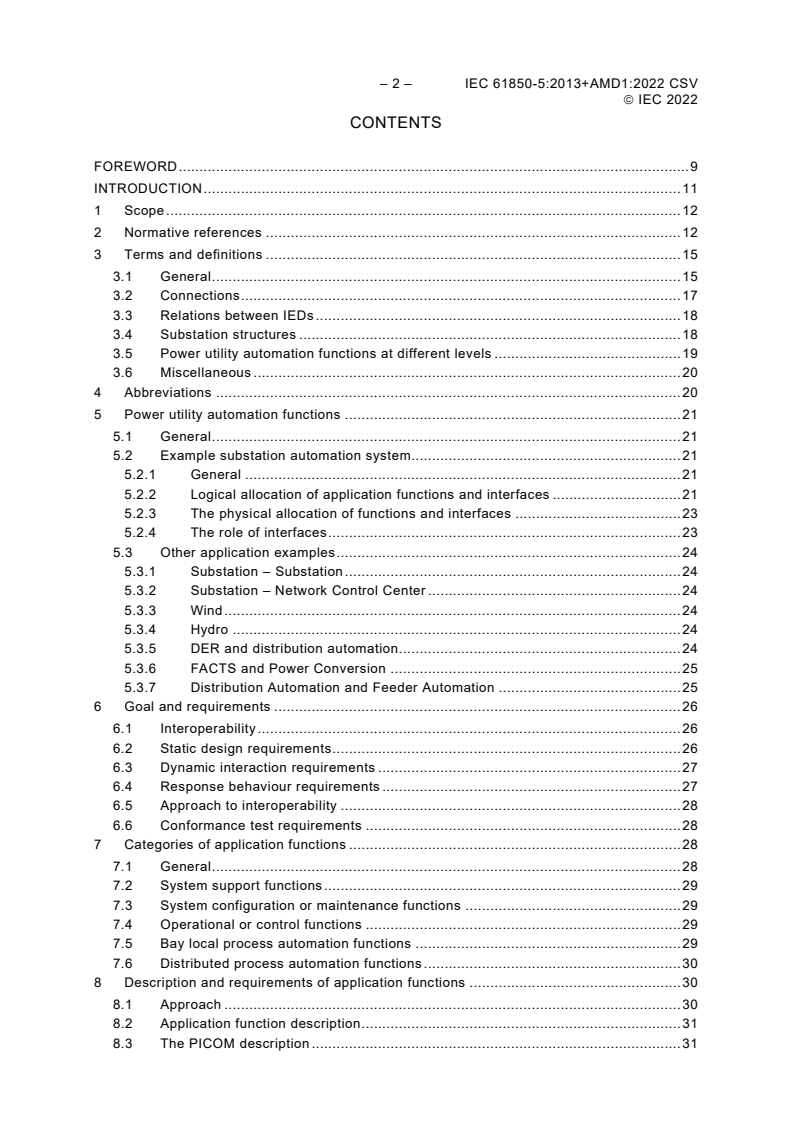
CONTENTS
FOREWORD . 9
INTRODUCTION . 11
1 Scope . 12
2 Normative references . 12
3 Terms and definitions . 15
3.1 General . 15
3.2 Connections . 17
3.3 Relations between IEDs . 18
3.4 Substation structures . 18
3.5 Power utility automation functions at different levels . 19
3.6 Miscellaneous . 20
4 Abbreviations . 20
5 Power utility automation functions . 21
5.1 General . 21
5.2 Example substation automation system. 21
5.2.1 General . 21
5.2.2 Logical allocation of application functions and interfaces . 21
5.2.3 The physical allocation of functions and interfaces . 23
5.2.4 The role of interfaces . 23
5.3 Other application examples . 24
5.3.1 Substation – Substation . 24
5.3.2 Substation – Network Control Center . 24
5.3.3 Wind . 24
5.3.4 Hydro . 24
5.3.5 DER and distribution automation. 24
5.3.6 FACTS and Power Conversion . 25
5.3.7 Distribution Automation and Feeder Automation . 25
6 Goal and requirements . 26
6.1 Interoperability . 26
6.2 Static design requirements . 26
6.3 Dynamic interaction requirements . 27
6.4 Response behaviour requirements . 27
6.5 Approach to interoperability . 28
6.6 Conformance test requirements . 28
7 Categories of application functions . 28
7.1 General . 28
7.2 System support functions . 29
7.3 System configuration or maintenance functions . 29
7.4 Operational or control functions . 29
7.5 Bay local process automation functions . 29
7.6 Distributed process automation functions . 30
8 Description and requirements of application functions . 30
8.1 Approach . 30
8.2 Application function description . 31
8.3 The PICOM description . 31
IEC 2022
8.3.1 The PICOM approach . 31
8.3.2 The content of PICOM description . 31
8.3.3 Attributes of PICOMs . 32
8.3.4 PICOM attributes to be covered by any message . 32
8.3.5 PICOM attributes to be covered at configuration time only . 32
8.3.6 PICOM attributes to be used for data flow calculations only . 32
8.4 Logical node description . 32
8.4.1 The logical node concept . 32
8.4.2 Logical nodes and logical connections . 33
8.4.3 Examples for decomposition of common functions into logical nodes . 34
8.5 List of logical nodes . 35
8.5.1 Logical Node allocation and distributed application functions . 35
8.5.2 Explanation of tables . 36
8.5.3 Defining and modelling of protection functions . 37
8.5.4 Defining and modelling of protection related functions . 43
8.5.5 Defining and modelling control functions . 45
8.5.6 Definition and modelling Interfaces, logging and archiving functions . 46
8.5.7 Defining and modelling automatic process control functions . 47
8.5.8 Defining and modelling functional block functions . 48
8.5.9 Defining and modelling metering and measurement functions . 49
8.5.10 Defining and modelling power quality functions . 51
8.5.11 Defining and modelling physical device functions and common data . 52
8.5.12 Defining and modelling of system services. 52
8.5.13 Definition and modelling of switching devices . 53
8.5.14 Definition and modelling of supervision and monitoring functions . 54
8.5.15 Definition and modelling of Instrument transformer functions . 56
8.5.16 Definition and modelling of position sensors functions . 56
8.5.17 Definition and modelling of material status sensors functions . 56
8.5.18 Definition and modelling of flow status sensor functions . 57
8.5.19 Definition and modelling of generic sensor functions . 57
8.5.20 Definition and modelling of power transformer functions . 58
8.5.21 Definition and modelling of further power system equipment . 58
8.5.22 Definition and modelling of generic process I/O . 59
8.6 Definition and modelling of mechanical non-electrical process equipment . 60
9 The application concept for Logical Nodes . 60
9.1 Example out of the substation automation domain. 60
9.2 Typical allocation and use of Logical Nodes . 60
9.2.1 Free allocation of Logical Nodes . 60
9.2.2 Station level. 60
9.2.3 Bay level . 60
9.2.4 Process/switchgear level . 61
9.2.5 The use of generic Logical Nodes . 61
9.3 Basic examples . 61
9.4 Additional examples . 62
9.5 Modelling . 64
9.5.1 Important remarks . 64
9.5.2 Object classes and instances . 64
9.5.3 Requirements and modelling. 64
9.5.4 Logical Nodes and modelling . 64
– 4 – IEC 61850-5:2013+AMD1:2022 CSV
IEC 2022
9.5.5 Use of Logical Nodes for applications . 65
10 System description and system requirements . 65
10.1 Need for a formal system description . 65
10.2 Requirements for Logical Node behaviour in the system . 65
11 Performance requirements. 66
11.1 Time synchronisation . 66
11.1.1 Basics . 66
11.2 Message performance requirements . 70
11.2.1 Basic definitions and requirements . 70
11.2.2 Concepts of message types and performance classes . 73
11.2.3 Definition of transfer time and synchronization classes . 75
11.3 Definition of messages types and performances classes . 76
11.3.1 Type 1 – Fast messages ("Protection") . 76
11.3.2 Type 2 – Medium speed messages ("Automatics") . 77
11.3.3 Type 3 – Low speed messages ("Operator") . 77
11.3.4 Type 4 – Raw data messages ("Samples") . 77
11.3.5 Type 5 – File transfer functions. 78
11.3.6 Type 6 – Command messages and file transfer with access control . 78
11.4 Requirements for data and communication quality . 79
11.4.1 General remarks . 79
11.4.2 Data integrity . 79
11.4.3 Reliability. 80
11.5 Requirements concerning the communication system . 82
11.5.1 Communication failures . 82
11.5.2 Requirements for station and bay level communication . 82
11.5.3 Requirements for process level communication . 83
11.5.4 Requirements for recovery delay . 83
11.5.5 Requirements for communication redundancy . 83
11.6 System performance requirements . 84
12 Additional requirements for the data model . 84
12.1 Semantics . 84
12.2 Logical and physical identification and addressing . 84
12.3 Self-description . 84
12.4 Administrative issues . 84
Annex A (informative) Logical nodes and related PICOMs . 86
Annex B (informative) PICOM identification and message classification . 101
B.1 General . 101
B.2 Identification and type allocation of PICOMs . 102
Annex C (informative) Communication optimization. 109
Annex D (informative) Rules for function definition . 110
D.1 Function definition . 110
D.2 Function description . 110
D.2.1 Task of the function . 110
D.2.2 Starting criteria for the function . 110
D.2.3 Result or impact of the function . 110
D.2.4 Performance of the function . 110
D.2.5 Function decomposition . 110
D.2.6 Interaction with other functions . 110
IEC 2022
D.3 Logical node description . 111
D.3.1 General . 111
D.3.2 Starting criteria . 111
D.4 PICOM description . 111
D.4.1 Input and outputs by PICOMs . 111
D.4.2 Operation modes . 111
D.4.3 Performance . 111
Annex E (informative) Interaction of functions and logical nodes . 112
Annex F (informative) Functions . 113
F.1 System support functions . 113
F.1.1 Network management . 113
F.1.2 Time synchronization . 114
F.1.3 Physical device self-checking . 114
F.1.4 Software management . 115
F.1.5 Configuration management . 116
F.1.6 Operative mode control of logical nodes . 117
F.1.7 Setting . 118
F.1.8 Test mode . 119
F.1.9 System security management . 120
F.2 Operational or control functions . 120
F.2.1 Access security management . 120
F.2.2 Control . 122
F.2.3 Operational use of spontaneous change of indications. 123
F.2.4 Synchronized switching (point-on-wave switching) . 124
F.2.5 Parameter set switching . 125
F.2.6 Alarm management . 125
F.2.7 Event management (SER) . 126
F.2.8 Data retrieval of configuration data and settings . 127
F.2.9 Disturbance/fault record retrieval . 128
F.2.10 Log management . 128
F.3 Local process automation functions . 128
F.3.1 Protection function (generic) . 128
F.3.2 Distance protection (example of protection function) . 129
F.3.3 Bay interlocking . 130
F.4 Distributed automatic functions . 130
F.4.1 Station-wide interlocking . 130
F.4.2 Distributed synchrocheck . 131
F.4.3 Breaker failure . 132
F.4.4 Automatic protection adaptation (generic) . 133
F.4.5 Reverse blocking function (example for automatic protection adaptation) . 133
F.4.6 Load shedding . 134
F.4.7 Load restoration . 134
F.4.8 Voltage and reactive power control . 135
F.4.9 Infeed switchover and transformer change . 135
F.4.10 Automatic switching sequences . 136
Annex G (informative) Results from function description . 138
– 6 – IEC 61850-5:2013+AMD1:2022 CSV
IEC 2022
Annex H (informative) Substation configurations . 144
H.1 Selected substations and associated layouts . 144
H.2 Assigned protection and control functions . 145
H.2.1 General . 145
H.2.2 Substation T1-1 . 145
H.2.3 Substation D2-1 . 147
H.2.4 Substation T1-2 . 147
H.2.5 Substation T2-2 . 147
Annex I (informative) Examples for protection functions in compensated networks . 149
I.1 The Transient Earth Fault (PTEF) . 149
I.2 Short term bypass (YPSH) . 150
I.3 The double earth fault (PTOC) . 150
Bibliography . 151
Figure 2 – Levels and logical interfaces in substation automation systems . 22
Figure 3 – The logical node and link concept (explanation see text) . 34
Figure 4 – Examples of the application of the logical node concept (explanation see text) . 35
Figure 5 – Protection function consisting of three Logical Nodes . 36
Figure 6 – The basic communication links of a logical node of main protection type . 43
Figure 7 – Decomposition of functions into interacting LNs on different levels:
Examples for generic automatic function, breaker control function and voltage control
function . 61
Figure 8 – Decomposition of functions into interacting LN on different levels: Examples
for generic function with telecontrol interface, protection function and
measuring/metering function . 62
Figure 9 – Example for control and protection LNs of a transformer bay combined in
one physical device (some kind of maximum allocation) . 62
Figure 10 – Example for interaction of LNs for switchgear control, interlocking,
synchrocheck, autoreclosure and protection (Abbreviation for LN see above) . 63
Figure 11 – Example for sequential interacting of LNs (local and remote) in a complex
function like point-on-wave switching (Abbreviations for LN see above) – Sequence view . 63
Figure 12 – Circuit breaker controllable per phase (XCBR instances per phase) and
instrument transformers with measuring units per phase (TCTR or TVTR per phase) . 64
Figure 14 – Transfer time for binary signal with conventional output and input delays . 71
Figure 15 – Definition of transfer time t for binary signals in case of line protection . 72
Figure 16 – Definition of transfer time t over serial link in case of line protection . 73
Figure H.1 – T1-1 Small size transmission substation (single busbar 132 kV with
infeed from 220 kV) . 144
Figure H.2 – D2-1 Medium size distribution substation (double busbar 22 kV with
infeed from 69 kV) . 144
Figure H.3 – T1-2 Small size transmission substation (1 1/2 breaker busbar at 110 kV) . 144
Figure H.4 – T2-2 Large size transmission substation (ring bus at 526 kV, double
busbar at 138 kV) . 145
Figure H.5 – Substation of type T1-1 with allocation functions . 146
Figure H.6 – Substation of type D2-1 with allocated functions . 147
Figure H.7 – Substation of type T1-2 (functions allocated same as for T2-2 in Figure H.8) . 147
Figure H.8 – Substation of type T2-2 with allocated functions . 148
Figure I.1 – The transient earth fault in a compensated network . 149
IEC 2022
Figure I.2 – Short term bypass for single earth fault in compensated networks . 150
Figure I.3 – Double earth fault in compensated networks . 150
Table 8 – Logical Nodes for protection functions . 37
Table 9 – Logical Nodes for protection related functions . 43
Table 10 – Logical Nodes for control functions . 45
Table 11 – Logical Nodes for interface functions . 46
Table 12 – Logical Nodes for automatic process control functions . 47
Table 13 – Logical Nodes for functional block functions . 49
Table 14 – Logical Nodes for metering and measurement functions . 50
Table 15 – Logical Nodes for power quality functions . 51
Table 16 – Logical Nodes for physical device functions and common data . 52
Table 17 – Logical Nodes for time, supervision and testing . 53
Table 18 – Logical Nodes for system and device security . 53
Table 19 – Logical Nodes for switching devices . 54
Table 20 – Logical Nodes for supervision and monitoring functions . 54
Table 21 – Logical Nodes for instrument transformers functions . 56
Table 22 – Logical Nodes for position sensor functions . 56
Table 23 – Logical Nodes for material status sensor functions . 57
Table 24 – Logical Nodes for flow status sensor functions . 57
Table 25 – Logical Nodes for Generic Sensor Functions . 58
Table 26 – Logical Nodes for power transformer functions . 58
Table 27 – Logical Nodes for further power system equipment . 58
Table 28 – Logical Nodes for generic process I/O . 59
Table 29 – Logical Nodes for mechanical non-electrical process equipment . 60
Table 2 – Time synchronization classes for AC applications synchronization . 68
Table 3 – Time synchronization classes for time tagging or sampling . 68
Table 30 – Classes for transfer times . 75
Table 31 -– Data integrity classes . 79
Table 32 – Security classes . 80
Table 33 – Dependability classes . 81
Table 34 – Requirements for recovery time (examples) . 83
Table A.1 – PICOM groups . 86
Table A.2 – Logical node list . 87
Table B.1 – PICOM identification (Part 1) . 102
Table B.2 – PICOM identification (Part 2) . 103
Table B.3 – PICOM allocation (Part 1) . 104
Table B.4 – PICOM allocation (Part 2) . 105
Table B.5 – PICOM types. 107
Table G.1 – Function-function interaction (Part 1) . 138
Table G.2 – Function-function interaction (Part 2) . 139
Table G.3 – Function decomposition into logical nodes (Part 1) . 140
Table G.4 – Function decomposition into logical nodes (Part 2) . 141
– 8 – IEC 61850-5:2013+AMD1:2022 CSV
IEC 2022
Table G.5 – Function decomposition into logical nodes (Part 3) . 142
Table G.6 – Function decomposition into logical nodes (Part 4) . 143
Table H.1 – Definition of the configuration of all substations evaluated . 145
IEC 2022
INTERNATIONAL ELECTROTECHNICAL COMMISSION
____________
COMMUNICATION NETWORKS AND SYSTEMS
FOR POWER UTILITY AUTOMATION –
Part 5: Communication requirements
for functions and device models
FOREWORD
1) The International Electrotechnical Commission (IEC) is a worldwide organization for standardization comprising
all national Electrotechnical Committees (IEC National Committees). The object of IEC is to promote international
co-operation on all questions concerning standardization in the electrical and electronic fields. To this end and
in addition to other activities, IEC publishes International Standards, Technical Specifications, Technical Reports,
Publicly Available Specifications (PAS) and Guides (hereafter referred to as “IEC Publication(s)”). Their
preparation is entrusted to technical committees; any IEC National Committee interested in the subject dealt with
may participate in this preparatory work. International, governmental and non-governmental organizations liaising
with the IEC also participate in this preparation. IEC collaborates closely with the International Organization for
Standardization (ISO) in accordance with conditions determined by agreement between the two organizations.
2) The formal decisions or agreements of IEC on technical matters express, as nearly as possible, an international
consensus of opinion on the relevant subjects since each technical committee has representation from all
interested IEC National Committees.
3) IEC Publications have the form of recommendations for international use and are accepted by IEC National
Committees in that sense. While all reasonable efforts are made to ensure that the technical content of IEC
Publications is accurate, IEC cannot be held responsible for the way in which they are used or for any
misinterpretation by any end user.
4) In order to promote international uniformity, IEC National Committees undertake to apply IEC Publications
transparently to the maximum extent possible in their national and regional publications. Any divergence between
any IEC Publication and the corresponding national or regional publication shall be clearly indicated in the latter.
5) IEC itself does not provide any attestation of conformity. Independent certification bodies provide conformity
assessment services and, in some areas, access to IEC marks of conformity. IEC is not responsible for any
services carried out by independent certification bodies.
6) All users should ensure that they have the latest edition of this publication.
7) No liability shall attach to IEC or its directors, employees, servants or agents including individual experts and
members of its technical committees and IEC National Committees for any personal injury, property damage or
other damage of any nature whatsoever, whether direct or indirect, or for costs (including legal fees) and
expenses arising out of the publication, use of, or reliance upon, this IEC Publication or any other IEC
Publications.
8) Attention is drawn to the normative references cited in this publication. Use of the referenced publications is
indispensable for the correct application of this publication.
9) Attention is drawn to the possibility that some of the elements of this IEC Publication may be the subject of patent
rights. IEC shall not be held responsible for identifying any or all such patent rights.
This consolidated version of the official IEC Standard and its amendment has been
prepared for user convenience.
IEC 61850-5 edition 2.1 contains the second edition (2013-01) [documents 57/1286/FDIS
and 57/1309/RVD] and its amendment 1 (2022-03) [documents 57/2448/FDIS and
57/2467/RVD].
– 10 – IEC 61850-5:2013+AMD1:2022 CSV
IEC 2022
International Standard IEC 61850-5 has been prepared by IEC technical committee 57: Power
systems management and associated information exchange.
The changes, corrections and updates have been made mainly according to the comments
received.
The major changes of this consolidated version with regard to the edition 2 are as follows:
a) extensions of the requirements with some Logical Nodes
b) errors and typos have been corrected
c) harmonization of all Logical Node descriptions (impact on all Logical Node tables)
d) re-organization of selected clause structures
e) updating of headlines
f) re-ordering subclauses in the chapter about performances
to provide
– ease of reading and understanding of the requirements for the IEC 61850 series
– consistent and updated requirement references for the data model and communication
service parts
This publication has been drafted in accordance with the ISO/IEC Directives, Part 2.
A list of all the parts in the IEC 61850 series, published under the general title Communication
networks and systems for power utility automation, can be found on the IEC website.
Future standards in this series will carry the new general title as cited above. Titles of existing
standards in this series will be updated at the time of the next edition.
The committee has decided that the contents of the base publication and its amendment will
remain unchanged until the stability date indicated on the IEC web site under webstore.iec.ch
in the data related to the specific publication. At this date, the publication will be
• reconfirmed,
• withdrawn,
• replaced by a revised edition, or
• amended.
IMPORTANT – The 'colour inside' logo on the cover page of this publication indicates
that it contains colours which are considered to be useful for the correct understanding
of its contents. Users should therefore print this document using a colour printer.
IEC 2022
INTRODUCTION
This part of IEC 61850 is part of a set of standards, the IEC 61850 series. The IEC 61850 series
is intended to provide interoperability between all devices in power utility automation systems.
Therefore, it defines communication networks and systems for power utility automation, and
more specially the communication architecture for subsystems like substation automation
systems. The sum of all subsystems may result also in the description of the communication
architecture for the overall power system management.
Communication between these devices in subsystems and between the subsystems within the
overall power utility automation system fulfils a lot of requirements imposed by all the functions
to be performed in power utility automation systems starting from the core requirements in
substations. These requirements are stated both for the data to be organized in a data model
and for the data exchange resulting in services. Performance of the data exchange means not
only transfer times but also the quality of the data exchange avoiding losses of information in
the communication.
Depending on the philosophy both of the manufacturer and the user and on the state-of-the-art
in technology, the allocation of functions to devices and control levels is not commonly fixed.
Therefore, the standard shall support any allocation of functions. This results in different
requirements for the different communication interfaces within the substation or plant, at its
border and beyond.
The IEC 61850 series shall be long living but allow following the fast changes in communication
technology by both its technical approach and its document structure. The IEC 61850 series
has been organized so that at least minor changes to one part do not require a significant
rewriting of another part. For example, the derived data models in subsequent parts (IEC 61850-
7-x) and mappings to dedicated stacks (IEC 61850-8-x and IEC 61850-9-x) based on the
communication requirements in IEC 61850-5 will not change the requirements defined in
IEC 61850-5. In addition, the general parts, the requirement specification and the modelling
parts are independent from any implementation. The implementation needed for the use of the
standard is defined in some few dedicated parts referring to main stream communication means
thus supporting the long living of the standard and its potential for later technical changes.
This consolidated version of IEC 61850-5:2013 and its Amendment 1 defines the
communication requirements for functions and device models for power utility automation
systems.
The modelling of communication requires the definition of objects (e.g., data objects, data sets,
report control, log control) and services accessing the objects (e.g., get, set, report, create,
delete). This is defined in IEC 61850-7 with a clear interface to implementation. To use the
benefits of communication technology, in this standard no new protocol stacks are defined but
a standardized mapping on existing stacks is given in IEC 61850-8 and IEC 61850-9. A System
configuration language (IEC 61850-6) for strong formal description of the system usable for
software tools and a standardized conformance testing (IEC 61850-10) complement the
standard.
NOTE 1 To keep the layered approach of the standard not mixing application and implementation requirements,
terms like client, s
...
IEC 61850-5 ®
Edition 2.0 2013-01
INTERNATIONAL
STANDARD
NORME
INTERNATIONALE
colour
inside
Communication networks and systems for power utility automation –
Part 5: Communication requirements for functions and device models
Réseaux et systèmes de communication pour l'automatisation des systèmes
électriques –
Partie 5: Exigences de communication pour les modèles de fonctions et
d’appareils
All rights reserved. Unless otherwise specified, no part of this publication may be reproduced or utilized in any form
or by any means, electronic or mechanical, including photocopying and microfilm, without permission in writing from
either IEC or IEC's member National Committee in the country of the requester.
If you have any questions about IEC copyright or have an enquiry about obtaining additional rights to this publication,
please contact the address below or your local IEC member National Committee for further information.
Droits de reproduction réservés. Sauf indication contraire, aucune partie de cette publication ne peut être reproduite ni
utilisée sous quelque forme que ce soit et par aucun procédé, électronique ou mécanique, y compris la photocopie et les
microfilms, sans l'accord écrit de la CEI ou du Comité national de la CEI du pays du demandeur.
Si vous avez des questions sur le copyright de la CEI ou si vous désirez obtenir des droits supplémentaires sur cette
publication, utilisez les coordonnées ci-après ou contactez le Comité national de la CEI de votre pays de résidence.
IEC Central Office Tel.: +41 22 919 02 11
3, rue de Varembé Fax: +41 22 919 03 00
CH-1211 Geneva 20 info@iec.ch
Switzerland www.iec.ch
About the IEC
The International Electrotechnical Commission (IEC) is the leading global organization that prepares and publishes
International Standards for all electrical, electronic and related technologies.
About IEC publications
The technical content of IEC publications is kept under constant review by the IEC. Please make sure that you have the
latest edition, a corrigenda or an amendment might have been published.
Useful links:
IEC publications search - www.iec.ch/searchpub Electropedia - www.electropedia.org
The advanced search enables you to find IEC publications The world's leading online dictionary of electronic and
by a variety of criteria (reference number, text, technical electrical terms containing more than 30 000 terms and
committee,…). definitions in English and French, with equivalent terms in
It also gives information on projects, replaced and additional languages. Also known as the International
withdrawn publications. Electrotechnical Vocabulary (IEV) on-line.
IEC Just Published - webstore.iec.ch/justpublished Customer Service Centre - webstore.iec.ch/csc
Stay up to date on all new IEC publications. Just Published If you wish to give us your feedback on this publication
details all new publications released. Available on-line and or need further assistance, please contact the
also once a month by email. Customer Service Centre: csc@iec.ch.
A propos de la CEI
La Commission Electrotechnique Internationale (CEI) est la première organisation mondiale qui élabore et publie des
Normes internationales pour tout ce qui a trait à l'électricité, à l'électronique et aux technologies apparentées.
A propos des publications CEI
Le contenu technique des publications de la CEI est constamment revu. Veuillez vous assurer que vous possédez
l’édition la plus récente, un corrigendum ou amendement peut avoir été publié.
Liens utiles:
Recherche de publications CEI - www.iec.ch/searchpub Electropedia - www.electropedia.org
La recherche avancée vous permet de trouver des Le premier dictionnaire en ligne au monde de termes
publications CEI en utilisant différents critères (numéro de électroniques et électriques. Il contient plus de 30 000
référence, texte, comité d’études,…). termes et définitions en anglais et en français, ainsi que
Elle donne aussi des informations sur les projets et les les termes équivalents dans les langues additionnelles.
publications remplacées ou retirées. Egalement appelé Vocabulaire Electrotechnique
International (VEI) en ligne.
Just Published CEI - webstore.iec.ch/justpublished
Service Clients - webstore.iec.ch/csc
Restez informé sur les nouvelles publications de la CEI.
Just Published détaille les nouvelles publications parues. Si vous désirez nous donner des commentaires sur
Disponible en ligne et aussi une fois par mois par email. cette publication ou si vous avez des questions
contactez-nous: csc@iec.ch.
IEC 61850-5 ®
Edition 2.0 2013-01
INTERNATIONAL
STANDARD
NORME
INTERNATIONALE
colour
inside
Communication networks and systems for power utility automation –
Part 5: Communication requirements for functions and device models
Réseaux et systèmes de communication pour l'automatisation des systèmes
électriques –
Partie 5: Exigences de communication pour les modèles de fonctions et
d’appareils
INTERNATIONAL
ELECTROTECHNICAL
COMMISSION
COMMISSION
ELECTROTECHNIQUE
PRICE CODE
INTERNATIONALE
CODE PRIX XG
ICS 33.200 ISBN 978-2-83220-556-3
– 2 – 61850-5 IEC:2013
CONTENTS
FOREWORD . 7
INTRODUCTION . 9
1 Scope . 11
2 Normative references . 11
3 Terms and definitions . 12
3.1 General . 12
3.2 Connections . 14
3.3 Relations between IEDs . 15
3.4 Substation structures. 15
3.5 Power utility automation functions at different levels. 16
3.6 Miscellaneous . 17
4 Abbreviations . 17
5 Power utility automation functions . 17
5.1 General . 17
5.2 Example substation automation system . 18
5.2.1 General . 18
5.2.2 Logical allocation of functions and interfaces . 18
5.2.3 The physical allocation of functions and interfaces . 20
5.2.4 The role of interfaces . 20
5.3 Other application examples . 21
5.3.1 Substation – Substation . 21
5.3.2 Substation – Network Control . 21
5.3.3 Wind . 21
5.3.4 Hydro . 21
5.3.5 DER . 21
6 Goal and requirements . 21
6.1 Interoperability . 21
6.2 Static design requirements . 22
6.3 Dynamic interaction requirements . 22
6.4 Response behaviour requirements . 23
6.5 Approach to interoperability . 23
6.6 Conformance test requirements . 24
7 Categories of functions . 24
7.1 General . 24
7.2 System support functions . 24
7.3 System configuration or maintenance functions . 24
7.4 Operational or control functions . 25
7.5 Bay local process automation functions . 25
7.6 Distributed process automation functions . 25
8 Function description and function requirements . 26
8.1 Approach . 26
8.2 Function description . 27
8.3 The PICOM description . 27
8.3.1 The PICOM approach . 27
8.3.2 The content of PICOM description . 27
61850-5 IEC:2013 – 3 –
8.3.3 Attributes of PICOMs . 27
8.3.4 PICOM attributes to be covered by any message . 27
8.3.5 PICOM attributes to be covered at configuration time only . 28
8.3.6 PICOM attributes to be used for data flow calculations only . 28
8.4 Logical node description . 28
8.4.1 The logical node concept . 28
8.4.2 Logical nodes and logical connections . 29
8.4.3 Examples for decomposition of common functions into logical nodes . 30
8.5 List of logical nodes . 31
8.5.1 Logical Node allocation and distributed functions . 31
8.5.2 Explanation to tables . 32
8.5.3 Protection . 33
8.5.4 Logical nodes for protection related functions . 40
8.5.5 Control . 42
8.5.6 Interfaces, logging, and archiving . 43
8.5.7 Automatic process control . 44
8.5.8 Functional blocks . 45
8.5.9 Metering and measurement . 46
8.5.10 Power quality . 47
8.5.11 Physical device and common data . 48
8.6 LNs related to system services . 48
8.6.1 System and device security . 48
8.6.2 Switching devices . 49
8.6.3 LN for supervision and monitoring . 50
8.6.4 Instrument transformers . 51
8.6.5 Position sensors . 51
8.6.6 Material status sensors . 52
8.6.7 Flow status sensors . 52
8.6.8 Generic sensors . 52
8.6.9 Power transformers . 53
8.6.10 Further power system equipment . 53
8.6.11 Generic process I/O . 54
8.7 Mechanical non-electrical primary equipment . 54
9 The application concept for logical nodes . 54
9.1 Example out of the domain substation automation . 54
9.2 Typical allocation and use of logical nodes . 54
9.2.1 Free allocation of LNs. 54
9.2.2 Station level . 55
9.2.3 Bay level . 55
9.2.4 Process/switchgear level . 55
9.2.5 The use of generic logical nodes . 55
9.3 Basic examples . 55
9.4 Additional examples . 56
9.5 Modelling . 58
9.5.1 Important remarks . 58
9.5.2 Object classes and instances . 58
9.5.3 Requirements and modelling . 58
9.5.4 LN and modelling. 58
9.5.5 Use of LN for applications . 59
– 4 – 61850-5 IEC:2013
10 System description and system requirements . 59
10.1 Need for a formal system description. 59
10.2 Requirements for logical node behaviour in the system . 59
11 Performance requirements . 60
11.1 Message performance requirements . 60
11.1.1 Basic definitions and requirements . 60
11.1.2 Message types and performance classes. 65
11.1.3 Definition of transfer time and synchronization classes . 66
11.2 Messages types and performances classes . 69
11.2.1 Type 1 – Fast messages (“Protection”) . 69
11.2.2 Type 2 – Medium speed messages (“Automatics”) . 69
11.2.3 Type 3 – Low speed messages (“Operator”) . 70
11.2.4 Type 4 – Raw data messages (“Samples”) . 70
11.2.5 Type 5 – File transfer functions . 70
11.2.6 Type 6 – Command messages and file transfer with access control . 71
11.3 Requirements for data and communication quality . 71
11.3.1 General remarks . 71
11.3.2 Data integrity . 72
11.3.3 Reliability . 73
11.3.4 Availability . 74
11.4 Requirements concerning the communication system . 74
11.4.1 Communication failures . 74
11.4.2 Requirements for station and bay level communication . 75
11.4.3 Requirements for process level communication . 75
11.4.4 Requirements for recovery delay . 76
11.4.5 Requirements for communication redundancy . 76
11.5 System performance requirements . 76
12 Additional requirements for the data model . 77
12.1 Semantics . 77
12.2 Logical and physical identification and addressing. 77
12.3 Self-description . 77
12.4 Administrative issues. 77
Annex A (informative) Logical nodes and related PICOMs . 78
Annex B (informative) PICOM identification and message classification . 93
Annex C (informative) Communication optimization . 101
Annex D (informative) Rules for function definition . 102
Annex E (informative) Interaction of functions and logical nodes . 104
Annex F (informative) Functions . 105
Annex G (informative) Results from function description . 129
Annex H (informative) Substation configurations . 135
Annex I (informative) Examples for protection functions in compensated networks. 140
Bibliography . 142
Figure 1 – Relative position of this part of the standard. 10
Figure 2 – Levels and logical interfaces in substation automation systems. 19
Figure 3 – The logical node and link concept (explanation see text) . 30
61850-5 IEC:2013 – 5 –
Figure 4 – Examples of the application of the logical node concept (explanation see
text) . 31
Figure 5 – Protection function consisting of 3 logical nodes . 32
Figure 6 – The basic communication links of a logical node of main protection type . 39
Figure 7 – Decomposition of functions into interacting LNs on different levels:
Examples for generic automatic function, breaker control function and voltage control
function. 55
Figure 8 – Decomposition of functions into interacting LN on different levels:
Examples for generic function with telecontrol interface, protection function and
measuring/metering function . 56
Figure 9 – Example for control and protection LNs of a transformer bay combined in
one physical device (some kind of maximum allocation) . 56
Figure 10 – Example for interaction of LNs for switchgear control, interlocking,
synchrocheck, autoreclosure and protection (Abbreviation for LN see above) . 57
Figure 11 – Example for sequential interacting of LNs (local and remote) for a complex
function like point-on-wave switching (Abbreviations for LN see above) – Sequence
view . 57
Figure 12 – Circuit breaker controllable per phase (XCBR instances per phase) and
instrument transformers with measuring units per phase (TCTR or TVTR per phase) . 58
Figure 13 – Definition of "overall transfer time" t and indication of processing times . 62
Figure 14 – Transfer time for binary signal with conventional output and input relays . 63
Figure 15 – Definition of transfer time t for binary signals in case of line protection . 64
Figure 16 – Definition of transfer time t over serial link in case of line protection. 64
Figure H.1 – T1-1 Small size transmission substation (single busbar 132 kV with
infeed from 220 kV) . 135
Figure H.2 – D2-1 Medium size distribution substation (double busbar 22 kV with
infeed from 69 kV) . 135
Figure H.3 – T1-2 Small size transmission substation (1 1/2 breaker busbar at 110 kV) . 135
Figure H.4 – T2-2 Large size transmission substation (ring bus at 526 kV, double
busbar at 138 kV) . 136
Figure H.5 – Substation of type T1-1 with allocation functions . 137
Figure H.6 – Substation of type D2-1 with allocated functions . 138
Figure H.7 – Substation of type T1-2 (functions allocated same as for T2-2 in Figure
H.8) . 138
Figure H.8 – Substation of type T2-2 with allocated functions . 139
Figure I.1 – The transient earth fault in a compensated network . 140
Figure I.2 – Short term bypass for single earth fault in compensated networks . 141
Figure I.3 – Double earth fault in compensated networks . 141
Table 1 – Classes for transfer times . 67
Table 2 – Time synchronization classes for IED synchronization . 68
Table 3 – Application of time synchronization classes for time tagging or sampling . 68
Table 4 – Data integrity classes . 72
Table 5 – Security classes . 73
Table 6 – Dependability classes . 74
Table 7 – Requirements on recovery time (examples) . 76
Table A.1 – PICOM groups . 78
– 6 – 61850-5 IEC:2013
Table A.2 – Logical node list . 79
Table B.1 – PICOM identification (Part 1) . 94
Table B.2 – PICOM identification (Part 2) . 95
Table B.3 – PICOM allocation (Part 1) . 96
Table B.4 – PICOM allocation (Part 2) . 97
Table B.5 – PICOM types . 99
Table G.1 – Function-function interaction (Part 1) . 129
Table G.2 – Function-function interaction (Part 2) . 130
Table G.3 – Function decomposition into logical nodes (Part 1) . 131
Table G.4 – Function decomposition into logical nodes (Part 2) . 132
Table G.5 – Function decomposition into logical nodes (Part 3) . 133
Table G.6 – Function decomposition into logical nodes (Part 4) . 134
Table H.1 – Definition of the configuration of all substations evaluated . 136
61850-5 IEC:2013 – 7 –
INTERNATIONAL ELECTROTECHNICAL COMMISSION
____________
COMMUNICATION NETWORKS AND SYSTEMS
FOR POWER UTILITY AUTOMATION –
Part 5: Communication requirements
for functions and device models
FOREWORD
1) The International Electrotechnical Commission (IEC) is a worldwide organization for standardization comprising
all national electrotechnical committees (IEC National Committees). The object of IEC is to promote
international co-operation on all questions concerning standardization in the electrical and electronic fields. To
this end and in addition to other activities, IEC publishes International Standards, Technical Specifications,
Technical Reports, Publicly Available Specifications (PAS) and Guides (hereafter referred to as “IEC
Publication(s)”). Their preparation is entrusted to technical committees; any IEC National Committee interested
in the subject dealt with may participate in this preparatory work. International, governmental and non-
governmental organizations liaising with the IEC also participate in this preparation. IEC collaborates closely
with the International Organization for Standardization (ISO) in accordance with conditions determined by
agreement between the two organizations.
2) The formal decisions or agreements of IEC on technical matters express, as nearly as possible, an international
consensus of opinion on the relevant subjects since each technical committee has representation from all
interested IEC National Committees.
3) IEC Publications have the form of recommendations for international use and are accepted by IEC National
Committees in that sense. While all reasonable efforts are made to ensure that the technical content of IEC
Publications is accurate, IEC cannot be held responsible for the way in which they are used or for any
misinterpretation by any end user.
4) In order to promote international uniformity, IEC National Committees undertake to apply IEC Publications
transparently to the maximum extent possible in their national and regional publications. Any divergence
between any IEC Publication and the corresponding national or regional publication shall be clearly indicated in
the latter.
5) IEC itself does not provide any attestation of conformity. Independent certification bodies provide conformity
assessment services and, in some areas, access to IEC marks of conformity. IEC is not responsible for any
services carried out by independent certification bodies.
6) All users should ensure that they have the latest edition of this publication.
7) No liability shall attach to IEC or its directors, employees, servants or agents including individual experts and
members of its technical committees and IEC National Committees for any personal injury, property damage or
other damage of any nature whatsoever, whether direct or indirect, or for costs (including legal fees) and
expenses arising out of the publication, use of, or reliance upon, this IEC Publication or any other IEC
Publications.
8) Attention is drawn to the Normative references cited in this publication. Use of the referenced publications is
indispensable for the correct application of this publication.
9) Attention is drawn to the possibility that some of the elements of this IEC Publication may be the subject of
patent rights. IEC shall not be held responsible for identifying any or all such patent rights.
International Standard IEC 61850-5 has been prepared by IEC technical committee 57: Power
systems management and associated information exchange.
This second edition cancels and replaces the first edition published in 2003. It constitutes a
technical revision.
The major technical changes with regard to the previous edition are as follows:
– extension from substation automation systems to utility automation systems;
– including the interfaces for communication between substations (interfaces 2 and 11);
– requirements from communication beyond the boundary of the substation.
– 8 – 61850-5 IEC:2013
The text of this standard is based on the following documents:
FDIS Report on voting
57/1286/FDIS 57/1309/RVD
Full information on the voting for the approval of this standard can be found in the report on
voting indicated in the above table.
This publication has been drafted in accordance with the ISO/IEC Directives, Part 2.
A list of all the parts in the IEC 61850 series, published under the general title Communication
networks and systems for power utility automation, can be found on the IEC website.
Future standards in this series will carry the new general title as cited above. Titles of existing
standards in this series will be updated at the time of the next edition.
The committee has decided that the contents of this publication will remain unchanged until
the stability date indicated on the IEC web site under "http://webstore.iec.ch" in the data
related to the specific publication. At this date, the publication will be
• reconfirmed,
• withdrawn,
• replaced by a revised edition, or
• amended.
IMPORTANT – The 'colour inside' logo on the cover page of this publication indicates
that it contains colours which are considered to be useful for the correct
understanding of its contents. Users should therefore print this document using a
colour printer.
61850-5 IEC:2013 – 9 –
INTRODUCTION
This part of IEC 61850 is part of set of standards, the IEC 61850 series. The IEC 61850
series is intended to provide interoperability between all devices in power utility automation
systems. Therefore, it defines communication networks and systems for power utility
automation, and more specially the communication architecture for subsystems like substation
automation systems. The sum of all subsystems may result also in the description of the
communication architecture for the overall power system management.
Communication between these devices in subsystems and between the subsystems within the
overall power utility automation system fulfils a lot of requirements imposed by all the
functions to be performed in power utility automation systems starting from the core
requirements in substations. These requirements are stated both for the data to be organized
in a data model and for the data exchange resulting in services. Performance of the data
exchange means not only transfer times but also the quality of the data exchange avoiding
losses of information in the communication.
Depending on the philosophy both of the vendor and the user and on the state-of-the-art in
technology, the allocation of functions to devices and control levels is not commonly fixed.
Therefore, the standard shall support any allocation of functions. This results in different
requirements for the different communication interfaces within the substation or plant, at its
border and beyond.
The standard series shall be long living but allow following the fast changes in communication
technology by both its technical approach and its document structure. Figure 1 shows the
relationship of Part 5 to subsequent parts of IEC 61850 series.
The standard series IEC 61850 has been organized so that at least minor changes to one part
do not require a significant rewriting of another part. For example, the derived data models in
subsequent parts (IEC 61850-7-x) and mappings to dedicated stacks (IEC 61850-8-x and
IEC 61850-9-x) based on the communication requirements in Part 5 will not change the
requirements defined in Part 5. In addition, the general parts, the requirement specification
and the modelling parts are independent from any implementation. The implementation
needed for the use of the standard is defined in some few dedicated parts referring to main
stream communication means thus supporting the long living of the standard and its potential
for later technical changes.
This Part 5 of the standard IEC 61850 defines the communication requirements for functions
and device models for power utility automation systems.
The modelling of communication requires the definition of objects (e.g., data objects, data
sets, report control, log control) and services accessing the objects (e.g., get, set, report,
create, delete). This is defined in Part 7 with a clear interface to implementation. To use the
benefits of communication technology, in this standard no new protocol stacks are defined but
a standardized mapping on existing stacks is given in Part 8 and Part 9. A System
configuration language (Part 6) for strong formal description of the system usable for software
tools and a standardized conformance testing (Part 10) complement the standard. Figure 1
shows the general structure of the documents of IEC 61850 as well as the position of the
clauses defined in this document.
NOTE To keep the layered approach of the standard not mixing application and implementation requirements,
terms like client, server, data objects, etc. are normally not used in Part 5 (requirements). In Parts 7 (modelling), 8
and 9 (specific communication service mapping) terms belonging to application requirements like PICOM are
normally not used.
– 10 – 61850-5 IEC:2013
IEC 61850-10
Conformance
testing
IEC 61850-6
Configuration description
language for communication
IEC 61850-8-x
IEC 61850-9-x
Specific communication
service mapping
IEC 61850-7-4
Compatible logical node and
data object adressing
IEC 61850-7-3
Common data classes and
attributes
IEC 61850-7-2
Abstract communication
service interface (ACSI)
IEC 61850-7-1
Communication reference
model
IEC 61850-5
Communication requirements
for functions and device
models
IEC 2379/12
Figure 1 – Relative position of this part of the standard
61850-5 IEC:2013 – 11 –
COMMUNICATION NETWORKS AND SYSTEMS
FOR POWER UTILITY AUTOMATION –
Part 5: Communication requirements
for functions and device models
1 Scope
This part of IEC 61850 applies to power utility automation systems with the core part of
substation automation systems (SAS). It standardizes the communication between intelligent
electronic devices (IEDs) and defines the related system requirements to be supported.
The specifications of this part refer to the communication requirements of the functions in
power automation systems. Most examples of functions and their communication
requirements in this part are originated primarily from the substation automation domain and
may be reused or extended for other domains within power utility automation if applicable.
Note that sometimes instead of the term substation automation domain the term substation
domain is used, especially if both the switchyard devices (primary system) and the automation
system (secondary system) is regarded.
The description of the functions is not used to standardize the functions, but to identify
communication requirements between Intelligent Electronic Devices within plants and
substations in the power system, between such stations s (e.g. between substation for line
protection) and between the plant or substation and higher-level remote operating places (e.g.
network control centres) and maintenance places. Also interfaces to remote technical services
(e.g. maintenance centres) are considered. The general scope is the communication
requirements for power utility automation systems. The basic goal is interoperability for all
interactions providing a seamless communication system for the overall power system
management.
Standardizing functions and their implementation is completely outside the scope of this
standard. Therefore, it cannot be assumed a single philosophy of allocating functions to
devices. To support the resulting request for free allocation of functions, a proper breakdown
of functions into parts relevant for communication is defined. The exchanged data and their
required performance are defined.
The same or similar intelligent electronic devices from substations like protective and control
devices are found in other installations like power plants also. Using this standard for such
devices in these plants facilitates the system integration e.g. between the power plant control
and the related substation automation system. For some of such other application domains
like wind power plants, hydro power plants and distributed energy resources specific standard
parts according to IEC 61850 series have been already defined and published.
2 Normative references
The following documents, in whole or in part, are normatively referenced in this document and
are indispensable for its application. For dated references, only the edition cited applies. For
undated references, the latest edition of the referenced document (including any
amendments) applies.
IEC 61000-4-15, Electromagnetic compatibility (EMC) – Part 4-15: Testing and measurement
techniques – Flickermeter – Functional and design specifications
IEC/TS 61850-2, Communication networks and systems in substations – Part 2: Glossary
– 12 – 61850-5 IEC:2013
IEC 61850-6, Communication networks and systems for power utility automation – Part 6:
Configuration description language for communication in electrical substations related to IEDs
IEC 81346 (all parts), Industrial systems, installations and equipment and industrial products
– Structuring principles and reference designations
Cigre JWG 34./35.11 – Protection using Telecommunication, Cigre Technical Brochure (TB)
192 (111 pages), 2007
3 Terms and definitions
For the purposes of this document, the terms and definitions given in IEC/TS 61850-2, as well
as the following apply.
3.1 General
3.1.1
application function
task, which is performed in or by power utility automation systems
Note 1 to entry: Generally, a function consists of subparts which may be distributed to different IEDs, which
exchange data with each other. More precisely these sub-functions implemented in the IEDs exchange data. Also
between different functions data are exchanged. The exchanged data exposed to the communication system shall
be standardized based on the semantic content to be understandable by the receiving function. For this purpose
the standard groups the exchanged data in objects called Logical Nodes which refer to the name of the allocated
functions by their mnemonic name.
3.1.2
local function
function which is performed by sub-functions in one physical device
Note 1 to entry: If the performance of the functions is not depending on functions in other devices no
standardized link is needed. Sometimes, functions with a weak dependency only from other ones are also called
local functions. The loss of such links should not result in blocking these functions but in worst case to some
graceful degradation.
3.1.3
distributed function
function which is performed by sub-functions in two or more different physical devices
Note 1 to entry: The exchanged data is contained in Logical Nodes having a common semantic reference to the
distributed function. Since all functions communicate in some way, the definition of a local or a distributed function
is not unique but depends on the definition of the functional steps to be performed until the function is defined as
complete In case of losing the data of one Logical Node or losing one included communication link the function
may be blocked completely or show a graceful degradation if applicable.
3.1.4
system
set of interacting entities which perform a common functionality
Note 1 to entry: The backbone of the system is the data exchange.
3.1.5
logical system
communicating set of all application functions performing some overall task like “management
of a substation” or “management of a plant”
Note 1 to entry: The boundary of a logical system is given by its logical interfaces. The backbone of
...