

IEC 63002:2016
(Main)Identification and communication interoperability method for external power supplies used with portable computing devices
General Information
- Abstract
IEC 63002:20016 defines interoperability guidelines for external power supplies used with portable computing devices that implement the IEC 62680-1-2: Universal Serial Bus Power Delivery Specification with the IEC 62680-1-3: Universal Serial Bus Interfaces for data and power-Common Components- Type-CTM Type-C Cable and Connector Specification. It specifies the data objects used by a portable computing system using IEC 62680-1-2 to understand the identity, design and performance characteristics, and operating status of an external power supply. This International Standard is applicable to external power supplies under 100 watts for portable computing devices, with a focus on power delivery application for notebook computers, tablets, smartphones and other related multimedia devices.
- Status
- Published
- Publication Date
- 04-Oct-2016
- Technical Committee
- TA 18 - Multimedia home systems and applications for end-user networks
- Drafting Committee
- PT 63002 - TC 100/TA 14/PT 63002
- Current Stage
- DELPUB - Deleted Publication
- Start Date
- 27-May-2021
- Completion Date
- 30-Oct-2020
Overview
IEC 63002:2016 is an international standard developed by the International Electrotechnical Commission (IEC) that establishes identification and communication interoperability methods for external power supplies (EPS) used with portable computing devices. This standard is particularly relevant to manufacturers and designers of notebook computers, tablets, smartphones, and multimedia devices requiring external power below 100 watts. Its focus is on ensuring compatibility when using IEC 62680-1-2 (USB Power Delivery) with IEC 62680-1-3 (USB Type-C Cable and Connector) standards.
By specifying guidelines for data communication, IEC 63002:2016 helps portable computing systems not only recognize but also adapt to the operating status, identity, design, and performance characteristics of the connected external power supply. This leads to a higher degree of interoperability, safety, and consumer convenience in the global market for USB-powered devices.
Key Topics
- EPS Identification: The standard defines how an external power supply communicates its unique product identification (vendor ID, product ID, model information) to the portable computing device.
- Performance and Design Communication: EPS devices report technical parameters such as voltage capability, load current step performance, holdup time, compliance with limited power source requirements, touch current levels, peak current capabilities, and surface temperature.
- Interoperability Guidelines: Methods to manage interoperability challenges when connecting different brands or models of EPS and portable computing devices, including data object structures and reporting recommendations.
- Safety and Compliance: Recommendations for reporting compliance with key safety standards (such as IEC 60950-1, IEC 62368-1) and features like overvoltage and overcurrent protection.
- Consumer and Market Impact: Promotes reusability and convenience by facilitating safe operation when connecting new or unfamiliar external power supplies to portable devices.
- Cable Considerations: Recommendations on cable types (detachable vs. captive), connectors, and electronic markers to support both charging and data transfer, minimizing user confusion and maximizing flexibility.
Applications
IEC 63002:2016 is widely applicable in the technology and electronics sector, particularly for:
- Manufacturers of portable computing devices who need to ensure device compatibility with a range of external power supplies in global markets.
- Designers of USB-C power adapters aiming for interoperability and safety across a large ecosystem of consumer electronics.
- Universal charger and adapter products intended to serve multiple classes of mobile devices (notebooks, tablets, smartphones, multimedia gadgets).
- Testing and Certification Laboratories verifying compliance of EPS with interoperability and safety standards.
- Consumers benefit from enhanced device compatibility, reduced likelihood of equipment damage, and greater flexibility in using interchangeable power supplies.
The standard fosters the global adoption of interoperable USB Power Delivery and USB Type-C-based charging infrastructure, making device charging simpler and safer for end users.
Related Standards
IEC 63002:2016 directly references or aligns with several crucial international standards to ensure a robust and interoperable power delivery ecosystem:
- IEC 62680-1-2: Universal Serial Bus interfaces for data and power - USB Power Delivery Specification
- IEC 62680-1-3: Universal Serial Bus interfaces for data and power - USB Type-C Cable and Connector Specification
- IEC 60950-1: Information technology equipment – Safety – General requirements
- IEC 62368-1: Audio/video, information and communication technology equipment – Safety requirements
Adherence to IEC 63002:2016 enhances product marketability, safety, and user satisfaction by enabling seamless identification and communication between EPS and portable computing devices. For organizations involved in portable electronics, referencing this standard is essential for compliance, innovation, and global interoperability.
Relations
- Effective Date
- 05-Sep-2023
Get Certified
Connect with accredited certification bodies for this standard

BSI Group
BSI (British Standards Institution) is the business standards company that helps organizations make excellence a habit.

NYCE
Mexican standards and certification body.
Sponsored listings
Frequently Asked Questions
IEC 63002:2016 is a standard published by the International Electrotechnical Commission (IEC). Its full title is "Identification and communication interoperability method for external power supplies used with portable computing devices". This standard covers: IEC 63002:20016 defines interoperability guidelines for external power supplies used with portable computing devices that implement the IEC 62680-1-2: Universal Serial Bus Power Delivery Specification with the IEC 62680-1-3: Universal Serial Bus Interfaces for data and power-Common Components- Type-CTM Type-C Cable and Connector Specification. It specifies the data objects used by a portable computing system using IEC 62680-1-2 to understand the identity, design and performance characteristics, and operating status of an external power supply. This International Standard is applicable to external power supplies under 100 watts for portable computing devices, with a focus on power delivery application for notebook computers, tablets, smartphones and other related multimedia devices.
IEC 63002:20016 defines interoperability guidelines for external power supplies used with portable computing devices that implement the IEC 62680-1-2: Universal Serial Bus Power Delivery Specification with the IEC 62680-1-3: Universal Serial Bus Interfaces for data and power-Common Components- Type-CTM Type-C Cable and Connector Specification. It specifies the data objects used by a portable computing system using IEC 62680-1-2 to understand the identity, design and performance characteristics, and operating status of an external power supply. This International Standard is applicable to external power supplies under 100 watts for portable computing devices, with a focus on power delivery application for notebook computers, tablets, smartphones and other related multimedia devices.
IEC 63002:2016 is classified under the following ICS (International Classification for Standards) categories: 31.020 - Electronic components in general; 35.200 - Interface and interconnection equipment. The ICS classification helps identify the subject area and facilitates finding related standards.
IEC 63002:2016 has the following relationships with other standards: It is inter standard links to IEC 63002:2021. Understanding these relationships helps ensure you are using the most current and applicable version of the standard.
IEC 63002:2016 is available in PDF format for immediate download after purchase. The document can be added to your cart and obtained through the secure checkout process. Digital delivery ensures instant access to the complete standard document.
Standards Content (Sample)
IEC 63002 ®
Edition 1.0 2016-10
INTERNATIONAL
STANDARD
NORME
INTERNATIONALE
Identification and communication interoperability method for external power
supplies used with portable computing devices
Méthode d'identification et d'interopérabilité des communications des
alimentations externes utilisées avec les dispositifs informatiques portatifs
All rights reserved. Unless otherwise specified, no part of this publication may be reproduced or utilized in any form
or by any means, electronic or mechanical, including photocopying and microfilm, without permission in writing from
either IEC or IEC's member National Committee in the country of the requester. If you have any questions about IEC
copyright or have an enquiry about obtaining additional rights to this publication, please contact the address below or
your local IEC member National Committee for further information.
Droits de reproduction réservés. Sauf indication contraire, aucune partie de cette publication ne peut être reproduite
ni utilisée sous quelque forme que ce soit et par aucun procédé, électronique ou mécanique, y compris la photocopie
et les microfilms, sans l'accord écrit de l'IEC ou du Comité national de l'IEC du pays du demandeur. Si vous avez des
questions sur le copyright de l'IEC ou si vous désirez obtenir des droits supplémentaires sur cette publication, utilisez
les coordonnées ci-après ou contactez le Comité national de l'IEC de votre pays de résidence.
IEC Central Office Tel.: +41 22 919 02 11
3, rue de Varembé Fax: +41 22 919 03 00
CH-1211 Geneva 20 info@iec.ch
Switzerland www.iec.ch
About the IEC
The International Electrotechnical Commission (IEC) is the leading global organization that prepares and publishes
International Standards for all electrical, electronic and related technologies.
About IEC publications
The technical content of IEC publications is kept under constant review by the IEC. Please make sure that you have the
latest edition, a corrigenda or an amendment might have been published.
IEC Catalogue - webstore.iec.ch/catalogue Electropedia - www.electropedia.org
The stand-alone application for consulting the entire The world's leading online dictionary of electronic and
bibliographical information on IEC International Standards, electrical terms containing 20 000 terms and definitions in
Technical Specifications, Technical Reports and other English and French, with equivalent terms in 15 additional
documents. Available for PC, Mac OS, Android Tablets and languages. Also known as the International Electrotechnical
iPad. Vocabulary (IEV) online.
IEC publications search - www.iec.ch/searchpub IEC Glossary - std.iec.ch/glossary
The advanced search enables to find IEC publications by a 65 000 electrotechnical terminology entries in English and
variety of criteria (reference number, text, technical French extracted from the Terms and Definitions clause of
committee,…). It also gives information on projects, replaced IEC publications issued since 2002. Some entries have been
and withdrawn publications. collected from earlier publications of IEC TC 37, 77, 86 and
CISPR.
IEC Just Published - webstore.iec.ch/justpublished
Stay up to date on all new IEC publications. Just Published IEC Customer Service Centre - webstore.iec.ch/csc
details all new publications released. Available online and If you wish to give us your feedback on this publication or
also once a month by email. need further assistance, please contact the Customer Service
Centre: csc@iec.ch.
A propos de l'IEC
La Commission Electrotechnique Internationale (IEC) est la première organisation mondiale qui élabore et publie des
Normes internationales pour tout ce qui a trait à l'électricité, à l'électronique et aux technologies apparentées.
A propos des publications IEC
Le contenu technique des publications IEC est constamment revu. Veuillez vous assurer que vous possédez l’édition la
plus récente, un corrigendum ou amendement peut avoir été publié.
Catalogue IEC - webstore.iec.ch/catalogue Electropedia - www.electropedia.org
Application autonome pour consulter tous les renseignements
Le premier dictionnaire en ligne de termes électroniques et
bibliographiques sur les Normes internationales,
électriques. Il contient 20 000 termes et définitions en anglais
Spécifications techniques, Rapports techniques et autres
et en français, ainsi que les termes équivalents dans 15
documents de l'IEC. Disponible pour PC, Mac OS, tablettes
langues additionnelles. Egalement appelé Vocabulaire
Android et iPad.
Electrotechnique International (IEV) en ligne.
Recherche de publications IEC - www.iec.ch/searchpub
Glossaire IEC - std.iec.ch/glossary
La recherche avancée permet de trouver des publications IEC 65 000 entrées terminologiques électrotechniques, en anglais
en utilisant différents critères (numéro de référence, texte, et en français, extraites des articles Termes et Définitions des
comité d’études,…). Elle donne aussi des informations sur les publications IEC parues depuis 2002. Plus certaines entrées
projets et les publications remplacées ou retirées. antérieures extraites des publications des CE 37, 77, 86 et
CISPR de l'IEC.
IEC Just Published - webstore.iec.ch/justpublished
Service Clients - webstore.iec.ch/csc
Restez informé sur les nouvelles publications IEC. Just
Published détaille les nouvelles publications parues. Si vous désirez nous donner des commentaires sur cette
Disponible en ligne et aussi une fois par mois par email. publication ou si vous avez des questions contactez-nous:
csc@iec.ch.
IEC 63002 ®
Edition 1.0 2016-10
INTERNATIONAL
STANDARD
NORME
INTERNATIONALE
Identification and communication interoperability method for external power
supplies used with portable computing devices
Méthode d'identification et d'interopérabilité des communications des
alimentations externes utilisées avec les dispositifs informatiques portatifs
INTERNATIONAL
ELECTROTECHNICAL
COMMISSION
COMMISSION
ELECTROTECHNIQUE
INTERNATIONALE
ICS 31.020; 35.200 ISBN 978-2-8322-3648-2
– 2 – IEC 63002:2016 © IEC 2016
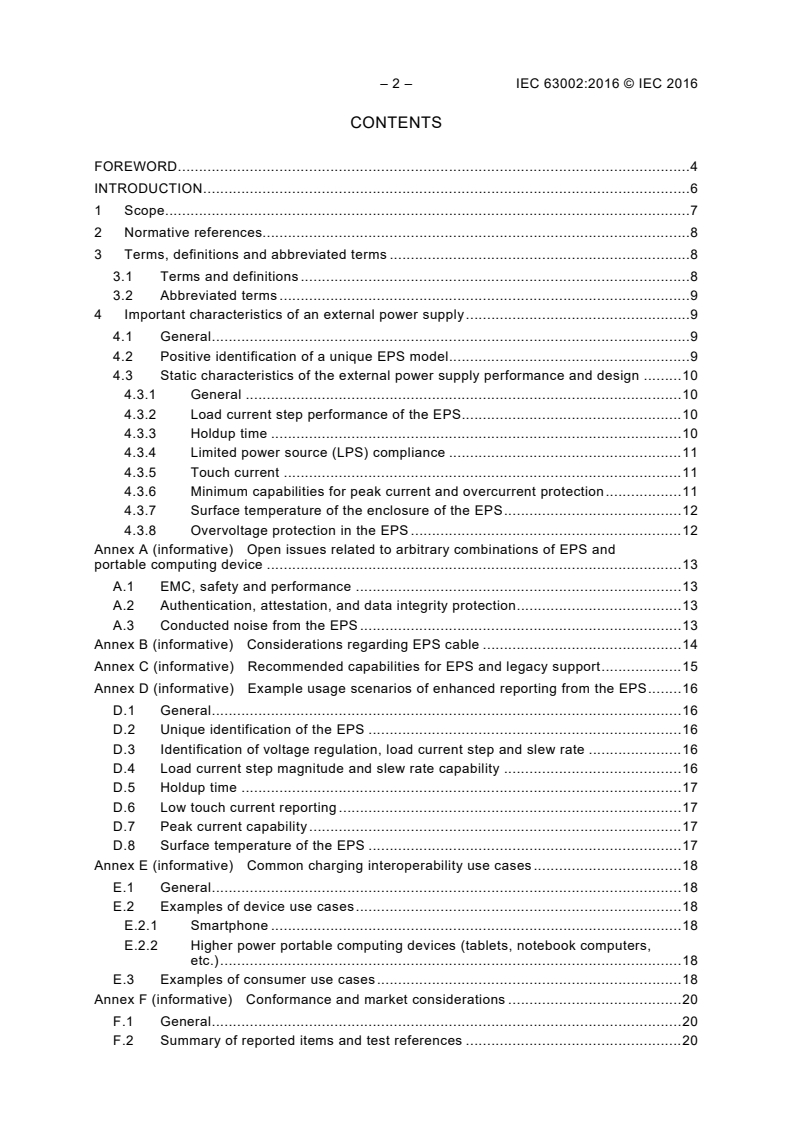
CONTENTS
FOREWORD . 4
INTRODUCTION . 6
1 Scope . 7
2 Normative references. 8
3 Terms, definitions and abbreviated terms . 8
3.1 Terms and definitions . 8
3.2 Abbreviated terms . 9
4 Important characteristics of an external power supply . 9
4.1 General . 9
4.2 Positive identification of a unique EPS model . 9
4.3 Static characteristics of the external power supply performance and design . 10
4.3.1 General . 10
4.3.2 Load current step performance of the EPS . 10
4.3.3 Holdup time . 10
4.3.4 Limited power source (LPS) compliance . 11
4.3.5 Touch current . 11
4.3.6 Minimum capabilities for peak current and overcurrent protection . 11
4.3.7 Surface temperature of the enclosure of the EPS . 12
4.3.8 Overvoltage protection in the EPS . 12
Annex A (informative) Open issues related to arbitrary combinations of EPS and
portable computing device . 13
A.1 EMC, safety and performance . 13
A.2 Authentication, attestation, and data integrity protection . 13
A.3 Conducted noise from the EPS . 13
Annex B (informative) Considerations regarding EPS cable . 14
Annex C (informative) Recommended capabilities for EPS and legacy support . 15
Annex D (informative) Example usage scenarios of enhanced reporting from the EPS . 16
D.1 General . 16
D.2 Unique identification of the EPS . 16
D.3 Identification of voltage regulation, load current step and slew rate . 16
D.4 Load current step magnitude and slew rate capability . 16
D.5 Holdup time . 17
D.6 Low touch current reporting . 17
D.7 Peak current capability . 17
D.8 Surface temperature of the EPS . 17
Annex E (informative) Common charging interoperability use cases . 18
E.1 General . 18
E.2 Examples of device use cases . 18
E.2.1 Smartphone . 18
E.2.2 Higher power portable computing devices (tablets, notebook computers,
etc.) . 18
E.3 Examples of consumer use cases . 18
Annex F (informative) Conformance and market considerations . 20
F.1 General . 20
F.2 Summary of reported items and test references . 20
F.3 USB-IF Compliance Program . 21
F.4 General regulatory compliance for EPS . 21
F.5 Other considerations for system testing . 22
F.6 After-market firmware updates to EPS . 22
Bibliography . 23
Figure 1 – Scope of the identification and communication method . 7
Figure 2 – Measurement of holdup time . 11
Table F.1 – Summary of reported parameters from EPS to portable computing device . 20
Table F.2 – Examples of current regulations and standards in the US and EU
applicable to external power supplies used with portable computing devices (non-
exhaustive list) . 22
– 4 – IEC 63002:2016 © IEC 2016
INTERNATIONAL ELECTROTECHNICAL COMMISSION
____________
IDENTIFICATION AND COMMUNICATION INTEROPERABILITY
METHOD FOR EXTERNAL POWER SUPPLIES USED
WITH PORTABLE COMPUTING DEVICES
FOREWORD
1) The International Electrotechnical Commission (IEC) is a worldwide organization for standardization comprising
all national electrotechnical committees (IEC National Committees). The object of IEC is to promote
international co-operation on all questions concerning standardization in the electrical and electronic fields. To
this end and in addition to other activities, IEC publishes International Standards, Technical Specifications,
Technical Reports, Publicly Available Specifications (PAS) and Guides (hereafter referred to as “IEC
Publication(s)”). Their preparation is entrusted to technical committees; any IEC National Committee interested
in the subject dealt with may participate in this preparatory work. International, governmental and non-
governmental organizations liaising with the IEC also participate in this preparation. IEC collaborates closely
with the International Organization for Standardization (ISO) in accordance with conditions determined by
agreement between the two organizations.
2) The formal decisions or agreements of IEC on technical matters express, as nearly as possible, an international
consensus of opinion on the relevant subjects since each technical committee has representation from all
interested IEC National Committees.
3) IEC Publications have the form of recommendations for international use and are accepted by IEC National
Committees in that sense. While all reasonable efforts are made to ensure that the technical content of IEC
Publications is accurate, IEC cannot be held responsible for the way in which they are used or for any
misinterpretation by any end user.
4) In order to promote international uniformity, IEC National Committees undertake to apply IEC Publications
transparently to the maximum extent possible in their national and regional publications. Any divergence
between any IEC Publication and the corresponding national or regional publication shall be clearly indicated in
the latter.
5) IEC itself does not provide any attestation of conformity. Independent certification bodies provide conformity
assessment services and, in some areas, access to IEC marks of conformity. IEC is not responsible for any
services carried out by independent certification bodies.
6) All users should ensure that they have the latest edition of this publication.
7) No liability shall attach to IEC or its directors, employees, servants or agents including individual experts and
members of its technical committees and IEC National Committees for any personal injury, property damage or
other damage of any nature whatsoever, whether direct or indirect, or for costs (including legal fees) and
expenses arising out of the publication, use of, or reliance upon, this IEC Publication or any other IEC
Publications.
8) Attention is drawn to the Normative references cited in this publication. Use of the referenced publications is
indispensable for the correct application of this publication.
9) Attention is drawn to the possibility that some of the elements of this IEC Publication may be the subject of
patent rights. IEC shall not be held responsible for identifying any or all such patent rights.
International Standard IEC 63002 has been prepared by technical area 14: Interfaces and
methods of measurement for personal computing equipment, of IEC technical committee 100:
Audio, video and multimedia systems and equipment.
The text of this standard is based on the following documents:
CDV Report on voting
100/2595A/CDV 100/2700/RVC
Full information on the voting for the approval of this standard can be found in the report on
voting indicated in the above table.
This publication has been drafted in accordance with the ISO/IEC Directives, Part 2.
The committee has decided that the contents of this publication will remain unchanged until
the stability date indicated on the IEC web site under "http://webstore.iec.ch" in the data
related to the specific publication. At this date, the publication will be
• reconfirmed,
• withdrawn,
• replaced by a revised edition, or
• amended.
– 6 – IEC 63002:2016 © IEC 2016
INTRODUCTION
The objective of this International Standard is to support interoperability of external power
supplies used with the increasing variety of portable computing devices that implement the
IEC 62680-1-2: USB Power Delivery with the IEC 62680-1-3: USB Type-C™ connector
standards. Broad market adoption of this International Standard is expected to make a
significant contribution to the global goals of consumer convenience and re-usability of power
supplies by building on the global market ecosystem of IEC 62680 compliant devices and
facilitating interoperability across different product categories.
IEC 62680-1-2 is expected to enjoy significant adoption in global markets for all kinds of
portable computing devices requiring less than 100 watts including notebook computers,
tablets, smartphones and other related devices. This International Standard enables the
reporting of the identity and power characteristics of external supplies supported by
IEC 62680-1-2 (USB Power Delivery) and specifies additional interoperability guidelines for
external power. The method for identification of a specific external power supply (EPS) will
enable equipment manufacturers to ensure compliant operation of an EPS using IEC 62680-1-
2; and promotes data communication that can be used by the portable computing device to
predict and mitigate interoperability concerns when an unfamiliar or incompatible external
power supply is connected to the device by a user.
This International Standard specifies the minimum technical requirements for interoperability
and includes recommendations for EPS functionality and the portable computing device. The
approach taken by this International Standard, focusing on common charging interoperability,
will allow manufacturers to innovate in aspects such as design, system performance, and
energy efficiency.
This International Standard also provides important information regarding consumer safety,
system reliability as well as relevant global standards and regulatory compliance.
Other international and regional standards, recommendations and regulatory policies for
“universal adapters” or “common product chargers” that reference this International Standard
should take into account open technical and regulatory compliance issues that are associated
with untested or arbitrary combinations of EPS and devices such as those identified in
Annex A. For clarity, this International Standard does not take the approach of specifying
“universal” or “common product adapters” because of these open issues and limitations to
satisfy market requirements. Instead, it focuses on interoperability specifications in order to
support global industry in developing interoperable charging solutions that meet regulatory
compliance and market requirements.
____________
TM TM
USB Type-C and USB-C are trademarks of the Universal Serial Bus Implementers Forum (USB-IF).
IDENTIFICATION AND COMMUNICATION INTEROPERABILITY
METHOD FOR EXTERNAL POWER SUPPLIES USED
WITH PORTABLE COMPUTING DEVICES
1 Scope
This International Standard defines interoperability guidelines for external power supplies
used with portable computing devices that implement the IEC 62680-1-2: Universal Serial Bus
Power Delivery Specification with the IEC 62680-1-3: Universal Serial Bus Interfaces for data
TM
and power-Common Components- Type-C Type-C Cable and Connector Specification.
This International Standard defines normative requirements for an EPS to ensure
interoperability, in particular it specifies the data communicated from an EPS to a portable
computing device (Figure 1). The scope does not apply to all aspects of an EPS. This
International Standard does not specify normative requirements for the portable computing
device but provides recommendations for the behaviour of a portable computing device when
used with an EPS compliant with this International Standard.
External Power Supply Portable Computing Device
Battery
Operational, Safety, Reliability Operational, Safety, Reliability
Operational, Safety, Reliability
standards. National and standards. National and
standards. National and
International standards International standards
International standards
hardware specifications
battery specifications
EPS Status
USB-PD Power Protection/Safety
EPS USB-PD
Battery Cell
communication management elements
Characteristics communication
EPS to Portable Computing Device
Identification and Control Method
IEC
Figure 1 – Scope of the identification and communication method
This International Standard specifies the data objects used by a portable computing system
using IEC 62680-1-2 to understand the identity, design and performance characteristics, and
operating status of an external power supply. This International Standard is applicable to
external power supplies under 100 watts for portable computing devices, with a focus on
power delivery application for notebook computers, tablets, smartphones and other related
multimedia devices.
This International Standard relies on established mechanical and electrical specifications, and
communication protocols established by IEC 62680-1-2 and IEC 62680-1-3. This International
Standard proposes methods supported by IEC 62680-1-2 to mitigate problems caused by the
connection of untested combinations of EPS and portable computing devices with the aim of
improving consumer satisfaction.
In addition, as given in Annex C, this International Standard provides interoperability
guidelines for an EPS supporting charging using USB Type-C current when IEC 62680-1-2
functionality is not enabled. Considerations for captive and removable cable are presented in
Annex B.
– 8 – IEC 63002:2016 © IEC 2016
An EPS is expected to follow the applicable global standards and regulatory compliance
requirements. Examples of those standards are given in Annex F.
2 Normative references
The following documents are referred to in the text in such a way that some or all of their
content constitutes requirements of this document. For dated references, only the edition
cited applies. For undated references, the latest edition of the referenced document (including
any amendments) applies.
IEC 60950-1, Information technology equipment – Safety – Part 1: General requirements
IEC 62368-1, Audio/video, information and communication technology equipment – Part 1:
Safety requirements
IEC 62680-1-2, Universal Serial Bus interfaces for data and power – Part 1-2: Common
components – USB Power Delivery Specification
IEC 62680-1-3, Universal Serial Bus interfaces for data and power –Part 1-3: Common
TM
components –USB Type-C Cable and Connector Specification
3 Terms, definitions and abbreviated terms
3.1 Terms and definitions
For the purposes of this document, the following terms and definitions apply.
ISO and IEC maintain terminological databases for use in standardization at the following
addresses:
• IEC Electropedia: available at http://www.electropedia.org/
• ISO Online browsing platform: available at http://www.iso.org/obp
3.1.1
vendor identification
VID
unique 16-bit unsigned value assigned by the USB-IF to a given vendor
3.1.2
portable computing device
computing device that is easily moved and can operate on battery power
3.1.3
power source
device designed to comply with a IEC 62680-1-2 device that supplies power over V
BUS
3.1.4
power sink
device designed to comply with IEC 62680-1-2 that receives and consumes power
EXAMPLE Portable computing device.
3.1.5
external power supply
EPS
equipment contained in a separate physical enclosure external to the computer casing and
designed to convert mains power supply to lower DC voltage(s) for the purpose of powering
the computer
Note 1 to entry: An external power supply is not built into the device in a way that the power consuming device
inherently knows the identity of the power supply.
3.2 Abbreviated terms
AC alternating current
DC direct current
V voltage, V
A current, A
W watt
Hz hertz
IoC contracted operating current in IEC 62680-1-2
LPS limited power source
VAC volts alternating current
EPS external power supply
USB universal serial bus
USB PD universal serial bus power delivery
USB-IF Universal Serial Bus Implementers Forum
PDO power data object
VID vendor identification
PID product identification
4 Important characteristics of an external power supply
4.1 General
Untested combinations of an EPS and a portable computing device will benefit from some
reporting of the EPS identity, characteristics and status to the portable computing device. The
portable computing device is recommended to use such information to confirm operation of
the EPS, modify its operation with the EPS, or to reject usage of the EPS. Examples of
common usage cases expected for EPS are given in Annex E, and examples of the
application of the EPS identity and characteristics in Annex D.
4.2 Positive identification of a unique EPS model
The specific model number of the EPS might be recognized by the portable computing device
to allow optimized and compliant operation. The portable computing device can benefit by the
ability to distinguish whether the power supply is generic or known.
The hardware version might affect the quality and performance of the EPS. Some provision
reporting the date of manufacture or a hardware version allows the portable computing device
to identify an EPS whose performance characteristics might vary.
The EPS shall use the USB-IF VID to identify its specific vendor. The EPS should also report
a PID unique to the model of the EPS. Lastly, the OEM may report information that helps
identify hardware version of the model of the EPS or serial number. The contents of the OEM-
– 10 – IEC 63002:2016 © IEC 2016
specific identifier and hardware version are not standardized by this International Standard,
but might be read by any portable computing device.
4.3 Static characteristics of the external power supply performance and design
4.3.1 General
IEC 62680-1-2 enables identification of the voltage and power capabilities of the power
source and also some key electrical parameters for voltage tolerance. This International
Standard extends the range of the EPS capabilities that are communicated to the portable
computer.
4.3.2 Load current step performance of the EPS
The power consumption of a portable computing device can change dynamically. The ability
of the EPS to regulate its voltage output might be important if the portable computing device
is sensitive to fluctuations in voltage. Transient changes in the system load with a fixed-
voltage EPS will result in changes to the load current from the EPS. The ability of the EPS to
respond to transient changes in power sink load is known as “load current step” and
capabilities are expressed as the magnitude of current change and also the rate of current
change (“slew rate”).
The EPS should announce its guaranteed load current step performance.
a) The default load current step magnitude in IEC 62680-1-2 is established at 25 % of
contracted current. The EPS may report a capability of up to 90 % of the full load output,
including from both no load and 10 % initial load. An EPS reporting capability greater than
the default shall support changes in both positive and negative load current steps from
1 Hz to 5 000 Hz.
b) The default load current step slew rate capability for an IEC 62680-1-2 EPS is established
at 150 mA per microsecond. The EPS may report higher capabilities, specifically
guaranteeing 500 mA/microsecond, 1 A/microsecond, or 2 A/microsecond slew rates.
4.3.3 Holdup time
The acceptable holdup time capability of the EPS (the condition of voltage regulation being
disturbed by a distortion of the AC input on the primary) might depend on whether the
portable computing device has its own battery or capacitive backup.
,
The EPS may report its guaranteed holdup time, from 3 ms to 16 ms. The holdup time, T
holdup
is measured at 115 VAC r.m.s. and 60 Hz (or 230 VAC r.m.s. and 50 Hz for an EPS that does
not support 115 VAC mains) with the load at rated maximum. The reported time describes the
maximum length of time from the last completed cycle until when the output voltage, V ,
out
decays below the guaranteed voltage regulation (Figure 2).
AC mains
T
holdup
V
out
5 %
IEC
Figure 2 – Measurement of holdup time
4.3.4 Limited power source (LPS) compliance
According to the requirements of IEC 60950-1, a portable computing device that was tested
and certified with an LPS EPS is prohibited to use a non-LPS EPS. An alternative,
IEC 62368-1, classifies power sources according to their maximum, constrained power output
(PS1 or PS2).
An EPS shall report its level of compliance to LPS, PS1 or PS2 to the portable computing
device. Since the EPS could have several potential output voltage and current settings, all of
the available voltage sources shall be compliant to LPS, PS1 or PS2 requirements in order for
the EPS to announce corresponding compliance.
4.3.5 Touch current
Touch current relates to both ergonomic and functional aspects of the portable computing
device. Touch current results from leakage that is below safety limits but might still be
perceived by the user, usually when touching the metallic chassis on the portable computing
device, and worsened by high (250 VAC r.m.s.) AC mains. Touch current also affects the
performance of capacitive touch input devices such as touchscreens, touchpads, and
capacitive buttons.
The EPS may identify itself as a low touch current EPS. Low touch current is leakage less
than 65 μA r.m.s when the EPS’s maximum nominal power capability is less than or equal to
30 W, or less than 100 μA r.m.s. when its power capability is between 30 W and 100 W. The
total combined leakage current is measured in accordance with IEC 60950-1 when tested at
250 VAC r.m.s and 50 Hz.
The EPS shall report whether a ground pin exists, and shall report whether the ground pin is
intended for functionality only or is relied upon as a protective earth for safety.
4.3.6 Minimum capabilities for peak current and overcurrent protection
Portable computing devices are highly power managed and their power consumption is
dynamic. Each EPS will have its own capabilities for supplying current at or in excess of the
label rating, and power draw beyond those capabilities might result in overcurrent protection
and surprise shutdown of the EPS. A surprise shutdown of the EPS might result in system
slowdown if the portable computing device has a battery backup, or lost work or data if the
portable computing device does not have battery backup. IEC 62680-1-2 allows optional
reporting of peak current delivery in excess of the contracted amount reported in the source
– 12 – IEC 63002:2016 © IEC 2016
PDO. Each source PDO may report a peak current field that describes overcurrent capability
for up to 10 ms. Two bits of information are used to communicate these power source
capabilities. The duration of peak current shall be compensated by an immediate consumption
below the operating current (IoC) in order to maintain a 20 ms average power delivery below
the IoC current.
The EPS may report its capability of peak current. The amount of peak current shall be
reported as a percentage of the maximum nominal operating current offered by the EPS. For
example, an EPS with a nominal 1,0 A IoC but with peak current capability of 1,3 A r.m.s shall
report “130 %”.
The duration for the overcurrent (the blanking period) shall be a minimum uninterrupted
trigger duration of 15 ms. Any decrease in power consumption below the reported peak
current capability shall reset the trigger duration timer.
It is recommended that the EPS auto-restart after an overcurrent protection. An EPS that does
not auto-restart after an overcurrent protection event (an EPS that requires manual
intervention to restart after an overcurrent protection event) shall not report any greater
capability of overcurrent tolerance (i.e. only report 100 % for this threshold).
4.3.7 Surface temperature of the enclosure of the EPS
Safety limits for EPS touch temperature are set in applicable product safety standards
(e.g. IEC 60950-1 or IEC 62368-1). The EPS may report when its touch temperature
performance conforms to the TS1 or TS2 limits described in IEC 62368-1.
4.3.8 Overvoltage protection in the EPS
Overvoltage of the EPS output might lead to damage of the portable computing device. The
wide operating range allowed by IEC 62680-1-2 might be excessive for some portable
computing devices. IEC 62680-1-2 includes protocol and detection methods to prevent the
deliberate output voltage of the EPS from exceeding the explicit requirements of the portable
computing device. However, component failures in an EPS might randomly occur and cause a
voltage output that exceeds the voltage tolerance of the portable computing device.
The EPS should support and report the capability of overvoltage protection, whereby a
detected voltage threshold of no more than 130 % of contracted V leads to an overvoltage
BUS
protection event, whereby a voltage above the threshold value shall interrupt output current
within 250 milliseconds.
It is recommended that the portable computing device consider its design capacity for
overvoltage and include its own protective devices. The portable computing device should not
consider overvoltage protection in the EPS as principal or redundant protection.
Annex A
(informative)
Open issues related to arbitrary combinations
of EPS and portable computing device
A.1 EMC, safety and performance
Untested or arbitrary combinations of EPS and portable computing device cannot guarantee
the same level of assurance for EMC and safety as that of the specific combinations that were
tested by certification bodies.
EPSs supplied with portable computing devices are typically designed for use and tested
together. System performance and reliability might be guaranteed only for those tested
combinations.
A.2 Authentication, attestation, and data integrity protection
This International Standard relies on a foundation of trust between the EPS and the portable
computing device. Functionality, EMC compliance and safety (and the mitigation methods
suggested in this International Standard) assume that the information provided by the EPS is
genuine. Counterfeit EPSs might masquerade and report the identity or characteristics of a
trusted EPS, but not follow the quality of design or manufacturing that ensured the original’s
operation.
IEC 62680-1-2 has the communications capability believed to be appropriate for the portable
computing device to authenticate the identity of the EPS. Establishing an industry standard
authentication method, a method of surveillance that can help recognize clones, and
identifying a supported set of policies for warning the user or revocation is beyond the scope
of this International Standard. Future versions of this International Standard may recognize
standardized authentication methods that are developed to support IEC 62680-1-2.
A.3 Conducted noise from the EPS
Common mode output noise might affect the operation of devices in the portable computing
device, particularly capacitive sensors (touchscreen or touchpad) that rely on sensing a
capacitive path to earth ground. Common mode noise is typically a product of the switching
frequency of the conversion topology of the EPS. The EPS might have multiple stages of
power conversion and each switching frequency might change dynamically, for example as a
function of the output voltage, mains voltage, or activation of PFC. Reporting narrowband
noise characteristics of the EPS could conceivably allow the portable computing device to
“frequency hop” to avoid functional problems due to this interference. However, further work is
needed in this area.
– 14 – IEC 63002:2016 © IEC 2016
Annex B
(informative)
Considerations regarding EPS cable
USB Type-C devices may terminate in either a plug or receptacle. The USB Type-C
specification provides detailed requirements over cables with USB Type-C connectors in order
to minimize interoperability issues. For example, all cables that support SuperSpeed USB
signalling or support currents above 3 A are required to contain an electronic marker. Without
detection of an appropriate electronic marker, all charging is limited to 3 A regardless of the
capabilities of the EPS and the portable computing device.
Power is commonly provided to small devices such as cell phones and tablets from power
sources other than charging blocks, such as portable computing devices and charging outlets.
Connection to portable computing devices often carries data as well as power. If the EPS has
a detachable cable, then the user can use just one cable for all his/her charging and data
communication needs.
An EPS terminating in a USB Type-C receptacle has several benefits.
– It can support interchangeability with products that do not use a USB Type-C receptacle.
– It can support re-use of the EPS upon independent failure of the secondary cable.
– It can be easier to store and carry.
An EPS with captive cable allows the EPS supplier to control the quality of the cable, or to
match the characteristics of the EPS to the cable. Conductor resistance or EMI characteristics
of the cable are inherently part of the EPS with a captive cable.
Annex C
(informative)
Recommended capabilities for EPS and legacy support
IEC 62680-1-3 describes USB Type-C cabling connections and specifies standardized
methods of power negotiation using analogue or digital communication methods. IEC 62680-
1-3 requires all USB Type-C sources to implement the USB Type-C current announcement
and requires implementation of USB PD digital communication for sources and sinks that
support a maximum voltage above 5V and/or the maximum current above 3A.
IEC 63002 requires EPS support of IEC 62680-1-2 (USB PD) with IEC 62680-1-3 (USB Type-
C). Support of USB PD digital communication is fundamental to reporting of the EPS
characteristics described in this document as well as other beneficial capabilities such as fast
charging and authentication. Therefore, it is recommended that all EPS terminating in USB
Type-C connectors and USB Type-C compliant sinks implement support for USB PD.
IEC 62680-1-3 also permits an EPS to support legacy (IEC 62680-1-1: USB BC 1.2) current
announcements and/or USB default current announcements (as specified in IEC 62680-2-1:
USB 2.0 and IEC 62680-3-1: USB 3.1). EPSs normally do not support USB default current
announcements in order to avoid the complexity of having to implement a USB Host Controller.
When an EPS supports multiple methods for announcing power capability, IEC 62680-1-3
specifies the priority of power announcements. It is recommended that USB Type-C compliant
sinks rely on USB Type-C current methods instead of using USB BC 1.2 methods.
Consequently, EPSs that are compliant to IEC 63002 are not required to support USB BC 1.2
current announcements or USB default power announcements.
– 16 – IEC 63002:2016 © IEC 2016
Annex D
(informative)
Example usage scenarios of enhanced reporting from the EPS
D.1 General
This International Standard recognizes that quality of operation for a computing device
ultimately relies on testing and mitigation of potential interoperability issues. This International
Standard cannot address quality of an EPS, and does not require any operation of the
portable computing device.
D.2 Unique identification of the EPS
The VID, PID and hardware version form an identity of the specific manufacturer and model of
the EPS. The portable computing device might use the identity to recognise that the EPS has
been tested. Or, the portable computing device might understand limitations or known
characteristics of the attached EPS and modify its policy. The PID/VID might be interpreted to
indicate that the power source is a particular EPS or instead a docking station or monitor.
A portable computing device might use the identity to approve the use of an EPS as a function
of operating mode. For example, an untested EPS might be considered to pose less of a user
problem if its usage is only to provide battery charge while the system is off, or enable only
partial battery charge.
The identity might be used to recognize when a new device is attached or to establish usage
models that suggest the portable computing device is used in a particular location. For
example, the hardware version might be distinguished as “new” and USB data on the port
disabled as a security measure. Or, the identity might distinguish the location (work or home)
to employ a particular power consumption policy. The identity might also be used when the
device is a dual mode (consumer/provider), for example, to automatically configure a direction
of power sharing when both devices are battery powered.
The hardware version field can also be used, for example, to recognize devices that might be
prone to failure and alert the user to a maintenance action.
The EPS identity might be used by the portable computing device rejecting any usage.
D.3 Identification of voltage regulation, load current step and slew rate
Battery powered devices generally are tolerant of broad changes in voltage supply. The actual
voltage regulation to the portable computing device will depend on both the EPS voltage
range and the detachable cable. The portable computing device might consider the potential
voltage variance of the EPS and cable, consider its own active power consumption, and, for
example, might choose a different voltage if the total voltage tolerance will not guarantee
complete operation or battery charge.
D.4 Load current step magnitude and slew rate capability
Load current step magnitude and slew rate of the EPS might be evaluated by the portable
computing device and the amount of dynamic power consumption affected. For example, an
EPS guaranteed for only 25 % load curre
...