

IEC 62325-451-4:2017
(Main)Framework for energy market communications - Part 451-4: Settlement and reconciliation business process, contextual and assembly models for European market
General Information
- Abstract
IEC 62325-451-4:2017 specifies a package for the settlement and reconciliation business process and the associated document contextual model, assembly model and XML schema for use within European style markets. The relevant aggregate core components (ACCs) defined in IEC 62325-351 have been contextualised into aggregated business information entities (ABIEs) to satisfy the requirements of this business process. The contextualised ABIEs have been assembled into the relevant document contextual models. Related assembly models and XML schema for the exchange of information between market participants are automatically generated from the assembled document contextual models.
This part of IEC 62325 provides a uniform layout for the transmission of aggregated data in order to settle the electricity market. It is however not the purpose of this document to define the formula to be taken into account to settle or reconcile a market. The purpose of this document is only to enable the information exchange necessary to carry out the computation of settlement and reconciliation.
The settlement process or reconciliation process is the way to compute the final position of each market participant as well as its imbalance amounts.
This new edition includes the following significant technical changes with respect to the previous edition:
- removal of the attributes “quantity” and “secondary quantity” of the class “Point”;
- introduction of the classes “Quantity” and "Reason" from IEC 62351-351 UML package.
- Status
- Published
- Publication Date
- 10-Apr-2017
- Technical Committee
- TC 57 - Power systems management and associated information exchange
- Drafting Committee
- WG 16 - TC 57/WG 16
- Current Stage
- PPUB - Publication issued
- Start Date
- 11-Apr-2017
- Completion Date
- 19-Apr-2017
Buy Documents
IEC 62325-451-4:2017 - Framework for energy market communications - Part 451-4: Settlement and reconciliation business process, contextual and assembly models for European market Released:4/11/2017
IEC 62325-451-4:2017 - Framework for energy market communications - Part 451-4: Settlement and reconciliation business process, contextual and assembly models for European market Released:7/30/2019
Overview - IEC 62325-451-4:2017 (Settlement & Reconciliation, European market)
IEC 62325-451-4:2017 is part of the IEC framework for energy market communications. It specifies a package for the settlement and reconciliation business process for European-style electricity markets, including the document contextual model, assembly model and XML schema used to exchange aggregated settlement data. The standard contextualises Aggregate Core Components (ACCs) from IEC 62325-351 into Aggregated Business Information Entities (ABIEs) and assembles them into document models. It enables reliable information exchange required to compute final participant positions and imbalance amounts - but it does not define settlement or reconciliation calculation formulas.
Key topics and technical requirements
- Document contextual model: Defines the business entities and attributes (e.g., EnergyAccount, TimeSeries, Point, Price) required for settlement and reconciliation messages.
- Assembly model: Specifies how contextualised ABIEs are composed into exchangeable documents and message structures.
- XML schema generation: Assembly models are used to automatically generate interoperable XML schemas (for example, EnergyAccount_MarketDocument) for information exchange between market participants.
- Data aggregation and layout: Provides a uniform layout for transmitting aggregated data needed to settle the electricity market.
- Interoperability components: Uses ACCs from IEC 62325-351 and introduces classes (e.g., Quantity and Reason per IEC 62351-351 UML package) and removes certain legacy attributes (e.g.,
quantityandsecondary quantityfromPoint). - Business rules & process flow: Specifies process context, use cases, sequence of information flow and validation rules for attributes such as TimeSeries, Point and price.amount.
- Scope limitation: Focused on enabling information exchange - calculation methodologies remain out of scope.
Applications - who uses this standard
IEC 62325-451-4 is intended for professionals implementing market data exchanges and settlement workflows in European electricity markets, including:
- Market operators, settlement and reconciliation systems
- Balance Responsible Parties (BRPs), exchanges and clearing agents
- Utility IT architects and software vendors producing market communication interfaces
- Meter data managers, aggregators and regulators who integrate or validate settlement messages
- System integrators building XML-based data exchange solutions for market settlement
Related standards
- IEC 62325-351 (Aggregate Core Components) - source of ACCs contextualised by this part.
- IEC 62325 family (energy market communications framework) - for broader market messaging models and profiles.
- IEC 62351 (security standards for power system management) - relevant for securing message exchanges and referenced UML packages.
This standard is essential for achieving interoperable, XML-based settlement and reconciliation message exchange in European-style electricity markets and for aligning implementations with the IEC 62325 modelling framework.
Relations
- Effective Date
- 05-Sep-2023
Buy Documents
IEC 62325-451-4:2017 - Framework for energy market communications - Part 451-4: Settlement and reconciliation business process, contextual and assembly models for European market Released:4/11/2017
IEC 62325-451-4:2017 - Framework for energy market communications - Part 451-4: Settlement and reconciliation business process, contextual and assembly models for European market Released:7/30/2019
Get Certified
Connect with accredited certification bodies for this standard

ANCE
Mexican certification and testing association.

Intertek Slovenia
Intertek testing, inspection, and certification services in Slovenia.

LNE (Laboratoire National de Métrologie et d'Essais)
French national laboratory for metrology and testing.
Sponsored listings
Frequently Asked Questions
IEC 62325-451-4:2017 is a standard published by the International Electrotechnical Commission (IEC). Its full title is "Framework for energy market communications - Part 451-4: Settlement and reconciliation business process, contextual and assembly models for European market". This standard covers: IEC 62325-451-4:2017 specifies a package for the settlement and reconciliation business process and the associated document contextual model, assembly model and XML schema for use within European style markets. The relevant aggregate core components (ACCs) defined in IEC 62325-351 have been contextualised into aggregated business information entities (ABIEs) to satisfy the requirements of this business process. The contextualised ABIEs have been assembled into the relevant document contextual models. Related assembly models and XML schema for the exchange of information between market participants are automatically generated from the assembled document contextual models. This part of IEC 62325 provides a uniform layout for the transmission of aggregated data in order to settle the electricity market. It is however not the purpose of this document to define the formula to be taken into account to settle or reconcile a market. The purpose of this document is only to enable the information exchange necessary to carry out the computation of settlement and reconciliation. The settlement process or reconciliation process is the way to compute the final position of each market participant as well as its imbalance amounts. This new edition includes the following significant technical changes with respect to the previous edition: - removal of the attributes “quantity” and “secondary quantity” of the class “Point”; - introduction of the classes “Quantity” and "Reason" from IEC 62351-351 UML package.
IEC 62325-451-4:2017 specifies a package for the settlement and reconciliation business process and the associated document contextual model, assembly model and XML schema for use within European style markets. The relevant aggregate core components (ACCs) defined in IEC 62325-351 have been contextualised into aggregated business information entities (ABIEs) to satisfy the requirements of this business process. The contextualised ABIEs have been assembled into the relevant document contextual models. Related assembly models and XML schema for the exchange of information between market participants are automatically generated from the assembled document contextual models. This part of IEC 62325 provides a uniform layout for the transmission of aggregated data in order to settle the electricity market. It is however not the purpose of this document to define the formula to be taken into account to settle or reconcile a market. The purpose of this document is only to enable the information exchange necessary to carry out the computation of settlement and reconciliation. The settlement process or reconciliation process is the way to compute the final position of each market participant as well as its imbalance amounts. This new edition includes the following significant technical changes with respect to the previous edition: - removal of the attributes “quantity” and “secondary quantity” of the class “Point”; - introduction of the classes “Quantity” and "Reason" from IEC 62351-351 UML package.
IEC 62325-451-4:2017 is classified under the following ICS (International Classification for Standards) categories: 33.200 - Telecontrol. Telemetering. The ICS classification helps identify the subject area and facilitates finding related standards.
IEC 62325-451-4:2017 has the following relationships with other standards: It is inter standard links to IEC 62325-451-4:2014. Understanding these relationships helps ensure you are using the most current and applicable version of the standard.
IEC 62325-451-4:2017 is available in PDF format for immediate download after purchase. The document can be added to your cart and obtained through the secure checkout process. Digital delivery ensures instant access to the complete standard document.
Standards Content (Sample)
IEC 62325-451-4 ®
Edition 2.0 2017-04
INTERNATIONAL
STANDARD
colour
inside
Framework for energy market communications –
Part 451-4: Settlement and reconciliation business process, contextual and
assembly models for European market
All rights reserved. Unless otherwise specified, no part of this publication may be reproduced or utilized in any form
or by any means, electronic or mechanical, including photocopying and microfilm, without permission in writing from
either IEC or IEC's member National Committee in the country of the requester. If you have any questions about IEC
copyright or have an enquiry about obtaining additional rights to this publication, please contact the address below or
your local IEC member National Committee for further information.
IEC Central Office Tel.: +41 22 919 02 11
3, rue de Varembé Fax: +41 22 919 03 00
CH-1211 Geneva 20 info@iec.ch
Switzerland www.iec.ch
About the IEC
The International Electrotechnical Commission (IEC) is the leading global organization that prepares and publishes
International Standards for all electrical, electronic and related technologies.
About IEC publications
The technical content of IEC publications is kept under constant review by the IEC. Please make sure that you have the
latest edition, a corrigenda or an amendment might have been published.
IEC Catalogue - webstore.iec.ch/catalogue Electropedia - www.electropedia.org
The stand-alone application for consulting the entire The world's leading online dictionary of electronic and
bibliographical information on IEC International Standards, electrical terms containing 20 000 terms and definitions in
Technical Specifications, Technical Reports and other English and French, with equivalent terms in 16 additional
documents. Available for PC, Mac OS, Android Tablets and languages. Also known as the International Electrotechnical
iPad. Vocabulary (IEV) online.
IEC publications search - www.iec.ch/searchpub IEC Glossary - std.iec.ch/glossary
The advanced search enables to find IEC publications by a 65 000 electrotechnical terminology entries in English and
variety of criteria (reference number, text, technical French extracted from the Terms and Definitions clause of
committee,…). It also gives information on projects, replaced IEC publications issued since 2002. Some entries have been
and withdrawn publications. collected from earlier publications of IEC TC 37, 77, 86 and
CISPR.
IEC Just Published - webstore.iec.ch/justpublished
Stay up to date on all new IEC publications. Just Published IEC Customer Service Centre - webstore.iec.ch/csc
details all new publications released. Available online and If you wish to give us your feedback on this publication or
also once a month by email. need further assistance, please contact the Customer Service
Centre: csc@iec.ch.
IEC 62325-451-4 ®
Edition 2.0 2017-04
INTERNATIONAL
STANDARD
colour
inside
Framework for energy market communications –
Part 451-4: Settlement and reconciliation business process, contextual and
assembly models for European market
INTERNATIONAL
ELECTROTECHNICAL
COMMISSION
ICS 33.200 ISBN 978-2-8322-4145-5
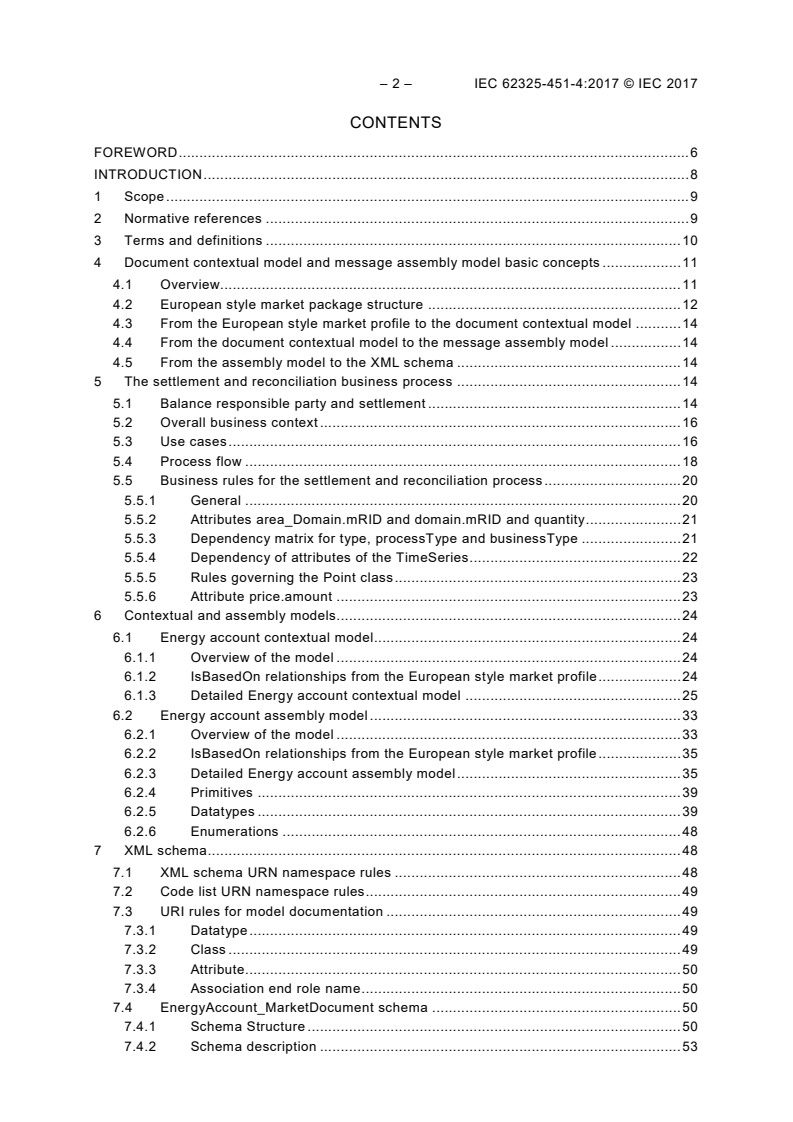
– 2 – IEC 62325-451-4:2017 © IEC 2017
CONTENTS
FOREWORD . 6
INTRODUCTION . 8
1 Scope . 9
2 Normative references . 9
3 Terms and definitions . 10
4 Document contextual model and message assembly model basic concepts . 11
4.1 Overview. 11
4.2 European style market package structure . 12
4.3 From the European style market profile to the document contextual model . 14
4.4 From the document contextual model to the message assembly model . 14
4.5 From the assembly model to the XML schema . 14
5 The settlement and reconciliation business process . 14
5.1 Balance responsible party and settlement . 14
5.2 Overall business context . 16
5.3 Use cases . 16
5.4 Process flow . 18
5.5 Business rules for the settlement and reconciliation process . 20
5.5.1 General . 20
5.5.2 Attributes area_Domain.mRID and domain.mRID and quantity . 21
5.5.3 Dependency matrix for type, processType and businessType . 21
5.5.4 Dependency of attributes of the TimeSeries . 22
5.5.5 Rules governing the Point class . 23
5.5.6 Attribute price.amount . 23
6 Contextual and assembly models. 24
6.1 Energy account contextual model. 24
6.1.1 Overview of the model . 24
6.1.2 IsBasedOn relationships from the European style market profile . 24
6.1.3 Detailed Energy account contextual model . 25
6.2 Energy account assembly model . 33
6.2.1 Overview of the model . 33
6.2.2 IsBasedOn relationships from the European style market profile . 35
6.2.3 Detailed Energy account assembly model . 35
6.2.4 Primitives . 39
6.2.5 Datatypes . 39
6.2.6 Enumerations . 48
7 XML schema . 48
7.1 XML schema URN namespace rules . 48
7.2 Code list URN namespace rules . 49
7.3 URI rules for model documentation . 49
7.3.1 Datatype . 49
7.3.2 Class . 49
7.3.3 Attribute . 50
7.3.4 Association end role name . 50
7.4 EnergyAccount_MarketDocument schema . 50
7.4.1 Schema Structure . 50
7.4.2 Schema description . 53
Bibliography . 59
Figure 1 – IEC 62325-450 modelling framework . 12
Figure 2 – Overview of European style market profile dependency. 13
Figure 3 – Balance responsible party relations . 15
Figure 4 – Settlement/reconciliation use case . 18
Figure 5 – Sequence diagram of the information flow . 19
Figure 6 – Energy account contextual model . 24
Figure 7 – Energy account assembly model . 34
Figure 8 – EnergyAccount_MarketDocument XML Schema Structure 1/2 . 51
Figure 9 – EnergyAccount_MarketDocument XML Schema Structure 2/2 . 52
Table 1 – Dependency table for type, processType and businessType . 22
Table 2 – Dependency table for TimeSeries attributes . 23
Table 3 – Dependency table for price.amount attribute . 23
Table 4 – IsBasedOn dependency. 24
Table 5 – Attributes of Energy account contextual
model::EnergyAccount_MarketDocument . 25
Table 6 – Association ends of Energy account contextual
model::EnergyAccount_MarketDocument with other classes . 26
Table 7 – Attributes of Energy account contextual model::Currency_Unit . 26
Table 8 – Attributes of Energy account contextual model::Domain . 27
Table 9 – Attributes of Energy account contextual model::MarketAgreement . 27
Table 10 – Attributes of Energy account contextual model::MarketEvaluationPoint . 27
Table 11 – Attributes of Energy account contextual model::MarketParticipant . 27
Table 12 – Association ends of Energy account contextual model::MarketParticipant
with other classes . 28
Table 13 – Attributes of Energy account contextual model::MarketRole. 28
Table 14 – Attributes of Energy account contextual model::Measure_Unit . 28
Table 15 – Attributes of Energy account contextual model:: Party_MarketParticipant . 28
Table 16 – Attributes of Energy account contextual model::Point . 29
Table 17 – Association ends of Energy account contextual model ::Point with other
classes . 29
Table 18 – Attributes of Energy account contextual model::Price . 30
Table 19 – Attributes of Energy account contextual model::Process . 30
Table 20 – Attributes of Energy account contextual model::Quantity . 30
Table 21 – Attributes of Energy account contextual model::Reason . 31
Table 22 – Attributes of Energy account contextual model::Series_Period . 31
Table 23 – Association ends of Energy account contextual model::Series_Period with
other classes . 31
Table 24 – Attributes of Energy account contextual model::Time_Period . 31
Table 25 – Attributes of Energy account contextual model::TimeSeries . 32
Table 26 – Association ends of Energy account contextual model::TimeSeries with
other classes . 32
Table 27 – IsBasedOn dependency . 35
– 4 – IEC 62325-451-4:2017 © IEC 2017
Table 28 – Attributes of Energy account assembly
model::EnergyAccount_MarketDocument . 35
Table 29 – Association ends of Energy account assembly
model::EnergyAccount_MarketDocument with other classes . 36
Table 30 – Attributes of Energy account assembly model::Point . 36
Table 31 – Association ends of Energy account assembly model:: Point with other
classes . 37
Table 32 – Attributes of Energy account assembly model::Reason . 37
Table 33 – Attributes of Energy account assembly model::Series_Period . 38
Table 34 – Association ends of Energy account assembly model:: Series_Period with
other classes . 38
Table 35 – Attributes of Energy account assembly model::TimeSeries . 38
Table 36 – Association ends of Energy account assembly model:: TimeSeries with
other classes . 39
Table 37 – Attributes of ESMPDataTypes::Action_Status . 40
Table 38 – Attributes of ESMPDataTypes::ESMP_DateTimeInterval . 40
Table 39 – Attributes of ESMPDataTypes::Amount_Decimal . 40
Table 40 – Restrictions of attributes for ESMPDataTypes::Amount_Decimal . 40
Table 41 – Attributes of ESMPDataTypes::AreaID_String. 41
Table 42 – Restrictions of attributes for ESMPDataTypes::AreaID_String . 41
Table 43 – Attributes of ESMPDataTypes::BusinessKind_String . 41
Table 44 – Attributes of ESMPDataTypes::ClassificationKind_String . 41
Table 45 – Attributes of ESMPDataTypes::CurrencyCode_String . 42
Table 46 – Attributes of ESMPDataTypes::EnergyProductKind_String . 42
Table 47 – Attributes of ESMPDataTypes::ESMP_DateTime . 42
Table 48 – Restrictions of attributes for ESMPDataTypes::ESMP_DateTime . 42
Table 49 – Attributes of ESMPDataTypes::ESMPVersion_String . 43
Table 50 – Restrictions of attributes for ESMPDataTypes::ESMPVersion_String . 43
Table 51 – Attributes of ESMPDataTypes::ID_String . 43
Table 52 – Restrictions of attributes for ESMPDataTypes::ID_String . 43
Table 53 – Attributes of ESMPDataTypes::MarketRoleKind_String . 44
Table 54 – Attributes of ESMPDataTypes::MeasurementPointID_String . 44
Table 55 – Restrictions of attributes for ESMPDataTypes:: MeasurementPointID_String . 44
Table 56 – Attributes of ESMPDataTypes::MeasurementUnitKind_String . 44
Table 57 – Attributes of ESMPDataTypes::MessageKind_String . 45
Table 58 – Attributes of ESMPDataTypes::ObjectAggregationKind_String . 45
Table 59 – Attributes of ESMPDataTypes::PartyID_String . 45
Table 60 – Restrictions of attributes for ESMPDataTypes::PartyID_String . 45
Table 61 – Attributes of ESMPDataTypes::Position_Integer . 46
Table 62 – Restrictions of attributes for ESMPDataTypes::Position_Integer . 46
Table 63 – Attributes of ESMPDataTypes::ProcessKind_String . 46
Table 64 – Attributes of ESMPDataTypes::Quality_String . 46
Table 65 – Attributes of ESMPDataTypes::ReasonCode_String . 47
Table 66 – Attributes of ESMPDataTypes::ReasonText_String . 47
Table 67 – Restrictions of attributes for ESMPDataTypes::ReasonText_String . 47
Table 68 – Attributes of ESMPDataTypes::Status_String . 47
Table 69 – Attributes of ESMPDataTypes::YMDHM_DateTime . 48
Table 70 – Restrictions of attributes for ESMPDataTypes::YMDHM_DateTime . 48
– 6 – IEC 62325-451-4:2017 © IEC 2017
INTERNATIONAL ELECTROTECHNICAL COMMISSION
____________
FRAMEWORK FOR ENERGY MARKET COMMUNICATIONS –
Part 451-4: Settlement and reconciliation business process,
contextual and assembly models for European market
FOREWORD
1) The International Electrotechnical Commission (IEC) is a worldwide organization for standardization comprising
all national electrotechnical committees (IEC National Committees). The object of IEC is to promote
international co-operation on all questions concerning standardization in the electrical and electronic fields. To
this end and in addition to other activities, IEC publishes International Standards, Technical Specifications,
Technical Reports, Publicly Available Specifications (PAS) and Guides (hereafter referred to as “IEC
Publication(s)”). Their preparation is entrusted to technical committees; any IEC National Committee interested
in the subject dealt with may participate in this preparatory work. International, governmental and non-
governmental organizations liaising with the IEC also participate in this preparation. IEC collaborates closely
with the International Organization for Standardization (ISO) in accordance with conditions determined by
agreement between the two organizations.
2) The formal decisions or agreements of IEC on technical matters express, as nearly as possible, an international
consensus of opinion on the relevant subjects since each technical committee has representation from all
interested IEC National Committees.
3) IEC Publications have the form of recommendations for international use and are accepted by IEC National
Committees in that sense. While all reasonable efforts are made to ensure that the technical content of IEC
Publications is accurate, IEC cannot be held responsible for the way in which they are used or for any
misinterpretation by any end user.
4) In order to promote international uniformity, IEC National Committees undertake to apply IEC Publications
transparently to the maximum extent possible in their national and regional publications. Any divergence
between any IEC Publication and the corresponding national or regional publication shall be clearly indicated in
the latter.
5) IEC itself does not provide any attestation of conformity. Independent certification bodies provide conformity
assessment services and, in some areas, access to IEC marks of conformity. IEC is not responsible for any
services carried out by independent certification bodies.
6) All users should ensure that they have the latest edition of this publication.
7) No liability shall attach to IEC or its directors, employees, servants or agents including individual experts and
members of its technical committees and IEC National Committees for any personal injury, property damage or
other damage of any nature whatsoever, whether direct or indirect, or for costs (including legal fees) and
expenses arising out of the publication, use of, or reliance upon, this IEC Publication or any other IEC
Publications.
8) Attention is drawn to the Normative references cited in this publication. Use of the referenced publications is
indispensable for the correct application of this publication.
9) Attention is drawn to the possibility that some of the elements of this IEC Publication may be the subject of
patent rights. IEC shall not be held responsible for identifying any or all such patent rights.
International Standard IEC 62325-451-4 has been prepared by IEC technical committee 57:
Power systems management and associated information exchange.
This second edition cancels and replaces the first edition published in 2014. This edition
constitutes a technical revision.
This edition includes the following significant technical changes with respect to the previous
edition:
a) Removal of the attributes “quantity” and “secondary quantity” of the class “Point”;
b) Introduction of the class “Quantity” from IEC 62351-351 UML package, with the following
attributes “quantity” as mandatory and “quality” as optional, and create two association
1.1 between the class “Quantity” and the class “Point” with the role “In_Quantity” and
“Out_Quantity”.
c) Introduction of the class “Reason” from IEC 62351-351 UML package, with the following
attributes “code” as mandatory and “text” as optional, and create an association 0.* from
the class “Reason” to the class “Point” with the role “Reason”.
The text of this International Standard is based on the following documents:
CDV Report on voting
57/1737/CDV 57/1804/RVC
Full information on the voting for the approval of this International Standard can be found in
the report on voting indicated in the above table.
This document has been drafted in accordance with the ISO/IEC Directives, Part 2.
A list of all parts in the IEC 62325 series, published under the general title Framework for
energy market communications, can be found on the IEC website.
The committee has decided that the contents of this document will remain unchanged until the
stability date indicated on the IEC website under "http://webstore.iec.ch" in the data related to
the specific document. At this date, the document will be
• reconfirmed,
• withdrawn,
• replaced by a revised edition, or
• amended.
A bilingual version of this publication may be issued at a later date.
IMPORTANT – The 'colour inside' logo on the cover page of this publication indicates
that it contains colours which are considered to be useful for the correct
understanding of its contents. Users should therefore print this document using a
colour printer.
– 8 – IEC 62325-451-4:2017 © IEC 2017
INTRODUCTION
This standard is one of the IEC 62325 series which define protocols for deregulated energy
market communications.
The principal objective of the IEC 62325 series is to produce standards which facilitate the
integration of market application software developed independently by different vendors into a
market management system, between market management systems and market participant
systems. This is accomplished by defining message exchanges to enable these applications
or systems access to public data and exchange information independent of how such
information is represented internally.
The common information model (CIM) specifies the basis for the semantics for this message
exchange.
The European style market profile (ESMP) is based on different parts of the CIM IEC
standard. The CIM is defined through a series of standards, i.e. IEC 62325-301, IEC 61970-
301 and IEC 61968-11.
This document provides the settlement and reconciliation business process that can be used
throughout a European style market. This standard was originally based upon the work of the
European Transmission System Operators (ETSO) Task Force EDI (Electronic Data
Interchange) and then on the work of the European Network of Transmission System
Operators (ENTSO-E) Working Group EDI.
This document describes the settlement and reconciliation process for wholesale markets; it is
brought to the attention of the reader that it is envisaged to initiate work on a combined
reconciliation process for retail and wholesale markets.
FRAMEWORK FOR ENERGY MARKET COMMUNICATIONS –
Part 451-4: Settlement and reconciliation business process,
contextual and assembly models for European market
1 Scope
Based on the European style market profile (ESMP) (IEC 62325-351), this part of IEC 62325-
451 specifies a package for the settlement and reconciliation business process and the
associated document contextual model, assembly model and XML schema for use within
European style markets.
The relevant aggregate core components (ACCs) defined in IEC 62325-351 have been
contextualised into aggregated business information entities (ABIEs) to satisfy the
requirements of this business process. The contextualised ABIEs have been assembled into
the relevant document contextual models. Related assembly models and XML schema for the
exchange of information between market participants are automatically generated from the
assembled document contextual models.
This part of IEC 62325 provides a uniform layout for the transmission of aggregated data in
order to settle the electricity market. It is however not the purpose of this document to define
the formula to be taken into account to settle or reconcile a market. The purpose of this
document is only to enable the information exchange necessary to carry out the computation
of settlement and reconciliation.
The settlement process or reconciliation process is the way to compute the final position of
each market participant as well as its imbalance amounts.
2 Normative references
The following documents are referred to in the text in such a way that some or all of their
content constitutes requirements of this document. For dated references, only the edition
cited applies. For undated references, the latest edition of the referenced document (including
any amendments) applies.
IEC TS 61970-2, Energy management system application program interface (EMS-API) –
Part 2: Glossary
IEC 62325-301, Framework for energy market communications – Part 301: Common
information model (CIM) extensions for markets
IEC 62325-351, Framework for energy market communications – Part 351: CIM European
market model exchange profile
IEC 62325-450:2013, Framework for energy market communications – Part 450: Profile and
context modelling rules
IEC 62325-451-1, Framework for energy market communications – Part 451-1:
Acknowledgement business process and contextual model for CIM European market
IEC 62325-451-2, Framework for energy market communications – Part 451-2: Scheduling
business process and contextual model for CIM European market
IEC 62361-100, Power systems management and associated information exchange –
Interoperability in the long term – Part 100: CIM profiles to XML schema mapping
– 10 – IEC 62325-451-4:2017 © IEC 2017
3 Terms and definitions
For the purposes of this document, the terms and definitions given in IEC TS 61970-2 and the
following apply.
ISO and IEC maintain terminological databases for use in standardization at the following
addresses:
• IEC Electropedia: available at http://www.electropedia.org/
• ISO Online browsing platform: available at http://www.iso.org/obp
NOTE Refer to IEC 60050, International Electrotechnical Vocabulary, for general glossary definitions.
3.1
aggregate business information entity
ABIE
collection of related pieces of business information that together convey a distinct business
meaning in a specific Business Context
Note 1 to entry Expressed in modelling terms, this is the representation of an object class, independent of any
specific business context.
[SOURCE: ISO/TS 15000-5:2014, 3.1]
3.2
aggregate core component
ACC
collection of related pieces of business information that together convey a distinct business
meaning, independent of any specific Business Context
[SOURCE: ISO/TS 15000-5:2014, 3.2]
3.3
application program interface
API
set of public functions provided by an executable application component for use by other
executable application components
3.4
assembly model
model that prepares information in a business context for assembly into electronic documents
for data interchange
3.5
based on
IsBasedOn
use of an artefact that has been restricted according to the requirements of a specific
business context
[SOURCE: IEC 62325-450:2013, 3.4]
3.6
business context
formal description of a specific business circumstance as identified by the values of a set of
context categories, allowing different business circumstances to be uniquely distinguished
[SOURCE: UN/Cefact, Unified Context Methodology Technical Specification]
3.7
information model
representation of concepts, relationships, constraints, rules, and operations to specify data
semantics for a chosen domain of discourse
Note 1 to entry It can provide shareable, stable, and organized structure of information requirements for the
domain context.
3.8
market management system
MMS
computer system comprised of a software platform providing basic support services and a set
of applications providing the functionality needed for the effective management of the
electricity market
Note 1 to entry These software systems in an electricity market may include support for capacity allocation,
scheduling energy, ancillary or other services, real-time operations and settlements.
3.9
message business information entity
MBIE
aggregation of a set of ABIEs that respects a define set of assembly rules
4 Document contextual model and message assembly model basic concepts
4.1 Overview
IEC 62325-450 defines a set of CIM profiles that follows a layered modelling framework as
outlined in Figure 1 going from the common information model (CIM, IEC 61968-11,
IEC 61970-301 and IEC 62325-301), to different regional contextual models and their
subsequent contextualized documents for information exchange; the final step being the
message specifications for information interchange.
– 12 – IEC 62325-451-4:2017 © IEC 2017
IEC
Figure 1 – IEC 62325-450 modelling framework
The regional contextual models are the basic core components that are necessary to build
electronic documents for information interchange. This is defined in the European style
market contextual model (IEC 62325-351). These core components are also termed
aggregate core components (ACCs).
A document contextual model is based upon a specific business requirements specification
and is constructed from the contextualisation of the ACCs that can be found in the European
style market contextual model. The contextualised ACCs at this stage are terms aggregate
business information entities (ABIEs) These ABIEs are the constructs that are assembled
together into a specific electronic document to satisfy the information requirements outlined in
the business requirements specification. The transformation from an ACC to an ABIE shall
respect the rules defined in IEC 62325-450.
Once a document contextual model has been built that satisfactorily meets the business
requirements, a message assembly model can be automatically generated from it.
XML schema may then be automatically generated from the message assembly model. If
necessary, specific mapping can take place at this stage to transform the CIM class names
and attribute names into legacy market names.
4.2 European style market package structure
Figure 2 describes the main package structure of the European style market profile (ESMP).
IEC
Figure 2 – Overview of European style market
profile dependency
For each business process, a business process package is described in an IEC 62325-451-x
(x from 1 to n) standard. A business process package contains:
• The document contextual model (ABIE) and the automatically generated message
assembly model (MBIE) for each electronic document required to enable the completion of
the business process. Each document is a sub contextual model derived by restriction
from the European style market profile.
• The XML schema of the business document that is automatically generated from the
message assembly model.
The European style market profile (ESMP), as defined in IEC 62325-351, provides the core
components permitted for use in an IEC 62325-451-x standard as all ABIEs shall be “based
on” the IEC 62325-351 core components:
• ESMPClasses: Defining all the semi-contextual classes of the European style market
profile derived by restriction from the CIM model.
• ESMPDataTypes: Defining all the core datatypes used within the ESMP classes.
– 14 – IEC 62325-451-4:2017 © IEC 2017
All the core components that are used in every electronic document structure have been
harmonized and centralized in the European style market profile. These core components are
consequently the basic building blocks from which all electronic document ABIEs are derived.
4.3 From the European style market profile to the document contextual model
The document contextual model for a given business process is constructed by an information
analyst who identifies all the information requirements necessary to satisfy the business
process.
Once the information requirements have been identified the information analyst identifies the
related ACCs that are available in the European style market profile and contextualises them
to meet the information requirements. This contextualisation step creates a set of aggregate
business information entities (ABIEs).
In a final step the information analyst assembles together into a specific document contextual
model package the ABIEs to form a document model satisfying the business requirements.
4.4 From the document contextual model to the message assembly model
Once the document contextual model has been finalised, the message assembly model may
be automatically generated.
All document contextual models share the same core components and core datatypes. These
are defined in the European style market profile (IEC 62325-351) and are contextualised and
refined in all document contextual models (IEC 62325-451-x series) respecting the rules as
described in IEC 62325-450.
4.5 From the assembly model to the XML schema
The final modelling step applies a standardized set of criteria in order to generate a uniform
XML schema from the assembly model. This transformation process respects the rules
defined in IEC 62361-100.
5 The settlement and reconciliation business process
5.1 Balance responsible party and settlement
As indicated in the IEC 62325-301 “MarketRoleKind enumeration”, in the European style
electricity market, a balance responsible party could be defined as:
• A party that has a contract proving financial security and identifying balance responsibility
with the imbalance settlement responsible for the market balance area entitling the party
to operate in the market. This is the only role allowing a party to nominate energy on a
wholesale level.
NOTE The meaning of the word "balance" in this context signifies that the quantity contracted to provide or to
consume shall be equal to the quantity really provided or consumed.
The role of balance responsible party is linked to the role of balance supplier, i.e.
• A party that markets the difference between actual metered energy consumption and the
energy bought with firm energy contracts by the party connected to the grid. In addition
the balance supplier markets any difference with the firm energy contract (of the party
connected to the grid) and the metered production. There is one balance supplier for each
accounting point.
IEC
Figure 3 – Balance responsible party relations
class Balance responsible part relations
The balance responsible party could provide ancillary
services and/or balancing services to a system operator.
This transaction is accounted either as "generation" or
"consumption" for the settlement, i.e. increase or decrease of
Balance responsible
generation, demand response, etc.
party
(from Actors)
System operator
(from The trade responsible party could exchange energy with
Contract agreement to be included in
Actors)
other trade responsible party through bilateral (over
the balance responsible party settlement.
the counter) transactions (national or international
transactions).
This transaction is accounted as generation or
consumption for the settlement.
Trade responsible
Balance supplier
Other trade
party
responsible party
(from
(from
Actors)
Actors)
A party connected to the grid
The trade responsible party could buy or sell
could sell or buy its measured
energy on power exchange.
generation or consumption.
This transaction is accounted as "generation"
Metered values are thus
or "consumption" for the settlement, i.e. "in
necessary to define that was
quantity" or "out quantity".
A party connected to the grid could
really injected or withdrawn
sell or buy a block of energy.
from the grid.
This transaction is accounted
Depending upon the meter
either as "generation" or
equipment, profile could be
"consumption" for the settlement.
used to estimate the energy
values.
Power exchange
Party connected to
Party connected to
Party connected to
the grid_1
the grid
(from the grid_n
Actors)
– 16 – IEC 62325-451-4:2017 © IEC 2017
A party connected to the grid could be defined as:
• A party that contracts for the right to consume or produce electricity at an accounting
point.
Figure 3 describes the different transactions of a balance responsible party which could have
to be considered when carrying out a settlement or a reconciliation process:
The settlement process thus enables the reconciliation of all the “commercial transactions”
with the actual measured values either from meters, estimated values or profiles.
The main purpose is thus to assess, after the fact, that the balance responsible party was
balanced and if not to compute the deviations and to settle them.
5.2 Overall business context
Within an electricity market, actors are buying/selling energy between themselves as well as
selling energy to end users or buying energy from generating units. These activities are
carried out from the time of early planning and trading, until the intraday processes.
When the market business processes as well as the operational processes (real-time
operation) are closed, then comes the time to settle or reconcile the market, i.e. to compute
for each balance responsible party what he has injected in a market area and what he has
withdrawn from this market area.
For proper operation of a European style electricity market, each balance responsible party
shall be balanced, i.e. he should have the sufficient “generation” (physical inputs or buying
transactions) to cover its “consumption” (physical outputs or selling transactions) at each
time.
The settlement process is the basic process to compute an imbalance deviation based on
commercial transactions and accounting energy values. It should be pointed out that the
accounting energy values could be energy meter readings, estimated energy meter readings
or profiles (derived from an index value and not based upon a load/generation curve).
Settlement and reconciliation processes are often carried out several times, i.e. typically there
are one or more re runs of the processes based on more accurate accounting energy values.
Typically, the reconciliation process is spread over the period until all metering values have
been read.
Depending upon local regulation, additional information could be used to compute the kinds of
imbalance, or deviation between the planned and the realized schedules.
It is not the purpose of this document to state how to collect the energy meter readings, the
index values, etc. Only aggregated values per balance responsible party are used for the
settlement process; the way to aggregate the data from the energy meter readings is not
within the scope of this document.
5.3 Use cases
The settlement or reconciliation process takes place once the market and operation
processes have been completed from the long term planning down to the intraday market and
through the day ahead market as well as the real time operations of the bulk power system.
The settlement or reconciliation process is composed of three basic activities.
• The first activity is the computation and aggregation per balance responsible party of all
agreed transactions including over the counter transactions, cross-border transactions,
power exchange transactions, and balancing transactions.
• The second activity is the computation and aggregation per balance responsible party of
all the accounting energy values, measured, estimated, or profiled for its physical injection
or withdrawal.
• The third activity is the settlement or reconciliation of these values, i.e. computes the
imbalances and establishes the imbalance settlement amounts.
Figure 4 describes the actors and main use cases of the settlement or reconciliation process.
The roles that take parts in the settlement or reconciliation process are, for example:
• Balance responsible party, who receives the settlement information.
• Nomination validator, who provides the cross-border transactions.
• Merit order list (MOL) responsible, who provides the balancing transactions.
• System operator, who provides the aggregated schedules, balancing and system
frequency data.
• Metered data aggregator, who provides the aggregated metered information. The metered
data aggregator may have local metered data aggregators that provide initial aggregated
input for consolidation and validation before being sent to the imbalance settlement
responsible.
• Imbalance
...
IEC 62325-451-4 ®
Edition 2.0 2017-04
INTERNATIONAL
STANDARD
NORME
INTERNATIONALE
colour
inside
Framework for energy market communications –
Part 451-4: Settlement and reconciliation business process, contextual and
assembly models for European market
Cadre pour les communications pour le marché de l'énergie –
Partie 451-4: Processus métier de règlement des écarts et de réconciliation,
modèles contextuels et modèles d’assemblage pour le marché européen
All rights reserved. Unless otherwise specified, no part of this publication may be reproduced or utilized in any form
or by any means, electronic or mechanical, including photocopying and microfilm, without permission in writing from
either IEC or IEC's member National Committee in the country of the requester. If you have any questions about IEC
copyright or have an enquiry about obtaining additional rights to this publication, please contact the address below or
your local IEC member National Committee for further information.
Droits de reproduction réservés. Sauf indication contraire, aucune partie de cette publication ne peut être reproduite
ni utilisée sous quelque forme que ce soit et par aucun procédé, électronique ou mécanique, y compris la photocopie
et les microfilms, sans l'accord écrit de l'IEC ou du Comité national de l'IEC du pays du demandeur. Si vous avez des
questions sur le copyright de l'IEC ou si vous désirez obtenir des droits supplémentaires sur cette publication, utilisez
les coordonnées ci-après ou contactez le Comité national de l'IEC de votre pays de résidence.
IEC Central Office Tel.: +41 22 919 02 11
3, rue de Varembé info@iec.ch
CH-1211 Geneva 20 www.iec.ch
Switzerland
About the IEC
The International Electrotechnical Commission (IEC) is the leading global organization that prepares and publishes
International Standards for all electrical, electronic and related technologies.
About IEC publications
The technical content of IEC publications is kept under constant review by the IEC. Please make sure that you have the
latest edition, a corrigendum or an amendment might have been published.
IEC publications search - webstore.iec.ch/advsearchform Electropedia - www.electropedia.org
The advanced search enables to find IEC publications by a The world's leading online dictionary on electrotechnology,
variety of criteria (reference number, text, technical containing more than 22 000 terminological entries in English
committee,…). It also gives information on projects, replaced and French, with equivalent terms in 16 additional languages.
and withdrawn publications. Also known as the International Electrotechnical Vocabulary
(IEV) online.
IEC Just Published - webstore.iec.ch/justpublished
Stay up to date on all new IEC publications. Just Published IEC Glossary - std.iec.ch/glossary
details all new publications released. Available online and 67 000 electrotechnical terminology entries in English and
once a month by email. French extracted from the Terms and Definitions clause of
IEC publications issued since 2002. Some entries have been
IEC Customer Service Centre - webstore.iec.ch/csc collected from earlier publications of IEC TC 37, 77, 86 and
If you wish to give us your feedback on this publication or CISPR.
need further assistance, please contact the Customer Service
Centre: sales@iec.ch.
A propos de l'IEC
La Commission Electrotechnique Internationale (IEC) est la première organisation mondiale qui élabore et publie des
Normes internationales pour tout ce qui a trait à l'électricité, à l'électronique et aux technologies apparentées.
A propos des publications IEC
Le contenu technique des publications IEC est constamment revu. Veuillez vous assurer que vous possédez l’édition la
plus récente, un corrigendum ou amendement peut avoir été publié.
Recherche de publications IEC - Electropedia - www.electropedia.org
webstore.iec.ch/advsearchform Le premier dictionnaire d'électrotechnologie en ligne au
La recherche avancée permet de trouver des publications IEC monde, avec plus de 22 000 articles terminologiques en
en utilisant différents critères (numéro de référence, texte, anglais et en français, ainsi que les termes équivalents dans
comité d’études,…). Elle donne aussi des informations sur les 16 langues additionnelles. Egalement appelé Vocabulaire
projets et les publications remplacées ou retirées. Electrotechnique International (IEV) en ligne.
IEC Just Published - webstore.iec.ch/justpublished Glossaire IEC - std.iec.ch/glossary
Restez informé sur les nouvelles publications IEC. Just 67 000 entrées terminologiques électrotechniques, en anglais
Published détaille les nouvelles publications parues. et en français, extraites des articles Termes et Définitions des
Disponible en ligne et une fois par mois par email. publications IEC parues depuis 2002. Plus certaines entrées
antérieures extraites des publications des CE 37, 77, 86 et
Service Clients - webstore.iec.ch/csc CISPR de l'IEC.
Si vous désirez nous donner des commentaires sur cette
publication ou si vous avez des questions contactez-nous:
sales@iec.ch.
IEC 62325-451-4 ®
Edition 2.0 2017-04
INTERNATIONAL
STANDARD
NORME
INTERNATIONALE
colour
inside
Framework for energy market communications –
Part 451-4: Settlement and reconciliation business process, contextual and
assembly models for European market
Cadre pour les communications pour le marché de l'énergie –
Partie 451-4: Processus métier de règlement des écarts et de réconciliation,
modèles contextuels et modèles d’assemblage pour le marché européen
INTERNATIONAL
ELECTROTECHNICAL
COMMISSION
COMMISSION
ELECTROTECHNIQUE
INTERNATIONALE
ICS 33.200 ISBN 978-2-8322-7228-2
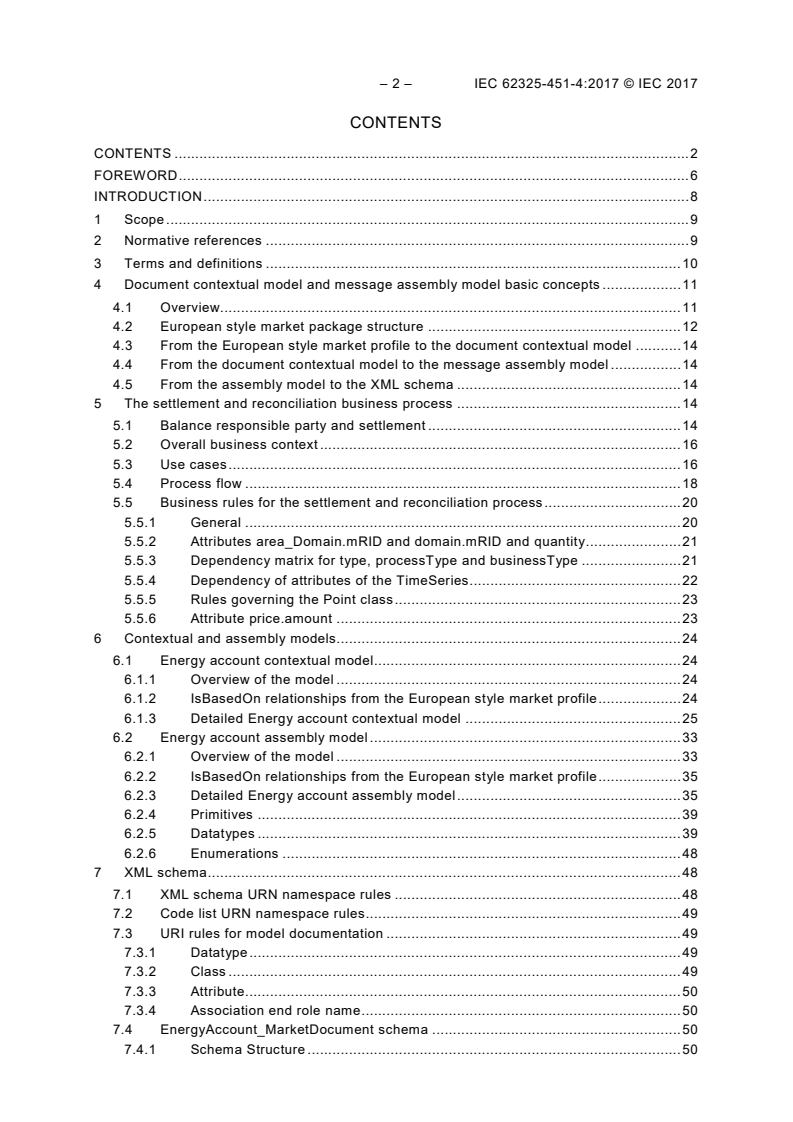
– 2 – IEC 62325-451-4:2017 © IEC 2017
CONTENTS
CONTENTS . 2
FOREWORD . 6
INTRODUCTION . 8
1 Scope . 9
2 Normative references . 9
3 Terms and definitions . 10
4 Document contextual model and message assembly model basic concepts . 11
4.1 Overview. 11
4.2 European style market package structure . 12
4.3 From the European style market profile to the document contextual model . 14
4.4 From the document contextual model to the message assembly model . 14
4.5 From the assembly model to the XML schema . 14
5 The settlement and reconciliation business process . 14
5.1 Balance responsible party and settlement . 14
5.2 Overall business context . 16
5.3 Use cases . 16
5.4 Process flow . 18
5.5 Business rules for the settlement and reconciliation process . 20
5.5.1 General . 20
5.5.2 Attributes area_Domain.mRID and domain.mRID and quantity . 21
5.5.3 Dependency matrix for type, processType and businessType . 21
5.5.4 Dependency of attributes of the TimeSeries . 22
5.5.5 Rules governing the Point class . 23
5.5.6 Attribute price.amount . 23
6 Contextual and assembly models. 24
6.1 Energy account contextual model. 24
6.1.1 Overview of the model . 24
6.1.2 IsBasedOn relationships from the European style market profile . 24
6.1.3 Detailed Energy account contextual model . 25
6.2 Energy account assembly model . 33
6.2.1 Overview of the model . 33
6.2.2 IsBasedOn relationships from the European style market profile . 35
6.2.3 Detailed Energy account assembly model . 35
6.2.4 Primitives . 39
6.2.5 Datatypes . 39
6.2.6 Enumerations . 48
7 XML schema . 48
7.1 XML schema URN namespace rules . 48
7.2 Code list URN namespace rules . 49
7.3 URI rules for model documentation . 49
7.3.1 Datatype . 49
7.3.2 Class . 49
7.3.3 Attribute . 50
7.3.4 Association end role name . 50
7.4 EnergyAccount_MarketDocument schema . 50
7.4.1 Schema Structure . 50
7.4.2 Schema description . 53
Bibliography . 59
Figure 1 – IEC 62325-450 modelling framework . 12
Figure 2 – Overview of European style market profile dependency. 13
Figure 3 – Balance responsible party relations . 15
Figure 4 – Settlement/reconciliation use case . 18
Figure 5 – Sequence diagram of the information flow . 19
Figure 6 – Energy account contextual model . 24
Figure 7 – Energy account assembly model . 34
Figure 8 – EnergyAccount_MarketDocument XML Schema Structure 1/2 . 51
Figure 9 – EnergyAccount_MarketDocument XML Schema Structure 2/2 . 52
Table 1 – Dependency table for type, processType and businessType . 22
Table 2 – Dependency table for TimeSeries attributes . 23
Table 3 – Dependency table for price.amount attribute . 23
Table 4 – IsBasedOn dependency. 24
Table 5 – Attributes of Energy account contextual
model::EnergyAccount_MarketDocument . 25
Table 6 – Association ends of Energy account contextual
model::EnergyAccount_MarketDocument with other classes . 26
Table 7 – Attributes of Energy account contextual model::Currency_Unit . 26
Table 8 – Attributes of Energy account contextual model::Domain . 27
Table 9 – Attributes of Energy account contextual model::MarketAgreement . 27
Table 10 – Attributes of Energy account contextual model::MarketEvaluationPoint . 27
Table 11 – Attributes of Energy account contextual model::MarketParticipant . 27
Table 12 – Association ends of Energy account contextual model:: MarketParticipant
with other classes . 28
Table 13 – Attributes of Energy account contextual model::MarketRole. 28
Table 14 – Attributes of Energy account contextual model::Measure_Unit . 28
Table 15 – Attributes of Energy account contextual model:: Party_MarketParticipant . 28
Table 16 – Attributes of Energy account contextual model::Point . 29
Table 17 – Association ends of Energy account contextual model ::Point with other
classes . 29
Table 18 – Attributes of Energy account contextual model::Price . 30
Table 19 – Attributes of Energy account contextual model::Process . 30
Table 20 – Attributes of Energy account contextual model::Quantity . 30
Table 21 – Attributes of Energy account contextual model::Reason . 31
Table 22 – Attributes of Energy account contextual model::Series_Period . 31
Table 23 – Association ends of Energy account contextual model:: Series_Period with
other classes . 31
Table 24 – Attributes of Energy account contextual model::Time_Period . 31
Table 25 – Attributes of Energy account contextual model::TimeSeries . 32
Table 26 – Association ends of Energy account contextual model:: TimeSeries with
other classes . 32
– 4 – IEC 62325-451-4:2017 © IEC 2017
Table 27 – IsBasedOn dependency . 35
Table 28 – Attributes of Energy account assembly
model::EnergyAccount_MarketDocument . 35
Table 29 – Association ends of Energy account assembly
model::EnergyAccount_MarketDocument with other classes . 36
Table 30 – Attributes of Energy account assembly model::Point . 36
Table 31 – Association ends of Energy account assembly model:: Point with other
classes . 37
Table 32 – Attributes of Energy account assembly model::Reason . 37
Table 33 – Attributes of Energy account assembly model::Series_Period . 38
Table 34 – Association ends of Energy account assembly model:: Series_Period with
other classes . 38
Table 35 – Attributes of Energy account assembly model::TimeSeries . 38
Table 36 – Association ends of Energy account assembly model:: TimeSeries with
other classes . 39
Table 37 – Attributes of ESMPDataTypes::Action_Status . 40
Table 38 – Attributes of ESMPDataTypes::ESMP_DateTimeInterval . 40
Table 39 – Attributes of ESMPDataTypes::Amount_Decimal . 40
Table 40 – Restrictions of attributes for ESMPDataTypes::Amount_Decimal . 40
Table 41 – Attributes of ESMPDataTypes::AreaID_String. 41
Table 42 – Restrictions of attributes for ESMPDataTypes::AreaID_String . 41
Table 43 – Attributes of ESMPDataTypes::BusinessKind_String . 41
Table 44 – Attributes of ESMPDataTypes::ClassificationKind_String . 41
Table 45 – Attributes of ESMPDataTypes::CurrencyCode_String . 42
Table 46 – Attributes of ESMPDataTypes::EnergyProductKind_String . 42
Table 47 – Attributes of ESMPDataTypes::ESMP_DateTime . 42
Table 48 – Restrictions of attributes for ESMPDataTypes::ESMP_DateTime . 42
Table 49 – Attributes of ESMPDataTypes::ESMPVersion_String . 43
Table 50 – Restrictions of attributes for ESMPDataTypes::ESMPVersion_String . 43
Table 51 – Attributes of ESMPDataTypes::ID_String . 43
Table 52 – Restrictions of attributes for ESMPDataTypes::ID_String . 43
Table 53 – Attributes of ESMPDataTypes::MarketRoleKind_String . 44
Table 54 – Attributes of ESMPDataTypes::MeasurementPointID_String . 44
Table 55 – Restrictions of attributes for ESMPDataTypes:: MeasurementPointID_String . 44
Table 56 – Attributes of ESMPDataTypes::MeasurementUnitKind_String . 44
Table 57 – Attributes of ESMPDataTypes::MessageKind_String . 45
Table 58 – Attributes of ESMPDataTypes::ObjectAggregationKind_String . 45
Table 59 – Attributes of ESMPDataTypes::PartyID_String . 45
Table 60 – Restrictions of attributes for ESMPDataTypes::PartyID_String . 45
Table 61 – Attributes of ESMPDataTypes::Position_Integer . 46
Table 62 – Restrictions of attributes for ESMPDataTypes::Position_Integer . 46
Table 63 – Attributes of ESMPDataTypes::ProcessKind_String . 46
Table 64 – Attributes of ESMPDataTypes::Quality_String . 46
Table 65 – Attributes of ESMPDataTypes::ReasonCode_String . 47
Table 66 – Attributes of ESMPDataTypes::ReasonText_String . 47
Table 67 – Restrictions of attributes for ESMPDataTypes::ReasonText_String . 47
Table 68 – Attributes of ESMPDataTypes::Status_String . 47
Table 69 – Attributes of ESMPDataTypes::YMDHM_DateTime . 48
Table 70 – Restrictions of attributes for ESMPDataTypes::YMDHM_DateTime . 48
– 6 – IEC 62325-451-4:2017 © IEC 2017
INTERNATIONAL ELECTROTECHNICAL COMMISSION
____________
FRAMEWORK FOR ENERGY MARKET COMMUNICATIONS –
Part 451-4: Settlement and reconciliation business process,
contextual and assembly models for European market
FOREWORD
1) The International Electrotechnical Commission (IEC) is a worldwide organization for standardization comprising
all national electrotechnical committees (IEC National Committees). The object of IEC is to promote
international co-operation on all questions concerning standardization in the electrical and electronic fields. To
this end and in addition to other activities, IEC publishes International Standards, Technical Specifications,
Technical Reports, Publicly Available Specifications (PAS) and Guides (hereafter referred to as “IEC
Publication(s)”). Their preparation is entrusted to technical committees; any IEC National Committee interested
in the subject dealt with may participate in this preparatory work. International, governmental and non-
governmental organizations liaising with the IEC also participate in this preparation. IEC collaborates closely
with the International Organization for Standardization (ISO) in accordance with conditions determined by
agreement between the two organizations.
2) The formal decisions or agreements of IEC on technical matters express, as nearly as possible, an international
consensus of opinion on the relevant subjects since each technical committee has representation from all
interested IEC National Committees.
3) IEC Publications have the form of recommendations for international use and are accepted by IEC National
Committees in that sense. While all reasonable efforts are made to ensure that the technical content of IEC
Publications is accurate, IEC cannot be held responsible for the way in which they are used or for any
misinterpretation by any end user.
4) In order to promote international uniformity, IEC National Committees undertake to apply IEC Publications
transparently to the maximum extent possible in their national and regional publications. Any divergence
between any IEC Publication and the corresponding national or regional publication shall be clearly indicated in
the latter.
5) IEC itself does not provide any attestation of conformity. Independent certification bodies provide conformity
assessment services and, in some areas, access to IEC marks of conformity. IEC is not responsible for any
services carried out by independent certification bodies.
6) All users should ensure that they have the latest edition of this publication.
7) No liability shall attach to IEC or its directors, employees, servants or agents including individual experts and
members of its technical committees and IEC National Committees for any personal injury, property damage or
other damage of any nature whatsoever, whether direct or indirect, or for costs (including legal fees) and
expenses arising out of the publication, use of, or reliance upon, this IEC Publication or any other IEC
Publications.
8) Attention is drawn to the Normative references cited in this publication. Use of the referenced publications is
indispensable for the correct application of this publication.
9) Attention is drawn to the possibility that some of the elements of this IEC Publication may be the subject of
patent rights. IEC shall not be held responsible for identifying any or all such patent rights.
International Standard IEC 62325-451-4 has been prepared by IEC technical committee 57:
Power systems management and associated information exchange.
This second edition cancels and replaces the first edition published in 2014. This edition
constitutes a technical revision.
This edition includes the following significant technical changes with respect to the previous
edition:
a) Removal of the attributes “quantity” and “secondary quantity” of the class “Point”;
b) Introduction of the class “Quantity” from IEC 62351-351 UML package, with the following
attributes “quantity” as mandatory and “quality” as optional, and create two association
1.1 between the class “Quantity” and the class “Point” with the role “In_Quantity” and
“Out_Quantity”.
c) Introduction of the class “Reason” from IEC 62351-351 UML package, with the following
attributes “code” as mandatory and “text” as optional, and create an association 0.* from
the class “Reason” to the class “Point” with the role “Reason”.
This bilingual version (2019-07) corresponds to the monolingual English version, published in
2017-04.
The text of this International Standard is based on the following documents:
CDV Report on voting
57/1737/CDV 57/1804/RVC
Full information on the voting for the approval of this International Standard can be found in
the report on voting indicated in the above table.
The French version of this standard has not been voted upon.
This document has been drafted in accordance with the ISO/IEC Directives, Part 2.
A list of all parts in the IEC 62325 series, published under the general title Framework for
energy market communications, can be found on the IEC website.
The committee has decided that the contents of this document will remain unchanged until the
stability date indicated on the IEC website under "http://webstore.iec.ch" in the data related to
the specific document. At this date, the document will be
• reconfirmed,
• withdrawn,
• replaced by a revised edition, or
• amended.
IMPORTANT – The 'colour inside' logo on the cover page of this publication indicates
that it contains colours which are considered to be useful for the correct
understanding of its contents. Users should therefore print this document using a
colour printer.
– 8 – IEC 62325-451-4:2017 © IEC 2017
INTRODUCTION
This standard is one of the IEC 62325 series which define protocols for deregulated energy
market communications.
The principal objective of the IEC 62325 series is to produce standards which facilitate the
integration of market application software developed independently by different vendors into a
market management system, between market management systems and market participant
systems. This is accomplished by defining message exchanges to enable these applications
or systems access to public data and exchange information independent of how such
information is represented internally.
The common information model (CIM) specifies the basis for the semantics for this message
exchange.
The European style market profile (ESMP) is based on different parts of the CIM IEC
standard. The CIM is defined through a series of standards, i.e. IEC 62325-301, IEC 61970-
301 and IEC 61968-11.
This document provides the settlement and reconciliation business process that can be used
throughout a European style market. This standard was originally based upon the work of the
European Transmission System Operators (ETSO) Task Force EDI (Electronic Data
Interchange) and then on the work of the European Network of Transmission System
Operators (ENTSO-E) Working Group EDI.
This document describes the settlement and reconciliation process for wholesale markets; it is
brought to the attention of the reader that it is envisaged to initiate work on a combined
reconciliation process for retail and wholesale markets.
FRAMEWORK FOR ENERGY MARKET COMMUNICATIONS –
Part 451-4: Settlement and reconciliation business process,
contextual and assembly models for European market
1 Scope
Based on the European style market profile (ESMP) (IEC 62325-351), this part of IEC 62325-
451 specifies a package for the settlement and reconciliation business process and the
associated document contextual model, assembly model and XML schema for use within
European style markets.
The relevant aggregate core components (ACCs) defined in IEC 62325-351 have been
contextualised into aggregated business information entities (ABIEs) to satisfy the
requirements of this business process. The contextualised ABIEs have been assembled into
the relevant document contextual models. Related assembly models and XML schema for the
exchange of information between market participants are automatically generated from the
assembled document contextual models.
This part of IEC 62325 provides a uniform layout for the transmission of aggregated data in
order to settle the electricity market. It is however not the purpose of this document to define
the formula to be taken into account to settle or reconcile a market. The purpose of this
document is only to enable the information exchange necessary to carry out the computation
of settlement and reconciliation.
The settlement process or reconciliation process is the way to compute the final position of
each market participant as well as its imbalance amounts.
2 Normative references
The following documents are referred to in the text in such a way that some or all of their
content constitutes requirements of this document. For dated references, only the edition
cited applies. For undated references, the latest edition of the referenced document (including
any amendments) applies.
IEC TS 61970-2, Energy management system application program interface (EMS-API) –
Part 2: Glossary
IEC 62325-301, Framework for energy market communications – Part 301: Common
information model (CIM) extensions for markets
IEC 62325-351, Framework for energy market communications – Part 351: CIM European
market model exchange profile
IEC 62325-450:2013, Framework for energy market communications – Part 450: Profile and
context modelling rules
IEC 62325-451-1, Framework for energy market communications – Part 451-1:
Acknowledgement business process and contextual model for CIM European market
IEC 62325-451-2, Framework for energy market communications – Part 451-2: Scheduling
business process and contextual model for CIM European market
– 10 – IEC 62325-451-4:2017 © IEC 2017
IEC 62361-100, Power systems management and associated information exchange –
Interoperability in the long term – Part 100: CIM profiles to XML schema mapping
3 Terms and definitions
For the purposes of this document, the terms and definitions given in IEC TS 61970-2 and the
following apply.
ISO and IEC maintain terminological databases for use in standardization at the following
addresses:
• IEC Electropedia: available at http://www.electropedia.org/
• ISO Online browsing platform: available at http://www.iso.org/obp
NOTE Refer to IEC 60050, International Electrotechnical Vocabulary, for general glossary definitions.
3.1
aggregate business information entity
ABIE
collection of related pieces of business information that together convey a distinct business
meaning in a specific Business Context
Note 1 to entry Expressed in modelling terms, this is the representation of an object class, independent of any
specific business context.
[SOURCE: ISO/TS 15000-5:2014, 3.1]
3.2
aggregate core component
ACC
collection of related pieces of business information that together convey a distinct business
meaning, independent of any specific Business Context
[SOURCE: ISO/TS 15000-5:2014, 3.2]
3.3
application program interface
API
set of public functions provided by an executable application component for use by other
executable application components
3.4
assembly model
model that prepares information in a business context for assembly into electronic documents
for data interchange
3.5
based on
IsBasedOn
use of an artefact that has been restricted according to the requirements of a specific
business context
[SOURCE: IEC 62325-450:2013, 3.4]
3.6
business context
formal description of a specific business circumstance as identified by the values of a set of
context categories, allowing different business circumstances to be uniquely distinguished
[SOURCE: UN/Cefact, Unified Context Methodology Technical Specification]
3.7
information model
representation of concepts, relationships, constraints, rules, and operations to specify data
semantics for a chosen domain of discourse
Note 1 to entry It can provide shareable, stable, and organized structure of information requirements for the
domain context.
3.8
market management system
MMS
computer system comprised of a software platform providing basic support services and a set
of applications providing the functionality needed for the effective management of the
electricity market
Note 1 to entry These software systems in an electricity market may include support for capacity allocation,
scheduling energy, ancillary or other services, real-time operations and settlements.
3.9
message business information entity
MBIE
aggregation of a set of ABIEs that respects a define set of assembly rules
4 Document contextual model and message assembly model basic concepts
4.1 Overview
IEC 62325-450 defines a set of CIM profiles that follows a layered modelling framework as
outlined in Figure 1 going from the common information model (CIM, IEC 61968-11,
IEC 61970-301 and IEC 62325-301), to different regional contextual models and their
subsequent contextualized documents for information exchange; the final step being the
message specifications for information interchange.
– 12 – IEC 62325-451-4:2017 © IEC 2017
IEC
Figure 1 – IEC 62325-450 modelling framework
The regional contextual models are the basic core components that are necessary to build
electronic documents for information interchange. This is defined in the European style
market contextual model (IEC 62325-351). These core components are also termed
aggregate core components (ACCs).
A document contextual model is based upon a specific business requirements specification
and is constructed from the contextualisation of the ACCs that can be found in the European
style market contextual model. The contextualised ACCs at this stage are terms aggregate
business information entities (ABIEs) These ABIEs are the constructs that are assembled
together into a specific electronic document to satisfy the information requirements outlined in
the business requirements specification. The transformation from an ACC to an ABIE shall
respect the rules defined in IEC 62325-450.
Once a document contextual model has been built that satisfactorily meets the business
requirements, a message assembly model can be automatically generated from it.
XML schema may then be automatically generated from the message assembly model. If
necessary, specific mapping can take place at this stage to transform the CIM class names
and attribute names into legacy market names.
4.2 European style market package structure
Figure 2 describes the main package structure of the European style market profile (ESMP).
IEC
Figure 2 – Overview of European style market
profile dependency
For each business process, a business process package is described in an IEC 62325-451-x
(x from 1 to n) standard. A business process package contains:
• The document contextual model (ABIE) and the automatically generated message
assembly model (MBIE) for each electronic document required to enable the completion of
the business process. Each document is a sub contextual model derived by restriction
from the European style market profile.
• The XML schema of the business document that is automatically generated from the
message assembly model.
The European style market profile (ESMP), as defined in IEC 62325-351, provides the core
components permitted for use in an IEC 62325-451-x standard as all ABIEs shall be “based
on” the IEC 62325-351 core components:
• ESMPClasses: Defining all the semi-contextual classes of the European style market
profile derived by restriction from the CIM model.
• ESMPDataTypes: Defining all the core datatypes used within the ESMP classes.
– 14 – IEC 62325-451-4:2017 © IEC 2017
All the core components that are used in every electronic document structure have been
harmonized and centralized in the European style market profile. These core components are
consequently the basic building blocks from which all electronic document ABIEs are derived.
4.3 From the European style market profile to the document contextual model
The document contextual model for a given business process is constructed by an information
analyst who identifies all the information requirements necessary to satisfy the business
process.
Once the information requirements have been identified the information analyst identifies the
related ACCs that are available in the European style market profile and contextualises them
to meet the information requirements. This contextualisation step creates a set of aggregate
business information entities (ABIEs).
In a final step the information analyst assembles together into a specific document contextual
model package the ABIEs to form a document model satisfying the business requirements.
4.4 From the document contextual model to the message assembly model
Once the document contextual model has been finalised, the message assembly model may
be automatically generated.
All document contextual models share the same core components and core datatypes. These
are defined in the European style market profile (IEC 62325-351) and are contextualised and
refined in all document contextual models (IEC 62325-451-x series) respecting the rules as
described in IEC 62325-450.
4.5 From the assembly model to the XML schema
The final modelling step applies a standardized set of criteria in order to generate a uniform
XML schema from the assembly model. This transformation process respects the rules
defined in IEC 62361-100.
5 The settlement and reconciliation business process
5.1 Balance responsible party and settlement
As indicated in the IEC 62325-301 “MarketRoleKind enumeration”, in the European style
electricity market, a balance responsible party could be defined as:
• A party that has a contract proving financial security and identifying balance responsibility
with the imbalance settlement responsible for the market balance area entitling the party
to operate in the market. This is the only role allowing a party to nominate energy on a
wholesale level.
NOTE The meaning of the word "balance" in this context signifies that the quantity contracted to provide or to
consume shall be equal to the quantity really provided or consumed.
The role of balance responsible party is linked to the role of balance supplier, i.e.
• A party that markets the difference between actual metered energy consumption and the
energy bought with firm energy contracts by the party connected to the grid. In addition
the balance supplier markets any difference with the firm energy contract (of the party
connected to the grid) and the metered production. There is one balance supplier for each
accounting point.
IEC
Figure 3 – Balance responsible party relations
class Balance responsible part relations
The balance responsible party could provide ancillary
services and/or balancing services to a system operator.
This transaction is accounted either as "generation" or
"consumption" for the settlement, i.e. increase or decrease of
Balance responsible
generation, demand response, etc.
party
(from Actors)
System operator
(from The trade responsible party could exchange energy with
Contract agreement to be included in
Actors)
other trade responsible party through bilateral (over
the balance responsible party settlement.
the counter) transactions (national or international
transactions).
This transaction is accounted as generation or
consumption for the settlement.
Trade responsible
Balance supplier
Other trade
party
responsible party
(from
(from
Actors)
Actors)
A party connected to the grid
The trade responsible party could buy or sell
could sell or buy its measured
energy on power exchange.
generation or consumption.
This transaction is accounted as "generation"
Metered values are thus
or "consumption" for the settlement, i.e. "in
necessary to define that was
quantity" or "out quantity".
A party connected to the grid could
really injected or withdrawn
sell or buy a block of energy.
from the grid.
This transaction is accounted
Depending upon the meter
either as "generation" or
equipment, profile could be
"consumption" for the settlement.
used to estimate the energy
values.
Power exchange
Party connected to
Party connected to
Party connected to
the grid_1
the grid
(from the grid_n
Actors)
– 16 – IEC 62325-451-4:2017 © IEC 2017
A party connected to the grid could be defined as:
• A party that contracts for the right to consume or produce electricity at an accounting
point.
Figure 3 describes the different transactions of a balance responsible party which could have
to be considered when carrying out a settlement or a reconciliation process:
The settlement process thus enables the reconciliation of all the “commercial transactions”
with the actual measured values either from meters, estimated values or profiles.
The main purpose is thus to assess, after the fact, that the balance responsible party was
balanced and if not to compute the deviations and to settle them.
5.2 Overall business context
Within an electricity market, actors are buying/selling energy between themselves as well as
selling energy to end users or buying energy from generating units. These activities are
carried out from the time of early planning and trading, until the intraday processes.
When the market business processes as well as the operational processes (real-time
operation) are closed, then comes the time to settle or reconcile the market, i.e. to compute
for each balance responsible party what he has injected in a market area and what he has
withdrawn from this market area.
For proper operation of a European style electricity market, each balance responsible party
shall be balanced, i.e. he should have the sufficient “generation” (physical inputs or buying
transactions) to cover its “consumption” (physical outputs or selling transactions) at each
time.
...