

IEC TS 62478:2016
(Main)High voltage test techniques - Measurement of partial discharges by electromagnetic and acoustic methods
General Information
- Abstract
IEC TS 62478:2016 is applicable to electromagnetic (HF/VHF/UHF) and acoustic measurements of PDs which occur in insulation of electrical apparatus. This specification deals with a large variety of applications, sensors of different frequency ranges and differing sensitivities. The tasks of PD location and measuring system calibration or sensitivity check are also taken into account. Key words: High Voltage Test Techniques, Partial Discharge, Electromagnetic, Acoustic.
- Status
- Published
- Publication Date
- 28-Aug-2016
- Technical Committee
- TC 42 - High-voltage and high-current test techniques
- Drafting Committee
- MT 14 - TC 42/MT 14
- Current Stage
- PPUB - Publication issued
- Start Date
- 29-Aug-2016
- Completion Date
- 15-Nov-2016
Overview
IEC TS 62478:2016, titled High voltage test techniques – Measurement of partial discharges by electromagnetic and acoustic methods, is a comprehensive technical specification developed by the International Electrotechnical Commission (IEC). It provides standardized methods for detecting and measuring partial discharges (PDs) within electrical apparatus insulation using electromagnetic and acoustic techniques. This document is essential for professionals engaged in high voltage testing, electrical equipment diagnosis, and condition monitoring.
Partial discharges are localized dielectric breakdowns of a small portion of insulation under high voltage stress. Detecting PDs early helps prevent insulation failure, enhances reliability, and extends the operational life of electrical assets. IEC TS 62478 addresses the detection of PD phenomena via sensors operating across high frequency (HF), very high frequency (VHF), and ultra-high frequency (UHF) bands for electromagnetic detection alongside acoustic sensors that pick up ultrasonic signals generated by PD activity.
Key Topics
Electromagnetic PD Phenomena
The specification explains the physics of electromagnetic emissions from partial discharges and their transmission characteristics. It elaborates on measurement systems including frequency ranges, sensor types, and instrument-related influences affecting signal quality and accuracy. A focus is placed on calibration and sensitivity checks crucial for valid PD quantification.Acoustic PD Phenomena
Acoustic measurement principles are covered with details about the generation of acoustic signals from PDs, their transmission paths, and suitable sensor technologies for ultrasonic detection. The document highlights calibration procedures and performance verification techniques for acoustic PD sensors.PD Source Location
Methods for locating PD sources are described for both electromagnetic and acoustic approaches. The specification also discusses combined methods leveraging both signal types for improved spatial diagnosis, including time-of-flight measurement techniques for precise defect localization.Sensor and Measurement System Calibration
The specification emphasizes the importance of regular system calibration and sensitivity verification to ensure reliable PD detection. Various procedures tailored to electromagnetic and acoustic systems are detailed to maintain accuracy under different test conditions.Application-Specific Considerations
Annexes provide practical insights for applying the standard to critical equipment such as gas-insulated switchgear (GIS), transformers, rotating machines, and cables. These sections discuss unique challenges and adaptations needed for PD measurements in these environments.
Applications
IEC TS 62478 is pivotal for electrical utilities, manufacturing, and testing laboratories involved in:
High Voltage Equipment Testing
Ensuring insulation integrity in transformers, switchgear, and cables during manufacturing acceptance tests and routine maintenance.Condition Monitoring and Diagnostics
Early detection of partial discharges aids predictive maintenance, minimizes unplanned outages, and supports asset management strategies.Research and Development
Development of advanced PD detection technologies and improvement of diagnostic algorithms for high voltage apparatus.Quality Assurance in Manufacturing
Compliance with international guidelines for PD measurement during production ensures equipment reliability and performance.Safety and Risk Management
Reducing the risk of catastrophic failure by identifying insulation defects and enabling timely remedial actions.
Related Standards
IEC 60270 – High-voltage test techniques – Partial discharge measurements
This standard complements IEC TS 62478 by specifying conventional electrical measurement techniques of PD for insulation testing.IEC 60034-27-2 – Rotating electrical machines – Part 27-2: On-line partial discharge measurements
Provides guidelines specific to PD detection in rotating machines using electrical and non-electrical methods.IEC 61934 – Power transformers – Guide for the measurement of partial discharges in the field
Focuses on field measurements and testing procedures for transformer PD assessment.IEC 62067 – High-voltage cables
Provides requirements for accessories and testing related to partial discharges in cable systems.
Keywords
High Voltage Test Techniques, Partial Discharge (PD), Electromagnetic Measurement, Acoustic Measurement, HF/VHF/UHF Sensors, PD Location, Sensitivity Check, Calibration, Electrical Insulation Testing, Condition Monitoring
By adhering to IEC TS 62478:2016, engineers and technicians can implement standardized, accurate, and reliable partial discharge detection methods, contributing to enhanced safety, performance, and longevity of high voltage electrical equipment.
Get Certified
Connect with accredited certification bodies for this standard

BSMI (Bureau of Standards, Metrology and Inspection)
Taiwan's standards and inspection authority.
Sponsored listings
Frequently Asked Questions
IEC TS 62478:2016 is a technical specification published by the International Electrotechnical Commission (IEC). Its full title is "High voltage test techniques - Measurement of partial discharges by electromagnetic and acoustic methods". This standard covers: IEC TS 62478:2016 is applicable to electromagnetic (HF/VHF/UHF) and acoustic measurements of PDs which occur in insulation of electrical apparatus. This specification deals with a large variety of applications, sensors of different frequency ranges and differing sensitivities. The tasks of PD location and measuring system calibration or sensitivity check are also taken into account. Key words: High Voltage Test Techniques, Partial Discharge, Electromagnetic, Acoustic.
IEC TS 62478:2016 is applicable to electromagnetic (HF/VHF/UHF) and acoustic measurements of PDs which occur in insulation of electrical apparatus. This specification deals with a large variety of applications, sensors of different frequency ranges and differing sensitivities. The tasks of PD location and measuring system calibration or sensitivity check are also taken into account. Key words: High Voltage Test Techniques, Partial Discharge, Electromagnetic, Acoustic.
IEC TS 62478:2016 is classified under the following ICS (International Classification for Standards) categories: 17.080 - Measurement of time, velocity, acceleration, angular velocity; 17.220.20 - Measurement of electrical and magnetic quantities. The ICS classification helps identify the subject area and facilitates finding related standards.
IEC TS 62478:2016 is available in PDF format for immediate download after purchase. The document can be added to your cart and obtained through the secure checkout process. Digital delivery ensures instant access to the complete standard document.
Standards Content (Sample)
IEC TS 62478 ®
Edition 1.0 2016-08
TECHNICAL
SPECIFICATION
SPECIFICATION
TECHNIQUE
colour
inside
High voltage test techniques – Measurement of partial discharges by
electromagnetic and acoustic methods
Techniques d’essais à haute tension – Mesurage des décharges partielles par
méthodes électromagnétiques et acoustiques
All rights reserved. Unless otherwise specified, no part of this publication may be reproduced or utilized in any form
or by any means, electronic or mechanical, including photocopying and microfilm, without permission in writing from
either IEC or IEC's member National Committee in the country of the requester. If you have any questions about IEC
copyright or have an enquiry about obtaining additional rights to this publication, please contact the address below or
your local IEC member National Committee for further information.
Droits de reproduction réservés. Sauf indication contraire, aucune partie de cette publication ne peut être reproduite
ni utilisée sous quelque forme que ce soit et par aucun procédé, électronique ou mécanique, y compris la photocopie
et les microfilms, sans l'accord écrit de l'IEC ou du Comité national de l'IEC du pays du demandeur. Si vous avez des
questions sur le copyright de l'IEC ou si vous désirez obtenir des droits supplémentaires sur cette publication, utilisez
les coordonnées ci-après ou contactez le Comité national de l'IEC de votre pays de résidence.
IEC Central Office Tel.: +41 22 919 02 11
3, rue de Varembé Fax: +41 22 919 03 00
CH-1211 Geneva 20 info@iec.ch
Switzerland www.iec.ch
About the IEC
The International Electrotechnical Commission (IEC) is the leading global organization that prepares and publishes
International Standards for all electrical, electronic and related technologies.
About IEC publications
The technical content of IEC publications is kept under constant review by the IEC. Please make sure that you have the
latest edition, a corrigenda or an amendment might have been published.
IEC Catalogue - webstore.iec.ch/catalogue Electropedia - www.electropedia.org
The stand-alone application for consulting the entire The world's leading online dictionary of electronic and
bibliographical information on IEC International Standards, electrical terms containing 20 000 terms and definitions in
Technical Specifications, Technical Reports and other English and French, with equivalent terms in 15 additional
documents. Available for PC, Mac OS, Android Tablets and languages. Also known as the International Electrotechnical
iPad. Vocabulary (IEV) online.
IEC publications search - www.iec.ch/searchpub IEC Glossary - std.iec.ch/glossary
The advanced search enables to find IEC publications by a 65 000 electrotechnical terminology entries in English and
variety of criteria (reference number, text, technical French extracted from the Terms and Definitions clause of
committee,…). It also gives information on projects, replaced IEC publications issued since 2002. Some entries have been
and withdrawn publications. collected from earlier publications of IEC TC 37, 77, 86 and
CISPR.
IEC Just Published - webstore.iec.ch/justpublished
Stay up to date on all new IEC publications. Just Published IEC Customer Service Centre - webstore.iec.ch/csc
details all new publications released. Available online and If you wish to give us your feedback on this publication or
also once a month by email. need further assistance, please contact the Customer Service
Centre: csc@iec.ch.
A propos de l'IEC
La Commission Electrotechnique Internationale (IEC) est la première organisation mondiale qui élabore et publie des
Normes internationales pour tout ce qui a trait à l'électricité, à l'électronique et aux technologies apparentées.
A propos des publications IEC
Le contenu technique des publications IEC est constamment revu. Veuillez vous assurer que vous possédez l’édition la
plus récente, un corrigendum ou amendement peut avoir été publié.
Catalogue IEC - webstore.iec.ch/catalogue Electropedia - www.electropedia.org
Application autonome pour consulter tous les renseignements
Le premier dictionnaire en ligne de termes électroniques et
bibliographiques sur les Normes internationales,
électriques. Il contient 20 000 termes et définitions en anglais
Spécifications techniques, Rapports techniques et autres
et en français, ainsi que les termes équivalents dans 15
documents de l'IEC. Disponible pour PC, Mac OS, tablettes
langues additionnelles. Egalement appelé Vocabulaire
Android et iPad.
Electrotechnique International (IEV) en ligne.
Recherche de publications IEC - www.iec.ch/searchpub
Glossaire IEC - std.iec.ch/glossary
La recherche avancée permet de trouver des publications IEC 65 000 entrées terminologiques électrotechniques, en anglais
en utilisant différents critères (numéro de référence, texte, et en français, extraites des articles Termes et Définitions des
comité d’études,…). Elle donne aussi des informations sur les publications IEC parues depuis 2002. Plus certaines entrées
projets et les publications remplacées ou retirées. antérieures extraites des publications des CE 37, 77, 86 et
CISPR de l'IEC.
IEC Just Published - webstore.iec.ch/justpublished
Service Clients - webstore.iec.ch/csc
Restez informé sur les nouvelles publications IEC. Just
Published détaille les nouvelles publications parues. Si vous désirez nous donner des commentaires sur cette
Disponible en ligne et aussi une fois par mois par email. publication ou si vous avez des questions contactez-nous:
csc@iec.ch.
IEC TS 62478 ®
Edition 1.0 2016-08
TECHNICAL
SPECIFICATION
SPECIFICATION
TECHNIQUE
colour
inside
High voltage test techniques – Measurement of partial discharges by
electromagnetic and acoustic methods
Techniques d’essais à haute tension – Mesurage des décharges partielles par
méthodes électromagnétiques et acoustiques
INTERNATIONAL
ELECTROTECHNICAL
COMMISSION
COMMISSION
ELECTROTECHNIQUE
INTERNATIONALE
ICS 17.220.20; 19.080 ISBN 978-2-8322-3560-7
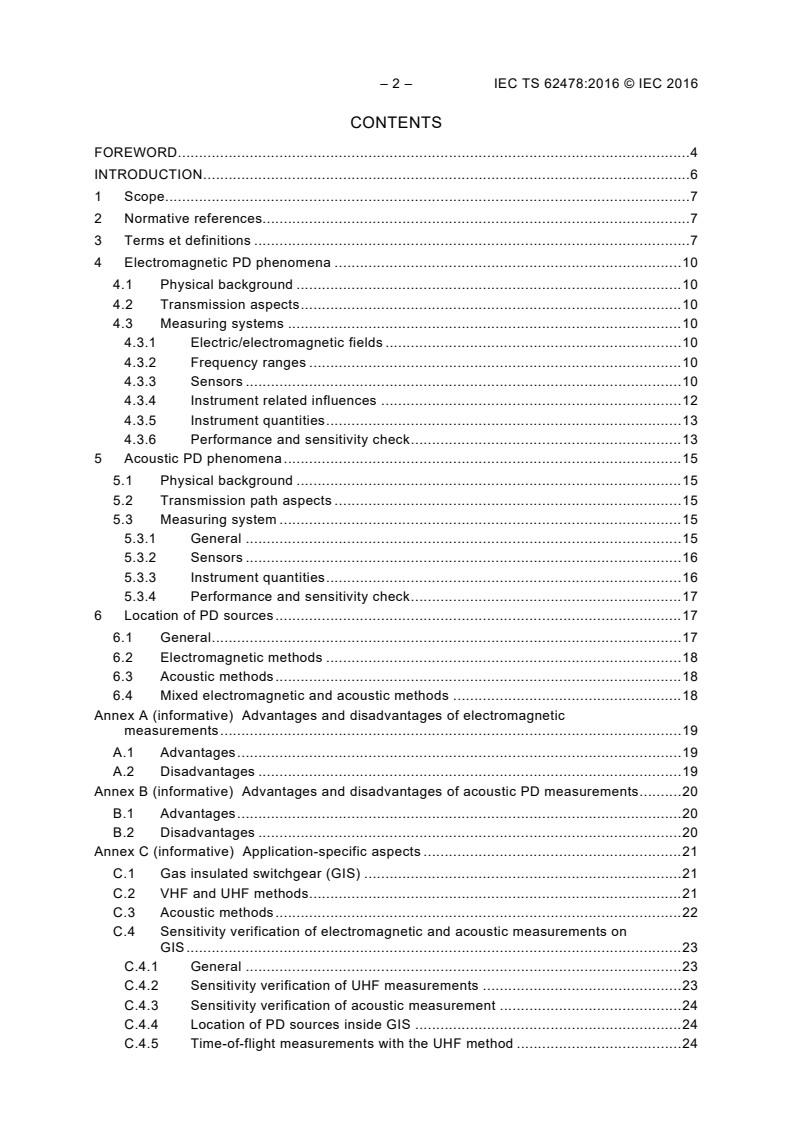
– 2 – IEC TS 62478:2016 © IEC 2016
CONTENTS
FOREWORD . 4
INTRODUCTION . 6
1 Scope . 7
2 Normative references. 7
3 Terms et definitions . 7
4 Electromagnetic PD phenomena . 10
4.1 Physical background . 10
4.2 Transmission aspects . 10
4.3 Measuring systems . 10
4.3.1 Electric/electromagnetic fields . 10
4.3.2 Frequency ranges . 10
4.3.3 Sensors . 10
4.3.4 Instrument related influences . 12
4.3.5 Instrument quantities . 13
4.3.6 Performance and sensitivity check . 13
5 Acoustic PD phenomena . 15
5.1 Physical background . 15
5.2 Transmission path aspects . 15
5.3 Measuring system . 15
5.3.1 General . 15
5.3.2 Sensors . 16
5.3.3 Instrument quantities . 16
5.3.4 Performance and sensitivity check . 17
6 Location of PD sources . 17
6.1 General . 17
6.2 Electromagnetic methods . 18
6.3 Acoustic methods . 18
6.4 Mixed electromagnetic and acoustic methods . 18
Annex A (informative) Advantages and disadvantages of electromagnetic
measurements . 19
A.1 Advantages . 19
A.2 Disadvantages . 19
Annex B (informative) Advantages and disadvantages of acoustic PD measurements . 20
B.1 Advantages . 20
B.2 Disadvantages . 20
Annex C (informative) Application-specific aspects . 21
C.1 Gas insulated switchgear (GIS) . 21
C.2 VHF and UHF methods . 21
C.3 Acoustic methods . 22
C.4 Sensitivity verification of electromagnetic and acoustic measurements on
GIS . 23
C.4.1 General . 23
C.4.2 Sensitivity verification of UHF measurements . 23
C.4.3 Sensitivity verification of acoustic measurement . 24
C.4.4 Location of PD sources inside GIS . 24
C.4.5 Time-of-flight measurements with the UHF method . 24
C.4.6 Signal reduction analysis . 25
C.4.7 Acoustic location methods . 25
C.5 Rotating machines . 26
C.6 Transformers . 27
C.6.1 Physical background of high frequency and acoustic PD phenomena on
transformers . 27
C.6.2 UHF PD signals in transformers . 28
C.6.3 Acoustic PD signals in transformers . 28
C.6.4 Spatial location of PD sources in liquid-insulated transformers/reactors . 28
C.7 Cable/accessories . 29
Bibliography . 33
Figure 1 – Classification of instruments for signal processing . 13
Figure 2 – Overview of the important aspects of electromagnetic PD detection . 14
Figure 3 – Overview of performance and sensitivity checks in different apparatus . 14
Figure C.1 – Defect location by time-of-flight measurement . 25
Figure C.2 – Illustration of the physical principle of acoustic and electromagnetic PD
detection in an oil/paper insulated transformer. 28
Figure C.3 – Classical arrival time based PD location for transformers/reactors with a
combination of the electric and acoustic PD signals . 29
– 4 – IEC TS 62478:2016 © IEC 2016
INTERNATIONAL ELECTROTECHNICAL COMMISSION
____________
HIGH VOLTAGE TEST TECHNIQUES –
MEASUREMENT OF PARTIAL DISCHARGES
BY ELECTROMAGNETIC AND ACOUSTIC METHODS
FOREWORD
1) The International Electrotechnical Commission (IEC) is a worldwide organization for standardization comprising
all national electrotechnical committees (IEC National Committees). The object of IEC is to promote
international co-operation on all questions concerning standardization in the electrical and electronic fields. To
this end and in addition to other activities, IEC publishes International Standards, Technical Specifications,
Technical Reports, Publicly Available Specifications (PAS) and Guides (hereafter referred to as “IEC
Publication(s)”). Their preparation is entrusted to technical committees; any IEC National Committee interested
in the subject dealt with may participate in this preparatory work. International, governmental and non-
governmental organizations liaising with the IEC also participate in this preparation. IEC collaborates closely
with the International Organization for Standardization (ISO) in accordance with conditions determined by
agreement between the two organizations.
2) The formal decisions or agreements of IEC on technical matters express, as nearly as possible, an international
consensus of opinion on the relevant subjects since each technical committee has representation from all
interested IEC National Committees.
3) IEC Publications have the form of recommendations for international use and are accepted by IEC National
Committees in that sense. While all reasonable efforts are made to ensure that the technical content of IEC
Publications is accurate, IEC cannot be held responsible for the way in which they are used or for any
misinterpretation by any end user.
4) In order to promote international uniformity, IEC National Committees undertake to apply IEC Publications
transparently to the maximum extent possible in their national and regional publications. Any divergence
between any IEC Publication and the corresponding national or regional publication shall be clearly indicated in
the latter.
5) IEC itself does not provide any attestation of conformity. Independent certification bodies provide conformity
assessment services and, in some areas, access to IEC marks of conformity. IEC is not responsible for any
services carried out by independent certification bodies.
6) All users should ensure that they have the latest edition of this publication.
7) No liability shall attach to IEC or its directors, employees, servants or agents including individual experts and
members of its technical committees and IEC National Committees for any personal injury, property damage or
other damage of any nature whatsoever, whether direct or indirect, or for costs (including legal fees) and
expenses arising out of the publication, use of, or reliance upon, this IEC Publication or any other IEC
Publications.
8) Attention is drawn to the Normative references cited in this publication. Use of the referenced publications is
indispensable for the correct application of this publication.
9) Attention is drawn to the possibility that some of the elements of this IEC Publication may be the subject of
patent rights. IEC shall not be held responsible for identifying any or all such patent rights.
The main task of IEC technical committees is to prepare International Standards. In
exceptional circumstances, a technical committee may propose the publication of a technical
specification when
• the required support cannot be obtained for the publication of an International Standard,
despite repeated efforts, or
• the subject is still under technical development or where, for any other reason, there is the
future but no immediate possibility of an agreement on an International Standard.
Technical specifications are subject to review within three years of publication to decide
whether they can be transformed into International Standards.
IEC TS 62478, which is a technical specification, has been prepared by IEC technical
committee 42: High-voltage and high-current test techniques.
The text of this technical specification is based on the following documents:
Enquiry draft Report on voting
42/325/DTS 42/333/RVC
Full information on the voting for the approval of this technical specification can be found in
the report on voting indicated in the above table.
This publication has been drafted in accordance with the ISO/IEC Directives, Part 2.
The committee has decided that the contents of this publication will remain unchanged until
the stability date indicated on the IEC web site under "http://webstore.iec.ch" in the data
related to the specific publication. At this date, the publication will be
• transformed into an International standard,
• reconfirmed,
• withdrawn,
• replaced by a revised edition, or
• amended.
IMPORTANT – The 'colour inside' logo on the cover page of this publication indicates
that it contains colours which are considered to be useful for the correct
understanding of its contents. Users should therefore print this document using a
colour printer.
– 6 – IEC TS 62478:2016 © IEC 2016
INTRODUCTION
Partial discharges (PDs) generate electromagnetic and acoustic waves, emit light and
produce chemical decomposition of insulation materials; these physical and chemical effects
can be detected by various diagnostic methods and appropriate sensing elements (sensors).
Besides the so-called ‘conventional’, electrical method described in IEC 60270, it is possible
to detect and measure PDs with various ‘non-conventional’ methods (see Annexes A and B).
There is a special need to give recommendations for two used non-conventional methods,
acoustic and electromagnetic ones, and this document is the first step in this direction.
HIGH VOLTAGE TEST TECHNIQUES –
MEASUREMENT OF PARTIAL DISCHARGES
BY ELECTROMAGNETIC AND ACOUSTIC METHODS
1 Scope
This document is applicable to electromagnetic (HF/VHF/UHF) and acoustic measurements of
PDs which occur in insulation of electrical apparatus.
This specification deals with a large variety of applications, sensors of different frequency
ranges and differing sensitivities. The tasks of PD location and measuring system calibration
or sensitivity check are also taken into account.
2 Normative references
The following documents are referred to in the text in such a way that some or all of their
content constitutes requirements of this document. For dated references, only the edition
cited applies. For undated references, the latest edition of the referenced document (including
any amendments) applies.
IEC TS 60034-27, Rotating electrical machines – Part 27: Off-line partial discharge
measurements on the stator winding insulation of rotating electrical machines
IEC 60270, High-voltage test techniques – Partial discharge measurements
3 Terms and definitions
For the purposes of this document, the following terms and definitions apply.
ISO and IEC maintain terminological databases for use in standardization at the following
addresses:
• IEC Electropedia: available at http://www.electropedia.org/
• ISO Online browsing platform: available at http://www.iso.org/obp
3.1
partial discharge
PD
complex physical phenomena consisting of a localized electrical discharge caused by partial
breakdown of an insulating medium under the influence of the local electrical field stress
3.1.1
partial discharge current pulses
PD current pulses
extremely fast current pulses, whose rise time and pulse width depend on the discharge type,
defect type, geometry and gas pressure
3.1.2
electromagnetic effects of PD
PD current pulses resulting in the emission of transient electromagnetic waves at very high
frequency ranges
– 8 – IEC TS 62478:2016 © IEC 2016
Note 1 to entry: The electromagnetic waves generated by PD signals propagate through the dielectric materials
which surround the PD source; these signals can be detected by various antennas or transducers (sensors).
3.1.3
acoustic effects of PD
transient acoustic wave resulting from the super-heated gas channel produced, similar to
lightning, by a PD current pulse
3.1.4
detection and measurement of effects of PD
activities that can be detected and measured using the following methods:
• electrical methods: conventional (according to IEC 60270) or electromagnetic (HF, VHF
and UHF) methods
• acoustical methods
• optical methods
• chemical methods
Note 1 to entry: Measurement of PD activity is an important criterion for the evaluation of the dielectric condition
of insulation systems of electrical apparatus.
Note 2 to entry: This document only discusses electromagnetic and acoustic methods.
3.2
PD measuring system
measuring system for unconventional PD detection consisting of sensing element,
transmission path and measuring instrument
3.2.1
sensing element
sensor or antenna and connection link (e.g. electric or fiber optical cable) to the measuring
instrument
3.2.2
transmission path
path characterized by the following parameters:
• distance from the location of the PD to the sensor
• type of PD signal transmission (conducted or field coupled)
• propagation characteristic of dielectric material(s) such as dispersion, attenuation,
resonances, reflection, diffraction
3.2.3
PD measuring instruments
instruments that utilize various combinations of digital and analog techniques to display partial
discharge signals in order to assist in their interpretation and evaluation
Note 1 to entry: The measured PD signals are influenced by different behavior of dielectric medium (gaseous,
liquid or solid) for acoustic or electromagnetic signal propagation and offer different possibilities for data evaluation
in the time and frequency domains, depending on different bandwidths of the sensing element and measuring
instrument.
3.3
PD measurement system checks
complex combination of equipment whose proper and correct operation is ascertained by
performance checking methods
3.3.1
performance check
check serving to assure correct functioning of the entire measuring system, from sensor to PD
measuring instrument, typically by injection of an artificial signal
Note 1 to entry: The time and frequency domain characteristics of the injected artificial signal(s) used for the
performance check are chosen to appropriately emulate the PD phenomenon being measured along with the
parameters of the PD measuring system, e.g. bandwidth, type of sensor, etc.
Note 2 to entry: In carrying out the performance check, it is not necessary to emit electromagnetic or acoustic
waves into the test object, that is to say, single-port checks are possible.
3.3.2
sensitivity check
check used to establish the quantitative correlation between the apparent charge of the PD
event (in units e.g. pC) and the quantity measured and displayed by the electromagnetic or
acoustic PD measurement system, typically by injection of an artificial signal
Note 1 to entry: The time and frequency domain characteristics along with the amplitude of the artificially injected
signal(s) used for the sensitivity check are typically derived from a laboratory measurement in which the output of
the electromagnetic or acoustic PD measurement system is simultaneously compared with the measurement of an
actual PD source in an IEC 60270 test set-up.
Note 2 to entry: In carrying out the sensitivity check, it is necessary to emit electromagnetic or acoustic waves
into the test object in order to emulate actual PD signals.
3.4
quantities and units
3.4.1
sensor output voltage
response of electromagnetic or acoustic sensor expressed in V or dBmV
3.4.2
sensor effective aperture
ratio between maximum sensor output power and power density of the incoming electrical
field
Note 1 to entry: The sensor effective aperture is expressed in mm .
Note 2 to entry: In this case the measured quantity is the pulse energy arising from a transient electric field
produced by the PD signal.
3.4.3
sensor effective height
sensor effective length
ratio between the sensor's output voltage magnitude (in V) to the incoming electric field
strength (in V/mm)
Note 1 to entry: The sensor effective height is expressed in mm .
Note 2 to entry: The typical output consists of a transient voltage pulse.
3.4.4
antenna factor
inverse of the effective height or length defined as ratio between incoming electric field
strength (in V/mm) to the sensor's output voltage magnitude (in V)
-1
Note 1 to entry: The antenna factor is expressed in mm .
– 10 – IEC TS 62478:2016 © IEC 2016
4 Electromagnetic PD phenomena
4.1 Physical background
The short rise times of PD pulse currents (<1 ns) excite electromagnetic waves ranging from
HF up to the UHF range (3 MHz up to 3 GHz) and exceeding in several insulation materials.
The propagation velocity of the resulting UHF waves is dependent on the resulting ε , e.g. in
r
oil estimated to about 2/3×c or 2×10 m/s (c denoting the speed of light in a vacuum). The
0 0
measurement frequency range depends on the specific apparatus.
4.2 Transmission aspects
Metal parts of apparatus enclosures can act as waveguides or resonators and effects such as
dispersion, attenuation, cavity resonances, standing waves, reflection and diffraction all
influence the propagation of the PD pulse signals and the pulse characteristics respectively.
Transmission path characteristics typically depend on
• material characteristics and dimensions,
• electromagnetic impedance and dielectric behavior of the surrounding dielectric medium,
• distance between source and sensor.
4.3 Measuring systems
4.3.1 Electric/electromagnetic fields
Non-conventional PD measurement systems based on radio frequency (RF) techniques
operate in two different modes; one uses the frequency range in the HF/VHF area and the
other uses the frequency range in the UHF area. In the HF and VHF range electric, magnetic
and electromagnetic field (e.g. TEM ) can typically be measured. In the UHF range
predominantly the electromagnetic field modes (e.g. TEM ) are measured.
xx
4.3.2 Frequency ranges
HF nominally covers the frequency range from 3 MHz to 30 MHz and VHF the frequency
range from 30 MHz to 300 MHz. Typical measuring bandwidths for narrow band measurement
in the HF and VHF range up to 3 MHz, for wide band measurement in the VHF range, typically
50 MHz and higher, respectively.
The UHF frequency range is nominally between 300 MHz to 3 GHz. The measuring mode
applied in the UHF range is typically either the zero span mode at one or several individual
frequencies with the resolution bandwidth typically between 3 MHz to 6 MHz, or the full
bandwidth mode.
4.3.3 Sensors
4.3.3.1 General
Typically used sensors in the HF and VHF frequency range are based on capacitive, inductive
and electromagnetic detection principle.
In the UHF frequency range, the sensors used are typically near-field antennas such as disc
or cone shaped sensors along with field grading electrodes.
The sensor output signals are typically in the form of high frequency oscillating pulses. These
signals can be displayed in the time domain as oscillating pulses with e.g. the maximum of the
envelope the measured output quantity. In the frequency domain the signals are typically
displayed as the spectrum resulting from the transient pulses. The measured output quantities
in the frequency domain are the maximum magnitudes of the related characteristic spectral
frequencies.
Sensors can be characterized as high frequency impedances consisting of a combination of
capacitive, inductive and resistive component values. This high frequency impedance and the
corresponding measuring frequency range determine the sensor’s measuring mode and the
resulting output is a function of its impedance and the magnitude of the related transient field
component arising from the PD signal.
The measured quantity can be a transient voltage or current pulse value.
4.3.3.2 Type and characteristic
Some examples of sensors predominantly used in HF up to VHF frequency ranges:
• capacitors;
• current transformers;
• Rogowski coils;
• directional electromagnetic couplers;
• film electrodes;
• axial field couplers;
• transient earth voltage (TEV) probes;
• resistive couplers.
Some examples of sensors mainly used in the UHF range:
• disc and cone-shaped sensors;
• external window couplers;
• hatch couplers;
• barrier sensors;
• field grading electrodes;
• wave guide sensors;
• UHF antennas;
• directional electromagnetic couplers.
The output quantity of the sensors can be classified into the following groups:
• frequency characteristic, i.e. transfer function;
• polarity maintaining;
• directional;
• field magnitude dependent;
• sensitivity;
• installation dependent on geometry and location;
• mode dependent;
• transfer characteristic;
• monitored area which shall be in the range of the receiving area of the sensors.
4.3.3.3 Position
Sensors can be installed inside the high voltage component or externally mounted at dielectric
apertures as e.g. inspection windows or valves. The sensors should be installed as close as
– 12 – IEC TS 62478:2016 © IEC 2016
possible to the particular PD detection area and inside the metallic enclosure or screen of the
high voltage component.
In larger high voltage apparatus or systems it is beneficial to install multiple sensors to
improve measurement sensitivity and to help in PD source detection and location. Multiple
sensors can also be used for the sensitivity check of the arrangement.
The sensors should not have any negative impact to the dielectric design and functionality of
the high voltage component.
4.3.4 Instrument related influences
4.3.4.1 Frequency and time domain signal processing
The output signals of the sensors can be processed in the time or frequency domain (see
Figure 1).
Broadband time domain signal processing better represents the complete wave shape of the
PD related pulse and enables detailed analysis of wave shape characteristics of individual
single pulses (e.g. PD reflectometry, PD pulse shape analysis, etc.).
Narrow-band frequency domain signal processing may allow a better noise suppression
capability should noise and external disturbances be present and consequently features an
improved sensitivity in noisy environments. A single pulse wave shape analysis is not fully
possible since bandwidth limitations in the processing path corrupts pulse shapes although
derived statistical analysis as e.g. phase resolved PD pattern can be applied.
4.3.4.2 Processing bandwidth
The time domain processing uses a wide or ultra wide frequency range for signal processing.
Filters to suppress single or multiple interferences are applied before signal processing. The
signal is then processed from a wide band peak detector and displayed in the time domain
typically synchronized with the phase of the applied high voltage.
Frequency domain processing is typically carried out either at various frequency spans or in
zero span mode, essentially a tuned receiver centered at a fixed center frequency with a
specific resolution bandwidth. The output of this zero span mode is typically displayed in the
time domain e.g. similarly to a typical oscilloscope display or e.g. as a PD phase resolved
pattern.
The wideband spectral mode processes the output of either a swept frequency receiver (i.e.
super heterodyne) or a so-called ‘real-time spectrum analyzer’ as a power spectrum versus
frequency. This can also be displayed as a spectrum of the measured signals (PD and other
signals).
Class Frequency domain measurement Time domain measurement
Mode Zero span Full spectra Ultra wide band
Frequency
band
PD
pattern
IEC
Figure 1 – Classification of instruments for signal processing
4.3.5 Instrument quantities
In HF and VHF ranges the instrument quantities are typically amperes or volts considering the
application of inductive and capacitive couplers. The output of UHF sensors is also typically a
voltage signal. These values measured by the instruments are in linear correlation to the
measured electromagnetic field mode and the sensor transfer characteristic.
Derived quantities however should be in correlation to the PD parameters. This can be linear,
when using the direct output voltage of the UHF sensor, or quadratic, e.g. by processing the
power quantity (W) of the sensor signal, or the signal energy (J) as related to the defined
measuring resistance
NOTE The UHF sensor can be described with its antenna characteristic in terms of its effective height (m),
effective aperture (mm ), antenna factor (1/m) or antenna gain (dBi).
4.3.6 Performance and sensitivity check
For detecting and measuring the electromagnetic waves emitted by partial discharges,
different aspects of the method are shown in Figure 2.
– 14 – IEC TS 62478:2016 © IEC 2016
Non-
conventional
methods
Electro-
magnetic
detection
Sensitivity PD
check measurement
HF/VHF UHF
Performance
On-site Signal
EM signal
and sensitivity
Sensors
test processing
transmission
check
IEC
Figure 2 – Overview of the important aspects of electromagnetic PD detection
It should be emphasized that when employing the electromagnetic detection (radio frequency)
method, the PD magnitude as apparent charge cannot be evaluated directly as a calibrated
value.
However, a verification of the detection sensitivity can be performed and has proven to be
useful in practice, e.g. for gas-insulated switchgear, rotating machines stator windings, etc. In
Figure 3 the general steps for performing a sensitivity check for GIS, power transformers,
stator windings and power cables are shown. Although the specific steps on different high
voltage apparatus differ slightly, the general approach is shown in Figure 2.
To evaluate the detection sensitivity of the electromagnetic e.g. UHF method, the sensitivity
check should be applied. With this the achievable detection sensitivity is demonstrated in a
worst-case configuration by direct comparison in a simultaneous IEC 60270 measurement of
apparent charge (pC) from an actual, significant and meaningful PD source.
The performance check is a functional check of the whole measuring PD system and does not
relate to apparent charge measurements in general.
NOTE The performance check also can be used for finding suitable narrow-band measurement frequencies.
Performance Sensitivity
check
check
Laboratory-set-up
Single port Dual port
PD source
with known
app. charge
Injection of Injection of
artificial pulses artificial pulses
in same sensor in other sensor
Injection of
artificial pulses
Transformers
On-site
and
stator windings Sensitivity
Check of sensor
arrangement
Cables, GIS
Transformers
IEC
Figure 3 – Overview of performance and sensitivity checks in different apparatus
The PD detection in the HF up to UHF range is mainly applied for power cable accessories
and rotating machines where the electromagnetic transients are captured by means of
inductive and capacitive sensors as well as by special designed field probes. For power
transformers, gas-insulated switchgear and stator windings, VHF and UHF ranges are
primarily used.
5 Acoustic PD phenomena
5.1 Physical background
Acoustic PD detection is based on the fact that PD appears as a point source of acoustic
waves. These acoustic waves spread through the internal structure of the high voltage
apparatus until reaching the external surface. Different wave types with different propagation
velocities appear and also reflections and refractions at boundaries result in attenuation,
absorption and scattering effects. Typically the acoustic waves are detected and converted
into electric signals typically by means of piezoelectric sensors, structure-born sound-
resonance-sensors, accelerometers, condenser microphones or opto-acoustic sensors.
Acoustic PD related signals might also be generated from free moving particles in gas
insulated apparatus (e.g. GIS).
For PD detection, typically the ultra-sonic frequency range is employed (approximately
20 kHz to 250 kHz), as well as the audible range (approximately 100 Hz to 20 kHz). The
frequency ranges used for acoustic detection are chosen depending on the insulation system
to which the method is being employed (solid, liquid and gaseous).
5.2 Transmission path aspects
Within liquid and gaseous insulation parts, the radiated sound field ideally propagates as a
spherical pressure (longitudinal) wave. When reaching solid insulation parts or enclosures,
more complicated modes and so-called structure-borne propagation paths will typically be
observed. The acoustic waves have different velocities in different media. Due to this, the
geometrically shortest propagation path may not necessarily be the fastest path taken
between source and sensor.
The acoustic transmission path typically includes the following very important characteristics:
• propagation modes of the acoustic wave and variations thereof along the transmission
path from source to sensing element;
• variations in propagation velocity depending on different materials and conditions (e.g. for
insulating oil: comparatively high velocity variation with temperature, only minor velocity
variation with humidity);
• dispersion: frequency-dependency of propagation velocity;
• frequency-dependent attenuation of acoustic pulses in various insulation material or
compounds and structures;
• matching of acoustic impedances at material boundaries e.g. between the sensing
element and high voltage apparatus housing;
• distance from sensing element to PD origin.
5.3 Measuring system
5.3.1 General
Measuring systems can be divided into contact and non-contact (or distance) ones. For
sensitive detection of PD inside high voltage apparatus, measuring systems employing direct
contact between their sensors and the structures of the apparatus e.g. the housing are
predominantly used.
– 16 – IEC TS 62478:2016 © IEC 2016
Furthermore the measuring systems can be also differentiated based on whether time-domain
or frequency-domain processing is employed.
5.3.2 Sensors
5.3.2.1 General
Available sensors can be divided into piezoelectric sensors, microphones or sensors using
acoustic-optical effects.
Two types of externally mounted piezoelectric sensors exist:
a) accelerometers (output signal proportional to acceleration) with flat frequency
characteristic;
b) acoustic emission sensors (output signal proportional to velocity) which typically exhibit
dominant resonances in their frequency characteristic.
5.3.2.2 Type and characteristic
There are passive or active sensors (meaning with signal amplification in the sensor housing).
Generally a significant level of signal amplification close to the sensor element is most
beneficial depending on characteristics of the sensing element.
General characteristics of a sensor comprise:
• sensitivity,
• frequency characteristics as a working range of frequencies (resonant type or flat
frequency response),
• temperature characteristics as a working range temperatures.
In view of the attenuation of acoustic signals, often sensors of resonant type with their
characteristic higher sensitivity in specific frequency ranges are preferred.
5.3.2.3 Positioning of acoustic sensors for PD detection
Generally external acoustic piezo-electric sensors should be positioned where they have the
best chance to pick up acoustic signals being generated by PD, i.e. where the structure best
transmits vibrations. Thus the sensors can be positioned close to areas which possibly may
have showed problems in prior tests.
NOTE GIS: Acoustic signals are picked up by sensors placed on the external surface of the GIS enclosure.
Typically the sensors are affixed to the enclosure either by elastic bands or magnetic holders. Because the
acoustic signal arriving from the defect(s) undergoes attenuation along the length of the GIS, especially when there
are e.g. spacers between the PD source and the measuring probe, the sensor is usually positioned in different
locations of the GIS (typically at least one measuring point in every compartment).
Transformers: Valuable information for positioning of sensors can be gained by referring to
the design of the transformer. It is advantageous to avoid locations for sensor positioning e.g.
close to or directly on top of stiffening ribs of the transformer housing, and instead choose
areas between mechanical reinforcement elements of the transformer housing. Safety
distances should be taken care of when placing sensors in the upper part of the transformer
tank. Also, the sensors may be moved around during the process of determining the location
of the PD within the enclosure.
5.3.3 Instrument quantities
The main unit to quantify mechanical pressure is the Pascal. However, the piezo-electric
sensors predominantly used convert incoming acoustic waves into voltage output signals
related to the mechanical input; hence the quantity measured in most of the instruments is
either by volts (V) or decibels (dB).
...