

IEC 60904-1:2020
(Main)Photovoltaic devices - Part 1: Measurement of photovoltaic current-voltage characteristics
General Information
- Abstract
IEC 60904-1:2020 describes procedures for the measurement of current-voltage characteristics (I-V curves) of photovoltaic (PV) devices in natural or simulated sunlight. These procedures are applicable to a single PV solar cell, a sub-assembly of PV solar cells, or a PV module. This document is applicable to non-concentrating PV devices for use in terrestrial environments, with reference to (usually but not exclusively) the global reference spectral irradiance AM1.5 defined in IEC 60904-3.
This third edition cancels and replaces the second edition published in 2006. The main changes with respect to the previous edition are as follows:
- Updated scope to include all conditions.
- Added terms and definitions.
- Reorganised document to avoid unnecessary duplication.
- Added data analysis clause.
- Added informative annexes (area measurement, PV devices with capacitance, dark I-V curves and effect of spatial non-uniformity of irradiance).
- Status
- Published
- Publication Date
- 24-Sep-2020
- Technical Committee
- TC 82 - Solar photovoltaic energy systems
- Drafting Committee
- WG 2 - TC 82/WG 2
- Current Stage
- PPUB - Publication issued
- Start Date
- 25-Sep-2020
- Completion Date
- 02-Oct-2020
Overview
IEC 60904-1:2020 is an international standard published by the International Electrotechnical Commission (IEC) that specifies methods for measuring the current-voltage (I-V) characteristics of photovoltaic (PV) devices. This third edition updates and replaces the 2006 version, providing procedures applicable to single solar cells, sub-assemblies, or full PV modules exposed to natural or simulated sunlight. The standard focuses on non-concentrating PV devices operating in terrestrial environments and references the global standard spectral irradiance AM1.5, as defined in IEC 60904-3.
The document aims to ensure accurate, reliable, and comparable measurements of photovoltaic I-V curves-critical for assessing device performance and efficiency. It introduces improved definitions, reorganized content to avoid redundancies, and new clauses on data analysis. Additionally, it includes informative annexes addressing specialized measurement concerns such as device area, capacitance effects, dark I-V curves, and irradiance non-uniformity.
Key Topics
- Scope and Applicability: Covers measurement procedures for single cells, cell assemblies, and modules under various illumination conditions, including natural sunlight and solar simulators.
- Measurement Procedures: Details techniques for conducting I-V curve measurements, stabilization criteria, and translating test results to standardized reporting conditions.
- Apparatus Requirements: Specifies equipment standards for capturing accurate electrical characteristics of PV devices.
- Data Analysis and Reporting: Introduces methods for extracting key I-V parameters such as short-circuit current, open-circuit voltage, maximum power output, and voltage/current at maximum power. Emphasizes evaluation of measurement uncertainty.
- Annexes for Special Cases:
- Device area definitions and measurement methods.
- Handling capacitance effects in PV devices to reduce measurement errors.
- Protocols for dark I-V curve measurement (without illumination) to assess device leakage and behavior.
- Effects of spatial non-uniformity of irradiance on measurement accuracy.
Applications
IEC 60904-1 is instrumental for PV manufacturers, testing laboratories, quality assurance teams, and research organizations involved in the characterization and certification of photovoltaic devices. Typical applications include:
- Performance Assessment: Accurate I-V curve measurement to evaluate efficiency and electrical output under standardized test conditions.
- Quality Control: Ensuring production consistency by comparing device parameters against benchmark values.
- Product Development: Analyzing electrical behavior under various illumination scenarios to optimize cell and module design.
- Certification & Compliance: Supporting certification processes where adherence to international standards is mandatory.
- Research & Innovation: Investigating the effects of environmental conditions or material characteristics on PV device performance.
Related Standards
- IEC 60904-3: Defines reference solar spectral irradiance (AM1.5), critical for standardized illumination conditions in PV testing.
- IEC 60904 Series: Comprises other parts related to photovoltaic device measurements covering spectral responsivity, module performance parameters, and more.
- ISO/IEC Directives Part 2: Guides the preparation and formatting of international standards including IEC 60904-1.
- Other Electrotechnical Vocabulary Standards: Terms and definitions supporting clarity and uniformity in terminology across electrical and photovoltaic standards.
Keywords: IEC 60904-1, photovoltaic devices, I-V curve measurement, PV current-voltage characteristics, solar cells, PV module testing, solar simulator, solar irradiance AM1.5, photovoltaic performance standards, measurement uncertainty, photovoltaic capacitance, dark I-V curve, spatial irradiance non-uniformity, photovoltaic quality control, PV certification.
Relations
- Effective Date
- 05-Sep-2023
Get Certified
Connect with accredited certification bodies for this standard

DNV
DNV is an independent assurance and risk management provider.

Lloyd's Register
Lloyd's Register is a global professional services organisation specialising in engineering and technology.
DNV Energy Systems
Energy and renewable energy certification.
Sponsored listings
Frequently Asked Questions
IEC 60904-1:2020 is a standard published by the International Electrotechnical Commission (IEC). Its full title is "Photovoltaic devices - Part 1: Measurement of photovoltaic current-voltage characteristics". This standard covers: IEC 60904-1:2020 describes procedures for the measurement of current-voltage characteristics (I-V curves) of photovoltaic (PV) devices in natural or simulated sunlight. These procedures are applicable to a single PV solar cell, a sub-assembly of PV solar cells, or a PV module. This document is applicable to non-concentrating PV devices for use in terrestrial environments, with reference to (usually but not exclusively) the global reference spectral irradiance AM1.5 defined in IEC 60904-3. This third edition cancels and replaces the second edition published in 2006. The main changes with respect to the previous edition are as follows: - Updated scope to include all conditions. - Added terms and definitions. - Reorganised document to avoid unnecessary duplication. - Added data analysis clause. - Added informative annexes (area measurement, PV devices with capacitance, dark I-V curves and effect of spatial non-uniformity of irradiance).
IEC 60904-1:2020 describes procedures for the measurement of current-voltage characteristics (I-V curves) of photovoltaic (PV) devices in natural or simulated sunlight. These procedures are applicable to a single PV solar cell, a sub-assembly of PV solar cells, or a PV module. This document is applicable to non-concentrating PV devices for use in terrestrial environments, with reference to (usually but not exclusively) the global reference spectral irradiance AM1.5 defined in IEC 60904-3. This third edition cancels and replaces the second edition published in 2006. The main changes with respect to the previous edition are as follows: - Updated scope to include all conditions. - Added terms and definitions. - Reorganised document to avoid unnecessary duplication. - Added data analysis clause. - Added informative annexes (area measurement, PV devices with capacitance, dark I-V curves and effect of spatial non-uniformity of irradiance).
IEC 60904-1:2020 is classified under the following ICS (International Classification for Standards) categories: 25.040.40 - Industrial process measurement and control; 27.160 - Solar energy engineering. The ICS classification helps identify the subject area and facilitates finding related standards.
IEC 60904-1:2020 has the following relationships with other standards: It is inter standard links to IEC 60904-1:2006. Understanding these relationships helps ensure you are using the most current and applicable version of the standard.
IEC 60904-1:2020 is available in PDF format for immediate download after purchase. The document can be added to your cart and obtained through the secure checkout process. Digital delivery ensures instant access to the complete standard document.
Standards Content (Sample)
IEC 60904-1 ®
Edition 3.0 2020-09
INTERNATIONAL
STANDARD
NORME
INTERNATIONALE
colour
inside
Photovoltaic devices –
Part 1: Measurement of photovoltaic current-voltage characteristics
Dispositifs photovoltaïques –
Partie 1: Mesurage des caractéristiques courant-tension des dispositifs
photovoltaïques
All rights reserved. Unless otherwise specified, no part of this publication may be reproduced or utilized in any form
or by any means, electronic or mechanical, including photocopying and microfilm, without permission in writing from
either IEC or IEC's member National Committee in the country of the requester. If you have any questions about IEC
copyright or have an enquiry about obtaining additional rights to this publication, please contact the address below or
your local IEC member National Committee for further information.
Droits de reproduction réservés. Sauf indication contraire, aucune partie de cette publication ne peut être reproduite
ni utilisée sous quelque forme que ce soit et par aucun procédé, électronique ou mécanique, y compris la photocopie
et les microfilms, sans l'accord écrit de l'IEC ou du Comité national de l'IEC du pays du demandeur. Si vous avez des
questions sur le copyright de l'IEC ou si vous désirez obtenir des droits supplémentaires sur cette publication, utilisez
les coordonnées ci-après ou contactez le Comité national de l'IEC de votre pays de résidence.
IEC Central Office Tel.: +41 22 919 02 11
3, rue de Varembé info@iec.ch
CH-1211 Geneva 20 www.iec.ch
Switzerland
About the IEC
The International Electrotechnical Commission (IEC) is the leading global organization that prepares and publishes
International Standards for all electrical, electronic and related technologies.
About IEC publications
The technical content of IEC publications is kept under constant review by the IEC. Please make sure that you have the
latest edition, a corrigendum or an amendment might have been published.
IEC publications search - webstore.iec.ch/advsearchform Electropedia - www.electropedia.org
The advanced search enables to find IEC publications by a The world's leading online dictionary on electrotechnology,
variety of criteria (reference number, text, technical containing more than 22 000 terminological entries in English
committee,…). It also gives information on projects, replaced and French, with equivalent terms in 16 additional languages.
and withdrawn publications. Also known as the International Electrotechnical Vocabulary
(IEV) online.
IEC Just Published - webstore.iec.ch/justpublished
Stay up to date on all new IEC publications. Just Published IEC Glossary - std.iec.ch/glossary
details all new publications released. Available online and 67 000 electrotechnical terminology entries in English and
once a month by email. French extracted from the Terms and Definitions clause of
IEC publications issued since 2002. Some entries have been
IEC Customer Service Centre - webstore.iec.ch/csc collected from earlier publications of IEC TC 37, 77, 86 and
If you wish to give us your feedback on this publication or CISPR.
need further assistance, please contact the Customer Service
Centre: sales@iec.ch.
A propos de l'IEC
La Commission Electrotechnique Internationale (IEC) est la première organisation mondiale qui élabore et publie des
Normes internationales pour tout ce qui a trait à l'électricité, à l'électronique et aux technologies apparentées.
A propos des publications IEC
Le contenu technique des publications IEC est constamment revu. Veuillez vous assurer que vous possédez l’édition la
plus récente, un corrigendum ou amendement peut avoir été publié.
Recherche de publications IEC - Electropedia - www.electropedia.org
webstore.iec.ch/advsearchform Le premier dictionnaire d'électrotechnologie en ligne au
La recherche avancée permet de trouver des publications IEC monde, avec plus de 22 000 articles terminologiques en
en utilisant différents critères (numéro de référence, texte, anglais et en français, ainsi que les termes équivalents dans
comité d’études,…). Elle donne aussi des informations sur les 16 langues additionnelles. Egalement appelé Vocabulaire
projets et les publications remplacées ou retirées. Electrotechnique International (IEV) en ligne.
IEC Just Published - webstore.iec.ch/justpublished Glossaire IEC - std.iec.ch/glossary
Restez informé sur les nouvelles publications IEC. Just 67 000 entrées terminologiques électrotechniques, en anglais
Published détaille les nouvelles publications parues. et en français, extraites des articles Termes et Définitions des
Disponible en ligne et une fois par mois par email. publications IEC parues depuis 2002. Plus certaines entrées
antérieures extraites des publications des CE 37, 77, 86 et
Service Clients - webstore.iec.ch/csc CISPR de l'IEC.
Si vous désirez nous donner des commentaires sur cette
publication ou si vous avez des questions contactez-nous:
sales@iec.ch.
IEC 60904-1 ®
Edition 3.0 2020-09
INTERNATIONAL
STANDARD
NORME
INTERNATIONALE
colour
inside
Photovoltaic devices –
Part 1: Measurement of photovoltaic current-voltage characteristics
Dispositifs photovoltaïques –
Partie 1: Mesurage des caractéristiques courant-tension des dispositifs
photovoltaïques
INTERNATIONAL
ELECTROTECHNICAL
COMMISSION
COMMISSION
ELECTROTECHNIQUE
INTERNATIONALE
ICS 27.160 ISBN 978-2-8322-8814-6
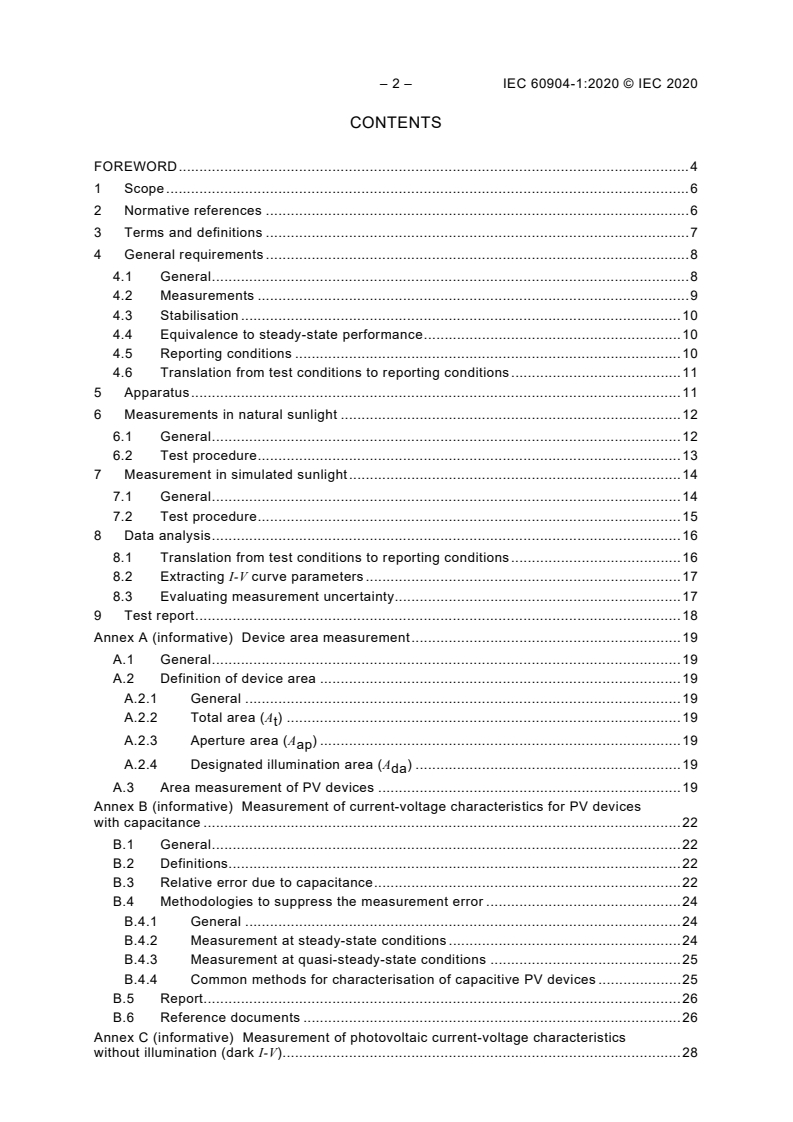
– 2 – IEC 60904-1:2020 © IEC 2020
CONTENTS
FOREWORD . 4
1 Scope . 6
2 Normative references . 6
3 Terms and definitions . 7
4 General requirements . 8
4.1 General . 8
4.2 Measurements . 9
4.3 Stabilisation . 10
4.4 Equivalence to steady-state performance . 10
4.5 Reporting conditions . 10
4.6 Translation from test conditions to reporting conditions . 11
5 Apparatus . 11
6 Measurements in natural sunlight . 12
6.1 General . 12
6.2 Test procedure . 13
7 Measurement in simulated sunlight . 14
7.1 General . 14
7.2 Test procedure . 15
8 Data analysis . 16
8.1 Translation from test conditions to reporting conditions . 16
8.2 Extracting I-V curve parameters . 17
8.3 Evaluating measurement uncertainty. 17
9 Test report . 18
Annex A (informative) Device area measurement . 19
A.1 General . 19
A.2 Definition of device area . 19
A.2.1 General . 19
A.2.2 Total area (A ) . 19
t
A.2.3 Aperture area (A ) . 19
ap
A.2.4 Designated illumination area (A ) . 19
da
A.3 Area measurement of PV devices . 19
Annex B (informative) Measurement of current-voltage characteristics for PV devices
with capacitance . 22
B.1 General . 22
B.2 Definitions. 22
B.3 Relative error due to capacitance . 22
B.4 Methodologies to suppress the measurement error . 24
B.4.1 General . 24
B.4.2 Measurement at steady-state conditions . 24
B.4.3 Measurement at quasi-steady-state conditions . 25
B.4.4 Common methods for characterisation of capacitive PV devices . 25
B.5 Report. 26
B.6 Reference documents . 26
Annex C (informative) Measurement of photovoltaic current-voltage characteristics
without illumination (dark I-V). 28
C.1 General . 28
C.2 Apparatus . 29
C.3 Procedure . 29
C.3.1 General . 29
C.3.2 Dark I-V curve measurements . 30
Annex D (informative) Influence of spatial non-uniformity of irradiance on I-V curve
parameters . 31
D.1 General . 31
D.2 Reference documents . 32
Bibliography . 33
Figure 1 – Schematic current-voltage characteristic (I-V curve) depicting typical I-V
curve parameters short-circuit current (I ), open-circuit voltage (V ), maximum
sc oc
power (P ), voltage at maximum power (V ) and current at maximum power
max Pmax
(I ). 8
Pmax
Figure 2 – Schematic power-voltage characteristic (P-V curve) depicting typical I-V
curve parameters open-circuit voltage (V ), maximum power (P ) and voltage at
oc max
maximum power (V ) . 9
Pmax
Figure A.1 – PV module (rectangular) . 20
Figure A.2 – PV module of different geometries (pentagon, trapezoid) . 20
Figure A.3 – PV cell (cut corners) . 21
Figure A.4 – PV cell (rounded corners, circle) . 21
Figure B.1 – Equivalent circuit diagram for device exhibiting a capacitance effect . 23
Figure B.2 – Three I-V curves (steady-state, forward sweep and reverse sweep)
showing the effect of device capacitance on the curve shape . 23
Figure B.3 – Deviation of maximum power (P ) determined from I-V curve due to
max
the effect of device capacitance with respect to steady-state result as a function of
sweep rate . 24
Figure C.1 – I-V characteristics without illumination (dark I-V curve) . 28
Figure C.2 – I-V characteristics under illumination (I-V curve) . 29
Figure D.1 – Monte-Carlo simulation of a 60-cell PV module with high shunt cell type . 32
– 4 – IEC 60904-1:2020 © IEC 2020
INTERNATIONAL ELECTROTECHNICAL COMMISSION
____________
PHOTOVOLTAIC DEVICES –
Part 1: Measurement of photovoltaic current-voltage characteristics
FOREWORD
1) The International Electrotechnical Commission (IEC) is a worldwide organization for standardization comprising
all national electrotechnical committees (IEC National Committees). The object of IEC is to promote international
co-operation on all questions concerning standardization in the electrical and electronic fields. To this end and
in addition to other activities, IEC publishes International Standards, Technical Specifications, Technical Reports,
Publicly Available Specifications (PAS) and Guides (hereafter referred to as “IEC Publication(s)”). Their
preparation is entrusted to technical committees; any IEC National Committee interested in the subject dealt with
may participate in this preparatory work. International, governmental and non-governmental organizations liaising
with the IEC also participate in this preparation. IEC collaborates closely with the International Organization for
Standardization (ISO) in accordance with conditions determined by agreement between the two organizations.
2) The formal decisions or agreements of IEC on technical matters express, as nearly as possible, an international
consensus of opinion on the relevant subjects since each technical committee has representation from all
interested IEC National Committees.
3) IEC Publications have the form of recommendations for international use and are accepted by IEC National
Committees in that sense. While all reasonable efforts are made to ensure that the technical content of IEC
Publications is accurate, IEC cannot be held responsible for the way in which they are used or for any
misinterpretation by any end user.
4) In order to promote international uniformity, IEC National Committees undertake to apply IEC Publications
transparently to the maximum extent possible in their national and regional publications. Any divergence between
any IEC Publication and the corresponding national or regional publication shall be clearly indicated in the latter.
5) IEC itself does not provide any attestation of conformity. Independent certification bodies provide conformity
assessment services and, in some areas, access to IEC marks of conformity. IEC is not responsible for any
services carried out by independent certification bodies.
6) All users should ensure that they have the latest edition of this publication.
7) No liability shall attach to IEC or its directors, employees, servants or agents including individual experts and
members of its technical committees and IEC National Committees for any personal injury, property damage or
other damage of any nature whatsoever, whether direct or indirect, or for costs (including legal fees) and
expenses arising out of the publication, use of, or reliance upon, this IEC Publication or any other IEC Publications.
8) Attention is drawn to the Normative references cited in this publication. Use of the referenced publications is
indispensable for the correct application of this publication.
9) Attention is drawn to the possibility that some of the elements of this IEC Publication may be the subject of patent
rights. IEC shall not be held responsible for identifying any or all such patent rights.
International Standard IEC 60904-1 has been prepared by IEC technical committee 82: Solar
photovoltaic energy systems.
This third edition cancels and replaces the second edition published in 2006. This edition
constitutes a technical revision.
The main changes with respect to the previous edition are as follows:
• Updated scope to include all conditions.
• Added terms and definitions.
• Reorganised document to avoid unnecessary duplication.
• Added data analysis clause.
• Added informative annexes (area measurement, PV devices with capacitance, dark I-V
curves and effect of spatial non-uniformity of irradiance).
The text of this International Standard is based on the following documents:
FDIS Report on voting
82/1760/FDIS 82/1786/RVD
Full information on the voting for the approval of this International Standard can be found in the
report on voting indicated in the above table.
This document has been drafted in accordance with the ISO/IEC Directives, Part 2.
A list of all parts of IEC 60904 series, under the general title Photovoltaic devices, can be found
on the IEC website.
The committee has decided that the contents of this document will remain unchanged until the
stability date indicated on the IEC website under "http://webstore.iec.ch" in the data related to
the specific document. At this date, the document will be
• reconfirmed,
• withdrawn,
• replaced by a revised edition, or
• amended.
IMPORTANT – The 'colour inside' logo on the cover page of this publication indicates
that it contains colours which are considered to be useful for the correct understanding
of its contents. Users should therefore print this document using a colour printer.
– 6 – IEC 60904-1:2020 © IEC 2020
PHOTOVOLTAIC DEVICES –
Part 1: Measurement of photovoltaic current-voltage characteristics
1 Scope
This part of IEC 60904 describes procedures for the measurement of current-voltage
characteristics (I-V curves) of photovoltaic (PV) devices in natural or simulated sunlight. These
procedures are applicable to a single PV solar cell, a sub-assembly of PV solar cells, or a PV
module. They are applicable to single-junction mono-facial PV devices. For other device types,
reference is made to the respective documents, in particular for multi-junction devices to
IEC 60904-1-1 and for bifacial devices to IEC TS 60904-1-2. Additionally informative annexes
are provided concerning area measurement of PV devices (Annex A), PV devices with
capacitance (Annex B), measurement of dark current-voltage characteristics (dark I-V curves)
(Annex C) and effects of spatial non-uniformity of irradiance (Annex D).
NOTE The methods provided in this document can also be used as guidance for taking I-V curves of PV arrays. For
on-site measurement refer to IEC 61829.
This document is applicable to non-concentrating PV devices for use in terrestrial environments,
with reference to (usually but not exclusively) the global reference spectral irradiance AM1.5
defined in IEC 60904-3. It may also be applicable to PV devices for use under concentrated
irradiation if the application uses direct sunlight and reference is instead made to the direct
reference spectral irradiance AM1.5d in IEC 60904-3.
The purposes of this document are to lay down basic requirements for the measurement of I-V
curves of PV devices, to define procedures for different measuring techniques in use and to
show practices for minimising measurement uncertainty. It is applicable to the measurement of
I-V curves in general. I-V measurements can have various purposes, such as calibration (i.e.
traceable measurement with stated uncertainty, usually performed at standard test conditions)
of a PV device under test against a reference device, performance measurement under various
conditions (e.g. for device temperature and irradiance) such as those required by IEC 60891
(for determination of temperature coefficients or internal series resistance), by IEC 61853-1
(power rating of PV devices) or by IEC 60904-10 (for determination of output’s linear
dependence and linearity with respect to a particular test parameter). I-V measurements are
also important in industrial environments such as PV module production facilities, and for testing
in the field. Further guidance on I-V measurements in production facilities is provided in
IEC TR 60904-14.
The actual requirements (e.g. for the class of solar simulator) depend on the end-use. Other
standards referring to IEC 60904-1 can stipulate specific requirements. Where those
requirements are in conflict with this document, the specific requirements take precedence.
2 Normative references
The following documents are referred to in the text in such a way that some or all of their content
constitutes requirements of this document. For dated references, only the edition cited applies.
For undated references, the latest edition of the referenced document (including any
amendments) applies.
IEC 60891, Photovoltaic devices – Procedures for temperature and irradiance corrections to
measured I-V characteristics
IEC 60904-2, Photovoltaic devices – Part 2: Requirements for reference devices
IEC 60904-3, Photovoltaic devices – Part 3: Measurement principles for terrestrial photovoltaic
(PV) solar devices with reference spectral irradiance data
IEC 60904-4, Photovoltaic devices – Part 4: Photovoltaic reference devices – Procedures for
establishing calibration traceability
IEC 60904-5, Photovoltaic devices – Part 5: Determination of the equivalent cell temperature
(ECT) of photovoltaic (PV) devices by the open-circuit voltage method
IEC 60904-7, Photovoltaic devices – Part 7: Computation of the spectral mismatch correction
for measurements of photovoltaic devices
IEC 60904-9, Photovoltaic devices – Part 9: Solar simulator performance requirements
IEC 60904-10, Photovoltaic devices – Part 10: Methods of linearity measurement
IEC TR 60904-14, Photovoltaic devices – Part 14: Guidelines for production line measurements
of single-junction PV module maximum power output and reporting at standard test conditions
IEC 61215 (all parts), Terrestrial photovoltaic (PV) modules – Design qualification and type
approval
IEC TS 61836, Solar photovoltaic energy systems – Terms, definitions and symbols
IEC 61853-1, Photovoltaic (PV) module performance testing and energy rating – Part 1:
Irradiance and temperature performance measurements and power rating
IEC TR 63228, Measurement protocols for photovoltaic devices based on organic, dye-
sensitized or perovskite materials
ISO 9060, Solar energy – Specification and classification of instruments for measuring
hemispherical solar and direct solar radiation
3 Terms and definitions
For the purposes of this document, the terms and definitions given in IEC TS 61836 and the
following apply.
ISO and IEC maintain terminological databases for use in standardization at the following
addresses:
• IEC Electropedia: available at http://www.electropedia.org/
• ISO Online browsing platform: available at http://www.iso.org/obp
3.1
sweep rate
temporal rate of change of the voltage applied to the measured PV device
Note 1 to entry: The term ramp rate is also used interchangeably.
3.2
sweep direction
direction of change of applied voltage during I-V measurements; a positive sweep rate is
referred to as forward or direct sweep (I to V direction), while a negative sweep rate is
sc oc
referred to as reverse or backward sweep (V to I direction)
oc sc
– 8 – IEC 60904-1:2020 © IEC 2020
3.3
time delay
time interval between the change of voltage applied to PV device and the measurement of PV
device current
4 General requirements
4.1 General
For illustration purposes a schematic current-voltage characteristic (I-V curve) is shown in
Figure 1 and the corresponding power-voltage characteristic (P-V curve) in Figure 2.
Figure 1 – Schematic current-voltage characteristic (I-V curve) depicting typical I-V
curve parameters short-circuit current (I ), open-circuit voltage (V ), maximum power
sc oc
(P ), voltage at maximum power (V ) and current at maximum power (I )
max Pmax Pmax
Figure 2 – Schematic power-voltage characteristic (P-V curve) depicting
typical I-V curve parameters open-circuit voltage (V ), maximum power (P )
oc max
)
and voltage at maximum power (V
Pmax
4.2 Measurements
a) When the measurements are intended to be reported at standard test conditions (see 4.5)
−2
the in-plane average irradiance during measurement shall be between 800 W∙m and
−2
1 200 W∙m to minimise errors arising from large corrections.
b) Temperature sensors should be located so as to detect as closely as possible the
temperature of the respective device cell junction. If a temperature gradient between the
sensor and the cell junction is suspected, an appropriate contribution to the measurement
uncertainty should be included. Consideration should also be given to any possible non-
uniformity of temperature across either device, particularly for PV modules, where the
temperature of individual cells can vary due to their electrical characteristics, particularly
when the module is illuminated under short-circuit conditions. The Equivalent Cell
Temperature (ECT) method specified in IEC 60904-5 can be useful in dealing with either a
temperature gradient or temperature non-uniformity. The cooling effect from airflow (for
example due to wind during outdoor measurement or due to air conditioning of the room for
indoor measurements) on the temperature sensors should be considered in the uncertainty
of the temperature measurement.
c) The active surface of the device under test shall be coplanar within ±2° with the active
surface of the reference device.
d) Voltages and currents shall be measured using independent leads from the terminals of the
device under test and keeping them as short as possible. If the device under test is a module,
a subassembly or an encapsulated solar cell, the 4-wire connection should start at the
terminals or connectors. If the device under test is a bare PV cell, the 4-wire connection
should start at the cell bus bars. The connection method for bare cells (i.e. provided without
connectors) should be carefully evaluated. Differences can occur if soldered tabs are used
compared with non-soldered methods such as bars having contact springs or conductive
plates having a large-area contact with the cell back contact. Non-soldered methods can
result in higher fill factors than are observed in the module. The contacting method should
be appropriate to the intended use of the cell or of the measurement. The contact method
used (bare cells) or the contact point (modules) for 4-wire connection shall be stated in the
report. For bare solar cells without busbars or cells with low surface conductivity such as
multi-busbar cells, 4-wire connection should start at the contacting structure in order to
avoid artificially increased fill factors in the measurement caused by voltage drop at the
resistance between current and voltage probe on the cell. Possible deviations between the
– 10 – IEC 60904-1:2020 © IEC 2020
calibration of the measurement system (typically under static load conditions) and its use
during I-V curve measurements (dynamic load conditions) shall be considered.
e) The I-V curve should be measured such that both the short-circuit current point and the
open-circuit voltage point fall within the bounds of the data set, including after correction to
the reporting conditions (Clause 8). For possible extrapolation to calculate these points from
measured data, see Clause 8.
f) The I-V curve can also be measured without illumination (dark I-V) (see Annex C), but this
is generally not required.
4.3 Stabilisation
Care shall be taken in measuring PV devices that are metastable. If it is possible to stabilise
the device, stabilisation should be performed before any characterisation (I-V or spectral
responsivity measurement). Any stabilisation procedure performed shall be reported together
with the test results. The IEC 61215 series of standards provides guidance on technology-
dependent appropriate stabilisation. In the case of a stabilisation procedure being applied, the
device under test should be measured before and after the procedure. The change in I-V
characteristic parameters should be evaluated and included in the report.
If it is not possible to stabilise the device, or stabilisation was not attempted, this shall be
indicated in the measurement report.
4.4 Equivalence to steady-state performance
The I-V characteristic for the device under test shall be measured such that it reflects, as closely
as possible, the performance of the device under steady-state conditions, i.e. where there is no
influence due to drifts in irradiance or device temperature or the voltage sweep rate. Sweep
rate effects occur when the voltage bias is stepped or swept too rapidly for the device response
to equilibrate for each measurement of the current. This effect can be due to device capacitance,
as is the case for some crystalline silicon PV devices, or it can be due to a more complex device
response, as is frequently observed in some thin-film devices such as perovskite cells, see
IEC TR 63228.
Errors due to PV device capacitance are related to the combination of the PV technology and
I-V curve measurement parameters (sweep direction, time delay per measurement point,
number of pulses (in multiple-pulse method) and rate of change of applied voltage, current or
irradiance). The errors due to PV device capacitance are normally most pronounced for the
maximum-power point and the open-circuit voltage of the I-V curve, whereas errors in short-
circuit current due to capacitance are in general minimal. More guidance on ensuring that the
measurement approximates steady-state conditions is provided in Annex B.
The contribution of transient effects to the overall measurement uncertainty shall be considered.
4.5 Reporting conditions
In general, test results are reported for various conditions. The three main parameters that shall
be reported together with any test result are:
a) Total in-plane irradiance.
b) Spectral irradiance in the test plane (graph or table), if spectral mismatch corrections are
required.
c) Cell junction temperature of the device under test.
The most common reporting conditions are the Standard Test Conditions (STC), which are
−2
1 000 W∙m total in-plane irradiance with a spectral irradiance distribution as defined in
IEC 60904-3 (global) and 25 °C cell junction temperature. However, sometimes the test result
is desired at other conditions. For any test result the three main reporting parameters listed
above shall be clearly indicated.
4.6 Translation from test conditions to reporting conditions
At times, the test conditions at which an I-V curve is measured are different from those at which
the test results are reported. Therefore, an I-V curve translation from the test conditions to the
reporting conditions can be required. This translation shall be made according to IEC 60891
(irradiance and temperature correction) in conjunction with IEC 60904-7 (correction for spectral
mismatch) and IEC 60904-10 (correction for non-linearity). Module characteristic parameters
(e.g. series resistance or temperature coefficients) can considerably affect the result if
temperature and irradiance corrections are performed across wide ranges. Therefore, care shall
be taken regarding the applicability of the I-V curve translation procedure according to
IEC 60891 and the relevance of the module parameters used in the I-V curve translation
procedure. Also, their contribution to uncertainty in the translated I-V curve shall be considered.
The contribution to measurement uncertainty due to the deviation of test conditions from
reporting conditions shall be evaluated.
For an I-V curve measurement to be referred to the reporting spectral irradiance, two correction
methods are available (IEC 60904-7):
a) If possible, adjust the total in-plane irradiance, e.g. by adjusting the solar simulator’s
intensity, so that the effective irradiance as determined according to IEC 60904-7 equals
the reporting irradiance. Proceed to measure the I-V curve as per Clause 6 or Clause 7.
b) Otherwise, measure the I-V curve as per Clause 6 or Clause 7 using the given irradiance.
Determine the effective irradiance at the reporting spectral irradiance using IEC 60904-7.
Then translate the I-V curve to the reporting irradiance using IEC 60891 with the effective
irradiance so determined.
If the reference device and the device under test are constructed using the same cell technology
and encapsulation package (Clause 5 a)), the irradiance measured by the reference device and
the effective irradiance max be assumed identical.
Method a) is preferred for simulated sunlight, as the actual measurement is performed at the
correct short-circuit current or maximum power, thus minimising errors and uncertainties arising
from translating the I-V curves. Method b) is usually chosen for measurements in natural
sunlight, as the light's spectral content and total in-plane irradiance cannot be easily controlled.
5 Apparatus
The following equipment is required to measure I-V curves:
a) For measuring the irradiance: a PV reference device packaged and calibrated in
conformance with IEC 60904-2 or in the case of natural sunlight alternatively a pyranometer
in conformance with ISO 9060. The calibration of either device for measuring the irradiance
shall be traceable according to IEC 60904-4. The output of the reference device shall be
linear with respect to incident irradiance as defined in IEC 60904-10 over the irradiance
range of interest. A spectral mismatch correction shall be performed in conformance with
IEC 60904-7 and reported with the measurement results. Alternatively, the reference device
shall be constructed using the same cell technology and encapsulation package as the
device under test. This includes the glass (type, thickness, texturing, and spectral
transmission), anti-reflective coatings, encapsulant, and backsheet (type, colour, and
spectral back-reflection). The stability of the reference device shall be assessed before it is
used for the measurements of the device under test.
– 12 – IEC 60904-1:2020 © IEC 2020
b) For monitoring the temporal fluctuations of irradiance: An irradiance monitor that tracks the
instantaneous irradiance during the acquisition of I-V curves. This irradiance monitor should
have an output linear with respect to incident irradiance according to IEC 60904-10 in the
range of irradiances over which the measurements are taken and a time response
sufficiently fast to be able to reveal temporal fluctuations in the incident irradiance. The data
recorded from the irradiance monitor shall be used to evaluate the stability criteria and to
correct the temporal instability of the total in-plane irradiance for each data point of the I-V
curve as well as to correct for variations in irradiance for the consecutive measurements in
case strategy 7.1 b) is followed. The reference device may serve as such an irradiance
monitor if it fulfils the above requirements and if it can be measured concurrently with the
device under test (measurement strategy 7.1 a)).
c) For measuring the temperature of the reference device and of the device under test:
temperature sensors and instrumentation with instrumental measurement uncertainty of
1 °C or less. Temperature measurement of the reference device is not required if it is a
pyranometer.
d) For measuring voltages and currents: instrumentation with instrumental measurement
uncertainty of 0,2 % or less of the open-circuit voltage and short-circuit current. The
measurement ranges of the data acquisition should be carefully chosen.
e) For measurement in simulated sunlight: a solar simulator classified in accordance with
IEC 60904-9, i.e. with Class CCC or better. The actual solar simulator requirements depend
on the end-use. Other standards referring to IEC 60904-1 can require different classes.
Therefore, the classes of the solar simulator to be used should reflect the requirements
specific to the case. The designated test area shall be equal to or greater than the area that
is spanned by the device under test (including its frame or package) and the irradiance
monitor.
EXAMPLE 1 IEC 60891 requires a class BBB solar simulator for determination of temperature coefficients.
EXAMPLE 2 IEC 60904-2 requires a class AAA solar simulator for calibration of secondary reference devices
against primary reference cell.
f) For measurement under natural sunlight: a two-axis solar tracking system to hold the device
under test plus the reference device and capable of tracking the sun with a maximum
deviation of ±5° (for PV calibration) or a fixed rack mounting (e.g. for energy rating and
monitoring). The two-axis solar tracking system is required for PV calibration, but at choice
of the user it may be used for other types of measurements, like for example the power
rating of PV modules. In any case for the alignment between reference device and device
under test refer to 4.2 c) .
g) For spectral mismatch corrections and effective irradiance calculation (if required): a
spectroradiometer in accordance with the requirements in IEC 60904-9 capable of
measuring the spectral irradiance of the natural or simulated sunlight in the range of the
spectral responsivity of the device under test and the reference device. For simulated
sunlight, care should be taken in the use of lamps with narrow intense peaks in their spectral
irradiance, such as Xenon lamps or some LEDs, when testing PV cells with spectral
responsivity showing a significant dependence on temperature. As the band gap changes
due to temperature, the device responsivity can pass through various emission lines in the
lamp spectral irradiance and give rise to large variations in spectral mismatch and shifts in
performance.
EXAMPLE 3 Crystalline silicon is a well-known example of an indirect bandgap material that shows a spectral
responsivity strongly dependent on temperature.
6 Measurements in natural sunlight
6.1 General
Measurements in natural sunlight shall be made only when global solar irradiance is stable
within ±1 % during the measurement of a complete I-V curve.
Two types of measurements should be distinguished. Firstly, the measurement of the electrical
performance of the device under test that is normally aimed at reporting at STC (conditions for
typical PV calibration), but sometimes also at other relevant conditions (e.g. for power rating as
described in IEC 61853-1). In this case, the device under test and the reference devices are
mounted on a two-axis tracking system. Secondly, the measurement of electrical performance
over time, normally aimed at energy rating and monitoring of devices under test. In this case,
normally the device under test and the reference device(s) are mounted on a fixed rack (to
simulate the conditions in a real-world PV system installation or to periodically measure
installed PV modules). This document applies to both types of measurement and therefore, in
the following, the respective list items of the test procedure have to be understood for either
case, if not otherwise specified. In any case care shall be taken to avoid shadowing or reflected
light from the surroundings (e.g. from windows or glossy metal parts) on both the reference
device and the device under test.
6.2 Test procedure
The test procedure is as follows:
a) Mount the reference device as near as possible to the device under test. For PV calibration
or power rating by use of solar tracker, both shall be normal to the direct solar beam within
±5°. For the alignment between reference device and device under test refer to 4.2 c).
Connect to the necessary instrumentation.
b) If the device under test and reference device are equipped with temperature controllers, set
them at the desired level. The temperature of the reference device should be brought and
kept as close as possible to the temperature at which it was calibrated and the temperature
of the device under test to the desired reporting temperature. If active temperature
controllers are not available, the latter may be achieved by bringing the device under test
to a point below the target temperature and letting it warm up naturally under the natural
sunlight in combination with temporary shading. In general, there can be differences
between average device temperature and average sensor temperature during warming up.
Therefore, either correction or proper accounting for it in the uncertainty calculation shall
be done.
c) Sweep through the I-V curve and take readings of the current and voltage of the device
under test concurrently with recording the output of the reference device. The temperature
of both devices shall also be recorded, but one measurement for each device during the
acquisition of the I-V curve or immediately before or afterwards is sufficient. In general, the
temperature should be measured as close to the V condition as possible. In most cases
oc
the thermal inertia of the device under test and the reference device will limit the
temperature rise during the first few seconds after removing the shade and their
temperatures will remain reasonably uniform. However, the variation of temperatures for the
de
...