

IEC 61968-3:2004
(Main)Application integration at electric utilities - System interfaces for distribution management - Part 3: Interface for network operations
General Information
- Abstract
Specifies the information content of a set of message types that can be used to support many of the business functions related to network operations. Typical uses of the message types defined in this part include data acquisition by external systems, fault isolation, fault restoration, trouble management, maintenance of the plant, and the commissioning of the plant.
This publication is of core relevance for Smart Grid.
- Status
- Published
- Publication Date
- 07-Mar-2004
- Technical Committee
- TC 57 - Power systems management and associated information exchange
- Drafting Committee
- WG 14 - TC 57/WG 14
- Current Stage
- DELPUB - Deleted Publication
- Start Date
- 11-Apr-2017
- Completion Date
- 28-Aug-2026
Overview
IEC 61968-3:2004 - "Application integration at electric utilities: System interfaces for distribution management - Part 3: Interface for network operations" - defines the information content of standardized message types used to support core network operations in distribution utilities. Part of the IEC 61968 series for Distribution Management Systems (DMS), this standard is implementation‑independent and focused on inter-application integration, enabling interoperability among diverse systems in Smart Grid and utility environments.
Key topics and requirements
- Message-type definitions: Standardized structures for messages used in network operations (e.g., MeasurementList, OperationalRestriction, OutageRecord, SafetyDocument, SwitchingSchedule).
- Static information model: Fields and data types are drawn from Common Information Model (CIM) classes to ensure consistency across messages.
- Interface Reference Model (IRM): Logical partitioning of DMS business functions and components used as the basis for message design.
- Loose coupling and middleware: Designed for inter-application messaging across heterogeneous platforms and languages (suitable for middleware-based message exchange rather than tight, in-process integrations).
- Operational scope: Supports data acquisition, fault isolation/restoration, trouble and outage management, plant maintenance, and commissioning.
- Message usage and formats: Guidance on message verbs, common fields, compliance and naming conventions to facilitate consistent implementations.
- Normative references: Builds on IEC 61968-1 (interface architecture) and references IEC 61850-7-4 for compatible logical node/data classes.
Practical applications
- Real-time and near-real-time exchange of operational documents and telemetry between DMS, SCADA, outage management systems (OMS), workforce management, and third‑party service providers.
- Automating outage reporting, fault restoration workflows, switching schedules, and safety permits.
- Enabling consistent data acquisition for analytics, grid monitoring, and Smart Grid applications where messages may be exchanged every few seconds, minutes, or hours.
- Integration of legacy and new systems across different vendors to support interoperable Smart Grid deployments.
Who uses this standard
- Utility IT architects and integration teams
- DMS/SCADA/OMS vendors and system integrators
- Smart Grid project managers and consultants
- Operations and outage management stakeholders planning cross-system workflows
Related standards
- IEC 61968-1 - Interface architecture and general requirements (core IRM)
- IEC 61968-2 - Glossary
- IEC 61968-4 - Records and asset management (related interfaces)
- IEC 61850-7-4 - Substation logical node/data class compatibility (referenced for data modeling)
IEC 61968-3 is a core reference for achieving interoperable, message-driven network operations in modern distribution utilities and Smart Grid projects.
Relations
- Effective Date
- 05-Sep-2023
Get Certified
Connect with accredited certification bodies for this standard

ANCE
Mexican certification and testing association.

Intertek Slovenia
Intertek testing, inspection, and certification services in Slovenia.

LNE (Laboratoire National de Métrologie et d'Essais)
French national laboratory for metrology and testing.
Sponsored listings
Frequently Asked Questions
IEC 61968-3:2004 is a standard published by the International Electrotechnical Commission (IEC). Its full title is "Application integration at electric utilities - System interfaces for distribution management - Part 3: Interface for network operations". This standard covers: Specifies the information content of a set of message types that can be used to support many of the business functions related to network operations. Typical uses of the message types defined in this part include data acquisition by external systems, fault isolation, fault restoration, trouble management, maintenance of the plant, and the commissioning of the plant. This publication is of core relevance for Smart Grid.
Specifies the information content of a set of message types that can be used to support many of the business functions related to network operations. Typical uses of the message types defined in this part include data acquisition by external systems, fault isolation, fault restoration, trouble management, maintenance of the plant, and the commissioning of the plant. This publication is of core relevance for Smart Grid.
IEC 61968-3:2004 is classified under the following ICS (International Classification for Standards) categories: 33.200 - Telecontrol. Telemetering. The ICS classification helps identify the subject area and facilitates finding related standards.
IEC 61968-3:2004 has the following relationships with other standards: It is inter standard links to IEC 61968-3:2017. Understanding these relationships helps ensure you are using the most current and applicable version of the standard.
IEC 61968-3:2004 is available in PDF format for immediate download after purchase. The document can be added to your cart and obtained through the secure checkout process. Digital delivery ensures instant access to the complete standard document.
Standards Content (Sample)
INTERNATIONAL IEC
STANDARD 61968-3
First edition
2004-03
Application integration at electric utilities –
System interfaces for distribution management –
Part 3:
Interface for network operations
Reference number
Publication numbering
As from 1 January 1997 all IEC publications are issued with a designation in the
60000 series. For example, IEC 34-1 is now referred to as IEC 60034-1.
Consolidated editions
The IEC is now publishing consolidated versions of its publications. For example,
edition numbers 1.0, 1.1 and 1.2 refer, respectively, to the base publication, the
base publication incorporating amendment 1 and the base publication incorporating
amendments 1 and 2.
Further information on IEC publications
The technical content of IEC publications is kept under constant review by the IEC,
thus ensuring that the content reflects current technology. Information relating to
this publication, including its validity, is available in the IEC Catalogue of
publications (see below) in addition to new editions, amendments and corrigenda.
Information on the subjects under consideration and work in progress undertaken
by the technical committee which has prepared this publication, as well as the list
of publications issued, is also available from the following:
• IEC Web Site (www.iec.ch)
• Catalogue of IEC publications
The on-line catalogue on the IEC web site (www.iec.ch/searchpub) enables you to
search by a variety of criteria including text searches, technical committees
and date of publication. On-line information is also available on recently issued
publications, withdrawn and replaced publications, as well as corrigenda.
• IEC Just Published
This summary of recently issued publications (www.iec.ch/online_news/ justpub)
is also available by email. Please contact the Customer Service Centre (see
below) for further information.
• Customer Service Centre
If you have any questions regarding this publication or need further assistance,
please contact the Customer Service Centre:
Email: custserv@iec.ch
Tel: +41 22 919 02 11
Fax: +41 22 919 03 00
INTERNATIONAL IEC
STANDARD 61968-3
First edition
2004-03
Application integration at electric utilities –
System interfaces for distribution management –
Part 3:
Interface for network operations
IEC 2004 Copyright - all rights reserved
No part of this publication may be reproduced or utilized in any form or by any means, electronic or
mechanical, including photocopying and microfilm, without permission in writing from the publisher.
International Electrotechnical Commission, 3, rue de Varembé, PO Box 131, CH-1211 Geneva 20, Switzerland
Telephone: +41 22 919 02 11 Telefax: +41 22 919 03 00 E-mail: inmail@iec.ch Web: www.iec.ch
PRICE CODE
Commission Electrotechnique Internationale W
International Electrotechnical Commission
МеждународнаяЭлектротехническаяКомиссия
For price, see current catalogue
– 2 – 61968-3 IEC:2004(E)
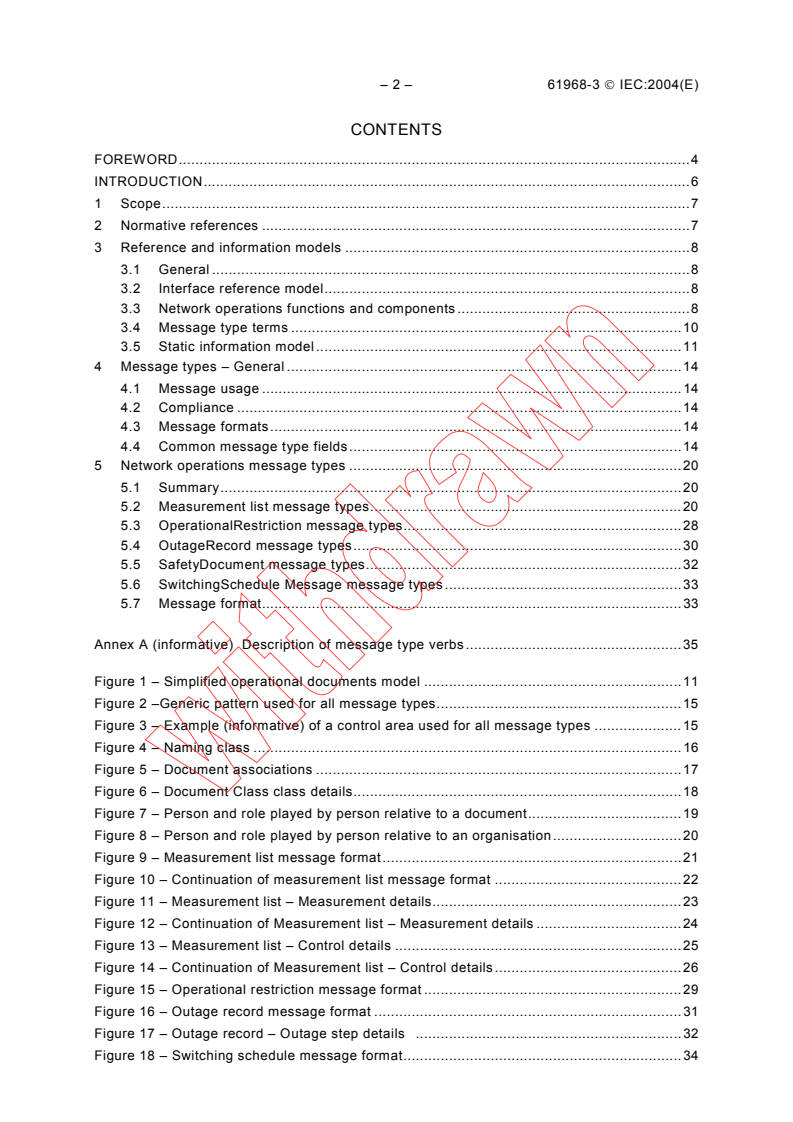
CONTENTS
FOREWORD.4
INTRODUCTION.6
1 Scope.7
2 Normative references.7
3 Reference and information models .8
3.1 General.8
3.2 Interface reference model.8
3.3 Network operations functions and components .8
3.4 Message type terms.10
3.5 Static information model.11
4 Message types – General .14
4.1 Message usage.14
4.2 Compliance.14
4.3 Message formats.14
4.4 Common message type fields.14
5 Network operations message types .20
5.1 Summary.20
5.2 Measurement list message types.20
5.3 OperationalRestriction message types.28
5.4 OutageRecord message types.30
5.5 SafetyDocument message types.32
5.6 SwitchingSchedule Message message types .33
5.7 Message format.33
Annex A (informative) Description of message type verbs.35
Figure 1 – Simplified operational documents model .11
Figure 2 –Generic pattern used for all message types.15
Figure 3 – Example (informative) of a control area used for all message types .15
Figure 4 – Naming class .16
Figure 5 – Document associations .17
Figure 6 – Document Class class details.18
Figure 7 – Person and role played by person relative to a document.19
Figure 8 – Person and role played by person relative to an organisation.20
Figure 9 – Measurement list message format.21
Figure 10 – Continuation of measurement list message format .22
Figure 11 – Measurement list – Measurement details.23
Figure 12 – Continuation of Measurement list – Measurement details .24
Figure 13 – Measurement list – Control details .25
Figure 14 – Continuation of Measurement list – Control details.26
Figure 15 – Operational restriction message format .29
Figure 16 – Outage record message format .31
Figure 17 – Outage record – Outage step details .32
Figure 18 – Switching schedule message format.34
61968-3 IEC:2004(E) – 3 –
Table 1 – Document overview for IEC 61968-3 .6
Table 2 – Business functions for network operations.9
Table 3 – Classes for Network Operations .12
Table 4 – Classes related to network operations .13
Table 5 – Recommended measurement names.26
Table A.1 – Commonly used verbs.35
– 4 – 61968-3 IEC:2004(E)
INTERNATIONAL ELECTROTECHNICAL COMMISSION
____________
APPLICATION INTEGRATION AT ELECTRIC UTILITIES –
SYSTEM INTERFACES FOR DISTRIBUTION MANAGEMENT –
Part 3: Interface for network operations
FOREWORD
1) The International Electrotechnical Commission (IEC) is a worldwide organization for standardization comprising
all national electrotechnical committees (IEC National Committees). The object of IEC is to promote
international co-operation on all questions concerning standardization in the electrical and electronic fields. To
this end and in addition to other activities, IEC publishes International Standards, Technical Specifications,
Technical Reports, Publicly Available Specifications (PAS) and Guides (hereafter referred to as “IEC
Publication(s)”). Their preparation is entrusted to technical committees; any IEC National Committee interested
in the subject dealt with may participate in this preparatory work. International, governmental and non-
governmental organizations liaising with the IEC also participate in this preparation. IEC collaborates closely
with the International Organization for Standardization (ISO) in accordance with conditions determined by
agreement between the two organizations.
2) The formal decisions or agreements of IEC on technical matters express, as nearly as possible, an international
consensus of opinion on the relevant subjects since each technical committee has representation from all
interested IEC National Committees.
3) IEC Publications have the form of recommendations for international use and are accepted by IEC National
Committees in that sense. While all reasonable efforts are made to ensure that the technical content of IEC
Publications is accurate, IEC cannot be held responsible for the way in which they are used or for any
misinterpretation by any end user.
4) In order to promote international uniformity, IEC National Committees undertake to apply IEC Publications
transparently to the maximum extent possible in their national and regional publications. Any divergence
between any IEC Publication and the corresponding national or regional publication shall be clearly indicated in
the latter.
5) IEC provides no marking procedure to indicate its approval and cannot be rendered responsible for any
equipment declared to be in conformity with an IEC Publication.
6) All users should ensure that they have the latest edition of this publication.
7) No liability shall attach to IEC or its directors, employees, servants or agents including individual experts and
members of its technical committees and IEC National Committees for any personal injury, property damage or
other damage of any nature whatsoever, whether direct or indirect, or for costs (including legal fees) and
expenses arising out of the publication, use of, or reliance upon, this IEC Publication or any other IEC
Publications.
8) Attention is drawn to the Normative references cited in this publication. Use of the referenced publications is
indispensable for the correct application of this publication.
9) Attention is drawn to the possibility that some of the elements of this IEC Publication may be the subject of
patent rights. IEC shall not be held responsible for identifying any or all such patent rights.
International Standard IEC 61968-3 has been prepared by IEC technical committee 57: Power
systems management and associated information exchange.
The text of this standard is based on the following documents:
FDIS Report on voting
57/694/FDIS 57/714/RVD
Full information on the voting for the approval of this standard can be found in the report on
voting indicated in the above table.
This publication has been drafted in accordance with the ISO/IEC Directives, Part 2.
61968-3 IEC:2004(E) – 5 –
IEC 61968 consists of the following parts under the general title Application integration at
electric utilities – System interfaces for distribution management:
Part 1: Interface architecture and general requirements
Part 2: Glossary
Part 3: Interface for network operations
Part 4: Interface for records and asset management
The committee has decided that the contents of this publication will remain unchanged until
2006. At this date, the publication will be
• reconfirmed;
• withdrawn;
• replaced by a revised edition, or
• amended.
A bilingual version of this publication may be issued at a later date.
———————
Under consideration.
– 6 – 61968-3 IEC:2004(E)
INTRODUCTION
The IEC 61968 series of standards is intended to facilitate inter-application integration as
opposed to intra-application integration. Intra-application integration is aimed at programs in
the same application system, usually communicating with each other using middleware that is
embedded in their underlying runtime environment, and tends to be optimised for close, real-
time, synchronous connections and interactive request/reply or conversation communication
models. IEC 61968, in contrast, is intended to support the inter-application integration of a
utility enterprise that needs to connect disparate applications that are already built or new
(legacy or purchased applications), each supported by dissimilar runtime environments.
Therefore, these interface standards are relevant to loosely coupled applications with more
heterogeneity in languages, operating systems, protocols and management tools. This series
of standards is intended to support applications that need to exchange data every few
seconds, minutes, or hours rather than waiting for a nightly batch run. This series of
standards, which are intended to be implemented with middleware services that exchange
messages among applications, will complement, but not replace utility data warehouses,
database gateways, and operational stores.
As used in IEC 61968, a Distribution Management System (DMS) consists of various
distributed application components for the utility to manage electrical distribution networks.
These capabilities include monitoring and control of equipment for power delivery,
management processes to ensure system reliability, voltage management, demand-side
management, outage management, work management, automated mapping and facilities
management. Standard interfaces are defined for each class of applications identified in the
Interface Reference Model (IRM), which is described in IEC 61968-1.
This Part of IEC 61968 contains the Clauses shown in Table 1.
Table 1 – Document overview for IEC 61968-3
Clause Title Purpose
1 Scope The scope and purpose of the document are described.
2 Normative references Documents that contain provisions which, through reference in
this text, constitute provisions of this International Standard.
3 Reference and information Description of the relevant parts of the interface reference
models model, static information model and message type naming
convention.
4 Message types – general Requirements common to all message types described in
Clause 5.
5 Network operations message Message types related to the exchange of information for
types operational documents namely operation restrictions, outage,
safety and switching schedule.
Annex A Message type verbs Description of the verbs that are used for the message types.
61968-3 IEC:2004(E) – 7 –
APPLICATION INTEGRATION AT ELECTRIC UTILITIES –
SYSTEM INTERFACES FOR DISTRIBUTION MANAGEMENT –
Part 3: Interface for network operations
1 Scope
The IEC 61968 series, taken as a whole, defines interfaces for the major elements of an
interface architecture for Distribution Management Systems (DMS). IEC 61968-1 identifies
and establishes requirements for standard interfaces based on an Interface Reference Model
(IRM). Parts 3 to 10 of the IEC 61968 series define interfaces relevant to each of the major
business functions described by the Interface Reference Model.
As used in the IEC 61968 series, a DMS consists of various distributed application
components for the utility to manage electrical distribution networks. These capabilities
include monitoring and control of equipment for power delivery, management processes to
ensure system reliability, voltage management, demand-side management, outage
management, work management, automated mapping and facilities management.
The IEC 61968 series is limited to the definition of interfaces and is implementation
independent. It provides for interoperability among different computer systems, platforms, and
languages. Methods and technologies used to implement a functionality conforming to these
interfaces are considered outside of the scope of the IEC 61968 series; only the interface
itself is specified in these standards.
This part specifies the information content of a set of message types that can be used to
support many of the business functions related to network operations. Typical uses of the
message types defined in this part include data acquisition by external systems, fault
isolation, fault restoration, trouble management, maintenance of the plant, and the
commissioning of the plant.
An additional part of IEC 61968 will document integration scenarios or use cases, which are
informative examples showing typical ways of using the message types defined in this
document as well as message types to be defined in other parts of the IEC 61968 series.
2 Normative references
The following referenced documents are indispensable for the application of this document.
For dated references, only the edition cited applies. For undated references, the latest edition
of the referenced document (including any amendments) applies.
IEC 61850-7-4:2003, Communication networks and systems in substations – Part 7-4: Basic
communication structure for substation and feeder equipment – Compatible logical node
classes and data classes
IEC 61968-1, System interfaces for distribution management – Part 1: Interface architecture
and general requirements
– 8 – 61968-3 IEC:2004(E)
3 Reference and information models
3.1 General
The message types defined in this document are based on a logical partitioning of the DMS
business functions and components called the IEC 61968 interface reference model.
The contents of the message types are based on a static information model to ensure
consistency of field names and data types. Each message type is defined as a set of fields
copied from Common Information Model (CIM) classes. The message types defined in this
standard are intended to satisfy a majority of typical applications. In some project
implementations, it may be desirable to modify the set of fields using a methodology such as
that described in IEC 61968-1.
3.2 Interface reference model
It is not the intention of this standard to define the applications and systems that vendors
should produce. It is expected that a concrete (physical) application will provide the
functionality of one or more abstract (logical) components as listed in this standard. These
abstract components are grouped by the business functions of the interface reference model.
In this standard, the term abstract component is used to refer to that portion of a software
system that supports one or more of the interfaces defined in Parts 3 to 10 of the IEC 61968
series. It does not necessarily mean that compliant software is delivered as separate
modules.
IEC 61968-1 describes infrastructure services common to all abstract components whilst
Parts 3 to 10 of the IEC 61968 series define the details of the information exchanged for
specific types of abstract component.
The IEC 61968 series defines that:
a) An inter-application infrastructure is compliant if it supplies services defined in IEC 61968-
1 to support at least two applications with interfaces compliant to IEC 61968 Parts
3 to 10.
b) An application interface is compliant if it supports the interface standards defined in IEC
61968 Parts 3 to 10 for the relevant abstract components defined in the interface
reference model.
c) An application is only required to support interface standards of the applicable
components listed under abstract components. It is not required to support interfaces
required by other abstract components of the same business sub-function or within the
same business function. While this standard primarily defines information exchanged
among components in different business functions, it will occasionally also define
information exchanged among components within a single business function when a
strong market need for this capability has been realised.
3.3 Network operations functions and components
The message types defined in IEC 61968-3, may be sent or received by any type of
component within a DMS system.
Table 2 shows these functions and typical abstract components that are expected to be
producers of information for these message types. Typical consumers of the information
include, but are not restricted to, the other components as listed in IEC 61968-1; for example,
geographic information systems, energy management systems and customer information
systems.
61968-3 IEC:2004(E) – 9 –
Table 2 – Business functions for network operations
Business
Business Functions Abstract components
sub-functions
Network operation (NO) Network operation Substation state supervision
Monitoring (NMON) Network state supervision for example by topology
processing and network colouring
Switching action supervision
Management of data acquired from SCADA and metering
systems
Management of data acquired through operation (field
crews, customers, scheduled and unscheduled outages)
Alarm management including supervision,
acknowledgement, and deletion
Operator and event logs
Network control (CTL) User access control
Automatic controls:
Protection (fault clearance)
Sectionalising
Local voltage/reactive power control
Assisted control:
Remote switch control
Load shedding
Voltage regulation for example broadcast of voltage
reduction command
Local control through field crews
Safety document management
Safety checking and interlocks
Major incident co-ordination
Fault management (FLT) Trouble call handling and coherency analysis (LV network)
Protective relays analysis
Fault location by analysis of fault detectors and/or trouble
call localisation
Supply restoration assessment
Customer incident information
Operation feedback Mal-operation analysis
Analysis (OFA)
Network fault analysis
Quality index analysis
Device operation history
Post-disturbance review
Operation statistics and Maintenance information
Reporting (OST)
Information for planning
Information for management control
Load estimation
Network calculations
– real-time (CLC)
Energy trading analysis
Load flow/voltage profile
Fault current analysis
Adaptive relay settings
Dispatcher training (TRN) SCADA simulation
– 10 – 61968-3 IEC:2004(E)
3.4 Message type terms
The message types defined in this standard are described using the following terms.
Message type name
Each message type has a name consisting of a verb and a noun.
Message type verb
The verb describes the purpose of the message. (See Annex A for the description of the
verbs).
Message type noun
The noun describes the type of data in the message body. Each noun corresponds to a class
name in the static information model. For most message types, the nouns are a type of
document.
Message body
The body of each message type is based on the attributes (fields) of the classes described by
the nouns.
Naming
"Naming" is a class that defines common attributes used to identify instances of common
information model classes. The attributes are a set of human readable alphanumeric strings.
It is usual for utilities to use unique alphanumeric codes to identify their substations and the
equipment in each substation. In some implementations, these codes may have to be prefixed
with additional characters to guarantee uniqueness across organisation boundaries.
Naming.name
This is a human readable alphanumeric string that identifies an entity with a specific scope,
for example within a particular substation.
Naming.pathname
This is a human readable alphanumeric string that identifies an entity with global scope, for
example a concatenation of zone, substation and equipment names.
Naming.aliasname
This is an alternative name that is expected to be used to contain other identifiers, for
example a machine allocated identification number. The aliasname may be used by a
computer system as an index to name translation tables when information is exchanged
between different organisations.
Naming.description
This is a human readable alphanumeric string that provides additional information but is not
intended for automatic processing by computer systems.
Document
"Document" is a class that defines common attributes used in all message types.
Document.type
The document type is the name of the class that is the actual instance, for example
"SwitchingSchedule", "ActivityRecord".
Document.subtype
This is additional information that may be utility specific, for example "Planned", "OnDemand"
for SwitchingSchedule, "Planned", "Unplanned" for OutageRecords, "PermitToWork" for a
SafetyDocument.
Document.status
The document status is a string indicating the status of the document. This is expected to be
specific to the document type, for example "Draft", "In Progress", "Approved".
61968-3 IEC:2004(E) – 11 –
3.5 Static information model
The information model relevant to network operations consists of classes that provide a
template for the attributes for each message.
The classes are defined in detail in another part of IEC 61968.
3.5.1 Operational documents model
The message types are based on a common model of a document that includes information
on the person (ErpContact) and organisation that created and/or modified the document.
Operational documents inherit from the base document class and have associations with
other classes such as PowerSystemResource or Asset.
ErpContact
Document
Organisation
OutageRecord
SwitchingSchedule
SafetyDocument
1.n 1.n
OperationalRestriction
OutageStep
SwitchingStep
IEC 176/04
Figure 1 – Simplified operational documents model
3.5.2 Classes for network operations
Table 3 lists classes that are used within message types. Usually all the attributes of these
classes are contained within a message type.
Classes described as type "document" are top-level container entities. Message type names
are based on these entities.
Classes described as type "part" are lower level entities that are associated with a containing
document.
– 12 – 61968-3 IEC:2004(E)
Table 3 – Classes for Network Operations
Class name Type Description
ActivityRecord Document A general purpose document that provides a chronological list
of textual remarks.
An ActivityRecord may be used to describe events and actions
taken to restore an outage.
MeasurementValueList Document A document providing header information for a list of
measurement values.
MeasurementValue Part The name, value, quality and timestamp for a measurement.
OutageRecord Document A document describing details of an outage in part of the
distribution network. An OutageRecord is typically produced as
part of a planned activity (for example work order for
maintenance) or following a breaker trip detected by SCADA or
within a trouble call system by grouping customer calls.
OutageStep Part An outage step lists each supply point, for example distribution
transformer or metered switch, that is affecte
...