

IEC 62984-2:2020
(Main)High-temperature secondary batteries – Part 2: Safety requirements and tests
General Information
- Abstract
IEC 62984-2:2020 specifies safety requirements and test procedures for high-temperature batteries for mobile and/or stationary use and whose rated voltage does not exceed 1 500 V.
This document does not cover aircraft batteries, which are covered by IEC 60952 (all parts), and batteries for the propulsion of electric road vehicles, covered by IEC 61982 (all parts).
- Status
- Published
- Publication Date
- 10-Mar-2020
- Technical Committee
- TC 21 - Secondary cells and batteries
- Drafting Committee
- WG 11 - TC 21/WG 11
- Current Stage
- PPUB - Publication issued
- Start Date
- 11-Mar-2020
- Completion Date
- 20-Mar-2020
Overview
IEC 62984-2:2020 is an international standard defining the safety requirements and test procedures for high-temperature secondary batteries intended for mobile and stationary applications. These batteries have a rated voltage up to 1,500 V. This standard excludes aircraft batteries and electric road vehicle propulsion batteries, which are governed under IEC 60952 and IEC 61982 respectively.
Developed by the International Electrotechnical Commission (IEC), IEC 62984-2:2020 ensures uniform safety protocols are implemented globally for high-temperature battery technology. The document addresses functional safety, mechanical robustness, electrical protection, and resistance to abnormal conditions through comprehensive testing methodologies.
Key Topics
Scope and Definitions
Detailed terminology and battery safety concepts are clearly defined to establish a common understanding for manufacturers, testers, and users.Environmental Service Conditions
Specifies normal and special service conditions for stationary and mobile installations to reflect real-world operating environments for the batteries.Safety Requirements
- Functional Safety: Battery management system reliability, protective management, and thermal management.
- Mechanical Design: Enclosure durability to withstand external and internal stresses.
- Electrical Safety: Protection against electrical shock under normal and single-fault conditions; requirements for insulation voltage, separation, spacing, and earthing.
- Resistance to Abnormal Conditions: Overcharge, short circuit, external fire, internal overheating, flooding, and impact resistance.
Safety Testing
Includes type tests such as overcharge, short circuit, fire exposure, cell failure propagation, overheating, and drop tests. Routine and special tests like withstand voltage, insulation resistance, and immersion tests are also detailed.Marking and Documentation
Requirements for battery data plate markings and documentation including instruction manuals and test reports to ensure traceability and compliance.Transportation, Installation, and Maintenance
Guidelines ensuring safe handling and sustained performance after deployment.
Applications
IEC 62984-2:2020 applies broadly to high-temperature secondary batteries used in:
Stationary Energy Storage Systems
For grid stabilization, backup power, and renewable energy integration.Mobile Power Solutions
Non-propulsion mobile equipment that relies on high-temperature batteries for operation and energy supply.Industrial and Commercial Installations
Where reliable electrical energy storage under elevated temperature conditions is critical.
This standard plays a vital role in enhancing battery safety, minimizing risk of electrical hazards, thermal runaway, mechanical failures, and ensuring compliance with international safety regulations within battery manufacturing and deployment industries.
Related Standards
IEC 60952 (All Parts)
Governs battery safety requirements for aircraft batteries.IEC 61982 (All Parts)
Covers batteries used for the propulsion of electric road vehicles.IEC 60335 Series
Addresses general safety of electrical appliances and may complement battery requirements in consumer products.IEC 62133
Focuses on safety requirements for secondary lithium cells and batteries used in portable applications.
Summary
IEC 62984-2:2020 is a crucial international safety standard for high-temperature secondary batteries, supporting manufacturers and users with rigorous safety criteria and testing procedures. By ensuring compliance with this standard, stakeholders can improve battery reliability, enhance safety in both stationary and mobile applications, and align with global regulatory requirements. This fosters safer energy storage solutions, advances battery technology innovation, and mitigates potential hazards associated with high-temperature batteries.
Get Certified
Connect with accredited certification bodies for this standard

IMQ S.p.A. (Certification)
Italian electrical product certification.

SLG Prüf- und Zertifizierungs GmbH
German testing and certification body.

UL Solutions
Global safety science company with testing, inspection and certification.
Sponsored listings
Frequently Asked Questions
IEC 62984-2:2020 is a standard published by the International Electrotechnical Commission (IEC). Its full title is "High-temperature secondary batteries – Part 2: Safety requirements and tests". This standard covers: IEC 62984-2:2020 specifies safety requirements and test procedures for high-temperature batteries for mobile and/or stationary use and whose rated voltage does not exceed 1 500 V. This document does not cover aircraft batteries, which are covered by IEC 60952 (all parts), and batteries for the propulsion of electric road vehicles, covered by IEC 61982 (all parts).
IEC 62984-2:2020 specifies safety requirements and test procedures for high-temperature batteries for mobile and/or stationary use and whose rated voltage does not exceed 1 500 V. This document does not cover aircraft batteries, which are covered by IEC 60952 (all parts), and batteries for the propulsion of electric road vehicles, covered by IEC 61982 (all parts).
IEC 62984-2:2020 is classified under the following ICS (International Classification for Standards) categories: 29.220.20 - Acid secondary cells and batteries. The ICS classification helps identify the subject area and facilitates finding related standards.
IEC 62984-2:2020 is available in PDF format for immediate download after purchase. The document can be added to your cart and obtained through the secure checkout process. Digital delivery ensures instant access to the complete standard document.
Standards Content (Sample)
IEC 62984-2 ®
Edition 1.0 2020-03
INTERNATIONAL
STANDARD
NORME
INTERNATIONALE
colour
inside
High-temperature secondary batteries –
Part 2: Safety requirements and tests
Batteries d'accumulateurs à haute température –
Partie 2: Exigences de sécurité et essais
All rights reserved. Unless otherwise specified, no part of this publication may be reproduced or utilized in any form
or by any means, electronic or mechanical, including photocopying and microfilm, without permission in writing from
either IEC or IEC's member National Committee in the country of the requester. If you have any questions about IEC
copyright or have an enquiry about obtaining additional rights to this publication, please contact the address below or
your local IEC member National Committee for further information.
Droits de reproduction réservés. Sauf indication contraire, aucune partie de cette publication ne peut être reproduite
ni utilisée sous quelque forme que ce soit et par aucun procédé, électronique ou mécanique, y compris la photocopie
et les microfilms, sans l'accord écrit de l'IEC ou du Comité national de l'IEC du pays du demandeur. Si vous avez des
questions sur le copyright de l'IEC ou si vous désirez obtenir des droits supplémentaires sur cette publication, utilisez
les coordonnées ci-après ou contactez le Comité national de l'IEC de votre pays de résidence.
IEC Central Office Tel.: +41 22 919 02 11
3, rue de Varembé info@iec.ch
CH-1211 Geneva 20 www.iec.ch
Switzerland
About the IEC
The International Electrotechnical Commission (IEC) is the leading global organization that prepares and publishes
International Standards for all electrical, electronic and related technologies.
About IEC publications
The technical content of IEC publications is kept under constant review by the IEC. Please make sure that you have the
latest edition, a corrigendum or an amendment might have been published.
IEC publications search - webstore.iec.ch/advsearchform Electropedia - www.electropedia.org
The advanced search enables to find IEC publications by a The world's leading online dictionary on electrotechnology,
variety of criteria (reference number, text, technical containing more than 22 000 terminological entries in English
committee,…). It also gives information on projects, replaced and French, with equivalent terms in 16 additional languages.
and withdrawn publications. Also known as the International Electrotechnical Vocabulary
(IEV) online.
IEC Just Published - webstore.iec.ch/justpublished
Stay up to date on all new IEC publications. Just Published IEC Glossary - std.iec.ch/glossary
details all new publications released. Available online and 67 000 electrotechnical terminology entries in English and
once a month by email. French extracted from the Terms and Definitions clause of
IEC publications issued since 2002. Some entries have been
IEC Customer Service Centre - webstore.iec.ch/csc collected from earlier publications of IEC TC 37, 77, 86 and
If you wish to give us your feedback on this publication or CISPR.
need further assistance, please contact the Customer Service
Centre: sales@iec.ch.
A propos de l'IEC
La Commission Electrotechnique Internationale (IEC) est la première organisation mondiale qui élabore et publie des
Normes internationales pour tout ce qui a trait à l'électricité, à l'électronique et aux technologies apparentées.
A propos des publications IEC
Le contenu technique des publications IEC est constamment revu. Veuillez vous assurer que vous possédez l’édition la
plus récente, un corrigendum ou amendement peut avoir été publié.
Recherche de publications IEC - Electropedia - www.electropedia.org
webstore.iec.ch/advsearchform Le premier dictionnaire d'électrotechnologie en ligne au
La recherche avancée permet de trouver des publications IEC monde, avec plus de 22 000 articles terminologiques en
en utilisant différents critères (numéro de référence, texte, anglais et en français, ainsi que les termes équivalents dans
comité d’études,…). Elle donne aussi des informations sur les 16 langues additionnelles. Egalement appelé Vocabulaire
projets et les publications remplacées ou retirées. Electrotechnique International (IEV) en ligne.
IEC Just Published - webstore.iec.ch/justpublished Glossaire IEC - std.iec.ch/glossary
Restez informé sur les nouvelles publications IEC. Just 67 000 entrées terminologiques électrotechniques, en anglais
Published détaille les nouvelles publications parues. et en français, extraites des articles Termes et Définitions des
Disponible en ligne et une fois par mois par email. publications IEC parues depuis 2002. Plus certaines entrées
antérieures extraites des publications des CE 37, 77, 86 et
Service Clients - webstore.iec.ch/csc CISPR de l'IEC.
Si vous désirez nous donner des commentaires sur cette
publication ou si vous avez des questions contactez-nous:
sales@iec.ch.
IEC 62984-2 ®
Edition 1.0 2020-03
INTERNATIONAL
STANDARD
NORME
INTERNATIONALE
colour
inside
High-temperature secondary batteries –
Part 2: Safety requirements and tests
Batteries d'accumulateurs à haute température –
Partie 2: Exigences de sécurité et essais
INTERNATIONAL
ELECTROTECHNICAL
COMMISSION
COMMISSION
ELECTROTECHNIQUE
INTERNATIONALE
ICS 29.220.20 ISBN 978-2-8322-7923-6
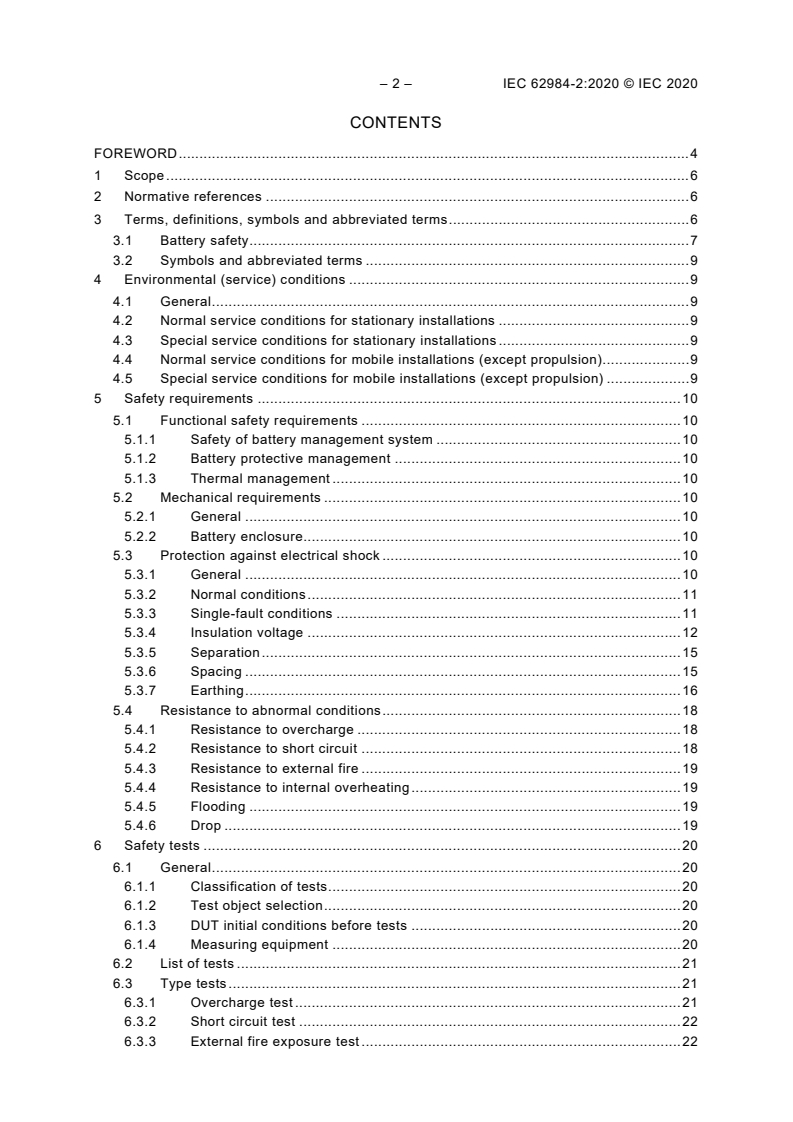
– 2 – IEC 62984-2:2020 © IEC 2020
CONTENTS
FOREWORD . 4
1 Scope . 6
2 Normative references . 6
3 Terms, definitions, symbols and abbreviated terms . 6
3.1 Battery safety. 7
3.2 Symbols and abbreviated terms . 9
4 Environmental (service) conditions . 9
4.1 General . 9
4.2 Normal service conditions for stationary installations . 9
4.3 Special service conditions for stationary installations . 9
4.4 Normal service conditions for mobile installations (except propulsion). 9
4.5 Special service conditions for mobile installations (except propulsion) . 9
5 Safety requirements . 10
5.1 Functional safety requirements . 10
5.1.1 Safety of battery management system . 10
5.1.2 Battery protective management . 10
5.1.3 Thermal management . 10
5.2 Mechanical requirements . 10
5.2.1 General . 10
5.2.2 Battery enclosure. 10
5.3 Protection against electrical shock . 10
5.3.1 General . 10
5.3.2 Normal conditions . 11
5.3.3 Single-fault conditions . 11
5.3.4 Insulation voltage . 12
5.3.5 Separation . 15
5.3.6 Spacing . 15
5.3.7 Earthing . 16
5.4 Resistance to abnormal conditions . 18
5.4.1 Resistance to overcharge . 18
5.4.2 Resistance to short circuit . 18
5.4.3 Resistance to external fire . 19
5.4.4 Resistance to internal overheating . 19
5.4.5 Flooding . 19
5.4.6 Drop . 19
6 Safety tests . 20
6.1 General . 20
6.1.1 Classification of tests . 20
6.1.2 Test object selection . 20
6.1.3 DUT initial conditions before tests . 20
6.1.4 Measuring equipment . 20
6.2 List of tests . 21
6.3 Type tests . 21
6.3.1 Overcharge test . 21
6.3.2 Short circuit test . 22
6.3.3 External fire exposure test . 22
6.3.4 Cell failure propagation test . 24
6.3.5 Overheating test . 25
6.3.6 Drop test . 27
6.4 Routine tests. 28
6.4.1 Withstand voltage test . 28
6.4.2 Insulation resistance measurement . 29
6.5 Special tests . 30
6.5.1 Immersion test . 30
7 Markings. 30
7.1 General . 30
7.2 Data plate marking . 32
8 Rules for transportation, installation and maintenance . 32
8.1 Transportation . 32
8.2 Installation . 32
8.3 Maintenance . 32
9 Documentation . 32
9.1 Instruction manual . 32
9.2 Test report . 32
Annex A (informative) Standard template for report of test results and description of
the DUT – Report of type test . 33
Bibliography . 36
Figure 1 – Examples of binding screw assemblies . 18
Figure 2 – Fire exposure test: pre-heating . 23
Figure 3 – Fire exposure test: direct exposure . 24
Figure 4 – Fire exposure: end . 24
Figure 5 – Plan view of specimen cross section for cell failure propagation test . 25
Figure 6 – Temperature management subsystem . 26
Figure 7 – Application of test voltage . 29
Figure 8 – Insulation resistance measurement . 29
Figure 9 – Examples of safety labels for sodium-nickel-chloride / sodium-sulfur
batteries . 31
Table 1 – List of symbols and abbreviated terms . 9
Table 2 – Withstand voltages . 13
Table 3 – Actual test voltage for impulse test with corresponding altitudes . 14
Table 4 – Guide to overvoltage category assignment . 15
Table 5 – Multiplication factors for clearances of equipment rated for operation at
altitudes up to 5 000 m . 16
Table 6 – Type tests . 21
Table 7 – Routine tests . 21
Table 8 – Special tests . 21
Table 9 – Drop test severity classes . 27
– 4 – IEC 62984-2:2020 © IEC 2020
INTERNATIONAL ELECTROTECHNICAL COMMISSION
____________
HIGH-TEMPERATURE SECONDARY BATTERIES –
Part 2: Safety requirements and tests
FOREWORD
1) The International Electrotechnical Commission (IEC) is a worldwide organization for standardization comprising
all national electrotechnical committees (IEC National Committees). The object of IEC is to promote international
co-operation on all questions concerning standardization in the electrical and electronic fields. To this end and
in addition to other activities, IEC publishes International Standards, Technical Specifications, Technical Reports,
Publicly Available Specifications (PAS) and Guides (hereafter referred to as “IEC Publication(s)”). Their
preparation is entrusted to technical committees; any IEC National Committee interested in the subject dealt with
may participate in this preparatory work. International, governmental and non-governmental organizations liaising
with the IEC also participate in this preparation. IEC collaborates closely with the International Organization for
Standardization (ISO) in accordance with conditions determined by agreement between the two organizations.
2) The formal decisions or agreements of IEC on technical matters express, as nearly as possible, an international
consensus of opinion on the relevant subjects since each technical committee has representation from all
interested IEC National Committees.
3) IEC Publications have the form of recommendations for international use and are accepted by IEC National
Committees in that sense. While all reasonable efforts are made to ensure that the technical content of IEC
Publications is accurate, IEC cannot be held responsible for the way in which they are used or for any
misinterpretation by any end user.
4) In order to promote international uniformity, IEC National Committees undertake to apply IEC Publications
transparently to the maximum extent possible in their national and regional publications. Any divergence between
any IEC Publication and the corresponding national or regional publication shall be clearly indicated in the latter.
5) IEC itself does not provide any attestation of conformity. Independent certification bodies provide conformity
assessment services and, in some areas, access to IEC marks of conformity. IEC is not responsible for any
services carried out by independent certification bodies.
6) All users should ensure that they have the latest edition of this publication.
7) No liability shall attach to IEC or its directors, employees, servants or agents including individual experts and
members of its technical committees and IEC National Committees for any personal injury, property damage or
other damage of any nature whatsoever, whether direct or indirect, or for costs (including legal fees) and
expenses arising out of the publication, use of, or reliance upon, this IEC Publication or any other IEC Publications.
8) Attention is drawn to the Normative references cited in this publication. Use of the referenced publications is
indispensable for the correct application of this publication.
9) Attention is drawn to the possibility that some of the elements of this IEC Publication may be the subject of patent
rights. IEC shall not be held responsible for identifying any or all such patent rights.
International Standard IEC 62984-2 has been prepared by IEC technical committee 21:
Secondary cells and batteries.
The text of this International Standard is based on the following documents:
FDIS Report on voting
21/1032/FDIS 21/1042/RVD
Full information on the voting for the approval of this International Standard can be found in the
report on voting indicated in the above table.
This document has been drafted in accordance with the ISO/IEC Directives, Part 2.
This document is to be read in conjunction with IEC 62984-1:2020.
A list of all parts in the IEC 62984 series, published under the general title High-temperature
secondary batteries, can be found on the IEC website.
The committee has decided that the contents of this document will remain unchanged until the
stability date indicated on the IEC website under "http://webstore.iec.ch" in the data related to
the specific document. At this date, the document will be
• reconfirmed,
• withdrawn,
• replaced by a revised edition, or
• amended.
IMPORTANT – The 'colour inside' logo on the cover page of this publication indicates
that it contains colours which are considered to be useful for the correct understanding
of its contents. Users should therefore print this document using a colour printer.
– 6 – IEC 62984-2:2020 © IEC 2020
HIGH-TEMPERATURE SECONDARY BATTERIES –
Part 2: Safety requirements and tests
1 Scope
This part of IEC 62984 specifies safety requirements and test procedures for high-temperature
batteries for mobile and/or stationary use and whose rated voltage does not exceed 1 500 V.
This document does not cover aircraft batteries, which are covered by IEC 60952 (all parts),
and batteries for the propulsion of electric road vehicles, covered by IEC 61982 (all parts).
NOTE High-temperature batteries are electrochemical systems whose cells' internal minimum operating
temperature is above 100 °C.
2 Normative references
The following documents are referred to in the text in such a way that some or all of their content
constitutes requirements of this document. For dated references, only the edition cited applies.
For undated references, the latest edition of the referenced document (including any
amendments) applies.
IEC 60068-2-18:2017, Environmental testing – Part 2-18: Tests – Test R and guidance: Water
IEC 60112, Method for the determination of the proof and the comparative tracking indices of
solid insulating materials
IEC 60204-1, Safety of machinery – Electrical equipment of machines – Part 1: General
requirements
IEC 60529, Degrees of protection provided by enclosures (IP Code)
IEC 60664-1:2007, Insulation coordination for equipment within low-voltage systems – Part 1:
Principles, requirements and tests
IEC 61140:2016, Protection against electric shock – Common aspects for installation and
equipment
IEC 61508 (all parts), Functional safety of electrical/electronic/programmable electronic
safety-related systems
IEC 62984-1:2020, High-temperature secondary batteries – Part 1: General requirements
3 Terms, definitions, symbols and abbreviated terms
For the purposes of this document, the terms and definitions given in IEC 62984-1 and the
following apply.
ISO and IEC maintain terminological databases for use in standardization at the following
addresses:
• IEC Electropedia: available at http://www.electropedia.org/
• ISO Online browsing platform: available at http://www.iso.org/obp
3.1 Battery safety
3.1.1
rated insulation voltage
rated value of the RMS withstand voltage assigned by the manufacturer to the equipment or to
a part of it, characterizing the specified (long-term) withstand capability of its insulation
Note 1 to entry: The rated insulation voltage is not necessarily equal to the rated voltage of equipment which is
primarily related to functional performance.
[SOURCE: IEC 60050-312:2014, 312-06-02]
3.1.2
functional insulation
insulation between conductive parts, necessary for the proper functioning of the equipment
[SOURCE: IEC 60050-195:1998, 195-02-41]
3.1.3
supplementary insulation
independent insulation applied in addition to basic insulation in order to provide protection
against electric shock in the event of a failure of basic insulation
[SOURCE: IEC 60050-195:1998, 195-06-07, modified – "for fault protection" has been replaced
by "in order to provide protection against electric shock in the event of a failure of basic
insulation".]
3.1.4
reinforced insulation
insulation of hazardous-live-parts which provides a degree of protection against electric shock
equivalent to double insulation
[SOURCE: IEC 60050-195:1998, 195-06-09, modified – The note has been omitted.]
3.1.5
double insulation
insulation comprising both basic insulation and supplementary insulation
Note 1 to entry: Basic and supplementary insulation are separate, each designed for basic protection against
electric shock.
[SOURCE: IEC 60050-195:1998, 195-06-08, modified – The note to entry has been added.]
3.1.6
extra-low voltage
ELV
voltage not exceeding the maximum value of the prospective touch voltage which is permitted
to be maintained indefinitely under specified conditions of external influences
[SOURCE: IEC 61140:2016, 3.26]
3.1.7
SELV system
electric system in which the voltage cannot exceed the value of extra-low voltage:
– under normal conditions and
– 8 – IEC 62984-2:2020 © IEC 2020
– under single fault conditions, including earth faults in other electric circuits
Note 1 to entry: SELV is the abbreviation for safety extra low voltage.
[SOURCE: IEC 60050-826:2004, 826-12-31]
3.1.8
PELV system
electric system in which the voltage cannot exceed the value of extra-low voltage:
– under normal conditions and
– under single fault conditions, except earth faults in other electric circuits
Note 1 to entry: PELV is the abbreviation for protective extra low voltage.
[SOURCE: IEC 60050-826:2004, 826-12-32]
3.1.9
protective-equipotential-bonding
PEB
equipotential bonding for the purposes of safety
EXAMPLE Protection against electric shock is an example of a safety purpose.
Note 1 to entry: Functional-equipotential-bonding is defined in IEV 195-01-16.
Note 2 to entry: This note applies to the French language only.
[SOURCE: IEC 60050-195:1998, 195-01-15, modified – Added abbreviated term, example and
notes.]
3.1.10
class I equipment
equipment with basic insulation as provision for basic protection against electric shock and
protective bonding as provision for fault protection, such that conductive parts on the outside
of the equipment case cannot become live in the event of a failure of the basic insulation
Note 1 to entry: Content based on IEC 60050-851:2008, 851-15-10.
3.1.11
class II equipment
equipment with basic insulation as provision for basic protection against electric shock, and
supplementary insulation as provision for fault protection, or in which basic protection and fault
protection are provided by reinforced insulation
Note 1 to entry: There should be no provision for a protective conductor or reliance upon installation conditions for
safety purposes. It is, however, possible to connect an earth conductor to Class II equipment for functional (for
example, EMC) purposes.
Note 2 to entry: Content based on IEC 60050-851:2008, 851-15-11.
3.1.12
class III equipment
equipment, or parts of equipment, in which protection against electric shock relies upon supply
from SELV or PELV systems and in which hazardous voltages (see hazardous-live-part) are not
generated
3.1.13
overvoltage category
number defining a transient overvoltage condition
Note 1 to entry: Overvoltage categories I, II, III are used.
Note 2 to entry: See 5.3.4 for overvoltage category details.
[SOURCE: IEC 60050-581:2008, 581-21-02, modified – Added notes to entry.]
3.1.14
hazardous-live-part
live part which, under certain conditions, can give a harmful electric shock
[SOURCE: IEC 60050-195:1998, 195-06-05]
3.2 Symbols and abbreviated terms
The list of symbols and abbreviated terms is given in Table 1.
Table 1 – List of symbols and abbreviated terms
Symbol / Full term Reference
Abbreviated
term
CTI Comparative tracking index
ELV Extra low voltage See 3.1.6
PEB Protective-equipotential-bonding See 3.1.9
PELV Protective extra low voltage See 3.1.8
SELV Safety extra low voltage See 3.1.7
4 Environmental (service) conditions
4.1 General
Refer to IEC 62984-1:2020, 4.1.
4.2 Normal service conditions for stationary installations
Refer to IEC 62984-1:2020, 4.2.
4.3 Special service conditions for stationary installations
Refer to IEC 62984-1:2020, 4.3.
4.4 Normal service conditions for mobile installations (except propulsion)
Refer to IEC 62984-1:2020, 4.4.
4.5 Special service conditions for mobile installations (except propulsion)
Refer to IEC 62984-1:2020, 4.5.
– 10 – IEC 62984-2:2020 © IEC 2020
5 Safety requirements
5.1 Functional safety requirements
5.1.1 Safety of battery management system
Electronic devices and software relied upon for safety shall be compliant with IEC 61508 (all
parts).
5.1.2 Battery protective management
If relied upon for maintaining the cells within their specified operating range, the battery
management system (BMS) shall maintain cells within the specified voltage, temperature and
current during standby, charging and discharging of the battery.
5.1.3 Thermal management
A battery system shall be provided with a thermal management control to ensure safe operation
of the battery, including its internal heaters and to prevent the battery from being overheated
or otherwise used outside of its specified operating temperature range. The battery
management system shall prevent the battery from entering a hazardous state as a result of
failure of the thermal management control.
Heaters used to maintain the cells at specified operating temperatures shall be dimensioned
for the current and voltage involved and designed to prevent breakages and short circuits from
occurring as a result of handling, installation and operation of the battery.
NOTE Good thermal management provides a good level of efficiency.
5.2 Mechanical requirements
5.2.1 General
Subclause 5.2.1 of IEC 62984-1:2020 is applicable with the following additional text:
The enclosure and mechanical support structure(s) for the battery arrangement shall have the
strength and rigidity required to resist the possible physical abuses that it will be exposed to
during its transport, installation and intended use, in order to reduce hazards.
The battery shall be capable of withstanding, with no harm to users, the vibrations and shocks
likely to occur during its transportation, storage, installation and operation according to the
intended application (stationary or mobile).
The requirements of 5.2.1 apply not only to modules, but also to the complete battery installation,
including module interconnections and supporting structure.
NOTE These requirements do not cover specific applications outside the scope of this document.
5.2.2 Battery enclosure
Subclause 5.2.2 of IEC 62984-1:2020 is applicable with the following additional text:
Unless installed in a protective location that prevents access to hazardous parts of the system,
the battery shall have a minimum IP rating of IP22 according to IEC 60529.
5.3 Protection against electrical shock
5.3.1 General
The battery shall not jeopardize the safety of people and property.
Users shall be protected against electric shock hazards by the employment of suitable
construction and engineering practices.
The testing of components and equipment with regard to protection against electric shock shall
be conducted as type tests and routine tests as defined in Clause 6.
Applicable fundamental rules for protection against electrical shock are given in
IEC 61140:2016, Clause 4, with application either under normal conditions, or under single fault
conditions.
The applicable principles covering these different conditions are given in IEC 61140:2016, 4.1,
4.2 and 4.3.
Provisions and measures for protection against electrical shock are described in
IEC 61140:2016, Clause 5 and Clause 6, which are applicable as far as relevant.
5.3.2 Normal conditions
To meet the fundamental rules for protection against electric shock under normal conditions,
basic protection is necessary. Basic protection shall consist of one or more provisions that
under normal conditions prevent contact with hazardous-live-parts.
NOTE Paints, varnishes, lacquers and similar products alone are generally not considered to provide adequate
insulation for protection against electric shock in normal service.
Basic protection provisions that may be used for basic protection are:
– basic insulation,
– barriers or enclosures,
– obstacles,
– placing out of arm's reach,
– limitation of voltage,
– limitation of steady state touch current and charge,
– other provisions (complying with the fundamental rules for protection against electric shock).
These provisions are described in IEC 61140:2016, 5.2.
Protection against electric shock for class I, II or III equipment is applicable to those parts
accessible under normal conditions. ELV, PEB, PELV and SELV systems provide protection
from electric shock by hazardous-live-parts, and are not necessarily related to a class I, II or III
equipment class.
Any conductive part that is not separated from the hazardous-live-parts by at least basic
insulation shall be considered to be a live part.
An accessible metallic part is considered to be conductive if its surface is bare or is covered by
an insulating layer which does not comply with the requirements of basic insulation.
5.3.3 Single-fault conditions
5.3.3.1 General
To meet the fundamental rules for protection against electric shock under single-fault conditions,
what is referred to in this document as fault protection is necessary. This protection can be
achieved by
– a further protective provision, independent of that for basic protection, or
– 12 – IEC 62984-2:2020 © IEC 2020
– an enhanced protective provision, which provides both basic and fault protection taking
account of all relevant influences. Unearthed accessible conductive parts which may
become hazardous-live-parts under a single-fault condition shall be separated from
hazardous-live-parts by double or reinforced insulation or be connected to the protective
conductor.
As a consequence, unearthed accessible conductive parts which may become
hazardous-live-parts under single-fault conditions, shall be separated from hazardous-live-parts
by double or reinforced insulation or be connected to the protective conductor.
5.3.3.2 Fault protection
Fault protection shall consist of one or more provision(s) independent of and in addition to those
for basic protection.
The scope of this independent and additional provision is that a single-fault condition applied
to the equipment shall not cause an electric shock hazard.
Provisions that may be used for fault protection are:
– supplementary insulation,
– protective-equipotential-bonding,
– protective screening,
– automatic disconnection of the supply,
– separation (between circuits),
– a non-conducting environment,
– other provisions (complying with the fundamental rules for protection against electric shock).
These provisions are described in IEC 61140:2016, 5.3.
5.3.3.3 Enhanced protective provisions
An enhanced protective provision shall provide both basic and fault protection.
Arrangements shall be made so that the protection provided by an enhanced protective
provision is unlikely to become degraded and so that a single fault is unlikely to occur.
Provisions that may be used for enhanced protection are:
– reinforced insulation,
– protective separation between circuits,
– limited current source,
– protective impedance devices,
– other provisions.
These provisions are described in IEC 61140:2016, 5.4.
5.3.4 Insulation voltage
High-temperature batteries are not simple components, but are typically an assembly of
subsystems, due to the need for a BMS controller and thermal management subsystem.
Therefore, the choice of the insulation voltage needs to take into account the connections of
each subsystem of the battery with the external environment and its insulation coordination
needs.
Each independent circuit of the battery shall be tested according to its rated insulation voltage
and relevant overvoltage category.
NOTE For example, in the case of sodium-based batteries, independent circuits that are typically present are the
following:
– main battery terminals,
– heater/cooler supply,
– BMS supply,
– digital communication ports,
– digital and/or analog I/O.
Not all of these circuits are necessarily present and externally accessible on each battery design.
The required withstand voltages are given in Table 2.
Table 2 – Withstand voltages
Voltage in volts
Withstand voltage
Rated insulation AC RMS Impulse 1,2/50 µs
voltage up to
1 min
Overvoltage Overvoltage Overvoltage
category I category II category III
60 1 000 --- --- ---
100 1 200 --- --- ---
150 1 350 --- --- 2 500
300 1 500 1 500 2 500 4 000
600 1 800 2 500 4 000 6 000
800 2 000 3 300 5 000 7 000
1 000 2 200 4 000 6 000 8 000
1 500 2 700 6 000 8 000 10 000
The voltage AC RMS value is to be applied for 1 min.
The actual test voltage for the impulse test is calculated from the rated impulse withstand
voltage, taking into account the altitude correction factor, according to Table 3.
– 14 – IEC 62984-2:2020 © IEC 2020
Table 3 – Actual test voltage for impulse test with corresponding altitudes
Voltage in kilovolts
Rated impulse
Test voltages and corresponding altitudes
withstand
U
voltage
1,2/50
U
Sea level 200 m 500 m 1 000 m 2 000 m
Imp
0,33 0,35 0,35 0,35 0,34 0,33
0,5 0,54 0,54 0,53 0,52 0,5
0,8 0,93 0,92 0,9 0,85 0,8
1,5 1,75 1,72 1,68 1,6 1,5
2,5 2,92 2,88 2,8 2,7 2,5
4,0 4,92 4,8 4,7 4,4 4,0
6,0 7,38 7,2 7,0 6,7 6,0
8,0 9,8 9,6 9,3 9,0 8,0
12 14,8 14,5 14 13,3 12
For additional information about the altitude correction factor, see IEC 60664-1:2007, 6.1.2.2.1.3.
Each independent circuit of the battery shall be assigned a rated insulation voltage and a rated
overvoltage category according to Table 2 and Table 4, respectively.
This rated overvoltage category shall take into account influencing factors including:
• length of connections with the external environment,
• direct connection with the grid or presence of a converter between the battery and the grid,
• presence of overvoltage suppressors,
• shielding,
• equipotential bonding impedance.
The applicable overvoltage category shall be determined on the basis of the following criteria.
CATEGORY I: This applies to equipment where special measures are taken to limit transient
voltages to appropriate values, for example, well-protected electronic circuits.
To claim category I status, the special voltage measures should apply to both common and
differentially connected circuits.
CATEGORY II: Where all of the following apply:
a) the auxiliary circuits (power supply circuits) of the equipment are connected to a voltage
supply used only for the power supply of static equipment;
NOTE This condition applies only if the leads are short, and in the absence of switching of other circuits
connected to the AC or DC supply, the levels of transient voltage on the supply leads will be lower than those
specified in overvoltage category III.
b) the battery terminals are connected to a load by short lead lengths, with good screening and
grounding.
CATEGORY III: This category applies to most practical cases of the application of equipment
and shall, in particular, be used where:
c) the auxiliary energizing circuits (power-supply circuits) of the equipment are connected to a
common battery and/or, due to long lead lengths, common mode transient overvoltages of
a relatively high value may appear on the supply leads, and differential mode voltages may
arise from switching in other circuits connected to the same battery or supply source;
d) the battery terminals are connected to a load by long leads with the result that common
mode transient voltages of a relatively high value may appear.
Table 4 – Guide to overvoltage category assignment
Circuit Cat. I Cat. II Cat. III
Main battery terminals Battery with no Normal case Very long wires (> 100 m)
connection to the external and very noisy
environment (e.g. environment (e.g.
embedded in UPS) or substation)
used in protected
environments (e.g.
onboard a vehicle)
Heater/cooler supply Normal case if supplied in Normal case if directly AC
DC by the main battery supplied by the grid
terminals
Applicable also to AC
supply properly isolated
and filtered
BMS supply Normal case if supplied in Normal case if directly AC
DC by the main battery supplied by the grid
terminals
Digital communication Normal case Very long lines (> 100 m)
ports
Digital and/or analog I/O Normal case Very long lines (> 100 m)
The rated insulation voltage shall be determined as follows:
1) for insulation between live parts and exposed conductive parts not less than the nominal
voltage of the circuit under consideration;
2) for insulation between the parts of one circuit, not less than the nominal voltage of the circuit
under consideration;
3) for insulation between parts of two independent circuits, the rated insulation voltage should
be at least equal to the higher nominal voltage of these circuits;
4) for gaps between open contacts, unless otherwise agreed between manufacturer and user,
no rated insulation voltage is specified.
5.3.5 Separation
The positive terminal and negative terminal of the battery/module main circuit shall be properly
separated to avoid inadvertent short circuit, and it shall be marked clearly that the terminal is
positive or negative. Compliance with the separation criteria may be demonstrated by the use
of a suitable connector. In this case it shall be mechanically impossible to mate the connector
with the wrong polarity.
5.3.6 Spacing
5.3.6.1 General
Electrical circuits at opposite polarity shall be provided with reliable physical spacing (clearance
and creepage suitable for the circuit) to prevent inadvertent short circuits (i.e. creepage
distances on printed wiring boards, physical securing of un-insulated leads and parts, etc.).
Insulation such as insulated wiring suitable for the anticipated temperatures and maximum
voltages shall be used where clearance and creepage distances cannot be controlled by reliable
physical separation.
– 16 – IEC 62984-2:2020 © IEC 2020
5.3.6.2 Clearances
Required clearances depend on the rated insulation voltage and the overvoltage category as
well as the rated altitude for operation. If the equipment is rated to operate at an altitude greater
than 2 000 m, all clearances shall be multiplied by the applicable factor of Table 5.
Table 5 – Multiplication factors for clearances of equipment
rated for operation at altitudes up to 5 000 m
Rated operating altitude Multiplication factor
m
Up to 2 000 1,00
2 001 to 3 000 1,14
3 001 to 4 000 1,29
4 001 to 5 000 1,48
For altitudes above 5 000 m refer to IEC 60664-1:2007, Table A.2.
5.3.6.3 Creepage distances
Required creepage distances depend on the rated insulation voltage and the overvoltage
category as well as the comparative tracking index (CTI) of the insulating material.
Materials are separated into four groups according to their CTI values, as follows:
– Material group I, 600 ≤ CTI,
– Material group II, 400 ≤ CTI < 600,
– Material grou
...