

IEC 62236-3-1:2018
(Main)Railway applications - Electromagnetic compatibility - Part 3-1: Rolling stock - Train and complete vehicle
General Information
- Abstract
IEC 62236-3-1:2018 specifies the emission and immunity requirements for all types of rolling stock. It covers traction stock, hauled stock and trainsets including urban vehicles for use in city streets. This document specifies the emission limits of the rolling stock to the outside world. This new edition includes the following significant technical changes with respect to the previous edition: clarification of certain parts of the standard.
- Status
- Published
- Publication Date
- 14-Feb-2018
- Technical Committee
- TC 9 - Electrical equipment and systems for railways
- Drafting Committee
- MT 62236 - TC 9/MT 62236
- Current Stage
- PPUB - Publication issued
- Start Date
- 15-Feb-2018
- Completion Date
- 23-Feb-2018
Buy Documents
IEC 62236-3-1:2018 RLV - Railway applications - Electromagnetic compatibility - Part 3-1: Rolling stock - Train and complete vehicle Released:2/15/2018
IEC 62236-3-1:2018 - Railway applications - Electromagnetic compatibility - Part 3-1: Rolling stock - Train and complete vehicle Released:2/15/2018
Overview
IEC 62236-3-1:2018 is an international standard developed by the International Electrotechnical Commission (IEC) focusing on electromagnetic compatibility (EMC) requirements for rolling stock in railway applications. This standard applies to all types of rolling stock, including traction stock, hauled stock, trainsets, and urban vehicles such as trams and trolleybuses used in city streets. Its primary objective is to define the emission and immunity requirements for complete railway vehicles, ensuring the electromagnetic emissions from rolling stock do not create unacceptable interference with the railway environment or external systems. The current edition brings clarified definitions, updated scope, and improved requirements for emissions and immunity.
Key Topics
Scope & Applicability
- Covers all rolling stock types, including main line and urban vehicles.
- Specifies the boundaries of emission control at the interface of rolling stock with power supplies (current collector, auxiliary power connector).
- Special cases and exceptions are addressed through adequate EMC analyses and plans.
Emission & Immunity Requirements
- Sets emission limits to minimize electromagnetic interference with the surrounding environment, especially for signaling, communication, and telecommunication systems.
- Immunity requirements for individual apparatus are defined in companion standard IEC 62236-3-2.
Testing Procedures
- Details on emission measurement methodologies for both stationary and slow-moving railway vehicles.
- Distinct guidelines for test site selection, configuration, and operational modes during testing to ensure repeatability and accuracy.
- Applicability of emission limits up to 1 GHz, addressing the majority of possible sources of interference.
Interference Management
- Addressing potential disturbances on external telecommunication lines due to harmonics in traction current.
- Use of frequency-weighted psophometric current measurements, as described in ITU-T recommendations.
Integration with EMC Plans
- Encourages the development and implementation of comprehensive EMC plans to manage all sources of disturbance and ensure compatibility within the railway system.
Applications
IEC 62236-3-1:2018 is essential for railway manufacturers, operators, infrastructure managers, and system integrators involved in designing, producing, or certifying rolling stock for use worldwide. The standard provides:
- A basis for ensuring safe and reliable operation of railways by minimizing electromagnetic disturbances that could affect signaling, train control, track circuits, and nearby telecommunication systems.
- Compliance requirements for rolling stock entering different regions, supporting interoperability and acceptance across international rail networks.
- Procedures to evaluate and demonstrate conformity during rolling stock testing, both in the laboratory and on operational routes.
- Guidance for the integration of electronic equipment within new vehicles or upgrading of existing fleets to meet modern EMC standards.
By adhering to IEC 62236-3-1, stakeholders contribute to improved operational safety, reduced risk of service interruptions, and smoother interaction with urban transport infrastructure.
Related Standards
To ensure full compliance and a comprehensive approach to EMC in railway systems, IEC 62236-3-1:2018 is intended to be used in conjunction with several related standards, including:
- IEC 62236-1: General requirements for railway EMC.
- IEC 62236-2: Emission requirements for the entire railway system to the external environment.
- IEC 62236-3-2: EMC requirements for apparatus installed in rolling stock.
- IEC 62427: Compatibility between rolling stock and train detection systems.
- CISPR 16-1-1: Radio disturbance and immunity measuring apparatus and methods.
- ITU-T Directives: Guidelines for protection of telecommunication lines near electrified railways.
Adopting IEC 62236-3-1:2018 ensures robust electromagnetic compatibility in railway operations, facilitating safer, more reliable, and internationally compliant railway transport systems.
Relations
- Effective Date
- 05-Sep-2023
Buy Documents
IEC 62236-3-1:2018 RLV - Railway applications - Electromagnetic compatibility - Part 3-1: Rolling stock - Train and complete vehicle Released:2/15/2018
IEC 62236-3-1:2018 - Railway applications - Electromagnetic compatibility - Part 3-1: Rolling stock - Train and complete vehicle Released:2/15/2018
Get Certified
Connect with accredited certification bodies for this standard

DNV
DNV is an independent assurance and risk management provider.

Lloyd's Register
Lloyd's Register is a global professional services organisation specialising in engineering and technology.
DNV Energy Systems
Energy and renewable energy certification.
Sponsored listings
Frequently Asked Questions
IEC 62236-3-1:2018 is a standard published by the International Electrotechnical Commission (IEC). Its full title is "Railway applications - Electromagnetic compatibility - Part 3-1: Rolling stock - Train and complete vehicle". This standard covers: IEC 62236-3-1:2018 specifies the emission and immunity requirements for all types of rolling stock. It covers traction stock, hauled stock and trainsets including urban vehicles for use in city streets. This document specifies the emission limits of the rolling stock to the outside world. This new edition includes the following significant technical changes with respect to the previous edition: clarification of certain parts of the standard.
IEC 62236-3-1:2018 specifies the emission and immunity requirements for all types of rolling stock. It covers traction stock, hauled stock and trainsets including urban vehicles for use in city streets. This document specifies the emission limits of the rolling stock to the outside world. This new edition includes the following significant technical changes with respect to the previous edition: clarification of certain parts of the standard.
IEC 62236-3-1:2018 is classified under the following ICS (International Classification for Standards) categories: 27.160 - Solar energy engineering; 33.100 - Electromagnetic compatibility (EMC); 45.060.01 - Railway rolling stock in general. The ICS classification helps identify the subject area and facilitates finding related standards.
IEC 62236-3-1:2018 has the following relationships with other standards: It is inter standard links to IEC 62236-3-1:2008. Understanding these relationships helps ensure you are using the most current and applicable version of the standard.
IEC 62236-3-1:2018 is available in PDF format for immediate download after purchase. The document can be added to your cart and obtained through the secure checkout process. Digital delivery ensures instant access to the complete standard document.
Standards Content (Sample)
IEC 62236-3-1 ®
Edition 3.0 2018-02
REDLINE VERSION
INTERNATIONAL
STANDARD
colour
inside
Railway applications – Electromagnetic compatibility –
Part 3-1: Rolling stock – Train and complete vehicle
All rights reserved. Unless otherwise specified, no part of this publication may be reproduced or utilized in any form
or by any means, electronic or mechanical, including photocopying and microfilm, without permission in writing from
either IEC or IEC's member National Committee in the country of the requester. If you have any questions about IEC
copyright or have an enquiry about obtaining additional rights to this publication, please contact the address below or
your local IEC member National Committee for further information.
IEC Central Office Tel.: +41 22 919 02 11
3, rue de Varembé info@iec.ch
CH-1211 Geneva 20 www.iec.ch
Switzerland
About the IEC
The International Electrotechnical Commission (IEC) is the leading global organization that prepares and publishes
International Standards for all electrical, electronic and related technologies.
About IEC publications
The technical content of IEC publications is kept under constant review by the IEC. Please make sure that you have the
latest edition, a corrigenda or an amendment might have been published.
IEC Catalogue - webstore.iec.ch/catalogue Electropedia - www.electropedia.org
The stand-alone application for consulting the entire The world's leading online dictionary of electronic and
bibliographical information on IEC International Standards, electrical terms containing 21 000 terms and definitions in
Technical Specifications, Technical Reports and other English and French, with equivalent terms in 16 additional
documents. Available for PC, Mac OS, Android Tablets and languages. Also known as the International Electrotechnical
iPad. Vocabulary (IEV) online.
IEC publications search - webstore.iec.ch/advsearchform IEC Glossary - std.iec.ch/glossary
The advanced search enables to find IEC publications by a 67 000 electrotechnical terminology entries in English and
variety of criteria (reference number, text, technical French extracted from the Terms and Definitions clause of
committee,…). It also gives information on projects, replaced IEC publications issued since 2002. Some entries have been
and withdrawn publications. collected from earlier publications of IEC TC 37, 77, 86 and
CISPR.
IEC Just Published - webstore.iec.ch/justpublished
Stay up to date on all new IEC publications. Just Published IEC Customer Service Centre - webstore.iec.ch/csc
details all new publications released. Available online and If you wish to give us your feedback on this publication or
also once a month by email. need further assistance, please contact the Customer Service
Centre: sales@iec.ch.
IEC 62236-3-1 ®
Edition 3.0 2018-02
REDLINE VERSION
INTERNATIONAL
STANDARD
colour
inside
Railway applications – Electromagnetic compatibility –
Part 3-1: Rolling stock – Train and complete vehicle
INTERNATIONAL
ELECTROTECHNICAL
COMMISSION
ICS 33.100; 45.060.01 ISBN 978-2-8322-5401-1
– 2 – IEC 62236-3-1:2018 RLV © IEC 2018
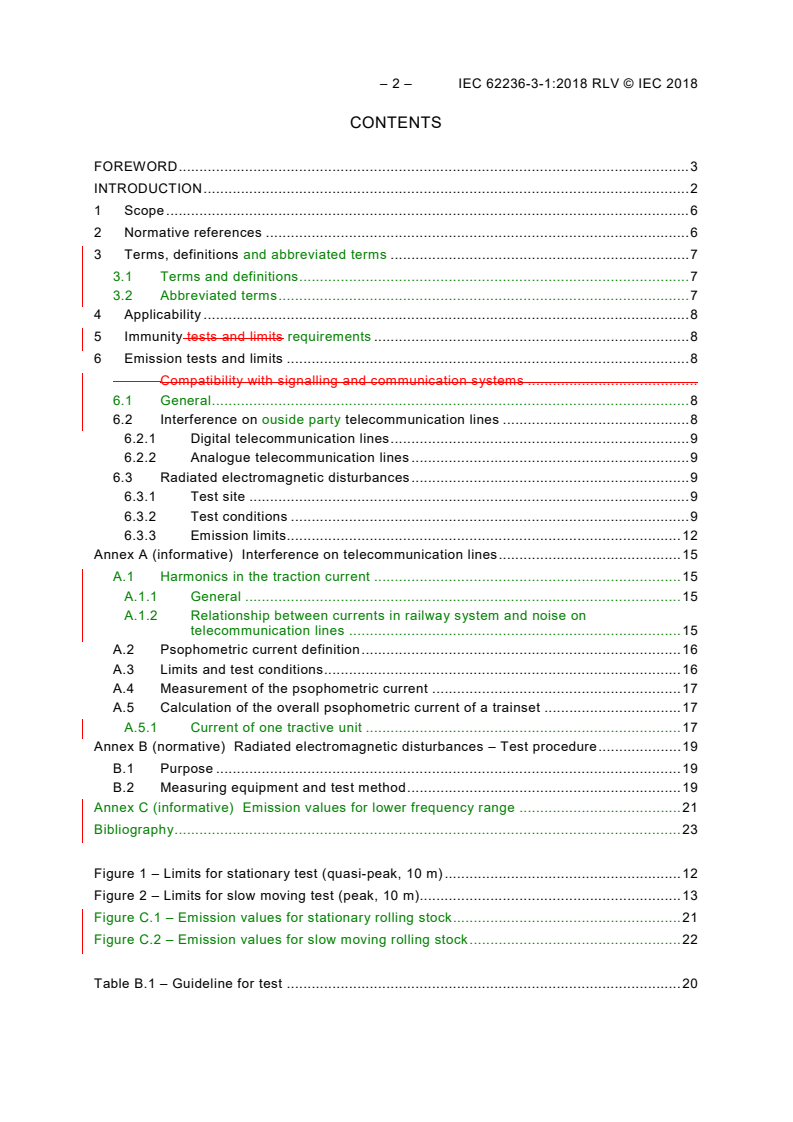
CONTENTS
FOREWORD . 3
INTRODUCTION . 2
1 Scope . 6
2 Normative references . 6
3 Terms, definitions and abbreviated terms . 7
3.1 Terms and definitions . 7
3.2 Abbreviated terms . 7
4 Applicability . 8
5 Immunity tests and limits requirements . 8
6 Emission tests and limits . 8
Compatibility with signalling and communication systems .
6.1 General . 8
6.2 Interference on ouside party telecommunication lines . 8
6.2.1 Digital telecommunication lines . 9
6.2.2 Analogue telecommunication lines . 9
6.3 Radiated electromagnetic disturbances . 9
6.3.1 Test site . 9
6.3.2 Test conditions . 9
6.3.3 Emission limits. 12
Annex A (informative) Interference on telecommunication lines . 15
A.1 Harmonics in the traction current . 15
A.1.1 General . 15
A.1.2 Relationship between currents in railway system and noise on
telecommunication lines . 15
A.2 Psophometric current definition . 16
A.3 Limits and test conditions . 16
A.4 Measurement of the psophometric current . 17
A.5 Calculation of the overall psophometric current of a trainset . 17
A.5.1 Current of one tractive unit . 17
Annex B (normative) Radiated electromagnetic disturbances – Test procedure . 19
B.1 Purpose . 19
B.2 Measuring equipment and test method . 19
Annex C (informative) Emission values for lower frequency range . 21
Bibliography . 23
Figure 1 – Limits for stationary test (quasi-peak, 10 m) . 12
Figure 2 – Limits for slow moving test (peak, 10 m). 13
Figure C.1 – Emission values for stationary rolling stock . 21
Figure C.2 – Emission values for slow moving rolling stock . 22
Table B.1 – Guideline for test . 20
INTERNATIONAL ELECTROTECHNICAL COMMISSION
____________
RAILWAY APPLICATIONS –
ELECTROMAGNETIC COMPATIBILITY –
Part 3-1: Rolling stock – Train and complete vehicle
FOREWORD
1) The International Electrotechnical Commission (IEC) is a worldwide organization for standardization comprising
all national electrotechnical committees (IEC National Committees). The object of IEC is to promote
international co-operation on all questions concerning standardization in the electrical and electronic fields. To
this end and in addition to other activities, IEC publishes International Standards, Technical Specifications,
Technical Reports, Publicly Available Specifications (PAS) and Guides (hereafter referred to as “IEC
Publication(s)”). Their preparation is entrusted to technical committees; any IEC National Committee interested
in the subject dealt with may participate in this preparatory work. International, governmental and non-
governmental organizations liaising with the IEC also participate in this preparation. IEC collaborates closely
with the International Organization for Standardization (ISO) in accordance with conditions determined by
agreement between the two organizations.
2) The formal decisions or agreements of IEC on technical matters express, as nearly as possible, an international
consensus of opinion on the relevant subjects since each technical committee has representation from all
interested IEC National Committees.
3) IEC Publications have the form of recommendations for international use and are accepted by IEC National
Committees in that sense. While all reasonable efforts are made to ensure that the technical content of IEC
Publications is accurate, IEC cannot be held responsible for the way in which they are used or for any
misinterpretation by any end user.
4) In order to promote international uniformity, IEC National Committees undertake to apply IEC Publications
transparently to the maximum extent possible in their national and regional publications. Any divergence
between any IEC Publication and the corresponding national or regional publication shall be clearly indicated in
the latter.
5) IEC itself does not provide any attestation of conformity. Independent certification bodies provide conformity
assessment services and, in some areas, access to IEC marks of conformity. IEC is not responsible for any
services carried out by independent certification bodies.
6) All users should ensure that they have the latest edition of this publication.
7) No liability shall attach to IEC or its directors, employees, servants or agents including individual experts and
members of its technical committees and IEC National Committees for any personal injury, property damage or
other damage of any nature whatsoever, whether direct or indirect, or for costs (including legal fees) and
expenses arising out of the publication, use of, or reliance upon, this IEC Publication or any other IEC
Publications.
8) Attention is drawn to the Normative references cited in this publication. Use of the referenced publications is
indispensable for the correct application of this publication.
9) Attention is drawn to the possibility that some of the elements of this IEC Publication may be the subject of
patent rights. IEC shall not be held responsible for identifying any or all such patent rights.
This redline version of the official IEC Standard allows the user to identify the changes
made to the previous edition. A vertical bar appears in the margin wherever a change
has been made. Additions are in green text, deletions are in strikethrough red text.
– 4 – IEC 62236-3-1:2018 RLV © IEC 2018
International Standard IEC 62236-3-1 has been prepared by IEC technical committee 9:
Electrical equipment and systems for railways.
This third edition cancels and replaces the second edition published in 2008. It constitutes a
technical revision and has been developed on the basis of EN 50121-3-1:2015.
This edition includes the following significant technical changes with respect to the previous
edition:
a) clarification of scope (Clause 1);
b) clarification of definitions (Clause 3);
c) clarification of applicability (Clause 4);
d) clarification of interference on outside party telecommunication lines (6.2), psophometric
current (Annex A);
e) moving emission values for radiated H-field in the frequency range 9 kHz to 150 kHz into
new Annex C due to the fact that:
– there are very few outside world victims (e.g. radio services),
– the radiated emission measured at 10 m is not representative of the compatibility with
internal railway apparatus,
– the EMC with other railway apparatus in this frequency range is covered in other
procedures and standards like IEC 62427 series,
– there is low reproducibility.
This International Standard is to be read in conjunction with IEC 62236-1.
The text of this International Standard is based on the following documents:
FDIS Report on voting
9/2337/FDIS 9/2367/RVD
Full information on the voting for the approval of this International Standard can be found in
the report on voting indicated in the above table.
This document has been drafted in accordance with the ISO/IEC Directives, Part 2.
A list of all parts in the IEC 62236 series, published under the general title Railway
applications – Electromagnetic compatibility, can be found on the IEC website.
The committee has decided that the contents of this document will remain unchanged until the
stability date indicated on the IEC website under "http://webstore.iec.ch" in the data related to
the specific document. At this date, the document will be
• reconfirmed,
• withdrawn,
• replaced by a revised edition, or
• amended.
IMPORTANT – The “colour inside” logo on the cover page of this publication indicates
that it contains colours which are considered to be useful for the correct understanding
of its contents. Users should therefore print this publication using a colour printer.
INTRODUCTION
High powered electronic equipment, together with low power microcontrollers and other
electronic devices, is being installed on trains in great numbers. Electromagnetic compatibility
has therefore become a critical issue for the design of train-related apparatus as well as of
the train as a whole.
This Product Standard for rolling stock sets limits for electromagnetic emission and immunity
in order to ensure a well functioning system within its intended environment.
Immunity limits are not given for the complete vehicle. Part 3-2 of this series defines
requirements for the apparatus installed in the rolling stock, since it is impractical to test the
complete unit. An EMC plan should be established for includes equipment covered by this
document.
– 6 – IEC 62236-3-1:2018 RLV © IEC 2018
RAILWAY APPLICATIONS –
ELECTROMAGNETIC COMPATIBILITY –
Part 3-1: Rolling stock – Train and complete vehicle
1 Scope
This part of IEC 62236 specifies the emission and immunity requirements for all types of
rolling stock. It covers traction stock, hauled stock and trainsets including urban vehicles for
use in city streets. This document specifies the emission limits of the rolling stock to the
outside world.
The scope of this document ends at the interface of the rolling stock with its respective energy
inputs and outputs. In the case of locomotives traction units, trainsets, trams, etc., this is the
current collector (pantograph, shoe gear). In the case of hauled stock, this is the AC or DC
auxiliary power connector. However, since the current collector is part of the traction stock, it
is not entirely possible to exclude the effects of this interface with the power supply line. The
slow moving test has been designed to minimize these effects.
Basically, all apparatus to be integrated into a vehicle should meet the requirements of Part 3-
2 of this standard. In exceptional cases, where apparatus meets another EMC standard, but
full compliance with Part 3-2 is not demonstrated, EMC should be assured by adequate
integration measures of the apparatus into the vehicle system and/or by an appropriate EMC
analysis and test which justifies deviating from Part 3-2.
There may be additional compatibility requirements within the railway system identified in the
EMC plan (e.g. as specified in IEC 62427).
The electromagnetic interference concerning Electromagnetic emissions of the railway system
as a whole is are dealt with in IEC 62236-2.
These specific provisions are to be used in conjunction with the general provisions in
IEC 62236-1.
The frequency range considered is from 0 Hz (DC) to 400 GHz. No measurements need to be
performed at frequencies where no requirement is specified.
2 Normative references
The following documents are referred to in the text in such a way that some or all of their
content constitutes requirements of this document. For dated references, only the edition
cited applies. For undated references, the latest edition of the referenced document (including
any amendments) applies.
IEC 62236-1:2018, Railway applications – Electromagnetic compatibility – Part 1: General
IEC 62236-2:2018, Railway applications – Electromagnetic compatibility – Part 2: Emission of
the whole railway system to the outside world
IEC 62236-3-2:2018, Railway applications – Electromagnetic compatibility – Part 3-2: Rolling
stock – Apparatus
IEC 62427, Railway applications – Compatibility between rolling stock and train detection
systems
CISPR 16-1-1:2015, Specification for radio disturbance and immunity measuring apparatus
and methods – Part 1-1: Radio disturbance and immunity measuring apparatus – Measuring
apparatus
ITU-T, Directive concerning the protection of telecommunication lines against harmful effects
from electrical power and electrified railway lines – Volume VI: Danger and disturbances
3 Terms, definitions and abbreviated terms
3.1 Terms and definitions
For the purposes of this document, the following terms and definitions apply.
ISO and IEC maintain terminological databases for use in standardization at the following
addresses:
• IEC Electropedia: available at http://www.electropedia.org/
• ISO Online browsing platform: available at http://www.iso.org/obp
3.1.1
traction stock
electric and diesel locomotives, high speed trainsets, electric and diesel multiple units (no
locomotive, each coach has its own traction equipment) for main line vehicles, Light Railway
Vehicles (LRV) such as underground trainsets, trams, etc., for urban vehicles
electric and diesel traction unit, high speed trainset, elementary fixed combination of traction
stock and hauled stock, electric and diesel multiple unit (no traction unit, distributed traction
equipment), Light Railway Vehicle (LRV), such as tram, trolley bus or any other electrical
vehicle for urban mass transit, underground trainset
3.1.2
hauled stock
all independent passenger coaches and freight wagons (if they contain electric apparatus
such as freezing equipment) which may be hauled in random combinations by different types
of locomotives traction units
3.1.3
main line vehicles
vehicles such as high speed trains, suburban trains, freight trains, mainly designed to operate
between cities
3.1.4
urban vehicles
vehicles such as underground trainsets, trams, LRV (Light Rail Vehicles), trolleybuses, mainly
designed to operate within the boundary of a city
3.2 Abbreviated terms
AC Alternating current
BW Band width
DC Direct current
E Electric (field)
EMC Electromagnetic compatibility
EUT Equipment under test
– 8 – IEC 62236-3-1:2018 RLV © IEC 2018
H Magnetic (field)
ISDN Integrated Services Digital Network
ITU-T International Telecommunucation Union – Telecommunication Standardization
Sector
LRV Light rail vehicle
PCM Pulse – code modulation
QC Quadrant converters
QP Quasi-Peak
xDSL All types of digital subscriber lines
4 Applicability
Generally, it is not possible to test electromagnetic compatibility invoking every function of the
stock. The tests shall be made at typical operating modes considered to produce the largest
emission.
The typical operating mode shall require all systems to be energised which are normally in
continuous operation during service. It is not necessary during the test to exercise systems
which operate transiently such as for example operation of internal doors, although they
should be energised. It is not necessary to test degraded modes of operation.
The configuration and mode of operation shall be specified in the test plan and the actual
conditions during the tests shall be precisely noted in the test report.
5 Immunity tests and limits requirements
No tests are applied to the complete vehicle, but the immunity tests and limits in Part 3-2 of
this standard were selected in the knowledge that the vehicle can be deemed to be immune
to a level of 20 V/m over the frequency range 0,15 MHz to 2 GHz. It is expected that the
assembly of the apparatus into a complete vehicle will give adequate immunity, provided that
an EMC plan has been prepared and implemented, taking into account the limits requirements
in IEC 62236-3-2.
In exceptional cases, where apparatus meets another EMC Standard, but full compliance with
IEC 62236-3-2 is not demonstrated, EMC shall be ensured by adequate integration measures
of the apparatus into the vehicle system and/or by an appropriate EMC analysis and test
which justifies deviating from IEC 62236-3-2.
6 Emission tests and limits
6.1 General
The emission tests and limits for rolling stock in this document should ensure as far as
possible that the rolling stock does not interfere with typical installations in the vicinity of the
railway system.
Measurements shall be performed in well-defined and reproducible conditions. It is not
possible to totally separate the effects of the railway system and the stock under test.
Therefore, the operator and the manufacturer have to define in the contract the test conditions
and the test site for compatibility with signalling and communication systems and for
interference on telecommunication lines, (e.g. load conditions, speed and configuration of the
units). For radiated emissions, the test conditions are defined in 6.3.1 and 6.3.2. The
contributions of other parts of the railway system (e.g. substations, signalling) and of the
external environment (e.g. power lines, industrial sites, radio and television transmitters) to
the measurements must be known and taken into account.
6.1 Compatibility with signalling and communication systems
NOTE 1 Signalling and communication, train radio and other railway systems (axle counters, track circuits, train
control systems, etc.) are different in every country in terms of operating frequencies and waveforms. Therefore,
emission compatibility requirements shall be are specified according to the type of signalling and communication
systems used (see IEC 62427).
NOTE 2 There can be cases in which radio or other railway external services with working frequencies below
150 kHz are in operation close to the railway. The EMC plan covers these cases and an adequate level of emission
from railway on these working frequencies may be found in the values given in informative Annex C, hence no
guarantee can be given for an undisturbed operation.
The requirements need to take into account sources of disturbance other than the rolling
stock, including the train radio and signalling systems themselves, and the effects of
transients due to bad contact, pantograph bouncing, third rail gaps, etc.
6.2 Interference on outside party telecommunication lines
6.2.1 Digital telecommunication lines
Interference with digital systems such as PCM, ISDN, xDSL is not covered in this document.
It should be noted that these systems operate in a higher frequency range using multiple
carriers and various automatic error correction protocols.
It is considered unlikely that rolling stock can produce sufficient interference in this frequency
range.
6.2.2 Analogue telecommunication lines
The harmonics in the traction current of a railway system may induce noise in a conventional
analogue telecommunication system. The acceptable level of noise on conventional analogue
telephone lines is specified by ITU-T. The value of this noise is measured with a psophometric
filter. The relationship between the current absorbed or generated by the traction vehicle and
the noise in the telephone line is neither under the total control of the vehicle manufacturer
nor of the operator of the network (for details see Clause A.1). Thus it shall be the
responsibility of the purchaser of the tractive stock in accordance with the rules of the
Infrastructure Controllers to specify a frequency weighted current limit at the vehicle interface.
One method commonly used is to specify the psophometric current I which has a
pso
psophometrical frequency weighting. The background and application of this method is
described in Annex A. As it is known that the I method does not fully represent the noise
pso
effect of the harmonics in the kHz range, alternative methods of frequency weighting may be
specified by the purchaser.
No harmonized limits apply.
Information about interference on telecommunication lines can be found in Annex A.
6.3 Radiated electromagnetic disturbances
6.3.1 Test site
The test site shall meet as far as possible the “free space“ requirements below within the
existing constraints of the railway environment:
– no trees, walls, bridges, tunnels or vehicles shall be close to the measurement point,
minimum separation distance:
– 10 – IEC 62236-3-1:2018 RLV © IEC 2018
30 m for main line vehicles,
10 m for urban vehicles;
It can be assumed that measurements will not take place in laboratory conditions. Trees,
walls, bridges, tunnels or other conductive objects in the vicinity of the measurement antenna
could have an impact on the measurement. Other railway vehicles operating in the same
feeding section or nearby the measuring point may affect the measurement result.
Overhead/third rail discontinuities as well as substations, power lines, buried lines,
transformers, neutral sections, section insulators, etc., close to the measuring point may
cause additional variations.
These influences shall be reduced as far as practical but in any case no obstacles above rail
level which may influence the measurements shall be located between antenna and EUT.
The overhead/third rail should be a continuous line as far as practical on both sides of the
measurement point (typically at least 200 m).
Since it is impossible to avoid the support masts of the overhead, the measurement point
shall be at the midpoint between masts, on the opposite side of the track (in case of a double
track, on the side of the track which is being used). If the railway system is powered by a third
rail, the antenna shall be on the same side of the track (worst case).
– the overhead/third rail should be an “infinite“ line on both sides of the measurement point,
the minimum clear length on both sides of the measurement point should be:
3 km for main line vehicles,
500 m for urban vehicles
Overhead/third rail discontinuities as well as substations, transformers, neutral sections,
section insulators, etc., should be avoided.
Since resonances may occur in the overhead line at radio-frequencies, it may be necessary to
change the test site. The exact location of the test site and features of both the site and the
overhead system layout shall be noted.
The contribution of the substation may be considered when assessing the emissions from the
vehicle. Note that the contribution of a DC substation depends on its load current and will not
be measured properly in a no-load condition.
– close proximity to power lines including buried lines, substations, etc., should be avoided;
– no other railway vehicle should be operating in the same feeding section or within a
distance of
20 km for main line vehicles,
2 km for urban vehicles
If these conditions are not possible, the ambient noise before and after each emission
measurement of the vehicle under test shall be recorded. Otherwise, only two ambient
noise measurements at the beginning and the end of the test series are sufficient.
At the beginning and at the end of the test series the ambient noise shall be recorded. This
measurement shall be done without any influence of the vehicle.
If at specific frequencies or in specific frequency ranges the ambient noise is higher than the
limit values less 6 dB (ambient noise > (limit – 6 dB)), the measurements at these frequencies
need not be considered. These frequencies shall be noted in the test report.
NOTE It is helpful to perform this ambient noise measurement also with the vehicle completely powered down in
front of the antenna.
6.3.2 Test conditions
The tests shall cover the operation of all systems onboard the rolling stock which may
produce radiated emissions.
Hauled stock (a representative version) shall be tested while stationary in an energised mode
(auxiliary converters, battery chargers, etc., in operation). The antenna should be sited
opposite the equipment expected to produce the greatest emissions at the frequencies under
measurement.
Tests for identical coaches or wagons are performed only once.
Traction stock shall be tested while stationary and at slow moving speed. During the
stationary test, the auxiliary converters shall operate (it is not inevitably under maximum load
conditions that the maximum emission level is produced) and the traction converters shall be
under voltage but not operating. The antenna should shall be sited opposite in front of the
middle of each vehicle centre line unless an alternative location is expected to produce higher
emission levels.
For the slow moving test, the speed shall be low enough to avoid arcing at or bouncing of the
sliding contact and high enough to allow for electric braking. The recommended speed range
is (20 ± 5) km/h for urban vehicles and (50 ± 10) km/h for main line vehicles. When passing
the antenna, the vehicle shall accelerate or decelerate with approximately 1/3 of its maximum
tractive effort within the given speed range.
The slow moving test may be replaced by a stationary test with the vehicle operating at 1/3 of
its maximum tractive effort against the mechanical brakes, if the following conditions are
fulfilled:
– the traction equipment allows for operation whilst can be operated while the vehicle is
stationary;
– tests of electric braking are not required, if no different circuits are used in braking.
If the slow moving test is replaced by a stationary test with tractive effort, then the slow
moving limits shall be applied apply. The decision for the stationary test with tractive effort
has to be justified in the test report.
Any vehicles using onboard energy storage for traction shall use the test procedure and limits
for slow moving test for the charging process.
NOTE Slow moving test procedure and limits are used for charging process (for traction energy storing devices)
because it has a short duration with high energy transfer.
– 12 – IEC 62236-3-1:2018 RLV © IEC 2018
6.3.3 Emission limits
dBµV/m
dBµA/m
-5
–20
–20
1 MHz
10 MHz 100 MHz
150 kHz 1 GHz
30 MHz
BW 1
BW 2
H Field E Field
Tram/trolleybus systems for use in city streets
Other rail vehicles
IEC
Figure 1 – Limits for stationary test (quasi-peak, 10 m)
NOTE The limits are defined as quasi-peak values and the bandwidths are those used in
CISPR 16-1-1:
Bandwidth
Frequencies up to 150 kHz 200 Hz
Frequencies from 150 kHz to 30 MHz 9 kHz (BW 1)
Frequencies above from 30 MHz to 1 GHz 120 kHz (BW 2)
NOTE All values are measured at a distance of 10 m from the centre of the track.
The emission limits are specified up to 1 GHz due to the fact that there are no significant
sources of interference above 1 GHz and that emissions from microprocessor controlled
equipment which may give rise to emissions at frequencies greater than 1 GHz are addressed
by compliance with IEC 62236-3-2.
dBµA/m dBµV/m
A
B
C
A
B
C
1 MHz
10 MHz 100 MHz
150 kHz 1 GHz
30 MHz
BW 1 BW 2
H Field E Field
A = 20/25 kV AC
B = 15 kV AC, 3 kV DC and 1,5 kV DC
C = 750 V and 600 V DC including tram/trolleybus systems
for use in city streets (catenary and conductor rail)
IEC
Figure 2 – Limits for slow moving test (peak, 10 m)
NOTE For details of test procedure, see Annex B.
NOTE All values are measured at a distance of 10 m from the centre of the track in peak
values.
NOTE For diesel and diesel electric locomotive traction units and multiple units, the emission
limits of Figure 1 (“other rail vehicles”) and B in Figure 2 shall apply unless specific measures
dictate otherwise (e.g. usage in lower voltage electrified lines).
The emission limits are specified up to 1 GHz due to the fact that there are no significant
sources of interference above 1 GHz and that emissions from microprocessor controlled
equipment which may give rise to emissions at frequencies greater than 1 GHz are addressed
by compliance with IEC 62236-3-2.
– 14 – IEC 62236-3-1:2018 RLV © IEC 2018
NOTE There are very few external radio services operating in the range 9 kHz to 150 kHz with which the railway
can interfere. If it can be demonstrated that no compatibility problem exists, any emission level exceeding the
relevant limits given in figure 1 and 2 may be acceptable.
Annex A
(informative)
Interference on telecommunication lines
A.1 Harmonics in the traction current
A.1.1 General
The harmonics in the traction current of a railway system may induce noise in a conventional
analogue telecommunication system. The acceptable level of noise on conventional analogue
telephone lines is specified by ITU-T. The value of this noise is measured with a psophometric
filter. The relationship between the current absorbed or generated by the traction vehicle and
the noise in the telephone line is neither under the total control of the vehicle manufacturer
nor of the operator of the network. Thus, it is the responsibility of the purchaser of the tractive
stock in accordance with the rules of the infrastructure manager to specify a frequency
weighted current limit at the vehicle interface.
One method commonly used is to specify the psophometric current I which has a
pso
psophometrical frequency weighting. The background and application of this method is
described in this Annex. As it is known that the I method does not fully represent the noise
pso
effect of the harmonics in the kHz range, alternative methods of frequency weighting may be
specified by the purchaser.
A.1.2 Relationship between currents in railway system and noise on
telecommunication lines
Conventional telecom copper cables in the vicinity of electrified railway lines are subject to
electromagnetic disturbances caused by the currents in the railway system.
These disturbances result in induced longitudinal voltages ranging from the frequency of the
fundamental wave to higher frequency harmonics. Sources of the harmonics are converters
applied within the traction equipment of the traction stock and/or in the power supply station.
Due to imbalances in the cable itself, these longitudinal voltages translate to transverse
voltages or noise.
The acceptable level of noise on conventional analogue telephone lines is specified by the
ITU-T. The value of this noise is measured with a psophometric filter.
The relationship between the current absorbed by the traction vehicle and the noise on the
telecom line is neither under the total control of the vehicle manufacturer nor of the railway
and telecommunication network operators.
This relationship depends on:
a) the structure of the telecom cables
1) shielding, isolation to ground, balance of the cable;
b) the characteristics of the telecom terminals
1) susceptibility, input balance;
c) the topology of the telecom network
1) length of parallel sections of the telecom line to the tracks;
2) the distance between tracks and telecom lines;
3) the earth-resistivity;
d) the topology of the railway network
– 16 – IEC 62236-3-1:2018 RLV © IEC 2018
1) single/double track;
e) the type of power supply of the catenary
1) AC / DC;
2) substation ripple (DC rectifiers or AC 16,7 Hz static converters in some cases);
3) type of catenary and feeder system (e.g. 1 × 25 kV or 2 × 25 kV);
4) application of return conductors;
5) single-end or double-end supply of the section under consideration;
f) the density of train circulation;
g) the current absorption and generation of harmonics of the tractive stock;
h) the kind of harmonics superposition from a number of converters.
A.2 Psophometric current definition
The psophometric current is an equivalent disturbance current, which represents the effective
disturbance of a current spectrum in a power circuit to a telephone line. It is defined by the
formula:
I = (p I )
pso f f
∑
p
where:
I is the current component at frequency f in the contact line current;
f
p is the psophometric weighting.
f
The values of p may be found in the ITU-T Directive „Protection of telecommunications lines
f
against harmful effects from electrical power and electrified railway lines“ (ITU-T O.41)
Directives ITU-T O.41 and ITU-T K.68.
For measurement purposes, voltage and ampere meters which automatically calculate the
signal according to these values of p by means of a psophometric filter are available.
f
A.3 Limits and test conditions
It shall be is the responsibility of the purchaser to specify the maximum value of the
psophometric current, and the conditions under which it is defined, including duration.
The following conditions shall be are covered:
a) Limits of I under normal and under reduced performance conditions (one or more
pso
traction converters temporarily out of service).
b) In the case of DC supply:
DC railways are normally fed by diode rectifiers from the 3-phase mains supply. Ideally, a
single bridge rectifier produces a 6-pulse shape of voltage (i.e. first harmonic at 300 Hz in
a 50 Hz mains) or two bridges produce a 12-pulse shape (i.e. 600 Hz). Due to imbalances
in the rectifier and due to induction, a fundamental component at 50 Hz is commonly
found.
The presence of filters in the substation greatly reduces the effect of the substation.
Nevertheless, in DC systems, the substation is the main source of perturbation.
Thus, to qualify a traction vehicle, the contribution of the rectifier unit and filters of the
fixed installation shall be taken into account are relevant.
It shall is also be necessary to take into account the distance between the traction vehicle
and the substation which affects the line inductance.
b) In the case of AC supply:
If the line voltage distortion has to be taken into consideration, the essential harmonics
shall have to be specified. If special resonance conditions in the catenary power supply
line system shall be taken into account are relevant, it shall be is necessary to specify the
relevant data. Otherwise, the situation of the vehicle nearest to the supply station is
assumed to give the highest value I .
pso
A.4 Measurement of the psophometric current
During acceptance tests or investigation tests, the disturbance current I shall be is
pso
measured on board the traction vehicle. Existing current sensors of the vehicle may be used,
if their frequency response is sufficient (at least up to 5 kHz). In the case of an a.c. system,
the current shall be picked up on the high voltage side of the transformer primary winding,
and not on the ground side, as the transformer may have a resonant frequency below 10 kHz.
The current is measured at the high voltage input of the vehicle and not on the ground side.
The psophometric current shall be is measured by means of a psophometer or another
adequate system which uses filtering according to the psophometric weighting factor p .
f
To obtain additional information about the composition of the spectrum and the sources of
disturbance, the use of a dual channel spectrum analyser, applied to vehicle input current and
input voltage, is strongly recommended.
The psophometric current should be is measured in normal and in reduced operation mode
(not all converters operating). The interpretation of the measurement results should takes into
consideration the influence of operating conditions as well as changes in line inductance and
supply voltage.
Effects due to transients (switching in the power circuits, pantograph bouncing, third
rail/fourth rail gaps, etc.) should be kept are out of the evaluation.
A.5 Calculation of the overall psophometric current of a trainset
A.5.1 Current of one tractive unit
A.5.1.1 General
Typically, the total current of a trainset is not available. Instead of installing a special
measuring system which can generate an image of the total current from sensors distributed
over the whole trainset, it is normally sufficient to pick up the current of one tractive unit of the
trainset.
If the psophometric current is being measured at one power terminal of a trainset and this
trainset has "n" terminals, the overall current shall be is calculated according to thefollowing
rules:
A.5.1.2 DC systems
DC railways are normally fed by diode rectifiers from the three phase supply. If no special
filters are applied, the ripple of the rectifier output contributes considerably to the
psophometric current absorbed by vehicles in the supply section.
– DC systems with dominating rectifier ripple
(Vehicles with camshaft control; vehicles with chopper or inverter control, substation with
6-pulse rectifier without filtering)
– 18 – IEC 62236-3-1:2018 RLV © IEC 2018
I = n x I
pso (total) pso (one unit)
– DC systems with converters on the vehicle and low rectifier ripple
I may be less than I , for choppers operating in interlaced mode
pso (total) pso (one unit)
I = n x I , for choppers operating without synchronisation or for
pso (total) pso (one unit)
inverters directly connected to the power supply.
A.5.1.3 AC systems
The psophometric current generated by vehicles in the supply section depends mainly on the
type of converter used on board the vehicle.
– AC systems with phase controlled converters
I = n x I . This seems to be based on a statistical mix of vehicle types,
pso (total) pso (one unit)
speeds and actual current consumption. But recent experience with high power trainsets
shows that this n-law is not applicable in the case of equal speeds, equal power and
equal vehicle types, when I = n x I applies.
pso (total) pso (one unit)
– AC systems with 4 quadrant converters (4QC, pulse width modulated line converter)
I < may be less than I , if 4QC operate in interlaced depends on the
pso (total) pso (one unit)
interlacing mode used (normal operating condition)
I = n x I , if n equal units operate in non-interlaced
...
IEC 62236-3-1 ®
Edition 3.0 2018-02
INTERNATIONAL
STANDARD
NORME
INTERNATIONALE
Railway applications – Electromagnetic compatibility –
Part 3-1: Rolling stock – Train and complete vehicle
Applications ferroviaires – Compatibilté électromagnétique –
Partie 3-1: Matériel roulant – Trains et véhicules complets
All rights reserved. Unless otherwise specified, no part of this publication may be reproduced or utilized in any form
or by any means, electronic or mechanical, including photocopying and microfilm, without permission in writing from
either IEC or IEC's member National Committee in the country of the requester. If you have any questions about IEC
copyright or have an enquiry about obtaining additional rights to this publication, please contact the address below or
your local IEC member National Committee for further information.
Droits de reproduction réservés. Sauf indication contraire, aucune partie de cette publication ne peut être reproduite
ni utilisée sous quelque forme que ce soit et par aucun procédé, électronique ou mécanique, y compris la photocopie
et les microfilms, sans l'accord écrit de l'IEC ou du Comité national de l'IEC du pays du demandeur. Si vous avez des
questions sur le copyright de l'IEC ou si vous désirez obtenir des droits supplémentaires sur cette publication, utilisez
les coordonnées ci-après ou contactez le Comité national de l'IEC de votre pays de résidence.
IEC Central Office Tel.: +41 22 919 02 11
3, rue de Varembé info@iec.ch
CH-1211 Geneva 20 www.iec.ch
Switzerland
About the IEC
The International Electrotechnical Commission (IEC) is the leading global organization that prepares and publishes
International Standards for all electrical, electronic and related technologies.
About IEC publications
The technical content of IEC publications is kept under constant review by the IEC. Please make sure that you have the
latest edition, a corrigenda or an amendment might have been published.
IEC Catalogue - webstore.iec.ch/catalogue Electropedia - www.electropedia.org
The stand-alone application for consulting the entire The world's leading online dictionary of electronic and
bibliographical information on IEC International Standards, electrical terms containing 21 000 terms and definitions in
Technical Specifications, Technical Reports and other English and French, with equivalent terms in 16 additional
documents. Available for PC, Mac OS, Android Tablets and languages. Also known as the International Electrotechnical
iPad. Vocabulary (IEV) online.
IEC publications search - webstore.iec.ch/advsearchform IEC Glossary - std.iec.ch/glossary
The advanced search enables to find IEC publications by a 67 000 electrotechnical terminology entries in English and
variety of criteria (reference number, text, technical French extracted from the Terms and Definitions clause of
committee,…). It also gives information on projects, replaced IEC publications issued since 2002. Some entries have been
and withdrawn publications. collected from earlier publications of IEC TC 37, 77, 86 and
CISPR.
IEC Just Published - webstore.iec.ch/justpublished
Stay up to date on all new IEC publications. Just Published IEC Customer Service Centre - webstore.iec.ch/csc
details all new publications released. Available online and If you wish to give us your feedback on this publication or
also once a month by email. need further assistance, please contact the Customer Service
Centre: sales@iec.ch.
A propos de l'IEC
La Commission Electrotechnique Internationale (IEC) est la première organisation mondiale qui élabore et publie des
Normes internationales pour tout ce qui a trait à l'électricité, à l'électronique et aux technologies apparentées.
A propos des publications IEC
Le contenu technique des publications IEC est constamment revu. Veuillez vous assurer que vous possédez l’édition la
plus récente, un corrigendum ou amendement peut avoir été publié.
Catalogue IEC - webstore.iec.ch/catalogue Electropedia - www.electropedia.org
Application autonome pour consulter tous les renseignements
Le premier dictionnaire en ligne de termes électroniques et
bibliographiques sur les Normes internationales,
électriques. Il contient 21 000 termes et définitions en anglais
Spécifications techniques, Rapports techniques et autres
et en français, ainsi que les termes équivalents dans 16
documents de l'IEC. Disponible pour PC, Mac OS, tablettes
langues additionnelles. Egalement appelé Vocabulaire
Android et iPad.
Electrotechnique International (IEV) en ligne.
Recherche de publications IEC -
Glossaire IEC - std.iec.ch/glossary
webstore.iec.ch/advsearchform
67 000 entrées terminologiques électrotechniques, en anglais
La recherche avancée permet de trouver des publications IEC et en français, extraites des articles Termes et Définitions des
en utilisant différents critères (numéro de référence, texte, publications IEC parues depuis 2002. Plus certaines entrées
comité d’études,…). Elle donne aussi des informations sur les antérieures extraites des publications des CE 37, 77, 86 et
projets et les publications remplacées ou retirées. CISPR de l'IEC.
IEC Just Published - webstore.iec.ch/justpublished Service Clients - webstore.iec.ch/csc
Restez informé sur les nouvelles publications IEC. Just Si vous désirez nous donner des commentaires sur cette
Published détaille les nouvelles publications parues. publication ou si vous avez des questions contactez-nous:
Disponible en ligne et aussi une fois par mois par email. sales@iec.ch.
IEC 62236-3-1 ®
Edition 3.0 2018-02
INTERNATIONAL
STANDARD
NORME
INTERNATIONALE
Railway applications – Electromagnetic compatibility –
Part 3-1: Rolling stock – Train and complete vehicle
Applications ferroviaires – Compatibilté électromagnétique –
Partie 3-1: Matériel roulant – Trains et véhicules complets
INTERNATIONAL
ELECTROTECHNICAL
COMMISSION
COMMISSION
ELECTROTECHNIQUE
INTERNATIONALE
ICS 33.100; 45.060.01 ISBN 978-2-8322-5308-3
– 2 – IEC 62236-3-1:2018 © IEC 2018
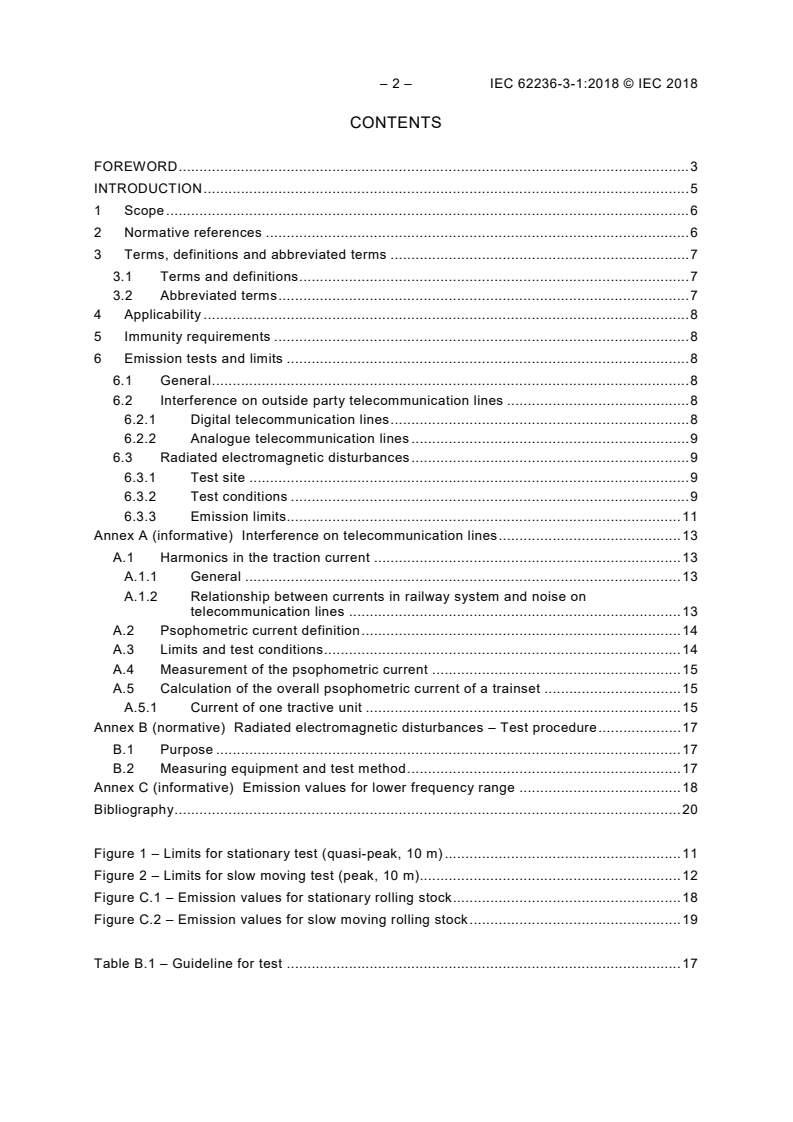
CONTENTS
FOREWORD . 3
INTRODUCTION . 5
1 Scope . 6
2 Normative references . 6
3 Terms, definitions and abbreviated terms . 7
3.1 Terms and definitions . 7
3.2 Abbreviated terms . 7
4 Applicability . 8
5 Immunity requirements . 8
6 Emission tests and limits . 8
6.1 General . 8
6.2 Interference on outside party telecommunication lines . 8
6.2.1 Digital telecommunication lines . 8
6.2.2 Analogue telecommunication lines . 9
6.3 Radiated electromagnetic disturbances . 9
6.3.1 Test site . 9
6.3.2 Test conditions . 9
6.3.3 Emission limits. 11
Annex A (informative) Interference on telecommunication lines . 13
A.1 Harmonics in the traction current . 13
A.1.1 General . 13
A.1.2 Relationship between currents in railway system and noise on
telecommunication lines . 13
A.2 Psophometric current definition . 14
A.3 Limits and test conditions . 14
A.4 Measurement of the psophometric current . 15
A.5 Calculation of the overall psophometric current of a trainset . 15
A.5.1 Current of one tractive unit . 15
Annex B (normative) Radiated electromagnetic disturbances – Test procedure . 17
B.1 Purpose . 17
B.2 Measuring equipment and test method . 17
Annex C (informative) Emission values for lower frequency range . 18
Bibliography . 20
Figure 1 – Limits for stationary test (quasi-peak, 10 m) . 11
Figure 2 – Limits for slow moving test (peak, 10 m). 12
Figure C.1 – Emission values for stationary rolling stock . 18
Figure C.2 – Emission values for slow moving rolling stock . 19
Table B.1 – Guideline for test . 17
INTERNATIONAL ELECTROTECHNICAL COMMISSION
____________
RAILWAY APPLICATIONS –
ELECTROMAGNETIC COMPATIBILITY –
Part 3-1: Rolling stock – Train and complete vehicle
FOREWORD
1) The International Electrotechnical Commission (IEC) is a worldwide organization for standardization comprising
all national electrotechnical committees (IEC National Committees). The object of IEC is to promote
international co-operation on all questions concerning standardization in the electrical and electronic fields. To
this end and in addition to other activities, IEC publishes International Standards, Technical Specifications,
Technical Reports, Publicly Available Specifications (PAS) and Guides (hereafter referred to as “IEC
Publication(s)”). Their preparation is entrusted to technical committees; any IEC National Committee interested
in the subject dealt with may participate in this preparatory work. International, governmental and non-
governmental organizations liaising with the IEC also participate in this preparation. IEC collaborates closely
with the International Organization for Standardization (ISO) in accordance with conditions determined by
agreement between the two organizations.
2) The formal decisions or agreements of IEC on technical matters express, as nearly as possible, an international
consensus of opinion on the relevant subjects since each technical committee has representation from all
interested IEC National Committees.
3) IEC Publications have the form of recommendations for international use and are accepted by IEC National
Committees in that sense. While all reasonable efforts are made to ensure that the technical content of IEC
Publications is accurate, IEC cannot be held responsible for the way in which they are used or for any
misinterpretation by any end user.
4) In order to promote international uniformity, IEC National Committees undertake to apply IEC Publications
transparently to the maximum extent possible in their national and regional publications. Any divergence
between any IEC Publication and the corresponding national or regional publication shall be clearly indicated in
the latter.
5) IEC itself does not provide any attestation of conformity. Independent certification bodies provide conformity
assessment services and, in some areas, access to IEC marks of conformity. IEC is not responsible for any
services carried out by independent certification bodies.
6) All users should ensure that they have the latest edition of this publication.
7) No liability shall attach to IEC or its directors, employees, servants or agents including individual experts and
members of its technical committees and IEC National Committees for any personal injury, property damage or
other damage of any nature whatsoever, whether direct or indirect, or for costs (including legal fees) and
expenses arising out of the publication, use of, or reliance upon, this IEC Publication or any other IEC
Publications.
8) Attention is drawn to the Normative references cited in this publication. Use of the referenced publications is
indispensable for the correct application of this publication.
9) Attention is drawn to the possibility that some of the elements of this IEC Publication may be the subject of
patent rights. IEC shall not be held responsible for identifying any or all such patent rights.
International Standard IEC 62236-3-1 has been prepared by IEC technical committee 9:
Electrical equipment and systems for railways.
This third edition cancels and replaces the second edition published in 2008. It constitutes a
technical revision and has been developed on the basis of EN 50121-3-1:2015.
This edition includes the following significant technical changes with respect to the previous
edition:
a) clarification of scope (Clause 1);
b) clarification of definitions (Clause 3);
c) clarification of applicability (Clause 4);
d) clarification of interference on outside party telecommunication lines (6.2), psophometric
current (Annex A);
– 4 – IEC 62236-3-1:2018 © IEC 2018
e) moving emission values for radiated H-field in the frequency range 9 kHz to 150 kHz into
new Annex C due to the fact that:
– there are very few outside world victims (e.g. radio services),
– the radiated emission measured at 10 m is not representative of the compatibility with
internal railway apparatus,
– the EMC with other railway apparatus in this frequency range is covered in other
procedures and standards like IEC 62427 series,
– there is low reproducibility.
This International Standard is to be read in conjunction with IEC 62236-1.
The text of this International Standard is based on the following documents:
FDIS Report on voting
9/2337/FDIS 9/2367/RVD
Full information on the voting for the approval of this International Standard can be found in
the report on voting indicated in the above table.
This document has been drafted in accordance with the ISO/IEC Directives, Part 2.
A list of all parts in the IEC 62236 series, published under the general title Railway
applications – Electromagnetic compatibility, can be found on the IEC website.
The committee has decided that the contents of this document will remain unchanged until the
stability date indicated on the IEC website under "http://webstore.iec.ch" in the data related to
the specific document. At this date, the document will be
• reconfirmed,
• withdrawn,
• replaced by a revised edition, or
• amended.
INTRODUCTION
High powered electronic equipment, together with low power microcontrollers and other
electronic devices, is being installed on trains in great numbers. Electromagnetic compatibility
has therefore become a critical issue for the design of train-related apparatus as well as of
the train as a whole.
This Product Standard for rolling stock sets limits for electromagnetic emission and immunity
in order to ensure a well functioning system within its intended environment.
Immunity limits are not given for the complete vehicle. Part 3-2 of this series defines
requirements for the apparatus installed in the rolling stock, since it is impractical to test the
complete unit. An EMC plan includes equipment covered by this document.
– 6 – IEC 62236-3-1:2018 © IEC 2018
RAILWAY APPLICATIONS –
ELECTROMAGNETIC COMPATIBILITY –
Part 3-1: Rolling stock – Train and complete vehicle
1 Scope
This part of IEC 62236 specifies the emission and immunity requirements for all types of
rolling stock. It covers traction stock, hauled stock and trainsets including urban vehicles for
use in city streets. This document specifies the emission limits of the rolling stock to the
outside world.
The scope of this document ends at the interface of the rolling stock with its respective energy
inputs and outputs. In the case of traction units, trainsets, trams, etc., this is the current
collector (pantograph, shoe gear). In the case of hauled stock, this is the AC or DC auxiliary
power connector. However, since the current collector is part of the traction stock, it is not
entirely possible to exclude the effects of this interface with the power supply line. The slow
moving test has been designed to minimize these effects.
There may be additional compatibility requirements within the railway system identified in the
EMC plan (e.g. as specified in IEC 62427).
Electromagnetic emissions of the railway system as a whole are dealt with in IEC 62236-2.
These specific provisions are used in conjunction with the general provisions in IEC 62236-1.
The frequency range considered is from 0 Hz (DC) to 400 GHz. No measurements need to be
performed at frequencies where no requirement is specified.
2 Normative references
The following documents are referred to in the text in such a way that some or all of their
content constitutes requirements of this document. For dated references, only the edition
cited applies. For undated references, the latest edition of the referenced document (including
any amendments) applies.
IEC 62236-1:2018, Railway applications – Electromagnetic compatibility – Part 1: General
IEC 62236-2:2018, Railway applications – Electromagnetic compatibility – Part 2: Emission of
the whole railway system to the outside world
IEC 62236-3-2:2018, Railway applications – Electromagnetic compatibility – Part 3-2: Rolling
stock – Apparatus
CISPR 16-1-1:2015, Specification for radio disturbance and immunity measuring apparatus
and methods – Part 1-1: Radio disturbance and immunity measuring apparatus – Measuring
apparatus
3 Terms, definitions and abbreviated terms
3.1 Terms and definitions
For the purposes of this document, the following terms and definitions apply.
ISO and IEC maintain terminological databases for use in standardization at the following
addresses:
• IEC Electropedia: available at http://www.electropedia.org/
• ISO Online browsing platform: available at http://www.iso.org/obp
3.1.1
traction stock
electric and diesel traction unit, high speed trainset, elementary fixed combination of traction
stock and hauled stock, electric and diesel multiple unit (no traction unit, distributed traction
equipment), Light Railway Vehicle (LRV), such as tram, trolley bus or any other electrical
vehicle for urban mass transit, underground trainset
3.1.2
hauled stock
independent passenger coaches and freight wagons (if they contain electric apparatus such
as freezing equipment) which may be hauled in random combinations by different types of
traction units
3.1.3
main line vehicles
vehicles such as high speed trains, suburban trains, freight trains, mainly designed to operate
between cities
3.1.4
urban vehicles
vehicles such as underground trainsets, trams, LRV (Light Rail Vehicles), trolleybuses, mainly
designed to operate within the boundary of a city
3.2 Abbreviated terms
AC Alternating current
BW Band width
DC Direct current
E Electric (field)
EMC Electromagnetic compatibility
EUT Equipment under test
H Magnetic (field)
ISDN Integrated Services Digital Network
ITU-T International Telecommunucation Union – Telecommunication Standardization
Sector
LRV Light rail vehicle
PCM Pulse – code modulation
QC Quadrant converters
QP Quasi-Peak
xDSL All types of digital subscriber lines
– 8 – IEC 62236-3-1:2018 © IEC 2018
4 Applicability
Generally, it is not possible to test electromagnetic compatibility invoking every function of the
stock. The tests shall be made at typical operating modes considered to produce the largest
emission.
The typical operating mode shall require all systems to be energised which are normally in
continuous operation during service. It is not necessary during the test to exercise systems
which operate transiently such as for example operation of internal doors, although they
should be energised. It is not necessary to test degraded modes of operation.
The configuration and mode of operation shall be specified in the test plan and the actual
conditions during the tests shall be precisely noted in the test report.
5 Immunity requirements
No tests are applied to the complete vehicle. It is expected that the assembly of the apparatus
into a complete vehicle will give adequate immunity, provided that an EMC plan has been
prepared and implemented, taking into account the requirements in IEC 62236-3-2.
In exceptional cases, where apparatus meets another EMC Standard, but full compliance with
IEC 62236-3-2 is not demonstrated, EMC shall be ensured by adequate integration measures
of the apparatus into the vehicle system and/or by an appropriate EMC analysis and test
which justifies deviating from IEC 62236-3-2.
6 Emission tests and limits
6.1 General
The emission tests and limits for rolling stock in this document should ensure as far as
possible that the rolling stock does not interfere with typical installations in the vicinity of the
railway system.
Measurements shall be performed in well-defined and reproducible conditions. It is not
possible to totally separate the effects of the railway system and the stock under test. For
radiated emissions, the test conditions are defined in 6.3.1 and 6.3.2.
NOTE 1 Signalling and communication, train radio and other railway systems (axle counters, track circuits, train
control systems, etc.) are different in every country in terms of operating frequencies and waveforms. Therefore,
compatibility requirements are specified according to the type of signalling and communication systems used.
NOTE 2 There can be cases in which radio or other railway external services with working frequencies below
150 kHz are in operation close to the railway. The EMC plan covers these cases and an adequate level of emission
from railway on these working frequencies may be found in the values given in informative Annex C, hence no
guarantee can be given for an undisturbed operation.
6.2 Interference on outside party telecommunication lines
6.2.1 Digital telecommunication lines
Interference with digital systems such as PCM, ISDN, xDSL is not covered in this document.
It should be noted that these systems operate in a higher frequency range using multiple
carriers and various automatic error correction protocols.
It is considered unlikely that rolling stock can produce sufficient interference in this frequency
range.
6.2.2 Analogue telecommunication lines
No harmonized limits apply.
Information about interference on telecommunication lines can be found in Annex A.
6.3 Radiated electromagnetic disturbances
6.3.1 Test site
It can be assumed that measurements will not take place in laboratory conditions. Trees,
walls, bridges, tunnels or other conductive objects in the vicinity of the measurement antenna
could have an impact on the measurement. Other railway vehicles operating in the same
feeding section or nearby the measuring point may affect the measurement result.
Overhead/third rail discontinuities as well as substations, power lines, buried lines,
transformers, neutral sections, section insulators, etc., close to the measuring point may
cause additional variations.
These influences shall be reduced as far as practical but in any case no obstacles above rail
level which may influence the measurements shall be located between antenna and EUT.
The overhead/third rail should be a continuous line as far as practical on both sides of the
measurement point (typically at least 200 m).
Since it is impossible to avoid the support masts of the overhead, the measurement point
shall be at the midpoint between masts, on the opposite side of the track (in case of a double
track, on the side of the track which is being used). If the railway system is powered by a third
rail, the antenna shall be on the same side of the track (worst case).
Since resonances may occur in the overhead line at radio-frequencies, it may be necessary to
change the test site. The exact location of the test site and features of both the site and the
overhead system layout shall be noted.
The contribution of the substation may be considered when assessing the emissions from the
vehicle. Note that the contribution of a DC substation depends on its load current and will not
be measured properly in a no-load condition.
At the beginning and at the end of the test series the ambient noise shall be recorded. This
measurement shall be done without any influence of the vehicle.
If at specific frequencies or in specific frequency ranges the ambient noise is higher than the
limit values less 6 dB (ambient noise > (limit – 6 dB)), the measurements at these frequencies
need not be considered. These frequencies shall be noted in the test report.
NOTE It is helpful to perform this ambient noise measurement also with the vehicle completely powered down in
front of the antenna.
6.3.2 Test conditions
The tests shall cover the operation of all systems onboard the rolling stock which may
produce radiated emissions.
Hauled stock (a representative version) shall be tested while stationary in an energised mode
(auxiliary converters, battery chargers, etc., in operation). The antenna should be sited
opposite the equipment expected to produce the greatest emissions at the frequencies under
measurement.
Tests for identical coaches or wagons are performed only once.
– 10 – IEC 62236-3-1:2018 © IEC 2018
Traction stock shall be tested while stationary and at slow moving speed. During the
stationary test, the auxiliary converters shall operate (it is not inevitably under maximum load
conditions that the maximum emission level is produced) and the traction converters shall be
under voltage but not operating. The antenna shall be in front of the middle of each vehicle
unless an alternative location is expected to produce higher emission levels.
For the slow moving test, the speed shall be low enough to avoid arcing at or bouncing of the
sliding contact and high enough to allow for electric braking. The recommended speed range
is (20 ± 5) km/h for urban vehicles and (50 ± 10) km/h for main line vehicles. When passing
the antenna, the vehicle shall accelerate or decelerate with approximately 1/3 of its maximum
tractive effort within the given speed range.
The slow moving test may be replaced by a stationary test with the vehicle operating at 1/3 of
its maximum tractive effort against the mechanical brakes, if the following conditions are
fulfilled:
– the traction equipment can be operated while the vehicle is stationary;
– tests of electric braking are not required, if no different circuits are used in braking.
If the slow moving test is replaced by a stationary test with tractive effort, then the slow
moving limits apply.
Any vehicles using onboard energy storage for traction shall use the test procedure and limits
for slow moving test for the charging process.
NOTE Slow moving test procedure and limits are used for charging process (for traction energy storing devices)
because it has a short duration with high energy transfer.
6.3.3 Emission limits
dBµV/m
dBµA/m
-5
–20
–20
1 MHz
10 MHz 100 MHz
150 kHz 1 GHz
30 MHz
BW 1
BW 2
H Field E Field
Tram/trolleybus systems for use in city streets
Other rail vehicles
IEC
Figure 1 – Limits for stationary test (quasi-peak, 10 m)
The limits are defined as quasi-peak values and the bandwidths are those used in
CISPR 16-1-1:
Bandwidth
Frequencies from 150 kHz to 30 MHz 9 kHz (BW 1)
Frequencies from 30 MHz to 1 GHz 120 kHz (BW 2)
All values are measured at a distance of 10 m from the centre of the track.
The emission limits are specified up to 1 GHz due to the fact that there are no significant
sources of interference above 1 GHz and that emissions from microprocessor controlled
equipment which may give rise to emissions at frequencies greater than 1 GHz are addressed
by compliance with IEC 62236-3-2.
– 12 – IEC 62236-3-1:2018 © IEC 2018
dBµA/m dBµV/m
A
B
C
A
B
C
1 MHz
10 MHz 100 MHz
150 kHz 1 GHz
30 MHz
BW 1 BW 2
H Field E Field
A = 20/25 kV AC
B = 15 kV AC, 3 kV DC and 1,5 kV DC
C = 750 V and 600 V DC including tram/trolleybus systems
for use in city streets (catenary and conductor rail)
IEC
Figure 2 – Limits for slow moving test (peak, 10 m)
For details of test procedure, see Annex B.
All values are measured at a distance of 10 m from the centre of the track in peak values.
For diesel and diesel electric traction units and multiple units, the emission limits of Figure 1
(“other rail vehicles”) and B in Figure 2 shall apply unless specific measures dictate otherwise
(e.g. usage in lower voltage electrified lines).
The emission limits are specified up to 1 GHz due to the fact that there are no significant
sources of interference above 1 GHz and that emissions from microprocessor controlled
equipment which may give rise to emissions at frequencies greater than 1 GHz are addressed
by compliance with IEC 62236-3-2.
Annex A
(informative)
Interference on telecommunication lines
A.1 Harmonics in the traction current
A.1.1 General
The harmonics in the traction current of a railway system may induce noise in a conventional
analogue telecommunication system. The acceptable level of noise on conventional analogue
telephone lines is specified by ITU-T. The value of this noise is measured with a psophometric
filter. The relationship between the current absorbed or generated by the traction vehicle and
the noise in the telephone line is neither under the total control of the vehicle manufacturer
nor of the operator of the network. Thus, it is the responsibility of the purchaser of the tractive
stock in accordance with the rules of the infrastructure manager to specify a frequency
weighted current limit at the vehicle interface.
One method commonly used is to specify the psophometric current I which has a
pso
psophometrical frequency weighting. The background and application of this method is
described in this Annex. As it is known that the I method does not fully represent the noise
pso
effect of the harmonics in the kHz range, alternative methods of frequency weighting may be
specified by the purchaser.
A.1.2 Relationship between currents in railway system and noise on
telecommunication lines
Conventional telecom copper cables in the vicinity of electrified railway lines are subject to
electromagnetic disturbances caused by the currents in the railway system.
These disturbances result in induced longitudinal voltages ranging from the frequency of the
fundamental wave to higher frequency harmonics. Sources of the harmonics are converters
applied within the traction equipment of the traction stock and/or in the power supply station.
Due to imbalances in the cable itself, these longitudinal voltages translate to transverse
voltages or noise.
The acceptable level of noise on conventional analogue telephone lines is specified by the
ITU-T. The value of this noise is measured with a psophometric filter.
The relationship between the current absorbed by the traction vehicle and the noise on the
telecom line is neither under the total control of the vehicle manufacturer nor of the railway
and telecommunication network operators.
This relationship depends on:
a) the structure of the telecom cables
1) shielding, isolation to ground, balance of the cable;
b) the characteristics of the telecom terminals
1) susceptibility, input balance;
c) the topology of the telecom network
1) length of parallel sections of the telecom line to the tracks;
2) the distance between tracks and telecom lines;
3) the earth-resistivity;
d) the topology of the railway network
– 14 – IEC 62236-3-1:2018 © IEC 2018
1) single/double track;
e) the type of power supply of the catenary
1) AC / DC;
2) substation ripple (DC rectifiers or AC 16,7 Hz static converters in some cases);
3) type of catenary and feeder system (e.g. 1 × 25 kV or 2 × 25 kV);
4) application of return conductors;
5) single-end or double-end supply of the section under consideration;
f) the density of train circulation;
g) the current absorption and generation of harmonics of the tractive stock;
h) the kind of harmonics superposition from a number of converters.
A.2 Psophometric current definition
The psophometric current is an equivalent disturbance current, which represents the effective
disturbance of a current spectrum in a power circuit to a telephone line. It is defined by the
formula:
I = (p I )
pso f f
∑
p
where:
I is the current component at frequency f in the contact line current;
f
p is the psophometric weighting.
f
The values of p may be found in the ITU-T Directives ITU-T O.41 and ITU-T K.68.
f
For measurement purposes, voltage and ampere meters which automatically calculate the
signal according to these values of p by means of a psophometric filter are available.
f
A.3 Limits and test conditions
It is the responsibility of the purchaser to specify the maximum value of the psophometric
current, and the conditions under which it is defined, including duration.
The following conditions are covered:
a) Limits of I under normal and under reduced performance conditions (one or more
pso
traction converters temporarily out of service).
b) In the case of DC supply:
DC railways are normally fed by diode rectifiers from the 3-phase mains supply. Ideally, a
single bridge rectifier produces a 6-pulse shape of voltage (i.e. first harmonic at 300 Hz in
a 50 Hz mains) or two bridges produce a 12-pulse shape (i.e. 600 Hz). Due to imbalances
in the rectifier and due to induction, a fundamental component at 50 Hz is commonly
found.
The presence of filters in the substation greatly reduces the effect of the substation.
Nevertheless, in DC systems, the substation is the main source of perturbation.
Thus, to qualify a traction vehicle, the contribution of the rectifier unit and filters of the
fixed installation are relevant.
It is also necessary to take into account the distance between the traction vehicle and the
substation which affects the line inductance.
c) In the case of AC supply:
If the line voltage distortion has to be taken into consideration, the essential harmonics
have to be specified. If special resonance conditions in the power supply line system are
relevant, it is necessary to specify the relevant data. Otherwise, the situation of the vehicle
nearest to the supply station is assumed to give the highest value I .
pso
A.4 Measurement of the psophometric current
During acceptance tests or investigation tests, the disturbance current I is measured on
pso
board the traction vehicle. Existing current sensors of the vehicle may be used, if their
frequency response is sufficient (at least up to 5 kHz). The current is measured at the high
voltage input of the vehicle and not on the ground side.
The psophometric current is measured by means of a psophometer or another adequate
.
system which uses filtering according to the psophometric weighting factor p
f
To obtain additional information about the composition of the spectrum and the sources of
disturbance, the use of a dual channel spectrum analyser, applied to vehicle input current and
input voltage, is strongly recommended.
The psophometric current is measured in normal and in reduced operation mode (not all
converters operating). The interpretation of the measurement results takes into consideration
the influence of operating conditions as well as changes in line inductance and supply
voltage.
Effects due to transients (switching in the power circuits, pantograph bouncing, third
rail/fourth rail gaps, etc.) are out of the evaluation.
A.5 Calculation of the overall psophometric current of a trainset
A.5.1 Current of one tractive unit
A.5.1.1 General
Typically, the total current of a trainset is not available. Instead of installing a special
measuring system which can generate an image of the total current from sensors distributed
over the whole trainset, it is normally sufficient to pick up the current of one tractive unit of the
trainset.
If the psophometric current is being measured at one power terminal of a trainset and this
trainset has "n" terminals, the overall current is calculated according to the following rules:
A.5.1.2 DC systems
DC railways are normally fed by diode rectifiers from the three phase supply. If no special
filters are applied, the ripple of the rectifier output contributes considerably to the
psophometric current absorbed by vehicles in the supply section.
– DC systems with dominating rectifier ripple
(Vehicles with camshaft control; vehicles with chopper or inverter control, substation with
6-pulse rectifier without filtering)
I = n x I
pso (total) pso (one unit)
– DC systems with converters on the vehicle and low rectifier ripple
I may be less than I , for choppers operating in interlaced mode
pso (total) pso (one unit)
I = n x I , for choppers operating without synchronisation or for
pso (total) pso (one unit)
inverters directly connected to the power supply.
– 16 – IEC 62236-3-1:2018 © IEC 2018
A.5.1.3 AC systems
The psophometric current generated by vehicles in the supply section depends mainly on the
type of converter used on board the vehicle.
– AC systems with phase controlled converters
I = n x I . This seems to be based on a statistical mix of vehicle types,
pso (total) pso (one unit)
speeds and actual current consumption. But recent experience with high power trainsets
shows that this n-law is not applicable in the case of equal speeds, equal power and
equal vehicle types, when I = n x I applies.
pso (total) pso (one unit)
– AC systems with 4 quadrant converters (4QC, pulse width modulated line converter)
I may be less than I , if 4QC depends on the interlacing mode used
pso (total) pso (one unit)
(normal operating condition)
I = n x I , if n equal units operate in non-interlaced mode.
pso (total) pso (one unit)
Annex B
(normative)
Radiated electromagnetic disturbances – Test procedure
B.1 Purpose
This annex describes a measurement method for evaluation and qualification of a complete
railway vehicle or train concerning the disturbance generated in the range 150 kHz to 1 GHz.
It fulfils most of the IEC 62236-2 measurement method recommendations but provides
simplified features which significantly reduce the whole test duration.
B.2 Measuring equipment and test method
To reduce test duration, the frequency scanning technique is used. This can be done either by
a spectrum analyser or a computer controlled receiver. Each frequency range is divided into
several subranges.
Each evaluation of a train or a vehicle consists in doing a test of each subrange.
The apparatus shall scan this subrange continuously and memorize the maximum values
reached during the test. This can be achieved by the "peak hold" function or under computer
control of the apparatus. This method assumes that the level and characteristics of
electromagnetic disturbance do not vary significantly during each scan.
The position, location, type and other features concerning the antennas are the same as
described in IEC 62236-2:2018, Clause 5.
The measuring apparatus shall be in accordance with the CISPR 16-1-1:2015 requirements
described in Clause 5: "Peak measuring receivers for the frequency range 9 kHz to 18 GHz".
Table B.1 may be used as a guideline for the test:
Table B.1 – Guideline for test
a b
Band Subrange Span Bandwidth Sweep time
Hz Hz kHz ms
B 150 k to 1,15 M 1 M 9 or 10 37
1 M to 11 M 10 M 9 or 10 370
10 M to 20 M 10 M 9 or 10 370
20 M to 30 M 10 M 9 or 10 370
C/D 30 M to 230 M 200 M 100 or 120 42
200 M to 500 M 300 M 100 or 120 63
500 M to 1 G 500 M 100 or 120 100
a
For a spectrum analyser.
b
May be slightly different from one instrument to another.
– 18 – IEC 62236-3-1:2018 © IEC 2018
Annex C
(informative)
Emission values for lower frequency range
In the early 1990s measurements of emission from railways and vehicles on railways were
undertaken to get information about the values to be expected in the neighbourhood of
railways. It was experienced that in particular the results of magnetic field measurements, at
10 m distance, gave a poor reproducibility for frequencies below 150 kHz due to several
reasons.
Due to the large variation in measured value (up to 20 dB) on the same vehicle depending on
the location and other circumstances the reproducibility cannot be achieved and the
usefulness is in question.
Since these emission values were published in the first editions of IEC 62236-3-1, the graphs
are shown in this informative annex without being a requirement to be fulfilled (see Figures
C.1 and C.2).
Quasi - peak values
dBµA/m
dBµA/m
40 40
10 kHz 10 0 kHz
BW = 200 Hz
H Field
9 kHz 150 kHz
Tram/trolleybus systems for use in city streets
Other rail vehicles
IEC
Figure C.1 – Emission values for stationary rolling stock
Peak values
dBµA/m dBµA/m
65 A
B
C
10 kHz 10 0 kHz
BW = 200 Hz
H Field
9 kHz 150 kHz
A = 20/25 kV
...