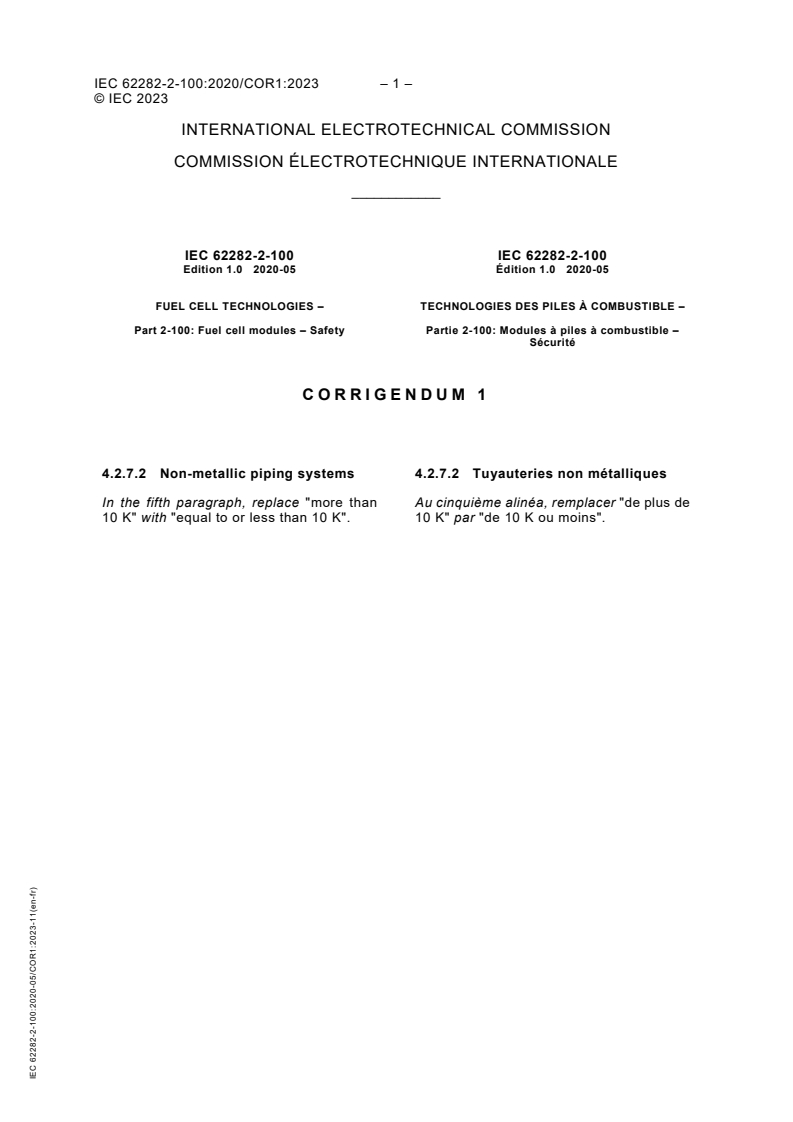
IEC 62282-2-100:2020/COR1:2023
(Corrigendum)Corrigendum 1 - Fuel cell technologies - Part 2-100: Fuel cell modules - Safety
Corrigendum 1 - Fuel cell technologies - Part 2-100: Fuel cell modules - Safety
Corrigendum 1 - Technologies des piles à combustible - Partie 2-100: Modules à piles à combustible - Sécurité
General Information
Relations
Standards Content (Sample)
© IEC 2023
INTERNATIONAL ELECTROTECHNICAL COMMISSION
COMMISSION ÉLECTROTECHNIQUE INTERNATIONALE
____________
IEC 62282-2-100 IEC 62282-2-100
Edition 1.0 2020-05 Édition 1.0 2020-05
FUEL CELL TECHNOLOGIES – TECHNOLOGIES DES PILES À COMBUSTIBLE –
Part 2-100: Fuel cell modules – Safety Partie 2-100: Modules à piles à combusti
...
This May Also Interest You
IEC 63341-3:2025 specifies the performance evaluation methodologies for fuel cell power systems that are designed for utilisation in electrically propelled rolling stock.
The scope of this document concerns itself exclusively with electrically powered rolling stock. Internal combustion engines utilising hydrogen are not encompassed within the scope of this document.
This document is applicable to hydrogen fuel cell power systems for electrically propelled rolling stock.
This document does not apply to reformer-equipped fuel cell power systems.
This document does not cover the hydrogen fuel systems that are permanently or separately attached to either the rolling stock or the fuel cell power system. These systems are addressed in IEC 63341-2. The fundamental system overview, incorporating the interrelationships between the primary functions and the connections to the external system, is delineated in IEC 63341-1:2025, Figure 4.
The relevant standards are comprehensively delineated in IEC 63341-1. The performance targets for fuel cell power systems are agreed upon between the user and the manufacturer
- Standard59 pagesEnglish languagesale 15% off
- Standard63 pagesFrench languagesale 15% off
- Standard122 pagesEnglish and French languagesale 15% off
IEC TS 62282-7-1:2025 covers cell assemblies, test station setup, measuring instruments and measuring methods, performance test methods, and test reports for PEFC single cells.
This document is used for evaluating:
a) the performance and durability of membrane electrode assemblies (MEAs) for PEFCs in a single cell configuration;
b) materials or structures of PEFCs in a single cell configuration; or,
c) the influence of impurities in fuel and/or in air on the fuel cell performance and durability.
This document is for proton exchange membrane fuel cells (PEMFC) basically having flow field configurations and using hydrogen or hydrogen containing gas as fuel. It excludes from the scope fuel cells based on anion exchange membranes, bipolar membranes, and phosphoric acid doped polybenzimidazole membranes.
- Technical specification92 pagesEnglish languagesale 15% off
IEC 62282-3-200:2025 covers operational and environmental aspects of the stationary fuel cell power systems performance. The test methods apply as follows:
- power output under specified operating and transient conditions;
- electrical and heat recovery efficiency under specified operating conditions;
- environmental characteristics, for example, exhaust gas emissions, noise, under specified operating and transient conditions.
This document applies to all kinds of stationary fuel cell technologies, such as:
- alkaline fuel cells (AFC);
- phosphoric acid fuel cells (PAFC);
- polymer electrolyte fuel cells (PEFC);
- molten carbonate fuel cells (MCFC);
- solid oxide fuel cells (SOFC).
This third edition cancels and replaces the second edition published in 2015. This edition includes the following significant technical changes with respect to the previous edition:
- revision of the Introduction, Scope and Clause 3;
- revision of the symbols in Table 1;
- revision of Figure 2 (symbol diagram);
- revision of measurement methods (8.3);
- revision of the efficiency test (10.2);
- revision of the electric power and thermal power response characteristics test (10.3);
- revision of the start-up and shutdown characteristics test (10.4);
- revision of Annex C.
- Standard241 pagesEnglish languagesale 15% off
IEC 62282-3-201:2025 provides test methods for the electrical, thermal, and environmental performance of small stationary fuel cell power systems that meet the following criteria:
- output: rated electric power output of less than 10 kW;
- output mode: grid-connected/independent operation or stand-alone operation with single-phase AC output or 3-phase AC output not exceeding 1 000 V, or DC output not exceeding 1 500 V;
- operating pressure: maximum allowable working pressure of 0,1 MPa (gauge) for the fuel and oxidant passages;
- fuel: gaseous fuel (natural gas, liquefied petroleum gas, propane, butane, hydrogen, etc.) or liquid fuel (kerosene, methanol, etc.);
- oxidant: air.
This document describes type tests and their test methods only. No routine tests are required or identified, and no performance targets are set in this document.
This document provides test methods to be carried out under laboratory conditions.
This document covers fuel cell power systems whose primary purpose is the production of electric power and whose secondary purpose can be the utilization of heat. Accordingly, fuel cell power systems for which the use of heat is primary, and the use of electric power is secondary are outside the scope of this document.
This third edition cancels and replaces the second edition published in 2017 and Amendment 1:2022. This edition includes the following significant technical changes with respect to the previous edition:
- revision of Introduction;
- revision of terms and definitions;
- revision of Table 1;
- revision of Figure 1, Figure 2, Figure 3 and Figure 4;
- revision of measurement instruments (10.2);
- revision of minimum required measurement systematic uncertainty (10.4);
- revision of test conditions (Clause 11);
- revision of operating process (Clause 12);
- revision of fuel consumption test (14.2);
- revision of heat recovery test (14.4);
- revision of Figure 13 and Figure 14;
- revision of calculation of results (14.14.4);
- revision of Annex A and Annex B.
- Standard286 pagesEnglish languagesale 15% off
IEC 62282-6-401:2025 covers the requirements for the performance test methods of a micro fuel cell/battery power system, consisting of a fuel cell system with secondary battery for laptop computers.
For this purpose, this document covers electrical performance tests for the fuel cell/battery hybrid system. This document also covers performance test methods which focus on the power and data interchangeability of the micro fuel cell power system and laptop computer and other characteristics for balance of plant (BOP) installed for laptop computer applications with a fuel cell/battery hybrid system. This document applies to gaseous hydrogen-fuelled fuel cell power, liquid hydrogen-fuelled fuel cell power, direct methanol fuel cell power, and battery hybrid power pack systems. The following fuels are considered within the scope of this document:
- gaseous hydrogen;
- liquid hydrogen compounds;
- methanol.
- Standard41 pagesEnglish and French languagesale 15% off
IEC 62282-3-202:2025 provides performance test methods specialized for the thermal and electrical characteristics of an energy management system to effectively share the heat and power of networked small stationary fuel cell power systems. These test methods are applied for each small stationary fuel cell power system. This document covers small stationary fuel cell power systems which can be complemented with a supplementary heat generator or a thermal storage system, or both, such as:
- output: rated electric power output of less than 10 kW for each system;
- output mode: grid-connected or independent operation or stand-alone operation with alternating current (AC) output not exceeding 240 V or direct current (DC) output;
- operating pressure: maximum allowable working pressure of less than 0,1 MPa (G) for the fuel and oxidant passages;
- fuel: gaseous fuel (natural gas, liquefied petroleum gas, propane, butane, hydrogen) or liquid fuel (kerosene, methanol); oxidant: air.
This document does not apply to small stationary fuel cell power systems with electricity storage other than (small scale) back-up power for safety, monitoring and control.
- Standard101 pagesEnglish and French languagesale 15% off
IEC TR 62282-7-3:2025 is a generic assessment of the feasibility of standardizing accelerated test procedures (both proton exchange membrane (PEM) and oxide ion-conducting solid oxide cell (SOC) technologies) for fuel cell stacks that have been engineered for a specific system application. This document comprises a review of literature and projects, a discussion of the main physical phenomena of interest in accelerated testing campaigns (focusing on the cell and stack levels, not looking at the system as a black box), a compendium of measurement techniques that are applicable, and it suggests a macroscopic approach to the formulation of a representative accelerated testing campaign.
- Technical report29 pagesEnglish languagesale 15% off
IEC 62282-7-2:2025 applies to SOFC cell/stack assembly units, testing systems, instruments and measuring methods, and specifies test methods to test the performance of SOFC cells and stacks. This document is not applicable to small button cells that are designed for SOFC material testing and provide no practical means of fuel utilization measurement. This document is used based on the recommendation of the entity that provides the cell performance specification or for acquiring data on a cell or stack in order to estimate the performance of a system based on it. Users of this document can selectively execute test items suitable for their purposes from those described in this document.
- Standard98 pagesEnglish and French languagesale 15% off
IEC 62282-8-201:2024 defines the evaluation methods of typical performances for electric energy storage systems using hydrogen. It is applicable to the systems that use electrochemical reaction devices for both power charge and discharge. This document applies to systems that are designed and used for service and operation in stationary locations (indoor and outdoor). It specifies performance evaluation methods for electric energy storage systems using hydrogen that employ electrochemical reactions both for water and steam electrolysis and electric power generation. This document is intended for power-to-power systems which typically employ a set of electrolyser and fuel cell, or a reversible cell for devices of electric charge and discharge. This second edition cancels and replaces the first edition published in 2020.
This edition includes the following significant technical changes with respect to the previous edition:
a) consideration of systems connected to hydrogen supply infrastructure (hydrogen grids, vessels, caverns or pipelines);
b) hydrogen input and output rate is added in the system parameters (5.10);
c) electric energy storage capacity test is revised (6.2);
d) roundtrip electrical efficiency test is revised (6.5);
e) hydrogen input and output rate test is added (6.6.6).
- Standard116 pagesEnglish languagesale 15% off
- Standard75 pagesEnglish and French languagesale 15% off
IEC 62282-6-107:2024 covers micro fuel cell power systems, micro fuel cell power units and fuel cartridges using hydrogen produced from water-reactive (UN Division 4.3) compounds as fuel. These systems and units use proton exchange membrane (PEM) fuel cell technologies. The designs can include fuel processing subsystems to derive hydrogen gas from the water-reactive fuel formulation.
This document only applies to water-reactive (UN Division 4.3) solid compounds which solely evolve hydrogen gas upon contact with water (or non-hazardous aqueous solutions). This document does not apply to compounds with a subsidiary hazard risk, or which are not permitted to be transported by air according to the International Civil Aviation Organization (ICAO) Technical Instructions.
- Standard25 pagesEnglish and French languagesale 15% off


Questions, Comments and Discussion
Ask us and Technical Secretary will try to provide an answer. You can facilitate discussion about the standard in here.
Loading comments...