

IEC TS 60695-2-20:2021
(Main)Fire hazard testing - Part 2-20: Glowing/hot-wire based test methods - Hot wire coil test method - Apparatus, verification, test method and guidance
General Information
- Abstract
IEC TS 60695-2-20:2021 describes a test method that applies to solid electrical insulating materials of which test specimens can be provided. The test measures the time required to ignite a test specimen when it is affected by heat from an electrically heated wire wound around the test specimen. If the test specimen drips, the time at which this occurs is also recorded.
The test method can be used to provide classifications which can be used for quality assurance, the preselection of materials of products as described in IEC 60695-1-30, or to verify the required minimum classification of materials used in end products.
This basic safety publication is intended for use by technical committees in the preparation of standards in accordance with the principles laid down in IEC Guide 104 and ISO/IEC Guide 51.
One of the responsibilities of a technical committee is, wherever applicable, to make use of basic safety publications in the preparation of its publications. The requirements, test methods or test conditions of this basic safety publication will not apply unless specifically referred to or included in the relevant publications.
This third edition of IEC TS 60695-2-20 cancels and replaces the second edition of IEC TS 60695-2-20 published in 2004. This edition constitutes a technical revision.
This edition includes the following significant technical changes with respect to the previous edition:
– Contents page added
– Updated Scope (Clause 1)
– Updated Terms and Definitions, added new relevant terms (Clause 3)
– Updated Principle (Clause 4)
– Updated Apparatus (Clause 5; recommendation to change the power source from a.c. to d.c. with a constant current output. Reason for this recommendation: d.c. technology is easier to obtain and to handle, which has been found to improve the Repeatability and Reproducibility of the test.
– Updated Test specimen dimensions (6.2)
– Revised Test procedure (Clause 8)
– Revised Observations and measurements (Clause 9)
– Revised Evaluation of test results (Clause 10)
– Revised Test report (Clause 11)
– Revised Annex A: Deletion of conformational test; Guidance on verification of the heater wire winding before testing
– Addition of normative Annex B: HWCT PLC Classes
– Addition of informative Annex C: Calibration curve to determine test current (Ic) in a spreadsheet program
– Addition of informative Annex D: Precision data
It has the status of a basic safety publication in accordance with IEC Guide 104 and ISO/IEC Guide 51.
This basic safety publication is intended for use by technical committees in the preparation of standards in accordance with the principles laid down in IEC Guide 104 and ISO/IEC Guide 51.
- Status
- Published
- Publication Date
- 26-Apr-2021
- Technical Committee
- TC 89 - Fire hazard testing
- Drafting Committee
- PT 60695-2-20 - TC 89/PT 60695-2-20
- Current Stage
- DELPUB - Deleted Publication
- Start Date
- 15-Nov-2024
- Completion Date
- 14-Apr-2023
Buy Documents
IEC TS 60695-2-20:2021 - Fire hazard testing - Part 2-20: Glowing/hot-wire based test methods - Hot wire coil test method - Apparatus, verification, test method and guidance Released:4/27/2021
Overview
IEC TS 60695-2-20:2021 is a Technical Specification developed by the International Electrotechnical Commission (IEC) focused on fire hazard testing of solid electrical insulating materials. It details the hot wire coil test method, which assesses how insulating materials respond to heat from an electrically heated wire wound around the specimen. This fire hazard testing procedure is crucial for quality assurance, material preselection, and for verifying the fire safety classification of materials used in electrical and electronic products.
This document is recognized as a basic safety publication and provides guidelines for technical committees during the preparation of product and material standards, in line with the framework set by IEC Guide 104 and ISO/IEC Guide 51.
Key Topics
Hot Wire Coil Test Method: The core of this standard is a test where a constant current is supplied to a coil of heater wire wrapped around a solid insulating specimen. The main observations are the time to ignition and, if applicable, the time to drip when the material starts to melt and droplets fall.
Apparatus and Test Conditions: IEC TS 60695-2-20:2021 specifies requirements for the test chamber (draught-free and low-light environment), heater wire composition and dimensions (nickel-chromium alloy), and the constant current DC power source. Conditioning procedures for both specimen and wire are also provided to ensure reproducibility.
Test Specimen Preparation: Material preparation follows standardized molding and cutting processes. Strict tolerances for specimen dimensions are outlined to maintain consistency.
Procedure & Observations: The document details the steps for winding, pressing, and heating the wire, followed by recording key test outcomes: time to ignite (IT) and time to drip (DT).
Classification System: Results allow the assignment of Hot Wire Coil Test (HWCT) performance level categories (PLC classes), which help stakeholders compare material performance and suitability.
Documentation and Reporting: Guidance is given for compiling test reports, ensuring clarity in the communication of test conditions, methods, and results.
Applications
IEC TS 60695-2-20:2021 is widely applicable in:
- Quality assurance testing for manufacturers of electrical insulating materials and components
- Material selection and preselection processes for designers and engineers working on electrical or electronic products
- Conformity assessment to ensure compliance with regulatory and safety standards
- Standardization activities by technical committees in the electrotechnical sector
Typical scenarios include the evaluation of plastics and other insulating materials intended for use in enclosures, wiring supports, connectors, and other critical safety components. By identifying how materials behave under abnormal thermal stress (such as a glowing or hot wire condition), stakeholders can minimize fire risks in end products.
Related Standards
This fire hazard assessment method is part of the broader IEC 60695 series, which covers various glowing/hot-wire test methods. The following related standards are frequently referenced in conjunction with IEC TS 60695-2-20:
- IEC 60695-1-30: Guidelines for assessing the fire hazard of electrotechnical products through preselection testing.
- IEC 60695-2-10: Details general requirements for glow-wire apparatus and common test procedures.
- IEC 60695-2-11/-12/-13: Specify various flammability indices and ignition temperature tests for end products or materials.
- IEC GUIDE 104 and ISO/IEC Guide 51: Frameworks for the preparation and use of basic safety publications in standards development.
Understanding and using IEC TS 60695-2-20:2021 in combination with these documents ensures robust fire hazard testing, consistent material classification, and enhanced product safety throughout the electrical and electronics industries.
Keywords: IEC TS 60695-2-20:2021, fire hazard testing, hot wire coil test, insulating materials, ignitability, fire safety standards, quality assurance, HWCT, electrotechnical products, IEC standards, material classification.
Relations
- Effective Date
- 05-Sep-2023
- Effective Date
- 05-Sep-2023
Buy Documents
IEC TS 60695-2-20:2021 - Fire hazard testing - Part 2-20: Glowing/hot-wire based test methods - Hot wire coil test method - Apparatus, verification, test method and guidance Released:4/27/2021
Get Certified
Connect with accredited certification bodies for this standard

IMQ S.p.A. (Certification)
Italian electrical product certification.

SLG Prüf- und Zertifizierungs GmbH
German testing and certification body.

UL Solutions
Global safety science company with testing, inspection and certification.
Sponsored listings
Frequently Asked Questions
IEC TS 60695-2-20:2021 is a technical specification published by the International Electrotechnical Commission (IEC). Its full title is "Fire hazard testing - Part 2-20: Glowing/hot-wire based test methods - Hot wire coil test method - Apparatus, verification, test method and guidance". This standard covers: IEC TS 60695-2-20:2021 describes a test method that applies to solid electrical insulating materials of which test specimens can be provided. The test measures the time required to ignite a test specimen when it is affected by heat from an electrically heated wire wound around the test specimen. If the test specimen drips, the time at which this occurs is also recorded. The test method can be used to provide classifications which can be used for quality assurance, the preselection of materials of products as described in IEC 60695-1-30, or to verify the required minimum classification of materials used in end products. This basic safety publication is intended for use by technical committees in the preparation of standards in accordance with the principles laid down in IEC Guide 104 and ISO/IEC Guide 51. One of the responsibilities of a technical committee is, wherever applicable, to make use of basic safety publications in the preparation of its publications. The requirements, test methods or test conditions of this basic safety publication will not apply unless specifically referred to or included in the relevant publications. This third edition of IEC TS 60695-2-20 cancels and replaces the second edition of IEC TS 60695-2-20 published in 2004. This edition constitutes a technical revision. This edition includes the following significant technical changes with respect to the previous edition: – Contents page added – Updated Scope (Clause 1) – Updated Terms and Definitions, added new relevant terms (Clause 3) – Updated Principle (Clause 4) – Updated Apparatus (Clause 5; recommendation to change the power source from a.c. to d.c. with a constant current output. Reason for this recommendation: d.c. technology is easier to obtain and to handle, which has been found to improve the Repeatability and Reproducibility of the test. – Updated Test specimen dimensions (6.2) – Revised Test procedure (Clause 8) – Revised Observations and measurements (Clause 9) – Revised Evaluation of test results (Clause 10) – Revised Test report (Clause 11) – Revised Annex A: Deletion of conformational test; Guidance on verification of the heater wire winding before testing – Addition of normative Annex B: HWCT PLC Classes – Addition of informative Annex C: Calibration curve to determine test current (Ic) in a spreadsheet program – Addition of informative Annex D: Precision data It has the status of a basic safety publication in accordance with IEC Guide 104 and ISO/IEC Guide 51. This basic safety publication is intended for use by technical committees in the preparation of standards in accordance with the principles laid down in IEC Guide 104 and ISO/IEC Guide 51.
IEC TS 60695-2-20:2021 describes a test method that applies to solid electrical insulating materials of which test specimens can be provided. The test measures the time required to ignite a test specimen when it is affected by heat from an electrically heated wire wound around the test specimen. If the test specimen drips, the time at which this occurs is also recorded. The test method can be used to provide classifications which can be used for quality assurance, the preselection of materials of products as described in IEC 60695-1-30, or to verify the required minimum classification of materials used in end products. This basic safety publication is intended for use by technical committees in the preparation of standards in accordance with the principles laid down in IEC Guide 104 and ISO/IEC Guide 51. One of the responsibilities of a technical committee is, wherever applicable, to make use of basic safety publications in the preparation of its publications. The requirements, test methods or test conditions of this basic safety publication will not apply unless specifically referred to or included in the relevant publications. This third edition of IEC TS 60695-2-20 cancels and replaces the second edition of IEC TS 60695-2-20 published in 2004. This edition constitutes a technical revision. This edition includes the following significant technical changes with respect to the previous edition: – Contents page added – Updated Scope (Clause 1) – Updated Terms and Definitions, added new relevant terms (Clause 3) – Updated Principle (Clause 4) – Updated Apparatus (Clause 5; recommendation to change the power source from a.c. to d.c. with a constant current output. Reason for this recommendation: d.c. technology is easier to obtain and to handle, which has been found to improve the Repeatability and Reproducibility of the test. – Updated Test specimen dimensions (6.2) – Revised Test procedure (Clause 8) – Revised Observations and measurements (Clause 9) – Revised Evaluation of test results (Clause 10) – Revised Test report (Clause 11) – Revised Annex A: Deletion of conformational test; Guidance on verification of the heater wire winding before testing – Addition of normative Annex B: HWCT PLC Classes – Addition of informative Annex C: Calibration curve to determine test current (Ic) in a spreadsheet program – Addition of informative Annex D: Precision data It has the status of a basic safety publication in accordance with IEC Guide 104 and ISO/IEC Guide 51. This basic safety publication is intended for use by technical committees in the preparation of standards in accordance with the principles laid down in IEC Guide 104 and ISO/IEC Guide 51.
IEC TS 60695-2-20:2021 is classified under the following ICS (International Classification for Standards) categories: 13.220.40 - Ignitability and burning behaviour of materials and products; 17.140.50 - Electroacoustics; 29.020 - Electrical engineering in general. The ICS classification helps identify the subject area and facilitates finding related standards.
IEC TS 60695-2-20:2021 has the following relationships with other standards: It is inter standard links to IEC TS 60695-2-20:2024, IEC TS 60695-2-20:2004. Understanding these relationships helps ensure you are using the most current and applicable version of the standard.
IEC TS 60695-2-20:2021 is available in PDF format for immediate download after purchase. The document can be added to your cart and obtained through the secure checkout process. Digital delivery ensures instant access to the complete standard document.
Standards Content (Sample)
IEC TS 60695-2-20 ®
Edition 3.0 2021-04
TECHNICAL
SPECIFICATION
colour
inside
Fire hazard testing –
Part 2-20: Glowing/hot wire based test methods – Hot-wire coil test method –
Apparatus, verification, test method and guidance
All rights reserved. Unless otherwise specified, no part of this publication may be reproduced or utilized in any form
or by any means, electronic or mechanical, including photocopying and microfilm, without permission in writing from
either IEC or IEC's member National Committee in the country of the requester. If you have any questions about IEC
copyright or have an enquiry about obtaining additional rights to this publication, please contact the address below or
your local IEC member National Committee for further information.
IEC Central Office Tel.: +41 22 919 02 11
3, rue de Varembé info@iec.ch
CH-1211 Geneva 20 www.iec.ch
Switzerland
About the IEC
The International Electrotechnical Commission (IEC) is the leading global organization that prepares and publishes
International Standards for all electrical, electronic and related technologies.
About IEC publications
The technical content of IEC publications is kept under constant review by the IEC. Please make sure that you have the
latest edition, a corrigendum or an amendment might have been published.
IEC publications search - webstore.iec.ch/advsearchform IEC online collection - oc.iec.ch
The advanced search enables to find IEC publications by a Discover our powerful search engine and read freely all the
variety of criteria (reference number, text, technical publications previews. With a subscription you will always
committee, …). It also gives information on projects, replaced have access to up to date content tailored to your needs.
and withdrawn publications.
Electropedia - www.electropedia.org
IEC Just Published - webstore.iec.ch/justpublished
The world's leading online dictionary on electrotechnology,
Stay up to date on all new IEC publications. Just Published
containing more than 22 000 terminological entries in English
details all new publications released. Available online and
and French, with equivalent terms in 18 additional languages.
once a month by email.
Also known as the International Electrotechnical Vocabulary
(IEV) online.
IEC Customer Service Centre - webstore.iec.ch/csc
If you wish to give us your feedback on this publication or
need further assistance, please contact the Customer Service
Centre: sales@iec.ch.
IEC TS 60695-2-20 ®
Edition 3.0 2021-04
TECHNICAL
SPECIFICATION
colour
inside
Fire hazard testing –
Part 2-20: Glowing/hot wire based test methods – Hot-wire coil test method –
Apparatus, verification, test method and guidance
INTERNATIONAL
ELECTROTECHNICAL
COMMISSION
ICS 13.220.40, 29.020 ISBN 978-2-8322-9707-0
– 2 – IEC TS 60695-2-20:2021 © IEC 2021
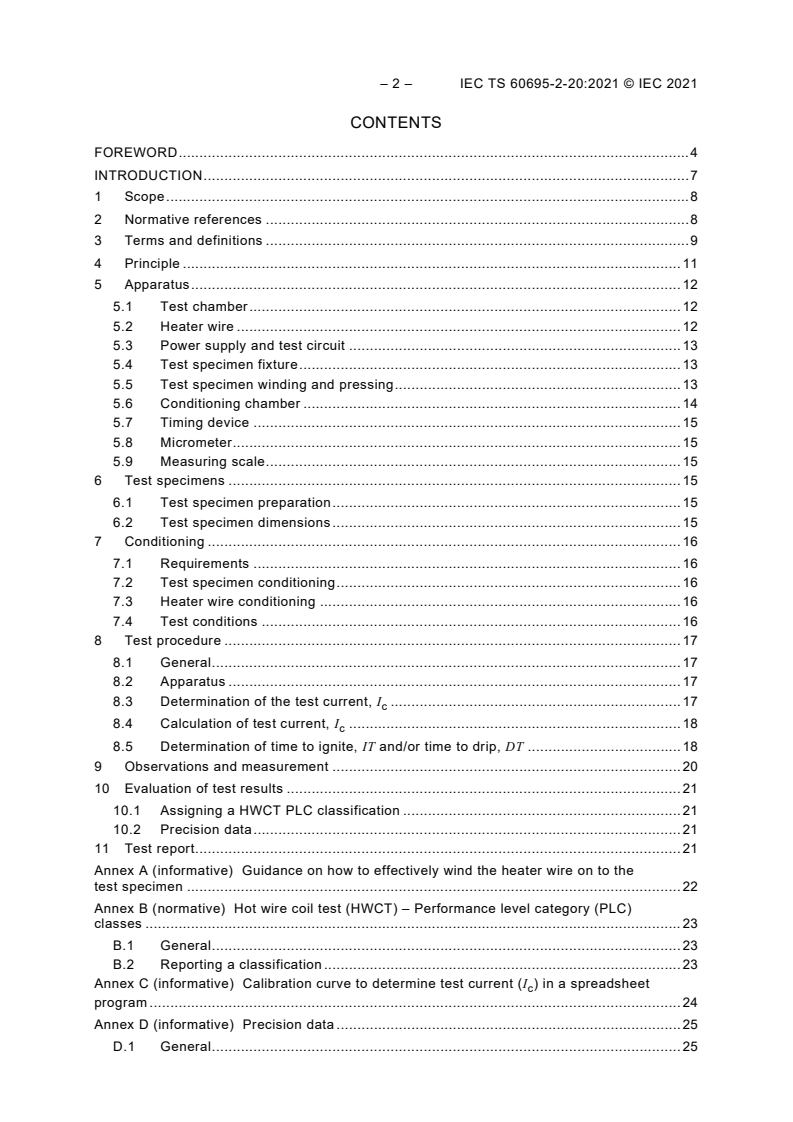
CONTENTS
FOREWORD . 4
INTRODUCTION . 7
1 Scope . 8
2 Normative references . 8
3 Terms and definitions . 9
4 Principle . 11
5 Apparatus . 12
5.1 Test chamber . 12
5.2 Heater wire . 12
5.3 Power supply and test circuit . 13
5.4 Test specimen fixture . 13
5.5 Test specimen winding and pressing . 13
5.6 Conditioning chamber . 14
5.7 Timing device . 15
5.8 Micrometer . 15
5.9 Measuring scale . 15
6 Test specimens . 15
6.1 Test specimen preparation . 15
6.2 Test specimen dimensions . 15
7 Conditioning . 16
7.1 Requirements . 16
7.2 Test specimen conditioning . 16
7.3 Heater wire conditioning . 16
7.4 Test conditions . 16
8 Test procedure . 17
8.1 General . 17
8.2 Apparatus . 17
8.3 Determination of the test current, I . 17
c
8.4 Calculation of test current, I . 18
c
8.5 Determination of time to ignite, IT and/or time to drip, DT . 18
9 Observations and measurement . 20
10 Evaluation of test results . 21
10.1 Assigning a HWCT PLC classification . 21
10.2 Precision data . 21
11 Test report . 21
Annex A (informative) Guidance on how to effectively wind the heater wire on to the
test specimen . 22
Annex B (normative) Hot wire coil test (HWCT) – Performance level category (PLC)
classes . 23
B.1 General . 23
B.2 Reporting a classification . 23
Annex C (informative) Calibration curve to determine test current (I ) in a spreadsheet
c
program . 24
Annex D (informative) Precision data . 25
D.1 General . 25
D.2 Results of preliminary inter-laboratory round robin . 25
D.3 Evaluation of test results . 28
Bibliography . 30
Figure 1 – Test fixture arrangement (example) . 11
Figure 2 – Test specimen winding pattern . 12
Figure 3 – Test specimen fixture (example) . 13
Figure 4 – Heater wire winding device (Example) . 14
Figure 5 – Test circuit arrangement for heater wire calibration . 17
Figure 6 – Calibration curve . 18
Figure 7 – Decision tree . 20
Figure A.1 – Illustration of type a) behaviour . 22
Figure A.2 – Illustration of type b) behaviour . 22
Figure C.1 – Calibration curve in a spreadsheet program used to determine I . 24
c
Table 1 – Nominal thickness tolerances . 16
Table B.1 – Hot wire coil test (HWCT) – Performance level category (PLC) classes . 23
Table D.1 – Results for material 1A . 26
Table D.2 – Results for material 1B . 26
Table D.3 – Results for material 2A . 26
Table D.4 – Results for material 2B . 27
Table D.5 – Results for material 3 . 27
Table D.6 – Results for material 4 . 28
Table D.7 – Occurrence of PLC classes in the round robin . 29
– 4 – IEC TS 60695-2-20:2021 © IEC 2021
INTERNATIONAL ELECTROTECHNICAL COMMISSION
____________
FIRE HAZARD TESTING –
Part 2-20: Glowing/hot wire based test methods –
Hot-wire coil test method –
Apparatus, verification, test method and guidance
FOREWORD
1) The International Electrotechnical Commission (IEC) is a worldwide organization for standardization comprising
all national electrotechnical committees (IEC National Committees). The object of IEC is to promote international
co-operation on all questions concerning standardization in the electrical and electronic fields. To this end and
in addition to other activities, IEC publishes International Standards, Technical Specifications, Technical Reports,
Publicly Available Specifications (PAS) and Guides (hereafter referred to as “IEC Publication(s)”). Their
preparation is entrusted to technical committees; any IEC National Committee interested in the subject dealt with
may participate in this preparatory work. International, governmental and non-governmental organizations liaising
with the IEC also participate in this preparation. IEC collaborates closely with the International Organization for
Standardization (ISO) in accordance with conditions determined by agreement between the two organizations.
2) The formal decisions or agreements of IEC on technical matters express, as nearly as possible, an international
consensus of opinion on the relevant subjects since each technical committee has representation from all
interested IEC National Committees.
3) IEC Publications have the form of recommendations for international use and are accepted by IEC National
Committees in that sense. While all reasonable efforts are made to ensure that the technical content of IEC
Publications is accurate, IEC cannot be held responsible for the way in which they are used or for any
misinterpretation by any end user.
4) In order to promote international uniformity, IEC National Committees undertake to apply IEC Publications
transparently to the maximum extent possible in their national and regional publications. Any divergence between
any IEC Publication and the corresponding national or regional publication shall be clearly indicated in the latter.
5) IEC itself does not provide any attestation of conformity. Independent certification bodies provide conformity
assessment services and, in some areas, access to IEC marks of conformity. IEC is not responsible for any
services carried out by independent certification bodies.
6) All users should ensure that they have the latest edition of this publication.
7) No liability shall attach to IEC or its directors, employees, servants or agents including individual experts and
members of its technical committees and IEC National Committees for any personal injury, property damage or
other damage of any nature whatsoever, whether direct or indirect, or for costs (including legal fees) and
expenses arising out of the publication, use of, or reliance upon, this IEC Publication or any other IEC
Publications.
8) Attention is drawn to the Normative references cited in this publication. Use of the referenced publications is
indispensable for the correct application of this publication.
9) Attention is drawn to the possibility that some of the elements of this IEC Publication may be the subject of patent
rights. IEC shall not be held responsible for identifying any or all such patent rights.
IEC TS 60695-2-20 has been prepared by IEC technical committee 89: Fire hazard testing. It is
a Technical Specification.
This third edition of IEC TS 60695-2-20 replaces the second edition of IEC TS 60695-2-20
published in 2004. This edition constitutes a technical revision.
This edition includes the following significant technical changes with respect to the previous
edition:
– Contents page added
– Updated Scope (Clause 1)
– Updated Terms and Definitions, added new relevant terms (Clause 3)
– Updated Principle (Clause 4)
– Updated Apparatus (Clause 5; recommendation to change the power source from a.c. to
d.c. with a constant current output. Reason for this recommendation: D.c. technology is
easier to obtain and to handle, which has been found to improve the Repeatability and
Reproducibility of the test.
– Updated Test specimen dimensions (6.2)
– Revised Test procedure (Clause 8)
– Revised Observations and measurements (Clause 9)
– Revised Evaluation of test results (Clause 10)
– Revised Test report (Clause 11)
– Revised Annex A: Deletion of conformational test; Guidance on verification of the heater
wire winding before testing
– Addition of normative Annex B: HWCT PLC Classes
– Addition of informative Annex C: Calibration curve to determine test current (I ) in a
c
spreadsheet program
– Addition of informative Annex D: Precision data
The text of this Technical Specification is based on the following documents:
DTS Report on voting
89/1465/DTS 89/1488/RVDTS
Full information on the voting for its approval can be found in the report on voting indicated in
the above table.
The language used for the development of this Technical Specification is English.
This document was drafted in accordance with ISO/IEC Directives, Part 2, and developed in
accordance with ISO/IEC Directives, Part 1 and ISO/IEC Directives, IEC Supplement, available
at www.iec.ch/members_experts/refdocs. The main document types developed by IEC are
described in greater detail at www.iec.ch/standardsdev/publications.
It has the status of a basic safety publication in accordance with IEC Guide 104 and ISO/IEC
Guide 51.
Part 2 of IEC 60695 consists of the following parts:
Part 2-10: Glowing/hot-wire based test methods – Glow-wire apparatus and common test
procedure
Part 2-11: Glowing/hot-wire based test methods – Glow-wire flammability test method for end
products
Part 2-12: Glowing/hot-wire based test methods – Glow-wire flammability index (GWFI) test
method for materials
Part 2-13: Glowing/hot-wire based test methods – Glow-wire ignition temperature (GWIT) test
method for materials
Part 2-20: Glowing/hot-wire based test methods – Hot-wire coil test method – Apparatus,
verification, test method and guidance
A list of all parts in the IEC 60695 series, published under the general title Fire hazard testing,
can be found on the IEC website.
Words in bold in the text are defined in Clause 3.
– 6 – IEC TS 60695-2-20:2021 © IEC 2021
The committee has decided that the contents of this document will remain unchanged until the
stability date indicated on the IEC website under webstore.iec.ch in the data related to the
specific document. At this date, the document will be
• reconfirmed,
• withdrawn,
• replaced by a revised edition, or
• amended.
IMPORTANT – The "colour inside" logo on the cover page of this document indicates that it
contains colours which are considered to be useful for the correct understanding of its
contents. Users should therefore print this document using a colour printer.
INTRODUCTION
In the design of any electrotechnical product, the risk of abnormal heat and the potential
hazards associated with abnormal heat need to be considered. In this respect the objective of
component, circuit, and product design, as well as the choice of materials, is to reduce to
acceptable levels the potential risks during normal operating conditions, reasonably foreseeable
abnormal use, malfunction and/or failure. IEC/TC 89 has developed IEC 60695-1-10 [1] ,
together with its companion IEC 60695-1-11 [2], to provide guidance on how this is to be
accomplished.
The primary aims of IEC 60695-1-10 [1] and IEC 60695-1-11 [2] are to provide guidance on
how:
a) to prevent ignition caused by an electrically energized component part, and
b) to confine any resulting fire within the bounds of the enclosure of the electro technical
product in the event of ignition.
Secondary aims of IEC 60695-1-10 [1] and IEC 60695-1-11 [2] include the minimization of any
flame spread beyond the product’s enclosure and the minimization of the harmful effects of fire
effluents such as heat, smoke, toxicity and/or corrosivity.
This test method applies to solid electrical insulating materials which can provide test
specimens. It applies to materials for which the test specimen does not deform during
preparation, especially during the winding of the test specimen with the heater wire as described
in 5.5.
Examples of deformation that render this test method inapplicable include:
a) bowing, in either a transverse or a longitudinal direction, or twisting of the test specimen
during the winding of the test specimen with the heater wire, to a degree visible to the eye,
or
b) visible indentation of the test specimen by the heater wire.
An informative classification system described in Annex B can be used for the preselection of
materials.
_____________
Numbers in square brackets refer to the bibliography.
– 8 – IEC TS 60695-2-20:2021 © IEC 2021
FIRE HAZARD TESTING –
Part 2-20: Glowing/hot wire based test methods –
Hot-wire coil test method –
Apparatus, verification, test method and guidance
1 Scope
This part of IEC 60695, which is a technical specification, describes a test method that applies
to solid electrical insulating materials of which test specimens can be provided. The test
measures the time required to ignite a test specimen when it is affected by heat from an
electrically heated wire wound around the test specimen. If the test specimen drips, the time at
which this occurs is also recorded.
The test method can be used to provide classifications which can be used for quality assurance,
the preselection of materials of products as described in IEC 60695-1-30, or to verify the
required minimum classification of materials used in end products.
This basic safety publication is intended for use by technical committees in the preparation of
standards in accordance with the principles laid down in IEC Guide 104 and ISO/IEC Guide 51.
One of the responsibilities of a technical committee is, wherever applicable, to make use of
basic safety publications in the preparation of its publications. The requirements, test methods
or test conditions of this basic safety publication will not apply unless specifically referred to or
included in the relevant publications.
2 Normative references
The following documents are referred to in the text in such a way that some or all of their content
constitutes requirements of this document. For dated references, only the edition cited applies.
For undated references, the latest edition of the referenced document (including any
amendments) applies.
IEC 60695-1-30, Fire hazard testing - Part 1-30: Guidance for assessing the fire hazard of
electrotechnical products - Preselection testing process - General guidelines
IEC 60695-4:2012, Fire hazard testing - Part 4: Terminology concerning fire tests for
electrotechnical products
IEC GUIDE 104:2019, The preparation of safety publications and the use of basic safety
publications and group safety publications
ISO/IEC Guide 51:2014, Safety aspects – Guidelines for their inclusion in standards
ISO 291:2008, Plastics – Standard atmospheres for conditioning and testing
ISO 293, Plastics – Compression moulding test specimens of thermoplastic materials
ISO 294 (all parts), Plastics – Injection moulding of test specimens of thermoplastic materials
ISO 295, Plastics – Compression moulding of test specimens of thermosetting materials
ISO 13943:2008, Fire safety - Vocabulary
ISO 16012:2004, Plastics – Determination of linear dimensions of test specimens
JIS C 2520:1999, Wires and rolled wires for electrical heating
3 Terms and definitions
For the purposes of this document, the terms and definitions given in ISO 13943:2017, some of
which are reproduced below for the user’s convenience, as well as the following apply.
ISO and IEC maintain terminological databases for use in standardization at the following
addresses:
• IEC Electropedia: available at http://www.electropedia.org/
• ISO Online browsing platform: available at http://www.iso.org/obp
3.1
abnormal heat
heat that is additional to that resulting from use under normal conditions, up
to and including that which causes a fire
[SOURCE: ISO 13943:2017, definition 3.1]
3.2
classification time, t
A
arithmetic mean of relevant times to ignite, IT and times to drip, DT, used for the purpose of
classification
3.3
combustion
exothermic reaction of a substance with an oxidizing agent
Note 1 to entry: Combustion generally emits fire effluent accompanied by flames and/or glowing.
[SOURCE: ISO 13943:2017, definition 3.55]
3.4
draught-free environment
space in which the results of experiments are not significantly affected by the local air speed
Note 1 to entry: A qualitative example is a space in which a wax candle flame remains essentially undisturbed.
-1 -1
Quantitative examples are small-scale fire tests in which a maximum air speed of 0,1 m⋅s or 0,2 m⋅s is sometimes
specified
[SOURCE: ISO 13943:2017, definition 3.83]
3.5
end product
product which is ready for use
Note 1 to entry: An end product can be a component of another end product.
[SOURCE: IEC 60695-4:2012, definition 3.2.7]
– 10 – IEC TS 60695-2-20:2021 © IEC 2021
3.6
fire effluent
all gases and aerosols, including suspended particles, created by combustion or pyrolysis and
emitted to the environment
[SOURCE: ISO 13943:2017, definition 3.123]
3.7
fire hazard
potential for harm associated with fire
Note 1 to entry: Alternatively, fire hazard can be a physical object or condition with a potential for an undesirable
consequence from fire.
[SOURCE: ISO 13943:2017, definition 3.131]
3.8
ignitability
ease of ignition
measure of the ease with which a test specimen can be ignited, under specified conditions
Note 1 to entry: Modified, notes to entry have been deleted
[SOURCE: ISO 13943:2017, definition 3.212]
3.9
ignition
sustained ignition (deprecated)
initiation of combustion
[SOURCE: ISO 13943:2017, definition 3.217]
3.10
molten drip
falling droplet of material which has been softened or liquefied by heat
Note 1 to entry: The droplets can be flaming or not flaming.
[SOURCE: ISO 13943:2017, definition 3.275]
3.11
preselection
process of assessing and choosing candidate materials, components or sub-assemblies for
making an end product
[SOURCE: IEC 60695-1-30, definition 3.5]
3.12
time to drip, DT
time elapsed after the start of a test when molten drips are first observed to fall from the test
specimen
3.13
time to ignite, IT
time elapsed after the start of a test when ignition of the test specimen is observed to occur
4 Principle
A rectangular bar-shaped test specimen is supported horizontally on a test fixture (an example
of a test fixture is shown in Figure 1 and Figure 3). The centre portion is wound with a coil of
heater wire as shown in Figure 2. A
...