

IEC 62087-3:2023
(Main)Audio, video, and related equipment - Determination of power consumption - Part 3: Television sets
General Information
- Abstract
IEC 62087-3:2023 specifies the determination of the power consumption and related characteristics of television sets. Television sets include, but are not limited to, those with LCD, OLED, or projection technologies. The operating modes and functions, as they specifically apply to television sets, are defined in detail in this part of IEC 62087. This document is limited to television sets that can be connected to an external power source. Television sets that include a non-removable, main battery are not covered by this document. Television sets can include any number of auxiliary batteries. The measuring conditions in this document represent the normal use of the equipment and can differ from specific conditions, for example as specified in safety standards. IEC 62087-3:2023 cancels and replaces the first edition published in 2015. This edition constitutes a technical revision. This edition includes the following significant technical changes with respect to the previous edition:
a) it introduces measuring procedures for the determination of power consumption in the On mode while viewing static metadata HDR video content;
b) all tests for On mode power determination are performed with MDD disabled;
c) only progressive video signals are used for testing;
d) a dimmable LED reflector lamp is used as a light source for illuminating the ABC sensor to achieve specific illuminance levels;
e) a dynamic box and outline video signal is used for determining the ratio of peak luminance.
- Status
- Published
- Publication Date
- 16-Feb-2023
- Drafting Committee
- MT 62087 - TC 100/TA 19/MT 62087
- Current Stage
- PPUB - Publication issued
- Start Date
- 17-Feb-2023
- Completion Date
- 22-Mar-2023
Buy Documents
IEC 62087-3:2023 RLV - Audio, video, and related equipment - Determination of power consumption - Part 3: Television sets Released:2/17/2023
IEC 62087-3:2023 - Audio, video, and related equipment - Determination of power consumption - Part 3: Television sets Released:2/17/2023
Overview
IEC 62087-3:2023 is the International Electrotechnical Commission (IEC) standard that specifies how to determine the power consumption and related characteristics of television sets. It covers TVs using LCD, OLED, projection and other display technologies that are designed to be connected to an external power source (non-removable main-battery TVs are excluded). Measurement conditions are defined to represent normal use and may differ from safety-test conditions. This second edition (2023) cancels and replaces IEC 62087-3:2015 and introduces several technical revisions focused on modern display behaviors and HDR content.
Key technical topics and requirements
- Defined operating modes (On, Partial On, Off, Standby variants) and TV-specific functions are used as the basis for power measurements.
- On‑mode power determination now includes procedures for viewing static metadata HDR video content.
- All On‑mode tests are performed with Motion‑based Dynamic Dimming (MDD) disabled.
- Only progressive video signals are used for testing to ensure consistent video-frame behavior.
- Automatic Brightness Control (ABC) testing: the standard prescribes illuminance levels and uses a dimmable LED reflector lamp to illuminate ABC sensors and achieve repeatable conditions.
- Peak luminance behavior is characterized using a dynamic box and outline video signal to determine the ratio of peak luminance.
- Measurement equipment and conditions specified: power measuring instruments, luminance and illuminance meters, signal generation equipment and specified ambient/environmental conditions representing normal use.
- Procedures cover stabilization, test signal formats, ABC disabling/enabling, networked TV behavior, and test sequencing to produce reproducible On/Partial On/Off power results.
- The document limits scope to externally powered TVs but allows auxiliary batteries and clarifies how measuring conditions differ from safety standards.
Practical applications
- Energy-efficiency testing and benchmarking for TV models
- Compliance testing for regulatory energy labeling and eco-design requirements
- Product development and R&D to optimize display power and ABC algorithms
- Quality assurance and production-line verification of power characteristics
- Independent test laboratories and certification bodies performing standardized power measurements
Who should use it
- TV manufacturers and design engineers
- Test and calibration laboratories
- Energy regulators and conformity assessment bodies
- Certification schemes and retailers who require consistent power-data reporting
- Product managers and sustainability teams tracking energy performance
Related standards
- Other parts of the IEC 62087 series (power-consumption measurement for audio/visual equipment)
- Broader standby and household appliance power measurement standards may also be relevant for comprehensive energy compliance programs (consult IEC catalogue for specific references).
Keywords: IEC 62087-3:2023, television power consumption, On mode power, HDR, automatic brightness control (ABC), peak luminance ratio, progressive video signals, energy labeling, TV test procedures.
Relations
- Effective Date
- 05-Sep-2023
Buy Documents
IEC 62087-3:2023 RLV - Audio, video, and related equipment - Determination of power consumption - Part 3: Television sets Released:2/17/2023
IEC 62087-3:2023 - Audio, video, and related equipment - Determination of power consumption - Part 3: Television sets Released:2/17/2023
Get Certified
Connect with accredited certification bodies for this standard

ANCE
Mexican certification and testing association.

Intertek Slovenia
Intertek testing, inspection, and certification services in Slovenia.

LNE (Laboratoire National de Métrologie et d'Essais)
French national laboratory for metrology and testing.
Sponsored listings
Frequently Asked Questions
IEC 62087-3:2023 is a standard published by the International Electrotechnical Commission (IEC). Its full title is "Audio, video, and related equipment - Determination of power consumption - Part 3: Television sets". This standard covers: IEC 62087-3:2023 specifies the determination of the power consumption and related characteristics of television sets. Television sets include, but are not limited to, those with LCD, OLED, or projection technologies. The operating modes and functions, as they specifically apply to television sets, are defined in detail in this part of IEC 62087. This document is limited to television sets that can be connected to an external power source. Television sets that include a non-removable, main battery are not covered by this document. Television sets can include any number of auxiliary batteries. The measuring conditions in this document represent the normal use of the equipment and can differ from specific conditions, for example as specified in safety standards. IEC 62087-3:2023 cancels and replaces the first edition published in 2015. This edition constitutes a technical revision. This edition includes the following significant technical changes with respect to the previous edition: a) it introduces measuring procedures for the determination of power consumption in the On mode while viewing static metadata HDR video content; b) all tests for On mode power determination are performed with MDD disabled; c) only progressive video signals are used for testing; d) a dimmable LED reflector lamp is used as a light source for illuminating the ABC sensor to achieve specific illuminance levels; e) a dynamic box and outline video signal is used for determining the ratio of peak luminance.
IEC 62087-3:2023 specifies the determination of the power consumption and related characteristics of television sets. Television sets include, but are not limited to, those with LCD, OLED, or projection technologies. The operating modes and functions, as they specifically apply to television sets, are defined in detail in this part of IEC 62087. This document is limited to television sets that can be connected to an external power source. Television sets that include a non-removable, main battery are not covered by this document. Television sets can include any number of auxiliary batteries. The measuring conditions in this document represent the normal use of the equipment and can differ from specific conditions, for example as specified in safety standards. IEC 62087-3:2023 cancels and replaces the first edition published in 2015. This edition constitutes a technical revision. This edition includes the following significant technical changes with respect to the previous edition: a) it introduces measuring procedures for the determination of power consumption in the On mode while viewing static metadata HDR video content; b) all tests for On mode power determination are performed with MDD disabled; c) only progressive video signals are used for testing; d) a dimmable LED reflector lamp is used as a light source for illuminating the ABC sensor to achieve specific illuminance levels; e) a dynamic box and outline video signal is used for determining the ratio of peak luminance.
IEC 62087-3:2023 is classified under the following ICS (International Classification for Standards) categories: 33.160.10 - Amplifiers. The ICS classification helps identify the subject area and facilitates finding related standards.
IEC 62087-3:2023 has the following relationships with other standards: It is inter standard links to IEC 62087-3:2015. Understanding these relationships helps ensure you are using the most current and applicable version of the standard.
IEC 62087-3:2023 is available in PDF format for immediate download after purchase. The document can be added to your cart and obtained through the secure checkout process. Digital delivery ensures instant access to the complete standard document.
Standards Content (Sample)
IEC 62087-3 ®
Edition 2.0 2023-02
REDLINE VERSION
INTERNATIONAL
STANDARD
colour
inside
Audio, video, and related equipment – Determination of power consumption –
Part 3: Television sets
All rights reserved. Unless otherwise specified, no part of this publication may be reproduced or utilized in any form
or by any means, electronic or mechanical, including photocopying and microfilm, without permission in writing from
either IEC or IEC's member National Committee in the country of the requester. If you have any questions about IEC
copyright or have an enquiry about obtaining additional rights to this publication, please contact the address below or
your local IEC member National Committee for further information.
IEC Secretariat Tel.: +41 22 919 02 11
3, rue de Varembé info@iec.ch
CH-1211 Geneva 20 www.iec.ch
Switzerland
About the IEC
The International Electrotechnical Commission (IEC) is the leading global organization that prepares and publishes
International Standards for all electrical, electronic and related technologies.
About IEC publications
The technical content of IEC publications is kept under constant review by the IEC. Please make sure that you have the
latest edition, a corrigendum or an amendment might have been published.
IEC publications search - webstore.iec.ch/advsearchform IEC Products & Services Portal - products.iec.ch
The advanced search enables to find IEC publications by a Discover our powerful search engine and read freely all the
variety of criteria (reference number, text, technical publications previews. With a subscription you will always have
committee, …). It also gives information on projects, replaced access to up to date content tailored to your needs.
and withdrawn publications.
Electropedia - www.electropedia.org
IEC Just Published - webstore.iec.ch/justpublished
The world's leading online dictionary on electrotechnology,
Stay up to date on all new IEC publications. Just Published
containing more than 22 300 terminological entries in English
details all new publications released. Available online and once
and French, with equivalent terms in 19 additional languages.
a month by email.
Also known as the International Electrotechnical Vocabulary
(IEV) online.
IEC Customer Service Centre - webstore.iec.ch/csc
If you wish to give us your feedback on this publication or need
further assistance, please contact the Customer Service
Centre: sales@iec.ch.
IEC 62087-3 ®
Edition 2.0 2023-02
REDLINE VERSION
INTERNATIONAL
STANDARD
colour
inside
Audio, video, and related equipment – Determination of power consumption –
Part 3: Television sets
INTERNATIONAL
ELECTROTECHNICAL
COMMISSION
ICS 33.160.10 ISBN 978-2-8322-6532-1
– 2 – IEC 62087-3:2023 RLV © IEC 2023
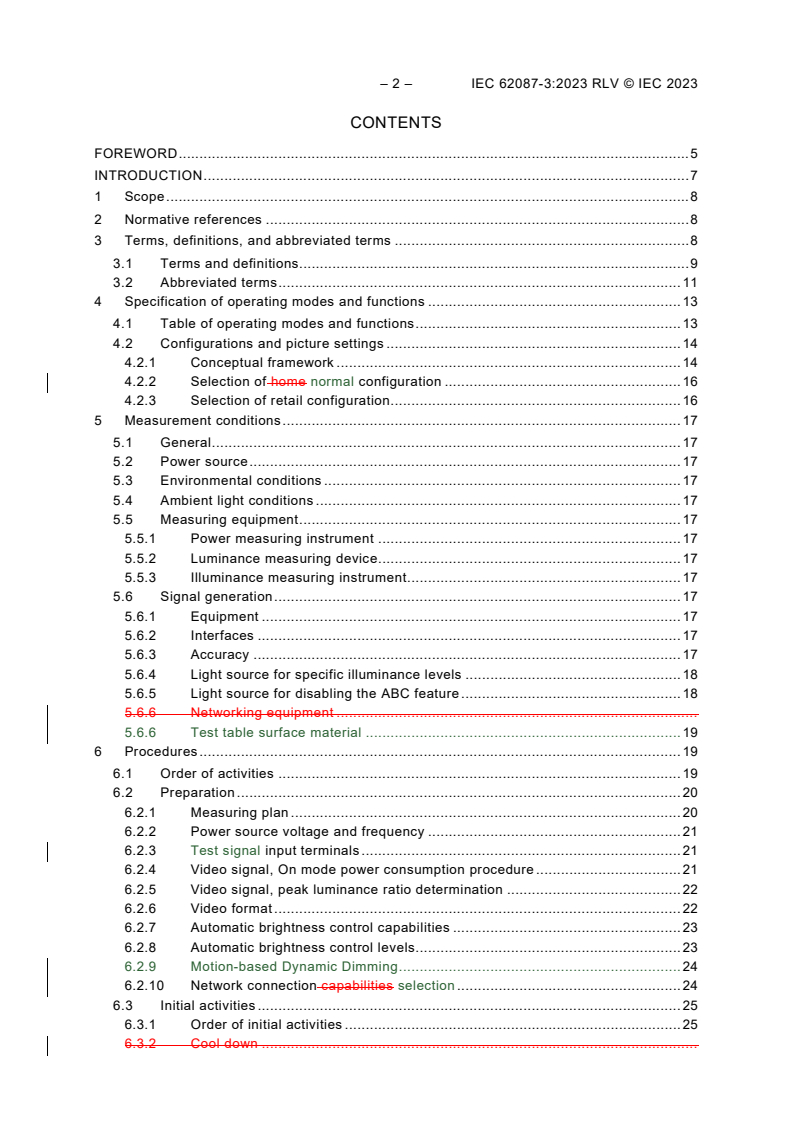
CONTENTS
FOREWORD . 5
INTRODUCTION . 7
1 Scope . 8
2 Normative references . 8
3 Terms, definitions, and abbreviated terms . 8
3.1 Terms and definitions. 9
3.2 Abbreviated terms . 11
4 Specification of operating modes and functions . 13
4.1 Table of operating modes and functions . 13
4.2 Configurations and picture settings . 14
4.2.1 Conceptual framework . 14
4.2.2 Selection of home normal configuration . 16
4.2.3 Selection of retail configuration . 16
5 Measurement conditions . 17
5.1 General . 17
5.2 Power source . 17
5.3 Environmental conditions . 17
5.4 Ambient light conditions . 17
5.5 Measuring equipment . 17
5.5.1 Power measuring instrument . 17
5.5.2 Luminance measuring device . 17
5.5.3 Illuminance measuring instrument . 17
5.6 Signal generation . 17
5.6.1 Equipment . 17
5.6.2 Interfaces . 17
5.6.3 Accuracy . 17
5.6.4 Light source for specific illuminance levels . 18
5.6.5 Light source for disabling the ABC feature . 18
5.6.6 Networking equipment .
5.6.6 Test table surface material . 19
6 Procedures . 19
6.1 Order of activities . 19
6.2 Preparation . 20
6.2.1 Measuring plan . 20
6.2.2 Power source voltage and frequency . 21
6.2.3 Test signal input terminals . 21
6.2.4 Video signal, On mode power consumption procedure . 21
6.2.5 Video signal, peak luminance ratio determination . 22
6.2.6 Video format . 22
6.2.7 Automatic brightness control capabilities . 23
6.2.8 Automatic brightness control levels . 23
6.2.9 Motion-based Dynamic Dimming . 24
6.2.10 Network connection capabilities selection . 24
6.3 Initial activities . 25
6.3.1 Order of initial activities . 25
6.3.2 Cool down .
6.3.2 Main batteries . 26
6.3.3 Plug-in module . 26
6.3.4 Installation . 26
6.3.5 Application of input signals . 27
6.3.6 Luminance measuring device setup . 27
6.3.7 Light source setup . 27
6.3.8 Power on . 31
6.3.9 UUT firmware update . 31
6.3.10 TV settings . 31
6.4 Determination of power consumption, On mode . 32
6.4.1 Order of activities . 32
6.4.2 Stabilization . 33
6.4.3 Television sets without automatic brightness control enabled by default . 34
6.4.4 Television sets with automatic brightness control enabled by default . 34
6.4.5 Power measurement . 34
6.5 Determination of peak luminance ratio and power factor . 36
6.5.1 General . 36
6.5.2 Activities for peak luminance ratio and power factor determination . 37
6.6 Determination of power consumption, Partial On mode . 40
6.6.1 General . 40
6.6.2 Order of activities . 40
6.6.3 AV inputs . 40
6.6.4 Standby-passive . 40
6.6.5 Standby-active, low . 41
6.7 Determination of power consumption, Off mode . 42
6.7.1 Connections and networking . 42
6.7.2 Availability . 42
6.7.3 Measurement . 42
Annex A (informative) Considerations for On mode television set power measurements . 43
A.1 General . 43
A.2 Illuminance levels for automatic brightness control .
A.2 Weighting of automatic brightness control levels . 43
A.3 Calculating On mode power consumption. 44
A.4 Picture level adjustments . 45
Annex B (normative) Test report . 46
Annex C (informative) Example test report template . 48
Annex D (informative) Representative test tools . 51
Annex E (normative) Measurement process overview . 52
Bibliography . 54
Figure 1 – Configurations and picture settings, conceptual framework . 16
Figure 2 – Recommended order of activities . 20
Figure 3 – Order of initial activities . 26
Figure 4 – Light source configuration . 28
Figure 5 – Wall-mounted TV with built-in ABC sensor . 30
Figure 6 – Wall Mounted TV with External ABC Sensor . 30
Figure 7 – Order of activities for determining power consumption, On mode . 33
– 4 – IEC 62087-3:2023 RLV © IEC 2023
Figure 8 – Order of activities for determining peak luminance ratio and power factor . 38
Figure 9 – Order of activities for determining the power consumption, Partial On mode . 40
Figure E.1 – Comprehensive measurement process flow chart . 53
Table 1 – Operating modes and functions . 14
Table 2 – Network Connection Hierarchy . 24
INTERNATIONAL ELECTROTECHNICAL COMMISSION
____________
AUDIO, VIDEO, AND RELATED EQUIPMENT –
DETERMINATION OF POWER CONSUMPTION –
Part 3: Television sets
FOREWORD
1) The International Electrotechnical Commission (IEC) is a worldwide organization for standardization comprising
all national electrotechnical committees (IEC National Committees). The object of IEC is to promote international
co-operation on all questions concerning standardization in the electrical and electronic fields. To this end and
in addition to other activities, IEC publishes International Standards, Technical Specifications, Technical Reports,
Publicly Available Specifications (PAS) and Guides (hereafter referred to as "IEC Publication(s)"). Their
preparation is entrusted to technical committees; any IEC National Committee interested in the subject dealt with
may participate in this preparatory work. International, governmental and non-governmental organizations liaising
with the IEC also participate in this preparation. IEC collaborates closely with the International Organization for
Standardization (ISO) in accordance with conditions determined by agreement between the two organizations.
2) The formal decisions or agreements of IEC on technical matters express, as nearly as possible, an international
consensus of opinion on the relevant subjects since each technical committee has representation from all
interested IEC National Committees.
3) IEC Publications have the form of recommendations for international use and are accepted by IEC National
Committees in that sense. While all reasonable efforts are made to ensure that the technical content of IEC
Publications is accurate, IEC cannot be held responsible for the way in which they are used or for any
misinterpretation by any end user.
4) In order to promote international uniformity, IEC National Committees undertake to apply IEC Publications
transparently to the maximum extent possible in their national and regional publications. Any divergence between
any IEC Publication and the corresponding national or regional publication shall be clearly indicated in the latter.
5) IEC itself does not provide any attestation of conformity. Independent certification bodies provide conformity
assessment services and, in some areas, access to IEC marks of conformity. IEC is not responsible for any
services carried out by independent certification bodies.
6) All users should ensure that they have the latest edition of this publication.
7) No liability shall attach to IEC or its directors, employees, servants or agents including individual experts and
members of its technical committees and IEC National Committees for any personal injury, property damage or
other damage of any nature whatsoever, whether direct or indirect, or for costs (including legal fees) and
expenses arising out of the publication, use of, or reliance upon, this IEC Publication or any other IEC
Publications.
8) Attention is drawn to the Normative references cited in this publication. Use of the referenced publications is
indispensable for the correct application of this publication.
9) Attention is drawn to the possibility that some of the elements of this IEC Publication may be the subject of patent
rights. IEC shall not be held responsible for identifying any or all such patent rights.
This redline version of the official IEC Standard allows the user to identify the changes made to
the previous edition IEC 62087-3:2015. A vertical bar appears in the margin wherever a change
has been made. Additions are in green text, deletions are in strikethrough red text.
– 6 – IEC 62087-3:2023 RLV © IEC 2023
IEC 62087-3 has been prepared by technical area 19: Environmental and energy aspects for
multimedia systems and equipment, of IEC technical committee 100: Audio, video and
multimedia systems and equipment. It is an International Standard.
This second edition cancels and replaces the first edition published in 2015. This edition
constitutes a technical revision.
This edition includes the following significant technical changes with respect to the previous
edition:
a) it introduces measuring procedures for the determination of power consumption in the On
mode while viewing static metadata HDR video content;
b) all tests for On mode power determination are performed with MDD disabled;
c) only progressive video signals are used for testing;
d) a dimmable LED reflector lamp is used as a light source for illuminating the ABC sensor to
achieve specific illuminance levels;
e) a dynamic box and outline video signal is used for determining the ratio of peak luminance.
The text of this International Standard is based on the following documents:
Draft Report on voting
100/3772/CDV 100/3849/RVC
Full information on the voting for its approval can be found in the report on voting indicated in
the above table.
The language used for the development of this International Standard is English.
A list of all parts in the IEC 62087 series, published under the general title Audio, video, and
related equipment – Determination of power consumption, can be found on the IEC website.
This document was drafted in accordance with ISO/IEC Directives, Part 2, and developed in
accordance with ISO/IEC Directives, Part 1 and ISO/IEC Directives, IEC Supplement, available
at www.iec.ch/members_experts/refdocs. The main document types developed by IEC are
described in greater detail at www.iec.ch/publications.
The committee has decided that the contents of this document will remain unchanged until the
stability date indicated on the IEC website under webstore.iec.ch in the data related to the
specific document. At this date, the document will be
• reconfirmed,
• withdrawn,
• replaced by a revised edition, or
• amended.
IMPORTANT – The "colour inside" logo on the cover page of this document indicates that it
contains colours which are considered to be useful for the correct understanding of its
contents. Users should therefore print this document using a colour printer.
INTRODUCTION
This document specifies the determination of the power consumption of television sets for
consumer use. It is used in conjunction with IEC 62087-2:2015, which specifies signals and
media.
This document includes measuring procedures for the determination of power consumption in
the On (operation) mode, which was identified as "On (average) mode" in previous editions of
IEC 62087. Additionally, it specifies measuring procedures for the determination of power
consumption in the Off mode and Partial On mode. This document also defines the
determination of the peak luminance ratio for use associated with television set power
consumption evaluation as well as the power factor. It also defines measuring procedures for
the determination of power consumption in the On mode while viewing representative static
metadata HDR video content.
A verification procedure to assess product compliance is described in Annex A of
IEC 62087-1:2015.
The IEC 62087 series consists of the following planned or published parts:
– Part 1: General
– Part 2: Signals and media
– Part 3: Television sets
– Part 4: Video recording equipment
– Part 5: Set-top boxes
– Part 6: Audio equipment
– Part 7: Computer monitors
– 8 – IEC 62087-3:2023 RLV © IEC 2023
AUDIO, VIDEO, AND RELATED EQUIPMENT –
DETERMINATION OF POWER CONSUMPTION –
Part 3: Television sets
1 Scope
This part of IEC 62087 specifies the determination of the power consumption and related
characteristics of television sets. Television sets include, but are not limited to, those with CRT,
LCD, PDP, OLED, or projection technologies.
The operating modes and functions, as they specifically apply to television sets, are defined in
detail in this part of IEC 62087.
This document is limited to television sets that can be connected to an external power source.
Television sets that include a non-removable, main battery are not covered by this document.
Television sets may can include any number of auxiliary batteries.
The measuring conditions in this document represent the normal use of the equipment and may
can differ from specific conditions, for example as specified in safety standards.
2 Normative references
The following documents are referred to in the text in such a way that some or all of their content
constitutes requirements of this document. For dated references, only the edition cited applies.
For undated references, the latest edition of the referenced document (including any
amendments) applies.
IEC 62087-1:2015, Audio, video, and related equipment – Determination of power consumption
– Part 1: General
IEC 62087-2:20152023, Audio, video, and related equipment – Determination of power
consumption – Part 2: Signals and media
IEC 62301:2011, Household electrical appliances – Measurement of standby power
3 Terms, definitions, and abbreviated terms
For the purposes of this document, the terms and definitions given in IEC 62087-1:2015,
IEC 62087-2:20152023 and in the following apply.
ISO and IEC maintain terminology databases for use in standardization at the following
addresses:
• IEC Electropedia: available at https://www.electropedia.org/
• ISO Online browsing platform: available at https://www.iso.org/obp
3.1 Terms and definitions
3.1.1
television set
TV
equipment for the reception and display of television broadcast and similar services for
terrestrial, cable, satellite and broadband network transmission of analogue and/or digital
signals
Note 1 to entry: A television set may can include additional functions that are not required for its basic operation
primary function.
3.1.2
forced menu
configuration selection required of the user when a television set is turned on for the first time
that forces the user to choose between the home configuration and the retail configuration
on-screen menu that requires the user to choose a configuration option when a television set
is first setup or after a factory reset
Note 1 to entry: For example, a forced menu can offer the user the option to select either "Normal"/"Home" or
"Retail"/"Store" configuration.
Note 2 to entry: See Figure 1.
3.1.3
normal configuration
setting intended to be chosen for home use from the forced menu
Note 1 to entry: Subclause 4.2.2 describes the selection of normal configuration from the forced menu. This
configuration selection is generally named "normal", "home", "standard", or equivalent.
Note 2 to entry: See Figure 1 and 3.1.16.
3.1.4
default configuration
configuration for television sets without a forced menu
manufacturer’s preset configuration for television sets without a forced menu
Note 1 to entry: See Figure 1.
3.1.5
retail configuration
forced menu selection most likely to be chosen intended for use in a retail environment
Note 1 to entry: Subclause 4.2.3 describes the selection of retail configuration from the forced menu. This
configuration selection is generally recommended by the manufacturer for presentation in a public space when the
television set is offered for sale and might be named "retail", "store", "shop", or equivalent.
Note 2 to entry: See Figure 1.
3.1.6
preset picture setting
common set of manufacturer-defined parameters which differ in their settings
Note 1 to entry: Examples of paraments of preset picture settings are brightness, contrast, colour space, chroma
control.
3.1.7
selectable preset picture setting
TV picture setting that is selectable by a user from a set of manufacturer-defined picture settings
Note 1 to entry: See Figure 1.
– 10 – IEC 62087-3:2023 RLV © IEC 2023
3.1.8
default picture setting
out-of-the-box picture setting for television sets in the home normal or default configuration that
is highlighted, or if none is highlighted, the picture setting first available for user selection
Note 1 to entry: See Figure 1. The HDR default picture setting (if different than the default picture setting) is the
one that the TV enters when HDR video is played from the starting point of the SDR default picture setting.
3.1.9
brightest selectable preset picture setting
user selectable, preset picture setting that produces the highest luminance picture in the home
normal or default configuration
Note 1 to entry: See Figure 1.
3.1.10
overall brightest preset picture setting
either the retail picture setting or the brightest selectable preset picture setting, whichever
produces the highest luminance picture
Note 1 to entry: See Figure 1.
3.1.11
retail picture setting
out-of-the-box picture setting for television sets with a forced menu in the retail configuration
selectable preset picture setting intended for use in a retail environment
Note 1 to entry: See Figure 1.
3.1.12
motion-based dynamic dimming
MDD
television feature that adjusts luminance in response to amount of motion in the displayed image
3.1.13
special function
function that is related to, but not required for, the basic operation primary function of the device
Note 1 to entry: Examples of special functions include, but are not limited to, special sound processing and power-
saving functions (e.g. automatic brightness control).
Note 2 to entry: Refer to the definition of television set (TV) (3.1.1) for primary function.
3.1.14
conditional access
encryption, decryption, and authorization techniques employed to protect content from
unauthorized viewing
3.1.15
conditional access module
plug-in module that enables conditional access
3.1.16
plug-in module
device that plugs into television sets to provide additional functionality
3.1.17
point of deployment module
conditional access module for digital signal reception
3.1.18
CAT5e
category 5e cable
twisted pair cable used for computer networks
Note 1 to entry: See IEC 61156-5 and IEC 61156-6.
3.1.19
neutral density filter
ND filter
optical device that reduces the light intensity in the visible wavelength region is designed to
reduce the light intensity equally over the range of visible wavelengths
3.1.20
quick-start
feature that, when enabled, presents sound and picture quickly when switching from Partial On
mode to On mode
function that reduces the television set’s resume time from Partial On mode to On mode
Note 1 to entry: Resume time is measured in accordance with 6.6.1.
3.1.21
colour rendering index
CRI
measure of the degree to which the psychophysical colour of an object illuminated by the test
illuminant conforms to that of the same object illuminated by the reference illuminant, suitable
allowance having been made for the state of chromatic adaptation
Note 1 to entry: See also CIE 13, Method of Measuring and Specifying Colour Rendering of Light Sources.
[SOURCE: IEV 845-22-109, modified – Note 2 to entry and Note 3 to entry removed]
3.1.1
additional functions
functions that are not required for the basic operation of the device
Note 1 to entry: Examples of additional functions include, but are not limited to, a VCR unit, a DVD unit, an HDD
unit, an FM-radio unit, a memory card-reader unit, or an ambient lighting unit.
3.1.9
home configuration
forced menu selection most likely to be chosen for home use
Note 1 to entry: Subclause 4.2.2 describes the selection of home configuration from the forced menu. This
configuration selection is generally named “home”, “standard”, or equivalent.
Note 2 to entry: See Figure 1.
3.2 Abbreviated terms
ABC automatic brightness control
AV audio-visual
BD Blu-ray Disc™
CRT Cathode Ray Tube
DVD digital versatile disc
___________
Blu-ray Disc™ is a trade mark of the Blu-ray Disc Association. This information is given for the convenience of
users of this document and does not constitute an endorsement by IEC of the product named. Equivalent products
may be used if they can be shown to lead to the same results.
– 12 – IEC 62087-3:2023 RLV © IEC 2023
DHCP dynamic host configuration protocol
DVI Digital Visual Interface
EMC electromagnetic compatibility
FM frequency modulation
HDD hard disk drive
HDMI® High Definition Multimedia Interface
HDR high dynamic range
HLG hybrid log-gamma
IP internet protocol
LAN local area network
LED light-emitting diode
LCD liquid-crystal display
LMD Luminance light measuring device
LNB low-noise block
MDD motion-based dynamic dimming
NAT network address translation
ND neutral density
OLED organic light-emitting diode
PC personal computer
PDP Plasma Display Panel
PQ perceptual quantizer
RF radio frequency
SCR silicon-controlled rectifier
SDR standard dynamic range
STB set-top box
SSID service set identifier
TV television set
USB Universal Serial Bus
UUT unit under test
VCR Video Cassette Recorder
VGA Video Graphics Array
WAN wide area network
WCG wide colour gamut
WLAN wireless local area network
WOL wake-on-LAN
WoWLAN wake on wireless LAN
WPA Wi-Fi protected access
___________
HDMI® and HDMI® High-Definition Multimedia Interface are registered trademarks of HDMI Licensing, LLC.
Administrator, Inc. This information is given for the convenience of users of this document and does not constitute
an endorsement by IEC of the product named. Equivalent products may be used if they can be shown to lead to
the same results.
USB Implementers Forum, Inc. takes the position that the terms "USB" and "Universal Serial Bus" are generic
terms. This information is given for the convenience of users of this document and does not constitute an
endorsement by IEC of the product named. Equivalent products may be used if they can be shown to lead to the
same results.
WPA2 Wi-Fi protected access 2
4 Specification of operating modes and functions
4.1 Table of operating modes and functions
Table 1 describes the various operating modes and functions for television sets.
For all modes, main batteries, if any, shall be removed for the duration of the measurement
procedure (see IEC 62087-1:2015, 5.1.1.1.)
– 14 – IEC 62087-3:2023 RLV © IEC 2023
Table 1 – Operating modes and functions
Power Mode Sub-mode Function(s) Functional description for TV
0 W Disconnected Disconnected – Disconnected from power The television set is disconnected or
source galvanically isolated from all external
power sources.
≥ 0 W Off Off – Off The television set is connected to an
external power source and does not
produce picture or sound and does
not provide any other function that
depends on an external power
source. The television set cannot be
switched into any other mode with the
remote control unit, or an external or
internal signal. Note that Some power
may be consumed if an EMC filter or
other components exist on the source
side of the power switch.
> 0 W Partial On Standby- – Wake on The television set is connected to an
passive external power source and does not
• remote control
provide picture or sound. The
• internal signal
television set can be switched into
another mode with the remote control
unit or an internal signal, but not with
an external signal.
Standby- – Wake on The television set is connected to an
active, low external power source and does not
• remote control
provide picture or sound. The
• internal signal
television set can be switched into
• external signal another mode with the remote control
unit or an internal signal and can
additionally be switched into another
mode with an external signal.
NOTE 1 When in Standby-active, low
mode, a television set may be able to
be switched into the On mode, the Off
mode, the Standby-passive, or the
Standby-active, high mode.
NOTE 2 A network-enabled TV is
considered to be in Standby-active low
when its presence on a local area
network can be detected and there is
minimal data communication beyond
network maintenance.
Standby- – Wake on The television set is connected to an
active, high external power source and does not
• remote control
provide picture or sound. The
• internal signal
television set can be switched into
• external signal another mode with the remote control
unit, an internal signal, or an external
– Data communications
signal. Additionally, the television set
is exchanging/ receiving data
with/from an external source.
Determination of power consumption
in this sub-mode is not specified by
this document.
On Operation – Operation The television set is connected to an
external power source and provides
picture and, if possible, sound.
4.2 Configurations and picture settings
4.2.1 Conceptual framework
Figure 1 shows a conceptual framework that includes the various configurations and picture
settings for television sets.
TV with TV without
forced menu forced menu
3.1.8
“Home” “Retail”
forced
menu
3.1.9 home 3.1.15 retail 3.1.6 default
configuration configuration configuration
3.1.17 3.1.17
selectable preset selectable preset
picture setting
picture setting
No Adjustments unless otherwise directed in this standard
3.1.7 default 3.1.2 brightest 3.1.16 retail 3.1.7 default 3.1.2 brightest
picture setting selectable preset picture setting picture setting selectable preset
picture setting picture setting
3.1.11 overall 3.1.11 overall
brightest preset brightest preset
picture setting picture setting
IEC
– 16 – IEC 62087-3:2023 RLV © IEC 2023
Figure 1 – Configurations and picture settings, conceptual framework
4.2.2 Selection of home normal configuration
When directed in this document, the home normal configuration shall be selected from the
forced menu by choosing the configuration that is recommended for normal home use and, if
not clearly defined, it shall be selected by choosing the first configuration listed in the forced
menu the default picture setting from the forced menu shall be selected: either the
manufacturer's indicated option from the forced menu or, if no preference is indicated, the first
option listed.
If the UUT has no forced menu, it shall remain in the default configuration.
NOTE A factory reset might can be required in order to enter the home normal configuration after the retail
configuration has been previously selected.
4.2.3 Selection of retail configuration
When directed in this document, retail configuration shall be selected from the forced menu by
choosing the configuration that, without any other adjustments, results in the highest display
luminance.
If the UUT has no forced menu, it shall remain in the default configuration.
NOTE A factory reset might can be required in order to enter the retail configuration after the home normal
configuration has been previously selected.
5 Measurement conditions
5.1 General
The measurement conditions clause specifies requirements that are independent of the
equipment to be evaluated. When setting up a test laboratory, these requirements shall be taken
into account.
The requirements of this clause apply to the procedures specified in Clause 6.
5.2 Power source
Defined in IEC 62087-1:2015, 5.1.1.
5.3 Environmental conditions
Defined in IEC 62087-1:2015, 5.1.2.
5.4 Ambient light conditions
For determining On mode power consumption for television sets with ABC enabled, ≤ 1 lx shall
be confirmed at the surface of the ABC sensor assembly with the light sources (5.6.4, 5.6.5) off
and the UUT in the Off or Disconnected mode.
For determining the peak luminance ratio (6.5.1.1) with a non-contact LMD, ≤ 5 lx shall be
confirmed at the nominal centre of the display area of the UUT in Off or Disconnected mode.
This requirement applies whether or not a light source (5.6.5) is applied to disable the ABC
feature.
A dark room and/or shroud may can be necessary in order to achieve the required ambient light
conditions.
5.5 Measuring equipment
5.5.1 Power measuring instrument
Defined in IEC 62087-1:2015, 5.1.5. and IEC 62087-1:2015, 5.1.6.
5.5.2 Luminance measuring device
Defined in IEC 62087-1:2015, 5.1.7.
5.5.3 Illuminance measuring instrument
Defined in IEC 62087-1:2015, 5.1.8.
5.6 Signal generation
5.6.1 Equipment
Defined in IEC 62087-2:20152023, 6.1 and IEC 62087-2:2023, 6.2.
5.6.2 Interfaces
Defined in IEC 62087-2:20152023, 6.3.
5.6.3 Accuracy
Defined in IEC 62087-2:2015, 6.3.
– 18 – IEC 62087-3:2023 RLV © IEC 2023
Accuracy of video signal levels is defined in IEC 62087-2:2023, 6.4.
5.6.4 Light source for specific illuminance levels
The light source used for illuminating the ABC sensor to specific illuminance levels shall use a
dimmable halogen lamp in a sealed LED reflector lamp and shall have a diameter of 120 mm
or less 90 mm ± 5mm. The rated beam angle of the lamp shall be 40° ± 5°. The rated correlated
colour temperature (CCT) of the light source shall be 2 800 2 700 K ± 300 K at its rated voltage.
The rated CRI shall be 80 ± 3. The front surface of the lamp shall be clear (i.e., not coloured or
coated with a spectrum modifying material) and may have a smooth or granular front surface;
when shined against a uniform white surface, the diffusion pattern should appear smooth to the
naked eye. The lamp assembly shall not modify the spectrum of the halogen LED source,
including the IR and UV bands.
The lamp shall be capable of providing the highest illumination level chosen in 6.2.8 within the
range of 70 % to 110 % of its rated voltage when configured as specified in 6.3.8.
For luminance levels below 10 lx, a 2 stop ND filter (3.1.10) shall be used. No ND filter shall be
used for luminance levels at or above 10 lx. The ND filter shall be of the absorptive type and
shall be large enough to cover the entire light acceptance area of the ABC sensor assembly
with a margin of at least 5 mm on all sides. The ND filter shall have an average transmission of
25 % ± 2,5 % within the visible range, which is 400 nm to 700 nm, without selectively absorbing
light at specific wavelengths.
To reach the illumination levels specified in 6.2.8, the lamp shall be wired with a compatible
dimming switch capable of dimming it to the lowest level required in 6.2.8. The lamp shall be
capable of providing the highest illumination level when wired with the dimming switch. For
luminance levels below 10 lx, a 2-stop ND filter (3.1.19) may be used if the lowest setting of the
lamp and dimmer combination does not reach the required level below 10 lx. No ND filter shall
be used for luminance levels at or above 10 lx. The ND filter shall be large enough to cover the
entire surface of the diffusion area of the lamp. The ND filter shall have an average transmission
of 25 % ± 2,5 % within the visible range, which is 400 nm to 700 nm, without selectively
absorbing light at specific wavelengths.
Caution: the lamp shall be compatible with leading-edge or forward-phase dimmers (i.e. the
lamp luminance does not vary with voltage).
Specific illuminance levels shall be obtained by controlling the voltage and/or duty cycle to the
above light source adjusting the dimming switch.
The model of the lamp and dimmer (and versions thereof if available) used for illuminating the
ABC sensor to specific illuminance levels shall be reported.
Some lighting controllers, such as those with SCR-based circuits, may introduce current spikes
into the power source. Such controllers should be avoided or otherwise isolated from the power
source for the UUT.
The lamp should be stabilized before testing by setting it to deliver the maximum tested lux to
the ABC sensor in accordance with 6.4.2 and maintaining that light level for 10 minutes.
Stabilisation may be carried out during the setting up of the light source (see 6.3.7).
5.6.5 Light source for disabling the ABC feature
The light source used for disabling the ABC feature shall use a dimmable halogen lamp in a
sealed reflector and shall have a diameter of 120 mm or less. The rated correlated colour
temperature shall be 2 800 K ± 300 K at its rated voltage. The front surface of the lamp shall
be clear (i.e., not coloured or coated with a spectrum modifying material) and may have a
smooth or granular front surface. The lamp assembly shall not modify the spectrum of the
halogen source, including the IR and UV bands. The light source shall be capable of providing
300 lx or greater when applied directly to the ABC sensor assembly.
The model of the lamp used for disabling the ABC feature shall be reported.
The same light source as that used in 5.6.4 may be used to override the ABC feature by reducing
the distance between the light source and the TV’s ABC sensor.
The manufacturer, model and version of the LED bulb used to override the ABC feature shall
be reported.
5.6.6 Networking equipment
For wireless connectivity, a Wi-Fi wireless access point that is compatible with
IEEE 802.11-2007 shall be used.
For wired connectivity, a category 5e or b
...
IEC 62087-3 ®
Edition 2.0 2023-02
INTERNATIONAL
STANDARD
NORME
INTERNATIONALE
colour
inside
Audio, video, and related equipment – Determination of power consumption –
Part 3: Television sets
Appareils audio, vidéo et matériel connexe – Détermination de la consommation
de puissance –
Partie 3: Téléviseurs
All rights reserved. Unless otherwise specified, no part of this publication may be reproduced or utilized in any form
or by any means, electronic or mechanical, including photocopying and microfilm, without permission in writing from
either IEC or IEC's member National Committee in the country of the requester. If you have any questions about IEC
copyright or have an enquiry about obtaining additional rights to this publication, please contact the address below or
your local IEC member National Committee for further information.
Droits de reproduction réservés. Sauf indication contraire, aucune partie de cette publication ne peut être reproduite ni
utilisée sous quelque forme que ce soit et par aucun procédé, électronique ou mécanique, y compris la photocopie et
les microfilms, sans l'accord écrit de l'IEC ou du Comité national de l'IEC du pays du demandeur. Si vous avez des
questions sur le copyright de l'IEC ou si vous désirez obtenir des droits supplémentaires sur cette publication, utilisez
les coordonnées ci-après ou contactez le Comité national de l'IEC de votre pays de résidence.
IEC Secretariat Tel.: +41 22 919 02 11
3, rue de Varembé info@iec.ch
CH-1211 Geneva 20 www.iec.ch
Switzerland
About the IEC
The International Electrotechnical Commission (IEC) is the leading global organization that prepares and publishes
International Standards for all electrical, electronic and related technologies.
About IEC publications
The technical content of IEC publications is kept under constant review by the IEC. Please make sure that you have the
latest edition, a corrigendum or an amendment might have been published.
IEC publications search - webstore.iec.ch/advsearchform IEC Products & Services Portal - products.iec.ch
The advanced search enables to find IEC publications by a Discover our powerful search engine and read freely all the
variety of criteria (reference number, text, technical publications previews. With a subscription you will always have
committee, …). It also gives information on projects, replaced access to up to date content tailored to your needs.
and withdrawn publications.
Electropedia - www.electropedia.org
IEC Just Published - webstore.iec.ch/justpublished
The world's leading online dictionary on electrotechnology,
Stay up to date on all new IEC publications. Just Published
containing more than 22 300 terminological entries in English
details all new publications released. Available online and once
and French, with equivalent terms in 19 additional languages.
a month by email.
Also known as the International Electrotechnical Vocabulary
(IEV) online.
IEC Customer Service Centre - webstore.iec.ch/csc
If you wish to give us your feedback on this publication or need
further assistance, please contact the Customer Service
Centre: sales@iec.ch.
A propos de l'IEC
La Commission Electrotechnique Internationale (IEC) est la première organisation mondiale qui élabore et publie des
Normes internationales pour tout ce qui a trait à l'électricité, à l'électronique et aux technologies apparentées.
A propos des publications IEC
Le contenu technique des publications IEC est constamment revu. Veuillez vous assurer que vous possédez l’édition la
plus récente, un corrigendum ou amendement peut avoir été publié.
Recherche de publications IEC - Découvrez notre puissant moteur de recherche et consultez
webstore.iec.ch/advsearchform gratuitement tous les aperçus des publications. Avec un
La recherche avancée permet de trouver des publications IEC abonnement, vous aurez toujours accès à un contenu à jour
en utilisant différents critères (numéro de référence, texte, adapté à vos besoins.
comité d’études, …). Elle donne aussi des informations sur les
projets et les publications remplacées ou retirées. Electropedia - www.electropedia.org
Le premier dictionnaire d'électrotechnologie en ligne au monde,
IEC Just Published - webstore.iec.ch/justpublished
avec plus de 22 300 articles terminologiques en anglais et en
Restez informé sur les nouvelles publications IEC. Just
français, ainsi que les termes équivalents dans 19 langues
Published détaille les nouvelles publications parues.
additionnelles. Egalement appelé Vocabulaire
Disponible en ligne et une fois par mois par email.
Electrotechnique International (IEV) en ligne.
Service Clients - webstore.iec.ch/csc
Si vous désirez nous donner des commentaires sur cette
publication ou si vous avez des questions contactez-nous:
sales@iec.ch.
IEC Products & Services Portal - products.iec.ch
IEC 62087-3 ®
Edition 2.0 2023-02
INTERNATIONAL
STANDARD
NORME
INTERNATIONALE
colour
inside
Audio, video, and related equipment – Determination of power consumption –
Part 3: Television sets
Appareils audio, vidéo et matériel connexe – Détermination de la consommation
de puissance –
Partie 3: Téléviseurs
INTERNATIONAL
ELECTROTECHNICAL
COMMISSION
COMMISSION
ELECTROTECHNIQUE
INTERNATIONALE
ICS 33.160.10 ISBN 978-2-8322-6478-2
– 2 – IEC 62087-3:2023 © IEC 2023
CONTENTS
FOREWORD . 5
INTRODUCTION . 7
1 Scope . 8
2 Normative references . 8
3 Terms, definitions, and abbreviated terms . 8
3.1 Terms and definitions. 9
3.2 Abbreviated terms . 11
4 Specification of operating modes and functions . 12
4.1 Table of operating modes and functions . 12
4.2 Configurations and picture settings . 13
4.2.1 Conceptual framework . 13
4.2.2 Selection of normal configuration . 14
4.2.3 Selection of retail configuration . 14
5 Measurement conditions . 15
5.1 General . 15
5.2 Power source . 15
5.3 Environmental conditions . 15
5.4 Ambient light conditions . 15
5.5 Measuring equipment . 15
5.5.1 Power measuring instrument . 15
5.5.2 Luminance measuring device . 15
5.5.3 Illuminance measuring instrument . 15
5.6 Signal generation . 15
5.6.1 Equipment . 15
5.6.2 Interfaces . 15
5.6.3 Accuracy . 15
5.6.4 Light source for specific illuminance levels . 16
5.6.5 Light source for disabling the ABC feature . 16
5.6.6 Test table surface material . 16
6 Procedures . 17
6.1 Order of activities . 17
6.2 Preparation . 18
6.2.1 Measuring plan . 18
6.2.2 Power source voltage and frequency . 19
6.2.3 Test signal input terminals . 19
6.2.4 Video signal, On mode power consumption procedure . 19
6.2.5 Video signal, peak luminance ratio determination . 19
6.2.6 Video format . 20
6.2.7 Automatic brightness control capabilities . 21
6.2.8 Automatic brightness control levels . 21
6.2.9 Motion-based Dynamic Dimming . 21
6.2.10 Network connection selection . 21
6.3 Initial activities . 22
6.3.1 Order of initial activities . 22
6.3.2 Main batteries . 23
6.3.3 Plug-in module . 23
6.3.4 Installation . 23
6.3.5 Application of input signals . 24
6.3.6 Luminance measuring device setup . 24
6.3.7 Light source setup . 24
6.3.8 Power on . 27
6.3.9 UUT firmware update . 27
6.3.10 TV settings . 27
6.4 Determination of power consumption, On mode . 28
6.4.1 Order of activities . 28
6.4.2 Stabilization . 29
6.4.3 Television sets without automatic brightness control enabled by default . 30
6.4.4 Television sets with automatic brightness control enabled by default . 30
6.4.5 Power measurement . 30
6.5 Determination of peak luminance ratio and power factor . 32
6.5.1 General . 32
6.5.2 Activities for peak luminance ratio and power factor determination . 33
6.6 Determination of power consumption, Partial On mode . 36
6.6.1 General . 36
6.6.2 Order of activities . 36
6.6.3 AV inputs . 36
6.6.4 Standby-passive . 36
6.6.5 Standby-active, low . 37
6.7 Determination of power consumption, Off mode . 38
6.7.1 Connections and networking . 38
6.7.2 Availability . 38
6.7.3 Measurement . 38
Annex A (informative) Considerations for On mode television set power measurements . 39
A.1 General . 39
A.2 Weighting of automatic brightness control levels . 39
A.3 Calculating On mode power consumption. 39
A.4 Picture level adjustments . 40
Annex B (normative) Test report . 41
Annex C (informative) Example test report template . 43
Annex D (informative) Representative test tools . 46
Annex E (normative) Measurement process overview . 47
Bibliography . 49
Figure 1 – Configurations and picture settings, conceptual framework . 14
Figure 2 – Recommended order of activities . 18
Figure 3 – Order of initial activities . 23
Figure 4 – Light source configuration . 25
Figure 5 – Wall-mounted TV with built-in ABC sensor . 26
Figure 6 – Wall Mounted TV with External ABC Sensor . 26
Figure 7 – Order of activities for determining power consumption, On mode . 29
Figure 8 – Order of activities for determining peak luminance ratio and power factor . 34
Figure 9 – Order of activities for determining the power consumption, Partial On mode . 36
Figure E.1 – Comprehensive measurement process flow chart . 48
– 4 – IEC 62087-3:2023 © IEC 2023
Table 1 – Operating modes and functions . 13
Table 2 – Network Connection Hierarchy . 22
INTERNATIONAL ELECTROTECHNICAL COMMISSION
____________
AUDIO, VIDEO, AND RELATED EQUIPMENT –
DETERMINATION OF POWER CONSUMPTION –
Part 3: Television sets
FOREWORD
1) The International Electrotechnical Commission (IEC) is a worldwide organization for standardization comprising
all national electrotechnical committees (IEC National Committees). The object of IEC is to promote international
co-operation on all questions concerning standardization in the electrical and electronic fields. To this end and
in addition to other activities, IEC publishes International Standards, Technical Specifications, Technical Reports,
Publicly Available Specifications (PAS) and Guides (hereafter referred to as "IEC Publication(s)"). Their
preparation is entrusted to technical committees; any IEC National Committee interested in the subject dealt with
may participate in this preparatory work. International, governmental and non-governmental organizations liaising
with the IEC also participate in this preparation. IEC collaborates closely with the International Organization for
Standardization (ISO) in accordance with conditions determined by agreement between the two organizations.
2) The formal decisions or agreements of IEC on technical matters express, as nearly as possible, an international
consensus of opinion on the relevant subjects since each technical committee has representation from all
interested IEC National Committees.
3) IEC Publications have the form of recommendations for international use and are accepted by IEC National
Committees in that sense. While all reasonable efforts are made to ensure that the technical content of IEC
Publications is accurate, IEC cannot be held responsible for the way in which they are used or for any
misinterpretation by any end user.
4) In order to promote international uniformity, IEC National Committees undertake to apply IEC Publications
transparently to the maximum extent possible in their national and regional publications. Any divergence between
any IEC Publication and the corresponding national or regional publication shall be clearly indicated in the latter.
5) IEC itself does not provide any attestation of conformity. Independent certification bodies provide conformity
assessment services and, in some areas, access to IEC marks of conformity. IEC is not responsible for any
services carried out by independent certification bodies.
6) All users should ensure that they have the latest edition of this publication.
7) No liability shall attach to IEC or its directors, employees, servants or agents including individual experts and
members of its technical committees and IEC National Committees for any personal injury, property damage or
other damage of any nature whatsoever, whether direct or indirect, or for costs (including legal fees) and
expenses arising out of the publication, use of, or reliance upon, this IEC Publication or any other IEC
Publications.
8) Attention is drawn to the Normative references cited in this publication. Use of the referenced publications is
indispensable for the correct application of this publication.
9) Attention is drawn to the possibility that some of the elements of this IEC Publication may be the subject of patent
rights. IEC shall not be held responsible for identifying any or all such patent rights.
IEC 62087-3 has been prepared by technical area 19: Environmental and energy aspects for
multimedia systems and equipment, of IEC technical committee 100: Audio, video and
multimedia systems and equipment. It is an International Standard.
This second edition cancels and replaces the first edition published in 2015. This edition
constitutes a technical revision.
This edition includes the following significant technical changes with respect to the previous
edition:
a) it introduces measuring procedures for the determination of power consumption in the On
mode while viewing static metadata HDR video content;
b) all tests for On mode power determination are performed with MDD disabled;
c) only progressive video signals are used for testing;
d) a dimmable LED reflector lamp is used as a light source for illuminating the ABC sensor to
achieve specific illuminance levels;
– 6 – IEC 62087-3:2023 © IEC 2023
e) a dynamic box and outline video signal is used for determining the ratio of peak luminance.
The text of this International Standard is based on the following documents:
Draft Report on voting
100/3772/CDV 100/3849/RVC
Full information on the voting for its approval can be found in the report on voting indicated in
the above table.
The language used for the development of this International Standard is English.
A list of all parts in the IEC 62087 series, published under the general title Audio, video, and
related equipment – Determination of power consumption, can be found on the IEC website.
This document was drafted in accordance with ISO/IEC Directives, Part 2, and developed in
accordance with ISO/IEC Directives, Part 1 and ISO/IEC Directives, IEC Supplement, available
at www.iec.ch/members_experts/refdocs. The main document types developed by IEC are
described in greater detail at www.iec.ch/publications.
The committee has decided that the contents of this document will remain unchanged until the
stability date indicated on the IEC website under webstore.iec.ch in the data related to the
specific document. At this date, the document will be
• reconfirmed,
• withdrawn,
• replaced by a revised edition, or
• amended.
INTRODUCTION
This document specifies the determination of the power consumption of television sets for
consumer use.
This document includes measuring procedures for the determination of power consumption in
the On (operation) mode, which was identified as "On (average) mode" in previous editions of
IEC 62087. Additionally, it specifies measuring procedures for the determination of power
consumption in the Off mode and Partial On mode. This document also defines the
determination of the peak luminance ratio for use associated with television set power
consumption evaluation as well as the power factor. It also defines measuring procedures for
the determination of power consumption in the On mode while viewing representative static
metadata HDR video content.
A verification procedure to assess product compliance is described in Annex A of
IEC 62087-1:2015.
The IEC 62087 series consists of the following planned or published parts:
– Part 1: General
– Part 2: Signals and media
– Part 3: Television sets
– Part 4: Video recording equipment
– Part 5: Set-top boxes
– Part 6: Audio equipment
– Part 7: Computer monitors
– 8 – IEC 62087-3:2023 © IEC 2023
AUDIO, VIDEO, AND RELATED EQUIPMENT –
DETERMINATION OF POWER CONSUMPTION –
Part 3: Television sets
1 Scope
This part of IEC 62087 specifies the determination of the power consumption and related
characteristics of television sets. Television sets include, but are not limited to, those with LCD,
OLED, or projection technologies.
The operating modes and functions, as they specifically apply to television sets, are defined in
detail in this part of IEC 62087.
This document is limited to television sets that can be connected to an external power source.
Television sets that include a non-removable, main battery are not covered by this document.
Television sets can include any number of auxiliary batteries.
The measuring conditions in this document represent the normal use of the equipment and can
differ from specific conditions, for example as specified in safety standards.
2 Normative references
The following documents are referred to in the text in such a way that some or all of their content
constitutes requirements of this document. For dated references, only the edition cited applies.
For undated references, the latest edition of the referenced document (including any
amendments) applies.
IEC 62087-1:2015, Audio, video, and related equipment – Determination of power consumption
– Part 1: General
IEC 62087-2:2023, Audio, video, and related equipment – Determination of power consumption
– Part 2: Signals and media
IEC 62301, Household electrical appliances – Measurement of standby power
3 Terms, definitions, and abbreviated terms
For the purposes of this document, the terms and definitions given in IEC 62087-1:2015,
IEC 62087-2:2023 and in the following apply.
ISO and IEC maintain terminology databases for use in standardization at the following
addresses:
• IEC Electropedia: available at https://www.electropedia.org/
• ISO Online browsing platform: available at https://www.iso.org/obp
3.1 Terms and definitions
3.1.1
television set
TV
equipment for the reception and display of television broadcast and similar services for
terrestrial, cable, satellite and broadband network transmission of analogue and/or digital
signals
Note 1 to entry: A television set can include additional functions that are not required for its primary function.
3.1.2
forced menu
on-screen menu that requires the user to choose a configuration option when a television set
is first setup or after a factory reset
Note 1 to entry: For example, a forced menu can offer the user the option to select either "Normal"/"Home" or
"Retail"/"Store" configuration.
Note 2 to entry: See Figure 1.
3.1.3
normal configuration
setting intended to be chosen for home use from the forced menu
Note 1 to entry: Subclause 4.2.2 describes the selection of normal configuration from the forced menu. This
configuration selection is generally named "normal", "home", "standard", or equivalent.
Note 2 to entry: See Figure 1 and 3.1.16.
3.1.4
default configuration
manufacturer’s preset configuration for television sets without a forced menu
Note 1 to entry: See Figure 1.
3.1.5
retail configuration
forced menu selection intended for use in a retail environment
Note 1 to entry: Subclause 4.2.3 describes the selection of retail configuration from the forced menu. This
configuration selection is generally recommended by the manufacturer for presentation in a public space when the
television set is offered for sale and might be named "retail", "store", "shop", or equivalent.
Note 2 to entry: See Figure 1.
3.1.6
preset picture setting
common set of manufacturer-defined parameters which differ in their settings
Note 1 to entry: Examples of paraments of preset picture settings are brightness, contrast, colour space, chroma
control.
3.1.7
selectable preset picture setting
TV picture setting that is selectable by a user from a set of manufacturer-defined picture settings
Note 1 to entry: See Figure 1.
3.1.8
default picture setting
picture setting for television sets in the normal or default configuration that is highlighted, or if
none is highlighted, the picture setting first available for user selection
– 10 – IEC 62087-3:2023 © IEC 2023
Note 1 to entry: See Figure 1. The HDR default picture setting (if different than the default picture setting) is the
one that the TV enters when HDR video is played from the starting point of the SDR default picture setting.
3.1.9
brightest selectable preset picture setting
user selectable, preset picture setting that produces the highest luminance picture in the normal
or default configuration
Note 1 to entry: See Figure 1.
3.1.10
overall brightest preset picture setting
retail picture setting or the brightest selectable preset picture setting, whichever produces the
highest luminance picture
Note 1 to entry: See Figure 1.
3.1.11
retail picture setting
selectable preset picture setting intended for use in a retail environment
Note 1 to entry: See Figure 1.
3.1.12
motion-based dynamic dimming
MDD
television feature that adjusts luminance in response to amount of motion in the displayed image
3.1.13
special function
function that is related to, but not required for, the primary function of the device
Note 1 to entry: Examples of special functions include, but are not limited to, special sound processing and power-
saving functions (e.g. automatic brightness control).
Note 2 to entry: Refer to the definition of television set (TV) (3.1.1) for primary function.
3.1.14
conditional access
encryption, decryption, and authorization techniques employed to protect content from
unauthorized viewing
3.1.15
conditional access module
plug-in module that enables conditional access
3.1.16
plug-in module
device that plugs into television sets to provide additional functionality
3.1.17
point of deployment module
conditional access module for digital signal reception
3.1.18
CAT5e
category 5e cable
twisted pair cable used for computer networks
Note 1 to entry: See IEC 61156-5 and IEC 61156-6.
3.1.19
neutral density filter
ND filter
optical device that is designed to reduce the light intensity equally over the range of visible
wavelengths
3.1.20
quick-start
function that reduces the television set’s resume time from Partial On mode to On mode
Note 1 to entry: Resume time is measured in accordance with 6.6.1.
3.1.21
colour rendering index
CRI
measure of the degree to which the psychophysical colour of an object illuminated by the test
illuminant conforms to that of the same object illuminated by the reference illuminant, suitable
allowance having been made for the state of chromatic adaptation
Note 1 to entry: See also CIE 13, Method of Measuring and Specifying Colour Rendering of Light Sources.
[SOURCE: IEV 845-22-109, modified – Note 2 to entry and Note 3 to entry removed]
3.2 Abbreviated terms
ABC automatic brightness control
AV audio-visual
BD Blu-ray Disc™
DVD digital versatile disc
DHCP dynamic host configuration protocol
DVI Digital Visual Interface
EMC electromagnetic compatibility
FM frequency modulation
HDD hard disk drive
HDMI® High Definition Multimedia Interface
HDR high dynamic range
HLG hybrid log-gamma
IP internet protocol
LAN local area network
LED light-emitting diode
LCD liquid-crystal display
LMD light measuring device
LNB low-noise block
MDD motion-based dynamic dimming
NAT network address translation
___________
Blu-ray Disc™ is a trade mark of the Blu-ray Disc Association. This information is given for the convenience of
users of this document and does not constitute an endorsement by IEC of the product named. Equivalent products
may be used if they can be shown to lead to the same results.
HDMI® and HDMI® High-Definition Multimedia Interface are registered trademarks of HDMI Licensing
Administrator, Inc. This information is given for the convenience of users of this document and does not constitute
an endorsement by IEC of the product named. Equivalent products may be used if they can be shown to lead to
the same results.
– 12 – IEC 62087-3:2023 © IEC 2023
ND neutral density
OLED organic light-emitting diode
PC personal computer
PQ perceptual quantizer
RF radio frequency
SCR silicon-controlled rectifier
SDR standard dynamic range
STB set-top box
SSID service set identifier
TV television set
USB Universal Serial Bus
UUT unit under test
VGA Video Graphics Array
WAN wide area network
WCG wide colour gamut
WLAN wireless local area network
WOL wake-on-LAN
WoWLAN wake on wireless LAN
WPA Wi-Fi protected access
WPA2 Wi-Fi protected access 2
4 Specification of operating modes and functions
4.1 Table of operating modes and functions
Table 1 describes the various operating modes and functions for television sets.
For all modes, main batteries, if any, shall be removed for the duration of the measurement
procedure (see IEC 62087-1:2015, 5.1.1.1.)
___________
USB Implementers Forum, Inc. takes the position that the terms "USB" and "Universal Serial Bus" are generic
terms. This information is given for the convenience of users of this document and does not constitute an
endorsement by IEC of the product named. Equivalent products may be used if they can be shown to lead to the
same results.
Table 1 – Operating modes and functions
Power Mode Sub-mode Function(s) Functional description for TV
0 W Disconnected Disconnected – Disconnected from power The television set is disconnected or
source galvanically isolated from all external
power sources.
≥ 0 W Off Off – Off The television set is connected to an
external power source and does not
produce picture or sound and does
not provide any other function that
depends on an external power
source. The television set cannot be
switched into any other mode with the
remote control unit, or an external or
internal signal. Some power may be
consumed if an EMC filter or other
components exist on the source side
of the power switch.
> 0 W Partial On Standby- – Wake on The television set is connected to an
passive external power source and does not
• remote control
provide picture or sound. The
• internal signal
television set can be switched into
another mode with the remote control
unit or an internal signal, but not with
an external signal.
Standby- – Wake on The television set is connected to an
active, low external power source and does not
• remote control
provide picture or sound. The
• internal signal
television set can be switched into
• external signal another mode with the remote control
unit or an internal signal and can
additionally be switched into another
mode with an external signal.
NOTE 1 When in Standby-active, low
mode, a television set may be able to
be switched into the On mode, the Off
mode, the Standby-passive, or the
Standby-active, high mode.
NOTE 2 A network-enabled TV is
considered to be in Standby-active low
when its presence on a local area
network can be detected and there is
minimal data communication beyond
network maintenance.
Standby- – Wake on The television set is connected to an
active, high external power source and does not
• remote control
provide picture or sound. The
• internal signal
television set can be switched into
• external signal another mode with the remote control
unit, an internal signal, or an external
– Data communications
signal. Additionally, the television set
is exchanging/ receiving data
with/from an external source.
Determination of power consumption
in this sub-mode is not specified by
this document.
On Operation – Operation The television set is connected to an
external power source and provides
picture and, if possible, sound.
4.2 Configurations and picture settings
4.2.1 Conceptual framework
Figure 1 shows a conceptual framework that includes the various configurations and picture
settings for television sets.
– 14 – IEC 62087-3:2023 © IEC 2023
Figure 1 – Configurations and picture settings, conceptual framework
4.2.2 Selection of normal configuration
When directed in this document, the normal configuration shall be selected from the forced
menu by choosing the configuration that is recommended for normal home use and, if not clearly
defined, the default picture setting from the forced menu shall be selected: either the
manufacturer's indicated option from the forced menu or, if no preference is indicated, the first
option listed.
If the UUT has no forced menu, it shall remain in the default configuration.
NOTE A factory reset can be required in order to enter the normal configuration after the retail configuration has
been previously selected.
4.2.3 Selection of retail configuration
When directed in this document, retail configuration shall be selected from the forced menu by
choosing the configuration that, without any other adjustments, results in the highest display
luminance.
If the UUT has no forced menu, it shall remain in the default configuration.
NOTE A factory reset can be required in order to enter the retail configuration after the normal configuration has
been previously selected.
5 Measurement conditions
5.1 General
The measurement conditions clause specifies requirements that are independent of the
equipment to be evaluated. When setting up a test laboratory, these requirements shall be taken
into account.
The requirements of this clause apply to the procedures specified in Clause 6.
5.2 Power source
Defined in IEC 62087-1:2015, 5.1.1.
5.3 Environmental conditions
Defined in IEC 62087-1:2015, 5.1.2.
5.4 Ambient light conditions
For determining On mode power consumption for television sets with ABC enabled, ≤ 1 lx shall
be confirmed at the surface of the ABC sensor assembly with the light sources (5.6.4, 5.6.5) off
and the UUT in the Off or Disconnected mode.
For determining the peak luminance ratio (6.5.1.1) with a non-contact LMD, ≤ 5 lx shall be
confirmed at the nominal centre of the display area of the UUT in Off or Disconnected mode.
This requirement applies whether or not a light source (5.6.5) is applied to disable the ABC
feature.
A dark room and/or shroud can be necessary in order to achieve the required ambient light
conditions.
5.5 Measuring equipment
5.5.1 Power measuring instrument
Defined in IEC 62087-1:2015, 5.1.5. and IEC 62087-1:2015, 5.1.6.
5.5.2 Luminance measuring device
Defined in IEC 62087-1:2015, 5.1.7.
5.5.3 Illuminance measuring instrument
Defined in IEC 62087-1:2015, 5.1.8.
5.6 Signal generation
5.6.1 Equipment
Defined in IEC 62087-2:2023, 6.1 and IEC 62087-2:2023, 6.2.
5.6.2 Interfaces
Defined in IEC 62087-2:2023, 6.3.
5.6.3 Accuracy
Accuracy of video signal levels is defined in IEC 62087-2:2023, 6.4.
– 16 – IEC 62087-3:2023 © IEC 2023
5.6.4 Light source for specific illuminance levels
The light source used for illuminating the ABC sensor to specific illuminance levels shall use a
dimmable LED reflector lamp and shall have a diameter of 90 mm ± 5mm. The rated beam angle
of the lamp shall be 40° ± 5°. The rated correlated colour temperature (CCT) of the light source
shall be 2 700 K ± 300 K at its rated voltage. The rated CRI shall be 80 ± 3. The front surface
of the lamp shall be clear (i.e., not coloured or coated with a spectrum modifying material) and
may have a smooth or granular front surface; when shined against a uniform white surface, the
diffusion pattern should appear smooth to the naked eye. The lamp assembly shall not modify
the spectrum of the LED source, including the IR and UV bands.
To reach the illumination levels specified in 6.2.8, the lamp shall be wired with a compatible
dimming switch capable of dimming it to the lowest level required in 6.2.8. The lamp shall be
capable of providing the highest illumination level when wired with the dimming switch. For
luminance levels below 10 lx, a 2-stop ND filter (3.1.19) may be used if the lowest setting of the
lamp and dimmer combination does not reach the required level below 10 lx. No ND filter shall
be used for luminance levels at or above 10 lx. The ND filter shall be large enough to cover the
entire surface of the diffusion area of the lamp. The ND filter shall have an average transmission
of 25 % ± 2,5 % within the visible range, which is 400 nm to 700 nm, without selectively
absorbing light at specific wavelengths.
Caution: the lamp shall be compatible with leading-edge or forward-phase dimmers (i.e. the
lamp luminance does not vary with voltage).
Specific illuminance levels shall be obtained by adjusting the dimming switch.
The model of the lamp and dimmer (and versions thereof if available) used for illuminating the
ABC sensor to specific illuminance levels shall be reported.
The lamp should be stabilized before testing by setting it to deliver the maximum tested lux to
the ABC sensor in accordance with 6.4.2 and maintaining that light level for 10 minutes.
Stabilisation may be carried out during the setting up of the light source (see 6.3.7).
5.6.5 Light source for disabling the ABC feature
The same light source as that used in 5.6.4 may be used to override the ABC feature by reducing
the distance between the light source and the TV’s ABC sensor.
The manufacturer, model and version of the LED bulb used to override the ABC feature shall
be reported.
5.6.6 Test table surface material
The table used to hold the UUT shall be covered with black, minimally reflective cloth and shall
have the area immediately in front of and underneath the UUT’s ABC sensor, as shown in
Figure 4, covered with material having a gloss measurement of 15 GU as measured by a 60°
gloss meter. The material shall not alter visible light in the 400 nm to 700 nm range that arrives
on, or is reflected by, the material. The thickness of the ABC sensor table surface material shall
be 4 mm or less and shall be at least 203 mm wide by 177 mm deep; it shall be printed with a
matte finish, with a colour adhering to the M1 lighting standard having CMYK values of (43, 53,
84, 84) ± 2. The card shall not polarize light reflected off its surface.
NOTE See Annex D for further information.
6 Procedures
6.1 Order of activities
The following order of activities is recommended (also represented in Figure 2):
– preparation (6.2),
– initial activities (6.3),
– determination of power consumption, On mode (6.4),
– determination of peak luminance ratio and power factor (6.4.5.5),
– determination of power consumption, Partial On mode (6.6),
– determination of power consumption, Off mode (6.7).
The above order is chosen to ensure proper stabilization prior to the taking of each
measurement. The technician performing the activities may vary the order as needed. However,
the stabilization process prior to the taking of each measurement shall effectively be the same
as if the recommended order had been followed.
A flowchart with the comprehensive measurement process is provided in Annex E, Figure E.1.
Countdown timers and 50 % grey field endings have been added to most of the video signal
test clips referenced by this document to allow test personnel to easily maintain a UUT’s
stabilization while moving from one measurement method to the next. It is easy to inspect a
given test’s power consumption log to note when the test both started and ended. Test
personnel are encouraged to familiarize themselves with each video signal test clip prior to
using them for actual testing.
– 18 – IEC 62087-3:2023 © IEC 2023
Figure 2 – Recommended order of activities
6.2 Preparation
6.2.1 Measuring plan
Before the UUT has been installed, a measuring plan should be
...