

IEC 60598-2-22:2021
(Main)Luminaires - Part 2-22: Particular requirements - Luminaires for emergency lighting
General Information
- Abstract
IEC 60598-2-22:2021 specifies requirements for emergency luminaires for use with electrical lamps on emergency power supplies not exceeding 1 000 V. This fifth edition cancels and replaces the fourth edition published in 2014 and Amendment 1:2017. This edition constitutes a technical revision. This edition includes the following significant technical changes with respect to the previous edition:
- update of requirements for rest mode and inhibiting mode;
- clarification of high temperature operation tests;
- introduction of new requirements for lithium batteries;
- introduction of new requirements for electric double layer capacitors (EDLCs);
- clarification of resistance to heat, fire and tracking;
- clarification of test facilities for self-contained luminaires;
- clarification of the test method for contrast measurements of exit signs.
- Status
- Published
- Publication Date
- 05-Dec-2021
- Technical Committee
- SC 34D - Luminaires
- Drafting Committee
- JWG 2 - TC 34/SC 34D/JWG 2
- Current Stage
- PPUB - Publication issued
- Start Date
- 06-Dec-2021
- Completion Date
- 24-Dec-2021
Buy Documents
IEC 60598-2-22:2021 RLV - Luminaires - Part 2-22: Particular requirements - Luminaires for emergency lighting Released:12/6/2021
IEC 60598-2-22:2021 - Luminaires - Part 2-22: Particular requirements - Luminaires for emergency lighting Released:12/6/2021
Overview
IEC 60598-2-22:2021 - Luminaires - Part 2-22: Particular requirements - Luminaires for emergency lighting is the fifth edition (2021) of the IEC technical standard that specifies safety, construction and test requirements for emergency luminaires used with electrical lamps on emergency power supplies not exceeding 1 000 V. This edition cancels and replaces the 2014 edition and Amendment 1:2017 and constitutes a technical revision.
Key topics and technical requirements
The standard provides particular requirements that supplement IEC 60598-1 (general luminaire requirements). Major technical topics and updated requirements include:
- Scope and classification of emergency luminaires and terminology aligned with Part 1.
- Construction, marking and wiring requirements specific to emergency use.
- Changeover operation and battery chargers for self-contained emergency luminaires.
- Photometric data and luminance/contrast measurement methods (including exit sign contrast).
- Endurance, thermal and high-temperature operation tests with clarified procedures.
- Resistance to heat, fire and tracking - clarified test expectations for safety under adverse conditions.
- Updated provisions for rest mode and inhibiting mode (remote/inhibition facilities).
- New safety and performance requirements for energy storage:
- Lithium batteries (new requirements and references to lithium battery safety standards).
- Electric double layer capacitors (EDLCs) - introduction of specific requirements.
- Test facilities and methods for self-contained and portable emergency luminaires.
- References and normative links to related lamp controlgear standards and battery/capacitor standards (see Related Standards).
Practical applications and who uses this standard
IEC 60598-2-22:2021 is used by professionals involved in the design, manufacture, testing, certification and specification of emergency lighting systems:
- Luminaire and LED module manufacturers developing emergency and self-contained luminaires.
- Lighting designers and specifiers writing compliant emergency lighting specifications for buildings, transit hubs, and public spaces.
- Test laboratories and certification bodies performing endurance, thermal, photometric and battery tests.
- Safety and facility managers implementing compliant emergency lighting installations and maintenance regimes.
- Control gear and battery suppliers ensuring component compatibility with emergency operation requirements.
Emergency lighting applications covered include exit signs, egress pathway luminaires, self-contained portable emergency lamps, and integrated emergency fittings for commercial, residential and industrial buildings.
Related Standards (if applicable)
The Part 2-22 standard is intended to be used with the latest edition of IEC 60598-1 and references multiple related standards, including (but not limited to): IEC 61347 series (lamp controlgear), IEC 62133-2 (lithium battery safety), IEC 62620 (industrial lithium batteries), IEC 62391 (EDLC), ISO 3864 (safety signs) and CIE photometry guidance.
Keywords: IEC 60598-2-22:2021, emergency luminaires, emergency lighting, lithium batteries, EDLC, self-contained luminaires, exit signs, high temperature operation, rest mode, inhibiting mode.
Relations
- Effective Date
- 05-Sep-2023
- Effective Date
- 05-Sep-2023
- Effective Date
- 05-Sep-2023
- Effective Date
- 05-Sep-2023
Buy Documents
IEC 60598-2-22:2021 RLV - Luminaires - Part 2-22: Particular requirements - Luminaires for emergency lighting Released:12/6/2021
IEC 60598-2-22:2021 - Luminaires - Part 2-22: Particular requirements - Luminaires for emergency lighting Released:12/6/2021
Get Certified
Connect with accredited certification bodies for this standard

IMQ S.p.A. (Certification)
Italian electrical product certification.

SLG Prüf- und Zertifizierungs GmbH
German testing and certification body.

UL Solutions
Global safety science company with testing, inspection and certification.
Sponsored listings
Frequently Asked Questions
IEC 60598-2-22:2021 is a standard published by the International Electrotechnical Commission (IEC). Its full title is "Luminaires - Part 2-22: Particular requirements - Luminaires for emergency lighting". This standard covers: IEC 60598-2-22:2021 specifies requirements for emergency luminaires for use with electrical lamps on emergency power supplies not exceeding 1 000 V. This fifth edition cancels and replaces the fourth edition published in 2014 and Amendment 1:2017. This edition constitutes a technical revision. This edition includes the following significant technical changes with respect to the previous edition: - update of requirements for rest mode and inhibiting mode; - clarification of high temperature operation tests; - introduction of new requirements for lithium batteries; - introduction of new requirements for electric double layer capacitors (EDLCs); - clarification of resistance to heat, fire and tracking; - clarification of test facilities for self-contained luminaires; - clarification of the test method for contrast measurements of exit signs.
IEC 60598-2-22:2021 specifies requirements for emergency luminaires for use with electrical lamps on emergency power supplies not exceeding 1 000 V. This fifth edition cancels and replaces the fourth edition published in 2014 and Amendment 1:2017. This edition constitutes a technical revision. This edition includes the following significant technical changes with respect to the previous edition: - update of requirements for rest mode and inhibiting mode; - clarification of high temperature operation tests; - introduction of new requirements for lithium batteries; - introduction of new requirements for electric double layer capacitors (EDLCs); - clarification of resistance to heat, fire and tracking; - clarification of test facilities for self-contained luminaires; - clarification of the test method for contrast measurements of exit signs.
IEC 60598-2-22:2021 is classified under the following ICS (International Classification for Standards) categories: 29.140.40 - Luminaires. The ICS classification helps identify the subject area and facilitates finding related standards.
IEC 60598-2-22:2021 has the following relationships with other standards: It is inter standard links to IEC 60598-2-22:2014, IEC 60598-2-22:2014/AMD1:2017, IEC 60598-2-22:2014/COR1:2015, IEC 60598-2-22:2014/COR2:2016. Understanding these relationships helps ensure you are using the most current and applicable version of the standard.
IEC 60598-2-22:2021 is available in PDF format for immediate download after purchase. The document can be added to your cart and obtained through the secure checkout process. Digital delivery ensures instant access to the complete standard document.
Standards Content (Sample)
IEC 60598-2-22 ®
Edition 5.0 2021-12
REDLINE VERSION
INTERNATIONAL
STANDARD
colour
inside
Luminaires –
Part 2-22: Particular requirements – Luminaires for emergency lighting
All rights reserved. Unless otherwise specified, no part of this publication may be reproduced or utilized in any form
or by any means, electronic or mechanical, including photocopying and microfilm, without permission in writing from
either IEC or IEC's member National Committee in the country of the requester. If you have any questions about IEC
copyright or have an enquiry about obtaining additional rights to this publication, please contact the address below or
your local IEC member National Committee for further information.
IEC Central Office Tel.: +41 22 919 02 11
3, rue de Varembé info@iec.ch
CH-1211 Geneva 20 www.iec.ch
Switzerland
About the IEC
The International Electrotechnical Commission (IEC) is the leading global organization that prepares and publishes
International Standards for all electrical, electronic and related technologies.
About IEC publications
The technical content of IEC publications is kept under constant review by the IEC. Please make sure that you have the
latest edition, a corrigendum or an amendment might have been published.
IEC publications search - webstore.iec.ch/advsearchform IEC online collection - oc.iec.ch
The advanced search enables to find IEC publications by a Discover our powerful search engine and read freely all the
variety of criteria (reference number, text, technical publications previews. With a subscription you will always
committee, …). It also gives information on projects, replaced have access to up to date content tailored to your needs.
and withdrawn publications.
Electropedia - www.electropedia.org
IEC Just Published - webstore.iec.ch/justpublished
The world's leading online dictionary on electrotechnology,
Stay up to date on all new IEC publications. Just Published
containing more than 22 000 terminological entries in English
details all new publications released. Available online and
and French, with equivalent terms in 18 additional languages.
once a month by email.
Also known as the International Electrotechnical Vocabulary
(IEV) online.
IEC Customer Service Centre - webstore.iec.ch/csc
If you wish to give us your feedback on this publication or
need further assistance, please contact the Customer Service
Centre: sales@iec.ch.
IEC 60598-2-22 ®
Edition 5.0 2021-12
REDLINE VERSION
INTERNATIONAL
STANDARD
colour
inside
Luminaires –
Part 2-22: Particular requirements – Luminaires for emergency lighting
INTERNATIONAL
ELECTROTECHNICAL
COMMISSION
ICS 29.140.40 ISBN 978-2-8322-4256-8
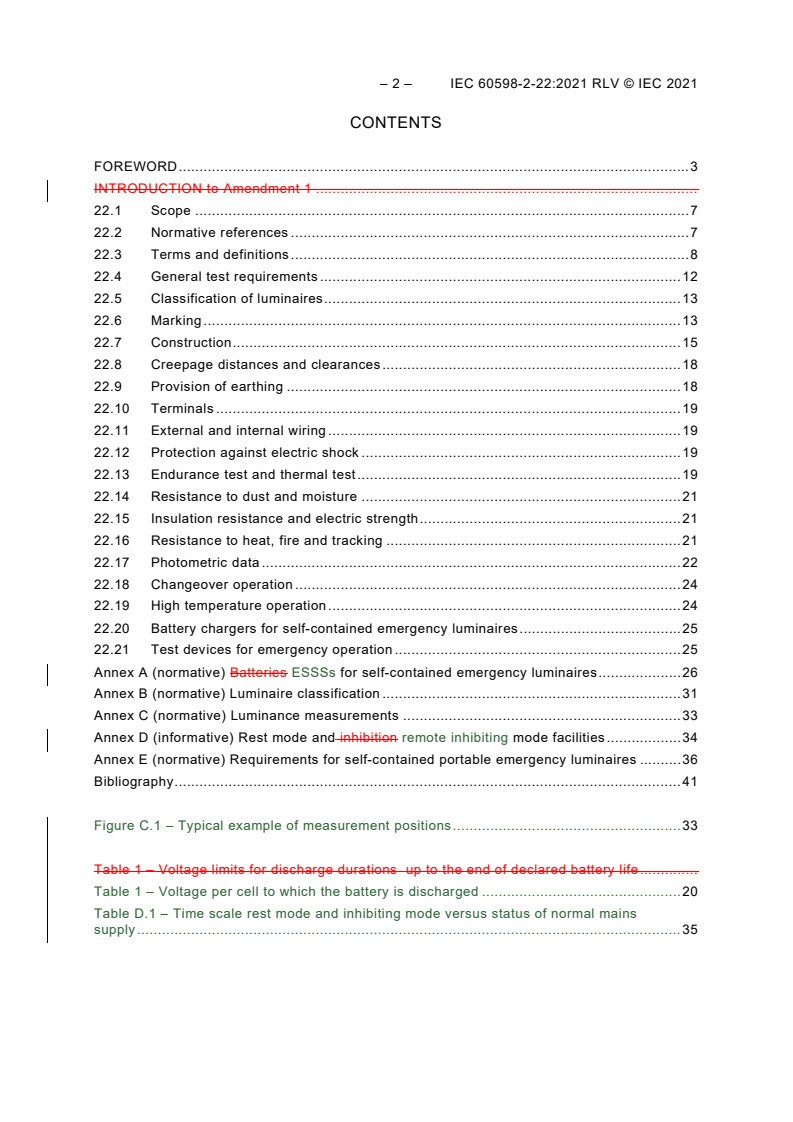
– 2 – IEC 60598-2-22:2021 RLV © IEC 2021
CONTENTS
FOREWORD . 3
INTRODUCTION to Amendment 1 .
22.1 Scope . 7
22.2 Normative references . 7
22.3 Terms and definitions . 8
22.4 General test requirements . 12
22.5 Classification of luminaires . 13
22.6 Marking . 13
22.7 Construction . 15
22.8 Creepage distances and clearances . 18
22.9 Provision of earthing . 18
22.10 Terminals . 19
22.11 External and internal wiring . 19
22.12 Protection against electric shock . 19
22.13 Endurance test and thermal test . 19
22.14 Resistance to dust and moisture . 21
22.15 Insulation resistance and electric strength . 21
22.16 Resistance to heat, fire and tracking . 21
22.17 Photometric data . 22
22.18 Changeover operation . 24
22.19 High temperature operation . 24
22.20 Battery chargers for self-contained emergency luminaires . 25
22.21 Test devices for emergency operation . 25
Annex A (normative) Batteries ESSSs for self-contained emergency luminaires . 26
Annex B (normative) Luminaire classification . 31
Annex C (normative) Luminance measurements . 33
Annex D (informative) Rest mode and inhibition remote inhibiting mode facilities . 34
Annex E (normative) Requirements for self-contained portable emergency luminaires . 36
Bibliography . 41
Figure C.1 – Typical example of measurement positions . 33
Table 1 – Voltage limits for discharge durations up to the end of declared battery life .
Table 1 – Voltage per cell to which the battery is discharged . 20
Table D.1 – Time scale rest mode and inhibiting mode versus status of normal mains
supply . 35
INTERNATIONAL ELECTROTECHNICAL COMMISSION
____________
LUMINAIRES –
Part 2-22: Particular requirements –
Luminaires for emergency lighting
FOREWORD
1) The International Electrotechnical Commission (IEC) is a worldwide organization for standardization comprising
all national electrotechnical committees (IEC National Committees). The object of IEC is to promote
international co-operation on all questions concerning standardization in the electrical and electronic fields. To
this end and in addition to other activities, IEC publishes International Standards, Technical Specifications,
Technical Reports, Publicly Available Specifications (PAS) and Guides (hereafter referred to as “IEC
Publication(s)”). Their preparation is entrusted to technical committees; any IEC National Committee interested
in the subject dealt with may participate in this preparatory work. International, governmental and non-
governmental organizations liaising with the IEC also participate in this preparation. IEC collaborates closely
with the International Organization for Standardization (ISO) in accordance with conditions determined by
agreement between the two organizations.
2) The formal decisions or agreements of IEC on technical matters express, as nearly as possible, an international
consensus of opinion on the relevant subjects since each technical committee has representation from all
interested IEC National Committees.
3) IEC Publications have the form of recommendations for international use and are accepted by IEC National
Committees in that sense. While all reasonable efforts are made to ensure that the technical content of IEC
Publications is accurate, IEC cannot be held responsible for the way in which they are used or for any
misinterpretation by any end user.
4) In order to promote international uniformity, IEC National Committees undertake to apply IEC Publications
transparently to the maximum extent possible in their national and regional publications. Any divergence
between any IEC Publication and the corresponding national or regional publication shall be clearly indicated in
the latter.
5) IEC itself does not provide any attestation of conformity. Independent certification bodies provide conformity
assessment services and, in some areas, access to IEC marks of conformity. IEC is not responsible for any
services carried out by independent certification bodies.
6) All users should ensure that they have the latest edition of this publication.
7) No liability shall attach to IEC or its directors, employees, servants or agents including individual experts and
members of its technical committees and IEC National Committees for any personal injury, property damage or
other damage of any nature whatsoever, whether direct or indirect, or for costs (including legal fees) and
expenses arising out of the publication, use of, or reliance upon, this IEC Publication or any other IEC
Publications.
8) Attention is drawn to the Normative references cited in this publication. Use of the referenced publications is
indispensable for the correct application of this publication.
9) Attention is drawn to the possibility that some of the elements of this IEC Publication may be the subject of
patent rights. IEC shall not be held responsible for identifying any or all such patent rights.
This redline version of the official IEC Standard allows the user to identify the changes made to
the previous edition IEC 60598-2-22:2014+AMD1:2017 CSV. A vertical bar appears in the margin
wherever a change has been made. Additions are in green text, deletions are in strikethrough
red text.
– 4 – IEC 60598-2-22:2021 RLV © IEC 2021
IEC 60598-2-22 has been prepared by subcommittee 34D: Luminaires of IEC technical
committee 34: Lighting. It is an International Standard.
This fifth edition cancels and replaces the fourth edition published in 2014 and
Amendment 1:2017. This edition constitutes a technical revision.
This edition includes the following significant technical changes with respect to the previous
edition:
a) update of requirements for rest mode and inhibiting mode;
b) clarification of high temperature operation tests;
c) introduction of new requirements for lithium batteries;
d) introduction of new requirements for electric double layer capacitors (EDLCs);
e) clarification of resistance to heat, fire and tracking;
f) clarification of test facilities for self-contained luminaires;
g) clarification of the test method for contrast measurements of exit signs.
The text of this International Standard is based on the following documents:
Draft Report on voting
34D/1635/FDIS 34D/1642/RVD
Full information on the voting for its approval can be found in the report on voting indicated in
the above table.
The language used for the development of this International Standard is English.
This document was drafted in accordance with ISO/IEC Directives, Part 2, and developed in
accordance with ISO/IEC Directives, Part 1 and ISO/IEC Directives, IEC Supplement,
available at www.iec.ch/members_experts/refdocs. The main document types developed by
IEC are described in greater detail at www.iec.ch/standardsdev/publications.
This Part 2-22 is to be used in conjunction with the latest edition of IEC 60598-1 and its
amendment(s). It was established on the basis of the ninth edition (2020) of that standard.
NOTE 1 When "Part 1" is mentioned in this document, it refers to IEC 60598-1.
NOTE 2 In this document, the following print type is used:
– compliance statements: in italic type.
A list of all parts in the IEC 60598 series, published under the general title Luminaires, can be
found on the IEC website.
The committee has decided that the contents of this document will remain unchanged until the
stability date indicated on the IEC website under webstore.iec.ch in the data related to the
specific document. At this date, the document will be
• reconfirmed,
• withdrawn,
• replaced by a revised edition, or
• amended.
IMPORTANT – The 'colour inside' logo on the cover page of this publication indicates that it
contains colours which are considered to be useful for the correct understanding of its
contents. Users should therefore print this document using a colour printer.
– 6 – IEC 60598-2-22:2021 RLV © IEC 2021
INTRODUCTION to Amendment 1
The light output of LED light sources depends also on the temperature at which it is operated.
Typically the temperature is controlled by a heat sink on which it is mounted (e.g. luminaire
surface).
For this reason, the calculation of the ratio of the electrical parameter (EOF ) will be
x
introduced in the LED controlgear standards IEC 61347-2-13 and IEC 61347-2-7, as the direct
measurement of EBLF is not practicable.
In particular EOF is defined as the ratio of the current in emergency mode from constant
I
current controlgear divided by the nominal current of LED (I ):
normal mode
EOF = I / I
I emergency normal mode
Knowing that the light output of an LED light source is nearly directly proportional with the
foreward current flowing through it, it is possible to calculate the luminous flux of the luminaire
in emergency mode by using the EOF or I from constant current controlgear
.
I emergency
This document contains a proposal for the modification of IEC 60598-2-22 to use the factor
EOF or I in the luminaire.
I emergency
Any non-linearity due to the increased efficacy at lower operation temperature leads to an increased tolerance
of the light output in the emergency mode but always positive.
LUMINAIRES –
Part 2-22: Particular requirements –
Luminaires for emergency lighting
22.1 Scope
This part of IEC 60598 specifies requirements for emergency luminaires for use with electrical
lamps on emergency power supplies not exceeding 1 000 V.
This document does not cover the effects of non-emergency voltage reductions on luminaires
incorporating high pressure discharge lamps.
This document gives general requirements for emergency lighting equipment.
In this document, the term "lamp" which also includes "light source(s)" where appropriate, is
used.
22.2 Normative references
The following documents are referred to in the text in such a way that some or all of their
content constitutes requirements of this document. For dated references, only the edition
cited applies. For undated references, the latest edition of the referenced document (including
any amendments) applies.
IEC 60073, Basic and safety principles for man-machine interface, marking and identification
– Coding principles for indication devices indicators and actuators
IEC 60155, Glow-starters for fluorescent lamps
IEC 60598-1, Luminaires – Part 1: General requirements and tests
IEC 60896-21, Stationary lead-acid batteries – Part 21: Valve regulated types – Methods of
test
IEC 61032:1997, Protection of persons and equipment by enclosures – Probes for verification
IEC 61056-1, General purpose lead-acid batteries (valve-regulated types) – Part 1: General
requirements, functional characteristics – Methods of test
IEC TR 61341, Method of measurement of centre beam intensity and beam angle(s) of
reflector lamps
IEC 61347-2-2, Lamp controlgear – Part 2-2: Particular requirements for d.c. or a.c. supplied
electronic step-down convertors for filament lamps
IEC 61347-2-3:2011, Lamp control gear – Part 2-3: Particular requirements for a.c. and/or d.c.
supplied electronic control gear for fluorescent lamps
– 8 – IEC 60598-2-22:2021 RLV © IEC 2021
IEC 61347-2-7:2011, Lamp controlgear – Part 2-7: Particular requirements for battery
supplied electronic controlgear for emergency lighting (self-contained)
IEC 61347-2-7:2011/AMD1:2017
IEC 61347-2-7:2011/AMD2:2021
IEC 61347-2-12, Lamp controlgear – Part 2-12: Particular requirements for d.c. or a.c.
supplied electronic ballasts for discharge lamps (excluding fluorescent lamps)
IEC 61347-2-13, Lamp controlgear – Part 2-13: Particular requirements for d.c. or a.c.
supplied electronic controlgear for LED modules
IEC 61951-1, Secondary cells and batteries containing alkaline or other non-acid electrolytes.
Portable sealed rechargeable single cells – Secondary sealed cells and batteries for portable
applications – Part 1: Nickel-Cadmium
IEC 61951-2, Secondary cells and batteries containing alkaline or other non-acid electrolytes.
Portable sealed rechargeable single cells – Secondary sealed cells and batteries for portable
applications – Part 2: Nickel-metal hydride
IEC 62034, Automatic test systems for battery powered emergency escape lighting
IEC 62133-2:2017, Secondary cells and batteries containing alkaline or other non-acid
electrolytes – Safety requirements for portable sealed secondary lithium cells, and for
batteries made from them, for use in portable applications – Part 2: Lithium systems
IEC 62391-1:2015, Fixed electric double-layer capacitors for use in electric and electronic
equipment – Part 1: Generic specification
IEC 62391-2:2006, Fixed electric double-layer capacitors for use in electronic equipment –
Part 2: Sectional specification – Electric double-layer capacitors for power application
IEC 62620:2014, Secondary cells and batteries containing alkaline or other non-acid
electrolytes – Secondary lithium cells and batteries for use in industrial applications
ISO 3864-1:2011, Graphical symbols — Safety colours and safety signs. Part 1: Design
principles for safety signs and safety markings
ISO 3864-4:2011, Graphical symbols – Safety colours and safety signs – Part 4: Colorimetric
and photometric properties of safety sign materials
ISO 30061:2007, Emergency lighting
CIE 121 SP1, The photometry of emergency luminaires The Photometry and Goniophotometry
of Luminaires – Supplement 1: Luminaires for Emergency Lighting
CIE S025, Test Method for LED Lamps, LED Luminaires and LED Modules
22.3 Terms and definitions
For the purposes of this document, the terms and definitions given in Part 1 and the following
apply.
ISO and IEC maintain terminological databases for use in standardization at the following
addresses:
• IEC Electropedia: available at http://www.electropedia.org/
• ISO Online browsing platform: available at http://www.iso.org/obp
22.3.1
emergency lighting
lighting for use when the supply to the normal lighting fails
Note 1 to entry: Emergency lighting includes emergency escape lighting, high-risk task-area lighting and standby
lighting.
22.3.2
emergency escape lighting
that part of emergency lighting that provides illumination for the safety of people leaving an
area or attempting to terminate a dangerous process before vacating an area
22.3.3
standby lighting
that part of emergency lighting that enables normal activities to continue substantially
unchanged
22.3.4
high-risk task-area lighting
part of emergency lighting provided to ensure the safety of people involved in a potentially
dangerous process or situation and to enable proper shut-down procedures for the safety of
the operator and occupants of the premises
22.3.5
maintained emergency luminaire
luminaire in which the emergency lighting lamps are energized at all times when normal or
emergency lighting is required
22.3.6
non-maintained emergency luminaire
luminaire in which the emergency lighting lamps are in operation only when the supply to the
normal lighting fails
22.3.7
combined emergency luminaire
luminaire containing two or more lamps, at least one of which is energized from the
emergency lighting supply and the others from the normal lighting supply
Note 1 to entry: A combined emergency luminaire is either maintained or non-maintained.
22.3.8
self-contained emergency luminaire
luminaire providing maintained or non-maintained emergency lighting in which all the
elements, such as the battery the electric source for safety services (ESSS), the lamp, the
control unit and the test and monitoring facilities, where provided, are contained within the
luminaire or adjacent to it (that is, within 1 m cable length)
22.3.9
centrally supplied emergency luminaire
luminaire for maintained or non-maintained operation which is energized from a central
emergency power system that is not contained within the luminaire
22.3.10
compound self-contained emergency luminaire
self-contained luminaire providing maintained or non-maintained emergency lighting and also
providing emergency supply for operating a satellite luminaire
– 10 – IEC 60598-2-22:2021 RLV © IEC 2021
22.3.11
satellite emergency luminaire
luminaire for maintained or non-maintained operation which derives emergency operation
supply from an associated compound self-contained emergency luminaire
22.3.12
control unit
unit or set of units comprising a supply changeover system, a battery an electric source for
safety services (ESSS) charging device and, where appropriate, a means for testing
Note 1 to entry: This unit may can also contain the lamp controlgear.
22.3.13
normal supply failure
condition in which the normal lighting can no longer provide a minimum illuminance for
emergency escape purposes and when the emergency lighting should become operative
22.3.14
emergency luminaire rated luminous flux
lumen output as claimed by the luminaire manufacturer, 60 s (0,5 s for high-risk task-area
luminaires) after failure of the normal supply, and continuously maintained to the end of the
rated duration of operation
22.3.15
rated duration of emergency operation
time, as claimed by the manufacturer, during which the rated emergency lumen output is
provided
22.3.16
normal mode
state of a self-contained emergency luminaire that is ready to operate in emergency mode
while the normal supply is on
Note 1 to entry: In the case of a normal supply failure, the self-contained luminaire automatically changes over to
the emergency mode.
22.3.17
emergency mode
state of a self-contained emergency luminaire that provides lighting when energized by its
internal power source, the normal supply having failed
22.3.18
rest mode
state of a self-contained emergency luminaire that has been intentionally extinguished while
the normal supply is off and that, in the event of restoration of the normal supply,
automatically reverts to normal mode
22.3.19
maximum overcharge rate
maximum continuous charge rate (e.g. current or voltage) that may can be applied to a fully
charged battery electric source for safety services (ESSS)
22.3.20
remote inhibiting facility
means for inhibiting remotely a luminaire associated with an emergency lighting system
22.3.21
remote inhibiting mode
state of a self-contained emergency luminaire which is inhibited from operating by a remote
device while the normal supply is on and in the case of a normal supply failure when the
luminaire does not change over to emergency mode
22.3.22
internally illuminated safety sign
self-contained or centrally supplied emergency luminaire intended to provide a specific safety
message obtained by a combination of colour and geometric shapes
Note 1 to entry: Details are given in ISO 3864-1 and ISO 3864-4.
22.3.23
practical emergency lamp flux
PELF
minimum luminous flux of the lamp observed during the rated duration of the emergency mode
Note 1 to entry: PELF = LDL × EBLF
where LDL is the rated luminous flux of fluorescent or discharge lamp; this is taken as the initial lighting design
lumens at 100 h.
Note 2 to entry: This note applies to the French language only.
22.3.24
self-contained portable emergency luminaire
portable luminaire providing emergency lighting where all of the elements, such as the battery
the electric source for safety services (ESSS), the lamp(s), the control unit, a manual switch
for switching on or off one or more lamp and the test and monitoring facilities, where provided,
are contained within the luminaire which can be detached from its base unit for use in the
emergency mode
22.3.25
emergency ballast lumen factor
EBLF
ratio of the emergency luminous flux of the lamp supplied by the emergency controlgear to the
luminous flux of the same lamp operated with the appropriate reference ballast at its rated
voltage and frequency
Note 1 to entry: The emergency ballast lumen factor is the minimum of the values measured at the appropriate
time after failure of the normal supply and continuously to the end of the rated time duration.
Note 2 to entry: This note applies to the French language only.
[SOURCE: IEC 61347-2-7:2011, 3.13]
22.3.26
emergency luminaire mounted on lighting track system
emergency luminaire specifically designed to be used on luminaire track systems
22.3.27
emergency remote box
box complying with the same requirements as the emergency luminaire
Note 1 to entry: Its purpose is to contain any of the components e.g. battery, controlgear that will not be fitted into
the emergency luminaire.
22.3.28
practical emergency light source flux
PELSF
minimum luminous flux of the light source observed during the rated duration of the
emergency mode
– 12 – IEC 60598-2-22:2021 RLV © IEC 2021
Note 1 to entry: For LED light sources:
a) if EOF is given: PELSF = LDL × EOF
I I
b) if I from constant current controlgear is defined: PELSF = LDL × (I / I )
emergency emergency normal mode
where LDL is the lumen output of the LED module under the condition corresponding to the operation in the
luminaire (identical t ) operated at the same current (I ).
p normal mode
Note 2 to entry: This note only applies to the French language.
22.3.29
battery manufacturer's declaration of design
document issued by the battery manufacturer that provides technical information necessary to
evaluate the safe use of the battery and its operating regime in accordance with the
requirements of this document
Note 1 to entry: Examples of the battery manufacturer's declaration of design for a lithium battery is given in
IEC 61347-2-7.
22.3.30
rated capacity
capacity value of a battery determined under specified conditions and declared by the
manufacturer
[SOURCE: IEC 60050-482:2004, 482-03-15]
22.3.31
electric source for safety services
ESSS
energy source for self-contained emergency luminaire, intended to supply the emergency
lighting luminaire in emergency mode
Note 1 to entry: The ESSS can also supply the luminaire in rest mode and inhibiting mode.
22.3.32
electric double-layer capacitor
EDLC
device that stores electrical energy using a double-layer in an electrochemical cell
22.4 General test requirements
The provisions of Section 0 of Part 1 shall apply. The tests described in each appropriate
section of Part 1 shall be carried out in the order listed in this document.
When testing combined emergency luminaires in accordance with the requirements of this
document, the tests shall cover those parts of the luminaire which are involved with providing
emergency lighting taking into account the influence of all other luminaire parts and
components. The components and parts of the luminaires designed to provide only normal
lighting shall be subjected to the tests in accordance with the requirements of the relevant
part of IEC 60598-2 (for example, if the luminaire is recessed, it shall be tested in accordance
with the requirements of the part dealing with recessed luminaires).
If some elements of an emergency luminaire are adjacent (within a 1 m cable length) to the
main part of the luminaire, all the elements of the luminaire, including the means of inter-
connection, shall satisfy the relevant requirements of this document.
The additional requirements covering self-contained portable emergency luminaires are given
in Annex E.
The photometric tests of Clause 22.17 shall be made on a separate sample luminaire.
Derating factors should be applied during the emergency lighting installation scheme design
which is relevant to the application. These factors are normally defined by the relevant
application standard.
22.5 Classification of luminaires
Emergency luminaires shall be classified in accordance with the provisions of Section 2 of
Part 1 except that all emergency luminaires shall be classified as suitable for direct mounting
on normally flammable surfaces.
Emergency luminaires shall also be classified as specified in Annex B.
22.6 Marking
The provisions of Section 3 of Part 1 shall apply together with the requirements of 22.6.1 to
22.6.20 below.
22.6.1 Luminaires shall be clearly marked with the rated supply voltage or voltage range(s).
22.6.2 Luminaires shall be clearly marked with details of their classification in accordance
with Clause 22.5 (see Annex B).
22.6.3 Luminaires with replaceable lamps shall be clearly marked with details of the correct
replacement lamp in a position visible during lamp replacement. This ensures that the
emergency luminaire's rated luminous flux can be achieved.
NOTE The information relating to correct lamp replacement can include the number, type, rated voltage and rated
wattage, etc.
22.6.4 Where appropriate, in addition to t marking, the range of ambient temperature shall
a
be marked or given in the instruction leaflet supplied with the luminaire.
22.6.5 Emergency luminaires employing replaceable fuses and/or replaceable indicator
lamps shall be marked with the details of fuse ratings and/or details of the indicator lamps.
22.6.6 For manual testing only, test facilities to simulate normal supply failure, where
provided, shall be clearly marked so that the marking is visible during routine testing.
22.6.7 Self-contained emergency luminaires shall be clearly marked with the details of
correct battery replacement including the battery technology (e.g. NiMH), rated voltage,
capacity, temperature rating, temperature classification and charge regime.
Self-contained luminaires shall be clearly marked with details about the nature of the ESSS it
contains as follows.
22.6.7.1 Self-contained emergency luminaires with replaceable batteries shall be clearly
marked with the details of the correct battery replacement. If the manufacturer indicates that
the battery is only replaceable with a specific type, the battery technology (e.g. NiMH) and the
type reference or the code of the replaceable battery shall be indicated. If the battery is
replaceable with another type, the details shall include the battery technology (e.g. NiMH),
rated voltage, capacity, temperature rating, and temperature classification.
Luminaires containing a non-replaceable battery(s) shall be marked to indicate that the
battery is non-replaceable.
22.6.7.2 In self-contained luminaires with batteries, the batteries shall be marked with the
year and month or year and week of manufacture.
– 14 – IEC 60598-2-22:2021 RLV © IEC 2021
In self-contained luminaires with replaceable batteries, space shall be provided on the battery
label to permit allow the marking, by the installer or commissioning engineer, of the date of
commissioning of the battery.
For luminaires with non-replaceable batteries, the space for marking the date of
commissioning shall be provided on the battery or on a label to be observed visible during
maintenance.
22.6.7.3 Self-contained emergency luminaires with an EDLC shall be clearly marked with the
details for correct EDLC replacement. If the manufacturer indicates that the EDLC is only
replaceable with a specific type, it shall indicate the type reference or the code of the
replaceable EDLC. If the EDLC is replaceable with another type, the details shall include the
type of EDLC (according to the applicable IEC standard), (e.g. rated voltage, capacity,
temperature rating, temperature classification, dimensions).
Luminaires containing a non-replaceable EDLC shall be marked to indicate that the EDLC is
non-replaceable.
22.6.8 Void.
22.6.9 Combined emergency luminaires shall be marked with details relating to correct lamp
replacement for all lamps. If the lamps used in the emergency circuit and the normal supply
circuit differ, the respective types shall be clearly identified.
Lampholders for emergency lighting lamps in combined luminaires shall be identified by a
green dot, at least 5 mm in diameter, which shall be visible when replacing the lamp.
22.6.10 In the instruction leaflet supplied with the self-contained emergency luminaire, the
manufacturer shall state that the replacement of the battery ESSS or of the whole luminaire (if
having equipped with a non-replaceable lamp(s) and/or battery ESSS) is needed when they
no longer meet their rated duration of operation after the corresponding recharge period.
All details for correct replacement of the ESSS shall be included in the instruction leaflet
supplied with the self-contained emergency luminaire. If the manufacturer indicates that the
ESSS is only replaceable with a specific type, the type reference or the code of the
replaceable ESSS shall be indicated. If the ESSS is replaceable with another type, the
instructions shall include: ESSS technology or type (battery, e.g. NiMH), applicable IEC
standard (EDLC), rated voltage, capacity, temperature rating, temperature classification.
In addition, the instruction leaflet supplied with the self-contained emergency luminaire shall
contain the substance of the following information: "The electric source for safety service is
not a user serviceable item and shall only be replaced by the manufacturer service agent or a
similar qualified person".
22.6.11 In the instruction leaflet supplied with the luminaire, the manufacturer shall give
details of test facilities incorporated in the luminaire or appropriate instructions if these test
facilities are supplied separately. The instructions shall include details of test procedures.
22.6.12 In the instruction leaflet supplied with the luminaire, the manufacturer shall give
details of the connection leads to be used between a compound self-contained luminaire and
an associated satellite luminaire. The maximum length of cables that limits the voltage drop to
3 % shall be specified.
22.6.13 Void.
22.6.14 In the instruction leaflet supplied with self-contained emergency luminaires, the
manufacturer shall give details of any device which changes the mode of operation.
22.6.15 The manufacturer shall make available the photometric data in accordance with
Clause 22.17.
22.6.16 Any normal preparation procedure for use of the luminaire shall be stated in the
manufacturer's installation instructions. This preparation shall be carried out before type tests
are made.
22.6.17 The marking required by 22.6.1, 22.6.2, 22.6.7.1 2nd paragraph, 22.6.7.3 2nd
paragraph and 22.6.20 shall be in a position such that the information can be seen when the
luminaire has been installed.
The marking in 22.6.5, 22.6.7.1 1st paragraph, 22.6.7.3 1st paragraph and 22.6.9 shall be
visible during the maintenance of the relevant component.
NOTE For recessed luminaires, this information can be marked on the interior of the luminaire so that it is visible
when the light controlling cover is removed.
22.6.18 The mounting instructions for luminaires intended for external plug and socket
connections, without provisions to prevent accidental disconnection, shall be provided with
the warning: "This luminaire is intended only for mounting in locations where the plug and
socket are protected from unauthorized disconnection".
22.6.19 In the instruction leaflet supplied with the luminaire, the manufacturer shall specify if
the lamp(s) and/or the battery ESSS is/are non-replaceable.
22.6.20 For emergency luminaires mounted on lighting track systems, they shall be marked
to indicate that they are an emergency luminaire and shall not be adjusted by unauthorized
persons. In the instruction leaflet supplied with the adjustable emergency track mounted
luminaire, the manufacturer shall provide the photometric data.
22.6.21 In self-contained luminaires, the rated charge time, if lower than 24 h, can be
declared in the instruction leaflet.
22.6.22 Where applicable, for self-contained luminaires, the manufacturer shall make
available information for the allowed time for the luminaire to stay in rest mode or remote
inhibiting mode after a full charging period, in order for the luminaire to provide at least 50 %
of its rated duration of emergency operation.
The time shall be declared in the instruction leaflet supplied with the luminaire in days and
calculated according to the procedure in IEC 61347-2-7:2011/AMD2:2021, 25.6.2.
NOTE 1 Examples of declared periods are 7, 30 or 90 days.
NOTE 2 The characteristics of rest mode and inhibiting mode are explained in Annex D.
22.6.23 Compliance with the requirements of 22.6.1 to 22.6.2022 is checked by inspection.
22.7 Construction
The provisions of Section 4 of Part 1 shall apply together with the requirements of 22.7.1 to
22.7.23 below. In addition, emergency luminaires with automatic testing systems shall comply
with the additional requirements of IEC 62034 as identified in Annex K of IEC 61347-2-7:2011
and Annex K of IEC 61347-2-7:2011/AMD1:2017.
22.7.1 In emergency luminaires, fluorescent lamps used to provide emergency lighting shall
start in the emergency mode without the aid of glow starters as specified in IEC 60155. Such
starters shall not be in circuit during the emergency mode. The emergency lighting shall not
be provided by means of fluorescent lamps with built-in glow starters.
– 16 – IEC 60598-2-22:2021 RLV © IEC 2021
Compliance is checked by inspection.
22.7.2 Lamp controlgear for operating the emergency lamp(s) and control units incorporated
into emergency luminaires shall comply with IEC 61347-2-2, IEC 61347-2-3, IEC 61347-2-7,
IEC 61347-2-12 and IEC 61347-2-13 as appropriate and with the additional safety
requirements for electronic controlgear for emergency lighting in the appropriate annex of the
standards (e.g. Annex J of IEC 61347-2-3:2011).
Compliance is checked by the relevant tests specified in these standards.
22.7.3 Emergency luminaires shall be equipped with a protection device which disconnects
the luminaire from the supply in case of any failure within that luminaire affecting the circuit
(short circuit or overcurrent consumption).
Compliance is checked by measurement and inspection.
22.7.4 For emergency luminaires, the mechanical strength tests given in Part 1 shall be
applied with a minimum impact energy of 0,35 Nm to all external parts.
22.7.5 Whilst connected to a live supply, self-contained emergency luminaires shall have
adequate separation between the normal supply and live parts in the circuit for battery ESSS
charging. When there are exposed live parts, double insulation, reinforced insulation, earth
screen or other equivalent techniques can be used.
Additionally, in the event of bare contacts in the battery ESSS charging circuit, a safety
isolating transformer shall be used. If a separating transformer is used as insulation between
the normal supply and the battery ESSS charging circuit, the insulation in the battery ESSS
charging circuit shall consist of at least basic insulation.
Compliance is checked by inspection and by the tests of Clauses 22.8 and 22.15.
22.7.6 In centrally supplied combined emergency luminaires, electrical separation between
normal and emergency supplies shall be ensured by double insulation, reinforced insulation,
earthed screen or other equivalent means.
EXAMPLE The use of basic insulation only, for both circuits, or double/ or reinforced insulation on the normal
supply circuit fulfils this requirement. The connection of both circuits to a terminal block where the required
creepage/ and clearances are obtained by leaving one terminal free, without the possibility of connection between
the circuits, is also acceptable.
Compliance is checked by inspection.
22.7.7 Self-contained emergency luminaires shall have adjacent to them or incorporated in
them a device for charging the battery ESSS from the normal supply and an indicator visible
in normal use, for example a lamp, which shows the following conditions:
a) the luminaire is connected and the charge of the battery ESSS is being maintained;
b) circuit continuity exists through the tungsten filament of emergency lighting lamps where
appropriate.
Where an electrical light source indicator is used, it shall comply with the colour requirements
of IEC 60073 and be green.
For emergency luminaires with tungsten filament lamp(s) both a) and b) apply at the same
time, and for other emergency luminaires without tungsten filaments, such as fluorescent and
LED lamps, only a) applies.
For emergency luminaires with tungsten filament lamps, compliance that circuit continuity
exists through the tungsten filament is checked in the following manner: disconnection of one
of the lamps, or all the lamps when connected in parallel, causes the indicator to extinguish or
change colour in accordance with IEC 60073.
For all emergency luminaires, compliance that the charge indicator is correctly connected to
the circuit is checked in the following manner: disconnection of the battery ESSS during the
charging phase, causes the indicator to extinguish or change colour in accordance with
IEC 60073.
22.7.8 Self-contained emergency luminaires shall incorporate a battery an ESSS that meets
the requirements of Annex A and is designed to provide the rated duration for at least four
years of normal operation. This battery ESSS shall be used only for emergency related
functions within the luminaire or its satellite.
Compliance is checked by inspection and the tests of Annex A.
22.7.9 Void
22.7.10 In self-contained emergency luminaires, there shall be no manual or non-self-
resetting circuits between the battery ESSS and emergency lighting lamps other than the
changeover device.
Self-contained emergency luminaires and centrally supplied emergency luminaires shall not
contain any manual or non-self-resetting switch isolating the emergency circuit(s) from the
mains supply other than facilities enabling rest mode or inhibition inhibiting mode.
NOTE Installation details can be found in IEC 60364-5-56.
Compliance is checked by inspection.
22.7.11 Lamp failure. Any la
...
IEC 60598-2-22 ®
Edition 5.0 2021-12
INTERNATIONAL
STANDARD
NORME
INTERNATIONALE
Luminaires –
Part 2-22: Particular requirements – Luminaires for emergency lighting
Luminaires –
Partie 2-22: Exigences particulières – Luminaires pour éclairage de secours
All rights reserved. Unless otherwise specified, no part of this publication may be reproduced or utilized in any form
or by any means, electronic or mechanical, including photocopying and microfilm, without permission in writing from
either IEC or IEC's member National Committee in the country of the requester. If you have any questions about IEC
copyright or have an enquiry about obtaining additional rights to this publication, please contact the address below or
your local IEC member National Committee for further information.
Droits de reproduction réservés. Sauf indication contraire, aucune partie de cette publication ne peut être reproduite
ni utilisée sous quelque forme que ce soit et par aucun procédé, électronique ou mécanique, y compris la photocopie
et les microfilms, sans l'accord écrit de l'IEC ou du Comité national de l'IEC du pays du demandeur. Si vous avez des
questions sur le copyright de l'IEC ou si vous désirez obtenir des droits supplémentaires sur cette publication, utilisez
les coordonnées ci-après ou contactez le Comité national de l'IEC de votre pays de résidence.
IEC Central Office Tel.: +41 22 919 02 11
3, rue de Varembé info@iec.ch
CH-1211 Geneva 20 www.iec.ch
Switzerland
About the IEC
The International Electrotechnical Commission (IEC) is the leading global organization that prepares and publishes
International Standards for all electrical, electronic and related technologies.
About IEC publications
The technical content of IEC publications is kept under constant review by the IEC. Please make sure that you have the
latest edition, a corrigendum or an amendment might have been published.
IEC publications search - webstore.iec.ch/advsearchform IEC online collection - oc.iec.ch
The advanced search enables to find IEC publications by a Discover our powerful search engine and read freely all the
variety of criteria (reference number, text, technical publications previews. With a subscription you will always
committee, …). It also gives information on projects, replaced have access to up to date content tailored to your needs.
and withdrawn publications.
Electropedia - www.electropedia.org
IEC Just Published - webstore.iec.ch/justpublished
The world's leading online dictionary on electrotechnology,
Stay up to date on all new IEC publications. Just Published
containing more than 22 000 terminological entries in English
details all new publications released. Available online and
and French, with equivalent terms in 18 additional languages.
once a month by email.
Also known as the International Electrotechnical Vocabulary
(IEV) online.
IEC Customer Service Centre - webstore.iec.ch/csc
If you wish to give us your feedback on this publication or
need further assistance, please contact the Customer Service
Centre: sales@iec.ch.
A propos de l'IEC
La Commission Electrotechnique Internationale (IEC) est la première organisation mondiale qui élabore et publie des
Normes internationales pour tout ce qui a trait à l'électricité, à l'électronique et aux technologies apparentées.
A propos des publications IEC
Le contenu technique des publications IEC est constamment revu. Veuillez vous assurer que vous possédez l’édition la
plus récente, un corrigendum ou amendement peut avoir été publié.
Recherche de publications IEC - IEC online collection - oc.iec.ch
webstore.iec.ch/advsearchform Découvrez notre puissant moteur de recherche et consultez
La recherche avancée permet de trouver des publications IEC gratuitement tous les aperçus des publications. Avec un
en utilisant différents critères (numéro de référence, texte, abonnement, vous aurez toujours accès à un contenu à jour
comité d’études, …). Elle donne aussi des informations sur adapté à vos besoins.
les projets et les publications remplacées ou retirées.
Electropedia - www.electropedia.org
IEC Just Published - webstore.iec.ch/justpublished
Le premier dictionnaire d'électrotechnologie en ligne au
Restez informé sur les nouvelles publications IEC. Just
monde, avec plus de 22 000 articles terminologiques en
Published détaille les nouvelles publications parues.
anglais et en français, ainsi que les termes équivalents dans
Disponible en ligne et une fois par mois par email.
16 langues additionnelles. Egalement appelé Vocabulaire
Electrotechnique International (IEV) en ligne.
Service Clients - webstore.iec.ch/csc
Si vous désirez nous donner des commentaires sur cette
publication ou si vous avez des questions contactez-nous:
sales@iec.ch.
IEC 60598-2-22 ®
Edition 5.0 2021-12
INTERNATIONAL
STANDARD
NORME
INTERNATIONALE
Luminaires –
Part 2-22: Particular requirements – Luminaires for emergency lighting
Luminaires –
Partie 2-22: Exigences particulières – Luminaires pour éclairage de secours
INTERNATIONAL
ELECTROTECHNICAL
COMMISSION
COMMISSION
ELECTROTECHNIQUE
INTERNATIONALE
ICS 29.140.40 ISBN 978-2-8322-1053-8
– 2 – IEC 60598-2-22:2021 © IEC 2021
CONTENTS
FOREWORD . 3
22.1 Scope . 5
22.2 Normative references . 5
22.3 Terms and definitions . 6
22.4 General test requirements . 10
22.5 Classification of luminaires . 11
22.6 Marking . 11
22.7 Construction . 13
22.8 Creepage distances and clearances . 16
22.9 Provision of earthing . 16
22.10 Terminals . 16
22.11 External and internal wiring . 16
22.12 Protection against electric shock . 17
22.13 Endurance test and thermal test . 17
22.14 Resistance to dust and moisture . 19
22.15 Insulation resistance and electric strength . 19
22.16 Resistance to heat, fire and tracking . 19
22.17 Photometric data . 20
22.18 Changeover operation . 21
22.19 High temperature operation . 21
22.20 Battery chargers for self-contained emergency luminaires . 22
22.21 Test devices for emergency operation . 22
Annex A (normative) ESSSs for self-contained emergency luminaires . 23
Annex B (normative) Luminaire classification . 28
Annex C (normative) Luminance measurements . 30
Annex D (informative) Rest mode and remote inhibiting mode facilities . 31
Annex E (normative) Requirements for self-contained portable emergency luminaires . 33
Bibliography . 38
Figure C.1 – Typical example of measurement positions . 30
Table 1 – Voltage per cell to which the battery is discharged . 18
Table D.1 – Time scale rest mode and inhibiting mode versus status of normal mains
supply . 31
INTERNATIONAL ELECTROTECHNICAL COMMISSION
____________
LUMINAIRES –
Part 2-22: Particular requirements –
Luminaires for emergency lighting
FOREWORD
1) The International Electrotechnical Commission (IEC) is a worldwide organization for standardization comprising
all national electrotechnical committees (IEC National Committees). The object of IEC is to promote
international co-operation on all questions concerning standardization in the electrical and electronic fields. To
this end and in addition to other activities, IEC publishes International Standards, Technical Specifications,
Technical Reports, Publicly Available Specifications (PAS) and Guides (hereafter referred to as “IEC
Publication(s)”). Their preparation is entrusted to technical committees; any IEC National Committee interested
in the subject dealt with may participate in this preparatory work. International, governmental and non-
governmental organizations liaising with the IEC also participate in this preparation. IEC collaborates closely
with the International Organization for Standardization (ISO) in accordance with conditions determined by
agreement between the two organizations.
2) The formal decisions or agreements of IEC on technical matters express, as nearly as possible, an international
consensus of opinion on the relevant subjects since each technical committee has representation from all
interested IEC National Committees.
3) IEC Publications have the form of recommendations for international use and are accepted by IEC National
Committees in that sense. While all reasonable efforts are made to ensure that the technical content of IEC
Publications is accurate, IEC cannot be held responsible for the way in which they are used or for any
misinterpretation by any end user.
4) In order to promote international uniformity, IEC National Committees undertake to apply IEC Publications
transparently to the maximum extent possible in their national and regional publications. Any divergence
between any IEC Publication and the corresponding national or regional publication shall be clearly indicated in
the latter.
5) IEC itself does not provide any attestation of conformity. Independent certification bodies provide conformity
assessment services and, in some areas, access to IEC marks of conformity. IEC is not responsible for any
services carried out by independent certification bodies.
6) All users should ensure that they have the latest edition of this publication.
7) No liability shall attach to IEC or its directors, employees, servants or agents including individual experts and
members of its technical committees and IEC National Committees for any personal injury, property damage or
other damage of any nature whatsoever, whether direct or indirect, or for costs (including legal fees) and
expenses arising out of the publication, use of, or reliance upon, this IEC Publication or any other IEC
Publications.
8) Attention is drawn to the Normative references cited in this publication. Use of the referenced publications is
indispensable for the correct application of this publication.
9) Attention is drawn to the possibility that some of the elements of this IEC Publication may be the subject of
patent rights. IEC shall not be held responsible for identifying any or all such patent rights.
IEC 60598-2-22 has been prepared by subcommittee 34D: Luminaires of IEC technical
committee 34: Lighting. It is an International Standard.
This fifth edition cancels and replaces the fourth edition published in 2014 and
Amendment 1:2017. This edition constitutes a technical revision.
This edition includes the following significant technical changes with respect to the previous
edition:
a) update of requirements for rest mode and inhibiting mode;
b) clarification of high temperature operation tests;
c) introduction of new requirements for lithium batteries;
d) introduction of new requirements for electric double layer capacitors (EDLCs);
– 4 – IEC 60598-2-22:2021 © IEC 2021
e) clarification of resistance to heat, fire and tracking;
f) clarification of test facilities for self-contained luminaires;
g) clarification of the test method for contrast measurements of exit signs.
The text of this International Standard is based on the following documents:
Draft Report on voting
34D/1635/FDIS 34D/1642/RVD
Full information on the voting for its approval can be found in the report on voting indicated in
the above table.
The language used for the development of this International Standard is English.
This document was drafted in accordance with ISO/IEC Directives, Part 2, and developed in
accordance with ISO/IEC Directives, Part 1 and ISO/IEC Directives, IEC Supplement,
available at www.iec.ch/members_experts/refdocs. The main document types developed by
IEC are described in greater detail at www.iec.ch/standardsdev/publications.
This Part 2-22 is to be used in conjunction with the latest edition of IEC 60598-1 and its
amendment(s). It was established on the basis of the ninth edition (2020) of that standard.
NOTE 1 When "Part 1" is mentioned in this document, it refers to IEC 60598-1.
NOTE 2 In this document, the following print type is used:
– compliance statements: in italic type.
A list of all parts in the IEC 60598 series, published under the general title Luminaires, can be
found on the IEC website.
The committee has decided that the contents of this document will remain unchanged until the
stability date indicated on the IEC website under webstore.iec.ch in the data related to the
specific document. At this date, the document will be
• reconfirmed,
• withdrawn,
• replaced by a revised edition, or
• amended.
LUMINAIRES –
Part 2-22: Particular requirements –
Luminaires for emergency lighting
22.1 Scope
This part of IEC 60598 specifies requirements for emergency luminaires for use with electrical
lamps on emergency power supplies not exceeding 1 000 V.
This document does not cover the effects of non-emergency voltage reductions on luminaires
incorporating high pressure discharge lamps.
This document gives general requirements for emergency lighting equipment.
In this document, the term "lamp" which also includes "light source(s)" where appropriate, is
used.
22.2 Normative references
The following documents are referred to in the text in such a way that some or all of their
content constitutes requirements of this document. For dated references, only the edition
cited applies. For undated references, the latest edition of the referenced document (including
any amendments) applies.
IEC 60073, Basic and safety principles for man-machine interface, marking and identification
– Coding principles for indicators and actuators
IEC 60155, Glow-starters for fluorescent lamps
IEC 60598-1, Luminaires – Part 1: General requirements and tests
IEC 60896-21, Stationary lead-acid batteries – Part 21: Valve regulated types – Methods of
test
IEC 61032:1997, Protection of persons and equipment by enclosures – Probes for verification
IEC 61056-1, General purpose lead-acid batteries (valve-regulated types) – Part 1: General
requirements, functional characteristics – Methods of test
IEC TR 61341, Method of measurement of centre beam intensity and beam angle(s) of
reflector lamps
IEC 61347-2-2, Lamp controlgear – Part 2-2: Particular requirements for d.c. or a.c. supplied
electronic step-down convertors for filament lamps
IEC 61347-2-3:2011, Lamp control gear – Part 2-3: Particular requirements for a.c. and/or d.c.
supplied electronic control gear for fluorescent lamps
– 6 – IEC 60598-2-22:2021 © IEC 2021
IEC 61347-2-7:2011, Lamp controlgear – Part 2-7: Particular requirements for battery
supplied electronic controlgear for emergency lighting (self-contained)
IEC 61347-2-7:2011/AMD1:2017
IEC 61347-2-7:2011/AMD2:2021
IEC 61347-2-12, Lamp controlgear – Part 2-12: Particular requirements for d.c. or a.c.
supplied electronic ballasts for discharge lamps (excluding fluorescent lamps)
IEC 61347-2-13, Lamp controlgear – Part 2-13: Particular requirements for d.c. or a.c.
supplied electronic controlgear for LED modules
IEC 61951-1, Secondary cells and batteries containing alkaline or other non-acid electrolytes
– Secondary sealed cells and batteries for portable applications – Part 1: Nickel-Cadmium
IEC 61951-2, Secondary cells and batteries containing alkaline or other non-acid electrolytes
– Secondary sealed cells and batteries for portable applications – Part 2: Nickel-metal hydride
IEC 62034, Automatic test systems for battery powered emergency escape lighting
IEC 62133-2:2017, Secondary cells and batteries containing alkaline or other non-acid
electrolytes – Safety requirements for portable sealed secondary lithium cells, and for
batteries made from them, for use in portable applications – Part 2: Lithium systems
IEC 62391-1:2015, Fixed electric double-layer capacitors for use in electric and electronic
equipment – Part 1: Generic specification
IEC 62391-2:2006, Fixed electric double-layer capacitors for use in electronic equipment –
Part 2: Sectional specification – Electric double-layer capacitors for power application
IEC 62620:2014, Secondary cells and batteries containing alkaline or other non-acid
electrolytes – Secondary lithium cells and batteries for use in industrial applications
ISO 3864-4:2011, Graphical symbols – Safety colours and safety signs – Part 4: Colorimetric
and photometric properties of safety sign materials
ISO 30061:2007, Emergency lighting
CIE 121 SP1, The Photometry and Goniophotometry of Luminaires – Supplement 1:
Luminaires for Emergency Lighting
CIE S025, Test Method for LED Lamps, LED Luminaires and LED Modules
22.3 Terms and definitions
For the purposes of this document, the terms and definitions given in Part 1 and the following
apply.
ISO and IEC maintain terminological databases for use in standardization at the following
addresses:
• IEC Electropedia: available at http://www.electropedia.org/
• ISO Online browsing platform: available at http://www.iso.org/obp
22.3.1
emergency lighting
lighting for use when the supply to the normal lighting fails
Note 1 to entry: Emergency lighting includes emergency escape lighting, high-risk task-area lighting and standby
lighting.
22.3.2
emergency escape lighting
that part of emergency lighting that provides illumination for the safety of people leaving an
area or attempting to terminate a dangerous process before vacating an area
22.3.3
standby lighting
that part of emergency lighting that enables normal activities to continue substantially
unchanged
22.3.4
high-risk task-area lighting
part of emergency lighting provided to ensure the safety of people involved in a potentially
dangerous process or situation and to enable proper shut-down procedures for the safety of
the operator and occupants of the premises
22.3.5
maintained emergency luminaire
luminaire in which the emergency lighting lamps are energized at all times when normal or
emergency lighting is required
22.3.6
non-maintained emergency luminaire
luminaire in which the emergency lighting lamps are in operation only when the supply to the
normal lighting fails
22.3.7
combined emergency luminaire
luminaire containing two or more lamps, at least one of which is energized from the
emergency lighting supply and the others from the normal lighting supply
Note 1 to entry: A combined emergency luminaire is either maintained or non-maintained.
22.3.8
self-contained emergency luminaire
luminaire providing maintained or non-maintained emergency lighting in which all the
elements, such as the electric source for safety services (ESSS), the lamp, the control unit
and the test and monitoring facilities, where provided, are contained within the luminaire or
adjacent to it (that is, within 1 m cable length)
22.3.9
centrally supplied emergency luminaire
luminaire for maintained or non-maintained operation which is energized from a central
emergency power system that is not contained within the luminaire
22.3.10
compound self-contained emergency luminaire
self-contained luminaire providing maintained or non-maintained emergency lighting and also
providing emergency supply for operating a satellite luminaire
– 8 – IEC 60598-2-22:2021 © IEC 2021
22.3.11
satellite emergency luminaire
luminaire for maintained or non-maintained operation which derives emergency operation
supply from an associated compound self-contained emergency luminaire
22.3.12
control unit
unit or set of units comprising a supply changeover system, an electric source for safety
services (ESSS) charging device and, where appropriate, a means for testing
Note 1 to entry: This unit can also contain the lamp controlgear.
22.3.13
normal supply failure
condition in which the normal lighting can no longer provide a minimum illuminance for
emergency escape purposes and when the emergency lighting should become operative
22.3.14
emergency luminaire rated luminous flux
lumen output as claimed by the luminaire manufacturer, 60 s (0,5 s for high-risk task-area
luminaires) after failure of the normal supply, and continuously maintained to the end of the
rated duration of operation
22.3.15
rated duration of emergency operation
time, as claimed by the manufacturer, during which the rated emergency lumen output is
provided
22.3.16
normal mode
state of a self-contained emergency luminaire that is ready to operate in emergency mode
while the normal supply is on
Note 1 to entry: In the case of a normal supply failure, the self-contained luminaire automatically changes over to
the emergency mode.
22.3.17
emergency mode
state of a self-contained emergency luminaire that provides lighting when energized by its
internal power source, the normal supply having failed
22.3.18
rest mode
state of a self-contained emergency luminaire that has been intentionally extinguished while
the normal supply is off and that, in the event of restoration of the normal supply,
automatically reverts to normal mode
22.3.19
maximum overcharge rate
maximum continuous charge rate (e.g. current or voltage) that can be applied to a fully
charged electric source for safety services (ESSS)
22.3.20
remote inhibiting facility
means for inhibiting remotely a luminaire associated with an emergency lighting system
22.3.21
remote inhibiting mode
state of a self-contained emergency luminaire which is inhibited from operating by a remote
device while the normal supply is on and in the case of a normal supply failure when the
luminaire does not change over to emergency mode
22.3.22
internally illuminated safety sign
self-contained or centrally supplied emergency luminaire intended to provide a specific safety
message obtained by a combination of colour and geometric shapes
Note 1 to entry: Details are given in ISO 3864-1 and ISO 3864-4.
22.3.23
practical emergency lamp flux
PELF
minimum luminous flux of the lamp observed during the rated duration of the emergency mode
Note 1 to entry: PELF = LDL × EBLF
where LDL is the rated luminous flux of fluorescent or discharge lamp; this is taken as the initial lighting design
lumens at 100 h.
22.3.24
self-contained portable emergency luminaire
portable luminaire providing emergency lighting where all of the elements, such as the electric
source for safety services (ESSS), the lamp(s), the control unit, a manual switch for switching
on or off one or more lamp and the test and monitoring facilities, where provided, are
contained within the luminaire which can be detached from its base unit for use in the
emergency mode
22.3.25
emergency ballast lumen factor
EBLF
ratio of the emergency luminous flux of the lamp supplied by the emergency controlgear to the
luminous flux of the same lamp operated with the appropriate reference ballast at its rated
voltage and frequency
Note 1 to entry: The emergency ballast lumen factor is the minimum of the values measured at the appropriate
time after failure of the normal supply and continuously to the end of the rated time duration.
[SOURCE: IEC 61347-2-7:2011, 3.13]
22.3.26
emergency luminaire mounted on lighting track system
emergency luminaire specifically designed to be used on luminaire track systems
22.3.27
remote box
box complying with the same requirements as the emergency luminaire
Note 1 to entry: Its purpose is to contain any of the components e.g. battery, controlgear that will not be fitted into
the emergency luminaire.
22.3.28
practical emergency light source flux
PELSF
minimum luminous flux of the light source observed during the rated duration of the
emergency mode
Note 1 to entry: For LED light sources:
a) if EOF is given: PELSF = LDL × EOF
I I
– 10 – IEC 60598-2-22:2021 © IEC 2021
b) if I from constant current controlgear is defined: PELSF = LDL × (I / I )
emergency emergency normal mode
where LDL is the lumen output of the LED module under the condition corresponding to the operation in the
luminaire (identical t ) operated at the same current (I ).
p normal mode
22.3.29
battery manufacturer's declaration of design
document issued by the battery manufacturer that provides technical information necessary to
evaluate the safe use of the battery and its operating regime in accordance with the
requirements of this document
Note 1 to entry: Examples of the battery manufacturer's declaration of design for a lithium battery is given in
IEC 61347-2-7.
22.3.30
rated capacity
capacity value of a battery determined under specified conditions and declared by the
manufacturer
[SOURCE: IEC 60050-482:2004, 482-03-15]
22.3.31
electric source for safety services
ESSS
energy source for self-contained emergency luminaire, intended to supply the emergency
lighting luminaire in emergency mode
Note 1 to entry: The ESSS can also supply the luminaire in rest mode and inhibiting mode.
22.3.32
electric double-layer capacitor
EDLC
device that stores electrical energy using a double-layer in an electrochemical cell
22.4 General test requirements
The provisions of Section 0 of Part 1 shall apply. The tests described in each appropriate
section of Part 1 shall be carried out in the order listed in this document.
When testing combined emergency luminaires in accordance with the requirements of this
document, the tests shall cover those parts of the luminaire which are involved with providing
emergency lighting taking into account the influence of all other luminaire parts and
components. The components and parts of the luminaires designed to provide only normal
lighting shall be subjected to the tests in accordance with the requirements of the relevant
part of IEC 60598-2 (for example, if the luminaire is recessed, it shall be tested in accordance
with the requirements of the part dealing with recessed luminaires).
If some elements of an emergency luminaire are adjacent (within a 1 m cable length) to the
main part of the luminaire, all the elements of the luminaire, including the means of inter-
connection, shall satisfy the relevant requirements of this document.
The additional requirements covering self-contained portable emergency luminaires are given
in Annex E.
The photometric tests of Clause 22.17 shall be made on a separate sample luminaire.
Derating factors should be applied during the emergency lighting installation scheme design
which is relevant to the application. These factors are normally defined by the relevant
application standard.
22.5 Classification of luminaires
Emergency luminaires shall be classified in accordance with the provisions of Section 2 of
Part 1 except that all emergency luminaires shall be classified as suitable for direct mounting
on normally flammable surfaces.
Emergency luminaires shall also be classified as specified in Annex B.
22.6 Marking
The provisions of Section 3 of Part 1 shall apply together with the requirements of 22.6.1 to
22.6.20 below.
22.6.1 Luminaires shall be clearly marked with the rated supply voltage or voltage range(s).
22.6.2 Luminaires shall be clearly marked with details of their classification in accordance
with Clause 22.5 (see Annex B).
22.6.3 Luminaires with replaceable lamps shall be clearly marked with details of the correct
replacement lamp in a position visible during lamp replacement. This ensures that the
emergency luminaire's rated luminous flux can be achieved.
NOTE The information relating to correct lamp replacement can include the number, type, rated voltage and rated
wattage, etc.
22.6.4 Where appropriate, in addition to t marking, the range of ambient temperature shall
a
be marked or given in the instruction leaflet supplied with the luminaire.
22.6.5 Emergency luminaires employing replaceable fuses and/or replaceable indicator
lamps shall be marked with the details of fuse ratings and/or details of the indicator lamps.
22.6.6 For manual testing only, test facilities to simulate normal supply failure, where
provided, shall be clearly marked so that the marking is visible during routine testing.
22.6.7 Self-contained luminaires shall be clearly marked with details about the nature of the
ESSS it contains as follows.
22.6.7.1 Self-contained emergency luminaires with replaceable batteries shall be clearly
marked with the details of the correct battery replacement. If the manufacturer indicates that
the battery is only replaceable with a specific type, the battery technology (e.g. NiMH) and the
type reference or the code of the replaceable battery shall be indicated. If the battery is
replaceable with another type, the details shall include the battery technology (e.g. NiMH),
rated voltage, capacity, temperature rating, and temperature classification.
Luminaires containing a non-replaceable battery(s) shall be marked to indicate that the
battery is non-replaceable.
22.6.7.2 In self-contained luminaires with batteries, the batteries shall be marked with the
year and month or year and week of manufacture.
In self-contained luminaires with replaceable batteries, space shall be provided on the battery
label to allow the marking, by the installer or commissioning engineer, of the date of
commissioning of the battery.
For luminaires with non-replaceable batteries, the space for marking the date of
commissioning shall be provided on the battery or on a label visible during maintenance.
– 12 – IEC 60598-2-22:2021 © IEC 2021
22.6.7.3 Self-contained emergency luminaires with an EDLC shall be clearly marked with the
details for correct EDLC replacement. If the manufacturer indicates that the EDLC is only
replaceable with a specific type, it shall indicate the type reference or the code of the
replaceable EDLC. If the EDLC is replaceable with another type, the details shall include the
type of EDLC (according to the applicable IEC standard), (e.g. rated voltage, capacity,
temperature rating, temperature classification, dimensions).
Luminaires containing a non-replaceable EDLC shall be marked to indicate that the EDLC is
non-replaceable.
22.6.8 Void.
22.6.9 Combined emergency luminaires shall be marked with details relating to correct lamp
replacement for all lamps. If the lamps used in the emergency circuit and the normal supply
circuit differ, the respective types shall be clearly identified.
Lampholders for emergency lighting lamps in combined luminaires shall be identified by a
green dot, at least 5 mm in diameter, which shall be visible when replacing the lamp.
22.6.10 In the instruction leaflet supplied with the self-contained emergency luminaire, the
manufacturer shall state that the replacement of the ESSS or of the whole luminaire (if
equipped with a non-replaceable ESSS) is needed when they no longer meet their rated
duration of operation after the corresponding recharge period.
All details for correct replacement of the ESSS shall be included in the instruction leaflet
supplied with the self-contained emergency luminaire. If the manufacturer indicates that the
ESSS is only replaceable with a specific type, the type reference or the code of the
replaceable ESSS shall be indicated. If the ESSS is replaceable with another type, the
instructions shall include: ESSS technology or type (battery, e.g. NiMH), applicable IEC
standard (EDLC), rated voltage, capacity, temperature rating, temperature classification.
In addition, the instruction leaflet supplied with the self-contained emergency luminaire shall
contain the substance of the following information: "The electric source for safety service is
not a user serviceable item and shall only be replaced by the manufacturer service agent or a
similar qualified person".
22.6.11 In the instruction leaflet supplied with the luminaire, the manufacturer shall give
details of test facilities incorporated in the luminaire or appropriate instructions if these test
facilities are supplied separately. The instructions shall include details of test procedures.
22.6.12 In the instruction leaflet supplied with the luminaire, the manufacturer shall give
details of the connection leads to be used between a compound self-contained luminaire and
an associated satellite luminaire. The maximum length of cables that limits the voltage drop to
3 % shall be specified.
22.6.13 Void.
22.6.14 In the instruction leaflet supplied with self-contained emergency luminaires, the
manufacturer shall give details of any device which changes the mode of operation.
22.6.15 The manufacturer shall make available the photometric data in accordance with
Clause 22.17.
22.6.16 Any normal preparation procedure for use of the luminaire shall be stated in the
manufacturer's installation instructions. This preparation shall be carried out before type tests
are made.
22.6.17 The marking required by 22.6.1, 22.6.2, 22.6.7.1 2nd paragraph, 22.6.7.3 2nd
paragraph and 22.6.20 shall be in a position such that the information can be seen when the
luminaire has been installed.
The marking in 22.6.5, 22.6.7.1 1st paragraph, 22.6.7.3 1st paragraph and 22.6.9 shall be
visible during the maintenance of the relevant component.
NOTE For recessed luminaires, this information can be marked on the interior of the luminaire so that it is visible
when the light controlling cover is removed.
22.6.18 The mounting instructions for luminaires intended for external plug and socket
connections, without provisions to prevent accidental disconnection, shall be provided with
the warning: "This luminaire is intended only for mounting in locations where the plug and
socket are protected from unauthorized disconnection".
22.6.19 In the instruction leaflet supplied with the luminaire, the manufacturer shall specify if
the lamp(s) and/or the ESSS is/are non-replaceable.
22.6.20 For emergency luminaires mounted on lighting track systems, they shall be marked
to indicate that they are an emergency luminaire and shall not be adjusted by unauthorized
persons. In the instruction leaflet supplied with the adjustable emergency track mounted
luminaire, the manufacturer shall provide the photometric data.
22.6.21 In self-contained luminaires, the rated charge time, if lower than 24 h, can be
declared in the instruction leaflet.
22.6.22 Where applicable, for self-contained luminaires, the manufacturer shall make
available information for the allowed time for the luminaire to stay in rest mode or remote
inhibiting mode after a full charging period, in order for the luminaire to provide at least 50 %
of its rated duration of emergency operation.
The time shall be declared in the instruction leaflet supplied with the luminaire in days and
calculated according to the procedure in IEC 61347-2-7:2011/AMD2:2021, 25.6.2.
NOTE 1 Examples of declared periods are 7, 30 or 90 days.
NOTE 2 The characteristics of rest mode and inhibiting mode are explained in Annex D.
22.6.23 Compliance with the requirements of 22.6.1 to 22.6.22 is checked by inspection.
22.7 Construction
The provisions of Section 4 of Part 1 shall apply together with the requirements of 22.7.1 to
22.7.23 below. In addition, emergency luminaires with automatic testing systems shall comply
with the additional requirements of IEC 62034 as identified in Annex K of IEC 61347-2-7:2011
and Annex K of IEC 61347-2-7:2011/AMD1:2017.
22.7.1 In emergency luminaires, fluorescent lamps used to provide emergency lighting shall
start in the emergency mode without the aid of glow starters as specified in IEC 60155. Such
starters shall not be in circuit during the emergency mode. The emergency lighting shall not
be provided by means of fluorescent lamps with built-in glow starters.
Compliance is checked by inspection.
– 14 – IEC 60598-2-22:2021 © IEC 2021
22.7.2 Lamp controlgear for operating the emergency lamp(s) and control units incorporated
into emergency luminaires shall comply with IEC 61347-2-2, IEC 61347-2-3, IEC 61347-2-7,
IEC 61347-2-12 and IEC 61347-2-13 as appropriate and with the additional safety
requirements for electronic controlgear for emergency lighting in the appropriate annex of the
standards (e.g. Annex J of IEC 61347-2-3:2011).
Compliance is checked by the relevant tests specified in these standards.
22.7.3 Emergency luminaires shall be equipped with a protection device which disconnects
the luminaire from the supply in case of any failure within that luminaire affecting the circuit
(short circuit or overcurrent consumption).
Compliance is checked by measurement and inspection.
22.7.4 For emergency luminaires, the mechanical strength tests given in Part 1 shall be
applied with a minimum impact energy of 0,35 Nm to all external parts.
22.7.5 Whilst connected to a live supply, self-contained emergency luminaires shall have
adequate separation between the normal supply and live parts in the circuit for ESSS
charging. When there are exposed live parts, double insulation, reinforced insulation, earth
screen or other equivalent techniques can be used.
Additionally, in the event of bare contacts in the ESSS charging circuit, a safety isolating
transformer shall be used. If a separating transformer is used as insulation between the
normal supply and the ESSS charging circuit, the insulation in the ESSS charging circuit shall
consist of at least basic insulation.
Compliance is checked by inspection and by the tests of Clauses 22.8 and 22.15.
22.7.6 In centrally supplied combined emergency luminaires, electrical separation between
normal and emergency supplies shall be ensured by double insulation, reinforced insulation,
earthed screen or other equivalent means.
EXAMPLE The use of basic insulation only, for both circuits, or double or reinforced insulation on the normal
supply circuit fulfils this requirement. The connection of both circuits to a terminal block where the required
creepage and clearances are obtained by leaving one terminal free, without the possibility of connection between
the circuits, is also acceptable.
Compliance is checked by inspection.
22.7.7 Self-contained emergency luminaires shall have adjacent to them or incorporated in
them a device for charging the ESSS from the normal supply and an indicator visible in
normal use, for example a lamp, which shows the following conditions:
a) the luminaire is connected and the charge of the ESSS is being maintained;
b) circuit continuity exists through the tungsten filament of emergency lighting lamps where
appropriate.
Where an electrical light source indicator is used, it shall comply with the colour requirements
of IEC 60073 and be green.
For emergency luminaires with tungsten filament lamp(s) both a) and b) apply at the same
time, and for other emergency luminaires without tungsten filaments, such as fluorescent and
LED lamps, only a) applies.
For emergency luminaires with tungsten filament lamps, compliance that circuit continuity
exists through the tungsten filament is checked in the following manner: disconnection of one
of the lamps, or all the lamps when connected in parallel, causes the indicator to extinguish or
change colour in accordance with IEC 60073.
For all emergency luminaires, compliance that the charge indicator is correctly connected to
the circuit is checked in the following manner: disconnection of the ESSS during the charging
phase, causes the indicator to extinguish or change colour in accordance with IEC 60073.
22.7.8 Self-contained emergency luminaires shall incorporate an ESSS that meets the
requirements of Annex A and is designed to provide the rated duration for at least four years
of normal operation. This ESSS shall be used only for emergency related functions within the
luminaire or its satellite.
Compliance is checked by inspection and the tests of Annex A.
22.7.9 Void
22.7.10 In self-contained emergency luminaires, there shall be no manual or non-self-
resetting circuits between the ESSS and emergency lighting lamps other than the changeover
device.
Self-contained emergency luminaires and centrally supplied emergency luminaires shall not
contain any manual or non-self-resetting switch isolating the emergency circuit(s) from the
mains supply other than facilities enabling rest mode or inhibiting mode.
NOTE Installation details can be found in IEC 60364-5-56.
Compliance is checked by inspection.
22.7.11 Lamp failure. Any lamp failure (emergency or normal operating lighting lamps) shall
not interrupt the charging current to the ESSS and shall not cause an overload that could
impair the operation of the ESSS.
Compliance is checked by the test of Clause 22.6 of IEC 61347-2-7:2011 and Clause 22.6 of
IEC 61347-2-7:2011/AMD2:2021.
22.7.12 Self-contained emergency luminaires using a rechargeable battery as the
emergency safety source shall comply with the re
...