

IEC 63011-3:2018
(Main)Integrated circuits - Three dimensional integrated circuits - Part 3: Model and measurement conditions of through-silicon via
General Information
- Abstract
IEC 63011-3:2018 specifies a reference model of through-silicon via (TSV) electrical characteristics required for an interface design in three dimensional integrated circuit (3-D IC) to transmit and receive digital data and measurement conditions for resistance and capacitance to specify TSV characteristics in 3-D IC.
Power devices, RF devices and micro-electromechanical systems (MEMS) are not in the scope of this document.
- Status
- Published
- Publication Date
- 27-Nov-2018
- Technical Committee
- SC 47A - Integrated circuits
- Drafting Committee
- WG 7 - TC 47/SC 47A/WG 7
- Current Stage
- PPUB - Publication issued
- Start Date
- 28-Nov-2018
- Completion Date
- 30-Nov-2018
Overview
IEC 63011-3:2018 is an international standard developed by the International Electrotechnical Commission (IEC) that specifies a reference model and measurement conditions for the through-silicon via (TSV) - a critical technology in three-dimensional integrated circuits (3-D ICs). This part of the IEC 63011 series focuses on defining the electrical characteristics required for TSVs to ensure reliable transmission and reception of digital data in multi-chip 3-D IC implementations. The document details standardized methods for measuring TSV resistance and capacitance, vital for consistency and interoperability in digital consumer and mobile applications. Power devices, RF devices, and micro-electromechanical systems (MEMS) are explicitly excluded from its scope.
Key Topics
Through-Silicon Via Reference Model:
The standard introduces a reference circuit model for the electrical characterization of TSVs, including considerations for capacitance and resistance. The model supports the interface design needed for digital data transmission in 3-D integrated circuits.Measurement Conditions:
IEC 63011-3:2018 establishes the measurement procedures and conditions for:- TSV resistance (using four-point measurement to isolate the resistance of the TSV from the surrounding structures).
- TSV capacitance (impedance measurement to distinguish TSV capacitance from parasitic capacitances).
- Frequency and voltage dependence of the TSV's electrical characteristics.
Scope and Exclusions:
The standard is specifically tailored to digital consumer and mobile electronics, covering operating voltages from 0.1 V to 5 V and frequencies below 2 GHz. It excludes power devices, RF devices, and MEMS from its requirements.Model Standardization Policy:
- Resistance is defined as an average value.
- Capacitance is waveform-defined, and fringe capacitance is removable.
- Inductance is not considered due to minimal influence.
- The model assumes the semiconductor substrate is connected to ground.
Applications
IEC 63011-3:2018 is highly relevant to manufacturers, designers, and test engineers working with advanced digital devices that leverage 3-D IC stacking. Key applications include:
Multi-Chip Module (MCM) Design:
Enables accurate modeling and interface development for high-density multi-chip solutions, particularly in mobile phones, digital cameras, and tablets.System on Chip (SoC) Integration:
Facilitates the integration of heterogeneous technologies, allowing digital logic and memory to interface efficiently and reliably through standardized TSV designs.Quality Assurance & Testing:
Standardizes the performance measurement criteria, supporting consistent TSV characterization across the semiconductor industry. Ensures reliable high-speed, low-power interconnection essential in modern consumer electronics.Design for Manufacturability:
Provides guidelines that help in mitigating the effects of mechanical stress and maintain transistor reliability near TSV structures (keep-out zones).
Related Standards
IEC 63011-1:
Integrated circuits – Three dimensional integrated circuits – Part 1: Terminology
Offers definitions and terminology referenced throughout the IEC 63011 series.IEC 63011 Series:
This series encompasses multiple standards focused on 3-D ICs, covering terminology, models, and test methods for multi-chip integration.Other IEC Semiconductor Standards:
The 47A subcommittee and related IEC/ISO documents address further technical and test requirements relevant to semiconductor devices and interconnection technologies.
By adhering to IEC 63011-3:2018, industry professionals can ensure interoperability and high performance in the fast-evolving landscape of 3-D integrated circuit technology, supporting innovation and product reliability in the global electronics market. For more details or to purchase the official document, visit the IEC Webstore.
Frequently Asked Questions
IEC 63011-3:2018 is a standard published by the International Electrotechnical Commission (IEC). Its full title is "Integrated circuits - Three dimensional integrated circuits - Part 3: Model and measurement conditions of through-silicon via". This standard covers: IEC 63011-3:2018 specifies a reference model of through-silicon via (TSV) electrical characteristics required for an interface design in three dimensional integrated circuit (3-D IC) to transmit and receive digital data and measurement conditions for resistance and capacitance to specify TSV characteristics in 3-D IC. Power devices, RF devices and micro-electromechanical systems (MEMS) are not in the scope of this document.
IEC 63011-3:2018 specifies a reference model of through-silicon via (TSV) electrical characteristics required for an interface design in three dimensional integrated circuit (3-D IC) to transmit and receive digital data and measurement conditions for resistance and capacitance to specify TSV characteristics in 3-D IC. Power devices, RF devices and micro-electromechanical systems (MEMS) are not in the scope of this document.
IEC 63011-3:2018 is classified under the following ICS (International Classification for Standards) categories: 01 - GENERALITIES. TERMINOLOGY. STANDARDIZATION. DOCUMENTATION; 31.200 - Integrated circuits. Microelectronics. The ICS classification helps identify the subject area and facilitates finding related standards.
IEC 63011-3:2018 is available in PDF format for immediate download after purchase. The document can be added to your cart and obtained through the secure checkout process. Digital delivery ensures instant access to the complete standard document.
Standards Content (Sample)
IEC 63011-3 ®
Edition 1.0 2018-11
INTERNATIONAL
STANDARD
NORME
INTERNATIONALE
colour
inside
Integrated circuits – Three dimensional integrated circuits –
Part 3: Model and measurement conditions of through-silicon via
Circuits intégrés – Circuits intégrés tridimensionnels –
Partie 3: Modèle et conditions de mesure des trous de liaison à travers le
silicium
All rights reserved. Unless otherwise specified, no part of this publication may be reproduced or utilized in any form
or by any means, electronic or mechanical, including photocopying and microfilm, without permission in writing from
either IEC or IEC's member National Committee in the country of the requester. If you have any questions about IEC
copyright or have an enquiry about obtaining additional rights to this publication, please contact the address below or
your local IEC member National Committee for further information.
Droits de reproduction réservés. Sauf indication contraire, aucune partie de cette publication ne peut être reproduite
ni utilisée sous quelque forme que ce soit et par aucun procédé, électronique ou mécanique, y compris la photocopie
et les microfilms, sans l'accord écrit de l'IEC ou du Comité national de l'IEC du pays du demandeur. Si vous avez des
questions sur le copyright de l'IEC ou si vous désirez obtenir des droits supplémentaires sur cette publication, utilisez
les coordonnées ci-après ou contactez le Comité national de l'IEC de votre pays de résidence.
IEC Central Office Tel.: +41 22 919 02 11
3, rue de Varembé info@iec.ch
CH-1211 Geneva 20 www.iec.ch
Switzerland
About the IEC
The International Electrotechnical Commission (IEC) is the leading global organization that prepares and publishes
International Standards for all electrical, electronic and related technologies.
About IEC publications
The technical content of IEC publications is kept under constant review by the IEC. Please make sure that you have the
latest edition, a corrigenda or an amendment might have been published.
IEC Catalogue - webstore.iec.ch/catalogue Electropedia - www.electropedia.org
The stand-alone application for consulting the entire The world's leading online dictionary of electronic and
bibliographical information on IEC International Standards, electrical terms containing 21 000 terms and definitions in
Technical Specifications, Technical Reports and other English and French, with equivalent terms in 16 additional
documents. Available for PC, Mac OS, Android Tablets and languages. Also known as the International Electrotechnical
iPad. Vocabulary (IEV) online.
IEC publications search - webstore.iec.ch/advsearchform IEC Glossary - std.iec.ch/glossary
The advanced search enables to find IEC publications by a 67 000 electrotechnical terminology entries in English and
variety of criteria (reference number, text, technical French extracted from the Terms and Definitions clause of
committee,…). It also gives information on projects, replaced IEC publications issued since 2002. Some entries have been
and withdrawn publications. collected from earlier publications of IEC TC 37, 77, 86 and
CISPR.
IEC Just Published - webstore.iec.ch/justpublished
Stay up to date on all new IEC publications. Just Published IEC Customer Service Centre - webstore.iec.ch/csc
details all new publications released. Available online and If you wish to give us your feedback on this publication or
also once a month by email. need further assistance, please contact the Customer Service
Centre: sales@iec.ch.
A propos de l'IEC
La Commission Electrotechnique Internationale (IEC) est la première organisation mondiale qui élabore et publie des
Normes internationales pour tout ce qui a trait à l'électricité, à l'électronique et aux technologies apparentées.
A propos des publications IEC
Le contenu technique des publications IEC est constamment revu. Veuillez vous assurer que vous possédez l’édition la
plus récente, un corrigendum ou amendement peut avoir été publié.
Catalogue IEC - webstore.iec.ch/catalogue Electropedia - www.electropedia.org
Application autonome pour consulter tous les renseignements
Le premier dictionnaire en ligne de termes électroniques et
bibliographiques sur les Normes internationales,
électriques. Il contient 21 000 termes et définitions en anglais
Spécifications techniques, Rapports techniques et autres
et en français, ainsi que les termes équivalents dans 16
documents de l'IEC. Disponible pour PC, Mac OS, tablettes
langues additionnelles. Egalement appelé Vocabulaire
Android et iPad.
Electrotechnique International (IEV) en ligne.
Recherche de publications IEC -
Glossaire IEC - std.iec.ch/glossary
webstore.iec.ch/advsearchform
67 000 entrées terminologiques électrotechniques, en anglais
La recherche avancée permet de trouver des publications IEC et en français, extraites des articles Termes et Définitions des
en utilisant différents critères (numéro de référence, texte, publications IEC parues depuis 2002. Plus certaines entrées
comité d’études,…). Elle donne aussi des informations sur les antérieures extraites des publications des CE 37, 77, 86 et
projets et les publications remplacées ou retirées. CISPR de l'IEC.
IEC Just Published - webstore.iec.ch/justpublished Service Clients - webstore.iec.ch/csc
Restez informé sur les nouvelles publications IEC. Just Si vous désirez nous donner des commentaires sur cette
Published détaille les nouvelles publications parues. publication ou si vous avez des questions contactez-nous:
Disponible en ligne et aussi une fois par mois par email. sales@iec.ch.
IEC 63011-3 ®
Edition 1.0 2018-11
INTERNATIONAL
STANDARD
NORME
INTERNATIONALE
colour
inside
Integrated circuits – Three dimensional integrated circuits –
Part 3: Model and measurement conditions of through-silicon via
Circuits intégrés – Circuits intégrés tridimensionnels –
Partie 3: Modèle et conditions de mesure des trous de liaison à travers le
silicium
INTERNATIONAL
ELECTROTECHNICAL
COMMISSION
COMMISSION
ELECTROTECHNIQUE
INTERNATIONALE
ICS 31.200 ISBN 978-2-8322-6276-4
– 2 – IEC 63011-3:2018 © IEC 2018
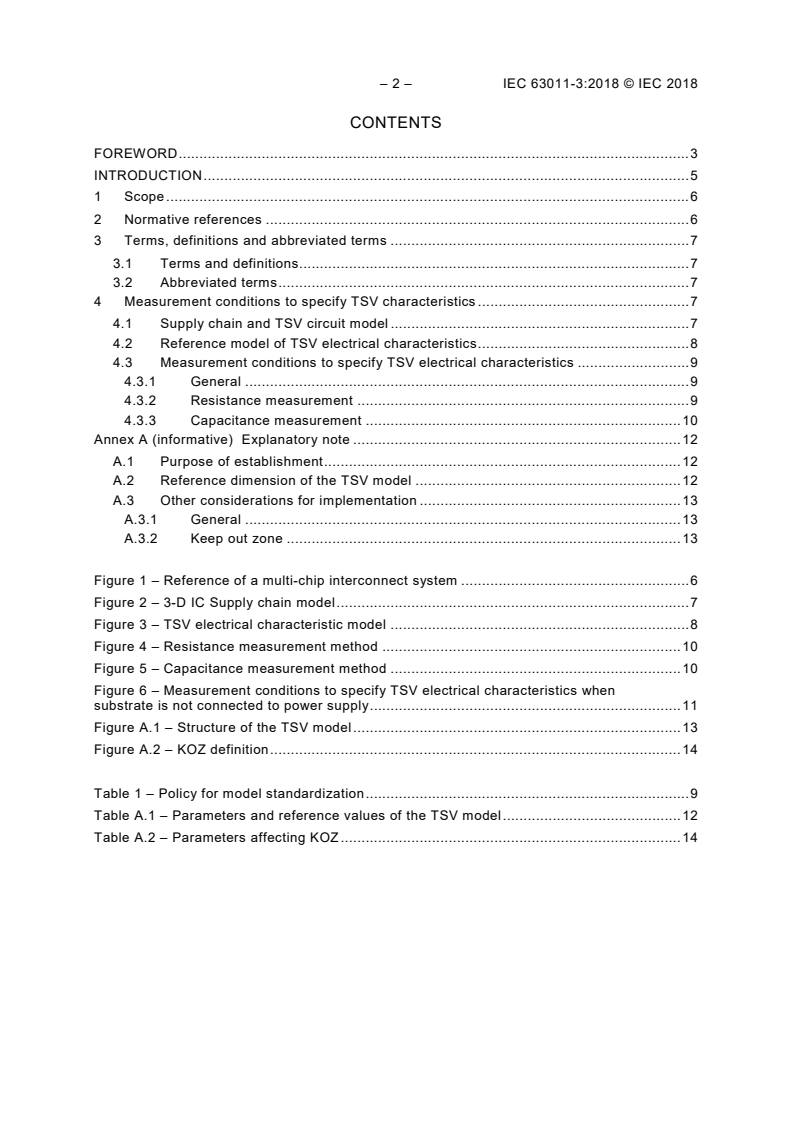
CONTENTS
FOREWORD . 3
INTRODUCTION . 5
1 Scope . 6
2 Normative references . 6
3 Terms, definitions and abbreviated terms . 7
3.1 Terms and definitions . 7
3.2 Abbreviated terms . 7
4 Measurement conditions to specify TSV characteristics . 7
4.1 Supply chain and TSV circuit model . 7
4.2 Reference model of TSV electrical characteristics . 8
4.3 Measurement conditions to specify TSV electrical characteristics . 9
4.3.1 General . 9
4.3.2 Resistance measurement . 9
4.3.3 Capacitance measurement . 10
Annex A (informative) Explanatory note . 12
A.1 Purpose of establishment . 12
A.2 Reference dimension of the TSV model . 12
A.3 Other considerations for implementation . 13
A.3.1 General . 13
A.3.2 Keep out zone . 13
Figure 1 – Reference of a multi-chip interconnect system . 6
Figure 2 – 3-D IC Supply chain model . 7
Figure 3 – TSV electrical characteristic model . 8
Figure 4 – Resistance measurement method . 10
Figure 5 – Capacitance measurement method . 10
Figure 6 – Measurement conditions to specify TSV electrical characteristics when
substrate is not connected to power supply . 11
Figure A.1 – Structure of the TSV model . 13
Figure A.2 – KOZ definition . 14
Table 1 – Policy for model standardization . 9
Table A.1 – Parameters and reference values of the TSV model . 12
Table A.2 – Parameters affecting KOZ . 14
INTERNATIONAL ELECTROTECHNICAL COMMISSION
____________
INTEGRATED CIRCUITS –
THREE DIMENSIONAL INTEGRATED CIRCUITS –
Part 3: Model and measurement conditions
of through-silicon via
FOREWORD
1) The International Electrotechnical Commission (IEC) is a worldwide organization for standardization comprising
all national electrotechnical committees (IEC National Committees). The object of IEC is to promote
international co-operation on all questions concerning standardization in the electrical and electronic fields. To
this end and in addition to other activities, IEC publishes International Standards, Technical Specifications,
Technical Reports, Publicly Available Specifications (PAS) and Guides (hereafter referred to as “IEC
Publication(s)”). Their preparation is entrusted to technical committees; any IEC National Committee interested
in the subject dealt with may participate in this preparatory work. International, governmental and non-
governmental organizations liaising with the IEC also participate in this preparation. IEC collaborates closely
with the International Organization for Standardization (ISO) in accordance with conditions determined by
agreement between the two organizations.
2) The formal decisions or agreements of IEC on technical matters express, as nearly as possible, an international
consensus of opinion on the relevant subjects since each technical committee has representation from all
interested IEC National Committees.
3) IEC Publications have the form of recommendations for international use and are accepted by IEC National
Committees in that sense. While all reasonable efforts are made to ensure that the technical content of IEC
Publications is accurate, IEC cannot be held responsible for the way in which they are used or for any
misinterpretation by any end user.
4) In order to promote international uniformity, IEC National Committees undertake to apply IEC Publications
transparently to the maximum extent possible in their national and regional publications. Any divergence
between any IEC Publication and the corresponding national or regional publication shall be clearly indicated in
the latter.
5) IEC itself does not provide any attestation of conformity. Independent certification bodies provide conformity
assessment services and, in some areas, access to IEC marks of conformity. IEC is not responsible for any
services carried out by independent certification bodies.
6) All users should ensure that they have the latest edition of this publication.
7) No liability shall attach to IEC or its directors, employees, servants or agents including individual experts and
members of its technical committees and IEC National Committees for any personal injury, property damage or
other damage of any nature whatsoever, whether direct or indirect, or for costs (including legal fees) and
expenses arising out of the publication, use of, or reliance upon, this IEC Publication or any other IEC
Publications.
8) Attention is drawn to the Normative references cited in this publication. Use of the referenced publications is
indispensable for the correct application of this publication.
9) Attention is drawn to the possibility that some of the elements of this IEC Publication may be the subject of
patent rights. IEC shall not be held responsible for identifying any or all such patent rights.
International Standard IEC 63011-3 has been prepared by subcommittee 47A: Integrated
circuits, of IEC technical committee 47: Semiconductor devices.
The text of this International Standard is based on the following documents:
FDIS Report on voting
47A/1057/FDIS 47A/1063/RVD
Full information on the voting for the approval of this International Standard can be found in
the report on voting indicated in the above table.
This document has been drafted in accordance with the ISO/IEC Directives, Part 2.
– 4 – IEC 63011-3:2018 © IEC 2018
A list of all parts in the IEC 63011 series, under the general title Integrated circuits – Three
dimensional integrated circuits, can be found on the IEC website.
The committee has decided that the contents of this document will remain unchanged until the
stability date indicated on the IEC website under "http://webstore.iec.ch" in the data related to
the specific document. At this date, the document will be
• reconfirmed,
• withdrawn,
• replaced by a revised edition, or
• amended.
IMPORTANT – The 'colour inside' logo on the cover page of this publication indicates
that it contains colours which are considered to be useful for the correct
understanding of its contents. Users should therefore print this document using a
colour printer.
INTRODUCTION
The embedded system implementation such as digital consumer and mobile devices is a
history of functional integration and power reduction for faster and smaller. At the beginning,
the embedded system was developed by various digital ASIC chips to implement required
functions. They were then integrated on one chip as a system on chip (SoC), which includes
application processor and peripheral I/F logic, such as PCIe, SATA, USB, and DDRx memory
controller. Because required performance and image resolution is growing, SoC has
embedded many functions through adopting advanced semiconductor technology.
Since advanced semiconductor technology is complicated and its development cost is higher,
the application is limited to use only for a few products. Those SoC's cost is not appropriate
for all embedded systems. Multi-chip implementation is a way to solve this issue. It
implements very large logic gate on the separated SoC and ASIC logic chips, connecting each
other. This multi-chip interconnection technique provides also implementation of
heterogeneous technology VLSI chips.
This document is focused to interconnect methodology to implement multi-chip VLSI for three-
dimensional integrated circuit. Thanks to through-silicon via (TSV) and micro bump
interconnect technology; the wire number between VLSI can be tremendously wider. It also
allows to connect chips with on-chip bus interconnection, which has several thousand signal
connections.
– 6 – IEC 63011-3:2018 © IEC 2018
INTEGRATED CIRCUITS –
THREE DIMENSIONAL INTEGRATED CIRCUITS –
Part 3: Model and measurement conditions
of through-silicon via
1 Scope
This part of IEC 63011 specifies a reference model of through-silicon via (TSV) electrical
characteristics required for an interface design in three dimensional integrated circuit (3-D IC)
to transmit and receive digital data and measurement conditions for resistance and
capacitance to specify TSV characteristics in 3-D IC.
3-D IC specifications covered by this document are the following:
• application: digital consumer and mobile;
• operating voltage: 0,1 V to 5,0 V,
• operating frequency: less than 2,0 GHz.
This document does not describe the equipment for the measurement. Figure 1 describes a
typical case of multi-chip interconnect system discussed in this document.
Figure 1 – Reference of a multi-chip interconnect system
Power devices, RF devices and micro-electromechanical systems (MEMS) are not in the
scope of this document.
2 Normative references
The following documents are referred to in the text in such a way that some or all of their
content constitutes requirements of this document. For dated references, only the edition
cited applies. For undated references, the latest edition of the referenced document (including
any amendments) applies.
IEC 63011-1, Integrated circuits – Three dimensional integrated circuits – Part 1: Terminology
3 Terms, definitions and abbreviated terms
3.1 Terms and definitions
For the purposes of this document, the terms and definitions given in IEC 63011-1 apply.
ISO and IEC maintain terminological databases for use in standardization at the following
addresses:
• IEC Electropedia: available at http://www.electropedia.org/
• ISO Online browsing platform: available at http://www.iso.org/obp
3.2 Abbreviated terms
3-D IC three-dimensional integrated circuit
ASIC application specific integrated circuit
NMOS N-channel MOSFET
PMOS P-channel MOSFET
SoC system on chip
TSV through-silicon via
VLSI very large scale integration
4 Measurement conditions to specify TSV characteristics
4.1 Supply chain and TSV circuit model
3-D IC supply chain employing the TSV circuit model is shown in Figure 2. Foundry
manufacturers of logic chip and 3-D stacking provide the TSV model. The circuit model is
determined based on an actual experimental result.
Figure 2 – 3-D IC Supply chain model
– 8 – IEC 63011-3:2018 © IEC 2018
4.2 Reference model of TSV electrical characteristics
Reference model of TSV electrical characteristics shown in Figure 3 is composed of a
capacitance (C ) and a resistance (R ). C is the total capacitance and consists of capacitance
v v v
of oxide layer (C , capacitance by depletion layer (C ) and fringe capacitance (C ). C
ox) dep fr ox
and C are capacitances between the TSV and the semiconductor substrate and dependent
dep
on the voltage applied to the TSV since depletion layer exists. C is a fringe capacitance
fr
between a bump and the semiconductor substrate. The node of C is connected to the
dep
ground through the substrate. When the interval of TSV is very short, coupling model is
recommended. Table 1 shows a policy for model standardization. Circuit definition explains
the view of proposed model. The device structure is the structure which will be the requisite in
the case of using the proposed model. Measurement condition explains device structure and
operating conditions for measurement. The parameters of the TSV model are derived from
TSV and its surrounding structure. An example of a typical concept is shown in Annex A.
Figure 3 – TSV electrical characteristic model
Table 1 – Policy for model standardization
Item Subitem Policy
Circuit Parameter Resistance is defined with average value.
definition
Capacitance is defined by a waveform.
Fringe capacitance is removable
Inductance is not included because of little influence.
Model for every application No definition
Device Surrounding TSV No definition
structure
When the interval of TSV is very short, coupling model is
recommended.
Semiconductor substrate Substrate is connected to the ground.
power supply
The defined TSV circuit model is inapplicable when
substrate isn’t connected to power supply.
Semiconductor substrate P type
Measurement Structure TSV array
condition
There is difference from single TSV and array TSVs.
Frequency Frequency dependence of capacitance is measured.
Voltage Voltage dependence of capacitance is measured.
4.3 Measurement conditions to specify TSV electrical characteristics
4.3.1 General
The electrical characteristics of the TSV shall be measured with the defined conditions.
4.3.2 Resistance measurement
TSV resistance (R ), consisting of bulk resistances of LSI interconnect, TSV, bumps and their
v
contact resistances, is obtained by four point measurement. A constant current ( I) is supplied
via current supply wirings connecting to terminal 1A and terminal 1B, and the generated
voltage (V) between wirings connecting to the terminals is measured by voltmeter as shown in
Figure 4. According to Ohm’s law, a pair resistance for the first chip (R ) is defined as V/ I .
Based on the same setup, a resistance for the first chip and the second chip (R ) is obtained.
TSV resistance (R ) is defined as (R -R )/2. This method is only valid when the second chip is
v 2 1
essentially the same as the first chip. To minimize measurement error, the voltage
measurement wiring should be connected as close as possible.
– 10 – IEC 63011-3:2018 © IEC 2018
TSV resistance (R ) is defined as R = R – R /2, where R is the first chip, and R is the second chip.
v v 2 1 1 2
Figure 4 – Resistance measurement method
4.3.3 Capacitance measurement
TSV capacitance (C ) is obtained by electrical impedance measurement. Overall capacitance
v
(C ) between terminal 1A and terminal 1B is measured by an impedance meter as a function
of signal frequency ( f) and DC voltage (V ) as shown in Figure 5. This capacitance (C ) is
dc 1
composed of TSV capacitance (C ) and the parasitic capacitance (C ) caused by the
v 2
measurement wiring and experimental setup. Therefore, TSV capacitance (C ) is given by
v
C – C . Parasitic capacitance (C ) between terminal 2A and terminal 2B is obtained by
1 2 2
impedance measurement for a measurement structure having neither TSV nor bump. Using
TSV array is recommended to reduce parasitic capacitance.
TSV capacitance (C ) is given by C – C , where C is the capacitance, and C is the parasitic capacitance.
v 1 2 1 2
Figure 5 – Capacitance measurement method
As a TSV high frequency characteristic, S parameters of TSV are measured using a vector
network analyzer (VNA). Every two TSVs short-circuited on the back side form a pair of a
grand line and a signal line using four TSVs, as shown in Figure 6 a). Two ground-signals (GS)
contact microwave probes with the contact pin pitch corresponding to the TSV interval (200μm)
are used in the measurement. After calibration operation for open, short, and load using a
calibration substrate, S parameters measurement of TSV is carried out. Typical measurement
results of S , S are shown in Figure 6 b).
21 11
6a) S parameter measurement method 6b) S parameter evaluation result
Figure 6 – Measurement conditions to specify TSV electrical characteristics
when substrate is not connected to power supply
– 12 – IEC 63011-3:2018 © IEC 2018
Annex A
(informative)
Explanatory note
A.1 Purpose of establishment
The conventional multi-chip interconnect specifications were used for limited applications and
were not suitable for SoC and ASIC interconnection. The wider range of interconnect
technology realized by TSV and micro bump changes the methodology of interconnect. The
wide range of I/O enables to extract on-chip bus to outside connection, and small size of TSV
and micro bump enables low capacitance load interface. These two technology permits to use
on-chip signalling for multi-chip signal interface.
Annex A describes neither TSV and micro bump technology, nor how to implement multi-chip
modules as a level of packaging technology, nor interposer materials. Annex A only shows
them as a reference.
A.2 Reference dimension of the TSV model
The following Table A.1 shows the parameters and reference values of the TSV model. The
structure of the TSV model is illustrated in Figure A.1.
Table A.1 – Parameters and reference values of the TSV model
Parameter Reference value
C LSI interconnect Size 20 µm to 30 µm
Pre-metal dielectric Dielectric ≈ 4
Thickness ≈ 0,3 µm
C TSV Diameter 10 µm to 20 µm
Length 25 µm to 50 µm
TSV interconnect Dielectric 4,5
Thickness 0,5 µm
C Back bump Size 10 µm to 30 µm
Backside ILD Dielectric 4,5
Thickness TBD
R Front bump-LSI Contact resistance
interconnect
LSI interconnect-TSV Contact resistance
TSV Resistivity 2,0 µΩ·cm
Diameter 10 µm to 20 µm
Length 25 µm to 50 µm
TSV-Back bump Contact resistance
Front bump/Back bump Resistivity
Thickness 5 µm to 5 µm
Size 10 µm to 30 µm
LSI interconnect Resistivity
Structure
Key
C Fringe capacitance between LSI interconnect and semiconductor substrate;
C Capacitance between TSV and semiconductor substrate;
C Fringe capacitance between b
...