

IEC 62497-1:2010
(Main)Railway applications - Insulation coordination - Part 1: Basic requirements - Clearances and creepage distances for all electrical and electronic equipment
General Information
- Abstract
IEC 62497-1:2010 deals with insulation coordination in railways. It applies to equipment for use in signalling, rolling stock and fixed installations up to 2 000 m above sea level.
- Status
- Published
- Publication Date
- 27-Mar-2013
- Technical Committee
- TC 9 - Electrical equipment and systems for railways
- Drafting Committee
- PT 62497 - TC 9/PT 62497
- Current Stage
- PPUB - Publication issued
- Start Date
- 18-Feb-2010
- Completion Date
- 15-Feb-2010
Buy Documents
IEC 62497-1:2010 - Railway applications - Insulation coordination - Part 1: Basic requirements - Clearances and creepage distances for all electrical and electronic equipment Released:2/18/2010
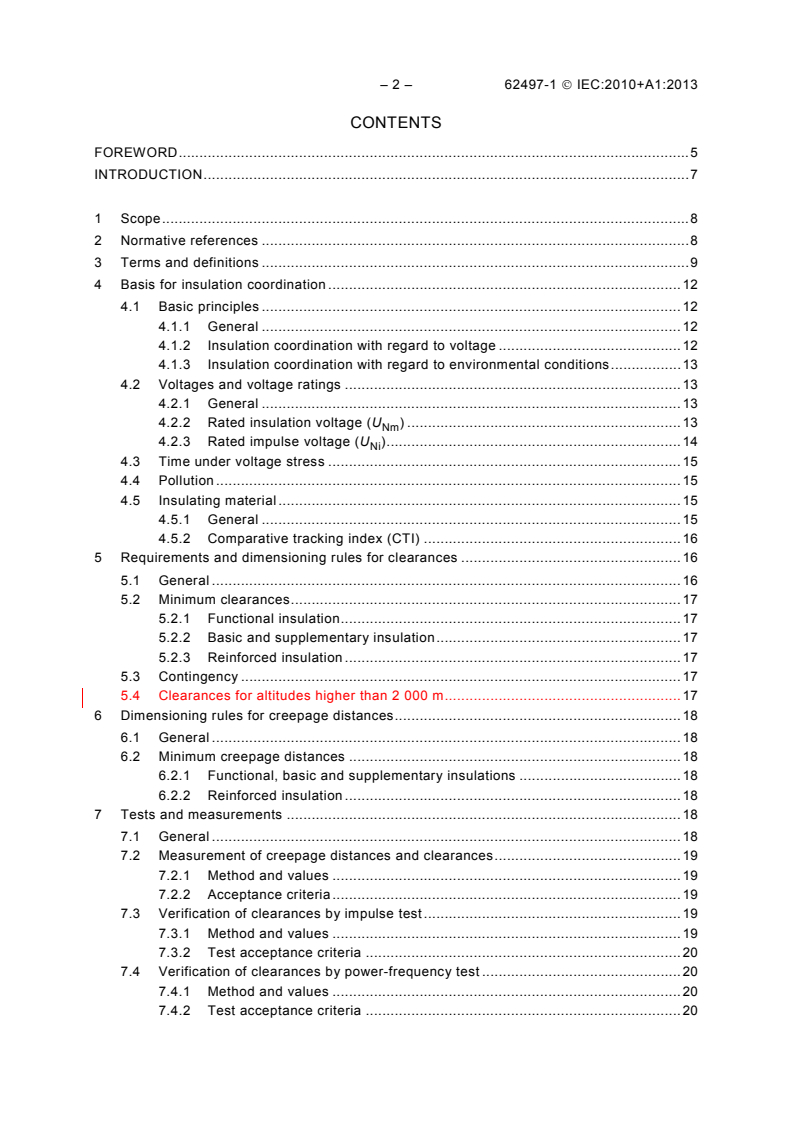
IEC 62497-1:2010+AMD1:2013 CSV - Railway applications - Insulation coordination - Part 1: Basic requirements - Clearances and creepage distances for all electricaland electronic equipment Released:3/28/2013
Overview
The IEC 62497-1:2010 standard, titled Railway Applications - Insulation Coordination - Part 1: Basic Requirements - Clearances and Creepage Distances for All Electrical and Electronic Equipment, provides essential guidelines to ensure the safety and reliability of electrical insulation in railway systems. Developed by the International Electrotechnical Commission (IEC), this standard focuses on defining the minimum clearances and creepage distances for electrical and electronic equipment used in railway signalling, rolling stock, and fixed installations up to 2,000 meters above sea level.
This standard plays a critical role in insulation coordination to prevent electrical breakdown, ensuring that equipment can withstand voltage stresses due to operational and environmental conditions. By following IEC 62497-1:2010, manufacturers and railway engineers can design systems that are compliant with globally recognized safety and performance criteria.
Key Topics
Insulation Coordination Principles
The standard establishes the basis for insulation coordination, covering voltage ratings, environmental influences, and time under voltage stress. It addresses how equipment insulation should be structured to cope with expected voltage stresses in the railway environment.Clearances and Creepage Distances
It provides detailed dimensioning rules for minimum clearances (air gap distances) and creepage distances (surface distances along insulating material), critical to prevent electrical arcing and tracking. The requirements vary depending on insulation type such as functional, basic, supplementary, and reinforced insulation.Pollution and Environmental Considerations
IEC 62497-1 defines pollution degree classifications and considers altitude's effect on insulation requirements. It includes altitude correction factors for equipment used above 2,000 meters and addresses pollution impacts on creepage distances.Testing and Verification
The standard specifies test methods including impulse voltage tests, power-frequency tests, and DC voltage tests to verify compliance with clearance and creepage requirements. It details acceptance criteria and measurement techniques to ensure equipment reliability.Application-Specific Requirements
There are dedicated sections for railway-specific use cases covering signalling systems, rolling stock, and fixed infrastructure. This includes guidance on rated impulse voltages, induced voltages, and installation conditions tailored for railway applications.
Applications
IEC 62497-1:2010 is applicable across various segments of the railway sector, including:
Signalling Equipment
Ensures that insulation distances meet safety requirements despite high-voltage surges and electromagnetic disturbances inherent in signalling systems.Rolling Stock Electrical Systems
Guides design for the electrical and electronic systems onboard trains, including traction units and control equipment, ensuring safe operation under mechanical and environmental stress.Fixed Railway Installations
Covers outdoor and indoor electrical equipment such as transformers, switches, and control gear, with respect to altitude and pollution effects.Component Manufacturing
Electrical insulation designers and component manufacturers refer to this standard when producing parts to be used in railway applications, maintaining conformity with international safety norms.
Related Standards
Professionals working with IEC 62497-1:2010 may also consider related international standards to ensure comprehensive compliance and interoperability:
- IEC 60077 – Railway Applications – Electric Equipment for Rolling Stock
- IEC 60950 – Safety of Information Technology Equipment (for supplementary insulation considerations)
- IEC 61010 – Safety Requirements for Electrical Equipment for Measurement, Control, and Laboratory Use
- ISO/IEC 17025 – General requirements for the competence of testing and calibration laboratories, relevant for test procedures
Summary
The IEC 62497-1:2010 standard sets crucial requirements for clearances and creepage distances in railway electrical and electronic equipment insulation. By adhering to its guidelines, manufacturers and railway system integrators can safeguard against insulation failures caused by voltage surges, environmental pollution, and altitude variations. This contributes significantly to operational safety, reliability, and standardized design across the global railway industry.
Keywords: IEC 62497-1, railway insulation coordination, clearances, creepage distances, electrical safety in railways, railway signalling, rolling stock electrical equipment, insulation coordination standard, railway electrical standards, pollution degree, altitude correction, impulse voltage test.
Relations
- Referred By
EN IEC 60310:2026 - Railway applications - Transformers and inductors on board rolling stock - Effective Date
- 26-May-2026
- Referred By
EN IEC 63522-7:2025 - Electrical relays - Tests and measurements - Part 7: Functional tests - Effective Date
- 10-Feb-2026
- Referred By
EN IEC 62928:2018 - Railway applications - Rolling stock - Onboard lithium-ion traction batteries - Effective Date
- 10-Feb-2026
- Effective Date
- 10-Feb-2026
- Effective Date
- 10-Feb-2026
- Effective Date
- 10-Feb-2026
- Effective Date
- 10-Feb-2026
- Effective Date
- 10-Feb-2026
- Effective Date
- 10-Feb-2026
- Effective Date
- 10-Feb-2026
- Referred By
EN 60310:2016 - Railway applications - Traction transformers and inductors on board rolling Stock - Effective Date
- 10-Feb-2026
- Effective Date
- 10-Feb-2026
- Effective Date
- 10-Feb-2026
- Effective Date
- 10-Feb-2026
- Effective Date
- 10-Feb-2026
Buy Documents
IEC 62497-1:2010 - Railway applications - Insulation coordination - Part 1: Basic requirements - Clearances and creepage distances for all electrical and electronic equipment Released:2/18/2010
IEC 62497-1:2010+AMD1:2013 CSV - Railway applications - Insulation coordination - Part 1: Basic requirements - Clearances and creepage distances for all electricaland electronic equipment Released:3/28/2013
Get Certified
Connect with accredited certification bodies for this standard

IRIS Certification (UNIFE)
International Railway Industry Standard certification.

TÜV SÜD Rail GmbH
TÜV SÜD railway certification services.

Bureau Veritas Railway Certification
Railway and transportation certification.
Sponsored listings
Frequently Asked Questions
IEC 62497-1:2010 is a standard published by the International Electrotechnical Commission (IEC). Its full title is "Railway applications - Insulation coordination - Part 1: Basic requirements - Clearances and creepage distances for all electrical and electronic equipment". This standard covers: IEC 62497-1:2010 deals with insulation coordination in railways. It applies to equipment for use in signalling, rolling stock and fixed installations up to 2 000 m above sea level.
IEC 62497-1:2010 deals with insulation coordination in railways. It applies to equipment for use in signalling, rolling stock and fixed installations up to 2 000 m above sea level.
IEC 62497-1:2010 is classified under the following ICS (International Classification for Standards) categories: 45.060.01 - Railway rolling stock in general. The ICS classification helps identify the subject area and facilitates finding related standards.
IEC 62497-1:2010 has the following relationships with other standards: It is inter standard links to EN IEC 60310:2026, EN IEC 63522-7:2025, EN IEC 62928:2018, EN 61287-1:2014, EN 61881-3:2012, EN 60077-1:2017, EN IEC 61810-4:2020, EN IEC 62847:2023, EN IEC 63341-1:2025, EN 61881-2:2012, EN 60310:2016, EN IEC 62590-1:2025, EN 62718:2016, FprEN IEC 63341-2:2025, EN 62621:2016. Understanding these relationships helps ensure you are using the most current and applicable version of the standard.
IEC 62497-1:2010 is available in PDF format for immediate download after purchase. The document can be added to your cart and obtained through the secure checkout process. Digital delivery ensures instant access to the complete standard document.
Standards Content (Sample)
IEC 62497-1 ®
Edition 1.0 2010-02
INTERNATIONAL
STANDARD
NORME
INTERNATIONALE
Railway applications – Insulation coordination –
Part 1: Basic requirements – Clearances and creepage distances for all electrical
and electronic equipment
Applications ferroviaires – Coordination de l'isolement –
Partie 1: Exigences fondamentales – Distances d'isolement dans l'air et lignes
de fuite pour tout matériel électrique et électronique
All rights reserved. Unless otherwise specified, no part of this publication may be reproduced or utilized in any form or by
any means, electronic or mechanical, including photocopying and microfilm, without permission in writing from either IEC or
IEC's member National Committee in the country of the requester.
If you have any questions about IEC copyright or have an enquiry about obtaining additional rights to this publication,
please contact the address below or your local IEC member National Committee for further information.
Droits de reproduction réservés. Sauf indication contraire, aucune partie de cette publication ne peut être reproduite
ni utilisée sous quelque forme que ce soit et par aucun procédé, électronique ou mécanique, y compris la photocopie
et les microfilms, sans l'accord écrit de la CEI ou du Comité national de la CEI du pays du demandeur.
Si vous avez des questions sur le copyright de la CEI ou si vous désirez obtenir des droits supplémentaires sur cette
publication, utilisez les coordonnées ci-après ou contactez le Comité national de la CEI de votre pays de résidence.
IEC Central Office
3, rue de Varembé
CH-1211 Geneva 20
Switzerland
Email: inmail@iec.ch
Web: www.iec.ch
About the IEC
The International Electrotechnical Commission (IEC) is the leading global organization that prepares and publishes
International Standards for all electrical, electronic and related technologies.
About IEC publications
The technical content of IEC publications is kept under constant review by the IEC. Please make sure that you have the
latest edition, a corrigenda or an amendment might have been published.
ƒ Catalogue of IEC publications: www.iec.ch/searchpub
The IEC on-line Catalogue enables you to search by a variety of criteria (reference number, text, technical committee,…).
It also gives information on projects, withdrawn and replaced publications.
ƒ IEC Just Published: www.iec.ch/online_news/justpub
Stay up to date on all new IEC publications. Just Published details twice a month all new publications released. Available
on-line and also by email.
ƒ Electropedia: www.electropedia.org
The world's leading online dictionary of electronic and electrical terms containing more than 20 000 terms and definitions
in English and French, with equivalent terms in additional languages. Also known as the International Electrotechnical
Vocabulary online.
ƒ Customer Service Centre: www.iec.ch/webstore/custserv
If you wish to give us your feedback on this publication or need further assistance, please visit the Customer Service
Centre FAQ or contact us:
Email: csc@iec.ch
Tel.: +41 22 919 02 11
Fax: +41 22 919 03 00
A propos de la CEI
La Commission Electrotechnique Internationale (CEI) est la première organisation mondiale qui élabore et publie des
normes internationales pour tout ce qui a trait à l'électricité, à l'électronique et aux technologies apparentées.
A propos des publications CEI
Le contenu technique des publications de la CEI est constamment revu. Veuillez vous assurer que vous possédez
l’édition la plus récente, un corrigendum ou amendement peut avoir été publié.
ƒ Catalogue des publications de la CEI: www.iec.ch/searchpub/cur_fut-f.htm
Le Catalogue en-ligne de la CEI vous permet d’effectuer des recherches en utilisant différents critères (numéro de référence,
texte, comité d’études,…). Il donne aussi des informations sur les projets et les publications retirées ou remplacées.
ƒ Just Published CEI: www.iec.ch/online_news/justpub
Restez informé sur les nouvelles publications de la CEI. Just Published détaille deux fois par mois les nouvelles
publications parues. Disponible en-ligne et aussi par email.
ƒ Electropedia: www.electropedia.org
Le premier dictionnaire en ligne au monde de termes électroniques et électriques. Il contient plus de 20 000 termes et
définitions en anglais et en français, ainsi que les termes équivalents dans les langues additionnelles. Egalement appelé
Vocabulaire Electrotechnique International en ligne.
ƒ Service Clients: www.iec.ch/webstore/custserv/custserv_entry-f.htm
Si vous désirez nous donner des commentaires sur cette publication ou si vous avez des questions, visitez le FAQ du
Service clients ou contactez-nous:
Email: csc@iec.ch
Tél.: +41 22 919 02 11
Fax: +41 22 919 03 00
IEC 62497-1 ®
Edition 1.0 2010-02
INTERNATIONAL
STANDARD
NORME
INTERNATIONALE
Railway applications – Insulation coordination –
Part 1: Basic requirements – Clearances and creepage distances for all
electrical and electronic equipment
Applications ferroviaires – Coordination de l'isolement –
Partie 1: Exigences fondamentales – Distances d'isolement dans l'air et lignes
de fuite pour tout matériel électrique et électronique
INTERNATIONAL
ELECTROTECHNICAL
COMMISSION
COMMISSION
ELECTROTECHNIQUE
PRICE CODE
INTERNATIONALE
XA
CODE PRIX
ICS 45.060 ISBN 978-2-88910-741-4
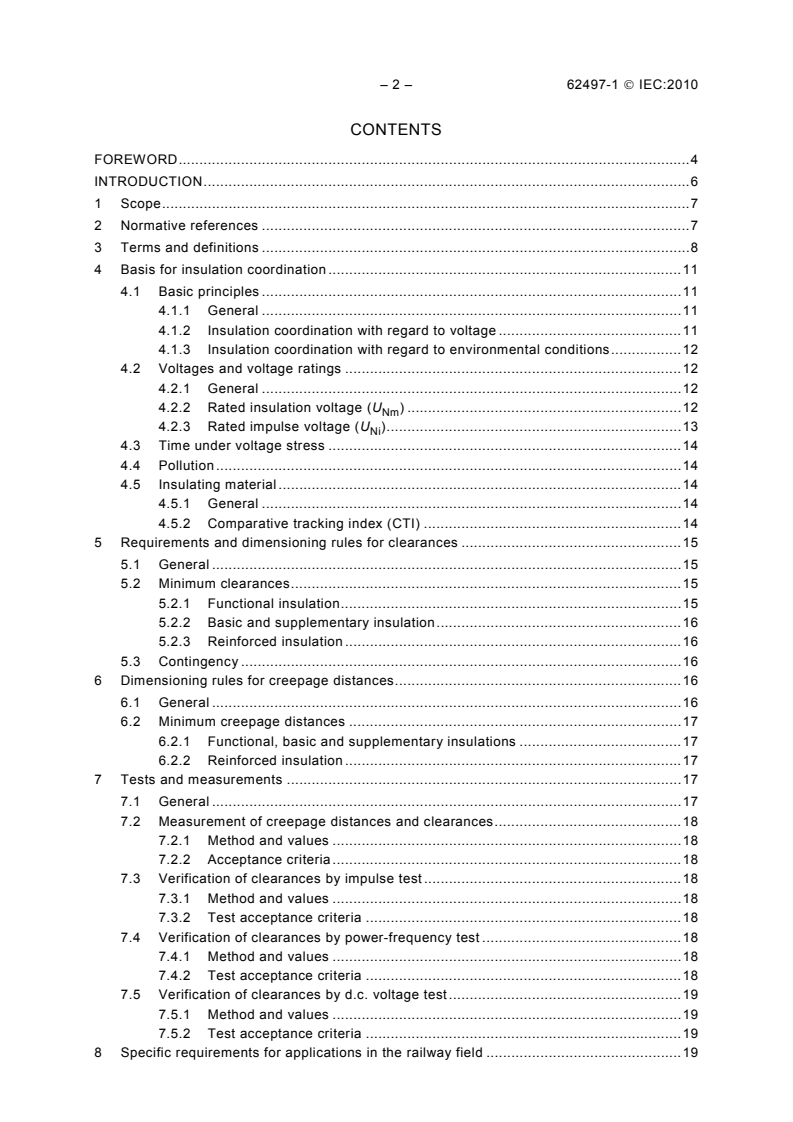
– 2 – 62497-1 © IEC:2010
CONTENTS
FOREWORD.4
INTRODUCTION.6
1 Scope.7
2 Normative references .7
3 Terms and definitions .8
4 Basis for insulation coordination .11
4.1 Basic principles .11
4.1.1 General .11
4.1.2 Insulation coordination with regard to voltage .11
4.1.3 Insulation coordination with regard to environmental conditions.12
4.2 Voltages and voltage ratings .12
4.2.1 General .12
4.2.2 Rated insulation voltage (U ) .12
Nm
4.2.3 Rated impulse voltage (U ).13
Ni
4.3 Time under voltage stress .14
4.4 Pollution.14
4.5 Insulating material.14
4.5.1 General .14
4.5.2 Comparative tracking index (CTI) .14
5 Requirements and dimensioning rules for clearances .15
5.1 General .15
5.2 Minimum clearances.15
5.2.1 Functional insulation.15
5.2.2 Basic and supplementary insulation.16
5.2.3 Reinforced insulation .16
5.3 Contingency .16
6 Dimensioning rules for creepage distances.16
6.1 General .16
6.2 Minimum creepage distances .17
6.2.1 Functional, basic and supplementary insulations .17
6.2.2 Reinforced insulation .17
7 Tests and measurements .17
7.1 General .17
7.2 Measurement of creepage distances and clearances.18
7.2.1 Method and values .18
7.2.2 Acceptance criteria.18
7.3 Verification of clearances by impulse test.18
7.3.1 Method and values .18
7.3.2 Test acceptance criteria .18
7.4 Verification of clearances by power-frequency test .18
7.4.1 Method and values .18
7.4.2 Test acceptance criteria .18
7.5 Verification of clearances by d.c. voltage test.19
7.5.1 Method and values .19
7.5.2 Test acceptance criteria .19
8 Specific requirements for applications in the railway field .19
62497-1 © IEC:2010 – 3 –
8.1 General .19
8.2 Specific requirements for signalling .19
8.2.1 Overvoltage categories.19
8.2.2 Rated impulse voltages .20
8.2.3 Induced voltages .20
8.2.4 Installation instructions .20
8.2.5 Pollution degrees.20
8.3 Specific requirements for rolling stock .20
8.3.1 Determination of U by method 1.20
Ni
8.3.2 Creepage distances.21
8.3.3 Roof installations.21
8.4 Specific requirements for fixed installations.21
8.4.1 Determination of the rated impulse voltage U by method 1.21
Ni
8.4.2 Distances of outdoor insulators.22
Annex A (normative) Tables.23
Annex B (normative) Provisions for type and routine dielectric tests for equipment .31
Annex C (normative) Methods of measuring creepage distances and clearances .33
Annex D (normative) Correlation between U and U .39
n Nm
Annex E (informative) Macro-environmental conditions .40
Annex F (informative) Application guide.41
Bibliography.51
Figure F.1 – Determination of minimum clearances and creepage distances.43
Figure F.2 – Example for types of insulation .46
Figure F.3 – Monitoring circuit showing examples of sections .48
Figure F.4 – Drawing of monitoring device .48
Table A.1 – Rated impulse voltage U for low voltage circuits not powered directly by
Ni
the contact line .23
Table A.2 – Rated impulse voltages (U ) for circuits powered by the contact line and
Ni
for traction power circuits in thermo-electric driven vehicles.24
Table A.3 – Minimum clearances in air (in mm) based on the rated impulse voltage U .25
Ni
Table A.4 – Definition of pollution degrees.26
Table A.5 – Minimum creepage distances (in mm) based on rated insulation voltage
U up to 1 000 V for printed wiring material and associated components.27
Nm
Table A.6 – Minimum creepage distances (in mm) for low values of rated insulation
voltage U for materials other than printed wiring material .28
Nm
Table A.7 – Minimum creepage distances (in mm/kV) for high values of rated insulation
voltage U .29
Nm
Table A.8 – Test voltages for verifying clearances in air for an altitude of 2 000 m
above sea level, not to be used for routine dielectric tests .30
Table B.1 – Dielectric test for equipments – Short-duration power-frequency (a.c.) test
levels U (kV r.m.s.) based on the rated impulse voltage U (kV).32
a Ni
Table C.1 – Minimum dimensions of grooves .33
Table D.1 – Correlation between nominal voltages of the railway power distribution
system and the required insulation voltages for circuits of equipment which are
intended to be connected to these systems.39
Table F.1 – Example for the determination of clearances and creepage distances .49
– 4 – 62497-1 © IEC:2010
INTERNATIONAL ELECTROTECHNICAL COMMISSION
______________
RAILWAY APPLICATIONS –
INSULATION COORDINATION –
Part 1: Basic requirements –
Clearances and creepage distances
for all electrical and electronic equipment
FOREWORD
1) The International Electrotechnical Commission (IEC) is a worldwide organization for standardization comprising
all national electrotechnical committees (IEC National Committees). The object of IEC is to promote
international co-operation on all questions concerning standardization in the electrical and electronic fields. To
this end and in addition to other activities, IEC publishes International Standards, Technical Specifications,
Technical Reports, Publicly Available Specifications (PAS) and Guides (hereafter referred to as “IEC
Publication(s)”). Their preparation is entrusted to technical committees; any IEC National Committee interested
in the subject dealt with may participate in this preparatory work. International, governmental and non-
governmental organizations liaising with the IEC also participate in this preparation. IEC collaborates closely
with the International Organization for Standardization (ISO) in accordance with conditions determined by
agreement between the two organizations.
2) The formal decisions or agreements of IEC on technical matters express, as nearly as possible, an international
consensus of opinion on the relevant subjects since each technical committee has representation from all
interested IEC National Committees.
3) IEC Publications have the form of recommendations for international use and are accepted by IEC National
Committees in that sense. While all reasonable efforts are made to ensure that the technical content of IEC
Publications is accurate, IEC cannot be held responsible for the way in which they are used or for any
misinterpretation by any end user.
4) In order to promote international uniformity, IEC National Committees undertake to apply IEC Publications
transparently to the maximum extent possible in their national and regional publications. Any divergence
between any IEC Publication and the corresponding national or regional publication shall be clearly indicated in
the latter.
5) IEC itself does not provide any attestation of conformity. Independent certification bodies provide conformity
assessment services and, in some areas, access to IEC marks of conformity. IEC is not responsible for any
services carried out by independent certification bodies.
6) All users should ensure that they have the latest edition of this publication.
7) No liability shall attach to IEC or its directors, employees, servants or agents including individual experts and
members of its technical committees and IEC National Committees for any personal injury, property damage or
other damage of any nature whatsoever, whether direct or indirect, or for costs (including legal fees) and
expenses arising out of the publication, use of, or reliance upon, this IEC Publication or any other IEC
Publications.
8) Attention is drawn to the Normative references cited in this publication. Use of the referenced publications is
indispensable for the correct application of this publication.
9) Attention is drawn to the possibility that some of the elements of this IEC Publication may be the subject of
patent rights. IEC shall not be held responsible for identifying any or all such patent rights.
International Standard IEC 62497-1 has been prepared by IEC technical committee 9:
Electrical equipment and systems for railways.
This standard is based on EN 50124-1.
The text of this standard is based on the following documents:
FDIS Report on voting
9/1335/FDIS 9/1358/RVD
Full information on the voting for the approval of this standard can be found in the report on
voting indicated in the above table.
62497-1 © IEC:2010 – 5 –
This publication has been drafted in accordance with the ISO/IEC Directives, Part 2.
A list of all parts of IEC 62497, under the general title Railway applications – Insulation
coordination, can be found of the IEC website.
The committee has decided that the contents of this publication will remain unchanged until
the stability date indicated on the IEC web site under "http://webstore.iec.ch" in the data
related to the specific publication. At this date, the publication will be
• reconfirmed,
• withdrawn,
• replaced by a revised edition, or
• amended.
– 6 – 62497-1 © IEC:2010
INTRODUCTION
Special conditions occurring in railway applications and the fact that the equipment here
concerned falls into the scope of both IEC 60071 (prepared by IEC technical committee 28)
and IEC 60664-1 (prepared by IEC technical committee 109), led to the decision to draw from
these documents and from IEC 60077-1 (prepared by IEC technical committee 9), a single
document of reference for all standards applicable to the whole railway field.
IEC 62497 consists of two parts:
– IEC 62497-1: Part 1: Basic requirements – Clearances and creepage distances for all
electrical and electronic equipment;
– IEC 62497-2: Part 2: Overvoltages and related protection.
This Part 1 allows, in conjunction with IEC 62497-2, to take into account advantages resulting
from the presence of overvoltage protection when dimensioning clearances.
62497-1 © IEC:2010 – 7 –
RAILWAY APPLICATIONS –
INSULATION COORDINATION –
Part 1: Basic requirements –
Clearances and creepage distances
for all electrical and electronic equipment
1 Scope
This part of IEC 62497 deals with insulation coordination in railways. It applies to equipment
for use in signalling, rolling stock and fixed installations up to 2 000 m above sea level.
Insulation coordination is concerned with the selection, dimensioning and correlation of
insulation both within and between items of equipment. In dimensioning insulation, electrical
stresses and environmental conditions are taken into account. For the same conditions and
stresses these dimensions are the same.
An objective of insulation coordination is to avoid unnecessary overdimensioning of insulation.
This standard specifies:
– requirements for clearances and creepage distances for equipment;
– general requirements for tests pertaining to insulation coordination.
The term equipment relates to a section as defined in 3.3; it may apply to a system, a sub-
system, an apparatus, a part of an apparatus, or a physical realisation of an equipotential line.
This standard does not deal with :
– distances through solid or liquid insulation;
– distances through gases other than air;
– distances through air not at atmospheric pressure;
– equipment used under extreme conditions.
Product standards have to align with this generic standard.
However, they may require, with justification, different requirements due to safety and/or
reliability reasons, e.g. for signalling, and/or particular operating conditions of the equipment
itself, e. g. overhead lines which have to comply to established standards or regulations such
as EN 50119.
This standard also gives provisions for dielectric tests (type tests or routine tests) on
equipment (see Annex B).
NOTE For safety critical systems, specific requirements are needed. These requirements are given in the product
specific signalling standard IEC 62425.
2 Normative references
The following referenced documents are indispensable for the application of this document.
For dated references, only the edition cited applies. For undated references, the latest edition
of the referenced document (including any amendments) applies.
– 8 – 62497-1 © IEC:2010
IEC 60060-1, High-voltage test techniques – Part 1: General definitions and test requirements
IEC 60071-1, Insulation co-ordination – Part 1: Definitions, principles and rules
IEC 60112, Method for the determination of the proof and the comparative tracking indices of
solid insulating materials
IEC 60507, Artificial pollution tests on high-voltage insulators to be used on a.c. systems
IEC 60587, Electrical insulating materials used under severe ambient conditions – Test
methods for evaluating resistance to tracking and erosion
IEC 60850, Railway applications – Supply voltages of traction systems
IEC 61245, Artificial pollution tests on high-voltage insulators to be used on d.c. systems
IEC 61992-1:2006, Railway applications – Fixed installations – DC switchgear – Part 1:
General
IEC 62236 (all parts), Railway applications – Electromagnetic compatibility
EN 50119, Railway applications – Fixed installations – Electric traction overhead contact lines
3 Terms and definitions
For the purposes of this document, the following terms and definitions apply.
NOTE For the purpose of this standard the following definitions apply according to the following priority order:
– the definition given here-under;
– the definition given in IEC 60664-1;
– the definition given in the documents mentioned in Clause 2 other than IEC 60664-1.
3.1
clearance
the shortest distance in air between two conductive parts
3.2
creepage distance
the shortest distance along the surface of the insulating material between two conductive
parts
3.3
sections
3.3.1
section
part of an electrical circuit having its own voltage ratings for insulation coordination
Sections fall into two categories:
3.3.2
earthed section
a section connected to earth or to the car body through a circuit for which interruption is not
expected
62497-1 © IEC:2010 – 9 –
3.3.3
floating section
a section isolated from earth or from the car body
NOTE 1 A section may be under electrical influence of adjacent sections.
NOTE 2 A particular point of a circuit may be considered as a section.
3.4
voltages
3.4.1
nominal voltage (U )
n
a suitable approximate voltage value used to designate or identify a given supply system
3.4.2
working voltage
the highest r.m.s value of the a.c or d.c voltage which can occur between two points across
any insulation, each circuit likely to influence the said r.m.s. value being supplied at its
maximum permanent voltage
NOTE Permanent means that the voltage lasts more than 5 min, as U in IEC 60850.
max1
3.4.3
rated voltage
the value of voltage assigned by the manufacturer to a component, device or equipment and
to which operation and performance characteristics are referred
NOTE Equipment may have more than one rated voltage value or may have a rated voltage range.
3.4.4
rated insulation voltage (U )
Nm
an r.m.s. withstand voltage value assigned by the manufacturer to the equipment or a part of
it, characterising the specified permanent (over 5 min) withstand capability of its insulation
NOTE 1 U is a voltage between a live part of equipment and earth or another live part. For rolling stock, earth
Nm
refers to the car body.
NOTE 2 For circuits, systems and sub-systems in railway applications this definition is preferred to "highest
voltage for equipment" which is widely used in international standards.
NOTE 3 U is higher than or equal to the working voltage. As a consequence, for circuits directly connected to
Nm
the contact line, U is equal to or higher than U as specified in IEC 60850.
Nm max1
NOTE 4 U is not necessarily equal to the rated voltage which is primarily related to functional performance.
Nm
3.4.5
working peak voltage
the highest value of voltage which can occur in service across any particular insulation
3.4.6
recurring peak voltage
the maximum peak value of periodic excursions of the voltage waveform resulting from
distortions of an a.c. voltage or from a.c. components superimposed on a d.c. voltage
NOTE Random overvoltages, for example due to occasional switching, are not considered to be recurring peak
voltages.
3.4.7
rated impulse voltage (U )
Ni
an impulse voltage value assigned by the manufacturer to the equipment or a part of it,
characterising the specified withstand capability of its insulation against transient
overvoltages
NOTE U is higher than or equal to the working peak voltage.
Ni
– 10 – 62497-1 © IEC:2010
3.5
overvoltages
any voltage having a peak value exceeding the corresponding peak value of maximum
steady-state voltage at normal operating conditions
3.5.1
temporary overvoltage
an overvoltage of relatively long duration due to voltage variations
NOTE A temporary overvoltage is independent of the network load. It is characterised by a voltage/time curve.
3.5.2
transient overvoltage
a short duration overvoltage of a few milliseconds or less due to current transfers
NOTE A transient overvoltage depends on the network load. It cannot be characterised by a voltage/time curve.
Basically, a transient overvoltage is the result of a current transfer from a source to the load (network).
Two particular transient overvoltages are defined:
3.5.3
switching overvoltage
the transient overvoltage at any point of the system due to specific switching operation or fault
3.5.4
lightning overvoltage
the transient overvoltage at any point of the system due to a specific lightning discharge.
NOTE The definitions of 3.5 are similar to those of IEC 60664-1 and IEC 60850.
However, the prevalence of the nature of the cause (voltage variations or current transfer) upon time, for
segregating transient overvoltages from temporary ones, is clearly stated here (whereas the nature of the cause is
not considered in IEC 60664-1).
Long-term (typically 20 ms to typically 1 s) overvoltages defined in IEC 60850, dedicated to contact line networks,
are equivalent to temporary overvoltages.
3.6
insulations
3.6.1
functional insulation
the insulation between conductive parts which is necessary only for the proper functioning
3.6.2
basic insulation
the insulation applied to live parts to provide basic protection against electric shock
3.6.3
supplementary insulation
an independent insulation applied in addition to basic insulation, in order to provide protection
against electric shock in the event of failure of basic insulation
3.6.4
double insulation
an insulation comprising both basic insulation and supplementary insulation
3.6.5
reinforced insulation
a single insulation system applied to live parts, which provides a degree of protection against
electric shock equivalent to double insulation
62497-1 © IEC:2010 – 11 –
NOTE The term "a single insulation system" does not imply that the insulation involves one homogeneous piece.
It may involve several layers which cannot be tested singly as basic and supplementary insulation.
4 Basis for insulation coordination
4.1 Basic principles
4.1.1 General
Insulation coordination implies the selection of the electric insulation characteristic of the
equipment with regard to its application and in relation to its surroundings.
Insulation coordination can only be achieved if the design of the equipment is based on the
stresses to which it is likely to be subjected during its anticipated lifetime.
4.1.2 Insulation coordination with regard to voltage
4.1.2.1 General
Consideration shall be given to:
– the voltages which can appear in the system;
– the voltages generated by the equipment (which could adversely affect other equipment in
the system);
– the degree of the expected availability of the equipment;
– the safety of persons and property, so that the probability of undesired incidents due to
voltage stresses do not lead to an unacceptable risk of harm;
– the safety of functions for control and protection systems;
– voltages induced in track-side cables;
– the shape of insulating surfaces;
– the orientation and the location of creepage distances;
– if necessary: the altitude that applies.
4.1.2.2 Insulation coordination with regard to permanent a.c. or d.c. voltages
Insulation coordination with regard to permanent voltages is based on:
– rated voltage;
– rated insulation voltage;
– working voltage.
Unless otherwise specified in product standards, permanent voltages last more than five
minutes.
4.1.2.3 Insulation coordination with regard to transient overvoltage
Insulation coordination with regard to transient overvoltage is based on controlled overvoltage
conditions. There are two kinds of control:
– inherent control: the condition within an electrical system wherein the characteristics of
the system can be expected to limit the prospective transient overvoltages to a defined
level;
– protective control: the condition within an electrical system wherein specific overvoltage
attenuating means can be expected to limit the prospective transient overvoltages to a
defined level.
NOTE 1 Overvoltages in large and complex systems such as overhead lines subjected to multiple and variable
influences can only be assessed on a statistical basis. This is particularly true for overvoltages of atmospheric
– 12 – 62497-1 © IEC:2010
origin and applies whether the controlled condition is achieved as a consequence of inherent control or by means
of protective control.
NOTE 2 A probabilistic analysis is recommended to assess whether inherent control exists or whether protective
control is needed.
NOTE 3 The specific overvoltage attenuating means may be a device having means for storage or dissipation of
energy and, under defined conditions, capable of harmlessly dissipating the energy of overvoltages expected at the
location.
EXAMPLE of inherent control: Control ensured by flash-over across insulators or spark gap
horns on overhead lines.
EXAMPLE of protective control: Control ensured by the filter of a locomotive on the
downstream circuit, provided that no switching overvoltage source is likely to perturb the said
circuit.
Insulation coordination uses a preferred series of values of rated impulse voltage: it consists
of the values listed in the first column of the Table A.3.
4.1.2.4 Insulation coordination with regard to recurring peak voltage
Consideration shall be given to the extent partial discharges can occur in solid insulation or
along surfaces of insulation.
4.1.3 Insulation coordination with regard to environmental conditions
The micro-environmental conditions for the insulation shall be taken into account as classified
by the pollution degree.
The micro-environmental conditions depend primarily on the macro-environmental conditions
in which the equipment is located and in many cases the environments are identical.
However, the micro-environment can be better or worse than the macro-environment where,
for example, enclosures, heating, ventilation or dust influence the micro-environment.
NOTE Protection by enclosures provided according to classes specified in IEC 60529 does not necessarily
improve the micro-environment with regard to pollution.
4.2 Voltages and voltage ratings
4.2.1 General
For determining the working voltage of a floating section, it is considered that a connection is
made to earth or to another section, so as to produce the worst case.
It is recommended to avoid floating sections in high voltage systems.
The voltages in this subclause 4.2 are "required voltages" that would be specified for a
particular application. These are different from rated voltages that are stated by a
manufacturer for a product.
Rated voltages are defined for each section of a circuit.
4.2.2 Rated insulation voltage (U )
Nm
The rated insulation voltage required as a minimum for a section is equal to the highest
working voltage appearing within the section, or produced by adjacent sections.
Stresses shorter than 5 min (e.g U as defined in IEC 60850) may be taken into account
max2
case by case, considering in particular the interval between such stresses.
62497-1 © IEC:2010 – 13 –
4.2.3 Rated impulse voltage (U )
Ni
4.2.3.1 General
The rated impulse voltage required as a minimum for a section is determined either by
method 1 or by method 2.
In inherent control, method 1 should be used.
In protective control, method 1 and method 2 may be used.
4.2.3.2 Method 1
Method 1 is based on rated insulation voltages and overvoltage categories.
The relation between rated insulation voltages and nominal voltages commonly used in
railway applications is given in Table D.1 of Annex D.
Method 1 uses four overvoltage categories to characterise the exposure of the equipment to
overvoltages.
− OV1: Circuits which are protected against external and internal overvoltages and in which
only very low overvoltages can occur because:
− they are not directly connected to the contact line;
− they are being operated indoor;
− they are within an equipment or device;
− OV2: The same as OV1, but with harsher overvoltage conditions and/or higher
requirements concerning safety and reliability;
− OV3: The same as OV4, but with less harsh overvoltage conditions and/or lower
requirements concerning safety and reliability;
− OV4: Circuits which are not protected against external or internal overvoltages (e.g.
directly connected to the contact or outside lines) and which may be endangered by
lightning or switching overvoltages.
Further details for specific applications are given in Clause 8.
In method 1, the rated impulse voltage required as a minimum for a section is determined as
follows:
– For low voltage circuits not powered directly by the contact line, the rated impulse voltage
is given by Table A.1;
– For circuits powered by the contact line and for traction power circuits in thermo-electric
driven vehicles the rated impulse voltage is given by Table A.2.
When a specific protection against overvoltages is involved, the choice of the overvoltage
category is linked to this protective device.
4.2.3.3 Method 2
In method 2, the rated impulse voltage required as a minimum for a section is equal to the
working peak voltage appearing within the section, or produced by adjacent sections.
4.2.3.4 Contingency
No contingency is to be applied to the rated impulse voltage, whatever the method.
– 14 – 62497-1 © IEC:2010
4.3 Time under voltage stress
With regard to creepage distances, the time under voltage stress influences the number of
drying-out incidents capable of causing surface electrical discharge with energy high enough
to entail tracking. The number of drying-out incidents is considered to be sufficiently large to
cause tracking:
– in equipment intended for continuous use and not generating in its interior sufficient heat
for drying-out;
– in equipment on the input side of a switch and between the line and load (input and
output) terminals of a switch supplied directly from the low-voltage mains;
– in equipment subject to condensation for long periods and frequently switched on and off.
The creepage distances shown in Tables A.5, A.6 and A.7 have been determined for
insulation intended to be under continuous voltage stress for a long time.
4.4 Pollution
The micro-environment determines the effect of pollution on the insulation. The macro-
environment, however, has to be taken into account when considering the micro-environment.
Means may be provided to reduce pollution at the insulation under consideration by effective
use of enclosures, encapsulation or hermetic sealing. Such means to reduce pollution may
not be effective when the equipment is subject to condensation or if, in normal operation, it
generates pollutants itself.
Small clearances can be bridged completely by solid particles, dust and water and therefore
minimum clearances are specified where pollution may be present in the micro-environment.
NOTE 1 Pollution will become conductive in the presence of humidity. Pollution caused by contaminated water,
soot, metal or carbon dust is inherently conductive.
NOTE 2 Conductive pollution by ionized gasses and metallic deposits occurs only on specific instances, for
example in arc chambers of switchgear or controlgear, and is not covered by this standard.
For the purpose of evaluating creepage distances and clearances, seven degrees of pollution
PD1, PD2.PD4B are established according to Table A.4.
NOTE 3 The seven pollution degrees were derived from IEC 60664-1, IEC 60815 and IEC 60077-1, but some
definitions are not identical. The main reason is that PD4 of IEC 60664-1 and IEC 60077-1 had to be broken down
into PD3A, PD4, PD4A and PD4B of this standard to cover railway applications and experience. Nevertheless, the
definitions given in this standard are consistent with those of IEC 60077-1 when the pollution degree is strictly
identical.
The classification considers micro-environmental conditions only. However, macro-
environmental conditions should not be ignored. Annex E gives some guidance when trying to
define the relevant PD to be applied to a practical case.
4.5 Insulating material
4.5.1 General
External high voltage insulators shall comply with their relevant product standards. Additional
compliance to this standard is not required.
4.5.2 Comparative tracking index (CTI)
4.5.2.1 Insulating materials can be roughly characterised according to the damage they
suffer from concentrated release of energy during electrical discharge when a surface leakage
current is interrupted due to drying of the contaminated surface. The following behaviour of
insulating materials in the presence of electrical discharge can occur:
62497-1 © IEC:2010 – 15 –
– decomposition of the insulating material;
– the wearing away of the insulating material by action of electrical discharges (electrical
erosion);
– the progressive formation of conductive paths which are produced on the surface of solid
insulating material due to the combined effects of electric stress and electrolytic
contamination on the surface (tracking).
NOTE Tracking or erosion will occur when:
– a liquid film carrying the surface leakage current breaks, and
– the applied voltage is sufficient to break down the small gap formed when the film breaks, and
– the current is above a limiting value which is necessary to provide sufficient energy locally to thermally
decompose the insulating material beneath the film.
Deterioration increases with the time for which the current flows.
4.5.2.2 A method of classification for insulating materials according to 4.5.2.1 does not
exist. The behaviour of the insulating material under various contaminants and voltages is
extremely complex. Under these conditions many of the materials may exhibit two, or even
three of the characteristics stated. A direct correlation with the material groups of 4.5.2.3 is
not practical. However, it has been found by experience and tests that insulating materials
having a higher relative performance also have approximately the same relative ranking
according to the comparative tracking index (CTI). Therefore, this standard uses the CTI
values to categorise insulation materials.
4.5.2.3 Materials are separated into four groups according to either their CTI values as
defined in IEC 60112 or their class as determined by IEC 60587 tests.
Material Group I 600 ≤ CTI or class 1A4.5
Material Group II 400 ≤ CTI < 600 or class 1A3.5
Material Group IIIa 175 ≤ CTI < 400 or class 1A2.5
Material Group IIIb 100 ≤ CTI < 175 or class 1A0
The CTI values above refer to values obtained, in accordance with IEC 60112, on samples
specifically made for the purpose and tested with solution A.
NOTE 1 The proof-tracking index (PTI) is also used to identify the tracking characteristics of materials. A material
may be included in one of the four groups given above on the basis that its PTI, established by the method of
IEC 60112 using solution A, is equal to or greater than the lower value specified for the group.
NOTE 2 Equivalence between CTI and classes has not been demonstrated.
5 Requirements and dimensioning rules for clearances
5.1 General
Clearances shall be dimensioned to withstand the
...
IEC 62497-1 ®
Edition 1.1 2013-03
CONSOLIDATED VERSION
INTERNATIONAL
STANDARD
NORME
INTERNATIONALE
colour
inside
Railway applications – Insulation coordination –
Part 1: Basic requirements – Clearances and creepage distances for all electrical
and electronic equipment
Applications ferroviaires – Coordination de l'isolement –
Partie 1: Exigences fondamentales – Distances d'isolement dans l'air et lignes
de fuite pour tout matériel électrique et électronique
All rights reserved. Unless otherwise specified, no part of this publication may be reproduced or utilized in any form
or by any means, electronic or mechanical, including photocopying and microfilm, without permission in writing from
either IEC or IEC's member National Committee in the country of the requester.
If you have any questions about IEC copyright or have an enquiry about obtaining additional rights to this publication,
please contact the address below or your local IEC member National Committee for further information.
Droits de reproduction réservés. Sauf indication contraire, aucune partie de cette publication ne peut être reproduite ni
utilisée sous quelque forme que ce soit et par aucun procédé, électronique ou mécanique, y compris la photocopie et les
microfilms, sans l'accord écrit de la CEI ou du Comité national de la CEI du pays du demandeur.
Si vous avez des questions sur le copyright de la CEI ou si vous désirez obtenir des droits supplémentaires sur cette
publication, utilisez les coordonnées ci-après ou contactez le Comité national de la CEI de votre pays de résidence.
IEC Central Office Tel.: +41 22 919 02 11
3, rue de Varembé Fax: +41 22 919 03 00
CH-1211 Geneva 20 info@iec.ch
Switzerland www.iec.ch
About the IEC
The International Electrotechnical Commission (IEC) is the leading global organization that prepares and publishes
International Standards for all electrical, electronic and related technologies.
About IEC publications
The technical content of IEC publications is kept under constant review by the IEC. Please make sure that you have the
latest edition, a corrigenda or an amendment might have been published.
Useful links:
IEC publications search - www.iec.ch/searchpub Electropedia - www.electropedia.org
The advanced search enables you to find IEC publications The world's leading online dictionary of electronic and
by a variety of criteria (reference number, text, technical electrical terms containing more than 30 000 terms and
committee,…). definitions in English and French, with equivalent terms in
It also gives information on projects, replaced and additional languages. Also known as the International
withdrawn publications. Electrotechnical Vocabulary (IEV) on-line.
IEC Just Published - webstore.iec.ch/justpublished Customer Service Centre - webstore.iec.ch/csc
Stay up to date on all new IEC publications. Just Published If you wish to give us your feedback on this publication
details all new publications released. Available on-line and or need further assistance, please contact the
also once a month by email. Customer Service Centre: csc@iec.ch.
A propos de la CEI
La Commission Electrotechnique Internationale (CEI) est la première organisation mondiale qui élabore et publie des
Normes internationales pour tout ce qui a trait à l'électricité, à l'électronique et aux technologies apparentées.
A propos des publications CEI
Le contenu technique des publications de la CEI est constamment revu. Veuillez vous assurer que vous possédez
l’édition la plus récente, un corrigendum ou amendement peut avoir été publié.
Liens utiles:
Recherche de publications CEI - www.iec.ch/searchpub Electropedia - www.electropedia.org
La recherche avancée vous permet de trouver des Le premier dictionnaire en ligne au monde de termes
publications CEI en utilisant différents critères (numéro de électroniques et électriques. Il contient plus de 30 000
référence, texte, comité d’études,…). termes et définitions en anglais et en français, ainsi que
Elle donne aussi des informations sur les projets et les les termes équivalents dans les langues additionnelles.
publications remplacées ou retirées. Egalement appelé Vocabulaire Electrotechnique
International (VEI) en ligne.
Just Published CEI - webstore.iec.ch/justpublished
Service Clients - webstore.iec.ch/csc
Restez informé sur les nouvelles publications de la CEI.
Just Published détaille les nouvelles publications parues. Si vous désirez nous donner des commentaires sur
Disponible en ligne et aussi une fois par mois par email. cette publication ou si vous avez des questions
contactez-nous: csc@iec.ch.
IEC 62497-1 ®
Edition 1.1 2013-03
CONSOLIDATED VERSION
INTERNATIONAL
STANDARD
NORME
INTERNATIONALE
colour
inside
Railway applications – Insulation coordination –
Part 1: Basic requirements – Clearances and creepage distances for all
electrical and electronic equipment
Applications ferroviaires – Coordination de l'isolement –
Partie 1: Exigences fondamentales – Distances d'isolement dans l'air et lignes
de fuite pour tout matériel électrique et électronique
INTERNATIONAL
ELECTROTECHNICAL
COMMISSION
COMMISSION
ELECTROTECHNIQUE
INTERNATIONALE
ICS 45.060 ISBN 978-2-8322-0736-9
– 2 – 62497-1 IEC:2010+A1:2013
CONTENTS
FOREWORD . 5
INTRODUCTION . 7
1 Scope . 8
2 Normative references . 8
3 Terms and definitions . 9
4 Basis for insulation coordination . 12
4.1 Basic principles . 12
4.1.1 General . 12
4.1.2 Insulation coordination with regard to voltage . 12
4.1.3 Insulation coordination with regard to environmental conditions . 13
4.2 Voltages and voltage ratings . 13
4.2.1 General . 13
4.2.2 Rated insulation voltage (U ) . 13
Nm
4.2.3 Rated impulse voltage (U ) . 14
Ni
4.3 Time under voltage stress . 15
4.4 Pollution . 15
4.5 Insulating material . 15
4.5.1 General . 15
4.5.2 Comparative tracking index (CTI) . 16
5 Requirements and dimensioning rules for clearances . 16
5.1 General . 16
5.2 Minimum clearances . 17
5.2.1 Functional insulation . 17
5.2.2 Basic and supplementary insulation . 17
5.2.3 Reinforced insulation . 17
5.3 Contingency . 17
5.4 Clearances for altitudes higher than 2 000 m . 17
6 Dimensioning rules for creepage distances . 18
6.1 General . 18
6.2 Minimum creepage distances . 18
6.2.1 Functional, basic and supplementary insulations . 18
6.2.2 Reinforced insulation . 18
7 Tests and measurements . 18
7.1 General . 18
7.2 Measurement of creepage distances and clearances . 19
7.2.1 Method and values . 19
7.2.2 Acceptance criteria . 19
7.3 Verification of clearances by impulse test . 19
7.3.1 Method and values . 19
7.3.2 Test acceptance criteria . 20
7.4 Verification of clearances by power-frequency test . 20
7.4.1 Method and values . 20
7.4.2 Test acceptance criteria . 20
62497-1 IEC:2010+A1:2013 – 3 –
7.5 Verification of clearances by d.c. voltage test . 20
7.5.1 Method and values . 20
7.5.2 Test acceptance criteria . 20
8 Specific requirements for applications in the railway field . 20
8.1 General . 20
8.2 Specific requirements for signalling . 21
8.2.1 Overvoltage categories . 21
8.2.2 Rated impulse voltages . 21
8.2.3 Induced voltages . 21
8.2.4 Installation instructions . 22
8.2.5 Pollution degrees . 22
8.3 Specific requirements for rolling stock . 22
8.3.1 Determination of the rated impulse voltage U by method 1 . 22
Ni
8.3.2 Creepage distances . 22
8.3.3 Roof installations . 22
8.4 Specific requirements for fixed installations . 23
8.4.1 Determination of the rated impulse voltage U by method 1 . 23
Ni
8.4.2 Distances of outdoor insulators . 23
Annex A (normative) Tables . 24
Annex B (normative) Provisions for type and routine dielectric tests for equipment . 33
Annex C (normative) Methods of measuring creepage distances and clearances . 35
Annex D (normative) Correlation between U and U . 41
n Nm
Annex E (informative) Macro-environmental conditions . 42
Annex F (informative) Application guide . 43
Bibliography . 54
Figure F.1 – Determination of minimum clearances and creepage distances . 45
Figure F.2 – Example for types of insulation . 49
Figure F.3 – Monitoring circuit showing examples of sections . 51
Figure F.4 – Drawing of monitoring device . 51
Table A.1 – Rated impulse voltage U for low voltage circuits not powered directly by
Ni
the contact line . 24
Table A.2 – Rated impulse voltages (U ) for circuits powered by the contact line and
Ni
for traction power circuits in thermo-electric driven vehicles . 25
Table A.3 – Minimum clearances in air (in mm) for the standard altitude ranges based
on the rated impulse voltage U . 26
Ni
Table A.4 – Definition of pollution degrees . 27
Table A.5 – Minimum creepage distances (in mm) based on rated insulation voltage
U up to 1 000 V for printed wiring material and associated components . 28
Nm
Table A.6 – Minimum creepage distances (in mm) for low values of rated insulation
voltage U for materials other than printed wiring material . 29
Nm
Table A.7 – Minimum creepage distances (in mm/kV) for high values of rated insulation
voltage U . 30
Nm
– 4 – 62497-1 IEC:2010+A1:2013
Table A.8 – Test voltages for verifying clearances in air for an altitude of 2 000 m
above sea level at atmospheric and altitude reference conditions, not to be used for
routine dielectric tests . 31
Table A.9 – Altitude correction factors for clearances in circuits with U up to and
Ni
including 60 kV when equipment is intended to be used above 2 000 m . 32
Table A.10 – Altitude correction factors for clearances in circuits with U higher than
Ni
60 kV when equipment is intended to be used above 2 000 m. 32
Table B.1 – Dielectric test for equipments – Short-duration power-frequency (a.c.) test
levels U (kV r.m.s.) based on the rated impulse voltage U (kV) . 34
a Ni
Table C.1 – Minimum dimensions of grooves . 35
Table D.1 – Correlation between nominal voltages of the railway power distribution
system and the required insulation voltages for circuits of equipment which are
intended to be connected to these systems . 41
Table F.1 – Example for the determination of clearances and creepage distances . 52
62497-1 IEC:2010+A1:2013 – 5 –
INTERNATIONAL ELECTROTECHNICAL COMMISSION
______________
RAILWAY APPLICATIONS –
INSULATION COORDINATION –
Part 1: Basic requirements –
Clearances and creepage distances
for all electrical and electronic equipment
FOREWORD
1) The International Electrotechnical Commission (IEC) is a worldwide organization for standardization comprising
all national electrotechnical committees (IEC National Committees). The object of IEC is to promote
international co-operation on all questions concerning standardization in the electrical and electronic fields. To
this end and in addition to other activities, IEC publishes International Standards, Technical Specifications,
Technical Reports, Publicly Available Specifications (PAS) and Guides (hereafter referred to as “IEC
Publication(s)”). Their preparation is entrusted to technical committees; any IEC National Committee interested
in the subject dealt with may participate in this preparatory work. International, governmental and non-
governmental organizations liaising with the IEC also participate in this preparation. IEC collaborates closely
with the International Organization for Standardization (ISO) in accordance with conditions determined by
agreement between the two organizations.
2) The formal decisions or agreements of IEC on technical matters express, as nearly as possible, an international
consensus of opinion on the relevant subjects since each technical committee has representation from all
interested IEC National Committees.
3) IEC Publications have the form of recommendations for international use and are accepted by IEC National
Committees in that sense. While all reasonable efforts are made to ensure that the technical content of IEC
Publications is accurate, IEC cannot be held responsible for the way in which they are used or for any
misinterpretation by any end user.
4) In order to promote international uniformity, IEC National Committees undertake to apply IEC Publications
transparently to the maximum extent possible in their national and regional publications. Any divergence
between any IEC Publication and the corresponding national or regional publication shall be clearly indicated in
the latter.
5) IEC itself does not provide any attestation of conformity. Independent certification bodies provide conformity
assessment services and, in some areas, access to IEC marks of conformity. IEC is not responsible for any
services carried out by independent certification bodies.
6) All users should ensure that they have the latest edition of this publication.
7) No liability shall attach to IEC or its directors, employees, servants or agents including individual experts and
members of its technical committees and IEC National Committees for any personal injury, property damage or
other damage of any nature whatsoever, whether direct or indirect, or for costs (including legal fees) and
expenses arising out of the publication, use of, or reliance upon, this IEC Publication or any other IEC
Publications.
8) Attention is drawn to the Normative references cited in this publication. Use of the referenced publications is
indispensable for the correct application of this publication.
9) Attention is drawn to the possibility that some of the elements of this IEC Publication may be the subject of
patent rights. IEC shall not be held responsible for identifying any or all such patent rights.
This consolidated version of the official IEC Standard and its amendment has been prepared
for user convenience.
IEC 62497-1 edition 1.1 contains the first edition (2010) [documents 9/1335/FDIS and 9/1358/
RVD] and its amendment 1 (2013) [documents 9/1758/FDIS and 9/1782/RVD].
A vertical line in the margin shows where the base publication has been modified by
amendment 1. Additions and deletions are displayed in red, with deletions being struck
through.
– 6 – 62497-1 IEC:2010+A1:2013
International Standard IEC 62497-1 has been prepared by IEC technical committee 9:
Electrical equipment and systems for railways.
This standard is based on EN 50124-1.
This publication has been drafted in accordance with the ISO/IEC Directives, Part 2.
A list of all parts of IEC 62497, under the general title Railway applications – Insulation
coordination, can be found of the IEC website.
The committee has decided that the contents of this publication will remain unchanged until
the stability date indicated on the IEC web site under "http://webstore.iec.ch" in the data
related to the specific publication. At this date, the publication will be
• reconfirmed,
• withdrawn,
• replaced by a revised edition, or
• amended.
IMPORTANT – The “colour inside” logo on the cover page of this publication indicates
that it contains colours which are considered to be useful for the correct understanding
of its contents. Users should therefore print this publication using a colour printer.
62497-1 IEC:2010+A1:2013 – 7 –
INTRODUCTION
Special conditions occurring in railway applications and the fact that the equipment here
concerned falls into the scope of both IEC 60071 (prepared by IEC technical committee 28)
and IEC 60664-1 (prepared by IEC technical committee 109), led to the decision to draw from
these documents and from IEC 60077-1 (prepared by IEC technical committee 9), a single
document of reference for all standards applicable to the whole railway field.
IEC 62497 consists of two parts:
– IEC 62497-1: Part 1: Basic requirements – Clearances and creepage distances for all
electrical and electronic equipment;
– IEC 62497-2: Part 2: Overvoltages and related protection.
This Part 1 allows, in conjunction with IEC 62497-2, to take into account advantages resulting
from the presence of overvoltage protection when dimensioning clearances.
– 8 – 62497-1 IEC:2010+A1:2013
RAILWAY APPLICATIONS –
INSULATION COORDINATION –
Part 1: Basic requirements –
Clearances and creepage distances
for all electrical and electronic equipment
1 Scope
This part of IEC 62497 deals with insulation coordination in railways. It applies to equipment
for use in signalling, rolling stock and fixed installations up to 2 000 m above sea level.
Insulation coordination is concerned with the selection, dimensioning and correlation of
insulation both within and between items of equipment. In dimensioning insulation, electrical
stresses and environmental conditions are taken into account. For the same conditions and
stresses these dimensions are the same.
An objective of insulation coordination is to avoid unnecessary overdimensioning of insulation.
This standard specifies:
– requirements for clearances and creepage distances for equipment;
– general requirements for tests pertaining to insulation coordination.
The term equipment relates to a section as defined in 3.3; it may apply to a system, a sub-
system, an apparatus, a part of an apparatus, or a physical realisation of an equipotential line.
This standard does not deal with :
– distances through solid or liquid insulation;
– distances through gases other than air;
– distances through air not at atmospheric pressure;
– equipment used under extreme conditions.
Product standards have to align with this generic standard.
However, they may require, with justification, different requirements due to safety and/or
reliability reasons, e.g. for signalling, and/or particular operating conditions of the equipment
itself, e. g. overhead lines which have to comply to established standards or regulations such
as EN 50119.
This standard also gives provisions for dielectric tests (type tests or routine tests) on
equipment (see Annex B).
NOTE For safety critical systems, specific requirements are needed. These requirements are given in the product
specific signalling standard IEC 62425.
2 Normative references
The following referenced documents are indispensable for the application of this document.
For dated references, only the edition cited applies. For undated references, the latest edition
of the referenced document (including any amendments) applies.
62497-1 IEC:2010+A1:2013 – 9 –
IEC 60060-1, High-voltage test techniques – Part 1: General definitions and test requirements
IEC 60071-1, Insulation co-ordination – Part 1: Definitions, principles and rules
IEC 60112, Method for the determination of the proof and the comparative tracking indices of
solid insulating materials
IEC 60507, Artificial pollution tests on high-voltage insulators to be used on a.c. systems
IEC 60587, Electrical insulating materials used under severe ambient conditions – Test
methods for evaluating resistance to tracking and erosion
IEC 60664-1:2007, Insulation coordination for equipment within low-voltage systems – Part 1:
Principles, requirements and tests
IEC 60850, Railway applications – Supply voltages of traction systems
IEC 61245, Artificial pollution tests on high-voltage insulators to be used on d.c. systems
IEC 61992-1:2006, Railway applications – Fixed installations – DC switchgear – Part 1:
General
IEC 62236 (all parts), Railway applications – Electromagnetic compatibility
EN 50119, Railway applications – Fixed installations – Electric traction overhead contact lines
3 Terms and definitions
For the purposes of this document, the following terms and definitions apply.
NOTE For the purpose of this standard the following definitions apply according to the following priority order:
– the definition given here-under;
– the definition given in IEC 60664-1;
– the definition given in the documents mentioned in Clause 2 other than IEC 60664-1.
3.1
clearance
the shortest distance in air between two conductive parts
3.2
creepage distance
the shortest distance along the surface of the insulating material between two conductive
parts
3.3
sections
3.3.1
section
part of an electrical circuit having its own voltage ratings for insulation coordination
Sections fall into two categories:
3.3.2
earthed section
a section connected to earth or to the car body through a circuit for which interruption is not
expected
– 10 – 62497-1 IEC:2010+A1:2013
3.3.3
floating section
a section isolated from earth or from the car body
NOTE 1 A section may be under electrical influence of adjacent sections.
NOTE 2 A particular point of a circuit may be considered as a section.
3.4
voltages
3.4.1
nominal voltage (U )
n
a suitable approximate voltage value used to designate or identify a given supply system
3.4.2
working voltage
the highest r.m.s value of the a.c or d.c voltage which can occur between two points across
any insulation, each circuit likely to influence the said r.m.s. value being supplied at its
maximum permanent voltage
NOTE Permanent means that the voltage lasts more than 5 min, as U in IEC 60850.
max1
3.4.3
rated voltage
the value of voltage assigned by the manufacturer to a component, device or equipment and
to which operation and performance characteristics are referred
NOTE Equipment may have more than one rated voltage value or may have a rated voltage range.
3.4.4
)
rated insulation voltage (U
Nm
an r.m.s. withstand voltage value assigned by the manufacturer to the equipment or a part of
it, characterising the specified permanent (over 5 min) withstand capability of its insulation
NOTE 1 U is a voltage between a live part of equipment and earth or another live part. For rolling stock, earth
Nm
refers to the car body.
NOTE 2 For circuits, systems and sub-systems in railway applications this definition is preferred to "highest
voltage for equipment" which is widely used in international standards.
NOTE 3 U is higher than or equal to the working voltage. As a consequence, for circuits directly connected to
Nm
the contact line, U is equal to or higher than U as specified in IEC 60850.
Nm max1
NOTE 4 U is not necessarily equal to the rated voltage which is primarily related to functional performance.
Nm
3.4.5
working peak voltage
the highest value of voltage which can occur in service across any particular insulation
3.4.6
recurring peak voltage
the maximum peak value of periodic excursions of the voltage waveform resulting from
distortions of an a.c. voltage or from a.c. components superimposed on a d.c. voltage
NOTE Random overvoltages, for example due to occasional switching, are not considered to be recurring peak
voltages.
3.4.7
rated impulse voltage (U )
Ni
an impulse voltage value assigned by the manufacturer to the equipment or a part of it,
characterising the specified withstand capability of its insulation against transient
overvoltages
NOTE U is higher than or equal to the working peak voltage.
Ni
62497-1 IEC:2010+A1:2013 – 11 –
3.5
overvoltages
any voltage having a peak value exceeding the corresponding peak value of maximum
steady-state voltage at normal operating conditions
3.5.1
temporary overvoltage
an overvoltage of relatively long duration due to voltage variations
NOTE A temporary overvoltage is independent of the network load. It is characterised by a voltage/time curve.
3.5.2
transient overvoltage
a short duration overvoltage of a few milliseconds or less due to current transfers
NOTE A transient overvoltage depends on the network load. It cannot be characterised by a voltage/time curve.
Basically, a transient overvoltage is the result of a current transfer from a source to the load (network).
Two particular transient overvoltages are defined:
3.5.3
switching overvoltage
the transient overvoltage at any point of the system due to specific switching operation or fault
3.5.4
lightning overvoltage
the transient overvoltage at any point of the system due to a specific lightning discharge.
NOTE The definitions of 3.5 are similar to those of IEC 60664-1 and IEC 60850.
However, the prevalence of the nature of the cause (voltage variations or current transfer) upon time, for
segregating transient overvoltages from temporary ones, is clearly stated here (whereas the nature of the cause is
not considered in IEC 60664-1).
Long-term (typically 20 ms to typically 1 s) overvoltages defined in IEC 60850, dedicated to contact line networks,
are equivalent to temporary overvoltages.
3.6
insulations
3.6.1
functional insulation
the insulation between conductive parts which is necessary only for the proper functioning
3.6.2
basic insulation
the insulation applied to live parts to provide basic protection against electric shock
3.6.3
supplementary insulation
an independent insulation applied in addition to basic insulation, in order to provide protection
against electric shock in the event of failure of basic insulation
3.6.4
double insulation
an insulation comprising both basic insulation and supplementary insulation
3.6.5
reinforced insulation
a single insulation system applied to live parts, which provides a degree of protection against
electric shock equivalent to double insulation
– 12 – 62497-1 IEC:2010+A1:2013
NOTE The term "a single insulation system" does not imply that the insulation involves one homogeneous piece.
It may involve several layers which cannot be tested singly as basic and supplementary insulation.
4 Basis for insulation coordination
4.1 Basic principles
4.1.1 General
Insulation coordination implies the selection of the electric insulation characteristic of the
equipment with regard to its application and in relation to its surroundings.
Insulation coordination can only be achieved if the design of the equipment is based on the
stresses to which it is likely to be subjected during its anticipated lifetime.
4.1.2 Insulation coordination with regard to voltage
4.1.2.1 General
Consideration shall be given to:
– the voltages which can appear in the system;
– the voltages generated by the equipment (which could adversely affect other equipment in
the system);
– the degree of the expected availability of the equipment;
– the safety of persons and property, so that the probability of undesired incidents due to
voltage stresses do not lead to an unacceptable risk of harm;
– the safety of functions for control and protection systems;
– voltages induced in track-side cables;
– the shape of insulating surfaces;
– the orientation and the location of creepage distances;
– if necessary: the altitude that applies.
4.1.2.2 Insulation coordination with regard to permanent a.c. or d.c. voltages
Insulation coordination with regard to permanent voltages is based on:
– rated voltage;
– rated insulation voltage;
– working voltage.
Unless otherwise specified in product standards, permanent voltages last more than five
minutes.
4.1.2.3 Insulation coordination with regard to transient overvoltage
Insulation coordination with regard to transient overvoltage is based on controlled overvoltage
conditions. There are two kinds of control:
– inherent control: the condition within an electrical system wherein the characteristics of
the system can be expected to limit the prospective transient overvoltages to a defined
level;
– protective control: the condition within an electrical system wherein specific overvoltage
attenuating means can be expected to limit the prospective transient overvoltages to a
defined level.
62497-1 IEC:2010+A1:2013 – 13 –
NOTE 1 Overvoltages in large and complex systems such as overhead lines subjected to multiple and variable
influences can only be assessed on a statistical basis. This is particularly true for overvoltages of atmospheric
origin and applies whether the controlled condition is achieved as a consequence of inherent control or by means
of protective control.
NOTE 2 A probabilistic analysis is recommended to assess whether inherent control exists or whether protective
control is needed.
NOTE 3 The specific overvoltage attenuating means may be a device having means for storage or dissipation of
energy and, under defined conditions, capable of harmlessly dissipating the energy of overvoltages expected at the
location.
EXAMPLE of inherent control: Control ensured by flash-over across insulators or spark gap
horns on overhead lines.
EXAMPLE of protective control: Control ensured by the filter of a locomotive on the
downstream circuit, provided that no switching overvoltage source is likely to perturb the said
circuit.
Insulation coordination uses a preferred series of values of rated impulse voltage: it consists
of the values listed in the first column of the Table A.3.
4.1.2.4 Insulation coordination with regard to recurring peak voltage
Consideration shall be given to the extent partial discharges can occur in solid insulation or
along surfaces of insulation.
4.1.3 Insulation coordination with regard to environmental conditions
The micro-environmental conditions for the insulation shall be taken into account as classified
by the pollution degree.
The micro-environmental conditions depend primarily on the macro-environmental conditions
in which the equipment is located and in many cases the environments are identical.
However, the micro-environment can be better or worse than the macro-environment where,
for example, enclosures, heating, ventilation or dust influence the micro-environment.
NOTE Protection by enclosures provided according to classes specified in IEC 60529 does not necessarily
improve the micro-environment with regard to pollution.
4.2 Voltages and voltage ratings
4.2.1 General
For determining the working voltage of a floating section, it is considered that a connection is
made to earth or to another section, so as to produce the worst case.
It is recommended to avoid floating sections in high voltage systems.
The voltages in this subclause 4.2 are "required voltages" that would be specified for a
particular application. These are different from rated voltages that are stated by a
manufacturer for a product.
Rated voltages are defined for each section of a circuit.
4.2.2 Rated insulation voltage (U )
Nm
The rated insulation voltage required as a minimum for a section is equal to the highest
working voltage appearing within the section, or produced by adjacent sections.
– 14 – 62497-1 IEC:2010+A1:2013
Stresses shorter than 5 min (e.g U as defined in IEC 60850) may be taken into account
max2
case by case, considering in particular the interval between such stresses.
4.2.3 Rated impulse voltage (U )
Ni
4.2.3.1 General
The rated impulse voltage required as a minimum for a section is determined either by
method 1 or by method 2.
In inherent control, method 1 should be used.
In protective control, method 1 and method 2 may be used.
4.2.3.2 Method 1
Method 1 is based on rated insulation voltages and overvoltage categories.
The relation between rated insulation voltages and nominal voltages commonly used in
railway applications is given in Table D.1 of Annex D.
Method 1 uses four overvoltage categories to characterise the exposure of the equipment to
overvoltages.
− OV1: Circuits which are protected against external and internal overvoltages and in which
only very low overvoltages can occur because:
− they are not directly connected to the contact line;
− they are being operated indoor;
− they are within an equipment or device;
− OV2: The same as OV1, but with harsher overvoltage conditions and/or higher
requirements concerning safety and reliability;
− OV3: The same as OV4, but with less harsh overvoltage conditions and/or lower
requirements concerning safety and reliability;
− OV4: Circuits which are not protected against external or internal overvoltages (e.g.
directly connected to the contact or outside lines) and which may be endangered by
lightning or switching overvoltages.
Further details for specific applications are given in Clause 8.
In method 1, the rated impulse voltage required as a minimum for a section is determined as
follows:
– For low voltage circuits not powered directly by the contact line, the rated impulse voltage
is given by Table A.1;
– For circuits powered by the contact line and for traction power circuits in thermo-electric
driven vehicles the rated impulse voltage is given by Table A.2.
When a specific protection against overvoltages is involved, the choice of the overvoltage
category is linked to this protective device.
4.2.3.3 Method 2
In method 2, the rated impulse voltage required as a minimum for a section is equal to the
working peak voltage appearing within the section, or produced by adjacent sections.
62497-1 IEC:2010+A1:2013 – 15 –
4.2.3.4 Contingency
No contingency is to be applied to the rated impulse voltage, whatever the method.
4.3 Time under voltage stress
With regard to creepage distances, the time under voltage stress influences the number of
drying-out incidents capable of causing surface electrical discharge with energy high enough
to entail tracking. The number of drying-out incidents is considered to be sufficiently large to
cause tracking:
– in equipment intended for continuous use and not generating in its interior sufficient heat
for drying-out;
– in equipment on the input side of a switch and between the line and load (input and
output) terminals of a switch supplied directly from the low-voltage mains;
– in equipment subject to condensation for long periods and frequently switched on and off.
The creepage distances shown in Tables A.5, A.6 and A.7 have been determined for
insulation intended to be under continuous voltage stress for a long time.
4.4 Pollution
The micro-environment determines the effect of pollution on the insulation. The macro-
environment, however, has to be taken into account when considering the micro-environment.
Means may be provided to reduce pollution at the insulation under consideration by effective
use of enclosures, encapsulation or hermetic sealing. Such means to reduce pollution may
not be effective when the equipment is subject to condensation or if, in normal operation, it
generates pollutants itself.
Small clearances can be bridged completely by solid particles, dust and water and therefore
minimum clearances are specified where pollution may be present in the micro-environment.
NOTE 1 Pollution will become conductive in the presence of humidity. Pollution caused by contaminated water,
soot, metal or carbon dust is inherently conductive.
NOTE 2 Conductive pollution by ionized gasses and metallic deposits occurs only on specific instances, for
example in arc chambers of switchgear or controlgear, and is not covered by this standard.
For the purpose of evaluating creepage distances and clearances, seven degrees of pollution
PD1, PD2.PD4B are established according to Table A.4.
NOTE 3 The seven pollution degrees were derived from IEC 60664-1, IEC 60815 and IEC 60077-1, but some
definitions are not identical. The main reason is that PD4 of IEC 60664-1 and IEC 60077-1 had to be broken down
into PD3A, PD4, PD4A and PD4B of this standard to cover railway applications and experience. Nevertheless, the
definitions given in this standard are consistent with those of IEC 60077-1 when the pollution degree is strictly
identical.
The classification considers micro-environmental conditions only. However, macro-
environmental conditions should not be ignored. Annex E gives some guidance when trying to
define the relevant PD to be applied to a practical case.
4.5 Insulating material
4.5.1 General
External high voltage insulators shall comply with their relevant product standards. Additional
compliance to this standard is not required.
– 16 – 62497-1 IEC:2010+A1:2013
4.5.2 Comparative tracking index (CTI)
4.5.2.1 Insulating materials can be roughly characterised according to the damage they
suffer from concentrated release of energy during electrical discharge when a surface leakage
current is interrupted due to drying of the contaminated surface. The following behaviour of
insulating materials in the presence of electrical discharge can occur:
– decomposition of the insulating material;
– the wearing away of the insulating material by action of electrical discharges (electrical
erosion);
– the progressive formation of conductive paths which are produced on the surface of solid
insulating material due to the combined effects of electric stress and electrolytic
contamination on the surface (tracking).
NOTE Tracking or erosion will occur when:
– a liquid film carrying the surface leakage current breaks, and
– the applied voltage is sufficient to break down the small gap formed when the film breaks, and
– the current is above a limiting value which is necessary to provide sufficient energy locally to thermally
decompose the i
...