

IEC 60794-1-217:2024
(Main)Optical fibre cables - Part 1-217: Generic specification - Basic optical cable test procedures - Environmental test methods - Cable shrinkage (fibre protrusion), Method F17
General Information
- Abstract
IEC 60794-1-217:2024 series defines the test procedure to measure the permanent fibre protrusion compared to the cable elements and cable sheath due to thermal exposure of a cable. This document partially replaces IEC 60794‑1‑22:2017. This edition constitutes a technical revision. This edition includes the following significant technical changes with respect to IEC 60794‑1‑22:2017:
a) added clarification in the objective that the purpose of this test procedure is to measure the permanent fibre protrusion of cables without rigid strength members;
b) replaced the reference to method F1 for the apparatus with a detailed description for the temperature chamber and temperature sensing device as done in IEC 60794-1-211;
c) added a measuring device in the subclause for apparatus;
d) added conditioning before cutting the cable sample as done in IEC 60794-1-211
e) added all required steps in the subclause for temperature cycling as well as the table for the minimum soak time and the figure for the cycle procedure, and removed the reference to IEC 60794-1-22, method F1;
f) improved the figures and added a figure for preparation of the cable sample;
g) added the informative Annex A for the test procedure recommended for cables with rigid strength members.
- Status
- Published
- Publication Date
- 02-Apr-2024
- Technical Committee
- SC 86A - Fibres and cables
- Current Stage
- PPUB - Publication issued
- Start Date
- 03-Apr-2024
- Completion Date
- 18-Apr-2024
Buy Documents
IEC 60794-1-217:2024 - Optical fibre cables - Part 1-217: Generic specification - Basic optical cable test procedures - Environmental test methods - Cable shrinkage (fibre protrusion), Method F17 Released:4/3/2024
Overview
IEC 60794-1-217:2024 is an international standard published by the International Electrotechnical Commission (IEC) that specifies the generic test procedures for basic optical fibre cables focusing on environmental test methods. Specifically, it details Method F17, which measures cable shrinkage manifested as fibre protrusion following thermal exposure. This standard serves as a technical revision and partial replacement of the earlier IEC 60794-1-22:2017, providing enhanced clarity, improved methodology, and updated apparatus requirements.
The primary objective of this standard is to measure the permanent fibre protrusion in optical fibre cables without rigid strength members, ensuring reliable, repeatable, and reproducible results under controlled temperature cycling conditions. IEC 60794-1-217:2024 includes detailed guidance on sample preparation, temperature cycling procedures, and measurement techniques, making it an essential reference for cable manufacturers, testers, and quality assurance engineers.
Key Topics
- Cable Shrinkage Measurement – The standard focuses on quantifying permanent fibre protrusion relative to cable elements and sheath after thermal exposure.
- Thermal Exposure Procedures – Detailed temperature cycling procedures outline minimum soak times, temperature chamber specifications, and temperature sensing devices.
- Sample Preparation – Instructions on how to prepare cable samples and cable ends to ensure accurate and consistent measurement results.
- Measurement Techniques – Specifies apparatus and measuring devices suitable for detecting subtle fibre protrusions resulting from cable shrinkage.
- Applicability – Primarily targets optical fibre cables without rigid strength members, with an informative annex addressing cables with rigid strength members.
- Updated Methodology – The 2024 edition replaces the reference to method F1 (older apparatus method) with a detailed apparatus description based on IEC 60794-1-211.
- Environmental Test Methods – Classification within IEC’s F-series environmental test methods, expanding the modular approach to optical fibre cable testing.
- Documentation and Reporting – Sets out requirements for detailed reporting of test conditions, procedures, and measured results for quality and compliance tracking.
Applications
The IEC 60794-1-217:2024 standard is essential for multiple use cases and stakeholders in the optical fibre cable industry:
- Optical Fibre Cable Manufacturers – To certify that cables maintain integrity and comply with stringent environmental conditions, preventing fibre protrusion that might impact installation or network performance.
- Quality Assurance and Testing Laboratories – For designing and conducting tests that replicate real-world temperature cycling impacts on fibre protrusion, ensuring cables meet international reliability standards.
- Telecommunications and Data Networks – Providing assurance that optical cables deployed outdoors and in varying climates can maintain structural stability without fiber damage due to thermal shrinkage.
- Research and Development – Supporting innovation in cable design by offering a standardized method to evaluate environmental durability and fibre protection.
- Certification Bodies – Utilizing the standard to assess compliance for product certifications and international market acceptance.
Related Standards
- IEC 60794-1-22:2017 – Previous edition on optical fibre cable test methods partially replaced by IEC 60794-1-217:2024.
- IEC 60794-1-211 – Defines detailed apparatus specifications for temperature chambers and sensing devices referenced in IEC 60794-1-217:2024.
- IEC 60794 Series – A broad suite of standards encompassing specifications and testing methods for various optical fibre cable characteristics.
- ISO/IEC Directives – Provides procedural structure for document development and harmonization of international standards.
- Annex A (informative) of IEC 60794-1-217:2024 – Recommended test procedure for optical fibre cables equipped with rigid strength members, complementing the main method F17.
Following the IEC 60794-1-217:2024 standard ensures accurate, reliable measurement of cable shrinkage effects on fibre protrusion due to environmental factors. It promotes quality, consistency, and global harmonization in optical fibre cable testing for robust telecommunications infrastructure and related applications.
Relations
- Effective Date
- 05-Sep-2023
Buy Documents
IEC 60794-1-217:2024 - Optical fibre cables - Part 1-217: Generic specification - Basic optical cable test procedures - Environmental test methods - Cable shrinkage (fibre protrusion), Method F17 Released:4/3/2024
Get Certified
Connect with accredited certification bodies for this standard

ANCE
Mexican certification and testing association.

Intertek Slovenia
Intertek testing, inspection, and certification services in Slovenia.

LNE (Laboratoire National de Métrologie et d'Essais)
French national laboratory for metrology and testing.
Sponsored listings
Frequently Asked Questions
IEC 60794-1-217:2024 is a standard published by the International Electrotechnical Commission (IEC). Its full title is "Optical fibre cables - Part 1-217: Generic specification - Basic optical cable test procedures - Environmental test methods - Cable shrinkage (fibre protrusion), Method F17". This standard covers: IEC 60794-1-217:2024 series defines the test procedure to measure the permanent fibre protrusion compared to the cable elements and cable sheath due to thermal exposure of a cable. This document partially replaces IEC 60794‑1‑22:2017. This edition constitutes a technical revision. This edition includes the following significant technical changes with respect to IEC 60794‑1‑22:2017: a) added clarification in the objective that the purpose of this test procedure is to measure the permanent fibre protrusion of cables without rigid strength members; b) replaced the reference to method F1 for the apparatus with a detailed description for the temperature chamber and temperature sensing device as done in IEC 60794-1-211; c) added a measuring device in the subclause for apparatus; d) added conditioning before cutting the cable sample as done in IEC 60794-1-211 e) added all required steps in the subclause for temperature cycling as well as the table for the minimum soak time and the figure for the cycle procedure, and removed the reference to IEC 60794-1-22, method F1; f) improved the figures and added a figure for preparation of the cable sample; g) added the informative Annex A for the test procedure recommended for cables with rigid strength members.
IEC 60794-1-217:2024 series defines the test procedure to measure the permanent fibre protrusion compared to the cable elements and cable sheath due to thermal exposure of a cable. This document partially replaces IEC 60794‑1‑22:2017. This edition constitutes a technical revision. This edition includes the following significant technical changes with respect to IEC 60794‑1‑22:2017: a) added clarification in the objective that the purpose of this test procedure is to measure the permanent fibre protrusion of cables without rigid strength members; b) replaced the reference to method F1 for the apparatus with a detailed description for the temperature chamber and temperature sensing device as done in IEC 60794-1-211; c) added a measuring device in the subclause for apparatus; d) added conditioning before cutting the cable sample as done in IEC 60794-1-211 e) added all required steps in the subclause for temperature cycling as well as the table for the minimum soak time and the figure for the cycle procedure, and removed the reference to IEC 60794-1-22, method F1; f) improved the figures and added a figure for preparation of the cable sample; g) added the informative Annex A for the test procedure recommended for cables with rigid strength members.
IEC 60794-1-217:2024 is classified under the following ICS (International Classification for Standards) categories: 33.180.10 - Fibres and cables. The ICS classification helps identify the subject area and facilitates finding related standards.
IEC 60794-1-217:2024 has the following relationships with other standards: It is inter standard links to IEC 60794-1-22:2017. Understanding these relationships helps ensure you are using the most current and applicable version of the standard.
IEC 60794-1-217:2024 is available in PDF format for immediate download after purchase. The document can be added to your cart and obtained through the secure checkout process. Digital delivery ensures instant access to the complete standard document.
Standards Content (Sample)
IEC 60794-1-217 ®
Edition 1.0 2024-04
INTERNATIONAL
STANDARD
NORME
INTERNATIONALE
Optical fibre cables –
Part 1-217: Generic specification – Basic optical cable test procedures –
Environmental test methods – Cable shrinkage (fibre protrusion), Method F17
Câbles à fibres optiques –
Partie 1-217: Spécification générique – Procédures fondamentales d’essais des
câbles optiques – Méthodes d’essais d’environnement – Rétraction de câble
(excroissance de la fibre), méthode F17
All rights reserved. Unless otherwise specified, no part of this publication may be reproduced or utilized in any form
or by any means, electronic or mechanical, including photocopying and microfilm, without permission in writing from
either IEC or IEC's member National Committee in the country of the requester. If you have any questions about IEC
copyright or have an enquiry about obtaining additional rights to this publication, please contact the address below or
your local IEC member National Committee for further information.
Droits de reproduction réservés. Sauf indication contraire, aucune partie de cette publication ne peut être reproduite ni
utilisée sous quelque forme que ce soit et par aucun procédé, électronique ou mécanique, y compris la photocopie et
les microfilms, sans l'accord écrit de l'IEC ou du Comité national de l'IEC du pays du demandeur. Si vous avez des
questions sur le copyright de l'IEC ou si vous désirez obtenir des droits supplémentaires sur cette publication, utilisez
les coordonnées ci-après ou contactez le Comité national de l'IEC de votre pays de résidence.
IEC Secretariat Tel.: +41 22 919 02 11
3, rue de Varembé info@iec.ch
CH-1211 Geneva 20 www.iec.ch
Switzerland
About the IEC
The International Electrotechnical Commission (IEC) is the leading global organization that prepares and publishes
International Standards for all electrical, electronic and related technologies.
About IEC publications
The technical content of IEC publications is kept under constant review by the IEC. Please make sure that you have the
latest edition, a corrigendum or an amendment might have been published.
IEC publications search - webstore.iec.ch/advsearchform IEC Products & Services Portal - products.iec.ch
The advanced search enables to find IEC publications by a Discover our powerful search engine and read freely all the
variety of criteria (reference number, text, technical publications previews, graphical symbols and the glossary.
committee, …). It also gives information on projects, replaced With a subscription you will always have access to up to date
and withdrawn publications. content tailored to your needs.
IEC Just Published - webstore.iec.ch/justpublished
Electropedia - www.electropedia.org
Stay up to date on all new IEC publications. Just Published
The world's leading online dictionary on electrotechnology,
details all new publications released. Available online and once
containing more than 22 500 terminological entries in English
a month by email.
and French, with equivalent terms in 25 additional languages.
Also known as the International Electrotechnical Vocabulary
IEC Customer Service Centre - webstore.iec.ch/csc
(IEV) online.
If you wish to give us your feedback on this publication or need
further assistance, please contact the Customer Service
Centre: sales@iec.ch.
A propos de l'IEC
La Commission Electrotechnique Internationale (IEC) est la première organisation mondiale qui élabore et publie des
Normes internationales pour tout ce qui a trait à l'électricité, à l'électronique et aux technologies apparentées.
A propos des publications IEC
Le contenu technique des publications IEC est constamment revu. Veuillez vous assurer que vous possédez l’édition la
plus récente, un corrigendum ou amendement peut avoir été publié.
Recherche de publications IEC - IEC Products & Services Portal - products.iec.ch
webstore.iec.ch/advsearchform Découvrez notre puissant moteur de recherche et consultez
La recherche avancée permet de trouver des publications IEC gratuitement tous les aperçus des publications, symboles
en utilisant différents critères (numéro de référence, texte, graphiques et le glossaire. Avec un abonnement, vous aurez
comité d’études, …). Elle donne aussi des informations sur les toujours accès à un contenu à jour adapté à vos besoins.
projets et les publications remplacées ou retirées.
Electropedia - www.electropedia.org
IEC Just Published - webstore.iec.ch/justpublished
Le premier dictionnaire d'électrotechnologie en ligne au monde,
Restez informé sur les nouvelles publications IEC. Just
avec plus de 22 500 articles terminologiques en anglais et en
Published détaille les nouvelles publications parues.
français, ainsi que les termes équivalents dans 25 langues
Disponible en ligne et une fois par mois par email.
additionnelles. Egalement appelé Vocabulaire
Electrotechnique International (IEV) en ligne.
Service Clients - webstore.iec.ch/csc
Si vous désirez nous donner des commentaires sur cette
publication ou si vous avez des questions contactez-nous:
sales@iec.ch.
IEC 60794-1-217 ®
Edition 1.0 2024-04
INTERNATIONAL
STANDARD
NORME
INTERNATIONALE
Optical fibre cables –
Part 1-217: Generic specification – Basic optical cable test procedures –
Environmental test methods – Cable shrinkage (fibre protrusion), Method F17
Câbles à fibres optiques –
Partie 1-217: Spécification générique – Procédures fondamentales d’essais des
câbles optiques – Méthodes d’essais d’environnement – Rétraction de câble
(excroissance de la fibre), méthode F17
INTERNATIONAL
ELECTROTECHNICAL
COMMISSION
COMMISSION
ELECTROTECHNIQUE
INTERNATIONALE
ICS 33.180.10 ISBN 978-2-8322-8545-9
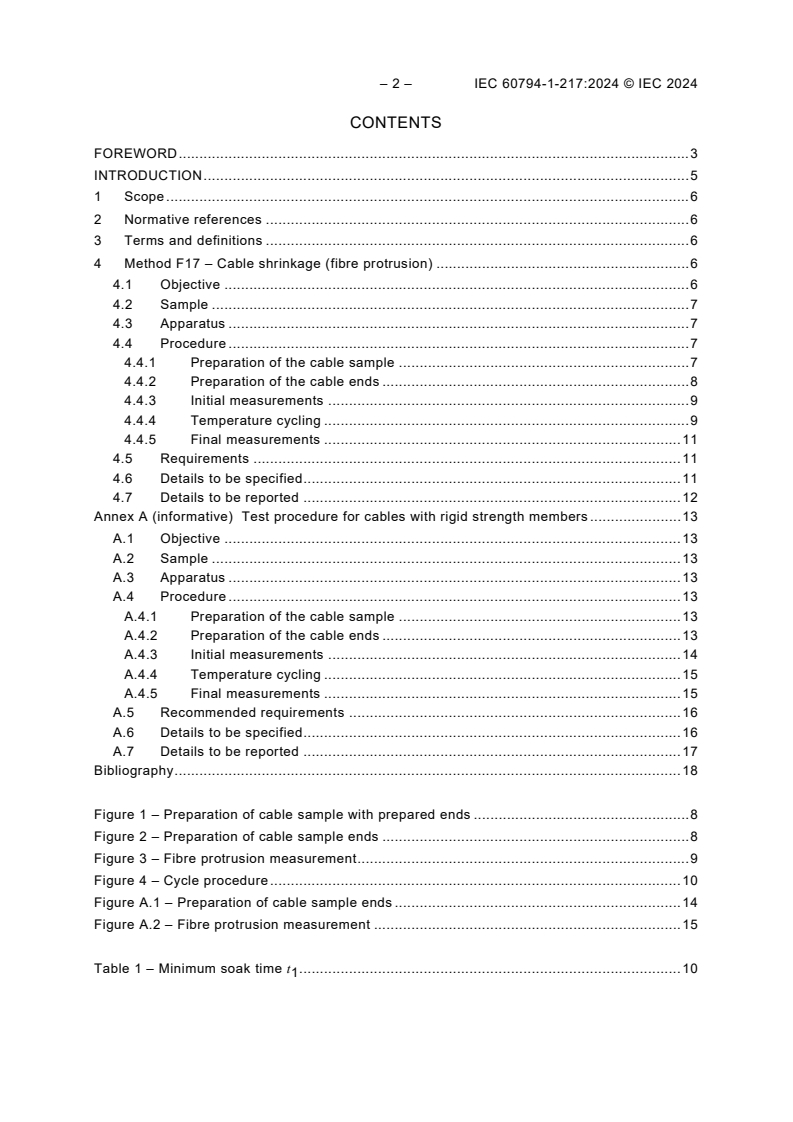
– 2 – IEC 60794-1-217:2024 © IEC 2024
CONTENTS
FOREWORD . 3
INTRODUCTION . 5
1 Scope . 6
2 Normative references . 6
3 Terms and definitions . 6
4 Method F17 – Cable shrinkage (fibre protrusion) . 6
4.1 Objective . 6
4.2 Sample . 7
4.3 Apparatus . 7
4.4 Procedure . 7
4.4.1 Preparation of the cable sample . 7
4.4.2 Preparation of the cable ends . 8
4.4.3 Initial measurements . 9
4.4.4 Temperature cycling . 9
4.4.5 Final measurements . 11
4.5 Requirements . 11
4.6 Details to be specified . 11
4.7 Details to be reported . 12
Annex A (informative) Test procedure for cables with rigid strength members . 13
A.1 Objective . 13
A.2 Sample . 13
A.3 Apparatus . 13
A.4 Procedure . 13
A.4.1 Preparation of the cable sample . 13
A.4.2 Preparation of the cable ends . 13
A.4.3 Initial measurements . 14
A.4.4 Temperature cycling . 15
A.4.5 Final measurements . 15
A.5 Recommended requirements . 16
A.6 Details to be specified . 16
A.7 Details to be reported . 17
Bibliography . 18
Figure 1 – Preparation of cable sample with prepared ends . 8
Figure 2 – Preparation of cable sample ends . 8
Figure 3 – Fibre protrusion measurement . 9
Figure 4 – Cycle procedure . 10
Figure A.1 – Preparation of cable sample ends . 14
Figure A.2 – Fibre protrusion measurement . 15
Table 1 – Minimum soak time t . 10
INTERNATIONAL ELECTROTECHNICAL COMMISSION
____________
OPTICAL FIBRE CABLES –
Part 1-217: Generic specification –
Basic optical cable test procedures – Environmental test methods –
Cable shrinkage (fibre protrusion), method F17
FOREWORD
1) The International Electrotechnical Commission (IEC) is a worldwide organization for standardization comprising
all national electrotechnical committees (IEC National Committees). The object of IEC is to promote international
co-operation on all questions concerning standardization in the electrical and electronic fields. To this end and
in addition to other activities, IEC publishes International Standards, Technical Specifications, Technical Reports,
Publicly Available Specifications (PAS) and Guides (hereafter referred to as “IEC Publication(s)”). Their
preparation is entrusted to technical committees; any IEC National Committee interested in the subject dealt with
may participate in this preparatory work. International, governmental and non-governmental organizations liaising
with the IEC also participate in this preparation. IEC collaborates closely with the International Organization for
Standardization (ISO) in accordance with conditions determined by agreement between the two organizations.
2) The formal decisions or agreements of IEC on technical matters express, as nearly as possible, an international
consensus of opinion on the relevant subjects since each technical committee has representation from all
interested IEC National Committees.
3) IEC Publications have the form of recommendations for international use and are accepted by IEC National
Committees in that sense. While all reasonable efforts are made to ensure that the technical content of IEC
Publications is accurate, IEC cannot be held responsible for the way in which they are used or for any
misinterpretation by any end user.
4) In order to promote international uniformity, IEC National Committees undertake to apply IEC Publications
transparently to the maximum extent possible in their national and regional publications. Any divergence between
any IEC Publication and the corresponding national or regional publication shall be clearly indicated in the latter.
5) IEC itself does not provide any attestation of conformity. Independent certification bodies provide conformity
assessment services and, in some areas, access to IEC marks of conformity. IEC is not responsible for any
services carried out by independent certification bodies.
6) All users should ensure that they have the latest edition of this publication.
7) No liability shall attach to IEC or its directors, employees, servants or agents including individual experts and
members of its technical committees and IEC National Committees for any personal injury, property damage or
other damage of any nature whatsoever, whether direct or indirect, or for costs (including legal fees) and
expenses arising out of the publication, use of, or reliance upon, this IEC Publication or any other IEC
Publications.
8) Attention is drawn to the Normative references cited in this publication. Use of the referenced publications is
indispensable for the correct application of this publication.
9) IEC draws attention to the possibility that the implementation of this document may involve the use of (a)
patent(s). IEC takes no position concerning the evidence, validity or applicability of any claimed patent rights in
respect thereof. As of the date of publication of this document, IEC had not received notice of (a) patent(s), which
may be required to implement this document. However, implementers are cautioned that this may not represent
the latest information, which may be obtained from the patent database available at https://patents.iec.ch. IEC
shall not be held responsible for identifying any or all such patent rights.
IEC 60794-1-217 has been prepared by subcommittee 86A: Fibres and cables, of IEC technical
committee 86: Fibre optics. It is an International Standard.
This document partially replaces IEC 60794-1-22:2017. This edition constitutes a technical
revision.
This edition includes the following significant technical changes with respect to
IEC 60794-1-22:2017:
a) added clarification in the objective that the purpose of this test procedure is to measure the
permanent fibre protrusion of cables without rigid strength members;
b) replaced the reference to method F1 for the apparatus with a detailed description for the
temperature chamber and temperature sensing device as done in IEC 60794-1-211;
– 4 – IEC 60794-1-217:2024 © IEC 2024
c) added a measuring device in the subclause for apparatus;
d) added conditioning before cutting the cable sample as done in IEC 60794-1-211
e) added all required steps in the subclause for temperature cycling as well as the table for the
minimum soak time and the figure for the cycle procedure, and removed the reference to
IEC 60794-1-22, method F1;
f) improved the figures and added a figure for preparation of the cable sample;
g) added the informative Annex A for the test procedure recommended for cables with rigid
strength members.
The text of this International Standard is based on the following documents:
Draft Report on voting
86A/2358/CDV 86A/2405/RVC
Full information on the voting for its approval can be found in the report on voting indicated in
the above table.
The language used for the development of this International Standard is English.
This document was drafted in accordance with ISO/IEC Directives, Part 2, and developed in
accordance with ISO/IEC Directives, Part 1 and ISO/IEC Directives, IEC Supplement, available
at www.iec.ch/members_experts/refdocs. The main document types developed by IEC are
described in greater detail at www.iec.ch/publications.
A list of all parts in the IEC 60794 series, published under the general title Optical fibre cables,
can be found on the IEC website.
The committee has decided that the contents of this document will remain unchanged until the
stability date indicated on the IEC website under webstore.iec.ch in the data related to the
specific document. At this date, the document will be
• reconfirmed,
• withdrawn, or
• revised.
IMPORTANT – The "colour inside" logo on the cover page of this document indicates
that it contains colours which are considered to be useful for the correct understanding
of its contents. Users should therefore print this document using a colour printer.
INTRODUCTION
This document defines the test method F17 to measure the change of fibre protrusion at both
cable ends caused by cable shrinkage due to thermal exposure.
The numbering of this test method continues the F-series numbering sequence of
IEC 60794-1-22:2017. This document cancels and replaces method F17 of
IEC 60794-1-22:2017, which will be withdrawn. It includes an editorial revision, based on the
new structure and numbering system for optical fibre cable test methods. Additionally, technical
changes were implemented. The environmental tests contained in IEC 60794-1-22:2017 will be
individually numbered in the IEC 60794-1-2xx series. Each test method is now considered to
be an individual document rather than part of a multi-test method compendium. Full cross-
reference details are given in IEC 60794-1-2.
All cables have a memory effect in the form of coils, and are elastic depending on the applied
force, making repeatable and reproducible measurements from one end to the other end on a
longer cable sample (for example 10 m or longer) very difficult or impossible. Therefore,
measurement of the fibre or cable element protrusion at both ends is a suitable and simple
alternative.
The advantage of this method is that the change in protrusion length can be directly compared
with the capability to accommodate this change of protrusion length in the application situation
(for example in a fibre distribution box). The limitation of this method is that the absolute
changes of the cable elements and sheath lengths cannot be determined.
The test method in this document determines the permanent fibre protrusion of cables without
rigid strength members compared to the cable elements and cable sheath due to temperature
changes. The reference for the fibre protrusion is in this case the end of the cable sheath.
The determination of the permanent fibre protrusion according to this test method is not
applicable if the strongest rigid strength member, often the central strength member, is to serve
as a reference. This is the case when the fixing of the rigid strength member is used in a
protective housing and the fixing of the rigid strength member is stronger than the fixing of the
cable sheath. For such an installation situation, the recommended test procedure is given in
Annex A.
IEC TR 62959 describes the test method F17 that can be optionally used as an indicator for
cables terminated with hardened connectors, terminated into passive components, fixed into a
module, a divider or a protective housing with the fibres terminated with splices.
IEC TR 62959 provides information on cable shrinkage characterisation of optical fibre cables
that consist of standard glass optical fibres for telecommunication applications. The
characterisation is directed to the effects of cable shrinkage or cable element shrinkage on the
termination of cables. Recommended test methods for the evaluation of cable shrinkage as an
indicator and classification by several grades are given.
A test procedure other than method F17 to measure shrinkage effects exists. Method F11
according to IEC 60794-1-211 defines shrinkage testing on a cable sample with a nominal
length of 1 m or less by calculation of the change in sheath length measured before and after
thermal exposure.
– 6 – IEC 60794-1-217:2024 © IEC 2024
OPTICAL FIBRE CABLES –
Part 1-217: Generic specification –
Basic optical cable test procedures – Environmental test methods –
Cable shrinkage (fibre protrusion), method F17
1 Scope
This part of the IEC 60794 series defines the test procedure to measure the permanent fibre
protrusion compared to the cable elements and cable sheath due to thermal exposure of a
cable.
2 Normative references
The following documents are referred to in the text in such a way that some or all of their content
constitutes requirements of this document. For dated references, only the edition cited applies.
For undated references, the latest edition of the referenced document (including any
amendments) applies.
IEC 60794-1-1, Optical fibre cables – Part 1-1: Generic specification – General
IEC 60794-1-2, Optical fibre cables – Part 1-2: Generic specification – Basic optical cable test
procedures – General guidance
3 Terms and definitions
For the purposes of this document, the terms and definitions given in IEC 60794-1-1 and the
following apply.
ISO and IEC maintain terminology databases for use in standardization at the following
addresses:
• IEC Electropedia: available at https://www.electropedia.org/
• ISO Online browsing platform: available at https://www.iso.org/obp
3.1
shrinkage
irreversible contraction after extrusion of plastic materials caused by heating or over time at
ambient temperature
4 Method F17 – Cable shrinkage (fibre protrusion)
4.1 Objective
The purpose of this test procedure is to measure the permanent fibre protrusion of cables
without rigid strength members compared to the cable elements and cable sheath due to
temperature changes. The reference for the fibre protrusion is in this case the end of the cable
sheath.
The determination of the permanent fibre protrusion according to this test method is not
applicable if the strongest rigid strength member, often the central strength member, is to serve
as a reference. This is the case when the fixing of the rigid strength member is used in a
protective housing and the fixing of the rigid strength member is stronger than the fixing of the
cable sheath. For such an installation situation, the recommended test procedure is given in
Annex A.
Low shrinkage of cable elements and cable sheath is important for termination of connectors
and passive optical components as well as in installations of protective housings with reinforced
cables. The permanent (or irreversible) fibre protrusion at the cable ends can occur when the
cable is used in areas with elevated temperature or direct exposure to the sun. Cable designs
with low friction between the stabilisation elements (for example rigid strength member) and
high material shrinkage (created by the extrusion process) can cause excessive and permanent
fibre protrusion at the cable end and can lead to an attenuation increase, cable attachment
degradation, sealing weakening, and in severe cases fibre breakage.
4.2 Sample
The cable sample shall have a minimum length of 10 m.
NOTE IEC TR 62959 recommends a length of 20 m for evaluation of the fibre protrusion because the observed
change of fibre protrusion of cable samples with a length of 20 m were often larger than with a sample length of
10 m.
4.3 Apparatus
A temperature chamber of appropriate size and a temperature sensing device. The temperature
chamber shall be able to accommodate the cable sample and maintain the specified
temperature within ±3 °C.
A length measuring device of sufficient length for measuring the protrusion length of the fibres
and secondary fibre protection or fibre tube with a minimum resolution of 1 mm (see Figure 2
and Figure 3).
NOTE For the test procedure recommended for cables with rigid strength member(s), see Figure A.1 and
Figure A.2.
4.4 Procedure
4.4.1 Preparation of the cable sample
The cable on the supply reel, or alternatively the cable coil, shall be conditioned for 24 h at
ambient temperature before cutting the cable sample, unless otherwise specified.
The cable sample shall be coiled in loose windings with a minimum diameter of 0,6 m, unless
otherwise specified. The cable coils shall be loosely fixed at least at two places distributed
around the circumference in a way that the cable elements are not held inside the cable and
are free to move (expand and contract), as shown in Figure 1.
– 8 – IEC 60794-1-217:2024 © IEC 2024
Key
1 coiled cable sample
2 loose fixing of cable sample coils
Figure 1 – Preparation of cable sample with prepared ends
4.4.2 Preparation of the cable ends
The outer cable sheath shall be removed over a length of l from the cable sample end, as
shown in Figure 2. Also the strength members, inner sheath and other cable elements should
be stripped closely to the end of the outer cable sheath. The secondary fibre protection or fibre
tubes shall be removed over a length of l from the end of the fibres as shown in Figure 2. This
preparation shall be done at both cable sample ends.
For cable types where the fibres are loosely embedded in the cable, the pulling out and pushing
in of the fibres should be avoided during preparation and measurement.
Dimensions in millimetres
l l
1 2
100 200
Key
1 fibre or bundle of fibres
2 secondary fibre protection or fibre tube
3 cable sheath
Figure 2 – Preparation of cable sample ends
At ambient temperature, the complete cable sample, including both cable ends, shall be put in
the temperature chamber.
4.4.3 Initial measurements
The initial fibre protrusion shall be measured from the edge of the secondary fibre protection or
fibre tube (L1) and from the edge of the cable sheath (L2) of all cable elements at both ends,
as shown in Figure 3.
Key
1 fibre or bundle of fibres
2 secondary fibre protection or fibre tube
3 cable sheath
NOTE The protrusion of the secondary fibre protection or fibre tube is represented as length L3, that can be
calculated as L2 minus L1.
Figure 3 – Fibre protrusion measurement
If multiple fibres are within a fibre tube, then one fibre shall be selected for the measurements
(for example red coloured fibre).
4.4.4 Temperature cycling
The temperature in the temperature chamber shall be at ambient temperature. Throughout this
procedure, the ambient temperature condition is the standard test condition as defined in
IEC 60794-1-2. The temperature cycles shall be carried out as shown in Figure 4 and as follows:
– the temperature of the chamber shall be decreased to the low temperature T at a rate of
A2
cooling not to exceed 60 °C/h;
– as soon as the temperature in the chamber has reached stable condition, the cable sample
shall be exposed to the low temperature for the appropriate period t (see next bullet point);
– a minimum soak time is given in Table 1; however, the soak time, t , shall be sufficient to
bring the cable sample to equilibrium with the specified temperature;
– the temperature in the chamber is then increased to the high temperature T at a rate of
B2
heating not to exceed 60 °C/h;
– as soon as the temperature in the chamber has reached stable condition, the cable sample
shall be exposed to the high temperature for the appropriate period t ;
– the temperature in the chamber shall be decreased to ambient temperature at a rate of
cooling not to exceed 60 °C/h.
This procedure constitutes one cycle. If this is the intermediate step in a series of cycles, no
soak is required, and no measurement shall be taken.
– 10 – IEC 60794-1-217:2024 © IEC 2024
A minimum of four cycles shall be carried out, unless otherwise specified in the relevant
specification.
At the end of the cycling sequence, hold the cable sample at ambient temperature for the
appropriate period t .
NOTE 1 The minimum number of four cycles is specifiedsince the shrinkage effects increases significantly with the
first four cycles, as shown in the shrinkage study (see IEC TR 62959).
NOTE 2 Temperature cycling for cable shrinkage testing can be done together with IEC 60794-1-201, method F1,
or with IEC 60794-1-212, method F12, if the specified test parameters are the same.
Table 1 – Minimum soak time t
Minimum soak times for a given sample mass (weight of cable sample)
Sample mass Minimum soak time, t
kg
h
Under 0,35 0,5
0,36 to 0,7 1
0,8 to 1,5 2
1,6 to 100 4
101 to 250 6
251 to 500 8
Over 501 12
If more than one sample is put into the chamber, the largest sample mass of all single samples should be compared
with the values in the table for the determination of the minimum soak time
NOTE It is the responsibility of the tester to assure that the soak time is long enough to bring the cable to
equilibrium with the specified temperature.
Key
t soak time
T low temperature
A2
T high temperature
B2
t unit of time
Figure 4 – Cycle procedure
4.4.5 Final measurements
The cable sample shall be kept in the same arrangement as in the initial measurements and
during temperature cycling, coiled in loose windings and the coils loosely fixed, as described in
4.4.1. Uncoiling and renewed coiling of the cable sample shall be avoided because it can affect
the change of fibre protrusion in addition to changes caused by cable shrinkage.
The fibre protrusion (L1 and L2) shall be measured at both ends (see Figure 3). If multiple fibres
are within a fibre tube, then the fibre selected for the initial measurements shall be used for the
final measurements (for example red coloured fibre).
The maximum change of fibre protrusion lengths of all cable elements is calculated as given in
Formula (1) and Formula (2).
∆L1 = max(∆L1 ) = max(L1 – L1 )
(1)
i ai bi
where
∆L1 is the change of fibre protrusion length from the edge of the secondary fibre protection
i
or fibre tube after temperature cycling of element number i;
L1 is the fibre protrusion length from the edge of the secondary fibre protection or fibre tube
ai
after temperature cycling of element number i;
L1 is the fibre protrusion length from the edge of the secondary fibre protection or fibre tube
bi
before temperature cycling of element number i.
∆L2 = max(∆L2 ) = max(L2 – L2 )
(2)
i ai bi
where
∆L2 is the change of fibre protrusion length from the edge of the cable sheath after
i
temperature cycling of element number i;
L2 is the fibre protrusion length from the edge of the cable sheath after temperature cycling
ai
of element number i;
L2 is the fibre protrusion length from the edge of the cable sheath before temperature
bi
cycling of element number i.
NOTE The change of protrusion lengths ∆L1 and ∆L2 give no information about which cable element has expanded
or contracted, because the reference point of the fibre end is not fixed.
4.5 Requirements
The calculated maximum change of fibre protrusion lengths (∆L1 and ∆L2) shall not exceed the
values given in the relevant specification.
NOTE The change of protrusion of the secondary fibre protection or fibre tube is represented as length ∆L3, that
can be calculated as ∆L2 minus ∆L1.
4.6 Details to be specified
The relevant specification shall include the following:
a) sample length;
b) low and high temperature;
– 12 – IEC 60794-1-217:2024 © IEC 2024
c) number of cycles;
d) permissible maximum change of fibre protrusion lengths.
4.7 Details to be reported
The test report shall include all the information given in 4.6 and the following, if applicable:
a) coiling diameter of cable sample;
b) recovery period;
c) soak time, t ;
d) selected fibre in each tube for protrusion length measurements (for example red coloured
fibre);
e) maximum change of fibre protrusion lengths (∆L1 , ∆L2 ) for all elements;
i i
f) protrusion length measurement uncertainty;
g) any deviations from this test method.
Annex A
(informative)
Test procedure for cables with rigid strength members
A.1 Objective
The purpose of the test procedure in Annex A is to measure the permanent fibre protrusion of
cables with rigid strength member(s) compared to the cable elements and rigid strength
member(s) due to temperature changes. The reference for the fibre protrusion is in this case
the end of the rigid strength member(s). In addition, the protrusion of the rigid strength
member(s) compared to the edge of the cable sheath is measured.
This test procedure is recommended when the fixing of the rigid strength member is used in a
protective housings and the fixing of the rigid strength member is stronger than the fixing of the
cable sheath.
A.2 Sample
The cable sample should be as defined in 4.2.
A.3 Apparatus
The apparatus should be as defined in 4.3.
A.4 Procedure
A.4.1 Preparation of the cable sample
The preparation of the cable sample should be done as defined in 4.4.1.
A.4.2 Preparation of the cable ends
The outer cable sheath should be removed over a length of l from the cable sample end and
the rigid strength member(s) should be cut at a length of l from the end of the outer cable
sheath, as shown in Figure A.1. The other strength members, inner sheath and other cable
elements should be stripped closely to the end of the outer cable sheath. The secondary fibre
protection or fibre tubes should be removed over a length of l from the end of the fibres as
shown in Figure A.1. This preparation should be done at both cable sample ends.
For cable types where the fibres are loosely embedded in the cable, the pulling out and pushing
in of the fibres should be avoided during preparation and measurement.
– 14 – IEC 60794-1-217:2024 © IEC 2024
Dimensions in millimetres
l l l
1 2 5
70 210 70
Key
1 fibre or bundle of fibres
2 secondary fibre protection or fibre tube
3 cable sheath
4 rigid strength member
NOTE This figure shows an example of a cable type with a central rigid strength member.
Figure A.1 – Preparation of cable sample ends
At ambient temperature, the complete cable sample, including both cable ends, should be put
in the temperature chamber.
A.4.3 Initial measurements
The initial fibre protrusion should be measured from the edge of the secondary fibre protection
or fibre tube (L1) and from the end of the rigid strength member (L4) of all cable elements at
both ends, as shown in Figure A.2. In addition, the protrusion of the rigid strength member
should be measured from the end of the rigid strength member to the edge of the outer cable
sheath (L5) at both ends.
Key
1 fibre or bundle of fibres
2 secondary fibre protection or fibre tube
3 cable sheath
4 rigid strength member
NOTE This figure shows an example of a cable type with a central rigid strength member.
Figure A.2 – Fibre protrusion measurement
If multiple fibres are within a fibre tube, then one fibre should be selected for the measurements
(for example red coloured fibre).
A.4.4 Temperature cycling
The temperature cycles should be performed as defined in 4.4.4.
A.4.5 Final measurements
The cable sample should be kept in the same arrangement as in the initial measurements and
during temperature cycling, coiled in loose windings and the coils loosely fixed, as described in
A.4.1. Uncoiling and renewed coiling of the cable sample should be avoided because it can
affect the change of fibre protrusion beside that is caused by cable shrinkage.
The fibre protrusion (L1 and L4) of all cable elements and the rigid strength member protrusion
(L5) should be measured at both ends (see Figure A.2). If multiple fibres are within a fibre tube,
then the fibre selected for the initial measurements should be used for the final measurements
(for example red coloured fibre).
The maximum change of the fibre protrusion lengths of all cable elements at both cable ends
and of the rigid strength member protrusion length at both cable ends are calculated as given
in Formula (A.1), Formula (A.2) and Formula (A.3).
∆L1 = max(∆L1 ) = max(L1 – L1 )
(A.1)
i ai bi
where
∆L1 is the change of fibre protrusion length from the edge of the secondary fibre protection
i
or fibre tube after temperature cycling of element number i;
L1 is the fibre protrusion length from the edge of the secondary fibre protection or fibre tube
ai
after temperature cycling of element number i;
– 16 – IEC 60794-1-217:2024 © IEC 2024
L1 is the fibre protrusion length from the edge of the secondary fibre protection or fibre tube
bi
before temperature cycling of element number i.
∆L4 = max(∆L4 ) = max(L4 – L4 )
(A.2)
i ai bi
where
∆L4 is the change of fibre protrusion length from the end of the rigid strength member after
i
temperature cycling of element number i;
L4 is the fibre protrusion length from the end of the rigid strength member after temperature
ai
cycling of element number i;
L4 is the fibre protrusion length from the end of the rigid strength member before
bi
temperature cycling of element number i.
∆L5 = max(∆L5 ) = max(L5 – L5 )
(A.3)
i ai bi
where
∆L5 is the change of rigid strength member protrusion length from the edge of the cable
i
sheath after temperature cycling of cable end i;
L5 is the rigid strength member protrusion length from the edge of the cable sheath after
ai
temperature cycling of cable end i;
L5 is the rigid strength member protrusion length from the edge of the cable sheath before
bi
temperature cycling of cable end i.
A.5 Recommended requirements
The calculated maximum change of fibre and rigid strength member protrusion lengths (∆L1,
∆L4, ∆L5) should not exceed the values given in the relevant specification.
A.6 Details to be specified
The relevant specification should include the following:
a) sample length;
b) low and high temperature;
c) number of cycles;
d) permissible maximum change of fibre and rigid strength member protrusion lengths.
A.7 Details to be reported
The test report should include all the information given in A.6 and the following, if applicable:
a) used test procedure (as defined in Annex A);
b) coiling diameter of cable sample;
c) recovery period;
d) soak time, t ;
e) selected fibre in each tube for protrusion length measurements (for example red coloured
fibre);
f) maximum change of fibre protrusion lengths (∆L1 , ∆L4 ) for all elements and of rigid
i i
strength member protrusion length (∆L5 );
i
g) protrusion length measurement uncertainty;
h) any deviations from this test method.
– 18 – IEC 60794-1-217:2024 © IEC 2024
Bibliography
IEC 60794-1-22:2017, Optical fibre cables – Part 1-22: Generic specification – Basic optical
cable test procedures – Environmental test methods
IEC 60794-1-201, Optical fibre cables – Part 1-201: Generic specification – Basic optical cable
test procedures – temperature cycling, method F1
IEC 60794-1-211, Optical fibre cables – Part 1-211: Generic specification – Basic optical cable
test procedures – Environmental test methods – Sheath shrinkage, method F11
IEC 60794-1-212, Optical fibre cables – Part 1-212: Generic specification – Basic optical cable
test procedures – Environmental test methods – Temperature cycling with cable elements fixed
at both ends, Method F12
IEC TR 62959, Optical fibre cables – Shrinkage effects on cable and cable element end
termination – Guidance
___________
___________
Under preparation. Stage at the time of publication: IEC FDIS 60794-1-201:2024.
– 20 – IEC 60794-1-217:2024 © IEC 2024
SOMMAIRE
AVANT-PROPOS . 21
INTRODUCTION . 23
1 Domaine d’application . 24
2 Références normatives . 24
3 Termes et définitions . 24
4 Méthode F17 – Rétraction de câble (excroissance de la fibre) . 24
4.1 Objectif . 24
4.2 Échantillon . 25
4.3 Appareillage . 25
4.4 Mode opératoire . 25
4.4.1 Préparation de l’échantillon de câble . 25
4.4.2 Préparation des extrémités de câble . 26
4.4.3 Mesures initiales . 27
4.4.4 Cycles de température . 27
4.4.5 Mesures finales . 29
4.5 Exigences . 30
4.6 Détails à spécifier . 30
4.7 Détails à consigner . 30
Annexe A (informative) Procédure d’essai des câbles avec éléments de renfort rigides . 31
A.1 Objectif . 31
A.2 Échantillon . 31
A.3 Appareillage . 31
A.4 Mode opératoire . 31
A.4.1 Préparation de l’échantillon de câble .
...