

IEC 62365:2009
(Main)Digital audio - Digital input-output interfacing - Transmission of digital audio over asynchronous transfer mode (ATM) networks
General Information
- Abstract
IEC 62365:2009 specifies a means to carry multiple channels of audio in linear PCM or IEC 60958-4 format over an ATM layer service conforming to ITU-T Recommendation I.150. It includes a means to convey, between parties, information concerning the digital audio signal when setting up audio calls across the ATM network. This bilingual version (2012-08) corresponds to the monolingual English version, published in 2009. This second edition of IEC 62365 cancels and replaces the first edition published in 2004.The main changes with respect to the previous edition (2004) are: second, third, and fourth required formats in 4.3 removed. 4.3 reformatted, eliminating Table 2, and subsequent Tables renumbered.
- Status
- Published
- Publication Date
- 12-May-2009
- Technical Committee
- TC 100 - Audio, video and multimedia systems and equipment
- Current Stage
- PPUB - Publication issued
- Start Date
- 13-May-2009
- Completion Date
- 31-May-2009
Buy Documents
IEC 62365:2009 - Digital audio - Digital input-output interfacing - Transmission of digital audio over asynchronous transfer mode (ATM) networks Released:5/13/2009
IEC 62365:2009 - Digital audio - Digital input-output interfacing - Transmission of digital audio over asynchronous transfer mode (ATM) networks Released:5/13/2009
Overview
IEC 62365:2009 - Digital audio: Transmission of digital audio over ATM networks defines a standardized method to carry multiple channels of professional digital audio (linear PCM or IEC 60958-4 format) over Asynchronous Transfer Mode (ATM) networks. The standard specifies how audio samples are packed into ATM cells, how audio call setup and management are signalled, and how format and control information are exchanged between endpoints. This edition (2009, bilingual version 2012-08) supersedes the 2004 edition and aligns ATM audio transport with ITU‑T Recommendation I.150.
Key topics and technical requirements
- Audio data format and packing
- Defines subframes, audio sample words, ancillary data and protocol overhead.
- Describes packing schemes, temporal grouping, multi‑channel support and grouping by channel.
- ATM cell structure
- Uses ATM cells (typical 5‑byte header + 48 data bytes) and virtual channel identifiers (VCI) to associate cells with audio calls.
- Call signalling and control
- Specifies use of ATM switched virtual circuits (SVCs) and permanent virtual circuits (PVCs).
- Defines information elements for SETUP, ADD PARTY and disconnection messages and the required responses for audio call establishment.
- Coding and timing
- Covers coding-related qualifying information, sampling frequency handling and packing of subframes into cells.
- Targets low latency and low jitter transport suitable for professional audio (the standard notes examples such as dual‑channel IEC 60958‑4 at 48 kHz producing inter‑cell times comparable to ISDN frame intervals).
- Management and protection
- Defines a management interface (message encapsulation, message types, status messages) and informative annexes on data protection and application identifiers.
- Interoperability
- References ATM adaptation layer options and ATM Forum/ITU recommendations for physical and signaling interworking.
Practical applications
- Low‑latency, high‑quality distribution of professional audio over metropolitan or wide‑area networks.
- Broadcast contribution and remote production links, studio‑to‑studio interconnections, and point‑to‑multipoint audio distribution where deterministic latency and tight timing are required.
- Use cases that require call setup, channel negotiation and per‑call audio format signaling across ATM infrastructure.
Who should use this standard
- Broadcast and pro‑audio equipment manufacturers integrating networked audio transport.
- Systems integrators and network engineers deploying professional audio over ATM.
- Standards developers and test labs validating ATM audio interoperability.
- Network operators providing guaranteed QoS for professional media services.
Related standards and references
- IEC 60958‑4 (digital audio format)
- ITU‑T Recommendation I.150 (ATM layer service)
- ATM Forum specifications (physical layer and abbreviations)
- Context: SONET/SDH, ISDN and IP/RSVP are discussed as networking alternatives in the standard.
Relations
- Effective Date
- 05-Sep-2023
Buy Documents
IEC 62365:2009 - Digital audio - Digital input-output interfacing - Transmission of digital audio over asynchronous transfer mode (ATM) networks Released:5/13/2009
IEC 62365:2009 - Digital audio - Digital input-output interfacing - Transmission of digital audio over asynchronous transfer mode (ATM) networks Released:5/13/2009
Get Certified
Connect with accredited certification bodies for this standard

BSI Group
BSI (British Standards Institution) is the business standards company that helps organizations make excellence a habit.

NYCE
Mexican standards and certification body.

ANCE
Mexican certification and testing association.
Sponsored listings
Frequently Asked Questions
IEC 62365:2009 is a standard published by the International Electrotechnical Commission (IEC). Its full title is "Digital audio - Digital input-output interfacing - Transmission of digital audio over asynchronous transfer mode (ATM) networks". This standard covers: IEC 62365:2009 specifies a means to carry multiple channels of audio in linear PCM or IEC 60958-4 format over an ATM layer service conforming to ITU-T Recommendation I.150. It includes a means to convey, between parties, information concerning the digital audio signal when setting up audio calls across the ATM network. This bilingual version (2012-08) corresponds to the monolingual English version, published in 2009. This second edition of IEC 62365 cancels and replaces the first edition published in 2004.The main changes with respect to the previous edition (2004) are: second, third, and fourth required formats in 4.3 removed. 4.3 reformatted, eliminating Table 2, and subsequent Tables renumbered.
IEC 62365:2009 specifies a means to carry multiple channels of audio in linear PCM or IEC 60958-4 format over an ATM layer service conforming to ITU-T Recommendation I.150. It includes a means to convey, between parties, information concerning the digital audio signal when setting up audio calls across the ATM network. This bilingual version (2012-08) corresponds to the monolingual English version, published in 2009. This second edition of IEC 62365 cancels and replaces the first edition published in 2004.The main changes with respect to the previous edition (2004) are: second, third, and fourth required formats in 4.3 removed. 4.3 reformatted, eliminating Table 2, and subsequent Tables renumbered.
IEC 62365:2009 is classified under the following ICS (International Classification for Standards) categories: 33.160.25 - Television receivers; 35.200 - Interface and interconnection equipment. The ICS classification helps identify the subject area and facilitates finding related standards.
IEC 62365:2009 has the following relationships with other standards: It is inter standard links to IEC 62365:2004. Understanding these relationships helps ensure you are using the most current and applicable version of the standard.
IEC 62365:2009 is available in PDF format for immediate download after purchase. The document can be added to your cart and obtained through the secure checkout process. Digital delivery ensures instant access to the complete standard document.
Standards Content (Sample)
IEC 62365 ®
Edition 2.0 2009-05
INTERNATIONAL
STANDARD
Digital audio – Digital input-output interfacing – Transmission of digital audio
over asynchronous transfer mode (ATM) networks
All rights reserved. Unless otherwise specified, no part of this publication may be reproduced or utilized in any form
or by any means, electronic or mechanical, including photocopying and microfilm, without permission in writing from
either IEC or IEC's member National Committee in the country of the requester.
If you have any questions about IEC copyright or have an enquiry about obtaining additional rights to this publication,
please contact the address below or your local IEC member National Committee for further information.
IEC Central Office
3, rue de Varembé
CH-1211 Geneva 20
Switzerland
Email: inmail@iec.ch
Web: www.iec.ch
About the IEC
The International Electrotechnical Commission (IEC) is the leading global organization that prepares and publishes
International Standards for all electrical, electronic and related technologies.
About IEC publications
The technical content of IEC publications is kept under constant review by the IEC. Please make sure that you have the
latest edition, a corrigenda or an amendment might have been published.
ƒ Catalogue of IEC publications: www.iec.ch/searchpub
The IEC on-line Catalogue enables you to search by a variety of criteria (reference number, text, technical committee,…).
It also gives information on projects, withdrawn and replaced publications.
ƒ IEC Just Published: www.iec.ch/online_news/justpub
Stay up to date on all new IEC publications. Just Published details twice a month all new publications released. Available
on-line and also by email.
ƒ Electropedia: www.electropedia.org
The world's leading online dictionary of electronic and electrical terms containing more than 20 000 terms and definitions
in English and French, with equivalent terms in additional languages. Also known as the International Electrotechnical
Vocabulary online.
ƒ Customer Service Centre: www.iec.ch/webstore/custserv
If you wish to give us your feedback on this publication or need further assistance, please visit the Customer Service
Centre FAQ or contact us:
Email: csc@iec.ch
Tel.: +41 22 919 02 11
Fax: +41 22 919 03 00
IEC 62365 ®
Edition 2.0 2009-05
INTERNATIONAL
STANDARD
Digital audio – Digital input-output interfacing – Transmission of digital audio
over asynchronous transfer mode (ATM) networks
INTERNATIONAL
ELECTROTECHNICAL
COMMISSION
PRICE CODE
U
ICS 35.200, 33.160 ISBN 978-2-88910-683-7
– 2 – 62365 © IEC:2009(E)
CONTENTS
FOREWORD.4
INTRODUCTION.6
1 Scope.8
2 Normative references .8
3 Terms and definitions .8
4 Format of audio data in ATM cells .10
4.1 Format of audio samples .10
4.1.1 Subframes.10
4.1.2 Audio sample word .10
4.1.3 Ancillary data .10
4.1.4 Protocol overhead .10
4.2 Packing of sample data into cells .12
4.2.1 Packing schemes .12
4.2.2 Temporal grouping .12
4.2.3 Multi-channel.12
4.2.4 Grouping by channel.13
4.3 Formats.13
4.4 ATM adaptation layer .13
4.5 ATM-user-to-ATM-user indication .13
5 Switched virtual circuits .14
5.1 Addresses .14
5.2 Audio call connection: SETUP and ADD PARTY messages .14
5.2.1 Restrictions on connection requests .14
5.2.2 Information elements in the SETUP and ADD PARTY messages .14
5.2.3 Destination response to SETUP and ADD PARTY messages.15
5.3 Call disconnection .16
6 Coding of audio formats .16
6.1 Qualifying information.16
6.2 Subframe format.17
6.3 Packing of subframes into cells .17
6.4 Sampling frequency.18
7 Permanent virtual circuits .18
8 Management interface .19
8.1 Call connection: SETUP messages .19
8.1.1 Restrictions on connection requests .19
8.1.2 Information elements in the SETUP message .19
8.1.3 Destination response to SETUP message.20
8.2 Message encapsulation .20
8.3 Message format and action to be taken by recipient .20
8.4 Message types .21
8.4.1 Messages sent from the controlling entity .21
8.4.2 Messages sent to the controlling entity .23
8.4.3 Vendor-specific messages.25
Annex A (informative) Data protection.26
Annex B (informative) Application identifier values.28
62365 © IEC:2009(E) – 3 –
Bibliography.29
Table 1 – Fields contained in a subframe.10
Table 2 – Default port number and packing for certain VCIs.19
Table 3 – Status enquiry message .21
Table 4 – Audio connection request message .22
Table 5 – Audio disconnection request message.22
Table 6 – Input port status message .23
Table 7 – Output port status message.24
Table 8 – Other status messages.25
Table 9 – Vendor-specific messages.25
Table A.1 – Sequence number protection field values .26
Table B.1 – Application identifier (octets 9 to 12) values in the BHLI IE .28
– 4 – 62365 © IEC:2009(E)
INTERNATIONAL ELECTROTECHNICAL COMMISSION
___________
DIGITAL AUDIO –
DIGITAL INPUT-OUTPUT INTERFACING –
TRANSMISSION OF DIGITAL AUDIO OVER
ASYNCHRONOUS TRANSFER MODE (ATM) NETWORKS
FOREWORD
1) The International Electrotechnical Commission (IEC) is a worldwide organization for standardization comprising
all national electrotechnical committees (IEC National Committees). The object of IEC is to promote
international co-operation on all questions concerning standardization in the electrical and electronic fields. To
this end and in addition to other activities, IEC publishes International Standards, Technical Specifications,
Technical Reports, Publicly Available Specifications (PAS) and Guides (hereafter referred to as “IEC
Publication(s)”). Their preparation is entrusted to technical committees; any IEC National Committee interested
in the subject dealt with may participate in this preparatory work. International, governmental and non-
governmental organizations liaising with the IEC also participate in this preparation. IEC collaborates closely
with the International Organization for Standardization (ISO) in accordance with conditions determined by
agreement between the two organizations.
2) The formal decisions or agreements of IEC on technical matters express, as nearly as possible, an international
consensus of opinion on the relevant subjects since each technical committee has representation from all
interested IEC National Committees.
3) IEC Publications have the form of recommendations for international use and are accepted by IEC National
Committees in that sense. While all reasonable efforts are made to ensure that the technical content of IEC
Publications is accurate, IEC cannot be held responsible for the way in which they are used or for any
misinterpretation by any end user.
4) In order to promote international uniformity, IEC National Committees undertake to apply IEC Publications
transparently to the maximum extent possible in their national and regional publications. Any divergence
between any IEC Publication and the corresponding national or regional publication shall be clearly indicated in
the latter.
5) IEC provides no marking procedure to indicate its approval and cannot be rendered responsible for any
equipment declared to be in conformity with an IEC Publication.
6) All users should ensure that they have the latest edition of this publication.
7) No liability shall attach to IEC or its directors, employees, servants or agents including individual experts and
members of its technical committees and IEC National Committees for any personal injury, property damage or
other damage of any nature whatsoever, whether direct or indirect, or for costs (including legal fees) and
expenses arising out of the publication, use of, or reliance upon, this IEC Publication or any other IEC
Publications.
8) Attention is drawn to the Normative references cited in this publication. Use of the referenced publications is
indispensable for the correct application of this publication.
9) Attention is drawn to the possibility that some of the elements of this IEC Publication may be the subject of
patent rights. IEC shall not be held responsible for identifying any or all such patent rights.
International Standard IEC 62365 has been prepared by technical area 4: Digital systems
interfaces and protocols, of IEC technical committee 100: Audio, video and multimedia
systems and equipment.
The text of this standard is based on the following documents:
FDIS Report on voting
100/1517/FDIS 100/1550/RVD
Full information on the voting for the approval of this standard can be found in the report on
voting indicated in the above table.
This publication has been drafted in accordance with the ISO/IEC Directives, Part 2.
62365 © IEC:2009(E) – 5 –
The main changes with respect to the previous edition (2004) are listed below.
– Second, third, and fourth required formats in 4.3 removed.
– 4.3 reformatted, eliminating Table 2, and subsequent Tables renumbered.
The committee has decided that the contents of this publication will remain unchanged until
the maintenance result date indicated on the IEC web site under "http://webstore.iec.ch" in
the data related to the specific publication. At this date, the publication will be
• reconfirmed;
• withdrawn;
• replaced by a revised edition, or
• amended.
A bilingual version of this publication may be issued at a later date.
– 6 – 62365 © IEC:2009(E)
INTRODUCTION
This International Standard describes means for the transmission of professional audio across
digital networks, including metropolitan- and wide-area networks, to provide the best
performance with regard to latency, jitter, and other relevant factors.
Current-generation wide-area communications are based on two very similar systems,
synchronous optical network (SONET) and synchronous digital hierarchy (SDH), SONET being
used in the United States and SDH in Europe. On top of them are run integrated services digital
network (ISDN), asynchronous transfer mode (ATM), and Internet protocol (IP).
ISDN provides telephone call connections of a fixed capacity that carry one 8-bit value per
125 μs; when a call is set up, its route through the system is chosen, and the switches that
route the data are configured accordingly. Each link, between switches or between switch and
end equipment, is formatted into frames that take 125 μs to transmit, and each data byte is
identified by its position in the frame.
ATM, also called broadband ISDN, provides a service similar to ISDN, but with the capacity of
each call being specified by the caller. Links are formatted into cells, which consist of a
header and 48 data bytes; the header is typically 5 bytes long, and most of it is taken up with
the virtual channel identifier (VCI) that shows to which call the cell belongs. Call set-up,
routeing, and switching are done in the same way as in ISDN, but with calls not being
restricted to 1 byte every 125 μs.
IP provides a very different service, not designed for continuous media such as audio and
video. There is no call set-up, and each packet contains enough information within itself to
allow it to be routed to its destination. This means that the header is much larger than in the
case of ATM, typically 74 bytes, and packets will also typically be much larger, if only
because otherwise the overheads would be excessive. Each packet is liable to be routed
separately, so two packets that are part of the same flow may well take different routes. This
can mean that the one that was sent first does not arrive first.
For many professional audio applications, a round-trip time from the microphone through the
mixing desk and back to the headphones of no more than 3 ms is required. Allowing 0,5 ms
each for conversion from analog to digital and back again, it follows that the network
connections to and from the mixing desk must have a latency of less than 1 ms each. For
distances of more than about 200 km, the transmission delay alone will exceed 1 ms, but
within a metropolitan area the transmission delay should be no more than 0,25 ms (equivalent
to about 50 km), leaving 0,75 ms for packetization, queuing within switches, and
resynchronization within the receiving equipment.
Packetization delays are proportional to the size of the transmission unit (frame, cell, or
packet), and resynchronization delays depend on how evenly spaced the transmission units
are when they arrive at their destination. Both classes of delay are thus small for ISDN and
large for IP. Using the format specified in this standard to carry dual-channel IEC 60958-4
audio with a 48 kHz sampling frequency over ATM results in an inter-cell time of 125 μs, at
which ATM will have similar delays to ISDN. A higher sampling frequency or a larger number
of channels would reduce the inter-cell time and hence also the delays.
The queuing time within each ISDN switch is likely to be around one frame time or 125 μs.
The ATM documents limit the queuing time in an ATM switch to approximately the inter-cell
time for the call, which, as with the other delays, translates into performance similar to that of
ISDN for dual-channel 48 kHz IEC 60958-4 audio and better for higher sampling frequencies
or larger numbers of channels.
The queuing time within an IP router for normal, best effort, Internet traffic is unbounded, and
if the router is congested, packets may simply be thrown away. Resource reservation protocol
(RSVP) (see Annex A) allows capacity to be reserved for a particular traffic flow, but it does
62365 © IEC:2009(E) – 7 –
not guarantee that the packets will actually be routed over the links on which the capacity has
been reserved; if the flow is re-routed, it will only get a best effort service until a reservation
has been made on the new route, and it may not even be possible to make a reservation on
the new route at all.
ATM has therefore been chosen as providing a more convenient service than ISDN and
significantly better performance than IP, even when RSVP is used.
This standard does not specify a physical interface to the network because one of the
features of ATM is its ability to make a seamless connection between interfaces operating at a
wide variety of data rates and with different ways of encoding the ATM cells. Commonly used
interfaces provide 25,6 Mbit/s over category 3 structured wiring and 155,52 Mbit/s over
category-5 structured wiring or fibre-optic cable.
The physical layer section description and unique ATM abbreviations can be found in ATM
forum approved specifications. See the Bibliography.
– 8 – 62365 © IEC:2009(E)
DIGITAL AUDIO –
DIGITAL INPUT-OUTPUT INTERFACING –
TRANSMISSION OF DIGITAL AUDIO OVER
ASYNCHRONOUS TRANSFER MODE (ATM) NETWORKS
1 Scope
This International Standard specifies a means to carry multiple channels of audio in linear
PCM or IEC 60958-4 format over an ATM layer service conforming to ITU-T Recommendation
I.150. It includes a means to convey, between parties, information concerning the digital audio
signal when setting up audio calls across the ATM network.
It does not specify the physical interface to the network.
2 Normative references
The following referenced documents are indispensable for the application of this document.
For dated references, only the edition cited applies. For undated references, the latest edition
of the referenced document (including any amendments) applies.
IEC 60958-1, Digital audio interface – Part 1: General
IEC 60958-4, Digital audio interface – Part 4: Professional applications (TA4)
ITU-T Recommendation I.150: B-ISDN asynchronous transfer mode functional characteristics
ITU-T Recommendation I.363.5, B-ISDN ATM Adaptation Layer specification: Type 5 AAL
ITU-T Recommendation Q.2931: Digital Subscriber Signalling System No. 2 – User-Network
Interface (UNI) layer 3 specification for basic call/connection control
3 Terms and definitions
For the purposes of this document, the following terms and definitions apply.
3.1
asynchronous transfer mode
ATM
networking technology in which data are carried in 48-o cells
NOTE Octet (unit symbol, o) is defined as an 8-bit data element by IEC 60027-2, which is synonymous with byte
(unit symbol, B) whenever the term, byte, is restricted to 8-bit elements.
3.2
ATM adaptation layer
AAL
protocol layer that allows different services, such as packet transfer, to be provided on an
ATM network
62365 © IEC:2009(E) – 9 –
3.3
ATM signaling
protocol that conveys connection management and other messages between an ATM network
and equipment attached to it
3.4
audio channel
path that carries one monophonic digital audio signal
3.5
audio port
physical or virtual connector that carries a fixed number of audio channels
3.6
information element
IE
component of an ATM signalling message
3.7
MADI
serial multi-channel audio digital interface
3.8
organizationally unique identifier
OUI
3-o code issued by a designated agency to form globally consistent bit strings as described in
OUI and company_id assignments
3.9
user-to-user indication
UI
single bit in the ATM cell header that can be used by the ATM adaptation layer as a marker
for certain cells
3.10
virtual channel
communications channel that provides for the sequential unidirectional transport of ATM cells
on a link between two pieces of equipment
3.11
virtual channel identifier
VCI
numerical tag occupying a 16-bit field in the ATM cell header that identifies the virtual channel
over which the cell is to travel
3.12
virtual circuit
route through a network formed by concatenating virtual channels
3.13
virtual path
group of up to 65 536 virtual channels
3.14
virtual path identifier
VPI
numerical tag occupying an 8-bit field in the ATM cell header that identifies the virtual path
which contains the virtual channel over which the cell is to travel
– 10 – 62365 © IEC:2009(E)
4 Format of audio data in ATM cells
4.1 Format of audio samples
4.1.1 Subframes
4.1.1.1 Each audio sample shall be encoded in a subframe that consists of a whole number
of octets. The subframe shall be stored in the cell in consecutive octets, with the first bit of the
subframe in the most significant bit of the first octet.
4.1.1.2 A subframe shall consist of the fields listed in Table 1, in the order in which they
appear.
Table 1 – Fields contained in a subframe
Field Specified in
Audio sample word 4.1.2
Ancillary data 4.1.3
Protocol overhead 4.1.4
4.1.2 Audio sample word
4.1.2.1 The audio sample shall be represented in linear 2’s complement form, with the most
significant bit first. If the source provides fewer bits than the size of this field, the unused least
significant bits shall be set to zero.
NOTE This specification is the same as in IEC 60958-4, except that the bit order is reversed.
4.1.2.2 The number of bits in the audio sample word shall be chosen in such a way that the
total number of bits in the subframe is 8, 16, 24, 32, or 48.
4.1.3 Ancillary data
4.1.3.1 This field shall either contain no bits or consist of four bits designated B, C, U, V, in
that order.
4.1.3.2 The C, U, and V bits shall be the channel status, user data, and validity bits specified
in IEC 60958-1.
4.1.3.3 The B bit shall be a 1 for the first subframe of the block specified in IEC 60958-1,
and a 0 for all other subframes.
NOTE The B bit affects the interpretation of the C bit, and possibly also of the U bit, but has no relation to the
grouping of samples specified in 4.2.
Where more than one audio channel is carried, the B bit shall be set at the start of the block
in every channel, not just in the first channel. The block starts may be unaligned.
4.1.4 Protocol overhead
This field shall either contain no bits or consist of a sequencing bit followed by three bits that
provide data protection.
4.1.4.1 Sequencing word
The sequencing word consists of the sequencing bits of all the subframes in a cell, in the
order in which the subframes appear in the cell.
62365 © IEC:2009(E) – 11 –
4.1.4.1.1 Sequence number
The first four bits of the sequencing word shall contain a sequence number in the form of a
binary integer with the least significant bit first.
Except in the first cell transmitted on a virtual circuit, the value of this integer shall be 1 more
(modulo 16) than in the previous cell on the same virtual circuit.
The value of this integer in the first cell transmitted on each virtual circuit shall be chosen
such that in the first cell of each block, as specified in 4.5, the least significant three bits shall
be zero.
The value of the most significant bit in the first cell transmitted on each virtual circuit shall not
be defined in this standard.
4.1.4.1.2 Sequence number protection
The fifth to seventh bits of the sequencing word shall contain the 1's complement of the
3 3
remainder of the division (modulo 2) by the generator polynomial x + x + 1 of the product x
multiplied by the sequence number. The coefficient of the x term in the remainder polynomial
is the fifth bit.
The eighth bit of the sequencing word shall be such that there are an even number of 1's in
the first eight bits.
NOTE Additional information is given in Annex A.
4.1.4.1.3 Second number
The ninth to twelfth bits of the sequencing word may contain a second number in the form of a
binary integer with the least significant bit first.
a) The value of this integer in the first cell transmitted on each virtual circuit shall be defined
in this standard only as in (b). Its value in a cell which is the first cell of a block (as
specified in 4.5) and has its user indication bit set to 1 shall be 1 more (modulo 16) than in
the previous cell on the same virtual circuit. Its value in each other cell shall be equal to
that in the previous cell on the same virtual circuit.
b) Where two ATM virtual circuits carry data from sources that use the same local clock as
specified in 4.5, there may be a defined relationship between the second number values
on the two connections which can allow co-temporal samples on the two connections to be
identified. The method by which the necessary information is conveyed to receiving
equipment is not specified in this standard.
NOTE The second number may be used to identify samples uniquely within a 16-second period.
c) If the sender does not support the inclusion of the second number, these four bits shall be
zero in every cell.
4.1.4.1.4 Remainder of sequencing word
Any further bits in the sequencing word shall be reserved and shall be set to zero on
transmission and ignored on reception.
4.1.4.2 Data protection bits
If the ancillary data field contains a V bit, the three data protection bits shall contain the 1's
complement of the remainder of the division (modulo 2) by the generator polynomial x + x + 1
of the sum of the product x multiplied by the most significant nine bits of the audio sample
and the product x multiplied by the V-bit.
– 12 – 62365 © IEC:2009(E)
Otherwise, the three data protection bits shall contain the 1's complement of the remainder of
3 3
the division (modulo 2) by the generator polynomial x + x + 1 of the product x multiplied by
the most significant nine bits of the audio sample.
In either case, the coefficient of the x term in the remainder polynomial is the first (most
significant) of the three bits.
NOTE This protection scheme is appropriate for linear PCM audio samples. Other data types carried in these
streams may need to arrange additional protection within their codecs.
4.2 Packing of sample data into cells
4.2.1 Packing schemes
4.2.1.1 An ATM virtual circuit shall carry either a single audio channel or a group of audio
channels. In the latter case, all audio channels in the group shall use the same format and
share the same sample clock.
For the purpose of this description, audio channels shall be numbered from 1 upwards. In the
examples, the sample times are given letters, so for instance 2a is the first sample on audio
channel 2 and 2b is the second.
4.2.1.2 The number of samples per cell shall be 48 divided by the number of octets in a
subframe (see 4.1.1).
4.2.1.3 On each ATM virtual circuit, one of the packing schemes specified in 4.2.2, 4.2.3,
and 4.2.4 shall be used. To assist interoperability, temporal grouping should be used in
preference to grouping by channel.
NOTE Only certain combinations of subframe size and number of audio channels are possible; if necessary, an
application may leave some audio channels unused.
4.2.1.4 The audio sample data in every subframe of an unused audio channel shall be 0.
4.2.2 Temporal grouping
The number of samples per cell shall be divisible by the number of audio channels.
Co-temporal samples shall be grouped together. Samples within a group shall be in audio
channel number order and groups shall be in temporal order.
A block, for the purposes of 4.5, shall consist of eight cells.
EXAMPLE
2 channels, 12 samples per cell: 1a, 2a, 1b, 2b, 1c, 2c, 1d, 2d, 1e, 2e, 1f, 2f.
4.2.3 Multi-channel
The number of audio channels shall be divisible by the number of samples per cell.
Samples shall be in channel number order.
A block, for the purposes of 4.5, shall consist of eight sets of samples.
62365 © IEC:2009(E) – 13 –
EXAMPLE
24 channels, 12 samples per cell: 1a . 12a in first cell; 13a . 24a in second; 1b . 12b in
third.
4.2.4 Grouping by channel
The number of samples per cell shall be divisible by the number of channels.
Samples on the same channel shall be grouped together; samples within a group shall be in
temporal order, and groups shall be in channel number order.
A block (for the purposes of 4.5) shall consist of eight cells.
EXAMPLE
2 channels, 12 samples per cell: 1a, 1b, 1c, 1d, 1e, 1f, 2a, 2b, 2c, 2d, 2e, 2f.
NOTE If there is just one channel, this scheme is identical to temporal grouping; if the number of channels is
equal to the number of samples per cell, all three schemes are identical.
4.3 Formats
4.3.1 Only those subframe formats, packing schemes, and sampling frequencies that are
expressible in the notation of Clause 6 shall be used.
NOTE See additional restrictions in 4.1.2 and 4.2.1.
4.3.2 To increase the likelihood that equipment designed for different applications will
interoperate successfully, all equipment should support the format with 24 audio data bits,
4 ancillary data bits, and 4 protocol overhead bits, packed as 2 channels with temporal
grouping as specified in 4.2.2.
NOTE This format is signaled by the values 56 in the second octet of the AAL Parameters IE and 02 in the
16 16
third octet; it is the appropriate format for conveying AES3 transparently.
4.3.3 Equipment that can convey at least 56 audio channels should support the format with
24 audio data bits, 4 ancillary data bits, and 4 protocol overhead bits as a multi-channel call
carrying 60 channels, as specified in 4.2.3.
NOTE This format is signaled by the values 56 in the second octet of the AAL parameters IE and 85 in the
16 16
third octet; it is the appropriate format for conveying 56-channel MADI transparently (the last 4 channels being
unused).
4.3.4 Sampling frequencies should be as specified in AES5.
NOTE The preferred sampling frequency specified in AES5 is 48 kHz.
4.4 ATM adaptation layer
Audio virtual circuits shall use a user-defined ATM adaptation layer.
4.5 ATM-user-to-ATM-user indication
4.5.1 Cells shall be grouped into blocks as specified in 4.2.
4.5.2 The sender shall include a local clock, which ticks once per second.
NOTE This standard does not specify the accuracy of the local clock, nor to what (if anything) it is synchronized.
It need not be related to the audio sample clock.
– 14 – 62365 © IEC:2009(E)
4.5.3 For the first block transmitted after a clock tick, the ATM-user-to-ATM-user indication
(UI bit) in the cell header shall be set to 1 in the first and last cells and to 0 in all other cells.
For all other blocks, the ATM-user-to-ATM-user indication shall be set to 1 in the last cell and
to 0 in all other cells.
NOTE If the state of the UI bit is latched as each cell is unpacked, the resulting signal can be a pulse train with
the leading edges of the pulses being evenly spaced with frequency f/8n, where f is the sampling frequency and n
the number of samples from the same channel in a cell, and with a double-width pulse once each second.
5 Switched virtual circuits
5.1 Addresses
5.1.1 The distinction between audio and other circuits, and between different types of ports,
shall be made using protocol and other information conveyed as specified in 5.2 and 8.1.
5.1.2 Source and destination ports may be different types; the calling party number (or
subaddress) shall identify a source port, and the called party number (or subaddress) shall
identify a destination port.
5.1.3 The distinction between different ports of the same type within an interface shall be
made using the Selector value.
5.1.4 An audio port may carry more than one audio channel; the protocol information
specifies how many channels are to be received. Ports with different numbers of channels
may be considered to be of different types, and the same physical port may be addressed in
more than one way; for instance, an AES3 output port may be addressed as a single stereo
port, two mono ports, a single mono port using double sampling frequency mode, or as one of
a group of three carrying a 5.1-channel signal.
5.2 Audio call connection: SETUP and ADD PARTY messages
5.2.1 Restrictions on connection requests
5.2.1.1 All audio connections shall be point to multipoint and shall be originated by the
equipment that contains the source port.
NOTE When connecting a new call, the caller sends a SETUP message and the destination equipment receives a
SETUP message; when adding a new destination, the caller sends an ADD PARTY message and the destination
equipment receives a SETUP message unless it already has a port that is a destination for that call, in which case
it receives an ADD PARTY message.
5.2.1.2 The AAL parameters, broadband high-layer information, and calling party number
information elements (IE), which are optional in the ATM signalling specification, shall be
required when connecting an audio call.
5.2.1.3 If the called party number is not in the network service access point (NSAP) format
conforming to Table 4-12 of ITU Q.2931, the called party subaddress IE shall be required.
If the calling party number is not in the NSAP format, the calling party subaddress IE shall be
required.
5.2.2 Information elements in the SETUP and ADD PARTY messages
5.2.2.1 ATM adaptation layer parameters IE
Within the ATM adaptation layer parameters IE, the following coding shall be used.
a) The AAL type shall be coded as user defined AAL (10 in octet 5).
62365 © IEC:2009(E) – 15 –
b) The first octet of the user defined AAL information (octet 6) shall encode the qualifying
information specified in 6.1.
c) The second octet of the user defined AAL information (octet 6.1) shall encode the
subframe format as specified in 6.2.
d) The third octet of the user defined AAL information (octet 6.2) shall encode the packing of
subframes into cells as specified in 6.3.
e) The fourth octet of the user defined AAL information (octet 6.3) shall encode the sampling
frequency as specified in 6.4.
5.2.2.2 Broadband high-layer information IE
Within the broadband high-layer information IE, the following coding shall be used.
a) The high-layer information type shall be coded as vendor-specific application identifier
(83 in octet 5).
b) The OUI value shall be coded as 00 in octet 6, 0B in octet 7, and 5E in octet 8.
16 16 16
c) The first octet of the application identifier (octet 9) shall be coded as zero to indicate the
first edition of this standard.
d) The second octet of the application identifier (octet 10) shall be coded as zero to indicate
audio data.
The remaining octets of the application identifier (octets 11 to 12) are reserved. They shall be
coded as zero but ignored by the recipient unless specified by a means specified outside this
standard.
NOTE A different value for octet 10 is specified in 8.1.2.2. Encodings in the broadband high-layer information IE
are summarized in Annex C.
5.2.3 Destination response to SETUP and ADD PARTY messages
5.2.3.1 Destination response to SETUP message
5.2.3.1.1 A SETUP message received from the network shall be processed according to the
provisions of this standard for audio calls if it meets the following three criteria.
a) It contains a broadband high-layer information IE which conforms to 5.2.2.2 or does not
contain a broadband high-layer information IE but is in other respects consistent with
being an audio call conforming to this standard.
b) It is for a point-to-multipoint connection.
c) It contains ATM adaptation layer parameters IE indicating a user-defined AAL (10 in
octet 5).
5.2.3.1.2 If the first octet of the user defined AAL information (octet 6) does not contain an
encoding recognized by the equipment, the destination equipment shall reject the call with
cause value call rejected (octet 6 = 95 in the cause IE), rejection reason user specific and
condition permanent (octet 7 = 81 ), and the user specific diagnostic (octet 7.1) coded as a
single octet with the value zero.
5.2.3.1.3 If the remaining octets of the user defined AAL information (octets 6.1 to 6.3)
indicate a format or sampling frequency which the equipment does not support, the
destination equipment shall reject the call with cause value call rejected (octet 6 = 95 ),
rejection reason user specific and condition permanent (octet 7 = 81 ), and the first user
specific diagnostic octet coded as 01.
NOTE The destination equipment should take the sampling frequency from the AAL parameters IE and not
calculate it from the cell rate in the ATM traffic descriptor IE.
– 16 – 62365 © IEC:2009(E)
5.2.3.1.4 If the Selector value, in the context of the format indicated by the ATM adaptation
layer parameters IE, does not correspond to an output port or corresponds to an output port
which is disabled, the destination equipment shall reject the call with cause value call rejected
(octet 6 = 95 ), rejection reason user specific and condition permanent if the port does not
exist, transient if it is disabled (octet 7 = 81 or 82 , respectively), and the first user specific
16 16
diagnostic octet coded as 02 .
5.2.3.1.5 If the selector value (in the context of the format indicated by the ATM adaptation
layer parameters IE) corresponds to an output port which would conflict with an existing
connection, or completing the connection would require some other resource that has been
used up for other calls, the destination equipment shall reject the call with cause value user
busy (octet 6 = 91 ).
NOTE Receiving equipment can include two cause IEs in the RELEASE message to give information on two
different aspects of the reason for rejection of the call. If two-cause IEs are included, the cause value specified in
this subclause may be in either of them.
5.2.3.2 Destination response to ADD PARTY message
5.2.3.2.1 An ADD PARTY message received from the network shall only be processed
according to this standard if it relates to an audio call conforming to this standard.
5.2.3.2.2 The receiving equipment may process the ATM adaptation layer parameters IE in
the same way as for a SETUP message (see 5.2.3.1), or it may check that it is the same as
that received when the call was connected and reject the call with cause invalid information
element contents (octet 6 = E4 ) citing the ATM adaptation layer parameters IE (octet 7 =
58 ) if it is not.
5.2.3.2.3 The selector value is processed in the same way as for a SETUP message (see
5.2.3.1).
5.3 Call disconnection
Disconnection may be initiated by either the source or the destination equipment without
giving any warning to the other party.
NOTE Disconnection can also be initiated by the network in the event of various kinds of error or if it detects that
the other party has been switched off, reset, or unplugged from the network.
The cause shall be specified as normal call clearing (90 in octet 6 of the cause IE).
NOTE This value is not included in the table in 5.4.5.15 of the UNI 3.0 specification. There are no diagnostics
associated with it.
6 Coding of audio formats
NOTE In this clause, bits are numbered in the same way as in the ATM UNI specifications. Thus, bit 8 is the most
significant bit of the octet and bit 1 the least significant.
6.1 Qualifying information
8 7 6 5 4 3 2 1
0 0 0 0 See 6.1.2 reserved
6.1.1 Bits 8 to 5 shall be zero to indicate the formats specified in this edition of this
standard.
NOTE Other formats, with bits 8 to 5 not all 0, are reserved.
62365 © IEC:2009(E) – 17 –
6.1.2 Bit 4 shall be coded as
0 no information about the exact frequency of the sample clock is provided;
1 sample clock is frequency-locked to a global reference.
NOTE This standard does not specify to what reference the sample clock is locked if bit 4 is a 1.
6.1.3 Bits 3 to 1 are reserved and shall be coded as zero unless otherwise specified.
6.2 Subframe format
8 7 6 5 4 3 2 1
Ancillary Overhead Sample length
6.2.1 The ancillary field shall be coded as
00 no ancillary data bits;
01 4 ancillary data bits as specified in 4.1.3;
1x reserved.
6.2.2 The overhead field shall be coded as
00 no protocol overhead bits;
01 four protocol overhead bits as specified in 4.1.4;
1x reserved.
6.2.3 The sample length field shall be coded to indicate the number of bits in the audio
sample word as
000x reserved
0010 8
0011 12
0100 16
0101 20
0110 24
0111 28
1000 32
1001 reserved
1010 40
1011 reserved
11xx reserved
6.3 Packing of subframes into cells
8 7 6 5 4 3 2 1
Packing Number of channels or cells
6.3.1 The packing field shall be coded as
00 temporal grouping, bits 6 to 1 show number of audio channels;
01 grouping by channel, bits 6 to 1 show number of audio channels;
10 multi-channel, bits 6 to 1 show number of cells per sample time;
– 18 – 62365 © IEC:2009(E)
11 reserved.
NOTE In the multi-channel case, the number of samples per cell must be deduced from the subframe format and
multiplied by the number in bits 6 to 1 to discover the number of channels.
6.3.2 Where the number of channels is 1, or equal to the number of samples per cell, the
coding for temporal grouping shall be used.
6.4 Sampling frequency
8 7 6 5 4 3 2 1
Basic Scale factor Multiplier
6.4.1 The basic field shall be coded as
00 reserved
01 44,1 kHz
10 48 kHz
11 32 kHz
6.4.2 The scale factor field shall be coded as
000 0,25
001 0,5
010 1
011 2
100 4
101 8
11x reserved
6.4.3 The multiplier field shall be coded as
000 1
001 1000/1001
010 1001/1000
011 varispeed: multiplier may vary between 0,875 and 1,125
1xx reserved
6.4.4 The sampling frequency sha
...
IEC 62365 ®
Edition 2.0 2009-05
INTERNATIONAL
STANDARD
NORME
INTERNATIONALE
Digital audio – Digital input-output interfacing – Transmission of digital audio
over asynchronous transfer mode (ATM) networks
Audionumérique – Interface numérique d’entrée-sortie – Transmission de
l’audionumérique sur les réseaux à mode de transfert asynchrone (ATM)
All rights reserved. Unless otherwise specified, no part of this publication may be reproduced or utilized in any form
or by any means, electronic or mechanical, including photocopying and microfilm, without permission in writing from
either IEC or IEC's member National Committee in the country of the requester.
If you have any questions about IEC copyright or have an enquiry about obtaining additional rights to this publication,
please contact the address below or your local IEC member National Committee for further information.
Droits de reproduction réservés. Sauf indication contraire, aucune partie de cette publication ne peut être reproduite ni
utilisée sous quelque forme que ce soit et par aucun procédé, électronique ou mécanique, y compris la photocopie et les
microfilms, sans l'accord écrit de la CEI ou du Comité national de la CEI du pays du demandeur.
Si vous avez des questions sur le copyright de la CEI ou si vous désirez obtenir des droits supplémentaires sur cette
publication, utilisez les coordonnées ci-après ou contactez le Comité national de la CEI de votre pays de résidence.
IEC Central Office Tel.: +41 22 919 02 11
3, rue de Varembé Fax: +41 22 919 03 00
CH-1211 Geneva 20 info@iec.ch
Switzerland www.iec.ch
About the IEC
The International Electrotechnical Commission (IEC) is the leading global organization that prepares and publishes
International Standards for all electrical, electronic and related technologies.
About IEC publications
The technical content of IEC publications is kept under constant review by the IEC. Please make sure that you have the
latest edition, a corrigenda or an amendment might have been published.
Useful links:
IEC publications search - www.iec.ch/searchpub Electropedia - www.electropedia.org
The advanced search enables you to find IEC publications The world's leading online dictionary of electronic and
by a variety of criteria (reference number, text, technical electrical terms containing more than 30 000 terms and
committee,…). definitions in English and French, with equivalent terms in
It also gives information on projects, replaced and additional languages. Also known as the International
withdrawn publications. Electrotechnical Vocabulary (IEV) on-line.
IEC Just Published - webstore.iec.ch/justpublished Customer Service Centre - webstore.iec.ch/csc
Stay up to date on all new IEC publications. Just Published If you wish to give us your feedback on this publication
details all new publications released. Available on-line and or need further assistance, please contact the
also once a month by email. Customer Service Centre: csc@iec.ch.
A propos de la CEI
La Commission Electrotechnique Internationale (CEI) est la première organisation mondiale qui élabore et publie des
Normes internationales pour tout ce qui a trait à l'électricité, à l'électronique et aux technologies apparentées.
A propos des publications CEI
Le contenu technique des publications de la CEI est constamment revu. Veuillez vous assurer que vous possédez
l’édition la plus récente, un corrigendum ou amendement peut avoir été publié.
Liens utiles:
Recherche de publications CEI - www.iec.ch/searchpub Electropedia - www.electropedia.org
La recherche avancée vous permet de trouver des Le premier dictionnaire en ligne au monde de termes
publications CEI en utilisant différents critères (numéro de électroniques et électriques. Il contient plus de 30 000
référence, texte, comité d’études,…). termes et définitions en anglais et en français, ainsi que
Elle donne aussi des informations sur les projets et les les termes équivalents dans les langues additionnelles.
publications remplacées ou retirées. Egalement appelé Vocabulaire Electrotechnique
International (VEI) en ligne.
Just Published CEI - webstore.iec.ch/justpublished
Service Clients - webstore.iec.ch/csc
Restez informé sur les nouvelles publications de la CEI.
Just Published détaille les nouvelles publications parues. Si vous désirez nous donner des commentaires sur
Disponible en ligne et aussi une fois par mois par email. cette publication ou si vous avez des questions
contactez-nous: csc@iec.ch.
IEC 62365 ®
Edition 2.0 2009-05
INTERNATIONAL
STANDARD
NORME
INTERNATIONALE
Digital audio – Digital input-output interfacing – Transmission of digital audio
over asynchronous transfer mode (ATM) networks
Audionumérique – Interface numérique d’entrée-sortie – Transmission de
l’audionumérique sur les réseaux à mode de transfert asynchrone (ATM)
INTERNATIONAL
ELECTROTECHNICAL
COMMISSION
COMMISSION
ELECTROTECHNIQUE
PRICE CODE
INTERNATIONALE
CODE PRIX U
ICS 35.200, 33.160 ISBN 978-2-83220-241-8
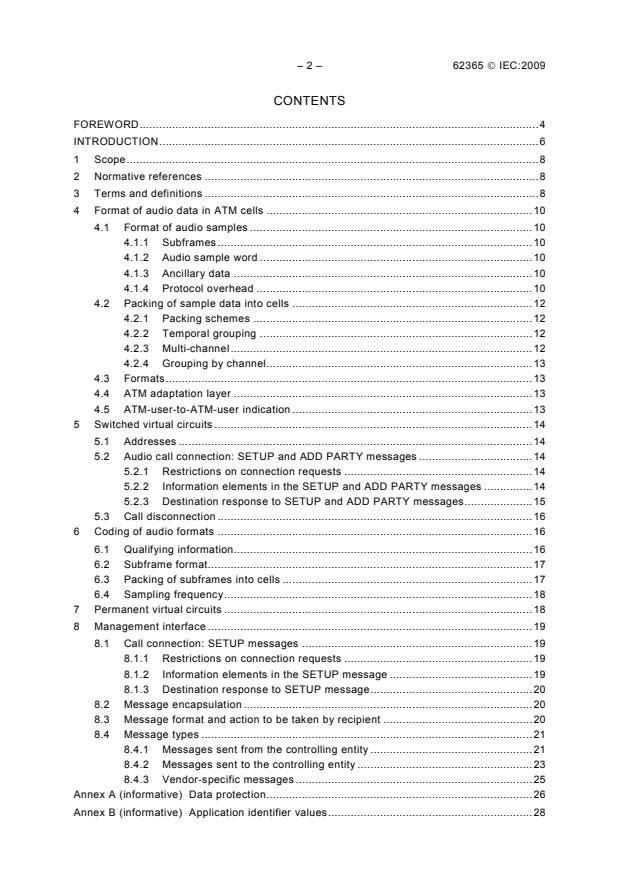
– 2 – 62365 IEC:2009
CONTENTS
FOREWORD . 4
INTRODUCTION . 6
1 Scope . 8
2 Normative references . 8
3 Terms and definitions . 8
4 Format of audio data in ATM cells . 10
4.1 Format of audio samples . 10
4.1.1 Subframes . 10
4.1.2 Audio sample word . 10
4.1.3 Ancillary data . 10
4.1.4 Protocol overhead . 10
4.2 Packing of sample data into cells . 12
4.2.1 Packing schemes . 12
4.2.2 Temporal grouping . 12
4.2.3 Multi-channel . 12
4.2.4 Grouping by channel. 13
4.3 Formats . 13
4.4 ATM adaptation layer . 13
4.5 ATM-user-to-ATM-user indication . 13
5 Switched virtual circuits . 14
5.1 Addresses . 14
5.2 Audio call connection: SETUP and ADD PARTY messages . 14
5.2.1 Restrictions on connection requests . 14
5.2.2 Information elements in the SETUP and ADD PARTY messages . 14
5.2.3 Destination response to SETUP and ADD PARTY messages . 15
5.3 Call disconnection . 16
6 Coding of audio formats . 16
6.1 Qualifying information. 16
6.2 Subframe format. 17
6.3 Packing of subframes into cells . 17
6.4 Sampling frequency . 18
7 Permanent virtual circuits . 18
8 Management interface . 19
8.1 Call connection: SETUP messages . 19
8.1.1 Restrictions on connection requests . 19
8.1.2 Information elements in the SETUP message . 19
8.1.3 Destination response to SETUP message . 20
8.2 Message encapsulation . 20
8.3 Message format and action to be taken by recipient . 20
8.4 Message types . 21
8.4.1 Messages sent from the controlling entity . 21
8.4.2 Messages sent to the controlling entity . 23
8.4.3 Vendor-specific messages . 25
Annex A (informative) Data protection . 26
Annex B (informative) Application identifier values . 28
62365 IEC:2009 – 3 –
Bibliography . 29
Table 1 – Fields contained in a subframe . 10
Table 2 – Default port number and packing for certain VCIs . 19
Table 3 – Status enquiry message . 21
Table 4 – Audio connection request message . 22
Table 5 – Audio disconnection request message . 22
Table 6 – Input port status message . 23
Table 7 – Output port status message . 24
Table 8 – Other status messages . 25
Table 9 – Vendor-specific messages . 25
Table A.1 – Sequence number protection field values . 26
Table B.1 – Application identifier (octets 9 to 12) values in the BHLI IE . 28
– 4 – 62365 IEC:2009
INTERNATIONAL ELECTROTECHNICAL COMMISSION
___________
DIGITAL AUDIO –
DIGITAL INPUT-OUTPUT INTERFACING –
TRANSMISSION OF DIGITAL AUDIO OVER
ASYNCHRONOUS TRANSFER MODE (ATM) NETWORKS
FOREWORD
1) The International Electrotechnical Commission (IEC) is a worldwide organization for standardization comprising
all national electrotechnical committees (IEC National Committees). The object of IEC is to promote
international co-operation on all questions concerning standardization in the electrical and electronic fields. To
this end and in addition to other activities, IEC publishes International Standards, Technical Specifications,
Technical Reports, Publicly Available Specifications (PAS) and Guides (hereafter referred to as “IEC
Publication(s)”). Their preparation is entrusted to technical committees; any IEC National Committee interested
in the subject dealt with may participate in this preparatory work. International, governmental and non-
governmental organizations liaising with the IEC also participate in this preparation. IEC collaborates closely
with the International Organization for Standardization (ISO) in accordance with conditions determined by
agreement between the two organizations.
2) The formal decisions or agreements of IEC on technical matters express, as nearly as possible, an international
consensus of opinion on the relevant subjects since each technical committee has representation from all
interested IEC National Committees.
3) IEC Publications have the form of recommendations for international use and are accepted by IEC National
Committees in that sense. While all reasonable efforts are made to ensure that the technical content of IEC
Publications is accurate, IEC cannot be held responsible for the way in which they are used or for any
misinterpretation by any end user.
4) In order to promote international uniformity, IEC National Committees undertake to apply IEC Publications
transparently to the maximum extent possible in their national and regional publications. Any divergence
between any IEC Publication and the corresponding national or regional publication shall be clearly indicated in
the latter.
5) IEC provides no marking procedure to indicate its approval and cannot be rendered responsible for any
equipment declared to be in conformity with an IEC Publication.
6) All users should ensure that they have the latest edition of this publication.
7) No liability shall attach to IEC or its directors, employees, servants or agents including individual experts and
members of its technical committees and IEC National Committees for any personal injury, property damage or
other damage of any nature whatsoever, whether direct or indirect, or for costs (including legal fees) and
expenses arising out of the publication, use of, or reliance upon, this IEC Publication or any other IEC
Publications.
8) Attention is drawn to the Normative references cited in this publication. Use of the referenced publications is
indispensable for the correct application of this publication.
9) Attention is drawn to the possibility that some of the elements of this IEC Publication may be the subject of
patent rights. IEC shall not be held responsible for identifying any or all such patent rights.
International Standard IEC 62365 has been prepared by technical area 4: Digital systems
interfaces and protocols, of IEC technical committee 100: Audio, video and multimedia
systems and equipment.
This bilingual version (2012-08) corresponds to the monolingual English version, published in
2009-05.The text of this standard is based on the following documents:
FDIS Report on voting
100/1517/FDIS 100/1550/RVD
Full information on the voting for the approval of this standard can be found in the report on
voting indicated in the above table.
The French version of this standard has not been voted upon.
62365 IEC:2009 – 5 –
This publication has been drafted in accordance with the ISO/IEC Directives, Part 2.
This second edition of IEC 62365 cancels and replaces the first edition published in 2004.
The main changes with respect to the previous edition (2004) are listed below.
– Second, third, and fourth required formats in 4.3 removed.
– 4.3 reformatted, eliminating Table 2, and subsequent Tables renumbered.
The committee has decided that the contents of this publication will remain unchanged until
the maintenance result date indicated on the IEC web site under "http://webstore.iec.ch" in
the data related to the specific publication. At this date, the publication will be
• reconfirmed;
• withdrawn;
• replaced by a revised edition, or
• amended.
– 6 – 62365 IEC:2009
INTRODUCTION
This International Standard describes means for the transmission of professional audio across
digital networks, including metropolitan- and wide-area networks, to provide the best
performance with regard to latency, jitter, and other relevant factors.
Current-generation wide-area communications are based on two very similar systems,
synchronous optical network (SONET) and synchronous digital hierarchy (SDH), SONET
being used in the United States and SDH in Europe. On top of them are run integrated
services digital network (ISDN), asynchronous transfer mode (ATM), and Internet protocol
(IP).
ISDN provides telephone call connections of a fixed capacity that carry one 8-bit value per
125 µs; when a call is set up, its route through the system is chosen, and the switches that
route the data are configured accordingly. Each link, between switches or between switch and
end equipment, is formatted into frames that take 125 µs to transmit, and each data byte is
identified by its position in the frame.
ATM, also called broadband ISDN, provides a service similar to ISDN, but with the capacity of
each call being specified by the caller. Links are formatted into cells, which consist of a
header and 48 data bytes; the header is typically 5 bytes long, and most of it is taken up with
the virtual channel identifier (VCI) that shows to which call the cell belongs. Call set-up,
routeing, and switching are done in the same way as in ISDN, but with calls not being
restricted to 1 byte every 125 µs.
IP provides a very different service, not designed for continuous media such as audio and
video. There is no call set-up, and each packet contains enough information within itself to
allow it to be routed to its destination. This means that the header is much larger than in the
case of ATM, typically 74 bytes, and packets will also typically be much larger, if only
because otherwise the overheads would be excessive. Each packet is liable to be routed
separately, so two packets that are part of the same flow may well take different routes. This
can mean that the one that was sent first does not arrive first.
For many professional audio applications, a round-trip time from the microphone through the
mixing desk and back to the headphones of no more than 3 ms is required. Allowing 0,5 ms
each for conversion from analog to digital and back again, it follows that the network
connections to and from the mixing desk must have a latency of less than 1 ms each. For
distances of more than about 200 km, the transmission delay alone will exceed 1 ms, but
within a metropolitan area the transmission delay should be no more than 0,25 ms (equivalent
to about 50 km), leaving 0,75 ms for packetization, queuing within switches, and
resynchronization within the receiving equipment.
Packetization delays are proportional to the size of the transmission unit (frame, cell, or
packet), and resynchronization delays depend on how evenly spaced the transmission units
are when they arrive at their destination. Both classes of delay are thus small for ISDN and
large for IP. Using the format specified in this standard to carry dual-channel IEC 60958-4
audio with a 48 kHz sampling frequency over ATM results in an inter-cell time of 125 µs, at
which ATM will have similar delays to ISDN. A higher sampling frequency or a larger number
of channels would reduce the inter-cell time and hence also the delays.
The queuing time within each ISDN switch is likely to be around one frame time or 125 µs.
The ATM documents limit the queuing time in an ATM switch to approximately the inter-cell
time for the call, which, as with the other delays, translates into performance similar to that of
ISDN for dual-channel 48 kHz IEC 60958-4 audio and better for higher sampling frequencies
or larger numbers of channels.
The queuing time within an IP router for normal, best effort, Internet traffic is unbounded, and
if the router is congested, packets may simply be thrown away. Resource reservation protocol
62365 IEC:2009 – 7 –
(RSVP) (see Annex A) allows capacity to be reserved for a particular traffic flow, but it does
not guarantee that the packets will actually be routed over the links on which the capacity has
been reserved; if the flow is re-routed, it will only get a best effort service until a reservation
has been made on the new route, and it may not even be possible to make a reservation on
the new route at all.
ATM has therefore been chosen as providing a more convenient service than ISDN and
significantly better performance than IP, even when RSVP is used.
This standard does not specify a physical interface to the network because one of the
features of ATM is its ability to make a seamless connection between interfaces operating at a
wide variety of data rates and with different ways of encoding the ATM cells. Commonly used
interfaces provide 25,6 Mbit/s over category 3 structured wiring and 155,52 Mbit/s over
category-5 structured wiring or fibre-optic cable.
The physical layer section description and unique ATM abbreviations can be found in ATM
forum approved specifications. See the Bibliography.
– 8 – 62365 IEC:2009
DIGITAL AUDIO –
DIGITAL INPUT-OUTPUT INTERFACING –
TRANSMISSION OF DIGITAL AUDIO OVER
ASYNCHRONOUS TRANSFER MODE (ATM) NETWORKS
1 Scope
This International Standard specifies a means to carry multiple channels of audio in linear
PCM or IEC 60958-4 format over an ATM layer service conforming to ITU-T Recommendation
I.150. It includes a means to convey, between parties, information concerning the digital audio
signal when setting up audio calls across the ATM network.
It does not specify the physical interface to the network.
2 Normative references
The following referenced documents are indispensable for the application of this document.
For dated references, only the edition cited applies. For undated references, the latest edition
of the referenced document (including any amendments) applies.
IEC 60958-1, Digital audio interface – Part 1: General
IEC 60958-4, Digital audio interface – Part 4: Professional applications (TA4)
ITU-T Recommendation I.150: B-ISDN asynchronous transfer mode functional characteristics
ITU-T Recommendation I.363.5, B-ISDN ATM Adaptation Layer specification: Type 5 AAL
ITU-T Recommendation Q.2931: Digital Subscriber Signalling System No. 2 – User-Network
Interface (UNI) layer 3 specification for basic call/connection control
3 Terms and definitions
For the purposes of this document, the following terms and definitions apply.
3.1
asynchronous transfer mode
ATM
networking technology in which data are carried in 48-o cells
NOTE Octet (unit symbol, o) is defined as an 8-bit data element by IEC 60027-2, which is synonymous with byte
(unit symbol, B) whenever the term, byte, is restricted to 8-bit elements.
3.2
ATM adaptation layer
AAL
protocol layer that allows different services, such as packet transfer, to be provided on an
ATM network
62365 IEC:2009 – 9 –
3.3
ATM signaling
protocol that conveys connection management and other messages between an ATM network
and equipment attached to it
3.4
audio channel
path that carries one monophonic digital audio signal
3.5
audio port
physical or virtual connector that carries a fixed number of audio channels
3.6
information element
IE
component of an ATM signalling message
3.7
MADI
serial multi-channel audio digital interface
3.8
organizationally unique identifier
OUI
3-o code issued by a designated agency to form globally consistent bit strings as described in
OUI and company_id assignments
3.9
user-to-user indication
UI
single bit in the ATM cell header that can be used by the ATM adaptation layer as a marker
for certain cells
3.10
virtual channel
communications channel that provides for the sequential unidirectional transport of ATM cells
on a link between two pieces of equipment
3.11
virtual channel identifier
VCI
numerical tag occupying a 16-bit field in the ATM cell header that identifies the virtual channel
over which the cell is to travel
3.12
virtual circuit
route through a network formed by concatenating virtual channels
3.13
virtual path
group of up to 65 536 virtual channels
3.14
virtual path identifier
VPI
numerical tag occupying an 8-bit field in the ATM cell header that identifies the virtual path
which contains the virtual channel over which the cell is to travel
– 10 – 62365 IEC:2009
4 Format of audio data in ATM cells
4.1 Format of audio samples
4.1.1 Subframes
4.1.1.1 Each audio sample shall be encoded in a subframe that consists of a whole number
of octets. The subframe shall be stored in the cell in consecutive octets, with the first bit of the
subframe in the most significant bit of the first octet.
4.1.1.2 A subframe shall consist of the fields listed in Table 1, in the order in which they
appear.
Table 1 – Fields contained in a subframe
Field Specified in
Audio sample word 4.1.2
Ancillary data 4.1.3
Protocol overhead 4.1.4
4.1.2 Audio sample word
4.1.2.1 The audio sample shall be represented in linear 2’s complement form, with the most
significant bit first. If the source provides fewer bits than the size of this field, the unused least
significant bits shall be set to zero.
NOTE This specification is the same as in IEC 60958-4, except that the bit order is reversed.
4.1.2.2 The number of bits in the audio sample word shall be chosen in such a way that the
total number of bits in the subframe is 8, 16, 24, 32, or 48.
4.1.3 Ancillary data
4.1.3.1 This field shall either contain no bits or consist of four bits designated B, C, U, V, in
that order.
4.1.3.2 The C, U, and V bits shall be the channel status, user data, and validity bits specified
in IEC 60958-1.
4.1.3.3 The B bit shall be a 1 for the first subframe of the block specified in IEC 60958-1,
and a 0 for all other subframes.
NOTE The B bit affects the interpretation of the C bit, and possibly also of the U bit, but has no relation to the
grouping of samples specified in 4.2.
Where more than one audio channel is carried, the B bit shall be set at the start of the block
in every channel, not just in the first channel. The block starts may be unaligned.
4.1.4 Protocol overhead
This field shall either contain no bits or consist of a sequencing bit followed by three bits that
provide data protection.
4.1.4.1 Sequencing word
The sequencing word consists of the sequencing bits of all the subframes in a cell, in the
order in which the subframes appear in the cell.
62365 IEC:2009 – 11 –
4.1.4.1.1 Sequence number
The first four bits of the sequencing word shall contain a sequence number in the form of a
binary integer with the least significant bit first.
Except in the first cell transmitted on a virtual circuit, the value of this integer shall be 1 more
(modulo 16) than in the previous cell on the same virtual circuit.
The value of this integer in the first cell transmitted on each virtual circuit shall be chosen
such that in the first cell of each block, as specified in 4.5, the least significant three bits shall
be zero.
The value of the most significant bit in the first cell transmitted on each virtual circuit shall not
be defined in this standard.
4.1.4.1.2 Sequence number protection
The fifth to seventh bits of the sequencing word shall contain the 1's complement of the
3 3
remainder of the division (modulo 2) by the generator polynomial x + x + 1 of the product x
multiplied by the sequence number. The coefficient of the x term in the remainder polynomial
is the fifth bit.
The eighth bit of the sequencing word shall be such that there are an even number of 1's in
the first eight bits.
NOTE Additional information is given in Annex A.
4.1.4.1.3 Second number
The ninth to twelfth bits of the sequencing word may contain a second number in the form of a
binary integer with the least significant bit first.
a) The value of this integer in the first cell transmitted on each virtual circuit shall be defined
in this standard only as in (b). Its value in a cell which is the first cell of a block (as
specified in 4.5) and has its user indication bit set to 1 shall be 1 more (modulo 16) than in
the previous cell on the same virtual circuit. Its value in each other cell shall be equal to
that in the previous cell on the same virtual circuit.
b) Where two ATM virtual circuits carry data from sources that use the same local clock as
specified in 4.5, there may be a defined relationship between the second number values
on the two connections which can allow co-temporal samples on the two connections to be
identified. The method by which the necessary information is conveyed to receiving
equipment is not specified in this standard.
NOTE The second number may be used to identify samples uniquely within a 16-second period.
c) If the sender does not support the inclusion of the second number, these four bits shall be
zero in every cell.
4.1.4.1.4 Remainder of sequencing word
Any further bits in the sequencing word shall be reserved and shall be set to zero on
transmission and ignored on reception.
4.1.4.2 Data protection bits
If the ancillary data field contains a V bit, the three data protection bits shall contain the 1's
complement of the remainder of the division (modulo 2) by the generator polynomial x + x + 1
of the sum of the product x multiplied by the most significant nine bits of the audio sample
and the product x multiplied by the V-bit.
– 12 – 62365 IEC:2009
Otherwise, the three data protection bits shall contain the 1's complement of the remainder of
3 3
the division (modulo 2) by the generator polynomial x + x + 1 of the product x multiplied by
the most significant nine bits of the audio sample.
In either case, the coefficient of the x term in the remainder polynomial is the first (most
significant) of the three bits.
NOTE This protection scheme is appropriate for linear PCM audio samples. Other data types carried in these
streams may need to arrange additional protection within their codecs.
4.2 Packing of sample data into cells
4.2.1 Packing schemes
4.2.1.1 An ATM virtual circuit shall carry either a single audio channel or a group of audio
channels. In the latter case, all audio channels in the group shall use the same format and
share the same sample clock.
For the purpose of this description, audio channels shall be numbered from 1 upwards. In the
examples, the sample times are given letters, so for instance 2a is the first sample on audio
channel 2 and 2b is the second.
4.2.1.2 The number of samples per cell shall be 48 divided by the number of octets in a
subframe (see 4.1.1).
4.2.1.3 On each ATM virtual circuit, one of the packing schemes specified in 4.2.2, 4.2.3,
and 4.2.4 shall be used. To assist interoperability, temporal grouping should be used in
preference to grouping by channel.
NOTE Only certain combinations of subframe size and number of audio channels are possible; if necessary, an
application may leave some audio channels unused.
4.2.1.4 The audio sample data in every subframe of an unused audio channel shall be 0.
4.2.2 Temporal grouping
The number of samples per cell shall be divisible by the number of audio channels.
Co-temporal samples shall be grouped together. Samples within a group shall be in audio
channel number order and groups shall be in temporal order.
A block, for the purposes of 4.5, shall consist of eight cells.
EXAMPLE
2 channels, 12 samples per cell: 1a, 2a, 1b, 2b, 1c, 2c, 1d, 2d, 1e, 2e, 1f, 2f.
4.2.3 Multi-channel
The number of audio channels shall be divisible by the number of samples per cell.
Samples shall be in channel number order.
A block, for the purposes of 4.5, shall consist of eight sets of samples.
62365 IEC:2009 – 13 –
EXAMPLE
24 channels, 12 samples per cell: 1a . 12a in first cell; 13a . 24a in second; 1b . 12b in
third.
4.2.4 Grouping by channel
The number of samples per cell shall be divisible by the number of channels.
Samples on the same channel shall be grouped together; samples within a group shall be in
temporal order, and groups shall be in channel number order.
A block (for the purposes of 4.5) shall consist of eight cells.
EXAMPLE
2 channels, 12 samples per cell: 1a, 1b, 1c, 1d, 1e, 1f, 2a, 2b, 2c, 2d, 2e, 2f.
NOTE If there is just one channel, this scheme is identical to temporal grouping; if the number of channels is
equal to the number of samples per cell, all three schemes are identical.
4.3 Formats
4.3.1 Only those subframe formats, packing schemes, and sampling frequencies that are
expressible in the notation of Clause 6 shall be used.
NOTE See additional restrictions in 4.1.2 and 4.2.1.
4.3.2 To increase the likelihood that equipment designed for different applications will
interoperate successfully, all equipment should support the format with 24 audio data bits,
4 ancillary data bits, and 4 protocol overhead bits, packed as 2 channels with temporal
grouping as specified in 4.2.2.
NOTE This format is signaled by the values 56 in the second octet of the AAL Parameters IE and 02 in the
16 16
third octet; it is the appropriate format for conveying AES3 transparently.
4.3.3 Equipment that can convey at least 56 audio channels should support the format with
24 audio data bits, 4 ancillary data bits, and 4 protocol overhead bits as a multi-channel call
carrying 60 channels, as specified in 4.2.3.
NOTE This format is signaled by the values 56 in the second octet of the AAL parameters IE and 85 in the
16 16
third octet; it is the appropriate format for conveying 56-channel MADI transparently (the last 4 channels being
unused).
4.3.4 Sampling frequencies should be as specified in AES5.
NOTE The preferred sampling frequency specified in AES5 is 48 kHz.
4.4 ATM adaptation layer
Audio virtual circuits shall use a user-defined ATM adaptation layer.
4.5 ATM-user-to-ATM-user indication
4.5.1 Cells shall be grouped into blocks as specified in 4.2.
4.5.2 The sender shall include a local clock, which ticks once per second.
NOTE This standard does not specify the accuracy of the local clock, nor to what (if anything) it is synchronized.
It need not be related to the audio sample clock.
– 14 – 62365 IEC:2009
4.5.3 For the first block transmitted after a clock tick, the ATM-user-to-ATM-user indication
(UI bit) in the cell header shall be set to 1 in the first and last cells and to 0 in all other cells.
For all other blocks, the ATM-user-to-ATM-user indication shall be set to 1 in the last cell and
to 0 in all other cells.
NOTE If the state of the UI bit is latched as each cell is unpacked, the resulting signal can be a pulse train with
the leading edges of the pulses being evenly spaced with frequency f/8n, where f is the sampling frequency and n
the number of samples from the same channel in a cell, and with a double-width pulse once each second.
5 Switched virtual circuits
5.1 Addresses
5.1.1 The distinction between audio and other circuits, and between different types of ports,
shall be made using protocol and other information conveyed as specified in 5.2 and 8.1.
5.1.2 Source and destination ports may be different types; the calling party number (or
subaddress) shall identify a source port, and the called party number (or subaddress) shall
identify a destination port.
5.1.3 The distinction between different ports of the same type within an interface shall be
made using the Selector value.
5.1.4 An audio port may carry more than one audio channel; the protocol information
specifies how many channels are to be received. Ports with different numbers of channels
may be considered to be of different types, and the same physical port may be addressed in
more than one way; for instance, an AES3 output port may be addressed as a single stereo
port, two mono ports, a single mono port using double sampling frequency mode, or as one of
a group of three carrying a 5.1-channel signal.
5.2 Audio call connection: SETUP and ADD PARTY messages
5.2.1 Restrictions on connection requests
5.2.1.1 All audio connections shall be point to multipoint and shall be originated by the
equipment that contains the source port.
NOTE When connecting a new call, the caller sends a SETUP message and the destination equipment receives a
SETUP message; when adding a new destination, the caller sends an ADD PARTY message and the destination
equipment receives a SETUP message unless it already has a port that is a destination for that call, in which case
it receives an ADD PARTY message.
5.2.1.2 The AAL parameters, broadband high-layer information, and calling party number
information elements (IE), which are optional in the ATM signalling specification, shall be
required when connecting an audio call.
5.2.1.3 If the called party number is not in the network service access point (NSAP) format
conforming to Table 4-12 of ITU Q.2931, the called party subaddress IE shall be required.
If the calling party number is not in the NSAP format, the calling party subaddress IE shall be
required.
5.2.2 Information elements in the SETUP and ADD PARTY messages
5.2.2.1 ATM adaptation layer parameters IE
Within the ATM adaptation layer parameters IE, the following coding shall be used.
a) The AAL type shall be coded as user defined AAL (10 in octet 5).
62365 IEC:2009 – 15 –
b) The first octet of the user defined AAL information (octet 6) shall encode the qualifying
information specified in 6.1.
c) The second octet of the user defined AAL information (octet 6.1) shall encode the
subframe format as specified in 6.2.
d) The third octet of the user defined AAL information (octet 6.2) shall encode the packing of
subframes into cells as specified in 6.3.
e) The fourth octet of the user defined AAL information (octet 6.3) shall encode the sampling
frequency as specified in 6.4.
5.2.2.2 Broadband high-layer information IE
Within the broadband high-layer information IE, the following coding shall be used.
a) The high-layer information type shall be coded as vendor-specific application identifier
(83 in octet 5).
b) The OUI value shall be coded as 00 in octet 6, 0B in octet 7, and 5E in octet 8.
16 16 16
c) The first octet of the application identifier (octet 9) shall be coded as zero to indicate the
first edition of this standard.
d) The second octet of the application identifier (octet 10) shall be coded as zero to indicate
audio data.
The remaining octets of the application identifier (octets 11 to 12) are reserved. They shall be
coded as zero but ignored by the recipient unless specified by a means specified outside this
standard.
NOTE A different value for octet 10 is specified in 8.1.2.2. Encodings in the broadband high-layer information IE
are summarized in Annex C.
5.2.3 Destination response to SETUP and ADD PARTY messages
5.2.3.1 Destination response to SETUP message
5.2.3.1.1 A SETUP message received from the network shall be processed according to the
provisions of this standard for audio calls if it meets the following three criteria.
a) It contains a broadband high-layer information IE which conforms to 5.2.2.2 or does not
contain a broadband high-layer information IE but is in other respects consistent with
being an audio call conforming to this standard.
b) It is for a point-to-multipoint connection.
c) It contains ATM adaptation layer parameters IE indicating a user-defined AAL (10 in
octet 5).
5.2.3.1.2 If the first octet of the user defined AAL information (octet 6) does not contain an
encoding recognized by the equipment, the destination equipment shall reject the call with
cause value call rejected (octet 6 = 95 in the cause IE), rejection reason user specific and
condition permanent (octet 7 = 81 ), and the user specific diagnostic (octet 7.1) coded as a
single octet with the value zero.
5.2.3.1.3 If the remaining octets of the user defined AAL information (octets 6.1 to 6.3)
indicate a format or sampling frequency which the equipment does not support, the
destination equipment shall reject the call with cause value call rejected (octet 6 = 95 ),
rejection reason user specific and condition permanent (octet 7 = 81 ), and the first user
specific diagnostic octet coded as 01.
NOTE The destination equipment should take the sampling frequency from the AAL parameters IE and not
calculate it from the cell rate in the ATM traffic descriptor IE.
– 16 – 62365 IEC:2009
5.2.3.1.4 If the Selector value, in the context of the format indicated by the ATM adaptation
layer parameters IE, does not correspond to an output port or corresponds to an output port
which is disabled, the destination equipment shall reject the call with cause value call rejected
(octet 6 = 95 ), rejection reason user specific and condition permanent if the port does not
exist, transient if it is disabled (octet 7 = 81 or 82 , respectively), and the first user specific
16 16
diagnostic octet coded as 02 .
5.2.3.1.5 If the selector value (in the context of the format indicated by the ATM adaptation
layer parameters IE) corresponds to an output port which would conflict with an existing
connection, or completing the connection would require some other resource that has been
used up for other calls, the destination equipment shall reject the call with cause value user
busy (octet 6 = 91 ).
NOTE Receiving equipment can include two cause IEs in the RELEASE message to give information on two
different aspects of the reason for rejection of the call. If two-cause IEs are included, the cause value specified in
this subclause may be in either of them.
5.2.3.2 Destination response to ADD PARTY message
5.2.3.2.1 An ADD PARTY message received from the network shall only be processed
according to this standard if it relates to an audio call conforming to this standard.
5.2.3.2.2 The receiving equipment may process the ATM adaptation layer parameters IE in
the same way as for a SETUP message (see 5.2.3.1), or it may check that it is the same as
that received when the call was connected and reject the call with cause invalid information
element contents (octet 6 = E4 ) citing the ATM adaptation layer parameters IE (octet 7 =
) if it is not.
5.2.3.2.3 The selector value is processed in the same way as for a SETUP message (see
5.2.3.1).
5.3 Call disconnection
Disconnection may be initiated by either the source or the destination equipment without
giving any warning to the other party.
NOTE Disconnection can also be initiated by the network in the e
...