

ISO/IEC 29341-18-13:2011
(Main)Information technology - UPnP Device Architecture - Part 18-13: Remote Access Device Control Protocol - Remote Access Transport Agent Configuration Service
General Information
- Abstract
ISO/IEC 29341-18-13:2011(E) describes a service definition which is compliant with the UPnP Device Architecture version 1.0. It defines a service type referred to herein as RATAConfig service. The RATAConfig service is a UPnP service that allows control points to provision and configure the parameters that are required for enabling a Remote Access Server to accept and a Remote Access Client to initiate remote access connections. This service provides control points with the following functionality: - Determine the Remote Access Transport Agents that can be configured by the service. - Determine the delivery mechanisms for credentials supported by the service. - Configure Remote Access Transport Agent profiles. - Management of Remote Access Transport Agent profiles.
- Status
- Published
- Publication Date
- 29-Aug-2011
- Technical Committee
- ISO/IEC JTC 1 - Information technology
- Current Stage
- PPUB - Publication issued
- Start Date
- 29-Aug-2011
- Completion Date
- 30-Nov-2011
Overview
ISO/IEC 29341-18-13:2011 - part of the UPnP Device Architecture series - defines the RATAConfig service (Remote Access Transport Agent Configuration Service). This UPnP-compatible service specification describes how control points can provision and configure the parameters required for a Remote Access Server to accept, and a Remote Access Client to initiate, remote access connections. The standard is compliant with UPnP Device Architecture v1.0 and targets automated configuration and management of remote-access transport agents.
Key Topics and Requirements
- Primary functionality:
- Determine which Remote Access Transport Agents can be configured by the device.
- Discover supported credential delivery mechanisms.
- Configure Remote Access Transport Agent profiles.
- Manage profiles (add, edit, delete, list).
- Service model elements:
- Defined state variables (e.g., TransportAgentCapabilities, CredentialDelivery, ProfileList, CredentialsList).
- Well-defined actions such as GetTransportAgentCapabilities(), GetSupportedCredentialDelivery(), GetCredentialsList(), GetProfileList(), AddProfile(), EditProfile(), DeleteProfile(), GetProfileConfigInfo().
- XML service description and eventing/moderation rules for UPnP control points.
- Implementation aids:
- Normative annexes with RATransportAgent data structures and templates (ProfileList, ProfileConfig).
- Annexes for using IPsec and OpenVPN as remote access transports, including templates and sample configuration files.
- Addressing considerations (e.g., IPv4 allocation and address-space collision).
- Excluded topics: the standard explicitly does not address the trust model for secure remote access or the mechanics of credential delivery itself - implementers must handle trust and credential exchange per complementary security standards.
Applications and Who Uses It
- Device and firmware vendors building gateways, routers, NAS, IoT hubs, or remote access appliances that expose UPnP services for remote-access configuration.
- Control point developers and management applications that automate provisioning of remote access profiles to client and server endpoints.
- System integrators and network administrators seeking standardized, programmatic ways to deploy VPN/IPsec/OpenVPN profiles across consumer and enterprise devices.
- Test labs and certification bodies validating UPnP-based remote-access configuration interoperability.
Practical use cases include zero-touch provisioning of remote-access profiles, centralized management of VPN endpoints, and automated distribution of transport-agent settings to enable secure remote connections.
Related Standards
- UPnP Device Architecture v1.0 (base architecture referenced by this part).
- Other parts of ISO/IEC 29341 (UPnP device architecture series) for complementary device and service definitions.
Keywords: ISO/IEC 29341-18-13:2011, UPnP, RATAConfig, Remote Access Transport Agent, Remote Access Device Control Protocol, IPsec, OpenVPN, profile configuration, control point, UPnP service.
Get Certified
Connect with accredited certification bodies for this standard

BSI Group
BSI (British Standards Institution) is the business standards company that helps organizations make excellence a habit.

IMQ S.p.A. (Certification)
Italian electrical product certification.

SLG Prüf- und Zertifizierungs GmbH
German testing and certification body.
Sponsored listings
Frequently Asked Questions
ISO/IEC 29341-18-13:2011 is a standard published by the International Electrotechnical Commission (IEC). Its full title is "Information technology - UPnP Device Architecture - Part 18-13: Remote Access Device Control Protocol - Remote Access Transport Agent Configuration Service". This standard covers: ISO/IEC 29341-18-13:2011(E) describes a service definition which is compliant with the UPnP Device Architecture version 1.0. It defines a service type referred to herein as RATAConfig service. The RATAConfig service is a UPnP service that allows control points to provision and configure the parameters that are required for enabling a Remote Access Server to accept and a Remote Access Client to initiate remote access connections. This service provides control points with the following functionality: - Determine the Remote Access Transport Agents that can be configured by the service. - Determine the delivery mechanisms for credentials supported by the service. - Configure Remote Access Transport Agent profiles. - Management of Remote Access Transport Agent profiles.
ISO/IEC 29341-18-13:2011(E) describes a service definition which is compliant with the UPnP Device Architecture version 1.0. It defines a service type referred to herein as RATAConfig service. The RATAConfig service is a UPnP service that allows control points to provision and configure the parameters that are required for enabling a Remote Access Server to accept and a Remote Access Client to initiate remote access connections. This service provides control points with the following functionality: - Determine the Remote Access Transport Agents that can be configured by the service. - Determine the delivery mechanisms for credentials supported by the service. - Configure Remote Access Transport Agent profiles. - Management of Remote Access Transport Agent profiles.
ISO/IEC 29341-18-13:2011 is classified under the following ICS (International Classification for Standards) categories: 29.060.10 - Wires; 35.200 - Interface and interconnection equipment. The ICS classification helps identify the subject area and facilitates finding related standards.
ISO/IEC 29341-18-13:2011 is available in PDF format for immediate download after purchase. The document can be added to your cart and obtained through the secure checkout process. Digital delivery ensures instant access to the complete standard document.
Standards Content (Sample)
ISO/IEC 29341-18-13
Edition 1.0 2011-08
INTERNATIONAL
STANDARD
colour
inside
Information technology – UPnP device architecture –
Part 18-13: Remote Access Device Control Protocol – Remote Access Transport
Agent Configuration Service
All rights reserved. Unless otherwise specified, no part of this publication may be reproduced or utilized in any form
or by any means, electronic or mechanical, including photocopying and microfilm, without permission in writing from
either IEC or IEC's member National Committee in the country of the requester.
If you have any questions about ISO/IEC copyright or have an enquiry about obtaining additional rights to this
publication, please contact the address below or your local IEC member National Committee for further information.
IEC Central Office
3, rue de Varembé
CH-1211 Geneva 20
Switzerland
Email: inmail@iec.ch
Web: www.iec.ch
About the IEC
The International Electrotechnical Commission (IEC) is the leading global organization that prepares and publishes
International Standards for all electrical, electronic and related technologies.
About IEC publications
The technical content of IEC publications is kept under constant review by the IEC. Please make sure that you have the
latest edition, a corrigenda or an amendment might have been published.
Catalogue of IEC publications: www.iec.ch/searchpub
The IEC on-line Catalogue enables you to search by a variety of criteria (reference number, text, technical committee,…).
It also gives information on projects, withdrawn and replaced publications.
IEC Just Published: www.iec.ch/online_news/justpub
Stay up to date on all new IEC publications. Just Published details twice a month all new publications released. Available
on-line and also by email.
Electropedia: www.electropedia.org
The world's leading online dictionary of electronic and electrical terms containing more than 20 000 terms and definitions
in English and French, with equivalent terms in additional languages. Also known as the International Electrotechnical
Vocabulary online.
Customer Service Centre: www.iec.ch/webstore/custserv
If you wish to give us your feedback on this publication or need further assistance, please visit the Customer Service
Centre FAQ or contact us:
Email: csc@iec.ch
Tel.: +41 22 919 02 11
Fax: +41 22 919 03 00
ISO/IEC 29341-18-13
Edition 1.0 2011-08
INTERNATIONAL
STANDARD
colour
inside
Information technology – UPnP device architecture –
Part 18-13: Remote Access Device Control Protocol – Remote Access Transport
Agent Configuration Service
INTERNATIONAL
ELECTROTECHNICAL
COMMISSION
PRICE CODE
S
ICS 35.200 ISBN 978-2-88912-641-5
29341-18-13 © ISO/IEC:2011(E)
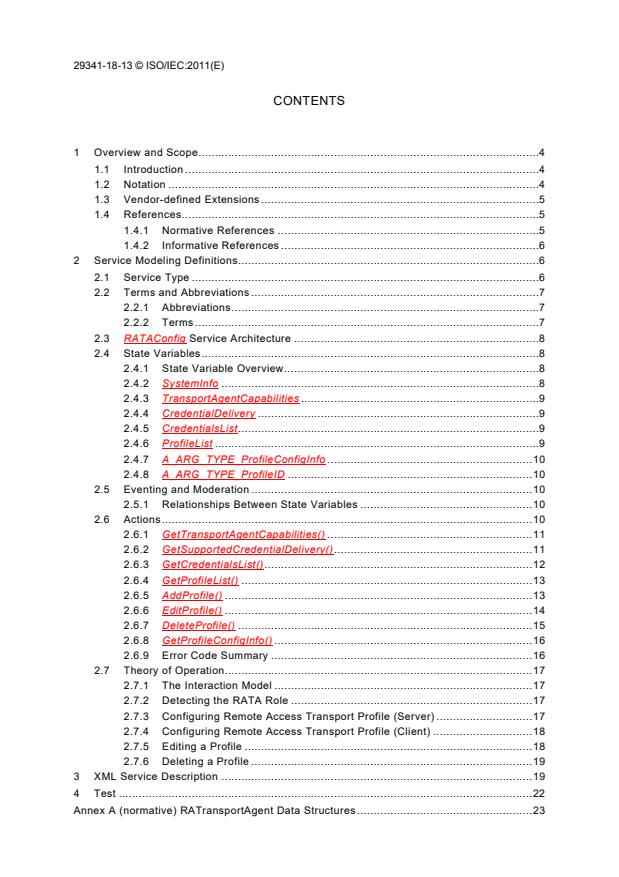
CONTENTS
1 Overview and Scope . 4
1.1 Introduction . 4
1.2 Notation . 4
1.3 Vendor-defined Extensions . 5
1.4 References . 5
1.4.1 Normative References . 5
1.4.2 Informative References . 6
2 Service Modeling Definitions . 6
2.1 Service Type . 6
2.2 Terms and Abbreviations . 7
2.2.1 Abbrevia tions . 7
2.2.2 Terms . 7
2.3 RATAConfig Service Architecture . 8
2.4 State Vari ables . 8
2.4.1 State Variable Overview . 8
2.4.2 SystemInfo . 8
2.4.3 TransportAgentCapabilities . 9
2.4.4 CredentialDelivery . 9
2.4.5 CredentialsList . 9
2.4.6 ProfileList . 9
2.4.7 A_ARG_TYPE_ProfileConfigInfo . 10
2.4.8 A_ARG_TYPE_ProfileID . 10
2.5 Eventing and Moderation . 10
2.5.1 Relationships Between State Variables . 10
2.6 Actions . 10
2.6.1 GetTransportAgentCapabilities() . 11
2.6.2 GetSupportedCredentialDelivery() . 11
2.6.3 GetCredentialsList() . 12
2.6.4 GetProfileList() . 13
2.6.5 AddProfile() . 13
2.6.6 EditProfile() . 14
2.6.7 DeleteProfile() . 15
2.6.8 GetProfileConfigInfo() . 16
2.6.9 Error Code Summary . 16
2.7 Theory of Operation . 17
2.7.1 The Interaction Model . 17
2.7.2 Detecting the RATA Role . 17
2.7.3 Configuring Remote Access Transport Profile (Server) . 17
2.7.4 Configuring Remote Access Transport Profile (Client) . 18
2.7.5 Editing a Profile . 18
2.7.6 Deleting a Profile . 19
3 XML Service Description . 19
4 Test . . 22
Annex A (normative) RATransportAgent Data Structures . 23
XXX: © IEC:2010 — 2— 29341-18-13 © ISO/IEC:2011(E)
A.1 ProfileList Template . 23
A.2 ProfileConfig Template . 23
A.3 TransportAgentCapabilities Template . 24
A.4 CredentialDelivery Template . 25
A.5 CredentialsList Template . 26
A.6 TransportAgent Datastructure Schema . 27
Annex B (informative) Addressing Considerations . 28
B.1 IPv4 Considerations . 28
B.1.1 IPv4 Address Allocation . 28
B.1.2 Address Space Collisi ons. 28
Annex C (normative) Using IPsec as Remote Access Transport . 30
C.1 IPsec Templates . 30
C.1.1 IPsec Options Template . 30
C.1.2 IPsec Configuration Template . 31
C.2 Sample IPsec Files . 34
C.2.1 Sample IPSec based on certificates . 34
C.2.2 Sample IPSec based on shared key null policy . 37
C.2.3 Sample IPSec based on shared key advanced policy . 39
Annex D (normative) Using OpenVPN as Remote Access Transport . 42
D.1 OpenVPN Templates . 42
D.1.1 OpenVPN Configuration Templa te . 42
D.2 Sample OpenVPN configurat ion . 46
D.2.1 Sample configuration for Server . 46
D.2.2 Sample configuration for Client . 46
Figure 2-1 — The Interaction Model. . 17
Figure 2-2 — Configuring Remote Access Transport Profiles. . 18
Figure 2-3 — Editing Remote Access Transport Profiles . . 18
Figure 2-4 — Deleting Remote Access Transport Profiles. . 19
Figure B.1 — Address Space Collision Problem. . 28
Table 2-1 — Abbreviati ons . 7
Table 2-2 — State Variables . 8
Table 2-3 — Eventing and Moderation . 10
Table 2-4 — Actions . 10
Table 2-5 — Arguments for GetTransportAgentCapabilities() . 11
Table 2-6 — Error Codes for GetTransportAgentCapabilities() . 11
Table 2-7 — Arguments for GetSupportedCredentialDelivery() . 11
Table 2-8 — Error Codes for GetSupportedCredentialDelivery() . 12
Table 2-9 — Arguments for GetCredentialsList() . 12
Table 2-10 — Error Codes for GetCredentialsList() . 13
Table 2-11 — Arguments for GetProfileList() . 13
Table 2-12 — Error Codes for GetProfileList() . 13
Table 2-13 — Arguments for AddProfile() . 13
Table 2-14 — Error Codes for AddProfile() . 14
Table 2-15 — Arguments for EditProfile() . 14
29341-18-13 XXX: © IEC:2010 © ISO/IEC:2011(E) — 3—
Table 2-16 — Error Codes for EditProfile() . 15
Table 2-17 — Arguments for DeleteProfile() . 15
Table 2-18 — Error Codes for DeleteProfile() . 16
Table 2-19 — Arguments for GetProfileConfigInfo() . 16
Table 2-20 — Error Codes for GetProfileConfigInfo() . 16
Table 2-21 — Error Code Summary . 17
29341-18-13 © ISO/IEC:2011(E)
INFORMATION TECHNOLOGY –
UPNP DEVICE ARCHITECTURE –
Part 18-13: Remote Access Device Control Protocol –
Remote Access Transport Agent Configuration Service
FOREWORD
1) ISO (International Organization for Standardization) and IEC (International Electrotechnical Commission) form the
specialized system for worldwide standardization. National bodies that are members of ISO or IEC participate in
the development of International Standards. Their preparation is entrusted to technical committees; any ISO and
IEC member body interested in the subject dealt with may participate in this preparatory work. International
governmental and non-governmental organizations liaising with ISO and IEC also participate in this preparation.
2) In the field of information technology, ISO and IEC have established a joint technical committee, ISO/IEC JTC 1.
Draft International Standards adopted by the joint technical committee are circulated to national bodies for voting.
Publication as an International Standard requires approval by at least 75 % of the national bodies casting a vote.
3) The formal decisions or agreements of IEC and ISO on technical matters express, as nearly as possible, an
international consensus of opinion on the relevant subjects since each technical committee has representation
from all interested IEC and ISO member bodies.
4) IEC, ISO and ISO/IEC publications have the form of recommendations for international use and are accepted
by IEC and ISO member bodies in that sense. While all reasonable efforts are made to ensure that the
technical content of IEC, ISO and ISO/IEC publications is accurate, IEC or ISO cannot be held responsible for
the way in which they are used or for any misinterpretation by any end user.
5) In order to promote international uniformity, IEC and ISO member bodies undertake to apply IEC, ISO and
ISO/IEC publications transparently to the maximum extent possible in their national and regional publications.
Any divergence between any ISO/IEC publication and the corresponding national or regional publication
should be clearly indicated in the latter.
6) ISO and IEC provide no marking procedure to indicate their approval and cannot be rendered responsible for
any equipment declared to be in conformity with an ISO/IEC publication.
7) All users should ensure that they have the latest edition of this publication.
8) No liability shall attach to IEC or ISO or its directors, employees, servants or agents including individual experts
and members of their technical committees and IEC or ISO member bodies for any personal injury, property
damage or other damage of any nature whatsoever, whether direct or indirect, or for costs (including legal fees)
and expenses arising out of the publication of, use of, or reliance upon, this ISO/IEC publication or any other IEC,
ISO or ISO/IEC publications.
9) Attention is drawn to the normative references cited in this publication. Use of the referenced publications is
indispensable for the correct application of this publication.
10) Attention is drawn to the possibility that some of the elements of this International Standard may be the subject of
patent rights. ISO and IEC shall not be held responsible for identifying any or all such patent rights.
International Standard ISO/IEC 29341-18-13 was prepared by UPnP Forum Steering
committee , was adopted, under the fast track procedure, by subcommittee 25:
Interconnection of information technology equipment, of ISO/IEC joint technical committee 1:
Information technology.
The list of all currently available parts of the ISO/IEC 29341 series, under the general title
Information technology – UPnP device architecture, can be found on the IEC web site.
This International Standard has been approved by vote of the member bodies, and the voting
results may be obtained from the address given on the second title page.
—————————
rd
UPnP Forum Steering committee, UPnP Forum, 3855 SW 153 Drive, Beaverton, Oregon 97006 USA. See also
“Introduction”.
29341-18-13 © ISO/IEC:2011(E)
IMPORTANT – The “colour inside” logo on the cover page of this publication indicates
that it contains colours which are considered to be useful for the correct understanding
of its contents. Users should therefore print this publication using a colour printer.
XXX: © IEC:2010 — 4— 29341-18-13 © ISO/IEC:2011(E)
1 Overview and Scope
This service definition is compliant with the UPnP Device Architecture version 1.0. It defines
a service type referred to herein as RATAConfig service.
1.1 Introduction
service is a UPnP service that allows control points to provision and
The RATAConfig
configure the parameters that are required for enabling a Remote Access Server to accept
and a Remote Access Client to initiate remote access connections. This service provides
control points with the following functionality:
• Determine the Remote Access Transport Agents that can be configured by the service.
• Determine the delivery mechanisms for credentials supported by the service.
• Configure Remote Access Transport Agent profiles
• Management of Remote Access Transport Agent profiles
This service does not address:
• The trust model that will enable secure remote access connections.
• The delivery of credentials.
1.2 Notation
• In this document, features are described as Required, Recommended, or Optional as
follows:
The key words “MUST,” “MUST NOT,” “REQUIRED,” “SHALL,” “SHALL NOT,” “SHOULD,”
“SHOULD NOT,” “RECOMMENDED,” “MAY,” and “OPTIONAL” in this specification are to
be interpreted as described in [RFC 2119].
In addition, the following keywords are used in this specification:
PROHIBITED – The definition or behavior is an absolute prohibition of this specification.
Opposite of REQUIRED.
CONDITIONALLY REQUIRED – The definition or behavior depends on a condition. If the
specified condition is met, then the definition or behavior is REQUIRED, otherwise it is
PROHIBITED.
CONDITIONALLY OPTIONAL – The definition or behavior depends on a condition. If the
specified condition is met, then the definition or behavior is OPTIONAL, otherwise it is
PROHIBITED.
These keywords are thus capitalized when used to unambiguously specify requirements
over protocol and application features and behavior that affect the interoperability and
security of implementations. When these words are not capitalized, they are meant in
their natural-language sense.
• Strings that are to be taken literally are enclosed in “double quotes”.
• Placeholder values that need to be replaced are enclosed in the curly brackets “{” and “}”.
• Words that are emphasized are printed in italic.
• Keywords that are defined by the UPnP Working Committee are printed using the forum
character style.
• Keywords that are defined by the UPnP Device Architecture are printed using the arch
character style.
• A double colon delimiter, “::”, signifies a hierarchical parent-child (parent::child)
relationship between the two objects separated by the double colon. This delimiter is used
in multiple contexts, for example: Service::Action(), Action()::Argument,
parentProperty::childProperty.
29341-18-13 XXX: © IEC:2010 © ISO/IEC:2011(E) — 5—
1.3 Vendor-defined Extensions
Whenever vendors create additional vendor-defined state variables, actions or properties,
their assigned names and XML representation MUST follow the naming conventions and XML
rules as specified in [DEVICE], Clause 2.5, “Description: Non-standard vendor extensions”.
1.4 References
1.4.1 Normative References
This clause lists the normative references used in this specification and includes the tag
inside square brackets that is used for each such reference:
[DEVICE] – UPnP Device Architecture, version 1.0. Available at:
http://www.upnp.org/specs/arch/UPnP-arch-DeviceArchitecture-v1.0-20080424.pdf. Latest
version available at: http://www.upnp.org/specs/arch/UPnP-arch-DeviceArchitecture-v1.0.pdf.
[DEVICE-IPv6] – UPnP Device Architecture, version 1.0., Annex A – IP Version 6 Support.
Available at: http://www.upnp.org/resources/documents/AnnexA-IPv6_000.pdf
[RAClient] – RAClient:1, UPnP Forum, Available at: http://www.upnp.org/specs/ra/UPnP-ra-
RAClient-v1-Device-20090930.pdf. Latest version available at:
http://www.upnp.org/specs/ra/UPnP-ra-RAClient-v1-Device.pdf.
[RAServer] – RAServer:1, UPnP Forum, Available at: http://www.upnp.org/specs/ra/UPnP-ra-
RAServer-v1-Device-20090930.pdf. Latest version available at:
http://upnp.org/specs/ra/UPnP-ra-RAServer-v1-Device.pdf.
[RADASync] – RADASync:1, UPnP Forum,
Available at: http://www.upnp.org/specs/ra/UPnP-ra-RADASync-v1-Service-20090930.pdf.
Latest version available at: http://www.upnp.org/specs/ra/UPnP-ra-RADASync-v1-Service.pdf.
[RFC 2119] – IETF RFC 2119, Key words for use in RFCs to Indicate Requirement Levels, S.
Bradner, March 1997.
Available at: http://www.ietf.org/rfcs/rfc2119.txt.
[DADS-XSD] – XML Schema for UPnP RA Discovery Agent XML Data Structures
Available at: http://www.upnp.org/schemas/ra/dads-v1-20090930.xsd.
Latest version available at: http://www.upnp.org/schemas/ra/dads-v1.xsd.
[TADS-XSD] – XML Schema for UPnP RA Transport Agent XML Data Structures
Available at: http://www.upnp.org/schemas/ra/tads-v1-20090930.xsd.
Latest version available at: http://www.upnp.org/schemas/ra/tads-v1.xsd.
[IPSEC-XSD] – XML Schema for IPSec Transport Agent Options and Configuration XML Data
Structures
Available at: http://www.upnp.org/schemas/ra/tacfg-ipsec-v1-20090930.xsd.
Latest version available at: http://www.upnp.org/schemas/ra/tacfg-ipsec-v1.xsd.
[OPENVPN-XSD] – XML Schema for OpenVPN Transport Agent Options and Configuration
XML Data Structures
Available at: http://www.upnp.org/schemas/ra/tacfg-openvpn-v1-20090930.xsd.
Latest version available at: http://www.upnp.org/schemas/ra/tacfg-openvpn-v1.xsd.
[XML] – “Extensible Markup Language (XML) 1.0 (Third Edition)”, François Yergeau, Tim
Bray, Jean Paoli, C. M. Sperberg-McQueen, Eve Maler, eds., W3C Recommendation,
February 4, 2004.
Available at: http://www.w3.org/TR/2004/REC-xml-20040204/.
XXX: © IEC:2010 — 6— 29341-18-13 © ISO/IEC:2011(E)
1.4.2 Informative References
This clause lists the informative references that are provided as information in helping
understand this specification:
[IGD] – InternetGatewayDevice:1, UPnP Forum, November, 2001
Available at: http://www.upnp.org/standardizeddcps/documents/UPnP_IGD_1.0.zip
[RAARCH] – RAArchitecture:1, UPnP Forum,
Available at: http://www.upnp.org/specs/ra/UPnP-ra-RAArchitecture-v1-20090930.pdf.
Latest version available at: http://www.upnp.org/specs/ra/UPnP-ra-RAArchitecture-v1.pdf.
[RADAConfig] – RADAConfig:1, UPnP Forum,
Available at: http://www.upnp.org/specs/ra/UPnP-ra-RADAConfig-v1-Service-20090930.pdf.
Latest version available at: http://www.upnp.org/specs/ra/UPnP-ra-RADAConfig-v1-
Service.pdf.
[RFC 2406] – IETF RFC 2406, IP Encapsulating Security Payload (ESP), S. Kent, R. Atkinson,
November 1998
Available at: http://www.ietf.org/rfc/rfc2406.txt
[RFC 3706] – IETF RFC 3706, A Traffic-Based Method of Detecting Dead Internet Key
Exchange (IKE) Peers, G. Huang, et. Al., February 2004
Available at: http://www.ietf.org/rfc/rfc3706.txt
[RFC 3947] – IETF RFC 3947, Negotiation of NAT-Traversal in the IKE, T. Kivinen, B.
Swander, A. Huttunen, V. Volpe, January 2005.
Available at: http://www.ietf.org/rfc/rfc3947.txt.
[RFC 4306] – IETF RFC 4306, Internet Key Exchange (IKEv2) Protocol, C. Kaufman, Ed.,
December 2005
Available at: http://www.ietf.org/rfc/rfc4306.txt
2 Service Modeling Definitions
2.1 Service Type
The following service type identifies a service that is compliant with this specification:
urn:schemas-upnp-org:service:RATAConfig:1 service is used herein to refer to this
service type.
29341-18-13 XXX: © IEC:2010 © ISO/IEC:2011(E) — 7—
2.2 Terms and Abbreviations
2.2.1 Abbreviations
Table 2-1 — Abbreviations
Definition Description
DPD Dead Peer Detection
ESP Encapsulating Security Payload
IKE Internet Key Exchange
IPsec IP security
RAC Remote Access Client
RADA Remote Access Discovery Agent
RAS Remote Access Server
RAT Remote Access Transport
RATA Remote Access Transport Agent
2.2.2 Terms
2.2.2.1 Credentials
The term credentials refer to certificates, shared secrets or other means of authentication
used in the RATA context.
2.2.2.2 Local Device
A local device is a UPnP device that is attached to the physical network where the RADA is
located.
2.2.2.3 Management Console
The collection of Control Points used to configure and monitor Remote Access related
services.
2.2.2.4 Remote Access Client
The Remote Access Client (RAC) is the peer physical device that is not part of the physical
home network. The RAC is exposing only the UPnP devices and services that are embedded
in the physical device.
2.2.2.5 Remote Access Network Interface
The RA network interface is the network interface that is created by the Remote Access
Transport Agent. The settings for this interface are contained in a RAT profile.
2.2.2.6 Remote Access Server
The Remote Access Server (RAS) is the peer physical device located in the home network.
RAS is exposing to the RAC the UPnP devices and services available in the physical home
network as well as any embedded in the physical RAS device.
2.2.2.7 Remote Access Transport Agent Profile
A RATA profile is a configured RATA connection ready to be used by either accepting
connections on the RAS side or to initiate connections on the RAC side.
XXX: © IEC:2010 — 8— 29341-18-13 © ISO/IEC:2011(E)
2.2.2.8 Remote Device
A remote device is a UPnP device that is not attached to the physical network where the
RADA is located.
2.3 RATAConfig Service Architecture
This service is responsible with providing a configuration interface for a secure
communication channel that enables a remote UPnP device to interact with the UPnP devices
located in the home network.
2.4 State Variables
Reader Note: For a first-time reader, it may be more helpful to read the action definitions
before reading the state variable definitions.
2.4.1 State Variable Overview
Table 2-2 — State Variables
a
Variable Name R/O Data Type Allowed Values Eng. Units
SystemInfo R string See Clause 2.4.2
TransportAgentCapabilities R string See Clause 2.4.3
CredentialDelivery R string See Clause 2.4.4
CredentialsList R string See Clause 2.4.5
ProfileList R string See Clause 2.4.6
A_ARG_TYPE_ProfileConfigInfo R string See Clause 2.4.7
A_ARG_TYPE_ProfileID R See Clause 2.4.8
ui4
a
R = Required, O = Optional, X = Non-standard
2.4.2 SystemInfo
This state variable contains the snapshot of all networks the RATA has a relationship with,
the status of the connection and the identity associated with the remote network.
The structure of the SystemInfo argument is a DADS XML Document:
• is the root element.
• See the DADS schema [DADS-XSD] for more details on the structure. The available
properties and their names are described in Annex A.1 of [RADASync].
Note that since the value of SystemInfo is XML, it needs to be escaped (using the normal
XML rules: [XML] Clause 2.4 Character Data and Markup) before embedding in a SOAP
response message.
Note: The SystemInfo maintained by the RATAConfig service is also shared by the
RADASync and RADAConfig services. This state variable MUST be updated by the device
and propagated internally to those other services when new remote networks become
available or existing remote networks become unavailable, for triggering the RADA
synchronization process. Furthermore, invocations of the AddProfile(), DeleteProfile() and
EditProfile() actions also result in a modification of this state variable. Each modification in
SystemInfo MUST be signalled by the device through the SystemInfoUpdateID evented state
variable of the RADAConfig service (see Clause 2.4.3 of [RADAConfig]).
29341-18-13 XXX: © IEC:2010 © ISO/IEC:2011(E) — 9—
2.4.3 TransportAgentCapabilities
This state variable contains the list of remote access transport agent protocols and their
capabilities supported by the RATAConfig.
The structure of the TransportAgentCapabilities argument is a TADS XML Document.
• is the root element.
• See the TADS schema [TADS-XSD] for more details on the structure. The available
properties and their names are described in Clause A.3. Examples are provided in
Clauses C.2.1.1, C.2.2.1 and C.2.3.1.
Note that since the value of TransportAgentCapabilities is XML, it needs to be escaped
(using the normal XML rules: [XML] Clause 2.4 Character Data and Markup) before
embedding in a SOAP response message.
2.4.4 CredentialDelivery
This state variable contains the list of credential delivery mechanisms supported by the
RATAConfig.
The structure of the CredentialDelivery argument is a TADS XML Document.
• is the root element.
• See the TADS schema [TADS-XSD] for more details on the structure. The available
properties and their names are described in Clause A.4.
Note that since the value of CredentialDelivery is XML, it needs to be escaped (using the
normal XML rules: [XML] Clause 2.4 Character Data and Markup) before embedding in a
SOAP response message.
2.4.5 CredentialsList
This state variable contains the list of credentials that are present on the RATA.
The structure of the CredentialsList argument is a TADS XML Document:
• is the root element.
• See the TADS schema [TADS-XSD] for more details on the structure. The available
properties and their names are described in Clause A.5.
Note that since the value of CredentialsList is XML, it needs to be escaped (using the normal
XML rules: [XML] Clause 2.4 Character Data and Markup) before embedding in a SOAP
response message.
2.4.6 ProfileList
This state variable contains the list of configured profiles on the RATA.
The structure of the ProfileList argument is a TADS XML Document:
• is the root element.
• See the TADS schema [TADS-XSD] for more details on the structure. The available
properties and their names are described in Clause A.1.
Note that since the value of ProfileList is XML, it needs to be escaped (using the normal XML
rules: [XML] Clause 2.4 Character Data and Markup) before embedding in a SOAP response
message.
XXX: © IEC:2010 — 10— 29341-18-13 © ISO/IEC:2011(E)
2.4.7 A_ARG_TYPE_ProfileConfigInfo
This state variable contains the profile configuration information for particular remote access
transport protocol supported by RATA.
The structure of the A_ARG_TYPE_ProfileConfigInfo is a TADS XML Document:
• is the root element.
• See the TADS schema [TADS-XSD] for more details on the structure. The available
properties and their names are described in Clause A.2. Examples are provided in
Clauses C.2.1.2, C.2.1.3, C.2.2.2, C.2.2.3, C.2.3.2, C.2.3.3, D.2.1 and D.2.2.
Note that since the value of A_ARG_TYPE_ProfileConfigInfo is XML, it needs to be escaped
(using the normal XML rules: [XML] Clause 2.4 Character Data and Markup) before
embedding in a SOAP response message.
2.4.8 A_ARG_TYPE_ProfileID
This state variable contains the unique id for a profile.
2.5 Eventing and Moderation
Table 2-3 — Eventing and Moderation
Min Delta
Max Event per
Moderated Logical
a b
Variable Name Evented Event Rate Combination Event
SystemInfo NO NO
TransportAgentCapabilities NO NO
CredentialDelivery NO NO
CredentialsList YES NO
ProfileList NO NO
A_ARG_TYPE_ProfileConfigInfo NO NO
A_ARG_TYPE_ProfileID NO NO
a
Determined by N, where Rate = (Event)/(N secs).
b
(N) * (allowedValueRange Step).
2.5.1 Relationships Between State Variables
None.
2.6 Actions
Table 2-4 — Actions
a
Name R/O
GetTransportAgentCapabilities() R
GetSupportedCredentialDelivery() R
GetCredentialsList() R
GetProfileList() R
AddProfile() R
EditProfile() R
DeleteProfile() R
GetProfileConfigInfo() R
29341-18-13 XXX: © IEC:2010 © ISO/IEC:2011(E) — 11—
a
Name R/O
a
R = REQUIRED, O = OPTIONAL, X = Non-standard
2.6.1 GetTransportAgentCapabilities()
This action specifies a mechanism to determine the remote access transport agent protocols
and their capabilities supported by the RATA.
2.6.1.1 Arguments
Table 2-5 — Arguments for GetTransportAgentCapabilities()
Argument Direction relatedStateVariable
TransportAgentCapabilities OUT TransportAgentCapabilities
2.6.1.1.1 TransportAgentCapabilities
This argument exposes the capabilities of the transport agent.
2.6.1.2 Dependency on State
None.
2.6.1.3 Effect on State
None.
2.6.1.4 Control Point Requirements
None.
2.6.1.5 Errors
Table 2-6 — Error Codes for GetTransportAgentCapabilities()
ErrorCode errorDescription Description
400-499 TBD See UPnP Device Architecture clause on Control.
500-599 TBD See UPnP Device Architecture clause on Control.
600-699 TBD See UPnP Device Architecture clause on Control.
2.6.2 GetSupportedCredentialDelivery()
This action specifies a mechanism to determine what are the mechanisms for delivering
credentials that are supported by the RATA.
2.6.2.1 Arguments
Table 2-7 — Arguments for GetSupportedCredentialDelivery()
Argument Direction relatedStateVariable
SupportedCredentialDelivery OUT CredentialDelivery
2.6.2.1.1 SupportedCredentialDelivery
This argument exposes which credential delivery mechanisms are supported by the device
hosting the service.
XXX: © IEC:2010 — 12— 29341-18-13 © ISO/IEC:2011(E)
2.6.2.2 Dependency on State
None.
2.6.2.3 Effect on State
None.
2.6.2.4 Control Point Requirements
None.
2.6.2.5 Errors
Table 2-8 — Error Codes for GetSupportedCredentialDelivery()
ErrorCode errorDescription Description
400-499 TBD See UPnP Device Architecture clause on Control.
500-599 TBD See UPnP Device Architecture clause on Control.
600-699 TBD See UPnP Device Architecture clause on Control.
2.6.3 GetCredentialsList()
This action specifies a mechanism to determine the credentials currently available on the
RATA.
2.6.3.1 Arguments
Table 2-9 — Arguments for GetCredentialsList()
Argument Direction relatedStateVariable
CurrentCredentialsList OUT CredentialsList
2.6.3.1.1 CurrentCredentialsList
This argument contains the list of credentials currently available on the RATA. Each entry in
the list contains also a pointer to the respective credential.
2.6.3.2 Dependency on State
None.
2.6.3.3 Effect on State
None.
2.6.3.4 Control Point Requirements
Control points MUST select and remember the CredentialID from the list in order to provide
this pointer in the AddProfile() action.
29341-18-13 XXX: © IEC:2010 © ISO/IEC:2011(E) — 13—
2.6.3.5 Errors
Table 2-10 — Error Codes for GetCredentialsList()
ErrorCode errorDescription Description
400-499 TBD See UPnP Device Architecture clause on Control.
500-599 TBD See UPnP Device Architecture clause on Control.
600-699 TBD See UPnP Device Architecture clause on Control.
2.6.4 GetProfileList()
This action specifies a mechanism to determine the profiles currently configured on the RATA.
2.6.4.1 Arguments
Table 2-11 — Arguments for GetProfileList()
Argument Direction relatedStateVariable
ProfileList OUT ProfileList
2.6.4.1.1 ProfileList
This argument contains a list of configured profiles.
2.6.4.2 Dependency on State
None.
2.6.4.3 Effect on State
None.
2.6.4.4 Control Point Requirements
None.
2.6.4.5 Errors
Table 2-12 — Error Codes for GetProfileList()
ErrorCode errorDescription Description
400-499 TBD See UPnP Device Architecture clause on Control.
500-599 TBD See UPnP Device Architecture clause on Control.
600-699 TBD See UPnP Device Architecture clause on Control.
2.6.5 AddProfile()
This action defines a mechanism to configure profile for RATA.
2.6.5.1 Arguments
Table 2-13 — Arguments for AddProfile()
Argument Direction relatedStateVariable
NewProfileConfigInfo IN A_ARG_TYPE_ProfileConfigInfo
XXX: © IEC:2010 — 14— 29341-18-13 © ISO/IEC:2011(E)
2.6.5.1.1 NewProfileConfigInfo
This argument contains the protocol config options and associated credentials for the new
RATA profile.
2.6.5.2 Dependency on State
None.
2.6.5.3 Effect on State
The effect of this action is that the device must generate a unique ID for the newly created
profile and update the ProfileList state variable. Furthermore, the device MUST update the
SystemInfo state variable with the information on this newly created profile. Note: Since the
SystemInfo state variable is shared with the RADAConfig and RADASync services, the
implementation MUST propagate the modification of its value internally to those services, if
present on the same device.
2.6.5.4 Control Point Requirements
None.
2.6.5.5 Errors
Table 2-14 — Error Codes for AddProfile()
ErrorCode errorDescription Description
400-499 TBD See UPnP Device Architecture clause on Control.
500-599 TBD See UPnP Device Architecture clause on Control.
600-699 TBD See UPnP Device Architecture clause on Control.
701 Invalid Profile Data The profile data provided is not valid
2.6.6 EditProfile()
This action defines a mechanism for updating the options and parameters of an already
configured profile.
2.6.6.1 Arguments
Table 2-15 — Arguments for EditProfile()
Argument Direction relatedStateVariable
ProfileID IN A_ARG_TYPE_ProfileID
UpdatedProfileConfigInfo IN A_ARG_TYPE_ProfileConfigInfo
2.6.6.1.1 ProfileID
This argument indicates the ID of the profile that is edited.
2.6.6.1.2 UpdatedProfileConfigInfo
This argument contains the updated protocol config options and associated credentials for a
RAT profile. However, it MUST NOT be used to change type of transport. The transport type
can only be changed by creating a new profile.
This argument only contains only the parameter values that need to be changed.
The deletion of specific parameters can be achieved by deleting and recreating an entire
profile.
29341-18-13 XXX: © IEC:2010 © ISO/IEC:2011(E) — 15—
2.6.6.2 Dependency on State
The profile indicated by the ProfileID must exist.
2.6.6.3 Effect on State
Updating the profile may potentially result in modifications to the SystemInfo state variable
(e.g. if the credentialID is modified). Since the SystemInfo state variable is shared with the
RADAConfig and RADASync services, the implementation MUST propagate the modification
of its value internally to those services, if present on the same device.
2.6.6.4 Control Point Requirements
None.
2.6.6.5 Errors
Table 2-16 — Error Codes for EditProfile()
ErrorCode errorDescription Description
400-499 TBD See UPnP Device Architecture clause on Control.
500-599 TBD See UPnP Device Architecture clause on Control.
600-699 TBD See UPnP Device Architecture clause on Control.
701 Invalid Profile Data The profile data provided is not valid
702 Invalid Profile ID The profile identified by profileID does not exist.
2.6.7 DeleteProfile()
This action defines a mechanism to delete profiles from a RATA.
2.6.7.1 Arguments
Table 2-17 — Arguments for DeleteProfile()
Argument Direction relatedStateVariable
ProfileID IN A_ARG_TYPE_ProfileID
2.6.7.1.1 ProfileID
This argument indicates the ID of the profile that is deleted.
2.6.7.2 Dependency on State
The profile indicated by the ProfileID must exist.
2.6.7.3 Effect on State
The effect is that the ProfileList must be updated. Furthermore, the device MUST update the
SystemInfo state variable. Note: Since the SystemInfo state variable is shared with the
RADAConfig and RADASync services, the implementation MUST propagate the modification
of its value internally to those services, if present on the same device.
2.6.7.4 Control Point Requirements
None.
XXX: © IEC:2010 — 16— 29341-18-13 © ISO/IEC:2011(E)
2.6.7.5 Errors
Table 2-18 — Error Codes for DeleteProfile()
ErrorCode errorDescription Description
400-499 TBD See UPnP Device Architecture clause on Control.
500-599 TBD See UPnP Device Architecture clause on Control.
600-699 TBD See UPnP Device Architecture clause on Control.
702 Invalid Profile ID The profile identified by profileID does not exist.
2.6.8 GetProfileConfigInfo()
This action a mechanism the determine the options and parameters of an already configured
profile.
2.6.8.1 Arguments
Table 2-19 — Arguments for GetProfileConfigInfo()
Argument Direction relatedStateVariable
ProfileID IN A_ARG_TYPE_ProfileID
ProfileConfigInfo OUT A_ARG_TYPE_ProfileConfigInfo
2.6.8.1.1 ProfileID
This argument indicates the ID of the profile for which the profile date is wanted.
2.6.8.1.2 ProfileConfigInfo
This argument contains the protocol config options and associated credentials for a RAT
profile associated with the ProfileID.
2.6.8.2 Dependency on State
The profile indicated by the ProfileID must exist.
2.6.8.3 Effect on State
None.
2.6.8.4 Control Point Requirements
None.
2.6.8.5 Errors
Table 2-20 — Error Codes for GetProfileConfigInfo()
ErrorCode errorDescription Description
400-499 TBD See UPnP Device Architecture clause on Control.
500-599 TBD See UPnP Device Architecture clause on Control.
600-699 TBD See UPnP Device Architecture clause on Control.
702 Invalid Profile ID The profile identified by profileID does not exist.
2.6.9 Error Code Summary
The following table lists error codes common to actions for this service type. If an action
results in multiple errors, the most specific error should be returned.
29341-18-13 XXX: © IEC:2010 © ISO/IEC:2011(E) — 17—
Table 2-21 — Error Code Summary
ErrorCode errorDescription Description
400-499 TBD See UPnP Device Architecture clause on Control.
500-599 TBD See UPnP Device Architecture clause on Control.
600-699 TBD See UPnP Device Architecture clause on Control.
700 Reserved for
...