

ISO/IEC 30140-2:2017
(Main)Information technology - Underwater acoustic sensor network (UWASN) - Part 2: Reference architecture
General Information
- Abstract
ISO/IEC 30140-2:2017(E) This part of ISO/IEC 30140 provides an underwater acoustic sensor network (UWASN) conceptual model by identifying and defining three domains (application domain, network domain and UWASN domain). It also provides multiple reference architecture views consistent with the requirements defined in ISO/IEC 30140-1 (systems reference architecture, communication reference architecture and information reference architecture). For each view, related physical and functional entities are described.
- Status
- Published
- Publication Date
- 25-Oct-2017
- Technical Committee
- ISO/IEC JTC 1/SC 41 - Internet of Things and Digital Twin
- Drafting Committee
- WG 5 - ISO/IEC JTC 1/SC 41/WG 5
- Current Stage
- PPUB - Publication issued
- Start Date
- 26-Oct-2017
- Completion Date
- 04-Dec-2017
Overview
ISO/IEC 30140-2:2017 - "Information technology - Underwater acoustic sensor network (UWASN) - Part 2: Reference architecture" defines a conceptual and reference architecture for underwater acoustic sensor networks (UWASNs). It identifies three domains (the application domain, network domain, and UWASN domain) and delivers multiple architecture views that align with the requirements set out in ISO/IEC 30140‑1. The document describes physical and functional entities, layered communication models, and high‑level information models intended to support design, development and interoperability of UWASNs.
Key topics and requirements
- Conceptual model and domains: Clear definition of the application, network and UWASN domains to frame system scope and responsibilities.
- Three reference architecture views:
- Systems Reference Architecture (SRA) - system‑level physical entities and service perspectives.
- Communication Reference Architecture (CRA) - layered communication model (UWA‑PHY, UWA‑Datalink, UWA‑Network, UWA‑Bundle, UWA‑Application) and functional modules for underwater acoustic communication.
- Information Reference Architecture (IRA) - information gathering, delivery and application/service layers for information flow and service modeling.
- Entity and interface descriptions: Physical and functional entity models (e.g., underwater sensor nodes, gateways, unmanned vehicles) and their interrelationships to support implementation and integration.
- Interoperability emphasis: High‑level requirements, interface guidelines and functional models to enable interoperable UWASN deployments.
- Application‑agnostic stance: The standard provides architecture and requirements but does not mandate specific acoustic waveforms or frequencies; implementers are responsible for waveform/frequency choices and regulatory compliance.
- Regulatory caution: Acoustic signaling can overlap biologically sensitive bands; designers should consult relevant regulatory agencies for noise exposure and emergency frequency band considerations.
Practical applications
ISO/IEC 30140‑2 is useful for planning and building UWASN solutions for:
- Environmental and water‑quality monitoring (pollution detection, climate data)
- Marine biology and fisheries research
- Infrastructure monitoring (pipeline leakage, offshore assets)
- Security and surveillance (intrusion detection, coastal monitoring)
- Resource exploration and unmanned underwater vehicle (UUV) coordination
Who should use this standard
- System architects and solution designers for underwater sensor systems
- Firmware and network engineers implementing underwater acoustic protocols
- System integrators and OEMs of underwater nodes, gateways and UUVs
- Researchers and project managers in oceanography, marine engineering and IoT/edge deployments
- Regulators and procurement officers assessing interoperability and architecture compliance
Related standards
- ISO/IEC 30140‑1 (Overview and requirements) - defines high‑level requirements that Part 2 aligns with.
- ISO/IEC 30140 Parts 3 & 4 - detailed entity/interface descriptions and interoperability requirements for UWASNs.
Keywords: ISO/IEC 30140-2:2017, UWASN, underwater acoustic sensor network, reference architecture, UWA‑PHY, communication architecture, information architecture, interoperability.
Get Certified
Connect with accredited certification bodies for this standard

BSI Group
BSI (British Standards Institution) is the business standards company that helps organizations make excellence a habit.

NYCE
Mexican standards and certification body.
Sponsored listings
Frequently Asked Questions
ISO/IEC 30140-2:2017 is a standard published by the International Electrotechnical Commission (IEC). Its full title is "Information technology - Underwater acoustic sensor network (UWASN) - Part 2: Reference architecture". This standard covers: ISO/IEC 30140-2:2017(E) This part of ISO/IEC 30140 provides an underwater acoustic sensor network (UWASN) conceptual model by identifying and defining three domains (application domain, network domain and UWASN domain). It also provides multiple reference architecture views consistent with the requirements defined in ISO/IEC 30140-1 (systems reference architecture, communication reference architecture and information reference architecture). For each view, related physical and functional entities are described.
ISO/IEC 30140-2:2017(E) This part of ISO/IEC 30140 provides an underwater acoustic sensor network (UWASN) conceptual model by identifying and defining three domains (application domain, network domain and UWASN domain). It also provides multiple reference architecture views consistent with the requirements defined in ISO/IEC 30140-1 (systems reference architecture, communication reference architecture and information reference architecture). For each view, related physical and functional entities are described.
ISO/IEC 30140-2:2017 is classified under the following ICS (International Classification for Standards) categories: 35.110 - Networking. The ICS classification helps identify the subject area and facilitates finding related standards.
ISO/IEC 30140-2:2017 is available in PDF format for immediate download after purchase. The document can be added to your cart and obtained through the secure checkout process. Digital delivery ensures instant access to the complete standard document.
Standards Content (Sample)
ISO/IEC 30140-2
Edition 1.0 2017-10
INTERNATIONAL
STANDARD
colour
inside
Information technology – Underwater acoustic sensor network (UWASN) –
Part 2: Reference architecture
All rights reserved. Unless otherwise specified, no part of this publication may be reproduced or utilized in any form
or by any means, electronic or mechanical, including photocopying and microfilm, without permission in writing from
either IEC or IEC's member National Committee in the country of the requester. If you have any questions about
ISO/IEC copyright or have an enquiry about obtaining additional rights to this publication, please contact the address
below or your local IEC member National Committee for further information.
IEC Central Office Tel.: +41 22 919 02 11
3, rue de Varembé Fax: +41 22 919 03 00
CH-1211 Geneva 20 info@iec.ch
Switzerland www.iec.ch
About the IEC
The International Electrotechnical Commission (IEC) is the leading global organization that prepares and publishes
International Standards for all electrical, electronic and related technologies.
About IEC publications
The technical content of IEC publications is kept under constant review by the IEC. Please make sure that you have the
latest edition, a corrigenda or an amendment might have been published.
IEC Catalogue - webstore.iec.ch/catalogue Electropedia - www.electropedia.org
The stand-alone application for consulting the entire The world's leading online dictionary of electronic and
bibliographical information on IEC International Standards, electrical terms containing 20 000 terms and definitions in
Technical Specifications, Technical Reports and other English and French, with equivalent terms in 16 additional
documents. Available for PC, Mac OS, Android Tablets and languages. Also known as the International Electrotechnical
iPad. Vocabulary (IEV) online.
IEC publications search - www.iec.ch/searchpub IEC Glossary - std.iec.ch/glossary
The advanced search enables to find IEC publications by a 65 000 electrotechnical terminology entries in English and
variety of criteria (reference number, text, technical French extracted from the Terms and Definitions clause of
committee,…). It also gives information on projects, replaced IEC publications issued since 2002. Some entries have been
and withdrawn publications. collected from earlier publications of IEC TC 37, 77, 86 and
CISPR.
IEC Just Published - webstore.iec.ch/justpublished
Stay up to date on all new IEC publications. Just Published IEC Customer Service Centre - webstore.iec.ch/csc
details all new publications released. Available online and If you wish to give us your feedback on this publication or
also once a month by email. need further assistance, please contact the Customer Service
Centre: csc@iec.ch.
ISO/IEC 30140-2
Edition 1.0 2017-10
INTERNATIONAL
STANDARD
colour
inside
Information technology – Underwater acoustic sensor network (UWASN) –
Part 2: Reference architecture
INTERNATIONAL
ELECTROTECHNICAL
COMMISSION
ICS 35.110 ISBN 978-2-8322-4990-1
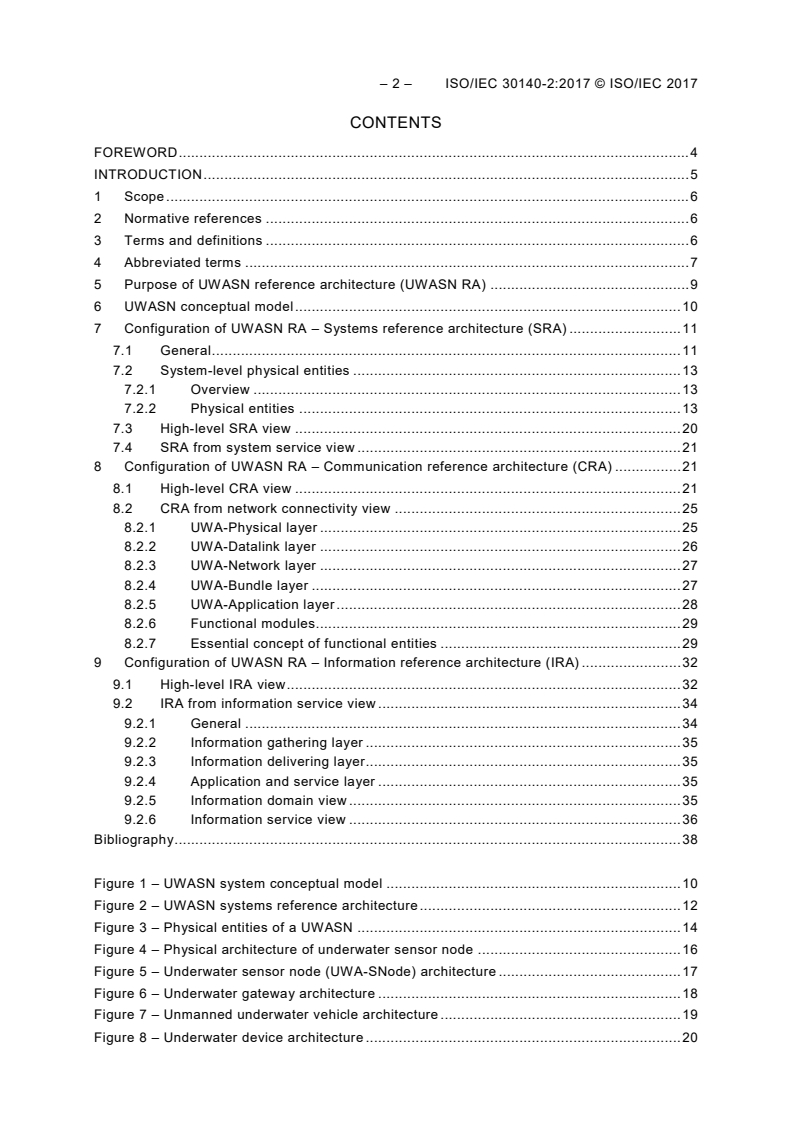
– 2 – ISO/IEC 30140-2:2017 © ISO/IEC 2017
CONTENTS
FOREWORD . 4
INTRODUCTION . 5
1 Scope . 6
2 Normative references . 6
3 Terms and definitions . 6
4 Abbreviated terms . 7
5 Purpose of UWASN reference architecture (UWASN RA) . 9
6 UWASN conceptual model . 10
7 Configuration of UWASN RA – Systems reference architecture (SRA) . 11
7.1 General . 11
7.2 System-level physical entities . 13
7.2.1 Overview . 13
7.2.2 Physical entities . 13
7.3 High-level SRA view . 20
7.4 SRA from system service view . 21
8 Configuration of UWASN RA – Communication reference architecture (CRA) . 21
8.1 High-level CRA view . 21
8.2 CRA from network connectivity view . 25
8.2.1 UWA-Physical layer . 25
8.2.2 UWA-Datalink layer . 26
8.2.3 UWA-Network layer . 27
8.2.4 UWA-Bundle layer . 27
8.2.5 UWA-Application layer . 28
8.2.6 Functional modules. 29
8.2.7 Essential concept of functional entities . 29
9 Configuration of UWASN RA – Information reference architecture (IRA) . 32
9.1 High-level IRA view . 32
9.2 IRA from information service view . 34
9.2.1 General . 34
9.2.2 Information gathering layer . 35
9.2.3 Information delivering layer . 35
9.2.4 Application and service layer . 35
9.2.5 Information domain view . 35
9.2.6 Information service view . 36
Bibliography . 38
Figure 1 – UWASN system conceptual model . 10
Figure 2 – UWASN systems reference architecture . 12
Figure 3 – Physical entities of a UWASN . 14
Figure 4 – Physical architecture of underwater sensor node . 16
Figure 5 – Underwater sensor node (UWA-SNode) architecture . 17
Figure 6 – Underwater gateway architecture . 18
Figure 7 – Unmanned underwater vehicle architecture . 19
Figure 8 – Underwater device architecture . 20
Figure 9 – Graphical representation of the interoperable UWASN RA from a service
point of view . 21
Figure 10 – UWASN communication reference architecture . 22
Figure 11 – Underwater acoustic communication architecture . 24
Figure 12 – Underwater acoustic sensor network architecture . 25
Figure 13 – UWA-PHY layer reference model . 26
Figure 14 – UWA-DL layer reference model . 26
Figure 15 – UWA-NWK layer reference model . 27
Figure 16 – UWA-Bundle layer reference model . 28
Figure 17 – UWA-APS layer reference model . 28
Figure 18 – Functional entities of UWASN . 30
Figure 19 – UWASN IRA . 33
Figure 20 – Underwater information service architecture . 35
Figure 21 – Underwater information domain view . 36
Figure 22 – Underwater information service view . 37
Table 1 – UWASN systems reference architecture . 12
Table 2 – UWASN communication reference architecture (UWASN CRA) . 23
Table 3 – Functional model and descriptions in UWASN . 30
Table 4 – Interrelationship between functional and physical entities of UWASN . 32
Table 5 – UWASN information reference architecture (UWASN IRA) . 34
– 4 – ISO/IEC 30140-2:2017 © ISO/IEC 2017
INFORMATION TECHNOLOGY –
UNDERWATER ACOUSTIC SENSOR NETWORK (UWASN) –
Part 2: Reference architecture
FOREWORD
1) ISO (the International Organization for Standardization) and IEC (the International Electrotechnical Commission)
form the specialized system for worldwide standardization. National bodies that are members of ISO or IEC
participate in the development of International Standards through technical committees established by the
respective organization to deal with particular fields of technical activity. ISO and IEC technical committees
collaborate in fields of mutual interest. Other international organizations, governmental and non-governmental, in
liaison with ISO and IEC, also take part in the work. In the field of information technology, ISO and IEC have
established a joint technical committee, ISO/IEC JTC 1.
2) The formal decisions or agreements of IEC and ISO on technical matters express, as nearly as possible, an
international consensus of opinion on the relevant subjects since each technical committee has representation
from all interested IEC National Committees and ISO member bodies.
3) IEC, ISO and ISO/IEC publications have the form of recommendations for international use and are accepted
by IEC National Committees and ISO member bodies in that sense. While all reasonable efforts are made to
ensure that the technical content of IEC, ISO and ISO/IEC publications is accurate, IEC or ISO cannot be held
responsible for the way in which they are used or for any misinterpretation by any end user.
4) In order to promote international uniformity, IEC National Committees and ISO member bodies undertake to
apply IEC, ISO and ISO/IEC publications transparently to the maximum extent possible in their national and
regional publications. Any divergence between any ISO, IEC or ISO/IEC publication and the corresponding
national or regional publication should be clearly indicated in the latter.
5) ISO and IEC do not provide any attestation of conformity. Independent certification bodies provide conformity
assessment services and, in some areas, access to IEC marks of conformity. ISO or IEC are not responsible
for any services carried out by independent certification bodies.
6) All users should ensure that they have the latest edition of this publication.
7) No liability shall attach to IEC or ISO or its directors, employees, servants or agents including individual experts
and members of their technical committees and IEC National Committees or ISO member bodies for any
personal injury, property damage or other damage of any nature whatsoever, whether direct or indirect, or for
costs (including legal fees) and expenses arising out of the publication of, use of, or reliance upon, this ISO/IEC
publication or any other IEC, ISO or ISO/IEC publications.
8) Attention is drawn to the normative references cited in this publication. Use of the referenced publications is
indispensable for the correct application of this publication.
9) Attention is drawn to the possibility that some of the elements of this ISO/IEC publication may be the subject of
patent rights. ISO and IEC shall not be held responsible for identifying any or all such patent rights.
International Standard ISO/IEC 30140-2 was prepared by subcommittee 41: Internet of Things
and related technologies, of ISO/IEC joint technical committee 1: Information technology.
The list of all currently available parts of the ISO/IEC 30140 series, under the general title
Information technology – Underwater acoustic sensor network (UWASN), can be found on the
IEC and ISO websites.
This International Standard has been approved by vote of the member bodies, and the voting
results may be obtained from the address given on the second title page.
This publication has been drafted in accordance with the ISO/IEC Directives, Part 2.
IMPORTANT – The 'colour inside' logo on the cover page of this publication indicates
that it contains colours which are considered to be useful for the correct
understanding of its contents. Users should therefore print this document using a
colour printer.
INTRODUCTION
Water covers approximately 71 % of the Earth’s surface. Modern technologies introduce new
methods to monitor the bodies of water, for example, pollution monitoring and detection.
Underwater data-gathering techniques require exploring the water environment, which can be
most effectively performed by underwater acoustic sensor networks (UWASNs). Applications
developed for the UWASNs can record underwater climate, detect and control water pollution,
monitor marine biology, discover natural resources, detect pipeline leakages, monitor and
locate underwater intruders, perform strategic surveillance, and so on.
The ISO/IEC 30140 series provides general requirements, reference architecture (RA)
including the entity models and high-level interface guidelines supporting interoperability
among UWASNs in order to provide the essential UWASN construction information to help
and guide architects, developers and implementers of UWASNs.
Additionally, the ISO/IEC 30140 series provides high-level functional models related to
underwater sensor nodes and relationships among the nodes to construct the architectural
perspective of UWASNs. However, the ISO/IEC 30140 series is an application agnostic
standard. Thus, ISO/IEC 30140 series specifies neither any type of communication waveforms
for use in UWASNs nor any underwater acoustic communication frequencies. Specifying
communication waveforms and/or frequencies are the responsibility of architects, developers
and implementers.
Acoustical data communication in sensor networks necessitates the introduction of acoustical
signals that overlap biologically important frequency bands into the subject environment.
These signals may conflict with regional, national or international noise exposure regulations.
Implementers of acoustical communication networks should consult the relevant regulatory
agencies prior to designing and deployment of these systems to ensure compliance with
regulations and avoid conflicts with the agencies.
The purpose of the ISO/IEC 30140 series is to provide general requirements, guidance and
facilitation in order for the users of the ISO/IEC 30140 series to design and develop the target
UWASNs for their applications and services.
The ISO/IEC 30140 series comprises four parts as shown below.
• Part 1 provides a general overview and requirements of the UWASN reference
architecture.
• Part 2 provides reference architecture models for UWASN.
• Part 3 provides descriptions for the entities and interfaces of the UWASN reference
architecture.
• Part 4 provides information on interoperability requirements among the entities within a
UWASN and among various UWASNs.
___________
Architects, developers and implementers need to be aware of the submarine emergency frequency band, near
and below 12 kHz, and it is recommended to provide a provision for such submarine emergency band in their
UWASN design and applications.
– 6 – ISO/IEC 30140-2:2017 © ISO/IEC 2017
INFORMATION TECHNOLOGY –
UNDERWATER ACOUSTIC SENSOR NETWORK (UWASN) –
Part 2: Reference architecture
1 Scope
This part of ISO/IEC 30140 provides a UWASN conceptual model by identifying and defining
three domains (application domain, network domain and UWASN domain).
It also provides UWASN reference architecture multiple views consistent with the
requirements defined in ISO/IEC 30140-1:
a) UWASN systems reference architecture;
b) UWASN communication reference architecture;
c) UWASN information reference architecture.
For each view, related physical and functional entities are described.
2 Normative references
The following documents are referred to in the text in such a way that some or all of their
content constitutes requirements of this document. For dated references, only the edition
cited applies. For undated references, the latest edition of the referenced document (including
any amendments) applies.
ISO/IEC 29182-2, Information technology – Sensor networks: Sensor Network Reference
Architecture (SNRA) – Part 2: Vocabulary and terminology
ISO/IEC 30140-1, Information technology – Underwater acoustic sensor network (UWASN) –
Part 1: Overview and requirements
3 Terms and definitions
For the purposes of this document, the terms and definitions given in ISO/IEC 29182-2 apply.
ISO and IEC maintain terminological databases for use in standardization at the following
addresses:
• IEC Electropedia: available at http://www.electropedia.org/
• ISO Online browsing platform: available at http://www.iso.org/obp
___________
Under preparation. Stage at time of publication: ISO/IEC FDIS 30140-1:2017.
4 Abbreviated terms
2D two-dimensional
3D three-dimensional
3G third generation
4G fourth generation
A/D analog-to-digital converter
AODV ad hoc on demand distance vector
APS IB application layer information base
APSDE application layer data entity
APSME application layer management entity
ASK amplitude shift keying
AUV autonomous underwater vehicle
BLDE bundle layer data entity
BLME bundle layer management entity
BUN IB bundle layer information base
CDMA code division multiple access
CLA convergence layer adapter
CM communication module
CPU central processing unit
CRA communication reference architecture
CSMA carrier sense multiple access
D/A digital-to-analog converter
DB database
DG distance group
DSDV destination-sequenced distance vector routing
DSR dynamic source routing
DTN delay and disruption tolerant network
HAL hardware abstraction layer
FSK frequency shift keying
GFG greedy-face-greedy
GPRS general packet radio service
HAL hardware layer
IB information base
I C inter-integrated circuit
IP Internet protocol
IRA information reference architecture
kbps kilobits per second
LAN local area network
MAC IB datalink layer information base
MAC media access control
MCU microcontroller unit
MFSK multiple frequency shift keying
– 8 – ISO/IEC 30140-2:2017 © ISO/IEC 2017
MIMO multi-input multi-output
MLDE MAC layer data entity
MLME MAC layer management entity
MM micro controller module
MSDU mac service data unit
NLDE network layer data entity
NLME network layer management entity
NWK IB network layer information base
OFDM orthogonal frequency division multiplexing
OLSR optimized link state routing
OS operating system
PC personal computer
PDU protocol data unit
PHY IB physical layer information base
PIT passive integrated transponder
PLDE physical layer data entity
PLME physical layer management entity
PSK phase shift keying
PTKF partial topology knowledge forwarding
PWM pulse width modulation
QAM quadrature amplitude modulation
QoS quality of service
RA reference architecture
REST representational state transfer
RF radio frequency
RFID radio-frequency identification
ROV remotely operated underwater vehicle
SAP service access point
SCI serial communication interface
SDV switched digital video
SIM sensor interface module
SIMO single-input multi-output
SISO single-input single-output
SM service module
SPI serial peripheral interface
SRA system reference architecture
TDMA time division multiple access
UART universal asynchronous receiver/transmitter
UUV unmanned underwater vehicle
UWA-APS underwater application layer
UWA-BUN underwater bundle layer
UWA-CH underwater acoustic cluster head
UWA-EUN underwater acoustic extend united network
UWA-FN underwater acoustic fundamental network
UWA-GW underwater acoustic gateway
UWA-DL underwater datalink layer
UWA-NWK underwater network layer
UWA-PHY underwater physical layer
UWASN underwater acoustic sensor network
UWA-SNode underwater acoustic sensor node
UWA-UN underwater acoustic united network
WAN wide area network
Wi-Fi wireless fidelity
5 Purpose of UWASN reference architecture (UWASN RA)
This document provides reference architecture views consistent with the requirements which
are defined in ISO/IEC 30140-1.
A UWASN reference architecture (UWASN RA) is a generalized architecture sharing one or
more common domains of several end systems, giving direction downward and requiring
compliance upward. In other words, the developer can reuse entities and elements in the
reference architecture that fit the developers’ application or target architecture. In addition,
the UWASN reference architecture provides standards and guidelines for building a specific
architecture for underwater environment.
The combination of these architecture perspectives and views forms a comprehensive
architectural description of a UWASN system. Reference architecture perspectives and views
are to:
a) specify how UWASNs operate;
b) specify systems of equipment and flows of information which support UWASNs;
c) specify technical rules and guidelines which allow these systems to interoperate.
UWASN RA provides the rules and guidance for developing and presenting the architecture
descriptions.
This document provides multiple views of the technical architecture of UWASN:
1) overview of UWASN reference architecture;
2) UWASN systems reference architecture;
3) UWASN communication reference architecture;
4) UWASN information reference architecture.
The UWASN supports development of interacting architectures. UWASN defines the multiple
perspectives of UWASN reference architecture and multiple views of the technical
architecture. All views are made up of sets of architecture data elements. The UWASN
defines relationship between architectural views and the data elements.
– 10 – ISO/IEC 30140-2:2017 © ISO/IEC 2017
6 UWASN conceptual model
The UWASN conceptual model shown in Figure 1 depicts the common domains that are
identified in various UWASN systems and each of the presented domains. In this document,
the UWASN reference architecture is described using the domains shown in Figure 1 and this
conceptual model is extended to develop the three UWASN reference architectures which
describe common entities and interfaces in each domain for various UWASN systems
applications and services.
The UWASN RA describes the key technology that enables “a UWASN system”. In most
UWASN systems, there are three main technologies involved: system technology,
communication technology and information technology. The UWASN reference architecture
views are described and focused on these three technologies, resulting in the architecture
views mentioned.
IEC
Key
1 domain
2 two-way communication link, interface for data/information and/or physical interface
Figure 1 – UWASN system conceptual model
The conceptual model describes the UWASN system in terms of the key domains which are
common to the deployed UWASN systems. These domains are identified and defined.
a) Application domain
The application domain includes many types of application users connected to a UWASN
system. These are scientific, military, business and aquatic applications. The application
users make use of underwater sensor data for monitoring the environment, providing
tsunami warnings, etc.
b) Network domain
The network domain can be realized using LAN, WAN and/or backbone networks. This
domain provides data/information links between the application domain and UWASN
domain. This domain uses RF communication, satellite or optical communication.
c) UWASN domain
This domain is related to the underwater environment, which includes surface domain,
sensing domain, and controlling domain. These three domains are described below.
1) Surface domain
In the UWASN system, ships, surface buoys and UUVs may be used as underwater
gateways. These gateways gather data from underwater sensor nodes using acoustic
communication links and transfer to the backbone network using, e.g. satellite
communication or CDMA.
2) Sensing domain
In the UWASN system, the sensing domain is used for sensing the underwater
environment using various types of sensors, e.g. temperature, pressure and imaging
sensors. The sensing domain can directly communicate with the surface domain in the
case of ad-hoc networks.
3) Controlling domain
In the UWASN system, the controlling domain is used for communication between the
sensing domain and the surface domain. Intermediate nodes, such as AUVs and relay
nodes, are used to gather data from the sensing domain and transform to surface
domain with the help of acoustic communication.
7 Configuration of UWASN RA – Systems reference architecture (SRA)
7.1 General
The UWASN systems reference architecture is shown in Figure 2, along with all the entities
involved and the interfaces among them. The entity and interface descriptions are presented
in Table 1.
– 12 – ISO/IEC 30140-2:2017 © ISO/IEC 2017
IEC
Key
1 domain
2 two-way communication link, interface for data/information and/or physical interface
3 entity
Figure 2 – UWASN systems reference architecture
Table 1 – UWASN systems reference architecture
UWASN domains Domain entities
Network domain Backbone
Internet
Intranet
Application domain Scientific
Business
Military
Aquatic
Civilian
Others (e.g. Sports)
Underwater domain Surface domain
– Ships
– Buoys
– USV (unmanned surface vehicle)
– Others [e.g. anti-submarine warfare (ASW) helicopters]
Sensing domain
– UUV
– Other sensing systems
Controlling domain
– Relay node
– UUV
Interfaces (between entities) Description
Application domain Network domain Inf-01: The interface between application domain
and network domain.
Network domain Underwater domain Inf-02: The interface between network domain and
underwater domain.
Underwater domain Application domain Inf-03: The interface between underwater domain
and application domain.
7.2 System-level physical entities
7.2.1 Overview
The purpose of this subclause is to provide not only basic information but also high-level
model descriptions for various UWASN entities identified in 7.1. Entities can be categorized
into two types: physical and functional.
Physical entities are hardware entities, which are actual, tangible devices and/or components,
such as underwater sensor nodes, underwater gateways, AUVs, relay nodes and access and
backbone network devices.
A functional entity represents a certain task that can be carried out on one or more physical
entities, for example, the sensing of underwater data, transceiver management, access
control management, network management and data forwarding. Figure 3 and Figure 4 show
all the entities modelled in this document.
Each entity model presented in this document is a description of the function and/or role of
that entity.
7.2.2 Physical entities
7.2.2.1 General
Figure 3 shows the physical entities that form an underwater acoustic sensor network and
how the entities are interconnected.
– 14 – ISO/IEC 30140-2:2017 © ISO/IEC 2017
IEC
Key
1 UWA-SNode 6 access network
2 UWA-CH 7 acoustic link
3 UUV 8 optional
4 UWA-GW 9 mandatory
5 communication path
Figure 3 – Physical entities of a UWASN
Figure 4 describes the internal architecture of UWA-SNode and this architecture includes:
a) CPU-on-board controller: This contains a CPU or controller interfaced with a UWA-SNode
via sensor interface circuitry. A microcontroller module obtains information from the UWA-
SNode and then
1) saves the information in the on-board memory;
2) processes the information; and
3) by controlling the acoustic modem, forwards the information to a new UWA-SNode. An
operating system (OS) is optional here.
b) Memory: A storage device is a memory unit which can be embedded in a sensor node or
located outside of the node. The memory unit stores various event data collected by the
node, e.g. measurements and processed data (if an on-the-node processing is
performed).
c) Sensor: A sensor or sensing element is a measuring device of external environment of a
certain phenomenology. Typically, this device converts physical parameters into a
measureable electrical signal. Depending on the type of a sensing device, the device can
measure acoustics, seismic waves or vibration, magnetic fields, various light spectra
(visual, infrared, etc.), electromagnetic fields (e.g. radio frequencies), temperature,
pressure, motion, contaminants, etc. Depending on the complexity and technology
implemented in the sensor, the sensor can measure one-dimensional, two-dimensional
and three-dimensional signals along with time tagging.
d) Communication module: A communication unit is an essential component of a sensor
node. This communication unit provides either a wired or wireless data link which is used
to transmit the data collected by the sensor or sensing element and any processed data if
available, in non-real time or in real time. In case of non-real time data transmission,
some type of storage device is required.
e) Power supply: A sensor node requires a power supply. If a sensor node is physically
connected via a wire, it typically does not require an on-board power supply, e.g.
batteries. In the case of a wireless sensor node, a battery is required. Power management
for a sensor node is essential and power management utility firmware may be hosted in
the CPU, especially for the sensor nodes located remotely and operating wirelessly. The
power supply is a critical element for powering a sensor node; therefore, it is also critical
for powering an entire sensor network. This becomes even more critical for a wireless,
geographically dispersed sensor network. A battery power supply is typical. The power
supply greatly depends on the type of sensor and the sensor node functions. Power
management on remote sensors is of great importance to the functionality of a UWA-
SNode. The remoteness of a UWA-SNode dictates the power supply capacity and power
usage management. The required frequency of inter-nodal communications also dictates
how the power should be managed.
f) Acoustic modem: It is used to transmit and receive underwater data. It works like a
telephone modem, which transmits the data with the help of a telephone line. It converts
the digital data to acoustic signals and these signals are converted back to digital data at
the receiver acoustic modem. These modems can be used for underwater monitoring and
data logging, UUV command and control, underwater telemetry, diver communications and
other applications wanting underwater wireless communications.
g) Node reclamation: Node replacement is also known as node reclamation. For more
information, refer to ISO/IEC 30140-1:– .
h) Housing case: Housing integrity must be suitable for operation at the required working
depth. Water proofing is one of the requirements for the UWA-SNode. For more
information, refer to ISO/IEC 30140-1.
i) Fouling cleaner: It is optional for UWA-SNodes to have timely cleaning to resist fouling
and corrosion because such issues may cause UWA-SNodes to fail.
___________
Under preparation. Stage at time of publication: ISO/IEC FDIS 30140-1:2017.
– 16 – ISO/IEC 30140-2:2017 © ISO/IEC 2017
IEC
Key
1 mandatory
2 optional
Figure 4 – Physical architecture of underwater sensor node
7.2.2.2 Underwater acoustic sensor node (UWA-SNode)
Underwater acoustic sensor technology can be used in all the environments. Novel types of
UWA-SNode can improve the range of environmental parameters for which information is
collected.
In a cluster-based UWASN, the cluster head (UWA-CH) receives data from UWA-SNodes and
transmits it to the UWA-CH of other clusters until data reach the UWA-GW. UWA-CH performs
data aggregation on the sensor data it receives and then sends it to the UWA-GW. The
cluster head will process the data of the cluster nodes. To perform effective communication
and clustering of the nodes in the network, it is important to maintain the tracking of the
nodes. The underwater cluster head improves network operation life and a network with an
underwater cluster head provides more reliable and better communication connectivity. The
underwater cluster head contains similar modules to the underwater sensor node, except that
the cluster head has data gathering, filtering and compression managers.
In an ad-hoc network, each sensor node is a fully functional device that can sense and
communicate with sensor nodes. A cluster-based network sensor node is either a reduced
function device or a fully functional device. The reduced function devices only have
communication functionality, whereas the fully functional devices are either UWA-SNodes or
UWA-CHs and have sensing and communicating capabilities. In cluster-based networks,
developers use the reduced function devices to reduce costs, energy consumption, etc.
The UWA-SNode architecture is presented in Figure 5.
IEC
Figure 5 – Underwater sensor node (UWA-SNode) architecture
a) Task manager: The task manager provides information about the management system. It
also performs network and communication management.
b) Power manager: The power manager manages the power supply to nodes and
peripherals.
c) Sensing manager: The sensing manager processes the data received from various
sensors.
d) Acoustic module: The acoustic module uses sound waves to transfer the data from a
source device to a destination device.
e) Peripheral interface module: The peripheral interface module manages underwater data
acquisition peripherals (e.g. actuators, underwater cameras, underwater sensors, etc.).
f) Power supply: The power supply module supplies power to underwater nodes.
g) Others: UWA-CH nodes receive the data from various underwater sensor nodes. UWA-CH
filters and compresses the data and sends the filtered/compressed data to the final
underwater gateway through the acoustic communication. Routing is performed by the
UWA-CH and ad-hoc UWA-SNodes.
7.2.2.3 Underwater gateway (UWA-GW & UWA-DTN-GW)
7.2.2.3.1 General
The underwater gateway basically performs communication relay between the base station
and the UWASN. The UWA-GW obtains underwater sensor information from relay nodes (or
the UWA-CH and UWA-SNodes) and transmits it to the monitoring centre via wireless
communication channels.
Underwater gateway communicates with two heterogeneous networks: RF based and acoustic
based. The DTN (delay and disruption-tolerant networks) gateway is used for communication
between heterogeneous communication networks.
7.2.2.3.2 UWA-GW architecture
Underwater gateway contains similar modules like those of the underwater sensor node. The
RF module is added additionally to the UWA-GW. The architecture is shown in Figure 6. The
RF module transfers the data to the surface or receives control commands from a ground
station.
– 18 – ISO/IEC 30140-2:2017 © ISO/IEC 2017
IEC
Figure 6 – Underwater gateway architecture
7.2.2.4 Housing case
In an underwater device, an expensive acoustic modem is needed for transmitting and
receiving data. Hence, a strong waterproof housing case is needed against high water
pressure and it can also prevent failures and corrosion.
7.2.2.5 Fouling cleaner
Fouling can be caused by marine wildlife, such as weeds, zebra mussels, algae, and
barnacles becoming attached to a stationary underwater entity. In a UWASN, avoiding fouling
is important because the attachment of marine wildlife to a membrane might limit or change
the membrane’s vibration characteristics [1] .
7.2.2.6 Acoustic modem
Acoustic modems allow for wireless communication in water. Acoustic modems are used in
real-time systems where information must be collected periodically.
As compared with radio communication, underwater acoustic communication is moderately
slow. Not only is the communication speed slow but there are also complications with acoustic
signal propagation because of boundary effects (multipath and delay-Doppler spreading).
Acoustic modem producers use numerous methods to handle the above complications, i.e.
signal data packaging, processing and coding schemes. These methods support the
guarantee of reliable communication and at the receiver end, they detect bit loss and/or repair
the lost bits of data. Not all producers use the same method.
7.2.2.7 Unmanned underwater vehicles (UUV)
7.2.2.7.1 General
AUV should be considered as one of the UUVs. Detailed explanation of AUV is given in
7.2.2.7.2.
7.2.2.7.2 Autonomous underwater vehicle (AUV)
These can be used to complete underwater operations such as detective work and the
mapping of rocks, immersed wrecks and obstructions that may cause navigation risks. AUVs
can autonomously conduct inspection operations and reach specified locations. Data
collected by AUVs during critical missions can be downloaded and processed. Different kinds
of sensors can be attached to AUVs and these can work without the use of cables, tethers or
remote controls. AUVs can make multiple missions to monitor different environments,
oceanography and water resources. AUVs are used to improve the capabilities of UWASNs in
___________
Numbers in square brackets refer to the Bibliography.
many ways. The integration of AUVs and UWA-SNodes can be networked with coordination
algorithms.
a) Adaptive spatial sampling: This comprises control procedures that command AUVs to
move to required locations. The adaptive sampling method has been used in innovative
observation operations.
b) Self-configuration: This contains management methods for automatically identifying
connectivity gaps due to node failure; it can then request AUV intervention. AUVs restore
connectivity by deploying additional relay or sensor nodes.
7.2.2.7.3 UUV architecture
In Figure 7, the routing manager collects information from UWA-SNodes and send it to the
gateway. It also provides the navigation path information for the UUV. The positioning
manager performs the function of propulsion.
IEC
Figure 7 – Unmanned underwater vehicle architecture
7.2.2.8 Access network
An access network provides the connectivity between the backbone network and underwater
gateway in the UWASN. Examples of access networks include Wi-Fi® networks, cellular
networks (such as 3G/4G wireless), Ethernet, ZigBee® and CDMA and satellite
communication.
7.2.2.9 Backbone network
The most obvious backbone network is the Internet. Another example would be an Intranet, in
which the data from the sensors are consumed “locally” and not accessed by other networks.
In general, a backbone network provides connectivity among a large number of potentially
geographically dispersed communicating entities. It is typically wired, although wireless
backbone networks may also be used.
7.2.2.10 User
These are the entities that ultimately consume the high level information provided by UWASN.
Sensor network applications, such as environmental monitoring and battlefield command and
control, run on the user machines. The user may have the capability to visualize the
information produced by UWASN applications.
___________
ZigBee and Wi-Fi are registered trademarks of ZigBee Alliance and Wi-Fi Alliance, respectively. This
information is given for the convenience of users of this document and does not constitute an endorsement by
ISO or IEC.
– 20 – ISO/IEC 30140-2:2017 © ISO/IEC 2017
7.3 High-level SRA view
The UWASN device reference architecture is shown in Figure 8. The underwater device
architecture mainly contains four underwater devices, an underwater acoustic sensor node
(UWA-SNode), an underwater acoustic cluster head (UWA-CH), UUVs and an underwater
gateway (UWA-GW & UWA-DTN-GW). Each device has its own functional architecture.
Detailed information for each device is given in 7.2.2.
IEC
Key
1 UWA-SNode 3 UUV
2 UWA-CH 4 UWA-GW
Figure 8 – Underwater device architecture
7.4 SRA from system service view
The reference architecture is described using a set of entities that make up the UWASN. Each
UWASN consists of a sensing domain, a controlling domain and a surface domain presented
in Figure 1. Figure 9 presents the services provided by the UWASN. The arrows in this figure
represent the interfaces that should allow seamless interoperations and interoperability
between the
...