

IEC 62911:2025
(Main)Audio, video and information technology equipment - Routine electrical safety testing in production
- Abstract
CORRECTED VERSION 2026-06
IEC 62911:2025 defines procedures for use during or after manufacturing of complete equipment, sub-assemblies or components, complying with IEC 62368-1 and powered by an AC or DC, to detect manufacturing failures and unacceptable tolerances in manufacturing and materials.
NOTE 1: Not all the tests defined in this document are necessarily performed at the end product manufacturing location. The optimal location for the can be defined by the equipment manufacturer and reviewed under the applicable conformity assessment scheme.
NOTE 2: The test procedures in this document are intended to identify production and manufacturing errors. These test procedures are not intended for product development or verification (see The test procedures in this document are intended to identify production and manufacturing errors. These test procedures are not intended for product development or verification (see IEC 62368-1).
The content of the corrigendum 1 (2026-06) has been included in this copy.
- Status
- Published
- Publication Date
- 01-Jun-2025
- Technical Committee
- TC 108 - Safety of electronic equipment within the field of audio/video, information technology and communication technology
- Drafting Committee
- WG HBSDT - TC 108/WG HBSDT
- Current Stage
- PPUB - Publication issued
- Start Date
- 02-Jun-2025
- Completion Date
- 23-May-2025
Buy Documents


IEC 62911:2025 RLV - Audio, video and information technology equipment - Routine electrical safety testing in production
IEC 62911:2025 - Audio, video and information technology equipment - Routine electrical safety testing in production
Overview
IEC 62911:2025 - "Audio, video and information technology equipment - Routine electrical safety testing in production" specifies routine electrical safety test procedures to be used during or after manufacturing of complete equipment, sub-assemblies or components powered from AC or DC mains. The standard is intended to detect manufacturing failures and unacceptable tolerances in materials and assembly for equipment that complies with IEC 62368-1 (and legacy IEC 60065 / IEC 60950-1). IEC 62911:2025 emphasizes production-level testing (not product development or type verification) and aligns terminology and requirements with IEC 62368-1:2023.
Key topics and requirements
- Scope and purpose: Defines routine electrical safety tests (3.16) for each manufactured item to identify production/manufacturing errors.
- Test types: Includes continuity/ resistance testing of the protective bonding system (for Class I equipment) and electric strength (dielectric) tests.
- AC and DC mains: Adds explicit test conditions for equipment supplied from DC mains in addition to AC mains. Test voltage tables are provided for different mains/overvoltage categories.
- Conformance and records: Equipment must pass applicable routine tests before shipment; results shall be recorded per Clause 6.
- Practical guidance: Notes state that not all routine tests must be performed at the final assembly site - manufacturers can define optimal test location and integrate with the applicable conformity assessment scheme.
- Limitations: Tests are intended to find manufacturing faults and are not a substitute for type testing or design verification (see IEC 62368-1).
Practical applications and users
Who uses IEC 62911:2025:
- Manufacturers and contract assemblers - to define and implement production-line electrical safety checks.
- Production test engineers / QA teams - to set up continuity, dielectric and bonding tests and to maintain test records.
- Test lab personnel and conformity assessors - to review production test plans as part of certification and conformity schemes.
- Safety managers and compliance officers - to ensure routine testing aligns with IEC 62368-1 safety objectives.
Practical uses:
- Preventing shipping of units with assembly defects (e.g., improper earth bonding, insulation faults).
- Integrating routine tests into automated production test stations.
- Demonstrating ongoing compliance during audits via documented test records.
Related standards
- IEC 62368-1:2023 - Primary safety standard for AV/IT equipment referenced for requirements.
- IEC 60065 and IEC 60950-1 - legacy normative references for specific equipment types.
- IEC 60664-1 - referenced for insulation and related terminology.
Keywords: IEC 62911:2025, routine electrical safety testing, production testing, audio video information technology equipment, IEC 62368-1, protective bonding continuity, electric strength test, AC mains, DC mains, manufacturing quality assurance.
Relations
- Effective Date
- 05-Jun-2026
- Effective Date
- 05-Sep-2023
Buy Documents
IEC 62911:2025 RLV - Audio, video and information technology equipment - Routine electrical safety testing in production
IEC 62911:2025 - Audio, video and information technology equipment - Routine electrical safety testing in production
Get Certified
Connect with accredited certification bodies for this standard

BSI Group
BSI (British Standards Institution) is the business standards company that helps organizations make excellence a habit.

NYCE
Mexican standards and certification body.

ANCE
Mexican certification and testing association.
Sponsored listings
Frequently Asked Questions
IEC 62911:2025 is a standard published by the International Electrotechnical Commission (IEC). Its full title is "Audio, video and information technology equipment - Routine electrical safety testing in production". This standard covers: CORRECTED VERSION 2026-06 IEC 62911:2025 defines procedures for use during or after manufacturing of complete equipment, sub-assemblies or components, complying with IEC 62368-1 and powered by an AC or DC, to detect manufacturing failures and unacceptable tolerances in manufacturing and materials. NOTE 1: Not all the tests defined in this document are necessarily performed at the end product manufacturing location. The optimal location for the can be defined by the equipment manufacturer and reviewed under the applicable conformity assessment scheme. NOTE 2: The test procedures in this document are intended to identify production and manufacturing errors. These test procedures are not intended for product development or verification (see The test procedures in this document are intended to identify production and manufacturing errors. These test procedures are not intended for product development or verification (see IEC 62368-1). The content of the corrigendum 1 (2026-06) has been included in this copy.
CORRECTED VERSION 2026-06 IEC 62911:2025 defines procedures for use during or after manufacturing of complete equipment, sub-assemblies or components, complying with IEC 62368-1 and powered by an AC or DC, to detect manufacturing failures and unacceptable tolerances in manufacturing and materials. NOTE 1: Not all the tests defined in this document are necessarily performed at the end product manufacturing location. The optimal location for the can be defined by the equipment manufacturer and reviewed under the applicable conformity assessment scheme. NOTE 2: The test procedures in this document are intended to identify production and manufacturing errors. These test procedures are not intended for product development or verification (see The test procedures in this document are intended to identify production and manufacturing errors. These test procedures are not intended for product development or verification (see IEC 62368-1). The content of the corrigendum 1 (2026-06) has been included in this copy.
IEC 62911:2025 is classified under the following ICS (International Classification for Standards) categories: 33.160.01 - Audio, video and audiovisual systems in general; 35.020 - Information technology (IT) in general. The ICS classification helps identify the subject area and facilitates finding related standards.
IEC 62911:2025 has the following relationships with other standards: It is inter standard links to IEC 62911:2025/COR1:2026, IEC 62911:2016. Understanding these relationships helps ensure you are using the most current and applicable version of the standard.
IEC 62911:2025 is available in PDF format for immediate download after purchase. The document can be added to your cart and obtained through the secure checkout process. Digital delivery ensures instant access to the complete standard document.
Standards Content (Sample)
IEC 62911 ®
Edition 2.0 2025-06
REDLINE VERSION
INTERNATIONAL
STANDARD
Audio, video and information technology equipment – Routine electrical safety
testing in production
ICS 33.160.01; 35.020 ISBN 978-2-8327-0477-6
All rights reserved. Unless otherwise specified, no part of this publication may be reproduced or utilized in any form or
by any means, electronic or mechanical, including photocopying and microfilm, without permission in writing from either
IEC or IEC's member National Committee in the country of the requester. If you have any questions about IEC copyright
or have an enquiry about obtaining additional rights to this publication, please contact the address below or your local
IEC member National Committee for further information.
IEC Secretariat Tel.: +41 22 919 02 11
3, rue de Varembé info@iec.ch
CH-1211 Geneva 20 www.iec.ch
Switzerland
About the IEC
The International Electrotechnical Commission (IEC) is the leading global organization that prepares and publishes
International Standards for all electrical, electronic and related technologies.
About IEC publications
The technical content of IEC publications is kept under constant review by the IEC. Please make sure that you have the
latest edition, a corrigendum or an amendment might have been published.
IEC publications search - IEC Products & Services Portal - products.iec.ch
webstore.iec.ch/advsearchform Discover our powerful search engine and read freely all the
The advanced search enables to find IEC publications by a publications previews, graphical symbols and the glossary.
variety of criteria (reference number, text, technical With a subscription you will always have access to up to date
committee, …). It also gives information on projects, content tailored to your needs.
replaced and withdrawn publications.
Electropedia - www.electropedia.org
The world's leading online dictionary on electrotechnology,
IEC Just Published - webstore.iec.ch/justpublished
Stay up to date on all new IEC publications. Just Published containing more than 22 500 terminological entries in English
details all new publications released. Available online and and French, with equivalent terms in 25 additional languages.
once a month by email. Also known as the International Electrotechnical Vocabulary
(IEV) online.
IEC Customer Service Centre - webstore.iec.ch/csc
If you wish to give us your feedback on this publication or
need further assistance, please contact the Customer
Service Centre: sales@iec.ch.
CONTENTS
FOREWORD . 2
1 Scope . 1
2 Normative references . 4
3 Terms and definitions . 4
4 Conformance . 7
5 Routine electrical safety tests . 7
5.1 Resistance of the protective bonding system . 7
5.2 Electric strength test . 8
6 Records of tests . 12
Bibliography . 14
Table 1 – Test voltage for equipment with a.c. mains supplied by an AC mains (3.7) in
overvoltage category I or overvoltage category II . 9
Table 2 – Test voltage for equipment intended to be supplied by an AC mains (3.7) . 9
Table 3 – Test voltage for equipment with d.c. mains intended to be supplied
by a DC mains (3.7) . 9
Table 3 – DC test voltages .
INTERNATIONAL ELECTROTECHNICAL COMMISSION
____________
Audio, video and information technology equipment - Routine electrical
safety testing in production
FOREWORD
1) The International Electrotechnical Commission (IEC) is a worldwide organization for standardization comprising
all national electrotechnical committees (IEC National Committees). The object of IEC is to promote international co-
operation on all questions concerning standardization in the electrical and electronic fields. To this end and in addition
to other activities, IEC publishes International Standards, Technical Specifications, Technical Reports, Publicly
Available Specifications (PAS) and Guides (hereafter referred to as “IEC Publication(s)”). Their preparation is
entrusted to technical committees; any IEC National Committee interested in the subject dealt with may participate
in this preparatory work. International, governmental and non-governmental organizations liaising with the IEC also
participate in this preparation. IEC collaborates closely with the International Organization for Standardization (ISO)
in accordance with conditions determined by agreement between the two organizations.
2) The formal decisions or agreements of IEC on technical matters express, as nearly as possible, an international
consensus of opinion on the relevant subjects since each technical committee has representation from all interested
IEC National Committees.
3) IEC Publications have the form of recommendations for international use and are accepted by IEC National
Committees in that sense. While all reasonable efforts are made to ensure that the technical content of IEC
Publications is accurate, IEC cannot be held responsible for the way in which they are used or for any
misinterpretation by any end user.
4) In order to promote international uniformity, IEC National Committees undertake to apply IEC Publications
transparently to the maximum extent possible in their national and regional publications. Any divergence between
any IEC Publication and the corresponding national or regional publication shall be clearly indicated in the latter.
5) IEC itself does not provide any attestation of conformity. Independent certification bodies provide conformity
assessment services and, in some areas, access to IEC marks of conformity. IEC is not responsible for any services
carried out by independent certification bodies.
6) All users should ensure that they have the latest edition of this publication.
7) No liability shall attach to IEC or its directors, employees, servants or agents including individual experts and
members of its technical committees and IEC National Committees for any personal injury, property damage or other
damage of any nature whatsoever, whether direct or indirect, or for costs (including legal fees) and expenses arising
out of the publication, use of, or reliance upon, this IEC Publication or any other IEC Publications.
8) Attention is drawn to the Normative references cited in this publication. Use of the referenced publications is
indispensable for the correct application of this publication.
9) IEC draws attention to the possibility that the implementation of this document may involve the use of (a) patent(s).
IEC takes no position concerning the evidence, validity or applicability of any claimed patent rights in respect thereof.
As of the date of publication of this document, IEC had not received notice of (a) patent(s), which may be required
to implement this document. However, implementers are cautioned that this may not represent the latest information,
which may be obtained from the patent database available at https://patents.iec.ch. IEC shall not be held responsible
for identifying any or all such patent rights.
This redline version of the official IEC Standard allows the user to identify the changes
made to the previous edition IEC 62911:2016. A vertical bar appears in the margin
wherever a change has been made. Additions are in green text, deletions are in
strikethrough red text.
IEC 62911 has been prepared by IEC technical committee 108: Safety of electronic equipment
within the field of audio/video, information technology and communication technology. It is an
International Standard.
This second edition cancels and replaces the first edition published in 2016. This edition
constitutes a technical revision.
This edition includes the following significant technical changes with respect to the previous
edition:
a) this edition aligns with the terminology and requirements of IEC 62368-1:2023;
b) test conditions for DC mains have been added;
c) smaller size technical changes were made.
The text of this International Standard is based on the following documents:
Draft Report on voting
108/833/FDIS 108/837/RVD
Full information on the voting for its approval can be found in the report on voting indicated in
the above table.
The language used for the development of this International Standard is English.
This document was drafted in accordance with ISO/IEC Directives, Part 2, and developed in
accordance with ISO/IEC Directives, Part 1 and ISO/IEC Directives, IEC Supplement, available
at http://www.iec.ch/members_experts/refdocs. The main document types developed by IEC
are described in greater detail at http://www.iec.ch/publications.
In this document, the following print types or formats are used:
– compliance statements and test specifications: in italic type.
The committee has decided that the contents of this document will remain unchanged until the
stability date indicated on the IEC website under webstore.iec.ch in the data related to the
specific document. At this date, the document will be
• reconfirmed,
• withdrawn, or
• revised.
1 Scope
This International Standard defines routine electrical safety test routine test (3.16)
procedures for use during or after manufacturing of complete equipment, sub-assemblies or
components, complying with IEC 60065, IEC 60950-1 or IEC 62368-1 and powered by an AC
mains (3.7) or DC mains (3.7), to detect manufacturing failures and unacceptable tolerances in
manufacturing and materials.
NOTE 1 Not all the tests defined in this document do not are necessarily have to be performed at the end product
manufacturing location. The optimal location for the routine electrical safety tests routine tests (3.16) can be
defined by the equipment manufacturer and reviewed under the applicable conformity assessment scheme.
NOTE 2 The test procedures in this document are intended to identify production and manufacturing errors. These
test procedures are not intended for product development or verification (see IEC 62368-1 [1]).
2 Normative references
The following documents are referred to in the text in such a way that some or all of their content
constitutes requirements of this document. For dated references, only the edition cited applies.
For undated references, the latest edition of the referenced document (including any
amendments) applies.
IEC 60065, Audio, video and similar electronic apparatus – Safety requirements
IEC 60950-1, Information technology equipment – Safety – Part 1: General requirements
IEC 62368-1:2023, Audio/video, information and communication technology equipment - Part
1: Safety requirements
IEC 62368-1, Audio/video, information and communication technology equipment - Part 1:
Safety requirements
3 Terms and definitions
For the purposes of this document, the following terms and definitions given in IEC 60065,
IEC 60950-1 and IEC 62368-1, as well as the following apply.
ISO and IEC maintain terminology databases for use in standardization at the following
addresses:
– IEC Electropedia: available at https://www.electropedia.org/
– ISO Online browsing platform: available at https://www.iso.org/obp
3.1
accessible
touchable by a body part
[SOURCE: IEC 62368-1:2023 [2], 3.3.6.1, modified - Note to entry omitted.]
3.2
basic insulation
insulation to provide a basic safeguard against electric shock
Note 1 to entry: This concept does not apply to insulation used exclusively for functional purposes.
[SOURCE: IEC 62368-1:2023 [2], 3.3.5.1]
3.3
double insulation
insulation comprising both basic insulation (3.2) and supplementary insulation
[SOURCE: IEC 62368-1:2023 [2], 3.3.5.2]
3.4
class I equipment
equipment with basic insulation (3.2) used as a basic safeguard, and with protective bonding
and protective earthing (3.11) used as a supplementary safeguard
Note 1 to entry: Class I equipment can be provided with class II construction.
[SOURCE: IEC 60050-851:2008 [3], 851-15-10, modified – The definition has been adapted to
the safeguard principle; addition of a new Note 1 to entry.]
3.5
device
material element or assembly of such elements intended to perform a required function
Note 1 to entry: A device may form part of a larger system (for example, a server node installed in a rack system).
[SOURCE: IEC 60050-151:2001 [4], 151-11-20, modified ─ In Note 1 to entry, replacement of
"device" with "system", and addition of the text within parenthesis.]
3.6
functional earthing
earthing a point or points in a system or in an installation or in equipment, for purposes other
than electrical safety
[SOURCE: IEC 60050-195:2021 [5], 195-01-13, modified ─ Addition of "a point or points in a
system or in an installation or in equipment".]
3.7
mains
AC or DC power distribution system (external to the equipment) that supplies operating power
to the equipment
Note 1 to entry: Mains include public or private utilities and, unless otherwise specified in this document, equivalent
sources such as motor-driven generators and uninterruptible power supplies.
Note 2 to entry: Powering external circuits by using communications cables and circuits that are isolated from the
mains (for example, data, voice, PoE, USB, HDMI, Coaxial, RFT and similar circuits in Table 13 of IEC 62368-1:2023
[2]) are not considered to be mains.
[SOURCE: IEC 62368-1:2023 [2], 3.3.1.3, modified - Addition of Note 2 to entry.]
3.8
permanently connected equipment
equipment that can only be electrically connected to or disconnected from the mains (3.7) by
the use of a tool
[SOURCE: IEC 62368-1:2023 [2], 3.3.3.6]
3.9
protective bonding conductor
protective conductor in the equipment provided for protective equipotential-bonding of parts
required to be earthed for safety purposes
Note 1 to entry: A protective bonding conductor is internal in the equipment.
[SOURCE: IEC 62368-1:2023 [2], 3.3.11.9]
3.10
protective current rating
current rating of an overcurrent protective device (3.5) that is in the building installation or in
the equipment to protect a circuit
[SOURCE: IEC 62368-1:2023 [2], 3.3.10.6]
3.11
protective earthing
earthing a point or points in a system or in an installation or in equipment for purposes of
electrical safety
[SOURCE: IEC 60050-195:2021 [5]195-01-11, modified ─ Addition of " a point or points in a
system or in an installation or in equipment".]
3.12
protective earthing conductor
protective conductor connecting a main protective earthing (3.11) terminal in the equipment to
an earth point in the building installation for protective earthing
[SOURCE: IEC 62368-1:2023 [2], 3.3.11.12]
3.13
rated frequency
supply frequency or frequency range as declared by the manufacturer
3.14
rated voltage
value of voltage assigned by the manufacturer to a component, device (3.5) or equipment and
to which operation and performance characteristics are referred
Note 1 to entry: Equipment may have more than one rated voltage (3.14) value or may have a rated voltage (3.14)
range.
[SOURCE: IEC 60664-1:2020 [6], 3.1.17]
3.15
reinforced insulation
single insulation system that provides a degree of protection against electric shock equivalent
to double insulation (3.3)
[SOURCE: IEC 62368-1:2023 [2], 3.3.5.5]
3.16
routine electrical safety test
electrical safety test to which each individual equipment is subjected during or at the end of
manufacture
test to which each individual device (3.5) is subjected during or after manufacture to ascertain
whether it complies with certain criteria
[SOURCE: IEC 60664-1:2020 [6], 3.1.42, modified ─ Replacement of "conformity test" with
"test", replacement of "item" with "device", addition of "to ascertain whether it complies with
certain criteria".]
3.17
type test
test on a representative sample with the objective of determining if, as designed and
manufactured, it can meet the requirements of this document
[SOURCE: IEC 62368-1:2023 [2],3.3.6.24]
3.18
working voltage
voltage across any particular insulation while the equipment is supplied at rated voltage (3.14)
or any voltage in the rated voltage range under normal operating conditions
Note 1 to entry: External transient voltages are disregarded.
Note 2 to entry: Recurring peak voltages are disregarded.
4 Conformance
Equipment shall pass the routine electrical safety tests routine tests (3.16) of Clause 5 where
applicable. The results of the performed tests shall be recorded according to Clause 6 prior to
shipment from the manufacturing site.
NOTE Practical Measures can be used to conduct the test, such as finding an appropriate way
to make the connections necessary to perform the relevant test.
5 Routine electrical safety tests
5.1 Resistance of the protective bonding system
For class I equipment (3.4), the continuity of the protective bonding system shall be tested
between the protective earth protective earthing (3.11) contact of the mains (3.7) plug or
appliance inlet of the equipment, or the protective earthing (3.11) terminal in case of a
permanently connected equipment (3.8), and
– the accessible (3.1) conductive parts that need to shall be connected to the protective
earthing (3.11) terminal for compliance with the requirements of the standard IEC 62368-
1:2023, and
– the protective earth protective earthing (3.11) contact of the socket-outlets respectively, if
provided to deliver mains (3.7) power to other equipment.
NOTE 1 Functional earth is not considered a part of the protective bonding system and as a consequence, it does
not need to be tested. Functional earthing (3.6) is not considered a part of the protective bonding system.
Consequently, testing of functional earthing is not required.
NOTE 2 Some parts of the equipment can have a circuit, part or terminal that is earthed for safety reasons, but that
is not accessible (3.1). It is the responsability of the manufacturer to determine adequate routine testing (3.16) for
these parts.
The minimum test current is 150 % of the rating of the overcurrent device (3.5) protecting the
circuit which is protected by the protective bonding conductor (3.9) (the protective current rating
(3.10)), but not less than 10 A and not more than 25 A (AC or DC), applied for any duration
between 1 s and 4 s. The source shall have a no-load voltage not exceeding 12 V.
The resistance, calculated from the voltage drop across the protective bonding system, shall
not exceed 0,1 Ω. Alternatively, the resistance can be read directly from a high-current-sourcing
milliohm meter.
It is permitted to include the power cord (if any) in the resistance measurement and, if the result
exceeds 0,1 Ω, to subtract the resistance of the protective earthing conductor (3.12) of the
power cord.
NOTE 3 Ensure It is important to check that that the contact resistance between the tip of the measuring probe and
the conductive part under test does not influence the test result.
5.2 Electric strength test
Routine tests (3.16) for electric strength shall be carried out between circuits connected to the
mains (3.7) (primary circuits) and accessible (3.1) terminals and accessible (3.1) conductive
parts. For accessible (3.1) circuits not connected to the mains (3.7) (secondary circuits), it is
permitted to test separately, before final assembly, subassemblies and components, such as
transformers, if the relevant insulation cannot be tested in the complete equipment, provided
that the complete equipment complies with IEC 60065, IEC 60950-1 or IEC 62368-1 as
appropriate.
NOTE 1 Overvoltage categories are as defined in IEC 62368-1:2023 [2], Annex I.
NOTE 2 Oher standards use a different term for electric strength, such as "voltage withstand test" [Source: IEC
60050-411:1996 [7], 411-53-49] or "withstand voltage test" (IEC 61180:2016 [8] or "voltage test" (IEC 60204-1:2016
[9], IEC 61010-1:2010 [10])]
The insulation of the equipment shall be tested as follows:
– for equipment supplied by an a.c. mains, an a.c. test voltage of substantially sine-wave
form, having mains frequency, or a d.c. test voltage or a combination of both with a peak
value as specified in Table 1 is applied;
– for equipment supplied by a d.c. mains, a d.c. voltage according to Table 2 is applied;
– for equipment supplied by either an a.c. mains or a d.c. mains, the test can be applied at
either a.c. or d.c., making sure that the test voltage is the equivalent of the highest of the
two required test voltages as given in the above two dashes.
– for equipment intended to be supplied by an AC mains (3.7) in overvoltage category I or
overvoltage category II , an AC test voltage of substantially sine-wave form having mains
(3.7) frequency or a DC test voltage, as specified in Table 1 or Table 2 can be applied;
– for all other equipment intended to be supplied by an AC mains (3.7), an AC test voltage of
substantially sine-wave form, having mains (3.7) frequency, or a DC test voltage or a
combination of both with a peak value as specified in Table 2 shall be applied;
NOTE 3 The frequency of the AC test voltage can be 50 Hz or 60 Hz independently of the rated frequency (3.13)
of the mains (3.7) of the equipment.
– for equipment intended to be supplied by a DC mains (3.7) only, a DC voltage according to
Table 3 shall be applied;
– for equipment intended to be supplied by either an AC mains (3.7) or a DC mains (3.7), the
test can be applied at either AC or DC voltage, making sure that the test voltage is the
equivalent of the highest of the two required test voltages as given in the above dashes;
– for equipment designed to be connected to a threephase supply, URMS shall be the phase
to neutral voltage or the worst case phase to ground voltage (that is, considering corner
grounded delta configurations).
The test voltages given are the minimum test voltages to be applied. Higher voltages are
allowed at the discretion of the manufacturer provided the insulation is not damaged due to
overstress by the applied voltage.
NOTE 4 Applying an electrical electric strength test voltage that is too high can result in deterioration or partial
damage of the insulation.
The test voltage is applied between the mains (3.7) supply terminals connected together and
– accessible (3.1) terminals, and
– accessible (3.1) conductive parts respectively.
that may become hazardous live (ES3) in the event of an insulation fault as a result of incorrect
assembly.
NOTE 2 Accessible (3.1) terminals and accessible (3.1) conductive parts can be connected
together during the electric strength test.
Functional earthing (3.6) is not protective earthing (3.11). Accessible (3.1) parts connected to
functional earthing (3.6) shall be tested as not being connected to protective earthing (3.11) if
the relevant insulation cannot be tested in the complete equipment.
Table 1 – Test voltage for equipment with a.c. mains supplied by an AC mains (3.7) in
overvoltage category I or overvoltage category II
Test voltage
V AC or DC
peak
Application of test voltage
Rated mains Rated mains (3.7) Rated mains
(3.7) voltage voltage (3.7) voltage
U ≤ 150 300 < U ≤ 600
> 150
RMS RMS
RMS
Accessible (3.1) parts connected to protective 1 130 2 120 3 540
earth protective earthing (3.11)
(800 RMS) (1 500 RMS) (2 500 RMS)
Accessible (3.1) parts not connected to 2 120 3 540 5 660
protective earth protective earthing (3.11)
(1 500 RMS) (2 500 RMS) (4 000 RMS)
Table 2 – Test voltage for equipment intended to be supplied by an AC mains (3.7)
Application of Test voltage
test voltage
V AC or DC
peak
Accessible (3.1) The value for basic insulation (3.2) as determined according to 5.4.9.2 of IEC 62368-1:2023
parts connected (Test procedure for routine tests (3.16)), by using the highest value as determined by
to protective Method 1, Method 2 and Method 3 of 5.4.9.1 of IEC 62368-1:2023, which may be reduced by
earthing (3.11) 10 %.
Accessible (3.1) The value for double insulation (3.3) or reinforced insulation (3.15) as determined according
parts not to 5.4.9.2 of IEC 62368-1:2023 (test procedure for routine tests (3.16)), by using the highest
connected to value as determined by Method 1, Method 2 and Method 3 of 5.4.9.1 of IEC 62368-1:2023,
protective which may be reduced by 10 %.
earthing (3.11)
The value of the test voltage can be derived from the test value in the type test (3.17) report
according to IEC 62368-1:2023, reduced by 10 %.
A higher test voltage can be necessary for cases where the peak of the working voltage (3.18)
and recurring peak voltages are such that the value of the test voltage according to Table 26
of IEC 62368-1:2023 is higher that the value resulting from this table.
Table 3 – Test voltage for equipment with d.c. mains intended to be supplied
by a DC mains (3.7)
Test voltage
V d.c.
Application of test voltage
Up to and including Over 60 V up to and
60 V including 10 kV
see V in Table 3
Accessible parts connected to protective earth No test
a
see V in Table 3
Accessible parts not connected to protective earth No test
b
Functional earth is not considered to be protective earth. Accessible parts connected to functional earth have to
be tested as not being connected to protective earth.
Application Test voltage
of test
V DC
voltage
Rated 60 V > 120 V > Rated mains (3.7) voltage ≤ 600 V
mains Rated
(3.7) mains (3.7)
voltage voltage
≤ 60 V ≤120 V
Accessible No test No test The value for basic insulation (3.2) as determined according to 5.4.9.2
(3.1) parts of IEC 62368-1:2023(test procedure for routine tests (3.16)), by using
connected the highest value as determined by Method 1 and Method 2 of 5.4.9.1
to protective of IEC 62368-1:2023, which may be reduced by 10 %
earthing
(3.11)
Accessible No test The value The value for double insulation (3.3) or reinforced insulation (3.15) as
determined according to 5.4.9.2 of IEC 62368-1:2023(test procedure
(3.1) parts for basic
not insulation for routine tests (3.16)), by using the highest value as determined by
connected (3.2) as Method 1 and Method 2 of 5.4.9.1 of IEC 62368-1:2023, which may be
to protective determined reduced by 10 %
earthing according
(3.11) to 5.4.9.2
of IEC
62368-
1:2023
(Test
procedure
for routine
tests
(3.16)), by
using the
highest
value as
determined
by Method
1 and
Method 2 of
5.4.9.1 of
IEC 62368-
1:2023,
which may
be reduced
by 10 %
Table 3 – DC test voltages
DC mains supply voltage V d.c. V d.c.
a b
921 1 472
> 60
62 935 1 495
64 947 1 517
66 962 1 538
68 976 1 560
70 988 1 581
72 1 001 1 602
74 1 014 1 622
76 1 027 1 643
78 1 039 1 663
80 1 052 1 683
85 1 082 1 731
90 1 110 1 777
95 1 138 1 821
100 1 167 1 865
105 1 193 1 909
110 1 219 1 950
115 1 244 1 991
120 1 268 2 031
125 1 294 2 069
130 1 316 2 107
135 1 340 2 145
140 1 363 2 180
145 1 386 2 217
150 1 407 2 253
152 1 414 2 262
a
1 414 2 286
a
1 414 2 320
a
1 414 2 353
a
1 414 2 387
a
1 414 2 419
a
1 414 2 450
a
1 414 2 476
185 1 551 2 482
190 1 571 2 513
200 1 608 2 573
210 1 644 2 631
220 1 681 2 689
230 1 717 2 746
240 1 751 2 800
250 1 783 2 853
260 1 817 2 906
270 1 848 2 958
280 1 881 3 008
290 1 910 3 057
300 1 941 3 105
310 1 971 3 153
320 1 999 3 200
330 2 029 3 247
340 2 057 3 292
V d.c. V d.c.
DC mains supply voltage
a b
350 2 084 3 336
360 2 113 3 379
380 2 166 3 466
400 2 219 3 549
420 2 269 3 630
440 2 319 3 709
460 2 367 3 787
480 2 414 3 862
500 2 460 3 937
520 2 506 4 009
540 2 549 4 079
560 2 593 4 149
580 2 636 4 217
588 2 651 4 242
600 2 677 4 242
Linear interpolation is permitted between the nearest two points.
a 0,463 8
At these voltages, the values of V are determined by the general curve V = 155,86 U and are not 1,6 V .
b b a
Before the test voltage is applied, contact shall be made between the equipment and the
connection devices (3.5).
The voltage applied to the insulation under test may can be gradually raised from zero to the
prescribed specified voltage and shall be maintained at that value for 1 s to 4 s.
During the test, mains (3.7) switches and functional switches conductively connected to the
mains (3.7), if any, shall be in the on-position and it shall be ensured by suitable means that
the test voltage is effectively connected to applied to the insulation of the equipment.
No flash-over or breakdown shall occur during the test. The test voltage source shall be
provided with a current sensing (overcurrent) device (3.5) which, when activated, gives an
indication "unacceptable". When loaded up to and including the overcurrent activation point,
the voltage source shall still deliver the prescribed required voltage.
NOTE 5 The manufacturer can define the minimum tripping current, making sure it is high enough to detect
breakdown but at the same time taking into account possible operator safety issues.
Activation of the current sensing device (3.5) is regarded as a flash-over or breakdown.
6 Records of tests
All test results should shall be kept available. The choice of support and format for reports is
left to the manufacturer. Separate forms (one for each complete equipment, sub-assembly or
component) or lists of equipment, grouped according to the most suitable parameters (periods
of time, model, etc.) are equally acceptable. The only obligation is the availability of data and
their immediate interpretability for all each complete equipment, sub-assembly or component
leaving the production line manufacturing location.
The following data should shall be retrievable as evidence that the test was performed:
– date of test;
– model of the complete equipment, sub-assembly or component;
– serial number of the complete equipment, sub-assembly or component, or another identifier
permitting the identification without ambiguity;
– location of the points tested;
– value of earthing circuit the resistance of the protective bonding system with the
corresponding current value (*);
– value and nature of the voltage applied during the electric strength test (*);
– quick-reference information that the whole set of tests has/ or has not been successful.
As an alternative to the values marked with an asterisk (*) above, a record of the result of each
test (pass or fail) is to shall be maintained.
Bibliography
[1] IEC 62368-1, Audio/video, information and communication technology equipment - Part
1: Safety requirements
[2] IEC 62368-1:2023, Audio/video, information and communication technology equipment
- Part 1: Safety requirements
[3] IEC 60050-851:2008, International Electrotechnical Vocabulary (IEV) - Part 851: Electric
welding
[4] IEC 60050-151:2001, International Electrotechnical Vocabulary (IEV) - Part 151:
Electrical and magnetic devices
[5] IEC 60050-195:2021, International Electrotechnical Vocabulary (IEV) - Part 195:
Earthing and protection against electric shock
[6] IEC 60664-1:2020, Insulation coordination for equipment within low-voltage supply
systems - Part 1: Principles, requirements and tests
[7] IEC 60050-411:1996, International Electrotechnical Vocabulary (IEV) - Part 411:
Rotating machinery
[8] IEC 61180:2016, High-voltage test techniques for low-voltage equipment - Definitions,
test and procedure requirements, test equipment
[9] IEC 60204-1:2016, Safety of machinery - Electrical equipment of machines - Part 1:
General requirements
[10] IEC 61010-1:2010, Safety requirements for electrical equipment for measurement,
control, and laboratory use - Part 1: General requirements
___________
IEC 62911 ®
Edition 2.0 2025-06
INTERNATIONAL
STANDARD
NORME
INTERNATIONALE
Audio, video and information technology equipment – Routine electrical safety
testing in production
Appareils audio, vidéo et matériel de traitement de l'information – Essais
individuels de série, en production, pour la vérification de la sécurité électrique
ICS 33.160.01, 35.020 ISBN 978-2-8327-0388-5
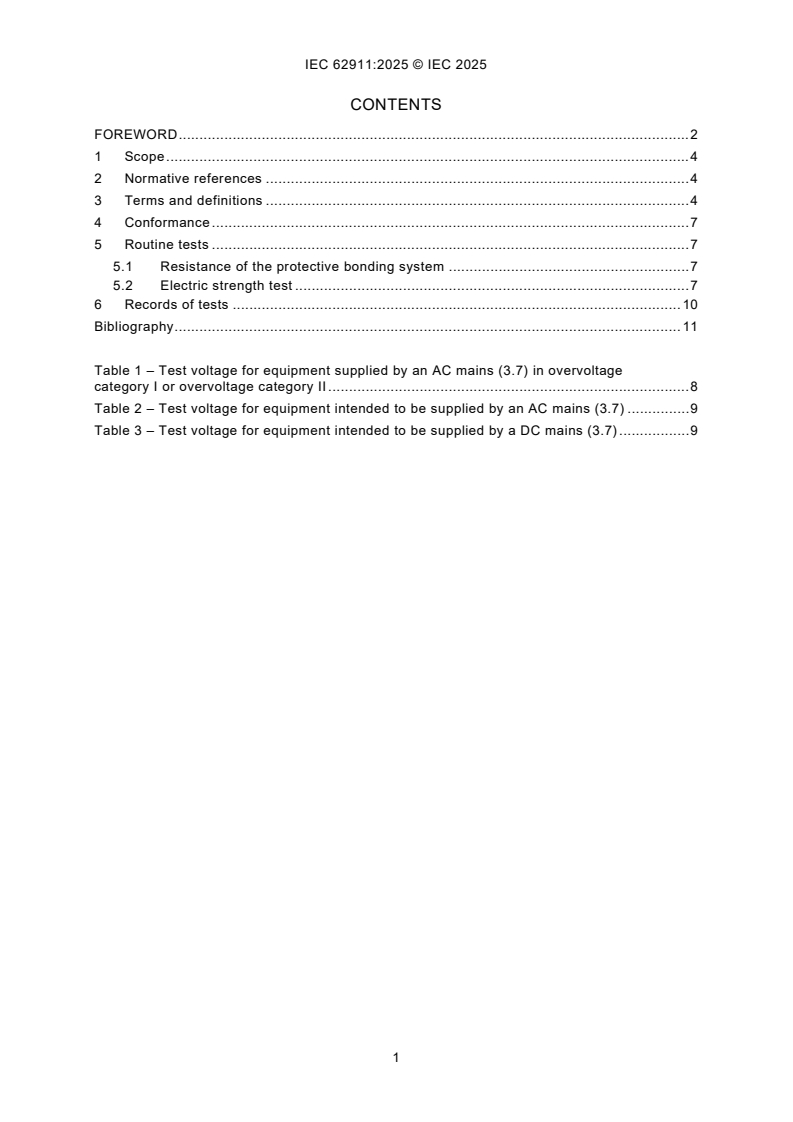
CONTENTS
FOREWORD . 2
1 Scope . 4
2 Normative references . 4
3 Terms and definitions . 4
4 Conformance . 7
5 Routine tests . 7
5.1 Resistance of the protective bonding system . 7
5.2 Electric strength test . 7
6 Records of tests . 10
Bibliography . 11
Table 1 – Test voltage for equipment supplied by an AC mains (3.7) in overvoltage
category I or overvoltage category II . 8
Table 2 – Test voltage for equipment intended to be supplied by an AC mains (3.7) . 9
Table 3 – Test voltage for equipment intended to be supplied by a DC mains (3.7) . 9
INTERNATIONAL ELECTROTECHNICAL COMMISSION
____________
Audio, video and information technology equipment - Routine electrical
safety testing in production
FOREWORD
1) The International Electrotechnical Commission (IEC) is a worldwide organization for
standardization comprising all national electrotechnical committees (IEC National Committees).
The object of IEC is to promote international co-operation on all questions concerning
standardization in the electrical and electronic fields. To this end and in addition to other
activities, IEC publishes International Standards, Technical Specifications, Technical Reports,
Publicly Available Specifications (PAS) and Guides (hereafter referred to as “IEC
Publication(s)”). Their preparation is entrusted to technical committees; any IEC National
Committee interested in the subject dealt with may participate in this preparatory work.
International, governmental and non-governmental organizations liaising with the IEC also
participate in this preparation. IEC collaborates closely with the International Organization for
Standardization (ISO) in accordance with conditions determined by agreement between the two
organizations.
2) The formal decisions or agreements of IEC on technical matters express, as nearly as
possible, an international consensus of opinion on the relevant subjects since each technical
committee has representation from all interested IEC National Committees.
3) IEC Publications have the form of recommendations for international use and are accepted
by IEC National Committees in that sense. While all reasonable efforts are made to ensure that
the technical content of IEC Publications is accurate, IEC cannot be held responsible for the
way in which they are used or for any misinterpretation by any end user.
4) In order to promote international uniformity, IEC National Committees undertake to apply IEC
Publications transparently to the maximum extent possible in their national and regional
publications. Any divergence between any IEC Publication and the corresponding national or
regional publication shall be clearly indicated in the latter.
5) IEC itself does not provide any attestation of conformity. Independent certification bodies
provide conformity assessment services and, in some areas, access to IEC marks of conformity.
IEC is not responsible for any services carried out by independent certification bodies.
6) All users should ensure that they have the latest edition of this publication.
7) No liability shall attach to IEC or its directors, employees, servants or agents including
individual experts and members of its technical committees and IEC National Committees for
any personal injury, property damage or other damage of any nature whatsoever, whether direct
or indirect, or for costs (including legal fees) and expenses arising out of the publication, use
of, or reliance upon, this IEC Publication or any other IEC Publications.
8) Attention is drawn to the Normative references cited in this publication. Use of the referenced
publications is indispensable for the correct application of this publication.
9) IEC draws attention to the possibility that the implementation of this document may involve
the use of (a) patent(s). IEC takes no position concerning the evidence, validity or applicability
of any claimed patent rights in respect thereof. As of the date of publication of this document,
IEC had not received notice of (a) patent(s), which may be required to implement this document.
However, implementers are cautioned that this may not represent the latest information, which
may be obtained from the patent database available at https://patents.iec.ch. IEC shall not be
held responsible for identifying any or all such patent rights.
IEC 62911 has been prepared by IEC technical committee 108: Safety of electronic equipment
within the field of audio/video, information technology and communication technology. It is an
International Standard.
This second edition cancels and replaces the first edition published in 2016. This edition
constitutes a technical revision.
This edition includes the following significant technical changes with respect to the previous
edition:
a) this edition aligns with the terminology and requirements of IEC 62368-1:2023;
b) test conditions for DC mains have been added;
c) smaller size technical changes were made.
The text of this International Standard is based on the following documents:
Draft Report on voting
108/833/FDIS 108/837/RVD
Full information on the voting for its approval can be found in the report on voting indicated in
the above table.
The language used for the development of this International Standard is English.
This document was drafted in accordance with ISO/IEC Directives, Part 2, and developed in
accordance with ISO/IEC Directives, Part 1 and ISO/IEC Directives, IEC Supplement, available
at http://www.iec.ch/members_experts/refdocs. The main document types developed by IEC
are described in greater detail at http://www.iec.ch/publications.
In this document, the following print types or formats are used:
– compliance statements and test specifications: in italic type.
The committee has decided that the contents of this document will remain unchanged until the
stability date indicated on the IEC website under webstore.iec.ch in the data related to the
specific document. At this date, the document will be
• reconfirmed,
• withdrawn, or
• revised.
1 Scope
This International Standard defines routine test (3.16) procedures for use during or after
manufacturing of complete equipment, sub-assemblies or components, complying with IEC
62368-1 and powered by an AC mains (3.7) or DC mains (3.7), to detect manufacturing failures
and unacceptable tolerances in manufacturing and materials.
NOTE 1 Not all the tests defined in this document are necessarily performed at the end product manufacturing
location. The optimal location for the routine tests (3.16) can be defined by the equipment manufacturer and reviewed
under the applicable conformity assessment scheme.
NOTE 2 The test procedures in this document are intended to identify production and manufacturing errors. These
test procedures are not intended for product development or verification (see IEC 62368-1 [1]).
2 Normative references
The following documents are referred to in the text in such a way that some or all of their content
constitutes requirements of this document. For dated references, only the edition cited applies.
For undated references, the latest edition of the referenced document (including any
amendments) applies.
IEC 62368-1:2023, Audio/video, information and communication technology equipment - Part
1: Safety requirements
IEC 62368-1, Audio/video, information and communication technology equipment - Part 1:
Safety requirements
3 Terms and definitions
For the purposes of this document, the following terms and definitions apply.
ISO and IEC maintain terminology databases for use in standardization at the following
addresses:
– IEC Electropedia: available at https://www.electropedia.org/
– ISO Online browsing platform: available at https://www.iso.org/obp
3.1
accessible
touchable by a body part
[SOURCE: IEC 62368-1:2023 [2], 3.3.6.1, modified - Note to entry omitted.]
3.2
basic insulation
insulation to provide a basic safeguard against electric shock
Note 1 to entry: This concept does not apply to insulation used exclusively for functional purposes.
[SOURCE: IEC 62368-1:2023 [2], 3.3.5.1]
3.3
double insulation
insulation comprising both basic insulation (3.2) and supplementary insulation
[SOURCE: IEC 62368-1:2023 [2], 3.3.5.2]
3.4
class I equipment
equipment with basic insulation (3.2) use
...
IEC 62911 ®
Edition 2.0 2025-06
INTERNATIONAL
STANDARD
NORME
INTERNATIONALE
Audio, video and information technology equipment – Routine electrical safety
testing in production
Appareils audio, vidéo et matériel de traitement de l'information – Essais
individuels de série, en production, pour la vérification de la sécurité électrique
ICS 33.160.01, 35.020 ISBN 978-2-8327-0388-5
All rights reserved. Unless otherwise specified, no part of this publication may be reproduced or utilized in any form or
by any means, electronic or mechanical, including photocopying and microfilm, without permission in writing from either
IEC or IEC's member National Committee in the country of the requester. If you have any questions about IEC copyright
or have an enquiry about obtaining additional rights to this publication, please contact the address below or your local
IEC member National Committee for further information.
Droits de reproduction réservés. Sauf indication contraire, aucune partie de cette publication ne peut être reproduite ni
utilisée sous quelque forme que ce soit et par aucun procédé, électronique ou mécanique, y compris la photocopie et
les microfilms, sans l'accord écrit de l'IEC ou du Comité national de l'IEC du pays du demandeur. Si vous avez des
questions sur le copyright de l'IEC ou si vous désirez obtenir des droits supplémentaires sur cette publication, utilisez
les coordonnées ci-après ou contactez le Comité national de l'IEC de votre pays de résidence.
IEC Secretariat Tel.: +41 22 919 02 11
3, rue de Varembé info@iec.ch
CH-1211 Geneva 20 www.iec.ch
Switzerland
About the IEC
The International Electrotechnical Commission (IEC) is the leading global organization that prepares and publishes
International Standards for all electrical, electronic and related technologies.
About IEC publications
The technical content of IEC publications is kept under constant review by the IEC. Please make sure that you have the
latest edition, a corrigendum or an amendment might have been published.
IEC publications search - IEC Products & Services Portal - products.iec.ch
webstore.iec.ch/advsearchform Discover our powerful search engine and read freely all the
The advanced search enables to find IEC publications by a publications previews, graphical symbols and the glossary.
variety of criteria (reference number, text, technical With a subscription you will always have access to up to date
committee, …). It also gives information on projects, content tailored to your needs.
replaced and withdrawn publications.
Electropedia - www.electropedia.org
IEC Just Published - webstore.iec.ch/justpublished The world's leading online dictionary on electrotechnology,
Stay up to date on all new IEC publications. Just Published containing more than 22 500 terminological entries in English
details all new publications released. Available online and and French, with equivalent terms in 25 additional languages.
once a month by email. Also known as the International Electrotechnical Vocabulary
(IEV) online.
IEC Customer Service Centre - webstore.iec.ch/csc
If you wish to give us your feedback on this publication or
need further assistance, please contact the Customer
Service Centre: sales@iec.ch.
A propos de l'IEC
La Commission Electrotechnique Internationale (IEC) est la première organisation mondiale qui élabore et publie des
Normes internationales pour tout ce qui a trait à l'électricité, à l'électronique et aux technologies apparentées.
A propos des publications IEC
Le contenu technique des publications IEC est constamment revu. Veuillez vous assurer que vous possédez l’édition la
plus récente, un corrigendum ou amendement peut avoir été publié.
Recherche de publications IEC - IEC Products & Services Portal - products.iec.ch
webstore.iec.ch/advsearchform Découvrez notre puissant moteur de recherche et consultez
La recherche avancée permet de trouver des publications gratuitement tous les aperçus des publications, symboles
IEC en utilisant différents critères (numéro de référence, graphiques et le glossaire. Avec un abonnement, vous aurez
texte, comité d’études, …). Elle donne aussi des toujours accès à un contenu à jour adapté à vos besoins.
informations sur les projets et les publications remplacées
ou retirées. Electropedia - www.electropedia.org
Le premier dictionnaire d'électrotechnologie en ligne au
IEC Just Published - webstore.iec.ch/justpublished monde, avec plus de 22 500 articles terminologiques en
Restez informé sur les nouvelles publications IEC. Just anglais et en français, ainsi que les termes équivalents
Published détaille les nouvelles publications parues. dans 25 langues additionnelles. Egalement appelé
Disponible en ligne et une fois par mois par email. Vocabulaire Electrotechnique International (IEV) en ligne.
Service Clients - webstore.iec.ch/csc
Si vous désirez nous donner des commentaires sur cette
publication ou si vous avez des questions contactez-
nous: sales@iec.ch.
CONTENTS
FOREWORD . 2
1 Scope . 4
2 Normative references . 4
3 Terms and definitions . 4
4 Conformance . 7
5 Routine tests . 7
5.1 Resistance of the protective bonding system . 7
5.2 Electric strength test . 7
6 Records of tests . 10
Bibliography . 11
Table 1 – Test voltage for equipment supplied by an AC mains (3.7) in overvoltage
category I or overvoltage category II . 8
Table 2 – Test voltage for equipment intended to be supplied by an AC mains (3.7) . 9
Table 3 – Test voltage for equipment intended to be supplied by a DC mains (3.7) . 9
INTERNATIONAL ELECTROTECHNICAL COMMISSION
____________
Audio, video and information technology equipment - Routine electrical
safety testing in production
FOREWORD
1) The International Electrotechnical Commission (IEC) is a worldwide organization for
standardization comprising all national electrotechnical committees (IEC National Committees).
The object of IEC is to promote international co-operation on all questions concerning
standardization in the electrical and electronic fields. To this end and in addition to other
activities, IEC publishes International Standards, Technical Specifications, Technical Reports,
Publicly Available Specifications (PAS) and Guides (hereafter referred to as “IEC
Publication(s)”). Their preparation is entrusted to technical committees; any IEC National
Committee interested in the subject dealt with may participate in this preparatory work.
International, governmental and non-governmental organizations liaising with the IEC also
participate in this preparation. IEC collaborates closely with the International Organization for
Standardization (ISO) in accordance with conditions determined by agreement between the two
organizations.
2) The formal decisions or agreements of IEC on technical matters express, as nearly as
possible, an international consensus of opinion on the relevant subjects since each technical
committee has representation from all interested IEC National Committees.
3) IEC Publications have the form of recommendations for international use and are accepted
by IEC National Committees in that sense. While all reasonable efforts are made to ensure that
the technical content of IEC Publications is accurate, IEC cannot be held responsible for the
way in which they are used or for any misinterpretation by any end user.
4) In order to promote international uniformity, IEC National Committees undertake to apply IEC
Publications transparently to the maximum extent possible in their national and regional
publications. Any divergence between any IEC Publication and the corresponding national or
regional publication shall be clearly indicated in the latter.
5) IEC itself does not provide any attestation of conformity. Independent certification bodies
provide conformity assessment services and, in some areas, access to IEC marks of conformity.
IEC is not responsible for any services carried out by independent certification bodies.
6) All users should ensure that they have the latest edition of this publication.
7) No liability shall attach to IEC or its directors, employees, servants or agents including
individual experts and members of its technical committees and IEC National Committees for
any personal injury, property damage or other damage of any nature whatsoever, whether direct
or indirect, or for costs (including legal fees) and expenses arising out of the publication, use
of, or reliance upon, this IEC Publication or any other IEC Publications.
8) Attention is drawn to the Normative references cited in this publication. Use of the referenced
publications is indispensable for the correct application of this publication.
9) IEC draws attention to the possibility that the implementation of this document may involve
the use of (a) patent(s). IEC takes no position concerning the evidence, validity or applicability
of any claimed patent rights in respect thereof. As of the date of publication of this document,
IEC had not received notice of (a) patent(s), which may be required to implement this document.
However, implementers are cautioned that this may not represent the latest information, which
may be obtained from the patent database available at https://patents.iec.ch. IEC shall not be
held responsible for identifying any or all such patent rights.
IEC 62911 has been prepared by IEC technical committee 108: Safety of electronic equipment
within the field of audio/video, information technology and communication technology. It is an
International Standard.
This second edition cancels and replaces the first edition published in 2016. This edition
constitutes a technical revision.
This edition includes the following significant technical changes with respect to the previous
edition:
a) this edition aligns with the terminology and requirements of IEC 62368-1:2023;
b) test conditions for DC mains have been added;
c) smaller size technical changes were made.
The text of this International Standard is based on the following documents:
Draft Report on voting
108/833/FDIS 108/837/RVD
Full information on the voting for its approval can be found in the report on voting indicated in
the above table.
The language used for the development of this International Standard is English.
This document was drafted in accordance with ISO/IEC Directives, Part 2, and developed in
accordance with ISO/IEC Directives, Part 1 and ISO/IEC Directives, IEC Supplement, available
at http://www.iec.ch/members_experts/refdocs. The main document types developed by IEC
are described in greater detail at http://www.iec.ch/publications.
In this document, the following print types or formats are used:
– compliance statements and test specifications: in italic type.
The committee has decided that the contents of this document will remain unchanged until the
stability date indicated on the IEC website under webstore.iec.ch in the data related to the
specific document. At this date, the document will be
• reconfirmed,
• withdrawn, or
• revised.
1 Scope
This International Standard defines routine test (3.16) procedures for use during or after
manufacturing of complete equipment, sub-assemblies or components, complying with IEC
62368-1 and powered by an AC mains (3.7) or DC mains (3.7), to detect manufacturing failures
and unacceptable tolerances in manufacturing and materials.
NOTE 1 Not all the tests defined in this document are necessarily performed at the end product manufacturing
location. The optimal location for the routine tests (3.16) can be defined by the equipment manufacturer and reviewed
under the applicable conformity assessment scheme.
NOTE 2 The test procedures in this document are intended to identify production and manufacturing errors. These
test procedures are not intended for product development or verification (see IEC 62368-1 [1]).
2 Normative references
The following documents are referred to in the text in such a way that some or all of their content
constitutes requirements of this document. For dated references, only the edition cited applies.
For undated references, the latest edition of the referenced document (including any
amendments) applies.
IEC 62368-1:2023, Audio/video, information and communication technology equipment - Part
1: Safety requirements
IEC 62368-1, Audio/video, information and communication technology equipment - Part 1:
Safety requirements
3 Terms and definitions
For the purposes of this document, the following terms and definitions apply.
ISO and IEC maintain terminology databases for use in standardization at the following
addresses:
– IEC Electropedia: available at https://www.electropedia.org/
– ISO Online browsing platform: available at https://www.iso.org/obp
3.1
accessible
touchable by a body part
[SOURCE: IEC 62368-1:2023 [2], 3.3.6.1, modified - Note to entry omitted.]
3.2
basic insulation
insulation to provide a basic safeguard against electric shock
Note 1 to entry: This concept does not apply to insulation used exclusively for functional purposes.
[SOURCE: IEC 62368-1:2023 [2], 3.3.5.1]
3.3
double insulation
insulation comprising both basic insulation (3.2) and supplementary insulation
[SOURCE: IEC 62368-1:2023 [2], 3.3.5.2]
3.4
class I equipment
equipment with basic insulation (3.2) used as a basic safeguard, and with protective bonding
and protective earthing (3.11) used as a supplementary safeguard
Note 1 to entry: Class I equipment can be provided with class II construction.
[SOURCE: IEC 60050-851:2008 [3], 851-15-10, modified – The definition has been adapted to
the safeguard principle; addition of a new Note 1 to entry.]
3.5
device
material element or assembly of such elements intended to perform a required function
Note 1 to entry: A device may form part of a larger system (for example, a server node installed in a rack system).
[SOURCE: IEC 60050-151:2001 [4], 151-11-20, modified ─ In Note 1 to entry, replacement of
"device" with "system", and addition of the text within parenthesis.]
3.6
functional earthing
earthing a point or points in a system or in an installation or in equipment, for purposes other
than electrical safety
[SOURCE: IEC 60050-195:2021 [5], 195-01-13, modified ─ Addition of "a point or points in a
system or in an installation or in equipment".]
3.7
mains
AC or DC power distribution system (external to the equipment) that supplies operating power
to the equipment
Note 1 to entry: Mains include public or private utilities and, unless otherwise specified in this document, equivalent
sources such as motor-driven generators and uninterruptible power supplies.
Note 2 to entry: Powering external circuits by using communications cables and circuits that are isolated from the
mains (for example, data, voice, PoE, USB, HDMI, Coaxial, RFT and similar circuits in Table 13 of IEC 62368-1:2023
[2]) are not considered to be mains.
[SOURCE: IEC 62368-1:2023 [2], 3.3.1.3, modified - Addition of Note 2 to entry.]
3.8
permanently connected equipment
equipment that can only be electrically connected to or disconnected from the mains (3.7) by
the use of a tool
[SOURCE: IEC 62368-1:2023 [2], 3.3.3.6]
3.9
protective bonding conductor
protective conductor in the equipment provided for protective equipotential-bonding of parts
required to be earthed for safety purposes
Note 1 to entry: A protective bonding conductor is internal in the equipment.
[SOURCE: IEC 62368-1:2023 [2], 3.3.11.9]
3.10
protective current rating
current rating of an overcurrent protective device (3.5) that is in the building installation or in
the equipment to protect a circuit
[SOURCE: IEC 62368-1:2023 [2], 3.3.10.6]
3.11
protective earthing
earthing a point or points in a system or in an installation or in equipment for purposes of
electrical safety
[SOURCE: IEC 60050-195:2021 [5]195-01-11, modified ─ Addition of " a point or points in a
system or in an installation or in equipment".]
3.12
protective earthing conductor
protective conductor connecting a main protective earthing (3.11) terminal in the equipment to
an earth point in the building installation for protective earthing
[SOURCE: IEC 62368-1:2023 [2], 3.3.11.12]
3.13
rated frequency
supply frequency or frequency range as declared by the manufacturer
3.14
rated voltage
value of voltage assigned by the manufacturer to a component, device (3.5) or equipment and
to which operation and performance characteristics are referred
Note 1 to entry: Equipment may have more than one rated voltage (3.14) value or may have a rated voltage (3.14)
range.
[SOURCE: IEC 60664-1:2020 [6], 3.1.17]
3.15
reinforced insulation
single insulation system that provides a degree of protection against electric shock equivalent
to double insulation (3.3)
[SOURCE: IEC 62368-1:2023 [2], 3.3.5.5]
3.16
routine test
test to which each individual device (3.5) is subjected during or after manufacture to ascertain
whether it complies with certain criteria
[SOURCE: IEC 60664-1:2020 [6], 3.1.42, modified ─ Replacement of "conformity test" with
"test", replacement of "item" with "device", addition of "to ascertain whether it complies with
certain criteria".]
3.17
type test
test on a representative sample with the objective of determining if, as designed and
manufactured, it can meet the requirements of this document
[SOURCE: IEC 62368-1:2023 [2],3.3.6.24]
3.18
working voltage
voltage across any particular insulation while the equipment is supplied at rated voltage (3.14)
or any voltage in the rated voltage range under normal operating conditions
Note 1 to entry: External transient voltages are disregarded.
Note 2 to entry: Recurring peak voltages are disregarded.
4 Conformance
Equipment shall pass the routine tests (3.16) of Clause 5 where applicable. The results of the
performed tests shall be recorded according to Clause 6 prior to shipment from the
manufacturing site.
Measures can be used to conduct the test, such as finding an appropriate way to make the
connections necessary to perform the relevant test.
5 Routine tests
5.1 Resistance of the protective bonding system
For class I equipment (3.4), the continuity of the protective bonding system shall be tested
between the protective earthing (3.11) contact of the mains (3.7) plug or appliance inlet of the
equipment, or the protective earthing (3.11) terminal in case of a permanently connected
equipment (3.8), and
– the accessible (3.1) conductive parts that shall be connected to the protective earthing
(3.11) terminal for compliance with the requirements of IEC 62368-1:2023, and
– the protective earthing (3.11) contact of the socket-outlets respectively, if provided to deliver
mains (3.7) power to other equipment.
NOTE 1 Functional earthing (3.6) is not considered a part of the protective bonding system. Consequently, testing
of functional earthing is not required.
NOTE 2 Some parts of the equipment can have a circuit, part or terminal that is earthed for safety reasons, but that
is not accessible (3.1). It is the responsability of the manufacturer to determine adequate routine testing (3.16) for
these parts.
The minimum test current is 150 % of the rating of the overcurrent device (3.5) protecting the
circuit which is protected by the protective bonding conductor (3.9) (the protective current rating
(3.10)), but not less than 10 A and not more than 25 A (AC or DC), applied for any duration
between 1 s and 4 s. The source shall have a no-load voltage not exceeding 12 V.
The resistance, calculated from the voltage drop across the protective bonding system, shall
not exceed 0,1 Ω. Alternatively, the resistance can be read directly from a high-current-sourcing
milliohm meter.
It is permitted to include the power cord (if any) in the resistance measurement and, if the result
exceeds 0,1 Ω, to subtract the resistance of the protective earthing conductor (3.12) of the
power cord.
NOTE 3 It is important to check that that the contact resistance between the tip of the measuring probe and the
conductive part under test does not influence the test result.
5.2 Electric strength test
Routine tests (3.16) for electric strength shall be carried out between circuits connected to the
mains (3.7) and accessible (3.1) terminals and accessible (3.1) conductive parts. For accessible
(3.1) circuits not connected to the mains (3.7) , it is permitted to test separately, before final
assembly, subassemblies and components, such as transformers, if the relevant insulation
cannot be tested in the complete equipment, provided that the complete equipment complies
with IEC 62368-1.
NOTE 1 Overvoltage categories are as defined in IEC 62368-1:2023 [2], Annex I.
NOTE 2 Oher standards use a different term for electric strength, such as "voltage withstand test" [Source: IEC
60050-411:1996 [7], 411-53-49] or "withstand voltage test" (IEC 61180:2016 [8] or "voltage test" (IEC 60204-1:2016
[9], IEC 61010-1:2010 [10])]
The insulation of the equipment shall be tested as follows:
– for equipment intended to be supplied by an AC mains (3.7) in overvoltage category I or
overvoltage category II , an AC test voltage of substantially sine-wave form having mains
(3.7) frequency or a DC test voltage, as specified in Table 1 or Table 2 can be applied;
– for all other equipment intended to be supplied by an AC mains (3.7), an AC test voltage of
substantially sine-wave form, having mains (3.7) frequency, or a DC test voltage or a
combination of both with a peak value as specified in Table 2 shall be applied;
NOTE 3 The frequency of the AC test voltage can be 50 Hz or 60 Hz independently of the rated frequency (3.13)
of the mains (3.7) of the equipment.
– for equipment intended to be supplied by a DC mains (3.7) only, a DC voltage according to
Table 3 shall be applied;
– for equipment intended to be supplied by either an AC mains (3.7) or a DC mains (3.7), the
test can be applied at either AC or DC voltage, making sure that the test voltage is the
equivalent of the highest of the two required test voltages as given in the above dashes;
– for equipment designed to be connected to a threephase supply, URMS shall be the phase
to neutral voltage or the worst case phase to ground voltage (that is, considering corner
grounded delta configurations).
The test voltages given are the minimum test voltages to be applied. Higher voltages are
allowed at the discretion of the manufacturer provided the insulation is not damaged due to
overstress by the applied voltage.
NOTE 4 Applying an electric strength test voltage that is too high can result in deterioration or partial damage of
the insulation.
The test voltage is applied between the mains (3.7) supply terminals connected together and
– accessible (3.1) terminals, and
– accessible (3.1) conductive parts respectively.
Accessible (3.1) terminals and accessible (3.1) conductive parts can be connected together
during the electric strength test.
Functional earthing (3.6) is not protective earthing (3.11). Accessible (3.1) parts connected to
functional earthing (3.6) shall be tested as not being connected to protective earthing (3.11) if
the relevant insulation cannot be tested in the complete equipment.
Table 1 – Test voltage for equipment supplied by an AC mains (3.7) in overvoltage
category I or overvoltage category II
Test voltage
V AC or DC
peak
Application of test voltage
Rated mains (3.7) Rated mains (3.7) Rated mains (3.7)
voltage voltage voltage
U ≤ 150 150
RMS RMS RMS
Accessible (3.1) parts connected to 1 130 2 120 3 540
protective earthing (3.11)
(800 RMS) (1 500 RMS) (2 500 RMS)
Test voltage
V AC or DC
peak
Application of test voltage
Rated mains (3.7) Rated mains (3.7) Rated mains (3.7)
voltage voltage voltage
U ≤ 150 150
RMS RMS RMS
Accessible (3.1) parts not connected to 2 120 3 540 5 660
protective earthing (3.11)
(1 500 RMS) (2 500 RMS) (4 000 RMS)
Table 2 – Test voltage for equipment intended to be supplied by an AC mains (3.7)
Application of
Test voltage
test voltage
V AC or DC
peak
Accessible (3.1) The value for basic insulation (3.2) as determined according to 5.4.9.2 of IEC 62368-1:2023
parts connected (Test procedure for routine tests (3.16)), by using the highest value as determined by
to protective Method 1, Method 2 and Method 3 of 5.4.9.1 of IEC 62368-1:2023, which may be reduced by
earthing (3.11) 10 %.
Accessible (3.1) The value for double insulation (3.3) or reinforced insulation (3.15) as determined according
parts not to 5.4.9.2 of IEC 62368-1:2023 (test procedure for routine tests (3.16)), by using the highest
connected to value as determined by Method 1, Method 2 and Method 3 of 5.4.9.1 of IEC 62368-1:2023,
protective which may be reduced by 10 %.
earthing (3.11)
The value of the test voltage can be derived from the test value in the type test (3.17) report
according to IEC 62368-1:2023, reduced by 10 %.
A higher test voltage can be necessary for cases where the peak of the working voltage (3.18)
and recurring peak voltages are such that the value of the test voltage according to Table 26
of IEC 62368-1:2023 is higher that the value resulting from this table.
Table 3 – Test voltage for equipment intended to be supplied by a DC mains (3.7)
Application of Test voltage
test voltage
V DC
rated 60 V > rated mains (3.7) voltage 120 V > rated mains (3.7) voltage ≤
mains ≤120 V 600 V
(3.7)
voltage ≤
60 V
Accessible (3.1) No test No test The value for basic insulation (3.2) as
parts connected determined according to 5.4.9.2 of IEC
to protective 62368-1:2023(test procedure for
earthing (3.11) routine tests (3.16)), by using the
highest value as determined by Method
1 and Method 2 of 5.4.9.1 of IEC
62368-1:2023, which may be reduced
by 10 %
Accessible (3.1) No test The value for basic insulation (3.2) The value for double insulation (3.3) or
parts not as determined according to 5.4.9.2 reinforced insulation (3.15) as
connected to of IEC 62368-1:2023 (Test determined according to 5.4.9.2 of IEC
protective procedure for routine tests (3.16)), 62368-1:2023(test procedure for
earthing (3.11) by using the highest value as routine tests (3.16)), by using the
determined by Method 1 and highest value as determined by Method
Method 2 of 5.4.9.1 of IEC 62368- 1 and Method 2 of 5.4.9.1 of IEC
1:2023, which may be reduced by 62368-1:2023, which may be reduced
10 % by 10 %
Before the test voltage is applied, contact shall be made between the equipment and the
connection devices (3.5).
The voltage applied to the insulation under test can be gradually raised from zero to the
specified voltage and shall be maintained at that value for 1 s to 4 s.
During the test, mains (3.7) switches and functional switches conductively connected to the
mains (3.7), if any, shall be in the on-position and it shall be ensured by suitable means that
the test voltage is effectively applied to the insulation of the equipment.
No flash-over or breakdown shall occur during the test. The test voltage source shall be
provided with a current sensing (overcurrent) device (3.5) which, when activated, gives an
indication "unacceptable". When loaded up to and including the overcurrent activation point,
the voltage source shall still deliver the required voltage.
NOTE 5 The manufacturer can define the minimum tripping current, making sure it is high enough to detect
breakdown but at the same time taking into account possible operator safety issues.
Activation of the current sensing device (3.5) is regarded as a flash-over or breakdown.
6 Records of tests
All test results shall be kept available. The choice of support and format for reports is left to the
manufacturer. Separate forms (one for each complete equipment, sub-assembly or component)
or lists of equipment, grouped according to the most suitable parameters (periods of time,
model, etc.) are equally acceptable. The only obligation is the availability of data and their
immediate interpretability for each complete equipment, sub-assembly or component leaving
the manufacturing location.
The following data shall be retrievable as evidence that the test was performed:
– date of test;
– model of the complete equipment, sub-assembly or component;
– serial number of the complete equipment, sub-assembly or component, or another identifier
permitting the identification without ambiguity;
– location of the points tested;
– value of the resistance of the protective bonding system with the corresponding current
value (*);
– value and nature of the voltage applied during the electric strength test (*);
– quick-reference information that the whole set of tests has or has not been successful.
As an alternative to the values marked with an asterisk (*) above, a record of the result of each
test (pass or fail) shall be maintained.
Bibliography
[1] IEC 62368-1, Audio/video, information and communication technology equipment - Part
1: Safety requirements
[2] IEC 62368-1:2023, Audio/video, information and communication technology equipment
- Part 1: Safety requirements
[3] IEC 60050-851:2008, International Electrotechnical Vocabulary (IEV) - Part 851: Electric
welding
[4] IEC 60050-151:2001, International Electrotechnical Vocabulary (IEV) - Part 151:
Electrical and magnetic devices
[5] IEC 60050-195:2021, International Electrotechnical Vocabulary (IEV) - Part 195:
Earthing and protection against electric shock
[6] IEC 60664-1:2020, Insulation coordination for equipment within low-voltage supply
systems - Part 1: Principles, requirements and tests
[7] IEC 60050-411:1996, International Electrotechnical Vocabulary (IEV) - Part 411:
Rotating machinery
[8] IEC 61180:2016, High-voltage test techniques for low-voltage equipment - Definitio
...