

IEC 62541-11:2025
(Main)OPC unified architecture - Part 11: Historical Access
General Information
- Abstract
IEC 62541-11: 2025 defines the Information Model associated with Historical Access (HA). It particularly includes additional and complementary descriptions of the NodeClasses and Attributes needed for Historical Access, additional standard Properties, and other information and behaviour. The complete AddressSpace Model including all NodeClasses and Attributes is specified in IEC 62541‑3. The predefined Information Model is defined in IEC 62541‑5. The Services to detect and access historical data and events, and description of the ExtensibleParameter types are specified in IEC 62541‑4. This document includes functionality to compute and return Aggregates like minimum, maximum, average etc. The Information Model and the concrete working of Aggregates are defined in IEC 62541‑13. Conventions for Historical Access Clients are informatively provided in Annex A.
This fourth edition cancels and replaces the third edition published in 2020. This edition constitutes a technical revision.
This edition includes the following significant technical changes with respect to the previous edition:
a) a functionality has been added to support retrieving of modified events;
b) an Event has been added to indicate when a backfill occurred;
c) a new ReferenceType that can be used to indicate an external node has been defined;
d) the text has been improved to better explain the concept of annotation and remove conflicting explanations;
e) a default historian configuration (and where to find it) has been defined;
f) HistoricalEventConfigurationType, which provides general configuration information about the historical Event storage, has been added;
g) the text has been updated and optional fields have been added to HA configuration object to allow configuration to be defined for periodic data collection, not just for exception-based collection;
h) an ObjectType that can be used for external event collection has been provided as well as an example how historians can be configured.
- Status
- Published
- Publication Date
- 22-Dec-2025
- Technical Committee
- SC 65E - Devices and integration in enterprise systems
- Drafting Committee
- WG 8 - TC 65/SC 65E/WG 8
- Current Stage
- PPUB - Publication issued
- Start Date
- 23-Dec-2025
- Completion Date
- 10-Dec-2025
Buy Documents

IEC 62541-11:2025 - OPC unified architecture - Part 11: Historical Access/23/2025
IEC 62541-11:2025 RLV - OPC unified architecture - Part 11: Historical Access Released:12/23/2025

IEC 62541-11:2025 - Architecture unifiée OPC - Partie 11: Accès à l'historique/23/2025

IEC 62541-11:2025 - OPC unified architecture - Part 11: Historical Access/23/2025
Overview
IEC 62541-11:2025 - OPC Unified Architecture (OPC UA) Part 11: Historical Access defines the Information Model and behavior needed to discover, access, configure and manage historical data and events in OPC UA AddressSpaces. This 2025 fourth edition is a technical revision that expands how historians, historians’ configurations and clients interact with historical records, including support for aggregates (min, max, average), modified events, annotations and default historian configuration.
Key topics and technical requirements
- Historical Information Model
- Definitions for HistoricalNodes, HistoricalDataNodes, HistoricalEventNodes, attributes, and standard properties needed for historical access.
- Specifications for Annotations and how they are exposed as properties of historical nodes.
- History services and parameters
- Service usage for reading historical raw/processed data, events, modified events, and annotations (see HistoryReadDetails and related structures).
- Continuation points, timestamps handling, bounding values and time-domain semantics.
- Configuration and capabilities
- HistoricalDataConfigurationType and HistoricalEventConfigurationType for configuring storage and collection (exception-based and periodic collection).
- HistoryServerCapabilitiesType to expose server/historian capabilities and a default historian configuration location.
- Event and audit handling
- Historical event storage, AuditHistory event types and new event to indicate backfill occurrences.
- Support for retrieving modified events and external event collection object types.
- Aggregates and processing
- Functionality to compute and return aggregates; Information Model and aggregate behavior referenced in IEC 62541-13.
- External sources and references
- New ReferenceType to indicate external nodes and guidance for external history sources.
- Client guidance
- Informative Annex A providing Historical Access client conventions, timestamps and best practices.
Applications and who uses it
- Industrial automation vendors building OPC UA servers with historian capabilities.
- Software developers and integrators creating historical clients, HMIs, SCADA, MES and analytics platforms that read/modify historical data and events.
- System architects defining historian configuration, data retention, backfill and audit policies.
- Compliance and operations teams needing reliable event audit trails, annotations and aggregate reporting.
Related standards
- IEC 62541-3 - AddressSpace Model (complete NodeClasses and Attributes)
- IEC 62541-4 - Services and ExtensibleParameter types for historical read/write
- IEC 62541-5 - Predefined Information Model
- IEC 62541-13 - Aggregates Information Model and behavior
Keywords: IEC 62541-11:2025, OPC UA Historical Access, historian configuration, historical data, historical events, OPC UA aggregates, annotations, HistoryReadDetails.
Relations
- Effective Date
- 05-Sep-2023
Buy Documents
IEC 62541-11:2025 - OPC unified architecture - Part 11: Historical Access/23/2025
IEC 62541-11:2025 RLV - OPC unified architecture - Part 11: Historical Access Released:12/23/2025
IEC 62541-11:2025 - Architecture unifiée OPC - Partie 11: Accès à l'historique/23/2025
IEC 62541-11:2025 - OPC unified architecture - Part 11: Historical Access/23/2025
Get Certified
Connect with accredited certification bodies for this standard

BSI Group
BSI (British Standards Institution) is the business standards company that helps organizations make excellence a habit.

DVS-ZERT GmbH
German welding certification society.
CARES (UK Certification Authority for Reinforcing Steels)
UK certification for reinforcing steels and construction.
Sponsored listings
Frequently Asked Questions
IEC 62541-11:2025 is a standard published by the International Electrotechnical Commission (IEC). Its full title is "OPC unified architecture - Part 11: Historical Access". This standard covers: IEC 62541-11: 2025 defines the Information Model associated with Historical Access (HA). It particularly includes additional and complementary descriptions of the NodeClasses and Attributes needed for Historical Access, additional standard Properties, and other information and behaviour. The complete AddressSpace Model including all NodeClasses and Attributes is specified in IEC 62541‑3. The predefined Information Model is defined in IEC 62541‑5. The Services to detect and access historical data and events, and description of the ExtensibleParameter types are specified in IEC 62541‑4. This document includes functionality to compute and return Aggregates like minimum, maximum, average etc. The Information Model and the concrete working of Aggregates are defined in IEC 62541‑13. Conventions for Historical Access Clients are informatively provided in Annex A. This fourth edition cancels and replaces the third edition published in 2020. This edition constitutes a technical revision. This edition includes the following significant technical changes with respect to the previous edition: a) a functionality has been added to support retrieving of modified events; b) an Event has been added to indicate when a backfill occurred; c) a new ReferenceType that can be used to indicate an external node has been defined; d) the text has been improved to better explain the concept of annotation and remove conflicting explanations; e) a default historian configuration (and where to find it) has been defined; f) HistoricalEventConfigurationType, which provides general configuration information about the historical Event storage, has been added; g) the text has been updated and optional fields have been added to HA configuration object to allow configuration to be defined for periodic data collection, not just for exception-based collection; h) an ObjectType that can be used for external event collection has been provided as well as an example how historians can be configured.
IEC 62541-11: 2025 defines the Information Model associated with Historical Access (HA). It particularly includes additional and complementary descriptions of the NodeClasses and Attributes needed for Historical Access, additional standard Properties, and other information and behaviour. The complete AddressSpace Model including all NodeClasses and Attributes is specified in IEC 62541‑3. The predefined Information Model is defined in IEC 62541‑5. The Services to detect and access historical data and events, and description of the ExtensibleParameter types are specified in IEC 62541‑4. This document includes functionality to compute and return Aggregates like minimum, maximum, average etc. The Information Model and the concrete working of Aggregates are defined in IEC 62541‑13. Conventions for Historical Access Clients are informatively provided in Annex A. This fourth edition cancels and replaces the third edition published in 2020. This edition constitutes a technical revision. This edition includes the following significant technical changes with respect to the previous edition: a) a functionality has been added to support retrieving of modified events; b) an Event has been added to indicate when a backfill occurred; c) a new ReferenceType that can be used to indicate an external node has been defined; d) the text has been improved to better explain the concept of annotation and remove conflicting explanations; e) a default historian configuration (and where to find it) has been defined; f) HistoricalEventConfigurationType, which provides general configuration information about the historical Event storage, has been added; g) the text has been updated and optional fields have been added to HA configuration object to allow configuration to be defined for periodic data collection, not just for exception-based collection; h) an ObjectType that can be used for external event collection has been provided as well as an example how historians can be configured.
IEC 62541-11:2025 is classified under the following ICS (International Classification for Standards) categories: 25.040.40 - Industrial process measurement and control; 35.100.05 - Multilayer applications. The ICS classification helps identify the subject area and facilitates finding related standards.
IEC 62541-11:2025 has the following relationships with other standards: It is inter standard links to IEC 62541-11:2020. Understanding these relationships helps ensure you are using the most current and applicable version of the standard.
IEC 62541-11:2025 is available in PDF format for immediate download after purchase. The document can be added to your cart and obtained through the secure checkout process. Digital delivery ensures instant access to the complete standard document.
Standards Content (Sample)
IEC 62541-11 ®
Edition 3.0 2025-12
INTERNATIONAL
STANDARD
OPC unified architecture -
Part 11: Historical Access
ICS 25.040.40; 35.100.05 ISBN 978-2-8327-0846-0
All rights reserved. Unless otherwise specified, no part of this publication may be reproduced or utilized in any form or
by any means, electronic or mechanical, including photocopying and microfilm, without permission in writing from either
IEC or IEC's member National Committee in the country of the requester. If you have any questions about IEC copyright
or have an enquiry about obtaining additional rights to this publication, please contact the address below or your local
IEC member National Committee for further information.
IEC Secretariat Tel.: +41 22 919 02 11
3, rue de Varembé info@iec.ch
CH-1211 Geneva 20 www.iec.ch
Switzerland
About the IEC
The International Electrotechnical Commission (IEC) is the leading global organization that prepares and publishes
International Standards for all electrical, electronic and related technologies.
About IEC publications
The technical content of IEC publications is kept under constant review by the IEC. Please make sure that you have the
latest edition, a corrigendum or an amendment might have been published.
IEC publications search - IEC Products & Services Portal - products.iec.ch
webstore.iec.ch/advsearchform Discover our powerful search engine and read freely all the
publications previews, graphical symbols and the glossary.
The advanced search enables to find IEC publications by a
variety of criteria (reference number, text, technical With a subscription you will always have access to up to date
committee, …). It also gives information on projects, content tailored to your needs.
replaced and withdrawn publications.
Electropedia - www.electropedia.org
The world's leading online dictionary on electrotechnology,
IEC Just Published - webstore.iec.ch/justpublished
Stay up to date on all new IEC publications. Just Published containing more than 22 500 terminological entries in English
details all new publications released. Available online and and French, with equivalent terms in 25 additional languages.
once a month by email. Also known as the International Electrotechnical Vocabulary
(IEV) online.
IEC Customer Service Centre - webstore.iec.ch/csc
If you wish to give us your feedback on this publication or
need further assistance, please contact the Customer
Service Centre: sales@iec.ch.
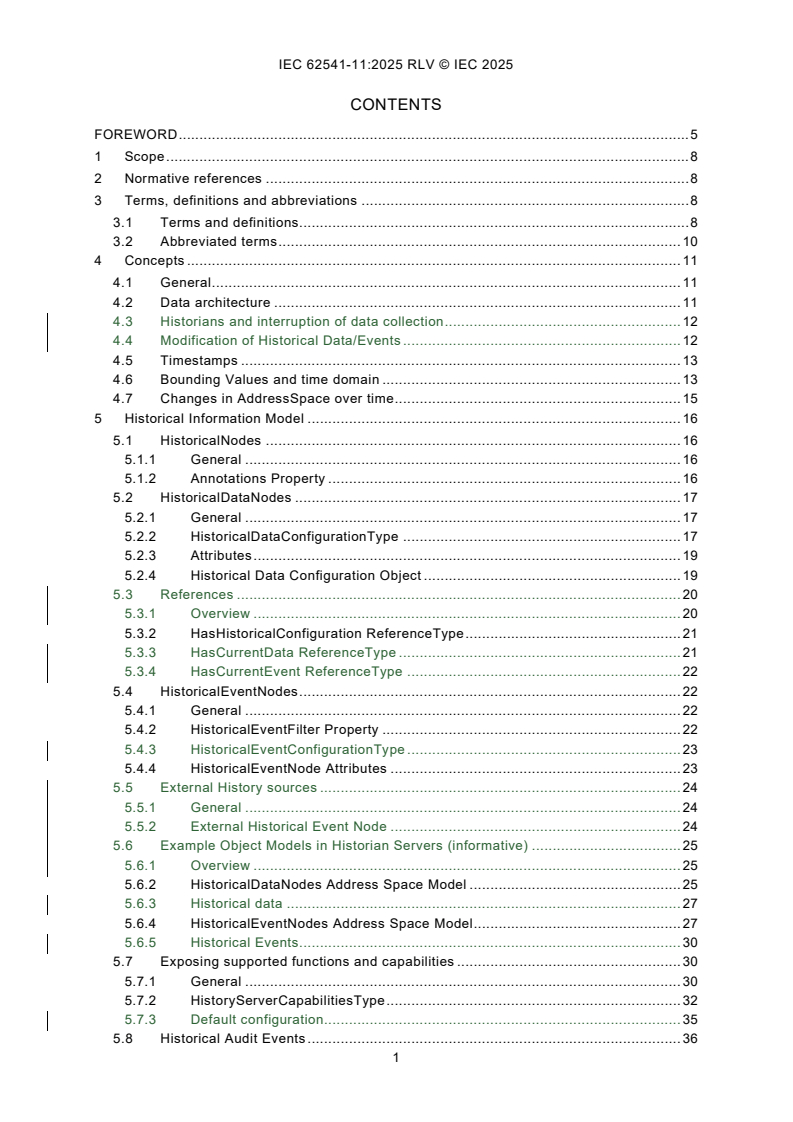
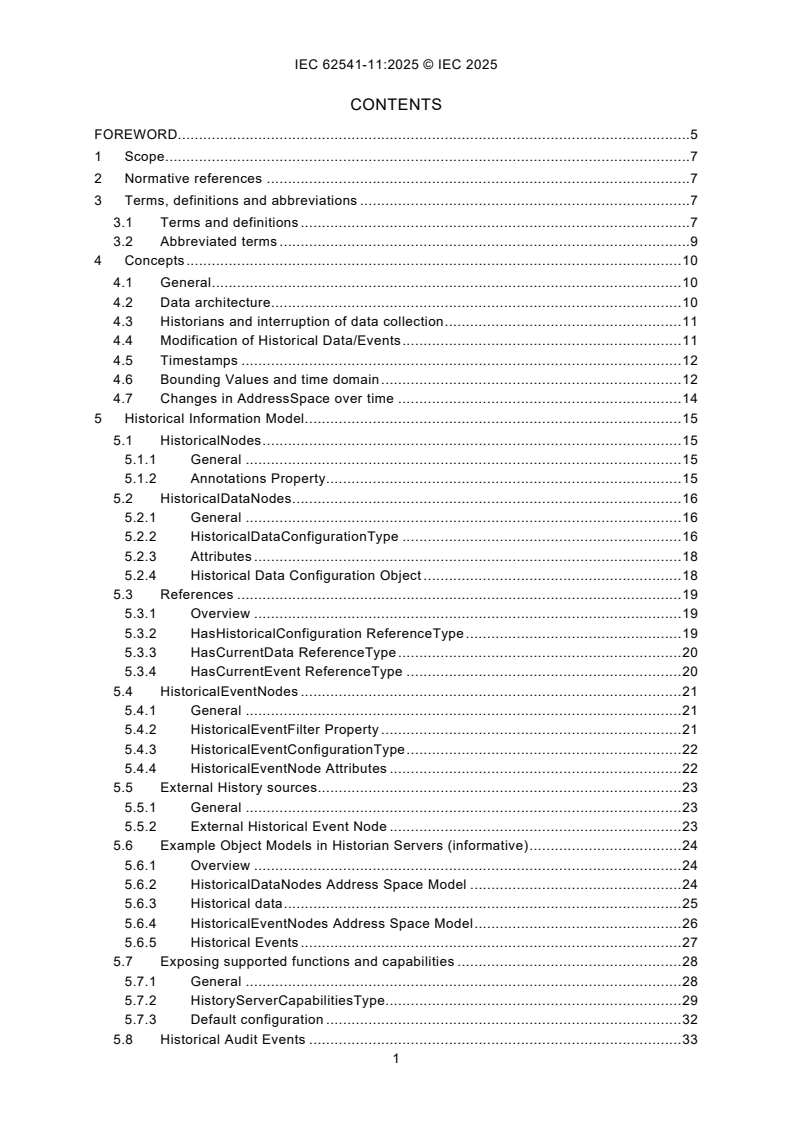
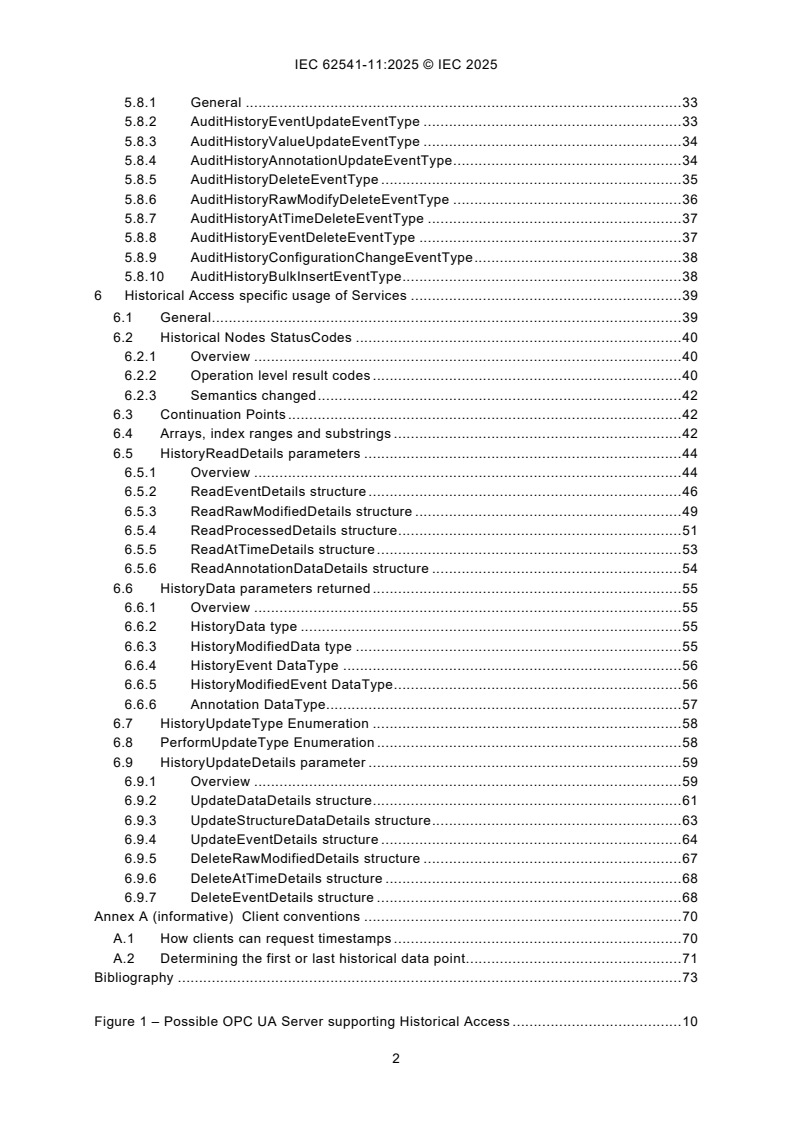
CONTENTS
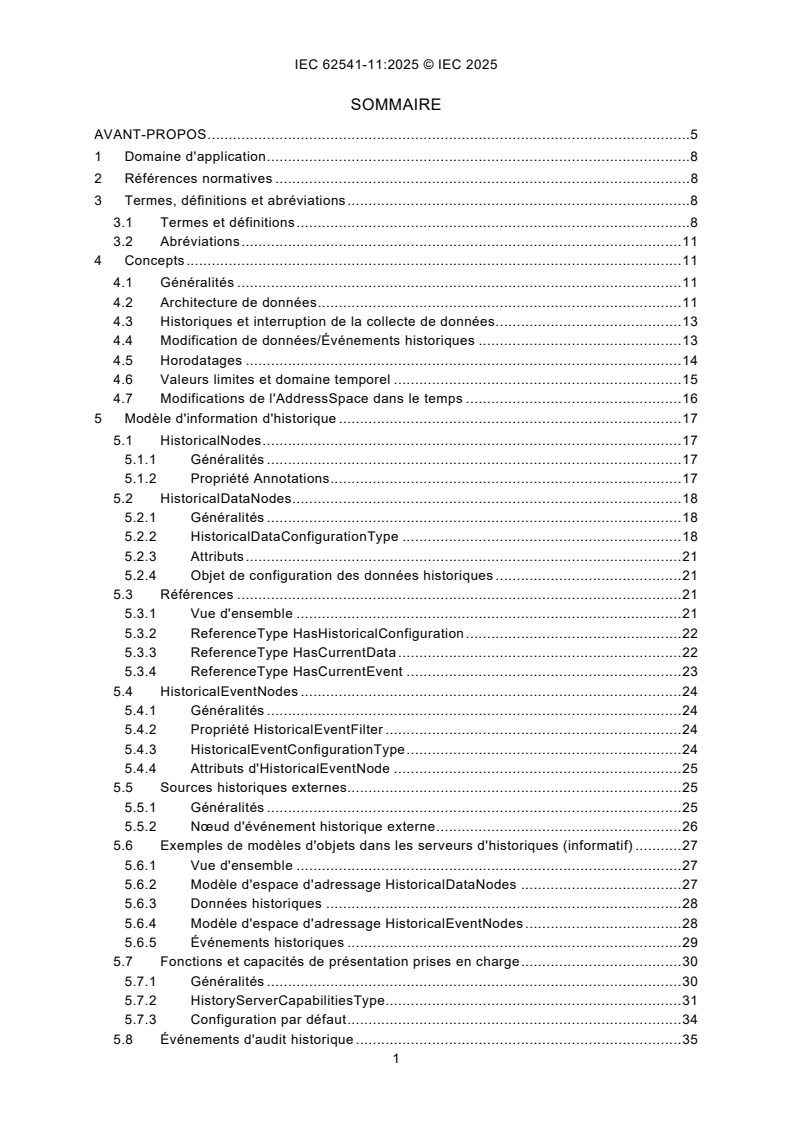
FOREWORD. 5
1 Scope . 7
2 Normative references . 7
3 Terms, definitions and abbreviations . 7
3.1 Terms and definitions . 7
3.2 Abbreviated terms . 9
4 Concepts . 10
4.1 General . 10
4.2 Data architecture. 10
4.3 Historians and interruption of data collection . 11
4.4 Modification of Historical Data/Events . 11
4.5 Timestamps . 12
4.6 Bounding Values and time domain . 12
4.7 Changes in AddressSpace over time . 14
5 Historical Information Model . 15
5.1 HistoricalNodes . 15
5.1.1 General . 15
5.1.2 Annotations Property . 15
5.2 HistoricalDataNodes . 16
5.2.1 General . 16
5.2.2 HistoricalDataConfigurationType . 16
5.2.3 Attributes . 18
5.2.4 Historical Data Configuration Object . 18
5.3 References . 19
5.3.1 Overview . 19
5.3.2 HasHistoricalConfiguration ReferenceType . 19
5.3.3 HasCurrentData ReferenceType . 20
5.3.4 HasCurrentEvent ReferenceType . 20
5.4 HistoricalEventNodes . 21
5.4.1 General . 21
5.4.2 HistoricalEventFilter Property . 21
5.4.3 HistoricalEventConfigurationType . 22
5.4.4 HistoricalEventNode Attributes . 22
5.5 External History sources. 23
5.5.1 General . 23
5.5.2 External Historical Event Node . 23
5.6 Example Object Models in Historian Servers (informative) . 24
5.6.1 Overview . 24
5.6.2 HistoricalDataNodes Address Space Model . 24
5.6.3 Historical data . 25
5.6.4 HistoricalEventNodes Address Space Model . 26
5.6.5 Historical Events . 27
5.7 Exposing supported functions and capabilities . 28
5.7.1 General . 28
5.7.2 HistoryServerCapabilitiesType . 29
5.7.3 Default configuration . 32
5.8 Historical Audit Events . 33
5.8.1 General . 33
5.8.2 AuditHistoryEventUpdateEventType . 33
5.8.3 AuditHistoryValueUpdateEventType . 34
5.8.4 AuditHistoryAnnotationUpdateEventType . 34
5.8.5 AuditHistoryDeleteEventType . 35
5.8.6 AuditHistoryRawModifyDeleteEventType . 36
5.8.7 AuditHistoryAtTimeDeleteEventType . 37
5.8.8 AuditHistoryEventDeleteEventType . 37
5.8.9 AuditHistoryConfigurationChangeEventType . 38
5.8.10 AuditHistoryBulkInsertEventType . 38
6 Historical Access specific usage of Services . 39
6.1 General . 39
6.2 Historical Nodes StatusCodes . 40
6.2.1 Overview . 40
6.2.2 Operation level result codes . 40
6.2.3 Semantics changed . 42
6.3 Continuation Points . 42
6.4 Arrays, index ranges and substrings . 42
6.5 HistoryReadDetails parameters . 44
6.5.1 Overview . 44
6.5.2 ReadEventDetails structure . 46
6.5.3 ReadRawModifiedDetails structure . 49
6.5.4 ReadProcessedDetails structure . 51
6.5.5 ReadAtTimeDetails structure . 53
6.5.6 ReadAnnotationDataDetails structure . 54
6.6 HistoryData parameters returned . 55
6.6.1 Overview . 55
6.6.2 HistoryData type . 55
6.6.3 HistoryModifiedData type . 55
6.6.4 HistoryEvent DataType . 56
6.6.5 HistoryModifiedEvent DataType . 56
6.6.6 Annotation DataType . 57
6.7 HistoryUpdateType Enumeration . 58
6.8 PerformUpdateType Enumeration . 58
6.9 HistoryUpdateDetails parameter . 59
6.9.1 Overview . 59
6.9.2 UpdateDataDetails structure . 61
6.9.3 UpdateStructureDataDetails structure . 63
6.9.4 UpdateEventDetails structure . 64
6.9.5 DeleteRawModifiedDetails structure . 67
6.9.6 DeleteAtTimeDetails structure . 68
6.9.7 DeleteEventDetails structure . 68
Annex A (informative) Client conventions . 70
A.1 How clients can request timestamps . 70
A.2 Determining the first or last historical data point . 71
Bibliography . 73
Figure 1 – Possible OPC UA Server supporting Historical Access . 10
Figure 2 – ReferenceType hierarchy . 19
Figure 3 – Historical Variable with Historical Data Configuration and Annotations . 25
Figure 4 – Historical Variable with Historical Data Configuration and Annotations . 26
Figure 5 – Representation of an Event with History in the AddressSpace . 27
Figure 6 – Event History configuration example . 28
Figure 7 – Server and HistoryServer Capabilities . 29
Figure 8 – History Array example . 43
Figure 9 – Historian Array Illustration 2 . 44
Table 1 – Bounding Value examples . 13
Table 2 – Annotations Property . 15
Table 3 – HistoricalDataConfigurationType definition . 16
Table 4 – ExceptionDeviationFormat Items . 18
Table 5 – ExceptionDeviationFormat definition . 18
Table 6 – Historical Access configuration definition . 19
Table 7 – HasHistoricalConfiguration ReferenceType . 20
Table 8 – HasCurrentData ReferenceType . 20
Table 9 – HasCurrentEvent ReferenceType . 21
Table 10 – Standard Historical Events Properties . 22
Table 11 – HistoricalEventConfigurationType definition . 22
Table 12 – HistoricalExternalEventSourceType definition . 23
Table 13 – HistoryServerCapabilitiesType Definition . 30
Table 14 – DefaultHAConfiguration definition . 32
Table 15 – DefaultHEConfiguration definition . 32
Table 16 – AuditHistoryEventUpdateEventType definition . 33
Table 17 – AuditHistoryValueUpdateEventType definition . 34
Table 18 – AuditHistoryAnnotationUpdateEventType definition . 35
Table 19 – AuditHistoryDeleteEventType definition . 36
Table 20 – AuditHistoryRawModifyDeleteEventType definition . 36
Table 21 – AuditHistoryAtTimeDeleteEventType definition . 37
Table 22 – AuditHistoryEventDeleteEventType definition . 38
Table 23 – AuditHistoryConfigurationChangeEventType definition . 38
Table 24 – AuditHistoryBulkInsertEventType definition . 39
Table 25 – Bad operation level result codes . 40
Table 26 – Good operation level result codes . 41
Table 27 – HistoryReadDetails parameter Symbolic Names . 45
Table 28 – HistoryReadDetails definition . 46
Table 29 – ReadEventDetails Structure . 46
Table 30 – ReadEventDetails definition . 46
Table 31 – ReadEventDetails2 Structure . 47
Table 32 – ReadEventDetails2 definition . 48
Table 33 – ReadRawModifiedDetails structure . 49
Table 34 – ReadRawModifiedDetails definition . 49
Table 35 – ReadProcessedDetails structure . 51
Table 36 – ReadProcessedDetails definition . 52
Table 37 – ReadAtTimeDetails structure . 53
Table 38 – ReadAtTimeDetails definition . 53
Table 39 – ReadAnnotationDataDetails Structure . 54
Table 40 – ReadAnnotationDataDetails definition . 54
Table 41 – HistoryData structure . 55
Table 42 – HistoryData definition . 55
Table 43 – HistoryModifiedData structure . 55
Table 44 – HistoryModifiedData definition . 56
Table 45 – HistoryEvent structure . 56
Table 46 – HistoryEvent definition . 56
Table 47 – HistoryModifiedEvent structure. 57
Table 48 – HistoryModifiedEvent definition . 57
Table 49 – Annotation Structure . 57
Table 50 – Annotation definition . 58
Table 51 – HistoryUpdateType Items . 58
Table 52 – HistoryUpdateType definition . 58
Table 53 – PerformUpdateType Items . 58
Table 54 – PerformUpdateType definition . 59
Table 55 – HistoryUpdateDetails parameter Symbolic Names . 60
Table 56 – HistoryUpdateDetails Structure . 61
Table 57 – HistoryUpdateDetails definition . 61
Table 58 – UpdateDataDetails Structure . 61
Table 59 – UpdateDataDetails definition . 62
Table 60 – UpdateStructureDataDetails Structure . 63
Table 61 – UpdateStructureDataDetails definition . 63
Table 62 – UpdateEventDetails Structure . 65
Table 63 – UpdateEventDetails definition . 65
Table 64 – DeleteRawModifiedDetails Structure . 67
Table 65 – DeleteRawModifiedDetails definition . 67
Table 66 – DeleteAtTimeDetails Structure . 68
Table 67 – DeleteAtTimeDetails definition . 68
Table 68 – DeleteEventDetails Structure . 68
Table 69 – DeleteEventDetails definition . 69
Table A.1 – Time keyword definitions . 71
Table A.2 – Time offset definitions . 71
INTERNATIONAL ELECTROTECHNICAL COMMISSION
____________
OPC unified architecture -
Part 11: Historical Access
FOREWORD
1) The International Electrotechnical Commission (IEC) is a worldwide organization for standardization comprising
all national electrotechnical committees (IEC National Committees). The object of IEC is to promote international
co-operation on all questions concerning standardization in the electrical and electronic fields. To this end and
in addition to other activities, IEC publishes International Standards, Technical Specifications, Technical Reports,
Publicly Available Specifications (PAS) and Guides (hereafter referred to as "IEC Publication(s)"). Their
preparation is entrusted to technical committees; any IEC National Committee interested in the subject dealt with
may participate in this preparatory work. International, governmental and non-governmental organizations liaising
with the IEC also participate in this preparation. IEC collaborates closely with the International Organization for
Standardization (ISO) in accordance with conditions determined by agreement between the two organizations.
2) The formal decisions or agreements of IEC on technical matters express, as nearly as possible, an international
consensus of opinion on the relevant subjects since each technical committee has representation from all
interested IEC National Committees.
3) IEC Publications have the form of recommendations for international use and are accepted by IEC National
Committees in that sense. While all reasonable efforts are made to ensure that the technical content of IEC
Publications is accurate, IEC cannot be held responsible for the way in which they are used or for any
misinterpretation by any end user.
4) In order to promote international uniformity, IEC National Committees undertake to apply IEC Publications
transparently to the maximum extent possible in their national and regional publications. Any divergence between
any IEC Publication and the corresponding national or regional publication shall be clearly indicated in the latter.
5) IEC itself does not provide any attestation of conformity. Independent certification bodies provide conformity
assessment services and, in some areas, access to IEC marks of conformity. IEC is not responsible for any
services carried out by independent certification bodies.
6) All users should ensure that they have the latest edition of this publication.
7) No liability shall attach to IEC or its directors, employees, servants or agents including individual experts and
members of its technical committees and IEC National Committees for any personal injury, property damage or
other damage of any nature whatsoever, whether direct or indirect, or for costs (including legal fees) and
expenses arising out of the publication, use of, or reliance upon, this IEC Publication or any other IEC
Publications.
8) Attention is drawn to the Normative references cited in this publication. Use of the referenced publications is
indispensable for the correct application of this publication.
9) IEC draws attention to the possibility that the implementation of this document may involve the use of (a)
patent(s). IEC takes no position concerning the evidence, validity or applicability of any claimed patent rights in
respect thereof. As of the date of publication of this document, IEC had not received notice of (a) patent(s), which
may be required to implement this document. However, implementers are cautioned that this may not represent
the latest information, which may be obtained from the patent database available at https://patents.iec.ch. IEC
shall not be held responsible for identifying any or all such patent rights.
IEC 62541-11 has been prepared by subcommittee 65E: Devices and integration in enterprise
systems, of IEC technical committee 65: Industrial-process measurement, control and
automation. It is an International Standard.
This fourth edition cancels and replaces the third edition published in 2020. This edition
constitutes a technical revision.
This edition includes the following significant technical changes with respect to the previous
edition:
a) a functionality has been added to support retrieving of modified events;
b) an Event has been added to indicate when a backfill occurred;
c) a new ReferenceType that can be used to indicate an external node has been defined;
d) the text has been improved to better explain the concept of annotation and remove
conflicting explanations;
e) a default historian configuration (and where to find it) has been defined;
f) HistoricalEventConfigurationType, which provides general configuration information about
the historical Event storage, has been added;
g) the text has been updated and optional fields have been added to HA configuration object
to allow configuration to be defined for periodic data collection, not just for exception-based
collection;
h) an ObjectType that can be used for external event collection has been provided as well as
an example how historians can be configured.
The text of this International Standard is based on the following documents:
Draft Report on voting
65E/1058/CDV 65E/1096/RVC
Full information on the voting for its approval can be found in the report on voting indicated in
the above table.
The language used for the development of this International Standard is English.
This document was drafted in accordance with ISO/IEC Directives, Part 2, and developed in
accordance with ISO/IEC Directives, Part 1 and ISO/IEC Directives, IEC Supplement, available
at www.iec.ch/members_experts/refdocs. The main document types developed by IEC are
described in greater detail at www.iec.ch/publications.
Throughout this document and the other parts of the IEC 62541 series, certain document
conventions are used:
Italics are used to denote a defined term or definition that appears in the "Terms and definitions"
clause in one of the parts of the IEC 62541 series.
Italics are also used to denote the name of a service input or output parameter or the name of
a structure or element of a structure that are usually defined in tables.
The italicized terms and names are, with a few exceptions, written in camel-case (the practice
of writing compound words or phrases in which the elements are joined without spaces, with
each element's initial letter capitalized within the compound). For example, the defined term is
AddressSpace instead of Address Space. This makes it easier to understand that there is a
single definition for AddressSpace, not separate definitions for Address and Space.
A list of all parts in the IEC 62541 series, published under the general title OPC Unified
Architecture, can be found on the IEC website.
The committee has decided that the contents of this document will remain unchanged until the
stability date indicated on the IEC website under webstore.iec.ch in the data related to the
specific document. At this date, the document will be
– reconfirmed,
– withdrawn, or
– revised.
1 Scope
This part of IEC 62541 belongs to the OPC Unified Architecture standards series and defines
the Information Model associated with Historical Access (HA). It particularly includes additional
and complementary descriptions of the NodeClasses and Attributes needed for Historical
Access, additional standard Properties, and other information and behaviour.
The complete AddressSpace Model including all NodeClasses and Attributes is specified in
IEC 62541-3. The predefined Information Model is defined in IEC 62541-5. The Services to
detect and access historical data and events, and description of the ExtensibleParameter types
are specified in IEC 62541-4.
This document includes functionality to compute and return Aggregates like minimum,
maximum, average etc. The Information Model and the concrete working of Aggregates are
defined in IEC 62541-13.
Conventions for Historical Access Clients are informatively provided in Annex A.
2 Normative references
The following documents are referred to in the text in such a way that some or all of their content
constitutes requirements of this document. For dated references, only the edition cited applies.
For undated references, the latest edition of the referenced document (including any
amendments) applies.
IEC 62541-1, OPC Unified Architecture - Part 1: Overview and Concepts
IEC 62541-3, OPC Unified Architecture - Part 3: Address Space Model
IEC 62541-4, OPC Unified Architecture - Part 4: Services
IEC 62541-5, OPC Unified Architecture - Part 5: Information Model
IEC 62541-7, OPC Unified Architecture - Part 7: Profiles
IEC 62541-8, OPC Unified Architecture - Part 8: Data Access
IEC 62541-13, OPC Unified Architecture - Part 13: Aggregates
3 Terms, definitions and abbreviations
3.1 Terms and definitions
For the purposes of this document, the terms and definitions given in IEC 62541-1,
IEC 62541-3, IEC 62541-4, IEC 62541-13 and the following apply.
ISO and IEC maintain terminology databases for use in standardization at the following
addresses:
– IEC Electropedia: available at https://www.electropedia.org/
– ISO Online browsing platform: available at https://www.iso.org/obp
3.1.1
Annotation
metadata associated with an item at a given instance in time
Note 1 to entry: An Annotation is metadata that is associated with an item at a given instance in time.
3.1.2
BoundingValues
values associated with the starting and ending time
Note 1 to entry: BoundingValues are the values that are associated with the starting and ending time of a
ProcessingInterval specified when reading from the historian. BoundingValues can be required by Clients to
determine the starting and ending values when requesting RawData over a time range. If a RawData value exists at
the start or end point, it is considered the bounding value even though it is part of the data request. If no RawData
value exists at the start or end point, then the Server will determine the boundary value, which possibly requires data
from a data point outside of the requested range. See 4.6 for details on using BoundingValues.
3.1.3
Historian
application storing time series data and/or time series events
3.1.4
HistoricalNode
Object, Variable, Property or View in the AddressSpace where a Client can access historical
data or Events
Note 1 to entry: A HistoricalNode is a term used in this document to represent any Object, Variable, Property or
View in the AddressSpace for which a Client can read and/or update historical data or Events. The terms
"HistoricalNodes's history" or "history of a HistoricalNodes" will refer to the time series data or Events stored for this
HistoricalNode. The term HistoricalNode refers to both HistoricalDataNodes and HistoricalEventNodes.
3.1.5
HistoricalDataNode
Variable or Property in the AddressSpace where a Client can access historical data
Note 1 to entry: A HistoricalDataNode represents any Variable or Property in the AddressSpace for which a Client
can read and/or update historical data. "HistoricalDataNode history" or "history of a HistoricalDataNode" refers to
the time series data stored for this HistoricalNode. Examples of such data are:
• device data (like temperature sensors)
• calculated data
• status information (open/closed, moving)
• dynamically changing system data (like stock quotes)
• diagnostic data
The term HistoricalDataNodes is used when referencing aspects of the standard that apply to accessing historical
data only.
3.1.6
HistoricalEventNode
Object or View in the AddressSpace for which a Client can access historical Events
Note 1 to entry: "HistoricalEventNode's history" or "history of a HistoricalEventNode" refers to the time series
Events stored in some historical system. Examples of such data are:
• Notifications
• system Alarms
• operator action Events
• system triggers (such as new orders to be processed)
The term HistoricalEventNode is used when referencing aspects of the standard that apply to accessing historical
Events only.
3.1.7
ModifiedValues
HistoricalDataNode's value that has been changed (or manually inserted or deleted) after it was
stored in the historian
Note 1 to entry: For some Servers, a lab data entry value is not a modified value, but if a user corrects a lab value,
the original value would be considered a modified value, and would be returned during a request for ModifiedValues.
Also manually inserting a value that was missed by a standard collection system can be considered a modified value.
Unless specified otherwise, all historical Services operate on the current, or most recent, value for the specified
HistoricalDataNode at the specified timestamp. Requests for ModifiedValues are used to access values that have
been superseded, deleted or inserted. It is up to a system to determine what is considered a modified value.
Whenever a Server has modified data available for an entry in the historical collection it shall set the ExtraData bit
in the StatusCode.
3.1.8
RawData
data that is stored within the historian for a HistoricalDataNode
Note 1 to entry: The data can be all data collected for the DataValue or it can be some subset of the data depending
on the historian and the storage rules invoked when the item's values were saved.
3.1.9
StartTime/EndTime
bounds of a history request which define the time domain
Note 1 to entry: For all requests, a value falling at the end time of the time domain is not included in the domain,
so that requests made for successive, contiguous time domains will include every value in the historical collection
exactly once.
3.1.10
TimeDomain
interval of time covered by a particular request, or response
Note 1 to entry: In general, if the start time is earlier than or the same as the end time, the time domain is considered
to begin at the start time and end just before the end time; if the end time is earlier than the start time, the time
domain still begins at the start time and ends just before the end time, with time "running backward" for the particular
request and response. In both cases, any value which falls exactly at the end time of the TimeDomain is not included
in the TimeDomain. See the examples in 4.6. BoundingValues effect the time domain as described in 4.6.
All timestamps which can legally be represented in a UtcTime DataType are valid timestamps, and the Server has
the choice to, or not to return an invalid argument result code due to the timestamp being outside of the range for
which the Server has data. See IEC 62541-3 for a description of the range and granularity of this DataType. Servers
are expected to handle out-of-bounds timestamps gracefully and return the proper StatusCodes to the Client.
3.1.11
StructuredHistoryData
structured data stored in a history collection where parts of the structure are used to uniquely
identify the data within the data collection
Note 1 to entry: Most historical data applications assume only one current value per timestamp. Therefore, the
timestamp of the data is considered the unique identifier for that value. Some data or meta data such as Annotations
can permit multiple values to exist at a single timestamp. In such cases the Server would use one or more parameters
of the StructuredHistoryData entry to uniquely identify each element within the history collection. Annotations are
examples of StructuredHistoryData.
3.2 Abbreviated terms
DA Data Access
HA Historical Access
HDA Historical Data Access
UA Unified Architecture
4 Concepts
4.1 General
This document defines the handling of historical time series data and historical Event data in
the OPC Unified Architecture (in a Historian). Included is the specification of the representation
of historical data and Events in the AddressSpace.
4.2 Data architecture
A Server supporting Historical Access provides Clients with transparent access to different
historical data and/or historical Event sources (e.g., process Historians, event Historians, etc.).
The historical data or Events can be in a proprietary data collection, database or a short-term
buffer within memory. A Server supporting Historical Access will provide historical data and
Events for all or a subset of the available Variables, Objects, Properties or Views within the
Server AddressSpace.
Figure 1 illustrates how the AddressSpace of a UA Server can consist of a broad range of
different historical data and/or historical Event sources.
Figure 1 – Possible OPC UA Server supporting Historical Access
The Historian can be implemented as a standalone OPC UA Server that collects data from
another OPC UA Server or another data source. The Historian can also just aggregate historical
data from underlying Historians. The Client that references the OPC UA Server supporting
Historical Access for historical data can be simple trending packages that desire values over a
given time frame or they can be complex reports that require data in multiple formats.
There are general requirements for Historians, but Historians can vary in functionality. A
consistent requirement for all Historians is that they store Historical data including a timestamp.
All historical data should include status information for each value, but a Historian can compress
this to only storing status information that indicates a problem (Bad status) and/or status
change, instead of storing a status for every time series data item. The status of historical data
can be complex. What is required is that the values returned as part of the timeseries raw data
match the data that would have been observed if the Value was subscribed to at that point in
time.
Historical Events are more complicated. In a stream of Events each Event can have a different
list of fields. EventTypes are defined in a hierarchical manner, where each EventType inherits
fields from its parent type and can add additional fields. Some of these additional fields can be
mandatory and are required to understand or process the given EventType. A Historian that
stores Events, shall be configurable to store all mandatory fields for any EventTypes that it
historizes. If it receives for storage an EventType that it does not support all mandatory fields
for, it can store it as one of its supertype EventTypes (one that it does support all mandatory
fields for), but then it shall not claim that it supports historizing of that EventType (see 5.4.3).
The Historian shall also provide information about the fields that are currently being historized
(see 5.4.3).
4.3 Historians and interruption of data collection
When an Historian is collecting and storing data, the data collection can be interrupted. The
interruption can have been for collecting the current values of data or for an event stream. The
interruption can have been due to an interruption in the source of a value or an interruption of
the forwarding of historical data from an underlying Historian. The interruption can also have
been due to an action that stopped the collection of HistoricalData or historical Events. Some
of these interruptions can recover with no loss of data, others can result in data gaps. The
Historian shall report any gaps when a client is accessing the stored historical data with an
error code of Bad_DataLost.
For example, if a subscription for data breaks, and the historian recovers the subscription after
several minutes, it can check the SourceTimestamp of the initial values in the subscription. If
the initial value SourceTimestamp matches the last stored value SourceTimestamp, then no
data was lost and nothing needs to be stored indicating the given HistoricalDataNode's data
collection was interrupted. But if the SourceTimestamp of the initial value is later than the
SourceTimestamp of the last stored value, then the historian has no way of knowing if any data
was lost and it shall record a bad status for the value with the timestamp of when the connection
was broken.
For Event collection, in addition to what is described for a data collection the following also has
to be addressed. If a Subscription for Event is interrupted for long enough that the Subscription
buffer reports an overflow (instance of EventQueueOverflowEventType), then the Event storage
shall report this error. This can be accomplished by storing the instance of
EventQueueOverflowEventType event or by recording a Bad_DataLost. If the lost data is
indicated by EventQueueOverflowEventType, this event shall always be returned for any filter,
just as it is in an Event Subscription.
4.4 Modification of Historical Data/Events
A Historian collects values (data or Events) and provides long term storage of these values.
Occasionally data that is collected is incorrect. It can be incorrect for many reasons, such as a
failed
...
IEC 62541-11 ®
Edition 3.0 2025-12
INTERNATIONAL
STANDARD
REDLINE VERSION
OPC unified architecture -
Part 11: Historical Access
ICS 25.040.40; 35.100.05 ISBN 978-2-8327-0974-0
All rights reserved. Unless otherwise specified, no part of this publication may be reproduced or utilized in any form or
by any means, electronic or mechanical, including photocopying and microfilm, without permission in writing from either
IEC or IEC's member National Committee in the country of the requester. If you have any questions about IEC copyright
or have an enquiry about obtaining additional rights to this publication, please contact the address below or your local
IEC member National Committee for further information.
IEC Secretariat Tel.: +41 22 919 02 11
3, rue de Varembé info@iec.ch
CH-1211 Geneva 20 www.iec.ch
Switzerland
About the IEC
The International Electrotechnical Commission (IEC) is the leading global organization that prepares and publishes
International Standards for all electrical, electronic and related technologies.
About IEC publications
The technical content of IEC publications is kept under constant review by the IEC. Please make sure that you have the
latest edition, a corrigendum or an amendment might have been published.
IEC publications search - IEC Products & Services Portal - products.iec.ch
webstore.iec.ch/advsearchform Discover our powerful search engine and read freely all the
The advanced search enables to find IEC publications by a publications previews, graphical symbols and the glossary.
variety of criteria (reference number, text, technical With a subscription you will always have access to up to date
committee, …). It also gives information on projects, content tailored to your needs.
replaced and withdrawn publications.
Electropedia - www.electropedia.org
The world's leading online dictionary on electrotechnology,
IEC Just Published - webstore.iec.ch/justpublished
Stay up to date on all new IEC publications. Just Published containing more than 22 500 terminological entries in English
details all new publications released. Available online and and French, with equivalent terms in 25 additional languages.
once a month by email. Also known as the International Electrotechnical Vocabulary
(IEV) online.
IEC Customer Service Centre - webstore.iec.ch/csc
If you wish to give us your feedback on this publication or
need further assistance, please contact the Customer
Service Centre: sales@iec.ch.
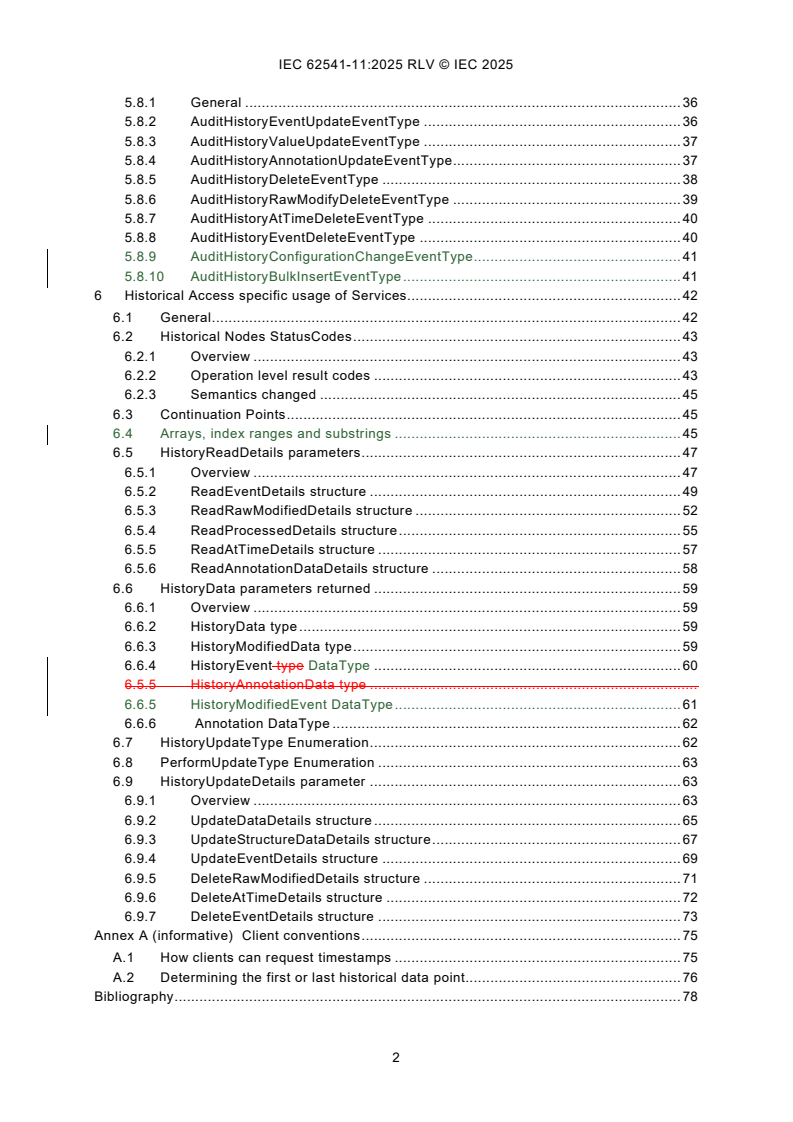
CONTENTS
FOREWORD . 5
1 Scope . 8
2 Normative references . 8
3 Terms, definitions and abbreviations . 8
3.1 Terms and definitions. 8
3.2 Abbreviated terms . 10
4 Concepts . 11
4.1 General . 11
4.2 Data architecture . 11
4.3 Historians and interruption of data collection . 12
4.4 Modification of Historical Data/Events . 12
4.5 Timestamps . 13
4.6 Bounding Values and time domain . 13
4.7 Changes in AddressSpace over time . 15
5 Historical Information Model . 16
5.1 HistoricalNodes . 16
5.1.1 General . 16
5.1.2 Annotations Property . 16
5.2 HistoricalDataNodes . 17
5.2.1 General . 17
5.2.2 HistoricalDataConfigurationType . 17
5.2.3 Attributes . 19
5.2.4 Historical Data Configuration Object . 19
5.3 References . 20
5.3.1 Overview . 20
5.3.2 HasHistoricalConfiguration ReferenceType . 21
5.3.3 HasCurrentData ReferenceType . 21
5.3.4 HasCurrentEvent ReferenceType . 22
5.4 HistoricalEventNodes . 22
5.4.1 General . 22
5.4.2 HistoricalEventFilter Property . 22
5.4.3 HistoricalEventConfigurationType . 23
5.4.4 HistoricalEventNode Attributes . 23
5.5 External History sources . 24
5.5.1 General . 24
5.5.2 External Historical Event Node . 24
5.6 Example Object Models in Historian Servers (informative) . 25
5.6.1 Overview . 25
5.6.2 HistoricalDataNodes Address Space Model . 25
5.6.3 Historical data . 27
5.6.4 HistoricalEventNodes Address Space Model . 27
5.6.5 Historical Events . 30
5.7 Exposing supported functions and capabilities . 30
5.7.1 General . 30
5.7.2 HistoryServerCapabilitiesType . 32
5.7.3 Default configuration. 35
5.8 Historical Audit Events . 36
5.8.1 General . 36
5.8.2 AuditHistoryEventUpdateEventType . 36
5.8.3 AuditHistoryValueUpdateEventType . 37
5.8.4 AuditHistoryAnnotationUpdateEventType . 37
5.8.5 AuditHistoryDeleteEventType . 38
5.8.6 AuditHistoryRawModifyDeleteEventType . 39
5.8.7 AuditHistoryAtTimeDeleteEventType . 40
5.8.8 AuditHistoryEventDeleteEventType . 40
5.8.9 AuditHistoryConfigurationChangeEventType . 41
5.8.10 AuditHistoryBulkInsertEventType . 41
6 Historical Access specific usage of Services. 42
6.1 General . 42
6.2 Historical Nodes StatusCodes . 43
6.2.1 Overview . 43
6.2.2 Operation level result codes . 43
6.2.3 Semantics changed . 45
6.3 Continuation Points . 45
6.4 Arrays, index ranges and substrings . 45
6.5 HistoryReadDetails parameters . 47
6.5.1 Overview . 47
6.5.2 ReadEventDetails structure . 49
6.5.3 ReadRawModifiedDetails structure . 52
6.5.4 ReadProcessedDetails structure . 55
6.5.5 ReadAtTimeDetails structure . 57
6.5.6 ReadAnnotationDataDetails structure . 58
6.6 HistoryData parameters returned . 59
6.6.1 Overview . 59
6.6.2 HistoryData type . 59
6.6.3 HistoryModifiedData type . 59
6.6.4 HistoryEvent type DataType . 60
6.5.5 HistoryAnnotationData type .
6.6.5 HistoryModifiedEvent DataType . 61
6.6.6 Annotation DataType . 62
6.7 HistoryUpdateType Enumeration . 62
6.8 PerformUpdateType Enumeration . 63
6.9 HistoryUpdateDetails parameter . 63
6.9.1 Overview . 63
6.9.2 UpdateDataDetails structure . 65
6.9.3 UpdateStructureDataDetails structure . 67
6.9.4 UpdateEventDetails structure . 69
6.9.5 DeleteRawModifiedDetails structure . 71
6.9.6 DeleteAtTimeDetails structure . 72
6.9.7 DeleteEventDetails structure . 73
Annex A (informative) Client conventions . 75
A.1 How clients can request timestamps . 75
A.2 Determining the first or last historical data point. 76
Bibliography . 78
Figure 1 – Possible OPC UA Server supporting Historical Access . 11
Figure 2 – ReferenceType hierarchy . 20
Figure 3 – Historical Variable with Historical Data Configuration and Annotations . 26
Figure 4 – Historical Variable with Historical Data Configuration and Annotations . 27
Figure 5 – Representation of an Event with History in the AddressSpace . 29
Figure 6 – Event History configuration example . 30
Figure 7 – Server and HistoryServer Capabilities . 32
Figure 8 – History Array example . 46
Figure 9 – Historian Array Illustration 2 . 47
Table 1 – Bounding Value examples . 14
Table 2 – Annotations Property . 16
Table 3 – HistoricalDataConfigurationType definition . 17
Table 4 – ExceptionDeviationFormat Values Items . 18
Table 5 – ExceptionDeviationFormat definition . 19
Table 6 – Historical Access configuration definition . 20
Table 7 – HasHistoricalConfiguration ReferenceType . 21
Table 8 – HasCurrentData ReferenceType . 21
Table 9 – HasCurrentEvent ReferenceType . 22
Table 10 – Standard Historical Events Properties . 23
Table 11 – HistoricalEventConfigurationType definition . 23
Table 12 – HistoricalExternalEventSourceType definition . 24
Table 13 – HistoryServerCapabilitiesType Definition . 33
Table 14 – DefaultHAConfiguration definition . 35
Table 15 – DefaultHEConfiguration definition . 35
Table 16 – AuditHistoryEventUpdateEventType definition . 36
Table 17 – AuditHistoryValueUpdateEventType definition . 37
Table 18 – AuditHistoryAnnotationUpdateEventType definition . 38
Table 19 – AuditHistoryDeleteEventType definition . 39
Table 20 – AuditHistoryRawModifyDeleteEventType definition . 39
Table 21 – AuditHistoryAtTimeDeleteEventType definition . 40
Table 22 – AuditHistoryEventDeleteEventType definition . 41
Table 23 – AuditHistoryConfigurationChangeEventType definition . 41
Table 24 – AuditHistoryBulkInsertEventType definition . 42
Table 25 – Bad operation level result codes . 43
Table 26 – Good operation level result codes . 44
Table 27 – HistoryReadDetails parameterTypeIds parameter Symbolic Names . 48
Table 28 – HistoryReadDetails definition . 49
Table 29 – ReadEventDetails Structure . 49
Table 30 – ReadEventDetails definition. 49
Table 31 – ReadEventDetails2 Structure . 51
Table 32 – ReadEventDetails2 definition . 51
Table 33 – ReadRawModifiedDetails structure . 52
Table 34 – ReadRawModifiedDetails definition . 52
Table 35 – ReadProcessedDetails structure. 55
Table 36 – ReadProcessedDetails definition . 55
Table 37 – ReadAtTimeDetails structure . 57
Table 38 – ReadAtTimeDetails definition . 57
Table 39 – ReadAnnotationDataDetails Structure . 58
Table 40 – ReadAnnotationDataDetails definition . 58
Table 41 – HistoryData Details structure . 59
Table 42 – HistoryData definition . 59
Table 43 – HistoryModifiedData Details structure . 60
Table 44 – HistoryModifiedData definition . 60
Table 45 – HistoryEvent Details structure . 60
Table 46 – HistoryEvent definition . 61
Table 47 – HistoryModifiedEvent structure . 61
Table 48 – HistoryModifiedEvent definition . 61
Table 49 – Annotation Structure . 62
Table 50 – Annotation definition . 62
Table 51 – HistoryUpdateType Enumeration Items . 62
Table 52 – HistoryUpdateType definition . 63
Table 53 – PerformUpdateType Enumeration Items . 63
Table 54 – PerformUpdateType definition . 63
Table 55 – HistoryUpdateDetails parameter TypeIds Symbolic Names . 64
Table 56 – HistoryUpdateDetails Structure. 65
Table 57 – HistoryUpdateDetails definition . 65
Table 58 – UpdateDataDetails Structure . 66
Table 59 – UpdateDataDetails definition . 66
Table 60 – UpdateStructureDataDetails Structure . 67
Table 61 – UpdateStructureDataDetails definition . 68
Table 62 – UpdateEventDetails Structure. 69
Table 63 – UpdateEventDetails definition . 70
Table 64 – DeleteRawModifiedDetails Structure . 72
Table 65 – DeleteRawModifiedDetails definition. 72
Table 66 – DeleteAtTimeDetails Structure. 73
Table 67 – DeleteAtTimeDetails definition . 73
Table 68 – DeleteEventDetails Structure . 73
Table 69 – DeleteEventDetails definition . 74
Table A.1 – Time keyword definitions . 76
Table A.2 – Time offset definitions . 76
INTERNATIONAL ELECTROTECHNICAL COMMISSION
____________
OPC unified architecture -
Part 11: Historical Access
FOREWORD
1) The International Electrotechnical Commission (IEC) is a worldwide organization for standardization comprising
all national electrotechnical committees (IEC National Committees). The object of IEC is to promote international
co-operation on all questions concerning standardization in the electrical and electronic fields. To this end and
in addition to other activities, IEC publishes International Standards, Technical Specifications, Technical Reports,
Publicly Available Specifications (PAS) and Guides (hereafter referred to as "IEC Publication(s)"). Their
preparation is entrusted to technical committees; any IEC National Committee interested in the subject dealt with
may participate in this preparatory work. International, governmental and non-governmental organizations liaising
with the IEC also participate in this preparation. IEC collaborates closely with the International Organization for
Standardization (ISO) in accordance with conditions determined by agreement between the two organizations.
2) The formal decisions or agreements of IEC on technical matters express, as nearly as possible, an international
consensus of opinion on the relevant subjects since each technical committee has representation from all
interested IEC National Committees.
3) IEC Publications have the form of recommendations for international use and are accepted by IEC National
Committees in that sense. While all reasonable efforts are made to ensure that the technical content of IEC
Publications is accurate, IEC cannot be held responsible for the way in which they are used or for any
misinterpretation by any end user.
4) In order to promote international uniformity, IEC National Committees undertake to apply IEC Publications
transparently to the maximum extent possible in their national and regional publications. Any divergence between
any IEC Publication and the corresponding national or regional publication shall be clearly indicated in the latter.
5) IEC itself does not provide any attestation of conformity. Independent certification bodies provide conformity
assessment services and, in some areas, access to IEC marks of conformity. IEC is not responsible for any
services carried out by independent certification bodies.
6) All users should ensure that they have the latest edition of this publication.
7) No liability shall attach to IEC or its directors, employees, servants or agents including individual experts and
members of its technical committees and IEC National Committees for any personal injury, property damage or
other damage of any nature whatsoever, whether direct or indirect, or for costs (including legal fees) and
expenses arising out of the publication, use of, or reliance upon, this IEC Publication or any other IEC
Publications.
8) Attention is drawn to the Normative references cited in this publication. Use of the referenced publications is
indispensable for the correct application of this publication.
9) IEC draws attention to the possibility that the implementation of this document may involve the use of (a)
patent(s). IEC takes no position concerning the evidence, validity or applicability of any claimed patent rights in
respect thereof. As of the date of publication of this document, IEC had not received notice of (a) patent(s), which
may be required to implement this document. However, implementers are cautioned that this may not represent
the latest information, which may be obtained from the patent database available at https://patents.iec.ch. IEC
shall not be held responsible for identifying any or all such patent rights.
This redline version of the official IEC Standard allows the user to identify the changes made
to the previous edition IEC 62541-11:2020. A vertical bar appears in the margin wherever a
change has been made. Additions are in green text, deletions are in strikethrough red text.
IEC 62541-11 has been prepared by subcommittee 65E: Devices and integration in enterprise
systems, of IEC technical committee 65: Industrial-process measurement, control and
automation. It is an International Standard.
This fourth edition cancels and replaces the third edition published in 2020. This edition
constitutes a technical revision.
This edition includes the following significant technical changes with respect to the previous
edition:
a) a functionality has been added to support retrieving of modified events;
b) an Event has been added to indicate when a backfill occurred;
c) a new ReferenceType that can be used to indicate an external node has been defined;
d) the text has been improved to better explain the concept of annotation and remove
conflicting explanations;
e) a default historian configuration (and where to find it) has been defined;
f) HistoricalEventConfigurationType, which provides general configuration information about
the historical Event storage, has been added;
g) the text has been updated and optional fields have been added to HA configuration object
to allow configuration to be defined for periodic data collection, not just for exception-based
collection;
h) an ObjectType that can be used for external event collection has been provided as well as
an example how historians can be configured.
The text of this International Standard is based on the following documents:
Draft Report on voting
65E/1058/CDV 65E/1096/RVC
Full information on the voting for its approval can be found in the report on voting indicated in
the above table.
The language used for the development of this International Standard is English.
This document was drafted in accordance with ISO/IEC Directives, Part 2, and developed in
accordance with ISO/IEC Directives, Part 1 and ISO/IEC Directives, IEC Supplement, available
at www.iec.ch/members_experts/refdocs. The main document types developed by IEC are
described in greater detail at www.iec.ch/publications.
Throughout this document and the other parts of the IEC 62541 series, certain document
conventions are used:
Italics are used to denote a defined term or definition that appears in the "Terms and definitions"
clause in one of the parts of the IEC 62541 series.
Italics are also used to denote the name of a service input or output parameter or the name of
a structure or element of a structure that are usually defined in tables.
The italicized terms and names are, with a few exceptions, written in camel-case (the practice
of writing compound words or phrases in which the elements are joined without spaces, with
each element's initial letter capitalized within the compound). For example, the defined term is
AddressSpace instead of Address Space. This makes it easier to understand that there is a
single definition for AddressSpace, not separate definitions for Address and Space.
A list of all parts in the IEC 62541 series, published under the general title OPC Unified
Architecture, can be found on the IEC website.
The committee has decided that the contents of this document will remain unchanged until the
stability date indicated on the IEC website under webstore.iec.ch in the data related to the
specific document. At this date, the document will be
– reconfirmed,
– withdrawn, or
– revised.
1 Scope
This part of IEC 62541 belongs to the OPC Unified Architecture standards series and defines
the Information Model associated with Historical Access (HA). It particularly includes additional
and complementary descriptions of the NodeClasses and Attributes needed for Historical
Access, additional standard Properties, and other information and behaviour.
The complete AddressSpace Model including all NodeClasses and Attributes is specified in
IEC 62541-3. The predefined Information Model is defined in IEC 62541-5. The Services to
detect and access historical data and events, and description of the ExtensibleParameter types
are specified in IEC 62541-4.
This document includes functionality to compute and return Aggregates like minimum,
maximum, average etc. The Information Model and the concrete working of Aggregates are
defined in IEC 62541-13.
Conventions for Historical Access Clients are informatively provided in Annex A.
2 Normative references
The following documents are referred to in the text in such a way that some or all of their content
constitutes requirements of this document. For dated references, only the edition cited applies.
For undated references, the latest edition of the referenced document (including any
amendments) applies.
IEC TR 62541-1, OPC Unified Architecture - Part 1: Overview and Concepts
IEC 62541-3, OPC Unified Architecture - Part 3: Address Space Model
IEC 62541-4, OPC Unified Architecture - Part 4: Services
IEC 62541-5, OPC Unified Architecture - Part 5: Information Model
IEC 62541-7, OPC Unified Architecture - Part 7: Profiles
IEC 62541-8, OPC Unified Architecture - Part 8: Data Access
IEC 62541-13, OPC Unified Architecture - Part 13: Aggregates
3 Terms, definitions and abbreviations
3.1 Terms and definitions
For the purposes of this document, the terms and definitions given in IEC TR 62541-1,
IEC 62541-3, IEC 62541-4, IEC 62541-13 and the following apply.
ISO and IEC maintain terminology databases for use in standardization at the following
addresses:
– IEC Electropedia: available at https://www.electropedia.org/
– ISO Online browsing platform: available at https://www.iso.org/obp
3.1.1
Annotation
metadata associated with an item at a given instance in time
Note 1 to entry: An Annotation is metadata that is associated with an item at a given instance in time.
3.1.2
BoundingValues
values associated with the starting and ending time
Note 1 to entry: BoundingValues are the values that are associated with the starting and ending time of a
ProcessingInterval specified when reading from the historian. BoundingValues may can be required by Clients to
determine the starting and ending values when requesting raw data RawData over a time range. If a raw data
RawData value exists at the start or end point, it is considered the bounding value even though it is part of the data
request. If no raw data RawData value exists at the start or end point, then the Server will determine the boundary
value, which may possibly requires data from a data point outside of the requested range. See 4.6 for details on
using BoundingValues.
3.1.3
Historian
application storing time series data and/or time series events
3.1.4
HistoricalNode
Object, Variable, Property or View in the AddressSpace where a Client can access historical
data or Events
Note 1 to entry: A HistoricalNode is a term used in this document to represent any Object, Variable, Property or
View in the AddressSpace for which a Client may can read and/or update historical data or Events. The terms
"HistoricalNodes's history" or "history of a HistoricalNodes" will refer to the time series data or Events stored for this
HistoricalNode. The term HistoricalNode refers to both HistoricalDataNodes and HistoricalEventNodes.
3.1.5
HistoricalDataNode
Variable or Property in the AddressSpace where a Client can access historical data
Note 1 to entry: A HistoricalDataNode represents any Variable or Property in the AddressSpace for which a Client
may can read and/or update historical data. "HistoricalDataNode history" or "history of a HistoricalDataNode" refers
to the time series data stored for this HistoricalNode. Examples of such data are:
• device data (like temperature sensors)
• calculated data
• status information (open/closed, moving)
• dynamically changing system data (like stock quotes)
• diagnostic data
The term HistoricalDataNodes is used when referencing aspects of the standard that apply to accessing historical
data only.
3.1.6
HistoricalEventNode
Object or View in the AddressSpace for which a Client can access historical Events
Note 1 to entry: "HistoricalEventNode's history" or "history of a HistoricalEventNode" refers to the time series
Events stored in some historical system. Examples of such data are:
• Notifications
• system Alarms
• operator action Events
• system triggers (such as new orders to be processed)
The term HistoricalEventNode is used when referencing aspects of the standard that apply to accessing historical
Events only.
3.1.7
modified values
ModifiedValues
HistoricalDataNode's value that has been changed (or manually inserted or deleted) after it was
stored in the historian
Note 1 to entry: For some Servers, a lab data entry value is not a modified value, but if a user corrects a lab value,
the original value would be considered a modified value, and would be returned during a request for modified values
ModifiedValues. Also manually inserting a value that was missed by a standard collection system can be considered
a modified value. Unless specified otherwise, all historical Services operate on the current, or most recent, value for
the specified HistoricalDataNode at the specified timestamp. Requests for modified values ModifiedValues are used
to access values that have been superseded, deleted or inserted. It is up to a system to determine what is considered
a modified value. Whenever a Server has modified data available for an entry in the historical collection it shall set
the ExtraData bit in the StatusCode.
3.1.8
raw data
RawData
data that is stored within the historian for a HistoricalDataNode
Note 1 to entry: The data can be all data collected for the DataValue or it can be some subset of the data depending
on the historian and the storage rules invoked when the item's values were saved.
3.1.9
StartTime/EndTime
bounds of a history request which define the time domain
Note 1 to entry: For all requests, a value falling at the end time of the time domain is not included in the domain,
so that requests made for successive, contiguous time domains will include every value in the historical collection
exactly once.
3.1.10
TimeDomain
interval of time covered by a particular request, or response
Note 1 to entry: In general, if the start time is earlier than or the same as the end time, the time domain is considered
to begin at the start time and end just before the end time; if the end time is earlier than the start time, the time
domain still begins at the start time and ends just before the end time, with time "running backward" for the particular
request and response. In both cases, any value which falls exactly at the end time of the TimeDomain is not included
in the TimeDomain. See the examples in 4.6. BoundingValues effect the time domain as described in 4.6.
All timestamps which can legally be represented in a UtcTime DataType are valid timestamps, and the Server may
has the choice to, or not to return an invalid argument result code due to the timestamp being outside of the range
for which the Server has data. See IEC 62541-3 for a description of the range and granularity of this DataType.
Servers are expected to handle out-of-bounds timestamps gracefully and return the proper StatusCodes to the Client.
3.1.11
StructuredHistoryData
structured data stored in a history collection where parts of the structure are used to uniquely
identify the data within the data collection
Note 1 to entry: Most historical data applications assume only one current value per timestamp. Therefore, the
timestamp of the data is considered the unique identifier for that value. Some data or meta data such as Annotations
may can permit multiple values to exist at a single timestamp. In such cases, the Server would use one or more
parameters of the StructuredHistoryData entry to uniquely identify each element within the history collection.
Annotations are examples of StructuredHistoryData.
3.2 Abbreviated terms
DA Data Access
HA Historical Access
HDA Historical Data Access
UA Unified Architecture
4 Concepts
4.1 General
This document defines the handling of historical time series data and historical Event data in
the OPC Unified Architecture (in a Historian). Included is the specification of the representation
of historical data and Events in the AddressSpace.
Annex A defines some useful, but not normative, conventions for OPC UA Clients.
4.2 Data architecture
A Server supporting Historical Access provides Clients with transparent access to different
historical data and/or historical Event sources (e.g., process Historians, event Historians, etc.).
The historical data or Events may can be located in a proprietary data collection, database or
a short-term buffer within memory. A Server supporting Historical Access will provide historical
data and Events for all or a subset of the available Variables, Objects, Properties or Views
within the Server AddressSpace.
Figure 1 illustrates how the AddressSpace of a UA Server might can consist of a broad range
of different historical data and/or historical Event sources.
Figure 1 – Possible OPC UA Server supporting Historical Access
The Server may Historian can be implemented as a standalone OPC UA Server that collects
data from another OPC UA Server or another data source. The Historian can also just aggregate
historical data from underlying Historians. The Client that references the OPC UA Server
supporting Historical Access for historical data may can be simple trending packages that desire
values over a given time frame or they may can be complex reports that require data in multiple
formats.
There are general requirements for Historians, but Historians can vary in functionality. A
consistent requirement for all Historians is that they store Historical data including a timestamp.
All historical data should include status information for each value, but a Historian can compress
this to only storing status information that indicates a problem (Bad status) and/or status
change, instead of storing a status for every time series data item. The status of historical data
can be complex. What is required is that the values returned as part of the timeseries raw data
match the data that would have been observed if the Value was subscribed to at that point in
time.
Historical Events are more complicated. In a stream of Events each Event can have a different
list of fields. EventTypes are defined in a hierarchical manner, where each EventType inherits
fields from its parent type and can add additional fields. Some of these additional fields can be
mandatory and are required to understand or process the given EventType. A Historian that
stores Events, shall be configurable to store all mandatory fields for any EventTypes that it
historizes. If it receives for storage an EventType that it does not support all mandatory fields
for, it can store it as one of its supertype EventTypes (one that it does support all mandatory
fields for), but then it shall not claim that it supports historizing of that EventType (see 5.4.3).
The Historian shall also provide information about the fields that are currently being historized
(see 5.4.3).
4.3 Historians and interruption of data collection
When an Historian is collecting and storing data, the data collection can be interrupted. The
interruption can have been for collecting the current values of data or for an event stream. The
interruption can have been due to an interruption in the source of a value or an interruption of
the forwarding of historical data from an underlying Historian. The interruption can also have
been due to an action that stopped the collection of HistoricalData or historical Events. Some
of these interruptions can recover with no loss of data, others can result in data gaps. The
Historian shall report any gaps when a client is accessing the stored historical data with an
error code of Bad_DataLost.
For example, if a subscription for data breaks, and the historian recovers the subscription after
several minutes, it can check the SourceTimestamp of the initial values in the subscription. If
the initial value SourceTimestamp matches the last stored value SourceTimestamp, then no
data was lost and nothing needs to be stored indicating the given HistoricalDataNode's data
collection was interrupted. But if the SourceTimestamp of the initial value is later than the
SourceTimestamp of the last stored value, then the historian has no way of knowing
...
IEC 62541-11 ®
Edition 3.0 2025-12
NORME
INTERNATIONALE
Architecture unifiée OPC -
Partie 11: Accès à l'historique
ICS 25.040.40; 35.100.05 ISBN 978-2-8327-0846-0
Droits de reproduction réservés. Sauf indication contraire, aucune partie de cette publication ne peut être reproduite ni
utilisée sous quelque forme que ce soit et par aucun procédé, électronique ou mécanique, y compris la photocopie et
les microfilms, sans l'accord écrit de l'IEC ou du Comité national de l'IEC du pays du demandeur. Si vous avez des
questions sur le copyright de l'IEC ou si vous désirez obtenir des droits supplémentaires sur cette publication, utilisez
les coordonnées ci-après ou contactez le Comité national de l'IEC de votre pays de résidence.
IEC Secretariat Tel.: +41 22 919 02 11
3, rue de Varembé info@iec.ch
CH-1211 Geneva 20 www.iec.ch
Switzerland
A propos de l'IEC
La Commission Electrotechnique Internationale (IEC) est la première organisation mondiale qui élabore et publie des
Normes internationales pour tout ce qui a trait à l'électricité, à l'électronique et aux technologies apparentées.
A propos des publications IEC
Le contenu technique des publications IEC est constamment revu. Veuillez vous assurer que vous possédez l’édition la
plus récente, un corrigendum ou amendement peut avoir été publié.
Recherche de publications IEC - IEC Products & Services Portal - products.iec.ch
webstore.iec.ch/advsearchform Découvrez notre puissant moteur de recherche et consultez
La recherche avancée permet de trouver des publications gratuitement tous les aperçus des publications, symboles
IEC en utilisant différents critères (numéro de référence, graphiques et le glossaire. Avec un abonnement, vous aurez
texte, comité d’études, …). Elle donne aussi des toujours accès à un contenu à jour adapté à vos besoins.
informations sur les projets et les publications remplacées
ou retirées. Electropedia - www.electropedia.org
Le premier dictionnaire d'électrotechnologie en ligne au
IEC Just Published - webstore.iec.ch/justpublished monde, avec plus de 22 500 articles terminologiques en
Restez informé sur les nouvelles publications IEC. Just anglais et en français, ainsi que les termes équivalents
Published détaille les nouvelles publications parues. dans 25 langues additionnelles. Egalement appelé
Disponible en ligne et une fois par mois par email. Vocabulaire Electrotechnique International (IEV) en ligne.
Service Clients - webstore.iec.ch/csc
Si vous désirez nous donner des commentaires sur cette
publication ou si vous avez des questions contactez-
nous: sales@iec.ch.
SOMMAIRE
AVANT-PROPOS . 5
1 Domaine d'application . 8
2 Références normatives . 8
3 Termes, définitions et abréviations . 8
3.1 Termes et définitions . 8
3.2 Abréviations . 11
4 Concepts . 11
4.1 Généralités . 11
4.2 Architecture de données . 11
4.3 Historiques et interruption de la collecte de données . 13
4.4 Modification de données/Événements historiques . 13
4.5 Horodatages . 14
4.6 Valeurs limites et domaine temporel . 15
4.7 Modifications de l'AddressSpace dans le temps . 16
5 Modèle d'information d'historique . 17
5.1 HistoricalNodes . 17
5.1.1 Généralités . 17
5.1.2 Propriété Annotations . 17
5.2 HistoricalDataNodes . 18
5.2.1 Généralités . 18
5.2.2 HistoricalDataConfigurationType . 18
5.2.3 Attributs . 21
5.2.4 Objet de configuration des données historiques . 21
5.3 Références . 21
5.3.1 Vue d'ensemble . 21
5.3.2 ReferenceType HasHistoricalConfiguration . 22
5.3.3 ReferenceType HasCurrentData . 22
5.3.4 ReferenceType HasCurrentEvent . 23
5.4 HistoricalEventNodes . 24
5.4.1 Généralités . 24
5.4.2 Propriété HistoricalEventFilter . 24
5.4.3 HistoricalEventConfigurationType . 24
5.4.4 Attributs d'HistoricalEventNode . 25
5.5 Sources historiques externes . 25
5.5.1 Généralités . 25
5.5.2 Nœud d'événement historique externe . 26
5.6 Exemples de modèles d'objets dans les serveurs d'historiques (informatif) . 27
5.6.1 Vue d'ensemble . 27
5.6.2 Modèle d'espace d'adressage HistoricalDataNodes . 27
5.6.3 Données historiques . 28
5.6.4 Modèle d'espace d'adressage HistoricalEventNodes . 28
5.6.5 Événements historiques . 29
5.7 Fonctions et capacités de présentation prises en charge . 30
5.7.1 Généralités . 30
5.7.2 HistoryServerCapabilitiesType . 31
5.7.3 Configuration par défaut . 34
5.8 Événements d'audit historique . 35
5.8.1 Généralités . 35
5.8.2 AuditHistoryEventUpdateEventType . 35
5.8.3 AuditHistoryValueUpdateEventType . 36
5.8.4 AuditHistoryAnnotationUpdateEventType . 37
5.8.5 AuditHistoryDeleteEventType . 37
5.8.6 AuditHistoryRawModifyDeleteEventType . 38
5.8.7 AuditHistoryAtTimeDeleteEventType . 39
5.8.8 AuditHistoryEventDeleteEventType . 39
5.8.9 AuditHistoryConfigurationChangeEventType . 40
5.8.10 AuditHistoryBulkInsertEventType . 40
6 Utilisation spécifique à l'Accès à l'historique des Services . 41
6.1 Généralités . 41
6.2 StatusCodes des Nœuds historiques . 42
6.2.1 Vue d'ensemble . 42
6.2.2 Codes de résultats de niveau opérationnel . 42
6.2.3 SemanticsChanged . 44
6.3 Points de continuation . 44
6.4 Matrices, plages d'indices et sous-chaînes . 45
6.5 Paramètres HistoryReadDetails . 47
6.5.1 Vue d'ensemble . 47
6.5.2 Structure ReadEventDetails . 49
6.5.3 Structure ReadRawModifiedDetails . 52
6.5.4 Structure ReadProcessedDetails . 55
6.5.5 Structure ReadAtTimeDetails . 57
6.5.6 Structure ReadAnnotationDataDetails . 58
6.6 Paramètres HistoryData renvoyés. 59
6.6.1 Vue d'ensemble . 59
6.6.2 Type HistoryData . 59
6.6.3 Type HistoryModifiedData . 59
6.6.4 DataType HistoryEvent . 60
6.6.5 DataType HistoryModifiedEvent . 61
6.6.6 DataType Annotation . 62
6.7 Énumération HistoryUpdateType . 62
6.8 Énumération PerformUpdateType . 63
6.9 Paramètre HistoryUpdateDetails . 64
6.9.1 Vue d'ensemble . 64
6.9.2 Structure UpdateDataDetails . 66
6.9.3 Structure UpdateStructureDataDetails . 67
6.9.4 Structure UpdateEventDetails . 69
6.9.5 Structure DeleteRawModifiedDetails . 71
6.9.6 Structure DeleteAtTimeDetails . 72
6.9.7 Structure DeleteEventDetails . 73
Annexe A (informative) Conventions du client . 75
A.1 Comment les clients peuvent-ils demander des horodatages . 75
A.2 Détermination du premier ou du dernier point de données historiques . 76
Bibliographie . 78
Figure 1 – Serveur OPC UA possible qui prend en charge l'Accès à l'historique . 12
Figure 2 – Hiérarchie de ReferenceType . 22
Figure 3 – Variable d'historique avec Configuration et Annotations de données
historiques . 27
Figure 4 – Variable d'historique avec Configuration et Annotations de données
historiques . 28
Figure 5 – Représentation d'un Événement à l'aide de l'Historique dans
l'AddressSpace . 29
Figure 6 – Exemple de configuration d'Historique d'Événements . 30
Figure 7 – Serveur et Capacités HistoryServer . 31
Figure 8 – Exemple de matrice d'historique . 46
Figure 9 – Représentation 2 d'une matrice d'historique . 47
Tableau 1 – Exemples de Valeurs limites . 15
Tableau 2 – Propriété Annotations . 17
Tableau 3 – Définition d'HistoricalDataConfigurationType . 19
Tableau 4 – Éléments ExceptionDeviationFormat . 20
Tableau 5 – Définition d'ExceptionDeviationFormat . 21
Tableau 6 – Définition de la configuration de l'Accès à l'historique . 21
Tableau 7 – ReferenceType HasHistoricalConfiguration . 22
Tableau 8 – ReferenceType HasCurrentData . 23
Tableau 9 – ReferenceType HasCurrentEvent . 23
Tableau 10 – Propriétés des Événements historiques normalisés . 24
Tableau 11 – Définition d'HistoricalEventConfigurationType . 25
Tableau 12 – Définition d'HistoricalExternalEventSourceType . 26
Tableau 13 – Définition d'HistoryServerCapabilitiesType . 32
Tableau 14 – Définition de DefaultHAConfiguration . 34
Tableau 15 – Définition de DefaultHEConfiguration . 34
Tableau 16 – Définition d'AuditHistoryEventUpdateEventType . 35
Tableau 17 – Définition d'AuditHistoryValueUpdateEventType . 36
Tableau 18 – Définition d'AuditHistoryAnnotationUpdateEventType . 37
Tableau 19 – Définition d'AuditHistoryDeleteEventType . 38
Tableau 20 – Définition d'AuditHistoryRawModifyDeleteEventType . 38
Tableau 21 – Définition d'AuditHistoryAtTimeDeleteEventType . 39
Tableau 22 – Définition d'AuditHistoryEventDeleteEventType . 40
Tableau 23 – Définition d'AuditHistoryConfigurationChangeEventType . 40
Tableau 24 – Définition d'AuditHistoryBulkInsertEventType . 41
Tableau 25 – Codes de résultat de niveau d'opération "Bad" . 43
Tableau 26 – Codes de résultat de niveau d'opération "Good" . 43
Tableau 27 – Noms symboliques du paramètre HistoryReadDetails . 48
Tableau 28 – Définition d'HistoryReadDetails . 49
Tableau 29 – Structure de ReadEventDetails . 49
Tableau 30 – Définition de ReadEventDetails . 49
Tableau 31 – Structure de ReadEventDetails2 . 51
Tableau 32 – Définition de ReadEventDetails2 . 51
Tableau 33 – Structure de ReadRawModifiedDetails . 52
Tableau 34 – Définition de ReadRawModifiedDetails . 52
Tableau 35 – Structure de ReadProcessedDetails . 55
Tableau 36 – Définition de ReadProcessedDetails . 55
Tableau 37 – Structure de ReadAtTimeDetails . 57
Tableau 38 – Définition de ReadAtTimeDetails . 57
Tableau 39 – Structure de ReadAnnotationDataDetails . 58
Tableau 40 – Définition de ReadAnnotationDataDetails . 58
Tableau 41 – Structure d'HistoryData . 59
Tableau 42 – Définition d'HistoryData . 59
Tableau 43 – Structure d'HistoryModifiedData . 60
Tableau 44 – Définition d'HistoryModifiedData . 60
Tableau 45 – Structure d'HistoryEvent . 60
Tableau 46 – Définition d'HistoryEvent . 61
Tableau 47 – Structure d'HistoryModifiedEvent . 61
Tableau 48 – Définition d'HistoryModifiedEvent . 61
Tableau 49 – Structure d'Annotation . 62
Tableau 50 – Définition d'Annotation . 62
Tableau 51 – Éléments HistoryUpdateType . 62
Tableau 52 – Définition d'HistoryUpdateType . 63
Tableau 53 – Éléments PerformUpdateType . 63
Tableau 54 – Définition de PerformUpdateType . 63
Tableau 55 – Noms symboliques du paramètre HistoryUpdateDetails . 64
Tableau 56 – Structure d'HistoryUpdateDetails . 65
Tableau 57 – Définition d'HistoryUpdateDetails . 66
Tableau 58 – Structure d'UpdateDataDetails . 66
Tableau 59 – Définition d'UpdateDataDetails . 66
Tableau 60 – Structure d'UpdateStructureDataDetails . 67
Tableau 61 – Définition d'UpdateStructureDataDetails . 68
Tableau 62 – Structure d'UpdateEventDetails . 69
Tableau 63 – Définition d'UpdateEventDetails . 70
Tableau 64 – Structure de DeleteRawModifiedDetails . 72
Tableau 65 – Définition de DeleteRawModifiedDetails . 72
Tableau 66 – Structure de DeleteAtTimeDetails . 73
Tableau 67 – Définition de DeleteAtTimeDetails . 73
Tableau 68 – Structure de DeleteEventDetails . 73
Tableau 69 – Définition de DeleteEventDetails . 74
Tableau A.1 – Définition des mots-clés temporels . 76
Tableau A.2 – Définition des décalages temporels . 76
COMMISSION ÉLECTROTECHNIQUE INTERNATIONALE
____________
Architecture unifiée OPC -
Partie 11: Accès à l'historique
AVANT-PROPOS
1) La Commission Électrotechnique Internationale (IEC) est une organisation mondiale de normalisation composée
de l'ensemble des comités électrotechniques nationaux (Comités nationaux de l'IEC). L'IEC a pour objet de
favoriser la coopération internationale pour toutes les questions de normalisation dans les domaines de
l'électricité et de l'électronique. À cet effet, l'IEC – entre autres activités – publie des Normes internationales,
des Spécifications techniques, des Rapports techniques, des Spécifications accessibles au public (PAS) et des
Guides (ci-après dénommés "Publication(s) de l'IEC"). Leur élaboration est confiée à des comités d'études, aux
travaux desquels tout Comité national intéressé par le sujet traité peut participer. Les organisations
internationales, gouvernementales et non gouvernementales, en liaison avec l'IEC, participent également aux
travaux. L'IEC collabore étroitement avec l'Organisation Internationale de Normalisation (ISO), selon des
conditions fixées par accord entre les deux organisations.
2) Les décisions ou accords officiels de l'IEC concernant les questions techniques représentent, dans la mesure du
possible, un accord international sur les sujets étudiés, étant donné que les Comités nationaux de l'IEC intéressés
sont représentés dans chaque comité d'études.
3) Les Publications de l'IEC se présentent sous la forme de recommandations internationales et sont agréées
comme telles par les Comités nationaux de l'IEC. Tous les efforts raisonnables sont entrepris afin que
l'IEC s'assure de l'exactitude du contenu technique de ses publications; l'IEC ne peut pas être tenue responsable
de l'éventuelle mauvaise utilisation ou interprétation qui en est faite par un quelconque utilisateur final.
4) Dans le but d'encourager l'uniformité internationale, les Comités nationaux de l'IEC s'engagent, dans toute la
mesure possible, à appliquer de façon transparente les Publications de l'IEC dans leurs publications nationales
et régionales. Toutes divergences entre toutes Publications de l'IEC et toutes publications nationales ou
régionales correspondantes doivent être indiquées en termes clairs dans ces dernières.
5) L'IEC elle-même ne fournit aucune attestation de conformité. Des organismes de certification indépendants
fournissent des services d'évaluation de conformité et, dans certains secteurs, accèdent aux marques de
conformité de l'IEC. L'IEC n'est responsable d'aucun des services effectués par les organismes de certification
indépendants.
6) Tous les utilisateurs doivent s'assurer qu'ils sont en possession de la dernière édition de cette publication.
7) Aucune responsabilité ne doit être imputée à l'IEC, à ses administrateurs, employés, auxiliaires ou mandataires,
y compris ses experts particuliers et les membres de ses comités d'études et des Comités nationaux de l'IEC,
pour tout préjudice causé en cas de dommages corporels et matériels, ou de tout autre dommage de quelque
nature que ce soit, directe ou indirecte, ou pour supporter les coûts (y compris les frais de justice) et les dépenses
découlant de la publication ou de l'utilisation de cette Publication de l'IEC ou de toute autre Publication de l'IEC,
ou au crédit qui lui est accordé.
8) L'attention est attirée sur les références normatives citées dans cette publication. L'utilisation de publications
référencées est obligatoire pour une application correcte de la présente publication.
9) L'IEC attire l'attention sur le fait que la mise en application du présent document peut entraîner l'utilisation d'un
ou de plusieurs brevets. L'IEC ne prend pas position quant à la preuve, à la validité et à l'applicabilité de tout
droit de brevet revendiqué à cet égard. À la date de publication du présent document, l'IEC n'avait pas reçu
notification qu'un ou plusieurs brevets pouvaient être nécessaires à sa mise en application. Toutefois, il y a lieu
d'avertir les responsables de la mise en application du présent document que des informations plus récentes
sont susceptibles de figurer dans la base de données de brevets, disponible à l'adresse https://patents.iec.ch.
L'IEC ne saurait être tenue pour responsable de ne pas avoir identifié tout ou partie de tels droits de brevet.
L'IEC 62541-11 a été établie par le sous-comité 65E: Les appareils et leur intégration dans les
systèmes de l'entreprise, du comité d'études 65 de l'IEC: Mesure, commande et automation
dans les processus industriels. Il s'agit d'une Norme internationale.
Cette quatrième édition annule et remplace la troisième édition parue en 2020. Cette édition
constitue une révision technique.
Cette édition inclut les modifications techniques majeures suivantes par rapport à l'édition
précédente:
a) une fonctionnalité qui permet de récupérer les événements modifiés a été ajoutée;
b) un Événement qui indique quand un remplissage a eu lieu a été ajouté;
c) un nouveau ReferenceType qui peut être utilisé pour indiquer un nœud externe a été défini;
d) le texte a été amélioré afin de mieux expliquer le concept d'annotation et de supprimer les
explications contradictoires;
e) une configuration d'historique par défaut (et l'endroit où la trouver) a été définie;
f) l'HistoricalEventConfigurationType, qui fournit des informations de configuration générale
sur le stockage des Événements historiques, a été ajouté;
g) le texte a été mis à jour et des champs facultatifs ont été ajoutés à l'objet de configuration
HA afin de permettre la définition de la configuration pour la collecte de données périodique,
et pas seulement pour la collecte fondée sur les exceptions;
h) un ObjectType qui peut être utilisé pour la collecte d'événements externes a été prévu, ainsi
qu'un exemple de la façon dont les historiques peuvent être configurés.
Le texte de cette Norme internationale est issu des documents suivants:
Projet Rapport de vote
65E/1058/CDV 65E/1096/RVC
Le rapport de vote indiqué dans le tableau ci-dessus donne toute information sur le vote ayant
abouti à son approbation.
La langue employée pour l'élaboration de cette Norme internationale est l'anglais.
Ce document a été rédigé selon les Directives ISO/IEC, Partie 2, il a été développé selon les
Directives ISO/IEC, Partie 1 et les Directives ISO/IEC, Supplément IEC, disponibles sous
www.iec.ch/members_experts/refdocs. Les principaux types de documents développés par
l'IEC sont décrits plus en détail sous www.iec.ch/publications.
Dans l'ensemble du présent document et dans les autres parties de la série IEC 62541,
certaines conventions de document sont utilisées:
Le format italique est utilisé pour mettre en évidence un terme défini ou une définition qui
apparaît à l'article "Termes et définitions" dans l'une des parties de la série IEC 62541.
Le format italique est également utilisé pour mettre en évidence le nom d'un paramètre d'entrée
ou de sortie de service, ou le nom d'une structure ou d'un élément de structure habituellement
défini dans les tableaux.
Les termes et noms en italique sont, à quelques exceptions près, écrits en camel-case (pratique
qui consiste à joindre, sans espace, les éléments des mots ou expressions composés, la
première lettre de chaque élément étant en majuscule). Par exemple, le terme défini est
AddressSpace et non Espace d'Adressage. Cela permet de mieux comprendre qu'il existe une
définition unique pour AddressSpace, et non deux définitions distinctes pour Espace et pour
Adressage.
Une liste de toutes les parties de la série IEC 62541, publiées sous le titre général Architecture
unifiée OPC, se trouve sur le site web de l'IEC.
Le comité a décidé que le contenu de ce document ne sera pas modifié avant la date de stabilité
indiquée sur le site web de l'IEC sous webstore.iec.ch dans les données relatives au document
recherché. À cette date, le document sera
– reconduit,
– supprimé, ou
– révisé.
1 Domaine d'application
La présente partie de l'IEC 62541 appartient à la série de normes d'Architecture Unifiée OPC
et définit le Modèle d'Information associé à l'Accès à l'historique (HA, Historical Access). Elle
inclut en particulier des descriptions supplémentaires et complémentaires des NodeClasses et
des Attributs nécessaires pour l'Accès à l'historique, des Propriétés normalisées
supplémentaires et d'autres informations et comportements.
Le Modèle complet de l'AddressSpace comprenant toutes les NodeClasses et tous les Attributs
est spécifié dans l'IEC 62541-3. Le Modèle d'information prédéfini est défini dans
l'IEC 62541-5. Les Services permettant de détecter et d'accéder aux données et événements
historiques, ainsi qu'une description des types ExtensibleParameter, sont spécifiés dans
l'IEC 62541-4.
Le présent document inclut une fonctionnalité permettant de calculer et de renvoyer des
Agrégats (minimum, maximum, moyenne, etc.). Le Modèle d'information et la fonction concrète
des Agrégats sont définis dans l'IEC 62541-13.
Les conventions pour les Clients d'Accès à l'historique sont données, à titre informatif, à
l'Annexe A.
2 Références normatives
Les documents suivants sont cités dans le texte de sorte qu'ils constituent, pour tout ou partie
de leur contenu, des exigences du présent document. Pour les références datées, seule
l’édition citée s’applique. Pour les références non datées, la dernière édition du document de
référence s'applique (y compris les éventuels amendements).
IEC 62541-1, Architecture unifiée OPC - Partie 1: Vue d'ensemble et concepts
IEC 62541-3, Architecture unifiée OPC - Partie 3: Modèle d'espace d'adressage
IEC 62541-4, Architecture unifiée OPC - Partie 4: Services
IEC 62541-5, Architecture unifiée OPC - Partie 5: Modèle d'information
IEC 62541-7, Architecture unifiée OPC - Partie 7: Profils
IEC 62541-8, Architecture unifiée OPC - Partie 8: Accès aux données
IEC 62541-13, Architecture unifiée OPC - Partie 13: Agrégats
3 Termes, définitions et abréviations
3.1 Termes et définitions
Pour les besoins du présent document, les termes et définitions de l'IEC 62541-1,
l'IEC 62541-3, l'IEC 62541-4, l'IEC 62541-13 ainsi que les suivants s'appliquent.
L'ISO et l'IEC tiennent à jour des bases de données terminologiques destinées à être utilisées
en normalisation, consultables aux adresses suivantes:
– IEC Electropedia: disponible à l'adresse https://www.electropedia.org/
– ISO Online browsing platform: disponible à l'adresse https://www.iso.org/obp
3.1.1
Annotation
métadonnées associées à un élément au niveau d'une instance donnée dans le temps
Note 1 à l'article: Une Annotation est une métadonnée associée à un élément au niveau d'une instance donnée
dans le temps.
3.1.2
BoundingValues
valeurs associées à l'heure de début et à l'heure de fin
Note 1 à l'article: Les BoundingValues sont les valeurs qui sont associées à l'heure de début et à l'heure de fin d'un
ProcessingInterval spécifié lors de la lecture de l'historique. Les BoundingValues peuvent être exigées par les Clients
pour déterminer les valeurs de début et de fin lors de la demande de RawData sur un intervalle de temps. Si une
valeur de RawData est présente au point de départ ou d'arrivée, elle est jugée comme une valeur limite, même si
elle fait parte de la demande de données. S'il n'existe aucune RawData au point de départ ou d'arrivée, le Serveur
détermine la valeur limite, qui exige éventuellement des données provenant d'un point de données se trouvant à
l'extérieur de la plage demandée. Voir le 4.6 pour plus d'informations sur l'utilisation des BoundingValues.
3.1.3
Historique
application qui stocke des données de séries chronologiques et/ou des événements de séries
chronologiques
3.1.4
HistoricalNode
Objet, Variable, Propriété ou Vue de l'AddressSpace où le Client peut accéder aux données
historiques ou aux Événements
Note 1 à l'article: Un HistoricalNode est un terme utilisé dans le présent document pour représenter un Objet, une
Variable, une Propriété ou une Vue de l'AddressSpace dont un Client peut lire et/ou mettre à jour les données
historiques ou les Événements. Les termes "historique d'HistoricalNodes" ou "historique d'un HistoricalNodes" se
réfèrent aux données de série chronologique ou aux Événements enregistrés pour cet HistoricalNode. Le terme
HistoricalNode désigne à la fois les HistoricalDataNodes et les HistoricalEventNodes.
3.1.5
HistoricalDataNode
Variable ou Propriété de l'AddressSpace où un Client peut accéder aux données historiques
Note 1 à l'article: Un HistoricalDataNode représente une Variable ou une Propriété de l'AddressSpace dont un
Client peut lire et/ou mettre à jour les données historiques. "Historique d'HistoricalDataNode" ou "historique d'un
HistoricalDataNode" se réfère aux données de série chronologique enregistrées pour cet HistoricalNode. Exemples
de ce type de données:
• données de l'appareil (comme les capteurs de température);
• données calculées;
• informations de statut (ouvert/fermé, en déplacement);
• données du système à variation dynamique (comme les cours en Bourse);
• données de diagnostic.
Le terme HistoricalDataNodes est utilisé lorsqu'il est fait référence à des aspects de la norme qui s'appliquent à
l'accès aux données historiques uniquement.
3.1.6
HistoricalEventNode
Objet ou Vue de l'AddressSpace où un Client peut accéder aux Événements historiques
Note 1 à l'article: "Historique d'HistoricalEventNode" ou "historique d'un HistoricalEventNode" se réfère aux
Événements de série chronologique enregistrés dans certains systèmes historiques. Exemples de ce type de
données:
• Notifications;
• Alarmes de système;
• Événements d'action de l'opérateur;
• déclencheurs du système (comme la réception de nouveaux ordres à traiter).
Le terme HistoricalEventNode est utilisé lorsqu'il est fait référence à des aspects de la norme qui s'appliquent à
l'accès aux Événements historiques uniquement.
3.1.7
ModifiedValues
valeur d'un HistoricalDataNode qui a été modifiée (ou insérée/supprimée manuellement) après
avoir été stockée dans l'historique
Note 1 à l'article: Pour certains Serveurs, une valeur d'entrée de données de laboratoire n'est pas une valeur
modifiée, mais si un utilisateur corrige une valeur de laboratoire, la valeur originale est jugée comme une valeur
modifiée et est renvoyée pendant une demande de ModifiedValues. De même, l'insertion manuelle d'une valeur qui
a été ignorée par un système de collecte normalisé peut être jugée comme une valeur modifiée. Sauf indication
contraire, tous les Services historiques fonctionnent sur la valeur en cours ou la plus récente pour l'Sauf indication
contraire, tous les Services historiques fonctionnent sur la valeur en cours ou la plus récente pour
l'HistoricalDataNode spécifié à l'horodatage spécifié. Les demandes de ModifiedValues sont utilisées pour accéder
aux valeurs qui ont été remplacées, supprimées ou insérées. Il revient au système de déterminer les valeurs jugées
comme étant des valeurs modifiées. À chaque fois qu'un Serveur modifie les données disponibles pour une entrée
dans l'ensemble d'historiques, il doit définir le bit ExtraData dans le StatusCode.
3.1.8
RawData
données stockées dans l'historique pour un HistoricalDataNode
Note 1 à l'article: Les données peuvent toutes être collectées pour la DataValue ou peuvent être un sous-ensemble
des données, en fonction de l'historique et des règles de stockage utilisées lors de la sauvegarde des valeurs de
l'élément.
3.1.9
StartTime/EndTime
limites d'une demande d'historique qui définissent le domaine temporel
Note 1 à l'article: Pour toutes les demandes, une valeur située à l'heure de fin du domaine temporel n'est pas
incluse dans le domaine. Par conséquent, les demandes formulées pour les domaines temporels successifs contigus
incluent exactement une fois chaque valeur de l'ensemble d'historiques.
3.1.10
TimeDomain
intervalle de temps couvert par une demande particulière ou une réponse
Note 1 à l'article: En général, si l'heure de début est antérieure ou égale à l'heure de fin, le domaine temporel est
réputé commencer à l'heure de début et se terminer juste avant l'heure de fin. Si l'heure de fin est antérieure à
l'heure de début, le domaine temporel commence toujours à l'heure de début et se termine juste avant l'heure de fin,
l'heure "revenant en arrière" pour la demande particulière et la réponse. Dans les deux cas, une valeur qui tombe
exactement à l'heure de fin du TimeDomain n'est pas incluse dans le TimeDomain. Voir les exemples en 4.6. Les
BoundingValues ont un impact sur le domaine temporel décrit en 4.6.
Tous les horodatages qui peuvent légalement être représentés dans un DataType UtcTime sont valides, et le Serveur
a le choix de renvoyer ou non un code de résultat d'argument non valide, l'horodatage étant hors de la plage pour
laquelle le Serveur détient des données. Voir l'IEC 62541-3 pour une description de la plage et la granularité de ce
DataType. Les Serveurs sont supposés traiter par commande les horodatages hors limites, et renvoyer les
StatusCodes appropriés au Client.
3.1.11
StructuredHistoryData
données structurées stockées dans un ensemble d'historiques, dont certaines parties de la
structure permettent d'identifier de manière unique les données dans l'ensemble de données
Note 1 à l'article: La plupart des données historiques ne prennent pour hypothèse qu'une valeur courante par
horodatage. Par conséquent, l'horodatage des données est jugé comme étant l'identificateur unique de cette valeur.
Certaines données ou métadonnées (les Annotations, par exemple) peuvent admettre plusieurs valeurs au niveau
d'un seul horodatage. Dans ce cas, le Serveur utilise un ou plusieurs paramètres de l'entrée de StructuredHistoryData
pour identifier de manière unique chaque élément de l'ensemble d'historiques. Les Annotations sont des exemples
de StructuredHistoryData.
3.2 Abréviations
DA (Data Access) Accès aux données
HA (Historical Access) Accès à l'historique
HDA (Historical Data Access) Accès aux données historiques
UA (Unified Architecture) Architecture unifiée
4 Concepts
4.1 Généralités
Le présent document définit le traitement des données de série chronologique et les données
d'Événement historiques dans l'Architecture unifiée OPC (dans un Historique). La spécification
de la représentation des données et Événements historiques est incluse dans l'AddressSpace.
4.2 Architecture de données
Un Serveur prenant en charge l'Accès à l'historique assure aux Clients un accès en toute
transparence aux différentes données historiques et/ou aux sources d'Événements historiques
(par exemple, Historiques de processus, Historiques d'événements, etc.).
Les données ou Événements historiques peuvent se trouver dans un ensemble de données
propriétaires, une base de données ou un tampon à court terme dans la mémoire. Un Serveur
prenant en charge l'Accès à l'historique fournit les données et Événements historiques pour
l'ensemble ou un sous-ensemble des Variables, Objets, Propriétés ou Vues disponibles dans
l'AddressSpace du Serveur.
La Figure 1 représente la manière dont l'AddressSpace d'un Serveur UA peut être composé
d'une large plage de données historiques et/ou sources d'Événements historiques.
Figure 1 – Serveur OPC UA possible qui prend en charge l'Accès à l'historique
L'Historique peut être mis en œuvre en tant que Serveur OPC UA autonome qui collecte les
données depuis un autre Serveur OPC UA ou une autre source de données. L'Historique peut
aussi simplement agréger des données historiques issues d'Historiques sous-jacents. Le Client
qui fait référence au Serveur OPC UA qui prend en charge l'Accès à l'historique pour les
données historiques peut simplement établir la tendance des modules qui souhaitent obtenir
des valeurs sur une base de temps donnée ou peut établir des rapports complexes exigeant
des données en plusieurs formats.
Il existe des exigences générales pour les Historiques, mais les fonctionnalités des Historiques
peuvent varier. Une exigence applicable à tous les Historiques est de stocker les données
Historiques avec un horodatage. Il convient que toutes les données historiques contiennent des
informations de statut pour chaque valeur, mais un Historique peut les compresser pour stocker
uniquement les informations de statut qui indiquent un problème (statut "Bad") et/ou un
changement de statut, plutôt que de stocker un statut pour chaque élément de données de
série chronologique. Le statut des données historiques peut être complexe. Il est exigé que les
valeurs renvoyées dans le cadre de données brutes de série chronologique correspondent aux
données qui aur
...
IEC 62541-11 ®
Edition 3.0 2025-12
INTERNATIONAL
STANDARD
NORME
INTERNATIONALE
OPC unified architecture -
Part 11: Historical Access
Architecture unifiée OPC -
Partie 11: Accès à l'historique
ICS 25.040.40, 35.100.05 ISBN 978-2-8327-0846-0
All rights reserved. Unless otherwise specified, no part of this publication may be reproduced or utilized in any form or
by any means, electronic or mechanical, including photocopying and microfilm, without permission in writing from either
IEC or IEC's member National Committee in the country of the requester. If you have any questions about IEC copyright
or have an enquiry about obtaining additional rights to this publication, please contact the address below or your local
IEC member National Committee for further information.
Droits de reproduction réservés. Sauf indication contraire, aucune partie de cette publication ne peut être reproduite ni
utilisée sous quelque forme que ce soit et par aucun procédé, électronique ou mécanique, y compris la photocopie et
les microfilms, sans l'accord écrit de l'IEC ou du Comité national de l'IEC du pays du demandeur. Si vous avez des
questions sur le copyright de l'IEC ou si vous désirez obtenir des droits supplémentaires sur cette publication, utilisez
les coordonnées ci-après ou contactez le Comité national de l'IEC de votre pays de résidence.
IEC Secretariat Tel.: +41 22 919 02 11
3, rue de Varembé info@iec.ch
CH-1211 Geneva 20 www.iec.ch
Switzerland
About the IEC
The International Electrotechnical Commission (IEC) is the leading global organization that prepares and publishes
International Standards for all electrical, electronic and related technologies.
About IEC publications
The technical content of IEC publications is kept under constant review by the IEC. Please make sure that you have the
latest edition, a corrigendum or an amendment might have been published.
IEC publications search - IEC Products & Services Portal - products.iec.ch
webstore.iec.ch/advsearchform Discover our powerful search engine and read freely all the
The advanced search enables to find IEC publications by a publications previews, graphical symbols and the glossary.
variety of criteria (reference number, text, technical With a subscription you will always have access to up to date
committee, …). It also gives information on projects, content tailored to your needs.
replaced and withdrawn publications.
Electropedia - www.electropedia.org
IEC Just Published - webstore.iec.ch/justpublished The world's leading online dictionary on electrotechnology,
Stay up to date on all new IEC publications. Just Published containing more than 22 500 terminological entries in English
details all new publications released. Available online and and French, with equivalent terms in 25 additional languages.
Also known as the International Electrotechnical Vocabulary
once a month by email.
(IEV) online.
IEC Customer Service Centre - webstore.iec.ch/csc
If you wish to give us your feedback on this publication or
need further assistance, please contact the Customer
Service Centre: sales@iec.ch.
A propos de l'IEC
La Commission Electrotechnique Internationale (IEC) est la première organisation mondiale qui élabore et publie des
Normes internationales pour tout ce qui a trait à l'électricité, à l'électronique et aux technologies apparentées.
A propos des publications IEC
Le contenu technique des publications IEC est constamment revu. Veuillez vous assurer que vous possédez l’édition la
plus récente, un corrigendum ou amendement peut avoir été publié.
Recherche de publications IEC - IEC Products & Services Portal - products.iec.ch
webstore.iec.ch/advsearchform Découvrez notre puissant moteur de recherche et consultez
La recherche avancée permet de trouver des publications gratuitement tous les aperçus des publications, symboles
IEC en utilisant différents critères (numéro de référence, graphiques et le glossaire. Avec un abonnement, vous aurez
texte, comité d’études, …). Elle donne aussi des toujours accès à un contenu à jour adapté à vos besoins.
informations sur les projets et les publications remplacées
ou retirées. Electropedia - www.electropedia.org
Le premier dictionnaire d'électrotechnologie en ligne au
IEC Just Published - webstore.iec.ch/justpublished monde, avec plus de 22 500 articles terminologiques en
Restez informé sur les nouvelles publications IEC. Just anglais et en français, ainsi que les termes équivalents
Published détaille les nouvelles publications parues. dans 25 langues additionnelles. Egalement appelé
Disponible en ligne et une fois par mois par email. Vocabulaire Electrotechnique International (IEV) en ligne.
Service Clients - webstore.iec.ch/csc
Si vous désirez nous donner des commentaires sur cette
publication ou si vous avez des questions contactez-
nous: sales@iec.ch.
CONTENTS
FOREWORD. 5
1 Scope . 7
2 Normative references . 7
3 Terms, definitions and abbreviations . 7
3.1 Terms and definitions . 7
3.2 Abbreviated terms . 9
4 Concepts . 10
4.1 General . 10
4.2 Data architecture. 10
4.3 Historians and interruption of data collection . 11
4.4 Modification of Historical Data/Events . 11
4.5 Timestamps . 12
4.6 Bounding Values and time domain . 12
4.7 Changes in AddressSpace over time . 14
5 Historical Information Model . 15
5.1 HistoricalNodes . 15
5.1.1 General . 15
5.1.2 Annotations Property . 15
5.2 HistoricalDataNodes . 16
5.2.1 General . 16
5.2.2 HistoricalDataConfigurationType . 16
5.2.3 Attributes . 18
5.2.4 Historical Data Configuration Object . 18
5.3 References . 19
5.3.1 Overview . 19
5.3.2 HasHistoricalConfiguration ReferenceType . 19
5.3.3 HasCurrentData ReferenceType . 20
5.3.4 HasCurrentEvent ReferenceType . 20
5.4 HistoricalEventNodes . 21
5.4.1 General . 21
5.4.2 HistoricalEventFilter Property . 21
5.4.3 HistoricalEventConfigurationType . 22
5.4.4 HistoricalEventNode Attributes . 22
5.5 External History sources. 23
5.5.1 General . 23
5.5.2 External Historical Event Node . 23
5.6 Example Object Models in Historian Servers (informative) . 24
5.6.1 Overview . 24
5.6.2 HistoricalDataNodes Address Space Model . 24
5.6.3 Historical data . 25
5.6.4 HistoricalEventNodes Address Space Model . 26
5.6.5 Historical Events . 27
5.7 Exposing supported functions and capabilities . 28
5.7.1 General . 28
5.7.2 HistoryServerCapabilitiesType . 29
5.7.3 Default configuration . 32
5.8 Historical Audit Events . 33
5.8.1 General . 33
5.8.2 AuditHistoryEventUpdateEventType . 33
5.8.3 AuditHistoryValueUpdateEventType . 34
5.8.4 AuditHistoryAnnotationUpdateEventType . 34
5.8.5 AuditHistoryDeleteEventType . 35
5.8.6 AuditHistoryRawModifyDeleteEventType . 36
5.8.7 AuditHistoryAtTimeDeleteEventType . 37
5.8.8 AuditHistoryEventDeleteEventType . 37
5.8.9 AuditHistoryConfigurationChangeEventType . 38
5.8.10 AuditHistoryBulkInsertEventType . 38
6 Historical Access specific usage of Services . 39
6.1 General . 39
6.2 Historical Nodes StatusCodes . 40
6.2.1 Overview . 40
6.2.2 Operation level result codes . 40
6.2.3 Semantics changed . 42
6.3 Continuation Points . 42
6.4 Arrays, index ranges and substrings . 42
6.5 HistoryReadDetails parameters . 44
6.5.1 Overview . 44
6.5.2 ReadEventDetails structure . 46
6.5.3 ReadRawModifiedDetails structure . 49
6.5.4 ReadProcessedDetails structure . 51
6.5.5 ReadAtTimeDetails structure . 53
6.5.6 ReadAnnotationDataDetails structure . 54
6.6 HistoryData parameters returned . 55
6.6.1 Overview . 55
6.6.2 HistoryData type . 55
6.6.3 HistoryModifiedData type . 55
6.6.4 HistoryEvent DataType . 56
6.6.5 HistoryModifiedEvent DataType . 56
6.6.6 Annotation DataType . 57
6.7 HistoryUpdateType Enumeration . 58
6.8 PerformUpdateType Enumeration . 58
6.9 HistoryUpdateDetails parameter . 59
6.9.1 Overview . 59
6.9.2 UpdateDataDetails structure . 61
6.9.3 UpdateStructureDataDetails structure . 63
6.9.4 UpdateEventDetails structure . 64
6.9.5 DeleteRawModifiedDetails structure . 67
6.9.6 DeleteAtTimeDetails structure . 68
6.9.7 DeleteEventDetails structure . 68
Annex A (informative) Client conventions . 70
A.1 How clients can request timestamps . 70
A.2 Determining the first or last historical data point . 71
Bibliography . 73
Figure 1 – Possible OPC UA Server supporting Historical Access . 10
Figure 2 – ReferenceType hierarchy . 19
Figure 3 – Historical Variable with Historical Data Configuration and Annotations . 25
Figure 4 – Historical Variable with Historical Data Configuration and Annotations . 26
Figure 5 – Representation of an Event with History in the AddressSpace . 27
Figure 6 – Event History configuration example . 28
Figure 7 – Server and HistoryServer Capabilities . 29
Figure 8 – History Array example . 43
Figure 9 – Historian Array Illustration 2 . 44
Table 1 – Bounding Value examples . 13
Table 2 – Annotations Property . 15
Table 3 – HistoricalDataConfigurationType definition . 16
Table 4 – ExceptionDeviationFormat Items . 18
Table 5 – ExceptionDeviationFormat definition . 18
Table 6 – Historical Access configuration definition . 19
Table 7 – HasHistoricalConfiguration ReferenceType . 20
Table 8 – HasCurrentData ReferenceType . 20
Table 9 – HasCurrentEvent ReferenceType . 21
Table 10 – Standard Historical Events Properties . 22
Table 11 – HistoricalEventConfigurationType definition . 22
Table 12 – HistoricalExternalEventSourceType definition . 23
Table 13 – HistoryServerCapabilitiesType Definition . 30
Table 14 – DefaultHAConfiguration definition . 32
Table 15 – DefaultHEConfiguration definition . 32
Table 16 – AuditHistoryEventUpdateEventType definition . 33
Table 17 – AuditHistoryValueUpdateEventType definition . 34
Table 18 – AuditHistoryAnnotationUpdateEventType definition . 35
Table 19 – AuditHistoryDeleteEventType definition . 36
Table 20 – AuditHistoryRawModifyDeleteEventType definition . 36
Table 21 – AuditHistoryAtTimeDeleteEventType definition . 37
Table 22 – AuditHistoryEventDeleteEventType definition . 38
Table 23 – AuditHistoryConfigurationChangeEventType definition . 38
Table 24 – AuditHistoryBulkInsertEventType definition . 39
Table 25 – Bad operation level result codes . 40
Table 26 – Good operation level result codes . 41
Table 27 – HistoryReadDetails parameter Symbolic Names . 45
Table 28 – HistoryReadDetails definition . 46
Table 29 – ReadEventDetails Structure . 46
Table 30 – ReadEventDetails definition . 46
Table 31 – ReadEventDetails2 Structure . 47
Table 32 – ReadEventDetails2 definition . 48
Table 33 – ReadRawModifiedDetails structure . 49
Table 34 – ReadRawModifiedDetails definition . 49
Table 35 – ReadProcessedDetails structure . 51
Table 36 – ReadProcessedDetails definition . 52
Table 37 – ReadAtTimeDetails structure . 53
Table 38 – ReadAtTimeDetails definition . 53
Table 39 – ReadAnnotationDataDetails Structure . 54
Table 40 – ReadAnnotationDataDetails definition . 54
Table 41 – HistoryData structure . 55
Table 42 – HistoryData definition . 55
Table 43 – HistoryModifiedData structure . 55
Table 44 – HistoryModifiedData definition . 56
Table 45 – HistoryEvent structure . 56
Table 46 – HistoryEvent definition . 56
Table 47 – HistoryModifiedEvent structure. 57
Table 48 – HistoryModifiedEvent definition . 57
Table 49 – Annotation Structure . 57
Table 50 – Annotation definition . 58
Table 51 – HistoryUpdateType Items . 58
Table 52 – HistoryUpdateType definition . 58
Table 53 – PerformUpdateType Items . 58
Table 54 – PerformUpdateType definition . 59
Table 55 – HistoryUpdateDetails parameter Symbolic Names . 60
Table 56 – HistoryUpdateDetails Structure . 61
Table 57 – HistoryUpdateDetails definition . 61
Table 58 – UpdateDataDetails Structure . 61
Table 59 – UpdateDataDetails definition . 62
Table 60 – UpdateStructureDataDetails Structure . 63
Table 61 – UpdateStructureDataDetails definition . 63
Table 62 – UpdateEventDetails Structure . 65
Table 63 – UpdateEventDetails definition . 65
Table 64 – DeleteRawModifiedDetails Structure . 67
Table 65 – DeleteRawModifiedDetails definition . 67
Table 66 – DeleteAtTimeDetails Structure . 68
Table 67 – DeleteAtTimeDetails definition . 68
Table 68 – DeleteEventDetails Structure . 68
Table 69 – DeleteEventDetails definition . 69
Table A.1 – Time keyword definitions . 71
Table A.2 – Time offset definitions . 71
INTERNATIONAL ELECTROTECHNICAL COMMISSION
____________
OPC unified architecture -
Part 11: Historical Access
FOREWORD
1) The International Electrotechnical Commission (IEC) is a worldwide organization for standardization comprising
all national electrotechnical committees (IEC National Committees). The object of IEC is to promote international
co-operation on all questions concerning standardization in the electrical and electronic fields. To this end and
in addition to other activities, IEC publishes International Standards, Technical Specifications, Technical Reports,
Publicly Available Specifications (PAS) and Guides (hereafter referred to as "IEC Publication(s)"). Their
preparation is entrusted to technical committees; any IEC National Committee interested in the subject dealt with
may participate in this preparatory work. International, governmental and non-governmental organizations liaising
with the IEC also participate in this preparation. IEC collaborates closely with the International Organization for
Standardization (ISO) in accordance with conditions determined by agreement between the two organizations.
2) The formal decisions or agreements of IEC on technical matters express, as nearly as possible, an international
consensus of opinion on the relevant subjects since each technical committee has representation from all
interested IEC National Committees.
3) IEC Publications have the form of recommendations for international use and are accepted by IEC National
Committees in that sense. While all reasonable efforts are made to ensure that the technical content of IEC
Publications is accurate, IEC cannot be held responsible for the way in which they are used or for any
misinterpretation by any end user.
4) In order to promote international uniformity, IEC National Committees undertake to apply IEC Publications
transparently to the maximum extent possible in their national and regional publications. Any divergence between
any IEC Publication and the corresponding national or regional publication shall be clearly indicated in the latter.
5) IEC itself does not provide any attestation of conformity. Independent certification bodies provide conformity
assessment services and, in some areas, access to IEC marks of conformity. IEC is not responsible for any
services carried out by independent certification bodies.
6) All users should ensure that they have the latest edition of this publication.
7) No liability shall attach to IEC or its directors, employees, servants or agents including individual experts and
members of its technical committees and IEC National Committees for any personal injury, property damage or
other damage of any nature whatsoever, whether direct or indirect, or for costs (including legal fees) and
expenses arising out of the publication, use of, or reliance upon, this IEC Publication or any other IEC
Publications.
8) Attention is drawn to the Normative references cited in this publication. Use of the referenced publications is
indispensable for the correct application of this publication.
9) IEC draws attention to the possibility that the implementation of this document may involve the use of (a)
patent(s). IEC takes no position concerning the evidence, validity or applicability of any claimed patent rights in
respect thereof. As of the date of publication of this document, IEC had not received notice of (a) patent(s), which
may be required to implement this document. However, implementers are cautioned that this may not represent
the latest information, which may be obtained from the patent database available at https://patents.iec.ch. IEC
shall not be held responsible for identifying any or all such patent rights.
IEC 62541-11 has been prepared by subcommittee 65E: Devices and integration in enterprise
systems, of IEC technical committee 65: Industrial-process measurement, control and
automation. It is an International Standard.
This fourth edition cancels and replaces the third edition published in 2020. This edition
constitutes a technical revision.
This edition includes the following significant technical changes with respect to the previous
edition:
a) a functionality has been added to support retrieving of modified events;
b) an Event has been added to indicate when a backfill occurred;
c) a new ReferenceType that can be used to indicate an external node has been defined;
d) the text has been improved to better explain the concept of annotation and remove
conflicting explanations;
e) a default historian configuration (and where to find it) has been defined;
f) HistoricalEventConfigurationType, which provides general configuration information about
the historical Event storage, has been added;
g) the text has been updated and optional fields have been added to HA configuration object
to allow configuration to be defined for periodic data collection, not just for exception-based
collection;
h) an ObjectType that can be used for external event collection has been provided as well as
an example how historians can be configured.
The text of this International Standard is based on the following documents:
Draft Report on voting
65E/1058/CDV 65E/1096/RVC
Full information on the voting for its approval can be found in the report on voting indicated in
the above table.
The language used for the development of this International Standard is English.
This document was drafted in accordance with ISO/IEC Directives, Part 2, and developed in
accordance with ISO/IEC Directives, Part 1 and ISO/IEC Directives, IEC Supplement, available
at www.iec.ch/members_experts/refdocs. The main document types developed by IEC are
described in greater detail at www.iec.ch/publications.
Throughout this document and the other parts of the IEC 62541 series, certain document
conventions are used:
Italics are used to denote a defined term or definition that appears in the "Terms and definitions"
clause in one of the parts of the IEC 62541 series.
Italics are also used to denote the name of a service input or output parameter or the name of
a structure or element of a structure that are usually defined in tables.
The italicized terms and names are, with a few exceptions, written in camel-case (the practice
of writing compound words or phrases in which the elements are joined without spaces, with
each element's initial letter capitalized within the compound). For example, the defined term is
AddressSpace instead of Address Space. This makes it easier to understand that there is a
single definition for AddressSpace, not separate definitions for Address and Space.
A list of all parts in the IEC 62541 series, published under the general title OPC Unified
Architecture, can be found on the IEC website.
The committee has decided that the contents of this document will remain unchanged until the
stability date indicated on the IEC website under webstore.iec.ch in the data related to the
specific document. At this date, the document will be
– reconfirmed,
– withdrawn, or
– revised.
1 Scope
This part of IEC 62541 belongs to the OPC Unified Architecture standards series and defines
the Information Model associated with Historical Access (HA). It particularly includes additional
and complementary descriptions of the NodeClasses and Attributes needed for Historical
Access, additional standard Properties, and other information and behaviour.
The complete AddressSpace Model including all NodeClasses and Attributes is specified in
IEC 62541-3. The predefined Information Model is defined in IEC 62541-5. The Services to
detect and access historical data and events, and description of the ExtensibleParameter types
are specified in IEC 62541-4.
This document includes functionality to compute and return Aggregates like minimum,
maximum, average etc. The Information Model and the concrete working of Aggregates are
defined in IEC 62541-13.
Conventions for Historical Access Clients are informatively provided in Annex A.
2 Normative references
The following documents are referred to in the text in such a way that some or all of their content
constitutes requirements of this document. For dated references, only the edition cited applies.
For undated references, the latest edition of the referenced document (including any
amendments) applies.
IEC 62541-1, OPC Unified Architecture - Part 1: Overview and Concepts
IEC 62541-3, OPC Unified Architecture - Part 3: Address Space Model
IEC 62541-4, OPC Unified Architecture - Part 4: Services
IEC 62541-5, OPC Unified Architecture - Part 5: Information Model
IEC 62541-7, OPC Unified Architecture - Part 7: Profiles
IEC 62541-8, OPC Unified Architecture - Part 8: Data Access
IEC 62541-13, OPC Unified Architecture - Part 13: Aggregates
3 Terms, definitions and abbreviations
3.1 Terms and definitions
For the purposes of this document, the terms and definitions given in IEC 62541-1,
IEC 62541-3, IEC 62541-4, IEC 62541-13 and the following apply.
ISO and IEC maintain terminology databases for use in standardization at the following
addresses:
– IEC Electropedia: available at https://www.electropedia.org/
– ISO Online browsing platform: available at https://www.iso.org/obp
3.1.1
Annotation
metadata associated with an item at a given instance in time
Note 1 to entry: An Annotation is metadata that is associated with an item at a given instance in time.
3.1.2
BoundingValues
values associated with the starting and ending time
Note 1 to entry: BoundingValues are the values that are associated with the starting and ending time of a
ProcessingInterval specified when reading from the historian. BoundingValues can be required by Clients to
determine the starting and ending values when requesting RawData over a time range. If a RawData value exists at
the start or end point, it is considered the bounding value even though it is part of the data request. If no RawData
value exists at the start or end point, then the Server will determine the boundary value, which possibly requires data
from a data point outside of the requested range. See 4.6 for details on using BoundingValues.
3.1.3
Historian
application storing time series data and/or time series events
3.1.4
HistoricalNode
Object, Variable, Property or View in the AddressSpace where a Client can access historical
data or Events
Note 1 to entry: A HistoricalNode is a term used in this document to represent any Object, Variable, Property or
View in the AddressSpace for which a Client can read and/or update historical data or Events. The terms
"HistoricalNodes's history" or "history of a HistoricalNodes" will refer to the time series data or Events stored for this
HistoricalNode. The term HistoricalNode refers to both HistoricalDataNodes and HistoricalEventNodes.
3.1.5
HistoricalDataNode
Variable or Property in the AddressSpace where a Client can access historical data
Note 1 to entry: A HistoricalDataNode represents any Variable or Property in the AddressSpace for which a Client
can read and/or update historical data. "HistoricalDataNode history" or "history of a HistoricalDataNode" refers to
the time series data stored for this HistoricalNode. Examples of such data are:
• device data (like temperature sensors)
• calculated data
• status information (open/closed, moving)
• dynamically changing system data (like stock quotes)
• diagnostic data
The term HistoricalDataNodes is used when referencing aspects of the standard that apply to accessing historical
data only.
3.1.6
HistoricalEventNode
Object or View in the AddressSpace for which a Client can access historical Events
Note 1 to entry: "HistoricalEventNode's history" or "history of a HistoricalEventNode" refers to the time series
Events stored in some historical system. Examples of such data are:
• Notifications
• system Alarms
• operator action Events
• system triggers (such as new orders to be processed)
The term HistoricalEventNode is used when referencing aspects of the standard that apply to accessing historical
Events only.
3.1.7
ModifiedValues
HistoricalDataNode's value that has been changed (or manually inserted or deleted) after it was
stored in the historian
Note 1 to entry: For some Servers, a lab data entry value is not a modified value, but if a user corrects a lab value,
the original value would be considered a modified value, and would be returned during a request for ModifiedValues.
Also manually inserting a value that was missed by a standard collection system can be considered a modified value.
Unless specified otherwise, all historical Services operate on the current, or most recent, value for the specified
HistoricalDataNode at the specified timestamp. Requests for ModifiedValues are used to access values that have
been superseded, deleted or inserted. It is up to a system to determine what is considered a modified value.
Whenever a Server has modified data available for an entry in the historical collection it shall set the ExtraData bit
in the StatusCode.
3.1.8
RawData
data that is stored within the historian for a HistoricalDataNode
Note 1 to entry: The data can be all data collected for the DataValue or it can be some subset of the data depending
on the historian and the storage rules invoked when the item's values were saved.
3.1.9
StartTime/EndTime
bounds of a history request which define the time domain
Note 1 to entry: For all requests, a value falling at the end time of the time domain is not included in the domain,
so that requests made for successive, contiguous time domains will include every value in the historical collection
exactly once.
3.1.10
TimeDomain
interval of time covered by a particular request, or response
Note 1 to entry: In general, if the start time is earlier than or the same as the end time, the time domain is considered
to begin at the start time and end just before the end time; if the end time is earlier than the start time, the time
domain still begins at the start time and ends just before the end time, with time "running backward" for the particular
request and response. In both cases, any value which falls exactly at the end time of the TimeDomain is not included
in the TimeDomain. See the examples in 4.6. BoundingValues effect the time domain as described in 4.6.
All timestamps which can legally be represented in a UtcTime DataType are valid timestamps, and the Server has
the choice to, or not to return an invalid argument result code due to the timestamp being outside of the range for
which the Server has data. See IEC 62541-3 for a description of the range and granularity of this DataType. Servers
are expected to handle out-of-bounds timestamps gracefully and return the proper StatusCodes to the Client.
3.1.11
StructuredHistoryData
structured data stored in a history collection where parts of the structure are used to uniquely
identify the data within the data collection
Note 1 to entry: Most historical data applications assume only one current value per timestamp. Therefore, the
timestamp of the data is considered the unique identifier for that value. Some data or meta data such as Annotations
can permit multiple values to exist at a single timestamp. In such cases the Server would use one or more parameters
of the StructuredHistoryData entry to uniquely identify each element within the history collection. Annotations are
examples of StructuredHistoryData.
3.2 Abbreviated terms
DA Data Access
HA Historical Access
HDA Historical Data Access
UA Unified Architecture
4 Concepts
4.1 General
This document defines the handling of historical time series data and historical Event data in
the OPC Unified Architecture (in a Historian). Included is the specification of the representation
of historical data and Events in the AddressSpace.
4.2 Data architecture
A Server supporting Historical Access provides Clients with transparent access to different
historical data and/or historical Event sources (e.g., process Historians, event Historians, etc.).
The historical data or Events can be in a proprietary data collection, database or a short-term
buffer within memory. A Server supporting Historical Access will provide historical data and
Events for all or a subset of the available Variables, Objects, Properties or Views within the
Server AddressSpace.
Figure 1 illustrates how the AddressSpace of a UA Server can consist of a broad range of
different historical data and/or historical Event sources.
Figure 1 – Possible OPC UA Server supporting Historical Access
The Historian can be implemented as a standalone OPC UA Server that collects data from
another OPC UA Server or another data source. The Historian can also just aggregate historical
data from underlying Historians. The Client that references the OPC UA Server supporting
Historical Access for historical data can be simple trending packages that desire values over a
given time frame or they can be complex reports that require data in multiple formats.
There are general requirements for Historians, but Historians can vary in functionality. A
consistent requirement for all Historians is that they store Historical data including a timestamp.
All historical data should include status information for each value, but a Historian can compress
this to only storing status information that indicates a problem (Bad status) and/or status
change, instead of storing a status for every time series data item. The status of historical data
can be complex. What is required is that the values returned as part of the timeseries raw data
match the data that would have been observed if the Value was subscribed to at that point in
time.
Historical Events are more complicated. In a stream of Events each Event can have a different
list of fields. EventTypes are defined in a hierarchical manner, where each EventType inherits
fields from its parent type and can add additional fields. Some of these additional fields can be
mandatory and are required to understand or process the given EventType. A Historian that
stores Events, shall be configurable to store all mandatory fields for any EventTypes that it
historizes. If it receives for storage an EventType that it does not support all mandatory fields
for, it can store it as one of its supertype EventTypes (
...