

IEC 62509:2010
(Main)Battery charge controllers for photovoltaic systems - Performance and functioning
General Information
- Abstract
IEC 62509:2010 establishes minimum requirements for the functioning and performance of battery charge controllers (BCC) used with lead acid batteries in terrestrial photovoltaic systems. The main aims are to ensure BCC reliability and to maximise the life of the battery.
This publication is to be read in conjunction with IEC 62093:2005.
- Status
- Published
- Publication Date
- 15-Dec-2010
- Technical Committee
- TC 82 - Solar photovoltaic energy systems
- Drafting Committee
- WG 6 - TC 82/WG 6
- Current Stage
- PPUB - Publication issued
- Start Date
- 16-Dec-2010
- Completion Date
- 31-Jan-2011
Overview
IEC 62509:2010 is an international standard published by the International Electrotechnical Commission (IEC) that establishes minimum requirements for the performance and functioning of battery charge controllers (BCC) used in terrestrial photovoltaic (PV) systems. This standard specifically focuses on BCC units designed for lead acid batteries, with the primary goals of ensuring reliable operation and maximizing the lifetime of the battery. It complements IEC 62093, which covers balance-of-system components design and qualification for PV installations.
Battery charge controllers regulate the charging and discharging processes between the photovoltaic generator and the battery to maintain the battery’s health and efficiency. IEC 62509 details functional performance, protection mechanisms, user interface requirements, and test methods to evaluate BCC devices to ensure compliance with these objectives.
Key Topics
Battery Charge Control Functions
The standard describes essential functions such as:- Photovoltaic generator charging optimization
- Load control and disconnect capabilities
- Protection against overcurrent, polarity reversal, and open circuit conditions
- Interface functions providing operational feedback and alarms
Battery Lifetime Protection
Requirements include preventing leakage current from batteries to PV generators, managing various charging stages-bulk, absorption, float, equalization-and ensuring set-point stability to avoid battery damage.Energy Performance and Efficiency
IEC 62509 specifies limits for standby self-consumption of BCC units and defines efficiency parameters to minimize energy loss during operation, thereby improving overall system performance.Protection and Safety Requirements
The standard mandates fail-safe operations such as:- Thermal performance under different conditions
- Reverse polarity protections for PV generator and battery connections
- Overcurrent protections at various points in the system
- Safe operation when the battery is disconnected or in open circuit condition
User Interface and Adjustable Features
To facilitate ease of use and flexibility, BCC devices must provide:- Clear operational information
- Configurable set-points for charging parameters
- Alarm systems to notify users of faults or operational states
Test Methods
IEC 62509 describes comprehensive test setups and procedures for validating BCC functionality, performance, protection measures, and user interface features. These tests include thermal tests, efficiency evaluation, leakage current tests, and charging cycle assessments.
Applications
IEC 62509:2010 applies to battery charge controllers used with lead acid batteries in terrestrial photovoltaic systems, including but not limited to:
- Off-grid solar power systems for residential, commercial, and remote installations
- Solar-powered telecommunications and lighting systems
- Solar energy storage management in renewable energy setups
- Hybrid energy systems incorporating photovoltaic arrays and battery backups
By complying with this standard, manufacturers and system integrators ensure their BCC units provide reliable charge control, enhance battery longevity, and meet safety and performance expectations. It also helps users achieve optimal photovoltaic system efficiency and reduce total cost of ownership by preventing battery failure due to improper charging.
Related Standards
IEC 62093:2005 – Balance-of-system components for photovoltaic systems; focuses on design qualification and environmental testing of components including BCCs. IEC 62509 should be used alongside IEC 62093 for complete system assurance.
IEC 61836 – Defines solar photovoltaic energy system terms, definitions, and symbols used in related IEC standards.
Other standards related to photovoltaic system design and safety may apply depending on installation requirements and application context.
Adherence to IEC 62509 helps stakeholders deliver photovoltaic battery charge controllers that meet rigorous international benchmarks for durability, efficiency, and safety-ensuring long-lasting, cost-effective solar energy solutions. For manufacturers, system designers, and end users, this standard offers a crucial reference to optimize photovoltaic battery charging performance.
Get Certified
Connect with accredited certification bodies for this standard

DNV
DNV is an independent assurance and risk management provider.

Lloyd's Register
Lloyd's Register is a global professional services organisation specialising in engineering and technology.
DNV Energy Systems
Energy and renewable energy certification.
Sponsored listings
Frequently Asked Questions
IEC 62509:2010 is a standard published by the International Electrotechnical Commission (IEC). Its full title is "Battery charge controllers for photovoltaic systems - Performance and functioning". This standard covers: IEC 62509:2010 establishes minimum requirements for the functioning and performance of battery charge controllers (BCC) used with lead acid batteries in terrestrial photovoltaic systems. The main aims are to ensure BCC reliability and to maximise the life of the battery. This publication is to be read in conjunction with IEC 62093:2005.
IEC 62509:2010 establishes minimum requirements for the functioning and performance of battery charge controllers (BCC) used with lead acid batteries in terrestrial photovoltaic systems. The main aims are to ensure BCC reliability and to maximise the life of the battery. This publication is to be read in conjunction with IEC 62093:2005.
IEC 62509:2010 is classified under the following ICS (International Classification for Standards) categories: 27.160 - Solar energy engineering. The ICS classification helps identify the subject area and facilitates finding related standards.
IEC 62509:2010 is available in PDF format for immediate download after purchase. The document can be added to your cart and obtained through the secure checkout process. Digital delivery ensures instant access to the complete standard document.
Standards Content (Sample)
IEC 62509 ®
Edition 1.0 2010-12
INTERNATIONAL
STANDARD
NORME
INTERNATIONALE
Battery charge controllers for photovoltaic systems – Performance and
functioning
Contrôleurs de charge de batteries pour systèmes photovoltaïques –
Performance et fonctionnement
All rights reserved. Unless otherwise specified, no part of this publication may be reproduced or utilized in any form or by
any means, electronic or mechanical, including photocopying and microfilm, without permission in writing from either IEC or
IEC's member National Committee in the country of the requester.
If you have any questions about IEC copyright or have an enquiry about obtaining additional rights to this publication,
please contact the address below or your local IEC member National Committee for further information.
Droits de reproduction réservés. Sauf indication contraire, aucune partie de cette publication ne peut être reproduite
ni utilisée sous quelque forme que ce soit et par aucun procédé, électronique ou mécanique, y compris la photocopie
et les microfilms, sans l'accord écrit de la CEI ou du Comité national de la CEI du pays du demandeur.
Si vous avez des questions sur le copyright de la CEI ou si vous désirez obtenir des droits supplémentaires sur cette
publication, utilisez les coordonnées ci-après ou contactez le Comité national de la CEI de votre pays de résidence.
IEC Central Office
3, rue de Varembé
CH-1211 Geneva 20
Switzerland
Email: inmail@iec.ch
Web: www.iec.ch
About the IEC
The International Electrotechnical Commission (IEC) is the leading global organization that prepares and publishes
International Standards for all electrical, electronic and related technologies.
About IEC publications
The technical content of IEC publications is kept under constant review by the IEC. Please make sure that you have the
latest edition, a corrigenda or an amendment might have been published.
§ Catalogue of IEC publications: www.iec.ch/searchpub
The IEC on-line Catalogue enables you to search by a variety of criteria (reference number, text, technical committee,…).
It also gives information on projects, withdrawn and replaced publications.
§ IEC Just Published: www.iec.ch/online_news/justpub
Stay up to date on all new IEC publications. Just Published details twice a month all new publications released. Available
on-line and also by email.
§ Electropedia: www.electropedia.org
The world's leading online dictionary of electronic and electrical terms containing more than 20 000 terms and definitions
in English and French, with equivalent terms in additional languages. Also known as the International Electrotechnical
Vocabulary online.
§ Customer Service Centre: www.iec.ch/webstore/custserv
If you wish to give us your feedback on this publication or need further assistance, please visit the Customer Service
Centre FAQ or contact us:
Email: csc@iec.ch
Tel.: +41 22 919 02 11
Fax: +41 22 919 03 00
A propos de la CEI
La Commission Electrotechnique Internationale (CEI) est la première organisation mondiale qui élabore et publie des
normes internationales pour tout ce qui a trait à l'électricité, à l'électronique et aux technologies apparentées.
A propos des publications CEI
Le contenu technique des publications de la CEI est constamment revu. Veuillez vous assurer que vous possédez
l’édition la plus récente, un corrigendum ou amendement peut avoir été publié.
§ Catalogue des publications de la CEI: www.iec.ch/searchpub/cur_fut-f.htm
Le Catalogue en-ligne de la CEI vous permet d’effectuer des recherches en utilisant différents critères (numéro de référence,
texte, comité d’études,…). Il donne aussi des informations sur les projets et les publications retirées ou remplacées.
§ Just Published CEI: www.iec.ch/online_news/justpub
Restez informé sur les nouvelles publications de la CEI. Just Published détaille deux fois par mois les nouvelles
publications parues. Disponible en-ligne et aussi par email.
§ Electropedia: www.electropedia.org
Le premier dictionnaire en ligne au monde de termes électroniques et électriques. Il contient plus de 20 000 termes et
définitions en anglais et en français, ainsi que les termes équivalents dans les langues additionnelles. Egalement appelé
Vocabulaire Electrotechnique International en ligne.
§ Service Clients: www.iec.ch/webstore/custserv/custserv_entry-f.htm
Si vous désirez nous donner des commentaires sur cette publication ou si vous avez des questions, visitez le FAQ du
Service clients ou contactez-nous:
Email: csc@iec.ch
Tél.: +41 22 919 02 11
Fax: +41 22 919 03 00
IEC 62509 ®
Edition 1.0 2010-12
INTERNATIONAL
STANDARD
NORME
INTERNATIONALE
Battery charge controllers for photovoltaic systems – Performance and
functioning
Contrôleurs de charge de batteries pour systèmes photovoltaïques –
Performance et fonctionnement
INTERNATIONAL
ELECTROTECHNICAL
COMMISSION
COMMISSION
ELECTROTECHNIQUE
PRICE CODE
INTERNATIONALE
U
CODE PRIX
ICS 27.160 ISBN 978-2-88912-307-0
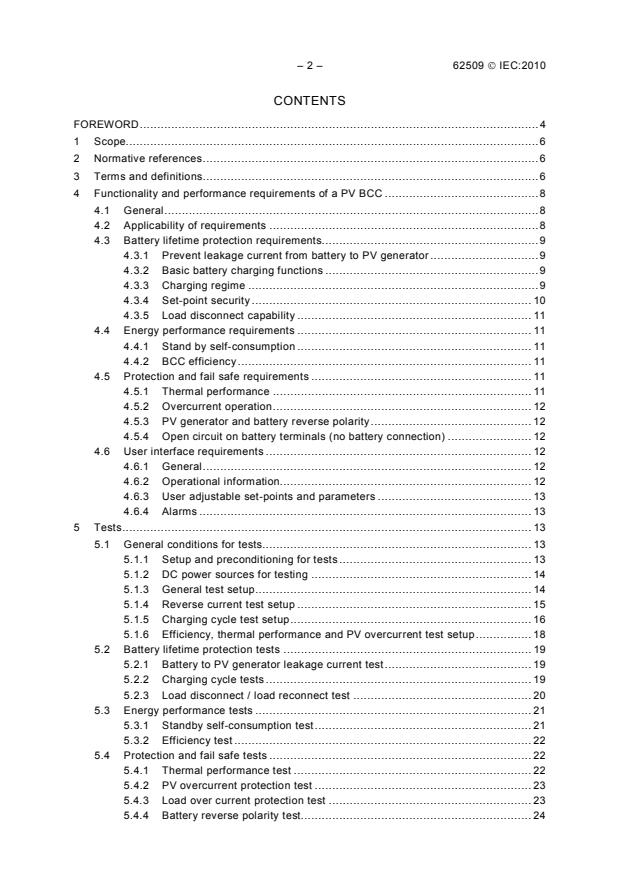
– 2 – 62509 Ó IEC:2010
CONTENTS
FOREW ORD . 4
1 Sc o pe . 6
2 Normative references . 6
3 Terms and definitions . 6
4 Functionality and performance requirements of a PV BCC . 8
4.1 Ge n eral . 8
4.2 Applicability of requirements . 8
4.3 Battery lifetime protection requirements . 9
4.3.1 Prevent leakage current from battery to PV generator . 9
4.3.2 Basic battery charging functions . 9
4.3.3 Charging regime . 9
4.3.4 Set-point security . 10
4.3.5 Load disconnect capability . 11
4.4 Energy performance requirements . 11
4.4.1 Stand by self-consumption . 11
4.4.2 BCC efficiency . 11
4.5 Protection and fail safe requirements . 11
4.5.1 Thermal performance . 11
4.5.2 Overcurrent operation . 12
4.5.3 PV generator and battery reverse polarity . 12
4.5.4 Open circuit on battery terminals (no battery connection) . 12
4.6 User interface requirements . 12
4.6.1 General . 12
4.6.2 Operational information. 12
4.6.3 User adjustable set-points and parameters . 13
4.6.4 Alarms . 13
5 Tests . 13
5.1 General conditions for tests. 13
5.1.1 Setup and preconditioning for tests . 13
5.1.2 DC power sources for testing . 14
5.1.3 General test setup . 14
5.1.4 Reverse current test setup . 15
5.1.5 Charging cycle test setup . 16
5.1.6 Efficiency, thermal performance and PV overcurrent test setup . 18
5.2 Battery lifetime protection tests . 19
5.2.1 Battery to PV generator leakage current test . 19
5.2.2 Charging cycle tests . 19
5.2.3 Load disconnect / load reconnect test . 20
5.3 Energy performance tests . 21
5.3.1 Standby self-consumption test . 21
5.3.2 Efficiency test . 22
5.4 Protection and fail safe tests . 22
5.4.1 Thermal performance test . 22
5.4.2 PV overcurrent protection test . 23
5.4.3 Load over current protection test . 23
5.4.4 Battery reverse polarity test. 24
62509 Ó IEC:2010 – 3 –
5.4.5 PV generator reverse polarity test . 24
5.4.6 Battery open circuit test . 25
5.5 User interface tests . 25
Annex A (informative) Battery charging guideline . 27
Figure 1 – General test setup . 15
Figure 2 – Reverse current test setup . 16
Table 1 – Requirements for self consumption . 11
Table A.1 – Battery charging setpoint guideline . 27
– 4 – 62509 Ó IEC:2010
INTERNATIONAL ELECTROTECHNICAL COMMISSION
____________
BATTERY CHARGE CONTROLLERS FOR PHOTOVOLTAIC SYSTEMS –
PERFORMANCE AND FUNCTIONING
FOREWORD
1) The International Electrotechnical Commission (IEC) is a worldwide organization for standardization comprising
all national electrotechnical committees (IEC National Committees). The object of IEC is to promote
international co-operation on all questions concerning standardization in the electrical and electronic fields. To
this end and in addition to other activities, IEC publishes International Standards, Technical Specifications,
Technical Reports, Publicly Available Specifications (PAS) and Guides (hereafter referred to as “IEC
Publication(s)”). Their preparation is entrusted to technical committees; any IEC National Committee interested
in the subject dealt with may participate in this preparatory work. International, governmental and non-
governmental organizations liaising with the IEC also participate in this preparation. IEC collaborates closely
with the International Organization for Standardization (ISO) in accordance with conditions determined by
agreement between the two organizations.
2) The formal decisions or agreements of IEC on technical matters express, as nearly as possible, an international
consensus of opinion on the relevant subjects since each technical committee has representation from all
interested IEC National Committees.
3) IEC Publications have the form of recommendations for international use and are accepted by IEC National
Committees in that sense. While all reasonable efforts are made to ensure that the technical content of IEC
Publications is accurate, IEC cannot be held responsible for the way in which they are used or for any
misinterpretation by any end user.
4) In order to promote international uniformity, IEC National Committees undertake to apply IEC Publications
transparently to the maximum extent possible in their national and regional publications. Any divergence
between any IEC Publication and the corresponding national or regional publication shall be clearly indicated in
the latter.
5) IEC itself does not provide any attestation of conformity. Independent certification bodies provide conformity
assessment services and, in some areas, access to IEC marks of conformity. IEC is not responsible for any
services carried out by independent certification bodies.
6) All users should ensure that they have the latest edition of this publication.
7) No liability shall attach to IEC or its directors, employees, servants or agents including individual experts and
members of its technical committees and IEC National Committees for any personal injury, property damage or
other damage of any nature whatsoever, whether direct or indirect, or for costs (including legal fees) and
expenses arising out of the publication, use of, or reliance upon, this IEC Publication or any other IEC
Publications.
8) Attention is drawn to the Normative references cited in this publication. Use of the referenced publications is
indispensable for the correct application of this publication.
9) Attention is drawn to the possibility that some of the elements of this IEC Publication may be the subject of
patent rights. IEC shall not be held responsible for identifying any or all such patent rights.
International Standard IEC 62509 has been prepared by IEC technical committee 82: Solar
photovoltaic energy systems.
This standard is to be read in conjunction with IEC 62093.
The text of this standard is based on the following documents:
FDIS Report on voting
82/614/FDIS 82/623/RVD
Full information on the voting for the approval of this standard can be found in the report on
voting indicated in the above table.
This publication has been drafted in accordance with the ISO/IEC Directives, Part 2.
62509 Ó IEC:2010 – 5 –
The committee has decided that the contents of this publication will remain unchanged until
the stability date indicated on the IEC web site under "http://webstore.iec.ch" in the data
related to the specific publication. At this date, the publication will be
• reconfirmed,
• withdrawn,
• replaced by a revised edition, or
• amended.
– 6 – 62509 Ó IEC:2010
BATTERY CHARGE CONTROLLERS FOR PHOTOVOLTAIC SYSTEMS –
PERFORMANCE AND FUNCTIONING
1 Scope
This International Standard establishes minimum requirements for the functioning and
performance of battery charge controllers (BCC) used with lead acid batteries in terrestrial
photovoltaic (PV) systems. The main aims are to ensure BCC reliability and to maximise the
life of the battery. This standard shall be used in conjunction with IEC 62093, which describes
test and requirements for intended installation application. In addition to the battery charge
control functions, this Standard addresses the following battery charge control features:
· photovoltaic generator charging of a battery,
· load control,
· protection functions,
· interface functions.
This standard does not cover MPPT performance, but it is applicable to BCC units that have
this feature.
This standard defines functional and performance requirements for battery charge controllers
and provides tests to determine the functioning and performance characteristics of charge
controllers. It is considered that IEC 62093 is used to determine the construction
requirements for the intended installation which includes but is not limited to aspects such as
the enclosure, physical connection sturdiness and safety.
This standard was written for lead acid battery applications. It is not limited in terms of the
BCC capacity to which it may be applied, however, the requirements for test equipment when
applied to BCC with high voltage or current, for example, greater than 120 V or 100 A, may be
difficult to achieve. These approaches may be applicable to other power sources and other
battery technologies like Ni-Cd batteries by using the corresponding values of cell voltages.
2 Normative references
The following referenced documents are indispensable for the application of this document.
For dated references, only the edition cited applies. For undated references, the latest edition
of the referenced document (including any amendments) applies.
IEC 61836, Solar photovoltaic energy systems – Terms, definitions and symbols
IEC 62093, Balance-of-system components for photovoltaic systems – Design qualification
natural environments
3 Terms and definitions
For the purposes of this document, the terms and definitions given in IEC 61836 apply as well
as the following.
3.1
battery charge controller (BCC)
an electronic device/s that controls the charging and discharging of the battery in a
photovoltaic energy system. The charge control function may be included as a subsystem
within another product.
62509 Ó IEC:2010 – 7 –
3.2
bulk charge
initial charging stage aimed at restoring the battery charge as fast as possible, in which all the
available charging current from the PV generator, or the maximum current rating of the BCC,
is delivered to the battery.
NOTE Sometimes referred to as boost charge.
3.3
bulk voltage
threshold voltage used by the BCC as a control parameter to change charging mode from bulk
charge to the next charging stage
NOTE Sometimes referred to as boost voltage.
3.4
bulk charge delay time
the amount of time for which the bulk voltage is to be maintained before the change from the
bulk charge stage to the next charging stage is made
3.5
equalise current
a constant current applied to the battery during equalise charge; normally determined by
battery manufacturer recommendations
3.6
equalise charge
a relatively high voltage charging stage that is maintained for a defined time. Charge control
can be achieved by constant voltage or constant current regulation or a combination of both.
Equalise charge is intended to bring all cells to the same state of charge and remove
electrolyte stratification in flooded cells by causing them to produce gas and stir the
electrolyte.
3.7
equalise voltage
the voltage that the battery is allowed to reach during equalisation. This voltage is set above
the gassing point for flooded batteries and below the maximum allowable voltage that the
battery can withstand without damage.
3.8
equalise time
time that the equalise voltage is maintained from the moment that the battery has reached the
equalise voltage, to the moment when the equalise charge is terminated to enter the next
charging stage
3.9
float charge
a constant voltage charging stage in which the battery is maintained at a voltage below the
gassing point to complete the charging cycle and compensate for battery self discharge
3.10
float voltage
the minimum constant voltage necessary to offset the internal losses of the battery
3.11
load disconnect point
condition (usually battery voltage) at which the load terminals of the charge controller are
switched off to prevent the battery from over discharging, or at which a control signal or alarm
– 8 – 62509 Ó IEC:2010
is triggered to signal a low battery state of charge. When the condition is a battery voltage,
the abbreviation LVD (Low Voltage Disconnect) is usually used.
3.12
load reconnect point
condition (usually battery voltage) at which the load terminals of the charge controller are
switched back on to allow the battery to supply the load, or at which a control signal or alarm
is switched off to signal a battery state of charge that warrants the supply of the load. When
the condition is a battery voltage, the abbreviation LVR (Low Voltage Reconnect) is usually
used.
3.13
self-adaptive
an algorithm that modifies the charge controller set-points based on state of charge
calculations, battery state of charge history, etc., or a combination of these parameters
3.14
temperature compensation for end of charge voltage set-points
a temperature dependent coefficient applied to the end of charge voltage set-points when the
temperature of the battery differs from the reference temperature (usually 25 °C). In addition
to the temperature coefficient, temperature compensation normally has minimum and
maximum limits that should be adhered to (i.e. voltage set-points should be constrained within
a range).
4 Functionality and performance requirements of a PV BCC
4.1 General
This Clause describes the performance and functionality requirements for PV battery charge
controllers (BCC). These requirements are divided in 5 main categories:
· Battery lifetime protection.
· Efficiency.
· User interface.
· Fail safe functions.
· Marking and documentation.
The provisions in this standard are not intended to preclude or rule out innovative control
techniques aimed at providing effective battery charging. These however shall be verifiable by
testing.
4.2 Applicability of requirements
Required provisions ensure reliable operation and essential protection functions, and are
generally easily achievable on even inexpensive BCCs intended for small installations (e.g.
single module installations at extra low voltage).
Recommended provisions ensure more effective battery charging, better efficiencies, longer
battery lifetime and additional user interface functions. They are intended to provide and/or
facilitate more advanced battery charging and load management.
62509 Ó IEC:2010 – 9 –
4.3 Battery lifetime protection requirements
4.3.1 Prevent leakage current from battery to PV generator
The BCC shall limit leakage current flowing from the battery to the PV generator in order to
prevent battery discharging at night. The allowable reverse current on the PV side shall be
£ 0,1 % of the BCC rated input current when the battery voltage is equal to the rated voltage.
Compliance shall be verified by test according to 5.2.1.
4.3.2 Basic battery charging functions
4.3.2.1 General
The BCC shall provide appropriate charging set-points and load disconnect set-points for the
specific battery technology or technologies it is intended to be used for.
4.3.2.2 Protect battery from over-charge
The BCC shall cut out or regulate the charging current to avoid over-charging of the battery
according to battery manufacturer recommended end of charge set-point.
Compliance shall be determined by test according to 5.2.2.
4.3.2.3 Protect battery from over-discharge
The BCC shall have a provision to prevent the battery from over-discharging either by directly
interrupting the current to the load, or by a trip signal to enable an external piece of
equipment to stop the current to the load, or an alarm.
If battery over-discharge protection is achieved by means of audible or visible alarms that
prompt the system user to disconnect all or non-essential load, this shall be clearly stated in
the operation manual.
If over-discharge protection is reliant on the installation of an external device that provides
over-discharge protection (such as an inverter), this fact shall be clearly stated in the
installation manual.
Battery over-discharge protection can be triggered by a battery voltage measurement, a state
of charge calculation, a combination of both or other algorithms. The protection set-points
may be current compensated. Battery over-discharge protection set-point shall be verifiable
by testing. The BCC documentation and/or interface shall clearly specify the algorithms and
criteria used to establish the load disconnect and reconnect set-points.
Compliance shall be determined by test according to 5.2.3.
4.3.2.4 Set-point accuracy
The BCC measurement accuracy for voltage set-points for charge control shall be ±1 % or
better. For load disconnect it shall be ±2 % or better.
Compliance shall be determined by test according to 5.2.2 and 5.2.3.
4.3.3 Charging regime
4.3.3.1 General
The BCC shall be matched to the specific battery technology for its intended use to ensure
that correct charging set-points are implemented. The PV BCC can use a variety of methods
– 10 – 62509 Ó IEC:2010
to ensure correct charging of batteries, the requirements in this clause include some of the
possible solutions and do not limit other solutions.
4.3.3.2 Required charging stages
As a minimum, PV battery charge controllers shall have bulk and float charging stages.
NOTE Some manufacturers give charging stages different names in their documentation than those defined in this
standard. Care must be taken to identify the charging characteristics appropriately for each individual unit or
manufacturer and cross-reference with the terminology used in this standard.
4.3.3.3 Recommended charging stages
In addition to the requirements of 4.3.3.2, battery charge controllers should provide equalise
charge periodically to the battery. The periodicity of equalise charge should be more than 7
days.
4.3.3.4 Adjustable charging set-points
In order to ensure correct charging regime for the battery type, charging set-points should be
adjustable or automatically selected either by means of individual set-point adjustment, or by
battery type selection or self-detection of type of battery. This can be achieved by hardware
means or software through user interface or by adjusting set-points as directed in manuals.
The specific charging regime used depends on the battery technology specified. A guide for
the battery set-points for testing purposes where such information is unavailable from the
manufacturer is given in Annex A.
Self-adaptive set-points based on advanced algorithms shall be able to be verified using
information provided by the user interface and the BCC documentation. No specific test
procedure has been developed for devices employing these advanced techniques.
NOTE Adjustable set-points may not be required for BCCs intended for low power applications (< 250 W) and for
a particular type of battery.
4.3.3.5 Temperature compensated charging set-points
Bulk, float, and other high voltage or end of charge set-points should be temperature
compensated. Temperature compensation if provided should be in accordance with battery
manufacturer recommendations for the particular type of battery. Temperature compensated
set-points shall be identifiable from the charge controller documentation.
NOTE Lead acid battery manufacturers typically specify a temperature compensation coefficient of –5 mV/°C/Cell.
4.3.3.6 Voltage drop compensation for set-point measurement
The BCC should provide a means to compensate for voltage drop in battery cables, or provide
installation instructions to minimise voltage drop.
If the battery charge controller has the provision for battery sense cables, it shall be able to
operate with or without these. This is to protect the unit against unintended disconnection of
the battery sense cables. This requirement is tested according to 5.2.2 and 5.2.3 by
performing the test with and without the sense wires connected at 25 °C test conditions.
4.3.4 Set-point security
Charging set-points shall be secured against change other than by a deliberate and qualified
action.
Compliance shall be determined by inspection of the unit and accompanying operating
instructions.
62509 Ó IEC:2010 – 11 –
NOTE 1 This clause does not apply to battery charge controllers with fixed set-points.
NOTE 2 The use of a tool or password are acceptable means of protection.
4.3.5 Load disconnect capability
Where over-discharge protection is provided by means of load disconnect functionality the
load disconnect and reconnect set-points shall be verified by testing according 5.2.3.
The load could be either a load directly switched or a load controlled by the BCC by other
means. In the case of a BCC directly switching the load this should be provided by means of
an integrated load breaking switching device.
If a BCC has multiple load disconnect set-points, these shall be verifiable by testing and able
to be determined from the BCC user interface and/or clearly written in documentation.
NOTE Battery over discharge protection is a mandatory feature (see 4.3.2.3). BCC load disconnection capability
is recommended only, but it must be achieved by other external means if not provided by the BCC, as it is essential
for battery lifetime protection.
4.4 Energy performance requirements
4.4.1 Stand by self-consumption
With no PV input or load the self-consumption of a PV BCC shall be as detailed in Table 1,
when the battery voltage is equivalent to 2,1 V/Cell ± 2 %, and the ambient temperature is
25 °C ± 2 °C.
Compliance shall be determined by test according to 5.3.1.
Table 1 – Requirements for self-consumption
Nominal charging current Maximum self-consumption
< 5 A 5 mA
5 A £ I £ 50 A 0,1 % of nominal charging current
> 50 A 50 mA
NOTE The limits given in Table 1 are intended for the charge controller function in “night time” mode. Where there
are other peripheral equipment such as load management devices, displays, data loggers and others that share the
power supply of the BCC, these shall be disabled or disconnected from the BCC if possible.
4.4.2 BCC efficiency
Power efficiency of the BCC shall be evaluated from 10 % to 100 % of the rated charging
current, at a battery voltage equivalent to 2,2 V/Cell ± 2 % and at ambient temperature of
25 °C ± 2 °C.
The efficiency shall be determined by test according to 5.3.2[N1].
4.5 Protection and fail safe requirements
4.5.1 Thermal performance
The BCC shall be capable of handling rated input current/power from the generator and,
simultaneously, rated load current to load terminals (if provided) for at least 1 h at the
manufacturer’s specified maximum rated ambient operating temperature ± 2 °C. Battery
voltage shall be 2,2 V/Cell ± 2 %.
Compliance shall be determined by test according to 5.4.1.
– 12 – 62509 Ó IEC:2010
NOTE Depending on the relative ratings of PV input and loads terminals, this test may result in battery charge or
discharge conditions.
4.5.2 Overcurrent operation
4.5.2.1 PV side
The BCC shall not be damaged by excessive current from the PV generator up to 125 % of
the full rated current. The BCC shall continue to operate normally after such an event and
shall not require manual resetting.
NOTE The reset time for any automatic resetting trip mechanism, should be no longer than the time indicated in
the manufacturer’s instructions, if specified.
Compliance shall be determined by test according to 5.4.2.
4.5.2.2 Load side
If the BCC has a load terminal, this terminal shall be current protected to prevent over loads
from causing damage to the operation of the essential PV BCC functions.
Compliance shall be determined by test according to 5.4.3.
The rating of the load terminals should match the requirement of the intended application/s.
4.5.3 PV generator and battery reverse polarity
The BCC shall be protected from reverse polarity connection of the PV generator or the
battery by hardware or by documented procedure and markings.
NOTE The preferred method of protection against reverse polarity is by hardware means, but procedural
documentation is allowed. This is a concern during installation and battery replacement.
Compliance shall be determined by test according to 5.4.4 and 5.4.5.
4.5.4 Open circuit on battery terminals (no battery connection)
BCC with load terminals shall be protected from damage to itself and protect the load from the
open circuit voltage of the PV generator in the case of battery disconnection.
Compliance shall be determined by test according to 5.4.6.
4.6 User interface requirements
4.6.1 General
The user interface of a BCC should include any of the following types; LCD screen, LED
indicators, audible alarms, relay contacts, other computer interface or other analogue or
digital interface. The interface can provide the user with valuable information about the
system operation if implemented properly.
The user interface may be integrated into another system component separate from the BCC
such as an additional control/logging/interface unit that can be physically connected to the
BCC or operate via wireless communication.
4.6.2 Operational information
4.6.2.1 General
The level of information provided to the user is determined by the intended application and its
specific requirements.
62509 Ó IEC:2010 – 13 –
The user interface of the charge controller should provide information such as detailed in
4.6.2.2.
4.6.2.2 Recommended operation information
· An indication of charging status (i.e. charging or not charging).
· An indication of load-disconnect state (or over discharge protection status).
· An indication of the state-of-charge of the connected battery.
Other additional operational information displayed by the unit may include but is not limited to:
· Charging set-points.
· Battery voltage.
· Charging current.
· Energy input/output.
4.6.3 User adjustable set-points and parameters
If user-adjustable set-points or parameters are provided, the user interface shall provide a
facility to modify and display those adjustments as specified in 4.3.3.4.
NOTE This clause does not apply to battery charge controllers with fixed set-points.
Compliance shall be determined by inspection of the unit and accompanying user/installation
manual.
4.6.4 Alarms
The following conditions should be signalled by the user interface:
· Low battery state of charge / Low battery voltage / Low availability.
· Load disconnect.
· BCC trip (e.g. by over temperature).
Visible and/or audible alarms, clearly identifiable by the system user, shall be triggered within
the unit in case of any of the above conditions occurring. Audible alarms shall be time limited
and revert to a visible alarm or be pulsed.
Compliance shall be determined by test according to 5.2.2 and 5.2.3.
5 Tests
5.1 General conditions for tests
5.1.1 Setup and preconditioning for tests
The BCC shall be mounted and installed according to the instructions supplied with the unit.
Where the BCC is intended to be installed in a particular manner or configuration (e.g. wall-
mounting), the installation shall mimic such conditions.
The BCC shall be installed in a temperature-controlled chamber for all tests. The test
procedure shall not commence until the chamber and BCC temperatures have reached
thermal stability.
– 14 – 62509 Ó IEC:2010
5.1.2 DC power sources for testing
5.1.2.1 PV input
The power source used as the PV input should be a PV generator simulator, however, a
voltage and current controlled power source in combination with a series resistor (R in the
S
test diagrams) can be used.
If a PV generator simulator is used, it shall have the following minimum ratings:
· V ³ 2 ´ V
OC BAT-NOM
· I ³ 1,25 ´ I
SC BCC-IN
If a voltage and current controlled power source with a series resistor is used, it shall have
the following minimum ratings:
· V ³ 2 ´ V
BAT-NOM
· I ³ 1,25 ´ I
BCC-IN
Where:
V is the nominal battery voltage;
BAT-NOM
I is the rated battery charge controller PV input current.
BCC-IN
5.1.2.2 Battery simulator
The power supply used for the battery simulation shall be voltage and current controlled and
have the following minimum ratings:
· V ³ 1,4 ´ V
BAT-NOM
· I ³ 1,25 ´ I
BCC-OUT
where:
I is the rated battery charge controller battery charging current.
BCC-OUT
5.1.3 General test setup
The general test setup shall be as specified in Figure 1. Any variations or modifications to the
basic setup for a particular test are specified in 5.1.4, 5.1.5 and 5.1.6 and in the
corresponding test clauses.
Voltage measurements shall be made at the BCC terminals.
62509 Ó IEC:2010 – 15 –
Environmental chamber
T
Ambient
R
s
+ + +
T
PV simulator/
Heatsink
C R
B B
DC power
DC power
U
U BCC
PV source
source
Battery
- - -
I I
Load
- +
U
Battery simulator
I
Key
Power cable
Enclosure
Optional component
Voltage measurement
U
Current measurement
I
Temperature
T
Test load
measurement
IEC 2889/10
Figure 1 – General test setup
5.1.4 Reverse current test setup
The test setup shall be as specified in Figure 2.
The PV generator input resistance (R ) shall be calculated using equations 1 and 2.
PV
N
S
R = 1440 (1)
PV
I
R
(2,1N )
C
P = (2)
R
PV
R
PV
where:
R is the PV generator resistance required to be connected to the system (W);
PV
N is the number of PV modules in series that would be used in each string for the BCC
S
under test (considering 1 series module per each 12 V of nominal system voltage). It is
assumed the standard number of PV cells in a module is 36 cells;
I is the rated current (A) of the BCC;
R
P is the minimum power (W) dissipation rating of R ;
R PV
PV
N is the number of series cells of the battery, where 1 cell is equivalent to a nominal
C
voltage of 2 V.
NOTE Equation 1 is based on the typical resistance of a-Si:H triple junction PV module technology.
– 16 – 62509 Ó IEC:2010
Environmental chamber
T
Ambient
+ T +
Heatsink
C
B
DC power
R
U
PV U BCC
PV source
Battery
- -
I I
Load
+
-
Battery simulator
U
I
Key
Power cable
Enclosure
Optional component
Voltage measurement
U
Current measurement
I
Temperature
T
measurement
Test load
IEC 2890/10
Figure 2 – Reverse current test setup
5.1.5 Charging cycle test setup
5.1.5.1 General
The test setup shall be as specified in Figure 1, with the considerations described below.
5.1.5.2 PV input
A PV generator simulator is the preferred option. If a PV generator simulator of the required
voltage and/or current ratings is not available, use a power supply with a series resistor (R ).
S
If a power supply with series resistor is used, the PV power supply settings should be as
follows:
V = 1,25´V (3)
PV-PSU BAT-MAX
I = 10 % of rated PV input current (4)
PV-PSU
where:
V is the maximum expected charging voltage during the set-point tests (e.g.
BAT-MAX
maximum equalisation voltage at 25 °C;
I is the current setting of the PV input power supply;
PV-PSU
V is the voltage setting of the PV input power supply.
PV-PSU
62509 Ó IEC:2010 – 17 –
The voltage drop in R should be between 10 % and 15 % of the voltage setting of the PV
S
power supply unit (PSU), therefore:
0,1´V 0,15´ V
PV-PSU PV-PSU
£ R £ (5)
S
I I
PV-PSU PV-PSU
Thus the minimum required power dissipation of R is given by:
S
P = I R (6)
R S
S PV-PSU
Where:
R is the series resistance connected between the PV power supply and the battery charge
S
controller.
5.1.5.3 Battery simulator
The battery side PSU is required as a back up for those BCCs that scan the PV IV curve and
therefore disconnect the PV current for a few seconds to perform this operation. It is intended
to prevent the battery voltage from dipping too much during such IV curve scans.
The settings of the battery backup PSU shall be:
0,9´V £ V £ 0,94´V
BAT BAT-PSU BAT
I = 120 % of Expected charging current
BAT-PSU
where:
V is the battery voltage measured at the BCC terminals;
BAT
V is the backup PSU voltage setting;
BAT-PSU
I is the backup PSU current setting.
BAT-PSU
NOTE should be adjusted every time the battery voltage is adjusted for testing as specified in the test
V
BAT-PSU
steps in 5.2.2.2.
The battery capacitor value (C ) should be 0,2 F ± 20 %.
B
R is a variable resistor that allows for battery voltage control. Its characteristics should be as
B
follows:
V
BAT-MIN
R =
B-MIN
I
CHG
V
BAT-MAX
R =
B-MAX
I
CHG
P = V I
R BAT-MAX CHG
B
where:
I is the battery charging current required for the test;
CHG
– 18 – 62509 Ó IEC:2010
R is the minimum resistance required for the test;
B-MIN
R is the maximum resistance required for the test;
B-MAX
P is the minimum required power dissipation capacity of R ;
R B
B
V is the minimum expected battery voltage during the set-point tests (e.g. simulating
BAT-MIN
battery low state of charge).
5.1.6 Efficiency, thermal performance and PV overcurrent test setup
5.1.6.1 General
The test setup shall be as specified in Figure 1, with the considerations described in 5.1.5.2
and 5.1.6.2.
5.1.6.2 Battery simulator
The voltage on the battery terminals of the BCC shall remain constant for the duration of the
tests. A battery simulator can be used if it can maintain a constant voltage. The use of voltage
and current controlled power supply unit (PSU) is suitable for this test as long as the following
points are considered.
The PSU connected to the BCC battery terminals in this case is required to provide a battery
voltage reference (V ). This PSU shall operate in voltage regulation mode and supply
BAT-PSU
current to R (see Figure 1) at all times during the test.
B
The settings of this PSU should be:
V = V (7)
BAT-PSU BAT-TEST
I = 1,3I (8)
BAT-PSU CHG-MAX
where:
V is the test battery voltage measured at the BCC terminals (2,2 V/Cell for efficiency
BAT-TEST
test);
V is the battery PSU voltage setting;
BAT-PSU
I is the maximum expected charging current.
CHG-MAX
NOTE will normally need to be adjusted slightly at each charging current level to compensate for the
V
BAT-PSU
changing voltage drop in the wiring.
The battery capacitor value (C , see Figure 1) shall be 0,1 F ± 20 %.
B
R is a fixed resistor that dissipates the charging current plus the current from the battery
B
PSU. Its characteristics should be as follows:
V
BAT-TEST
R = ±10 % (9)
B
1,15I
CHG-MAX
P ³ 1,3V I (10)
R BAT-TEST CHG-MAX
B
where:
62509 Ó IEC:2010 – 19 –
R is the battery setup resistor required for the test;
B
P is the minimum required power dissipation capacity of R .
R B
B
5.2 Battery lifetime protection tests
5.2.1 Battery to PV generator leakage current test
5.2.1.1 Objective/scope
This test is intended to measure the reverse current through the BCC from the battery to the
PV generator, when the PV generator is connected but not producing any current. The test
verifies compliance with the requirements of 4.3.1. Measurements are to be made at
25 °C ± 2 °C.
5.2.1.2 Test setup
As specified in 5.1.4.
5.2.1.3 Test procedure
a) Connect test setup as specified in Figure 2.
b) Ensure the conditions specified in 5.1.1 are met.
c) Adjust the battery voltage to 2,1 V/Cell ± 2 %.
d) Measure the current in the R loop.
PV
NOTE Some units may have a delay time, from the time the PV voltage is below the battery voltage to the time
that it reduces PV generator leakage current.
e) Comp
...