

IEC 61557-12:2018
(Main)Electrical safety in low voltage distribution systems up to 1 000 V AC and 1 500 V DC - Equipment for testing, measuring or monitoring of protective measures - Part 12: Power metering and monitoring devices (PMD)
General Information
- Abstract
IEC 61557-12:2018 specifies requirements for power metering and monitoring devices (PMD) that measure and monitor the electrical quantities within electrical distribution systems, and optionally other external signals. These requirements also define the performance in single- and three-phase AC or DC systems having rated voltages up to 1 000 V AC or up to 1 500 V DC. These devices are fixed or portable. They are intended to be used indoors and/or outdoors. Power metering and monitoring devices (PMD), as defined in this document, give additional safety information, which aids the verification of the installation and enhances the performance of the distribution systems. The power metering and monitoring devices (PMD) for electrical parameters described in this document are used for general industrial and commercial applications. This document does not address functional safety and cyber security aspects. This document is not applicable for:
– electricity metering equipment that complies with IEC 62053-21, IEC 62053-22, IEC 62053-23 and IEC 62053-24. Nevertheless, uncertainties defined in this document for active and reactive energy measurement are derived from those defined in IEC 62053 (all parts);
– the measurement and monitoring of electrical parameters defined in IEC 61557-2 to IEC 61557-9 and IEC 61557-13 or in IEC 62020;
– power quality instrument (PQI) according IEC 62586 (all parts);
– devices covered by IEC 60051 (all parts) (direct acting analogue electrical measuring instrument). IEC 61557-12:2018 cancels and replaces the first edition published in 2007. This edition constitutes a technical revision. This edition includes the following significant technical changes with respect to the previous edition:
a) PMD-A has been withdrawn due the fact these devices are now mainly covered by the IEC 62586 series of standards.
b) Three categories of PMD have been created with a list of minimum required functions for each category.
c) Added a new Annex A explaining the different applications linked to the relevant standards and devices, and another new Annex C about the power factor conventions.
The contents of the corrigendum 1 (2022-09) have been included in this copy.
- Status
- Published
- Publication Date
- 20-May-2021
- Technical Committee
- TC 85 - Measuring equipment for electrical and electromagnetic quantities
- Drafting Committee
- WG 20 - TC 85/WG 20
- Current Stage
- PPUB - Publication issued
- Start Date
- 22-Oct-2018
- Completion Date
- 28-Sep-2018
Buy Documents
IEC 61557-12:2018 RLV - Electrical safety in low voltage distribution systems up to 1 000 V AC and 1 500 V DC - Equipment for testing, measuring or monitoring of protective measures - Part 12: Power metering and monitoring devices (PMD) Released:10/22/2018
IEC 61557-12:2018 - Electrical safety in low voltage distribution systems up to 1 000 V AC and 1 500 V DC - Equipment for testing, measuring or monitoring of protective measures - Part 12: Power metering and monitoring devices (PMD) Released:10/22/2018

IEC 61557-12:2018+AMD1:2021 CSV - Electrical safety in low voltage distribution systems up to 1 000 V AC and 1 500 V DC - Equipment for testing, measuring or monitoring of protective measures - Part 12: Power metering and monitoring devices (PMD) Released:5/21/2021
Overview
IEC 61557-12:2018 - Electrical safety in low voltage distribution systems - Part 12 specifies requirements for power metering and monitoring devices (PMD) used in low-voltage distribution systems up to 1 000 V AC and 1 500 V DC. The standard defines performance, classification and tests for fixed or portable PMD intended for indoor and/or outdoor industrial and commercial applications. It focuses on measurement and monitoring of electrical quantities (power, energy, voltage, current, harmonics, unbalance, dips/swells, etc.) and the related uncertainty and performance requirements. IEC 61557-12:2018 supersedes the 2007 edition, includes corrigendum 1 (2022) and introduces major updates such as three PMD categories and new informative annexes (applications and power factor conventions).
Key topics and technical requirements
- Scope and applicability: Covers PMD performance in single- and three-phase AC or DC systems up to rated voltages given above. Does not apply to revenue electricity meters (IEC 62053 series), power quality instruments (IEC 62586), IEC 60051 analogue instruments, or parameters covered by other parts of IEC 61557.
- Classification and functions: Defines three categories of PMD with minimum required functions for each category and recommended sensor classes (Annex F).
- Measured parameters: Requirements for active/reactive/apparent power & energy, frequency, RMS currents and voltages, power factor, harmonics/THD, flicker, voltage dips/swells/interruption, transients, unbalance, demand/peaks and related derived quantities.
- Performance and uncertainty: Specifies intrinsic and operating uncertainty concepts and tests; uncertainties for active/reactive energy are derived from IEC 62053 definitions.
- Architecture and sensors: Defines PMD structures with or without external sensors, requirements for self-powered PMD, and system performance classes when external sensors are used.
- Tests and compliance: Type and routine tests covering intrinsic uncertainty, environmental influences (temperature, vibration, climatic), EMC, start‑up, gapless measurement and safety tests.
- Marking and documentation: Requirements for marking, installation and operating instructions, and essential characteristics to be declared.
Practical applications and who uses it
- Intended for engineers, manufacturers, test laboratories, installers and facility managers who specify, design, test or deploy PMD for:
- Energy management and submetering in commercial and industrial buildings
- Load verification, fault diagnosis and verification of protective measures
- Monitoring distributed generation, DC/AC microgrids and distribution assets
- Useful for procurement specifications, type testing, product conformity and system integration.
Related standards (brief)
- IEC 62053 (electricity metering) - revenue meters (not covered here)
- IEC 62586 (power quality instruments) - PMD-A relocated coverage
- Other parts of IEC 61557 cover complementary measurement parameters and safety testing
Keywords: IEC 61557-12:2018, power metering and monitoring devices, PMD, low voltage distribution, power monitoring, energy measurement, uncertainty, PMD categories, IEC standards.
Relations
- Effective Date
- 05-Sep-2023
- Effective Date
- 05-Sep-2023
- Effective Date
- 05-Sep-2023
Buy Documents
IEC 61557-12:2018 RLV - Electrical safety in low voltage distribution systems up to 1 000 V AC and 1 500 V DC - Equipment for testing, measuring or monitoring of protective measures - Part 12: Power metering and monitoring devices (PMD) Released:10/22/2018
IEC 61557-12:2018 - Electrical safety in low voltage distribution systems up to 1 000 V AC and 1 500 V DC - Equipment for testing, measuring or monitoring of protective measures - Part 12: Power metering and monitoring devices (PMD) Released:10/22/2018
IEC 61557-12:2018+AMD1:2021 CSV - Electrical safety in low voltage distribution systems up to 1 000 V AC and 1 500 V DC - Equipment for testing, measuring or monitoring of protective measures - Part 12: Power metering and monitoring devices (PMD) Released:5/21/2021
Get Certified
Connect with accredited certification bodies for this standard

IMQ S.p.A. (Certification)
Italian electrical product certification.

SLG Prüf- und Zertifizierungs GmbH
German testing and certification body.

UL Solutions
Global safety science company with testing, inspection and certification.
Sponsored listings
Frequently Asked Questions
IEC 61557-12:2018 is a standard published by the International Electrotechnical Commission (IEC). Its full title is "Electrical safety in low voltage distribution systems up to 1 000 V AC and 1 500 V DC - Equipment for testing, measuring or monitoring of protective measures - Part 12: Power metering and monitoring devices (PMD)". This standard covers: IEC 61557-12:2018 specifies requirements for power metering and monitoring devices (PMD) that measure and monitor the electrical quantities within electrical distribution systems, and optionally other external signals. These requirements also define the performance in single- and three-phase AC or DC systems having rated voltages up to 1 000 V AC or up to 1 500 V DC. These devices are fixed or portable. They are intended to be used indoors and/or outdoors. Power metering and monitoring devices (PMD), as defined in this document, give additional safety information, which aids the verification of the installation and enhances the performance of the distribution systems. The power metering and monitoring devices (PMD) for electrical parameters described in this document are used for general industrial and commercial applications. This document does not address functional safety and cyber security aspects. This document is not applicable for: – electricity metering equipment that complies with IEC 62053-21, IEC 62053-22, IEC 62053-23 and IEC 62053-24. Nevertheless, uncertainties defined in this document for active and reactive energy measurement are derived from those defined in IEC 62053 (all parts); – the measurement and monitoring of electrical parameters defined in IEC 61557-2 to IEC 61557-9 and IEC 61557-13 or in IEC 62020; – power quality instrument (PQI) according IEC 62586 (all parts); – devices covered by IEC 60051 (all parts) (direct acting analogue electrical measuring instrument). IEC 61557-12:2018 cancels and replaces the first edition published in 2007. This edition constitutes a technical revision. This edition includes the following significant technical changes with respect to the previous edition: a) PMD-A has been withdrawn due the fact these devices are now mainly covered by the IEC 62586 series of standards. b) Three categories of PMD have been created with a list of minimum required functions for each category. c) Added a new Annex A explaining the different applications linked to the relevant standards and devices, and another new Annex C about the power factor conventions. The contents of the corrigendum 1 (2022-09) have been included in this copy.
IEC 61557-12:2018 specifies requirements for power metering and monitoring devices (PMD) that measure and monitor the electrical quantities within electrical distribution systems, and optionally other external signals. These requirements also define the performance in single- and three-phase AC or DC systems having rated voltages up to 1 000 V AC or up to 1 500 V DC. These devices are fixed or portable. They are intended to be used indoors and/or outdoors. Power metering and monitoring devices (PMD), as defined in this document, give additional safety information, which aids the verification of the installation and enhances the performance of the distribution systems. The power metering and monitoring devices (PMD) for electrical parameters described in this document are used for general industrial and commercial applications. This document does not address functional safety and cyber security aspects. This document is not applicable for: – electricity metering equipment that complies with IEC 62053-21, IEC 62053-22, IEC 62053-23 and IEC 62053-24. Nevertheless, uncertainties defined in this document for active and reactive energy measurement are derived from those defined in IEC 62053 (all parts); – the measurement and monitoring of electrical parameters defined in IEC 61557-2 to IEC 61557-9 and IEC 61557-13 or in IEC 62020; – power quality instrument (PQI) according IEC 62586 (all parts); – devices covered by IEC 60051 (all parts) (direct acting analogue electrical measuring instrument). IEC 61557-12:2018 cancels and replaces the first edition published in 2007. This edition constitutes a technical revision. This edition includes the following significant technical changes with respect to the previous edition: a) PMD-A has been withdrawn due the fact these devices are now mainly covered by the IEC 62586 series of standards. b) Three categories of PMD have been created with a list of minimum required functions for each category. c) Added a new Annex A explaining the different applications linked to the relevant standards and devices, and another new Annex C about the power factor conventions. The contents of the corrigendum 1 (2022-09) have been included in this copy.
IEC 61557-12:2018 is classified under the following ICS (International Classification for Standards) categories: 17.220.20 - Measurement of electrical and magnetic quantities; 29.080.01 - Electrical insulation in general; 29.240.01 - Power transmission and distribution networks in general. The ICS classification helps identify the subject area and facilitates finding related standards.
IEC 61557-12:2018 has the following relationships with other standards: It is inter standard links to IEC 61557-12:2018/AMD1:2021, IEC 61557-12:2018/COR1:2022, IEC 61557-12:2007. Understanding these relationships helps ensure you are using the most current and applicable version of the standard.
IEC 61557-12:2018 is available in PDF format for immediate download after purchase. The document can be added to your cart and obtained through the secure checkout process. Digital delivery ensures instant access to the complete standard document.
Standards Content (Sample)
IEC 61557-12 ®
Edition 2.0 2018-10
REDLINE VERSION
INTERNATIONAL
STANDARD
colour
inside
Electrical safety in low voltage distribution systems up to 1 000 V AC and
1 500 V DC. – Equipment for testing, measuring or monitoring of protective
measures –
Part 12: Performance measuring Power metering and monitoring devices (PMD)
All rights reserved. Unless otherwise specified, no part of this publication may be reproduced or utilized in any form
or by any means, electronic or mechanical, including photocopying and microfilm, without permission in writing from
either IEC or IEC's member National Committee in the country of the requester. If you have any questions about IEC
copyright or have an enquiry about obtaining additional rights to this publication, please contact the address below or
your local IEC member National Committee for further information.
IEC Central Office Tel.: +41 22 919 02 11
3, rue de Varembé info@iec.ch
CH-1211 Geneva 20 www.iec.ch
Switzerland
About the IEC
The International Electrotechnical Commission (IEC) is the leading global organization that prepares and publishes
International Standards for all electrical, electronic and related technologies.
About IEC publications
The technical content of IEC publications is kept under constant review by the IEC. Please make sure that you have the
latest edition, a corrigenda or an amendment might have been published.
IEC Catalogue - webstore.iec.ch/catalogue Electropedia - www.electropedia.org
The stand-alone application for consulting the entire The world's leading online dictionary of electronic and
bibliographical information on IEC International Standards, electrical terms containing 21 000 terms and definitions in
Technical Specifications, Technical Reports and other English and French, with equivalent terms in 16 additional
documents. Available for PC, Mac OS, Android Tablets and languages. Also known as the International Electrotechnical
iPad. Vocabulary (IEV) online.
IEC publications search - webstore.iec.ch/advsearchform IEC Glossary - std.iec.ch/glossary
The advanced search enables to find IEC publications by a 67 000 electrotechnical terminology entries in English and
variety of criteria (reference number, text, technical French extracted from the Terms and Definitions clause of
committee,…). It also gives information on projects, replaced IEC publications issued since 2002. Some entries have been
and withdrawn publications. collected from earlier publications of IEC TC 37, 77, 86 and
CISPR.
IEC Just Published - webstore.iec.ch/justpublished
Stay up to date on all new IEC publications. Just Published IEC Customer Service Centre - webstore.iec.ch/csc
details all new publications released. Available online and If you wish to give us your feedback on this publication or
also once a month by email. need further assistance, please contact the Customer Service
Centre: sales@iec.ch.
IEC 61557-12 ®
Edition 2.0 2018-10
REDLINE VERSION
INTERNATIONAL
STANDARD
colour
inside
Electrical safety in low voltage distribution systems up to 1 000 V AC and
1 500 V DC. – Equipment for testing, measuring or monitoring of protective
measures –
Part 12: Performance measuring Power metering and monitoring devices (PMD)
INTERNATIONAL
ELECTROTECHNICAL
COMMISSION
ICS 17.220.20; 29.080.01; 29.240.01 ISBN 978-2-8322-6183-5
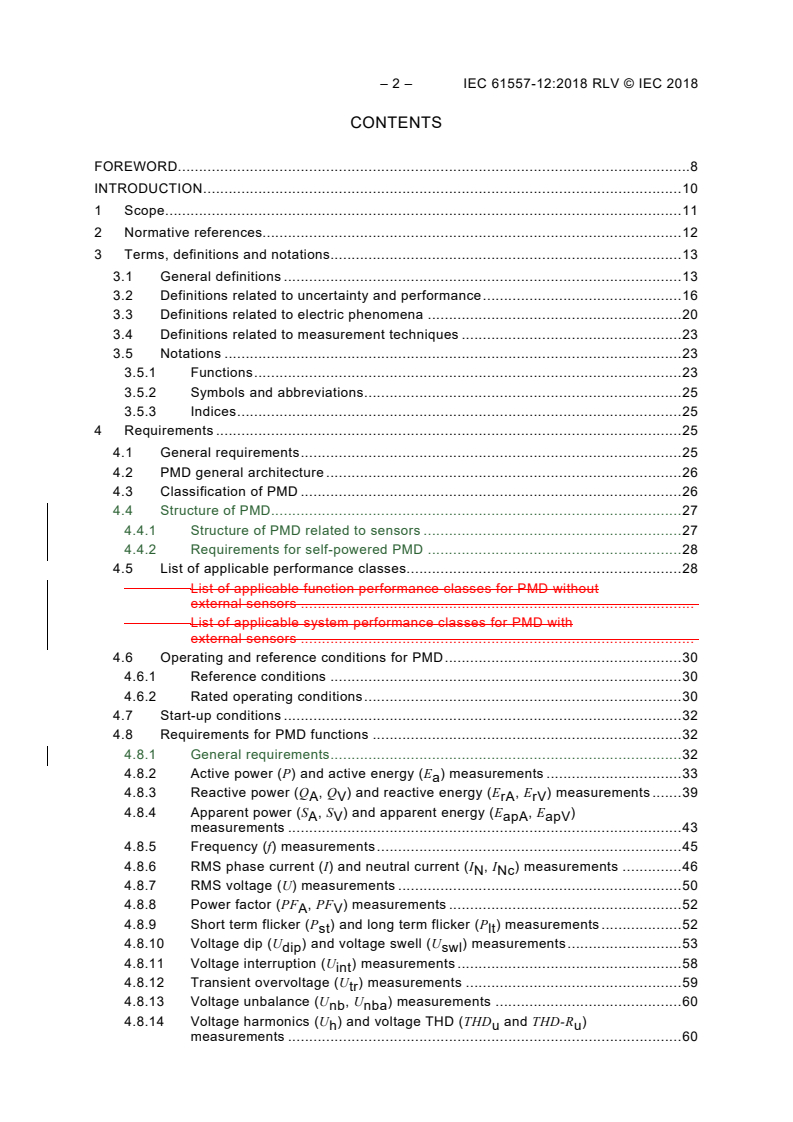
– 2 – IEC 61557-12:2018 RLV © IEC 2018
CONTENTS
FOREWORD . 8
INTRODUCTION . 10
1 Scope . 11
2 Normative references. 12
3 Terms, definitions and notations. 13
3.1 General definitions . 13
3.2 Definitions related to uncertainty and performance . 16
3.3 Definitions related to electric phenomena . 20
3.4 Definitions related to measurement techniques . 23
3.5 Notations . 23
3.5.1 Functions . 23
3.5.2 Symbols and abbreviations . 25
3.5.3 Indices . 25
4 Requirements . 25
4.1 General requirements . 25
4.2 PMD general architecture . 26
4.3 Classification of PMD . 26
4.4 Structure of PMD. 27
4.4.1 Structure of PMD related to sensors . 27
4.4.2 Requirements for self-powered PMD . 28
4.5 List of applicable performance classes . 28
List of applicable function performance classes for PMD without
external sensors .
List of applicable system performance classes for PMD with
external sensors .
4.6 Operating and reference conditions for PMD . 30
4.6.1 Reference conditions . 30
4.6.2 Rated operating conditions . 30
4.7 Start-up conditions . 32
4.8 Requirements for PMD functions . 32
4.8.1 General requirements . 32
4.8.2 Active power (P) and active energy (E ) measurements . 33
a
4.8.3 Reactive power (Q , Q ) and reactive energy (E , E ) measurements . 39
A V rA rV
4.8.4 Apparent power (S , S ) and apparent energy (E , E )
A V apA apV
measurements . 43
4.8.5 Frequency (f) measurements . 45
4.8.6 RMS phase current (I) and neutral current (I , I ) measurements . 46
N Nc
4.8.7 RMS voltage (U) measurements . 50
4.8.8 Power factor (PF , PF ) measurements . 52
A V
4.8.9 Short term flicker (P ) and long term flicker (P ) measurements . 52
st lt
4.8.10 Voltage dip (U ) and voltage swell (U ) measurements . 53
dip swl
4.8.11 Voltage interruption (U ) measurements . 58
int
4.8.12 Transient overvoltage (U ) measurements . 59
tr
4.8.13 Voltage unbalance (U , U ) measurements . 60
nb nba
4.8.14 Voltage harmonics (U ) and voltage THD (THD and THD-R )
h u u
measurements . 60
4.8.15 Current unbalance (I , I ) measurements . 62
nb nba
4.8.16 Current harmonics (I ) and current THD (THD and THD-R )
h i i
measurements . 62
4.8.17 Minimum, maximum, peak, three-phases average and demand
measurements . 64
Requirements for PMD-A functions .
4.9 General mechanical requirements . 65
4.9.1 Vibration requirements . 65
4.9.2 IP requirements . 65
4.10 Safety requirements . 66
4.10.1 Protection against electrical hazards . 66
4.10.2 Protection against mechanical hazards . 67
4.10.3 Protection against other hazards . 67
4.11 EMC requirements . 67
4.11.1 Immunity . 67
4.11.2 Emission . 67
4.12 Inputs and/or outputs . 67
4.12.1 General . 67
4.12.2 Analog outputs . 67
4.12.3 Pulse outputs . 68
4.12.4 Control outputs . 68
4.12.5 Analog inputs . 68
4.12.6 Pulse and control inputs . 68
5 Marking and operating instructions . 69
5.1 General . 69
5.2 Marking . 69
5.3 Operating, installation and maintenance instructions . 69
5.3.1 General . 69
5.3.2 General characteristics . 69
5.3.3 Essential characteristics . 70
6 Tests . 72
6.1 General . 72
6.2 Type tests of PMD . 72
6.2.1 General . 72
6.2.2 Tests of intrinsic uncertainty . 73
6.2.3 Tests of variation of uncertainty with influence quantities . 73
6.2.4 Test of temperature influence . 73
6.2.5 Active power . 73
6.2.6 Apparent power . 76
6.2.7 Power factor . 77
6.2.8 Common mode voltage rejection test . 77
6.2.9 Frequency. 77
6.2.10 Measurement of voltage harmonics and THD . 78
u
6.2.11 Measurement of current harmonics and THD . 79
i
6.2.12 Dips and swells . 79
6.2.13 Voltage interruptions . 79
6.2.14 Outputs tests . 79
6.2.15 Climatic tests . 80
6.2.16 EMC tests . 81
– 4 – IEC 61557-12:2018 RLV © IEC 2018
6.2.17 Start-up tests . 81
6.2.18 Gapless measurement test . 81
6.2.19 Type tests of PMD-A Safety tests . 82
6.3 Routine tests . 82
6.3.1 Protective bonding test . 82
6.3.2 Dielectric strength test . 82
6.3.3 Uncertainty test . 82
Annex A (informative) Metering, measuring and monitoring applications . 83
A.1 Applications on demand side and supply side . 83
A.2 Link between applications, devices and standards . 83
Annex B (informative) Definitions of electrical parameters . 85
B.1 General . 88
B.2 Definitions in the presence of a neutral . 88
B.3 Power measurement in three-phase three-wire systems using the two-
wattmeter method . 93
B.3.1 General . 93
B.3.2 Total active power . 94
B.3.3 Total vector reactive power using quadrature phase shift definition . 94
B.3.4 Total vector reactive power using Budeanu’s definition . 94
B.4 Additional relationships in case of sinusoidal voltage . 95
Annex C (informative) Convention about the sign of the power factor . 96
C.1 General . 96
C.2 Convention for power factor (consumer perspective) . 96
C.3 Convention for power factor (producer reference frame) . 97
Annex D (normative) Definitions of minimum, maximum, peak and demand values . 99
D.1 Demand quantities . 99
D.1.1 General . 99
D.1.2 Power demand . 99
D.1.3 Current demand . 99
D.1.4 Thermal current demand (or bi-metal current demand) . 99
D.1.5 Specified intervals for demand calculation . 99
D.2 Peak demand quantities . 100
D.3 Three-phase average quantities . 100
D.4 Maximum and minimum quantities . 100
Annex E (normative) Requirements applicable to PMD and to PMD-A .
Annex E (informative) Intrinsic uncertainty and operating uncertainty and overall
system uncertainty . 102
E.1 General . 102
E.2 Operating uncertainty calculation . 102
Overall system uncertainty .
Annex F (informative) Recommended sensor classes for the different kinds of PMD . 104
F.1 General considerations . 106
PMD with external current sensor or voltage sensor .
PMD with external current sensor and voltage sensor .
Range of applicable performance classes .
F.2 Specific case of an active power and energy measurement, achieved by a
PMD associated with an external current sensor or/and a voltage sensor . 106
F.3 List of functions affected by uncertainty of external sensors . 106
Annex G (informative) Notion of measurement uncertainty . 108
G.1 General considerations . 108
G.2 Computing the expanded uncertainty . 108
G.2.1 General . 108
G.2.2 Estimated standard deviation . 108
G.2.3 Expanded uncertainty . 109
G.3 Determining the measurement uncertainty . 110
G.3.1 Systematic error . 110
G.3.2 Measurement uncertainty . 110
G.4 Using the measurement uncertainty as a pass/fail criterion . 111
G.4.1 Intrinsic uncertainty tests . 111
G.4.2 Tests with influence quantities . 111
G.4.3 Overall pass/fail criterion . 111
Bibliography . 113
Figure 1 – PMD generic measurement chain . 26
Figure 2 – Description of different types of PMD . 28
Figure 3 – Relationship between ambient air temperature and relative humidity . 32
Figure 4 – Waveform for odd harmonics influence test on active power measurement . 74
Figure 5 – Spectral content for odd harmonics influence test on active power
measurement . 75
Figure 6 – Waveform for sub-harmonics influence test on active power measurement . 76
Figure 7 – Spectral content for sub-harmonics influence test on active power
measurement . 76
Figure 8 – Common mode voltage influence testing . 77
Figure 9 – Waveform for harmonics influence test on frequency measurement . 78
Figure A.1 – Simplified overview of measurement applications on supply side and
demand side . 83
Figure B.1 – Arithmetic and vector apparent powers in sinusoidal situation . 93
Figure B.2 – Three-phase circuit without neutral . 93
Figure C.1 – Formatting of power factor with a consumer perspective . 96
Figure C.2 – Convention for power factor with a producer perspective . 97
Figure D.1 – Thermal current demand . 99
Figure D.2 – Fixed block interval . 100
Figure D.3 – Sliding block interval . 100
Figure E.1 – Different kinds of uncertainties . 102
Figure E.2 – Flowchart for the determination of the operating uncertainty . 103
Figure G.1 – Illustration of the notion of measurement uncertainty . 110
Figure G.2 – Overview of the uncertainty test procedure . 112
Table – Complementary characteristics of PMD-A .
Table – Characteristics specification template .
Table – PMD SD associated to current sensor or PMD DS
associated to voltage sensor .
Table – PMD SS with current sensor and voltage sensor association .
– 6 – IEC 61557-12:2018 RLV © IEC 2018
Table – Range of applicable performance classes for PMD without its associated external
sensors .
Table D.4 – Range of applicable performance classes when calculating performance class of
PMD with its associated external sensors .
Table 1 – Functional classification of PMD with minimal required functions . 25
Table 2 – Classification Structure of PMD . 25
Table 3 – List of applicable performance classes . 26
Table 4 – Reference conditions for testing . 27
Table 5 – Rated operating temperatures for portable equipment . 28
Table 6 – Rated operating temperatures for fixed installed equipment . 28
Table 7 – Humidity and altitude operating conditions . 28
Table 8 – Intrinsic uncertainty table for active power and active energy measurement . 31
Table 9 – Influence quantities for active power and active energy measurement (1 of 3) . 32
Table 10 – Minimum test period . 35
Table 11 – Starting current for active power and active energy measurement . 36
Table 12 – Intrinsic uncertainty table for reactive power and reactive energy
measurement . 37
Table 13 – Influence quantities for reactive power and reactive energy measurement . 38
Table 14 – Minimum test period . 39
Table 15 – Starting current for reactive energy measurement . 40
Table 16 – Intrinsic uncertainty table for apparent power and apparent energy
measurement . 40
Table 17 – Influence quantities for apparent power and apparent energy measurement . 41
Table 18 – Intrinsic uncertainty table for frequency measurement . 42
Table 19 – Influence quantities for frequency measurement . 43
Table 20 – Rated range of operation for phase current measurement . 43
Table 21 – Rated range of operation for neutral current measurement (calculated or
measured) . 44
Table 22 – Intrinsic uncertainty table for phase current . 44
Table 23 – Intrinsic uncertainty table for neutral current measurement . 44
Table 24 – Intrinsic uncertainty table for neutral current calculation . 45
Table 25 – Influence quantities for phase current and neutral current measurement . 46
Table 26 – Rated range of operation for RMS voltage measurement . 47
Table 27 – Intrinsic uncertainty table for RMS voltage measurement . 47
Table 28 – Influence quantities for RMS voltage measurement . 48
Table 29 – Intrinsic uncertainty table for power factor measurement . 49
Table 30 – Intrinsic uncertainty table for flicker measurement . 50
Table 31 – Rated range of operation for voltage dips and swells measurement . 53
Table 32 – Intrinsic uncertainty table for voltage dips and swells measurement . 53
Table 33 – Influence quantities for dips and swells measurement . 54
Table 34 – Intrinsic uncertainty table for voltage interruption measurement . 56
Table 35 – Intrinsic uncertainty table for transient overvoltage measurement . 56
Table 36 – Intrinsic uncertainty table for voltage unbalance measurement . 57
Table 37 – Rated range of operation for voltage harmonics measurement . 57
Table 38 – Intrinsic uncertainty table for voltage harmonics measurement . 58
Table 39 – Intrinsic uncertainty table for voltage THD or THD-R measurement . 58
u u
Table 40 – Intrinsic uncertainty table for current unbalance measurement . 59
Table 41 – Rated range of operation for current harmonics measurement . 59
Table 42 – Intrinsic uncertainty table for current harmonics measurement . 59
Table 43 – Intrinsic uncertainty table for current THD and THD-R measurement . 60
i i
Table 44 – Minimum IP requirements for PMD . 61
Table 45 – PMD specification form . 65
Table 46 – Characteristics specification template . 66
Table A.1 – Main measurement applications . 78
Table B.1 – Definition of symbols . 81
Table B.2 – Calculation definitions for electrical parameters . 82
Table C.1 – Conventions for the sign of Power factor with a Consumer perspective . 89
Table C.2 – Conventions for the sign of power factor with a producer perspective . 90
Table F.1 – PMD SD associated with current sensor or PMD DS associated with
voltage sensor or PMD SS associated with voltage and current sensors . 97
Table F.2 – List of functions affected by uncertainty of external sensors . 97
Table G.1 – Correction factor C(N) for sample size N . 100
– 8 – IEC 61557-12:2018 RLV © IEC 2018
INTERNATIONAL ELECTROTECHNICAL COMMISSION
____________
ELECTRICAL SAFETY IN LOW VOLTAGE DISTRIBUTION
SYSTEMS UP TO 1 000 V AC AND 1 500 V DC. –
EQUIPMENT FOR TESTING, MEASURING OR
MONITORING OF PROTECTIVE MEASURES –
Part 12: Performance measuring Power metering and
monitoring devices (PMD)
FOREWORD
1) The International Electrotechnical Commission (IEC) is a worldwide organization for standardization comprising
all national electrotechnical committees (IEC National Committees). The object of IEC is to promote
international co-operation on all questions concerning standardization in the electrical and electronic fields. To
this end and in addition to other activities, IEC publishes International Standards, Technical Specifications,
Technical Reports, Publicly Available Specifications (PAS) and Guides (hereafter referred to as “IEC
Publication(s)”). Their preparation is entrusted to technical committees; any IEC National Committee interested
in the subject dealt with may participate in this preparatory work. International, governmental and non-
governmental organizations liaising with the IEC also participate in this preparation. IEC collaborates closely
with the International Organization for Standardization (ISO) in accordance with conditions determined by
agreement between the two organizations.
2) The formal decisions or agreements of IEC on technical matters express, as nearly as possible, an international
consensus of opinion on the relevant subjects since each technical committee has representation from all
interested IEC National Committees.
3) IEC Publications have the form of recommendations for international use and are accepted by IEC National
Committees in that sense. While all reasonable efforts are made to ensure that the technical content of IEC
Publications is accurate, IEC cannot be held responsible for the way in which they are used or for any
misinterpretation by any end user.
4) In order to promote international uniformity, IEC National Committees undertake to apply IEC Publications
transparently to the maximum extent possible in their national and regional publications. Any divergence
between any IEC Publication and the corresponding national or regional publication shall be clearly indicated in
the latter.
5) IEC itself does not provide any attestation of conformity. Independent certification bodies provide conformity
assessment services and, in some areas, access to IEC marks of conformity. IEC is not responsible for any
services carried out by independent certification bodies.
6) All users should ensure that they have the latest edition of this publication.
7) No liability shall attach to IEC or its directors, employees, servants or agents including individual experts and
members of its technical committees and IEC National Committees for any personal injury, property damage or
other damage of any nature whatsoever, whether direct or indirect, or for costs (including legal fees) and
expenses arising out of the publication, use of, or reliance upon, this IEC Publication or any other IEC
Publications.
8) Attention is drawn to the Normative references cited in this publication. Use of the referenced publications is
indispensable for the correct application of this publication.
9) Attention is drawn to the possibility that some of the elements of this IEC Publication may be the subject of
patent rights. IEC shall not be held responsible for identifying any or all such patent rights.
This redline version of the official IEC Standard allows the user to identify the changes
made to the previous edition. A vertical bar appears in the margin wherever a change
has been made. Additions are in green text, deletions are in strikethrough red text.
International Standard IEC 61557-12 has been prepared by IEC technical committee 85:
Measuring equipment for electrical and electromagnetic quantities.
This second edition cancels and replaces the first edition published in 2007. This edition
constitutes a technical revision.
This edition includes the following significant technical changes with respect to the previous
edition:
a) PMD-A has been withdrawn due the fact these devices are now mainly covered by the IEC
62586 series of standards.
b) Three categories of PMD have been created with a list of minimum required functions for
each category.
c) Added a new Annex A explaining the different applications linked to the relevant standards
and devices, and another new Annex C about the power factor conventions.
The text of this International Standard is based on the following documents:
FDIS Report on voting
85/644/FDIS 85/649/RVD
Full information on the voting for the approval of this International Standard can be found in
the report on voting indicated in the above table.
This document has been drafted in accordance with the ISO/IEC Directives, Part 2.
A list of all parts in the IEC 61557 series, published under the general title Electrical safety in
low voltage distribution systems up to 1 000 V AC and 1 500 V DC – Equipment for testing,
measuring or monitoring of protective measures, can be found on the IEC website.
The committee has decided that the contents of this document will remain unchanged until the
stability date indicated on the IEC website under "http://webstore.iec.ch" in the data related to
the specific document. At this date, the document will be
• reconfirmed,
• withdrawn,
• replaced by a revised edition, or
• amended.
IMPORTANT – The 'colour inside' logo on the cover page of this publication indicates
that it contains colours which are considered to be useful for the correct
understanding of its contents. Users should therefore print this document using a
colour printer.
The contents of the corrigendum 1 (2022-09) only applies to the French version.
– 10 – IEC 61557-12:2018 RLV © IEC 2018
INTRODUCTION
As a complement to protection measures, it becomes more and more necessary to measure
different electrical parameters, in order to monitor the required performances in energy
distribution systems due to:
• installation standards evolutions, for instance over current detection is now a new
requirement for the neutral conductor due to harmonic content;
• technological evolutions (electronic loads, electronic measuring methods, etc.);
• end-users needs (cost saving, compliance with aspects of building regulations, etc.);
• safety and continuity of service;
Energy distribution systems need to guarantee energy efficiency, availability and network
performances in order to address the following challenges:
– sustainable development requirements where energy measurement, for instance, is
recognised as an essential element of energy management, part of the overall drive to
reduce carbon emissions and to improve the commercial efficiency of manufacturing,
commercial organizations and public services;
– technological evolutions (electronic loads, electronic measuring methods, etc.);
– end-users needs (cost saving, compliance with aspects of building regulations, etc.)
regarding electrical energy management as well as other energies, or fluids. Other
functionalities involving several non electrical parameters are often needed in parallel;
– safety and continuity of service;
– evolution of installation standards, for instance over-current detection is now a new
requirement for the neutral conductor due to harmonic content.
Monitoring electrical quantities in internal networks allows to address these challenges.
The devices on the current market have different characteristics, which need a common
system of references. Therefore there is a need for this document in order to facilitate the
choices of the end-users in terms of performance, safety, interpretation of the indications, etc.
This document provides a basis by which such devices can be specified and described, and
their performance evaluated.
In order to fulfil the requirements of the energy efficiency project, many PMD measuring
electrical parameters can also collect data (water, air, gas, temperature…) coming from other
sensors or meters inside building or plant areas. In order to be able to transmit all these data
to a supervision software it will be relevant to equip the PMD with a communication bus. The
supervision software will then manage all the collected data in order to monitor them and
produce useful reports for energy usage and consumption analysis.
ELECTRICAL SAFETY IN LOW VOLTAGE DISTRIBUTION
SYSTEMS UP TO 1 000 V AC AND 1 500 V DC. –
EQUIPMENT FOR TESTING, MEASURING OR
MONITORING OF PROTECTIVE MEASURES –
Part 12: Performance measuring Power metering and
monitoring devices (PMD)
1 Scope
This part of IEC 61557 specifies requirements for combined performance measuring power
metering and monitoring devices (PMD) that measure and monitor the electrical parameters
quantities within electrical distribution systems, and optionally other external signals. These
requirements also define the performance in single- and three-phase AC or DC systems
having rated voltages up to 1 000 V AC or up to 1 500 V DC.
These devices are fixed installed or portable. They are intended to be used indoors and/or
outdoors. This standard is not applicable for:
• electricity metering equipment that complies with IEC 62053-21, IEC 62053-22 and
IEC 62053-23. Nevertheless, uncertainties defined in this standard for active and reactive
energy measurement are derived from those defined in the IEC 62053 standards series.
• simple remote relays or simple monitoring relays.
This standard is intended to be used in conjunction with IEC 61557-1 (unless otherwise
specified), which specifies the general requirements for measuring and monitoring equipment,
as required in IEC 60364-6.
The standard does not include the measurement and monitoring of electrical parameters
defined in Parts 2 to 9 of IEC 61557 or in IEC 62020.
Combined performance measuring Power metering and monitoring devices (PMD), as defined
in this document, give additional safety information, which aids the verification of the
installation and enhances the performance of the distribution systems. For instance, those
devices help to check if the level of harmonics is still compliant with the wiring systems as
required in IEC 60364-5-52.
The combined performance measuring power metering and monitoring devices (PMD) for
electrical parameters described in this document are used for general industrial and
commercial applications. A PMD-A is a specific PMD complying with requirements of
IEC 61000-4-30 class A, which may be used in "power quality assessment" applications.
This document does not address functional safety and cyber security aspects.
This document is not applicable for:
– electricity metering equipment that complies with IEC 62053-21, IEC 62053-22,
IEC 62053-23 and IEC 62053-24. Nevertheless, uncertainties defined in this document for
active and reactive energy measurement are derived from those defined in IEC 62053 (all
parts);
– the measurement and monitoring of electrical parameters defined in IEC 61557-2 to
IEC 61557-9 and IEC 61557-13 or in IEC 62020;
– power quality instrument (PQI) according IEC 62586 (all parts);
– 12 – IEC 61557-12:2018 RLV © IEC 2018
– devices covered by IEC 60051 (all parts) (direct acting analogue electrical measuring
instrument).
NOTE 1 Generally such types of devices are used in the following applications or for the following general needs:
– energy management inside the installation, such as facilitating the implementation of documents such as
ISO 50001 and IEC 60364-8-1;
– monitoring and/or measurement of electrical parameters that may be required or usual;
– measurement and/or monitoring of the quality of energy inside commercial/industrial installations.
NOTE 2 A measuring and monitoring device of electrical parameters usually consists of several functional
modules. All or some of the functional modules are combined in one device. Examples of functional modules are
mentioned below:
– measurement and indication monitoring of several electrical parameters simultaneously;
– energy measurement and/or monitoring, as well as sometimes compliance with aspects of building regulations;
– alarms functions;
– power demand side quality (current and voltage harmonics, over/under voltages, voltage dips and swells, etc.).
NOTE 3 PMD are historically called power meter, po
...
IEC 61557-12 ®
Edition 2.0 2018-10
INTERNATIONAL
STANDARD
NORME
INTERNATIONALE
colour
inside
Electrical safety in low voltage distribution systems up to 1 000 V AC and
1 500 V DC. – Equipment for testing, measuring or monitoring of protective
measures –
Part 12: Power metering and monitoring devices (PMD)
Sécurité électrique dans les réseaux de distribution basse tension jusqu’à
1 000 V c.a. et 1 500 V c.c. – Dispositifs de contrôle, de mesure ou de
surveillance de mesures de protection –
Partie 12: Dispositifs de comptage et de surveillance du réseau électrique (PMD)
All rights reserved. Unless otherwise specified, no part of this publication may be reproduced or utilized in any form
or by any means, electronic or mechanical, including photocopying and microfilm, without permission in writing from
either IEC or IEC's member National Committee in the country of the requester. If you have any questions about IEC
copyright or have an enquiry about obtaining additional rights to this publication, please contact the address below or
your local IEC member National Committee for further information.
Droits de reproduction réservés. Sauf indication contraire, aucune partie de cette publication ne peut être reproduite
ni utilisée sous quelque forme que ce soit et par aucun procédé, électronique ou mécanique, y compris la photocopie
et les microfilms, sans l'accord écrit de l'IEC ou du Comité national de l'IEC du pays du demandeur. Si vous avez des
questions sur le copyright de l'IEC ou si vous désirez obtenir des droits supplémentaires sur cette publication, utilisez
les coordonnées ci-après ou contactez le Comité national de l'IEC de votre pays de résidence.
IEC Central Office Tel.: +41 22 919 02 11
3, rue de Varembé info@iec.ch
CH-1211 Geneva 20 www.iec.ch
Switzerland
About the IEC
The International Electrotechnical Commission (IEC) is the leading global organization that prepares and publishes
International Standards for all electrical, electronic and related technologies.
About IEC publications
The technical content of IEC publications is kept under constant review by the IEC. Please make sure that you have the
latest edition, a corrigenda or an amendment might have been published.
IEC Catalogue - webstore.iec.ch/catalogue Electropedia - www.electropedia.org
The stand-alone application for consulting the entire The world's leading online dictionary of electronic and
bibliographical information on IEC International Standards, electrical terms containing 21 000 terms and definitions in
Technical Specifications, Technical Reports and other English and French, with equivalent terms in 16 additional
documents. Available for PC, Mac OS, Android Tablets and languages. Also known as the International Electrotechnical
iPad. Vocabulary (IEV) online.
IEC publications search - webstore.iec.ch/advsearchform IEC Glossary - std.iec.ch/glossary
The advanced search enables to find IEC publications by a 67 000 electrotechnical terminology entries in English and
variety of criteria (reference number, text, technical French extracted from the Terms and Definitions clause of
committee,…). It also gives information on projects, replaced IEC publications issued since 2002. Some entries have been
and withdrawn publications. collected from earlier publications of IEC TC 37, 77, 86 and
CISPR.
IEC Just Published - webstore.iec.ch/justpublished
Stay up to date on all new IEC publications. Just Published IEC Customer Service Centre - webstore.iec.ch/csc
details all new publications released. Available online and If you wish to give us your feedback on this publication or
also once a month by email. need further assistance, please contact the Customer Service
Centre: sales@iec.ch.
A propos de l'IEC
La Commission Electrotechnique Internationale (IEC) est la première organisation mondiale qui élabore et publie des
Normes internationales pour tout ce qui a trait à l'électricité, à l'électronique et aux technologies apparentées.
A propos des publications IEC
Le contenu technique des publications IEC est constamment revu. Veuillez vous assurer que vous possédez l’édition la
plus récente, un corrigendum ou amendement peut avoir été publié.
Catalogue IEC - webstore.iec.ch/catalogue Electropedia - www.electropedia.org
Application autonome pour consulter tous les renseignements
Le premier dictionnaire en ligne de termes électroniques et
bibliographiques sur les Normes internationales,
électriques. Il contient 21 000 termes et définitions en anglais
Spécifications techniques, Rapports techniques et autres
et en français, ainsi que les termes équivalents dans 16
documents de l'IEC. Disponible pour PC, Mac OS, tablettes
langues additionnelles. Egalement appelé Vocabulaire
Android et iPad.
Electrotechnique International (IEV) en ligne.
Recherche de publications IEC -
Glossaire IEC - std.iec.ch/glossary
webstore.iec.ch/advsearchform
67 000 entrées terminologiques électrotechniques, en anglais
La recherche avancée permet de trouver des publications IEC et en français, extraites des articles Termes et Définitions des
en utilisant différents critères (numéro de référence, texte, publications IEC parues depuis 2002. Plus certaines entrées
comité d’études,…). Elle donne aussi des informations sur les antérieures extraites des publications des CE 37, 77, 86 et
projets et les publications remplacées ou retirées. CISPR de l'IEC.
IEC Just Published - webstore.iec.ch/justpublished Service Clients - webstore.iec.ch/csc
Restez informé sur les nouvelles publications IEC. Just Si vous désirez nous donner des commentaires sur cette
Published détaille les nouvelles publications parues. publication ou si vous avez des questions contactez-nous:
Disponible en ligne et aussi une fois par mois par email. sales@iec.ch.
IEC 61557-12 ®
Edition 2.0 2018-10
INTERNATIONAL
STANDARD
NORME
INTERNATIONALE
colour
inside
Electrical safety in low voltage distribution systems up to 1 000 V AC and
1 500 V DC. – Equipment for testing, measuring or monitoring of protective
measures –
Part 12: Power metering and monitoring devices (PMD)
Sécurité électrique dans les réseaux de distribution basse tension jusqu’à
1 000 V c.a. et 1 500 V c.c. – Dispositifs de contrôle, de mesure ou de
surveillance de mesures de protection –
Partie 12: Dispositifs de comptage et de surveillance du réseau électrique (PMD)
INTERNATIONAL
ELECTROTECHNICAL
COMMISSION
COMMISSION
ELECTROTECHNIQUE
INTERNATIONALE
ICS 17.220.20; 29.080.01; 29.240.01 ISBN 978-2-8322-6077-7
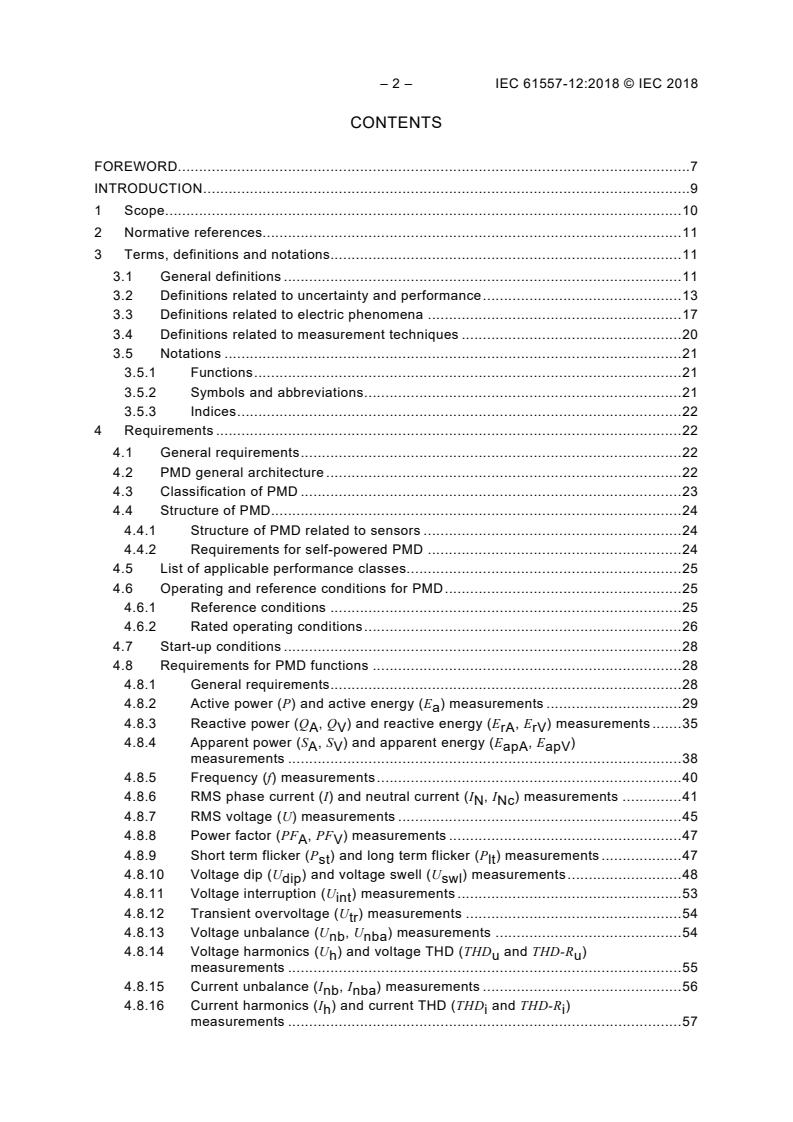
– 2 – IEC 61557-12:2018 © IEC 2018
CONTENTS
FOREWORD . 7
INTRODUCTION . 9
1 Scope . 10
2 Normative references. 11
3 Terms, definitions and notations. 11
3.1 General definitions . 11
3.2 Definitions related to uncertainty and performance . 13
3.3 Definitions related to electric phenomena . 17
3.4 Definitions related to measurement techniques . 20
3.5 Notations . 21
3.5.1 Functions . 21
3.5.2 Symbols and abbreviations . 21
3.5.3 Indices . 22
4 Requirements . 22
4.1 General requirements . 22
4.2 PMD general architecture . 22
4.3 Classification of PMD . 23
4.4 Structure of PMD. 24
4.4.1 Structure of PMD related to sensors . 24
4.4.2 Requirements for self-powered PMD . 24
4.5 List of applicable performance classes . 25
4.6 Operating and reference conditions for PMD . 25
4.6.1 Reference conditions . 25
4.6.2 Rated operating conditions . 26
4.7 Start-up conditions . 28
4.8 Requirements for PMD functions . 28
4.8.1 General requirements . 28
4.8.2 Active power (P) and active energy (E ) measurements . 29
a
4.8.3 Reactive power (Q , Q ) and reactive energy (E , E ) measurements . 35
A V rA rV
4.8.4 Apparent power (S , S ) and apparent energy (E , E )
A V apA apV
measurements . 38
4.8.5 Frequency (f) measurements . 40
4.8.6 RMS phase current (I) and neutral current (I , I ) measurements . 41
N Nc
4.8.7 RMS voltage (U) measurements . 45
4.8.8 Power factor (PF , PF ) measurements . 47
A V
4.8.9 Short term flicker (P ) and long term flicker (P ) measurements . 47
st lt
4.8.10 Voltage dip (U ) and voltage swell (U ) measurements . 48
dip swl
4.8.11 Voltage interruption (U ) measurements . 53
int
4.8.12 Transient overvoltage (U ) measurements . 54
tr
4.8.13 Voltage unbalance (U , U ) measurements . 54
nb nba
4.8.14 Voltage harmonics (U ) and voltage THD (THD and THD-R )
h u u
measurements . 55
4.8.15 Current unbalance (I , I ) measurements . 56
nb nba
4.8.16 Current harmonics (I ) and current THD (THD and THD-R )
h i i
measurements . 57
4.8.17 Minimum, maximum, peak, three-phases average and demand
measurements . 58
4.9 General mechanical requirements . 58
4.9.1 Vibration requirements . 58
4.9.2 IP requirements . 58
4.10 Safety requirements . 59
4.10.1 Protection against electrical hazards . 59
4.10.2 Protection against mechanical hazards . 60
4.10.3 Protection against other hazards . 60
4.11 EMC requirements . 60
4.11.1 Immunity . 60
4.11.2 Emission . 60
4.12 Inputs and/or outputs . 60
4.12.1 General . 60
4.12.2 Analog outputs . 60
4.12.3 Pulse outputs . 61
4.12.4 Control outputs . 61
4.12.5 Analog inputs . 61
4.12.6 Pulse and control inputs . 61
5 Marking and operating instructions . 61
5.1 General . 61
5.2 Marking . 61
5.3 Operating, installation and maintenance instructions . 62
5.3.1 General . 62
5.3.2 General characteristics . 62
5.3.3 Essential characteristics . 62
6 Tests . 64
6.1 General . 64
6.2 Type tests of PMD . 65
6.2.1 General . 65
6.2.2 Tests of intrinsic uncertainty . 65
6.2.3 Tests of variation of uncertainty with influence quantities . 65
6.2.4 Test of temperature influence . 65
6.2.5 Active power . 66
6.2.6 Apparent power . 68
6.2.7 Power factor . 69
6.2.8 Common mode voltage rejection test . 69
6.2.9 Frequency. 69
6.2.10 Measurement of voltage harmonics and THD . 70
u
6.2.11 Measurement of current harmonics and THD . 70
i
6.2.12 Dips and swells . 71
6.2.13 Voltage interruptions . 71
6.2.14 Outputs tests . 71
6.2.15 Climatic tests . 72
6.2.16 EMC tests . 73
6.2.17 Start-up tests . 73
6.2.18 Gapless measurement test . 73
6.2.19 Safety tests . 73
6.3 Routine tests . 73
– 4 – IEC 61557-12:2018 © IEC 2018
6.3.1 Protective bonding test . 73
6.3.2 Dielectric strength test . 74
6.3.3 Uncertainty test . 74
Annex A (informative) Metering, measuring and monitoring applications . 75
A.1 Applications on demand side and supply side . 75
A.2 Link between applications, devices and standards . 75
Annex B (informative) Definitions of electrical parameters . 77
B.1 General . 77
B.2 Definitions in the presence of a neutral . 77
B.3 Power measurement in three-phase three-wire systems using the two-
wattmeter method . 81
B.3.1 General . 81
B.3.2 Total active power . 82
B.3.3 Total vector reactive power using quadrature phase shift definition . 82
B.3.4 Total vector reactive power using Budeanu’s definition . 83
B.4 Additional relationships in case of sinusoidal voltage . 83
Annex C (informative) Convention about the sign of the power factor . 84
C.1 General . 84
C.2 Convention for power factor (consumer perspective) . 84
C.3 Convention for power factor (producer reference frame) . 85
Annex D (normative) Definitions of minimum, maximum, peak and demand values . 87
D.1 Demand quantities . 87
D.1.1 General . 87
D.1.2 Power demand . 87
D.1.3 Current demand . 87
D.1.4 Thermal current demand (or bi-metal current demand) . 87
D.1.5 Specified intervals for demand calculation . 87
D.2 Peak demand quantities . 88
D.3 Three-phase average quantities . 88
D.4 Maximum and minimum quantities . 88
Annex E (informative) Intrinsic uncertainty and operating uncertainty . 89
E.1 General . 89
E.2 Operating uncertainty calculation . 89
Annex F (informative) Recommended sensor classes for the different kinds of PMD . 91
F.1 General considerations . 91
F.2 Specific case of an active power and energy measurement, achieved by a
PMD associated with an external current sensor or/and a voltage sensor . 91
F.3 List of functions affected by uncertainty of external sensors . 91
Annex G (informative) Notion of measurement uncertainty . 93
G.1 General considerations . 93
G.2 Computing the expanded uncertainty . 93
G.2.1 General . 93
G.2.2 Estimated standard deviation . 93
G.2.3 Expanded uncertainty . 94
G.3 Determining the measurement uncertainty . 95
G.3.1 Systematic error . 95
G.3.2 Measurement uncertainty . 95
G.4 Using the measurement uncertainty as a pass/fail criterion . 96
G.4.1 Intrinsic uncertainty tests . 96
G.4.2 Tests with influence quantities . 96
G.4.3 Overall pass/fail criterion . 96
Bibliography . 98
Figure 1 – PMD generic measurement chain . 23
Figure 2 – Description of different types of PMD . 24
Figure 3 – Relationship between ambient air temperature and relative humidity . 28
Figure 4 – Waveform for odd harmonics influence test on active power measurement . 66
Figure 5 – Spectral content for odd harmonics influence test on active power
measurement . 67
Figure 6 – Waveform for sub-harmonics influence test on active power measurement . 68
Figure 7 – Spectral content for sub-harmonics influence test on active power
measurement . 68
Figure 8 – Common mode voltage influence testing . 69
Figure 9 – Waveform for harmonics influence test on frequency measurement . 70
Figure A.1 – Simplified overview of measurement applications on supply side and
demand side . 75
Figure B.1 – Arithmetic and vector apparent powers in sinusoidal situation . 81
Figure B.2 – Three-phase circuit without neutral . 82
Figure C.1 – Formatting of power factor with a consumer perspective . 84
Figure C.2 – Convention for power factor with a producer perspective . 85
Figure D.1 – Thermal current demand . 87
Figure D.2 – Fixed block interval . 88
Figure D.3 – Sliding block interval . 88
Figure E.1 – Different kinds of uncertainties . 89
Figure E.2 – Flowchart for the determination of the operating uncertainty . 90
Figure G.1 – Illustration of the notion of measurement uncertainty . 95
Figure G.2 – Overview of the uncertainty test procedure . 97
Table 1 – Functional classification of PMD with minimal required functions . 23
Table 2 – Structure of PMD . 24
Table 3 – List of applicable performance classes . 25
Table 4 – Reference conditions for testing . 26
Table 5 – Rated operating temperatures for portable equipment . 26
Table 6 – Rated operating temperatures for fixed installed equipment . 27
Table 7 – Humidity and altitude operating conditions . 27
Table 8 – Intrinsic uncertainty table for active power and active energy measurement . 30
Table 9 – Influence quantities for active power and active energy measurement (1 of 3) . 31
Table 10 – Minimum test period . 34
Table 11 – Starting current for active power and active energy measurement . 35
Table 12 – Intrinsic uncertainty table for reactive power and reactive energy
measurement . 35
Table 13 – Influence quantities for reactive power and reactive energy measurement . 36
Table 14 – Minimum test period . 37
– 6 – IEC 61557-12:2018 © IEC 2018
Table 15 – Starting current for reactive energy measurement . 38
Table 16 – Intrinsic uncertainty table for apparent power and apparent energy
measurement . 38
Table 17 – Influence quantities for apparent power and apparent energy measurement . 39
Table 18 – Intrinsic uncertainty table for frequency measurement . 40
Table 19 – Influence quantities for frequency measurement . 41
Table 20 – Rated range of operation for phase current measurement . 41
Table 21 – Rated range of operation for neutral current (calculated or measured) . 42
Table 22 – Intrinsic uncertainty table for phase current . 42
Table 23 – Intrinsic uncertainty table for neutral current measurement . 42
Table 24 – Intrinsic uncertainty table for neutral current calculation . 43
Table 25 – Influence quantities for phase current and neutral current measurement . 44
Table 26 – Rated range of operation for RMS voltage measurement . 45
Table 27 – Intrinsic uncertainty table for RMS voltage measurement . 45
Table 28 – Influence quantities for RMS voltage measurement . 46
Table 29 – Intrinsic uncertainty table for power factor measurement . 47
Table 30 – Intrinsic uncertainty table for flicker measurement . 48
Table 31 – Rated range of operation for voltage dips and swells measurement . 50
Table 32 – Intrinsic uncertainty table for voltage dips and swells measurement . 51
Table 33 – Influence quantities for dips and swells measurement . 52
Table 34 – Intrinsic uncertainty table for voltage interruption measurement . 54
Table 35 – Intrinsic uncertainty table for transient overvoltage measurement . 54
Table 36 – Intrinsic uncertainty table for voltage unbalance measurement . 55
Table 37 – Rated range of operation for voltage harmonics measurement . 55
Table 38 – Intrinsic uncertainty table for voltage harmonics measurement . 55
Table 39 – Intrinsic uncertainty table for voltage THD or THD-R measurement . 56
u u
Table 40 – Intrinsic uncertainty table for current unbalance measurement . 56
Table 41 – Rated range of operation for current harmonics measurement . 57
Table 42 – Intrinsic uncertainty table for current harmonics measurement . 57
Table 43 – Intrinsic uncertainty table for current THD and THD-R measurement . 57
i i
Table 44 – Minimum IP requirements for PMD . 58
Table 45 – PMD specification form . 63
Table 46 – Characteristics specification template . 64
Table A.1 – Main measurement applications . 76
Table B.1 – Definition of symbols . 77
Table B.2 – Calculation definitions for electrical parameters . 78
Table C.1 – Conventions for the sign of Power factor with a Consumer perspective . 85
Table C.2 – Conventions for the sign of power factor with a producer perspective . 86
Table F.1 – PMD SD associated with current sensor or PMD DS associated with
voltage sensor or PMD SS associated with voltage and current sensors . 91
Table F.2 – List of functions affected by uncertainty of external sensors . 92
Table G.1 – Correction factor C(N) for sample size N . 94
INTERNATIONAL ELECTROTECHNICAL COMMISSION
____________
ELECTRICAL SAFETY IN LOW VOLTAGE DISTRIBUTION
SYSTEMS UP TO 1 000 V AC AND 1 500 V DC. –
EQUIPMENT FOR TESTING, MEASURING OR
MONITORING OF PROTECTIVE MEASURES –
Part 12: Power metering and monitoring devices (PMD)
FOREWORD
1) The International Electrotechnical Commission (IEC) is a worldwide organization for standardization comprising
all national electrotechnical committees (IEC National Committees). The object of IEC is to promote
international co-operation on all questions concerning standardization in the electrical and electronic fields. To
this end and in addition to other activities, IEC publishes International Standards, Technical Specifications,
Technical Reports, Publicly Available Specifications (PAS) and Guides (hereafter referred to as “IEC
Publication(s)”). Their preparation is entrusted to technical committees; any IEC National Committee interested
in the subject dealt with may participate in this preparatory work. International, governmental and non-
governmental organizations liaising with the IEC also participate in this preparation. IEC collaborates closely
with the International Organization for Standardization (ISO) in accordance with conditions determined by
agreement between the two organizations.
2) The formal decisions or agreements of IEC on technical matters express, as nearly as possible, an international
consensus of opinion on the relevant subjects since each technical committee has representation from all
interested IEC National Committees.
3) IEC Publications have the form of recommendations for international use and are accepted by IEC National
Committees in that sense. While all reasonable efforts are made to ensure that the technical content of IEC
Publications is accurate, IEC cannot be held responsible for the way in which they are used or for any
misinterpretation by any end user.
4) In order to promote international uniformity, IEC National Committees undertake to apply IEC Publications
transparently to the maximum extent possible in their national and regional publications. Any divergence
between any IEC Publication and the corresponding national or regional publication shall be clearly indicated in
the latter.
5) IEC itself does not provide any attestation of conformity. Independent certification bodies provide conformity
assessment services and, in some areas, access to IEC marks of conformity. IEC is not responsible for any
services carried out by independent certification bodies.
6) All users should ensure that they have the latest edition of this publication.
7) No liability shall attach to IEC or its directors, employees, servants or agents including individual experts and
members of its technical committees and IEC National Committees for any personal injury, property damage or
other damage of any nature whatsoever, whether direct or indirect, or for costs (including legal fees) and
expenses arising out of the publication, use of, or reliance upon, this IEC Publication or any other IEC
Publications.
8) Attention is drawn to the Normative references cited in this publication. Use of the referenced publications is
indispensable for the correct application of this publication.
9) Attention is drawn to the possibility that some of the elements of this IEC Publication may be the subject of
patent rights. IEC shall not be held responsible for identifying any or all such patent rights.
International Standard IEC 61557-12 has been prepared by IEC technical committee 85:
Measuring equipment for electrical and electromagnetic quantities.
This second edition cancels and replaces the first edition published in 2007. This edition
constitutes a technical revision.
This edition includes the following significant technical changes with respect to the previous
edition:
a) PMD-A has been withdrawn due the fact these devices are now mainly covered by the IEC
62586 series of standards.
b) Three categories of PMD have been created with a list of minimum required functions for
each category.
– 8 – IEC 61557-12:2018 © IEC 2018
c) Added a new Annex A explaining the different applications linked to the relevant standards
and devices, and another new Annex C about the power factor conventions.
The text of this International Standard is based on the following documents:
FDIS Report on voting
85/644/FDIS 85/649/RVD
Full information on the voting for the approval of this International Standard can be found in
the report on voting indicated in the above table.
This document has been drafted in accordance with the ISO/IEC Directives, Part 2.
A list of all parts in the IEC 61557 series, published under the general title Electrical safety in
low voltage distribution systems up to 1 000 V AC and 1 500 V DC – Equipment for testing,
measuring or monitoring of protective measures, can be found on the IEC website.
The committee has decided that the contents of this document will remain unchanged until the
stability date indicated on the IEC website under "http://webstore.iec.ch" in the data related to
the specific document. At this date, the document will be
• reconfirmed,
• withdrawn,
• replaced by a revised edition, or
• amended.
IMPORTANT – The 'colour inside' logo on the cover page of this publication indicates
that it contains colours which are considered to be useful for the correct
understanding of its contents. Users should therefore print this document using a
colour printer.
INTRODUCTION
Energy distribution systems need to guarantee energy efficiency, availability and network
performances in order to address the following challenges:
– sustainable development requirements where energy measurement, for instance, is
recognised as an essential element of energy management, part of the overall drive to
reduce carbon emissions and to improve the commercial efficiency of manufacturing,
commercial organizations and public services;
– technological evolutions (electronic loads, electronic measuring methods, etc.);
– end-users needs (cost saving, compliance with aspects of building regulations, etc.)
regarding electrical energy management as well as other energies, or fluids. Other
functionalities involving several non electrical parameters are often needed in parallel;
– safety and continuity of service;
– evolution of installation standards, for instance over-current detection is now a new
requirement for the neutral conductor due to harmonic content.
Monitoring electrical quantities in internal networks allows to address these challenges.
The devices on the current market have different characteristics, which need a common
system of references. Therefore there is a need for this document in order to facilitate the
choices of the end-users in terms of performance, safety, interpretation of the indications, etc.
This document provides a basis by which such devices can be specified and described, and
their performance evaluated.
In order to fulfil the requirements of the energy efficiency project, many PMD measuring
electrical parameters can also collect data (water, air, gas, temperature…) coming from other
sensors or meters inside building or plant areas. In order to be able to transmit all these data
to a supervision software it will be relevant to equip the PMD with a communication bus. The
supervision software will then manage all the collected data in order to monitor them and
produce useful reports for energy usage and consumption analysis.
– 10 – IEC 61557-12:2018 © IEC 2018
ELECTRICAL SAFETY IN LOW VOLTAGE DISTRIBUTION
SYSTEMS UP TO 1 000 V AC AND 1 500 V DC. –
EQUIPMENT FOR TESTING, MEASURING OR
MONITORING OF PROTECTIVE MEASURES –
Part 12: Power metering and monitoring devices (PMD)
1 Scope
This part of IEC 61557 specifies requirements for power metering and monitoring devices
(PMD) that measure and monitor the electrical quantities within electrical distribution systems,
and optionally other external signals. These requirements also define the performance in
single- and three-phase AC or DC systems having rated voltages up to 1 000 V AC or up to
1 500 V DC.
These devices are fixed or portable. They are intended to be used indoors and/or outdoors.
Power metering and monitoring devices (PMD), as defined in this document, give additional
safety information, which aids the verification of the installation and enhances the
performance of the distribution systems.
The power metering and monitoring devices (PMD) for electrical parameters described in this
document are used for general industrial and commercial applications.
This document does not address functional safety and cyber security aspects.
This document is not applicable for:
– electricity metering equipment that complies with IEC 62053-21, IEC 62053-22,
IEC 62053-23 and IEC 62053-24. Nevertheless, uncertainties defined in this document for
active and reactive energy measurement are derived from those defined in IEC 62053 (all
parts);
– the measurement and monitoring of electrical parameters defined in IEC 61557-2 to
IEC 61557-9 and IEC 61557-13 or in IEC 62020;
– power quality instrument (PQI) according IEC 62586 (all parts);
– devices covered by IEC 60051 (all parts) (direct acting analogue electrical measuring
instrument).
NOTE 1 Generally such types of devices are used in the following applications or for the following general needs:
– energy management inside the installation, such as facilitating the implementation of documents such as
ISO 50001 and IEC 60364-8-1;
– monitoring and/or measurement of electrical parameters;
– measurement and/or monitoring of the quality of energy inside commercial/industrial installations.
NOTE 2 A measuring and monitoring device of electrical parameters usually consists of several functional
modules. All or some of the functional modules are combined in one device. Examples of functional modules are:
– measurement and monitoring of several electrical parameters simultaneously;
– energy measurement and/or monitoring, as well as sometimes compliance with aspects of building regulations;
– alarms functions;
– demand side quality (current and voltage harmonics, over/under voltages, voltage dips and swells, etc.).
NOTE 3 PMD are historically called power meter, power monitor, power monitor device, power energy monitoring
device, power analyser, multifunction meter, measuring multifunction equipment, energy meters.
NOTE 4 Metering, measuring and monitoring applications are explained in Annex A.
2 Normative references
The following documents are referred to in the text in such a way that some or all of their
content constitutes requirements of this document. For dated references, only the edition
cited applies. For undated references, the latest edition of the referenced document (including
any amendments) applies.
IEC 60068-2-1, Environmental testing – Part 2-1: Tests – Test A: Cold
IEC 60068-2-2, Environmental testing – Part 2: Tests – Tests B: Dry heat
IEC 60068-2-30, Environmental testing – Part 2-30 – Tests – Test Db: Damp heat, cyclic
(12 h + 12 h cycle)
IEC 60529, Degrees of protection provided by enclosures (IP Code)
IEC 61000-4-30:2015, Electromagnetic compatibility (EMC) – Part 4-30: Testing and
measurement techniques – Power quality measurem
...
IEC 61557-12 ®
Edition 2.1 2021-05
CONSOLIDATED VERSION
INTERNATIONAL
STANDARD
NORME
INTERNATIONALE
colour
inside
Electrical safety in low voltage distribution systems up to 1 000 V AC and
1 500 V DC – Equipment for testing, measuring or monitoring of protective
measures –
Part 12: Power metering and monitoring devices (PMD)
Sécurité électrique dans les réseaux de distribution basse tension jusqu’à
1 000 V en courant alternatif et 1 500 V en courant continu – Dispositifs de
contrôle, de mesure ou de surveillance de mesures de protection –
Partie 12: Dispositifs de comptage et de surveillance du réseau électrique (PMD)
All rights reserved. Unless otherwise specified, no part of this publication may be reproduced or utilized in any form
or by any means, electronic or mechanical, including photocopying and microfilm, without permission in writing from
either IEC or IEC's member National Committee in the country of the requester. If you have any questions about IEC
copyright or have an enquiry about obtaining additional rights to this publication, please contact the address below or
your local IEC member National Committee for further information.
Droits de reproduction réservés. Sauf indication contraire, aucune partie de cette publication ne peut être reproduite
ni utilisée sous quelque forme que ce soit et par aucun procédé, électronique ou mécanique, y compris la photocopie
et les microfilms, sans l'accord écrit de l'IEC ou du Comité national de l'IEC du pays du demandeur. Si vous avez des
questions sur le copyright de l'IEC ou si vous désirez obtenir des droits supplémentaires sur cette publication, utilisez
les coordonnées ci-après ou contactez le Comité national de l'IEC de votre pays de résidence.
IEC Central Office Tel.: +41 22 919 02 11
3, rue de Varembé info@iec.ch
CH-1211 Geneva 20 www.iec.ch
Switzerland
About the IEC
The International Electrotechnical Commission (IEC) is the leading global organization that prepares and publishes
International Standards for all electrical, electronic and related technologies.
About IEC publications
The technical content of IEC publications is kept under constant review by the IEC. Please make sure that you have the
latest edition, a corrigendum or an amendment might have been published.
IEC publications search - webstore.iec.ch/advsearchform IEC online collection - oc.iec.ch
The advanced search enables to find IEC publications by a Discover our powerful search engine and read freely all the
variety of criteria (reference number, text, technical publications previews. With a subscription you will always
committee, …). It also gives information on projects, replaced have access to up to date content tailored to your needs.
and withdrawn publications.
Electropedia - www.electropedia.org
IEC Just Published - webstore.iec.ch/justpublished
The world's leading online dictionary on electrotechnology,
Stay up to date on all new IEC publications. Just Published
containing more than 22 000 terminological entries in English
details all new publications released. Available online and
and French, with equivalent terms in 18 additional languages.
once a month by email.
Also known as the International Electrotechnical Vocabulary
(IEV) online.
IEC Customer Service Centre - webstore.iec.ch/csc
If you wish to give us your feedback on this publication or
need further assistance, please contact the Customer Service
Centre: sales@iec.ch.
A propos de l'IEC
La Commission Electrotechnique Internationale (IEC) est la première organisation mondiale qui élabore et publie des
Normes internationales pour tout ce qui a trait à l'électricité, à l'électronique et aux technologies apparentées.
A propos des publications IEC
Le contenu technique des publications IEC est constamment revu. Veuillez vous assurer que vous possédez l’édition la
plus récente, un corrigendum ou amendement peut avoir été publié.
Recherche de publications IEC - IEC online collection - oc.iec.ch
webstore.iec.ch/advsearchform Découvrez notre puissant moteur de recherche et consultez
La recherche avancée permet de trouver des publications IEC gratuitement tous les aperçus des publications. Avec un
en utilisant différents critères (numéro de référence, texte, abonnement, vous aurez toujours accès à un contenu à jour
comité d’études, …). Elle donne aussi des informations sur adapté à vos besoins.
les projets et les publications remplacées ou retirées.
Electropedia - www.electropedia.org
IEC Just Published - webstore.iec.ch/justpublished
Le premier dictionnaire d'électrotechnologie en ligne au
Restez informé sur les nouvelles publications IEC. Just
monde, avec plus de 22 000 articles terminologiques en
Published détaille les nouvelles publications parues.
anglais et en français, ainsi que les termes équivalents dans
Disponible en ligne et une fois par mois par email.
16 langues additionnelles. Egalement appelé Vocabulaire
Electrotechnique International (IEV) en ligne.
Service Clients - webstore.iec.ch/csc
Si vous désirez nous donner des commentaires sur cette
publication ou si vous avez des questions contactez-nous:
sales@iec.ch.
IEC 61557-12 ®
Edition 2.1 2021-05
CONSOLIDATED VERSION
INTERNATIONAL
STANDARD
NORME
INTERNATIONALE
colour
inside
Electrical safety in low voltage distribution systems up to 1 000 V AC and
1 500 V DC – Equipment for testing, measuring or monitoring of protective
measures –
Part 12: Power metering and monitoring devices (PMD)
Sécurité électrique dans les réseaux de distribution basse tension jusqu’à
1 000 V en courant alternatif et 1 500 V en courant continu – Dispositifs de
contrôle, de mesure ou de surveillance de mesures de protection –
Partie 12: Dispositifs de comptage et de surveillance du réseau électrique (PMD)
INTERNATIONAL
ELECTROTECHNICAL
COMMISSION
COMMISSION
ELECTROTECHNIQUE
INTERNATIONALE
ICS 17.220.20; 29.080.01; 29.240.01 ISBN 978-2-8322-9845-9
IEC 61557-12 ®
Edition 2.1 2021-05
CONSOLIDATED VERSION
REDLINE VERSION
VERSION REDLINE
colour
inside
Electrical safety in low voltage distribution systems up to 1 000 V AC and
1 500 V DC – Equipment for testing, measuring or monitoring of protective
measures –
Part 12: Power metering and monitoring devices (PMD)
Sécurité électrique dans les réseaux de distribution basse tension jusqu’à
1 000 V en courant alternatif et 1 500 V en courant continu – Dispositifs de
contrôle, de mesure ou de surveillance de mesures de protection –
Partie 12: Dispositifs de comptage et de surveillance du réseau électrique (PMD)
– 2 – IEC 61557-12:2018+AMD1:2021 CSV
© IEC 2021
CONTENTS
FOREWORD . 9
INTRODUCTION . 11
1 Scope . 12
2 Normative references . 13
3 Terms, definitions and notations . 13
3.1 General definitions . 14
3.2 Definitions related to uncertainty and performance . 16
3.3 Definitions related to electric phenomena . 19
3.4 Definitions related to measurement techniques . 22
3.5 Notations . 23
3.5.1 Functions . 23
3.5.2 Symbols and abbreviations . 23
3.5.3 Indices . 24
4 Requirements . 24
4.1 General requirements . 24
4.2 PMD general architecture . 24
4.3 Classification of PMD . 25
4.4 Structure of PMD . 26
4.4.1 Structure of PMD related to sensors . 26
4.4.2 Requirements for self-powered PMD . 26
4.5 List of applicable performance classes . 27
4.6 Operating and reference conditions for PMD . 27
4.6.1 Reference conditions . 27
4.6.2 Rated operating conditions . 28
4.7 Start-up conditions . 30
4.8 Requirements for PMD functions . 30
4.8.1 General requirements . 30
4.8.2 Active power (P) and active energy (E ) measurements . 31
a
4.8.3 Reactive power (Q , Q ) and reactive energy (E , E ) measurements . 37
A V rA rV
4.8.4 Apparent power (S , S ) and apparent energy (E , E )
A V apA apV
measurements . 40
4.8.5 Frequency (f) measurements . 42
4.8.6 RMS phase current (I) and neutral current (I , I ) measurements . 43
N Nc
4.8.7 RMS voltage (U) measurements . 47
4.8.8 Power factor (PF , PF ) measurements . 49
A V
4.8.9 Short term flicker (P ) and long term flicker (P ) measurements . 49
st lt
4.8.10 Voltage dip (U ) and voltage swell (U ) measurements . 50
dip swl
4.8.11 Voltage interruption (U ) measurements . 55
int
4.8.12 Transient overvoltage (U ) measurements . 56
tr
4.8.13 Voltage unbalance (U , U ) measurements . 56
nb nba
4.8.14 Voltage harmonics (U ) and voltage THD (THD and THD-R )
h u u
measurements . 57
4.8.15 Current unbalance (I , I ) measurements . 58
nb nba
4.8.16 Current harmonics (I ) and current THD (THD and THD-R )
h i i
measurements . 59
© IEC 2021
4.8.17 Minimum, maximum, peak, three-phases average and demand
measurements . 60
4.9 General mechanical requirements . 60
4.9.1 Vibration requirements . 60
4.9.2 IP requirements . 60
4.10 Safety requirements . 61
4.10.1 Protection against electrical hazards . 61
4.10.2 Protection against mechanical hazards . 62
4.10.3 Protection against other hazards . 62
4.11 EMC requirements . 62
4.11.1 Immunity . 62
4.11.2 Emission . 62
4.12 Inputs and/or outputs . 62
4.12.1 General . 62
4.12.2 Analog outputs . 62
4.12.3 Pulse outputs . 63
4.12.4 Control outputs . 63
4.12.5 Analog inputs . 63
4.12.6 Pulse and control inputs . 63
5 Marking and operating instructions . 63
5.1 General . 63
5.2 Marking . 63
5.3 Operating, installation and maintenance instructions . 64
5.3.1 General . 64
5.3.2 General characteristics . 64
5.3.3 Essential characteristics . 64
6 Tests . 66
6.1 General . 66
6.2 Type tests of PMD . 67
6.2.1 General . 67
6.2.2 Tests of intrinsic uncertainty . 67
6.2.3 Tests of variation of uncertainty with influence quantities . 67
6.2.4 Test of temperature influence . 67
6.2.5 Active power . 68
6.2.6 Apparent power . 70
6.2.7 Power factor . 71
6.2.8 Common mode voltage rejection test . 71
6.2.9 Frequency . 71
6.2.10 Measurement of voltage harmonics and THD . 72
u
6.2.11 Measurement of current harmonics and THD . 72
i
6.2.12 Dips and swells . 73
6.2.13 Voltage interruptions . 73
6.2.14 Outputs tests . 73
6.2.15 Climatic tests . 74
6.2.16 EMC tests . 75
6.2.17 Start-up tests . 75
6.2.18 Gapless measurement test . 75
6.2.19 Safety tests . 75
6.3 Routine tests. 75
– 4 – IEC 61557-12:2018+AMD1:2021 CSV
© IEC 2021
6.3.1 Protective bonding test . 75
6.3.2 Dielectric strength test . 76
6.3.3 Uncertainty test . 76
Annex A (informative) Metering, measuring and monitoring applications . 77
A.1 Applications on demand side and supply side . 77
A.2 Link between applications, devices and standards . 77
Annex B (informative) Definitions of electrical parameters . 79
B.1 General . 79
B.2 Definitions in the presence of a neutral . 79
B.3 Power measurement in three-phase three-wire systems using the two-
wattmeter method . 83
B.3.1 General . 83
B.3.2 Total active power . 84
B.3.3 Total vector reactive power using quadrature phase shift definition . 84
B.3.4 Total vector reactive power using Budeanu’s definition . 85
B.4 Additional relationships in case of sinusoidal voltage . 85
Annex C (informative) Convention about the sign of the power factor . 86
C.1 General . 86
C.2 Convention for power factor (consumer perspective) . 86
C.3 Convention for power factor (producer reference frame) . 87
Annex D (normative) Definitions of minimum, maximum, peak and demand values . 89
D.1 Demand quantities . 89
D.1.1 General . 89
D.1.2 Power demand. 89
D.1.3 Current demand . 89
D.1.4 Thermal current demand (or bi-metal current demand). 89
D.1.5 Specified intervals for demand calculation . 89
D.2 Peak demand quantities . 90
D.3 Three-phase average quantities . 90
D.4 Maximum and minimum quantities . 90
Annex E (informative) Intrinsic uncertainty and operating uncertainty . 91
E.1 General . 91
E.2 Operating uncertainty calculation . 91
Annex F (informative) Recommended sensor classes for the different kinds of PMD . 93
F.1 General considerations . 93
F.2 Specific case of an active power and energy measurement, achieved by a
PMD associated with an external current sensor or/and a voltage sensor . 93
F.3 List of functions affected by uncertainty of external sensors . 93
Annex G (informative) Notion of measurement uncertainty . 95
G.1 General considerations . 95
G.2 Computing the expanded uncertainty . 95
G.2.1 General . 95
G.2.2 Estimated standard deviation . 95
G.2.3 Expanded uncertainty . 96
G.3 Determining the measurement uncertainty . 97
G.3.1 Systematic error . 97
G.3.2 Measurement uncertainty. 97
G.4 Using the measurement uncertainty as a pass/fail criterion . 98
© IEC 2021
G.4.1 Intrinsic uncertainty tests . 98
G.4.2 Tests with influence quantities . 98
G.4.3 Overall pass/fail criterion . 98
Annex H (normative) Requirements for power metering and monitoring function (PMF)
and additional requirements for equipment embedding power metering and monitoring
function (EPMF) . 100
H.1 Scope . 100
H.2 Normative references . 100
H.3 Terms, definitions and notations . 101
H.4 Requirements for PMF and additional requirements for EPMF . 101
H.4.1 General requirements . 101
H.4.2 EPMF general architecture . 102
H.4.3 Classification of PMF . 102
H.4.4 Structure of EPMF . 103
H.4.5 List of applicable performance classes for PMF . 103
H.4.6 Operating and reference conditions . 103
H.4.7 Start-up conditions for EPMF . 104
H.4.8 Requirements for PMF . 104
H.4.9 General mechanical requirements . 104
H.4.10 Safety requirements. 104
H.4.11 EMC requirements . 104
H.4.12 Inputs and/or outputs . 104
H.5 Marking and operating instructions . 105
H.5.1 General . 105
H.5.2 Marking . 105
H.5.3 Operating, installation and maintenance instructions . 105
H.6 Tests . 106
H.6.1 General . 106
H.6.2 Type tests of EPMF . 106
H.6.3 Routine tests of EPMF . 108
Annex I (informative) Potential new requirements derived from IEC 62053-2x series of
standards . 109
I.1 Scope . 109
I.2 Future requirements for active power (P) and active energy (E )
a
measurements . 110
I.2.1 Future intrinsic uncertainty tables . 110
I.2.2 Future limits of variations due to influence quantities . 111
I.3 Future requirements for reactive power (Q) and reactive energy (E )
r
measurements . 116
I.3.1 Future intrinsic uncertainty tables . 116
I.3.2 Limits of variation in percentage error due to influence quantities . 116
Bibliography . 119
Figure 1 – PMD generic measurement chain . 25
Figure 2 – Description of different types of PMD . 26
Figure 3 – Relationship between ambient air temperature and relative humidity . 30
Figure 4 – Waveform for odd harmonics influence test on active power measurement . 68
Figure 5 – Spectral content for odd harmonics influence test on active power
measurement . 69
– 6 – IEC 61557-12:2018+AMD1:2021 CSV
© IEC 2021
Figure 6 – Waveform for sub-harmonics influence test on active power measurement. 70
Figure 7 – Spectral content for sub-harmonics influence test on active power
measurement . 70
Figure 8 – Common mode voltage influence testing . 71
Figure 9 – Waveform for harmonics influence test on frequency measurement . 72
Figure A.1 – Simplified overview of measurement applications on supply side and
demand side . 77
Figure B.1 – Arithmetic and vector apparent powers in sinusoidal situation . 83
Figure B.2 – Three-phase circuit without neutral . 84
Figure C.1 – Formatting of power factor with a consumer perspective . 86
Figure C.2 – Convention for power factor with a producer perspective . 87
Figure D.1 – Thermal current demand . 89
Figure D.2 – Fixed block interval . 90
Figure D.3 – Sliding block interval . 90
Figure E.1 – Different kinds of uncertainties . 91
Figure E.2 – Flowchart for the determination of the operating uncertainty . 92
Figure G.1 – Illustration of the notion of measurement uncertainty . 97
Figure G.2 – Overview of the uncertainty test procedure . 99
Figure H.1 – Example of architecture of EPMF . 102
Table 1 – Functional classification of PMD with minimal required functions . 25
Table 2 – Structure of PMD . 26
Table 3 – List of applicable performance classes . 27
Table 4 – Reference conditions for testing . 28
Table 5 – Rated operating temperatures for portable equipment . 28
Table 6 – Rated operating temperatures for fixed installed equipment . 29
Table 7 – Humidity and altitude operating conditions . 29
Table 8 – Intrinsic uncertainty table for active power and active energy measurement . 32
Table 9 – Influence quantities for active power and active energy measurement (1 of 3) . 33
Table 10 – Minimum test period . 36
Table 11 – Starting current for active power and active energy measurement . 37
Table 12 – Intrinsic uncertainty table for reactive power and reactive energy
measurement . 37
Table 13 – Influence quantities for reactive power and reactive energy measurement . 38
Table 14 – Minimum test period . 39
Table 15 – Starting current for reactive energy measurement . 40
Table 16 – Intrinsic uncertainty table for apparent power and apparent energy
measurement . 40
Table 17 – Influence quantities for apparent power and apparent energy measurement . 41
Table 18 – Intrinsic uncertainty table for frequency measurement . 42
Table 19 – Influence quantities for frequency measurement . 43
Table 20 – Rated range of operation for phase current measurement . 43
Table 21 – Rated range of operation for neutral current (calculated or measured) . 44
Table 22 – Intrinsic uncertainty table for phase current . 44
© IEC 2021
Table 23 – Intrinsic uncertainty table for neutral current measurement . 44
Table 24 – Intrinsic uncertainty table for neutral current calculation . 45
Table 25 – Influence quantities for phase current and neutral current measurement . 46
Table 26 – Rated range of operation for RMS voltage measurement . 47
Table 27 – Intrinsic uncertainty table for RMS voltage measurement. 47
Table 28 – Influence quantities for RMS voltage measurement . 48
Table 29 – Intrinsic uncertainty table for power factor measurement . 49
Table 30 – Intrinsic uncertainty table for flicker measurement . 50
Table 31 – Rated range of operation for voltage dips and swells measurement . 52
Table 32 – Intrinsic uncertainty table for voltage dips and swells measurement . 53
Table 33 – Influence quantities for dips and swells measurement . 54
Table 34 – Intrinsic uncertainty table for voltage interruption measurement . 56
Table 35 – Intrinsic uncertainty table for transient overvoltage measurement . 56
Table 36 – Intrinsic uncertainty table for voltage unbalance measurement . 57
Table 37 – Rated range of operation for voltage harmonics measurement . 57
Table 38 – Intrinsic uncertainty table for voltage harmonics measurement . 57
Table 39 – Intrinsic uncertainty table for voltage THD or THD-R measurement . 58
u u
Table 40 – Intrinsic uncertainty table for current unbalance measurement . 58
Table 41 – Rated range of operation for current harmonics measurement . 59
Table 42 – Intrinsic uncertainty table for current harmonics measurement . 59
Table 43 – Intrinsic uncertainty table for current THD and THD-R measurement . 59
i i
Table 44 – Minimum IP requirements for PMD . 60
Table 45 – PMD specification form . 65
Table 46 – Characteristics specification template . 66
Table A.1 – Main measurement applications . 78
Table B.1 – Definition of symbols . 79
Table B.2 – Calculation definitions for electrical parameters . 80
Table C.1 – Conventions for the sign of Power factor with a Consumer perspective . 87
Table C.2 – Conventions for the sign of power factor with a producer perspective . 88
Table F.1 – PMD SD associated with current sensor or PMD DS associated with
voltage sensor or PMD SS associated with voltage and current sensors . 93
Table F.2 – List of functions affected by uncertainty of external sensors . 94
Table G.1 – Correction factor C(N) for sample size N . 96
Table H.1 – List of equipment that may embed EPMF . 101
Table H.2 – Functional classification of PMF with minimal required functions . 102
Table H.3 – Structure of EPMF . 103
Table H.4 – Value of current according to the type of EPMF . 104
Table H.5 – EPMF specification form . 105
Table I.1 – Future intrinsic uncertainty table for active power and active energy
measurement for classes > 0,5 . 110
Table I.2 – Future intrinsic uncertainty table for active power and active energy
measurement for classes ≤ 0,5 . 110
Table I.3 – Limits of variation in percentage error due to influence quantities for
classes > 0,5 . 111
– 8 – IEC 61557-12:2018+AMD1:2021 CSV
© IEC 2021
Table I.4 – Limits of variation in percentage error due to influence quantities for
classes ≤ 0,5 . 113
Table I.5 – Future intrinsic uncertainty table for reactive power and reactive energy
measurement . 116
Table I.6 – Limits of variation in percentage error due to influence quantities . 116
© IEC 2021
INTERNATIONAL ELECTROTECHNICAL COMMISSION
____________
ELECTRICAL SAFETY IN LOW VOLTAGE DISTRIBUTION
SYSTEMS UP TO 1 000 V AC AND 1 500 V DC. –
EQUIPMENT FOR TESTING, MEASURING OR
MONITORING OF PROTECTIVE MEASURES –
Part 12: Power metering and monitoring devices (PMD)
FOREWORD
1) The International Electrotechnical Commission (IEC) is a worldwide organization for standardization comprising
all national electrotechnical committees (IEC National Committees). The object of IEC is to promote
international co-operation on all questions concerning standardization in the electrical and electronic fields. To
this end and in addition to other activities, IEC publishes International Standards, Technical Specifications,
Technical Reports, Publicly Available Specifications (PAS) and Guides (hereafter referred to as “IEC
Publication(s)”). Their preparation is entrusted to technical committees; any IEC National Committee interested
in the subject dealt with may participate in this preparatory work. International, governmental and non-
governmental organizations liaising with the IEC also participate in this preparation. IEC collaborates closely
with the International Organization for Standardization (ISO) in accordance with conditions determined by
agreement between the two organizations.
2) The formal decisions or agreements of IEC on technical matters express, as nearly as possible, an international
consensus of opinion on the relevant subjects since each technical committee has representation from all
interested IEC National Committees.
3) IEC Publications have the form of recommendations for international use and are accepted by IEC National
Committees in that sense. While all reasonable efforts are made to ensure that the technical content of IEC
Publications is accurate, IEC cannot be held responsible for the way in which they are used or for any
misinterpretation by any end user.
4) In order to promote international uniformity, IEC National Committees undertake to apply IEC Publications
transparently to the maximum extent possible in their national and regional publications. Any divergence
between any IEC Publication and the corresponding national or regional publication shall be clearly indicated in
the latter.
5) IEC itself does not provide any attestation of conformity. Independent certification bodies provide conformity
assessment services and, in some areas, access to IEC marks of conformity. IEC is not responsible for any
services carried out by independent certification bodies.
6) All users should ensure that they have the latest edition of this publication.
7) No liability shall attach to IEC or its directors, employees, servants or agents including individual experts and
members of its technical committees and IEC National Committees for any personal injury, property damage or
other damage of any nature whatsoever, whether direct or indirect, or for costs (including legal fees) and
expenses arising out of the publication, use of, or reliance upon, this IEC Publication or any other IEC
Publications.
8) Attention is drawn to the Normative references cited in this publication. Use of the referenced publications is
indispensable for the correct application of this publication.
9) Attention is drawn to the possibility that some of the elements of this IEC Publication may be the subject of
patent rights. IEC shall not be held responsible for identifying any or all such patent rights.
This consolidated version of the official IEC Standard and its amendment has been
prepared for user convenience.
IEC 61557-12 edition 2.1 contains the second edition (2018-10) [documents 85/644/FDIS and
85/649/RVD] and its corrigendum 1 (2022-09), its amendment 1 (2021-05) [documents
85/755/FDIS and 85/764/RVD] and its corrigendum 1 (2022-09). The contents of the
corrigenda only applies to the French versions.
In this Redline version, a vertical line in the margin shows where the technical content is
modified by amendment 1. Additions are in green text, deletions are in strikethrough red
text. A separate Final version with all changes accepted is available in this publication.
– 10 – IEC 61557-12:2018+AMD1:2021 CSV
© IEC 2021
International Standard IEC 61557-12 has been prepared by IEC technical committee 85:
Measuring equipment for electrical and electromagnetic quantities.
This second edition constitutes a technical revision.
This edition includes the following significant technical changes with respect to the previous
edition:
a) PMD-A has been withdrawn due the fact these devices are now mainly covered by the IEC
62586 series of standards.
b) Three categories of PMD have been created with a list of minimum required functions for
each category.
c) Added a new Annex A explaining the different applications linked to the relevant standa
...