

IEC 60793-1-45:2017
(Main)Optical fibres - Part 1-45: Measurement methods and test procedures - Mode field diameter
General Information
- Abstract
IEC 60793-1-45:2017 establishes uniform requirements for measuring the mode field diameter (MFD) of single-mode optical fibre, thereby assisting in the inspection of fibres and cables for commercial purposes. This second edition cancels and replaces the first edition published in 2001. This edition constitutes a technical revision. This edition includes the following significant technical changes with respect to the previous edition:
- improvement of the description of measurement details for B6 fibre;
- correction of Equations (1), (2), (5) and (6);
- correction of Table E.1, Table E.2 and Table E.3.
Keywords: mode field diameter (MFD)
- Status
- Published
- Publication Date
- 08-Nov-2017
- Technical Committee
- SC 86A - Fibres and cables
- Drafting Committee
- WG 1 - TC 86/SC 86A/WG 1
- Current Stage
- DELPUB - Deleted Publication
- Start Date
- 19-Apr-2024
- Completion Date
- 24-Jun-2022
Buy Documents


IEC 60793-1-45:2017 RLV - Optical fibres - Part 1-45: Measurement methods and test procedures - Mode field diameter Released:11/9/2017


IEC 60793-1-45:2017 - Optical fibres - Part 1-45: Measurement methods and test procedures - Mode field diameter Released:11/9/2017
Overview
IEC 60793-1-45:2017 is an international standard developed by the International Electrotechnical Commission (IEC) that sets uniform requirements for measuring the mode field diameter (MFD) of single-mode optical fibre. MFD is a crucial optical property that describes the distribution width of the electromagnetic field in a fibre, impacting fibre performance in communications and connectivity. This standard provides consistency in fibre inspection and assists in verifying product specifications for commercial applications. The 2017 edition introduces technical revisions to improve measurement clarity and update procedures, particularly for specific fibre types such as B6 and core equations and tables.
Key Topics
- Mode Field Diameter (MFD): Defines the effective width of light intensity distribution in single-mode optical fibres.
- Measurement Methods: The standard outlines four primary methods for MFD measurement:
- Direct Far-Field Scan (Method A): Reference method for dispute resolution.
- Variable Aperture in the Far Field (Method B)
- Near-Field Scan (Method C)
- Optical Time Domain Reflectometer (OTDR) Backscatter (Method D): Not recommended for fibres of unknown type.
- Apparatus Requirements: Specifies general and method-specific apparatus, including light sources, optics, detectors, and data processing systems.
- Sampling and Specimens: Details specimen length, preparation, and handling for robust and consistent results.
- Calculation Procedures: Provides guidance for performing calculations based on Petermann II definition for each method.
- Reporting: Outlines the necessary information to be included with each measurement for traceability and quality assurance.
Applications
- Fibre and Cable Manufacturing: Enables producers to verify product quality by ensuring fibres meet international mode field diameter criteria, supporting consistency in optical performance.
- Telecommunications Networks: Facilitates the assessment of single-mode optical fibres used in high-speed data transmission, ensuring low loss and compatibility across network components.
- Quality Control and Inspection: Provides a uniform, standardized approach for inspecting and accepting optical fibre shipments based on agreed measurement methods.
- Research and Development: Assists developers and laboratories in benchmarking new fibre designs and understanding modal propagation characteristics.
- Procurement and Specification Compliance: Serves as a reference for contractual acceptance and compliance to international requirements for optical fibre specifications.
Related Standards
- IEC 60793-1-40: Covers attenuation measurement methods for optical fibres.
- IEC 60793-2: Specifies product requirements and general provisions for optical fibres.
- IEC 60793 Series: Encompasses a broad range of standards for optical fibre properties, measurements, and environmental performance.
- ISO Electropedia: Provides standardized definitions and terminology for the fibre optics industry.
Practical Value
Adoption of IEC 60793-1-45:2017 ensures:
- Reliable and repeatable mode field diameter measurements across global supply chains.
- Transparency in commercial fibre transactions, reducing ambiguity and supporting fair evaluations.
- Uniform quality standards in telecommunications infrastructure, which is key to high-speed, error-free data transmission.
- Support for regulatory compliance, industry certification, and competitive product placement in international markets.
By adhering to the measurement principles and methods in IEC 60793-1-45:2017, stakeholders gain confidence in the performance and interoperability of single-mode optical fibres, strengthening the entire communications ecosystem.
Relations
- Effective Date
- 25-Aug-2026
- Effective Date
- 25-Aug-2026
- Effective Date
- 05-Sep-2023
- Effective Date
- 05-Sep-2023
- Effective Date
- 05-Sep-2023
Buy Documents
IEC 60793-1-45:2017 RLV - Optical fibres - Part 1-45: Measurement methods and test procedures - Mode field diameter Released:11/9/2017
IEC 60793-1-45:2017 - Optical fibres - Part 1-45: Measurement methods and test procedures - Mode field diameter Released:11/9/2017
Get Certified
Connect with accredited certification bodies for this standard

ANCE
Mexican certification and testing association.

Intertek Slovenia
Intertek testing, inspection, and certification services in Slovenia.

LNE (Laboratoire National de Métrologie et d'Essais)
French national laboratory for metrology and testing.
Sponsored listings
Frequently Asked Questions
IEC 60793-1-45:2017 is a standard published by the International Electrotechnical Commission (IEC). Its full title is "Optical fibres - Part 1-45: Measurement methods and test procedures - Mode field diameter". This standard covers: IEC 60793-1-45:2017 establishes uniform requirements for measuring the mode field diameter (MFD) of single-mode optical fibre, thereby assisting in the inspection of fibres and cables for commercial purposes. This second edition cancels and replaces the first edition published in 2001. This edition constitutes a technical revision. This edition includes the following significant technical changes with respect to the previous edition: - improvement of the description of measurement details for B6 fibre; - correction of Equations (1), (2), (5) and (6); - correction of Table E.1, Table E.2 and Table E.3. Keywords: mode field diameter (MFD)
IEC 60793-1-45:2017 establishes uniform requirements for measuring the mode field diameter (MFD) of single-mode optical fibre, thereby assisting in the inspection of fibres and cables for commercial purposes. This second edition cancels and replaces the first edition published in 2001. This edition constitutes a technical revision. This edition includes the following significant technical changes with respect to the previous edition: - improvement of the description of measurement details for B6 fibre; - correction of Equations (1), (2), (5) and (6); - correction of Table E.1, Table E.2 and Table E.3. Keywords: mode field diameter (MFD)
IEC 60793-1-45:2017 is classified under the following ICS (International Classification for Standards) categories: 33.180.10 - Fibres and cables. The ICS classification helps identify the subject area and facilitates finding related standards.
IEC 60793-1-45:2017 has the following relationships with other standards: It is inter standard links to EN 4641-201:2018, EN 4641-200:2018, IEC 60793-1-45:2001, IEC 60793-1-45:2024, IEC 60793-1-45:2001/COR1:2002. Understanding these relationships helps ensure you are using the most current and applicable version of the standard.
IEC 60793-1-45:2017 is available in PDF format for immediate download after purchase. The document can be added to your cart and obtained through the secure checkout process. Digital delivery ensures instant access to the complete standard document.
Standards Content (Sample)
IEC 60793-1-45 ®
Edition 2.0 2017-11
REDLINE VERSION
INTERNATIONAL
STANDARD
colour
inside
Optical fibres –
Part 1-45: Measurement methods and test procedures – Mode field diameter
IEC 60000:2017-01 RLV(en)
All rights reserved. Unless otherwise specified, no part of this publication may be reproduced or utilized in any form
or by any means, electronic or mechanical, including photocopying and microfilm, without permission in writing from
either IEC or IEC's member National Committee in the country of the requester. If you have any questions about IEC
copyright or have an enquiry about obtaining additional rights to this publication, please contact the address below or
your local IEC member National Committee for further information.
IEC Central Office Tel.: +41 22 919 02 11
3, rue de Varembé Fax: +41 22 919 03 00
CH-1211 Geneva 20 info@iec.ch
Switzerland www.iec.ch
About the IEC
The International Electrotechnical Commission (IEC) is the leading global organization that prepares and publishes
International Standards for all electrical, electronic and related technologies.
About IEC publications
The technical content of IEC publications is kept under constant review by the IEC. Please make sure that you have the
latest edition, a corrigenda or an amendment might have been published.
IEC Catalogue - webstore.iec.ch/catalogue Electropedia - www.electropedia.org
The stand-alone application for consulting the entire The world's leading online dictionary of electronic and
bibliographical information on IEC International Standards, electrical terms containing 20 000 terms and definitions in
Technical Specifications, Technical Reports and other English and French, with equivalent terms in 16 additional
documents. Available for PC, Mac OS, Android Tablets and languages. Also known as the International Electrotechnical
iPad. Vocabulary (IEV) online.
IEC publications search - www.iec.ch/searchpub IEC Glossary - std.iec.ch/glossary
The advanced search enables to find IEC publications by a 65 000 electrotechnical terminology entries in English and
variety of criteria (reference number, text, technical French extracted from the Terms and Definitions clause of
committee,…). It also gives information on projects, replaced IEC publications issued since 2002. Some entries have been
and withdrawn publications. collected from earlier publications of IEC TC 37, 77, 86 and
CISPR.
IEC Just Published - webstore.iec.ch/justpublished
Stay up to date on all new IEC publications. Just Published IEC Customer Service Centre - webstore.iec.ch/csc
details all new publications released. Available online and If you wish to give us your feedback on this publication or
also once a month by email. need further assistance, please contact the Customer Service
Centre: csc@iec.ch.
IEC 60793-1-45 ®
Edition 2.0 2017-11
REDLINE VERSION
INTERNATIONAL
STANDARD
colour
inside
Optical fibres –
Part 1-45: Measurement methods and test procedures – Mode field diameter
INTERNATIONAL
ELECTROTECHNICAL
COMMISSION
ICS 33.180.10 ISBN 978-2-8322-5059-4
– 2 – IEC 60793-1-45:2017 RLV © IEC 2017
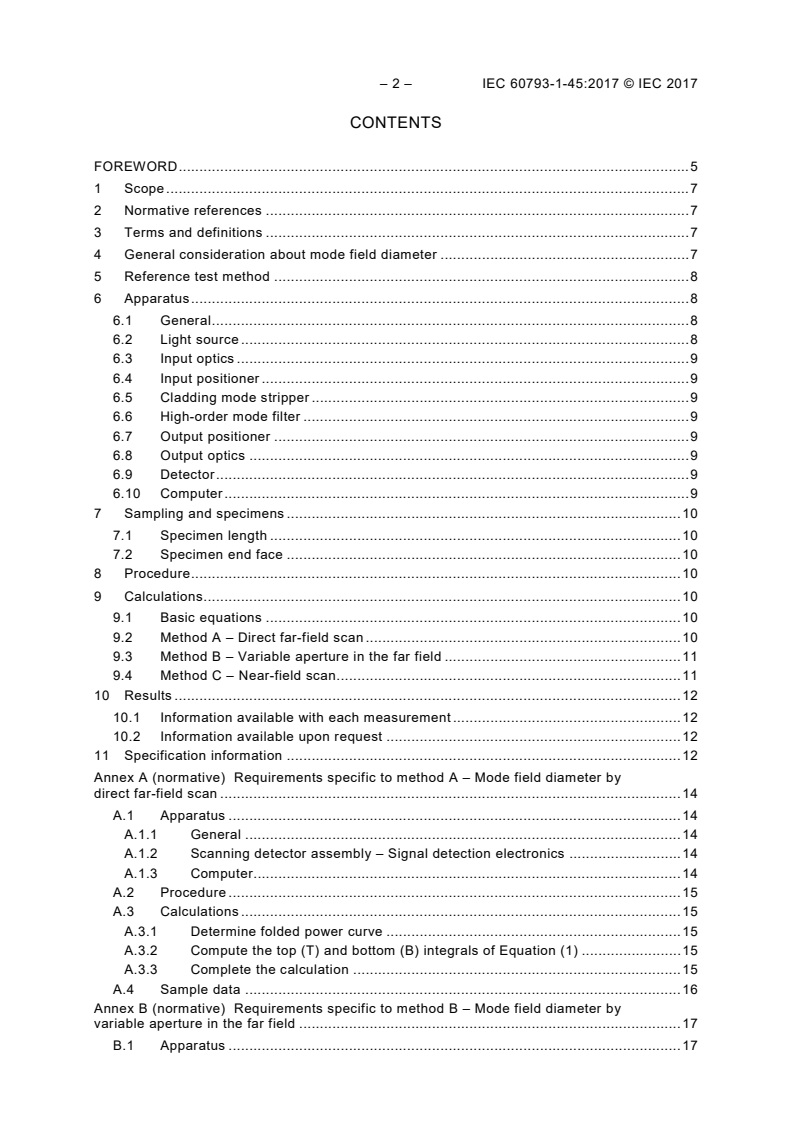
CONTENTS
FOREWORD . 5
INTRODUCTION .
1 Scope . 8
2 Normative references . 8
3 Terms and definitions . 8
4 General consideration about mode field diameter . 8
5 Reference test method . 9
6 Apparatus . 9
6.1 General . 9
6.2 Light source . 9
6.3 Input optics . 10
6.4 Input positioner . 10
6.5 Cladding mode stripper . 10
6.6 High-order mode filter . 10
6.7 Output positioner . 10
6.8 Output optics . 10
6.9 Detector . 10
6.10 Computer . 10
7 Sampling and specimens . 11
7.1 Specimen length . 11
7.2 Specimen end face . 11
8 Procedure . 11
9 Calculations . 11
9.1 Basic equations . 11
9.2 Method A – Direct far-field scan . 11
9.3 Method B – Variable aperture in the far field . 12
9.4 Method C – Near-field scan . 13
10 Results . 13
10.1 Information to be provided available with each measurement . 13
10.2 Information available upon request . 14
11 Specification information . 14
Annex A (normative) Requirements specific to method A – Mode field diameter by
direct far-field scan . 15
A.1 Apparatus . 15
A.1.1 General . 15
A.1.2 Scanning detector assembly – Signal detection electronics . 15
A.1.3 Computer. 15
A.2 Procedure . 16
A.3 Calculations . 16
A.3.1 Determine folded power curve . 16
A.3.2 Compute the top (T) and bottom (B) integrals of Equation (1) . 16
A.3.3 Complete the calculation . 16
A.4 Sample data . 17
Annex B (normative) Requirements specific to method B – Mode field diameter by
variable aperture in the far field . 18
B.1 Apparatus . 18
B.1.1 General . 18
B.1.2 Output variable aperture assembly . 18
B.1.3 Output optics system . 19
B.1.4 Detector assembly and signal detection electronics . 19
B.2 Procedure . 19
B.3 Calculations . 19
B.3.1 Determine complementary aperture function . 19
B.3.2 Complete the integration . 20
B.3.3 Complete the calculation . 20
B.4 Sample data set . 20
Annex C (normative) Requirements specific to method C – Mode field diameter by
near-field scan . 21
C.1 Apparatus . 21
C.1.1 General . 21
C.1.2 Magnifying output optics . 21
C.1.3 Scanning detector . 21
C.1.4 Detection electronics . 22
C.2 Procedure . 22
C.3 Calculations . 22
C.3.1 Calculate the centroid . 22
C.3.2 Fold the intensity profile . 23
C.3.3 Compute the integrals . 23
C.3.4 Complete the calculation . 23
C.4 Sample data . 24
Annex D (normative) Requirements specific to method D – Mode field diameter by
optical time domain reflectometer (OTDR) . 25
D.1 General . 25
D.2 Apparatus . 25
D.2.1 OTDR . 25
D.2.2 Optional auxiliary switches . 25
D.2.3 Optional computer . 26
D.2.4 Test sample . 26
D.2.5 Reference sample . 26
D.3 Procedure . 26
D.3.1 Orientation and notation . 26
D.4 Calculations . 27
D.4.1 Reference fibre mode field diameter . 27
D.4.2 Computation of the specimen mode field diameter . 28
D.4.3 Validation . 28
Annex E (informative) Sample data sets and calculated values . 30
E.1 General . 30
E.2 Method A – Mode field diameter by direct far-field scan . 30
E.3 Method B – Mode field diameter by variable aperture in the far field . 31
E.4 Method C – Mode field diameter by near-field scan . 31
Figure 1 – Transform relationships between measurement results . 9
Figure A.1 – Far-field measurement set . 15
Figure B.1 – Variable aperture by far-field measurement set . 18
– 4 – IEC 60793-1-45:2017 RLV © IEC 2017
Figure C.1 – Near-field measurement set-ups . 21
Figure D.1 – Optical switch arrangement . 26
Figure D.2 – View from reference fibre A . 27
Figure D.3 – View from reference fibre B . 27
Figure D.4 – Validation example – Comparison of methods . 28
Table E.1 – Sample data, method A – Mode field diameter by direct far-field scan . 30
Table E.2 – Sample data set, method B – Mode field diameter by variable aperture
in the far field. 31
Table E.3 – Sample data set, method C – Mode field diameter by near-field scan . 31
INTERNATIONAL ELECTROTECHNICAL COMMISSION
____________
OPTICAL FIBRES –
Part 1-45: Measurement methods and test procedures –
Mode field diameter
FOREWORD
1) The International Electrotechnical Commission (IEC) is a worldwide organization for standardization comprising
all national electrotechnical committees (IEC National Committees). The object of IEC is to promote
international co-operation on all questions concerning standardization in the electrical and electronic fields. To
this end and in addition to other activities, IEC publishes International Standards, Technical Specifications,
Technical Reports, Publicly Available Specifications (PAS) and Guides (hereafter referred to as “IEC
Publication(s)”). Their preparation is entrusted to technical committees; any IEC National Committee interested
in the subject dealt with may participate in this preparatory work. International, governmental and non-
governmental organizations liaising with the IEC also participate in this preparation. IEC collaborates closely
with the International Organization for Standardization (ISO) in accordance with conditions determined by
agreement between the two organizations.
2) The formal decisions or agreements of IEC on technical matters express, as nearly as possible, an international
consensus of opinion on the relevant subjects since each technical committee has representation from all
interested IEC National Committees.
3) IEC Publications have the form of recommendations for international use and are accepted by IEC National
Committees in that sense. While all reasonable efforts are made to ensure that the technical content of IEC
Publications is accurate, IEC cannot be held responsible for the way in which they are used or for any
misinterpretation by any end user.
4) In order to promote international uniformity, IEC National Committees undertake to apply IEC Publications
transparently to the maximum extent possible in their national and regional publications. Any divergence
between any IEC Publication and the corresponding national or regional publication shall be clearly indicated in
the latter.
5) IEC itself does not provide any attestation of conformity. Independent certification bodies provide conformity
assessment services and, in some areas, access to IEC marks of conformity. IEC is not responsible for any
services carried out by independent certification bodies.
6) All users should ensure that they have the latest edition of this publication.
7) No liability shall attach to IEC or its directors, employees, servants or agents including individual experts and
members of its technical committees and IEC National Committees for any personal injury, property damage or
other damage of any nature whatsoever, whether direct or indirect, or for costs (including legal fees) and
expenses arising out of the publication, use of, or reliance upon, this IEC Publication or any other IEC
Publications.
8) Attention is drawn to the Normative references cited in this publication. Use of the referenced publications is
indispensable for the correct application of this publication.
9) Attention is drawn to the possibility that some of the elements of this IEC Publication may be the subject of
patent rights. IEC shall not be held responsible for identifying any or all such patent rights.
This redline version of the official IEC Standard allows the user to identify the changes
made to the previous edition. A vertical bar appears in the margin wherever a change
has been made. Additions are in green text, deletions are in strikethrough red text.
– 6 – IEC 60793-1-45:2017 RLV © IEC 2017
International Standard IEC 60793-1-45 has been prepared by subcommittee 86A: Fibres and
cables, of IEC technical committee 86: Fibre optics.
This second edition cancels and replaces the first edition published in 2001. This edition
constitutes a technical revision.
This edition includes the following significant technical changes with respect to the previous
edition:
a) improvement of the description of measurement details for B6 fibre;
b) correction of Equations (1), (2),(5) and (6);
c) correction of Table E.1, Table E.2 and Table E.3.
The text of this International Standard is based on the following documents:
CDV Report on voting
86A/1758/CDV 86A/1802/RVC
Full information on the voting for the approval of this International Standard can be found in
the report on voting indicated in the above table.
This document has been drafted in accordance with the ISO/IEC Directives, Part 2.
A list of all parts in the IEC 60793 series, published under the general title Optical fibres, can
be found on the IEC website.
The committee has decided that the contents of this document will remain unchanged until the
stability date indicated on the IEC website under "http://webstore.iec.ch" in the data related to
the specific document. At this date, the document will be
• reconfirmed,
• withdrawn,
• replaced by a revised edition, or
• amended.
IMPORTANT – The “colour inside” logo on the cover page of this publication indicates
that it contains colours which are considered to be useful for the correct understanding
of its contents. Users should therefore print this publication using a colour printer.
INTRODUCTION
Publications in the IEC 60793-1 series concern measurement methods and test procedures as
they apply to optical fibres.
Within the same series several different areas are grouped, as follows:
– parts 1-10 to 1-19: General
– parts 1-20 to 1-29: Measurement methods and test procedures for dimensions
– parts 1-30 to 1-39: Measurement methods and test procedures for mechanical charac-
teristics
– parts 1-40 to 1-49: Measurement methods and test procedures for transmission and
optical characteristics
– parts 1-50 to 1-59: Measurement methods and test procedures for environmental charac-
teristics.
– 8 – IEC 60793-1-45:2017 RLV © IEC 2017
OPTICAL FIBRES –
Part 1-45: Measurement methods and test procedures –
Mode field diameter
1 Scope
This part of IEC 60793 establishes uniform requirements for measuring the mode field
diameter (MFD) of single-mode optical fibre, thereby assisting in the inspection of fibres and
cables for commercial purposes.
2 Normative references
The following documents are referred to in the text in such a way that some or all of their
content constitutes requirements of this document. For dated references, only the edition
cited applies. For undated references, the latest edition of the referenced document (including
any amendments) applies.
IEC 60793-1-40:2001, Optical fibres – Part 1-40: Measurement methods and test procedures
– Attenuation
IEC 60793-2:1998, Optical fibres – Part 2: Product specifications – General
3 Terms and definitions
No terms and definitions are listed in this document.
ISO and IEC maintain terminological databases for use in standardization at the following
addresses:
• IEC Electropedia: available at http://www.electropedia.org/
• ISO Online browsing platform: available at http://www.iso.org/obp
4 General consideration about mode field diameter
The mode field diameter measurement represents a measure of the transverse extent of the
electromagnetic field intensity of the guided mode in a fibre cross section, and it is defined
from the far-field intensity distribution as a ratio of integrals known as the Petermann II
definition. See Equation (1).
The definitions of mode field diameter are strictly related to the measurement configurations.
The mathematical equivalence of these definitions results from transform relationships
between measurement results obtained by different implementations summarized in Figure 1
as follows.
Far-field
scan
Hankel
Integration
transform
Variable
Near-field
aperture
scan
technique
IEC
Figure 1 – Transform relationships between measurement results
Four methods are described for measuring mode field diameter:
– method A: direct far-field scan;
– method B: variable aperture in the far field;
– method C: near-field scan;
– method D: bi-directional backscatter using an optical time domain reflectometer (OTDR).
All four methods apply to all categories of type B single-mode fibre shown in IEC 60793-2 and
operating near 1 310 nm or 1 550 nm. Method D is not recommended for the measurement of
fibres of unknown type or design.
Information common to all four methods is contained in Clauses 1 to 11, and information
pertaining to each individual method appears in annexes A, B, C and D, respectively.
5 Reference test method
Method A, direct far-field scan, is the reference test method (RTM), which shall be the one
used to settle disputes.
6 Apparatus
6.1 General
The following apparatus is common to all measurement methods. Annexes A, B, C and D
include layout drawings and other equipment requirements for each of the four methods,
respectively.
6.2 Light source
For methods A, B and C, use a suitable coherent or non-coherent light source, such as a
semiconductor laser or a sufficiently powerful filtered white light source. The source shall
produce sufficient radiation at the intended wavelength(s) and be stable in intensity over a
time period sufficient to perform the measurement.
A monochromator or interference filter(s) may be used, if required, for wavelength selection.
The detail specification shall specify the wavelength of the source. The full width half
maximum (FWHM) spectral line width of the source shall be less than or equal to 10 nm,
unless otherwise specified.
See Annex D for method D.
– 10 – IEC 60793-1-45:2017 RLV © IEC 2017
6.3 Input optics
For method A, B, and C, an optical lens system or fibre pigtail may be employed to excite the
specimen. It is recommended that the power coupled into the specimen be relatively
insensitive to the position of its input end face. This can be accomplished by using a launch
beam that spatially and angularly overfills the input end face.
If using a butt splice, employ index-matching material between the fibre pigtail and the
specimen to avoid interference effects. The coupling shall be stable for the duration of the
measurement.
See Annex D for method D.
6.4 Input positioner
Provide means of positioning the input end of the specimen to the light source. Examples
include the use of x-y-z micropositioner stages, or mechanical coupling devices such as
connectors, vacuum splices, three-rod splices. The position of the fibre shall remain stable
over the duration of the measurement.
6.5 Cladding mode stripper
Use a device that extracts cladding modes. Under some circumstances, the fibre coating will
perform this function.
6.6 High-order mode filter
Use a means to remove high-order propagating modes in the wavelength range that is greater
than or equal to the cut-off wavelength of the specimen. For example, a one-turn bend with a
radius of 30 mm on the fibre is generally sufficient for most B1.1 to B6 fibres. For some B6
fibres, smaller radius, multiple bends or longer specimen length can be applied to remove
high-order propagating modes.
6.7 Output positioner
Provide a suitable means for aligning the fibre output end face in order to allow an accurate
axial adjustment of the output end, such that, at the measurement wavelength, the scan
pattern is suitably focused on the plane of the scanning detector. Such coupling may include
the use of lenses, or may be a mechanical connector to a detector pigtail.
Provide means such as a side-viewing microscope or camera with a crosshair to locate the
fibre at a fixed distance from the apertures or detectors. It may be sufficient to provide only
longitudinal adjustment if the fibre is constrained in the lateral plane by a device such as a
vacuum chuck (this depends mainly upon the size of the light detector).
6.8 Output optics
See the appropriate annex: A, B, C or D.
6.9 Detector
See the appropriate annex: A, B, C or D.
6.10 Computer
Use a computer to perform operations such as controlling the apparatus, taking intensity
measurements, and processing the data to obtain the final results. For individual details, see
the appropriate annex: A, B, C or D.
7 Sampling and specimens
7.1 Specimen length
For methods A, B and C, the specimen shall be a known length, typically 2 m ± 0,2 m of
single-mode for most B1.1 to B6 fibres. For some B6 fibres, longer specimen length can be
used to avoid high-order propagating modes, 22 m for example.
NOTE For method D, OTDR, the sample must shall be long enough to exceed (or be positioned
beyond) the dead zone of the OTDR, with both ends accessible, as described in the
backscatter test method IEC 60793-1-40.
7.2 Specimen end face
Prepare a flat end face, orthogonal to the fibre axis, at the input and output ends of each
specimen.
8 Procedure
See Annexes A, B, C and D for methods A, B, C and D, respectively.
9 Calculations
9.1 Basic equations
The basic equations for calculating mode field diameter by methods A, B and C are given
below. For additional calculations, see the appropriate annex: A, B, C or D. Sample data sets
for methods A, B and C are included in Annex E.
9.2 Method A – Direct far-field scan
The following equation defines the mode field diameter for method A in terms of the
electromagnetic field emitted from the end of the specimen.
Calculate the mode field diameter by scanning the far-field data and evaluating the Petermann
II integral, which is defined from the far-field intensity distribution:
1/ 2
π/2
π / 2
P (θ ) sin(θ ) cos(θ )dθ
P (θ )sin(θ )cos(θ )dθ
F
F
∫
λ 2 ∫
λ 2
2W = (1)
2W =
0
0
π / 2
π/2
π π
3 3
P (θ )sin (θ )cos(θ )dθ
P (θ ) sin (θ ) cos(θ )dθ
F F
∫ ∫
0
0
where
2W is the mode field diameter in µm;
P (θ) is the far-field intensity distribution;
F
λ is the wavelength of measurement in µm;
θ is the angle in the far-field measurement from the axis of the fibre.
NOTE 1 The integration limits are shown to be from zero to π/2, but it is understood that the integrands approach
zero with increasing argument so that, in practice, the integrals can be truncated.
NOTE 2 P is F (θ) in ITU-T documents.
F
The far-field method for obtaining the mode field diameter of a single-mode fibre is a two-step
procedure. First, measure the far-field radiation pattern of the fibre. Second, use a
– 12 – IEC 60793-1-45:2017 RLV © IEC 2017
mathematical procedure based on the Petermann II far-field definition to calculate the mode
field from far-field data, as described in Equation (1) above.
Annex E provides sample data and calculated 2W values for 2W to enable one to check
0 0
verifying the numerical evaluation of the Petermann II Integral. The sample data are in the
form of the folded power, P (θ), as a function of the angle, θ.
F
9.3 Method B – Variable aperture in the far field
The following equations define the mode field diameter for method B in terms of the
electromagnetic field emitted from the end of the specimen.
Calculate the mode field diameter, 2W , as follows:
−1/ 2
1/2
∞
λ x
∞
λ x
2W = a(x) dx
2W = a(x) dx 0 (2)
∫ 2
0 2 2
∫
πD
0
πD (x + D )
2 2
(x + D )
where
2W is the mode field diameter, in µm;
λ is the wavelength of measurement, in µm;
D is the distance between the aperture and the fibre, in mm;
a(x) is the complementary aperture transmission function, calculated as
P(x)
a(x) = 1− (3)
P(max)
where
P(x) is the power measured through an aperture of radius, x, or half angle, θ;
P(max) is the maximum power, assuming an infinite aperture;
x is the aperture radius, calculated as
x = D tan(θ )
(4)
where D is the distance between the aperture and the fibre, in mm.
The mathematical equivalence of equations (1) and (2) is valid in the approximation of small
angles, θ. Under this approximation, equation (2) can be derived from equation (1) by
integration.
Another equivalent expression of Equation (2) is
1/2
−1/ 2
∞ ∞
λ 2 λ 2
( )
2W = a θ sin 2θ dθ 2W = a(θ )sin2θdθ (5)
0
∫ ∫
0 0
π
π
where
2W is the MFD, in µm;
a(θ) is the complementary aperture function, calculated as
P(θ )
a(θ ) = 1 − (6)
P(max)
where
P(θ) is the power through the largest aperture;
P(max) is the maximum power, assuming an infinite aperture.
The variable aperture far-field method for obtaining the mode field diameter of a single-mode
fibre is a two-step procedure. First, measure the two-dimensional far-field pattern as the
power passing through a series of transmitting apertures of various size. Second, use a
mathematical procedure to calculate the mode field diameter from the far-field data.
The mathematical basis for the calculation of mode field diameter is based on the Petermann
II far-field definition from Equation (1). The mathematical equivalence of equations (1) and (3)
is valid in the approximation of small angles, θ. Derive Equation (5) from Equation (1) by
integration. Equation (2) and Equation (5) can be derived from Equation (1) by integration.
9.4 Method C – Near-field scan
The following equation defines the mode field diameter for method C in terms of the
electromagnetic field emitted from the end of the specimen.
Calculate the mode field diameter from the measured near-field intensity distribution, using
the following integral:
1/ 2
∞
2 ∞
r f (r )dr
∫ r f (r)dr
∫
2W = 2 2 (6)
2W = 2 2
2
∞
df (r )
∞
df (r)
dr
∫ r dr
dr
∫
dr
where
2W is the mode field diameter, in µm;
r is the radial coordinate, in µm;
f (r) is the near-field intensity distribution.
NOTE The upper integration limits are shown to infinity, but it is understood that since the integrands approach
zero with increasing argument, in practice the integrals can be truncated. A smoothing algorithm can be used for
the calculation of the derivative.
The near-field scan method for obtaining the mode field diameter of a single-mode fibre is a
two-step procedure. First, measure the radial near-field pattern. Second, use a mathematical
procedure to calculate the mode field diameter from the near-field data.
The mathematical basis for the calculation of the mode field diameter is based on the
Petermann II definition from Equation (1). The mathematical equivalence of equations (1) and
(5) is valid in the approximation of small angles, θ. Under this approximation, The near field,
f(r), and the far field, F(θ), form a Hankel pair. By means of the Hankel transformation it is
possible to pass from Equation (1) to equation (7), and reverse. The near field, f(r), and the
far field, F(θ), form a Hankel transform pair. By Hankel transforming and using P =F (θ), it is
F
possible to derive Equation (6) from Equation (1), and vice versa.
10 Results
10.1 Information to be provided available with each measurement
Report the following information with each measurement:
– date and title of measurement;
– 14 – IEC 60793-1-45:2017 RLV © IEC 2017
– identification of specimen;
– optical source wavelength;
– mode field diameter(s), in micrometres.
10.2 Information available upon request
The following information shall be available upon request:
– measurement method used: A, B, C or D;
– type of optical source used and its spectral width (FWHM);
– description of equipment;
– description of high-order modes filter;
– details of computation technique;
– date of latest calibration of measurement equipment.
11 Specification information
The detail specification shall specify the following information:
– type of fibre to be measured;
– failure or acceptance criteria;
– information to be reported;
– any deviations to the procedure that apply.
Annex A
(normative)
Requirements specific to method A –
Mode field diameter by direct far-field scan
A.1 Apparatus
A.1.1 General
Annex A describes apparatus in addition to the requirements set down in Clause 6.
Figure A.1 illustrates a typical set-up for measurement by direct far-field scan.
Stepper motor
rotation stage
Splice PIN detector
Laser diode
Pigtail Test fibre
Reference
Desktop Lock-in
computer amplifier
IEC
Figure A.1 – Far-field measurement set
A.1.2 Scanning detector assembly – Signal detection electronics
Use a mechanism to scan the far-field intensity distribution. Use a scanning device capable of
0,5° steps or finer to scan the detector. Use a means of aligning the fibre axis with respect to
the rotation plane of the detector, and of aligning the fibre end-face with the centre of rotation
of the scan. A typical system might include a PIN photodiode, operating in a photovoltaic
mode, amplified by a current-input preamplifier, with synchronous detection by a lock-in
amplifier. The detector should be at least 10 mm from the fibre end, and the detector's active
area should not subtend an angle too large in the far field. To ensure this, place the detector
at a distance from the fibre end greater than 2wb/λ, where 2w is the expected mode field
diameter of the specimen and b is the diameter of the active area of the detector.
For very accurate measurements, the minimum dynamic range of the measurement should be
50 dB. This corresponds to a maximum scan half-angle of 20° and 25°, or greater, for
category B1 and B2 fibres, respectively. Reducing the dynamic range (or maximum scan
half-angle) requirements may introduce errors. For example, restricting those values to 30 dB
and 12,5° for category B1 fibres, and to 40 dB and 20° for category B2 fibres, may result in a
relative error, in the determination of the mode field diameter, that is greater than 1 %.
A.1.3 Computer
A typical system should also include a computer to process the far-field data.
– 16 – IEC 60793-1-45:2017 RLV © IEC 2017
A.2 Procedure
Align the fibre in the system, prepared as described in Clause 6, with its output end aligned
on the detector assembly for maximum power.
Scan the detector in 0,5° steps, equally spaced, and record the detector power.
Calculate a value of the Petermann II integral from the recorded data, and use it to compute
the fibre mode field diameter as described in Equation (1), and in Clause A.3.
A.3 Calculations
A.3.1 Determine folded power curve
The folded power curve for 0 ≤ θ = θ is
i max
P(θ )+ P(θ )
i −i
P (θ ) =
(A.1)
F i
where
P (θ ) is the folded power curve;
F i
P(θ ) is the measured power as a function of the angular position, θ (radians), indexed by i.
-i i
A.3.2 Compute the top (T) and bottom (B) integrals of Equation (1)
Use an appropriate numerical integration technique to compute the integrals of Equation (1).
The following is an example using the rectangular method. Any other integration method shall
be at least as accurate as this one.
n
T = P (θ )sin(θ )cos(θ )dθ
(A.2)
F i i i
∑
n
B = P (θ )sin (θ )cos(θ )dθ
(A.3)
∑ F i i i
where
P is the folded power curve;
F
θ is the angular position, indexed by i (radians);
i
dθ = θ – θ .
1 0
A.3.3 Complete the calculation
λ 2 T
MFD = 2W =
(A.4)
π B
where
2W is the mode field diameter, in µm;
T is from Equation (A.2);
B is from Equation (A.3).
A.4 Sample data
See Table E.1 for a sample data set as calculated in Clause A.3.
– 18 – IEC 60793-1-45:2017 RLV © IEC 2017
Annex B
(normative)
Requirements specific to method B –
Mode field diameter by variable aperture in the far field
B.1 Apparatus
B.1.1 General
Annex B describes apparatus in addition to the requirements in Clause 6.
Figure B.1 illustrates a typical set-up for the measurement by variable aperture in the far field.
Monochromator
Tungsten Cladding mode
or interference
light source stripper
filters
High order mode filter
(if necessary)
Light collection
optics
Detection
system
Vaccum
chuck
Apertures
IEC
Figure B.1 – Variable aperture by far-field measurement set
B.1.2 Output variable aperture assembly
B.1.2.1 Principle
Place a device consisting of round, transmitting apertures of various sizes (such as an
aperture wheel) at a distance of at least 100 W /λ from the specimen, and use it to vary the
power detached from the fibre output far field pattern. Typically, the apertures are located
20 mm to 50 mm away from the fibre end.
Use a means of centring the apertures with respect to the pattern in order to decrease the
sensitivity to fibre end angle. Use a sufficient number and size of apertures such that the
measurement results are not unduly affected by the inclusion of any additional aperture. In
addition, take care to ensure that the largest apertures are of sufficient size to avoid
truncation of the collected pattern.
NOTE 1 Optical alignment is critical.
NOTE 2 The number and size of the apertures are critical to the accuracy of this method. The optimum can vary
depending on the design of the fibres being tested. Verification of a particular selection can be completed by
comparison with method A, direct far-field.
B.1.2.2 Equipment requirements for category B1 and B6 fibre
The accuracy of the mode field diameter measurement given by this procedure depends on
the maximum numerical aperture of the measurement set. For category B1 and B6 fibre, the
error is typically 1 % or less for a measurement set with a maximum numerical aperture of
0,25. If less error is desired, or if the specimen has a mode field diameter less than 8,2 µm,
use either of two approaches:
a) use a measurement system with a maximum numerical aperture of 0,35 or greater; or
b) determine a mapping function that relates the measurement of category B1 and B6 fibre
on limited aperture measurement set to that of a set with 0,35 or greater numerical
aperture.
B.1.2.3 Equipment requirements for category B2, B3, B4 and B5 fibres
The maximum numerical aperture of the measurement set shall be equal to or greater than
0,40 for fibres with mode field diameters equal to or greater than 6 µm.
B.1.3 Output optics system
Use an optical system, such as a pair of lenses, mirrors, or other suitable arrangement, to
collect all the light transmitted through the aperture, and to couple it to the detector.
B.1.4 Detector assembly and signal detection electronics
Use a detector that is sensitive to the output radiation over the range of wavelengths to be
measured and that is linear over the range of intensities encountered. A typical system might
can include a germanium or GaInAs photodiode, operating in the photovoltaic mode, and a
current-sensitive preamplifier, with synchronous detection by a lock-in amplifier. Generally, a
computer is required to analyze the data.
B.2 Procedure
a) Place the specimen, prepared as described in Clause 6, in the input and output alignment
devices, and adjust it for the correct distance to the aperture assembly.
a) Set the a
...
IEC 60793-1-45 ®
Edition 2.0 2017-11
INTERNATIONAL
STANDARD
NORME
INTERNATIONALE
Optical fibres –
Part 1-45: Measurement methods and test procedures – Mode field diameter
Fibres optiques –
Partie 1-45: Méthodes de mesure et procédures d'essai – Diamètre du champ de
mode
All rights reserved. Unless otherwise specified, no part of this publication may be reproduced or utilized in any form
or by any means, electronic or mechanical, including photocopying and microfilm, without permission in writing from
either IEC or IEC's member National Committee in the country of the requester. If you have any questions about IEC
copyright or have an enquiry about obtaining additional rights to this publication, please contact the address below or
your local IEC member National Committee for further information.
Droits de reproduction réservés. Sauf indication contraire, aucune partie de cette publication ne peut être reproduite
ni utilisée sous quelque forme que ce soit et par aucun procédé, électronique ou mécanique, y compris la photocopie
et les microfilms, sans l'accord écrit de l'IEC ou du Comité national de l'IEC du pays du demandeur. Si vous avez des
questions sur le copyright de l'IEC ou si vous désirez obtenir des droits supplémentaires sur cette publication, utilisez
les coordonnées ci-après ou contactez le Comité national de l'IEC de votre pays de résidence.
IEC Central Office Tel.: +41 22 919 02 11
3, rue de Varembé Fax: +41 22 919 03 00
CH-1211 Geneva 20 info@iec.ch
Switzerland www.iec.ch
About the IEC
The International Electrotechnical Commission (IEC) is the leading global organization that prepares and publishes
International Standards for all electrical, electronic and related technologies.
About IEC publications
The technical content of IEC publications is kept under constant review by the IEC. Please make sure that you have the
latest edition, a corrigenda or an amendment might have been published.
IEC Catalogue - webstore.iec.ch/catalogue Electropedia - www.electropedia.org
The stand-alone application for consulting the entire The world's leading online dictionary of electronic and
bibliographical information on IEC International Standards, electrical terms containing 20 000 terms and definitions in
Technical Specifications, Technical Reports and other English and French, with equivalent terms in 16 additional
documents. Available for PC, Mac OS, Android Tablets and languages. Also known as the International Electrotechnical
iPad. Vocabulary (IEV) online.
IEC publications search - www.iec.ch/searchpub IEC Glossary - std.iec.ch/glossary
The advanced search enables to find IEC publications by a 65 000 electrotechnical terminology entries in English and
variety of criteria (reference number, text, technical French extracted from the Terms and Definitions clause of
committee,…). It also gives information on projects, replaced IEC publications issued since 2002. Some entries have been
and withdrawn publications. collected from earlier publications of IEC TC 37, 77, 86 and
CISPR.
IEC Just Published - webstore.iec.ch/justpublished
Stay up to date on all new IEC publications. Just Published IEC Customer Service Centre - webstore.iec.ch/csc
details all new publications released. Available online and If you wish to give us your feedback on this publication or
also once a month by email. need further assistance, please contact the Customer Service
Centre: csc@iec.ch.
A propos de l'IEC
La Commission Electrotechnique Internationale (IEC) est la première organisation mondiale qui élabore et publie des
Normes internationales pour tout ce qui a trait à l'électricité, à l'électronique et aux technologies apparentées.
A propos des publications IEC
Le contenu technique des publications IEC est constamment revu. Veuillez vous assurer que vous possédez l’édition la
plus récente, un corrigendum ou amendement peut avoir été publié.
Catalogue IEC - webstore.iec.ch/catalogue Electropedia - www.electropedia.org
Application autonome pour consulter tous les renseignements
Le premier dictionnaire en ligne de termes électroniques et
bibliographiques sur les Normes internationales,
électriques. Il contient 20 000 termes et définitions en anglais
Spécifications techniques, Rapports techniques et autres
et en français, ainsi que les termes équivalents dans 16
documents de l'IEC. Disponible pour PC, Mac OS, tablettes
langues additionnelles. Egalement appelé Vocabulaire
Android et iPad.
Electrotechnique International (IEV) en ligne.
Recherche de publications IEC - www.iec.ch/searchpub
Glossaire IEC - std.iec.ch/glossary
65 000 entrées terminologiques électrotechniques, en anglais
La recherche avancée permet de trouver des publications IEC
en utilisant différents critères (numéro de référence, texte, et en français, extraites des articles Termes et Définitions des
comité d’études,…). Elle donne aussi des informations sur les publications IEC parues depuis 2002. Plus certaines entrées
projets et les publications remplacées ou retirées. antérieures extraites des publications des CE 37, 77, 86 et
CISPR de l'IEC.
IEC Just Published - webstore.iec.ch/justpublished
Service Clients - webstore.iec.ch/csc
Restez informé sur les nouvelles publications IEC. Just
Published détaille les nouvelles publications parues. Si vous désirez nous donner des commentaires sur cette
Disponible en ligne et aussi une fois par mois par email. publication ou si vous avez des questions contactez-nous:
csc@iec.ch.
IEC 60793-1-45 ®
Edition 2.0 2017-11
INTERNATIONAL
STANDARD
NORME
INTERNATIONALE
Optical fibres –
Part 1-45: Measurement methods and test procedures – Mode field diameter
Fibres optiques –
Partie 1-45: Méthodes de mesure et procédures d'essai – Diamètre du champ de
mode
INTERNATIONAL
ELECTROTECHNICAL
COMMISSION
COMMISSION
ELECTROTECHNIQUE
INTERNATIONALE
ICS 33.180.10 ISBN 978-2-8322-4979-6
– 2 – IEC 60793-1-45:2017 © IEC 2017
CONTENTS
FOREWORD . 5
1 Scope . 7
2 Normative references . 7
3 Terms and definitions . 7
4 General consideration about mode field diameter . 7
5 Reference test method . 8
6 Apparatus . 8
6.1 General . 8
6.2 Light source . 8
6.3 Input optics . 9
6.4 Input positioner . 9
6.5 Cladding mode stripper . 9
6.6 High-order mode filter . 9
6.7 Output positioner . 9
6.8 Output optics . 9
6.9 Detector . 9
6.10 Computer . 9
7 Sampling and specimens . 10
7.1 Specimen length . 10
7.2 Specimen end face . 10
8 Procedure . 10
9 Calculations . 10
9.1 Basic equations . 10
9.2 Method A – Direct far-field scan . 10
9.3 Method B – Variable aperture in the far field . 11
9.4 Method C – Near-field scan . 11
10 Results . 12
10.1 Information available with each measurement . 12
10.2 Information available upon request . 12
11 Specification information . 12
Annex A (normative) Requirements specific to method A – Mode field diameter by
direct far-field scan . 14
A.1 Apparatus . 14
A.1.1 General . 14
A.1.2 Scanning detector assembly – Signal detection electronics . 14
A.1.3 Computer. 14
A.2 Procedure . 15
A.3 Calculations . 15
A.3.1 Determine folded power curve . 15
A.3.2 Compute the top (T) and bottom (B) integrals of Equation (1) . 15
A.3.3 Complete the calculation . 15
A.4 Sample data . 16
Annex B (normative) Requirements specific to method B – Mode field diameter by
variable aperture in the far field . 17
B.1 Apparatus . 17
B.1.1 General . 17
B.1.2 Output variable aperture assembly . 17
B.1.3 Output optics system . 18
B.1.4 Detector assembly and signal detection electronics . 18
B.2 Procedure . 18
B.3 Calculations . 18
B.3.1 Determine complementary aperture function . 18
B.3.2 Complete the integration . 19
B.3.3 Complete the calculation . 19
B.4 Sample data . 19
Annex C (normative) Requirements specific to method C – Mode field diameter by
near-field scan . 20
C.1 Apparatus . 20
C.1.1 General . 20
C.1.2 Magnifying output optics . 20
C.1.3 Scanning detector . 20
C.1.4 Detection electronics . 21
C.2 Procedure . 21
C.3 Calculations . 21
C.3.1 Calculate the centroid . 21
C.3.2 Fold the intensity profile . 22
C.3.3 Compute the integrals . 22
C.3.4 Complete the calculation . 22
C.4 Sample data . 23
Annex D (normative) Requirements specific to method D – Mode field diameter by
optical time domain reflectometer (OTDR) . 24
D.1 General . 24
D.2 Apparatus . 24
D.2.1 OTDR . 24
D.2.2 Optional auxiliary switches . 24
D.2.3 Optional computer . 25
D.2.4 Test sample . 25
D.2.5 Reference sample . 25
D.3 Procedure . 25
D.3.1 Orientation and notation . 25
D.4 Calculations . 26
D.4.1 Reference fibre mode field diameter . 26
D.4.2 Computation of the specimen mode field diameter . 27
D.4.3 Validation . 27
Annex E (informative) Sample data sets and calculated values . 29
E.1 General . 29
E.2 Method A – Mode field diameter by direct far-field scan . 29
E.3 Method B – Mode field diameter by variable aperture in the far field . 30
E.4 Method C – Mode field diameter by near-field scan . 30
Figure 1 – Transform relationships between measurement results . 8
Figure A.1 – Far-field measurement set . 14
Figure B.1 – Variable aperture by far-field measurement set . 17
– 4 – IEC 60793-1-45:2017 © IEC 2017
Figure C.1 – Near-field measurement set-ups . 20
Figure D.1 – Optical switch arrangement . 25
Figure D.2 – View from reference fibre A . 26
Figure D.3 – View from reference fibre B . 26
Figure D.4 – Validation example – Comparison of methods . 27
Table E.1 – Sample data, method A – Mode field diameter by direct far-field scan . 29
Table E.2 – Sample data set, method B – Mode field diameter by variable aperture in
the far field . 30
Table E.3 – Sample data set, method C – Mode field diameter by near-field scan . 30
INTERNATIONAL ELECTROTECHNICAL COMMISSION
____________
OPTICAL FIBRES –
Part 1-45: Measurement methods and test procedures –
Mode field diameter
FOREWORD
1) The International Electrotechnical Commission (IEC) is a worldwide organization for standardization comprising
all national electrotechnical committees (IEC National Committees). The object of IEC is to promote
international co-operation on all questions concerning standardization in the electrical and electronic fields. To
this end and in addition to other activities, IEC publishes International Standards, Technical Specifications,
Technical Reports, Publicly Available Specifications (PAS) and Guides (hereafter referred to as “IEC
Publication(s)”). Their preparation is entrusted to technical committees; any IEC National Committee interested
in the subject dealt with may participate in this preparatory work. International, governmental and non-
governmental organizations liaising with the IEC also participate in this preparation. IEC collaborates closely
with the International Organization for Standardization (ISO) in accordance with conditions determined by
agreement between the two organizations.
2) The formal decisions or agreements of IEC on technical matters express, as nearly as possible, an international
consensus of opinion on the relevant subjects since each technical committee has representation from all
interested IEC National Committees.
3) IEC Publications have the form of recommendations for international use and are accepted by IEC National
Committees in that sense. While all reasonable efforts are made to ensure that the technical content of IEC
Publications is accurate, IEC cannot be held responsible for the way in which they are used or for any
misinterpretation by any end user.
4) In order to promote international uniformity, IEC National Committees undertake to apply IEC Publications
transparently to the maximum extent possible in their national and regional publications. Any divergence
between any IEC Publication and the corresponding national or regional publication shall be clearly indicated in
the latter.
5) IEC itself does not provide any attestation of conformity. Independent certification bodies provide conformity
assessment services and, in some areas, access to IEC marks of conformity. IEC is not responsible for any
services carried out by independent certification bodies.
6) All users should ensure that they have the latest edition of this publication.
7) No liability shall attach to IEC or its directors, employees, servants or agents including individual experts and
members of its technical committees and IEC National Committees for any personal injury, property damage or
other damage of any nature whatsoever, whether direct or indirect, or for costs (including legal fees) and
expenses arising out of the publication, use of, or reliance upon, this IEC Publication or any other IEC
Publications.
8) Attention is drawn to the Normative references cited in this publication. Use of the referenced publications is
indispensable for the correct application of this publication.
9) Attention is drawn to the possibility that some of the elements of this IEC Publication may be the subject of
patent rights. IEC shall not be held responsible for identifying any or all such patent rights.
International Standard IEC 60793-1-45 has been prepared by subcommittee 86A: Fibres and
cables, of IEC technical committee 86: Fibre optics.
This second edition cancels and replaces the first edition published in 2001. This edition
constitutes a technical revision.
This edition includes the following significant technical changes with respect to the previous
edition:
a) improvement of the description of measurement details for B6 fibre;
b) correction of Equations (1), (2),(5) and (6);
c) correction of Table E.1, Table E.2 and Table E.3.
– 6 – IEC 60793-1-45:2017 © IEC 2017
The text of this International Standard is based on the following documents:
CDV Report on voting
86A/1758/CDV 86A/1802/RVC
Full information on the voting for the approval of this International Standard can be found in
the report on voting indicated in the above table.
This document has been drafted in accordance with the ISO/IEC Directives, Part 2.
A list of all parts in the IEC 60793 series, published under the general title Optical fibres, can
be found on the IEC website.
The committee has decided that the contents of this document will remain unchanged until the
stability date indicated on the IEC website under "http://webstore.iec.ch" in the data related to
the specific document. At this date, the document will be
• reconfirmed,
• withdrawn,
• replaced by a revised edition, or
• amended.
OPTICAL FIBRES –
Part 1-45: Measurement methods and test procedures –
Mode field diameter
1 Scope
This part of IEC 60793 establishes uniform requirements for measuring the mode field
diameter (MFD) of single-mode optical fibre, thereby assisting in the inspection of fibres and
cables for commercial purposes.
2 Normative references
The following documents are referred to in the text in such a way that some or all of their
content constitutes requirements of this document. For dated references, only the edition
cited applies. For undated references, the latest edition of the referenced document (including
any amendments) applies.
IEC 60793-1-40:2001, Optical fibres – Part 1-40: Measurement methods and test procedures
– Attenuation
IEC 60793-2, Optical fibres – Part 2: Product specifications – General
3 Terms and definitions
No terms and definitions are listed in this document.
ISO and IEC maintain terminological databases for use in standardization at the following
addresses:
• IEC Electropedia: available at http://www.electropedia.org/
• ISO Online browsing platform: available at http://www.iso.org/obp
4 General consideration about mode field diameter
The mode field diameter measurement represents a measure of the transverse extent of the
electromagnetic field intensity of the guided mode in a fibre cross section, and it is defined
from the far-field intensity distribution as a ratio of integrals known as the Petermann II
definition. See Equation (1).
The definitions of mode field diameter are strictly related to the measurement configurations.
The mathematical equivalence of these definitions results from transform relationships
between measurement results obtained by different implementations summarized in Figure 1
as follows.
– 8 – IEC 60793-1-45:2017 © IEC 2017
Far-field
scan
Hankel
Integration
transform
Variable
Near-field
aperture
scan
technique
IEC
Figure 1 – Transform relationships between measurement results
Four methods are described for measuring mode field diameter:
– method A: direct far-field scan;
– method B: variable aperture in the far field;
– method C: near-field scan;
– method D: bi-directional backscatter using an optical time domain reflectometer (OTDR).
All four methods apply to all categories of type B single-mode fibre shown in IEC 60793-2 and
operating near 1 310 nm or 1 550 nm. Method D is not recommended for the measurement of
fibres of unknown type or design.
Information common to all four methods is contained in Clauses 1 to 11, and information
pertaining to each individual method appears in annexes A, B, C and D, respectively.
5 Reference test method
Method A, direct far-field scan, is the reference test method (RTM), which shall be the one
used to settle disputes.
6 Apparatus
6.1 General
The following apparatus is common to all measurement methods. Annexes A, B, C and D
include layout drawings and other equipment requirements for each of the four methods,
respectively.
6.2 Light source
For methods A, B and C, use a suitable coherent or non-coherent light source, such as a
semiconductor laser or a sufficiently powerful filtered white light source. The source shall
produce sufficient radiation at the intended wavelength(s) and be stable in intensity over a
time period sufficient to perform the measurement.
A monochromator or interference filter(s) may be used, if required, for wavelength selection.
The detail specification shall specify the wavelength of the source. The full width half
maximum (FWHM) spectral line width of the source shall be less than or equal to 10 nm,
unless otherwise specified.
See Annex D for method D.
6.3 Input optics
For method A, B, and C, an optical lens system or fibre pigtail may be employed to excite the
specimen. It is recommended that the power coupled into the specimen be relatively
insensitive to the position of its input end face. This can be accomplished by using a launch
beam that spatially and angularly overfills the input end face.
If using a butt splice, employ index-matching material between the fibre pigtail and the
specimen to avoid interference effects. The coupling shall be stable for the duration of the
measurement.
See Annex D for method D.
6.4 Input positioner
Provide means of positioning the input end of the specimen to the light source. Examples
include the use of x-y-z micropositioner stages, or mechanical coupling devices such as
connectors, vacuum splices, three-rod splices. The position of the fibre shall remain stable
over the duration of the measurement.
6.5 Cladding mode stripper
Use a device that extracts cladding modes. Under some circumstances, the fibre coating will
perform this function.
6.6 High-order mode filter
Use a means to remove high-order propagating modes in the wavelength range that is greater
than or equal to the cut-off wavelength of the specimen. For example, a one-turn bend with a
radius of 30 mm on the fibre is generally sufficient for most B1.1 to B6 fibres. For some B6
fibres, smaller radius, multiple bends or longer specimen length can be applied to remove
high-order propagating modes.
6.7 Output positioner
Provide a suitable means for aligning the fibre output end face in order to allow an accurate
axial adjustment of the output end, such that, at the measurement wavelength, the scan
pattern is suitably focused on the plane of the scanning detector. Such coupling may include
the use of lenses, or may be a mechanical connector to a detector pigtail.
Provide means such as a side-viewing microscope or camera with a crosshair to locate the
fibre at a fixed distance from the apertures or detectors. It may be sufficient to provide only
longitudinal adjustment if the fibre is constrained in the lateral plane by a device such as a
vacuum chuck (this depends mainly upon the size of the light detector).
6.8 Output optics
See the appropriate annex: A, B, C or D.
6.9 Detector
See the appropriate annex: A, B, C or D.
6.10 Computer
Use a computer to perform operations such as controlling the apparatus, taking intensity
measurements, and processing the data to obtain the final results. For individual details, see
the appropriate annex: A, B, C or D.
– 10 – IEC 60793-1-45:2017 © IEC 2017
7 Sampling and specimens
7.1 Specimen length
For methods A, B and C, the specimen shall be a known length, typically 2 m ± 0,2 m for most
B1.1 to B6 fibres. For some B6 fibres, longer specimen length can be used to avoid high-order
propagating modes, 22 m for example.
For method D, OTDR, the sample shall be long enough to exceed (or be positioned beyond)
the dead zone of the OTDR, with both ends accessible, as described in the backscatter test
method IEC 60793-1-40.
7.2 Specimen end face
Prepare a flat end face, orthogonal to the fibre axis, at the input and output ends of each
specimen.
8 Procedure
See Annexes A, B, C and D for methods A, B, C and D, respectively.
9 Calculations
9.1 Basic equations
The basic equations for calculating mode field diameter by methods A, B and C are given
below. For additional calculations, see the appropriate annex: A, B, C or D. Sample data sets
for methods A, B and C are included in Annex E.
9.2 Method A – Direct far-field scan
The following equation defines the mode field diameter for method A in terms of the
electromagnetic field emitted from the end of the specimen.
Calculate the mode field diameter by scanning the far-field data and evaluating the Petermann
II integral, which is defined from the far-field intensity distribution:
1/ 2
π / 2
P(θ)sin(θ)cos(θ)dθ
F
λ 2 ∫
(1)
2W =
0
π / 2
π
( ) ( ) ( )
P θ sin θ cosθ dθ
F
∫
where
2W is the mode field diameter in µm;
P (θ) is the far-field intensity distribution;
F
λ is the wavelength of measurement in µm;
θ is the angle in the far-field measurement from the axis of the fibre.
NOTE 1 The integration limits are shown to be from zero to π/2, but it is understood that the integrands approach
zero with increasing argument so that, in practice, the integrals can be truncated.
NOTE 2 P is F (θ) in ITU-T documents.
F
The far-field method for obtaining the mode field diameter of a single-mode fibre is a two-step
procedure. First, measure the far-field radiation pattern of the fibre. Second, use a
mathematical procedure based on the Petermann II far-field definition to calculate the mode
field from far-field data, as described in Equation (1) above.
Annex E provides sample data and calculated 2W values for verifying the numerical
evaluation of the Petermann II Integral. The sample data are in the form of the folded power,
P (θ), as a function of the angle, θ.
F
9.3 Method B – Variable aperture in the far field
The following equations define the mode field diameter for method B in terms of the
electromagnetic field emitted from the end of the specimen.
Calculate the mode field diameter, 2W , as follows:
−1/ 2
∞
λ x
2W = a(x) dx
∫
0 2 2
πD
(x + D )
(2)
where
2W is the mode field diameter, in µm;
λ is the wavelength of measurement, in µm;
D is the distance between the aperture and the fibre, in mm;
a(x) is the complementary aperture transmission function, calculated as
P(x)
a(x)= 1− (3)
P(max)
where
P(x) is the power measured through an aperture of radius, x, or half angle, θ;
P(max) is the maximum power, assuming an infinite aperture;
x is the aperture radius, calculated as
x= D tan(θ)
(4)
Another equivalent expression of Equation (2) is
−1/ 2
∞
λ 2
2W = a(θ )sin2θdθ (5)
∫
0
π
The variable aperture far-field method for obtaining the mode field diameter of a single-mode
fibre is a two-step procedure. First, measure the two-dimensional far-field pattern as the
power passing through a series of transmitting apertures of various size. Second, use a
mathematical procedure to calculate the mode field diameter from the far-field data.
The mathematical basis for the calculation of mode field diameter is based on the Petermann
II far-field definition from Equation (1). Equation (2) and Equation (5) can be derived from
Equation (1) by integration.
9.4 Method C – Near-field scan
The following equation defines the mode field diameter for method C in terms of the
electromagnetic field emitted from the end of the specimen.
– 12 – IEC 60793-1-45:2017 © IEC 2017
Calculate the mode field diameter from the measured near-field intensity distribution, using
the following integral:
1/ 2
∞
r f (r)dr
∫
2W = 2 2 (6)
∞
df(r)
r dr
∫
dr
where
2W is the mode field diameter, in µm;
r is the radial coordinate, in µm;
f (r) is the near-field intensity distribution.
NOTE The upper integration limits are shown to infinity, but it is understood that since the integrands approach
zero with increasing argument, in practice the integrals can be truncated. A smoothing algorithm can be used for
the calculation of the derivative.
The near-field scan method for obtaining the mode field diameter of a single-mode fibre is a
two-step procedure. First, measure the radial near-field pattern. Second, use a mathematical
procedure to calculate the mode field diameter from the near-field data.
The mathematical basis for the calculation of the mode field diameter is based on the
Petermann II definition from Equation (1). The near field, f(r), and the far field, F(θ), form a
Hankel transform pair. By Hankel transforming and using P =F (θ), it is possible to derive
F
Equation (6) from Equation (1), and vice versa.
10 Results
10.1 Information available with each measurement
Report the following information with each measurement:
– date and title of measurement;
– identification of specimen;
– optical source wavelength;
– mode field diameter(s), in micrometres.
10.2 Information available upon request
The following information shall be available upon request:
– measurement method used: A, B, C or D;
– type of optical source used and its spectral width (FWHM);
– description of equipment;
– description of high-order modes filter;
– details of computation technique;
– date of latest calibration of measurement equipment.
11 Specification information
The detail specification shall specify the following information:
– type of fibre to be measured;
– failure or acceptance criteria;
– information to be reported;
– any deviations to the procedure that apply.
– 14 – IEC 60793-1-45:2017 © IEC 2017
Annex A
(normative)
Requirements specific to method A –
Mode field diameter by direct far-field scan
A.1 Apparatus
A.1.1 General
Annex A describes apparatus in addition to the requirements set down in Clause 6.
Figure A.1 illustrates a typical set-up for measurement by direct far-field scan.
Stepper motor
rotation stage
Splice PIN detector
Laser diode
Pigtail Test fibre
Reference
Desktop Lock-in
computer amplifier
IEC
Figure A.1 – Far-field measurement set
A.1.2 Scanning detector assembly – Signal detection electronics
Use a mechanism to scan the far-field intensity distribution. Use a scanning device capable of
0,5° steps or finer to scan the detector. Use a means of aligning the fibre axis with respect to
the rotation plane of the detector, and of aligning the fibre end-face with the centre of rotation
of the scan. A typical system might include a PIN photodiode, operating in a photovoltaic
mode, amplified by a current-input preamplifier, with synchronous detection by a lock-in
amplifier. The detector should be at least 10 mm from the fibre end, and the detector's active
area should not subtend an angle too large in the far field. To ensure this, place the detector
at a distance from the fibre end greater than 2wb/λ, where 2w is the expected mode field
diameter of the specimen and b is the diameter of the active area of the detector.
For very accurate measurements, the minimum dynamic range of the measurement should be
50 dB. This corresponds to a maximum scan half-angle of 20° and 25°, or greater, for
category B1 and B2 fibres, respectively. Reducing the dynamic range (or maximum scan
half-angle) requirements may introduce errors. For example, restricting those values to 30 dB
and 12,5° for category B1 fibres, and to 40 dB and 20° for category B2 fibres, may result in a
relative error, in the determination of the mode field diameter, that is greater than 1 %.
A.1.3 Computer
A typical system should also include a computer to process the far-field data.
A.2 Procedure
Align the fibre in the system, prepared as described in Clause 6, with its output end aligned
on the detector assembly for maximum power.
Scan the detector in 0,5° steps, equally spaced, and record the detector power.
Calculate a value of the Petermann II integral from the recorded data, and use it to compute
the fibre mode field diameter as described in Equation (1), and in Clause A.3.
A.3 Calculations
A.3.1 Determine folded power curve
The folded power curve for 0 ≤ θ = θ is
i max
P(θ)+ P(θ )
i −i
P(θ)=
(A.1)
F i
where
P (θ ) is the folded power curve;
F i
P(θ ) is the measured power as a function of the angular position, θ (radians), indexed by i.
-i i
A.3.2 Compute the top (T) and bottom (B) integrals of Equation (1)
Use an appropriate numerical integration technique to compute the integrals of Equation (1).
The following is an example using the rectangular method. Any other integration method shall
be at least as accurate as this one.
n
T= P(θ)sin(θ)cos(θ)dθ
(A.2)
∑ F i i i
n
B= P(θ)sin (θ)cos(θ)dθ (A.3)
F i i i
∑
where
P is the folded power curve;
F
θ is the angular position, indexed by i (radians);
i
dθ = θ – θ .
1 0
A.3.3 Complete the calculation
λ 2 T
MFD= 2W =
(A.4)
π B
where
2W is the mode field diameter, in µm;
T is from Equation (A.2);
B is from Equation (A.3).
– 16 – IEC 60793-1-45:2017 © IEC 2017
A.4 Sample data
See Table E.1 for a sample data set as calculated in Clause A.3.
Annex B
(normative)
Requirements specific to method B –
Mode field diameter by variable aperture in the far field
B.1 Apparatus
B.1.1 General
Annex B describes apparatus in addition to the requirements in Clause 6.
Figure B.1 illustrates a typical set-up for the measurement by variable aperture in the far field.
Monochromator
Tungsten Cladding mode
or interference
light source stripper
filters
High order mode filter
(if necessary)
Light collection
optics
Detection
system
Vaccum
chuck
Apertures
IEC
Figure B.1 – Variable aperture by far-field measurement set
B.1.2 Output variable aperture assembly
B.1.2.1 Principle
Place a device consisting of round, transmitting apertures of various sizes (such as an
aperture wheel) at a distance of at least 100 W /λ from the specimen, and use it to vary the
power detached from the fibre output far field pattern. Typically, the apertures are located
20 mm to 50 mm away from the fibre end.
Use a means of centring the apertures with respect to the pattern in order to decrease the
sensitivity to fibre end angle. Use a sufficient number and size of apertures such that the
measurement results are not unduly affected by the inclusion of any additional aperture. In
addition, take care to ensure that the largest apertures are of sufficient size to avoid
truncation of the collected pattern.
NOTE 1 Optical alignment is critical.
– 18 – IEC 60793-1-45:2017 © IEC 2017
NOTE 2 The number and size of the apertures are critical to the accuracy of this method. The optimum can vary
depending on the design of the fibres being tested. Verification of a particular selection can be completed by
comparison with method A, direct far-field.
B.1.2.2 Equipment requirements for category B1 and B6 fibre
The accuracy of the mode field diameter measurement given by this procedure depends on
the maximum numerical aperture of the measurement set. For category B1 and B6 fibre, the
error is typically 1 % or less for a measurement set with a maximum numerical aperture of
0,25. If less error is desired, or if the specimen has a mode field diameter less than 8,2 µm,
use either of two approaches:
a) use a measurement system with a maximum numerical aperture of 0,35 or greater; or
b) determine a mapping function that relates the measurement of category B1 and B6 fibre
on limited aperture measurement set to that of a set with 0,35 or greater numerical
aperture.
B.1.2.3 Equipment requirements for category B2, B4, and B5 fibres
The maximum numerical aperture of the measurement set shall be equal to or greater than
0,40 for fibres with mode field diameters equal to or greater than 6 µm.
B.1.3 Output optics system
Use an optical system, such as a pair of lenses, mirrors, or other suitable arrangement, to
collect all the light transmitted through the aperture, and to couple it to the detector.
B.1.4 Detector assembly and signal detection electronics
Use a detector that is sensitive to the output radiation over the range of wavelengths to be
measured and that is linear over the range of intensities encountered. A typical system can
include a germanium or GaInAs photodiode, operating in the photovoltaic mode, and a
current-sensitive preamplifier, with synchronous detection by a lock-in amplifier. Generally, a
computer is required to analyze the data.
B.2 Procedure
a) Place the specimen, prepared as described in Clause 6, in the input and output alignment
devices, and adjust it for the correct distance to the aperture assembly.
b) Set the aperture assembly to a small aperture, and adjust the far field to an aperture
lateral alignment for maximum detected power.
c) Measure the detected power for each of the apertures.
d) Repeat B.2.3 for each specified measurement wavelength.
e) Calculate the mode field diameter per Equation (2) and Clause B.3.
B.3 Calculations
B.3.1 Determine complementary ape
...