

IEC 60214-1:2014
(Main)Tap-changers - Part 1: Performance requirements and test methods
General Information
- Abstract
IEC 60214-1:2014 applies to on-load tap-changers of both resistor and reactor types, de-energized tap-changers, and their motor-drive mechanisms. It applies mainly to tap-changers immersed in mineral insulating oil according to IEC 60296 but may also be used for tap-changers with air or gas insulation or immersed in other insulating liquids insofar as conditions are applicable. It applies mainly to tap-changers with arcing contacts but may also be used for arcing-free on-load tap-changers (such as electronic switching) insofar as conditions are applicable. This part of IEC 60214 applies to power and distribution transformers of all types and also to reactors. It does not apply to transformers and reactors mounted on railway rolling stock. This second edition cancels and replaces the first edition published in 2003. This edition constitutes a technical revision. This edition includes the following significant technical changes with respect to the previous edition:
a) incorporation of requirements on vacuum type on-load tap-changers,
b) incorporation of requirements on gas insulated tap-changers,
c) changes in the type tests to fit with the service conditions,
d) reference to the newest edition of IEC 60076-3:2013.
- Status
- Published
- Publication Date
- 21-May-2014
- Technical Committee
- TC 14 - Power transformers
- Current Stage
- PPUB - Publication issued
- Start Date
- 22-May-2014
- Completion Date
- 31-May-2014
Buy Documents
IEC 60214-1:2014 - Tap-changers - Part 1: Performance requirements and test methods Released:5/22/2014
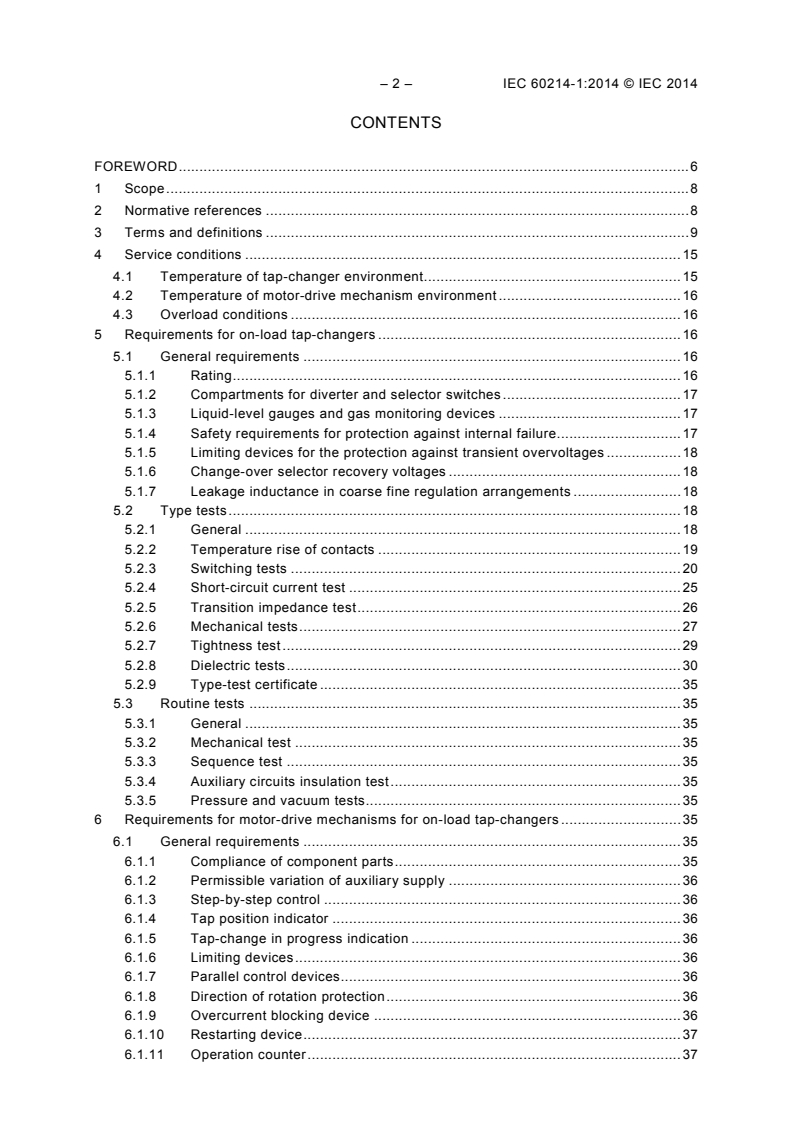
IEC 60214-1:2014 - Tap-changers - Part 1: Performance requirements and test methods Released:5/22/2014
Overview
IEC 60214-1:2014 - Tap-changers: Part 1 - Performance requirements and test methods defines performance requirements and standardized test methods for both on‑load and de‑energized tap‑changers and their motor‑drive mechanisms. The edition covers conventional oil‑immersed tap‑changers (mineral insulating oil per IEC 60296) and extends to vacuum, gas‑insulated, air‑insulated or other liquid‑immersed designs where applicable. It applies to tap‑changers used on power and distribution transformers and reactors (excluding railway rolling stock) and introduces updated type and routine test requirements to reflect modern service conditions.
Key topics and technical requirements
The standard specifies measurable performance criteria and test procedures, including:
- Ratings and general construction: required nameplate data, compartments, interlocks, and safety provisions.
- Service conditions: environmental and overload conditions for tap‑changers and motor drives.
- Type tests (typical list):
- Switching tests and service duty tests (resistor and reactor types)
- Temperature rise of contacts and resistors
- Short‑circuit current tests and transition impedance measurements
- Dielectric tests and voltage application sequences
- Mechanical tests, tightness, pressure/vacuum tests, and breaking/making capability
- Routine tests for production verification (mechanical sequences, insulation checks, pressure tests).
- Motor‑drive mechanism requirements: step control, position indication, limiting devices, mechanical load and overrun tests.
- De‑energized tap‑changer requirements: handles/drives, interlocks, dielectric and mechanical testing.
- Documentation and marking: nameplate data, warning labels, and manufacturers’ operating instructions.
Significant 2014 updates include explicit requirements for vacuum and gas‑insulated on‑load tap‑changers and alignment of type tests with contemporary service conditions (reference to IEC 60076‑3:2013).
Practical applications - who uses this standard
IEC 60214‑1 is essential for:
- Transformer and reactor manufacturers designing or specifying tap‑changers and motor drives.
- Test laboratories performing type and routine acceptance tests.
- Utilities and system operators setting procurement specs and acceptance criteria.
- OEMs, maintenance teams and asset managers for evaluation, replacement planning and safety compliance.
- Standards writers and certification bodies ensuring conformity to international test procedures.
Related standards
- IEC 60296 - Mineral insulating oils (relevant for oil‑immersed tap‑changers)
- IEC 60076‑3:2013 - Power transformers - Insulation levels, referenced for coordinating dielectric requirements
IEC 60214‑1:2014 provides the standardized test framework and acceptance limits needed to ensure reliable, safe tap‑changer performance across transformer and reactor applications.
Relations
- Effective Date
- 05-Sep-2023
Buy Documents
IEC 60214-1:2014 - Tap-changers - Part 1: Performance requirements and test methods Released:5/22/2014
IEC 60214-1:2014 - Tap-changers - Part 1: Performance requirements and test methods Released:5/22/2014
Get Certified
Connect with accredited certification bodies for this standard

IMQ S.p.A. (Certification)
Italian electrical product certification.

SLG Prüf- und Zertifizierungs GmbH
German testing and certification body.

UL Solutions
Global safety science company with testing, inspection and certification.
Sponsored listings
Frequently Asked Questions
IEC 60214-1:2014 is a standard published by the International Electrotechnical Commission (IEC). Its full title is "Tap-changers - Part 1: Performance requirements and test methods". This standard covers: IEC 60214-1:2014 applies to on-load tap-changers of both resistor and reactor types, de-energized tap-changers, and their motor-drive mechanisms. It applies mainly to tap-changers immersed in mineral insulating oil according to IEC 60296 but may also be used for tap-changers with air or gas insulation or immersed in other insulating liquids insofar as conditions are applicable. It applies mainly to tap-changers with arcing contacts but may also be used for arcing-free on-load tap-changers (such as electronic switching) insofar as conditions are applicable. This part of IEC 60214 applies to power and distribution transformers of all types and also to reactors. It does not apply to transformers and reactors mounted on railway rolling stock. This second edition cancels and replaces the first edition published in 2003. This edition constitutes a technical revision. This edition includes the following significant technical changes with respect to the previous edition: a) incorporation of requirements on vacuum type on-load tap-changers, b) incorporation of requirements on gas insulated tap-changers, c) changes in the type tests to fit with the service conditions, d) reference to the newest edition of IEC 60076-3:2013.
IEC 60214-1:2014 applies to on-load tap-changers of both resistor and reactor types, de-energized tap-changers, and their motor-drive mechanisms. It applies mainly to tap-changers immersed in mineral insulating oil according to IEC 60296 but may also be used for tap-changers with air or gas insulation or immersed in other insulating liquids insofar as conditions are applicable. It applies mainly to tap-changers with arcing contacts but may also be used for arcing-free on-load tap-changers (such as electronic switching) insofar as conditions are applicable. This part of IEC 60214 applies to power and distribution transformers of all types and also to reactors. It does not apply to transformers and reactors mounted on railway rolling stock. This second edition cancels and replaces the first edition published in 2003. This edition constitutes a technical revision. This edition includes the following significant technical changes with respect to the previous edition: a) incorporation of requirements on vacuum type on-load tap-changers, b) incorporation of requirements on gas insulated tap-changers, c) changes in the type tests to fit with the service conditions, d) reference to the newest edition of IEC 60076-3:2013.
IEC 60214-1:2014 is classified under the following ICS (International Classification for Standards) categories: 01 - GENERALITIES. TERMINOLOGY. STANDARDIZATION. DOCUMENTATION; 01.040.29 - Electrical engineering (Vocabularies); 29.020 - Electrical engineering in general; 29.180 - Transformers. Reactors. The ICS classification helps identify the subject area and facilitates finding related standards.
IEC 60214-1:2014 has the following relationships with other standards: It is inter standard links to IEC 60214-1:2003. Understanding these relationships helps ensure you are using the most current and applicable version of the standard.
IEC 60214-1:2014 is available in PDF format for immediate download after purchase. The document can be added to your cart and obtained through the secure checkout process. Digital delivery ensures instant access to the complete standard document.
Standards Content (Sample)
IEC 60214-1 ®
Edition 2.0 2014-05
INTERNATIONAL
STANDARD
colour
inside
Tap-changers –
Part 1: Performance requirements and test methods
All rights reserved. Unless otherwise specified, no part of this publication may be reproduced or utilized in any form
or by any means, electronic or mechanical, including photocopying and microfilm, without permission in writing from
either IEC or IEC's member National Committee in the country of the requester. If you have any questions about IEC
copyright or have an enquiry about obtaining additional rights to this publication, please contact the address below or
your local IEC member National Committee for further information.
IEC Central Office Tel.: +41 22 919 02 11
3, rue de Varembé Fax: +41 22 919 03 00
CH-1211 Geneva 20 info@iec.ch
Switzerland www.iec.ch
About the IEC
The International Electrotechnical Commission (IEC) is the leading global organization that prepares and publishes
International Standards for all electrical, electronic and related technologies.
About IEC publications
The technical content of IEC publications is kept under constant review by the IEC. Please make sure that you have the
latest edition, a corrigenda or an amendment might have been published.
IEC Catalogue - webstore.iec.ch/catalogue Electropedia - www.electropedia.org
The stand-alone application for consulting the entire The world's leading online dictionary of electronic and
bibliographical information on IEC International Standards, electrical terms containing more than 30 000 terms and
Technical Specifications, Technical Reports and other definitions in English and French, with equivalent terms in 14
documents. Available for PC, Mac OS, Android Tablets and additional languages. Also known as the International
iPad. Electrotechnical Vocabulary (IEV) online.
IEC publications search - www.iec.ch/searchpub IEC Glossary - std.iec.ch/glossary
The advanced search enables to find IEC publications by a More than 55 000 electrotechnical terminology entries in
variety of criteria (reference number, text, technical English and French extracted from the Terms and Definitions
committee,…). It also gives information on projects, replaced clause of IEC publications issued since 2002. Some entries
and withdrawn publications. have been collected from earlier publications of IEC TC 37,
77, 86 and CISPR.
IEC Just Published - webstore.iec.ch/justpublished
Stay up to date on all new IEC publications. Just Published IEC Customer Service Centre - webstore.iec.ch/csc
details all new publications released. Available online and If you wish to give us your feedback on this publication or
also once a month by email. need further assistance, please contact the Customer Service
Centre: csc@iec.ch.
IEC 60214-1 ®
Edition 2.0 2014-05
INTERNATIONAL
STANDARD
colour
inside
Tap-changers –
Part 1: Performance requirements and test methods
INTERNATIONAL
ELECTROTECHNICAL
COMMISSION
PRICE CODE
XC
ICS 29.180 ISBN 978-2-8322-1621-7
– 2 – IEC 60214-1:2014 © IEC:2014
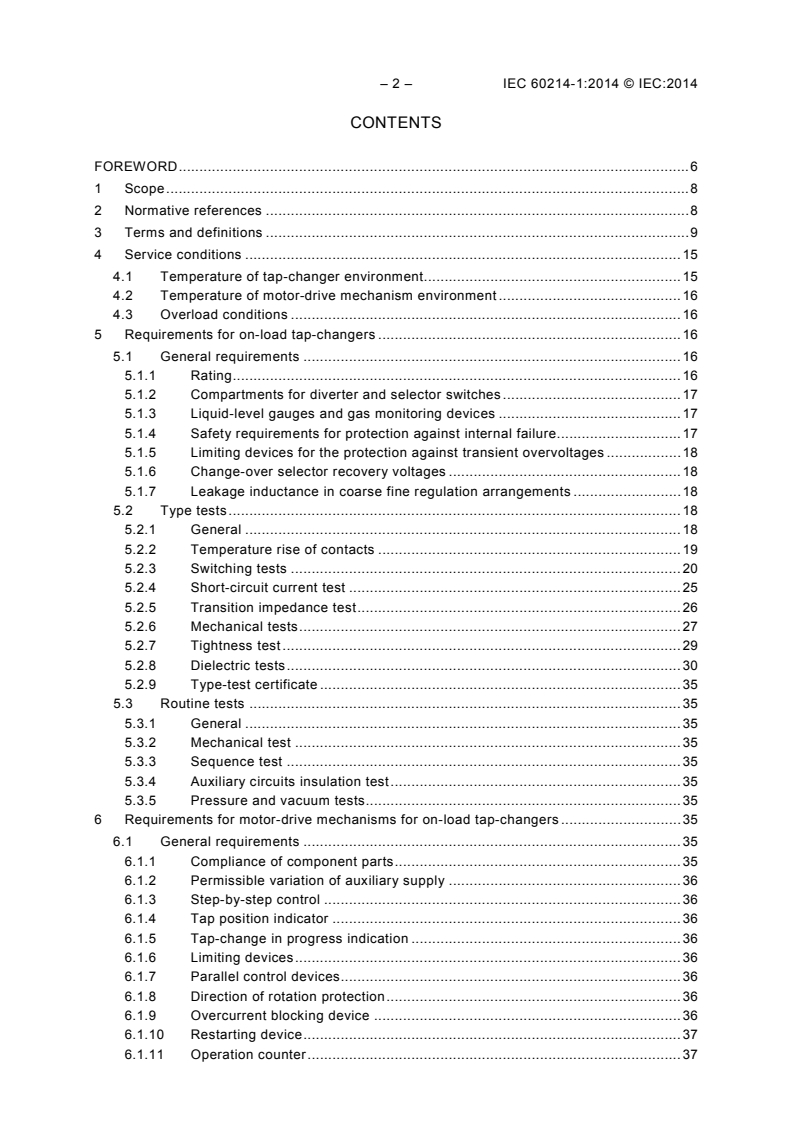
CONTENTS
FOREWORD . 6
1 Scope . 8
2 Normative references . 8
3 Terms and definitions . 9
4 Service conditions . 15
4.1 Temperature of tap-changer environment . 15
4.2 Temperature of motor-drive mechanism environment . 16
4.3 Overload conditions . 16
5 Requirements for on-load tap-changers . 16
5.1 General requirements . 16
5.1.1 Rating . 16
5.1.2 Compartments for diverter and selector switches . 17
5.1.3 Liquid-level gauges and gas monitoring devices . 17
5.1.4 Safety requirements for protection against internal failure. 17
5.1.5 Limiting devices for the protection against transient overvoltages . 18
5.1.6 Change-over selector recovery voltages . 18
5.1.7 Leakage inductance in coarse fine regulation arrangements . 18
5.2 Type tests . 18
5.2.1 General . 18
5.2.2 Temperature rise of contacts . 19
5.2.3 Switching tests . 20
5.2.4 Short-circuit current test . 25
5.2.5 Transition impedance test . 26
5.2.6 Mechanical tests . 27
5.2.7 Tightness test . 29
5.2.8 Dielectric tests . 30
5.2.9 Type-test certificate . 35
5.3 Routine tests . 35
5.3.1 General . 35
5.3.2 Mechanical test . 35
5.3.3 Sequence test . 35
5.3.4 Auxiliary circuits insulation test . 35
5.3.5 Pressure and vacuum tests . 35
6 Requirements for motor-drive mechanisms for on-load tap-changers . 35
6.1 General requirements . 35
6.1.1 Compliance of component parts . 35
6.1.2 Permissible variation of auxiliary supply . 36
6.1.3 Step-by-step control . 36
6.1.4 Tap position indicator . 36
6.1.5 Tap-change in progress indication . 36
6.1.6 Limiting devices . 36
6.1.7 Parallel control devices . 36
6.1.8 Direction of rotation protection . 36
6.1.9 Overcurrent blocking device . 36
6.1.10 Restarting device . 37
6.1.11 Operation counter . 37
6.1.12 Manual operation of the motor-drive mechanism . 37
6.1.13 Motor-drive cubicle . 37
6.1.14 Protective device against running-through . 37
6.1.15 Protection against access to hazardous parts . 37
6.2 Type tests . 37
6.2.1 Mechanical load test . 37
6.2.2 Overrun test . 38
6.2.3 Degree of protection of motor-drive cubicle. 38
6.3 Routine tests . 38
6.3.1 Mechanical tests . 38
6.3.2 Auxiliary circuits insulation test . 38
7 Requirements for de-energized tap-changers . 38
7.1 General requirements . 38
7.1.1 Rated characteristics . 38
7.1.2 Types . 39
7.1.3 Handles and drives . 39
7.1.4 Glands . 39
7.1.5 Interlocks . 39
7.1.6 Mechanical end stops . 39
7.2 Type tests . 40
7.2.1 General . 40
7.2.2 Temperature rise of contacts . 40
7.2.3 Short-circuit current test . 41
7.2.4 Mechanical tests . 41
7.2.5 Dielectric tests . 42
7.2.6 Type test certificate . 47
7.3 Routine tests . 47
7.3.1 Mechanical tests . 47
7.3.2 Pressure and vacuum tests . 47
8 Requirements for motor-drive mechanisms for de-energized tap-changers . 47
8.1 General requirements . 47
8.1.1 General . 47
8.1.2 Compliance of component parts . 47
8.1.3 Permissible variation of auxiliary supply . 47
8.1.4 Tap position indicator . 47
8.1.5 Limiting devices . 48
8.1.6 Operation counter . 48
8.1.7 Manual operation of the motor-drive mechanism . 48
8.1.8 Motor-drive cubicle . 48
8.1.9 Protection against access to hazardous parts . 48
8.2 Type tests . 48
8.2.1 Mechanical load test . 48
8.2.2 Overrun test . 49
8.2.3 Degree of protection of motor-drive cubicle. 49
8.3 Routine tests . 49
8.3.1 Mechanical tests . 49
8.3.2 Auxiliary circuits insulation test . 49
9 Nameplate . 49
9.1 Tap-changers (on-load and de-energized) . 49
– 4 – IEC 60214-1:2014 © IEC:2014
9.2 Motor-drive mechanisms . 50
10 De-energized tap-changer warning label . 50
11 Manufacturers operating instructions . 51
Annex A (normative) Supplementary information on switching duty on main and
transition contacts relating to resistor type tap-changers . 52
Annex B (normative) Supplementary information on switching duty relating to reactor
type tap-changers . 58
B.1 Additional test parameters . 58
B.1.1 Service duty test . 58
B.1.2 Breaking capacity test . 58
B.2 Duty of switching contacts . 58
Annex C (normative) Method for determining the equivalent temperature of the
transition resistor using power pulse current . 69
Annex D (informative) Simulated a.c. circuits for service duty and breaking capacity
tests . 70
D.1 General . 70
D.2 Transformer method. 70
D.3 Resistance method . 71
Annex E (informative) Example of a synthetic test circuit for service duty test of
vacuum type tap-changers . 73
E.1 Definitions with relevance to the synthetic test circuit . 73
E.1.1 Synthetic test circuit . 73
E.1.2 Simulated a.c. test circuit. 73
E.1.3 Pre-arc . 73
E.1.4 Making voltage . 73
E.2 Example for the test setup of a synthetic test circuit . 73
E.3 Example for the breaking/making condition during a switching operation. 74
Bibliography . 76
Figure 1 – Short-circuit test current (r.m.s. value) as a multiple of the maximum rated
through-current (on-load tap-changer) . 25
Figure 2 – Time sequence for the application of test voltage (on-load tap-changer) . 34
Figure 3 – Short-circuit test current (r.m.s. value) as a multiple of the maximum rated
through-current (de-energized tap-changer) . 41
Figure 4 – Time sequence for the application of test voltage (de-energized tap-
changer) . 46
Figure 5 – Warning label (example) . 50
Figure A.1 – Examples of current and voltage vectors for resistor type tap-changers . 53
Figure B.1 – Operating sequence of reactor type tap-changers with selector switch . 59
Figure B.2 – Current and voltage vectors for reactor type tap-changers with selector
switch . 60
Figure B.3 – Operating sequence of reactor type tap-changers with selector switch
and equalizer windings . 61
Figure B.4 – Current and voltage vectors for reactor type tap-changers with selector
switch and equalizer windings . 62
Figure B.5 – Operating sequence of a reactor type tap-changer with diverter switch
and tap selector . 64
Figure B.6 – Current and voltage vectors for reactor type tap-changers with diverter
switch and tap selector . 65
Figure B.7 – Operating sequence of a reactor type tap-changer with vacuum
interrupter and tap selector . 67
Figure B.8 – Current and voltage vectors for reactor type tap-changers with vacuum
interrupter and tap selector . 68
Figure D.1 – Simulated test circuit – Transformer method . 70
Figure D.2 – Simulated test circuit – Resistance method . 71
Figure E.1 – Synthetic test circuit for service duty test of vacuum type tap-changers . 73
Figure E.2 – Currents of the synthetic test circuit . 74
Figure E.3 – Example of the synthetic test for a switching operation with equal voltages
for breaking and making duty . 74
Table 1 – Temperature of tap-changer environment . 16
Table 2 – Contact temperature-rise limits for on-load tap-changers . 19
Table 3 – Test voltage levels for on-load tap-changers . 30
Table 4 – Contact temperature-rise limits for de-energized tap-changers . 40
Table 5 – Test voltage levels for de-energized tap-changers . 43
Table A.1 – Duty of main and transition contacts for resistor type tap-changers (non-
vacuum type) . 54
Table A.2 – Effect of load power-factor on circuit-breaking duty for resistor type tap-
changers (non-vacuum type) . 55
Table A.3 – Duty of main and transition contacts for resistor type tap-changers
(vacuum type) (1 of 2) . 56
Table B.1 – Duty of switching contacts for reactor type tap-changers with selector
switch – Switching direction from P1 to P5 . 59
Table B.2 – Duty of switching contacts for reactor type tap-changers with selector
switch and equalizer windings – Switching direction from P1 to P5 . 61
Table B.3 – Duty of switching contacts for reactor type tap-changers with diverter
switch and tap selector – Switching direction from P1 to P7 . 63
Table B.4 – Duty of switching contacts for reactor type tap-changers with vacuum
interrupter and tap selector – Switching direction from P1 to P11 . 66
– 6 – IEC 60214-1:2014 © IEC:2014
INTERNATIONAL ELECTROTECHNICAL COMMISSION
____________
TAP-CHANGERS –
Part 1: Performance requirements
and test methods
FOREWORD
1) The International Electrotechnical Commission (IEC) is a worldwide organization for standardization comprising
all national electrotechnical committees (IEC National Committees). The object of IEC is to promote
international co-operation on all questions concerning standardization in the electrical and electronic fields. To
this end and in addition to other activities, IEC publishes International Standards, Technical Specifications,
Technical Reports, Publicly Available Specifications (PAS) and Guides (hereafter referred to as “IEC
Publication(s)”). Their preparation is entrusted to technical committees; any IEC National Committee interested
in the subject dealt with may participate in this preparatory work. International, governmental and non-
governmental organizations liaising with the IEC also participate in this preparation. IEC collaborates closely
with the International Organization for Standardization (ISO) in accordance with conditions determined by
agreement between the two organizations.
2) The formal decisions or agreements of IEC on technical matters express, as nearly as possible, an international
consensus of opinion on the relevant subjects since each technical committee has representation from all
interested IEC National Committees.
3) IEC Publications have the form of recommendations for international use and are accepted by IEC National
Committees in that sense. While all reasonable efforts are made to ensure that the technical content of IEC
Publications is accurate, IEC cannot be held responsible for the way in which they are used or for any
misinterpretation by any end user.
4) In order to promote international uniformity, IEC National Committees undertake to apply IEC Publications
transparently to the maximum extent possible in their national and regional publications. Any divergence
between any IEC Publication and the corresponding national or regional publication shall be clearly indicated in
the latter.
5) IEC itself does not provide any attestation of conformity. Independent certification bodies provide conformity
assessment services and, in some areas, access to IEC marks of conformity. IEC is not responsible for any
services carried out by independent certification bodies.
6) All users should ensure that they have the latest edition of this publication.
7) No liability shall attach to IEC or its directors, employees, servants or agents including individual experts and
members of its technical committees and IEC National Committees for any personal injury, property damage or
other damage of any nature whatsoever, whether direct or indirect, or for costs (including legal fees) and
expenses arising out of the publication, use of, or reliance upon, this IEC Publication or any other IEC
Publications.
8) Attention is drawn to the Normative references cited in this publication. Use of the referenced publications is
indispensable for the correct application of this publication.
9) Attention is drawn to the possibility that some of the elements of this IEC Publication may be the subject of
patent rights. IEC shall not be held responsible for identifying any or all such patent rights.
International Standard IEC 60214-1 has been prepared by IEC technical committee 14: Power
transformers.
This second edition cancels and replaces the first edition published in 2003. This edition
constitutes a technical revision.
This edition includes the following significant technical changes with respect to the previous
edition:
• incorporation of requirements on vacuum type on-load tap-changers,
• incorporation of requirements on gas insulated tap-changers,
• changes in the type tests to fit with the service conditions,
• reference to the newest edition of IEC 60076-3:2013.
The text of this standard is based on the following documents:
CDV Report on voting
14/746/CDV 14/767A/RVC
Full information on the voting for the approval of this standard can be found in the report on
voting indicated in the above table.
This publication has been drafted in accordance with the ISO/IEC Directives, Part 2.
A list of all parts in the IEC 60214 series, published under the general title Tap-changers, can
be found on the IEC website.
The committee has decided that the contents of this publication will remain unchanged until
the stability date indicated on the IEC web site under "http://webstore.iec.ch" in the data
related to the specific publication. At this date, the publication will be
• reconfirmed,
• withdrawn,
• replaced by a revised edition, or
• amended.
A bilingual version of this publication may be issued at a later date.
IMPORTANT – The 'colour inside' logo on the cover page of this publication indicates
that it contains colours which are considered to be useful for the correct
understanding of its contents. Users should therefore print this document using a
colour printer.
– 8 – IEC 60214-1:2014 © IEC:2014
TAP-CHANGERS –
Part 1: Performance requirements
and test methods
1 Scope
This part of IEC 60214 applies to on-load tap-changers of both resistor and reactor types, de-
energized tap-changers, and their motor-drive mechanisms.
It applies mainly to tap-changers immersed in mineral insulating oil according to IEC 60296
but may also be used for tap-changers with air or gas insulation or immersed in other
insulating liquids insofar as conditions are applicable.
It applies mainly to tap-changers with arcing contacts but may also be used for arcing-free on-
load tap-changers (such as electronic switching) insofar as conditions are applicable.
This part of IEC 60214 applies to power and distribution transformers of all types and also to
reactors.
It does not apply to transformers and reactors mounted on railway rolling stock.
2 Normative references
The following documents, in whole or in part, are normatively referenced in this document and
are indispensable for its application. For dated references, only the edition cited applies. For
undated references, the latest edition of the referenced document (including any
amendments) applies.
IEC 60050 (all parts), International Electrotechnical Vocabulary (available at
http://www.electropedia.org)
IEC 60050-421, International Electrotechnical Vocabulary – Chapter 421: Power transformers
and reactors
IEC 60060-1, High voltage test techniques – Part 1: General definitions and test requirements
IEC 60076-3:2013, Power transformers – Part 3: Insulation levels, dielectric tests and external
clearances in air
IEC 60076-7:2005, Power transformers – Part 7: Loading guide for oil-immersed power
transformers
IEC 60076-21:2011, Power transformers – Part 21: Standard requirements, terminology, and
test code for step-voltage regulators
IEC 60137:2008, Insulated bushings for alternating voltages above 1 000 V
IEC 60214-2:2004, Tap-changers – Part 2: Application guide
IEC 60270, High-voltage test techniques – Partial discharge measurements
IEC 60296, Fluids for electrotechnical applications – Unused mineral insulating oils for
transformers and switchgear
IEC 60529, Degrees of protection provided by enclosures (IP Code)
3 Terms and definitions
For the purposes of this document, the terms and definitions given in IEC 60050-421 as well
as the following apply.
3.1
on-load tap-changer
OLTC
device for changing the tap connections of a winding, suitable for operation while the
transformer is energized or on load
Note 1 to entry: On-load tap-changers are sometimes called load tap-changers (LTC).
3.2
non-vacuum type on-load tap-changer
on-load tap-changer with contacts that break and make the load and circulating currents and
where the arcing takes place in a liquid or gas, the tap-changer itself being placed in liquid or
gas
Note 1 to entry: This definition does not apply to arcing-free on-load tap-changers.
3.3
vacuum type on-load tap-changer
on-load tap-changer where vacuum interrupters (VI) break and make the load and circulating
currents, the tap-changer itself being placed in a different medium such as liquid or gas
3.4
tap selector
device designed to carry, but not to make or break, current, used in conjunction with a
diverter switch to select tap connections
3.5
diverter switch
switching device used in conjunction with a tap selector to carry, make and break currents in
circuits which have already been selected
Note 1 to entry: Diverter switches are sometimes called arcing switches.
3.6
selector switch
switching device capable of carrying, making and breaking current, combining the duties of
a tap selector and a diverter switch
Note 1 to entry: Selector switches are sometimes called arcing tap switches.
Note 2 to entry: In non-vacuum type selector switches the selection of tap connections (tap selector duty) and the
diversion of the through-current (diverter switch duty) are carried out by the same contacts.
Note 3 to entry: In vacuum type selector switches the selection of tap connections (tap selector duty) and the
diversion of the through-current (diverter switch duty) are carried out by different contacts.
– 10 – IEC 60214-1:2014 © IEC:2014
3.7
de-energized tap-changer
DETC
device for changing the tap connections of a winding, suitable for operation only while the
transformer is de-energized (isolated from the system)
Note 1 to entry: De-energized tap-changers are sometimes called off-circuit tap-changers.
Note 2 to entry: De-energized tap-changers are sometimes abbreviated as DTC.
3.8
change-over selector
device designed to carry, but not to make or break, through-current, used in conjunction with
the tap selector or selector switch to enable its contacts and the connected taps to be used
more than once when moving from one extreme position to the other
3.9
coarse change-over selector
change-over selector connecting the tap winding to either the main winding or the coarse
winding or parts thereof
3.10
reversing change-over selector
change-over selector connecting either end of the tap winding to the main winding
3.11
transition impedance
resistor or reactor consisting of one or more units bridging the tap in use and the tap next to
be used, for the purpose of transferring load from one tap to the other without interruption or
appreciable change in the load current, at the same time limiting the circulating current for the
period that both taps are used
Note 1 to entry: For reactor type tap-changers, the transition impedance (reactor) is commonly called a preventive
auto transformer. Reactor type tap-changers normally use the bridging position as a service position (mid-point or
centre tapped reactor tap-changers) and, therefore, the reactor is designed for continuous operation.
3.12
preventive auto transformer
auto transformer (or centre tapped reactor) used in on-load tap-changing and regulating
transformers, or step voltage regulators to limit the circulating current when operating on a
position in which two adjacent taps are bridged, or during the change of tap between adjacent
positions
3.13
equalizer winding
winding on the same magnetic circuit (core) as the excitation and tap winding of a reactor
type regulating transformer with approximately half the number of turns of each tap section
3.14
drive mechanism
means by which the drive to the tap-changer is actuated
Note 1 to entry: The mechanism may include an independent means of storing energy to control the operation.
3.15
set of contacts
pair of individual fixed and moving contacts or a combination of such pairs operating
substantially simultaneously
3.16
diverter switch and selector switch main contacts
set of through-current carrying contacts which usually by-passes the main switching contact
and only commutates any current (sparking often occurs)
3.17
diverter switch and selector switch main switching contacts
changer>
set of contacts which has no transition resistor between the transformer winding and the
contacts and makes and breaks current (arcing will occur)
Note 1 to entry: In case of vacuum type tap-changers, these contact systems are replaced by vacuum
interrupters.
3.18
diverter switch and selector switch transition contacts,
set of contacts which is connected in series with a transition resistor and makes or breaks
current (arcing will occur)
Note 1 to entry: In case of vacuum type tap-changers, these contact systems are replaced by vacuum
interrupters.
3.19
transfer contacts
set of contacts that makes or breaks current
Note 1 to entry: Where by-pass contacts are not provided, the transfer contact is a continuous current-carrying
contact.
3.20
by-pass contacts
set of through-current carrying contacts that commutates the current to the transfer contacts
without any arc (sparking may occur)
3.21
bridging position
position of a reactor type tap-changer with the selector and transfer contacts being on two
adjacent taps and with the output terminal being electrically in the middle between two
adjacent taps
3.22
non-bridging position
position of a reactor type tap-changer with the selector and transfer contacts being on the
same tap
3.23
circulating current
that part of the current that flows through the transition impedance at the time when two taps
are momentarily bridged during a tap-change operation for a resistor type tap-changer or
when bridged in an operating position for a reactor type tap-changer
Note 1 to entry: The circulating current is due to the voltage difference between the taps.
3.24
switched current
prospective current to be broken during switching operation by each set of main switching or
transition contacts (resistor type tap-changer) or transfer contacts (reactor type tap-changer)
incorporated in the diverter switch or the selector switch
– 12 – IEC 60214-1:2014 © IEC:2014
3.25
recovery voltage
power-frequency voltage which appears across each set of main switching or transition
contacts (resistor type tap-changer) or transfer contacts (reactor type tap-changer) of the
diverter switch or selector switch after these contacts have broken the switched current
3.26
tap-change operation
complete sequence of events from the initiation to the completion of a tap-change from one
service tap position to an adjacent position
3.27
cycle of operation
movement of the tap-changer from one end of its range to the other end and the return to its
original position
3.28
rated insulation level
withstand values of the impulse and applied voltages to earth, and where appropriate between
phases, and between those parts where insulation is required
3.29
rated through-current
I
r
current flowing through an on-load tap-changer towards the external circuit, which the
apparatus is capable of transferring from one tap to the other at the relevant rated step
voltage and which can be carried continuously while meeting the requirements of this
standard
3.30
maximum rated through-current
I
rm
highest rated through-current for which the tap-changer is designed for and all the current
related tests are based on
3.31
rated step voltage
U
ir
for each value of rated through-current, the highest permissible voltage between terminals
which are intended to be connected to successive taps of the transformer
3.32
relevant rated step voltage
highest step voltage permitted in connection with a given rated through-current
3.33
maximum rated step voltage
U
irm
highest value of the rated step voltage for which the tap-changer is designed
3.34
rated frequency
frequency of the alternating current for which the tap-changer is designed
3.35
number of inherent tap positions
highest number of tap positions for half a cycle of operation for which a tap-changer can be
used according to its design
Note 1 to entry: The term “tap positions” is generally given as the ± value of the relevant number, for example,
±11 positions. They are in principle also valid for the motor-driven mechanism. When using a “number of tap
positions” in connection with a transformer, this always refers to the number of service tap positions of the
transformer.
3.36
number of service tap positions
number of tap positions for half a cycle of operation for which a tap-changer is used in the
transformer
Note 1 to entry: The term “tap position” is generally given as the ± values of the relevant number, for example,
±11 positions. They are in principle also valid for the motor-driven mechanism. When using the term “number of tap
positions” in connection with a transformer, this always refers to the number of service tap positions of the
transformer.
3.37
type test
test made on a tap-changer which is representative of other tap-changers, to demonstrate that
these tap-changers comply with the specified requirements not covered by the routine tests: a
tap-changer is considered to be representative of others if it is built to the same drawings
using the same techniques and same materials
Note 1 to entry: In general a type test can be carried out on a tap-changer or the components of a tap-changer or
a family of tap-changers or components.
Note 2 to entry: A family of tap-changers is a number of tap-changers based on the same design and having the
same characteristics, with the exception of the insulation levels to earth and possibly between phases, the number
of steps and in the case of OLTCs the value of the transition impedance.
Note 3 to entry: Design variations that are clearly irrelevant to a particular type test would not require that type
test to be repeated.
Note 4 to entry: Design variations that cause a reduction in values and stresses relevant to a particular type test
do not require a new type test if accepted by the purchaser and the manufacturer.
3.38
routine test
test to which each individual tap-changer is subjected
Note 1 to entry: In general a routine test can be carried out on a tap-changer or the components of a tap-changer.
3.39
motor-drive mechanism
driving mechanism which incorporates an electric motor and a control circuit
3.40
step-by-step control
device for stopping the motor-drive mechanism after completion of a tap-change,
independently of the operating sequence of the control switch
3.41
tap position indicator
device for indicating the tap position of the tap-changer
3.42
tap-change in progress indicator
device for indicating that the motor-drive mechanism is running
3.43
limit switches
devices for preventing operation of the tap-changer beyond either end position, but allowing
operation in the opposite direction
– 14 – IEC 60214-1:2014 © IEC:2014
3.44
mechanical end stop
device which physically prevents operation of the tap-changer beyond either end position, but
allows operation in the opposite direction
3.45
parallel control device
control device to move, in the case of parallel operation of several transformers with taps, all
tap-changers to the required position and to avoid divergence of the respective motor-drive
mechanisms
Note 1 to entry: Such devices would be necessary also in the case of single-phase transformers forming a three-
phase bank when each single-phase tap-changer is fitted with its own motor-drive mechanisms.
3.46
emergency tripping device
device for stopping the motor-drive mechanism at any time in such a way that a special action
has to be performed before the next tap-change operation can be started
3.47
overcurrent blocking device
device for preventing or interrupting operation of the motor-drive mechanism for the period in
which an overcurrent exceeding a pre-set value is flowing in the transformer winding
Note 1 to entry: Where diverter or selector switches are actuated by spring energy systems, interruption of the
operation of the motor-drive mechanism will not prevent operation of the diverter or selector switch if the spring
release has been actuated.
3.48
restarting device
device designed to restart the motor-drive mechanism after an interruption of the supply
voltage to complete a tap-change operation already initiated
3.49
operation counter
device for indicating the number of tap-changes accomplished
3.50
manual operation of a motor-drive mech
...
IEC 60214-1 ®
Edition 2.0 2014-05
INTERNATIONAL
STANDARD
NORME
INTERNATIONALE
colour
inside
Tap-changers –
Part 1: Performance requirements and test methods
Changeurs de prises –
Partie 1: Prescriptions de performances et méthodes d’essai
All rights reserved. Unless otherwise specified, no part of this publication may be reproduced or utilized in any form
or by any means, electronic or mechanical, including photocopying and microfilm, without permission in writing from
either IEC or IEC's member National Committee in the country of the requester. If you have any questions about IEC
copyright or have an enquiry about obtaining additional rights to this publication, please contact the address below or
your local IEC member National Committee for further information.
Droits de reproduction réservés. Sauf indication contraire, aucune partie de cette publication ne peut être reproduite
ni utilisée sous quelque forme que ce soit et par aucun procédé, électronique ou mécanique, y compris la photocopie
et les microfilms, sans l'accord écrit de l'IEC ou du Comité national de l'IEC du pays du demandeur. Si vous avez des
questions sur le copyright de l'IEC ou si vous désirez obtenir des droits supplémentaires sur cette publication, utilisez
les coordonnées ci-après ou contactez le Comité national de l'IEC de votre pays de résidence.
IEC Central Office Tel.: +41 22 919 02 11
3, rue de Varembé Fax: +41 22 919 03 00
CH-1211 Geneva 20 info@iec.ch
Switzerland www.iec.ch
About the IEC
The International Electrotechnical Commission (IEC) is the leading global organization that prepares and publishes
International Standards for all electrical, electronic and related technologies.
About IEC publications
The technical content of IEC publications is kept under constant review by the IEC. Please make sure that you have the
latest edition, a corrigenda or an amendment might have been published.
IEC Catalogue - webstore.iec.ch/catalogue Electropedia - www.electropedia.org
The stand-alone application for consulting the entire The world's leading online dictionary of electronic and
bibliographical information on IEC International Standards, electrical terms containing more than 30 000 terms and
Technical Specifications, Technical Reports and other definitions in English and French, with equivalent terms in 14
documents. Available for PC, Mac OS, Android Tablets and additional languages. Also known as the International
iPad. Electrotechnical Vocabulary (IEV) online.
IEC publications search - www.iec.ch/searchpub IEC Glossary - std.iec.ch/glossary
The advanced search enables to find IEC publications by a More than 55 000 electrotechnical terminology entries in
variety of criteria (reference number, text, technical English and French extracted from the Terms and Definitions
committee,…). It also gives information on projects, replaced clause of IEC publications issued since 2002. Some entries
and withdrawn publications. have been collected from earlier publications of IEC TC 37,
77, 86 and CISPR.
IEC Just Published - webstore.iec.ch/justpublished
Stay up to date on all new IEC publications. Just Published IEC Customer Service Centre - webstore.iec.ch/csc
details all new publications released. Available online and If you wish to give us your feedback on this publication or
also once a month by email. need further assistance, please contact the Customer Service
Centre: csc@iec.ch.
A propos de l'IEC
La Commission Electrotechnique Internationale (IEC) est la première organisation mondiale qui élabore et publie des
Normes internationales pour tout ce qui a trait à l'électricité, à l'électronique et aux technologies apparentées.
A propos des publications IEC
Le contenu technique des publications IEC est constamment revu. Veuillez vous assurer que vous possédez l’édition la
plus récente, un corrigendum ou amendement peut avoir été publié.
Catalogue IEC - webstore.iec.ch/catalogue Electropedia - www.electropedia.org
Application autonome pour consulter tous les renseignements
Le premier dictionnaire en ligne de termes électroniques et
bibliographiques sur les Normes internationales,
électriques. Il contient plus de 30 000 termes et définitions en
Spécifications techniques, Rapports techniques et autres
anglais et en français, ainsi que les termes équivalents dans
documents de l'IEC. Disponible pour PC, Mac OS, tablettes
14 langues additionnelles. Egalement appelé Vocabulaire
Android et iPad.
Electrotechnique International (IEV) en ligne.
Recherche de publications IEC - www.iec.ch/searchpub
Glossaire IEC - std.iec.ch/glossary
Plus de 55 000 entrées terminologiques électrotechniques, en
La recherche avancée permet de trouver des publications IEC
en utilisant différents critères (numéro de référence, texte, anglais et en français, extraites des articles Termes et
comité d’études,…). Elle donne aussi des informations sur les Définitions des publications IEC parues depuis 2002. Plus
projets et les publications remplacées ou retirées. certaines entrées antérieures extraites des publications des
CE 37, 77, 86 et CISPR de l'IEC.
IEC Just Published - webstore.iec.ch/justpublished
Service Clients - webstore.iec.ch/csc
Restez informé sur les nouvelles publications IEC. Just
Published détaille les nouvelles publications parues. Si vous désirez nous donner des commentaires sur cette
Disponible en ligne et aussi une fois par mois par email. publication ou si vous avez des questions contactez-nous:
csc@iec.ch.
IEC 60214-1 ®
Edition 2.0 2014-05
INTERNATIONAL
STANDARD
NORME
INTERNATIONALE
colour
inside
Tap-changers –
Part 1: Performance requirements and test methods
Changeurs de prises –
Partie 1: Prescriptions de performances et méthodes d’essai
INTERNATIONAL
ELECTROTECHNICAL
COMMISSION
COMMISSION
ELECTROTECHNIQUE
PRICE CODE
INTERNATIONALE
CODE PRIX XC
ICS 29.180 ISBN 978-2-8322-1988-1
– 2 – IEC 60214-1:2014 © IEC 2014
CONTENTS
FOREWORD . 6
1 Scope . 8
2 Normative references . 8
3 Terms and definitions . 9
4 Service conditions . 15
4.1 Temperature of tap-changer environment . 15
4.2 Temperature of motor-drive mechanism environment . 16
4.3 Overload conditions . 16
5 Requirements for on-load tap-changers . 16
5.1 General requirements . 16
5.1.1 Rating . 16
5.1.2 Compartments for diverter and selector switches . 17
5.1.3 Liquid-level gauges and gas monitoring devices . 17
5.1.4 Safety requirements for protection against internal failure. 17
5.1.5 Limiting devices for the protection against transient overvoltages . 18
5.1.6 Change-over selector recovery voltages . 18
5.1.7 Leakage inductance in coarse fine regulation arrangements . 18
5.2 Type tests . 18
5.2.1 General . 18
5.2.2 Temperature rise of contacts . 19
5.2.3 Switching tests . 20
5.2.4 Short-circuit current test . 25
5.2.5 Transition impedance test . 26
5.2.6 Mechanical tests . 27
5.2.7 Tightness test . 29
5.2.8 Dielectric tests . 30
5.2.9 Type-test certificate . 35
5.3 Routine tests . 35
5.3.1 General . 35
5.3.2 Mechanical test . 35
5.3.3 Sequence test . 35
5.3.4 Auxiliary circuits insulation test . 35
5.3.5 Pressure and vacuum tests . 35
6 Requirements for motor-drive mechanisms for on-load tap-changers . 35
6.1 General requirements . 35
6.1.1 Compliance of component parts . 35
6.1.2 Permissible variation of auxiliary supply . 36
6.1.3 Step-by-step control . 36
6.1.4 Tap position indicator . 36
6.1.5 Tap-change in progress indication . 36
6.1.6 Limiting devices . 36
6.1.7 Parallel control devices . 36
6.1.8 Direction of rotation protection . 36
6.1.9 Overcurrent blocking device . 36
6.1.10 Restarting device . 37
6.1.11 Operation counter . 37
6.1.12 Manual operation of the motor-drive mechanism . 37
6.1.13 Motor-drive cubicle . 37
6.1.14 Protective device against running-through . 37
6.1.15 Protection against access to hazardous parts . 37
6.2 Type tests . 37
6.2.1 Mechanical load test . 37
6.2.2 Overrun test . 38
6.2.3 Degree of protection of motor-drive cubicle. 38
6.3 Routine tests . 38
6.3.1 Mechanical tests . 38
6.3.2 Auxiliary circuits insulation test . 38
7 Requirements for de-energized tap-changers . 38
7.1 General requirements . 38
7.1.1 Rated characteristics . 38
7.1.2 Types . 39
7.1.3 Handles and drives . 39
7.1.4 Glands . 39
7.1.5 Interlocks . 39
7.1.6 Mechanical end stops . 39
7.2 Type tests . 40
7.2.1 General . 40
7.2.2 Temperature rise of contacts . 40
7.2.3 Short-circuit current test . 41
7.2.4 Mechanical tests . 41
7.2.5 Dielectric tests . 42
7.2.6 Type test certificate . 47
7.3 Routine tests . 47
7.3.1 Mechanical tests . 47
7.3.2 Pressure and vacuum tests . 47
8 Requirements for motor-drive mechanisms for de-energized tap-changers . 47
8.1 General requirements . 47
8.1.1 General . 47
8.1.2 Compliance of component parts . 47
8.1.3 Permissible variation of auxiliary supply . 47
8.1.4 Tap position indicator . 47
8.1.5 Limiting devices . 48
8.1.6 Operation counter . 48
8.1.7 Manual operation of the motor-drive mechanism . 48
8.1.8 Motor-drive cubicle . 48
8.1.9 Protection against access to hazardous parts . 48
8.2 Type tests . 48
8.2.1 Mechanical load test . 48
8.2.2 Overrun test . 49
8.2.3 Degree of protection of motor-drive cubicle. 49
8.3 Routine tests . 49
8.3.1 Mechanical tests . 49
8.3.2 Auxiliary circuits insulation test . 49
9 Nameplate . 49
9.1 Tap-changers (on-load and de-energized) . 49
– 4 – IEC 60214-1:2014 © IEC 2014
9.2 Motor-drive mechanisms . 50
10 De-energized tap-changer warning label . 50
11 Manufacturers operating instructions . 51
Annex A (normative) Supplementary information on switching duty on main and
transition contacts relating to resistor type tap-changers . 52
Annex B (normative) Supplementary information on switching duty relating to reactor
type tap-changers . 58
B.1 Additional test parameters . 58
B.1.1 Service duty test . 58
B.1.2 Breaking capacity test . 58
B.2 Duty of switching contacts . 58
Annex C (normative) Method for determining the equivalent temperature of the
transition resistor using power pulse current . 69
Annex D (informative) Simulated a.c. circuits for service duty and breaking capacity
tests . 70
D.1 General . 70
D.2 Transformer method. 70
D.3 Resistance method . 71
Annex E (informative) Example of a synthetic test circuit for service duty test of
vacuum type tap-changers . 73
E.1 Definitions with relevance to the synthetic test circuit . 73
E.1.1 Synthetic test circuit . 73
E.1.2 Simulated a.c. test circuit. 73
E.1.3 Pre-arc . 73
E.1.4 Making voltage . 73
E.2 Example for the test setup of a synthetic test circuit . 73
E.3 Example for the breaking/making condition during a switching operation. 74
Bibliography . 76
Figure 1 – Short-circuit test current (r.m.s. value) as a multiple of the maximum rated
through-current (on-load tap-changer) . 25
Figure 2 – Time sequence for the application of test voltage (on-load tap-changer) . 34
Figure 3 – Short-circuit test current (r.m.s. value) as a multiple of the maximum rated
through-current (de-energized tap-changer) . 41
Figure 4 – Time sequence for the application of test voltage (de-energized tap-
changer) . 46
Figure 5 – Warning label (example) . 50
Figure A.1 – Examples of current and voltage vectors for resistor type tap-changers . 53
Figure B.1 – Operating sequence of reactor type tap-changers with selector switch . 59
Figure B.2 – Current and voltage vectors for reactor type tap-changers with selector
switch . 60
Figure B.3 – Operating sequence of reactor type tap-changers with selector switch
and equalizer windings . 61
Figure B.4 – Current and voltage vectors for reactor type tap-changers with selector
switch and equalizer windings . 62
Figure B.5 – Operating sequence of a reactor type tap-changer with diverter switch
and tap selector . 64
Figure B.6 – Current and voltage vectors for reactor type tap-changers with diverter
switch and tap selector . 65
Figure B.7 – Operating sequence of a reactor type tap-changer with vacuum
interrupter and tap selector . 67
Figure B.8 – Current and voltage vectors for reactor type tap-changers with vacuum
interrupter and tap selector . 68
Figure D.1 – Simulated test circuit – Transformer method . 70
Figure D.2 – Simulated test circuit – Resistance method . 71
Figure E.1 – Synthetic test circuit for service duty test of vacuum type tap-changers . 73
Figure E.2 – Currents of the synthetic test circuit . 74
Figure E.3 – Example of the synthetic test for a switching operation with equal voltages
for breaking and making duty . 74
Table 1 – Temperature of tap-changer environment . 16
Table 2 – Contact temperature-rise limits for on-load tap-changers . 19
Table 3 – Test voltage levels for on-load tap-changers . 30
Table 4 – Contact temperature-rise limits for de-energized tap-changers . 40
Table 5 – Test voltage levels for de-energized tap-changers . 43
Table A.1 – Duty of main and transition contacts for resistor type tap-changers (non-
vacuum type) . 54
Table A.2 – Effect of load power-factor on circuit-breaking duty for resistor type tap-
changers (non-vacuum type) . 55
Table A.3 – Duty of main and transition contacts for resistor type tap-changers
(vacuum type) (1 of 2) . 56
Table B.1 – Duty of switching contacts for reactor type tap-changers with selector
switch – Switching direction from P1 to P5 . 59
Table B.2 – Duty of switching contacts for reactor type tap-changers with selector
switch and equalizer windings – Switching direction from P1 to P5 . 61
Table B.3 – Duty of switching contacts for reactor type tap-changers with diverter
switch and tap selector – Switching direction from P1 to P7 . 63
Table B.4 – Duty of switching contacts for reactor type tap-changers with vacuum
interrupter and tap selector – Switching direction from P1 to P11 . 66
– 6 – IEC 60214-1:2014 © IEC 2014
INTERNATIONAL ELECTROTECHNICAL COMMISSION
____________
TAP-CHANGERS –
Part 1: Performance requirements
and test methods
FOREWORD
1) The International Electrotechnical Commission (IEC) is a worldwide organization for standardization comprising
all national electrotechnical committees (IEC National Committees). The object of IEC is to promote
international co-operation on all questions concerning standardization in the electrical and electronic fields. To
this end and in addition to other activities, IEC publishes International Standards, Technical Specifications,
Technical Reports, Publicly Available Specifications (PAS) and Guides (hereafter referred to as “IEC
Publication(s)”). Their preparation is entrusted to technical committees; any IEC National Committee interested
in the subject dealt with may participate in this preparatory work. International, governmental and non-
governmental organizations liaising with the IEC also participate in this preparation. IEC collaborates closely
with the International Organization for Standardization (ISO) in accordance with conditions determined by
agreement between the two organizations.
2) The formal decisions or agreements of IEC on technical matters express, as nearly as possible, an international
consensus of opinion on the relevant subjects since each technical committee has representation from all
interested IEC National Committees.
3) IEC Publications have the form of recommendations for international use and are accepted by IEC National
Committees in that sense. While all reasonable efforts are made to ensure that the technical content of IEC
Publications is accurate, IEC cannot be held responsible for the way in which they are used or for any
misinterpretation by any end user.
4) In order to promote international uniformity, IEC National Committees undertake to apply IEC Publications
transparently to the maximum extent possible in their national and regional publications. Any divergence
between any IEC Publication and the corresponding national or regional publication shall be clearly indicated in
the latter.
5) IEC itself does not provide any attestation of conformity. Independent certification bodies provide conformity
assessment services and, in some areas, access to IEC marks of conformity. IEC is not responsible for any
services carried out by independent certification bodies.
6) All users should ensure that they have the latest edition of this publication.
7) No liability shall attach to IEC or its directors, employees, servants or agents including individual experts and
members of its technical committees and IEC National Committees for any personal injury, property damage or
other damage of any nature whatsoever, whether direct or indirect, or for costs (including legal fees) and
expenses arising out of the publication, use of, or reliance upon, this IEC Publication or any other IEC
Publications.
8) Attention is drawn to the Normative references cited in this publication. Use of the referenced publications is
indispensable for the correct application of this publication.
9) Attention is drawn to the possibility that some of the elements of this IEC Publication may be the subject of
patent rights. IEC shall not be held responsible for identifying any or all such patent rights.
International Standard IEC 60214-1 has been prepared by IEC technical committee 14: Power
transformers.
This second edition cancels and replaces the first edition published in 2003. This edition
constitutes a technical revision.
This edition includes the following significant technical changes with respect to the previous
edition:
• incorporation of requirements on vacuum type on-load tap-changers,
• incorporation of requirements on gas insulated tap-changers,
• changes in the type tests to fit with the service conditions,
• reference to the newest edition of IEC 60076-3:2013.
This bilingual version (2014-12) corresponds to the monolingual English version, published in
2014-05.
The text of this standard is based on the following documents:
CDV Report on voting
14/746/CDV 14/767A/RVC
Full information on the voting for the approval of this standard can be found in the report on
voting indicated in the above table.
The French version of this standard has not been voted upon.
This publication has been drafted in accordance with the ISO/IEC Directives, Part 2.
A list of all parts in the IEC 60214 series, published under the general title Tap-changers, can
be found on the IEC website.
The committee has decided that the contents of this publication will remain unchanged until
the stability date indicated on the IEC web site under "http://webstore.iec.ch" in the data
related to the specific publication. At this date, the publication will be
• reconfirmed,
• withdrawn,
• replaced by a revised edition, or
• amended.
IMPORTANT – The 'colour inside' logo on the cover page of this publication indicates
that it contains colours which are considered to be useful for the correct
understanding of its contents. Users should therefore print this document using a
colour printer.
– 8 – IEC 60214-1:2014 © IEC 2014
TAP-CHANGERS –
Part 1: Performance requirements
and test methods
1 Scope
This part of IEC 60214 applies to on-load tap-changers of both resistor and reactor types, de-
energized tap-changers, and their motor-drive mechanisms.
It applies mainly to tap-changers immersed in mineral insulating oil according to IEC 60296
but may also be used for tap-changers with air or gas insulation or immersed in other
insulating liquids insofar as conditions are applicable.
It applies mainly to tap-changers with arcing contacts but may also be used for arcing-free on-
load tap-changers (such as electronic switching) insofar as conditions are applicable.
This part of IEC 60214 applies to power and distribution transformers of all types and also to
reactors.
It does not apply to transformers and reactors mounted on railway rolling stock.
2 Normative references
The following documents, in whole or in part, are normatively referenced in this document and
are indispensable for its application. For dated references, only the edition cited applies. For
undated references, the latest edition of the referenced document (including any
amendments) applies.
IEC 60050 (all parts), International Electrotechnical Vocabulary (available at
http://www.electropedia.org)
IEC 60050-421, International Electrotechnical Vocabulary – Chapter 421: Power transformers
and reactors
IEC 60060-1, High voltage test techniques – Part 1: General definitions and test requirements
IEC 60076-3:2013, Power transformers – Part 3: Insulation levels, dielectric tests and external
clearances in air
IEC 60076-7:2005, Power transformers – Part 7: Loading guide for oil-immersed power
transformers
IEC 60076-21:2011, Power transformers – Part 21: Standard requirements, terminology, and
test code for step-voltage regulators
IEC 60137:2008, Insulated bushings for alternating voltages above 1 000 V
IEC 60214-2:2004, Tap-changers – Part 2: Application guide
IEC 60270, High-voltage test techniques – Partial discharge measurements
IEC 60296, Fluids for electrotechnical applications – Unused mineral insulating oils for
transformers and switchgear
IEC 60529, Degrees of protection provided by enclosures (IP Code)
3 Terms and definitions
For the purposes of this document, the terms and definitions given in IEC 60050-421 as well
as the following apply.
3.1
on-load tap-changer
OLTC
device for changing the tap connections of a winding, suitable for operation while the
transformer is energized or on load
Note 1 to entry: On-load tap-changers are sometimes called load tap-changers (LTC).
3.2
non-vacuum type on-load tap-changer
on-load tap-changer with contacts that break and make the load and circulating currents and
where the arcing takes place in a liquid or gas, the tap-changer itself being placed in liquid or
gas
Note 1 to entry: This definition does not apply to arcing-free on-load tap-changers.
3.3
vacuum type on-load tap-changer
on-load tap-changer where vacuum interrupters (VI) break and make the load and circulating
currents, the tap-changer itself being placed in a different medium such as liquid or gas
3.4
tap selector
device designed to carry, but not to make or break, current, used in conjunction with a
diverter switch to select tap connections
3.5
diverter switch
switching device used in conjunction with a tap selector to carry, make and break currents in
circuits which have already been selected
Note 1 to entry: Diverter switches are sometimes called arcing switches.
3.6
selector switch
switching device capable of carrying, making and breaking current, combining the duties of
a tap selector and a diverter switch
Note 1 to entry: Selector switches are sometimes called arcing tap switches.
Note 2 to entry: In non-vacuum type selector switches the selection of tap connections (tap selector duty) and the
diversion of the through-current (diverter switch duty) are carried out by the same contacts.
Note 3 to entry: In vacuum type selector switches the selection of tap connections (tap selector duty) and the
diversion of the through-current (diverter switch duty) are carried out by different contacts.
– 10 – IEC 60214-1:2014 © IEC 2014
3.7
de-energized tap-changer
DETC
device for changing the tap connections of a winding, suitable for operation only while the
transformer is de-energized (isolated from the system)
Note 1 to entry: De-energized tap-changers are sometimes called off-circuit tap-changers.
Note 2 to entry: De-energized tap-changers are sometimes abbreviated as DTC.
3.8
change-over selector
device designed to carry, but not to make or break, through-current, used in conjunction with
the tap selector or selector switch to enable its contacts and the connected taps to be used
more than once when moving from one extreme position to the other
3.9
coarse change-over selector
change-over selector connecting the tap winding to either the main winding or the coarse
winding or parts thereof
3.10
reversing change-over selector
change-over selector connecting either end of the tap winding to the main winding
3.11
transition impedance
resistor or reactor consisting of one or more units bridging the tap in use and the tap next to
be used, for the purpose of transferring load from one tap to the other without interruption or
appreciable change in the load current, at the same time limiting the circulating current for the
period that both taps are used
Note 1 to entry: For reactor type tap-changers, the transition impedance (reactor) is commonly called a preventive
auto transformer. Reactor type tap-changers normally use the bridging position as a service position (mid-point or
centre tapped reactor tap-changers) and, therefore, the reactor is designed for continuous operation.
3.12
preventive auto transformer
auto transformer (or centre tapped reactor) used in on-load tap-changing and regulating
transformers, or step voltage regulators to limit the circulating current when operating on a
position in which two adjacent taps are bridged, or during the change of tap between adjacent
positions
3.13
equalizer winding
winding on the same magnetic circuit (core) as the excitation and tap winding of a reactor
type regulating transformer with approximately half the number of turns of each tap section
3.14
drive mechanism
means by which the drive to the tap-changer is actuated
Note 1 to entry: The mechanism may include an independent means of storing energy to control the operation.
3.15
set of contacts
pair of individual fixed and moving contacts or a combination of such pairs operating
substantially simultaneously
3.16
diverter switch and selector switch main contacts
set of through-current carrying contacts which usually by-passes the main switching contact
and only commutates any current (sparking often occurs)
3.17
diverter switch and selector switch main switching contacts
changer>
set of contacts which has no transition resistor between the transformer winding and the
contacts and makes and breaks current (arcing will occur)
Note 1 to entry: In case of vacuum type tap-changers, these contact systems are replaced by vacuum
interrupters.
3.18
diverter switch and selector switch transition contacts,
set of contacts which is connected in series with a transition resistor and makes or breaks
current (arcing will occur)
Note 1 to entry: In case of vacuum type tap-changers, these contact systems are replaced by vacuum
interrupters.
3.19
transfer contacts
set of contacts that makes or breaks current
Note 1 to entry: Where by-pass contacts are not provided, the transfer contact is a continuous current-carrying
contact.
3.20
by-pass contacts
set of through-current carrying contacts that commutates the current to the transfer contacts
without any arc (sparking may occur)
3.21
bridging position
position of a reactor type tap-changer with the selector and transfer contacts being on two
adjacent taps and with the output terminal being electrically in the middle between two
adjacent taps
3.22
non-bridging position
position of a reactor type tap-changer with the selector and transfer contacts being on the
same tap
3.23
circulating current
that part of the current that flows through the transition impedance at the time when two taps
are momentarily bridged during a tap-change operation for a resistor type tap-changer or
when bridged in an operating position for a reactor type tap-changer
Note 1 to entry: The circulating current is due to the voltage difference between the taps.
3.24
switched current
prospective current to be broken during switching operation by each set of main switching or
transition contacts (resistor type tap-changer) or transfer contacts (reactor type tap-changer)
incorporated in the diverter switch or the selector switch
– 12 – IEC 60214-1:2014 © IEC 2014
3.25
recovery voltage
power-frequency voltage which appears across each set of main switching or transition
contacts (resistor type tap-changer) or transfer contacts (reactor type tap-changer) of the
diverter switch or selector switch after these contacts have broken the switched current
3.26
tap-change operation
complete sequence of events from the initiation to the completion of a tap-change from one
service tap position to an adjacent position
3.27
cycle of operation
movement of the tap-changer from one end of its range to the other end and the return to its
original position
3.28
rated insulation level
withstand values of the impulse and applied voltages to earth, and where appropriate between
phases, and between those parts where insulation is required
3.29
rated through-current
I
r
current flowing through an on-load tap-changer towards the external circuit, which the
apparatus is capable of transferring from one tap to the other at the relevant rated step
voltage and which can be carried continuously while meeting the requirements of this
standard
3.30
maximum rated through-current
I
rm
highest rated through-current for which the tap-changer is designed for and all the current
related tests are based on
3.31
rated step voltage
U
ir
for each value of rated through-current, the highest permissible voltage between terminals
which are intended to be connected to successive taps of the transformer
3.32
relevant rated step voltage
highest step voltage permitted in connection with a given rated through-current
3.33
maximum rated step voltage
U
irm
highest value of the rated step voltage for which the tap-changer is designed
3.34
rated frequency
frequency of the alternating current for which the tap-changer is designed
3.35
number of inherent tap positions
highest number of tap positions for half a cycle of operation for which a tap-changer can be
used according to its design
Note 1 to entry: The term “tap positions” is generally given as the ± value of the relevant number, for example,
±11 positions. They are in principle also valid for the motor-driven mechanism. When using a “number of tap
positions” in connection with a transformer, this always refers to the number of service tap positions of the
transformer.
3.36
number of service tap positions
number of tap positions for half a cycle of operation for which a tap-changer is used in the
transformer
Note 1 to entry: The term “tap position” is generally given as the ± values of the relevant number, for example,
±11 positions. They are in principle also valid for the motor-driven mechanism. When using the term “number of tap
positions” in connection with a transformer, this always refers to the number of service tap positions of the
transformer.
3.37
type test
test made on a tap-changer which is representative of other tap-changers, to demonstrate that
these tap-changers comply with the specified requirements not covered by the routine tests: a
tap-changer is considered to be representative of others if it is built to the same drawings
using the same techniques and same materials
Note 1 to entry: In general a type test can be carried out on a tap-changer or the components of a tap-changer or
a family of tap-changers or
...