

IEC 60601-2-33:2022
(Main)Medical electrical equipment - Part 2-33: Particular requirements for the basic safety and essential performance of magnetic resonance equipment for medical diagnosis
General Information
- Abstract
CORRECTED VERSION 2025-11
IEC 60601-2-33:2022 establishes particular basic safety and essential performance requirements for magnetic resonance equipment to provide protection for the patient and the magnetic resonance worker.
The contents of the Interpretation sheets 1 (2023-05) and 2 (2025-11) have been included in this copy.
- Status
- Published
- Publication Date
- 03-Aug-2022
- Technical Committee
- SC 62B - Medical imaging equipment, software, and systems
- Drafting Committee
- MT 40 - TC 62/SC 62B/MT 40
- Current Stage
- PPUB - Publication issued
- Start Date
- 04-Aug-2022
- Completion Date
- 29-Jul-2022
Buy Documents
IEC 60601-2-33:2022 - Medical electrical equipment - Part 2-33: Particular requirements for the basic safety and essential performance of magnetic resonance equipment for medical diagnosis
Overview
IEC 60601-2-33:2022 is an international standard developed by the International Electrotechnical Commission (IEC) that specifies the particular requirements for the basic safety and essential performance of magnetic resonance (MR) equipment used in medical diagnosis. This fourth edition updates and replaces previous versions, aligning closely with IEC 60601-1 and incorporating significant technical revisions to enhance patient and worker safety during MR imaging procedures.
The standard applies to medical electrical equipment designed for magnetic resonance imaging (MRI), ensuring protection against electrical, mechanical, thermal, radiation, and other hazards inherent in MR operation. It integrates interpretation sheets from 2023 and 2025 to provide comprehensive guidance. IEC 60601-2-33:2022 is fundamental for manufacturers, healthcare providers, and regulatory bodies focused on MRI safety and performance compliance.
Key Topics
- Safety Requirements: Detailed protection measures against electrical hazards, mechanical risks, excessive temperatures, and unwanted radiation. Special emphasis on emergency field shutdown units and acoustic protection for patients and MR workers.
- Performance and Testing: Criteria for accurate instrument controls, fault condition management, electromagnetic compatibility, and testing methods for MR equipment reliability.
- Magnetic Field Management: Updated limits for static magnetic fields (B hazard areas), stray field determination methods, and compliance procedures to safeguard sensitive medical devices and personnel.
- RF Coil Safety: Compliance techniques for thermal safety of radio-frequency (RF) coils and precise definitions aligning with MR Conditional labelling requirements.
- Labelling and Documentation: Mandatory symbols for RF coils and accessories, MR Conditional labelling clarifications, and essential information for site-planning and patient/operator alert systems.
- Programmable Electrical Medical Systems: Safety principles for programmable elements integrated within MR equipment.
- Advanced Functionalities: Introduction of Multiple Resonance Operating Conditions (MROC) as mandatory for 1.5 T and 3 T MRI systems, enhancing scanning capabilities for patients with MR Conditional medical devices.
- Noise Emission Declaration: Requirements for noise exposure reporting inside the MR examination room to support occupational health assessments.
Applications
IEC 60601-2-33:2022 serves as the cornerstone for healthcare institutions and MRI equipment manufacturers seeking to:
- Ensure compliance with international safety standards for magnetic resonance medical equipment.
- Design and manufacture MR devices that meet stringent safety and performance criteria.
- Safeguard patients and MR personnel from hazards such as electromagnetic fields, mechanical injuries, and thermal effects during MRI procedures.
- Facilitate safe scanning of patients with implants and accessories labeled MR Conditional by using MROC technology.
- Provide accurate labelling and comprehensive documentation to operators and technicians.
- Support site planning and hazard communication to enhance operational safety within MRI environments.
- Achieve conformity certifications and regulatory approvals worldwide by adhering to harmonized standards.
- Control and mitigate noise exposures within MR examination rooms for occupational safety.
Related Standards
- IEC 60601-1 - General requirements for basic safety and essential performance of medical electrical equipment.
- ISO 14117 - Particular requirements for the safety of active implantable medical devices in the presence of electromagnetic fields.
- IEC 60601-2-1 - Particular requirements for basic safety and essential performance of X-ray equipment-relevant for healthcare diagnostic environments.
- ISO/IEC Directives - Guidelines followed in the drafting and publication of IEC standards ensuring international harmonization.
- Relevant Electropedia Terms - Clarifications and definitions related to electrotechnology and MR equipment terminology.
By rigorously following IEC 60601-2-33:2022, stakeholders can enhance the safety, reliability, and performance of magnetic resonance medical devices, contributing to more effective diagnostics and protection for patients and medical staff worldwide.
Relations
- Effective Date
- 26-Oct-2025
- Effective Date
- 05-Sep-2023
- Effective Date
- 05-Sep-2023
- Effective Date
- 05-Sep-2023
- Effective Date
- 05-Sep-2023
- Effective Date
- 05-Sep-2023
- Effective Date
- 05-Sep-2023
Buy Documents
IEC 60601-2-33:2022 - Medical electrical equipment - Part 2-33: Particular requirements for the basic safety and essential performance of magnetic resonance equipment for medical diagnosis
Get Certified
Connect with accredited certification bodies for this standard

BSI Group
BSI (British Standards Institution) is the business standards company that helps organizations make excellence a habit.

TÜV Rheinland
TÜV Rheinland is a leading international provider of technical services.

TÜV SÜD
TÜV SÜD is a trusted partner of choice for safety, security and sustainability solutions.
Sponsored listings
Frequently Asked Questions
IEC 60601-2-33:2022 is a standard published by the International Electrotechnical Commission (IEC). Its full title is "Medical electrical equipment - Part 2-33: Particular requirements for the basic safety and essential performance of magnetic resonance equipment for medical diagnosis". This standard covers: CORRECTED VERSION 2025-11 IEC 60601-2-33:2022 establishes particular basic safety and essential performance requirements for magnetic resonance equipment to provide protection for the patient and the magnetic resonance worker. The contents of the Interpretation sheets 1 (2023-05) and 2 (2025-11) have been included in this copy.
CORRECTED VERSION 2025-11 IEC 60601-2-33:2022 establishes particular basic safety and essential performance requirements for magnetic resonance equipment to provide protection for the patient and the magnetic resonance worker. The contents of the Interpretation sheets 1 (2023-05) and 2 (2025-11) have been included in this copy.
IEC 60601-2-33:2022 is classified under the following ICS (International Classification for Standards) categories: 11.040.55 - Diagnostic equipment. The ICS classification helps identify the subject area and facilitates finding related standards.
IEC 60601-2-33:2022 has the following relationships with other standards: It is inter standard links to IEC 60601-2-33:2022/ISH2:2025, IEC 60601-2-33:2010, IEC 60601-2-33:2010/COR1:2012, IEC 60601-2-33:2022/ISH1:2023, IEC 60601-2-33:2010/AMD1:2013, IEC 60601-2-33:2010/AMD2:2015, IEC 60601-2-33:2010/COR2:2016. Understanding these relationships helps ensure you are using the most current and applicable version of the standard.
IEC 60601-2-33:2022 is available in PDF format for immediate download after purchase. The document can be added to your cart and obtained through the secure checkout process. Digital delivery ensures instant access to the complete standard document.
Standards Content (Sample)
IEC 60601-2-33 ®
Edition 4.0 2022-08
INTERNATIONAL
STANDARD
NORME
INTERNATIONALE
colour
inside
Medical electrical equipment –
Part 2-33: Particular requirements for the basic safety and essential performance
of magnetic resonance equipment for medical diagnosis
Appareils électromédicaux –
Partie 2-33: Exigences particulières pour la sécurité de base et les performances
essentielles des appareils à résonance magnétique utilisés pour le diagnostic
médical
All rights reserved. Unless otherwise specified, no part of this publication may be reproduced or utilized in any form
or by any means, electronic or mechanical, including photocopying and microfilm, without permission in writing from
either IEC or IEC's member National Committee in the country of the requester. If you have any questions about IEC
copyright or have an enquiry about obtaining additional rights to this publication, please contact the address below or
your local IEC member National Committee for further information.
Droits de reproduction réservés. Sauf indication contraire, aucune partie de cette publication ne peut être reproduite ni
utilisée sous quelque forme que ce soit et par aucun procédé, électronique ou mécanique, y compris la photocopie et
les microfilms, sans l'accord écrit de l'IEC ou du Comité national de l'IEC du pays du demandeur. Si vous avez des
questions sur le copyright de l'IEC ou si vous désirez obtenir des droits supplémentaires sur cette publication, utilisez
les coordonnées ci-après ou contactez le Comité national de l'IEC de votre pays de résidence.
IEC Secretariat Tel.: +41 22 919 02 11
3, rue de Varembé info@iec.ch
CH-1211 Geneva 20 www.iec.ch
Switzerland
About the IEC
The International Electrotechnical Commission (IEC) is the leading global organization that prepares and publishes
International Standards for all electrical, electronic and related technologies.
About IEC publications
The technical content of IEC publications is kept under constant review by the IEC. Please make sure that you have the
latest edition, a corrigendum or an amendment might have been published.
IEC publications search - webstore.iec.ch/advsearchform IEC Products & Services Portal - products.iec.ch
The advanced search enables to find IEC publications by a Discover our powerful search engine and read freely all the
variety of criteria (reference number, text, technical publications previews. With a subscription you will always have
committee, …). It also gives information on projects, replaced access to up to date content tailored to your needs.
and withdrawn publications.
Electropedia - www.electropedia.org
IEC Just Published - webstore.iec.ch/justpublished
The world's leading online dictionary on electrotechnology,
Stay up to date on all new IEC publications. Just Published
containing more than 22 300 terminological entries in English
details all new publications released. Available online and once
and French, with equivalent terms in 19 additional languages.
a month by email.
Also known as the International Electrotechnical Vocabulary
(IEV) online.
IEC Customer Service Centre - webstore.iec.ch/csc
If you wish to give us your feedback on this publication or need
further assistance, please contact the Customer Service
Centre: sales@iec.ch.
A propos de l'IEC
La Commission Electrotechnique Internationale (IEC) est la première organisation mondiale qui élabore et publie des
Normes internationales pour tout ce qui a trait à l'électricité, à l'électronique et aux technologies apparentées.
A propos des publications IEC
Le contenu technique des publications IEC est constamment revu. Veuillez vous assurer que vous possédez l’édition la
plus récente, un corrigendum ou amendement peut avoir été publié.
Recherche de publications IEC - Découvrez notre puissant moteur de recherche et consultez
webstore.iec.ch/advsearchform gratuitement tous les aperçus des publications. Avec un
La recherche avancée permet de trouver des publications IEC abonnement, vous aurez toujours accès à un contenu à jour
en utilisant différents critères (numéro de référence, texte, adapté à vos besoins.
comité d’études, …). Elle donne aussi des informations sur les
projets et les publications remplacées ou retirées. Electropedia - www.electropedia.org
Le premier dictionnaire d'électrotechnologie en ligne au monde,
IEC Just Published - webstore.iec.ch/justpublished
avec plus de 22 300 articles terminologiques en anglais et en
Restez informé sur les nouvelles publications IEC. Just
français, ainsi que les termes équivalents dans 19 langues
Published détaille les nouvelles publications parues.
additionnelles. Egalement appelé Vocabulaire
Disponible en ligne et une fois par mois par email.
Electrotechnique International (IEV) en ligne.
Service Clients - webstore.iec.ch/csc
Si vous désirez nous donner des commentaires sur cette
publication ou si vous avez des questions contactez-nous:
sales@iec.ch.
IEC Products & Services Portal - products.iec.ch
IEC 60601-2-33 ®
Edition 4.0 2022-08
INTERNATIONAL
STANDARD
NORME
INTERNATIONALE
colour
inside
Medical electrical equipment –
Part 2-33: Particular requirements for the basic safety and essential performance
of magnetic resonance equipment for medical diagnosis
Appareils électromédicaux –
Partie 2-33: Exigences particulières pour la sécurité de base et les performances
essentielles des appareils à résonance magnétique utilisés pour le diagnostic
médical
INTERNATIONAL
ELECTROTECHNICAL
COMMISSION
COMMISSION
ELECTROTECHNIQUE
INTERNATIONALE
ICS 11.040.55 ISBN 978-2-8322-3955-1
– 2 – IEC 60601-2-33:2022 © IEC 2022
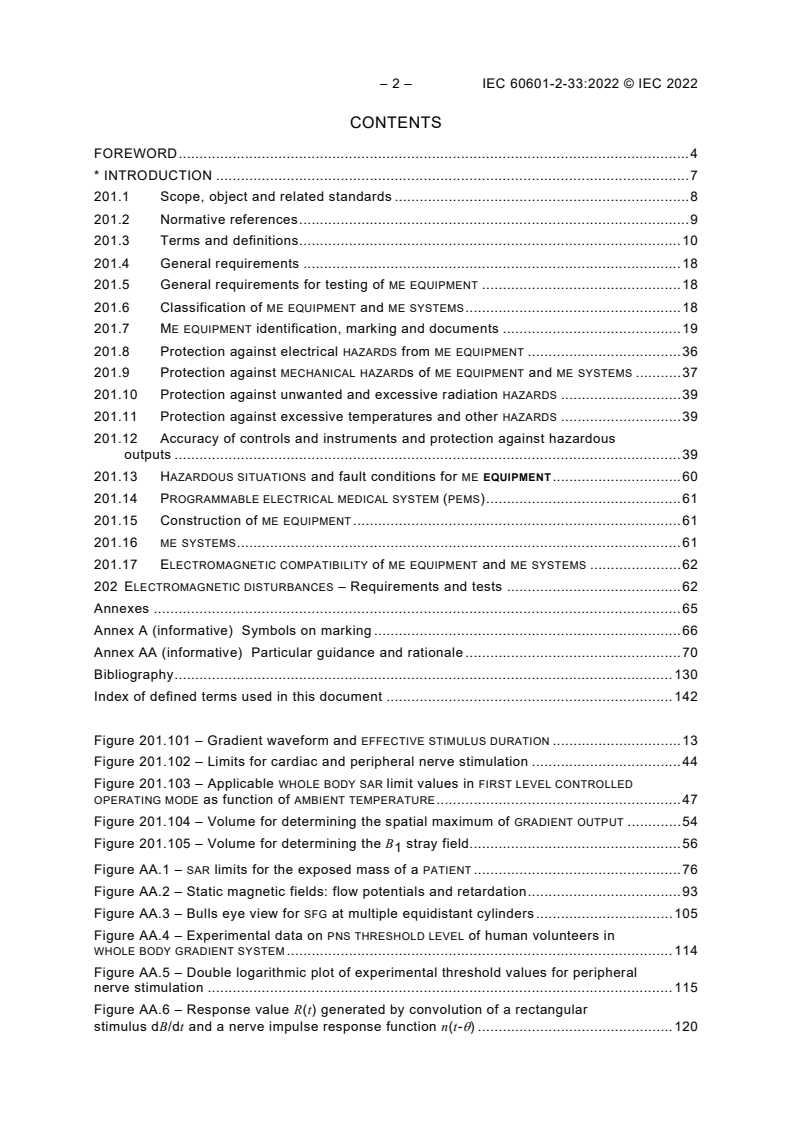
CONTENTS
FOREWORD . 4
* INTRODUCTION . 7
201.1 Scope, object and related standards . 8
201.2 Normative references . 9
201.3 Terms and definitions . 10
201.4 General requirements . 18
201.5 General requirements for testing of ME EQUIPMENT . 18
201.6 Classification of ME EQUIPMENT and ME SYSTEMS . 18
201.7 ME EQUIPMENT identification, marking and documents . 19
201.8 Protection against electrical HAZARDS from ME EQUIPMENT . 36
201.9 Protection against MECHANICAL HAZARDs of ME EQUIPMENT and ME SYSTEMS . 37
201.10 Protection against unwanted and excessive radiation HAZARDS . 39
201.11 Protection against excessive temperatures and other HAZARDS . 39
201.12 Accuracy of controls and instruments and protection against hazardous
outputs . 39
201.13 HAZARDOUS SITUATIONS and fault conditions for ME EQUIPMENT . 60
201.14 PROGRAMMABLE ELECTRICAL MEDICAL SYSTEM (PEMS) . 61
201.15 Construction of ME EQUIPMENT . 61
201.16 ME SYSTEMS . 61
201.17 ELECTROMAGNETIC COMPATIBILITY of ME EQUIPMENT and ME SYSTEMS . 62
202 ELECTROMAGNETIC DISTURBANCES – Requirements and tests . 62
Annexes . 65
Annex A (informative) Symbols on marking . 66
Annex AA (informative) Particular guidance and rationale . 70
Bibliography . 130
Index of defined terms used in this document . 142
Figure 201.101 – Gradient waveform and EFFECTIVE STIMULUS DURATION . 13
Figure 201.102 – Limits for cardiac and peripheral nerve stimulation . 44
Figure 201.103 – Applicable WHOLE BODY SAR limit values in FIRST LEVEL CONTROLLED
OPERATING MODE as function of AMBIENT TEMPERATURE . 47
Figure 201.104 – Volume for determining the spatial maximum of GRADIENT OUTPUT . 54
Figure 201.105 – Volume for determining the B stray field. 56
Figure AA.1 – SAR limits for the exposed mass of a PATIENT . 76
Figure AA.2 – Static magnetic fields: flow potentials and retardation . 93
Figure AA.3 – Bulls eye view for SFG at multiple equidistant cylinders . 105
Figure AA.4 – Experimental data on PNS THRESHOLD LEVEL of human volunteers in
WHOLE BODY GRADIENT SYSTEM . 114
Figure AA.5 – Double logarithmic plot of experimental threshold values for peripheral
nerve stimulation . 115
Figure AA.6 – Response value R(t) generated by convolution of a rectangular
stimulus dB/dt and a nerve impulse response function n(t-θ) . 120
Figure AA.7 – Gradient waveform G, stimulus waveform dB/dt and response value R,
for a trapezoid EPI waveform starting at t = 0 . 120
Figure AA.8 – Threshold values dB/dt for two gradient waveforms, plotted against
EFFECTIVE STIMULUS DURATION . 121
Figure AA.9 – Threshold value of dB/dt for a sinusoid gradient waveform, as function of
the number of half periods in the waveform . 121
Figure AA.10 – Schematic overview of various possible hardware configurations of a
birdcage coil and their appropriate classification . 126
Table 201.101 – Units outside the SI units system that may be used on MR EQUIPMENT . 20
Table 201.102 – Rheobase values per type of gradient system . 43
Table 201.103 – Weighting factors for PNS evaluation per GRADIENT UNIT . 45
Table 201.104 – SAR limits for VOLUME RF TRANSMIT COILS . 46
Table 201.105 – SAR limits for LOCAL RF TRANSMIT COILs . 46
+
Table 201.106 – Maximum B PEAK values for MROC implementation . 58
Table 201.107 – User selectable control parameters for MROC implementation . 59
Table 201.A.101 – MR SAFETY SIGNs . 66
Table 201.A.102 – RF coil symbols . 68
Table 201.A.103 – MR CONDITIONAL symbols . 69
Table 201.AA.101 – Overview of quantities, and their SI units . 80
Table 201.AA.102 – Overview physiological effects in humans, animals and model
systems, for magnetic-field exposures at field strengths relevant for MRI . 83
Table 201.AA.103 – CORE TEMPERATURE limits . 122
– 4 – IEC 60601-2-33:2022 © IEC 2022
INTERNATIONAL ELECTROTECHNICAL COMMISSION
____________
MEDICAL ELECTRICAL EQUIPMENT –
Part 2-33: Particular requirements for the basic safety and essential
performance of magnetic resonance equipment for medical diagnosis
FOREWORD
1) The International Electrotechnical Commission (IEC) is a worldwide organization for standardization comprising
all national electrotechnical committees (IEC National Committees). The object of IEC is to promote international
co-operation on all questions concerning standardization in the electrical and electronic fields. To this end and
in addition to other activities, IEC publishes International Standards, Technical Specifications, Technical Reports,
Publicly Available Specifications (PAS) and Guides (hereafter referred to as "IEC Publication(s)"). Their
preparation is entrusted to technical committees; any IEC National Committee interested in the subject dealt with
may participate in this preparatory work. International, governmental and non-governmental organizations liaising
with the IEC also participate in this preparation. IEC collaborates closely with the International Organization for
Standardization (ISO) in accordance with conditions determined by agreement between the two organizations.
2) The formal decisions or agreements of IEC on technical matters express, as nearly as possible, an international
consensus of opinion on the relevant subjects since each technical committee has representation from all
interested IEC National Committees.
3) IEC Publications have the form of recommendations for international use and are accepted by IEC National
Committees in that sense. While all reasonable efforts are made to ensure that the technical content of IEC
Publications is accurate, IEC cannot be held responsible for the way in which they are used or for any
misinterpretation by any end user.
4) In order to promote international uniformity, IEC National Committees undertake to apply IEC Publications
transparently to the maximum extent possible in their national and regional publications. Any divergence between
any IEC Publication and the corresponding national or regional publication shall be clearly indicated in the latter.
5) IEC itself does not provide any attestation of conformity. Independent certification bodies provide conformity
assessment services and, in some areas, access to IEC marks of conformity. IEC is not responsible for any
services carried out by independent certification bodies.
6) All users should ensure that they have the latest edition of this publication.
7) No liability shall attach to IEC or its directors, employees, servants or agents including individual experts and
members of its technical committees and IEC National Committees for any personal injury, property damage or
other damage of any nature whatsoever, whether direct or indirect, or for costs (including legal fees) and
expenses arising out of the publication, use of, or reliance upon, this IEC Publication or any other IEC
Publications.
8) Attention is drawn to the Normative references cited in this publication. Use of the referenced publications is
indispensable for the correct application of this publication.
9) Attention is drawn to the possibility that some of the elements of this IEC Publication may be the subject of patent
rights. IEC shall not be held responsible for identifying any or all such patent rights.
IEC 60601-2-33 has been prepared by subcommittee 62B: Diagnostic imaging equipment, of
IEC technical committee 62: Electrical equipment in medical practice. It is an International
Standard.
This fourth edition cancels and replaces the third edition published in 2010, Amendment 1:2013
and Amendment 2:2015. This edition constitutes a technical revision.
This edition includes the following significant technical changes with respect to the previous
edition:
a) aligned with IEC 60601-1:2005 and its two amendments IEC 60601-1:2005/AMD1:2012 and
IEC 60601-1:2005/AMD2:2020;
b) addition of safety requirements for the EMERGENCY FIELD SHUT DOWN UNIT;
c) clarification of acoustic protection measures for the PATIENT and MR WORKER;
d) addition of noise emission declaration for exposure inside the MR EXAMINATION ROOM, to
support occupational health assessment by the RESPONSIBLE ORGANIZATION;
e) addition of compliance methods for thermal safety of RF coils;
f) addition of RF transmit definitions to match MR CONDITIONAL labelling requirements for
MEDICAL DEVICES;
g) clarification of requirements for MR CONDITIONAL labelling of ACCESSORIES;
h) alignment of static magnetic field limit for B HAZARD area to limits in other MEDICAL DEVICE
standards (especially that for pacemakers, ISO 14117), the new limit value being 0,9 mT;
i) improved description of the magnetic field related plots in the Compatibility Technical
Specification Sheet (CTSS);
j) provision of compatibility sequences (in the CTSS) to test auxiliary equipment by the MR
manufacturer has become optional, and is expected to be eliminated in a future edition;
k) a separate section with requirements for a site-planning document containing safety
information;
l) requirements for the alerting function (PATIENT to OPERATOR);
m) introduction of MROC as mandatory functionality for 1,5 T and 3 T systems to facilitate
scanning of PATIENTs with MEDICAL DEVICES labelled as MR CONDITIONAL, unless such
scanning is explicitly contra-indicated by the MR MANUFACTURER;
n) RF coil symbols in Table 201.A.102 have become mandatory, and the preferred and
alternate signs have been swapped relative to the previous edition, with preferred now being
the sign with color;
o) determination of the B stray field in 201.12.4.105.3.3 based on calculations only.
The text of this International Standard is based on the following documents:
Draft Report on voting
62B/1277/FDIS 62B/1284/RVD
Full information on the voting for its approval can be found in the report on voting indicated in
the above table.
The language used for the development of this International Standard is English.
This document was drafted in accordance with ISO/IEC Directives, Part 2, and developed in
accordance with ISO/IEC Directives, Part 1 and ISO/IEC Directives, IEC Supplement, available
at http://www.iec.ch/members_experts/refdocs. The main document types developed by IEC
are described in greater detail at www.iec.ch/standardsdev/publications.
In this document, the following print types are used:
– requirements and definitions: roman type;
– test specifications: italic type;
– informative material appearing outside of tables, such as notes, examples and references: in smaller type.
Normative text of tables is also in a smaller type;
– TERMS DEFINED IN CLAUSE 3 OF IEC 60601-1:2005, IEC 60601-1:2005/AMD1:2012 AND
IEC 60601-1:2005/AMD2:2020, IN THIS DOCUMENT OR AS NOTED: SMALL CAPITALS.
In referring to the structure of this document, the term
– "clause" means one of the eighteen numbered divisions within the table of contents,
inclusive of all subdivisions (e.g. Clause 7 includes subclauses 7.1, 7.2, etc.);
– "subclause" means a numbered subdivision of a clause (e.g. 7.1, 7.2 and 7.2.1 are all
subclauses of Clause 7).
References to clauses within this document are preceded by the term "Clause" followed by the
clause number. References to subclauses within this document are by number only.
– 6 – IEC 60601-2-33:2022 © IEC 2022
In this document, the conjunctive "or" is used as an "inclusive or" so a statement is true if any
combination of the conditions is true.
The verbal forms used in this document conform to usage described in Clause 7 of the ISO/IEC
Directives, Part 2. For the purposes of this document, the auxiliary verb:
– "shall" means that compliance with a requirement or a test is mandatory for compliance with
this document;
– "should" means that compliance with a requirement or a test is recommended but is not
mandatory for compliance with this document;
– "may" is used to describe a permissible way to achieve compliance with a requirement or
test.
An asterisk (*) as the first character of a title or at the beginning of a paragraph or table title
indicates that there is guidance or rationale related to that item in Annex AA.
A list of all parts of the IEC 60601 and IEC 80601 series, published under the general title:
Medical electrical equipment, can be found on the IEC website.
The committee has decided that the contents of this document will remain unchanged until the
stability date indicated on the IEC website under webstore.iec.ch/?ref=menu in the data related
to the specific document. At this date, the document will be
• reconfirmed,
• withdrawn,
• replaced by a revised edition, or
• amended.
IMPORTANT – The "colour inside" logo on the cover page of this document indicates that it
contains colours which are considered to be useful for the correct understanding of its
contents. Users should therefore print this document using a colour printer.
* INTRODUCTION
This International Standard addresses technical aspects of medical diagnostic MR EQUIPMENT
and MR SYSTEMS, necessary to ensure the safety of PATIENTs, and to address electromagnetic
field (EMF) exposure concerns for MR WORKERs involved with the operation, development,
manufacturing, installation, and servicing of MR EQUIPMENT and MR SYSTEMS. Annex AA provides
rationales for requirements and limit values including references to peer-reviewed publications
used to establish the content of this document.
Exposure limits for PATIENTs and for MR WORKERs are selected to protect them from transient
adverse health effects and from unacceptable RISK. In addition, scientific consensus today is
that no experimental or theoretical basis exists to expect long-term adverse health effects in
humans from (repeated) EMF exposures.
Organizational aspects related to safety of operating the MR EQUIPMENT are the task of the
RESPONSIBLE ORGANIZATION. This task includes, but is not limited to:
– qualification of staff for decisions that are related to safety;
– adequate training of staff;
– definition of medical responsibility; including
• rules for screening the PATIENT for contraindications or for conditions that can affect
acceptable exposure;
• rules for ROUTINE MONITORING, and for MEDICAL SUPERVISION of the PATIENT during the MR
EXAMINATION;
• rules for access to and oversight of the MR ENVIRONMENT, and for hearing protection;
– demarcating, maintaining and controlling access to the B HAZARD AREA and the MR
ENVIRONMENT, including
• screening of any person entering this environment;
• confirming that no materials or equipment entering this environment pose a HAZARD.
– emergency procedures for (rapid) removal of the PATIENT who is in the B HAZARD AREA;
– emergency procedures related to a potential QUENCH of a superconductive magnet, when
applicable;
– rules to minimize and to limit the exposure of MR workers to EMF;
– establishing and ensuring adequate preventive maintenance;
– evaluation and implementation of local regulations.
This fourth edition aligns with IEC 60601-1:2005, IEC 60601-1:2005/AMD1:2012 and
IEC 60601-1:2005/AMD2:2020 and the associated updates of the collateral standards.
– 8 – IEC 60601-2-33:2022 © IEC 2022
MEDICAL ELECTRICAL EQUIPMENT –
Part 2-33: Particular requirements for the basic safety and essential
performance of magnetic resonance equipment for medical diagnosis
201.1 Scope, object and related standards
Clause 1 of IEC 60601-1:2005, IEC 60601-1:2005/AMD1:2012 and
IEC 60601-1:2005/AMD2:2020 applies, except as follows:
201.1.1 Scope
Replacement:
This document applies to the BASIC SAFETY and ESSENTIAL PERFORMANCE of MAGNETIC
RESONANCE (MR) EQUIPMENT and MAGNETIC RESONANCE (MR) SYSTEMS.
NOTE Where ME EQUIPMENT and ME SYSTEMS are used in the clause headings, this is to be understood to indicate
MR EQUIPMENT and MR SYSTEMS.
This document does not cover the application of MR EQUIPMENT beyond the INTENDED USE.
If a clause or subclause is specifically intended to be applicable to MR EQUIPMENT only, or to
MR SYSTEMS only, the title and content of that clause or subclause will say so. If that is not the
case, the clause or subclause applies both to MR EQUIPMENT and to MR SYSTEMS, as relevant.
This document does not formulate additional specific requirements for MR EQUIPMENT or
MR SYSTEMS used in INTERVENTIONAL MR EXAMINATIONS.
201.1.2 Object
Replacement:
The object of this document is to establish particular BASIC SAFETY and ESSENTIAL PERFORMANCE
requirements for MR EQUIPMENT to provide protection for the PATIENT and the MR WORKER.
NOTE This document presumes that the MR WORKERs are screened, trained and instructed in their duties.
201.1.3 Collateral standards
Addition:
This document refers to those applicable collateral standards that are listed in Clause 2 of
IEC 60601-1:2005, IEC 60601-1:2005/AMD1:2012 and IEC 60601-1:2005/AMD2:2020 and
Clause 201.2 of this document.
IEC 60601-1-2:2014 and IEC 60601-1-2:2014/AMD1:2020 applies as modified in Clause 202.
IEC 60601-1-3 [1], IEC 60601-1-9 [2], IEC 60601-1-10 [3], IEC 60601-1-11 [4] and
IEC 60601-1-12 [5] do not apply. All other published collateral standards in the IEC 60601-1
series apply as published.
201.1.4 Particular standards
Addition:
In the IEC 60601 series, particular standards may modify, replace or delete requirements
contained in the general standard and collateral standards as appropriate for the particular
ME EQUIPMENT under consideration, and may add other BASIC SAFETY and ESSENTIAL
PERFORMANCE requirements.
A requirement of a particular standard takes priority over the general standard, viz.
IEC 60601-1:2005, IEC 60601-1:2005/AMD1:2012 and IEC 60601-1:2005/AMD2:2020.
Collateral standards are referred to by their document number.
The numbering of clauses and subclauses of this document corresponds to that of the general
standard with the prefix "201" (e.g. 201.1 in this document addresses the content of Clause 1
of the general standard) or applicable collateral standard with the prefix "20x" where x is the
final digit(s) of the collateral standard document number (e.g. 202.4 in this document addresses
the content of Clause 4 of the 60601-1-2 collateral standard, 208.4 in this document addresses
the content of Clause 4 of the 60601-1-8 collateral standard, etc.). The changes to the text of
the general standard are specified by the use of the following words:
"Replacement" means that the clause or subclause of the general standard or applicable
collateral standard is replaced completely by the text in this document.
"Addition" means that the text of this document is additional to the requirements of the general
standard or applicable collateral standard.
"Amendment" means that the clause or subclause of the general standard or applicable
collateral standard is amended as indicated by the text of this document.
Subclauses, figures or tables which are additional to those of the general standard are
numbered starting from 201.101. However due to the fact that definitions in the general standard
are numbered 3.1 through 3.154, additional definitions in this document are numbered
beginning from 201.3.201. Additional annexes are lettered AA, BB, etc., and additional items
aa), bb), etc.
Subclauses, figures or tables which are additional to those of a collateral standard are
numbered starting from 20x, where "x" is the number of the collateral standard, e.g. 202 for
IEC 60601-1-2, 203 for IEC 60601-1-3, etc.
The term "this document" is used to make reference to IEC 60601-1:2005,
IEC 60601-1:2005/AMD1:2012 and IEC 60601-1:2005/AMD2:2020, any applicable collateral
standards and this document taken together.
Where there is no corresponding clause or subclause in this document, the clause or subclause
of the general standard or applicable collateral standard, although possibly not relevant, applies
without modification; where it is intended that any part of the general standard or applicable
collateral standard, although possibly relevant, is not to be applied, a statement to that effect
is given in this document.
201.2 Normative references
NOTE Informative references are listed in the bibliography beginning on page 130.
Clause 2 of IEC 60601-1:2005, IEC 60601-1:2005/AMD1:2012 and IEC 60601-1:2005/AMD2:2020
applies except as follows:
– 10 – IEC 60601-2-33:2022 © IEC 2022
Replacement:
IEC 60601-1-2:2014, Medical electrical equipment – Part 1-2: General requirements for basic
safety and essential performance – Collateral Standard: Electromagnetic disturbances –
Requirements and tests
IEC 60601-1-2:2014/AMD1:2020
Addition:
IEC 60601-1:2005, Medical electrical equipment – Part 1: General requirements for basic safety
and essential performance
IEC 60601-1:2005/AMD1:2012
IEC 60601-1:2005/AMD2:2020
IEC 60695-11-10:2013, Fire hazard testing – Part 11-10: Test flames – 50 W horizontal and
vertical flame test methods
IEC 61672-1:2013, Electroacoustics – Sound level meters – Part 1: Specifications
IEC 61672-2:2013, Electroacoustics – Sound level meters – Part 2: Pattern evaluation tests
IEC 62570:2014, Standard practice for marking devices and other items for safety in the
magnetic resonance environment
ISO 3746:2010, Acoustics – Determination of sound power levels and sound energy levels of
noise sources using sound pressure – Survey method using an enveloping measurement
surface over a reflecting plane
ISO 9614-1, Acoustics – Determination of sound power levels of noise sources using sound
intensity – Part 1: Measurement at discrete points
NEMA MS 4, Acoustic noise measurement procedure for diagnostic magnetic resonance
equipment
NEMA MS 8, Characterization of the Specific Absorption Rate (SAR) for magnetic resonance
imaging systems
NEMA MS 14, Characterization of radiofrequency (RF) coil heating in magnetic resonance
imaging systems
201.3 Terms and definitions
For the purposes of this document, the terms and definitions given in IEC 60601-1:2005,
IEC 60601-1:2005/AMD1:2012 and IEC 60601-1:2005/AMD2:2020, and the following apply.
ISO and IEC maintain terminological databases for use in standardization at the following
addresses:
• IEC Electropedia: available at http://www.electropedia.org/
• ISO Online browsing platform: available at http://www.iso.org/obp
NOTE An index of defined terms is found beginning on page 142.
Addition:
* 201.3.201
AMBIENT TEMPERATURE
temperature of the air flowing through the PATIENT environment
201.3.202
B HAZARD AREA
space around the MR EQUIPMENT where the static magnetic field can cause HARM
Note 1 to entry: The B HAZARD AREA is not identical to the SPECIAL ENVIRONMENT as defined in IEC 60601-1-2.
Note 2 to entry: The B HAZARD AREA is not identical to the MR ENVIRONMENT as defined in IEC 62570.
* 201.3.203
+
B
component of the RF magnetic field in the rotating frame that is effective for tilting of the nuclear
magnetization
+
Note 1 to entry: B is derived from the flip angle estimated from the MR signal as detected from an adjustment
volume, which is typically represented by an axial slab passing through MR ISOCENTRE.
Note 2 to entry: The spatially-localized amplitude of total B , especially in the off-centre position, can exceed the
+
VALUE of B by up to an order of magnitude.
(spatially averaged and local)
201.3.204
+
B PEAK
+
maximum VALUE of B
* 201.3.205
+
B RMS
+
root mean square (RMS) of B , which represents the highest average VALUE for any 10 s period,
evaluated over the duration of the sequence:
t
x
+
(B (t)) dt
+ ∫
B RMS=
t
x
where t is time, and t is the integration time
x
Note 1 to entry: When a sequence is shorter than 10 s, the integration time equals the sequence duration, unless
sliding window continuous integration across sequences is used.
* 201.3.206
|dB/dt| PEAK
maximum time rate of change of the magnitude of the magnetic field generated by the combined
outputs of the GRADIENT UNITS during the MR EXAMINATION, evaluated at the COMPLIANCE VOLUME
201.3.207
CIRCULARLY POLARIZED DRIVE
CP
RF excitation where the two principal electromagnetic modes of a birdcage VOLUME RF TRANSMIT
COIL are driven with equal amplitude and 90° phase difference
Note 1 to entry: CIRCULARLY POLARIZED DRIVE is also commonly referred to as "quadrature drive" or "circularly
polarized" and can be used interchangeably.
– 12 – IEC 60601-2-33:2022 © IEC 2022
–
Note 2 to entry: CP into a loaded coil does not necessarily result in the lowest possible counter-rotating B
component.
Note 3 to entry: A coil operating in CP can additionally use a single mode, linearly-polarized excitation if the
exposure is infrequent, short, and does not exceed 50 % power drive for CP.
Note 4 to entry: Transverse electromagnetic (TEM) coils can be characterized as CP by using additional qualification
and controls.
201.3.208
CIRCULARLY POLARIZED RF
time-varying B field, where the field vector describes a circular trajectory in a plane orthogonal
to the static magnetic field vector
Note 1 to entry: The polarity of the magnet determines the direction in which the generated B field rotates to
+
generate MR signals (that is, the B component).
─
Note 2 to entry: A small B component (rotating in the opposite direction) is unavoidable in real-world
implementations of VOLUME RF TRANSMIT COILS when using CIRCULARLY POLARIZED DRIVE. The consequence is that
the generated time-varying B field vector deviates slightly from the ideal circular trajectory.
201.3.209
COMPLIANCE VOLUME
space in which compliance of GRADIENT OUTPUT is inspected
Note 1 to entry: In CYLINDRICAL MR EQUIPMENT with a WHOLE BODY MAGNET, the COMPLIANCE VOLUME is a cylinder
with its axis coinciding with the PATIENT’s axis and with a radius of 0,20 m and with a length equal to the length of
the gradient coil.
Note 2 to entry: In MR EQUIPMENT with a TRANSVERSE FIELD MAGNET and a WHOLE BODY GRADIENT SYSTEM, the
COMPLIANCE VOLUME is a cylinder aligned with the PATIENT’s axis, of length equal to the gradient coil diameter, and a
radius of 0,20 m or equal to half the distance between the poles of the magnet, whichever is less.
Note 3 to entry: In all other MR SYSTEMS, the COMPLIANCE VOLUME is the volume where any part of a PATIENT body
can be properly located according to the INTENDED USE of the MR EQUIPMENT.
* 201.3.210
CORE TEMPERATURE
temperature of the internal organs in the body and the aortic blood
* 201.3.211
CUMULATIVE EQUIVALENT MINUTES AT 43 °C
CEM43
duration of exposure at a constant temperature of 43 °C required to produce the magnitude of
a thermally induced bio-effect, i.e., an "iso-effect", as is produced by an exposure of duration
t at a different temperature T that can vary in time; defined mathematically as:
exam
t
exam
k (43−T (τ ))
CEM 43= R dτ
∫
where
-1
k = (1 °C) , a constant to render the exponent dimensionless;
T(τ) = temperature in °C during time course τ of an MR EXAMINATION;
τ = time (in min);
t = duration (in min) of the MR EXAMINATION, including the time after the last RF exposure, during which the
exam
temperature returns to physiological baseline;
R = exponential constant: 0,25 for T < 43 °C and 0,5 for T ≥ 43 °C.
Note 1 to entry: This definition has been adapted from THERMALLY EQUIVALENT TIME, as defined in IEC 60601-2-62
[160].
Note 2 to entry: Temperature can vary throughout the body.
Note 3 to entry: CEM43 has been used in hyperthermia treatments to predict cell death as the thermally-induced
bio-effect, it is not a proven metric for thermal protection.
201.3.212
CYLINDRICAL MR EQUIPMENT
MR EQUIPMENT with a substantially cylindrical PATIENT aperture, and a static magnetic field
aligned with the long axis of the cylinder
Note 1 to entry: This is inclusive of elliptical PATIENT aperture equipment.
201.3.213
DETACHABLE
term qualifying an ACCESSORY fastened or otherwise secured at a specific location, and/or
requiring a FUNCTIONAL CONNECTION to ME EQUIPMENT during NORMAL USE, and which can be
installed and removed by the OPERATOR without the use of a TOOL
EXAMPLE 1 A VOLUME RF TRANSMIT COIL can be FIXED (integrated in the system) or a DETACHABLE ACCESSORY.
EXAMPLE 2 The squeeze bulb which is part of the PATIENT alerting function is often a DETACHABLE ACCESSORY.
EXAMPLE 3 Sensors for cardiac or respiratory triggering involve either a wired or wireless interface, which can both
qualify such devices as DETACHABLE ACCESSORIES.
EXAMPLE 4 ACCESSORIES of other types of interfaces can qualify as DETACHABLE.
201.3.214
EFFECTIVE STIMULUS DURATION
t
s,eff
duration of any period of the monotonic increasing or decreasing gradient, used to describe its
limits for cardiac or peripheral nerve stimulation, defined as the ratio of the peak-to-peak field
variation and the maximum VALUE of the time derivative of the gradient in that period (see
Figure 201.101)
Three periods of monotonic change of the gradient G are shown in Graph a. The corresponding GRADIENT
OUTPUT dB/dt is shown in Graph b and the EFFECTIVE STIMULUS DURATION t is indicated.
s,eff
Figure 201.101 – Gradient waveform and EFFECTIVE STIMULUS DURATION
201.3.215
EMERGENCY FIELD SHUT DOWN UNIT
subsystem enabling fast removal of the magnetic field of a superconducting or resistive magnet
in case of an emergency situation
– 14 – IEC 60601-2-33:2022 © IEC 2022
201.3.216
FIRST LEVEL CONTROLLED OPERATING MODE
mode of operation of MR EQUIPMENT where MEDICAL SUPERVISION mitigates RISKs associated with
biophysical effects induced by exposure to electromagnetic fields
Note 1 to entry: The electromagnetic fields essential to the operation of MR EQUIPMENT are the main magnetic field,
the spatial encoding gradients, and RF. The operating mode for each field is independently assessed and reported.
Note 2 to entry: Indirect effects like displacement forces, acoustic noise, or interference with other MEDICAL DEVICEs
are not considered when identifying threshold exposure values.
201.3.217
GRADIENT OUTPUT
parameter characterizing the gradient performance as rate of change of the magnitude of the
magnetic field or electric field induced by one or more GRADIENT UNITS under specified conditions
and at a specified position
201.3.218
GRADIENT UNIT
all gradient coils and amplifiers that together generate a magnetic field gradient along one of
the axes of the coordinate system of the MR EQUIPMENT
201.3.219
HEAD SAR
SAR averaged over the mass of the head
Note 1 to entry: The lower extent of the head is generally considered to be a line drawn from the foramen magnum
anteriorly along the inferior border of the body of the mandible in closed mouth position.
* 201.3.220
INTERVENTIONAL MR EXAMINATION
MR EXAMINATION applied to guide a medical (including invasive) procedure e.g. biopsy or the
treatment of a lesion
201.3.221
LOCAL RF TRANSMIT COIL
RF transmit coil other than a VOLUME RF TRANSMIT COIL
201.3.222
LOCAL SAR
SAR averaged over any 10 g of tissue of the body
* 201.3.223
MAGNETIC RESONANCE
MR
resonant absorption of electromagnetic energy by an ensemble of atomic nuclei situated in a
magnetic field
201.3.224
MAGNETIC RESONANCE ENVIRONMENT
MR ENVIRONMENT
three-dimensional volume surrounding the MR magnet that contains both the SPECIAL
ENVIRONMENT (Faraday shielded volume) and the B HAZARD AREA
Note 1 to entry: This volume is the region in which an item might pose a HAZARD from exposure to the
electromagnetic fields produced by the MR EQUIPMENT and ACCESSORIES, and for which access control is part of the
RISK mitigation
Note 2 to entry: The entrance to the MR ENVIRONMENT is controlled by the RESPONSIBLE ORGANIZATION.
Note 3 to entry: The area to which entry is controlled is sometimes referred to as the MR controlled access area.
[SOURCE: IEC 62570:2014, 3.1.10, modified ─ Replacement of “0,50 mT field contour (5 gauss
(G) line)” with “B HAZARD AREA”, and modification of the structure of the definition.]
201.3.225
MAGNETIC RESONANCE EQUIPMENT
MR EQUIPMENT
MEDICAL ELECTRICAL EQUIPMENT for the MAGNETIC RESONANCE EXAMINATION of a PATIENT
Note 1 to entry: The MR EQUIPMENT is a PROGRAMMABLE ELECTRICAL MEDICAL SYSTEM (PEMS).
201.3.226
MAGNETIC RESONANCE EXAMINATION
MR EXAMINATION
PROCESS of acquiring data by MAGNETIC RESONANCE from a PATIENT
201.3.227
MAGNETIC RESONANCE EXAMINATION ROOM
MR EXAMINATION ROOM
room where PATIENT undergoes an MR EXAMINATION
201.3.228
MAGNETIC RESONANCE ISOCENTRE
MR ISOCENTRE
null point of the spatially encoding gradients
Note 1 to entry: Typically this also corresponds to the region of highest magnet homogeneity.
Note 2 to entry: Typically this corresponds with the position in the system targeted for imaging.
[SOURCE: IEC 62464-1:2018, 3.1.11, modified ─ Addition of “MAGNETIC RESONANCE” to the main
term, and New Note 2 to entry.]
201.3.229
MAGNETIC RESONANCE SYSTEM
MR SYSTEM
combination, as specified by the MR MANUFACTURER, of items of equipment, at least one of which
is MR EQUIPMENT, to be inter-connected by FUNCTIONAL CONNECTION or by use of a MULTIPLE
SOCKET-OUTLET
* 201.3.230
MAGNETIC RESONANCE WORKER
MR WORKER
person that because of their profession is trained concerning RISKs which can occur when
entering the MR ENVIRONMENT
Note 1 to entry: MR volunteers and PATIENT’s social companions are not covered by this definition.
201.3.231
MAXIMUM GRADIENT SLEW RATE
rate of change of the gradient magnetic field by switching one GRADIENT UNIT between its
maximum specified gradient strengths G+max and G−max in the shortest possible ramp time
* 201.3.232
MEDICAL SUPERVISION
ROUTINE MONITORING supplemented with medical management of PATIENTS who can be at
elevated RISK from exposure to the MR EQUIPMENT
– 16 – IEC 60601-2-33:2022 © IEC 2022
201.3.233
MR EQUIPMENT OUTPUT CONDITIONING
MROC
functionality allowing the OPERATOR to specify conditions to particular outputs for the MR
EXAMINATION
Note 1 to entry: Such limits include those commonly specified in MR CONDITIONAL labelling.
201.3.234
MULTI CHANNEL-N DRIVE
MC-N
RF excitation where N independent waveforms are fed into a b
...