

IEC 61788-8:2010
(Main)Superconductivity - Part 8: AC loss measurements - Total AC loss measurement of round superconducting wires exposed to a transverse alternating magnetic field at liquid helium temperature by a pickup coil method
General Information
- Abstract
IEC 61788-8:2010 specifies the measurement method of total AC losses by the pickup coil method in composite superconducting wires exposed to a transverse alternating magnetic field. The losses may contain hysteresis, coupling and eddy current losses. The standard method to measure only the hysteresis loss in DC or low-sweep-rate magnetic field is specified in IEC 61788-13. In metallic and oxide round superconducting wires expected to be mainly used for pulsed coil and AC coil applications, AC loss is generated by the application of time-varying magnetic field and/or current. The contribution of the magnetic field to the AC loss is predominant in usual electromagnetic configurations of the coil applications. For the superconducting wires exposed to a transverse alternating magnetic field, the present method can be generally used in measurements of the total AC loss in a wide range of frequency up to the commercial level, 50/60 Hz, at liquid helium temperature. For the superconducting wires with fine filaments, the AC loss measured with the present method can be divided into the hysteresis loss in the individual filaments, the coupling loss among the filaments and the eddy current loss in the normal conducting parts. In cases where the wires do not have a thick outer normal conducting sheath, the main components are the hysteresis loss and the coupling loss by estimating the former part as an extrapolated level of the AC loss per cycle to zero frequency in the region of lower frequency, where the coupling loss per cycle is proportional to the frequency. This second edition cancels and replaces the first edition published in 2003. This edition constitutes a technical revision. The main changes with respect to the previous edition are listed below:
- extending the applications of the pickup coil method to the a.c. loss measurements in metallic and oxide superconducting wires with a round cross section at liquid helium temperature,
- using the word "uncertainty" for all quantitative (associated with a number) statistical expressions and eliminating the quantitative use of "precision" and "accuracy". Key words: superconductivity, TC90
- Status
- Published
- Publication Date
- 23-Jun-2010
- Technical Committee
- TC 90 - Superconductivity
- Drafting Committee
- WG 9 - TC 90/WG 9
- Current Stage
- PPUB - Publication issued
- Start Date
- 24-Jun-2010
- Completion Date
- 15-Jul-2010
Buy Documents
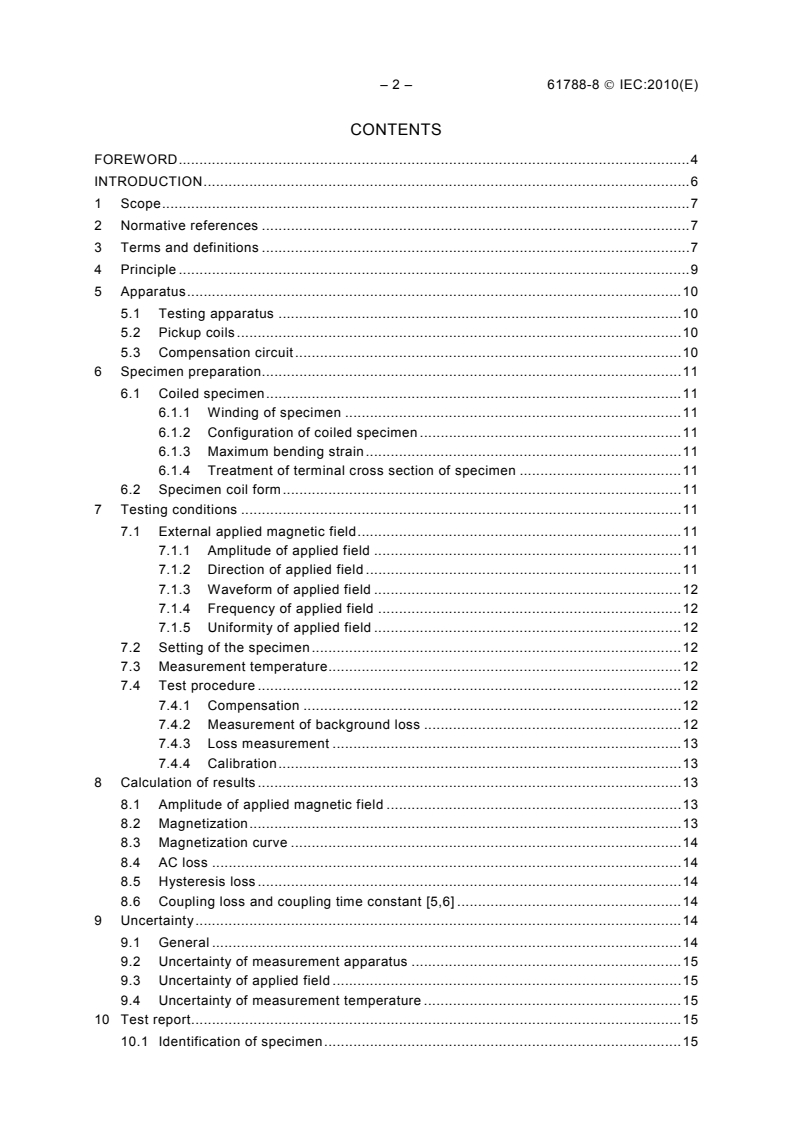
IEC 61788-8:2010 - Superconductivity - Part 8: AC loss measurements - Total AC loss measurement of round superconducting wires exposed to a transverse alternating magnetic field at liquid helium temperature by a pickup coil method Released:6/24/2010
IEC 61788-8:2010 - Superconductivity - Part 8: AC loss measurements - Total AC loss measurement of round superconducting wires exposed to a transverse alternating magnetic field at liquid helium temperature by a pickup coil method Released:6/24/2010
Overview
IEC 61788-8:2010 - Superconductivity, Part 8 - defines a standardized pickup coil method for measuring the total AC loss of round composite superconducting wires exposed to a transverse alternating magnetic field at liquid helium temperature. The method captures combined loss components (hysteresis, coupling and eddy‑current losses) across a broad frequency range (practically up to commercial power frequencies, e.g. 50/60 Hz; the pickup‑coil method overlaps low‑frequency magnetometer methods around 0.005–0.06 Hz). This second edition extends applicability to metallic and oxide round wires and adopts consistent use of the term uncertainty for quantitative expressions.
Key topics and technical requirements
- Measurement principle: total AC loss determined by induced voltage in pickup coils surrounding a coiled specimen; compensation circuits and calibration procedures reduce background signals.
- Specimen preparation: guidance for coiling, maximum bending strain, terminal treatment and coil form to ensure reproducible results.
- Testing conditions:
- Applied magnetic field: amplitude, direction, waveform and frequency requirements and uniformity criteria.
- Measurement temperature: liquid helium (4 K region) specified for superconducting performance.
- Apparatus: design and placement of pickup coils, compensation circuitry and measurement electronics; recommended calibration methods and evaluation of geometrical errors.
- Data processing: calculation of magnetization, magnetization curves, AC loss per cycle, separation/estimation of hysteresis loss, coupling loss and eddy current loss, including methods to extrapolate hysteresis contribution at low frequency.
- Uncertainty and reporting: quantitative uncertainty analysis (Annexes on uncertainty evaluation), required test report content and identification of measurement apparatus.
Practical applications
- Characterizing AC loss in superconducting wires intended for:
- Pulsed magnets and pulsed‑coil systems
- AC coil and power‑frequency superconducting devices
- R&D on Nb‑Ti, Nb3Sn and high‑temperature‑oxide composite wires (as metallic/oxide round wires)
- Supporting design tradeoffs for coil engineering (cooling requirements, AC loss minimization) and quality control in wire manufacture.
- Benchmarking wire performance for magnet designers, cryogenic system engineers and materials researchers.
Who should use this standard
- Materials scientists and test labs performing superconducting wire characterization
- Magnet and coil designers assessing AC loss in transverse fields
- Manufacturers specifying acceptance tests and quality assurance for superconducting wire products
- Standards and compliance teams within organizations working with IEC TC90 (Superconductivity)
Related standards
- IEC 61788-13 - standard method for measuring hysteresis loss in DC or low‑sweep‑rate magnetic fields.
- Other parts of the IEC 61788 series and IEC TC90 publications (see IEC catalog) that address superconductivity test methods and terminology.
Relations
- Effective Date
- 05-Sep-2023
Buy Documents
IEC 61788-8:2010 - Superconductivity - Part 8: AC loss measurements - Total AC loss measurement of round superconducting wires exposed to a transverse alternating magnetic field at liquid helium temperature by a pickup coil method Released:6/24/2010
IEC 61788-8:2010 - Superconductivity - Part 8: AC loss measurements - Total AC loss measurement of round superconducting wires exposed to a transverse alternating magnetic field at liquid helium temperature by a pickup coil method Released:6/24/2010
Get Certified
Connect with accredited certification bodies for this standard

IMQ S.p.A. (Certification)
Italian electrical product certification.

SLG Prüf- und Zertifizierungs GmbH
German testing and certification body.

UL Solutions
Global safety science company with testing, inspection and certification.
Sponsored listings
Frequently Asked Questions
IEC 61788-8:2010 is a standard published by the International Electrotechnical Commission (IEC). Its full title is "Superconductivity - Part 8: AC loss measurements - Total AC loss measurement of round superconducting wires exposed to a transverse alternating magnetic field at liquid helium temperature by a pickup coil method". This standard covers: IEC 61788-8:2010 specifies the measurement method of total AC losses by the pickup coil method in composite superconducting wires exposed to a transverse alternating magnetic field. The losses may contain hysteresis, coupling and eddy current losses. The standard method to measure only the hysteresis loss in DC or low-sweep-rate magnetic field is specified in IEC 61788-13. In metallic and oxide round superconducting wires expected to be mainly used for pulsed coil and AC coil applications, AC loss is generated by the application of time-varying magnetic field and/or current. The contribution of the magnetic field to the AC loss is predominant in usual electromagnetic configurations of the coil applications. For the superconducting wires exposed to a transverse alternating magnetic field, the present method can be generally used in measurements of the total AC loss in a wide range of frequency up to the commercial level, 50/60 Hz, at liquid helium temperature. For the superconducting wires with fine filaments, the AC loss measured with the present method can be divided into the hysteresis loss in the individual filaments, the coupling loss among the filaments and the eddy current loss in the normal conducting parts. In cases where the wires do not have a thick outer normal conducting sheath, the main components are the hysteresis loss and the coupling loss by estimating the former part as an extrapolated level of the AC loss per cycle to zero frequency in the region of lower frequency, where the coupling loss per cycle is proportional to the frequency. This second edition cancels and replaces the first edition published in 2003. This edition constitutes a technical revision. The main changes with respect to the previous edition are listed below: - extending the applications of the pickup coil method to the a.c. loss measurements in metallic and oxide superconducting wires with a round cross section at liquid helium temperature, - using the word "uncertainty" for all quantitative (associated with a number) statistical expressions and eliminating the quantitative use of "precision" and "accuracy". Key words: superconductivity, TC90
IEC 61788-8:2010 specifies the measurement method of total AC losses by the pickup coil method in composite superconducting wires exposed to a transverse alternating magnetic field. The losses may contain hysteresis, coupling and eddy current losses. The standard method to measure only the hysteresis loss in DC or low-sweep-rate magnetic field is specified in IEC 61788-13. In metallic and oxide round superconducting wires expected to be mainly used for pulsed coil and AC coil applications, AC loss is generated by the application of time-varying magnetic field and/or current. The contribution of the magnetic field to the AC loss is predominant in usual electromagnetic configurations of the coil applications. For the superconducting wires exposed to a transverse alternating magnetic field, the present method can be generally used in measurements of the total AC loss in a wide range of frequency up to the commercial level, 50/60 Hz, at liquid helium temperature. For the superconducting wires with fine filaments, the AC loss measured with the present method can be divided into the hysteresis loss in the individual filaments, the coupling loss among the filaments and the eddy current loss in the normal conducting parts. In cases where the wires do not have a thick outer normal conducting sheath, the main components are the hysteresis loss and the coupling loss by estimating the former part as an extrapolated level of the AC loss per cycle to zero frequency in the region of lower frequency, where the coupling loss per cycle is proportional to the frequency. This second edition cancels and replaces the first edition published in 2003. This edition constitutes a technical revision. The main changes with respect to the previous edition are listed below: - extending the applications of the pickup coil method to the a.c. loss measurements in metallic and oxide superconducting wires with a round cross section at liquid helium temperature, - using the word "uncertainty" for all quantitative (associated with a number) statistical expressions and eliminating the quantitative use of "precision" and "accuracy". Key words: superconductivity, TC90
IEC 61788-8:2010 is classified under the following ICS (International Classification for Standards) categories: 17.220.20 - Measurement of electrical and magnetic quantities; 29.050 - Superconductivity and conducting materials; 31.080.01 - Semiconductor devices in general. The ICS classification helps identify the subject area and facilitates finding related standards.
IEC 61788-8:2010 has the following relationships with other standards: It is inter standard links to IEC 61788-8:2003. Understanding these relationships helps ensure you are using the most current and applicable version of the standard.
IEC 61788-8:2010 is available in PDF format for immediate download after purchase. The document can be added to your cart and obtained through the secure checkout process. Digital delivery ensures instant access to the complete standard document.
Standards Content (Sample)
IEC 61788-8 ®
Edition 2.0 2010-06
INTERNATIONAL
STANDARD
Superconductivity –
Part 8: AC loss measurements – Total AC loss measurement of round
superconducting wires exposed to a transverse alternating magnetic field
at liquid helium temperature by a pickup coil method
All rights reserved. Unless otherwise specified, no part of this publication may be reproduced or utilized in any form
or by any means, electronic or mechanical, including photocopying and microfilm, without permission in writing from
either IEC or IEC's member National Committee in the country of the requester.
If you have any questions about IEC copyright or have an enquiry about obtaining additional rights to this publication,
please contact the address below or your local IEC member National Committee for further information.
IEC Central Office
3, rue de Varembé
CH-1211 Geneva 20
Switzerland
Email: inmail@iec.ch
Web: www.iec.ch
About the IEC
The International Electrotechnical Commission (IEC) is the leading global organization that prepares and publishes
International Standards for all electrical, electronic and related technologies.
About IEC publications
The technical content of IEC publications is kept under constant review by the IEC. Please make sure that you have the
latest edition, a corrigenda or an amendment might have been published.
ƒ Catalogue of IEC publications: www.iec.ch/searchpub
The IEC on-line Catalogue enables you to search by a variety of criteria (reference number, text, technical committee,…).
It also gives information on projects, withdrawn and replaced publications.
ƒ IEC Just Published: www.iec.ch/online_news/justpub
Stay up to date on all new IEC publications. Just Published details twice a month all new publications released. Available
on-line and also by email.
ƒ Electropedia: www.electropedia.org
The world's leading online dictionary of electronic and electrical terms containing more than 20 000 terms and definitions
in English and French, with equivalent terms in additional languages. Also known as the International Electrotechnical
Vocabulary online.
ƒ Customer Service Centre: www.iec.ch/webstore/custserv
If you wish to give us your feedback on this publication or need further assistance, please visit the Customer Service
Centre FAQ or contact us:
Email: csc@iec.ch
Tel.: +41 22 919 02 11
Fax: +41 22 919 03 00
IEC 61788-8 ®
Edition 2.0 2010-06
INTERNATIONAL
STANDARD
Superconductivity –
Part 8: AC loss measurements – Total AC loss measurement of round
superconducting wires exposed to a transverse alternating magnetic field
at liquid helium temperature by a pickup coil method
INTERNATIONAL
ELECTROTECHNICAL
COMMISSION
PRICE CODE
V
ICS 17.220 ISBN 978-2-88912-007-9
– 2 – 61788-8 © IEC:2010(E)
CONTENTS
FOREWORD.4
INTRODUCTION.6
1 Scope.7
2 Normative references .7
3 Terms and definitions .7
4 Principle .9
5 Apparatus.10
5.1 Testing apparatus .10
5.2 Pickup coils .10
5.3 Compensation circuit.10
6 Specimen preparation.11
6.1 Coiled specimen.11
6.1.1 Winding of specimen .11
6.1.2 Configuration of coiled specimen .11
6.1.3 Maximum bending strain.11
6.1.4 Treatment of terminal cross section of specimen .11
6.2 Specimen coil form.11
7 Testing conditions .11
7.1 External applied magnetic field.11
7.1.1 Amplitude of applied field .11
7.1.2 Direction of applied field .11
7.1.3 Waveform of applied field .12
7.1.4 Frequency of applied field .12
7.1.5 Uniformity of applied field .12
7.2 Setting of the specimen.12
7.3 Measurement temperature.12
7.4 Test procedure .12
7.4.1 Compensation .12
7.4.2 Measurement of background loss .12
7.4.3 Loss measurement .13
7.4.4 Calibration.13
8 Calculation of results .13
8.1 Amplitude of applied magnetic field .13
8.2 Magnetization.13
8.3 Magnetization curve .14
8.4 AC loss .14
8.5 Hysteresis loss.14
8.6 Coupling loss and coupling time constant [5,6] .14
9 Uncertainty.14
9.1 General .14
9.2 Uncertainty of measurement apparatus .15
9.3 Uncertainty of applied field .15
9.4 Uncertainty of measurement temperature .15
10 Test report.15
10.1 Identification of specimen.15
61788-8 © IEC:2010(E) – 3 –
10.2 Configuration of coiled specimen.15
10.3 Testing conditions .16
10.4 Results.16
10.5 Measurement apparatus .16
10.5.1 Pickup coils .16
10.5.2 Measurement system.17
Annex A (informative) Additional information relating to Clauses 1 to 10 .19
Annex B (informative) Explanation of AC loss measurement with Poynting’s vector [10] .21
Annex C (informative) Estimation of geometrical error in the pickup coil method .22
Annex D (informative) Recommended method for calibration of magnetization and AC
loss.23
Annex E (informative) Coupling loss for various types of applied magnetic field.25
Annex F (informative) Uncertainty considerations .26
Annex G (informative) Evaluation of uncertainty in AC loss measurement by pickup coil
method [13] .31
Bibliography.34
Figure 1 – Standard arrangement of the specimen and pickup coils .17
Figure 2 – A typical electrical circuit for AC loss measurement by pickup coils.18
Figure C.1 − Examples of calculated contour line map of the coefficient G.22
Figure D.1 – Evaluation of critical field from magnetization curves .24
Figure E.1 – Waveforms of applied magnetic field with a period T = 1/f.25
Table F.1 – Output signals from two nominally identical extensometers .27
Table F.2 – Mean values of two output signals.27
Table F.3 – Experimental standard deviations of two output signals.27
Table F.4 – Standard uncertainties of two output signals .28
Table F.5 – Coefficient of variations of two output signals.28
Table G.1 – Propagation of relative uncertainty in the pickup coil method (α = 0,5).33
– 4 – 61788-8 © IEC:2010(E)
INTERNATIONAL ELECTROTECHNICAL COMMISSION
__________
SUPERCONDUCTIVITY –
Part 8: AC loss measurements –
Total AC loss measurement of round
superconducting wires exposed to a transverse alternating
magnetic field at liquid helium temperature by a pickup coil method
FOREWORD
1) The International Electrotechnical Commission (IEC) is a worldwide organization for standardization comprising
all national electrotechnical committees (IEC National Committees). The object of IEC is to promote international
co-operation on all questions concerning standardization in the electrical and electronic fields. To this end and in
addition to other activities, IEC publishes International Standards, Technical Specifications, Technical Reports,
Publicly Available Specifications (PAS) and Guides (hereafter referred to as “IEC Publication(s)”). Their
preparation is entrusted to technical committees; any IEC National Committee interested in the subject dealt with
may participate in this preparatory work. International, governmental and non-governmental organizations liaising
with the IEC also participate in this preparation. IEC collaborates closely with the International Organization for
Standardization (ISO) in accordance with conditions determined by agreement between the two organizations.
2) The formal decisions or agreements of IEC on technical matters express, as nearly as possible, an international
consensus of opinion on the relevant subjects since each technical committee has representation from all
interested IEC National Committees.
3) IEC Publications have the form of recommendations for international use and are accepted by IEC National
Committees in that sense. While all reasonable efforts are made to ensure that the technical content of IEC
Publications is accurate, IEC cannot be held responsible for the way in which they are used or for any
misinterpretation by any end user.
4) In order to promote international uniformity, IEC National Committees undertake to apply IEC Publications
transparently to the maximum extent possible in their national and regional publications. Any divergence between
any IEC Publication and the corresponding national or regional publication shall be clearly indicated in the latter.
5) IEC itself does not provide any attestation of conformity. Independent certification bodies provide conformity
assessment services and, in some areas, access to IEC marks of conformity. IEC is not responsible for any
services carried out by independent certification bodies.
6) All users should ensure that they have the latest edition of this publication.
7) No liability shall attach to IEC or its directors, employees, servants or agents including individual experts and
members of its technical committees and IEC National Committees for any personal injury, property damage or
other damage of any nature whatsoever, whether direct or indirect, or for costs (including legal fees) and expenses
arising out of the publication, use of, or reliance upon, this IEC Publication or any other IEC Publications.
8) Attention is drawn to the Normative references cited in this publication. Use of the referenced publications is
indispensable for the correct application of this publication.
9) Attention is drawn to the possibility that some of the elements of this IEC Publication may be the subject of patent
rights. IEC shall not be held responsible for identifying any or all such patent rights.
International Standard IEC 61788-8 has been prepared by IEC technical committee 90:
Superconductivity.
This second edition cancels and replaces the first edition published in 2003. This edition
constitutes a technical revision.
The main changes with respect to the previous edition are listed below:
– extending the applications of the pickup coil method to the a.c. loss measurements in
metallic and oxide superconducting wires with a round cross section at liquid helium
temperature,
– u1 in accordance with the decision at the June 2006 IEC/TC90 meeting in Kyoto.
61788-8 © IEC:2010(E) – 5 –
The text of this standard is based on the following documents:
FDIS Report on voting
90/243/FDIS 90/249/RVD
Full information on the voting for the approval of this standard can be found in the report on
voting indicated in the above table.
This publication has been drafted in accordance with the ISO/IEC Directives, Part 2.
A list of all parts of the IEC 61788 series, under the general title: Superconductivity, can be
found on the IEC website.
The committee has decided that the contents of this publication will remain unchanged until the
stability date indicated on the IEC web site under "http://webstore.iec.ch" in the data related to
the specific publication. At this date, the publication will be
• reconfirmed,
• withdrawn,
• replaced by a revised edition, or
• amended.
A bilingual version of this publication may be issued at a later date.
– 6 – 61788-8 © IEC:2010(E)
INTRODUCTION
Magnetometer and pickup coil methods are proposed for measuring the AC losses of composite
superconducting wires in transverse time-varying magnetic fields. These represent initial steps
in standardization of methods for measuring the various contributions to AC loss in transverse
fields, the most frequently encountered configuration.
It was decided to split the initial proposal mentioned above into two documents covering two
standard methods. One of them describes the magnetometer method for hysteresis loss and low
frequency (or sweep rate) total AC loss measurement, and the other describes the pickup coil
method for total AC loss measurement in higher frequency (or sweep rate) magnetic fields. The
frequency range is 0 Hz to 0,06 Hz for the magnetometer method and 0,005 Hz to 60 Hz for the
pickup coil method. The overlap between 0,005 Hz and 0,06 Hz is a complementary frequency
range for the two methods.
This standard covers the pickup coil method. The test method for standardization of AC loss
covered in this standard is partly based on the Versailles Project on Advanced Materials and
Standards (VAMAS) pre-standardization work on the AC loss of Nb-Ti composite
1)
superconductors [1] .
___________
1)
Numbers in square brackets refer to the bibliography.
61788-8 © IEC:2010(E) – 7 –
SUPERCONDUCTIVITY –
Part 8: AC loss measurements –
Total AC loss measurement of round
superconducting wires exposed to a transverse alternating
magnetic field at liquid helium temperature by a pickup coil method
1 Scope
This part of IEC 61788 specifies the measurement method of total AC losses by the pickup coil
method in composite superconducting wires exposed to a transverse alternating magnetic field.
The losses may contain hysteresis, coupling and eddy current losses. The standard method to
measure only the hysteresis loss in DC or low-sweep-rate magnetic field is specified in
IEC 61788-13 [2].
In metallic and oxide round superconducting wires expected to be mainly used for pulsed coil
and AC coil applications, AC loss is generated by the application of time-varying magnetic field
and/or current. The contribution of the magnetic field to the AC loss is predominant in usual
electromagnetic configurations of the coil applications. For the superconducting wires exposed
to a transverse alternating magnetic field, the present method can be generally used in
measurements of the total AC loss in a wide range of frequency up to the commercial level,
50/60 Hz, at liquid helium temperature. For the superconducting wires with fine filaments, the
AC loss measured with the present method can be divided into the hysteresis loss in the
individual filaments, the coupling loss among the filaments and the eddy current loss in the
normal conducting parts. In cases where the wires do not have a thick outer normal conducting
sheath, the main components are the hysteresis loss and the coupling loss by estimating the
former part as an extrapolated level of the AC loss per cycle to zero frequency in the region of
lower frequency, where the coupling loss per cycle is proportional to the frequency.
2 Normative references
The following referenced documents are indispensable for the application of this document. For
dated references, only the edition cited applies. For undated references, the latest edition of the
referenced document (including any amendments) applies.
IEC 60050-815:2000, International Electrotechnical Vocabulary (IEV) – Part 815:
Superconductivity
3 Terms and definitions
For the purposes of this document, the following terms and definitions, as well as those of
IEC 60050-815, apply.
3.1
AC loss
P
power dissipated in a composite superconductor due to application of time-varying magnetic
field or electric current
[IEC 60050-815:2000, 815-04-54]
– 8 – 61788-8 © IEC:2010(E)
3.2
hysteresis loss
P
h
loss of the type whose value per cycle is independent of frequency arising in a superconductor
under a varying magnetic field
NOTE This loss is caused by the irreversible magnetic properties of the superconducting material due to pinning of
flux lines.
[IEC 60050-815:2000, 815-04-55]
3.3
eddy current loss
P
e
loss arising in the normal conducting matrix of a composite superconductor or the structural
material when exposed to a varying magnetic field, either from an applied field or from a
self-field
[IEC 60050-815:2000, 815-04-56, modified]
3.4
(filament) coupling (current) loss
P
c
loss arising in multi-filamentary superconducting wires with a normal matrix due to coupling
current
[IEC 60050-815:2000, 815-04-59]
3.5
(filament)coupling time constant
τ
characteristic time constant of coupling current directed perpendicularly to filaments within
a strand for low frequencies
[IEC 60050-815:2000, 815-04-60]
3.6
shielding current
current induced by an external magnetic field applied to a superconductor and which includes
coupling current and eddy current after a field change in composite superconductors
3.7
critical (magnetic) field strength
H
c
magnetic field strength corresponding to the superconducting condensation energy at zero
magnetic field strength
[IEC 60050-815:2000, 815-01-21]
3.8
magnetization (of a superconductor)
magnetic moment divided by the volume of the superconductor
NOTE The macroscopic magnetic moment is also equal to the product of the shielding current and the area of
the closed path in a composite superconductor together with the magnetic moment of any penetrated trapped flux.
61788-8 © IEC:2010(E) – 9 –
3.9
magnetization method for AC loss
method to determine the AC loss of materials from the area of the loop of the magnetization
curve
NOTE When pickup coils are used to measure the change in flux, which is then integrated to get the magnetization
of stationary coiled specimens, the method is called the pickup coil method.
[IEC 60050-815:2000, 815-08-15, modified]
3.10
pickup coil method
method to determine the AC loss of materials by evaluating electromagnetic power flow into the
materials by pickup coils
NOTE The pickup coil arrangement consists essentially of a primary winding (a superconducting magnet supplied
with a time varying current) and a pair of secondary windings (pickup coils), one of which (the main pickup coil)
contains the specimen to be measured and the other (the compensation coil) plays two roles: 1) it compensates the
signal from the main pickup coil when empty; 2) it supplies the field sweep information.
Here the coaxial and concentric arrangement of the pickup coils as shown in Figure 1 is used as the standard one for
the AC loss measurement. In order to obtain sufficient volume of the wire specimen to be measured and at the same
time to expose it to a transverse magnetic field, it must be wound into a coil. The specimen so prepared is also referred
to as the “coiled specimen”.
3.11
background loss
apparent loss obtained by the pickup coil method in the case where no specimen is located
inside the pickup coils
NOTE The background loss gives the experimental error in the system of the AC loss measurement by the pickup coil
method. It results from phase shift of electrical signal in the compensation process, an additional magnetic moment
induced in many components of experimental hardware, and external noise. The background loss can be reduced by
adjusting the experimental setup and compensated by subtracting it from measured AC loss as shown in 7.4.2.
3.12
effective cross-sectional area of the coiled specimen
total specimen volume divided by the larger of the specimen coil height or the pickup coil height
3.13
bending strain
ε
b
strain in percent arising from pure bending defined as ε = 100 r / R, where r is a half of
b
the specimen thickness and R is the bending radius
[IEC 60050-815:2000, 815-08-03]
NOTE In the pickup coil method, the coiled specimen by react and wind technique is prepared with an attention to the
permissive level of bending strain.
3.14
n-value (of a superconductor)
n
exponent obtained in a specific range of electric field strength or resistivity when the voltage
n
current U(I) curve is approximated by the equation U∝I
[IEC 60050-815:2000, 815-03-10]
4 Principle
The test consists of applying an alternating transverse magnetic field to a specimen and
detecting the magnetic moment of shielding currents induced in the specimen by means of
pickup coils for the purpose of estimating the AC losses defined in 3.1.
– 10 – 61788-8 © IEC:2010(E)
5 Apparatus
5.1 Testing apparatus
The testing apparatus shall be constructed such that the pickup coils and a coiled specimen are
arranged in a uniform alternating magnetic field applied by a superconducting magnet.
The coils of the testing apparatus are arranged as described below. Typically, the main pickup
and compensation coils are coaxially positioned on the outside and inside of the coiled
specimen, respectively.
The applied alternating magnetic field shall have a high uniformity as shown in 7.1.5.
The testing apparatus has a sub-system that calculates the magnetization and the AC loss of the
specimen by integrating the signal of the pickup coils. A typical electrical circuit for the AC loss
measurement is given in Figure 2.
5.2 Pickup coils
Pickup coils shall be made of very fine insulated wire, such as insulated copper wire with
a diameter of 0,1 mm, to avoid eddy currents at low temperatures.
The pickup coil formers shall be made of non-metallic and non-magnetic material such as glass
fiber reinforced plastic, phenol resin, etc.
The main pickup coil shall be arranged coaxially and adjusted concentrically outside the
compensation coil. The standard arrangement is shown schematically in Figure 1, where the
height of the compensation coil is the same as that of the main pickup coil. The number of turns
in the compensation coil shall be usually adjusted to be a little larger than the balance level in
which the total interlinkage flux of the applied magnetic field into the compensation coil is equal
to that into the main pickup coil.
The pickup coil system shall be constructed so that the coiled specimen can be taken in and out
easily from the system.
The pickup coil method has geometrical errors in relation with the arrangement of the coiled
specimen and the pickup coils. The geometrical error is mentioned briefly in Annex C. To
achieve a low uncertainty due to geometrical effects of less than 1 %, the following arrangement
for the coiled specimen and the two pickup coils shall be the standard one; a height of 30 mm for
the coiled specimen, a height of 10 mm for the pickup coils, a coil radius of 18 mm for the
specimen, and a 2 mm difference between the radii of the specimen and each pickup coil. In the
case where the arrangement of the specimen and pickup coils are a little different from the
above standard one, the geometrical error in the arrangement shall be estimated, as shown
in Annex C. If the geometrical error cannot be estimated quantitatively, the calibration
indicated in Annex D may need to be performed.
5.3 Compensation circuit
The total interlinkage flux of the applied field in the compensation coil is usually a little larger
than that in the main pickup coil by adjusting the number of turns. The signal from the main
pickup coil is counterbalanced against a reduced signal of the compensation coil by means of
the compensation circuit. For delicate adjustment of the reduction ratio, called the compensation
coefficient, the compensation circuit usually has the structure of a resistive potential divider with
a wide adjustable range of four or five digits, namely minimum adjustable unit of 1 part in 10 or
1 part in 10 . The delicate adjustment using the wide range of the circuit results in a full
compensation to almost remove the tilt in the magnetization loop in accordance with the
procedures in 7.4.1. The number of digits for the compensation circuit is designed with the
condition that the minimum adjustable unit is sufficiently fine in comparison with the ratio of the
moment-related component to the field-related one in the signal from the main pickup coil.
61788-8 © IEC:2010(E) – 11 –
6 Specimen preparation
6.1 Coiled specimen
6.1.1 Winding of specimen
A coil former shall be used to wind the specimen into a single-layer solenoidal coil. When the
specimen has an insulation layer, the turns of the coil shall be tightly wound right next to
adjacent turns. When the specimen surface is not coated with an insulating material, the
specimen shall be wound with an equal space between turns by inserting a non-metallic and
non-magnetic spacer such as a fishing line to achieve turn-to-turn insulation of the specimen.
The diameter of the spacer shall be approximately half the specimen diameter. In the cases
where demagnetization effects due to the adjacent turns ought to be reduced, the specimen
shall be also wound by inserting an appropriate spacer between the turns.
6.1.2 Configuration of coiled specimen
The coil height of the specimen shall be more than three times as high as that of the pickup coil
in order to reduce geometrical error coming from the end effects of the coiled specimen.
6.1.3 Maximum bending strain
The coiled specimen of each superconducting wire shall be prepared and arranged between the
two concentric pickup coils with considering permissive tolerance of bending strain. For
specimens of Nb-Ti wires, the maximum bending strain shall not exceed a permissive level for
the DC critical current measurement.
NOTE For the DC critical current measurement of Nb-Ti composite superconductors, the permissive level of 3 % is
given in IEC 61788-1 (2006) [3].
6.1.4 Treatment of terminal cross section of specimen
Both ends of a specimen shall be opened and ground by emery paper of 12 μm (800 mesh) to 7
μm (1 000 mesh) to prevent filaments from contacting each other.
6.2 Specimen coil form
The former upon which the specimen is wound shall be made of non-metallic and non-magnetic
material such as glass fiber reinforced plastic and phenol resin. An adhesive, such as
cyanoacrylate or epoxy resin, shall be used as a bonding material to bond the specimen to the
coil former to keep the cylindrical coil shape.
7 Testing conditions
7.1 External applied magnetic field
7.1.1 Amplitude of applied field
The standard condition for the amplitude of applied field shall be ranged from around 0,1 T to 1 T
by considering the frequency range to evaluate the coupling time constant.
NOTE In the past round-robin tests, the measurement amplitude of applied field was 1 T in the range from 0,005 Hz
to 1 Hz for Cu/Nb-Ti multifilamentary wires and 0,5 T from 0,005 Hz to 10 Hz for three-component superconducting
wires, as represented in A.2.
7.1.2 Direction of applied field
In a coiled specimen, the external field shall be applied along the coil axis.
– 12 – 61788-8 © IEC:2010(E)
7.1.3 Waveform of applied field
The standard waveform of the applied field shall be a sine waveform or a triangular waveform.
7.1.4 Frequency of applied field
The present method shall be used in the range of frequency up to the commercial levels of 50 Hz
and 60 Hz to measure the total AC loss. In the region of higher frequency, attentions shall be
paid to reduce electromagnetic noise from metallic parts in the vicinity of the pickup coils as
shown in Annex A.
For the superconducting wires with fine filaments, the number of measurement points shall be
more than five in an extensive range of frequency on a logarithmic scale so as to calculate the
coupling time constant from linear frequency dependence of the coupling loss as shown in 8.6.
In the measurement of frequency dependence of AC losses, the amplitude of the applied field
shall be fixed.
NOTE The linear frequency dependence of the coupling loss is observed in the range of lower frequency and smaller
amplitude of applied magnetic field [4]. In cases where the coupling loss is not linearly dependent upon the frequency
at a level of fixed amplitude, the range of measurement frequency shall be shifted to the lower side to obtain the
linearity. Recommended ranges of the frequency are given in A.2 for Cu/Nb-Ti multifilamentary wires and
three-component superconducting wires.
7.1.5 Uniformity of applied field
The applied field shall have uniformity within 5 % over the coil length of the specimen and within
1 % over the length of the pickup coils.
7.2 Setting of the specimen
The coiled specimen shall be arranged coaxially and concentrically between a main pickup coil
and a compensation coil.
7.3 Measurement temperature
The specimen and the pickup coils shall be immersed in liquid helium. The measurement
temperature shall be determined using a calibrated thermometer or an atmospheric pressure
measurement.
7.4 Test procedure
7.4.1 Compensation
The first step of the compensation is to measure a hysteresis loop of magnetization of the
specimen for a fixed amplitude of applied field by subtracting the signal of the compensation coil
from that of the main pickup coil as they are. Since the total interlinkage flux of the applied field
into the compensation coil is a little larger than that into the main pickup coil, the obtained
magnetization loop is usually tilted against the horizontal axis of applied magnetic field.
In the second step of the compensation, the signal from the compensation coil is loosely
modified by multiplying by a compensation coefficient slightly less than unity through the
compensation circuit to reduce the tilt of magnetization loop.
In the final step, the compensation coefficient is delicately adjusted to get the condition that both
branches of the magnetization curve in increasing and decreasing processes are symmetric with
respect to the horizontal axis in the regions around the extreme values of applied field.
7.4.2 Measurement of background loss
In order to estimate background loss in the pickup coil system including pickup coils,
compensation circuit, amplifiers, etc., apparent loss shall be measured when no specimen is
61788-8 © IEC:2010(E) – 13 –
located inside the pickup coils. The measurement procedure is the same as that for usual
specimens mentioned in 7.4.3.
7.4.3 Loss measurement
In the pickup coil method, the AC loss shall be calculated by integrating the product between the
compensated signal from the main pickup coil (moment related) and the signal from the
compensation coil (field related), following Equation (3). If the apparent background loss cannot
be neglected in the system of loss measurement, the AC loss for the specimen shall be obtained
by subtracting the background loss from the apparent, measured one. In the correction by the
background loss, attention shall be paid to the sign of the background loss.
The AC loss can be also estimated by integrating the magnetization for the applied field over a
period, as shown in Annex B.
7.4.4 Calibration
In general, calibration is a basic procedure in the AC loss measurement with imperfect detection
of signals. A recommended method of the calibration is given in Annex D. On the other hand, if
the conditions for the configuration of the pickup coils and the coiled specimen, indicated in
Clauses 5 and 6 and Annex C are satisfied, the AC loss and magnetization measurements with
an error due to the geometrical configuration less than a few percent can be performed without
calibration. However, when the configuration of the pickup coil system is outside the given
conditions, the calibration indicated in Annex D may need to be performed.
8 Calculation of results
8.1 Amplitude of applied magnetic field
The applied field H (t) shall be calculated by substituting the measured voltage U (t) from the
e c
compensation coil into Equation (1):
t
(1)
() ()
H t = U t' d t'
e c
∫
μ N S
0 c c
where N and S are the number of turns and the interlinkage area per turn of the compensation
c c
coil, respectively. The initial time of integration is a zero-crossing point of U (t). The zero level of
c
the magnetic field is equal to the midpoint between the maximum and minimum levels of H (t) in
e
Equation (1). The amplitude shall be obtained as a half of difference between the maximum and
minimum values of H (t).
e
8.2 Magnetization
The magnetization shall be calculated by substituting the compensated voltage U (t) from the
p-c
pickup coils into Equation (2):
1 t
(2)
M()t = U ()t ' dt '
p - c
∫
μ N S
0 p s
where N is the number of turns for the main pickup coil and S is an effective cross-sectional
p s
area of the coiled specimen obtained from dividing the total specimen volume by the height of
coiled specimen. The initial time of integration is also the zero-crossing point of U (t). The zero
c
level of the magnetization is equal to the midpoint between the maximum and minimum levels of
M(t) in Equation (2).
– 14 – 61788-8 © IEC:2010(E)
8.3 Magnetization curve
Over a period of the applied magnetic field from the initial time, the hysteretic magnetization
curve can be obtained by plotting the magnetization versus the applied field. The zero levels of
the magnetization and the applied field can be obtained as shown in 8.1 and 8.2.
8.4 AC loss
As shown in Annex B, the AC loss per cycle in a superconducting wire can be estimated by
integrating Poynting’s vector E × H on a closed surface surrounding the wire over a period T of
alternating electromagnetic environment. In this case, the AC loss per unit volume P [W/m ]
shall be calculated by substituting the compensated voltage U from the main pickup coil and
p-c
the applied magnetic field H into Equation (3),
e
T
f
(3)
P = − U ()t H ()t dt
p - c e
∫
N S
p s
where f is the frequency of the applied magnetic field and equal to 1/T. Under steady periodic
conditions, Equation (3) is equivalent to the alternative expression of integrating the
manetization defined by Equation (2) over a cycle of the applied field, as shown in Annex B.
In cases where eddy current loss in normal metal of the specimen is a minor component, the AC
loss can be classified into two main components, hysteresis loss P and coupling loss P , by
h c
measuring the frequency dependence for a fixed amplitude of the applied magnetic field.
If the background loss cannot be neglected in the loss measurement system, the AC loss shall
be obtained by subtracting the background loss from the measured value.
8.5 Hysteresis loss
The hysteresis loss in unit volume of the individual filaments, P , shall be obtained as an
h
extrapolated level of the AC loss in unit volume at f = 0. The level can be extrapolated in the
frequency dependence of AC loss per cycle by using linear regression.
NOTE In the measurements where the AC losses are not divided into the hysteresis loss and the coupling loss, for
example in cases of specimens with low n-values, the results only of the total AC losses are reported.
8.6 Coupling loss and coupling time constant [5,6]
The coupling loss among the filaments shall be obtained by subtracting the hysteresis loss from
the total AC loss in the region of lower frequency where the coupling loss per cycle estimated is
proportional to the frequency. For isotropic superconducting round wires with fine filaments in a
sine waveform of the applied magnetic field, the coupling loss in unit volume, P , is theoretically
c
predicted by
2 2 2
P = 4 π τ μ H f (4)
c 0 m
where τ is the coupling time constant and H is the amplitude of applied magnetic field. The
m
coupling time constant can be calculated from the proportional coefficient of the coupling loss
per cycle to the frequency. The expressions of the coupling loss in the round wire for various
types of waveforms of the applied field are given in Annex E.
9 Uncertainty
9.1 General
Background for introducing uncertainty, the definition and the application to the pickup coil
method are summarized in Annex F and Annex G. The results of the relative combined standard
61788-8 © IEC:2010(E) – 15 –
uncertainties evaluated in Annex G are 3,8 % for the hysteresis loss and 5,4 % (5,5 %) for the
coupling loss (the coupling time constant) as a typical example for NbTi conductors under the
condition that the ratio of the hysteresis loss to the total AC loss is 0,5 on an average at the
upper limit in the measurement frequency region. The target relative combined standard
uncertainty of this method is defined as an expanded uncertainty with a coverage factor k of 2,
which does not exceed 7,6 % and 10,8 % (11,0 %) respectively in the above example.
9.2 Uncertainty of measurement apparatus
Measurement apparatus with relative standard uncertainty not to exceed 0,5 % shall be used.
The dimension measuring apparatus shall have a relative standard uncertainty not to exceed
0,5 %.
9.3 Uncertainty of applied field
An applied magnetic field system shall provide the magnetic field with a relative standard
uncertainty not to exceed 0,5 %. The applied field shall have a uniformity given in 7.1.5.
9.4 Uncertainty of measurement temperature
A cryostat shall provide the necessary environment for measuring AC loss and the specimen
shall be measured while immersed in liquid helium. The specimen temperature is assumed to be
the same as the temperature of the liquid. The liquid temperature shall be reported with a
standard uncertainty not to exceed 0,05 K. For converting the observed atmospheric pressure in
the cryostat to a temperature value, the phase diagram of helium shall be used. The atmospheric
pressure measurement shall have low enough uncertainty to obtain the required uncertainty of
the temperature measurement. For liquid helium depths greater than 1 m, a head correction may
be necessary.
10 Test report
10.1 Identification of specimen
The specimen shall be identified, if possible, by the following:
a) name of manufacturer;
b) classification;
c) lot number;
d) matrix material;
e) dimension of the wire;
f) filament diameter;
g) number of filaments;
h) interfilamentary spacing;
i) copper / non-Cu ratio;
j) twist pitch;
k) residual resistance ratio (RRR);
l) thickness of insulation layer.
10.2 Configuration of coiled specimen
The following configuration of the coiled specimen shall be reported:
a) inner diameter;
b) outer diameter;
– 16 – 61788-8 © IEC:2010(E)
c) height;
d) number of turns;
e) effective cross-sectional area of coiled specimen;
f) volume ratio of coiled specimen volume within the height of the pickup coils to the volume of
the space between the pickup coils.
10.3 Testing conditions
The following testing conditions shall be reported:
a) amplitude of applied field;
b) waveform of applied field;
c) frequency of applied field;
d) uniformities of applied field over the coil length of the specimen and the length of pickup
coils;
e) measurement temperature;
f) measurement method of temperature;
g) sampling time of induced voltage of pickup coils;
h) magnitude of background loss.
10.4 Results
The following results shall be reported. In repeated measurements of the total AC loss, the
hysteresis loss and the coupling loss (the coupling time constant), the average value and the
rel
...
IEC 61788-8 ®
Edition 2.0 2010-06
INTERNATIONAL
STANDARD
NORME
INTERNATIONALE
Superconductivity –
Part 8: AC loss measurements – Total AC loss measurement of round
superconducting wires exposed to a transverse alternating magnetic field
at liquid helium temperature by a pickup coil method
Supraconductivité –
Partie 8 : Mesure des pertes en courant alternatif – Mesure de la perte totale en
courant alternatif des fils supraconducteurs ronds exposés à un champ
magnétique alternatif transverse par une méthode par bobines de détection
All rights reserved. Unless otherwise specified, no part of this publication may be reproduced or utilized in any form
or by any means, electronic or mechanical, including photocopying and microfilm, without permission in writing from
either IEC or IEC's member National Committee in the country of the requester. If you have any questions about IEC
copyright or have an enquiry about obtaining additional rights to this publication, please contact the address below or
your local IEC member National Committee for further information.
Droits de reproduction réservés. Sauf indication contraire, aucune partie de cette publication ne peut être reproduite
ni utilisée sous quelque forme que ce soit et par aucun procédé, électronique ou mécanique, y compris la photocopie
et les microfilms, sans l'accord écrit de l'IEC ou du Comité national de l'IEC du pays du demandeur. Si vous avez des
questions sur le copyright de l'IEC ou si vous désirez obtenir des droits supplémentaires sur cette publication, utilisez
les coordonnées ci-après ou contactez le Comité national de l'IEC de votre pays de résidence.
IEC Central Office Tel.: +41 22 919 02 11
3, rue de Varembé Fax: +41 22 919 03 00
CH-1211 Geneva 20 info@iec.ch
Switzerland www.iec.ch
About the IEC
The International Electrotechnical Commission (IEC) is the leading global organization that prepares and publishes
International Standards for all electrical, electronic and related technologies.
About IEC publications
The technical content of IEC publications is kept under constant review by the IEC. Please make sure that you have the
latest edition, a corrigenda or an amendment might have been published.
IEC Catalogue - webstore.iec.ch/catalogue Electropedia - www.electropedia.org
The stand-alone application for consulting the entire The world's leading online dictionary of electronic and
bibliographical information on IEC International Standards, electrical terms containing more than 30 000 terms and
Technical Specifications, Technical Reports and other definitions in English and French, with equivalent terms in 14
documents. Available for PC, Mac OS, Android Tablets and additional languages. Also known as the International
iPad. Electrotechnical Vocabulary (IEV) online.
IEC publications search - www.iec.ch/searchpub IEC Glossary - std.iec.ch/glossary
The advanced search enables to find IEC publications by a More than 55 000 electrotechnical terminology entries in
variety of criteria (reference number, text, technical English and French extracted from the Terms and Definitions
committee,…). It also gives information on projects, replaced clause of IEC publications issued since 2002. Some entries
and withdrawn publications. have been collected from earlier publications of IEC TC 37,
77, 86 and CISPR.
IEC Just Published - webstore.iec.ch/justpublished
Stay up to date on all new IEC publications. Just Published IEC Customer Service Centre - webstore.iec.ch/csc
details all new publications released. Available online and If you wish to give us your feedback on this publication or
also once a month by email. need further assistance, please contact the Customer Service
Centre: csc@iec.ch.
A propos de l'IEC
La Commission Electrotechnique Internationale (IEC) est la première organisation mondiale qui élabore et publie des
Normes internationales pour tout ce qui a trait à l'électricité, à l'électronique et aux technologies apparentées.
A propos des publications IEC
Le contenu technique des publications IEC est constamment revu. Veuillez vous assurer que vous possédez l’édition la
plus récente, un corrigendum ou amendement peut avoir été publié.
Catalogue IEC - webstore.iec.ch/catalogue Electropedia - www.electropedia.org
Application autonome pour consulter tous les renseignements
Le premier dictionnaire en ligne de termes électroniques et
bibliographiques sur les Normes internationales,
électriques. Il contient plus de 30 000 termes et définitions en
Spécifications techniques, Rapports techniques et autres
anglais et en français, ainsi que les termes équivalents dans
documents de l'IEC. Disponible pour PC, Mac OS, tablettes
14 langues additionnelles. Egalement appelé Vocabulaire
Android et iPad.
Electrotechnique International (IEV) en ligne.
Recherche de publications IEC - www.iec.ch/searchpub
Glossaire IEC - std.iec.ch/glossary
La recherche avancée permet de trouver des publications IEC Plus de 55 000 entrées terminologiques électrotechniques, en
en utilisant différents critères (numéro de référence, texte, anglais et en français, extraites des articles Termes et
comité d’études,…). Elle donne aussi des informations sur les Définitions des publications IEC parues depuis 2002. Plus
projets et les publications remplacées ou retirées. certaines entrées antérieures extraites des publications des
CE 37, 77, 86 et CISPR de l'IEC.
IEC Just Published - webstore.iec.ch/justpublished
Service Clients - webstore.iec.ch/csc
Restez informé sur les nouvelles publications IEC. Just
Published détaille les nouvelles publications parues. Si vous désirez nous donner des commentaires sur cette
Disponible en ligne et aussi une fois par mois par email. publication ou si vous avez des questions contactez-nous:
csc@iec.ch.
IEC 61788-8 ®
Edition 2.0 2010-06
INTERNATIONAL
STANDARD
NORME
INTERNATIONALE
Superconductivity –
Part 8: AC loss measurements – Total AC loss measurement of round
superconducting wires exposed to a transverse alternating magnetic field
at liquid helium temperature by a pickup coil method
Supraconductivité –
Partie 8 : Mesure des pertes en courant alternatif – Mesure de la perte totale en
courant alternatif des fils supraconducteurs ronds exposés à un champ
magnétique alternatif transverse par une méthode par bobines de détection
INTERNATIONAL
ELECTROTECHNICAL
COMMISSION
COMMISSION
ELECTROTECHNIQUE
PRICE CODE
INTERNATIONALE
CODE PRIX V
ICS 17.220 ISBN 978-2-8322-1467-1
– 2 – IEC 61788-8:2010 © IEC 2010
CONTENTS
FOREWORD . 4
INTRODUCTION . 6
1 Scope . 7
2 Normative references . 7
3 Terms and definitions . 7
4 Principle . 9
5 Apparatus . 10
5.1 Testing apparatus . 10
5.2 Pickup coils . 10
5.3 Compensation circuit . 10
6 Specimen preparation. 11
6.1 Coiled specimen . 11
6.1.1 Winding of specimen . 11
6.1.2 Configuration of coiled specimen . 11
6.1.3 Maximum bending strain . 11
6.1.4 Treatment of terminal cross section of specimen . 11
6.2 Specimen coil form . 11
7 Testing conditions . 11
7.1 External applied magnetic field . 11
7.1.1 Amplitude of applied field . 11
7.1.2 Direction of applied field . 11
7.1.3 Waveform of applied field . 12
7.1.4 Frequency of applied field . 12
7.1.5 Uniformity of applied field . 12
7.2 Setting of the specimen . 12
7.3 Measurement temperature . 12
7.4 Test procedure . 12
7.4.1 Compensation . 12
7.4.2 Measurement of background loss . 12
7.4.3 Loss measurement . 13
7.4.4 Calibration . 13
8 Calculation of results . 13
8.1 Amplitude of applied magnetic field . 13
8.2 Magnetization . 13
8.3 Magnetization curve . 14
8.4 AC loss . 14
8.5 Hysteresis loss . 14
8.6 Coupling loss and coupling time constant [5,6] . 14
9 Uncertainty . 14
9.1 General . 14
9.2 Uncertainty of measurement apparatus . 15
9.3 Uncertainty of applied field . 15
9.4 Uncertainty of measurement temperature . 15
10 Test report. 15
10.1 Identification of specimen . 15
10.2 Configuration of coiled specimen . 15
10.3 Testing conditions . 16
10.4 Results . 16
10.5 Measurement apparatus . 16
10.5.1 Pickup coils . 16
10.5.2 Measurement system . 17
Annex A (informative) Additional information relating to Clauses 1 to 10 . 19
Annex B (informative) Explanation of AC loss measurement with Poynting’s vector [10] . 21
Annex C (informative) Estimation of geometrical error in the pickup coil method . 22
Annex D (informative) Recommended method for calibration of magnetization and AC
loss . 23
Annex E (informative) Coupling loss for various types of applied magnetic field . 25
Annex F (informative) Uncertainty considerations . 26
Annex G (informative) Evaluation of uncertainty in AC loss measurement by pickup coil
method [13] . 31
Bibliography . 34
Figure 1 – Standard arrangement of the specimen and pickup coils . 17
Figure 2 – A typical electrical circuit for AC loss measurement by pickup coils . 18
Figure C.1 − Examples of calculated contour line map of the coefficient G . 22
Figure D.1 – Evaluation of critical field from magnetization curves . 24
Figure E.1 – Waveforms of applied magnetic field with a period T = 1/f . 25
Table F.1 – Output signals from two nominally identical extensometers . 27
Table F.2 – Mean values of two output signals . 27
Table F.3 – Experimental standard deviations of two output signals . 27
Table F.4 – Standard uncertainties of two output signals . 28
Table F.5 – Coefficient of variations of two output signals . 28
Table G.1 – Propagation of relative uncertainty in the pickup coil method (α = 0,5) . 33
– 4 – IEC 61788-8:2010 © IEC 2010
INTERNATIONAL ELECTROTECHNICAL COMMISSION
__________
SUPERCONDUCTIVITY –
Part 8: AC loss measurements –
Total AC loss measurement of round
superconducting wires exposed to a transverse alternating
magnetic field at liquid helium temperature by a pickup coil method
FOREWORD
1) The International Electrotechnical Commission (IEC) is a worldwide organization for standardization comprising
all national electrotechnical committees (IEC National Committees). The object of IEC is to promote international
co-operation on all questions concerning standardization in the electrical and electronic fields. To this end and in
addition to other activities, IEC publishes International Standards, Technical Specifications, Technical Reports,
Publicly Available Specifications (PAS) and Guides (hereafter referred to as “IEC Publication(s)”). Their
preparation is entrusted to technical committees; any IEC National Committee interested in the subject dealt with
may participate in this preparatory work. International, governmental and non-governmental organizations liaising
with the IEC also participate in this preparation. IEC collaborates closely with the International Organization for
Standardization (ISO) in accordance with conditions determined by agreement between the two organizations.
2) The formal decisions or agreements of IEC on technical matters express, as nearly as possible, an international
consensus of opinion on the relevant subjects since each technical committee has representation from all
interested IEC National Committees.
3) IEC Publications have the form of recommendations for international use and are accepted by IEC National
Committees in that sense. While all reasonable efforts are made to ensure that the technical content of IEC
Publications is accurate, IEC cannot be held responsible for the way in which they are used or for any
misinterpretation by any end user.
4) In order to promote international uniformity, IEC National Committees undertake to apply IEC Publications
transparently to the maximum extent possible in their national and regional publications. Any divergence between
any IEC Publication and the corresponding national or regional publication shall be clearly indicated in the latter.
5) IEC itself does not provide any attestation of conformity. Independent certification bodies provide conformity
assessment services and, in some areas, access to IEC marks of conformity. IEC is not responsible for any
services carried out by independent certification bodies.
6) All users should ensure that they have the latest edition of this publication.
7) No liability shall attach to IEC or its directors, employees, servants or agents including individual experts and
members of its technical committees and IEC National Committees for any personal injury, property damage or
other damage of any nature whatsoever, whether direct or indirect, or for costs (including legal fees) and expenses
arising out of the publication, use of, or reliance upon, this IEC Publication or any other IEC Publications.
8) Attention is drawn to the Normative references cited in this publication. Use of the referenced publications is
indispensable for the correct application of this publication.
9) Attention is drawn to the possibility that some of the elements of this IEC Publication may be the subject of patent
rights. IEC shall not be held responsible for identifying any or all such patent rights.
International Standard IEC 61788-8 has been prepared by IEC technical committee 90:
Superconductivity.
This bilingual version (2014-03) corresponds to the monolingual English version, published in
2010-06.
This second edition cancels and replaces the first edition published in 2003. This edition
constitutes a technical revision.
The main changes with respect to the previous edition are listed below:
– extending the applications of the pickup coil method to the a.c. loss measurements in
metallic and oxide superconducting wires with a round cross section at liquid helium
temperature,
– u1 in accordance with the decision at the June 2006 IEC/TC90 meeting in Kyoto.
The text of this standard is based on the following documents:
FDIS Report on voting
90/243/FDIS 90/249/RVD
Full information on the voting for the approval of this standard can be found in the report on
voting indicated in the above table.
The French version of this standard has not been voted upon.
This publication has been drafted in accordance with the ISO/IEC Directives, Part 2.
A list of all parts of the IEC 61788 series, under the general title: Superconductivity, can be
found on the IEC website.
The committee has decided that the contents of this publication will remain unchanged until the
stability date indicated on the IEC web site under "http://webstore.iec.ch" in the data related to
the specific publication. At this date, the publication will be
• reconfirmed,
• withdrawn,
• replaced by a revised edition, or
• amended.
– 6 – IEC 61788-8:2010 © IEC 2010
INTRODUCTION
Magnetometer and pickup coil methods are proposed for measuring the AC losses of composite
superconducting wires in transverse time-varying magnetic fields. These represent initial steps
in standardization of methods for measuring the various contributions to AC loss in transverse
fields, the most frequently encountered configuration.
It was decided to split the initial proposal mentioned above into two documents covering two
standard methods. One of them describes the magnetometer method for hysteresis loss and low
frequency (or sweep rate) total AC loss measurement, and the other describes the pickup coil
method for total AC loss measurement in higher frequency (or sweep rate) magnetic fields. The
frequency range is 0 Hz to 0,06 Hz for the magnetometer method and 0,005 Hz to 60 Hz for the
pickup coil method. The overlap between 0,005 Hz and 0,06 Hz is a complementary frequency
range for the two methods.
This standard covers the pickup coil method. The test method for standardization of AC loss
covered in this standard is partly based on the Versailles Project on Advanced Materials and
Standards (VAMAS) pre-standardization work on the AC loss of Nb-Ti composite
1)
superconductors [1] .
___________
1)
Numbers in square brackets refer to the bibliography.
SUPERCONDUCTIVITY –
Part 8: AC loss measurements –
Total AC loss measurement of round
superconducting wires exposed to a transverse alternating
magnetic field at liquid helium temperature by a pickup coil method
1 Scope
This part of IEC 61788 specifies the measurement method of total AC losses by the pickup coil
method in composite superconducting wires exposed to a transverse alternating magnetic field.
The losses may contain hysteresis, coupling and eddy current losses. The standard method to
measure only the hysteresis loss in DC or low-sweep-rate magnetic field is specified in
IEC 61788-13 [2].
In metallic and oxide round superconducting wires expected to be mainly used for pulsed coil
and AC coil applications, AC loss is generated by the application of time-varying magnetic field
and/or current. The contribution of the magnetic field to the AC loss is predominant in usual
electromagnetic configurations of the coil applications. For the superconducting wires exposed
to a transverse alternating magnetic field, the present method can be generally used in
measurements of the total AC loss in a wide range of frequency up to the commercial level,
50/60 Hz, at liquid helium temperature. For the superconducting wires with fine filaments, the
AC loss measured with the present method can be divided into the hysteresis loss in the
individual filaments, the coupling loss among the filaments and the eddy current loss in the
normal conducting parts. In cases where the wires do not have a thick outer normal conducting
sheath, the main components are the hysteresis loss and the coupling loss by estimating the
former part as an extrapolated level of the AC loss per cycle to zero frequency in the region of
lower frequency, where the coupling loss per cycle is proportional to the frequency.
2 Normative references
The following referenced documents are indispensable for the application of this document. For
dated references, only the edition cited applies. For undated references, the latest edition of the
referenced document (including any amendments) applies.
IEC 60050-815:2000, International Electrotechnical Vocabulary (IEV) – Part 815:
Superconductivity
3 Terms and definitions
For the purposes of this document, the following terms and definitions, as well as those of
IEC 60050-815, apply.
3.1
AC loss
P
power dissipated in a composite superconductor due to application of time-varying magnetic
field or electric current
[IEC 60050-815:2000, 815-04-54]
– 8 – IEC 61788-8:2010 © IEC 2010
3.2
hysteresis loss
P
h
loss of the type whose value per cycle is independent of frequency arising in a superconductor
under a varying magnetic field
NOTE This loss is caused by the irreversible magnetic properties of the superconducting material due to pinning of
flux lines.
[IEC 60050-815:2000, 815-04-55]
3.3
eddy current loss
P
e
loss arising in the normal conducting matrix of a composite superconductor or the structural
material when exposed to a varying magnetic field, either from an applied field or from a
self-field
[IEC 60050-815:2000, 815-04-56, modified]
3.4
(filament) coupling (current) loss
P
c
loss arising in multi-filamentary superconducting wires with a normal matrix due to coupling
current
[IEC 60050-815:2000, 815-04-59]
3.5
(filament)coupling time constant
τ
characteristic time constant of coupling current directed perpendicularly to filaments within
a strand for low frequencies
[IEC 60050-815:2000, 815-04-60]
3.6
shielding current
current induced by an external magnetic field applied to a superconductor and which includes
coupling current and eddy current after a field change in composite superconductors
3.7
critical (magnetic) field strength
H
c
magnetic field strength corresponding to the superconducting condensation energy at zero
magnetic field strength
[IEC 60050-815:2000, 815-01-21]
3.8
magnetization (of a superconductor)
magnetic moment divided by the volume of the superconductor
NOTE The macroscopic magnetic moment is also equal to the product of the shielding current and the area of
the closed path in a composite superconductor together with the magnetic moment of any penetrated trapped flux.
3.9
magnetization method for AC loss
method to determine the AC loss of materials from the area of the loop of the magnetization
curve
NOTE When pickup coils are used to measure the change in flux, which is then integrated to get the magnetization
of stationary coiled specimens, the method is called the pickup coil method.
[IEC 60050-815:2000, 815-08-15, modified]
3.10
pickup coil method
method to determine the AC loss of materials by evaluating electromagnetic power flow into the
materials by pickup coils
NOTE The pickup coil arrangement consists essentially of a primary winding (a superconducting magnet supplied
with a time varying current) and a pair of secondary windings (pickup coils), one of which (the main pickup coil)
contains the specimen to be measured and the other (the compensation coil) plays two roles: 1) it compensates the
signal from the main pickup coil when empty; 2) it supplies the field sweep information.
Here the coaxial and concentric arrangement of the pickup coils as shown in Figure 1 is used as the standard one for
the AC loss measurement. In order to obtain sufficient volume of the wire specimen to be measured and at the same
time to expose it to a transverse magnetic field, it must be wound into a coil. The specimen so prepared is also referred
to as the “coiled specimen”.
3.11
background loss
apparent loss obtained by the pickup coil method in the case where no specimen is located
inside the pickup coils
NOTE The background loss gives the experimental error in the system of the AC loss measurement by the pickup coil
method. It results from phase shift of electrical signal in the compensation process, an additional magnetic moment
induced in many components of experimental hardware, and external noise. The background loss can be reduced by
adjusting the experimental setup and compensated by subtracting it from measured AC loss as shown in 7.4.2.
3.12
effective cross-sectional area of the coiled specimen
total specimen volume divided by the larger of the specimen coil height or the pickup coil height
3.13
bending strain
ε
b
strain in percent arising from pure bending defined as ε = 100 r / R, where r is a half of
b
the specimen thickness and R is the bending radius
[IEC 60050-815:2000, 815-08-03]
NOTE In the pickup coil method, the coiled specimen by react and wind technique is prepared with an attention to the
permissive level of bending strain.
3.14
n-value (of a superconductor)
n
exponent obtained in a specific range of electric field strength or resistivity when the voltage
n
current U(I) curve is approximated by the equation U∝I
[IEC 60050-815:2000, 815-03-10]
4 Principle
The test consists of applying an alternating transverse magnetic field to a specimen and
detecting the magnetic moment of shielding currents induced in the specimen by means of
pickup coils for the purpose of estimating the AC losses defined in 3.1.
– 10 – IEC 61788-8:2010 © IEC 2010
5 Apparatus
5.1 Testing apparatus
The testing apparatus shall be constructed such that the pickup coils and a coiled specimen are
arranged in a uniform alternating magnetic field applied by a superconducting magnet.
The coils of the testing apparatus are arranged as described below. Typically, the main pickup
and compensation coils are coaxially positioned on the outside and inside of the coiled
specimen, respectively.
The applied alternating magnetic field shall have a high uniformity as shown in 7.1.5.
The testing apparatus has a sub-system that calculates the magnetization and the AC loss of the
specimen by integrating the signal of the pickup coils. A typical electrical circuit for the AC loss
measurement is given in Figure 2.
5.2 Pickup coils
Pickup coils shall be made of very fine insulated wire, such as insulated copper wire with
a diameter of 0,1 mm, to avoid eddy currents at low temperatures.
The pickup coil formers shall be made of non-metallic and non-magnetic material such as glass
fiber reinforced plastic, phenol resin, etc.
The main pickup coil shall be arranged coaxially and adjusted concentrically outside the
compensation coil. The standard arrangement is shown schematically in Figure 1, where the
height of the compensation coil is the same as that of the main pickup coil. The number of turns
in the compensation coil shall be usually adjusted to be a little larger than the balance level in
which the total interlinkage flux of the applied magnetic field into the compensation coil is equal
to that into the main pickup coil.
The pickup coil system shall be constructed so that the coiled specimen can be taken in and out
easily from the system.
The pickup coil method has geometrical errors in relation with the arrangement of the coiled
specimen and the pickup coils. The geometrical error is mentioned briefly in Annex C. To
achieve a low uncertainty due to geometrical effects of less than 1 %, the following arrangement
for the coiled specimen and the two pickup coils shall be the standard one; a height of 30 mm for
the coiled specimen, a height of 10 mm for the pickup coils, a coil radius of 18 mm for the
specimen, and a 2 mm difference between the radii of the specimen and each pickup coil. In the
case where the arrangement of the specimen and pickup coils are a little different from the
above standard one, the geometrical error in the arrangement shall be estimated, as shown
in Annex C. If the geometrical error cannot be estimated quantitatively, the calibration
indicated in Annex D may need to be performed.
5.3 Compensation circuit
The total interlinkage flux of the applied field in the compensation coil is usually a little larger
than that in the main pickup coil by adjusting the number of turns. The signal from the main
pickup coil is counterbalanced against a reduced signal of the compensation coil by means of
the compensation circuit. For delicate adjustment of the reduction ratio, called the compensation
coefficient, the compensation circuit usually has the structure of a resistive potential divider with
a wide adjustable range of four or five digits, namely minimum adjustable unit of 1 part in 10 or
1 part in 10 . The delicate adjustment using the wide range of the circuit results in a full
compensation to almost remove the tilt in the magnetization loop in accordance with the
procedures in 7.4.1. The number of digits for the compensation circuit is designed with the
condition that the minimum adjustable unit is sufficiently fine in comparison with the ratio of the
moment-related component to the field-related one in the signal from the main pickup coil.
6 Specimen preparation
6.1 Coiled specimen
6.1.1 Winding of specimen
A coil former shall be used to wind the specimen into a single-layer solenoidal coil. When the
specimen has an insulation layer, the turns of the coil shall be tightly wound right next to
adjacent turns. When the specimen surface is not coated with an insulating material, the
specimen shall be wound with an equal space between turns by inserting a non-metallic and
non-magnetic spacer such as a fishing line to achieve turn-to-turn insulation of the specimen.
The diameter of the spacer shall be approximately half the specimen diameter. In the cases
where demagnetization effects due to the adjacent turns ought to be reduced, the specimen
shall be also wound by inserting an appropriate spacer between the turns.
6.1.2 Configuration of coiled specimen
The coil height of the specimen shall be more than three times as high as that of the pickup coil
in order to reduce geometrical error coming from the end effects of the coiled specimen.
6.1.3 Maximum bending strain
The coiled specimen of each superconducting wire shall be prepared and arranged between the
two concentric pickup coils with considering permissive tolerance of bending strain. For
specimens of Nb-Ti wires, the maximum bending strain shall not exceed a permissive level for
the DC critical current measurement.
NOTE For the DC critical current measurement of Nb-Ti composite superconductors, the permissive level of 3 % is
given in IEC 61788-1 (2006) [3].
6.1.4 Treatment of terminal cross section of specimen
Both ends of a specimen shall be opened and ground by emery paper of 12 µm (800 mesh) to 7
µm (1 000 mesh) to prevent filaments from contacting each other.
6.2 Specimen coil form
The former upon which the specimen is wound shall be made of non-metallic and non-magnetic
material such as glass fiber reinforced plastic and phenol resin. An adhesive, such as
cyanoacrylate or epoxy resin, shall be used as a bonding material to bond the specimen to the
coil former to keep the cylindrical coil shape.
7 Testing conditions
7.1 External applied magnetic field
7.1.1 Amplitude of applied field
The standard condition for the amplitude of applied field shall be ranged from around 0,1 T to 1 T
by considering the frequency range to evaluate the coupling time constant.
NOTE In the past round-robin tests, the measurement amplitude of applied field was 1 T in the range from 0,005 Hz
to 1 Hz for Cu/Nb-Ti multifilamentary wires and 0,5 T from 0,005 Hz to 10 Hz for three-component superconducting
wires, as represented in A.2.
7.1.2 Direction of applied field
In a coiled specimen, the external field shall be applied along the coil axis.
– 12 – IEC 61788-8:2010 © IEC 2010
7.1.3 Waveform of applied field
The standard waveform of the applied field shall be a sine waveform or a triangular waveform.
7.1.4 Frequency of applied field
The present method shall be used in the range of frequency up to the commercial levels of 50 Hz
and 60 Hz to measure the total AC loss. In the region of higher frequency, attentions shall be
paid to reduce electromagnetic noise from metallic parts in the vicinity of the pickup coils as
shown in Annex A.
For the superconducting wires with fine filaments, the number of measurement points shall be
more than five in an extensive range of frequency on a logarithmic scale so as to calculate the
coupling time constant from linear frequency dependence of the coupling loss as shown in 8.6.
In the measurement of frequency dependence of AC losses, the amplitude of the applied field
shall be fixed.
NOTE The linear frequency dependence of the coupling loss is observed in the range of lower frequency and smaller
amplitude of applied magnetic field [4]. In cases where the coupling loss is not linearly dependent upon the frequency
at a level of fixed amplitude, the range of measurement frequency shall be shifted to the lower side to obtain the
linearity. Recommended ranges of the frequency are given in A.2 for Cu/Nb-Ti multifilamentary wires and
three-component superconducting wires.
7.1.5 Uniformity of applied field
The applied field shall have uniformity within 5 % over the coil length of the specimen and within
1 % over the length of the pickup coils.
7.2 Setting of the specimen
The coiled specimen shall be arranged coaxially and concentrically between a main pickup coil
and a compensation coil.
7.3 Measurement temperature
The specimen and the pickup coils shall be immersed in liquid helium. The measurement
temperature shall be determined using a calibrated thermometer or an atmospheric pressure
measurement.
7.4 Test procedure
7.4.1 Compensation
The first step of the compensation is to measure a hysteresis loop of magnetization of the
specimen for a fixed amplitude of applied field by subtracting the signal of the compensation coil
from that of the main pickup coil as they are. Since the total interlinkage flux of the applied field
into the compensation coil is a little larger than that into the main pickup coil, the obtained
magnetization loop is usually tilted against the horizontal axis of applied magnetic field.
In the second step of the compensation, the signal from the compensation coil is loosely
modified by multiplying by a compensation coefficient slightly less than unity through the
compensation circuit to reduce the tilt of magnetization loop.
In the final step, the compensation coefficient is delicately adjusted to get the condition that both
branches of the magnetization curve in increasing and decreasing processes are symmetric with
respect to the horizontal axis in the regions around the extreme values of applied field.
7.4.2 Measurement of background loss
In order to estimate background loss in the pickup coil system including pickup coils,
compensation circuit, amplifiers, etc., apparent loss shall be measured when no specimen is
located inside the pickup coils. The measurement procedure is the same as that for usual
specimens mentioned in 7.4.3.
7.4.3 Loss measurement
In the pickup coil method, the AC loss shall be calculated by integrating the product between the
compensated signal from the main pickup coil (moment related) and the signal from the
compensation coil (field related), following Equation (3). If the apparent background loss cannot
be neglected in the system of loss measurement, the AC loss for the specimen shall be obtained
by subtracting the background loss from the apparent, measured one. In the correction by the
background loss, attention shall be paid to the sign of the background loss.
The AC loss can be also estimated by integrating the magnetization for the applied field over a
period, as shown in Annex B.
7.4.4 Calibration
In general, calibration is a basic procedure in the AC loss measurement with imperfect detection
of signals. A recommended method of the calibration is given in Annex D. On the other hand, if
the conditions for the configuration of the pickup coils and the coiled specimen, indicated in
Clauses 5 and 6 and Annex C are satisfied, the AC loss and magnetization measurements with
an error due to the geometrical configuration less than a few percent can be performed without
calibration. However, when the configuration of the pickup coil system is outside the given
conditions, the calibration indicated in Annex D may need to be performed.
8 Calculation of results
8.1 Amplitude of applied magnetic field
The applied field H (t) shall be calculated by substituting the measured voltage U (t) from the
e c
compensation coil into Equation (1):
1 t
(1)
H (t ) = U (t') d t'
e c
∫
μ N S
0 c c
where N and S are the number of turns and the interlinkage area per turn of the compensation
c c
coil, respectively. The initial time of integration is a zero-crossing point of U (t). The zero level of
c
the magnetic field is equal to the midpoint between the maximum and minimum levels of H (t) in
e
Equation (1). The amplitude shall be obtained as a half of difference between the maximum and
minimum values of H (t).
e
8.2 Magnetization
The magnetization shall be calculated by substituting the compensated voltage U (t) from the
p-c
pickup coils into Equation (2):
1 t
(2)
M(t ) = U (t') dt'
p-c
∫
μ N S
0 p s
where N is the number of turns for the main pickup coil and S is an effective cross-sectional
p s
area of the coiled specimen obtained from dividing the total specimen volume by the height of
coiled specimen. The initial time of integration is also the zero-crossing point of U (t). The zero
c
level of the magnetization is equal to the midpoint between the maximum and minimum levels of
M(t) in Equation (2).
– 14 – IEC 61788-8:2010 © IEC 2010
8.3 Magnetization curve
Over a period of the applied magnetic field from the initial time, the hysteretic magnetization
curve can be obtained by plotting the magnetization versus the applied field. The zero levels of
the magnetization and the applied field can be obtained as shown in 8.1 and 8.2.
8.4 AC loss
As shown in Annex B, the AC loss per cycle in a superconducting wire can be estimated by
integrating Poynting’s vector E × H on a closed surface surrounding the wire over a period T of
alternating electromagnetic environment. In this case, the AC loss per unit volume P [W/m ]
shall be calculated by substituting the compensated voltage U from the main pickup coil and
p-c
the applied magnetic field H into Equation (3),
e
T
f
(3)
P = − U (t ) H (t ) dt
p-c e
∫
N S
p s
where f is the frequency of the applied magnetic field and equal to 1/T. Under steady periodic
conditions, Equation (3) is equivalent to the alternative expression of integrating the
manetization defined by Equation (2) over a cycle of the applied field, as shown in Annex B.
In cases where eddy current loss in normal metal of the specimen is a minor component, the AC
loss can be classified into two main components, hysteresis loss P and coupling loss P , by
h c
measuring the frequency dependence for a fixed amplitude of the applied magnetic field.
If the background loss cannot be neglected in the loss measurement system, the AC loss shall
be obtained by subtracting the background loss from the measured value.
8.5 Hysteresis loss
The hysteresis loss in unit volume of the individual filaments, P , shall be obtained as an
h
extrapolated level of the AC loss in unit volume at f = 0. The level can be extrapolated in the
frequency dependence of AC loss per cycle by using linear regression.
NOTE In the measurements where the AC losses are not divided into the hysteresis loss and the coupling loss, for
example in cases of specimens with low n-values, t
...