

IEC 62232:2025
(Amendment)Determination of RF field strength, power density and SAR in the vicinity of base stations for the purpose of evaluating human exposure
General Information
- Abstract
IEC 62232:2025 provides methods for the determination of RF field strength, power density and specific absorption rate (SAR) in the vicinity of base stations (BS) for the purpose of evaluating human exposure.
This document:
a) considers intentionally radiating BS which transmit on one or more antennas using one or more frequencies in the range 110 MHz to 300 GHz;
b) considers the impact of ambient sources on RF exposure at least in the 100 kHz to 300 GHz frequency range;
c) specifies the methods to be used for RF exposure evaluation for compliance assessment applications, namely:
1) product compliance – determination of compliance boundary information for a BS product before it is placed on the market;
2) product installation compliance – determination of the total RF exposure levels in accessible areas from a BS product and other relevant sources before the product is put into operation;
3) in-situ RF exposure assessment – measurement of in-situ RF exposure levels in the vicinity of a BS installation after the product has been taken into operation;
d) specifies how to perform RF exposure assessment based on the actual maximum approach;
e) describes several RF field strength, power density, and SAR measurement and computation methodologies with guidance on their applicability to address both the in-situ evaluation of installed BS and laboratory-based evaluations;
f) describes how surveyors establish their specific evaluation procedures appropriate for their evaluation purpose;
g) provides guidance on how to report, interpret and compare results from different evaluation methodologies and, where the evaluation purpose requires it, determine a justified decision against a limit value;
h) provides methods for the RF exposure assessment of BS using time-varying beam-steering technologies such as new radio (NR) BS using massive multiple input multiple output (MIMO).
NOTE 1 Practical implementation case studies are provided as examples in the companion Technical Report IEC TR 62669 [5].
NOTE 2 Although the current BS product types have been specified to operate up to 200 GHz (see, for example, [6] and [7]), the upper frequency of 300 GHz is consistent with applicable exposure limits.
NOTE 3 The lower frequency considered for ambient sources, 100 kHz, is derived from ICNIRP-1998 [2] and ICNIRP-2020 [1]. However, some applicable exposure guidelines require ambient fields to be evaluated as low as 3 kHz, e.g. Safety Code 6 [4] and IEEE Std C95.1-2019 [3].
NOTE 4 Specification of appropriate RF exposure mitigation measures such as signage, access control, and training are beyond the scope of this document. It is possible to refer to the applicable regulations or recommended practices on these topics.
NOTE 5 While this document is based on the current international consensus about the best engineering practice for assessing the compliance of RF exposure with the applicable exposure limits, it is possible that national regulatory agencies specify different requirements. The entity conducting an RF exposure assessment needs to be aware of the applicable regulations.
This fourth edition cancels and replaces the third edition published in 2022. It includes corrections of obvious errors and text improvements on the third edition in order to bring more clarity in the description of the assessment methods and avoid misinterpretations. This edition has the same technical content as the third edition.
- Status
- Published
- Publication Date
- 28-Apr-2025
- Technical Committee
- TC 106 - Methods for the assessment of electric, magnetic and electromagnetic fields associated with human exposure
- Drafting Committee
- MT 3 - TC 106/MT 3
- Current Stage
- PPUB - Publication issued
- Start Date
- 29-Apr-2025
- Completion Date
- 15-Apr-2025
Overview
IEC 62232:2025 is an international standard published by the International Electrotechnical Commission (IEC) that specifies methods for evaluating human exposure to radio frequency (RF) emissions in the vicinity of base stations (BS). It covers the determination of RF field strength, power density, and specific absorption rate (SAR) for intent-based radiating base stations operating in the frequency range from 110 MHz to 300 GHz. This standard provides a comprehensive framework to assess compliance with exposure limits to ensure public safety.
This fourth edition updates previous versions by clarifying assessment methods and avoiding misinterpretations, while maintaining consistent technical content. It addresses evaluations during product compliance, product installation, and in-situ assessments of operational base stations.
Key Topics
Scope of RF Exposure Assessment:
- Evaluation of RF emissions from intentional radiating base stations using single or multiple antennas and frequencies.
- Consideration of ambient sources impacting RF exposure in the 100 kHz to 300 GHz frequency range.
Exposure Evaluation Purposes:
- Product Compliance: Determining compliance boundaries before market placement.
- Installation Compliance: Assessing total RF exposure in accessible areas prior to product operation.
- In-Situ Assessment: Measuring RF exposure after base station installation and operation.
Assessment Methods:
- Guidance on measurement and computation techniques for RF field strength, power density, and SAR.
- Approaches for time-varying beam-steering technologies, such as 5G New Radio (NR) with massive MIMO.
- Strategies for establishing product-specific evaluation procedures and handling uncertainties.
Reporting and Interpretation:
- Standardized format and recommendations for reporting findings.
- Methods to compare results from different evaluation methodologies for clear decision-making relative to exposure limits.
Frequency Considerations:
- Applicable for base stations operating between 110 MHz and 300 GHz.
- Ambient source evaluation starts from 100 kHz, consistent with ICNIRP guidelines.
Important Notes:
- RF exposure mitigation (e.g., signage, training) is outside this document's scope.
- National regulations may have unique requirements; assessors must be aware of local rules.
Applications
IEC 62232:2025 is essential for professionals involved in the design, regulation, deployment, and maintenance of wireless base stations, including:
Manufacturers and OEMs: To validate and demonstrate product compliance with global RF exposure limits before market deployment.
Installation Engineers: To assess RF exposure at installation sites and ensure safety for accessible areas.
Regulatory Authorities: To establish evaluation frameworks for monitoring human exposure near base stations.
Health and Safety Personnel: To perform accurate in-situ measurements and assessments ensuring public and worker safety.
Research and Development: To develop new technologies, such as massive MIMO and beam-steering, within safe exposure parameters.
Related Standards
For comprehensive RF exposure management, IEC 62232:2025 should be used in conjunction with:
ICNIRP Guidelines (2020, 1998): Providing basic exposure limits and evaluation frameworks for RF emissions.
IEEE Std C95.1-2019: Standard for safety levels regarding human exposure to RF electromagnetic fields.
National Standards (e.g., Safety Code 6): Some require evaluation of ambient fields down to 3 kHz frequencies.
Technical Report IEC TR 62669: Offers practical implementation case studies supporting IEC 62232.
Standards on RF Exposure Mitigation: For guidance on signage, access control, and training outside the technical scope of IEC 62232.
By adhering to IEC 62232:2025 alongside these complementary standards, stakeholders can ensure effective, harmonized evaluation of RF exposure from base stations, facilitating safe deployment of telecommunications infrastructure worldwide.
Keywords: IEC 62232, RF field strength measurement, power density, SAR evaluation, base station RF exposure, human exposure assessment, 5G compliance, RF safety standards, massive MIMO exposure, RF exposure limits, compliance boundary, in-situ RF assessment, RF power density, IEC standards, radio frequency safety
Relations
- Effective Date
- 06-Oct-2023
Get Certified
Connect with accredited certification bodies for this standard

BSMI (Bureau of Standards, Metrology and Inspection)
Taiwan's standards and inspection authority.
CIS Institut d.o.o.
Personal Protective Equipment (PPE) certification body. Notified Body NB-2890 for EU Regulation 2016/425 PPE.

Kiwa BDA Testing
Building and construction product certification.
Sponsored listings
Frequently Asked Questions
IEC 62232:2025 is a standard published by the International Electrotechnical Commission (IEC). Its full title is "Determination of RF field strength, power density and SAR in the vicinity of base stations for the purpose of evaluating human exposure". This standard covers: IEC 62232:2025 provides methods for the determination of RF field strength, power density and specific absorption rate (SAR) in the vicinity of base stations (BS) for the purpose of evaluating human exposure. This document: a) considers intentionally radiating BS which transmit on one or more antennas using one or more frequencies in the range 110 MHz to 300 GHz; b) considers the impact of ambient sources on RF exposure at least in the 100 kHz to 300 GHz frequency range; c) specifies the methods to be used for RF exposure evaluation for compliance assessment applications, namely: 1) product compliance – determination of compliance boundary information for a BS product before it is placed on the market; 2) product installation compliance – determination of the total RF exposure levels in accessible areas from a BS product and other relevant sources before the product is put into operation; 3) in-situ RF exposure assessment – measurement of in-situ RF exposure levels in the vicinity of a BS installation after the product has been taken into operation; d) specifies how to perform RF exposure assessment based on the actual maximum approach; e) describes several RF field strength, power density, and SAR measurement and computation methodologies with guidance on their applicability to address both the in-situ evaluation of installed BS and laboratory-based evaluations; f) describes how surveyors establish their specific evaluation procedures appropriate for their evaluation purpose; g) provides guidance on how to report, interpret and compare results from different evaluation methodologies and, where the evaluation purpose requires it, determine a justified decision against a limit value; h) provides methods for the RF exposure assessment of BS using time-varying beam-steering technologies such as new radio (NR) BS using massive multiple input multiple output (MIMO). NOTE 1 Practical implementation case studies are provided as examples in the companion Technical Report IEC TR 62669 [5]. NOTE 2 Although the current BS product types have been specified to operate up to 200 GHz (see, for example, [6] and [7]), the upper frequency of 300 GHz is consistent with applicable exposure limits. NOTE 3 The lower frequency considered for ambient sources, 100 kHz, is derived from ICNIRP-1998 [2] and ICNIRP-2020 [1]. However, some applicable exposure guidelines require ambient fields to be evaluated as low as 3 kHz, e.g. Safety Code 6 [4] and IEEE Std C95.1-2019 [3]. NOTE 4 Specification of appropriate RF exposure mitigation measures such as signage, access control, and training are beyond the scope of this document. It is possible to refer to the applicable regulations or recommended practices on these topics. NOTE 5 While this document is based on the current international consensus about the best engineering practice for assessing the compliance of RF exposure with the applicable exposure limits, it is possible that national regulatory agencies specify different requirements. The entity conducting an RF exposure assessment needs to be aware of the applicable regulations. This fourth edition cancels and replaces the third edition published in 2022. It includes corrections of obvious errors and text improvements on the third edition in order to bring more clarity in the description of the assessment methods and avoid misinterpretations. This edition has the same technical content as the third edition.
IEC 62232:2025 provides methods for the determination of RF field strength, power density and specific absorption rate (SAR) in the vicinity of base stations (BS) for the purpose of evaluating human exposure. This document: a) considers intentionally radiating BS which transmit on one or more antennas using one or more frequencies in the range 110 MHz to 300 GHz; b) considers the impact of ambient sources on RF exposure at least in the 100 kHz to 300 GHz frequency range; c) specifies the methods to be used for RF exposure evaluation for compliance assessment applications, namely: 1) product compliance – determination of compliance boundary information for a BS product before it is placed on the market; 2) product installation compliance – determination of the total RF exposure levels in accessible areas from a BS product and other relevant sources before the product is put into operation; 3) in-situ RF exposure assessment – measurement of in-situ RF exposure levels in the vicinity of a BS installation after the product has been taken into operation; d) specifies how to perform RF exposure assessment based on the actual maximum approach; e) describes several RF field strength, power density, and SAR measurement and computation methodologies with guidance on their applicability to address both the in-situ evaluation of installed BS and laboratory-based evaluations; f) describes how surveyors establish their specific evaluation procedures appropriate for their evaluation purpose; g) provides guidance on how to report, interpret and compare results from different evaluation methodologies and, where the evaluation purpose requires it, determine a justified decision against a limit value; h) provides methods for the RF exposure assessment of BS using time-varying beam-steering technologies such as new radio (NR) BS using massive multiple input multiple output (MIMO). NOTE 1 Practical implementation case studies are provided as examples in the companion Technical Report IEC TR 62669 [5]. NOTE 2 Although the current BS product types have been specified to operate up to 200 GHz (see, for example, [6] and [7]), the upper frequency of 300 GHz is consistent with applicable exposure limits. NOTE 3 The lower frequency considered for ambient sources, 100 kHz, is derived from ICNIRP-1998 [2] and ICNIRP-2020 [1]. However, some applicable exposure guidelines require ambient fields to be evaluated as low as 3 kHz, e.g. Safety Code 6 [4] and IEEE Std C95.1-2019 [3]. NOTE 4 Specification of appropriate RF exposure mitigation measures such as signage, access control, and training are beyond the scope of this document. It is possible to refer to the applicable regulations or recommended practices on these topics. NOTE 5 While this document is based on the current international consensus about the best engineering practice for assessing the compliance of RF exposure with the applicable exposure limits, it is possible that national regulatory agencies specify different requirements. The entity conducting an RF exposure assessment needs to be aware of the applicable regulations. This fourth edition cancels and replaces the third edition published in 2022. It includes corrections of obvious errors and text improvements on the third edition in order to bring more clarity in the description of the assessment methods and avoid misinterpretations. This edition has the same technical content as the third edition.
IEC 62232:2025 is classified under the following ICS (International Classification for Standards) categories: 13.280 - Radiation protection; 17.240 - Radiation measurements. The ICS classification helps identify the subject area and facilitates finding related standards.
IEC 62232:2025 has the following relationships with other standards: It is inter standard links to IEC 62232:2022. Understanding these relationships helps ensure you are using the most current and applicable version of the standard.
IEC 62232:2025 is available in PDF format for immediate download after purchase. The document can be added to your cart and obtained through the secure checkout process. Digital delivery ensures instant access to the complete standard document.
Standards Content (Sample)
IEC 62232 ®
Edition 4.0 2025-04
INTERNATIONAL
STANDARD
NORME
INTERNATIONALE
Determination of RF field strength, power density and SAR in the vicinity of base
stations for the purpose of evaluating human exposure
Détermination de l'intensité du champ de radiofréquences, de la densité de
puissance et du DAS à proximité des stations de base dans le but d'évaluer
l'exposition humaine
All rights reserved. Unless otherwise specified, no part of this publication may be reproduced or utilized in any form
or by any means, electronic or mechanical, including photocopying and microfilm, without permission in writing from
either IEC or IEC's member National Committee in the country of the requester. If you have any questions about IEC
copyright or have an enquiry about obtaining additional rights to this publication, please contact the address below or
your local IEC member National Committee for further information.
Droits de reproduction réservés. Sauf indication contraire, aucune partie de cette publication ne peut être reproduite ni
utilisée sous quelque forme que ce soit et par aucun procédé, électronique ou mécanique, y compris la photocopie et
les microfilms, sans l'accord écrit de l'IEC ou du Comité national de l'IEC du pays du demandeur. Si vous avez des
questions sur le copyright de l'IEC ou si vous désirez obtenir des droits supplémentaires sur cette publication, utilisez
les coordonnées ci-après ou contactez le Comité national de l'IEC de votre pays de résidence.
IEC Secretariat Tel.: +41 22 919 02 11
3, rue de Varembé info@iec.ch
CH-1211 Geneva 20 www.iec.ch
Switzerland
About the IEC
The International Electrotechnical Commission (IEC) is the leading global organization that prepares and publishes
International Standards for all electrical, electronic and related technologies.
About IEC publications
The technical content of IEC publications is kept under constant review by the IEC. Please make sure that you have the
latest edition, a corrigendum or an amendment might have been published.
IEC publications search - webstore.iec.ch/advsearchform
IEC Products & Services Portal - products.iec.ch
The advanced search enables to find IEC publications by a Discover our powerful search engine and read freely all the
variety of criteria (reference number, text, technical publications previews, graphical symbols and the glossary.
committee, …). It also gives information on projects, replaced With a subscription you will always have access to up to date
and withdrawn publications. content tailored to your needs.
IEC Just Published - webstore.iec.ch/justpublished
Electropedia - www.electropedia.org
Stay up to date on all new IEC publications. Just Published
The world's leading online dictionary on electrotechnology,
details all new publications released. Available online and once
containing more than 22 500 terminological entries in English
a month by email.
and French, with equivalent terms in 25 additional languages.
Also known as the International Electrotechnical Vocabulary
IEC Customer Service Centre - webstore.iec.ch/csc
(IEV) online.
If you wish to give us your feedback on this publication or need
further assistance, please contact the Customer Service
Centre: sales@iec.ch.
A propos de l'IEC
La Commission Electrotechnique Internationale (IEC) est la première organisation mondiale qui élabore et publie des
Normes internationales pour tout ce qui a trait à l'électricité, à l'électronique et aux technologies apparentées.
A propos des publications IEC
Le contenu technique des publications IEC est constamment revu. Veuillez vous assurer que vous possédez l’édition la
plus récente, un corrigendum ou amendement peut avoir été publié.
Recherche de publications IEC - IEC Products & Services Portal - products.iec.ch
webstore.iec.ch/advsearchform Découvrez notre puissant moteur de recherche et consultez
La recherche avancée permet de trouver des publications IEC gratuitement tous les aperçus des publications, symboles
en utilisant différents critères (numéro de référence, texte, graphiques et le glossaire. Avec un abonnement, vous aurez
comité d’études, …). Elle donne aussi des informations sur les toujours accès à un contenu à jour adapté à vos besoins.
projets et les publications remplacées ou retirées.
Electropedia - www.electropedia.org
IEC Just Published - webstore.iec.ch/justpublished
Le premier dictionnaire d'électrotechnologie en ligne au monde,
Restez informé sur les nouvelles publications IEC. Just
avec plus de 22 500 articles terminologiques en anglais et en
Published détaille les nouvelles publications parues.
français, ainsi que les termes équivalents dans 25 langues
Disponible en ligne et une fois par mois par email.
additionnelles. Egalement appelé Vocabulaire
Electrotechnique International (IEV) en ligne.
Service Clients - webstore.iec.ch/csc
Si vous désirez nous donner des commentaires sur cette
publication ou si vous avez des questions contactez-nous:
sales@iec.ch.
IEC 62232 ®
Edition 4.0 2025-04
INTERNATIONAL
STANDARD
NORME
INTERNATIONALE
Determination of RF field strength, power density and SAR in the vicinity of
base stations for the purpose of evaluating human exposure
Détermination de l'intensité du champ de radiofréquences, de la densité de
puissance et du DAS à proximité des stations de base dans le but d'évaluer
l'exposition humaine
INTERNATIONAL
ELECTROTECHNICAL
COMMISSION
COMMISSION
ELECTROTECHNIQUE
INTERNATIONALE
ICS 13.280, 17.240 ISBN 978-2-8327-0316-8
– 2 – IEC 62232:2025 © IEC 2025
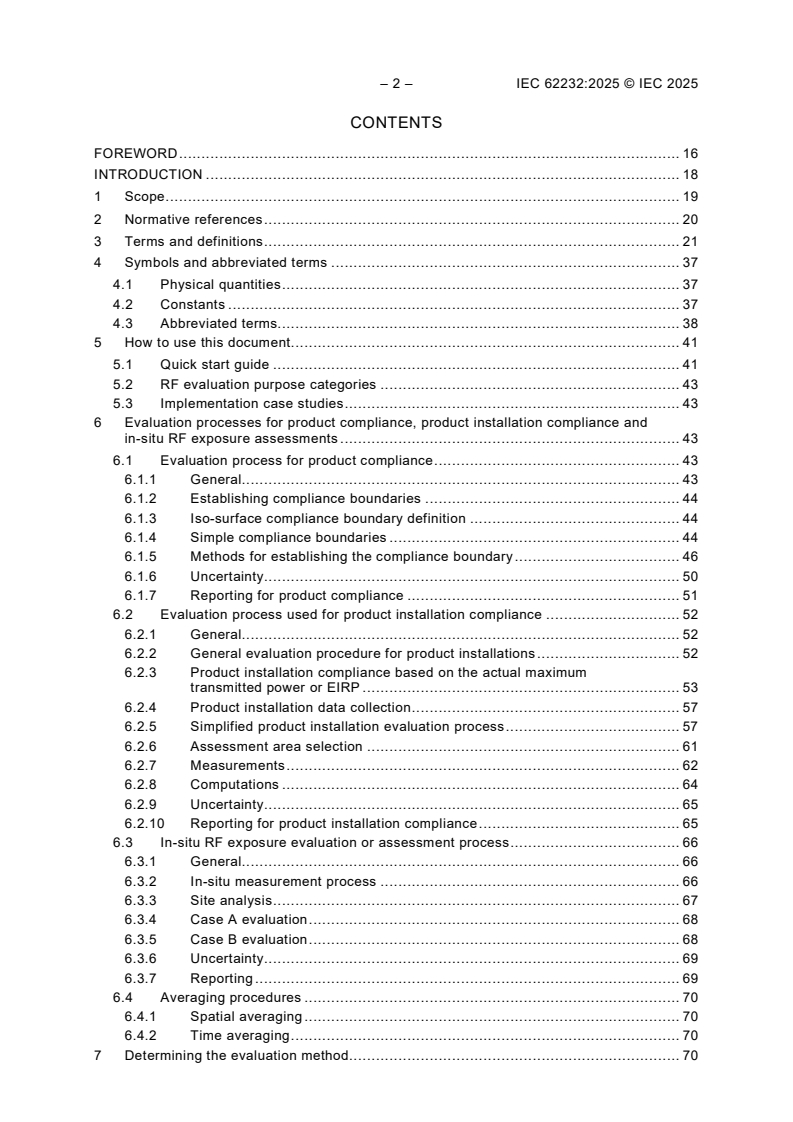
CONTENTS
FOREWORD . 16
INTRODUCTION . 18
1 Scope . 19
2 Normative references . 20
3 Terms and definitions . 21
4 Symbols and abbreviated terms . 37
4.1 Physical quantities . 37
4.2 Constants . 37
4.3 Abbreviated terms. 38
5 How to use this document . 41
5.1 Quick start guide . 41
5.2 RF evaluation purpose categories . 43
5.3 Implementation case studies . 43
6 Evaluation processes for product compliance, product installation compliance and
in-situ RF exposure assessments . 43
6.1 Evaluation process for product compliance . 43
6.1.1 General. 43
6.1.2 Establishing compliance boundaries . 44
6.1.3 Iso-surface compliance boundary definition . 44
6.1.4 Simple compliance boundaries . 44
6.1.5 Methods for establishing the compliance boundary . 46
6.1.6 Uncertainty . 50
6.1.7 Reporting for product compliance . 51
6.2 Evaluation process used for product installation compliance . 52
6.2.1 General. 52
6.2.2 General evaluation procedure for product installations . 52
6.2.3 Product installation compliance based on the actual maximum
transmitted power or EIRP . 53
6.2.4 Product installation data collection . 57
6.2.5 Simplified product installation evaluation process . 57
6.2.6 Assessment area selection . 61
6.2.7 Measurements . 62
6.2.8 Computations . 64
6.2.9 Uncertainty . 65
6.2.10 Reporting for product installation compliance . 65
6.3 In-situ RF exposure evaluation or assessment process . 66
6.3.1 General. 66
6.3.2 In-situ measurement process . 66
6.3.3 Site analysis . 67
6.3.4 Case A evaluation . 68
6.3.5 Case B evaluation . 68
6.3.6 Uncertainty . 69
6.3.7 Reporting . 69
6.4 Averaging procedures . 70
6.4.1 Spatial averaging . 70
6.4.2 Time averaging . 70
7 Determining the evaluation method . 70
7.1 Overview . 70
7.2 Process to determine the evaluation method . 70
7.2.1 General. 70
7.2.2 Establishing the evaluation points in relation to the source-environment
plane . 71
7.2.3 Exposure metric selection . 73
8 Evaluation methods . 74
8.1 General . 74
8.2 Measurement methods . 74
8.2.1 General. 74
8.2.2 RF field strength and power density measurements . 75
8.2.3 SAR measurements . 76
8.3 Computation methods . 76
8.4 Methods for assessment based on actual maximum approach . 78
8.4.1 General requirements . 78
8.4.2 Actual transmitted power or EIRP monitoring . 79
8.4.3 Actual transmitted power or EIRP control . 79
8.5 Methods for the assessment of RF exposure to multiple sources . 80
8.6 Methods for establishing the BS transmitted power or EIRP . 82
9 Uncertainty . 82
10 Reporting . 83
10.1 General requirements. 83
10.2 Report format . 83
10.3 Opinions and interpretations . 84
Annex A (informative) Source-environment plane and guidance on the evaluation
method selection . 85
A.1 Guidance on the source-environment plane . 85
A.1.1 General. 85
A.1.2 Source-environment plane example . 85
A.1.3 Source regions . 86
A.2 Select between computation or measurement approaches . 92
A.3 Select measurement method . 93
A.3.1 Selection stages . 93
A.3.2 Selecting between RF field strength, power density and SAR
measurement approaches . 93
A.3.3 Selecting between broadband and frequency selective measurement . 94
A.3.4 Selecting RF field strength measurement procedures . 95
A.4 Select computation method . 96
A.5 Additional considerations . 97
A.5.1 Simplicity . 97
A.5.2 Evaluation method ranking . 97
A.5.3 Applying multiple methods for RF exposure evaluation . 97
Annex B (normative) Evaluation methods . 98
B.1 Overview . 98
B.2 General . 98
B.2.1 Coordinate systems and reference points . 98
B.2.2 Variables . 99
B.3 RF exposure evaluation principles . 100
B.3.1 Simple calculation of RF field strength and power density . 100
– 4 – IEC 62232:2025 © IEC 2025
B.3.2 Measurement of RF field strength and power density . 104
B.3.3 Spatial averaging . 106
B.3.4 Time averaging . 109
B.3.5 Comparing measured and computed values . 111
B.3.6 Personal RF monitors . 111
B.4 RF field strength and power density measurements . 111
B.4.1 Applicability of RF field strength and power density measurements . 111
B.4.2 In-situ RF exposure measurements . 111
B.4.3 Laboratory based RF field strength and power density measurements . 123
B.4.4 RF field strength and power density measurement uncertainty . 133
B.5 SAR measurements . 138
B.5.1 Overview of SAR measurements . 138
B.5.2 SAR measurement requirements . 138
B.5.3 SAR measurement description . 140
B.5.4 SAR measurement uncertainty . 146
B.6 Basic computation methods . 148
B.6.1 General. 148
B.6.2 Basic computation formulas for RF field strength or power density
evaluation . 149
B.6.3 Basic wbSAR and psSAR evaluation formulas. 155
B.6.4 Basic compliance boundary assessment method for BS using parabolic
dish antennas . 162
B.6.5 Basic compliance boundary assessment method for intentionally
radiating cables . 165
B.7 Advanced computation methods . 166
B.7.1 General. 166
B.7.2 Synthetic model and ray tracing algorithms . 166
B.7.3 Full wave RF exposure computation. 173
B.7.4 Full wave SAR computation . 182
B.8 Extrapolation from the evaluated values to the maximum or actual values . 187
B.8.1 Extrapolation method . 187
B.8.2 Extrapolation to maximum in-situ RF field strength or power density
using broadband measurements . 189
B.8.3 Extrapolation to maximum in-situ RF field strength / power density using
frequency or code selective measurements . 189
B.8.4 Influence of traffic in real operating network . 190
B.8.5 Extrapolation for massive MIMO and beamforming BS . 191
B.8.6 Maximum exposure extrapolation with dynamic spectrum sharing (DSS) . 193
B.9 Guidance for implementing the actual maximum approach . 194
B.9.1 BS actual EIRP evaluation assumptions . 194
B.9.2 Technology duty-cycle factor description . 195
B.9.3 CDF evaluation using modelling studies . 197
B.9.4 CDF evaluation using measurement studies on operational BS sites . 198
B.9.5 Actual transmitted power or EIRP monitoring counters . 200
B.9.6 Configurations with multiple transmitters . 200
B.10 Transmitted power or EIRP evaluation . 202
B.10.1 General. 202
B.10.2 Measurement of the transmitted power in conducted mode . 202
B.10.3 Measurement of the transmitted power in OTA conditions . 203
B.10.4 Measurement of the EIRP in OTA and laboratory conditions . 203
B.10.5 Measurement of the EIRP in OTA and in-situ conditions . 204
Annex C (informative) Guidelines for the validation of power or EIRP control features
and monitoring counter(s) related to the actual maximum approach . 205
C.1 Overview . 205
C.2 Guidelines for validating control feature(s) and monitoring counters . 205
C.3 Validation of power or EIRP monitoring counter in laboratory conditions . 206
C.3.1 Validation of power or EIRP monitoring counter in conducted mode –
test procedure . 206
C.3.2 Validation of power or EIRP monitoring counter in OTA mode – test
procedure . 208
C.3.3 Validation of control feature(s) in laboratory conditions . 211
C.3.4 Validation of control features using in-situ measurements . 214
C.4 Validation test report . 216
C.5 Case studies . 217
C.5.1 Case study A – In-situ validation. 217
C.5.2 Case study B – In-situ validation. 221
C.5.3 Case study C – In-situ validation . 224
Annex D (informative) Rationale supporting simplified product installation criteria . 230
D.1 General . 230
D.2 Class E2 . 230
D.3 Class E10 . 231
D.4 Class E100 . 232
D.5 Class E+ . 234
D.6 Simplified formulas for millimetre-wave antennas using massive MIMO or
beam steering . 235
Annex E (informative) Technology-specific exposure evaluation guidance . 237
E.1 Overview to guidance on specific technologies . 237
E.2 Summary of technology-specific information . 237
E.3 Guidance on spectrum analyser settings . 238
E.3.1 Overview of spectrum analyser settings. 238
E.3.2 Detection algorithms . 239
E.3.3 Resolution bandwidth and channel power processing . 239
E.3.4 Integration per service . 242
E.4 Stable transmitted power signals . 242
E.4.1 TDMA/FDMA technology . 242
E.4.2 WCDMA/UMTS technology . 243
E.4.3 OFDM technology . 244
E.5 WCDMA measurement and calibration using a code domain analyser . 244
E.5.1 WCDMA measurements – General . 244
E.5.2 WCDMA decoder characteristics. 244
E.5.3 Calibration . 245
E.6 Wi-Fi measurements . 247
E.6.1 General. 247
E.6.2 Integration time for reproducible measurements . 248
E.6.3 Channel occupation. 248
E.6.4 Some considerations . 249
E.6.5 Measurement configuration and steps . 249
E.6.6 Influence of the application layers . 250
E.6.7 Power control . 250
– 6 – IEC 62232:2025 © IEC 2025
E.7 LTE measurements . 251
E.7.1 Overview . 251
E.7.2 LTE transmission modes . 251
E.7.3 LTE-FDD frame structure . 252
E.7.4 LTE-TDD frame structure . 253
E.7.5 Maximum LTE exposure evaluation . 255
E.7.6 Instantaneous LTE exposure evaluation . 260
E.7.7 MIMO multiplexing of LTE BS . 260
E.8 NR BS measurements . 261
E.8.1 General. 261
E.8.2 Maximum NR exposure evaluation . 261
E.9 Establishing compliance boundaries using numerical simulations of MIMO
array antennas emitting correlated waveforms . 270
E.9.1 General. 270
E.9.2 Field combining near base stations for correlated exposure with the
purpose of establishing compliance boundaries . 271
E.9.3 Numerical simulations of MIMO array antennas with densely packed
columns . 272
E.9.4 Numerical simulations of large MIMO array antennas . 272
E.10 Massive MIMO antennas . 273
E.10.1 Overview . 273
E.10.2 Deterministic conservative approach . 273
E.10.3 Statistical conservative approach. 273
E.10.4 Example approaches . 274
Annex F (informative) Guidelines for the assessment of BS compliance with ICNIRP-
2020 brief exposure limits . 291
F.1 General . 291
F.2 Brief exposure limits . 291
F.3 Implications of brief exposure limits on signal modulation and TDD duty
cycle . 293
F.4 Implications of brief exposure limits on the actual maximum approach . 293
Annex G (informative) Uncertainty . 298
G.1 Background . 298
G.2 Requirement to estimate uncertainty . 298
G.3 How to estimate uncertainty . 299
G.4 Guidance on uncertainty and assessment schemes . 299
G.4.1 General. 299
G.4.2 Overview of assessment schemes . 299
G.4.3 Examples of assessment schemes . 300
G.4.4 Assessment schemes and compliance probabilities . 303
G.5 Guidance on uncertainty . 305
G.5.1 Overview . 305
G.5.2 Measurement uncertainty and confidence levels . 306
G.6 Applying uncertainty for compliance assessments . 307
G.7 Example influence quantities for field measurements . 308
G.7.1 General. 308
G.7.2 Calibration uncertainty of measurement antenna or field probe . 308
G.7.3 Frequency response of the measurement antenna or field probe . 308
G.7.4 Isotropy of the measurement antenna or field probe . 310
G.7.5 Frequency response of the spectrum analyser . 310
G.7.6 Temperature response of a broadband field probe . 310
G.7.7 Linearity deviation of a broadband field probe . 311
G.7.8 Mismatch uncertainty . 311
G.7.9 Deviation of the experimental source from numerical source. 311
G.7.10 Meter fluctuation uncertainty for time-varying signals . 311
G.7.11 Uncertainty due to power variation in the RF source . 312
G.7.12 Uncertainty due to field gradients . 312
G.7.13 Mutual coupling between measurement antenna or isotropic probe and
object . 313
G.7.14 Uncertainty due to field scattering from the surveyor’s body . 314
G.7.15 Measurement device . 316
G.7.16 Fields out of measurement range . 316
G.7.17 Noise . 317
G.7.18 Integration time. 317
G.7.19 Power chain . 317
G.7.20 Positioning system . 317
G.7.21 Matching between probe and the EUT . 317
G.7.22 Drifts in output power of the EUT, probe, temperature, and humidity . 317
G.7.23 Perturbation by the environment . 317
G.8 Example influence quantities for RF field strength computations by ray
tracing or full wave methods . 318
G.8.1 General. 318
G.8.2 System . 318
G.8.3 Technique uncertainties . 319
G.8.4 Environmental uncertainties . 319
G.9 Influence quantities for SAR measurements . 320
G.9.1 General. 320
G.9.2 Post-processing . 320
G.9.3 EUT holder . 320
G.9.4 EUT positioning . 321
G.9.5 Phantom shell uncertainty . 322
G.9.6 SAR correction depending on target liquid permittivity and conductivity . 322
G.9.7 Liquid permittivity and conductivity measurements . 323
G.9.8 Liquid temperature . 323
G.10 Influence quantities for SAR calculations. 323
G.11 Spatial averaging . 323
G.11.1 General. 323
G.11.2 Small-scale fading variations . 324
G.11.3 Error on the estimation of local average power density . 324
G.11.4 Characterization of environment statistical properties . 325
G.11.5 Characterization of different spatial averaging schemes . 326
G.12 Influence of human body on measurements of the electric RF field strength . 330
G.12.1 Simulations of the influence of human body on measurements based on
the method of moments (surface equivalence principle) . 330
G.12.2 Comparison with measurements . 332
G.12.3 Conclusions . 333
Annex H (informative) Guidance on comparing evaluated parameters with a limit
value . 334
H.1 Overview . 334
H.2 Information recommended to compare evaluated value against limit value . 334
– 8 – IEC 62232:2025 © IEC 2025
H.3 Performing a limit comparison at a given confidence level . 334
H.4 Performing a limit comparison using a process-based assessment scheme . 335
Bibliography . 336
Figure 1 – Quick start guide to the evaluation process. 41
Figure 2 – Example of iso-surface compliance boundary. 44
Figure 3 – Example of cylindrical and half-pipe compliance boundaries . 45
Figure 4 – Example of box shaped compliance boundary . 46
Figure 5 – Example of truncated box shaped compliance boundary . 46
Figure 6 – Example illustrating the linear scaling procedure . 47
Figure 7 – Example of massive MIMO antenna and corresponding beams and envelope
patterns . 49
Figure 8 – Example of compliance boundary shape for BS antennas with beam
steering . 50
Figure 9 – Example of dish antenna compliance boundary . 50
Figure 10 – Flowchart describing the product installation evaluation process . 53
Figure 11 – Example of a CDF curve representing the normalized actual transmitted
power or EIRP. 55
Figure 12 – Flow chart for product installation compliance based on the actual
maximum transmitted power or EIRP threshold(s) . 56
Figure 13 – Simplified compliance assessment process using installation classes . 58
Figure 14 – Example of DI within a square-shaped assessment domain boundary
(ADB) with dimension L . 62
ADB
Figure 15 – In-situ RF exposure evaluation or assessment process flow chart . 67
Figure 16 – Source-environment plane concept . 72
Figure 17 – Flow chart of the measurement methods. 75
Figure 18 – Flow chart of the relevant computation methods . 77
Figure 19 – Example of segments used for monitoring and control of BS using mMIMO
or beam steering . 79
Figure A.1 – Example source-environment plane regions near a base station antenna
on a tower . 85
Figure A.2 – Example source-environment plane regions near a roof-top antenna that
has a narrow vertical (elevation plane) beamwidth (not to scale) . 86
Figure A.3 – Geometry of an antenna with largest linear dimension L and largest
eff
end dimension L . 87
end
Figure A.4 – Maximum path difference for an antenna with largest linear dimension L . 91
Figure B.1 – Cartesian, cylindrical and spherical coordinate systems relative to the BS
antenna (view from the rear panel) . 99
Figure B.2 – Typical RF exposure assessment case . 101
Figure B.3 – Reflection due to the presence of a ground plane . 102
Figure B.4 – Reflections due to the presence of internal walls of the housing and
surrounding asphalt and soil configuring a base station installed underground . 103
Figure B.5 – General representation of RF field strength or power density
measurements . 104
Figure B.6 – Practical examples of measurement equipment installation . 105
Figure B.7 – Spatial averaging schemes relative to walking or standing surface and in
the vertical plane oriented to offer maximum area in the direction of the source being
evaluated . 107
Figure B.8 – Spatial averaging relative to spatial-peak field strength point height . 109
Figure B.9 – Evaluation points . 121
Figure B.10 – Relationship of separation of remote radio source and evaluation area to
separation of evaluation points . 122
Figure B.11 – Outline of the surface scanning methodology . 125
Figure B.12 – Block diagram of the antenna measurement system. 126
Figure B.13 – Minimum radius constraint, where a denotes the minimum radius of a
sphere, centred at the reference point, that encompasses the EUT . 127
Figure B.14 – Maximum angular sampling spacing constraint . 127
Figure B.15 – Outline of the volume/surface scanning methodology . 130
Figure B.16 – Block diagram of typical near-field EUT measurement system. 131
Figure B.17 – Examples of positioning of the EUT relative to the relevant phantom . 138
Figure B.18 – Phantom liquid volume and measurement volume used for wbSAR
measurements with the box-shaped phantoms. 145
Figure B.19 – Reference frame employed for cylindrical formulas for RF field strength
computation at a point P (left), and on a line perpendicular to boresight (right) . 149
Figure B.20 – Views illustrating the three valid zones for field strength computation
around an antenna . 151
Figure B.21 – Enclosed cylinder around collinear array antennas, with and without
electrical downtilt. 152
Figure B.22 – Spherical formulas reference results . 155
Figure B.23 – Cylindrical formulas reference results .
...